Balancing Commercial Pressure
    with Pedagogic Needs
          John Gordon
          Opuslearning
Commercial Pressure
• More with less
• Fixed overheads, and reducing funding
• Increased tech competence in learners
• Increases in expectation for content
  consumption
• The rise of the immediate satisfaction
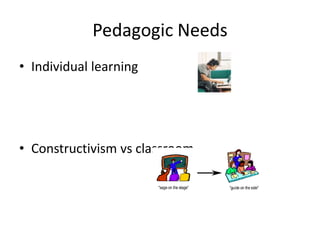
Pedagogic Needs
• Individual learning


• Constructivism vs classroom
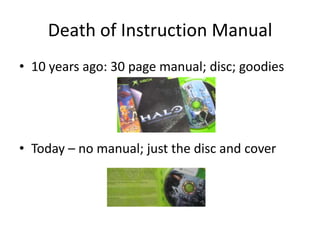
Death of Instruction Manual
• 10 years ago: 30 page manual; disc; goodies


• Today – no manual; just the disc and cover
The Goal of eLearning
•   21st Century Pedagogy
•   Embedded in Learners Digital Life
•   Exploiting new media
•   Managing expectation
•   Keeping the students engaged
The problems
•   Design
•   Tools
•   People
•   Maintenance
•   ->>>>>>>COSTS
Solution 1
• Standardise and simplify pedagogy
• Reduce expectation of retention
• Go massive
  – Spend on marketing not content
  – Be didactic let students go hang
• Worry about monetising.
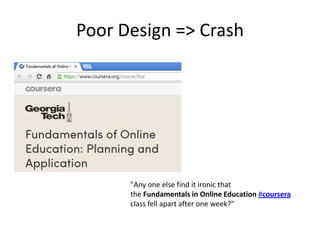
Poor Design => Crash


      "Any one else find it ironic that
      the Fundamentals in Online Education #coursera
      class fell apart after one week?"
Solution 2
•   Standardise and simplify
•   Invest and continually improve
•   Focus on support for learning
•   Improve retention
•   Manager learning and learners
The Opus Approach
• Solution 2, but recognising cost implications
  and technology developments
• Opus Learning provides online education, so
  the usual problems
  – Tracking learning
  – Authentication
  – Identifying problems in learning
  – Recognising need for intervention
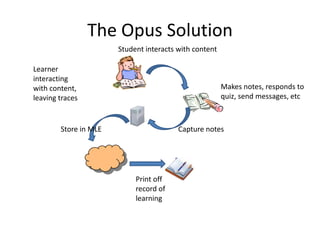
The Opus Solution
                       Student interacts with content

Learner
interacting
with content,                                           Makes notes, responds to
leaving traces                                          quiz, send messages, etc


        Store in MLE                     Capture notes


                            Print off
                            record of
                            learning
Opus e-Players
• Moodle
• E-reader
• PDF
• Tablet
• Phone
All the same/ All equivalent
The market
•   Home
•   College
•   Distance
•   Work
•   Blend
Case Studies
• The product
  – Set of Turnkey HNDs
  – Structure – Fixed Framework, no options
• Fixed Technology Moodle 2.3
• Standardised Quality Manual
• Standardises Training and Consultancy
Working with partners

Two models
1. UK centre with students abroad
2. Centre Abroad, with local and
   distance students
Model 1 Centre Abroad
Centre in South East Asia
• History as examination centre
• Part of network of 6th form schools
• No significant VET delivery
• No Accreditation by SQA
Proposal
• We proposed to do the following:
  – Carry out an Initial Investigation
  – Develop a roadmap, with our support
  – Deliver a Training Programme
  – Design the HND Programme
  – Support the acquisition of SQA accreditation
• Agreed September 2012
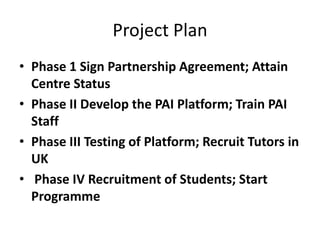
Project Plan
• Phase 1 Sign Partnership Agreement; Attain
  Centre Status
• Phase II Develop the PAI Platform; Train PAI
  Staff
• Phase III Testing of Platform; Recruit Tutors in
  UK
• Phase IV Recruitment of Students; Start
  Programme
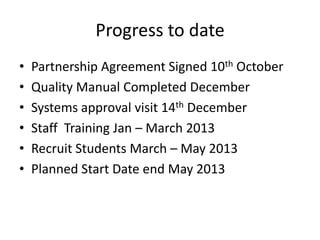
Progress to date
•   Partnership Agreement Signed 10th October
•   Quality Manual Completed December
•   Systems approval visit 14th December
•   Staff Training Jan – March 2013
•   Recruit Students March – May 2013
•   Planned Start Date end May 2013
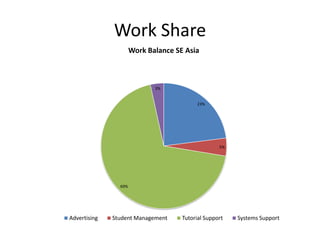
Work Share
                      Work Balance SE Asia


                             3%


                                          23%


                                                   5%


                69%


Advertising   Student Management     Tutorial Support   Systems Support
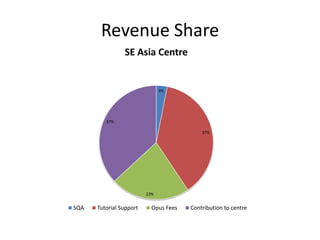
Revenue Share
                SE Asia Centre


                               3%


         37%

                                           37%


                         23%


SQA   Tutorial Support     Opus Fees   Contribution to centre
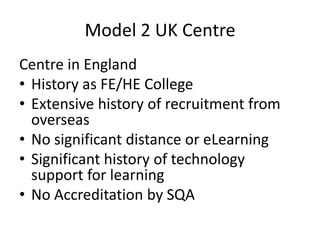
Model 2 UK Centre
Centre in England
• History as FE/HE College
• Extensive history of recruitment from
  overseas
• No significant distance or eLearning
• Significant history of technology
  support for learning
• No Accreditation by SQA
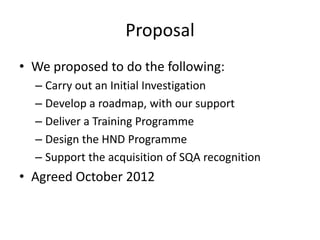
Proposal
• We proposed to do the following:
  – Carry out an Initial Investigation
  – Develop a roadmap, with our support
  – Deliver a Training Programme
  – Design the HND Programme
  – Support the acquisition of SQA recognition
• Agreed October 2012
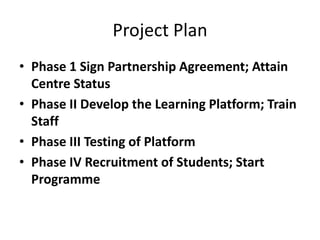
Project Plan
• Phase 1 Sign Partnership Agreement; Attain
  Centre Status
• Phase II Develop the Learning Platform; Train
  Staff
• Phase III Testing of Platform
• Phase IV Recruitment of Students; Start
  Programme
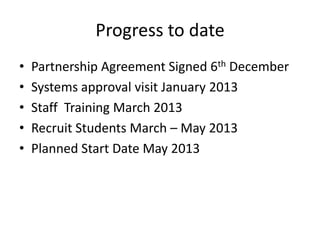
Progress to date
•   Partnership Agreement Signed 6th December
•   Systems approval visit January 2013
•   Staff Training March 2013
•   Recruit Students March – May 2013
•   Planned Start Date May 2013
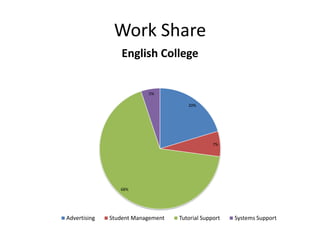
Work Share
                  English College


                          5%

                                      20%


                                                7%


                 68%


Advertising   Student Management   Tutorial Support   Systems Support
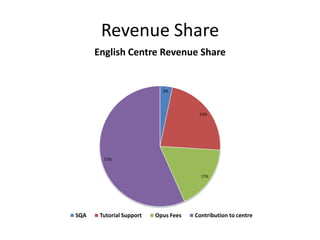
Revenue Share
      English Centre Revenue Share


                            3%


                                       23%


        57%


                                        17%


SQA    Tutorial Support   Opus Fees   Contribution to centre
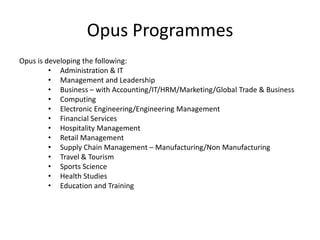
Opus Programmes
Opus is developing the following:
         • Administration & IT
         • Management and Leadership
         • Business – with Accounting/IT/HRM/Marketing/Global Trade & Business
         • Computing
         • Electronic Engineering/Engineering Management
         • Financial Services
         • Hospitality Management
         • Retail Management
         • Supply Chain Management – Manufacturing/Non Manufacturing
         • Travel & Tourism
         • Sports Science
         • Health Studies
         • Education and Training
Thank You
• John Gordon
• 07799895464
• jg@opuslearning.com

Balancing commercial pressure with pedagogic needs v2

  • 1.
    Balancing Commercial Pressure with Pedagogic Needs John Gordon Opuslearning
  • 2.
    Commercial Pressure • Morewith less • Fixed overheads, and reducing funding • Increased tech competence in learners • Increases in expectation for content consumption • The rise of the immediate satisfaction
  • 3.
    Pedagogic Needs • Individuallearning • Constructivism vs classroom
  • 4.
    Death of InstructionManual • 10 years ago: 30 page manual; disc; goodies • Today – no manual; just the disc and cover
  • 5.
    The Goal ofeLearning • 21st Century Pedagogy • Embedded in Learners Digital Life • Exploiting new media • Managing expectation • Keeping the students engaged
  • 6.
    The problems • Design • Tools • People • Maintenance • ->>>>>>>COSTS
  • 7.
    Solution 1 • Standardiseand simplify pedagogy • Reduce expectation of retention • Go massive – Spend on marketing not content – Be didactic let students go hang • Worry about monetising.
  • 8.
    Poor Design =>Crash "Any one else find it ironic that the Fundamentals in Online Education #coursera class fell apart after one week?"
  • 9.
    Solution 2 • Standardise and simplify • Invest and continually improve • Focus on support for learning • Improve retention • Manager learning and learners
  • 10.
    The Opus Approach •Solution 2, but recognising cost implications and technology developments • Opus Learning provides online education, so the usual problems – Tracking learning – Authentication – Identifying problems in learning – Recognising need for intervention
  • 11.
    The Opus Solution Student interacts with content Learner interacting with content, Makes notes, responds to leaving traces quiz, send messages, etc Store in MLE Capture notes Print off record of learning
  • 12.
    Opus e-Players • Moodle •E-reader • PDF • Tablet • Phone All the same/ All equivalent
  • 13.
    The market • Home • College • Distance • Work • Blend
  • 14.
    Case Studies • Theproduct – Set of Turnkey HNDs – Structure – Fixed Framework, no options • Fixed Technology Moodle 2.3 • Standardised Quality Manual • Standardises Training and Consultancy
  • 15.
    Working with partners Twomodels 1. UK centre with students abroad 2. Centre Abroad, with local and distance students
  • 16.
    Model 1 CentreAbroad Centre in South East Asia • History as examination centre • Part of network of 6th form schools • No significant VET delivery • No Accreditation by SQA
  • 17.
    Proposal • We proposedto do the following: – Carry out an Initial Investigation – Develop a roadmap, with our support – Deliver a Training Programme – Design the HND Programme – Support the acquisition of SQA accreditation • Agreed September 2012
  • 18.
    Project Plan • Phase1 Sign Partnership Agreement; Attain Centre Status • Phase II Develop the PAI Platform; Train PAI Staff • Phase III Testing of Platform; Recruit Tutors in UK • Phase IV Recruitment of Students; Start Programme
  • 19.
    Progress to date • Partnership Agreement Signed 10th October • Quality Manual Completed December • Systems approval visit 14th December • Staff Training Jan – March 2013 • Recruit Students March – May 2013 • Planned Start Date end May 2013
  • 20.
    Work Share Work Balance SE Asia 3% 23% 5% 69% Advertising Student Management Tutorial Support Systems Support
  • 21.
    Revenue Share SE Asia Centre 3% 37% 37% 23% SQA Tutorial Support Opus Fees Contribution to centre
  • 22.
    Model 2 UKCentre Centre in England • History as FE/HE College • Extensive history of recruitment from overseas • No significant distance or eLearning • Significant history of technology support for learning • No Accreditation by SQA
  • 23.
    Proposal • We proposedto do the following: – Carry out an Initial Investigation – Develop a roadmap, with our support – Deliver a Training Programme – Design the HND Programme – Support the acquisition of SQA recognition • Agreed October 2012
  • 24.
    Project Plan • Phase1 Sign Partnership Agreement; Attain Centre Status • Phase II Develop the Learning Platform; Train Staff • Phase III Testing of Platform • Phase IV Recruitment of Students; Start Programme
  • 25.
    Progress to date • Partnership Agreement Signed 6th December • Systems approval visit January 2013 • Staff Training March 2013 • Recruit Students March – May 2013 • Planned Start Date May 2013
  • 26.
    Work Share English College 5% 20% 7% 68% Advertising Student Management Tutorial Support Systems Support
  • 27.
    Revenue Share English Centre Revenue Share 3% 23% 57% 17% SQA Tutorial Support Opus Fees Contribution to centre
  • 28.
    Opus Programmes Opus isdeveloping the following: • Administration & IT • Management and Leadership • Business – with Accounting/IT/HRM/Marketing/Global Trade & Business • Computing • Electronic Engineering/Engineering Management • Financial Services • Hospitality Management • Retail Management • Supply Chain Management – Manufacturing/Non Manufacturing • Travel & Tourism • Sports Science • Health Studies • Education and Training
  • 29.
    Thank You • JohnGordon • 07799895464 • jg@opuslearning.com