Manifest Destiny & Its Legacy1841-1848The American PageantChapter 17
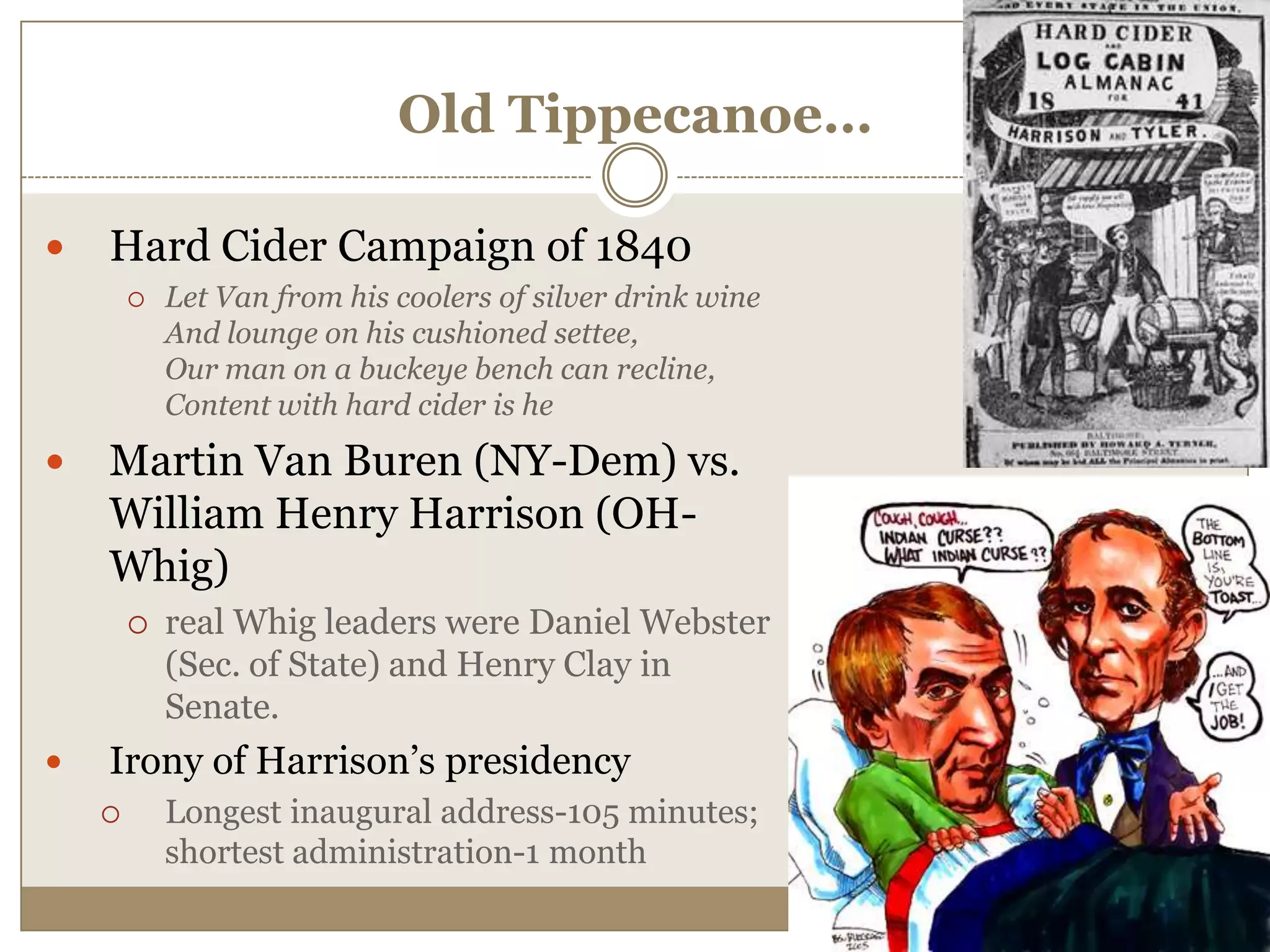
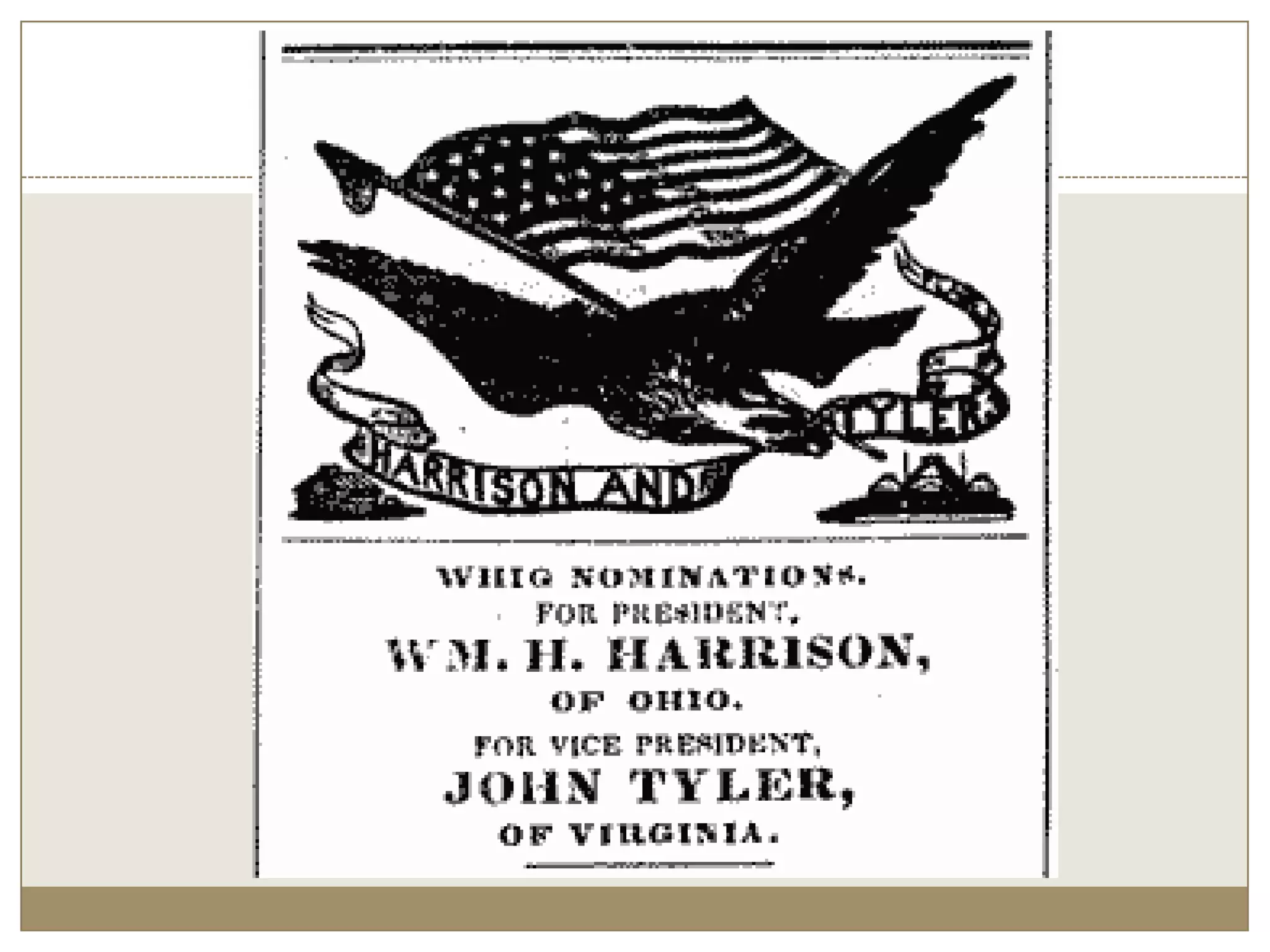
Old Tippecanoe…    Hard Cider Campaign of 1840Let Van from his coolers of silver drink wineAnd lounge on his cushioned settee,Our man on a buckeye bench can recline,Content with hard cider is he Martin Van Buren (NY-Dem) vs. William Henry Harrison (OH-Whig)real Whig leaders were Daniel Webster (Sec. of State) and Henry Clay in Senate.Irony of Harrison’s presidencyLongest inaugural address-105 minutes; shortest administration-1 month
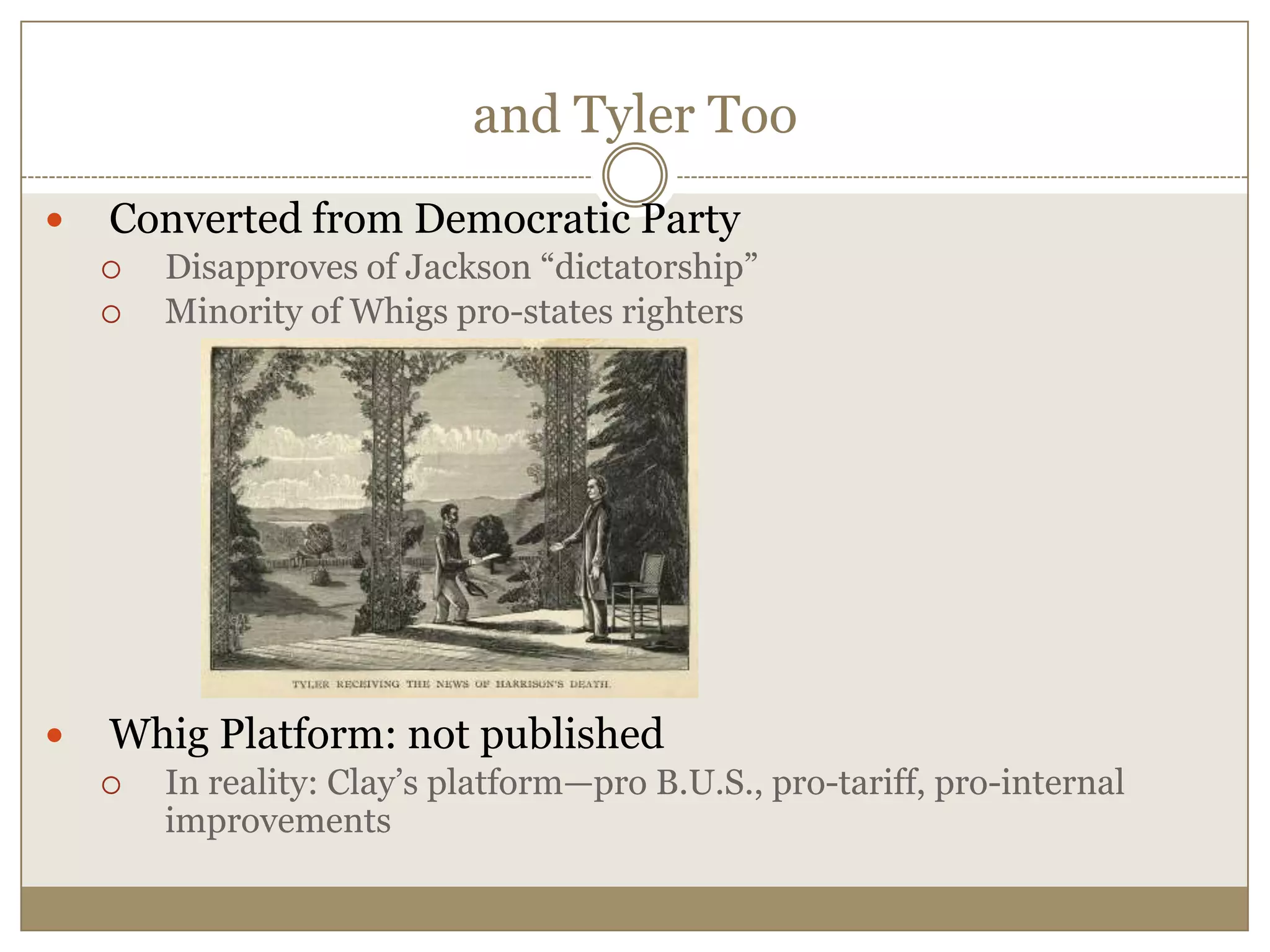
and Tyler TooConverted from Democratic PartyDisapproves of Jackson “dictatorship”Minority of Whigs pro-states rightersWhig Platform: not publishedIn reality: Clay’s platform—pro B.U.S., pro-tariff, pro-internal improvements
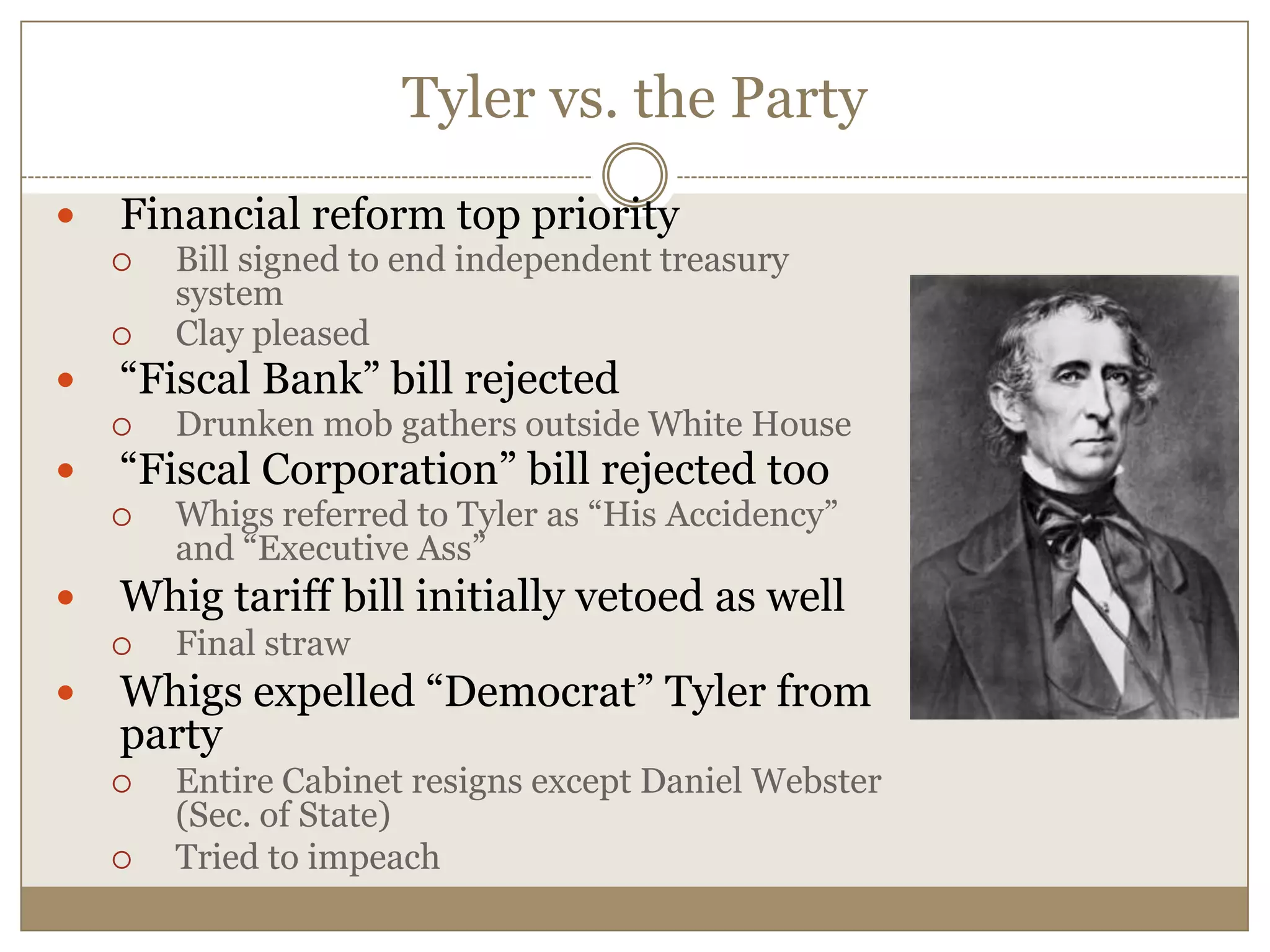
Tyler vs. the PartyFinancial reform top priorityBill signed to end independent treasury systemClay pleased“Fiscal Bank” bill rejectedDrunken mob gathers outside White House“Fiscal Corporation” bill rejected tooWhigs referred to Tyler as “His Accidency” and “Executive Ass”Whig tariff bill initially vetoed as wellFinal strawWhigs expelled “Democrat” Tyler from partyEntire Cabinet resigns except Daniel Webster (Sec. of State) Tried to impeach
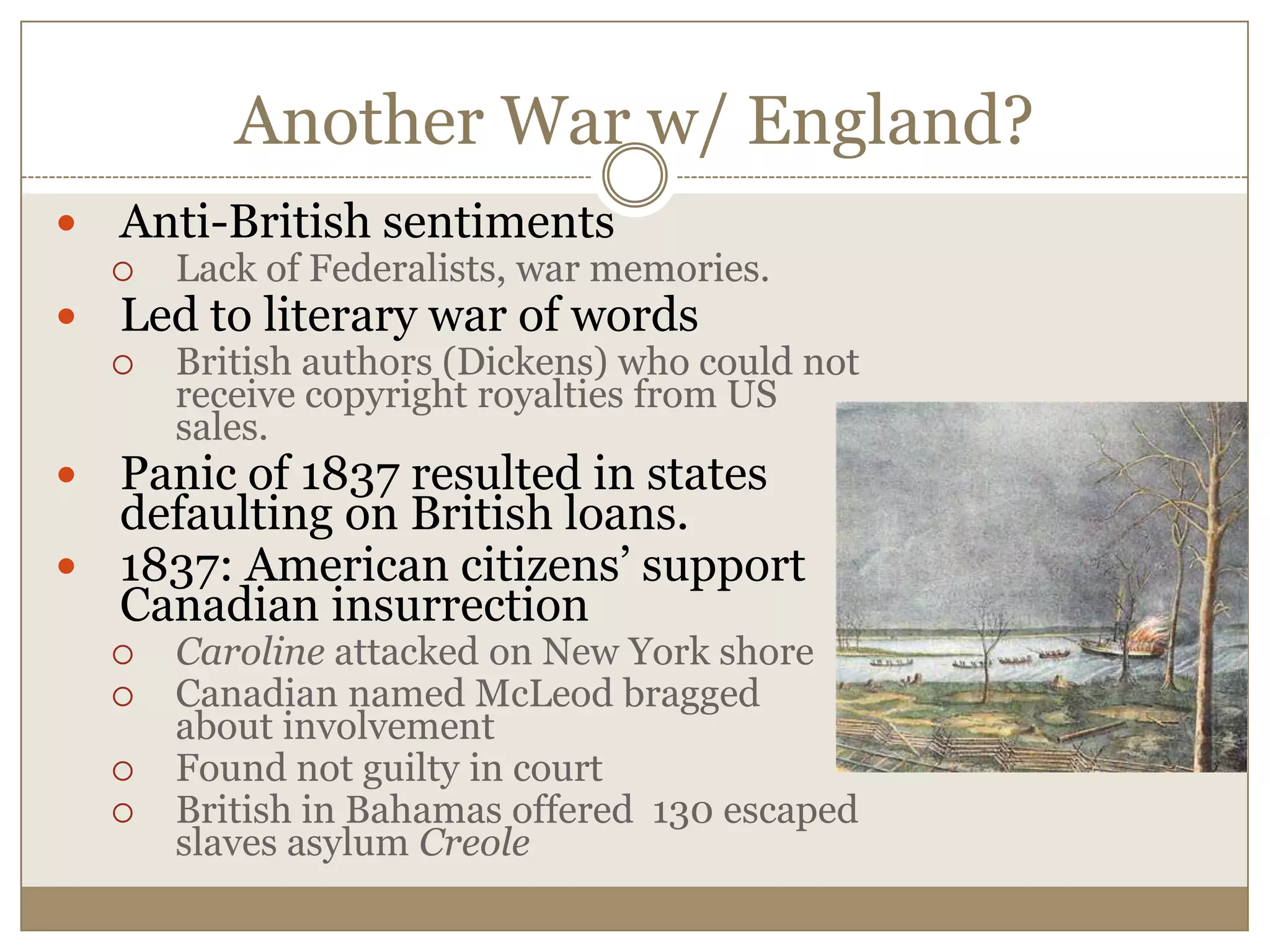
Another War w/ England?Anti-British sentiments Lack of Federalists, war memories.Led to literary war of wordsBritish authors (Dickens) who could not receive copyright royalties from US sales.Panic of 1837 resulted in states defaulting on British loans.1837: American citizens’ support Canadian insurrection Caroline attacked on New York shoreCanadian named McLeod bragged about involvementFound not guilty in courtBritish in Bahamas offered  130 escaped slaves asylum Creole
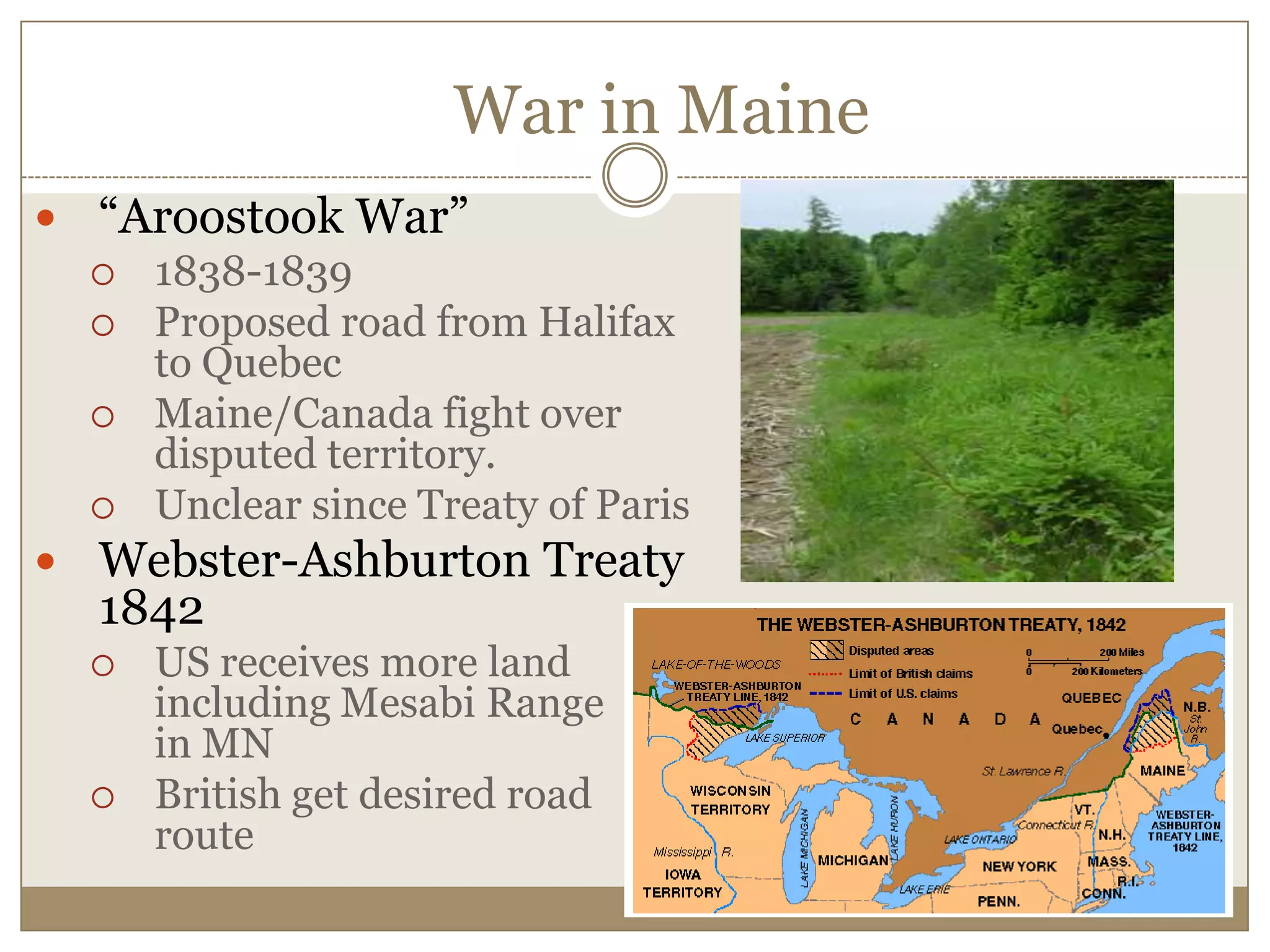
War in Maine“Aroostook War”1838-1839Proposed road from Halifax to QuebecMaine/Canada fight over disputed territory.Unclear since Treaty of ParisWebster-Ashburton Treaty 1842 US receives more land including Mesabi Range      in MNBritish get desired road route
Texas Shines Alone1836 Texas Independent of Mexico.Lone Star Republic-province in revolt?Constant fear of Mexican attackLarge MilitaryTreaties with France, Holland, and BelgiumBritish interests in using TX Check US expansion into SWWanted TX for cotton.British abolitionists wanted to use Texas as  base to attack slavery in SouthUS afraid of foreign powers (FR) using British & TX vs. US conflict to violate Monroe Doctrine
Texas Issue RaisedDue to fears, TX became campaign issue in 1844.Pro expansion Polk (D) defeated Clay (W)Lame Duck Tyler interpreted as mandate to acquire Texas.“Conscience” Whigs opposed of expansion due to slavery issue1845: Texas annexed by joint resolution instead of treatyInvited to become 28th stateMexico angered.
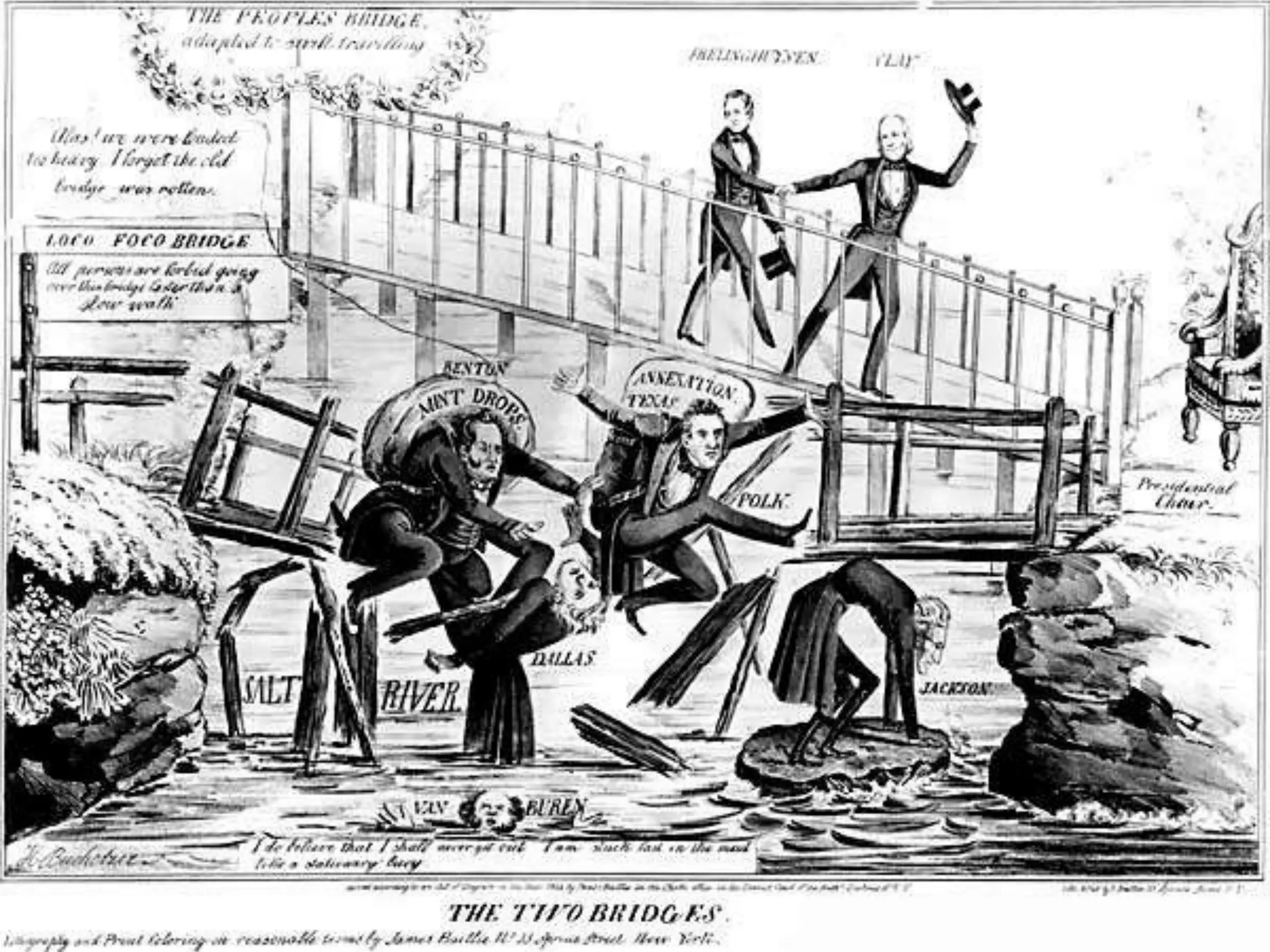
Manifest Destiny1844 Election: Whigs chose Clay, expansionists in Democratic Party engineered nomination of Polk1st “dark horse” candidatePolk: Speaker of House, Governor of TN, backed by Jackson.“Manifest Destiny” was campaign issueDemocrats called for annexation of Texas and all of Oregon.Whigs responded by tying Polk to slavery and Clay to liberty.Clay hurt by straddling fence on Texas.Lost New York by 5,000 votesAntislavery Liberty Party won 16,000 votes!
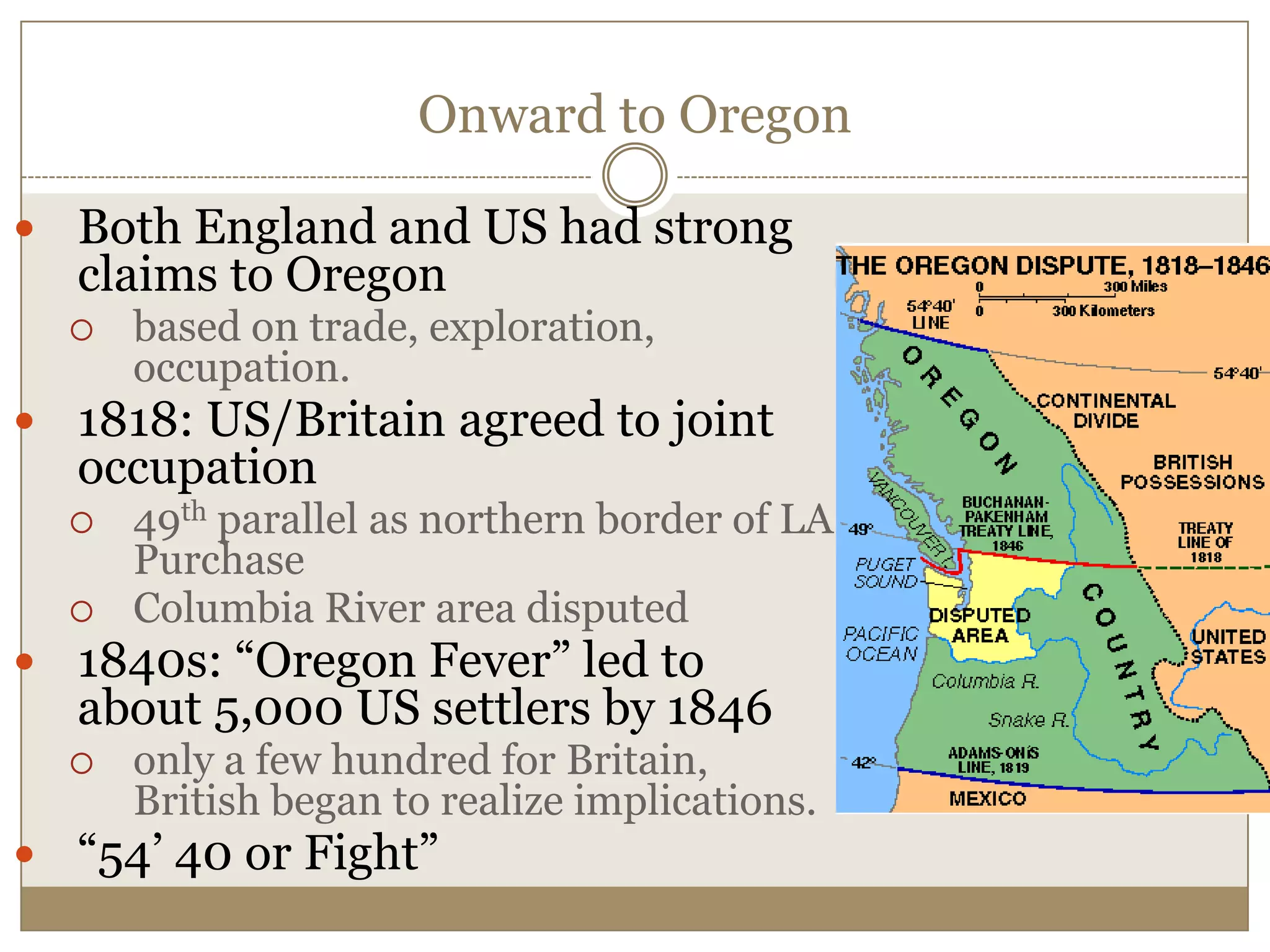
Onward to OregonBoth England and US had strong claims to Oregonbased on trade, exploration, occupation.1818: US/Britain agreed to joint occupation49th parallel as northern border of LA PurchaseColumbia River area disputed1840s: “Oregon Fever” led to about 5,000 US settlers by 1846only a few hundred for Britain, British began to realize implications.“54’ 40 or Fight”
Young HickoryPolk develops 4-point program, achieved in under 4 years.1st point: lowered tariff.  Treasury Sec. Walker lobbied Congress for Walker Tariff of 1846.  Reduced rates (32% to 25%), but yet gave good revenue b/c strong economy.2nd point: Independent Treasury restored;  Achieved in 1846.3rd point: Acquire California.4th point: Acquire Oregon.  Polk again proposed 49º, British first said no, but realized Columbia R. not that valuable, area was “furred out.”
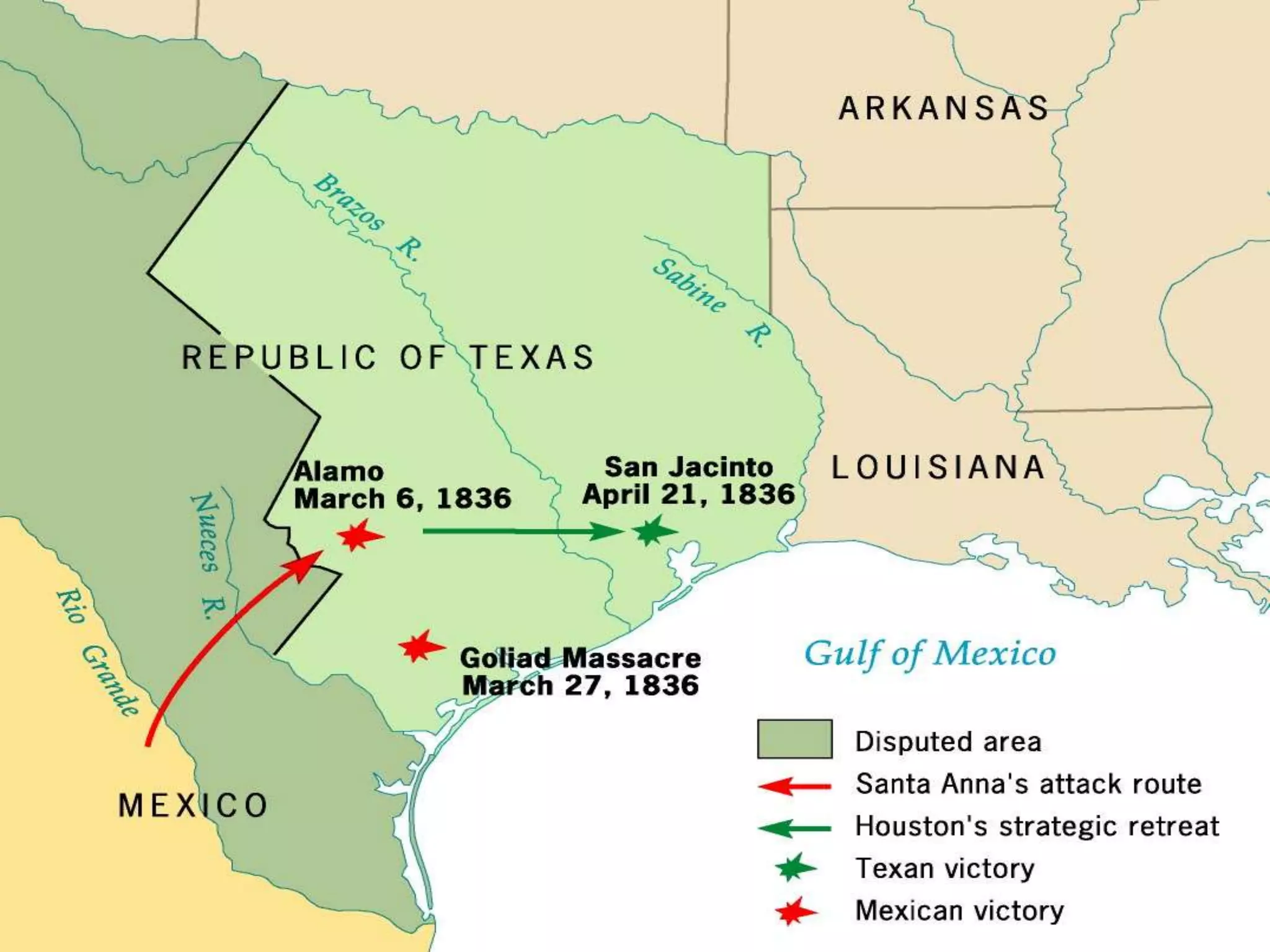
Misunderstandings w/ MexicoPolk & others felt Manifest Destiny included California.1845:  CA population mostly Indians and Spanish-Mexicans, less than 1,000 Americans.Polk wanted to buy California, but Mexico upset by damage claims in Texas.Texas dispute heightened by boundary dispute: Nueces River or Rio Grande?  Polk kept US troops out of disputed area.Polk thought British might buy it, sent minister (John Slidell)to Mexico City to purchaseMexico refused to even hear offer.
American Blood on American Soil Jan. 1846, Polk ordered Gen. Zachary Taylor to move from Nueces River to Rio Grandedid not provoke Mexican army initially.April/May, impatient Polk moved to declare warbut his plan worked – Mexico started shooting, 16 US killed.Polk declared shedding of “American blood on American soil,” Congress voted for war.Congressman Abraham Lincoln suspicious, introduces “spot” resolutions to get info about location of attacks.  Damaged Polk’s reputationPolk provoked war to grab California, protect from British.Southwestern expansionist also wanted war against Mexico.
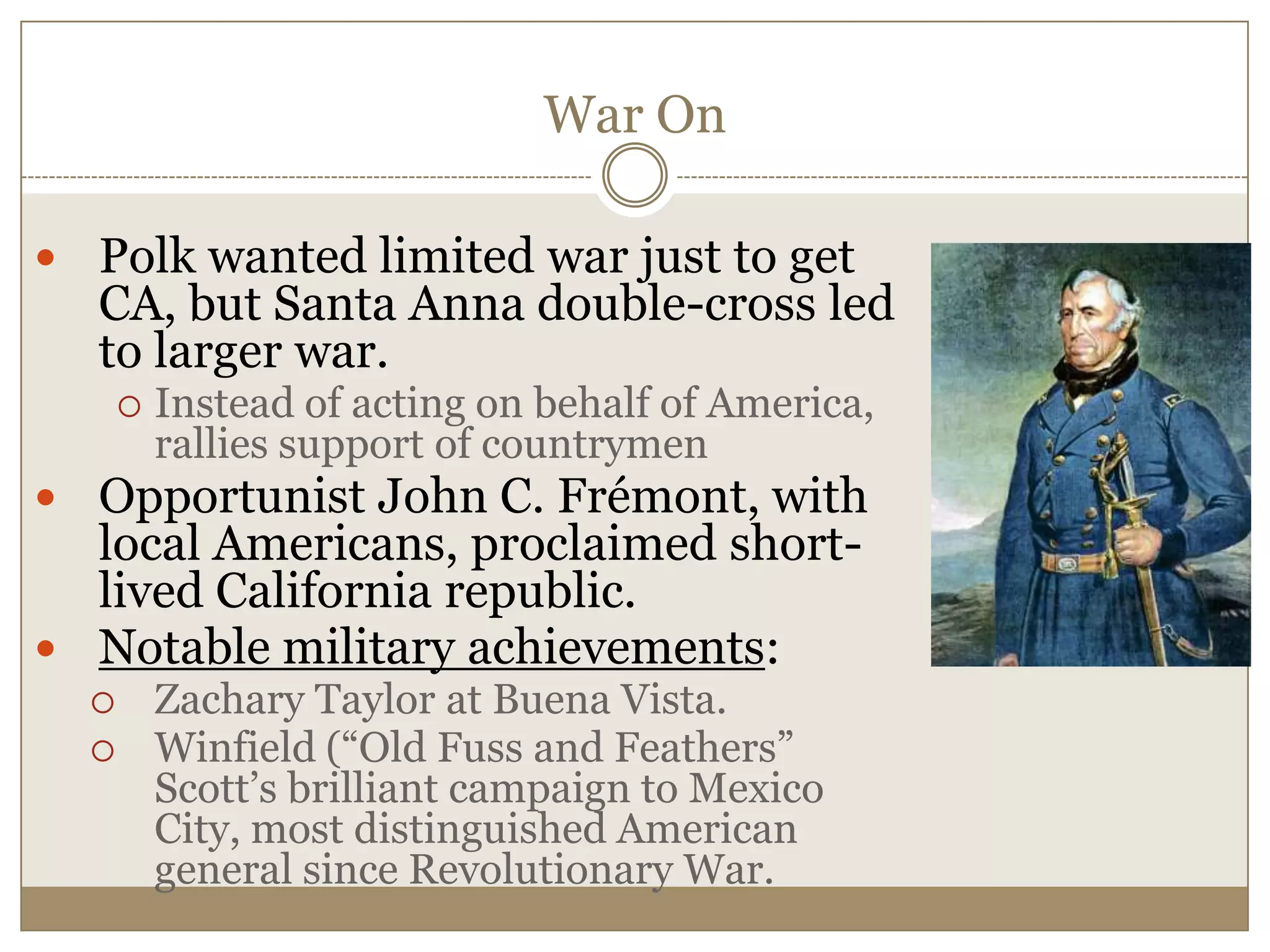
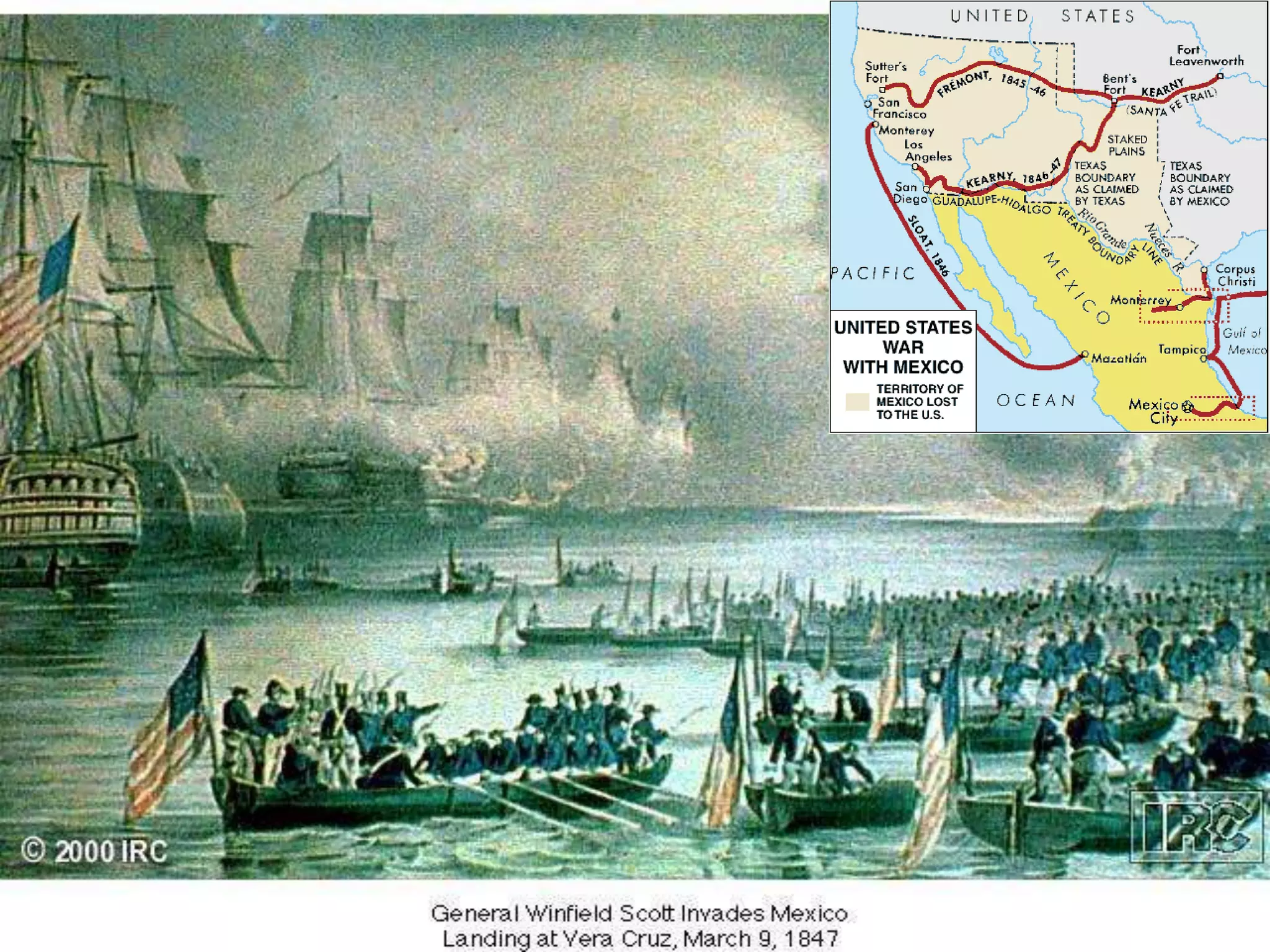
War OnPolk wanted limited war just to get CA, but Santa Anna double-cross led to larger war.Instead of acting on behalf of America, rallies support of countrymenOpportunist John C. Frémont, with local Americans, proclaimed short-lived California republic.Notable military achievements:Zachary Taylor at Buena Vista.Winfield (“Old Fuss and Feathers” Scott’s brilliant campaign to Mexico City, most distinguished American general since Revolutionary War.
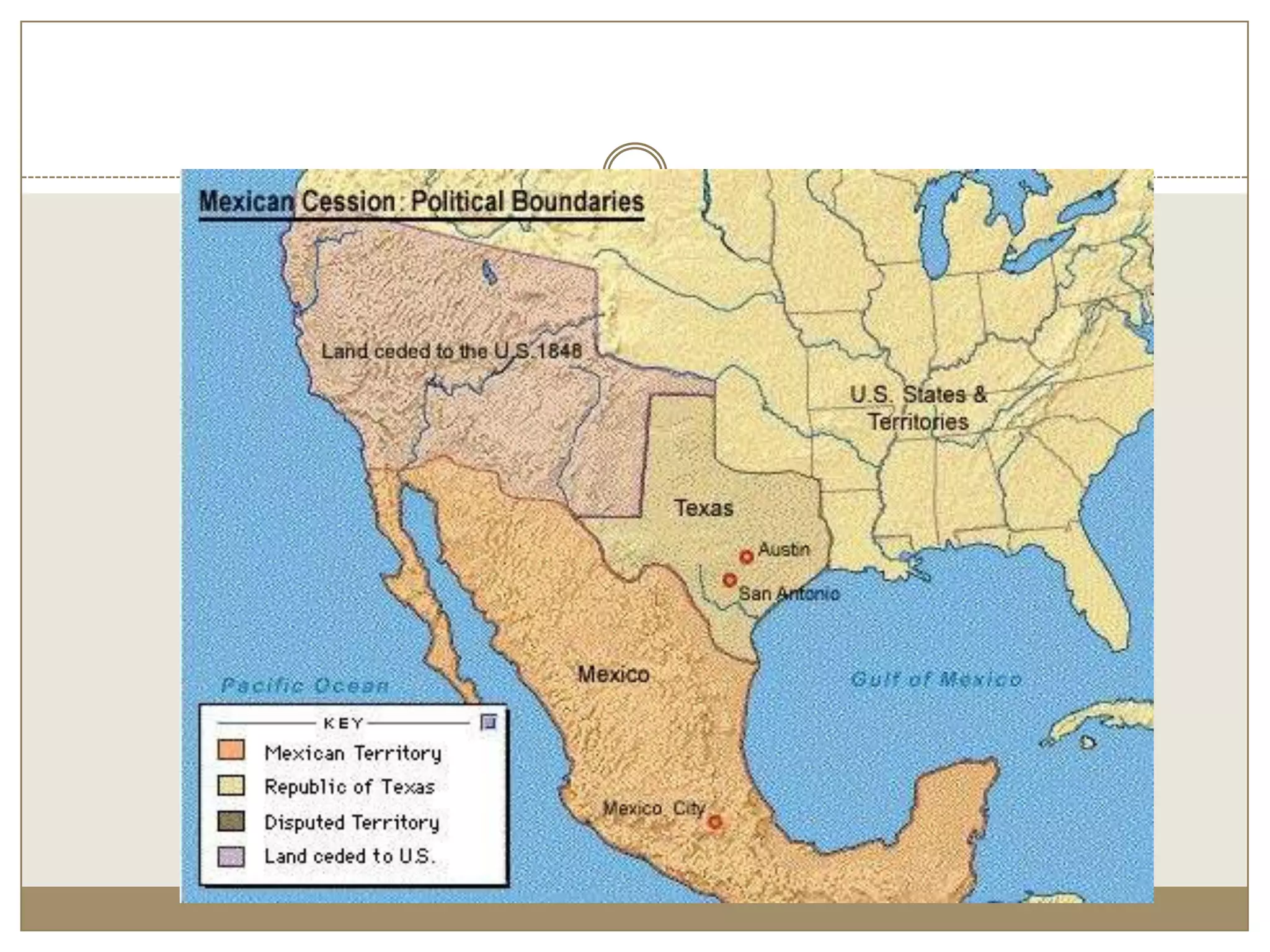
Seeking PeacePolk’s rep. Trist, embarrassed by Santa Anna, finally negotiates Treaty of Guadalupe Hidalgo.Terms: (1) US gets all land between Texas and Oregon, incl. California.Terms: (2) US pays $15M for land, and agrees to pay damage claims against Mexico ($3.25M).Two problems with ratification:1) “Conscience Whigs” got control of House in 1847, threatened to not fund the war.(2) Manifest Destiny expansionists were calling for all of Mexico.Critics suggest $18.25M was for guilty conscience, but need for haste was likely motivator.
Profit and Loss in MexicoWar cost 13,000 US livesmost from disease (fairly cheap).Enormous gains: US territory increased by 1/3larger than LA Purchase.Military success impressed British/foreign critics.After war, Latin America feared US, condemned greed.Heightened slavery tension

Baileychap17

  • 1.
    Manifest Destiny &Its Legacy1841-1848The American PageantChapter 17
  • 2.
    Old Tippecanoe… Hard Cider Campaign of 1840Let Van from his coolers of silver drink wineAnd lounge on his cushioned settee,Our man on a buckeye bench can recline,Content with hard cider is he Martin Van Buren (NY-Dem) vs. William Henry Harrison (OH-Whig)real Whig leaders were Daniel Webster (Sec. of State) and Henry Clay in Senate.Irony of Harrison’s presidencyLongest inaugural address-105 minutes; shortest administration-1 month
  • 4.
    and Tyler TooConvertedfrom Democratic PartyDisapproves of Jackson “dictatorship”Minority of Whigs pro-states rightersWhig Platform: not publishedIn reality: Clay’s platform—pro B.U.S., pro-tariff, pro-internal improvements
  • 5.
    Tyler vs. thePartyFinancial reform top priorityBill signed to end independent treasury systemClay pleased“Fiscal Bank” bill rejectedDrunken mob gathers outside White House“Fiscal Corporation” bill rejected tooWhigs referred to Tyler as “His Accidency” and “Executive Ass”Whig tariff bill initially vetoed as wellFinal strawWhigs expelled “Democrat” Tyler from partyEntire Cabinet resigns except Daniel Webster (Sec. of State) Tried to impeach
  • 6.
    Another War w/England?Anti-British sentiments Lack of Federalists, war memories.Led to literary war of wordsBritish authors (Dickens) who could not receive copyright royalties from US sales.Panic of 1837 resulted in states defaulting on British loans.1837: American citizens’ support Canadian insurrection Caroline attacked on New York shoreCanadian named McLeod bragged about involvementFound not guilty in courtBritish in Bahamas offered 130 escaped slaves asylum Creole
  • 7.
    War in Maine“AroostookWar”1838-1839Proposed road from Halifax to QuebecMaine/Canada fight over disputed territory.Unclear since Treaty of ParisWebster-Ashburton Treaty 1842 US receives more land including Mesabi Range in MNBritish get desired road route
  • 8.
    Texas Shines Alone1836Texas Independent of Mexico.Lone Star Republic-province in revolt?Constant fear of Mexican attackLarge MilitaryTreaties with France, Holland, and BelgiumBritish interests in using TX Check US expansion into SWWanted TX for cotton.British abolitionists wanted to use Texas as base to attack slavery in SouthUS afraid of foreign powers (FR) using British & TX vs. US conflict to violate Monroe Doctrine
  • 9.
    Texas Issue RaisedDueto fears, TX became campaign issue in 1844.Pro expansion Polk (D) defeated Clay (W)Lame Duck Tyler interpreted as mandate to acquire Texas.“Conscience” Whigs opposed of expansion due to slavery issue1845: Texas annexed by joint resolution instead of treatyInvited to become 28th stateMexico angered.
  • 10.
    Manifest Destiny1844 Election:Whigs chose Clay, expansionists in Democratic Party engineered nomination of Polk1st “dark horse” candidatePolk: Speaker of House, Governor of TN, backed by Jackson.“Manifest Destiny” was campaign issueDemocrats called for annexation of Texas and all of Oregon.Whigs responded by tying Polk to slavery and Clay to liberty.Clay hurt by straddling fence on Texas.Lost New York by 5,000 votesAntislavery Liberty Party won 16,000 votes!
  • 12.
    Onward to OregonBothEngland and US had strong claims to Oregonbased on trade, exploration, occupation.1818: US/Britain agreed to joint occupation49th parallel as northern border of LA PurchaseColumbia River area disputed1840s: “Oregon Fever” led to about 5,000 US settlers by 1846only a few hundred for Britain, British began to realize implications.“54’ 40 or Fight”
  • 13.
    Young HickoryPolk develops4-point program, achieved in under 4 years.1st point: lowered tariff. Treasury Sec. Walker lobbied Congress for Walker Tariff of 1846. Reduced rates (32% to 25%), but yet gave good revenue b/c strong economy.2nd point: Independent Treasury restored; Achieved in 1846.3rd point: Acquire California.4th point: Acquire Oregon. Polk again proposed 49º, British first said no, but realized Columbia R. not that valuable, area was “furred out.”
  • 14.
    Misunderstandings w/ MexicoPolk& others felt Manifest Destiny included California.1845: CA population mostly Indians and Spanish-Mexicans, less than 1,000 Americans.Polk wanted to buy California, but Mexico upset by damage claims in Texas.Texas dispute heightened by boundary dispute: Nueces River or Rio Grande? Polk kept US troops out of disputed area.Polk thought British might buy it, sent minister (John Slidell)to Mexico City to purchaseMexico refused to even hear offer.
  • 16.
    American Blood onAmerican Soil Jan. 1846, Polk ordered Gen. Zachary Taylor to move from Nueces River to Rio Grandedid not provoke Mexican army initially.April/May, impatient Polk moved to declare warbut his plan worked – Mexico started shooting, 16 US killed.Polk declared shedding of “American blood on American soil,” Congress voted for war.Congressman Abraham Lincoln suspicious, introduces “spot” resolutions to get info about location of attacks. Damaged Polk’s reputationPolk provoked war to grab California, protect from British.Southwestern expansionist also wanted war against Mexico.
  • 17.
    War OnPolk wantedlimited war just to get CA, but Santa Anna double-cross led to larger war.Instead of acting on behalf of America, rallies support of countrymenOpportunist John C. Frémont, with local Americans, proclaimed short-lived California republic.Notable military achievements:Zachary Taylor at Buena Vista.Winfield (“Old Fuss and Feathers” Scott’s brilliant campaign to Mexico City, most distinguished American general since Revolutionary War.
  • 19.
    Seeking PeacePolk’s rep.Trist, embarrassed by Santa Anna, finally negotiates Treaty of Guadalupe Hidalgo.Terms: (1) US gets all land between Texas and Oregon, incl. California.Terms: (2) US pays $15M for land, and agrees to pay damage claims against Mexico ($3.25M).Two problems with ratification:1) “Conscience Whigs” got control of House in 1847, threatened to not fund the war.(2) Manifest Destiny expansionists were calling for all of Mexico.Critics suggest $18.25M was for guilty conscience, but need for haste was likely motivator.
  • 21.
    Profit and Lossin MexicoWar cost 13,000 US livesmost from disease (fairly cheap).Enormous gains: US territory increased by 1/3larger than LA Purchase.Military success impressed British/foreign critics.After war, Latin America feared US, condemned greed.Heightened slavery tension

Editor's Notes

  • #6 1841 – William Henry Harrison became president • Seen more as figurehead • Daniel Webster (secretary of state) and Henry Clay (in Senate) led Whig Party • Harrison finally reigned in Webster and Clay • After only 4 weeks in office, Harrison got pneumonia and died John Tyler • Virginian aristocrat • Had left Democratic party because of dictatorial tactics of Jackson • Part of minority in Whig party that accepted many states’ rights ideas of Democrats • Opposed Whig party platform • Whigs were pro-bank, pro-protective tariff, prointernal improvements Financial reform first for Whigs • Whig Congress first passed law ending Van Buren’s independent treasury • Signed by Tyler • Congress next passed law for a “Fiscal Bank” to establish new Bank of US Tyler vetoed bill for “Fiscal Bank” • Constitutional and practical grounds • Congress retries; passes bill for “Fiscal Corporation” • Again vetoed by Tyler Political reaction to bank vetoes • Democrats extremely happy; if not for death of Harrison, they would have been stuck with new Bank of US • Whigs extremely angry • Tyler burned in effigy, attacked in words, and even threatened with death • Congress debated impeachment • Tyler’s entire cabinet (except Webster) resigned • Tyler formally expelled from his party The tariff • Whigs passed tariff that was protective (which Tyler opposed) and distributed money from sale of western land to states • Tyler opposed distribution of money to states because federal treasury was low on money • Whigs rewrote law; tariff rate lowered to 32% (about same as 1832 rate) and distribution of money to states dropped • Tyler signed into law because federal government needed money
  • #7 Anti-British feelings erupted periodically in 1800s • Why Americans were anti-British • Bitter memories of 2 wars with Britain • Pro-British Federalists had disappeared • Aristocratic British looked down on crude Americans • Travelers and magazine writers attacked American backwardness • British writers attacked US because of lack of copyright in US (until 1891 for foreign writers)British loaned money to US economy • Owing money to British made them unpopular in US • Panic of 1837 led to some states defaulting on loans • British attacked US for not paying back loans1837 – short rebellion in Canada • Had no real chance of success • Americans (although US government was neutral) sent money and guns to rebels • Caroline – US ship transporting supplies to Canada set on fire by British • US protested without success • 1840 – a Canadian (McLeod) arrested for Caroline attack in US • Britain threatened war if he was executed • Came up with an alibi and released 1841 – British in Bahamas offered 130 escaped slaves asylum • British had abolished slavery in 1834 • South feared that escaped slaves would run to British Caribbean as well as Canada
  • #8 British want to build a road from Halifax to Quebec • Would go through land disputed by British and US (1783 Treaty of Paris had been unclear) • “Aroostook War” (1838 – 1839) • Settlers on both sides clashed in Aroostook Valley 1842 – Britain sent Lord Ashburton to make peace (working with Webster) • US and Britain split (approximately) the disputed area • Britain got the land needed to build its road • US got land to west (Minnesota), settling the US-Canada border there
  • #9 1836 – 1844 – Texas’s hostile relations with Mexico • Mexico refused to recognize Texas’ independence • Planned to reconquer Texas • Threatened war with US if US annexed Texas Texas entered into negotiations with Britain and France for protection • 1839 – 1840 – treaties with France, Holland, Belgium signed • French also wanted to divide and militarize America by working with Texas British reasons for dealing with Texas • Wanted to stop advance of US in southwest and weaken US • US threatened British possessions in New World • Texas would give British excuse to move into New World and challenge Monroe Doctrine • British abolitionists wanted to use Texas as base to attack slavery in rest of South • Texas important for free trade (while US had protective tariff) • Texas would be grow a lot of cotton that British factories depended on, especially if supply from US was ever cut off
  • #10 1844 – Texas became important issue, including in presidential election • US feared British involvement in Texas • Pro-expansionist Democrat Polk won presidential election Tyler gets Texas annexed by US • Believes Polk’s victory gives him “mandate” • Annexation opposed by “conscience Whigs” because of expansion of slavery • Tyler gets Congress to annex Texas by joint resolution (requiring simple majority – 50% + 1) instead of treaty (requiring 2/3 vote) • Early 1845 – Texas annexed by US Mexican reaction to annexation • Believed US had taken Texas from Mexico • Reality of Texas annexation • Had been independent for 9 years • US had to stop foreign powers (especially Britain) from gaining foothold in Texas
  • #13 Oregon Country • From Rockies to Pacific Ocean, northern California to 54° 40’ line (southern border of Alaska today) • 4 nations claimed all or part of Oregon • Spain, Russia, Britain, US • 1819 – Spain gave up its claim to US in Florida Treaty of 1819 • 1824 – 1825 – Russia moved north of 54° 40’ line with treaties with US and Britain British claims to Oregon • Strongest north of Columbia River • Discovery, exploration, treaty rights, and actual occupation supported British rights • Hudson’s Bay Company traded furs with Indians US claims to Oregon • 1792 – Robert Gray discovered Columbia River • 1804 – 1806 – Lewis and Clark expedition explored Oregon • 1830s – Christian settlers moved to Oregon to convert Indians and settle landTreaty of 1818 • US and Britain had agreed on 49th parallel as northern border of Louisiana Purchase • US and Britain would share Oregon Country • US had wanted to extend 49th parallel across continent, but British wanted area around Columbia River 1840s – Oregon Fever led thousands of Americans to settle Oregon • 1846 – 5,000 Americans south of Columbia River • British only had about 700 north of Columbia • Area in dispute • 49th parallel to Columbia River to Pacific Ocean • British saw need for peaceful solution
  • #14 President Polk • Took life seriously • Refused to delegate authority • Hard-working but not brilliant • Developed 4-point program for US; achieved in his 1 term • Lower tariff • Restoration of independent treasury • Settlement of Oregon problem (with Britain) • Acquisition of California Lower tariff • Robert Walker (treasury secretary) got Congress to lower tariffs from 32% to 25% • Opposed by New England and middle states • Supported strongly by South • Walker Tariff of 1846 passed • Generated much money for government because of boom in economy and heavy imports Restoration of independent treasury • Van Buren’s had been dropped by Whigs in 1841 • Opposed by pro-Bank of US Whigs • Passed in 1846 Settlement of Oregon problem (with Britain) • South and North had agreed to annex both Texas and Oregon • Texas annexed in 1845 • Sectionalism led South to not push for annexation of Oregon • North wanted 54° 40’ line • 1845 – Polk asked for 49° line but was rejected by Britain Early 1846 – Britain changed its mind; proposed border at 49° • Decided that issue was not worth a war; since many more Americans were there, US would probably be able to seize area anyway • 1846 – Senate approved treaty with Britain • Antislavery northerners attacked compromise • Why all of Texas, but only part of Oregon? • What US got was much better than possible war with Britain
  • #15 California • Expansionists (including Polk) wanted California • Fertile land, San Francisco Bay • Mixed population in 1845 • 13,000 Mexicans • 75,000 Indians • Under 1,000 Americans Polk wanted to buy California, but couldn’t because of poor relations with Mexico • Default of $3 million that Mexico owed to US citizens • Diplomatic relations cut off by Mexico after US annexed Texas • Dispute over boundary of Texas (northern Nueces River or southern Rio Grande River) • Polk kept US troops out of disputed area to avoid war 1845 – false rumors in Washington that Britain was about to take California • Would be violation of Monroe Doctrine what would force war • Late 1845 – Polk sent John Slidell to negotiate with Mexico • Authorized to buy California and other land for up to $25 million • Slidell not allowed to make proposal in MexicoJanuary 13, 1846 – Polk tries to provoke a war • Sent 4,000 troops under General Zachary Taylor to Texas • No war occurred • May 9, 1846 – Polk proposed declaration of war to his cabinet • Based on unpaid money by Mexico and rejection of Slidell in Mexico • Cabinet concerned that these “reasons” weren’t good enough; needed Mexican troops to fire to justify war Night of May 9 – news arrived in Washington that Mexican troops had fired on US troops • April 25, 1846 – Mexicans troops had crossed Rio Grande and fired on Taylor’s troops; 16 killed and woundedPolk sends war message to Congress •
  • #17 Claimed Mexico had forced war on US • Mexico had shed “American blood upon the American soil” • Congress overwhelmingly voted for war • Even antislavery North supported war (although some later turned against Polk because of it) Evaluating Polk’s claims • Mexicans had killed Americans on soil that they actually saw as theirs (not “American soil”) • Abraham Lincoln introduced “spot” resolutions in Congress • Called on Polk to specify exact “spot” on map where hostilities occurred • Northern antislavery Whigs called Polk a liar Who caused the war? • Polk wanted the war to take California • Mexico refused to sell it • Feared British might take it if US didn’t act • Mexico wanted to defeat US • Large standing army that even dreamed of invading US • Hoped fight with Britain in Oregon would turn to simultaneous war • Did not believe US could successfully invade Mexico • Americans and Mexicans both saw other side as causing the war
  • #18 Santa Anna • Had been in exile in Cuba • US allowed him to return to sell out his country • Santa Anna betrays US and leads Mexican fight against US August 1846 – General Stephen Kearny take fort at Santa Fe • Kearny then marches to California • June 1846 – Captain John C. Frémont works with Americans in California and US Navy to overthrow Mexicans • Establish independent Bear Flag Republic 1846 – 1847 – General Zachary Taylor invades Mexico • February 22-23, 1847 – Taylor (with 5,000) drives back Santa Anna (with 20,000) • Early 1847 – General Winfield Scott lands at Vera Cruz and moves north to Mexico City • September 1847 – American victory at Mexico City under ScottNegotiator Nicholas P. Trist sent with Scott to Mexico city to end war with Mexico • Makes several mistakes (including failed bribe of Santa Anna) • Polk tries to recall him, but Trist refuses to go February 2, 1848 – Treaty of Guadalupe Hidalgo signed between Trist and Mexicans • US given official title to Texas • Mexican Cession • Land of present-day Southwest, including California granted to US • About 1/2 of Mexico at the time • US would pay $15 million for the land • US would pay $3.25 million that Mexico owed to US citizens Polk submitted treaty to Senate • Opponents in Congress (“Conscience Whigs”) opposed war and expansion of southern land (where slavery would be practiced) • Threatened to cut off funding for war in 1847 • Expansionists (especially Democratic Southerners) wanted to take all of Mexico • Congress compromised and approved treaty 38 – 14 Mexican War was relatively small • 13,000 US soldiers died, most from disease • US increased its land by about 1/3 • Gave field experience to future generals of Civil War • Including Grant and Lee • US military served with success • No defeats, no mistakes • Europe (especially Britain) saw US as more powerfulMexican army fought fiercely, but with poor leadership • US gained more respect for Mexican fighting ability • Turning point in relations between US and Mexico (and rest of Latin America) • Mexico angry at “theft” of their land • Before, US had been seen as friend; now seen as greedy bully War aroused slavery issue • North claimed that war was fought to expand slavery • Most land gained was south of 36° 30’ line • Most soldiers were from South • Although real reason is that they were closer to the action • Wilmot Proviso • David Wilmot (WIL-maht), representative from Pennsylvania • 1846 – would ban slavery in any territory taken from Mexico • Passed House, but not Senate; southerners refused to give in • All but 1 free state legislatures endorsed it • Slavery issues brought up by Mexican War not settled until Civil War
  • #20 Santa Anna • Had been in exile in Cuba • US allowed him to return to sell out his country • Santa Anna betrays US and leads Mexican fight against US August 1846 – General Stephen Kearny take fort at Santa Fe • Kearny then marches to California • June 1846 – Captain John C. Frémont works with Americans in California and US Navy to overthrow Mexicans • Establish independent Bear Flag Republic 1846 – 1847 – General Zachary Taylor invades Mexico • February 22-23, 1847 – Taylor (with 5,000) drives back Santa Anna (with 20,000) • Early 1847 – General Winfield Scott lands at Vera Cruz and moves north to Mexico City • September 1847 – American victory at Mexico City under ScottNegotiator Nicholas P. Trist sent with Scott to Mexico city to end war with Mexico • Makes several mistakes (including failed bribe of Santa Anna) • Polk tries to recall him, but Trist refuses to go February 2, 1848 – Treaty of Guadalupe Hidalgo signed between Trist and Mexicans • US given official title to Texas • Mexican Cession • Land of present-day Southwest, including California granted to US • About 1/2 of Mexico at the time • US would pay $15 million for the land • US would pay $3.25 million that Mexico owed to US citizens Polk submitted treaty to Senate • Opponents in Congress (“Conscience Whigs”) opposed war and expansion of southern land (where slavery would be practiced) • Threatened to cut off funding for war in 1847 • Expansionists (especially Democratic Southerners) wanted to take all of Mexico • Congress compromised and approved treaty 38 – 14 Mexican War was relatively small • 13,000 US soldiers died, most from disease • US increased its land by about 1/3 • Gave field experience to future generals of Civil War • Including Grant and Lee • US military served with success • No defeats, no mistakes • Europe (especially Britain) saw US as more powerfulMexican army fought fiercely, but with poor leadership • US gained more respect for Mexican fighting ability • Turning point in relations between US and Mexico (and rest of Latin America) • Mexico angry at “theft” of their land • Before, US had been seen as friend; now seen as greedy bully War aroused slavery issue • North claimed that war was fought to expand slavery • Most land gained was south of 36° 30’ line • Most soldiers were from South • Although real reason is that they were closer to the action • Wilmot Proviso • David Wilmot (WIL-maht), representative from Pennsylvania • 1846 – would ban slavery in any territory taken from Mexico • Passed House, but not Senate; southerners refused to give in • All but 1 free state legislatures endorsed it • Slavery issues brought up by Mexican War not settled until Civil War