© BRITISH NUTRITION FOUNDATION 2016
Bacterial toxins
Dr. Amer Alzobaay
College of Agricultural Engineering Sciences
food Science
© BRITISH NUTRITION FOUNDATION 2016
Soluble substances that alter normal metabolism
with deleterious effects on the host cells.
Poisonous substances produced by microorganisms (and
Others).
toxins - primary factor – pathogenicity 220 known
bacterial toxins .
40% cause disease by damaging the Eukaryotic cell
membrane.
Host range
Known for bacteria, but possible that they play a role in
diseases caused by fungi, protozoa, and worms.
Definition
© BRITISH NUTRITION FOUNDATION 2016
Classes of Toxins by Site of Action
e.g.:
• Neurotoxins Nerve Tissue
• Enterotoxins Enteric System
• Cytotoxins Cells
• Hemotoxins Blood Cells
• Dermatotoxins Skin Cells
• Hepatotoxins Liver tissue
© BRITISH NUTRITION FOUNDATION 2016
Mechanism of Bacterial
Damage and Bacterial Toxins
© BRITISH NUTRITION FOUNDATION 2016
Clostridium botulinum
The most potent biological toxin
10 ng can kill a human
1 g can kill 100 million people
Preserved foods such as sausage (botulus)
C. botulinum was first recognized and isolated in 1897 by
Emile van Ermengem from home cured ham and victim's
liver in Belgian.
Inject the isolated culture into animals and the same symptoms of
human were obtained.
© BRITISH NUTRITION FOUNDATION 2016
Staphylococcal α-toxin
© BRITISH NUTRITION FOUNDATION 2016
Enterobacteriaceae
Opportunistic pathogens
Escherichia coli
Klebsiella pneumoniae
Enterobacter aerogenes
Serratia marcescens
Proteus spp.
Providencia spp.
Citrobacter spp.
Obligate pathogens
Salmonella spp.
Shigella spp.
Yersinia spp.
Some E. coli strains
Sepsis
Meningitis
UTI
Diarrhea
Pneumonia
© BRITISH NUTRITION FOUNDATION 2016
Salmonella
one of the most common
causes of food poisoning.
Salmonella is killed by cooking
and pasteurization, But it can
contaminate the food
processing area and transmitted
to another food item.
Symptoms :Lower GIT signs Lower
abdominal cramps & diarrhea
Source
Raw poultry and eggs
Undercooked poultry and
meat.
© BRITISH NUTRITION FOUNDATION 2016
Campylobacter jejuni
• Causes an estimated 2.5 million
foodborne illnesses / year
• Among the most common causes of
enteric infection in humans overall
• Usually mild disease in immunocompetent hosts
• for immunocompromised hosts, antimicrobial
therapy needed
• ~2 in 100,000 diagnosed infections lead to
Guillan-Barre syndrome, a paralysis that lasts
several weeks
• Primary vehicles: milk, poultry, pork
• inadequate cooking, cross-contamination
primary causes of infection.
Symptoms :Fever, chills, malaise , aches,
swollen lymph nodes.
© BRITISH NUTRITION FOUNDATION 2016
Escherichia coli
E. coli (0157:H7)Lives in intestines
of healthy cattle .
It produce Enterotoxin causes
hemolytic inflammation of the
intestines results in bloody
diarrhea hemorrhagic uremic
syndrome (HUS)
• Source :
– Undercooked hamburger ,
salami – Unpasteurized milk, Well
water – Fruits and Vegetables.
Symptoms :Fever, chills, malaise ,
aches, swollen lymph nodes.
© BRITISH NUTRITION FOUNDATION 2016
Shigella
It causes diarrhea in human
which called bacillary
dysentery,, Shigellosis is a
cause of traveler’s diarrhea
from food and water
contaminated in
developing countries.
Symptoms :Lower GIT signs
Lower , abdominal cramps &
diarrhea
Source :
Salads and sandwiches
Raw vegetables
© BRITISH NUTRITION FOUNDATION 2016
Staphylococcus aureus
It is commonly found on
the skin , hair , noses and
throats of people and
animals.
It can multiply quickly at
room temperature and
produce a toxin that causes
Food poisoning .
Source ;
Salads, macaroni, Bakery
products, cream pies, and
chocolate.
Milk and dairy products,
Symptoms: Upper GIT signs
Nausea, vomiting,
abdominal pain, diarrhea .
© BRITISH NUTRITION FOUNDATION 2016
Listeria monocytogenes
It is widespread in nature, in soil
and water . It grows at low
temperature and in refrigerator.
It is very dangerous pathogens
for pregnant
women; it can transmit from
mother to baby through
placenta results in abortion.
Symptoms :Fever, chills, malaise
, aches, swollen lymph nodes.
Source : Ice-cream
,unpasteurized milk, soft cheeses
Ready-to-Eat foods, salads
© BRITISH NUTRITION FOUNDATION 2016
Vibrio
this bacteria in the summer months when water
gets wormer.
V. parahaemolyticus typically causes non-
bloody diarrhea
V. cholerae cause watery diarrhea (called "rice
water stools"
It cause electrolyte imbalance by Losing body
fluids
Severe cases, 12 - 20 liters of liquid lost in a day
Untreated cases - Mortality Rate about 50%
Symptoms :Lower GIT signs Lower abdominal
cramps & diarrhea
Source :
Raw or undercooked fish and shellfish , Drinking
contaminated water , Eating food washed or
made with contaminated 10 water
© BRITISH NUTRITION FOUNDATION 2016
Clostridium perfringens
One of the most common
spore forming bacteria
causing food poisoning.
Cooking kills Bacterial cells, but
the spores grow into new cells.
When food prepared in large
quantities and kept long time
before serving it cause infection
Outbreaks usually linked to
institutions (hospitals,
school cafeterias, and prisons).
Symptoms: Lower GIT signs
Lower abdominal cramps &
diarrhea.
Sources
such as Beef and Poultry
© BRITISH NUTRITION FOUNDATION 2016
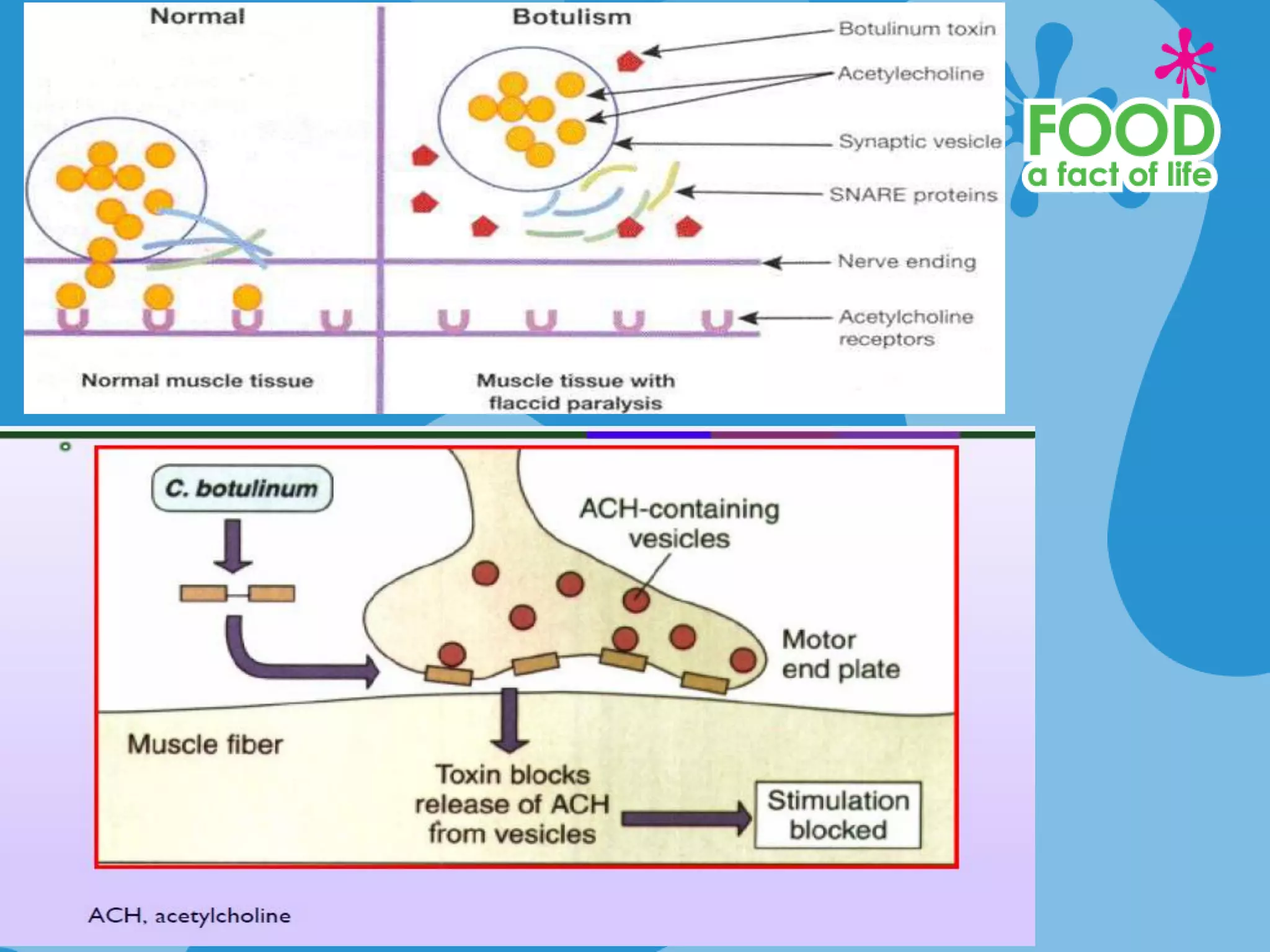
Clostridium botulinum
This is one toxin producing bacteria
producing Neurotoxin
Leads to flaccid paralysis.
(Botulism) is rare but fatal caused by
eating food contamination as it end
by death .
Symptoms :Neurological signs
Visual disturbances, vertigo & paralysis
Sources:
Honey, home-canned vegetables
and fruits, and salted fish . Improperly
canned foods, vacuum packed
© BRITISH NUTRITION FOUNDATION 2016
Bacillus cereus
It is type of bacteria that
produces toxins.
These toxins can cause two
types of illness:
diarrheal toxin, emetic toxin,
It presents in food and can
multiply quickly at room
temperature
Symptoms: Upper GIT signs
Nausea, vomiting, abdominal
pain, diarrhea .
Source :
Rice , sauces, soups
Food that have stayed too
long at room temperature
© BRITISH NUTRITION FOUNDATION 2016

Bacterial toxins

  • 1.
    © BRITISH NUTRITIONFOUNDATION 2016 Bacterial toxins Dr. Amer Alzobaay College of Agricultural Engineering Sciences food Science
  • 2.
    © BRITISH NUTRITIONFOUNDATION 2016 Soluble substances that alter normal metabolism with deleterious effects on the host cells. Poisonous substances produced by microorganisms (and Others). toxins - primary factor – pathogenicity 220 known bacterial toxins . 40% cause disease by damaging the Eukaryotic cell membrane. Host range Known for bacteria, but possible that they play a role in diseases caused by fungi, protozoa, and worms. Definition
  • 3.
    © BRITISH NUTRITIONFOUNDATION 2016
  • 4.
    © BRITISH NUTRITIONFOUNDATION 2016
  • 5.
    © BRITISH NUTRITIONFOUNDATION 2016
  • 6.
    © BRITISH NUTRITIONFOUNDATION 2016 Classes of Toxins by Site of Action e.g.: • Neurotoxins Nerve Tissue • Enterotoxins Enteric System • Cytotoxins Cells • Hemotoxins Blood Cells • Dermatotoxins Skin Cells • Hepatotoxins Liver tissue
  • 7.
    © BRITISH NUTRITIONFOUNDATION 2016
  • 8.
    © BRITISH NUTRITIONFOUNDATION 2016
  • 9.
    © BRITISH NUTRITIONFOUNDATION 2016
  • 10.
    © BRITISH NUTRITIONFOUNDATION 2016
  • 11.
    © BRITISH NUTRITIONFOUNDATION 2016
  • 12.
    © BRITISH NUTRITIONFOUNDATION 2016 Mechanism of Bacterial Damage and Bacterial Toxins
  • 13.
    © BRITISH NUTRITIONFOUNDATION 2016
  • 14.
    © BRITISH NUTRITIONFOUNDATION 2016
  • 15.
    © BRITISH NUTRITIONFOUNDATION 2016
  • 16.
    © BRITISH NUTRITIONFOUNDATION 2016
  • 17.
    © BRITISH NUTRITIONFOUNDATION 2016 Clostridium botulinum The most potent biological toxin 10 ng can kill a human 1 g can kill 100 million people Preserved foods such as sausage (botulus) C. botulinum was first recognized and isolated in 1897 by Emile van Ermengem from home cured ham and victim's liver in Belgian. Inject the isolated culture into animals and the same symptoms of human were obtained.
  • 18.
    © BRITISH NUTRITIONFOUNDATION 2016
  • 19.
    © BRITISH NUTRITIONFOUNDATION 2016
  • 20.
    © BRITISH NUTRITIONFOUNDATION 2016 Staphylococcal α-toxin
  • 21.
    © BRITISH NUTRITIONFOUNDATION 2016
  • 22.
    © BRITISH NUTRITIONFOUNDATION 2016
  • 23.
    © BRITISH NUTRITIONFOUNDATION 2016
  • 24.
    © BRITISH NUTRITIONFOUNDATION 2016 Enterobacteriaceae Opportunistic pathogens Escherichia coli Klebsiella pneumoniae Enterobacter aerogenes Serratia marcescens Proteus spp. Providencia spp. Citrobacter spp. Obligate pathogens Salmonella spp. Shigella spp. Yersinia spp. Some E. coli strains Sepsis Meningitis UTI Diarrhea Pneumonia
  • 25.
    © BRITISH NUTRITIONFOUNDATION 2016 Salmonella one of the most common causes of food poisoning. Salmonella is killed by cooking and pasteurization, But it can contaminate the food processing area and transmitted to another food item. Symptoms :Lower GIT signs Lower abdominal cramps & diarrhea Source Raw poultry and eggs Undercooked poultry and meat.
  • 26.
    © BRITISH NUTRITIONFOUNDATION 2016 Campylobacter jejuni • Causes an estimated 2.5 million foodborne illnesses / year • Among the most common causes of enteric infection in humans overall • Usually mild disease in immunocompetent hosts • for immunocompromised hosts, antimicrobial therapy needed • ~2 in 100,000 diagnosed infections lead to Guillan-Barre syndrome, a paralysis that lasts several weeks • Primary vehicles: milk, poultry, pork • inadequate cooking, cross-contamination primary causes of infection. Symptoms :Fever, chills, malaise , aches, swollen lymph nodes.
  • 27.
    © BRITISH NUTRITIONFOUNDATION 2016 Escherichia coli E. coli (0157:H7)Lives in intestines of healthy cattle . It produce Enterotoxin causes hemolytic inflammation of the intestines results in bloody diarrhea hemorrhagic uremic syndrome (HUS) • Source : – Undercooked hamburger , salami – Unpasteurized milk, Well water – Fruits and Vegetables. Symptoms :Fever, chills, malaise , aches, swollen lymph nodes.
  • 28.
    © BRITISH NUTRITIONFOUNDATION 2016 Shigella It causes diarrhea in human which called bacillary dysentery,, Shigellosis is a cause of traveler’s diarrhea from food and water contaminated in developing countries. Symptoms :Lower GIT signs Lower , abdominal cramps & diarrhea Source : Salads and sandwiches Raw vegetables
  • 29.
    © BRITISH NUTRITIONFOUNDATION 2016 Staphylococcus aureus It is commonly found on the skin , hair , noses and throats of people and animals. It can multiply quickly at room temperature and produce a toxin that causes Food poisoning . Source ; Salads, macaroni, Bakery products, cream pies, and chocolate. Milk and dairy products, Symptoms: Upper GIT signs Nausea, vomiting, abdominal pain, diarrhea .
  • 30.
    © BRITISH NUTRITIONFOUNDATION 2016 Listeria monocytogenes It is widespread in nature, in soil and water . It grows at low temperature and in refrigerator. It is very dangerous pathogens for pregnant women; it can transmit from mother to baby through placenta results in abortion. Symptoms :Fever, chills, malaise , aches, swollen lymph nodes. Source : Ice-cream ,unpasteurized milk, soft cheeses Ready-to-Eat foods, salads
  • 31.
    © BRITISH NUTRITIONFOUNDATION 2016 Vibrio this bacteria in the summer months when water gets wormer. V. parahaemolyticus typically causes non- bloody diarrhea V. cholerae cause watery diarrhea (called "rice water stools" It cause electrolyte imbalance by Losing body fluids Severe cases, 12 - 20 liters of liquid lost in a day Untreated cases - Mortality Rate about 50% Symptoms :Lower GIT signs Lower abdominal cramps & diarrhea Source : Raw or undercooked fish and shellfish , Drinking contaminated water , Eating food washed or made with contaminated 10 water
  • 32.
    © BRITISH NUTRITIONFOUNDATION 2016 Clostridium perfringens One of the most common spore forming bacteria causing food poisoning. Cooking kills Bacterial cells, but the spores grow into new cells. When food prepared in large quantities and kept long time before serving it cause infection Outbreaks usually linked to institutions (hospitals, school cafeterias, and prisons). Symptoms: Lower GIT signs Lower abdominal cramps & diarrhea. Sources such as Beef and Poultry
  • 33.
    © BRITISH NUTRITIONFOUNDATION 2016 Clostridium botulinum This is one toxin producing bacteria producing Neurotoxin Leads to flaccid paralysis. (Botulism) is rare but fatal caused by eating food contamination as it end by death . Symptoms :Neurological signs Visual disturbances, vertigo & paralysis Sources: Honey, home-canned vegetables and fruits, and salted fish . Improperly canned foods, vacuum packed
  • 34.
    © BRITISH NUTRITIONFOUNDATION 2016 Bacillus cereus It is type of bacteria that produces toxins. These toxins can cause two types of illness: diarrheal toxin, emetic toxin, It presents in food and can multiply quickly at room temperature Symptoms: Upper GIT signs Nausea, vomiting, abdominal pain, diarrhea . Source : Rice , sauces, soups Food that have stayed too long at room temperature
  • 35.
    © BRITISH NUTRITIONFOUNDATION 2016
  • 36.
    © BRITISH NUTRITIONFOUNDATION 2016
  • 37.
    © BRITISH NUTRITIONFOUNDATION 2016
  • 38.
    © BRITISH NUTRITIONFOUNDATION 2016
  • 39.
    © BRITISH NUTRITIONFOUNDATION 2016
  • 40.
    © BRITISH NUTRITIONFOUNDATION 2016