FOOD BORNE
MICROORGANISM
Ankita Behera
M.Sc Microbiology
St. George College of Management & Science
Bengaluru North University
INTRODUCTION
◦ Human illness caused by consumption of foods contaminated with
factors like poisons or chemical toxic but there other than these
factors the role of pathogens in food borne disease has been
understood.
◦ Early days our elder people says eating foods after well cooking and
serving food warm and also not eating spoiled foods were to protect
people from danger of microbial food borne disease.
◦ In middle ages mostly food poisoning incidents is due to consumption
of grains infested with toxin produced by fungi.
◦ However , Pasteur’s discovery of role micro-organisms in foods was
their involvement in foodborne disease.this helped in search for and
isolate pathogens by suitable technique from foods .
◦ Salmonella and Staphylococcus aureus causes salmonellosis and
staphylococcal poisoning and Clostridium botulinum causes botulism
were isolated from foods incriminated with food borne disease before
20th centuary.
Salmonella causing salmonellosis Staphylococcus aureus causing food poisoning
Clostridium botulinum causes Botulism
◦ Subsequently many pathogenic bacteria like toxin producing molds
and pathogenic viruses are also causative agents in human food borne
illness.
◦ Even now the exact role of many bacteria and viruses in food borne
disease is not well understood and several of them are designated as
opportunistic pathogens but due to development of efficient
technique it has enabled us to identify role of pathogens in food
borne disease.
ORGANISMS RELATED
TO
FOOD BORNE DISEASE
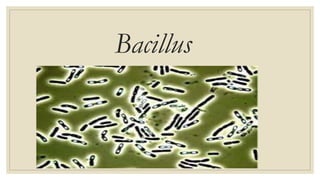
Bacillus
INTRODUCTION
◦ Bacillus cereus is the causative agent of the GASTROENTERITIS.
◦ In European countries it is relatively high as compared to U.S
countries .
◦ Between 1973 and 1987 mostly 58 outbreaks involving 1123 cases
were reported.
CHARACTERISTICS
◦ The cells are gram positive motile rods.
◦ Forms endospore in the middle.
◦ Cells are sensitive to pasteurization
◦ Spores can survive high temperature used in many cooking procedure.
◦ Aerobic but can also grow under some degree of anaerobic environment.
◦ Cells can multiply in a temperature of 4-50 degree C with optimum temp at
35-40 degree C.
◦ Grow in PH of 4.9-9.3 and NACL conc. Below 10%.
HABITAT
◦ Mostly found in soil and dust and can be readily isolated in small
number from many foods which include both raw and finished
products.
◦ Intestinal tracts of 10% of healthy adult humans have bacillus under
normal conditions.
TOXINS & TOXIN PRODUCTION
◦ Strains produces Enterotoxins like emetic and enteric .
◦ The toxin are produced during growth of cells at growth temperature
and retained in the cells.
◦ When cells are lysed the toxins are released .
◦ They occurs in the intestinal tract but also in foods i.e they cause
FOOD POISONING OR Staphylococcal FOOD POISONING .
DISEASE AND SYMPTOMS
◦ Generally large no.of cells {106-8/g}need to be ingested to produce
GASTEROENTERITIES.
◦ The ENTEROTOXIN produces 2 types of symptoms-
◦ The enteric toxins associated with diarrheal form symptoms occurs 6-
12 hrs after consumption of a food containing Bacillus.sometimes
symptoms include
Abdominal pain Watery diarrhea Nausea
◦But no vomiting or fever.
◦Recovery is seen usually in 24 hrs.
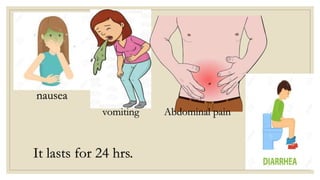
◦In the emetic toxin the symptoms occur in 1-
5 hours after ingestion of food containing
viable cells .
◦Symptoms are
nausea
vomiting Abdominal pain
It lasts for 24 hrs.
FOOD ASSOCIATION
◦ Many foods contain small no.of cells & spores of Bacillus consumption may
not harm you but when these foods are facilitate spore germination and
cell multiplication occurs which leads to rise in population of live cells
reach high levels for the purpose of disease.
◦ In diarrheal outbreak a variety of food like vegetables, salads , meats ,
pudding, casserols ,sauces and soups mostly because of improper cooling
.sometime rice and starchy product may also cause this disease.
◦ For ex-FRIED RICE for preparation the rice is boiled and kept at room
temperature for long time . Here the surviving spores germinates and the
cell multiply at high levels which causes food poisoning.
PREVENTION
◦The factors associated with Bacillus cereus causing
Gastroenteritis are improper holding
temperature, contaminated equipment,
inadequate cooking, poor personal hygine.
DETECTION METHOD
◦ Bacillus cereus can be enumerated by surface plating on an agar medium
containing mannitol, egg yolk and polymyxin B {Bacillus cereus agar}
{sheep blood agar}or VP test, starch hydrolysis test, nitrate reduction
test, Acid production.
◦ Colonies surrounded by precipitation result from lecithinase of the
cells are indicative.
Sheep blood agar Bacillus cereus agar
Treatment
◦ Bacillus cereus produces Beta –lactamases so it is resistant to Beta
lactam antibiotics.
◦ so it can be treated with clindamycin ,vancomycin , gentamycin ,
chloramphenicol and erythromycin .
Clostridium
INTRODUCTION
◦ GASTEROENTERITIS caused by Clostridium perfringens.
◦ In U.S in1960 and 1970this cases was involved in more than 7 % of the total food
borne outbreaks and more than 10 % of the total number of cases.
◦ In 1980 the incidence dropped to 3%of the total outbreaks affecting 5% of the
total cases.
◦The outbreak generally occur with some foods that were
prepare in advance by heating and then kept warm for
several hours before serving.
◦Majorly these situations are associated with feeding many
people within a short period of time in cafeterias , resturants
, schools and banquets.
◦As the disease produces mild symptoms many incidents were
probably not reported.
Characteristics
◦ Cells are Gram-positive rods ,motile and spore formers.
◦ They vary in size and can form small chains.
◦ It is anaerobic but can tolerate oxygen.
◦ The vegetative cells are sensitive to low heat treatment but spores are extremely
heat resistant due to which it can survive even boiling for several hours.
◦ Cells are resistant to D-cycloserine.
◦ In the presence of suitable substrates H2S is formed during growth.
◦ Cells need several amino acids for growth i.e they can grow very effectively in
protein foods.
◦Temperatures of growth of vegetative cells and
germination of spores and outgrowth range
between 10-52 degree celcius and optimum
growth is 45 degree celcius.
◦Cell multiplication occur in 9 min.
◦Cell fail to grow well at PH of < 5 and Nacl
concentration >5%.
HABITAT
◦Spores and vegetative cells are found is soil ,dust
, intestinal contents of animals ,birds and
humans and sewage .
◦Particularly raw foods gets contaminated from
these sources .
TOXIN & TOXIN PRODUCTION
◦ Among the 5 types of Clostridium perfringens ,type A strains are involved
in food borne toxico infection.
◦ Enterotoxin associated with the foodborne disease is a heat liable
protein .
◦ It is an intracellular protein produced by the cells during sporulation
in intestine and released i.e the enterotoxin is produced in the
digestive tract.
◦ There are some reports which says sporulation and enterotoxin
production at certain levels also occurs in some foods.
DISEASE & SYMPTOMS
◦They cause GASTROENTERITIS.
◦Symptoms appear 8-24 hrs after ingestion of large number
of viable cells through of foods.
◦It is generally considered as a mild disease .
◦The toxin changes the permeability of intestinal cells.
◦Symptoms are
ABDOMINAL PAIN
NAUSEA
VOMITING
fever
FOOD ASSOCIATION
◦ Raw meat from animals and birds is mostly contaminated with spores and cells
from digestive tract content .
◦ Vegetables and fruits gets contaminated from soil and dust.
◦ A bacterium has some amino acids requirements for growth ,so meat and meat
containing food provide good environment for cell growth.so the foods like meat
stew , meat pies , caserols, gravies , sauces , are incriminated with outbreaks.
◦ Sometimes due to improper handling, inadequate cooking and contaminated
equipment.
PREVENTION
◦ The presence of spores and cells in foods is not uncommon unless viable cells are
present in high numbers before eating they cannot cause GASTROENTERITIS.
◦ It can be achieved by using proper sanitation in all phases of food preparation
and handling .
◦ Food should be cooked to highest temperature recommended to kill the cells and
as many spores as possible.
◦ If a food is stored for a long time it is important to reheat it quickly and
uniformly and keep it hot while being served.
DETECTION
◦The detection method involves enumeration of
incriminated food and feacal samples for
clostridium in a selective agar medium and
incubation of plates under anaerobic conditions.
TREATMENT
◦ The treatment or the antibiotics used for staphylococcal food
poisoning treatment is used for Clostridum infection.
THANK YOU

Food borne bacteria

  • 1.
    FOOD BORNE MICROORGANISM Ankita Behera M.ScMicrobiology St. George College of Management & Science Bengaluru North University
  • 2.
    INTRODUCTION ◦ Human illnesscaused by consumption of foods contaminated with factors like poisons or chemical toxic but there other than these factors the role of pathogens in food borne disease has been understood. ◦ Early days our elder people says eating foods after well cooking and serving food warm and also not eating spoiled foods were to protect people from danger of microbial food borne disease.
  • 3.
    ◦ In middleages mostly food poisoning incidents is due to consumption of grains infested with toxin produced by fungi. ◦ However , Pasteur’s discovery of role micro-organisms in foods was their involvement in foodborne disease.this helped in search for and isolate pathogens by suitable technique from foods . ◦ Salmonella and Staphylococcus aureus causes salmonellosis and staphylococcal poisoning and Clostridium botulinum causes botulism were isolated from foods incriminated with food borne disease before 20th centuary.
  • 4.
    Salmonella causing salmonellosisStaphylococcus aureus causing food poisoning Clostridium botulinum causes Botulism
  • 5.
    ◦ Subsequently manypathogenic bacteria like toxin producing molds and pathogenic viruses are also causative agents in human food borne illness. ◦ Even now the exact role of many bacteria and viruses in food borne disease is not well understood and several of them are designated as opportunistic pathogens but due to development of efficient technique it has enabled us to identify role of pathogens in food borne disease.
  • 6.
  • 7.
  • 8.
    INTRODUCTION ◦ Bacillus cereusis the causative agent of the GASTROENTERITIS. ◦ In European countries it is relatively high as compared to U.S countries . ◦ Between 1973 and 1987 mostly 58 outbreaks involving 1123 cases were reported.
  • 9.
    CHARACTERISTICS ◦ The cellsare gram positive motile rods. ◦ Forms endospore in the middle. ◦ Cells are sensitive to pasteurization ◦ Spores can survive high temperature used in many cooking procedure. ◦ Aerobic but can also grow under some degree of anaerobic environment. ◦ Cells can multiply in a temperature of 4-50 degree C with optimum temp at 35-40 degree C. ◦ Grow in PH of 4.9-9.3 and NACL conc. Below 10%.
  • 10.
    HABITAT ◦ Mostly foundin soil and dust and can be readily isolated in small number from many foods which include both raw and finished products. ◦ Intestinal tracts of 10% of healthy adult humans have bacillus under normal conditions.
  • 11.
    TOXINS & TOXINPRODUCTION ◦ Strains produces Enterotoxins like emetic and enteric . ◦ The toxin are produced during growth of cells at growth temperature and retained in the cells. ◦ When cells are lysed the toxins are released . ◦ They occurs in the intestinal tract but also in foods i.e they cause FOOD POISONING OR Staphylococcal FOOD POISONING .
  • 12.
    DISEASE AND SYMPTOMS ◦Generally large no.of cells {106-8/g}need to be ingested to produce GASTEROENTERITIES. ◦ The ENTEROTOXIN produces 2 types of symptoms- ◦ The enteric toxins associated with diarrheal form symptoms occurs 6- 12 hrs after consumption of a food containing Bacillus.sometimes symptoms include
  • 13.
    Abdominal pain Waterydiarrhea Nausea
  • 14.
    ◦But no vomitingor fever. ◦Recovery is seen usually in 24 hrs. ◦In the emetic toxin the symptoms occur in 1- 5 hours after ingestion of food containing viable cells . ◦Symptoms are
  • 15.
  • 16.
    FOOD ASSOCIATION ◦ Manyfoods contain small no.of cells & spores of Bacillus consumption may not harm you but when these foods are facilitate spore germination and cell multiplication occurs which leads to rise in population of live cells reach high levels for the purpose of disease. ◦ In diarrheal outbreak a variety of food like vegetables, salads , meats , pudding, casserols ,sauces and soups mostly because of improper cooling .sometime rice and starchy product may also cause this disease. ◦ For ex-FRIED RICE for preparation the rice is boiled and kept at room temperature for long time . Here the surviving spores germinates and the cell multiply at high levels which causes food poisoning.
  • 17.
    PREVENTION ◦The factors associatedwith Bacillus cereus causing Gastroenteritis are improper holding temperature, contaminated equipment, inadequate cooking, poor personal hygine.
  • 18.
    DETECTION METHOD ◦ Bacilluscereus can be enumerated by surface plating on an agar medium containing mannitol, egg yolk and polymyxin B {Bacillus cereus agar} {sheep blood agar}or VP test, starch hydrolysis test, nitrate reduction test, Acid production. ◦ Colonies surrounded by precipitation result from lecithinase of the cells are indicative.
  • 19.
    Sheep blood agarBacillus cereus agar
  • 20.
    Treatment ◦ Bacillus cereusproduces Beta –lactamases so it is resistant to Beta lactam antibiotics. ◦ so it can be treated with clindamycin ,vancomycin , gentamycin , chloramphenicol and erythromycin .
  • 21.
  • 22.
    INTRODUCTION ◦ GASTEROENTERITIS causedby Clostridium perfringens. ◦ In U.S in1960 and 1970this cases was involved in more than 7 % of the total food borne outbreaks and more than 10 % of the total number of cases. ◦ In 1980 the incidence dropped to 3%of the total outbreaks affecting 5% of the total cases.
  • 23.
    ◦The outbreak generallyoccur with some foods that were prepare in advance by heating and then kept warm for several hours before serving. ◦Majorly these situations are associated with feeding many people within a short period of time in cafeterias , resturants , schools and banquets. ◦As the disease produces mild symptoms many incidents were probably not reported.
  • 24.
    Characteristics ◦ Cells areGram-positive rods ,motile and spore formers. ◦ They vary in size and can form small chains. ◦ It is anaerobic but can tolerate oxygen. ◦ The vegetative cells are sensitive to low heat treatment but spores are extremely heat resistant due to which it can survive even boiling for several hours. ◦ Cells are resistant to D-cycloserine. ◦ In the presence of suitable substrates H2S is formed during growth. ◦ Cells need several amino acids for growth i.e they can grow very effectively in protein foods.
  • 25.
    ◦Temperatures of growthof vegetative cells and germination of spores and outgrowth range between 10-52 degree celcius and optimum growth is 45 degree celcius. ◦Cell multiplication occur in 9 min. ◦Cell fail to grow well at PH of < 5 and Nacl concentration >5%.
  • 26.
    HABITAT ◦Spores and vegetativecells are found is soil ,dust , intestinal contents of animals ,birds and humans and sewage . ◦Particularly raw foods gets contaminated from these sources .
  • 27.
    TOXIN & TOXINPRODUCTION ◦ Among the 5 types of Clostridium perfringens ,type A strains are involved in food borne toxico infection. ◦ Enterotoxin associated with the foodborne disease is a heat liable protein . ◦ It is an intracellular protein produced by the cells during sporulation in intestine and released i.e the enterotoxin is produced in the digestive tract. ◦ There are some reports which says sporulation and enterotoxin production at certain levels also occurs in some foods.
  • 28.
    DISEASE & SYMPTOMS ◦Theycause GASTROENTERITIS. ◦Symptoms appear 8-24 hrs after ingestion of large number of viable cells through of foods. ◦It is generally considered as a mild disease . ◦The toxin changes the permeability of intestinal cells. ◦Symptoms are
  • 29.
  • 30.
    FOOD ASSOCIATION ◦ Rawmeat from animals and birds is mostly contaminated with spores and cells from digestive tract content . ◦ Vegetables and fruits gets contaminated from soil and dust. ◦ A bacterium has some amino acids requirements for growth ,so meat and meat containing food provide good environment for cell growth.so the foods like meat stew , meat pies , caserols, gravies , sauces , are incriminated with outbreaks. ◦ Sometimes due to improper handling, inadequate cooking and contaminated equipment.
  • 31.
    PREVENTION ◦ The presenceof spores and cells in foods is not uncommon unless viable cells are present in high numbers before eating they cannot cause GASTROENTERITIS. ◦ It can be achieved by using proper sanitation in all phases of food preparation and handling . ◦ Food should be cooked to highest temperature recommended to kill the cells and as many spores as possible. ◦ If a food is stored for a long time it is important to reheat it quickly and uniformly and keep it hot while being served.
  • 32.
    DETECTION ◦The detection methodinvolves enumeration of incriminated food and feacal samples for clostridium in a selective agar medium and incubation of plates under anaerobic conditions.
  • 33.
    TREATMENT ◦ The treatmentor the antibiotics used for staphylococcal food poisoning treatment is used for Clostridum infection.
  • 34.