Backtesting:
Measuring the Effectiveness of ALLL
Methodologies
About Sageworks
• Financial information company that provides credit and risk
management solutions to financial institutions
• Data and applications used by thousands of financial institutions and
accounting firms across North America
• Provides resources, including whitepapers, webinars, videos, and
templates, for bankers accessible at www.sageworks.com
• Model Risk
• What is Backtesting?
• ALLL Backtesting at the Portfolio Level
• Deeper Investigation of Specific Portfolio Segments
• Examples
• Conclusion
Learning Objectives
• DEFINED: The potential for adverse consequences from decisions
based on incorrect or misused model outputs and reports.
• Can lead to financial loss, poor business and strategic decision
making, or damage to a bank’s reputation.
What is Model Risk?
Primary Reasons for Model Risk Occurrence
1. The model may have fundamental errors and may produce
inaccurate outputs when viewed against the design objective and
intended business uses.
2. The model may be used incorrectly or inappropriately.
• “Even with skilled modeling and robust validation, model risk cannot be
eliminated, so other tools should be used to manage model risk effectively. Among
these are establishing limits on model use, monitoring model performance,
adjusting or revising models over time, and supplementing model results with
other analysis and information.”
OCC – Supervisory Guidance on Model Risk Management – April 2011
Combating Model Risk:
• Backtesting is an exercise that compares the actual outcome with
model forecasts during a defined period, a period of time that was not
used to develop the methodology.
• Backtesting is a form of Outcome Analysis critical to managing Model
Risk.
• An exercise that enables us to monitor model performance and adjust
or revised the model over time.
What is Backtesting?
• The objective is to ensure the ALLL methodology is accurate in
measuring the losses inherent in a bank’s portfolio over the
subsequent 12-month period.
• NOTE: This time horizon may shift somewhat as the FASB’s CECL model
and the life of loan concept takes hold, but regardless of any
forthcoming changes, the request for measuring the effectiveness of a
methodology, or backtesting ALLL models, will continue in some
fashion.
The Backtesting Objective:
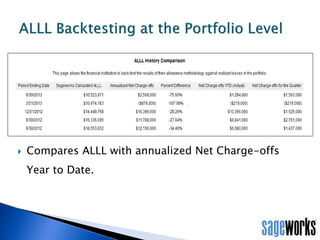
ALLL Backtesting at the Portfolio Level
 Compares ALLL with annualized Net Charge-offs Year to Date.
• How many years of losses can be estimated to be covered by any period-end
allowance when examining the current period allowance as compared to Net
Charge-offs Year to Date (annualized)?
• Does the current period's Net Charge-offs Year to Date (annualized) exceed the
prior period's allowance?
• Were there significant changes from one quarter to the next in the net charge-
offs? If so, did the allowance increase accordingly?
Important Analysis Questions
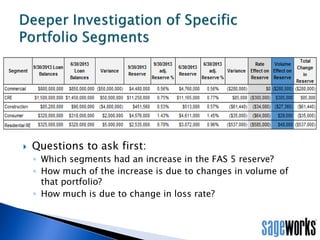
Deeper Investigation of Specific
Portfolio Segments
• Questions to ask first:
» Which segments had an increase in the FAS 5 reserve?
» How much of the increase is due to changes in volume of that portfolio?
» How much is due to change in loss rate?
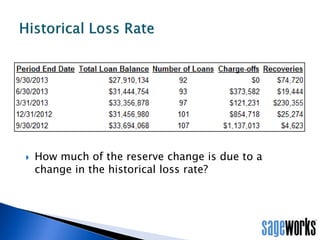
Historical Loss Rate
 How much of the reserve change is due to a change in
the historical loss rate?
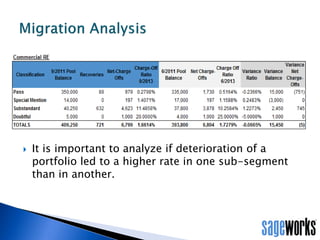
Migration Analysis
 It is important to analyze if deterioration of a portfolio led
to a higher rate in one sub-segment than in another.
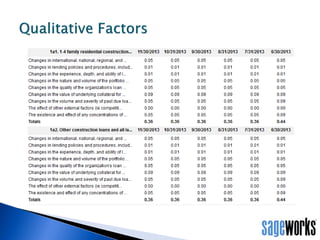
• A bank should look closely at the change in qualitative factors over time and
compare the direction of change to the direction of change of any applicable
metrics for that specific factor.
Qualitative Factors
Qualitative Factors
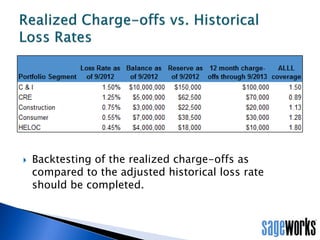
• Backtesting of the realized charge-offs as compared to the
adjusted historical loss rate should be completed.
Realized Charge-offs vs. Historical
Loss Rates
• To what degree did the ALLL cover the net charge-offs over the subsequent 12
months?
• Did the current period’s (annualized) or the subsequent 12 months’ charge-offs
exceed the ALLL?
Important Analysis Questions
Data!
• Do I have sufficient data stored to backtest?
• Is the archived data easily accessible/malleable?
• FASB’s CECL
Challenges to Backtesting:
• Backtesting is a form of Outcome Analysis critical to managing Model Risk.
• Backtesting enables you to monitor model performance and adjust or revised the
model over time.
• Backtesting is growing as a useful way to defend a bank’s ALLL methodology.
• Backtesting puts you ahead of your peers in the eyes of examiners.
Conclusion
Additional resources:
» Whitepapers, archived webinars and more: sageworks.com
» LinkedIn: ALLL Forum for Bankers
» ALLL.com
Additional Resources & Contact Info

Backtesting - Measuring the Effectiveness of your ALLL

  • 1.
  • 2.
    About Sageworks • Financialinformation company that provides credit and risk management solutions to financial institutions • Data and applications used by thousands of financial institutions and accounting firms across North America • Provides resources, including whitepapers, webinars, videos, and templates, for bankers accessible at www.sageworks.com
  • 3.
    • Model Risk •What is Backtesting? • ALLL Backtesting at the Portfolio Level • Deeper Investigation of Specific Portfolio Segments • Examples • Conclusion Learning Objectives
  • 4.
    • DEFINED: Thepotential for adverse consequences from decisions based on incorrect or misused model outputs and reports. • Can lead to financial loss, poor business and strategic decision making, or damage to a bank’s reputation. What is Model Risk?
  • 5.
    Primary Reasons forModel Risk Occurrence 1. The model may have fundamental errors and may produce inaccurate outputs when viewed against the design objective and intended business uses. 2. The model may be used incorrectly or inappropriately.
  • 6.
    • “Even withskilled modeling and robust validation, model risk cannot be eliminated, so other tools should be used to manage model risk effectively. Among these are establishing limits on model use, monitoring model performance, adjusting or revising models over time, and supplementing model results with other analysis and information.” OCC – Supervisory Guidance on Model Risk Management – April 2011 Combating Model Risk:
  • 7.
    • Backtesting isan exercise that compares the actual outcome with model forecasts during a defined period, a period of time that was not used to develop the methodology. • Backtesting is a form of Outcome Analysis critical to managing Model Risk. • An exercise that enables us to monitor model performance and adjust or revised the model over time. What is Backtesting?
  • 8.
    • The objectiveis to ensure the ALLL methodology is accurate in measuring the losses inherent in a bank’s portfolio over the subsequent 12-month period. • NOTE: This time horizon may shift somewhat as the FASB’s CECL model and the life of loan concept takes hold, but regardless of any forthcoming changes, the request for measuring the effectiveness of a methodology, or backtesting ALLL models, will continue in some fashion. The Backtesting Objective:
  • 9.
    ALLL Backtesting atthe Portfolio Level  Compares ALLL with annualized Net Charge-offs Year to Date.
  • 10.
    • How manyyears of losses can be estimated to be covered by any period-end allowance when examining the current period allowance as compared to Net Charge-offs Year to Date (annualized)? • Does the current period's Net Charge-offs Year to Date (annualized) exceed the prior period's allowance? • Were there significant changes from one quarter to the next in the net charge- offs? If so, did the allowance increase accordingly? Important Analysis Questions
  • 11.
    Deeper Investigation ofSpecific Portfolio Segments • Questions to ask first: » Which segments had an increase in the FAS 5 reserve? » How much of the increase is due to changes in volume of that portfolio? » How much is due to change in loss rate?
  • 12.
    Historical Loss Rate How much of the reserve change is due to a change in the historical loss rate?
  • 13.
    Migration Analysis  Itis important to analyze if deterioration of a portfolio led to a higher rate in one sub-segment than in another.
  • 14.
    • A bankshould look closely at the change in qualitative factors over time and compare the direction of change to the direction of change of any applicable metrics for that specific factor. Qualitative Factors
  • 15.
  • 16.
    • Backtesting ofthe realized charge-offs as compared to the adjusted historical loss rate should be completed. Realized Charge-offs vs. Historical Loss Rates
  • 17.
    • To whatdegree did the ALLL cover the net charge-offs over the subsequent 12 months? • Did the current period’s (annualized) or the subsequent 12 months’ charge-offs exceed the ALLL? Important Analysis Questions
  • 18.
    Data! • Do Ihave sufficient data stored to backtest? • Is the archived data easily accessible/malleable? • FASB’s CECL Challenges to Backtesting:
  • 19.
    • Backtesting isa form of Outcome Analysis critical to managing Model Risk. • Backtesting enables you to monitor model performance and adjust or revised the model over time. • Backtesting is growing as a useful way to defend a bank’s ALLL methodology. • Backtesting puts you ahead of your peers in the eyes of examiners. Conclusion
  • 20.
    Additional resources: » Whitepapers,archived webinars and more: sageworks.com » LinkedIn: ALLL Forum for Bankers » ALLL.com Additional Resources & Contact Info