World Religions
     Judaism
Biblical Historical Roots


• The Biblical Patriarchs
   – Abraham c. 1750 – 2000 BC
   – Worshipped God as El (Many others names added in time,
     i.e., El Shaddai (God Almighty), El Elyon (God most high),
     and El Olam (God Everlasting.)
• Exodus
   – Moses
   – God identifies Himself to Moses as Yahweh (“I Am”)
Biblical Historical Roots

• Sinai & The Law
    The Law becomes foundational for the emerging Jews
    Forms the basis for the writings of the prophets
    It is both apodictic and case-oriented

• Post Sinai Religious Institutions
    The Tabernacle: the first place of worship for the Jews,
   and     housing place of the Ark of the Covenant.

• Worship in Shiloh
    The first “holy place”
Biblical Historical Roots


• Religion in the Time of the Monarchy
    The Temple
    The prophetic movement
• Exile & Return
    The kingdom split into North and South in 977 BC
    Northern Kingdom fell in 722 BC
    Southern Kingdom falls in 587 BC (to Babylonians)
    Prophets during Babylonian captivity: Ezekiel and Daniel
    Isaiah and Jeremiah predicted return (Isa 44:28 & Jer 30:18)
Biblical Historical Roots


The Jews began to return to Jerusalem from Babylonian
captivity in 539 BC.
The temple was rebuilt in 516 BC.
Temple worship, ritual, and sacrifice was reinstituted.
The new temple lasted for nearly 600 years.

 The entire period from the Assyrian conquest of the Northern
  Kingdom to the Babylonian conquest of the South is known
            to Jews as the Diaspora, or dispersion.
Contributions of The Diaspora

• The LXX --- Septuagint --- was written during the period to
accommodate the large number of Jews in Alexandria, Egypt.
• The synagogue system developed
      Rules of establishment
       Copy of Scriptures (Torah)
       Ten men (minyan)
       The Rabbi (“my master”)
• Diverse Orders emerged (Pharisees, Saducees,
Zelots, etc.)
• Heightened Messianic expectancy
• Well developed missions program
Roman Persecution and the Fall of
          Jerusalem
Persecution came largely as a result of three things
(2)Jewish tradition & worship ritual
(3)Christian misidentification
(3) Jewish revolts

Significant Events
  Yohanan ben Zakkai and Jamnia
  The Zelots and Jerusalem – AD 66
  The Essenes and Masada – AD 66
  Abomination of Desolation – AD 70
  The final loss of Jerusalem – AD 135
  All lost until 1948
About AD 136 many Jews moved to Babylon (modern Iraq). Life was easier
 there than in Galilee under Rome. This move, combined with the rise of
Christianity in AD 323 and their general dispersion, left the Jews in need of
               greater self-identity and personal perspective.

Literary Developments

 The Mishna (Halakah)
     Commentary on Scripture first developed by Rabbi Judah ha-Nasi
 The Talmud
     A compilation of the Mishna and the Germara or Haggadah.
 Two versions: Palestinian and Babylonian
 Two sections of material
     Mishnah – legal material (“the proper way”)
     Haggadah – history and folklore (“tale”)
Medieval Judaism

• Middle East came under Muslim rule c. AD 650, leading to
  persecution of Jews in Babylon c. AD 900.
• Jews fled across the Mediterranean, largely to Spain (even
  though they later encountered Muslims there).
• By the early middle ages Jews in Spain led worldwide
  Judaism.
• Greatest leader: Moses ben Maimon (Maimonides
  1135-1204).
• In the 13th century Muslims vacated Spain causing Spain to
  react by becoming antagonistic to all outsiders, especially
  Jews.
• 1391 massacre of Jews
• 1492 all Jews and remaining Muslims expelled.
Medieval Judaism


                     The Cabala (Jewish Mystics)
    A tradition dealing with witches, ghouls, astrology, and magic
    A philosophical system that seeks to answer the problem of
  evil and find secret knowledge in the Bible and other places.
    Their literature provided hope for oppressed European Jews
     during the Middle Ages by claiming that behind the evil in the
     world are secret truths of God that give comfort.


The Cabalas still exist, for Jewish mysticism is as old as Judaism
Modern Judaism


• Mostly about fleeing persecution and finding ways to cope
• Developed unique language—Yiddish (high German and
  Hebrew)
• Often forced to live in segregated communities—Ghettos—
  enduring forced curfews and locked gates
• 4th Lateran Council required wearing yellow ID badges
• Many fled to Poland and Russia in Eastern Europe
• 1648 Cossack and Ukrainian peasants slaughtered 500,000
  Jews in a “pogrom” (ethnic cleansing)
• These circumstances led to numerous responses, including a
  return to Western Europe and new Protestant lands
Responses to Modernity


Shabbatai Zevi
 Jewish Cabala Mystic in the seventeenth century
      Led a strong messianic movement in Jewish ghettos
 His disciples declared him “Messiah”
      In Egypt, married Sarah who claimed she would give
      birth to the messiah
 1665 Zevi and his army entered Constantinople to dethrone the
 Sultan of Turkey
      Zevi was captured and imprisoned
 Faced with the choice of convert to Islam or die, he converted
Responses to Modernity

  Moses Mendelssohn
     1743, as small boy, came to the Jewish gate of
Berlin and asked for entrance to learn
         Became a renowned scholar and philosopher of
            all things Jewish and Germanic
     Wrote Nathan the Wise
         His work and scholarship were accepted by
            Jews and non-Jews worldwide
     He encouraged Jews to come out of the ghettos and
     engage the modern world—to write and speak
German, not Yiddish
Responses to Modernity
         • Reform Judaism
             Following Mendelssohn, German Jews believed the
             practices of Judaism were out dated. Three things
         proposed, becoming the basis for the reform
         movement:
                    There is continuation in the development of Judaism
                    The Talmud has no authority for modern Jews
                    “We seek no Messiah and know no homeland but
                    the land of our birth”

In Practice, These Three Things Resulted In:
    Use of the vernacular
                                               Movement became
    Synagogues called temples
    Kosher foods not stressed                  strong in Germany,
    Choirs and organs introduced in worship      Russia, and US
    Biblical criticism practiced
Zionism


• In response to the Dreyfus spy case, Austrian journalist
Theodore Herzel wrote that injustice would not cease until
the Jews had a home state.
• Early 1900s Jews started buying land in Palestine.
• 1909 they established the Jewish city, Tel Aviv.
• By 1920 about 50,000 Jews had emigrated to Tel Aviv.
• End of World War I the Ottoman Empire was dissolved and
Palestine came under British rule.
• 1917 British Foreign Minister, Lord Balfour, expressed
interest in Palestine becoming a national home for Jews.
• By 1933 220,000 Jews had emigrated to Palestine.
“God died during in the holocaust,”
     The Holocaust Rubenstein
               Richard


 • 1933 Hitler became chancellor of Germany
      1935 His Nuremberg Laws reduced Jews to second-
 class citizens
      1939 with the invasion of Poland a total of 3.5 million
 Jews came under his power
      Jews were rounded up and put in camps to be worked
 to death
      1941 Zykon B gas used for mass extermination
      By war’s end, 3.5 million Jews had been reduced to
 500,000

Some of the reasons suggested for the holocaust include, German
  racism, Germany’s problems after WWI, Nazi madness, and
                worldwide silence to the atrocity.
Modern State of Israel


 1947 UN votes to partition Palestine into Jewish and Arab
  state.
 1948 British leave Palestine
 Jews immediately proclaim Palestine a Jewish state and the
  nation of Israel was reborn
 Today there are approximately 13-30 million Jews
worldwide
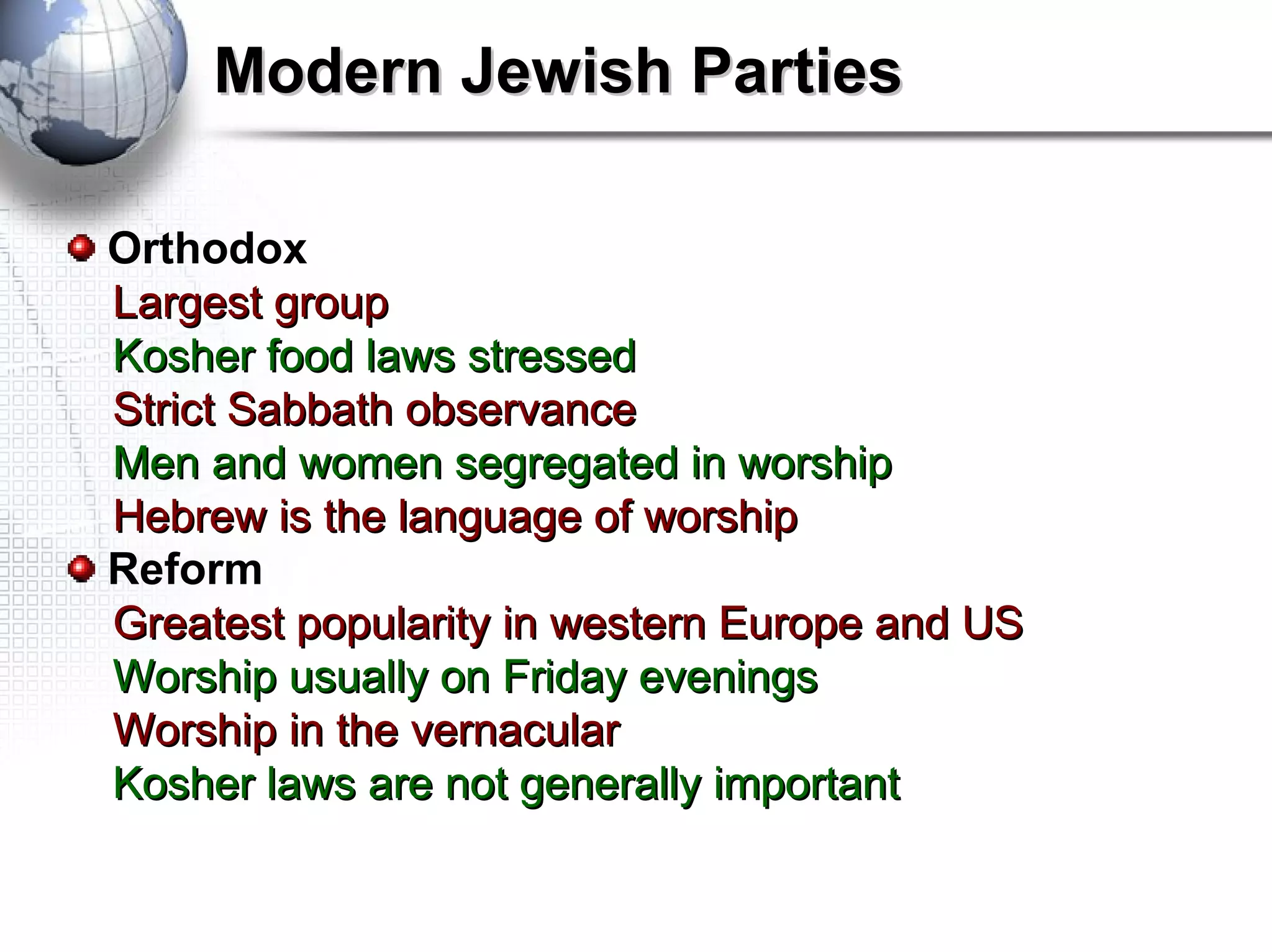
Modern Jewish Parties

Orthodox
Largest group
Kosher food laws stressed
Strict Sabbath observance
Men and women segregated in worship
Hebrew is the language of worship
Reform
Greatest popularity in western Europe and US
Worship usually on Friday evenings
Worship in the vernacular
Kosher laws are not generally important
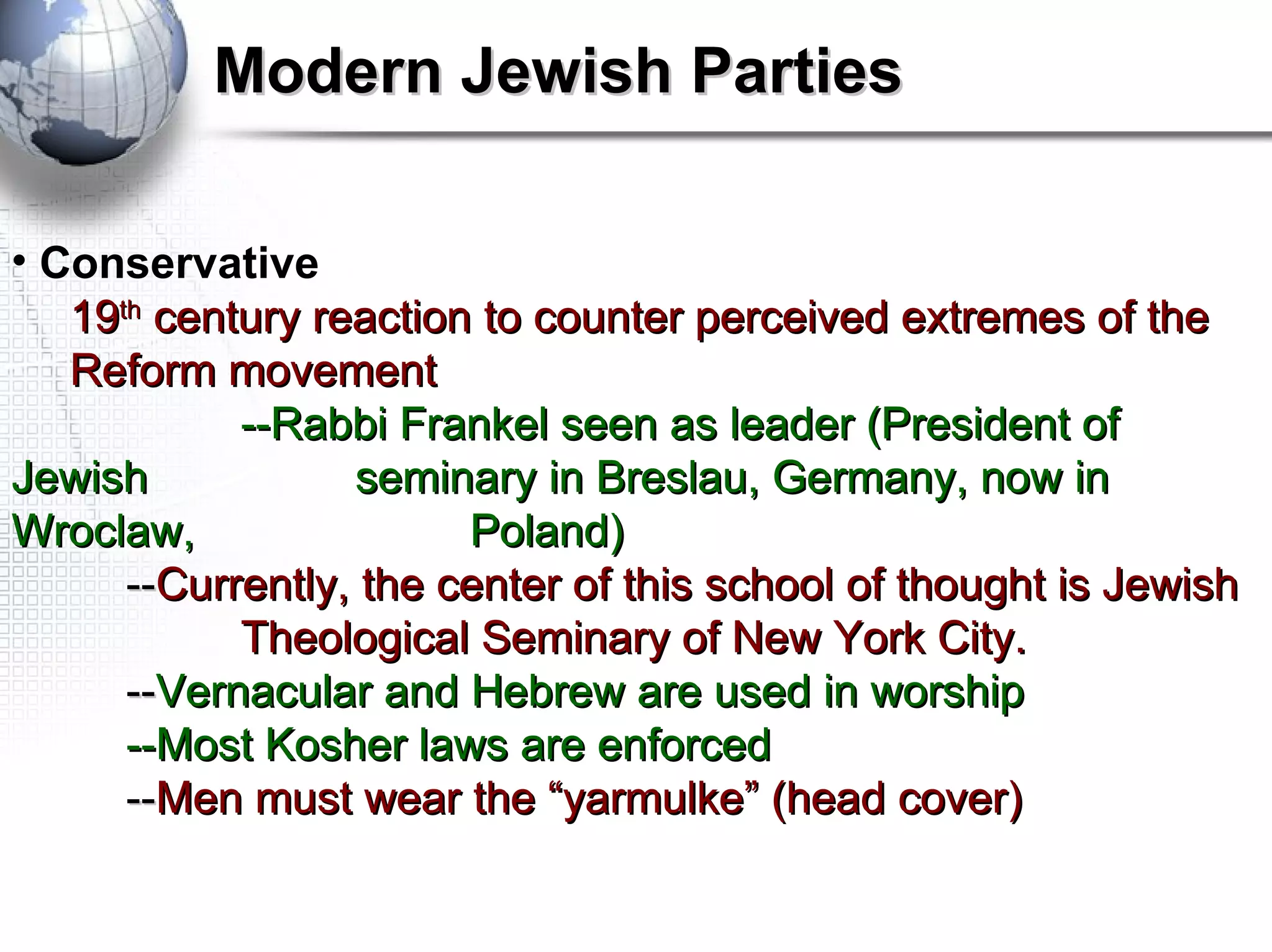
Modern Jewish Parties

• Conservative
   19th century reaction to counter perceived extremes of the
   Reform movement
            --Rabbi Frankel seen as leader (President of
Jewish            seminary in Breslau, Germany, now in
Wroclaw,                Poland)
      --Currently, the center of this school of thought is Jewish
            Theological Seminary of New York City.
      --Vernacular and Hebrew are used in worship
      --Most Kosher laws are enforced
      --Men must wear the “yarmulke” (head cover)
Modern Jewish Parties

  Numerous national/ethnic groups
  The Falashas, black Ethiopian Jews
  Similar groups exist in India and China
  Post Holocaust secular Jews
  Groups concerned with assimilation
  Groups concerned with a resurgence of anti-
Semitism
Jewish Holy Days


  Sabbath (Shabbat)
   Weekly observance
  Passover (Pesach)
   15th of Nisan (March-April). Last 8 days to commemorate
deliverance from Egypt.
  Feast of Weeks (Shavuot)
   50 days after Pesach. New Testament Pentecost. Celebrates
   harvest and the giving of the Law to Moses.
  New Year (Rosh Hashanah)
   1st and 2nd days of Tshre (September-October). Period of
penitence that culminates in the next holiday. Celebrated by
special prayers of confession.
Jewish Holy Days

  Day of Atonement (Yom Kippur)
   Holiest of all holy days. Celebrated on 10th of Tishre.
Abstain       from work, food, and drink. Synagogue attendance is
required      with prayers and acts of charity.
  Feast of Tabernacles or Booths (Sukkot)
   5 days after Yom Kippur on 15th of Tishre Celebrates the
Exodus experience. Often crude booths are built.
  Feast of Dedication (Chanukah)
   25th of Kislev (November-December). One of few non-
Exodus events. It celebrates the Maccabean revolt, the re-
taking of the temple, and the miraculous oil.
Jewish Holy Days


Feast of Lots
 14th of Adar (February-March). A remembrance of Jewish victory
 over Gentiles under Esther.
Son of Commandment (Bar Mitzvah)
 Celebrated on a boys 13th birthday to signify his passage from
 childhood to manhood. In reformed congregations, Bat Mitzvah
 is celebrated for girls

World religions judaism

  • 1.
  • 2.
    Biblical Historical Roots •The Biblical Patriarchs – Abraham c. 1750 – 2000 BC – Worshipped God as El (Many others names added in time, i.e., El Shaddai (God Almighty), El Elyon (God most high), and El Olam (God Everlasting.) • Exodus – Moses – God identifies Himself to Moses as Yahweh (“I Am”)
  • 3.
    Biblical Historical Roots •Sinai & The Law  The Law becomes foundational for the emerging Jews  Forms the basis for the writings of the prophets  It is both apodictic and case-oriented • Post Sinai Religious Institutions  The Tabernacle: the first place of worship for the Jews, and housing place of the Ark of the Covenant. • Worship in Shiloh  The first “holy place”
  • 4.
    Biblical Historical Roots •Religion in the Time of the Monarchy  The Temple  The prophetic movement • Exile & Return  The kingdom split into North and South in 977 BC  Northern Kingdom fell in 722 BC  Southern Kingdom falls in 587 BC (to Babylonians)  Prophets during Babylonian captivity: Ezekiel and Daniel  Isaiah and Jeremiah predicted return (Isa 44:28 & Jer 30:18)
  • 5.
    Biblical Historical Roots TheJews began to return to Jerusalem from Babylonian captivity in 539 BC. The temple was rebuilt in 516 BC. Temple worship, ritual, and sacrifice was reinstituted. The new temple lasted for nearly 600 years. The entire period from the Assyrian conquest of the Northern Kingdom to the Babylonian conquest of the South is known to Jews as the Diaspora, or dispersion.
  • 6.
    Contributions of TheDiaspora • The LXX --- Septuagint --- was written during the period to accommodate the large number of Jews in Alexandria, Egypt. • The synagogue system developed Rules of establishment Copy of Scriptures (Torah) Ten men (minyan) The Rabbi (“my master”) • Diverse Orders emerged (Pharisees, Saducees, Zelots, etc.) • Heightened Messianic expectancy • Well developed missions program
  • 7.
    Roman Persecution andthe Fall of Jerusalem Persecution came largely as a result of three things (2)Jewish tradition & worship ritual (3)Christian misidentification (3) Jewish revolts Significant Events Yohanan ben Zakkai and Jamnia The Zelots and Jerusalem – AD 66 The Essenes and Masada – AD 66 Abomination of Desolation – AD 70 The final loss of Jerusalem – AD 135 All lost until 1948
  • 8.
    About AD 136many Jews moved to Babylon (modern Iraq). Life was easier there than in Galilee under Rome. This move, combined with the rise of Christianity in AD 323 and their general dispersion, left the Jews in need of greater self-identity and personal perspective. Literary Developments The Mishna (Halakah) Commentary on Scripture first developed by Rabbi Judah ha-Nasi The Talmud A compilation of the Mishna and the Germara or Haggadah. Two versions: Palestinian and Babylonian Two sections of material Mishnah – legal material (“the proper way”) Haggadah – history and folklore (“tale”)
  • 9.
    Medieval Judaism • MiddleEast came under Muslim rule c. AD 650, leading to persecution of Jews in Babylon c. AD 900. • Jews fled across the Mediterranean, largely to Spain (even though they later encountered Muslims there). • By the early middle ages Jews in Spain led worldwide Judaism. • Greatest leader: Moses ben Maimon (Maimonides 1135-1204). • In the 13th century Muslims vacated Spain causing Spain to react by becoming antagonistic to all outsiders, especially Jews. • 1391 massacre of Jews • 1492 all Jews and remaining Muslims expelled.
  • 10.
    Medieval Judaism The Cabala (Jewish Mystics) A tradition dealing with witches, ghouls, astrology, and magic A philosophical system that seeks to answer the problem of evil and find secret knowledge in the Bible and other places. Their literature provided hope for oppressed European Jews during the Middle Ages by claiming that behind the evil in the world are secret truths of God that give comfort. The Cabalas still exist, for Jewish mysticism is as old as Judaism
  • 11.
    Modern Judaism • Mostlyabout fleeing persecution and finding ways to cope • Developed unique language—Yiddish (high German and Hebrew) • Often forced to live in segregated communities—Ghettos— enduring forced curfews and locked gates • 4th Lateran Council required wearing yellow ID badges • Many fled to Poland and Russia in Eastern Europe • 1648 Cossack and Ukrainian peasants slaughtered 500,000 Jews in a “pogrom” (ethnic cleansing) • These circumstances led to numerous responses, including a return to Western Europe and new Protestant lands
  • 12.
    Responses to Modernity ShabbataiZevi Jewish Cabala Mystic in the seventeenth century Led a strong messianic movement in Jewish ghettos His disciples declared him “Messiah” In Egypt, married Sarah who claimed she would give birth to the messiah 1665 Zevi and his army entered Constantinople to dethrone the Sultan of Turkey Zevi was captured and imprisoned Faced with the choice of convert to Islam or die, he converted
  • 13.
    Responses to Modernity Moses Mendelssohn 1743, as small boy, came to the Jewish gate of Berlin and asked for entrance to learn Became a renowned scholar and philosopher of all things Jewish and Germanic Wrote Nathan the Wise His work and scholarship were accepted by Jews and non-Jews worldwide He encouraged Jews to come out of the ghettos and engage the modern world—to write and speak German, not Yiddish
  • 14.
    Responses to Modernity • Reform Judaism Following Mendelssohn, German Jews believed the practices of Judaism were out dated. Three things proposed, becoming the basis for the reform movement: There is continuation in the development of Judaism The Talmud has no authority for modern Jews “We seek no Messiah and know no homeland but the land of our birth” In Practice, These Three Things Resulted In: Use of the vernacular Movement became Synagogues called temples Kosher foods not stressed strong in Germany, Choirs and organs introduced in worship Russia, and US Biblical criticism practiced
  • 15.
    Zionism • In responseto the Dreyfus spy case, Austrian journalist Theodore Herzel wrote that injustice would not cease until the Jews had a home state. • Early 1900s Jews started buying land in Palestine. • 1909 they established the Jewish city, Tel Aviv. • By 1920 about 50,000 Jews had emigrated to Tel Aviv. • End of World War I the Ottoman Empire was dissolved and Palestine came under British rule. • 1917 British Foreign Minister, Lord Balfour, expressed interest in Palestine becoming a national home for Jews. • By 1933 220,000 Jews had emigrated to Palestine.
  • 16.
    “God died duringin the holocaust,” The Holocaust Rubenstein Richard • 1933 Hitler became chancellor of Germany 1935 His Nuremberg Laws reduced Jews to second- class citizens 1939 with the invasion of Poland a total of 3.5 million Jews came under his power Jews were rounded up and put in camps to be worked to death 1941 Zykon B gas used for mass extermination By war’s end, 3.5 million Jews had been reduced to 500,000 Some of the reasons suggested for the holocaust include, German racism, Germany’s problems after WWI, Nazi madness, and worldwide silence to the atrocity.
  • 17.
    Modern State ofIsrael 1947 UN votes to partition Palestine into Jewish and Arab state. 1948 British leave Palestine Jews immediately proclaim Palestine a Jewish state and the nation of Israel was reborn Today there are approximately 13-30 million Jews worldwide
  • 18.
    Modern Jewish Parties Orthodox Largestgroup Kosher food laws stressed Strict Sabbath observance Men and women segregated in worship Hebrew is the language of worship Reform Greatest popularity in western Europe and US Worship usually on Friday evenings Worship in the vernacular Kosher laws are not generally important
  • 19.
    Modern Jewish Parties •Conservative 19th century reaction to counter perceived extremes of the Reform movement --Rabbi Frankel seen as leader (President of Jewish seminary in Breslau, Germany, now in Wroclaw, Poland) --Currently, the center of this school of thought is Jewish Theological Seminary of New York City. --Vernacular and Hebrew are used in worship --Most Kosher laws are enforced --Men must wear the “yarmulke” (head cover)
  • 20.
    Modern Jewish Parties Numerous national/ethnic groups The Falashas, black Ethiopian Jews Similar groups exist in India and China Post Holocaust secular Jews Groups concerned with assimilation Groups concerned with a resurgence of anti- Semitism
  • 21.
    Jewish Holy Days Sabbath (Shabbat) Weekly observance Passover (Pesach) 15th of Nisan (March-April). Last 8 days to commemorate deliverance from Egypt. Feast of Weeks (Shavuot) 50 days after Pesach. New Testament Pentecost. Celebrates harvest and the giving of the Law to Moses. New Year (Rosh Hashanah) 1st and 2nd days of Tshre (September-October). Period of penitence that culminates in the next holiday. Celebrated by special prayers of confession.
  • 22.
    Jewish Holy Days Day of Atonement (Yom Kippur) Holiest of all holy days. Celebrated on 10th of Tishre. Abstain from work, food, and drink. Synagogue attendance is required with prayers and acts of charity. Feast of Tabernacles or Booths (Sukkot) 5 days after Yom Kippur on 15th of Tishre Celebrates the Exodus experience. Often crude booths are built. Feast of Dedication (Chanukah) 25th of Kislev (November-December). One of few non- Exodus events. It celebrates the Maccabean revolt, the re- taking of the temple, and the miraculous oil.
  • 23.
    Jewish Holy Days Feastof Lots 14th of Adar (February-March). A remembrance of Jewish victory over Gentiles under Esther. Son of Commandment (Bar Mitzvah) Celebrated on a boys 13th birthday to signify his passage from childhood to manhood. In reformed congregations, Bat Mitzvah is celebrated for girls