1
Back Safety
Presented by: Bill Byron
September 25, 2009
2
• About 87.5 million cases of low back pain in India,
• Back problems are the most frequent cause of activity
limitations in working-age adults
• In the long run, surgery, chiropractic care, etc., are considered
no more effective than no treatment in reducing low back
pain…so, prevention is key!
Back facts
in general…
3
Personal factors
• Age
– LBP occurs greatest among 35-55 y/o
• Gender
– Equal among males and females
• Anthropometry
– No evidence based on body size or shape
• Physical fitness and conditioning
– Evidence supports conditioning, optimal type in question
• Lumbar mobility
– No evidence that reduced mobility associated with LBP
• Strength
– Some evidence linking poor physical performance to LBP
• Medical history
– Evidence that hx of LBP increases risk for future problems
• Structural abnormalities
– No strong evidence exists between this factor and LBP
– Source: NYC firefighter study
4
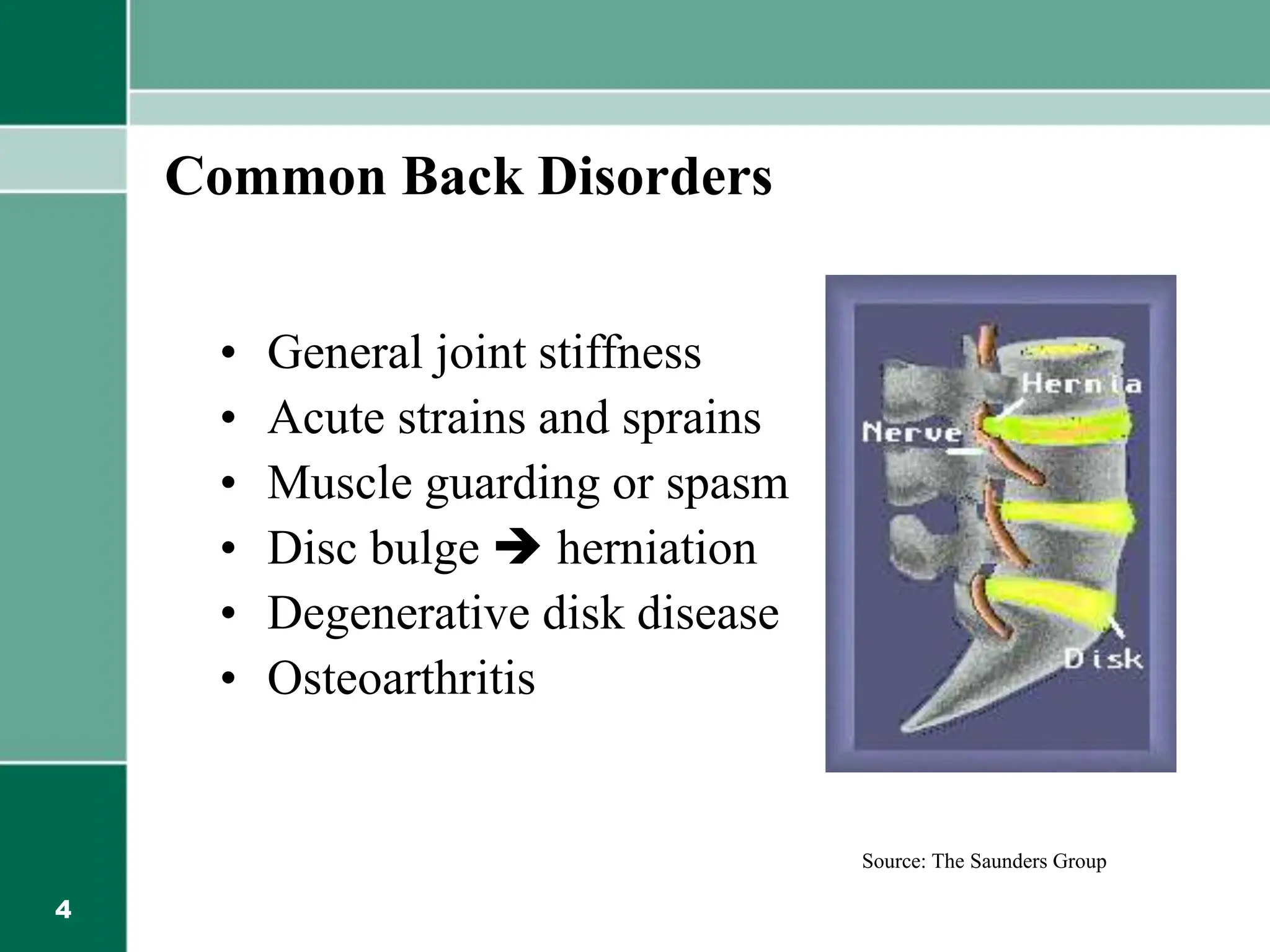
Common Back Disorders
• General joint stiffness
• Acute strains and sprains
• Muscle guarding or spasm
• Disc bulge  herniation
• Degenerative disk disease
• Osteoarthritis
Source: The Saunders Group
5
Anatomy Review…
the spine
• Bones
• Joints
• Discs
• Muscles and ligaments
• Nerves
6
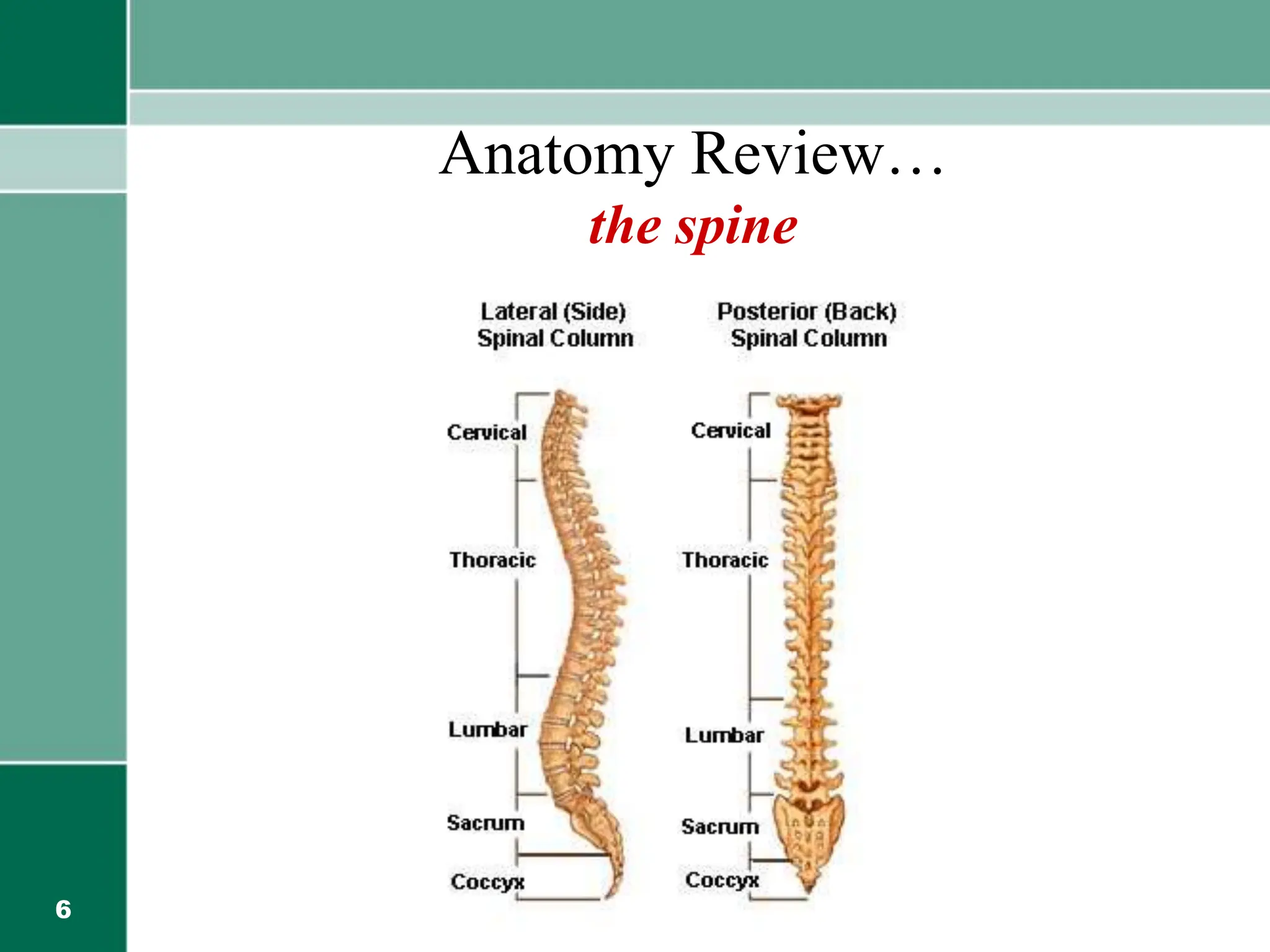
Anatomy Review…
the spine
7
8
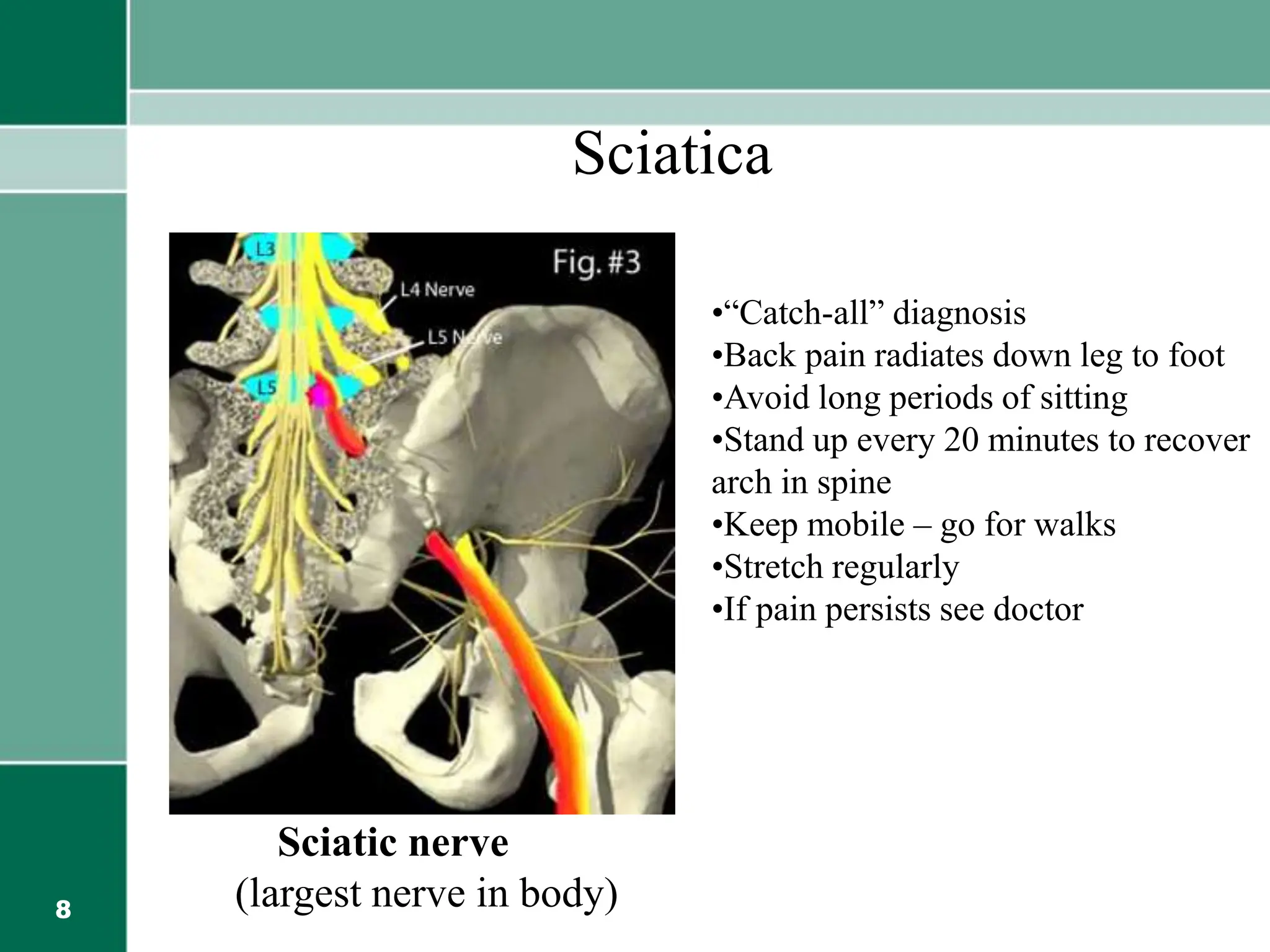
Sciatica
Sciatic nerve
(largest nerve in body)
•“Catch-all” diagnosis
•Back pain radiates down leg to foot
•Avoid long periods of sitting
•Stand up every 20 minutes to recover
arch in spine
•Keep mobile – go for walks
•Stretch regularly
•If pain persists see doctor
9
Back
Problem
Weakness
Stiffness
Stop
Moving
Hurts to
Move
Back Injury Cycle
Source: The Saunders Group
10
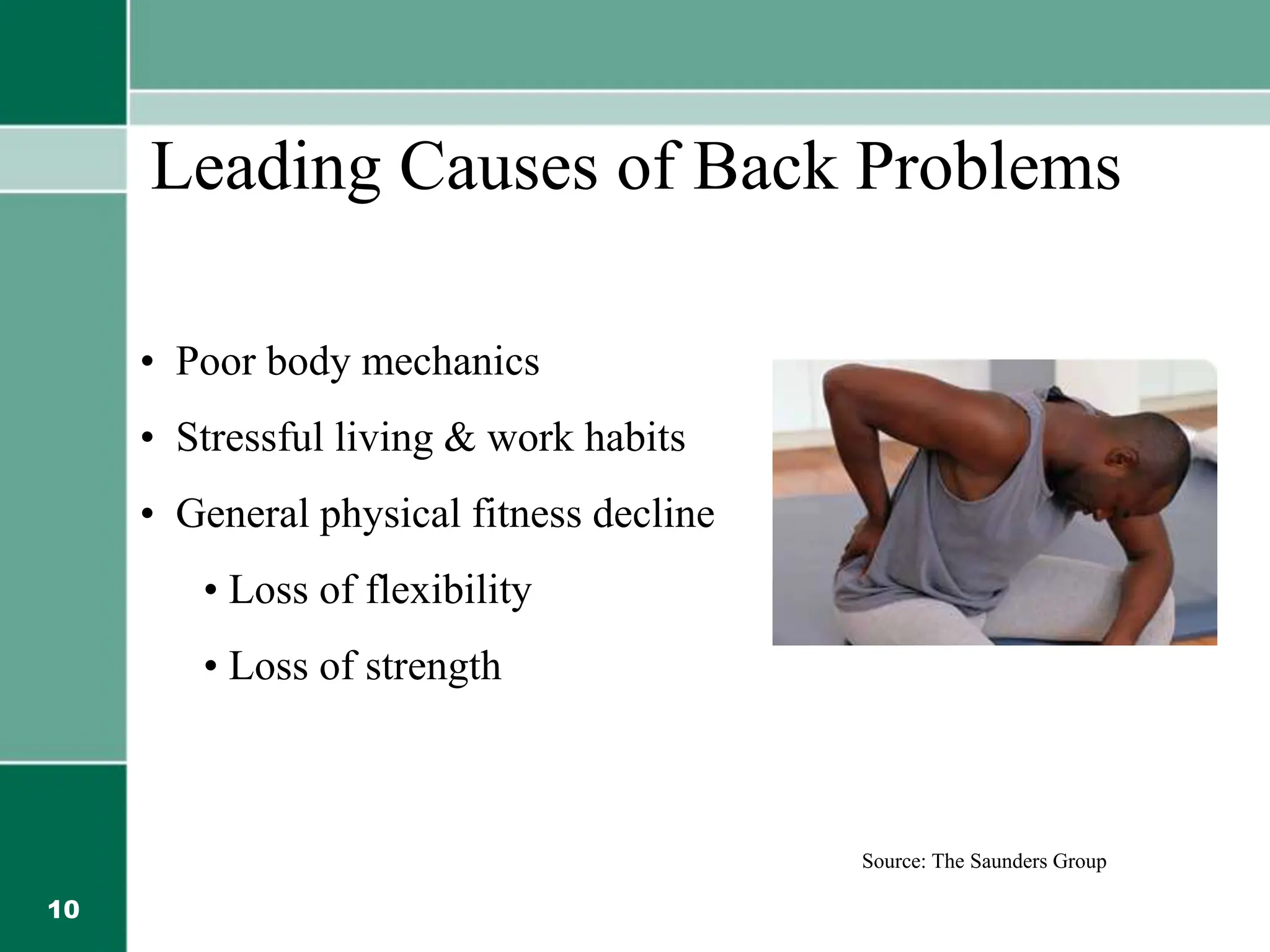
• Poor body mechanics
• Stressful living & work habits
• General physical fitness decline
• Loss of flexibility
• Loss of strength
Leading Causes of Back Problems
Source: The Saunders Group
11
Another cause of back problems…
accidents
It is also possible to injure
your back due to accidents.
12
How do we take care of our back?
• Body Mechanics
• Proper Lifting Techniques
• Maintain safe postures
• Keep physically fit
• Stretch and exercise
• Stress management
• Good nutrition Source: The Saunders Group
13
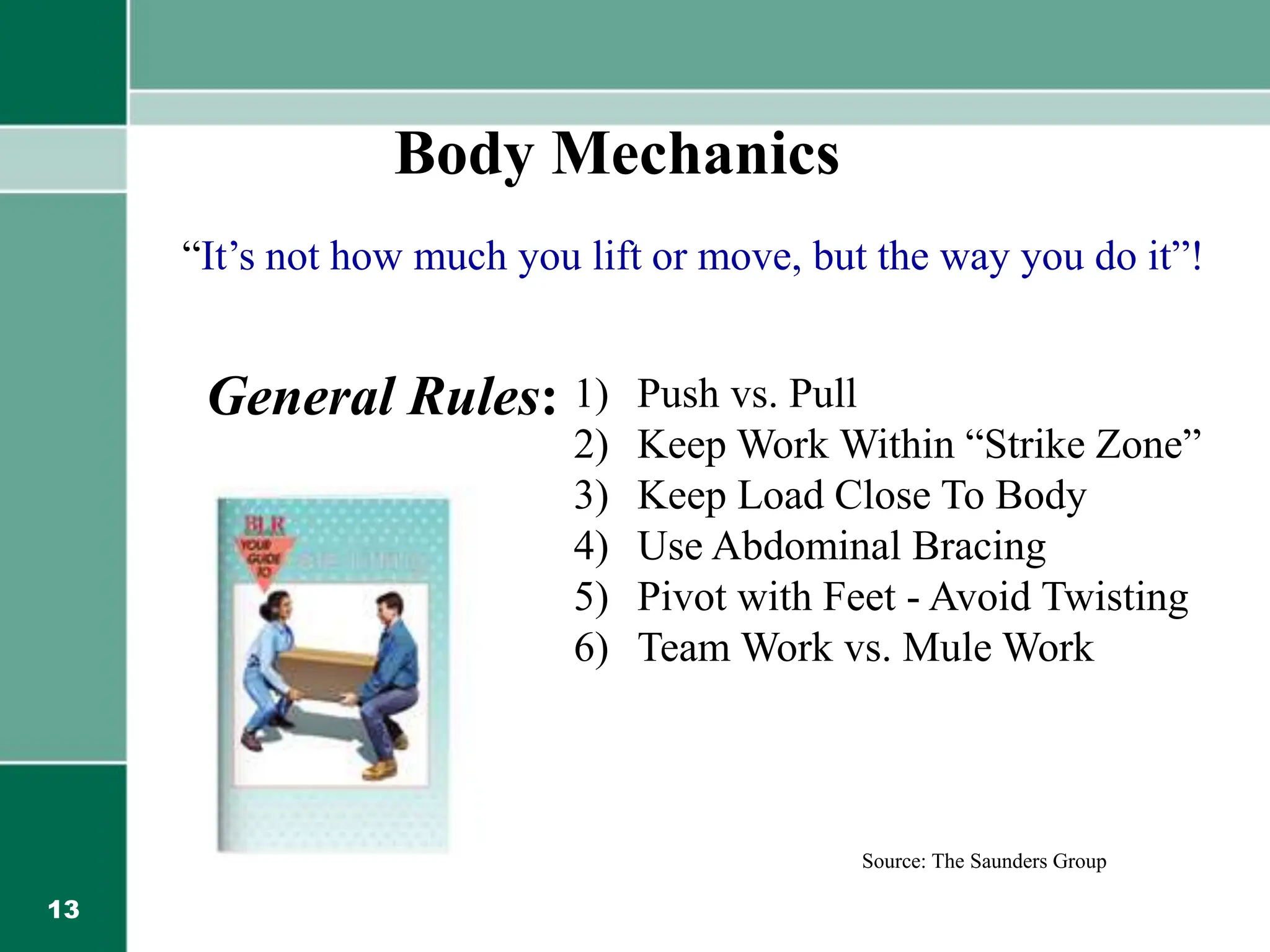
“It’s not how much you lift or move, but the way you do it”!
1) Push vs. Pull
2) Keep Work Within “Strike Zone”
3) Keep Load Close To Body
4) Use Abdominal Bracing
5) Pivot with Feet - Avoid Twisting
6) Team Work vs. Mule Work
Body Mechanics
General Rules:
Source: The Saunders Group
14
Place objects up off the floor. Set objects
down on a table or other elevated surface
instead of on the floor.
Raise / lower shelves. The best zone for
lifting is between your shoulders and your
waist. Put heavier objects on shelves at waist
level, lighter objects on lower or higher
shelves.
Avoid lifting and bending when able
15
Power Position:
• Wide base of support
• Feet shoulder width apart
• Back straight
• Head and shoulders up
• Bend at hips and knees - NOT BACK!
• Keep load close to body
• Tighten stomach muscles
• Use leg, hip and buttock muscles
• Breathe out with lift
Proper Lifting Technique
16
QUESTIONS?
17
Back Safety isn’t just a work thing!
The big picture…
18
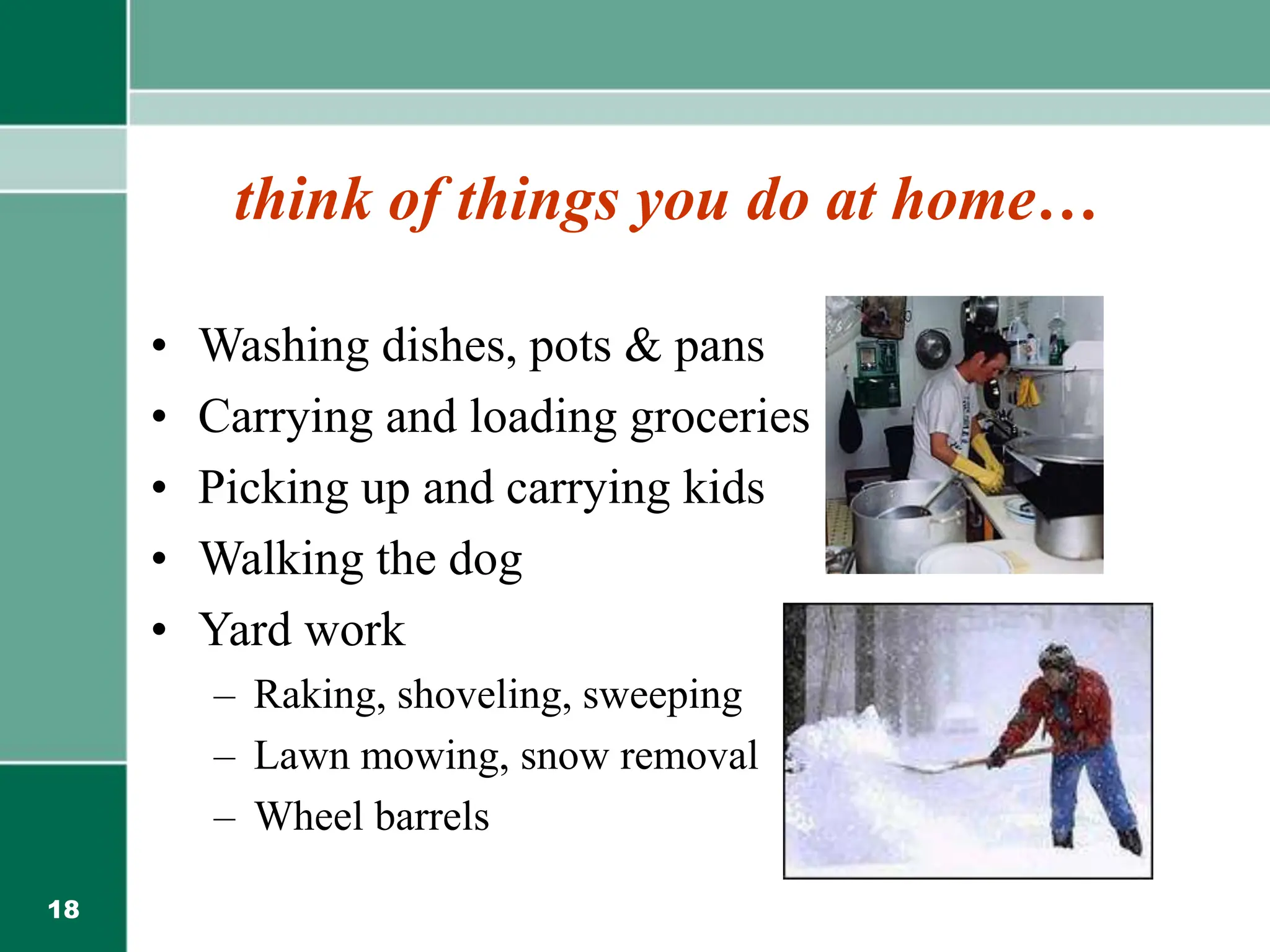
think of things you do at home…
• Washing dishes, pots & pans
• Carrying and loading groceries
• Picking up and carrying kids
• Walking the dog
• Yard work
– Raking, shoveling, sweeping
– Lawn mowing, snow removal
– Wheel barrels
19
think of driving your car…
• Elbow resting on door, center console
• Wrist over steering wheel
• Buttock and back pain
• Posture
• Nerve and tissue compression
• Position of legs while driving
• Muscle strain: hamstring tightness
– Decreased circulation
– Increased pain – lateral right knee
• Upper neck/back tension and pain
– Muscle strain:upper trapezius
– Stress reactions, trigger points
• Eye strain
– Glare
– Dehydration
20
think of sleeping in your bed…
• Neck posture
• Shoulder and arm posture
• Wrist posture
• Knee and hip posture
• Back posture
For long periods of time: static and awkward positions,
decreased circulation, increased compression!
21
there is no magic solution…
we are all unique in certain ways
• Age
• Gender
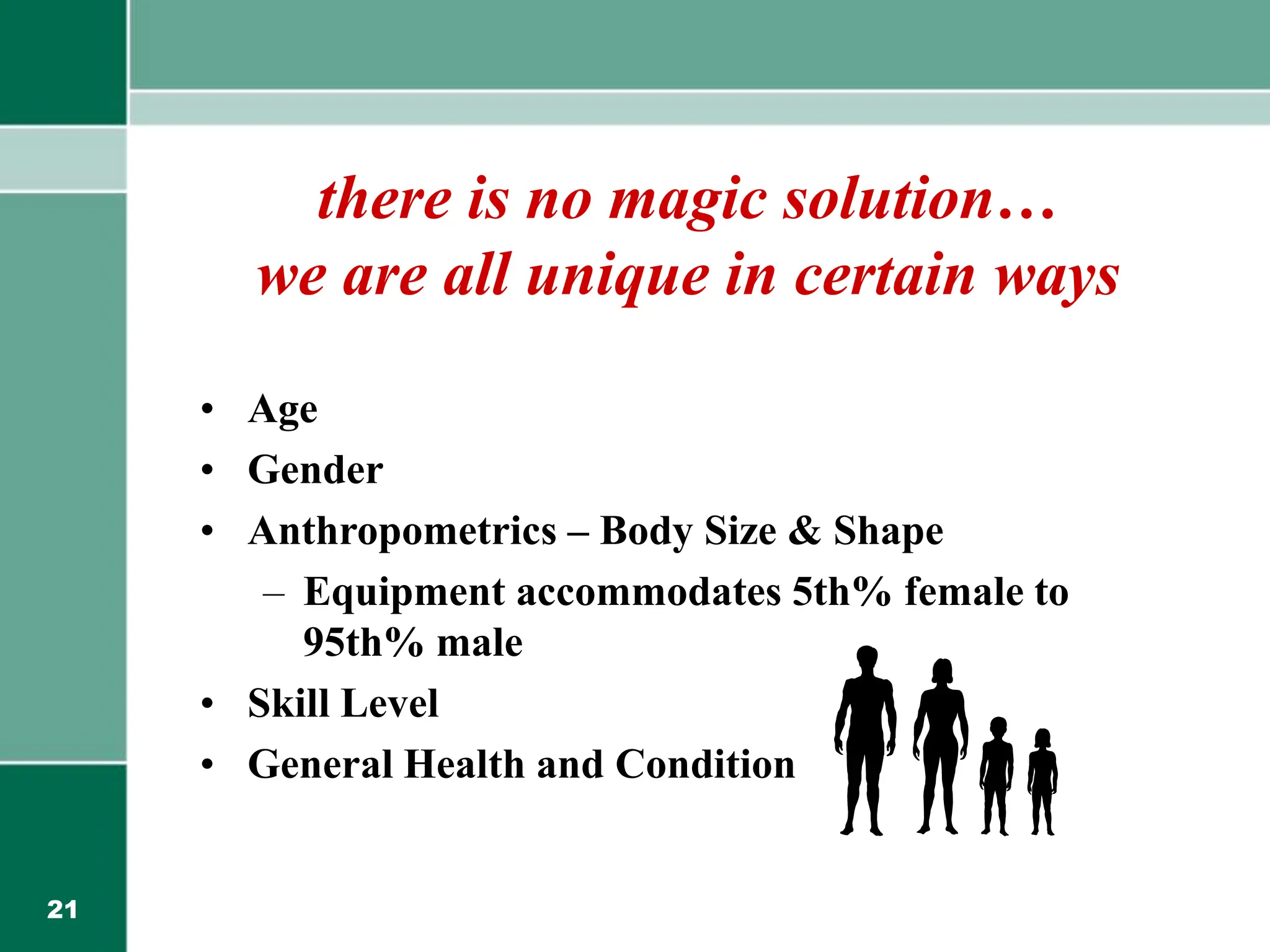
• Anthropometrics – Body Size & Shape
– Equipment accommodates 5th% female to
95th% male
• Skill Level
• General Health and Condition
22
Injury Prevention…
Conditioning is key!
• Strength and Stability
• Flexibility
• Aerobics for endurance
• Anaerobics for recovery
23
Aerobic Exercise
• 20-30 minutes per day
• Enhanced circulation - healthier heart
• Weight management benefit
• Increases endurance & decreases recovery time
• Enables sustained performance without increased
stress to body systems
• Breathing rates return to normal quicker after
strenuous work
• Heart maintains more constant rate as opposed to
peaks and valleys
24
Other benefits of conditioning…
• Reduction in blood pressure
• Increase in good (HDL) cholesterol
• Decreased total cholesterol
• Increased heart function
• Decreased body fat stores
• Increased aerobic capacity
• Decreased clinical symptoms of anxiety, tension, depression
• Possible reduction in mortality in post-heart attack patients
25
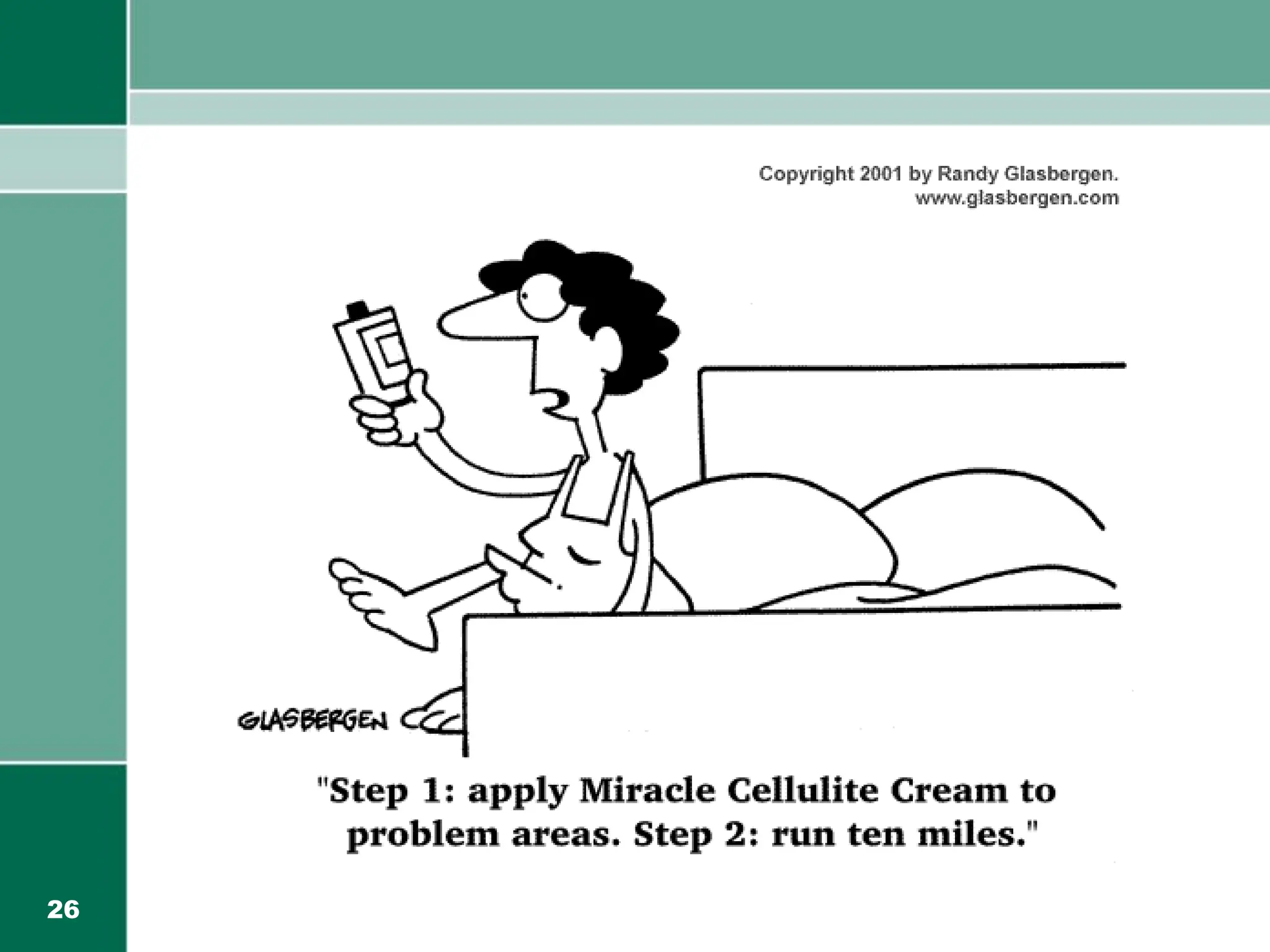
Making Physical Activity
a Part of Your Life.
There are 1440 minutes in every
day...Schedule 30 of them for physical
activity.
26
27
 Trunk
 Abdominals
 Extensors
 Legs
 Quads
 Gluts
 Hip Flexors
Strength & Flexibility
areas of focus…
28
Stability Exercises
• Crunches
• Press Ups
• Bird Dog
29
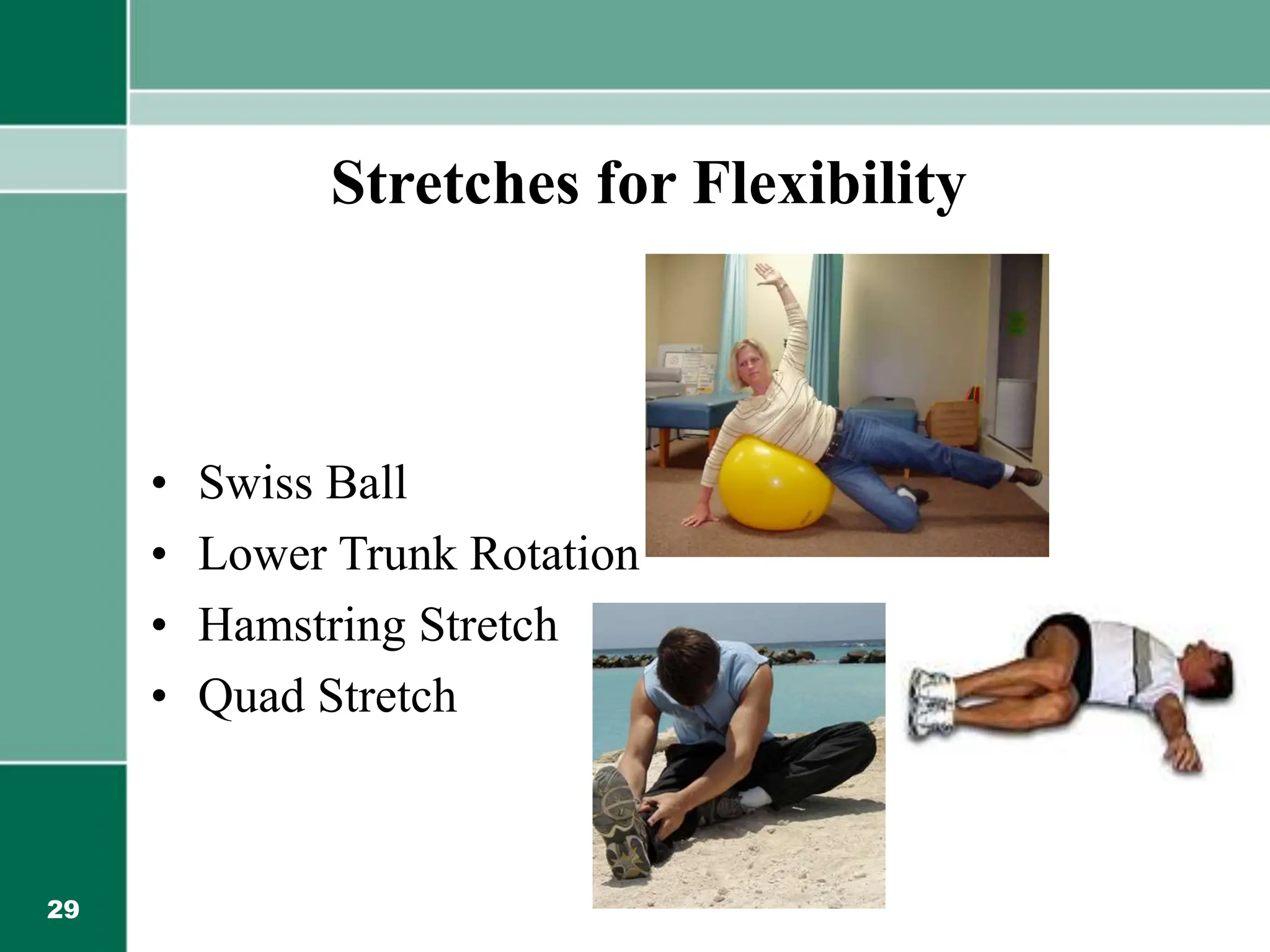
Stretches for Flexibility
• Swiss Ball
• Lower Trunk Rotation
• Hamstring Stretch
• Quad Stretch
30
QUESTIONS?

SoNH BACK CARE.......................ppt

  • 1.
    1 Back Safety Presented by:Bill Byron September 25, 2009
  • 2.
    2 • About 87.5million cases of low back pain in India, • Back problems are the most frequent cause of activity limitations in working-age adults • In the long run, surgery, chiropractic care, etc., are considered no more effective than no treatment in reducing low back pain…so, prevention is key! Back facts in general…
  • 3.
    3 Personal factors • Age –LBP occurs greatest among 35-55 y/o • Gender – Equal among males and females • Anthropometry – No evidence based on body size or shape • Physical fitness and conditioning – Evidence supports conditioning, optimal type in question • Lumbar mobility – No evidence that reduced mobility associated with LBP • Strength – Some evidence linking poor physical performance to LBP • Medical history – Evidence that hx of LBP increases risk for future problems • Structural abnormalities – No strong evidence exists between this factor and LBP – Source: NYC firefighter study
  • 4.
    4 Common Back Disorders •General joint stiffness • Acute strains and sprains • Muscle guarding or spasm • Disc bulge  herniation • Degenerative disk disease • Osteoarthritis Source: The Saunders Group
  • 5.
    5 Anatomy Review… the spine •Bones • Joints • Discs • Muscles and ligaments • Nerves
  • 6.
  • 7.
  • 8.
    8 Sciatica Sciatic nerve (largest nervein body) •“Catch-all” diagnosis •Back pain radiates down leg to foot •Avoid long periods of sitting •Stand up every 20 minutes to recover arch in spine •Keep mobile – go for walks •Stretch regularly •If pain persists see doctor
  • 9.
  • 10.
    10 • Poor bodymechanics • Stressful living & work habits • General physical fitness decline • Loss of flexibility • Loss of strength Leading Causes of Back Problems Source: The Saunders Group
  • 11.
    11 Another cause ofback problems… accidents It is also possible to injure your back due to accidents.
  • 12.
    12 How do wetake care of our back? • Body Mechanics • Proper Lifting Techniques • Maintain safe postures • Keep physically fit • Stretch and exercise • Stress management • Good nutrition Source: The Saunders Group
  • 13.
    13 “It’s not howmuch you lift or move, but the way you do it”! 1) Push vs. Pull 2) Keep Work Within “Strike Zone” 3) Keep Load Close To Body 4) Use Abdominal Bracing 5) Pivot with Feet - Avoid Twisting 6) Team Work vs. Mule Work Body Mechanics General Rules: Source: The Saunders Group
  • 14.
    14 Place objects upoff the floor. Set objects down on a table or other elevated surface instead of on the floor. Raise / lower shelves. The best zone for lifting is between your shoulders and your waist. Put heavier objects on shelves at waist level, lighter objects on lower or higher shelves. Avoid lifting and bending when able
  • 15.
    15 Power Position: • Widebase of support • Feet shoulder width apart • Back straight • Head and shoulders up • Bend at hips and knees - NOT BACK! • Keep load close to body • Tighten stomach muscles • Use leg, hip and buttock muscles • Breathe out with lift Proper Lifting Technique
  • 16.
  • 17.
    17 Back Safety isn’tjust a work thing! The big picture…
  • 18.
    18 think of thingsyou do at home… • Washing dishes, pots & pans • Carrying and loading groceries • Picking up and carrying kids • Walking the dog • Yard work – Raking, shoveling, sweeping – Lawn mowing, snow removal – Wheel barrels
  • 19.
    19 think of drivingyour car… • Elbow resting on door, center console • Wrist over steering wheel • Buttock and back pain • Posture • Nerve and tissue compression • Position of legs while driving • Muscle strain: hamstring tightness – Decreased circulation – Increased pain – lateral right knee • Upper neck/back tension and pain – Muscle strain:upper trapezius – Stress reactions, trigger points • Eye strain – Glare – Dehydration
  • 20.
    20 think of sleepingin your bed… • Neck posture • Shoulder and arm posture • Wrist posture • Knee and hip posture • Back posture For long periods of time: static and awkward positions, decreased circulation, increased compression!
  • 21.
    21 there is nomagic solution… we are all unique in certain ways • Age • Gender • Anthropometrics – Body Size & Shape – Equipment accommodates 5th% female to 95th% male • Skill Level • General Health and Condition
  • 22.
    22 Injury Prevention… Conditioning iskey! • Strength and Stability • Flexibility • Aerobics for endurance • Anaerobics for recovery
  • 23.
    23 Aerobic Exercise • 20-30minutes per day • Enhanced circulation - healthier heart • Weight management benefit • Increases endurance & decreases recovery time • Enables sustained performance without increased stress to body systems • Breathing rates return to normal quicker after strenuous work • Heart maintains more constant rate as opposed to peaks and valleys
  • 24.
    24 Other benefits ofconditioning… • Reduction in blood pressure • Increase in good (HDL) cholesterol • Decreased total cholesterol • Increased heart function • Decreased body fat stores • Increased aerobic capacity • Decreased clinical symptoms of anxiety, tension, depression • Possible reduction in mortality in post-heart attack patients
  • 25.
    25 Making Physical Activity aPart of Your Life. There are 1440 minutes in every day...Schedule 30 of them for physical activity.
  • 26.
  • 27.
    27  Trunk  Abdominals Extensors  Legs  Quads  Gluts  Hip Flexors Strength & Flexibility areas of focus…
  • 28.
  • 29.
    29 Stretches for Flexibility •Swiss Ball • Lower Trunk Rotation • Hamstring Stretch • Quad Stretch
  • 30.