Focused more for interview Perspective and Easy Understanding
Object-Oriented Programming (OOP) is a software development paradigm that suggests developers to split a program in building blocks known as objects. The OOP paradigm allows developers to define the object's data, functions, and its relationship with other objects.
Code Reusability Enables to model real world object Easy Modification Easy Maintenance More Flexible
Defines an Abstract thing of a thing (i.e. Object) Explaining its Behavior A user-defined data structure that groups properties and methods. Class doesn’t occupies memory. Class is a definition Abstract classes are classes that can have no instances
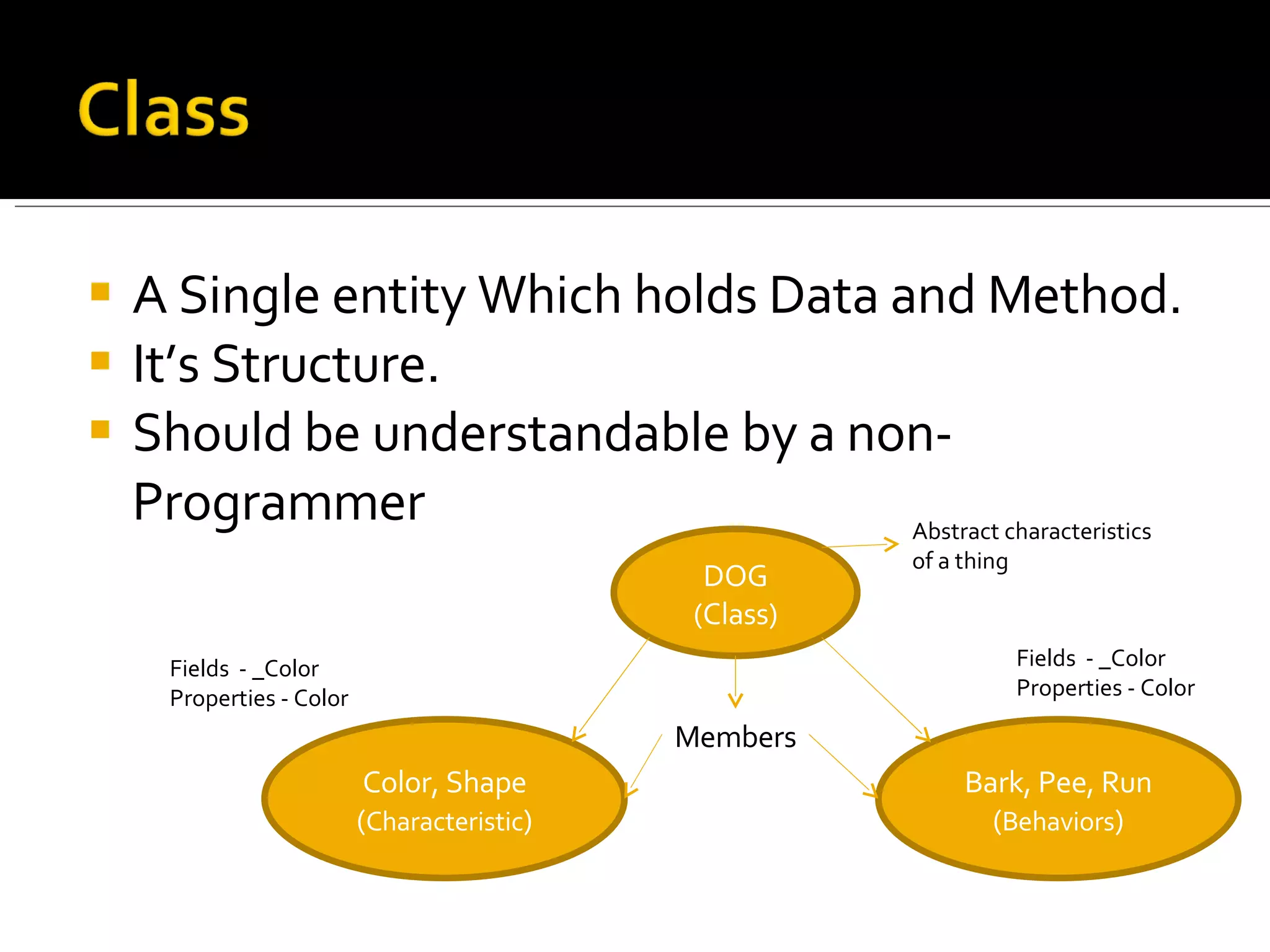
A Single entity Which holds Data and Method. It’s Structure. Should be understandable by a non- Programmer DOG (Class) Color, Shape ( Characteristic ) Bark, Pee, Run ( Behaviors ) Members Abstract characteristics  of a thing  Fields  - _Color Properties - Color Fields  - _Color Properties - Color
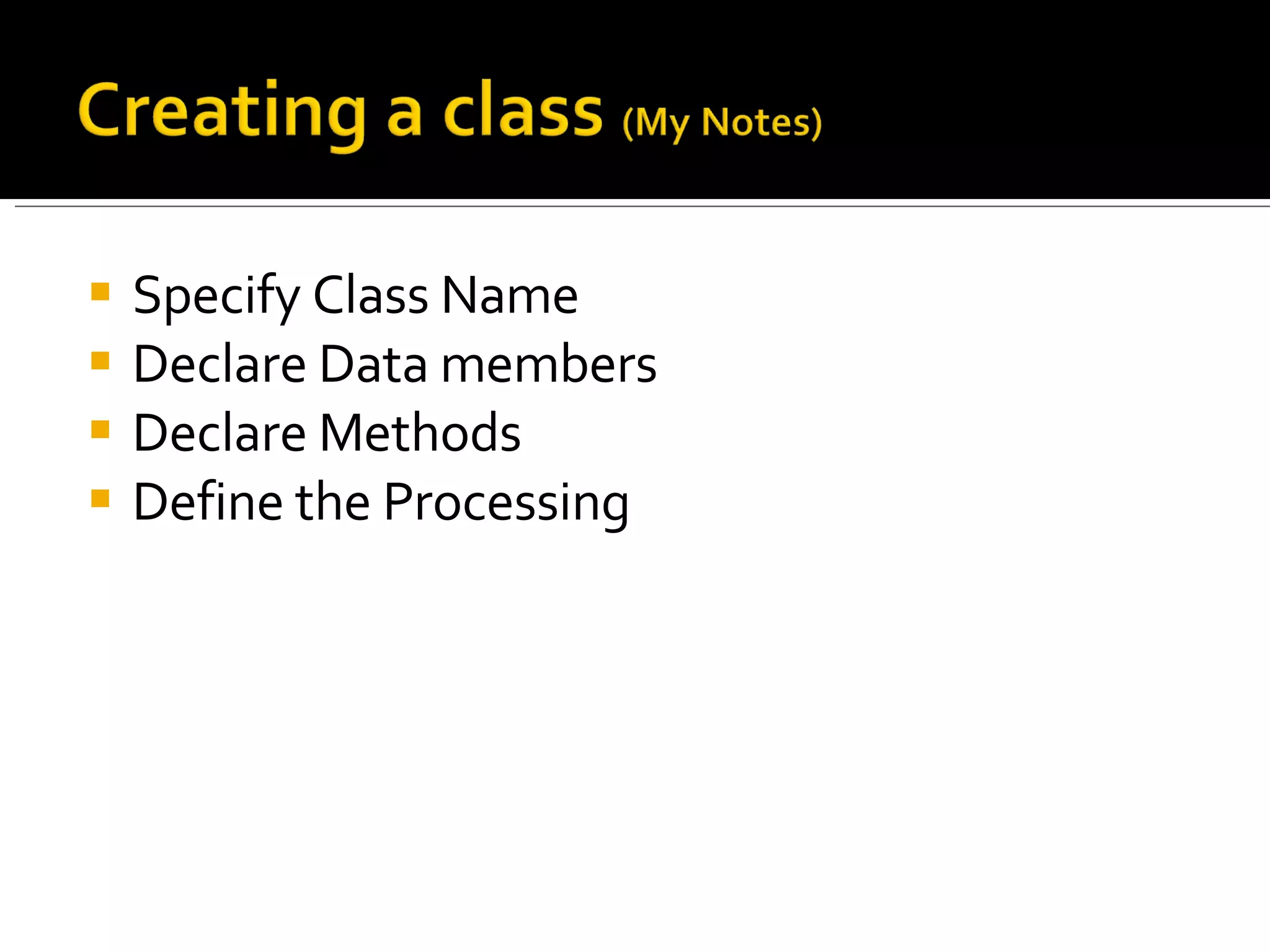
Specify Class Name Declare Data members Declare Methods Define the Processing
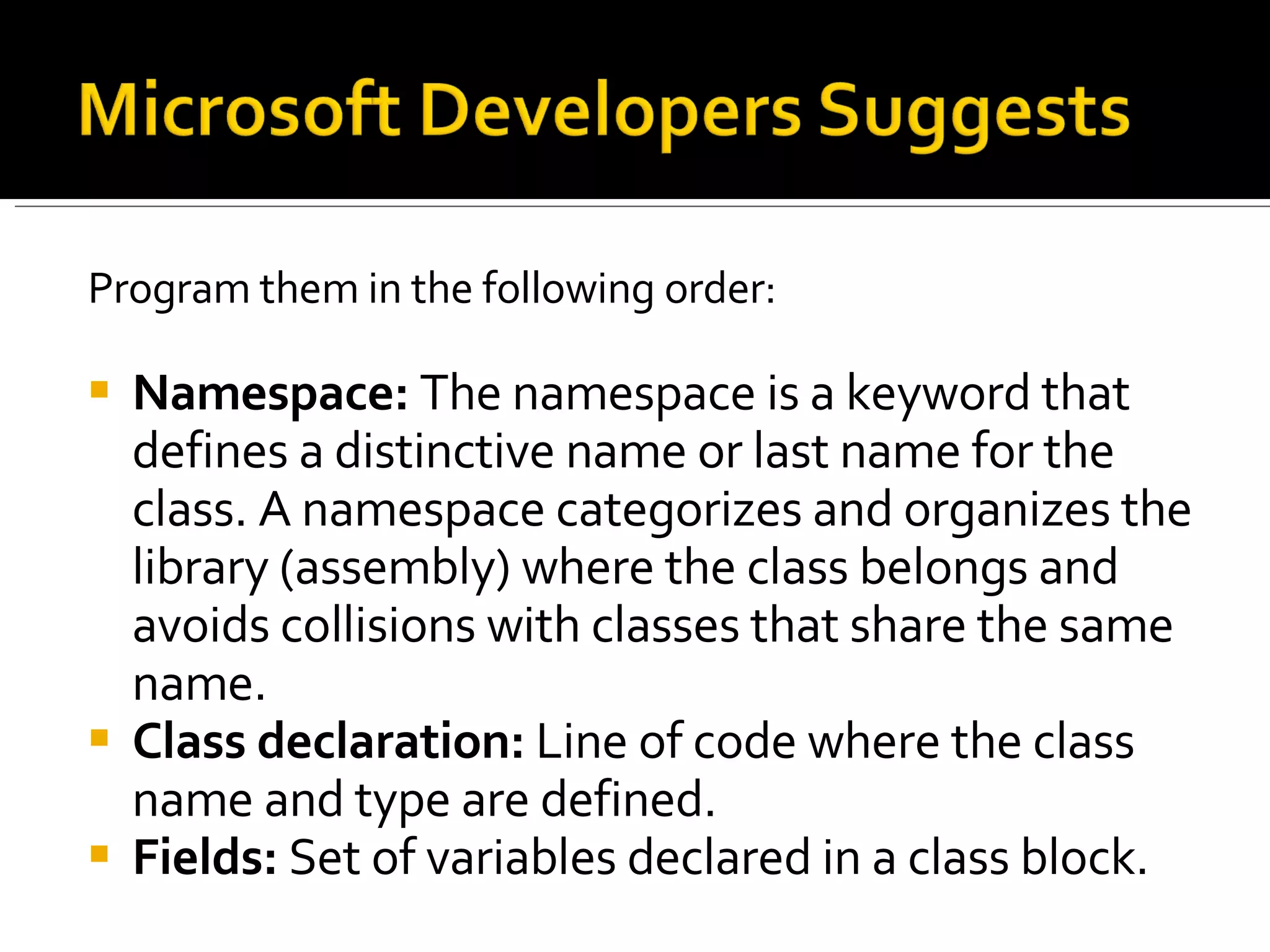
Program them in the following order: Namespace:  The namespace is a keyword that defines a distinctive name or last name for the class. A namespace categorizes and organizes the library (assembly) where the class belongs and avoids collisions with classes that share the same name.  Class declaration:  Line of code where the class name and type are defined.  Fields:  Set of variables declared in a class block.
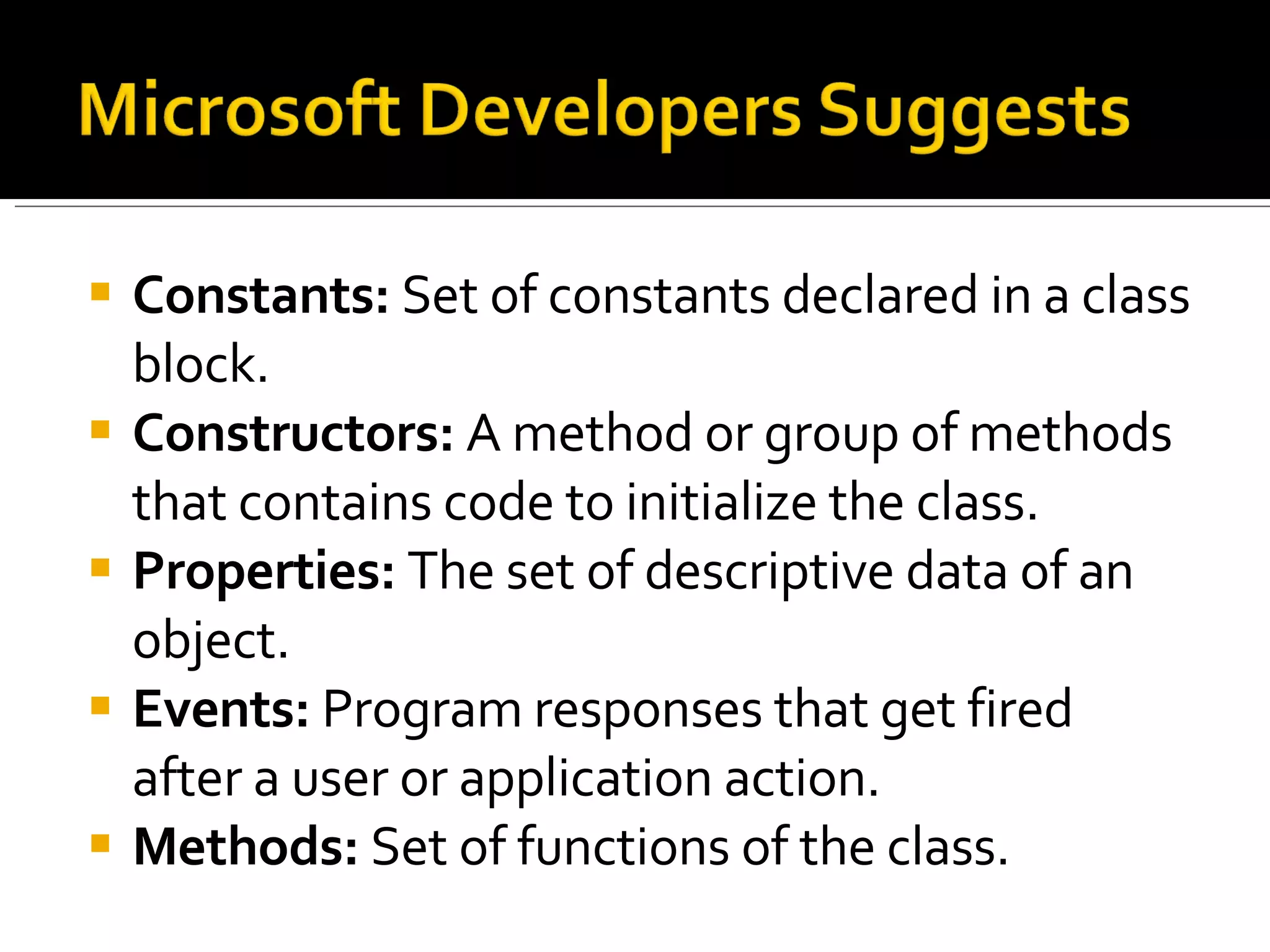
Constants:  Set of constants declared in a class block.  Constructors:  A method or group of methods that contains code to initialize the class.  Properties:  The set of descriptive data of an object.  Events:  Program responses that get fired after a user or application action.  Methods:  Set of functions of the class.
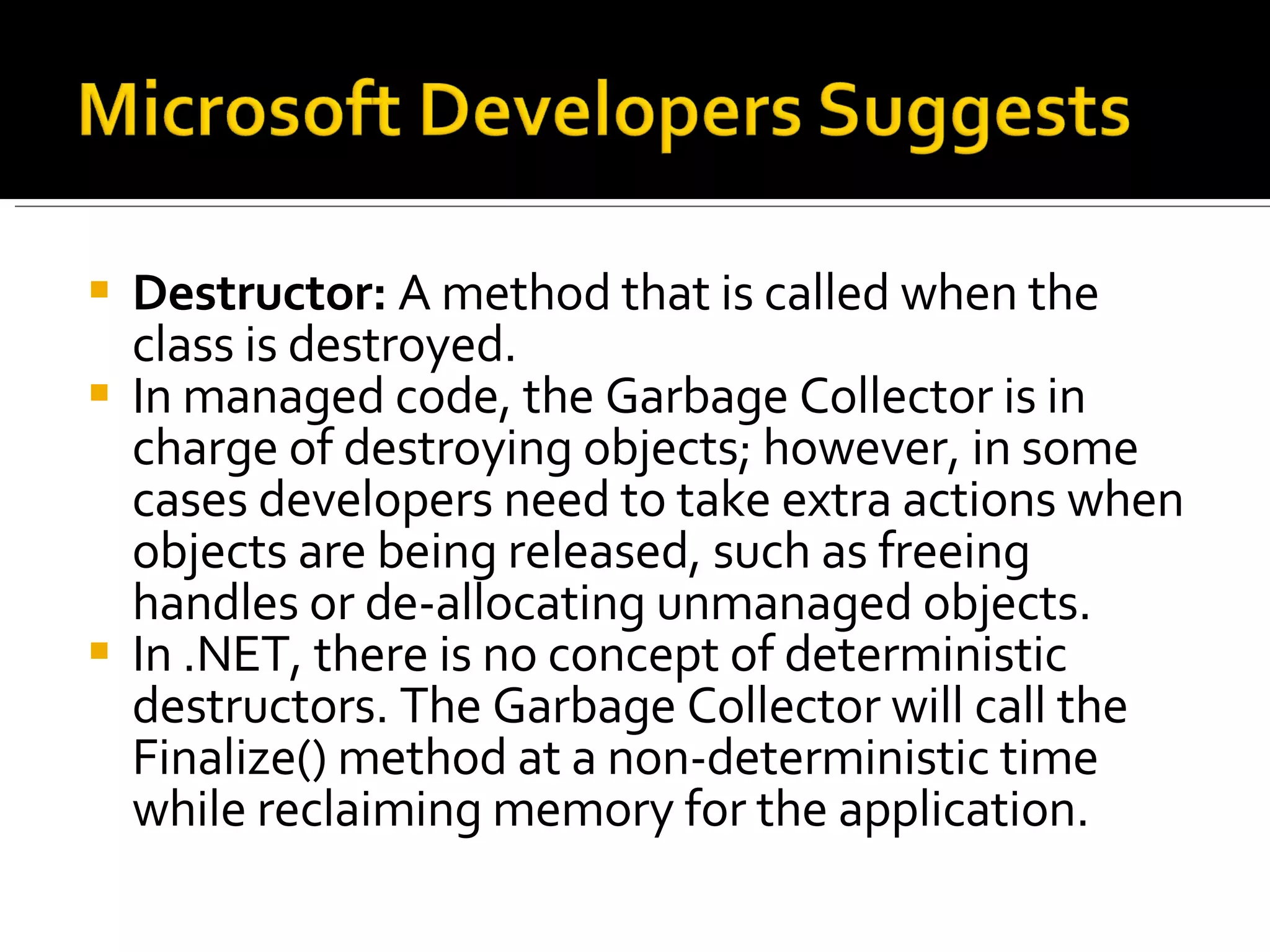
Destructor:  A method that is called when the class is destroyed.  In managed code, the Garbage Collector is in charge of destroying objects; however, in some cases developers need to take extra actions when objects are being released, such as freeing handles or de-allocating unmanaged objects.  In .NET, there is no concept of deterministic destructors. The Garbage Collector will call the Finalize() method at a non-deterministic time while reclaiming memory for the application.
 
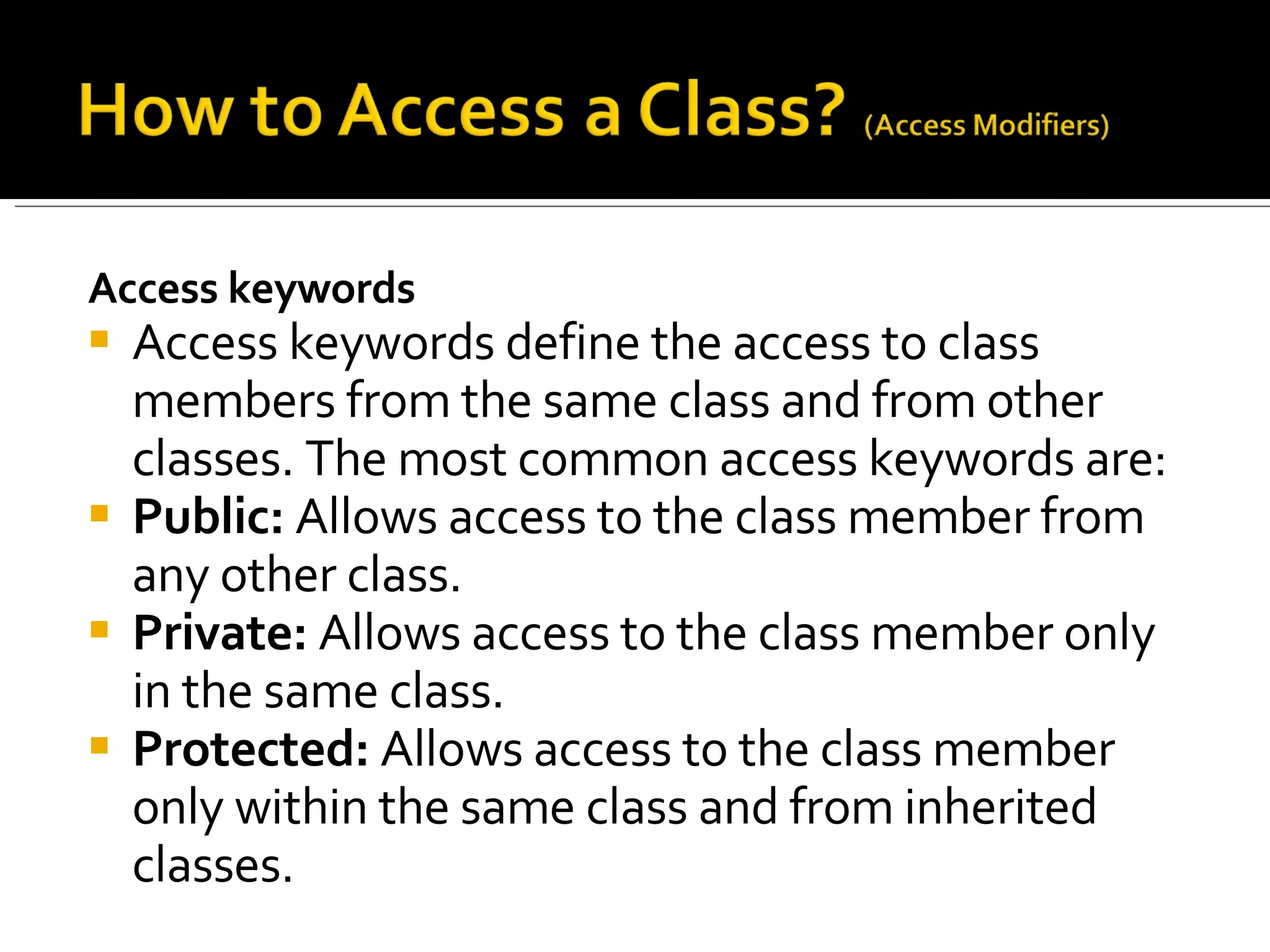
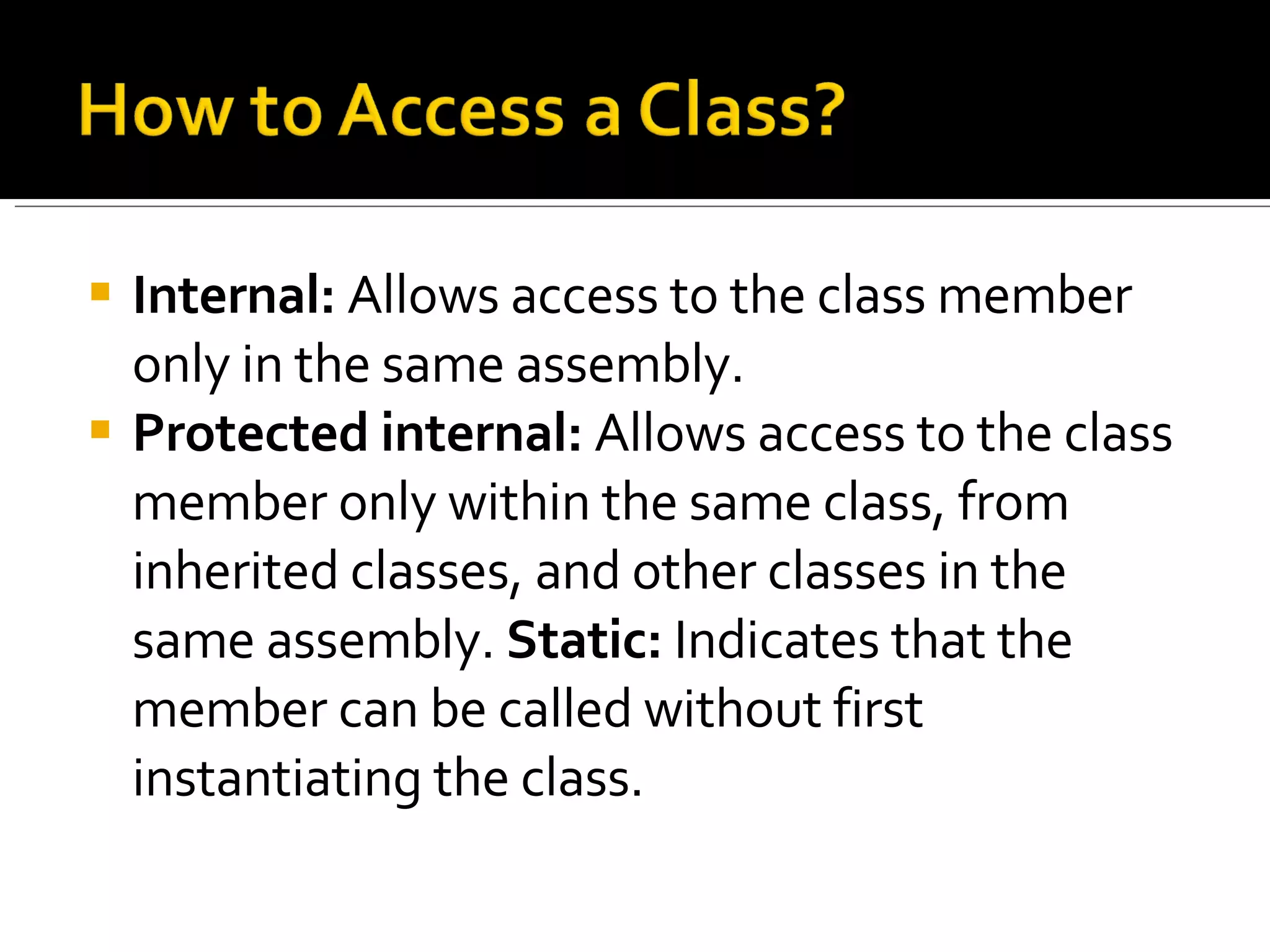
Access keywords Access keywords define the access to class members from the same class and from other classes. The most common access keywords are: Public:  Allows access to the class member from any other class.  Private:  Allows access to the class member only in the same class.  Protected:  Allows access to the class member only within the same class and from inherited classes.
Internal:  Allows access to the class member only in the same assembly.  Protected internal:  Allows access to the class member only within the same class, from inherited classes, and other classes in the same assembly.  Static:  Indicates that the member can be called without first instantiating the class.
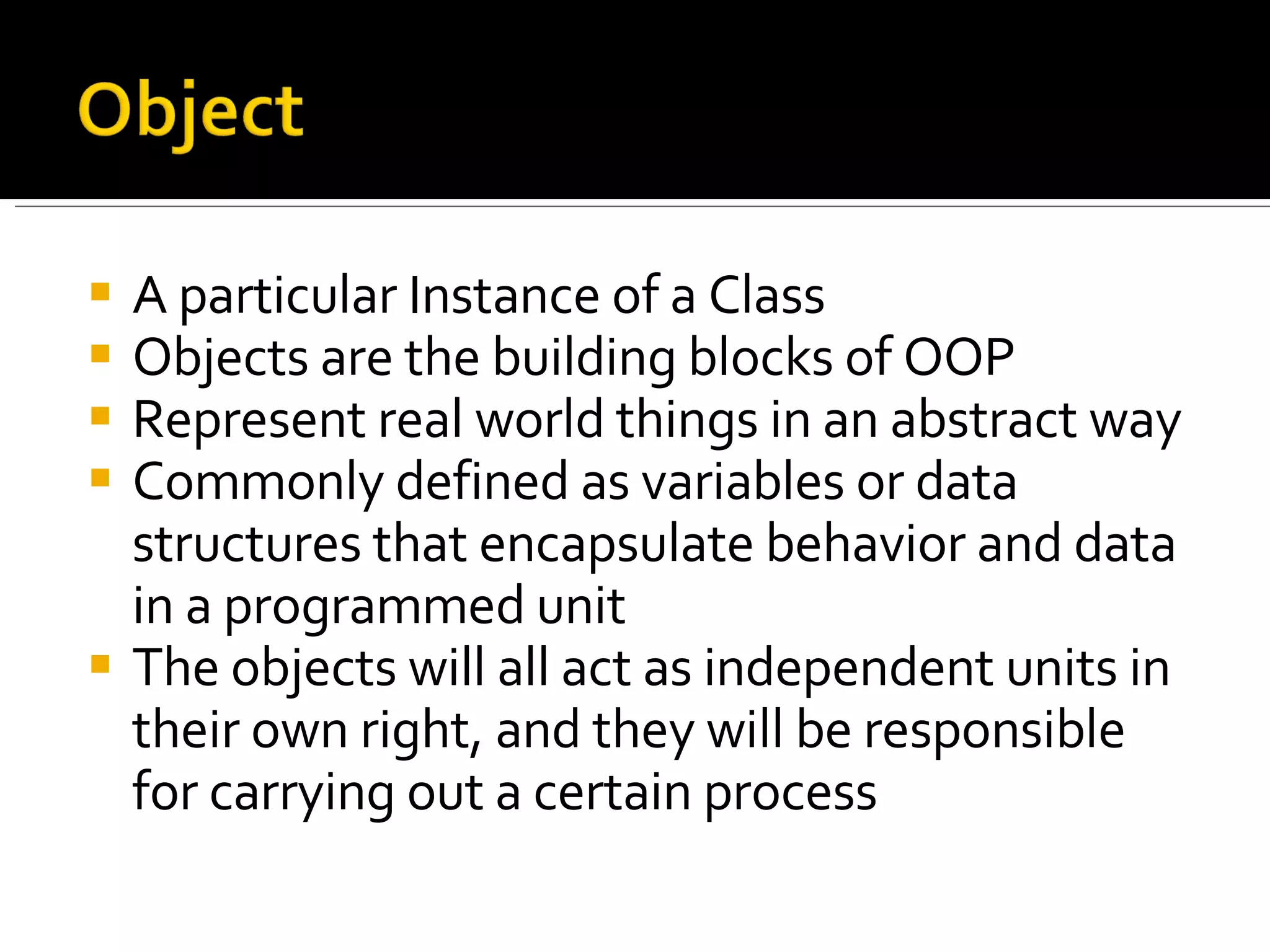
A particular Instance of a Class Objects are the building blocks of OOP Represent real world things in an abstract way Commonly defined as variables or data structures that encapsulate behavior and data in a programmed unit The objects will all act as independent units in their own right, and they will be responsible for carrying out a certain process
Object identity:   Every object is unique and can be differentiated from other objects. Each time and object is created (instantiated) the object identity is defined.  Object behavior:   What the object can do. In OOP, methods work as functions that define the set of actions that the object can do.  Objec t state:   The data stored within the object at any given moment. In OOP, fields, constants, and properties define the state of an object.
Inheritance Abstraction Polymorphism Encapsulation Event
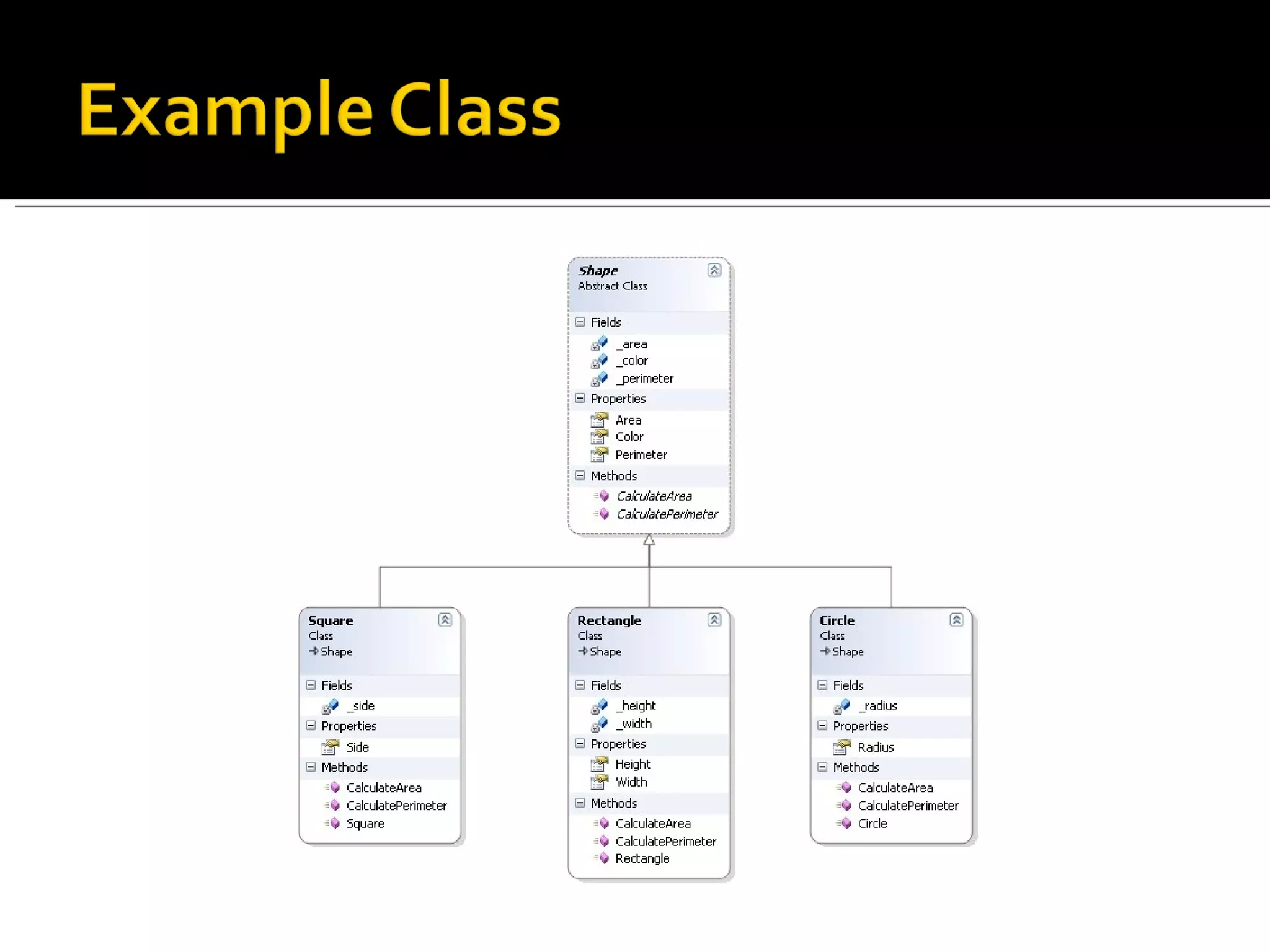
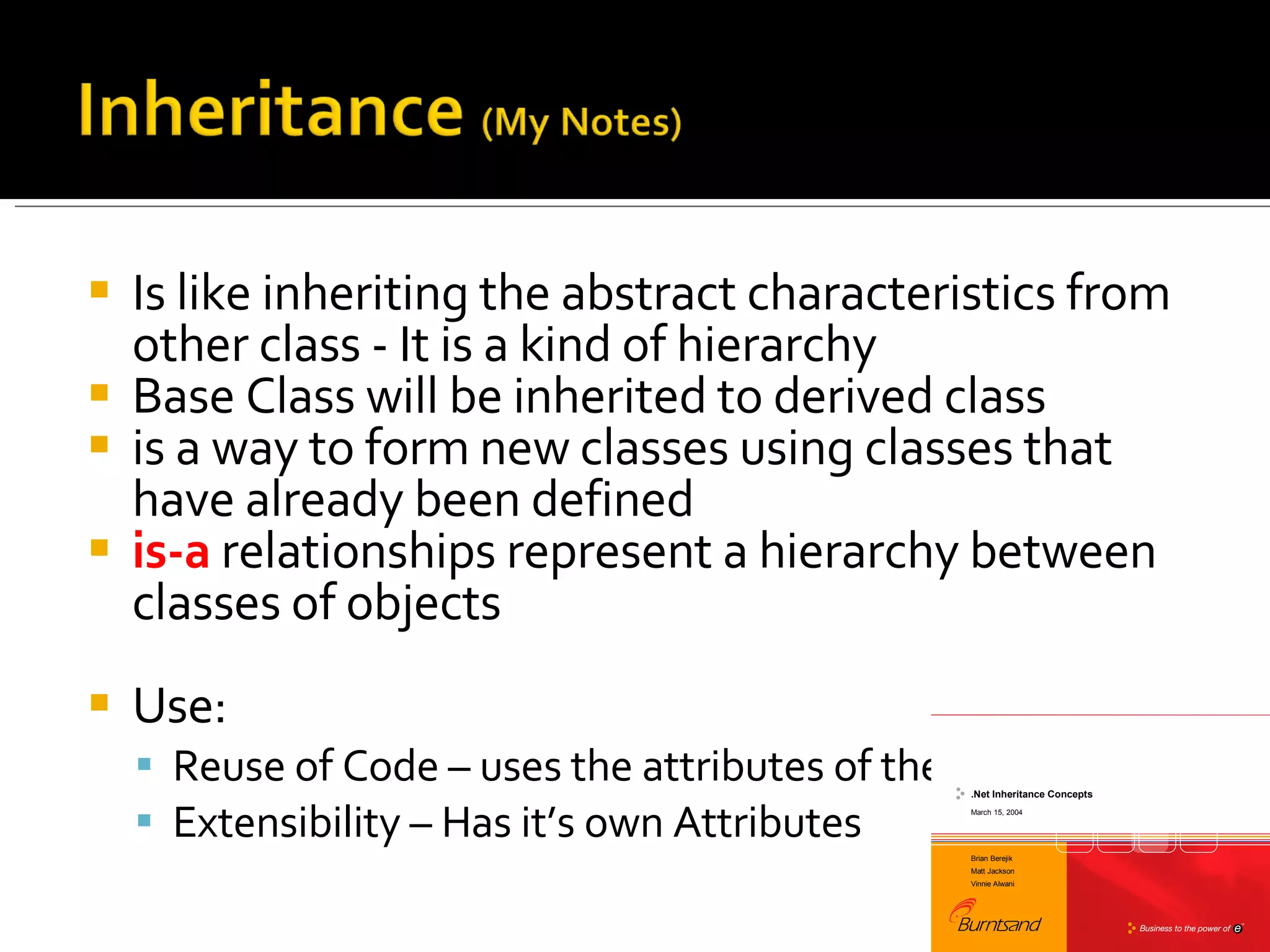
Is like inheriting the abstract characteristics from other class - It is a kind of hierarchy  Base Class will be inherited to derived class is a way to form new classes using classes that have already been defined is-a  relationships represent a hierarchy between classes of objects Use:  Reuse of Code – uses the attributes of the base class Extensibility – Has it’s own Attributes
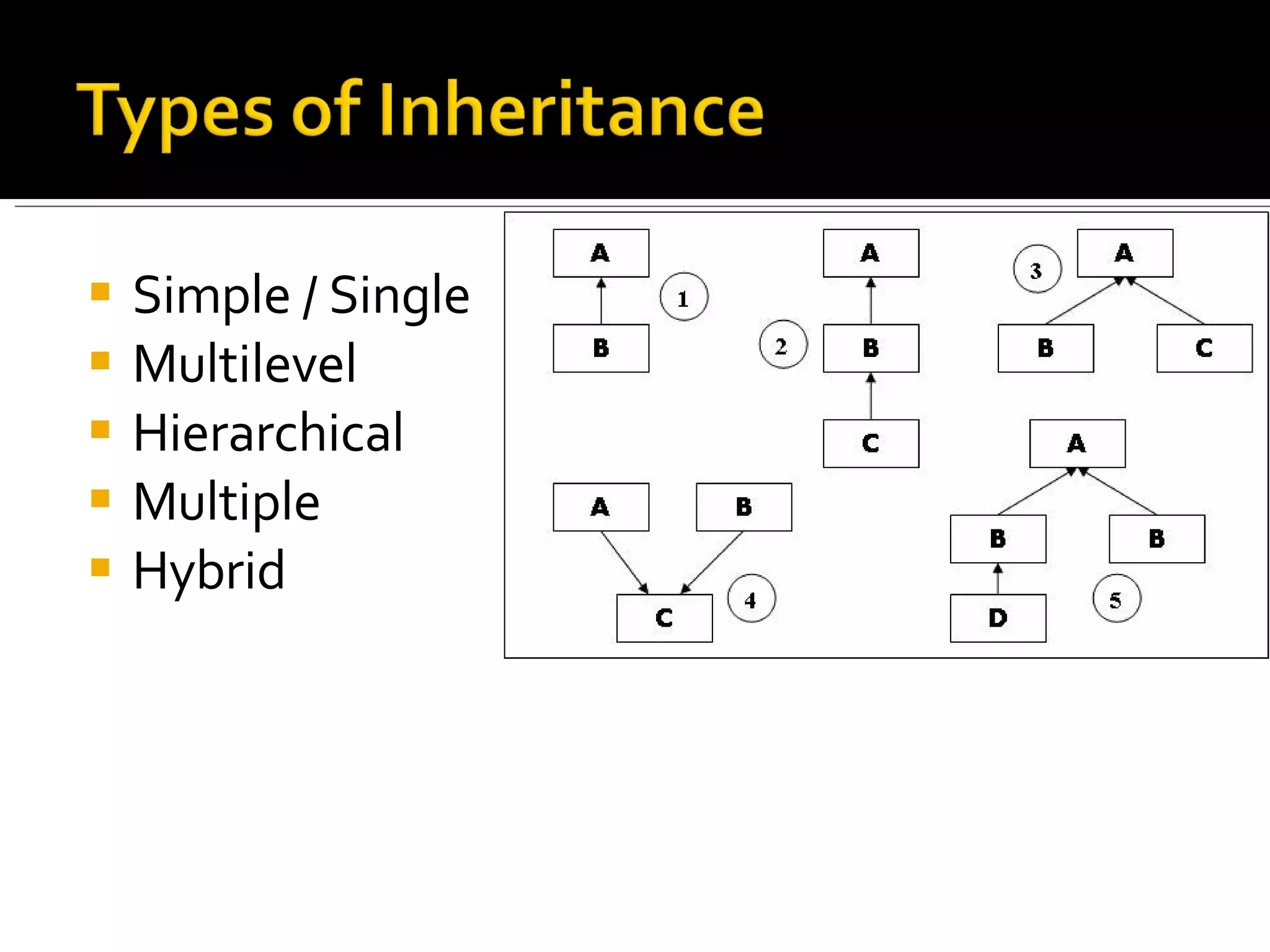
Simple / Single Multilevel Hierarchical Multiple Hybrid
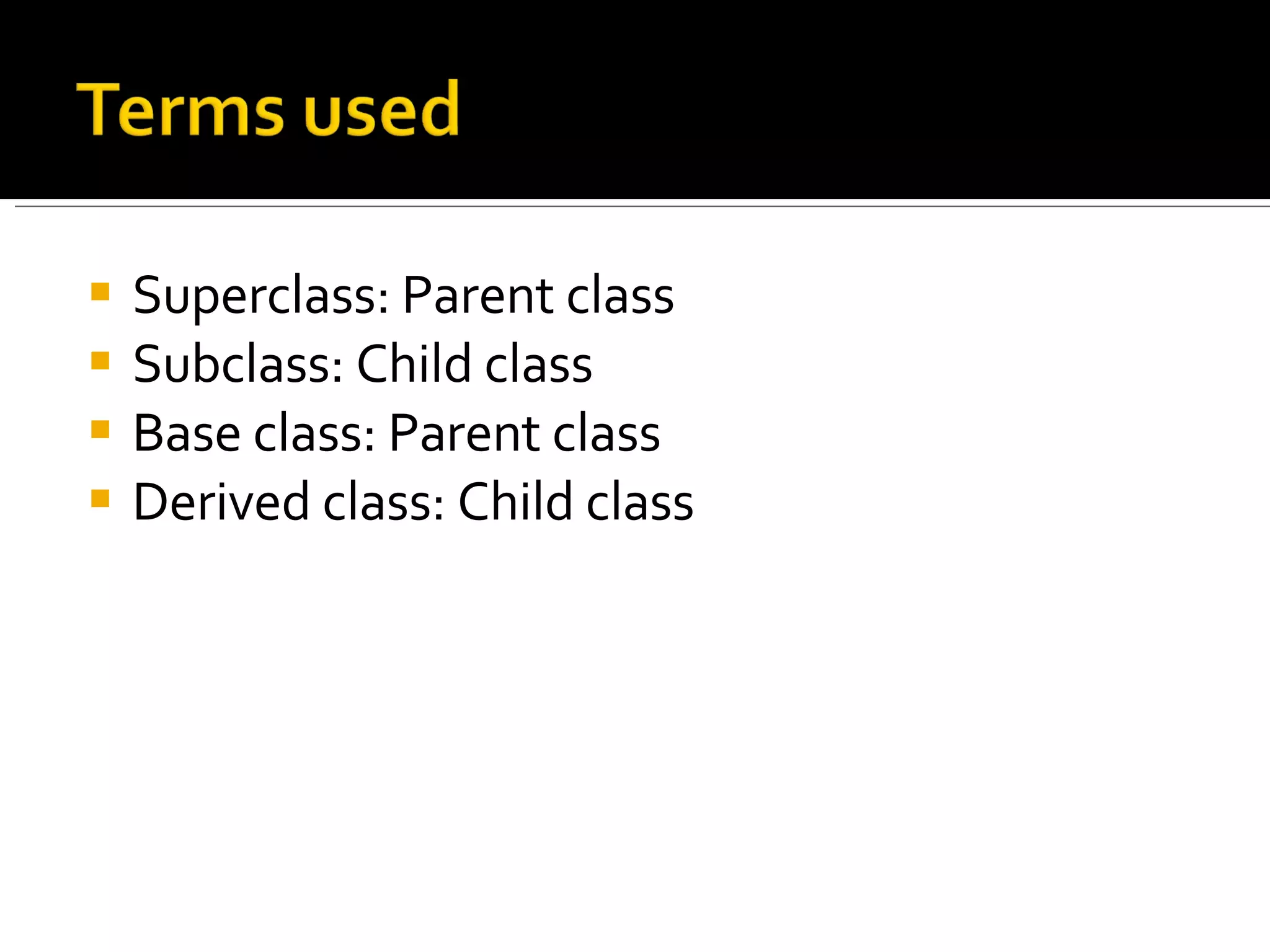
Superclass: Parent class Subclass: Child class Base class: Parent class Derived class: Child class
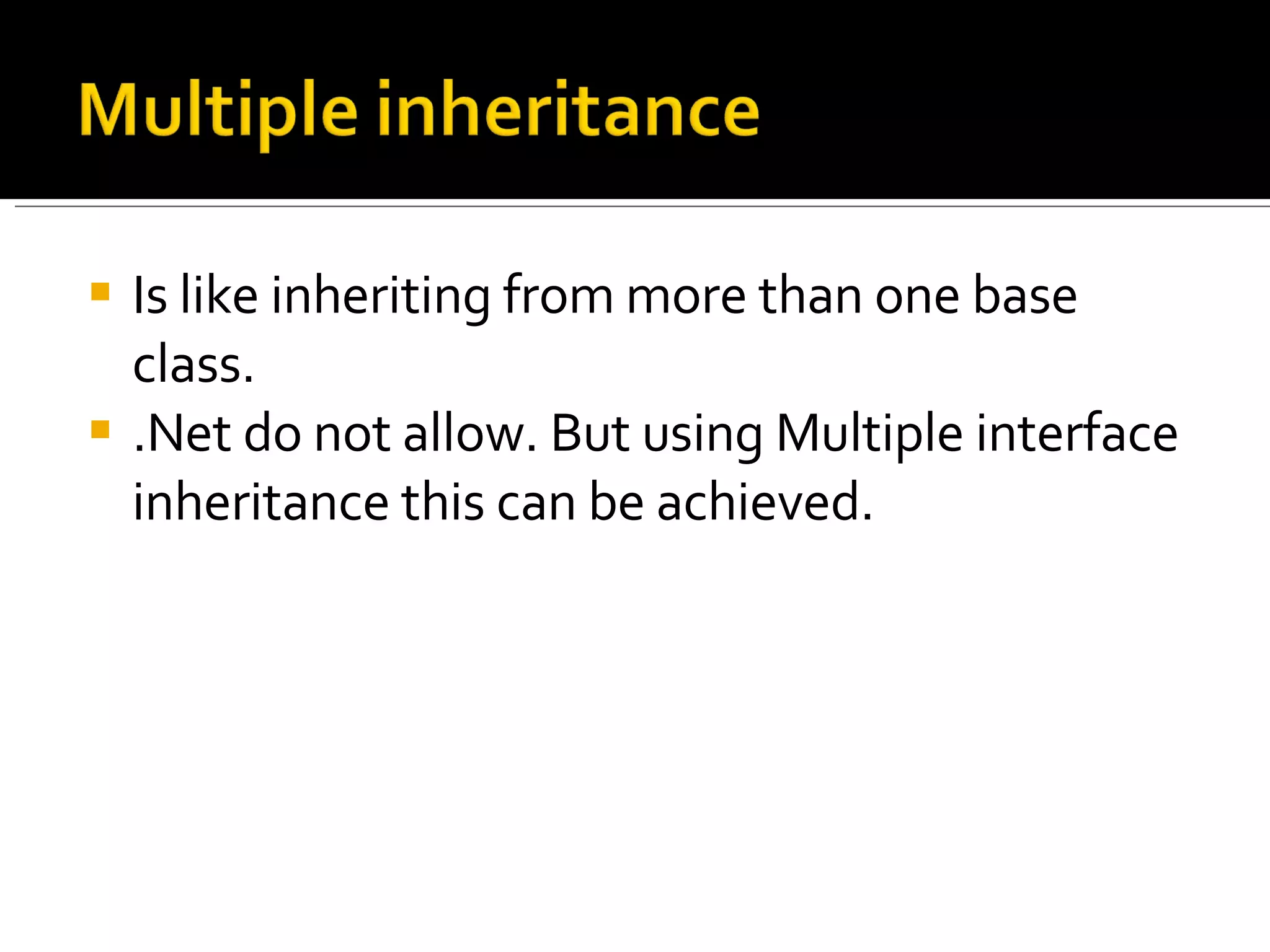
Is like inheriting from more than one base class. .Net do not allow. But using Multiple interface inheritance this can be achieved.
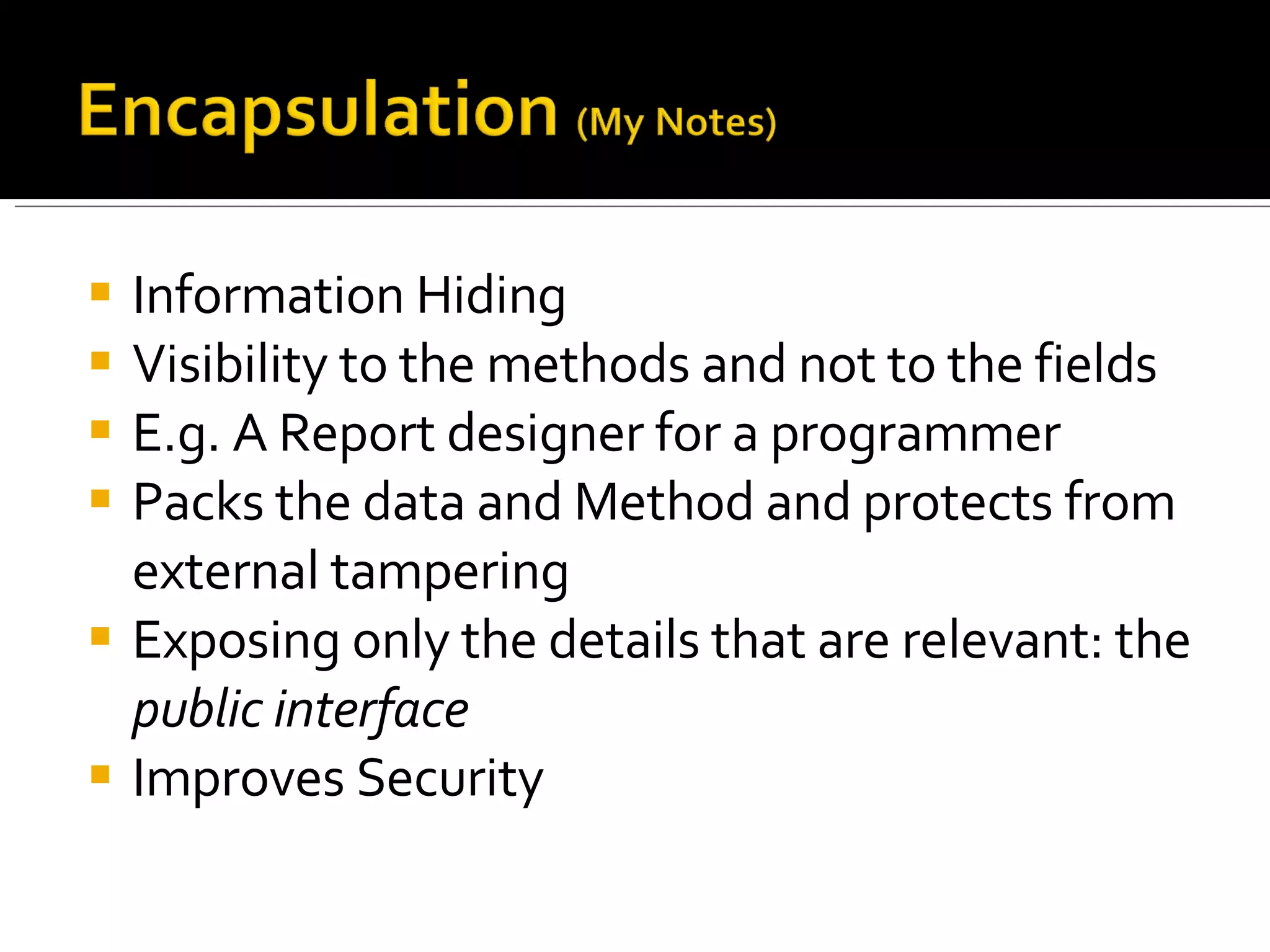
Information Hiding Visibility to the methods and not to the fields E.g. A Report designer for a programmer Packs the data and Method and protects from external tampering Exposing only the details that are relevant: the  public interface Improves Security
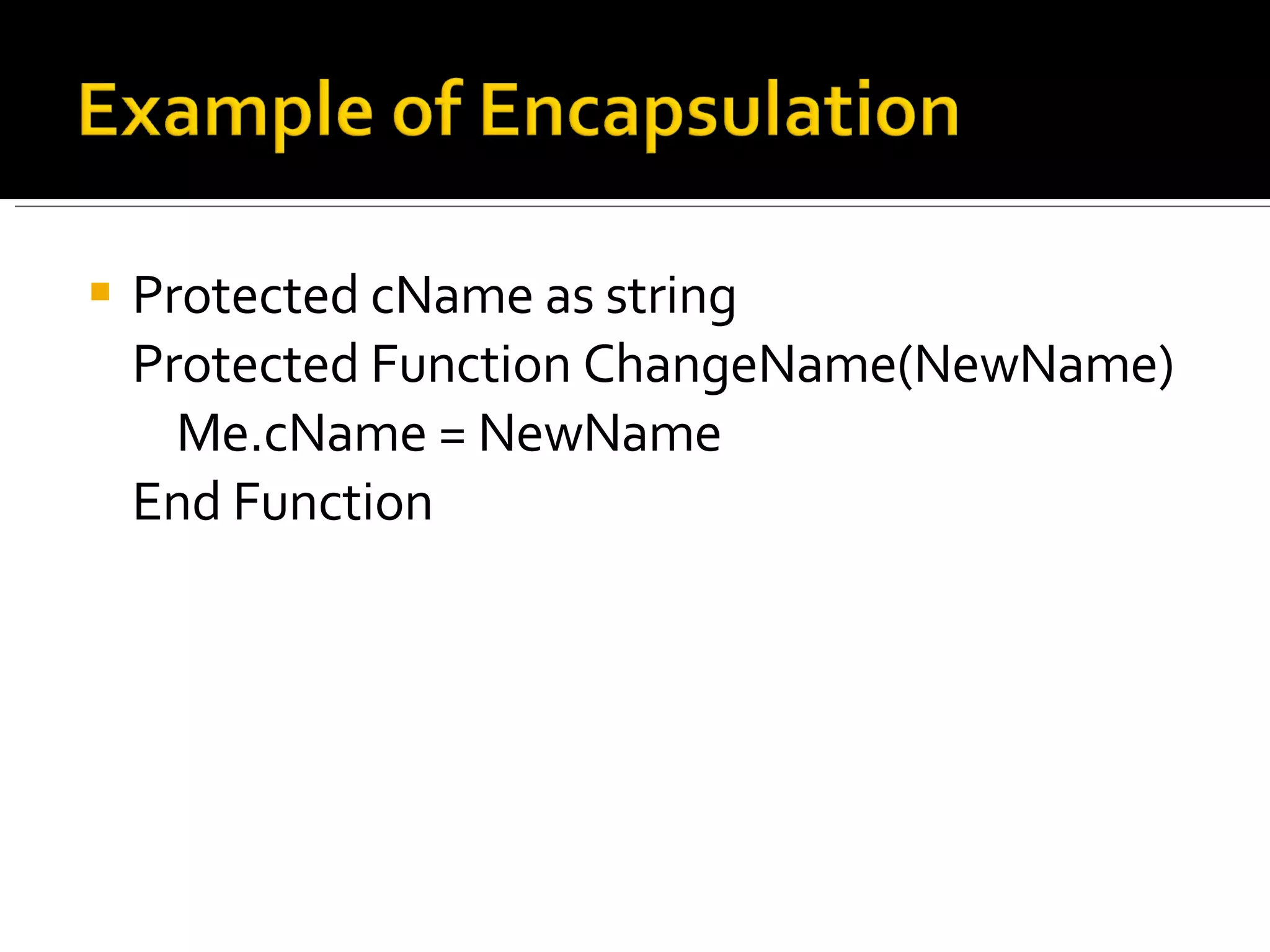
Protected cName as string Protected Function ChangeName(NewName)     Me.cName = NewName End Function
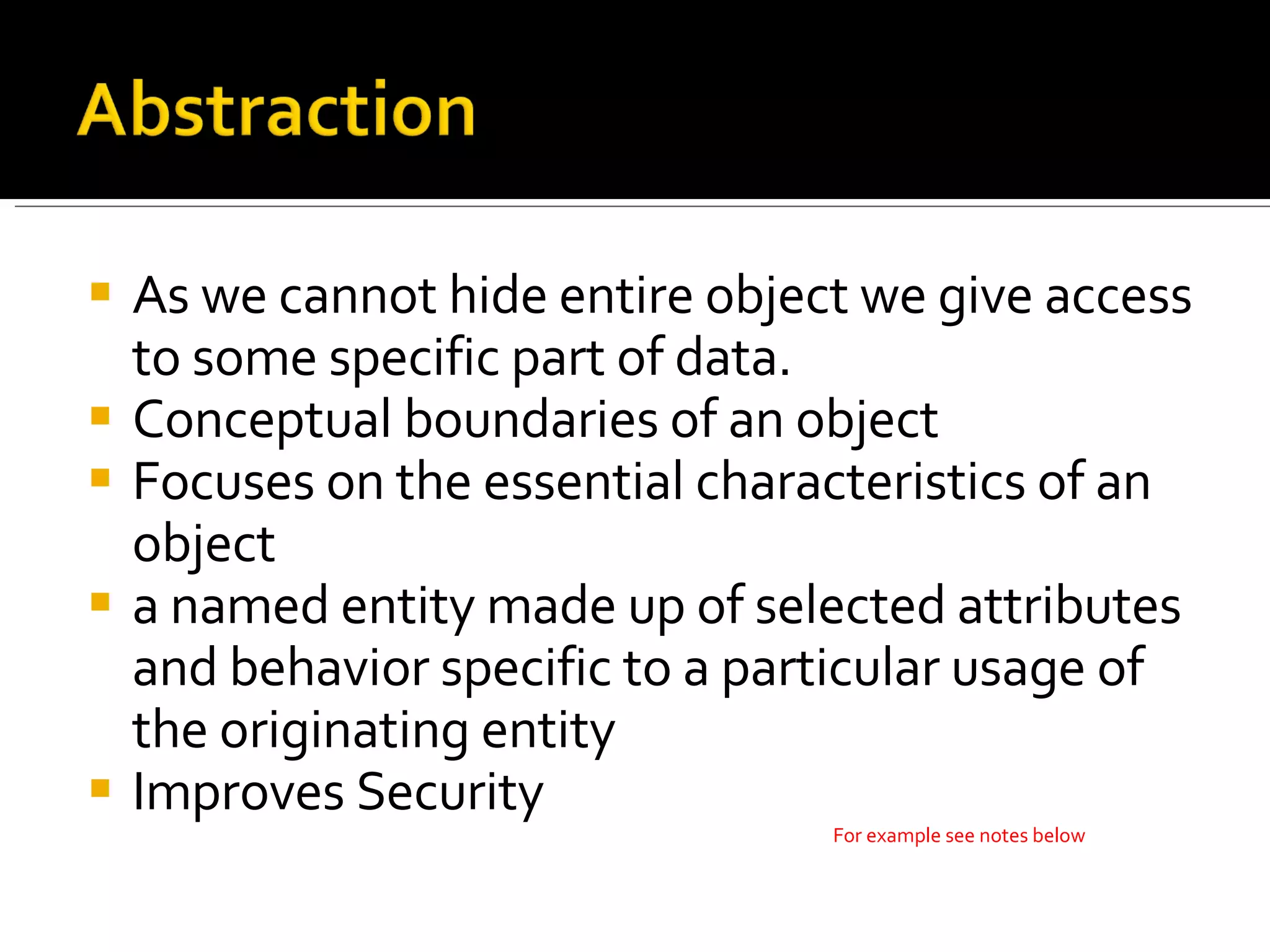
As we cannot hide entire object we give access to some specific part of data. Conceptual boundaries of an object Focuses on the essential characteristics of an object a named entity made up of selected attributes and behavior specific to a particular usage of the originating entity Improves Security For example see notes below
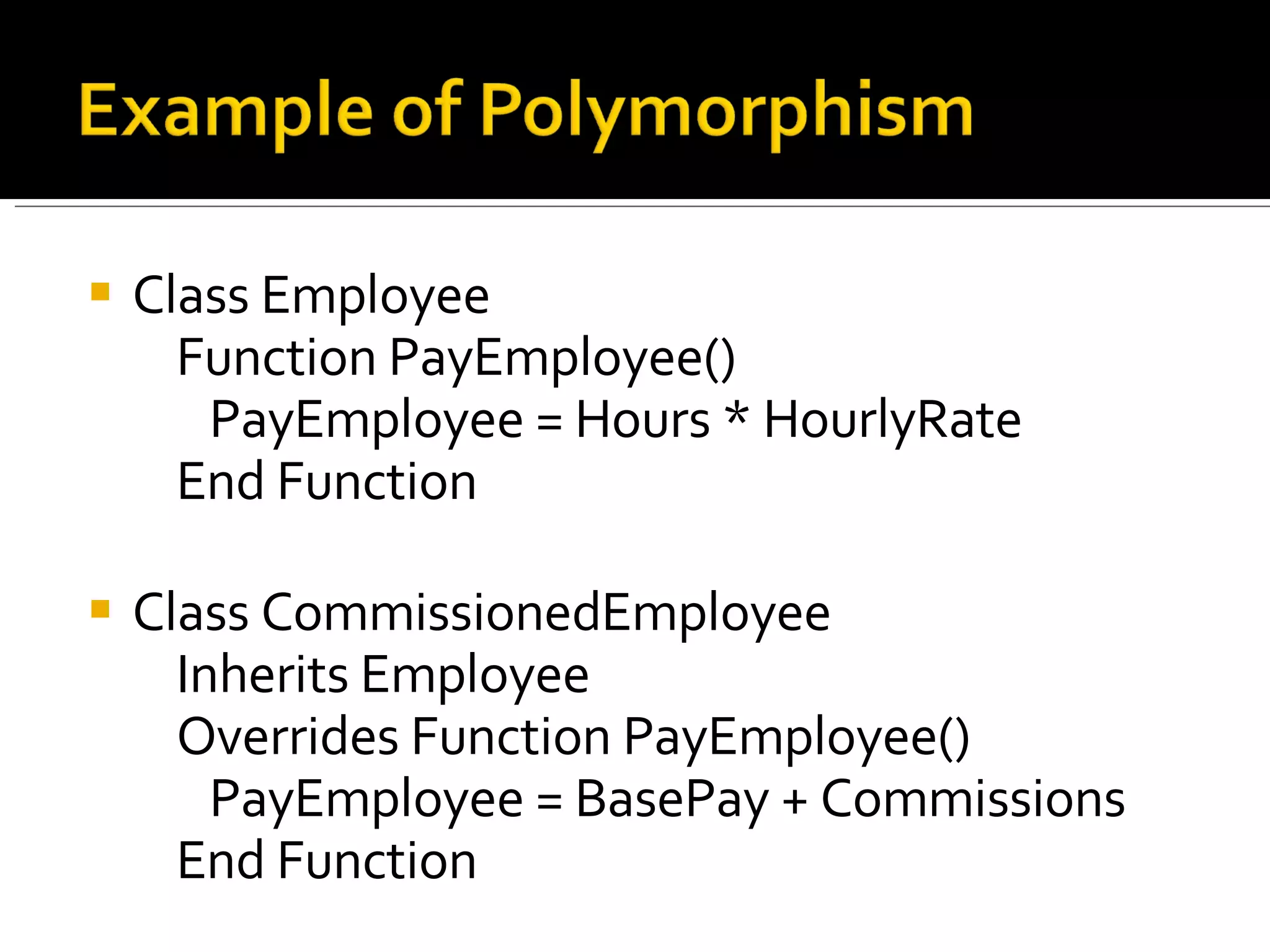
One entity existing in multiple forms Behavior depends on the type of data Same message to diff objects results in different behavior Linked to inheritance and assures that derived class to override the implementation of parents methods.
Class Employee     Function PayEmployee()        PayEmployee = Hours * HourlyRate     End Function Class CommissionedEmployee     Inherits Employee     Overrides Function PayEmployee()        PayEmployee = BasePay + Commissions     End Function
Upcasting  Casting an object of any type to another type which is above it in the inheritance hierarchy. Downcasting  Casting an object of any type to another type which is below it in the inheritance hierarchy.  Example Sealed Class When applied to a class, the sealed modifier prevents other classes from inheriting from it.
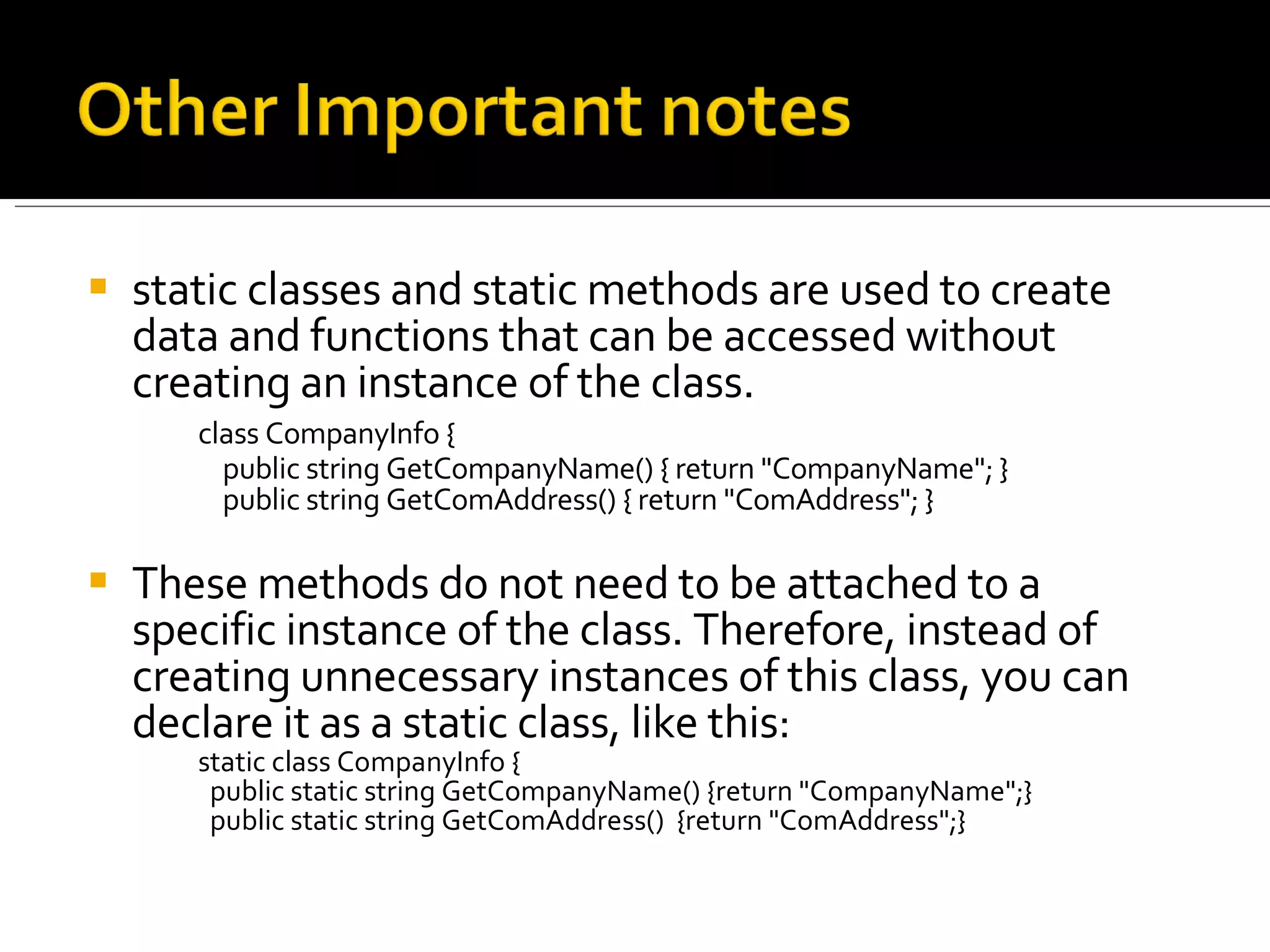
static classes and static methods are used to create data and functions that can be accessed without creating an instance of the class. class CompanyInfo {     public string GetCompanyName() { return "CompanyName"; }     public string GetComAddress() { return "ComAddress"; }   These methods do not need to be attached to a specific instance of the class. Therefore, instead of creating unnecessary instances of this class, you can declare it as a static class, like this: static class CompanyInfo {   public static string GetCompanyName() {return "CompanyName";}   public static string GetComAddress()  {return "ComAddress";}
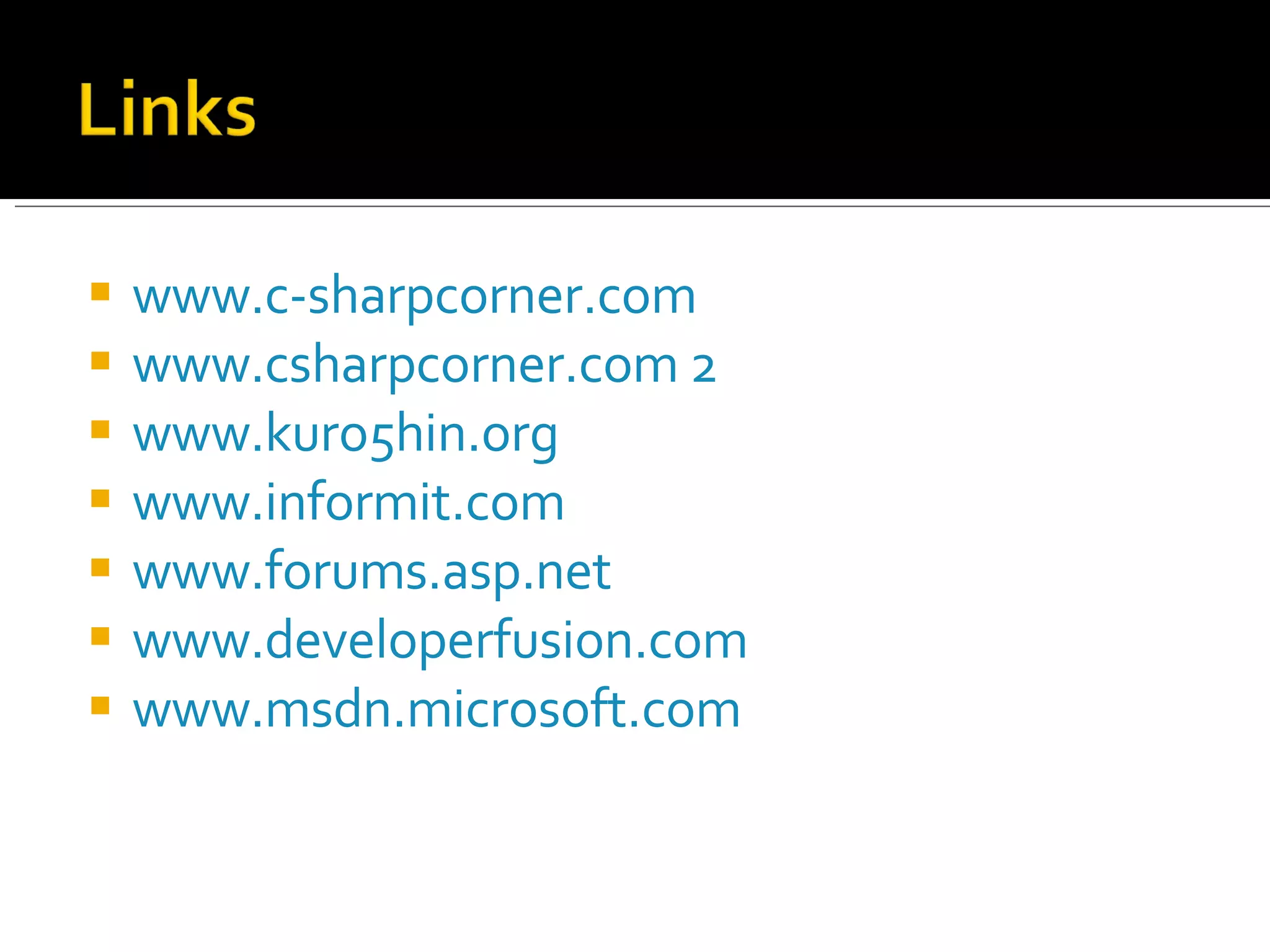
www.c-sharpcorner.com www.csharpcorner.com 2 www.kuro5hin.org www.informit.com www.forums.asp.net www.developerfusion.com www.msdn.microsoft.com

Oops

  • 1.
    Focused more forinterview Perspective and Easy Understanding
  • 2.
    Object-Oriented Programming (OOP)is a software development paradigm that suggests developers to split a program in building blocks known as objects. The OOP paradigm allows developers to define the object's data, functions, and its relationship with other objects.
  • 3.
    Code Reusability Enablesto model real world object Easy Modification Easy Maintenance More Flexible
  • 4.
    Defines an Abstractthing of a thing (i.e. Object) Explaining its Behavior A user-defined data structure that groups properties and methods. Class doesn’t occupies memory. Class is a definition Abstract classes are classes that can have no instances
  • 5.
    A Single entityWhich holds Data and Method. It’s Structure. Should be understandable by a non- Programmer DOG (Class) Color, Shape ( Characteristic ) Bark, Pee, Run ( Behaviors ) Members Abstract characteristics of a thing Fields - _Color Properties - Color Fields - _Color Properties - Color
  • 6.
    Specify Class NameDeclare Data members Declare Methods Define the Processing
  • 7.
    Program them inthe following order: Namespace: The namespace is a keyword that defines a distinctive name or last name for the class. A namespace categorizes and organizes the library (assembly) where the class belongs and avoids collisions with classes that share the same name. Class declaration: Line of code where the class name and type are defined. Fields: Set of variables declared in a class block.
  • 8.
    Constants: Setof constants declared in a class block. Constructors: A method or group of methods that contains code to initialize the class. Properties: The set of descriptive data of an object. Events: Program responses that get fired after a user or application action. Methods: Set of functions of the class.
  • 9.
    Destructor: Amethod that is called when the class is destroyed. In managed code, the Garbage Collector is in charge of destroying objects; however, in some cases developers need to take extra actions when objects are being released, such as freeing handles or de-allocating unmanaged objects. In .NET, there is no concept of deterministic destructors. The Garbage Collector will call the Finalize() method at a non-deterministic time while reclaiming memory for the application.
  • 10.
  • 11.
    Access keywords Accesskeywords define the access to class members from the same class and from other classes. The most common access keywords are: Public: Allows access to the class member from any other class. Private: Allows access to the class member only in the same class. Protected: Allows access to the class member only within the same class and from inherited classes.
  • 12.
    Internal: Allowsaccess to the class member only in the same assembly. Protected internal: Allows access to the class member only within the same class, from inherited classes, and other classes in the same assembly. Static: Indicates that the member can be called without first instantiating the class.
  • 13.
    A particular Instanceof a Class Objects are the building blocks of OOP Represent real world things in an abstract way Commonly defined as variables or data structures that encapsulate behavior and data in a programmed unit The objects will all act as independent units in their own right, and they will be responsible for carrying out a certain process
  • 14.
    Object identity: Every object is unique and can be differentiated from other objects. Each time and object is created (instantiated) the object identity is defined. Object behavior: What the object can do. In OOP, methods work as functions that define the set of actions that the object can do. Objec t state: The data stored within the object at any given moment. In OOP, fields, constants, and properties define the state of an object.
  • 15.
  • 16.
    Is like inheritingthe abstract characteristics from other class - It is a kind of hierarchy Base Class will be inherited to derived class is a way to form new classes using classes that have already been defined is-a relationships represent a hierarchy between classes of objects Use: Reuse of Code – uses the attributes of the base class Extensibility – Has it’s own Attributes
  • 17.
    Simple / SingleMultilevel Hierarchical Multiple Hybrid
  • 18.
    Superclass: Parent classSubclass: Child class Base class: Parent class Derived class: Child class
  • 19.
    Is like inheritingfrom more than one base class. .Net do not allow. But using Multiple interface inheritance this can be achieved.
  • 20.
    Information Hiding Visibilityto the methods and not to the fields E.g. A Report designer for a programmer Packs the data and Method and protects from external tampering Exposing only the details that are relevant: the public interface Improves Security
  • 21.
    Protected cName asstring Protected Function ChangeName(NewName)     Me.cName = NewName End Function
  • 22.
    As we cannothide entire object we give access to some specific part of data. Conceptual boundaries of an object Focuses on the essential characteristics of an object a named entity made up of selected attributes and behavior specific to a particular usage of the originating entity Improves Security For example see notes below
  • 23.
    One entity existingin multiple forms Behavior depends on the type of data Same message to diff objects results in different behavior Linked to inheritance and assures that derived class to override the implementation of parents methods.
  • 24.
    Class Employee    Function PayEmployee()        PayEmployee = Hours * HourlyRate     End Function Class CommissionedEmployee     Inherits Employee     Overrides Function PayEmployee()        PayEmployee = BasePay + Commissions     End Function
  • 25.
    Upcasting Castingan object of any type to another type which is above it in the inheritance hierarchy. Downcasting Casting an object of any type to another type which is below it in the inheritance hierarchy. Example Sealed Class When applied to a class, the sealed modifier prevents other classes from inheriting from it.
  • 26.
    static classes andstatic methods are used to create data and functions that can be accessed without creating an instance of the class. class CompanyInfo {     public string GetCompanyName() { return "CompanyName"; }     public string GetComAddress() { return "ComAddress"; }   These methods do not need to be attached to a specific instance of the class. Therefore, instead of creating unnecessary instances of this class, you can declare it as a static class, like this: static class CompanyInfo {   public static string GetCompanyName() {return "CompanyName";}   public static string GetComAddress() {return "ComAddress";}
  • 27.
    www.c-sharpcorner.com www.csharpcorner.com 2www.kuro5hin.org www.informit.com www.forums.asp.net www.developerfusion.com www.msdn.microsoft.com