Relevant Costs for
Decision Making
Chapter
8
© The McGraw-Hill Companies, Inc., 2000Irwin/McGraw-Hill
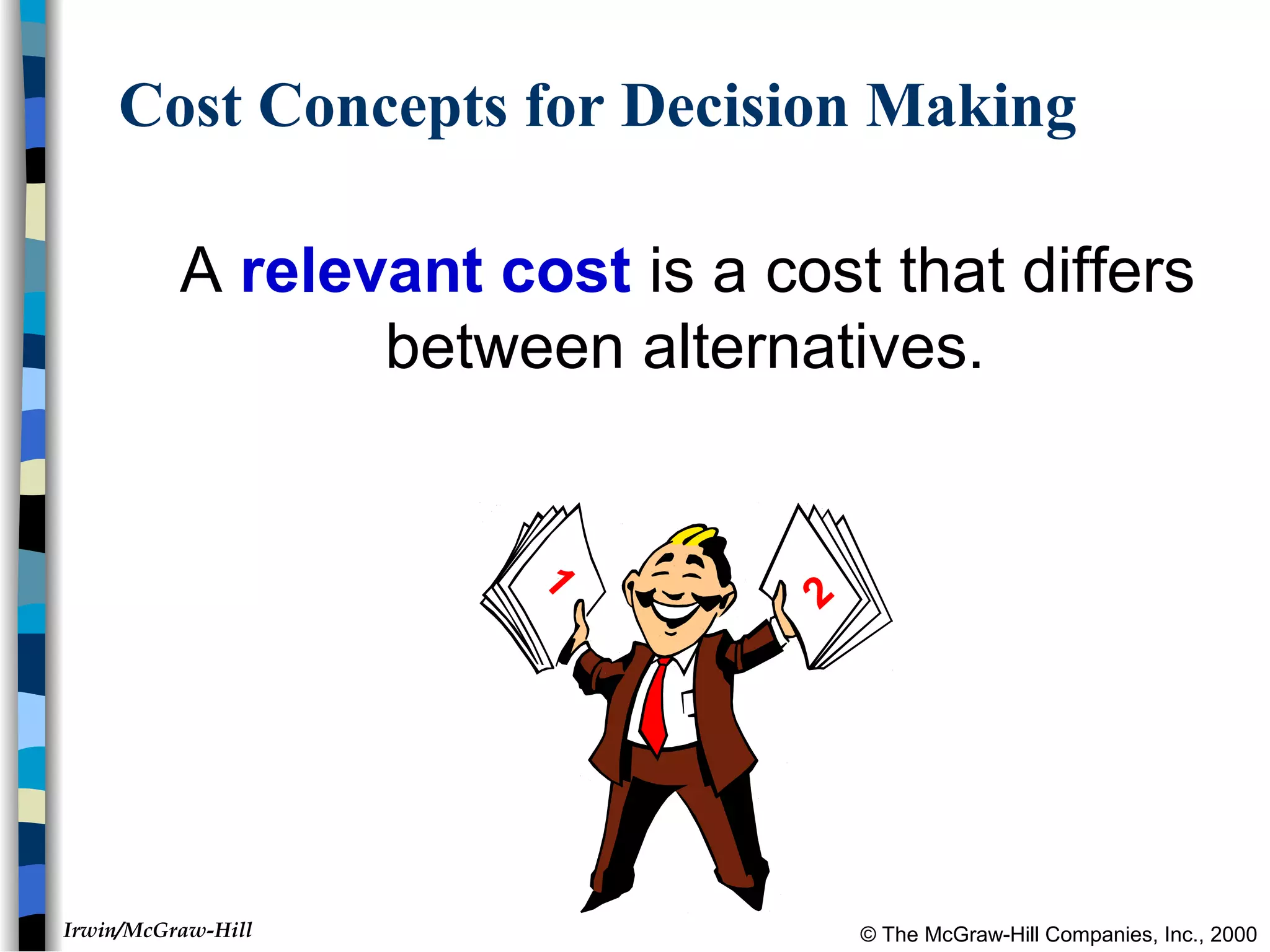
Cost Concepts for Decision Making
A relevant cost is a cost that differs
between alternatives.
1
2
© The McGraw-Hill Companies, Inc., 2000Irwin/McGraw-Hill
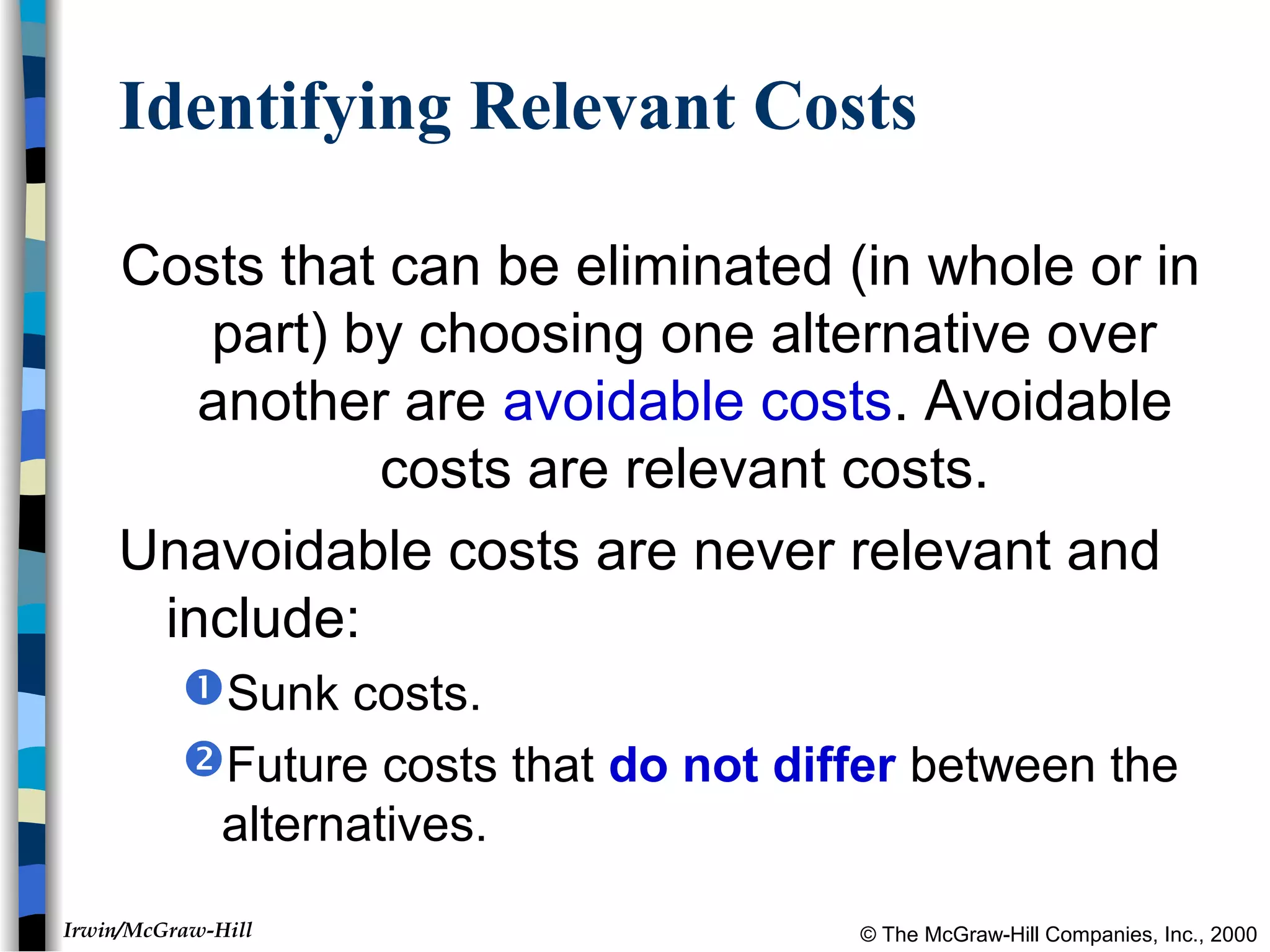
Identifying Relevant Costs
Costs that can be eliminated (in whole or in
part) by choosing one alternative over
another are avoidable costs. Avoidable
costs are relevant costs.
Unavoidable costs are never relevant and
include:
Sunk costs.
Future costs that do not differ between the
alternatives.
© The McGraw-Hill Companies, Inc., 2000Irwin/McGraw-Hill
Identifying Relevant Costs
Sunk cost -- a cost that has already
been incurred and that cannot be
avoided regardless of what a manager
decides to do.
© The McGraw-Hill Companies, Inc., 2000Irwin/McGraw-Hill
Identifying Relevant Costs
Well, I’ve assembled
all the costs associated
with the alternatives
we are considering.
© The McGraw-Hill Companies, Inc., 2000Irwin/McGraw-Hill
Identifying Relevant Costs
Great! The first
thing we need to
do is eliminate all
the sunk costs.
© The McGraw-Hill Companies, Inc., 2000Irwin/McGraw-Hill
Identifying Relevant Costs
Now that we have eliminated the
sunk costs, we need to eliminate
the future costs that don’t differ
between alternatives.
© The McGraw-Hill Companies, Inc., 2000Irwin/McGraw-Hill
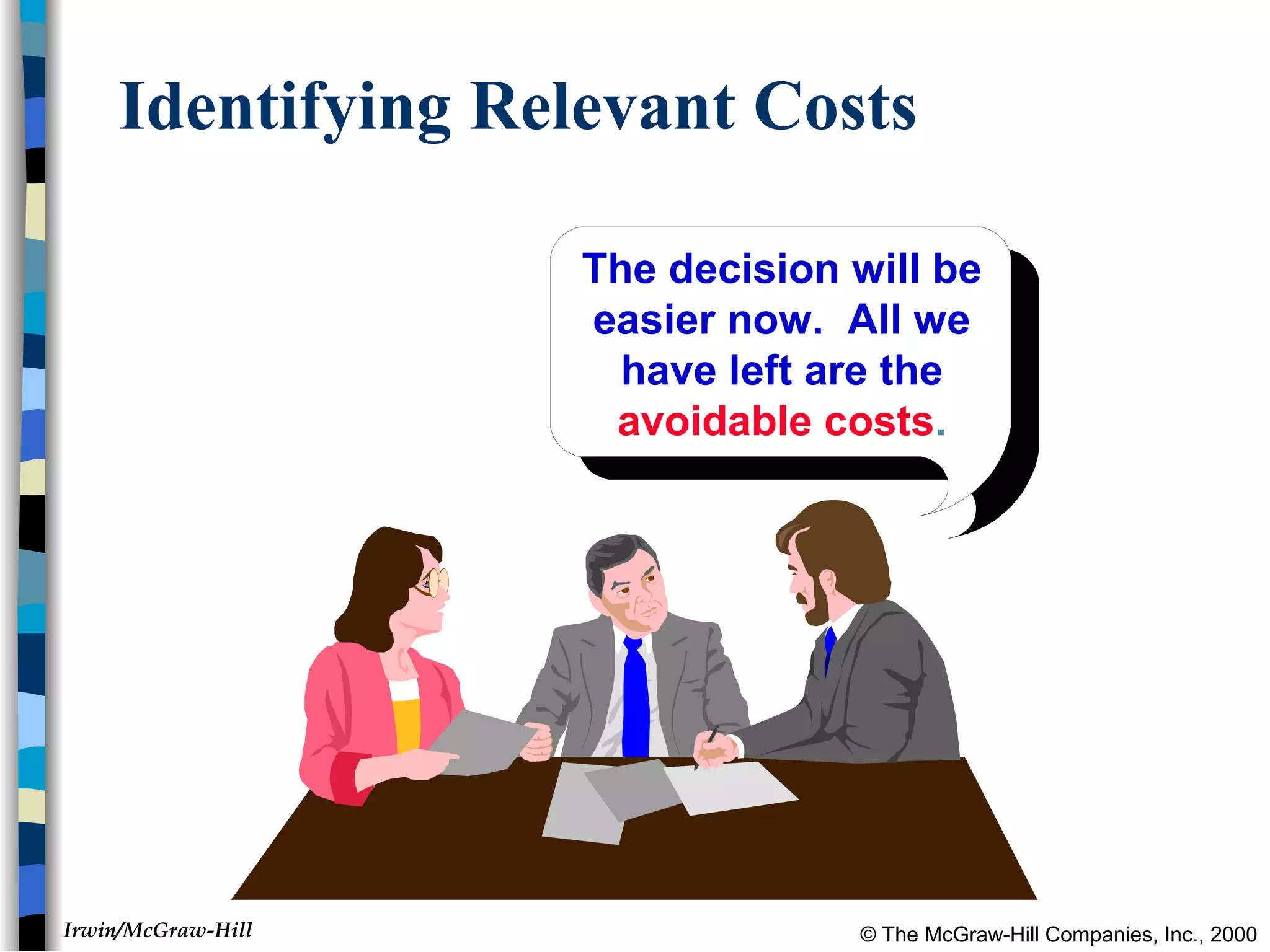
Identifying Relevant Costs
The decision will be
easier now. All we
have left are the
avoidable costs.
© The McGraw-Hill Companies, Inc., 2000Irwin/McGraw-Hill
Sunk Costs are not Relevant Costs
Let’s look at
the White
Company
example.
© The McGraw-Hill Companies, Inc., 2000Irwin/McGraw-Hill
Sunk Costs are not Relevant Costs
A manager at White Co. wants to replace an old
machine with a new, more efficient machine.
New machine:
List price 90,000$
Annual variable expenses 80,000
Expected life in years 5
Old machine:
Original cost 72,000$
Remaining book value 60,000
Disposal value now 15,000
Annual variable expenses 100,000
Remaining life in years 5
© The McGraw-Hill Companies, Inc., 2000Irwin/McGraw-Hill
Sunk Costs are not Relevant Costs
White’s sales are $200,000 per year.
Fixed expenses, other than depreciation, are
$70,000 per year.
Should the manager purchase the new
machine?
© The McGraw-Hill Companies, Inc., 2000Irwin/McGraw-Hill
Incorrect Analysis
The manager recommends that the
company not purchase the new
machine since disposal of the old
machine would result in a loss:
Remaining book value 60,000$
Disposal value (15,000)
Loss from disposal 45,000$
© The McGraw-Hill Companies, Inc., 2000Irwin/McGraw-Hill
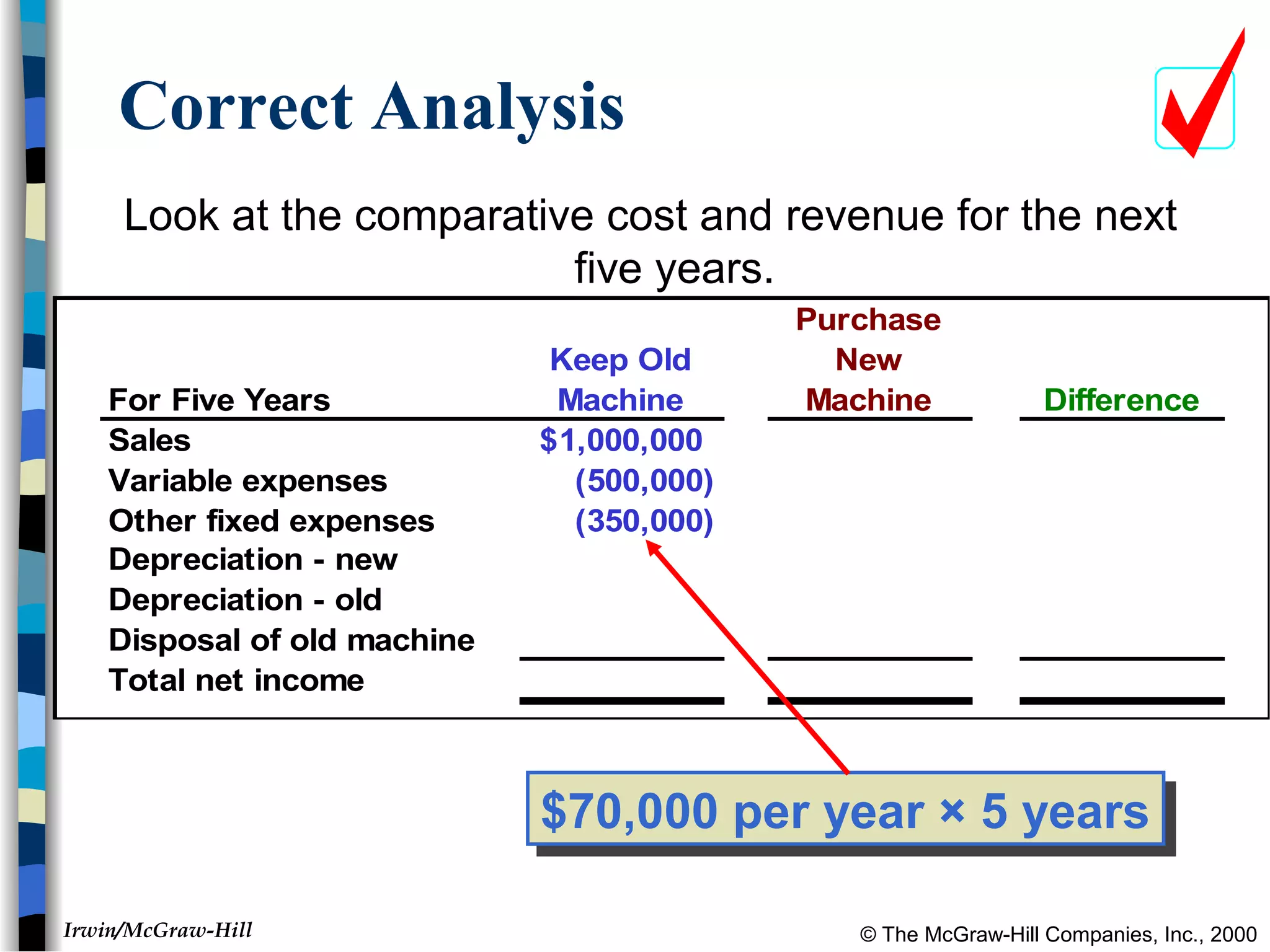
For Five Years
Keep Old
Machine
Purchase
New
Machine Difference
Sales 1,000,000$
Variable expenses (500,000)
Other fixed expenses
Depreciation - new
Depreciation - old
Disposal of old machine
Total net income
Correct Analysis
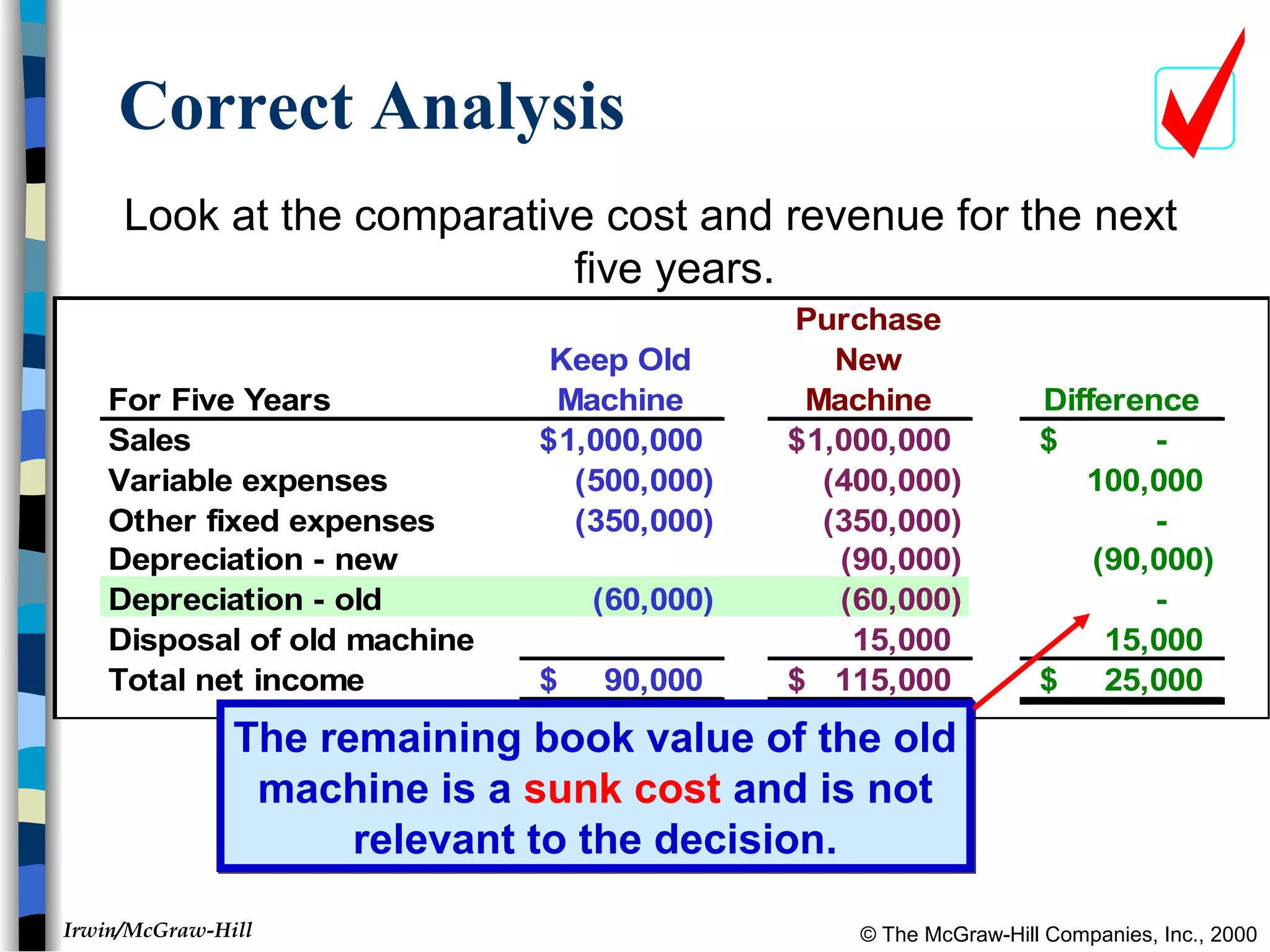
Look at the comparative cost and revenue for the next
five years.
$200,000 per year × 5 years$200,000 per year × 5 years
$100,000 per year × 5 years$100,000 per year × 5 years
© The McGraw-Hill Companies, Inc., 2000Irwin/McGraw-Hill
For Five Years
Keep Old
Machine
Purchase
New
Machine Difference
Sales 1,000,000$
Variable expenses (500,000)
Other fixed expenses (350,000)
Depreciation - new
Depreciation - old
Disposal of old machine
Total net income
Correct Analysis
$70,000 per year × 5 years$70,000 per year × 5 years
Look at the comparative cost and revenue for the next
five years.
© The McGraw-Hill Companies, Inc., 2000Irwin/McGraw-Hill
For Five Years
Keep Old
Machine
Purchase
New
Machine Difference
Sales 1,000,000$
Variable expenses (500,000)
Other fixed expenses (350,000)
Depreciation - new
Depreciation - old (60,000)
Disposal of old machine
Total net income 90,000$
Correct Analysis
The remaining book
value of the old machine.
The remaining book
value of the old machine.
Look at the comparative cost and revenue for the next
five years.
© The McGraw-Hill Companies, Inc., 2000Irwin/McGraw-Hill
For Five Years
Keep Old
Machine
Purchase
New
Machine Difference
Sales 1,000,000$ 1,000,000$ -$
Variable expenses (500,000) (400,000) 100,000
Other fixed expenses (350,000)
Depreciation - new
Depreciation - old (60,000)
Disposal of old machine
Total net income 90,000$
Correct Analysis
$80,000 per year × 5 years$80,000 per year × 5 years
Look at the comparative cost and revenue for the next
five years.
© The McGraw-Hill Companies, Inc., 2000Irwin/McGraw-Hill
For Five Years
Keep Old
Machine
Purchase
New
Machine Difference
Sales 1,000,000$ 1,000,000$ -$
Variable expenses (500,000) (400,000) 100,000
Other fixed expenses (350,000) (350,000) -
Depreciation - new (90,000) (90,000)
Depreciation - old (60,000)
Disposal of old machine
Total net income 90,000$
Correct Analysis
Look at the comparative cost and revenue for the next
five years.
The total cost will be depreciated
over the five year period.
The total cost will be depreciated
over the five year period.
© The McGraw-Hill Companies, Inc., 2000Irwin/McGraw-Hill
For Five Years
Keep Old
Machine
Purchase
New
Machine Difference
Sales 1,000,000$ 1,000,000$ -$
Variable expenses (500,000) (400,000) 100,000
Other fixed expenses (350,000) (350,000) -
Depreciation - new (90,000) (90,000)
Depreciation - old (60,000) (60,000) -
Disposal of old machine 15,000 15,000
Total net income 90,000$ 115,000$ 25,000$
Correct Analysis
Look at the comparative cost and revenue for the next
five years.
The remaining book value of the old
machine is a sunk cost and is not
relevant to the decision.
The remaining book value of the old
machine is a sunk cost and is not
relevant to the decision.
© The McGraw-Hill Companies, Inc., 2000Irwin/McGraw-Hill
For Five Years
Keep Old
Machine
Purchase
New
Machine Difference
Sales 1,000,000$ 1,000,000$ -$
Variable expenses (500,000) (400,000) 100,000
Other fixed expenses (350,000) (350,000) -
Depreciation - new (90,000) (90,000)
Depreciation - old (60,000) (60,000) -
Disposal of old machine 15,000 15,000
Total net income 90,000$ 115,000$ 25,000$
Correct Analysis
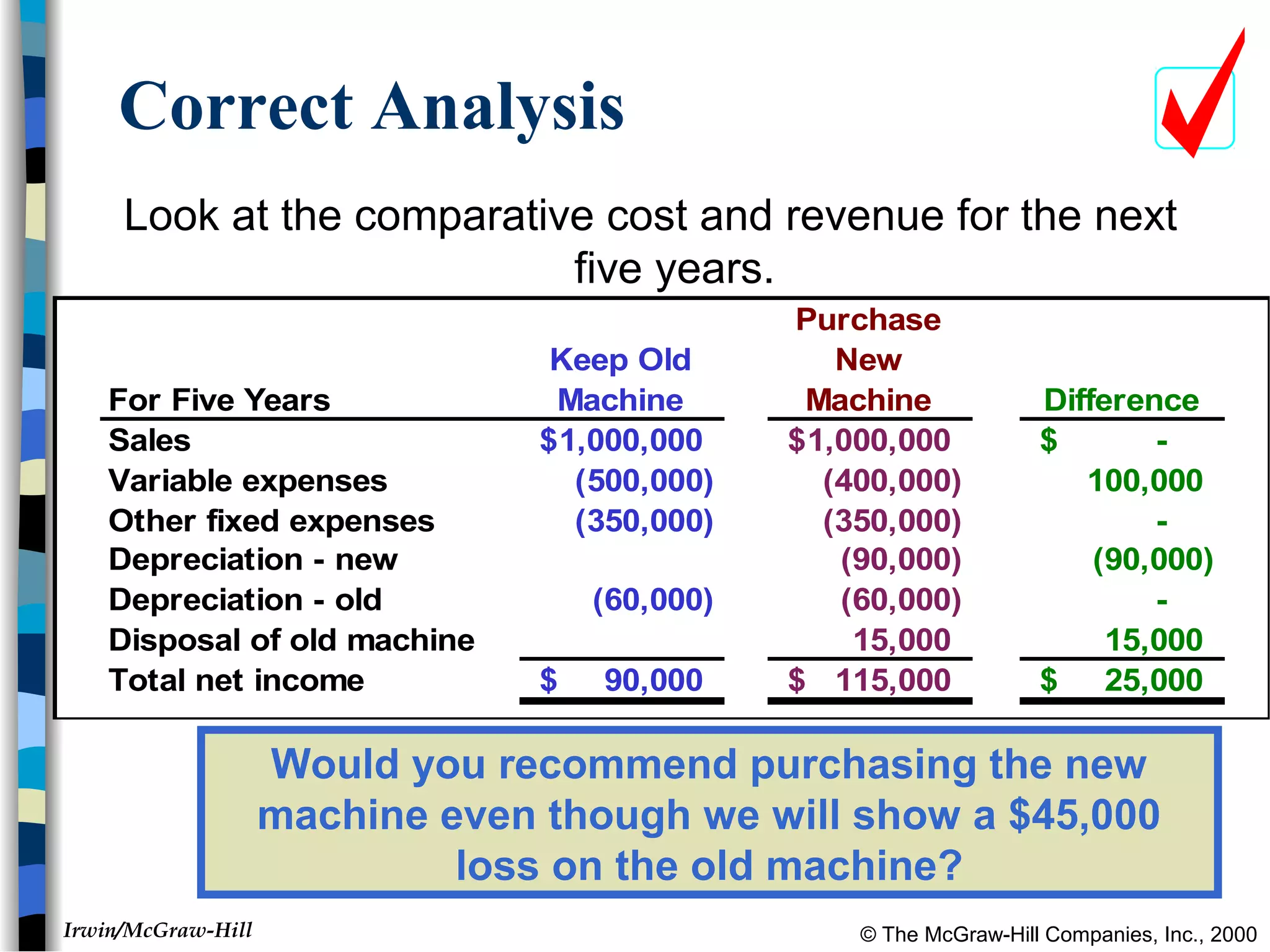
Look at the comparative cost and revenue for the next
five years.
Would you recommend purchasing the new
machine even though we will show a $45,000
loss on the old machine?
© The McGraw-Hill Companies, Inc., 2000Irwin/McGraw-Hill
Correct Analysis
Let’s look at a
more efficient
way to analyze
this decision.
© The McGraw-Hill Companies, Inc., 2000Irwin/McGraw-Hill
Relevant Cost Analysis
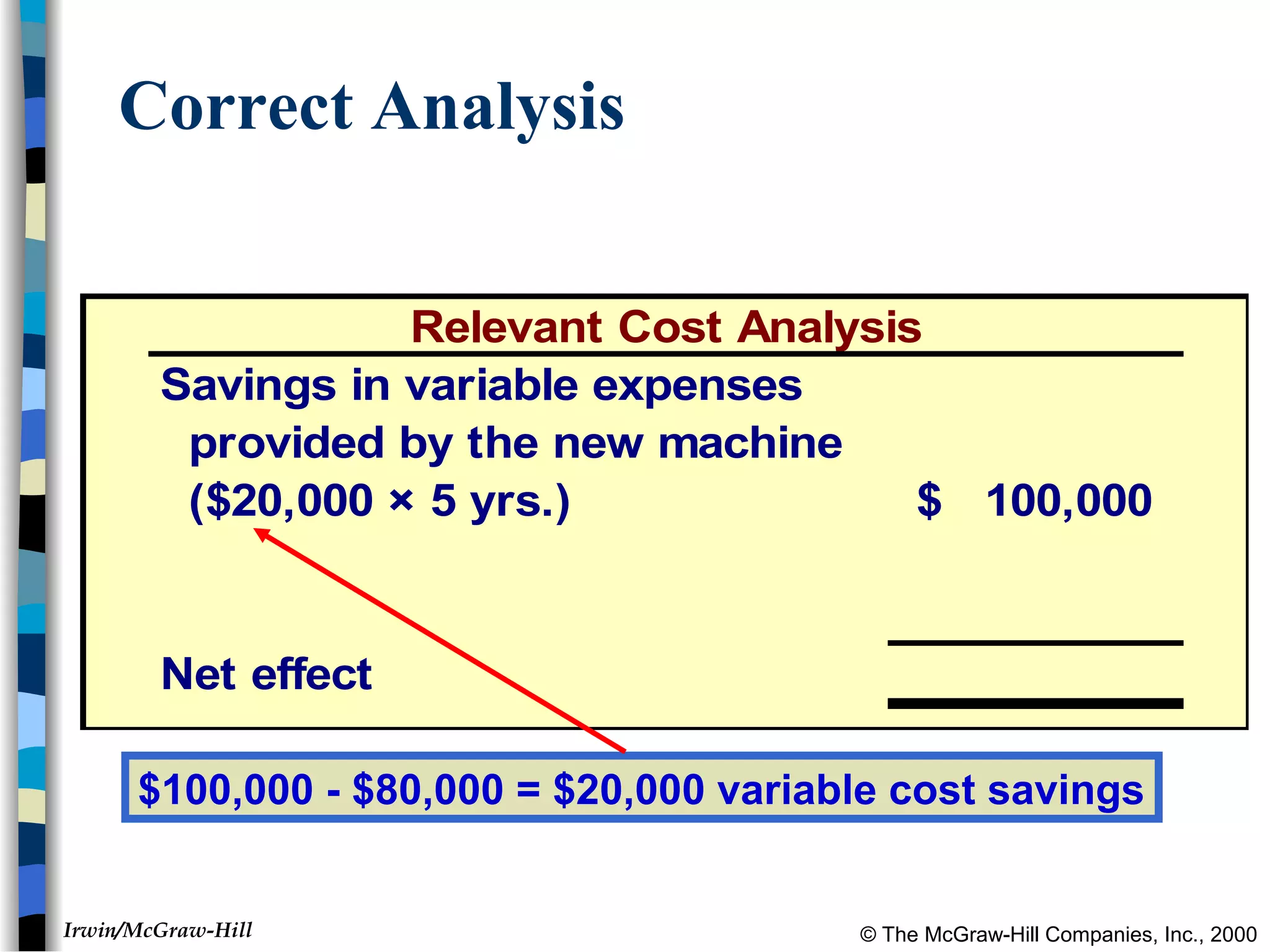
Savings in variable expenses
provided by the new machine
($20,000 × 5 yrs.) 100,000$
Net effect
Correct Analysis
$100,000 - $80,000 = $20,000 variable cost savings
© The McGraw-Hill Companies, Inc., 2000Irwin/McGraw-Hill
Correct Analysis
Relevant Cost Analysis
Savings in variable expenses
provided by the new machine
($20,000 × 5 yrs.) 100,000$
Cost of the new machine (90,000)
Disposal value of old machine 15,000
Net effect 25,000$
© The McGraw-Hill Companies, Inc., 2000Irwin/McGraw-Hill
Adding/Dropping Segments
One of the most important decisions
managers make is whether to add or
drop a business segment such as a
product or a store.
Let’s see how relevant costs
should be used in this decision.
© The McGraw-Hill Companies, Inc., 2000Irwin/McGraw-Hill
Adding/Dropping Segments
Due to the declining popularity of digital
watches, Lovell Company’s digital watch
line has not reported a profit for several
years. An income statement for last year
is shown on the next screen.
© The McGraw-Hill Companies, Inc., 2000Irwin/McGraw-Hill
Adding/Dropping Segments
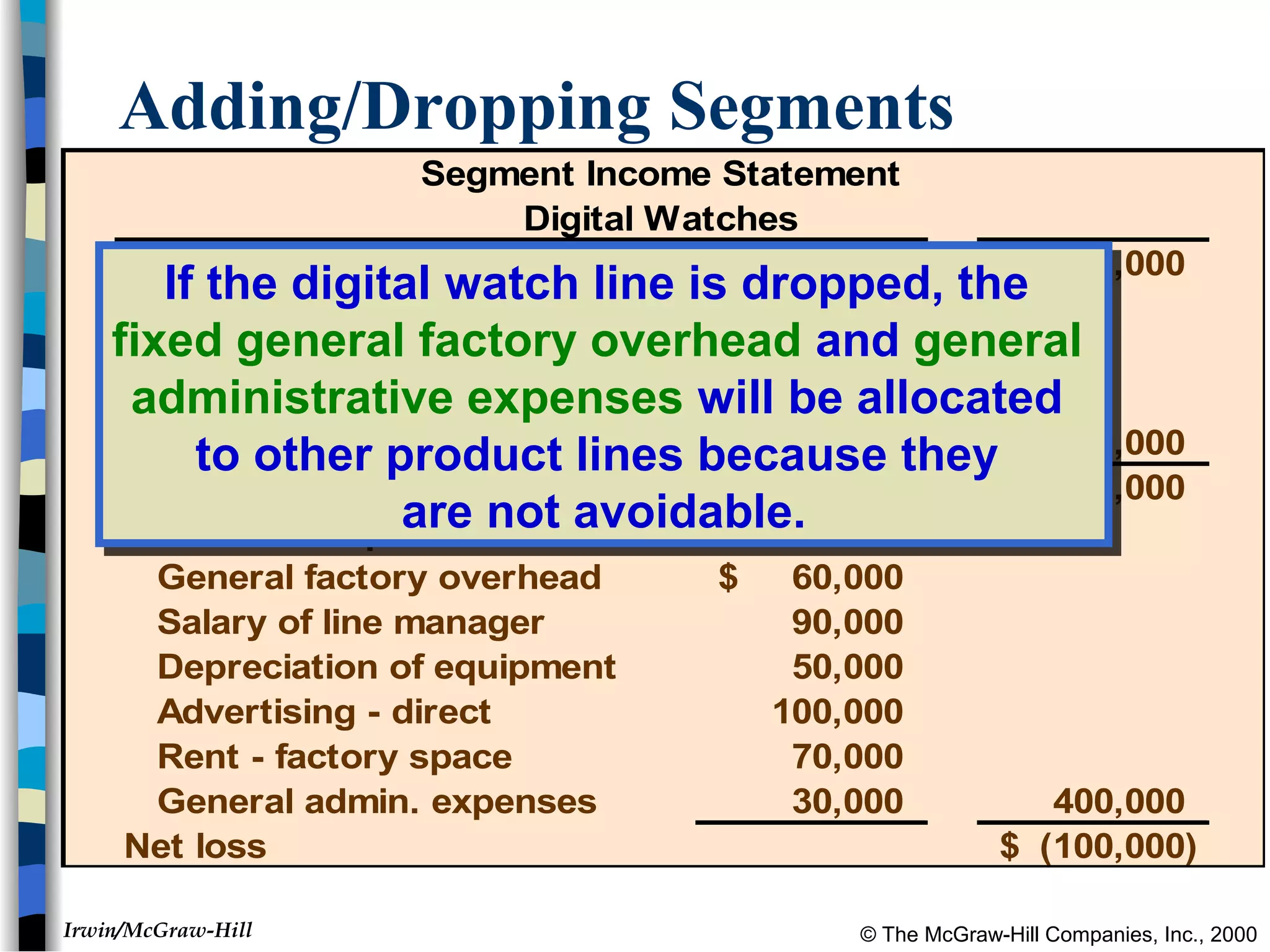
Segment Income Statement
Digital Watches
Sales 500,000$
Less: variable expenses
Variable mfg. costs 120,000$
Variable shipping costs 5,000
Commissions 75,000 200,000
Contribution margin 300,000$
Less: fixed expenses
General factory overhead 60,000$
Salary of line manager 90,000
Depreciation of equipment 50,000
Advertising - direct 100,000
Rent - factory space 70,000
General admin. expenses 30,000 400,000
Net loss (100,000)$
© The McGraw-Hill Companies, Inc., 2000Irwin/McGraw-Hill
Segment Income Statement
Digital Watches
Sales 500,000$
Less: variable expenses
Variable mfg. costs 120,000$
Variable shipping costs 5,000
Commissions 75,000 200,000
Contribution margin 300,000$
Less: fixed expenses
General factory overhead 60,000$
Salary of line manager 90,000
Depreciation of equipment 50,000
Advertising - direct 100,000
Rent - factory space 70,000
General admin. expenses 30,000 400,000
Net loss (100,000)$
Adding/Dropping Segments
If the digital watch line is dropped, the
fixed general factory overhead and general
administrative expenses will be allocated
to other product lines because they
are not avoidable.
If the digital watch line is dropped, the
fixed general factory overhead and general
administrative expenses will be allocated
to other product lines because they
are not avoidable.
© The McGraw-Hill Companies, Inc., 2000Irwin/McGraw-Hill
Adding/Dropping Segments
Segment Income Statement
Digital Watches
Sales 500,000$
Less: variable expenses
Variable mfg. costs 120,000$
Variable shipping costs 5,000
Commissions 75,000 200,000
Contribution margin 300,000$
Less: fixed expenses
General factory overhead 60,000$
Salary of line manager 90,000
Depreciation of equipment 50,000
Advertising - direct 100,000
Rent - factory space 70,000
General admin. expenses 30,000 400,000
Net loss (100,000)$
The equipment used to manufacture
digital watches has no resale
value or alternative use.
The equipment used to manufacture
digital watches has no resale
value or alternative use.
Should Lovell retain or drop
the digital watch segment?
Should Lovell retain or drop
the digital watch segment?
© The McGraw-Hill Companies, Inc., 2000Irwin/McGraw-Hill
A Contribution Margin Approach
DECISION RULEDECISION RULE
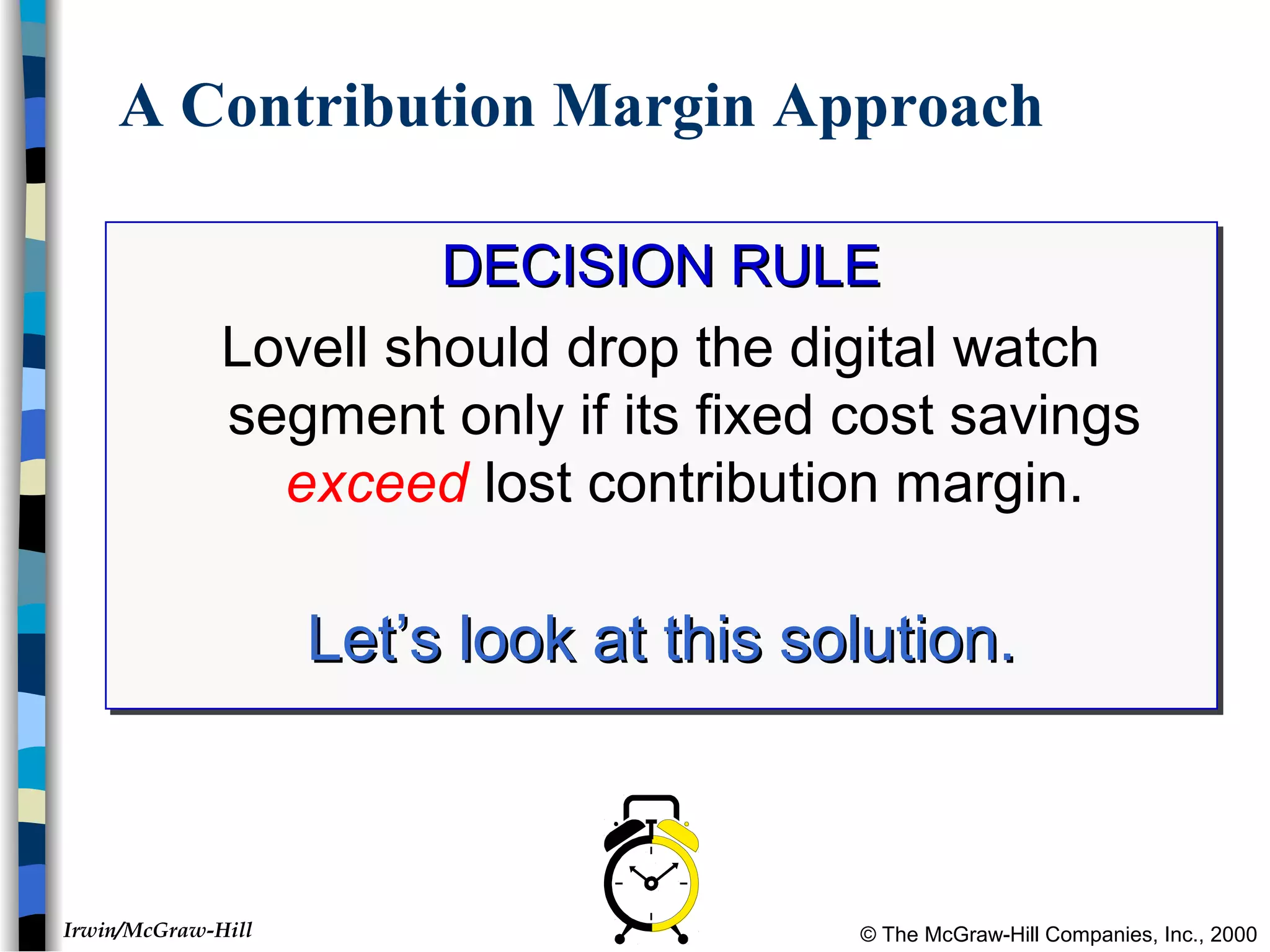
Lovell should drop the digital watch
segment only if its fixed cost savings
exceed lost contribution margin.
Let’s look at this solution.Let’s look at this solution.
DECISION RULEDECISION RULE
Lovell should drop the digital watch
segment only if its fixed cost savings
exceed lost contribution margin.
Let’s look at this solution.Let’s look at this solution.
© The McGraw-Hill Companies, Inc., 2000Irwin/McGraw-Hill
A Contribution Margin Approach
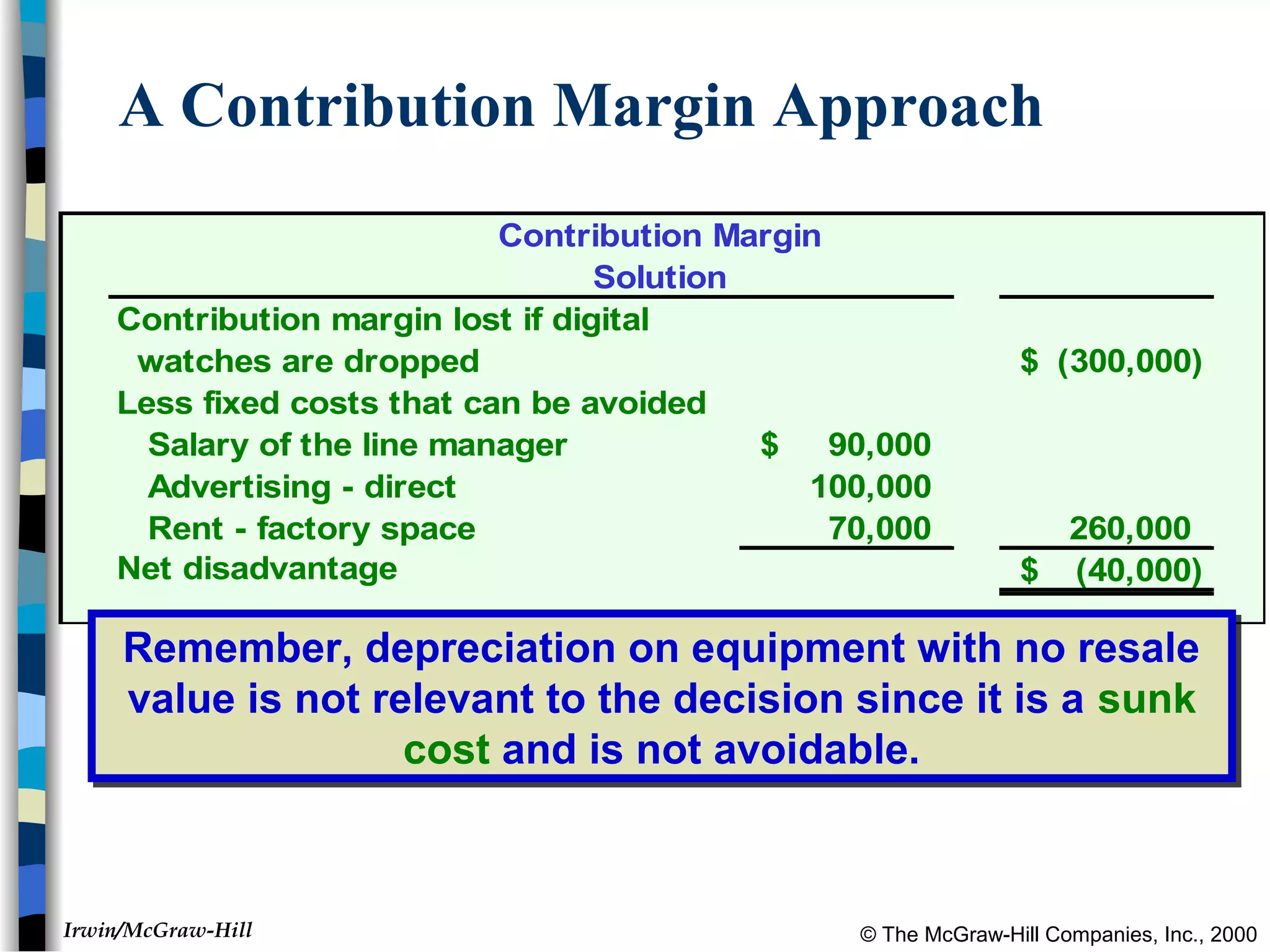
Contribution Margin
Solution
Contribution margin lost if digital
watches are dropped (300,000)$
Less fixed costs that can be avoided
Salary of the line manager 90,000$
Advertising - direct 100,000
Rent - factory space 70,000 260,000
Net disadvantage (40,000)$
Remember, depreciation on equipment with no resale
value is not relevant to the decision since it is a sunk
cost and is not avoidable.
Remember, depreciation on equipment with no resale
value is not relevant to the decision since it is a sunk
cost and is not avoidable.
© The McGraw-Hill Companies, Inc., 2000Irwin/McGraw-Hill
Comparative Income Approach
The Lovell solution can also be obtained by
preparing comparative income
statements showing results with and
without the digital watch segment.
Let’s look at this second approach.Let’s look at this second approach.
© The McGraw-Hill Companies, Inc., 2000Irwin/McGraw-Hill
Comparative Income Approach
Solution
Keep
Digital
Watches
Drop
Digital
Watches Difference
Sales 500,000$ -$ (500,000)$
Less variable expenses: -
Mfg. expenses 120,000 - 120,000
Freight out 5,000 - 5,000
Commissions 75,000 - 75,000
Total variable expenses 200,000 - 200,000
Contribution margin 300,000 - (300,000)
Less fixed expenses:
General factory overhead 60,000 60,000 -
Salary of line manager 90,000 - 90,000
Depreciation 50,000 50,000 -
Advertising - direct 100,000 - 100,000
Rent - factory space 70,000 - 70,000
General admin. expenses 30,000 30,000 -
Total fixed expenses 400,000 140,000 260,000
Net loss (100,000)$ (140,000)$ (40,000)$
© The McGraw-Hill Companies, Inc., 2000Irwin/McGraw-Hill
Beware of Allocated Fixed Costs
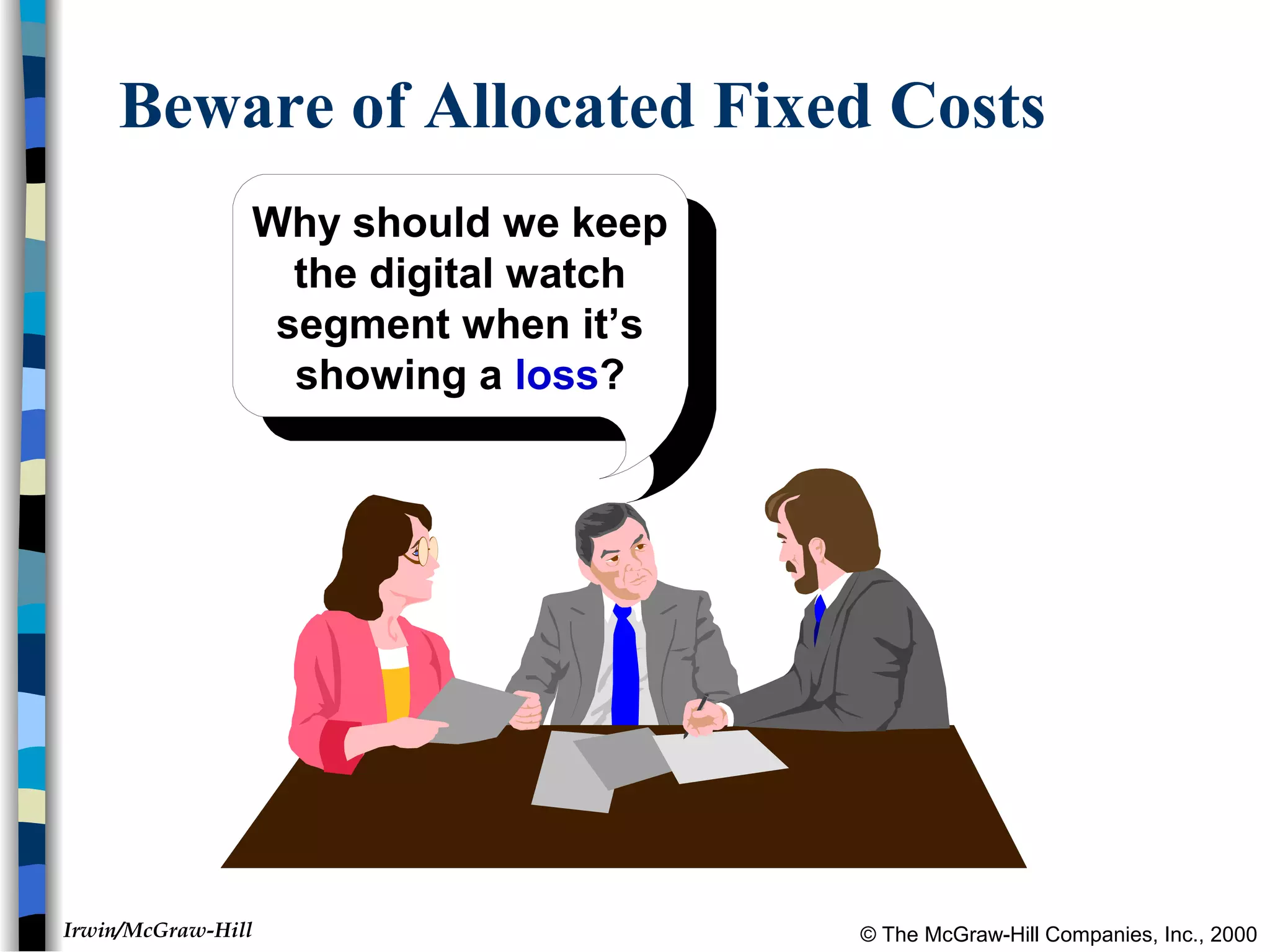
Why should we keep
the digital watch
segment when it’s
showing a loss?
© The McGraw-Hill Companies, Inc., 2000Irwin/McGraw-Hill
Beware of Allocated Fixed Costs
Part of the answer lies
in the way we allocate
common fixed costs
to our products.
© The McGraw-Hill Companies, Inc., 2000Irwin/McGraw-Hill
Beware of Allocated Fixed Costs
Our allocations can
make a segment
look less profitable
than it really is.
© The McGraw-Hill Companies, Inc., 2000Irwin/McGraw-Hill
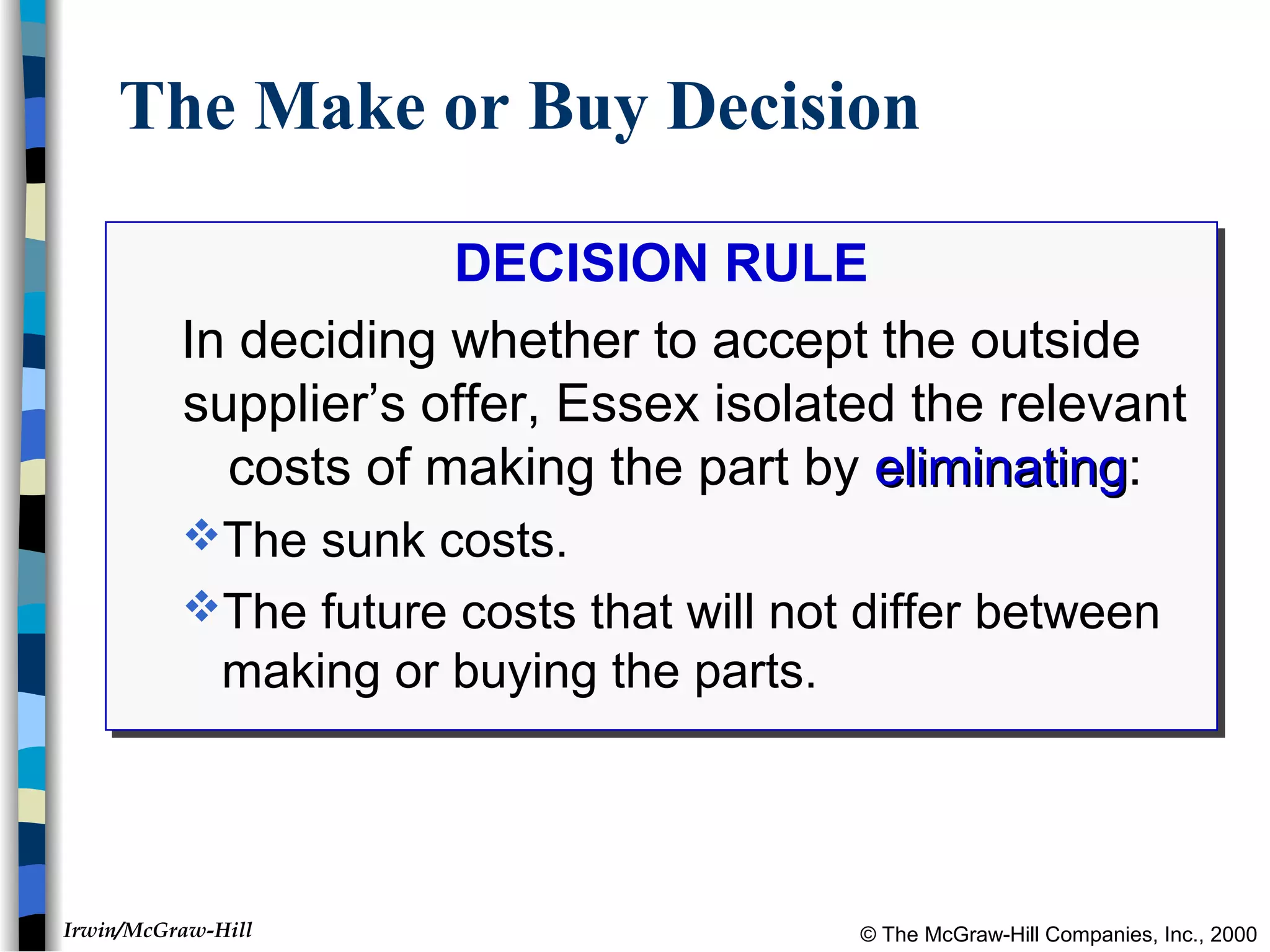
The Make or Buy Decision
A decision concerning whether an item
should be produced internally or
purchased from an outside supplier is
called a “make or buy” decision.
Let’s look at the Essex Company example.Let’s look at the Essex Company example.
© The McGraw-Hill Companies, Inc., 2000Irwin/McGraw-Hill
The Make or Buy Decision
Essex manufactures part 4A that is currently
used in one of its products.
The unit cost to make this part is:
Direct materials $ 9
Direct labor 5
Variable overhead 1
Depreciation of special equip. 3
Supervisor's salary 2
General factory overhead 10
Total cost per unit 30$
© The McGraw-Hill Companies, Inc., 2000Irwin/McGraw-Hill
The Make or Buy Decision
The special equipment used to manufacture part
4A has no resale value.
General factory overhead is allocated on the
basis of direct labor hours.
The $30 total unit cost is based on 20,000 parts
produced each year.
An outside supplier has offered to provide the
20,000 parts at a cost of $25 per part.
Should we accept the supplier’s offer?Should we accept the supplier’s offer?
© The McGraw-Hill Companies, Inc., 2000Irwin/McGraw-Hill
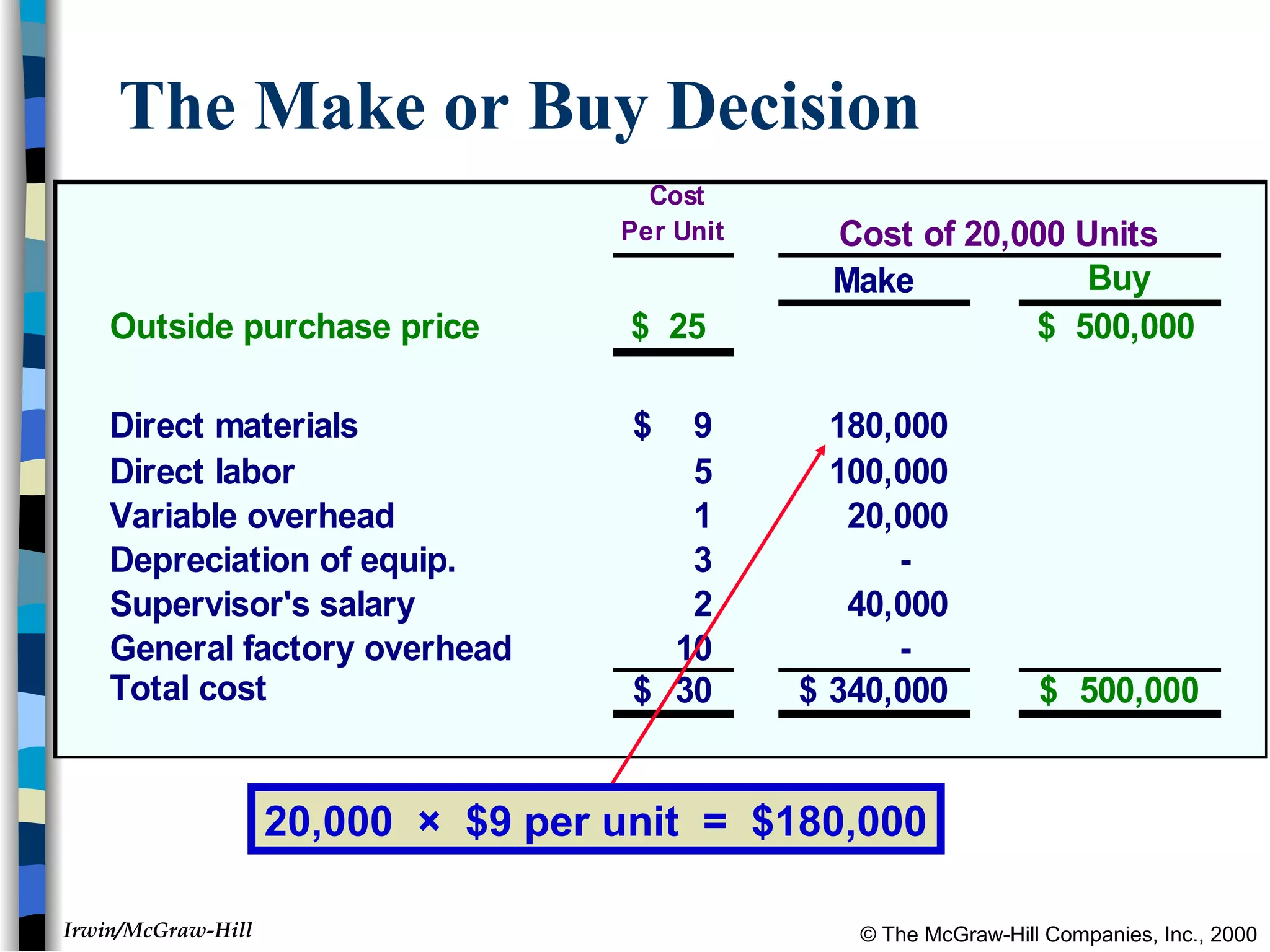
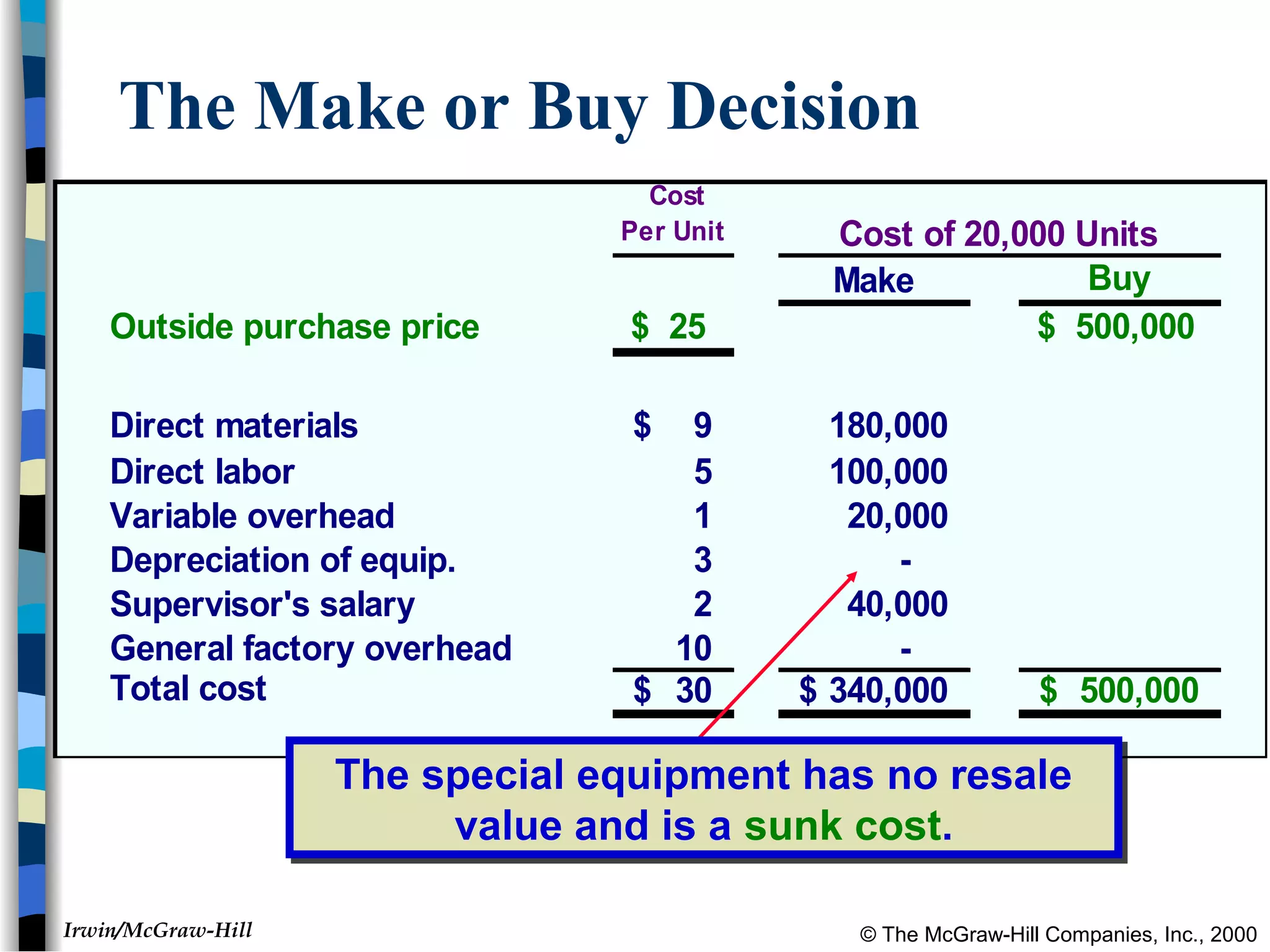
Cost
Per Unit Cost of 20,000 Units
Make Buy
Outside purchase price $ 25 $ 500,000
Direct materials 9$ 180,000
Direct labor 5 100,000
Variable overhead 1 20,000
Depreciation of equip. 3 -
Supervisor's salary 2 40,000
General factory overhead 10 -
Total cost 30$ 340,000$ 500,000$
The Make or Buy Decision
20,000 × $9 per unit = $180,000
© The McGraw-Hill Companies, Inc., 2000Irwin/McGraw-Hill
Cost
Per Unit Cost of 20,000 Units
Make Buy
Outside purchase price $ 25 $ 500,000
Direct materials 9$ 180,000
Direct labor 5 100,000
Variable overhead 1 20,000
Depreciation of equip. 3 -
Supervisor's salary 2 40,000
General factory overhead 10 -
Total cost 30$ 340,000$ 500,000$
The Make or Buy Decision
The special equipment has no resale
value and is a sunk cost.
The special equipment has no resale
value and is a sunk cost.
© The McGraw-Hill Companies, Inc., 2000Irwin/McGraw-Hill
Cost
Per Unit Cost of 20,000 Units
Make Buy
Outside purchase price $ 25 $ 500,000
Direct materials 9$ 180,000
Direct labor 5 100,000
Variable overhead 1 20,000
Depreciation of equip. 3 -
Supervisor's salary 2 40,000
General factory overhead 10 -
Total cost 30$ 340,000$ 500,000$
The Make or Buy Decision
Not avoidable and is irrelevant. If the product is
dropped, it will be reallocated to other products.
Not avoidable and is irrelevant. If the product is
dropped, it will be reallocated to other products.
© The McGraw-Hill Companies, Inc., 2000Irwin/McGraw-Hill
The Make or Buy Decision
Should we make or buy part 4A?Should we make or buy part 4A?
Cost
Per Unit Cost of 20,000 Units
Make Buy
Outside purchase price $ 25 $ 500,000
Direct materials 9$ 180,000
Direct labor 5 100,000
Variable overhead 1 20,000
Depreciation of equip. 3 -
Supervisor's salary 2 40,000
General factory overhead 10 -
Total cost 30$ 340,000$ 500,000$
© The McGraw-Hill Companies, Inc., 2000Irwin/McGraw-Hill
The Make or Buy Decision
DECISION RULE
In deciding whether to accept the outside
supplier’s offer, Essex isolated the relevant
costs of making the part by eliminatingeliminating:
The sunk costs.
The future costs that will not differ between
making or buying the parts.
DECISION RULE
In deciding whether to accept the outside
supplier’s offer, Essex isolated the relevant
costs of making the part by eliminatingeliminating:
The sunk costs.
The future costs that will not differ between
making or buying the parts.
© The McGraw-Hill Companies, Inc., 2000Irwin/McGraw-Hill
The Matter of Opportunity Cost
The economic benefits that are foregone as a
result of pursuing some course of action.
Opportunity costs are not actual dollar
outlays and are not recorded in the
accounts of an organization.
© The McGraw-Hill Companies, Inc., 2000Irwin/McGraw-Hill
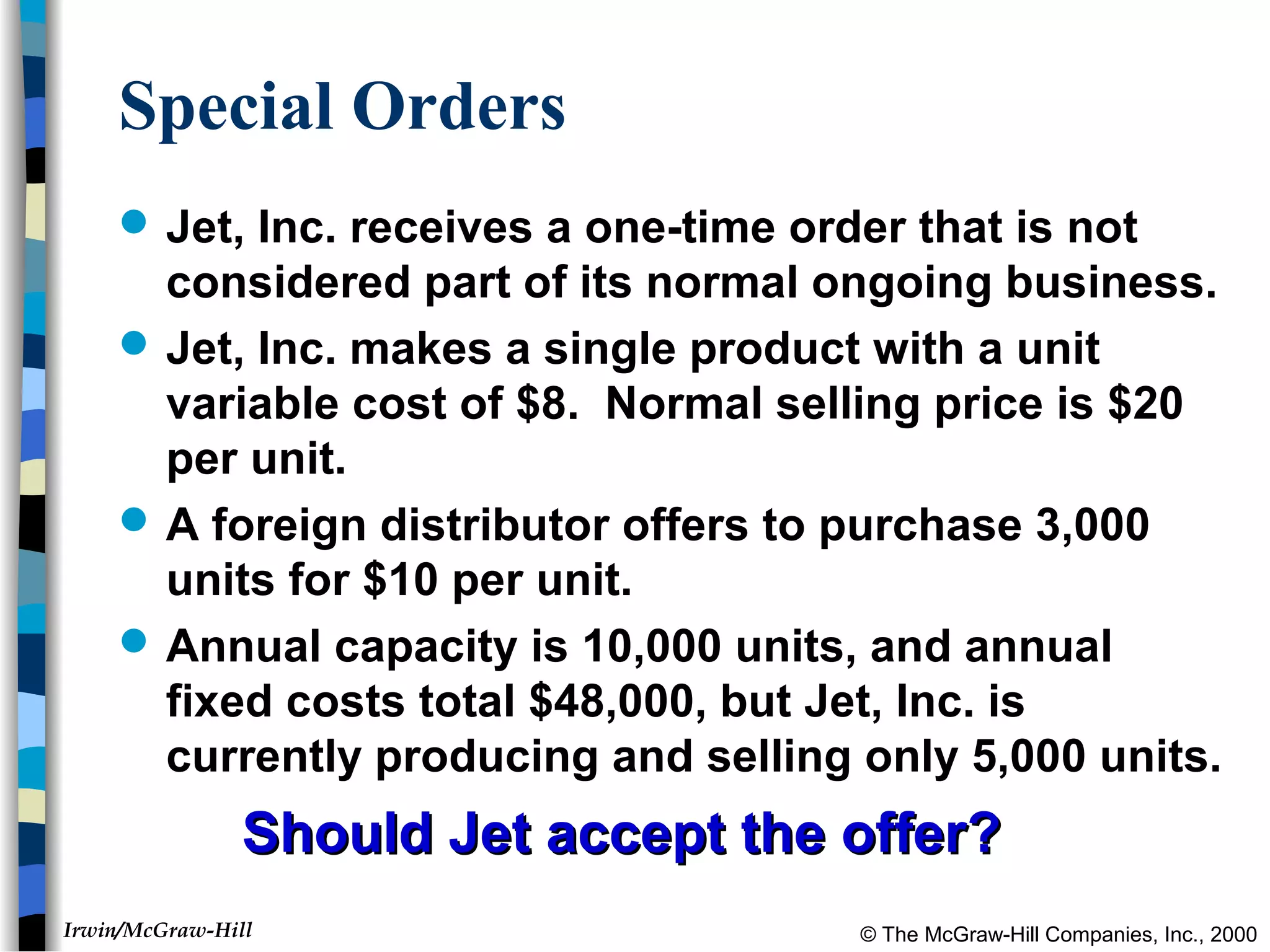
Special Orders
 Jet, Inc. receives a one-time order that is not
considered part of its normal ongoing business.
 Jet, Inc. makes a single product with a unit
variable cost of $8. Normal selling price is $20
per unit.
 A foreign distributor offers to purchase 3,000
units for $10 per unit.
 Annual capacity is 10,000 units, and annual
fixed costs total $48,000, but Jet, Inc. is
currently producing and selling only 5,000 units.
Should Jet accept the offer?Should Jet accept the offer?
© The McGraw-Hill Companies, Inc., 2000Irwin/McGraw-Hill
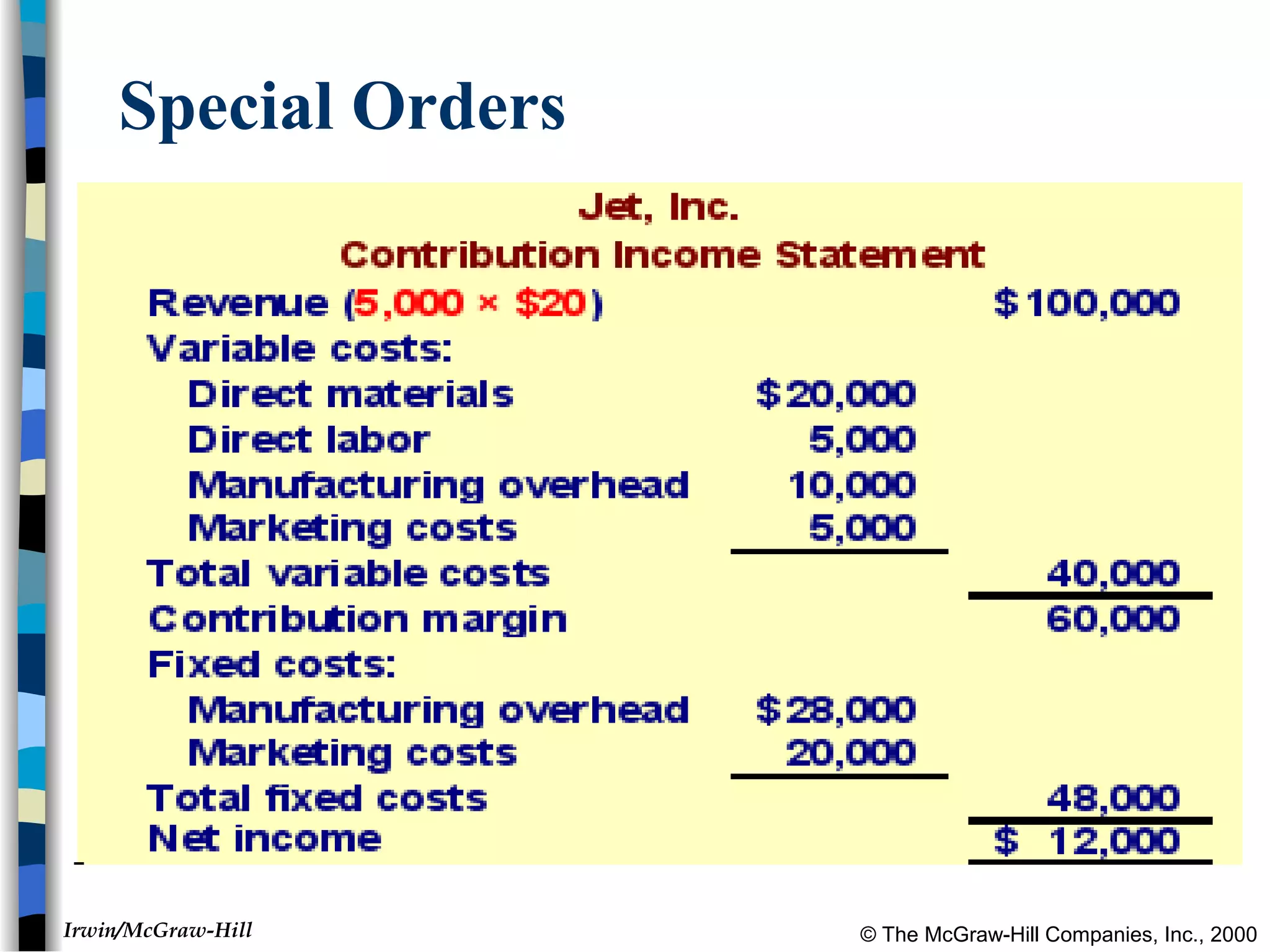
Special Orders
© The McGraw-Hill Companies, Inc., 2000Irwin/McGraw-Hill
Special Orders
If Jet accepts the offer, net income will
increase by $6,000.
Increase in revenue (3,000 × $10) 30,000$
Increase in costs (3,000 × $8 variable cost) 24,000
Increase in net income 6,000$
We can reach the same results more quickly like this:
Special order contribution margin = $10 – $8 = $2
Change in income = $2 × 3,000 units = $6,000.
© The McGraw-Hill Companies, Inc., 2000Irwin/McGraw-Hill
Utilization of a Constrained Resource
Firms often face the problem of deciding how
to best utilize a constrained resource.
Usually, fixed costs are not affected by this
particular decision, so management can focus
on maximizing total contribution margin.
Let’s look at the Ensign Company example.Let’s look at the Ensign Company example.
© The McGraw-Hill Companies, Inc., 2000Irwin/McGraw-Hill
Utilization of a Constrained Resource
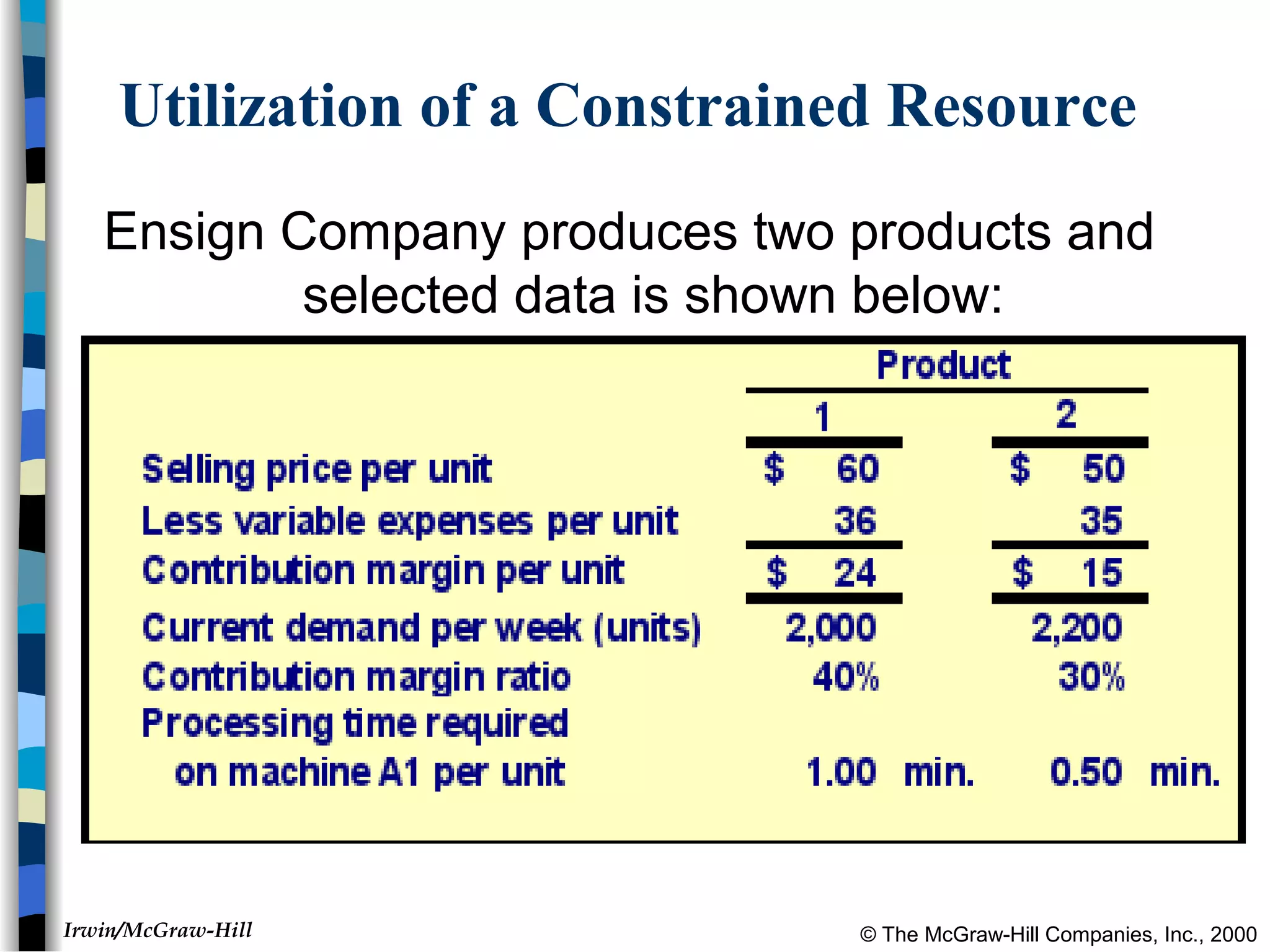
Ensign Company produces two products and
selected data is shown below:
© The McGraw-Hill Companies, Inc., 2000Irwin/McGraw-Hill
Utilization of a Constrained Resource
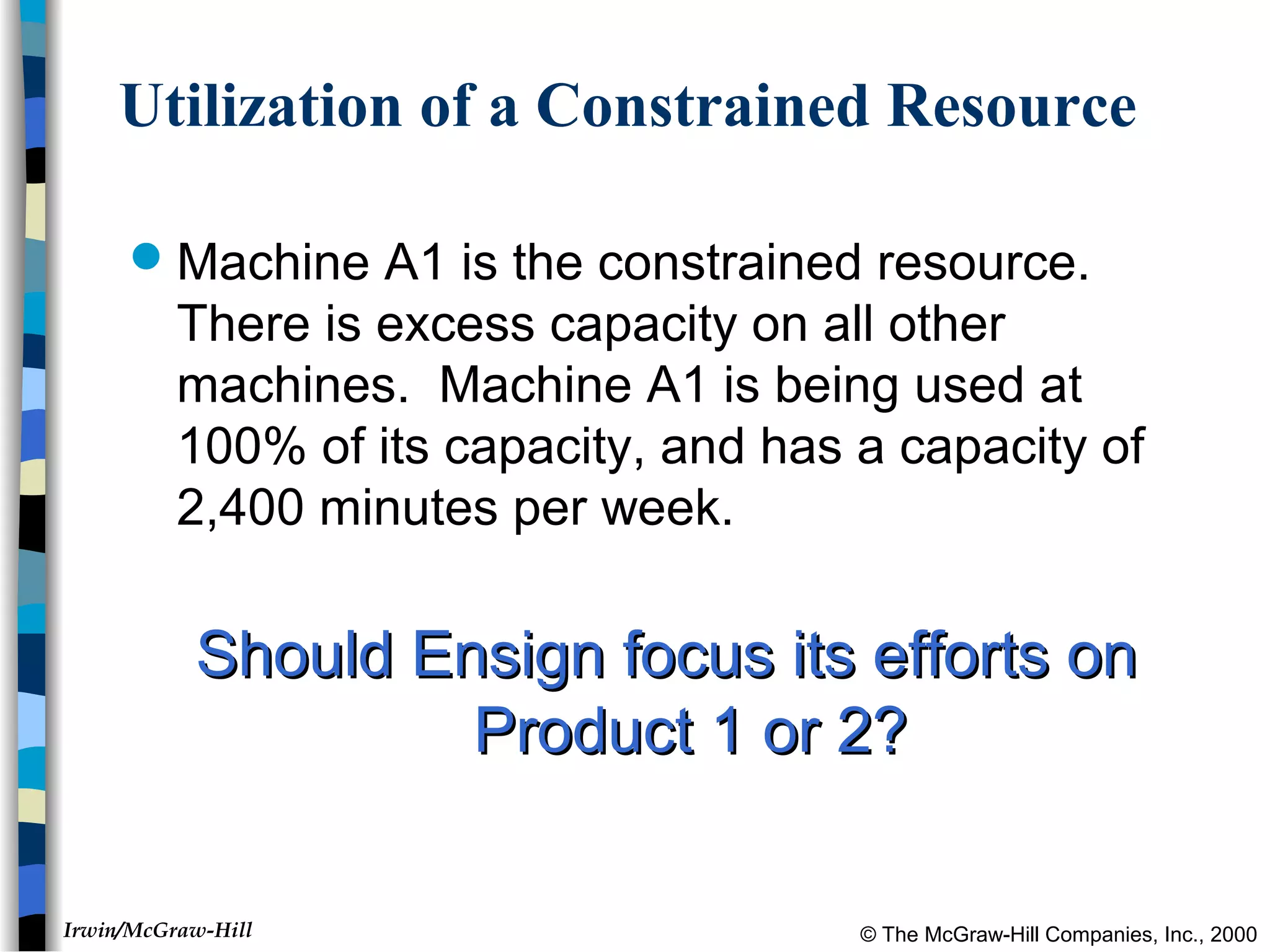
Machine A1 is the constrained resource.
There is excess capacity on all other
machines. Machine A1 is being used at
100% of its capacity, and has a capacity of
2,400 minutes per week.
Should Ensign focus its efforts onShould Ensign focus its efforts on
Product 1 or 2?Product 1 or 2?
© The McGraw-Hill Companies, Inc., 2000Irwin/McGraw-Hill
Utilization of a Constrained Resource
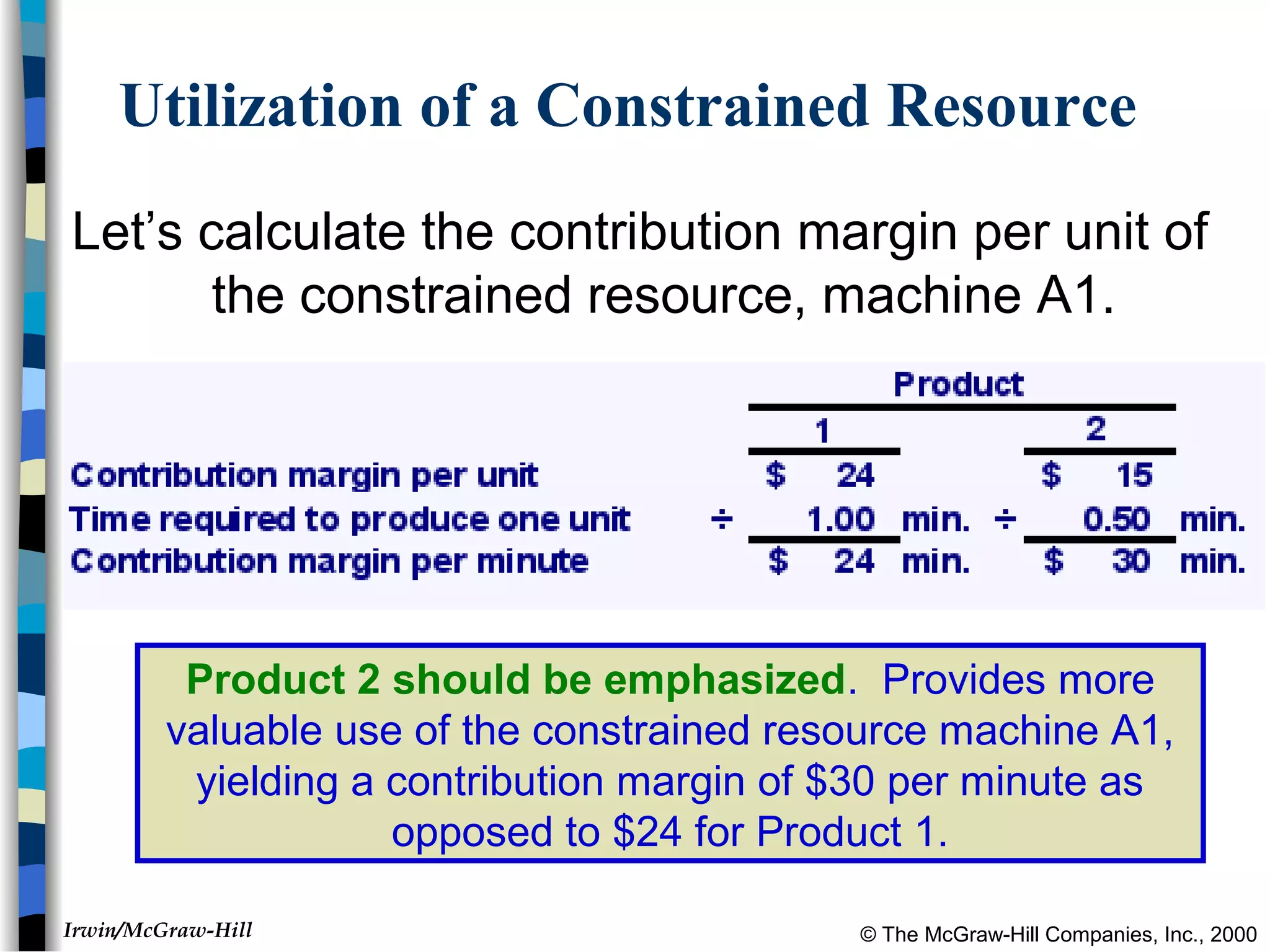
Let’s calculate the contribution margin per unit of
the constrained resource, machine A1.
Product 2 should be emphasized. Provides more
valuable use of the constrained resource machine A1,
yielding a contribution margin of $30 per minute as
opposed to $24 for Product 1.
© The McGraw-Hill Companies, Inc., 2000Irwin/McGraw-Hill
Utilization of a Constrained Resource
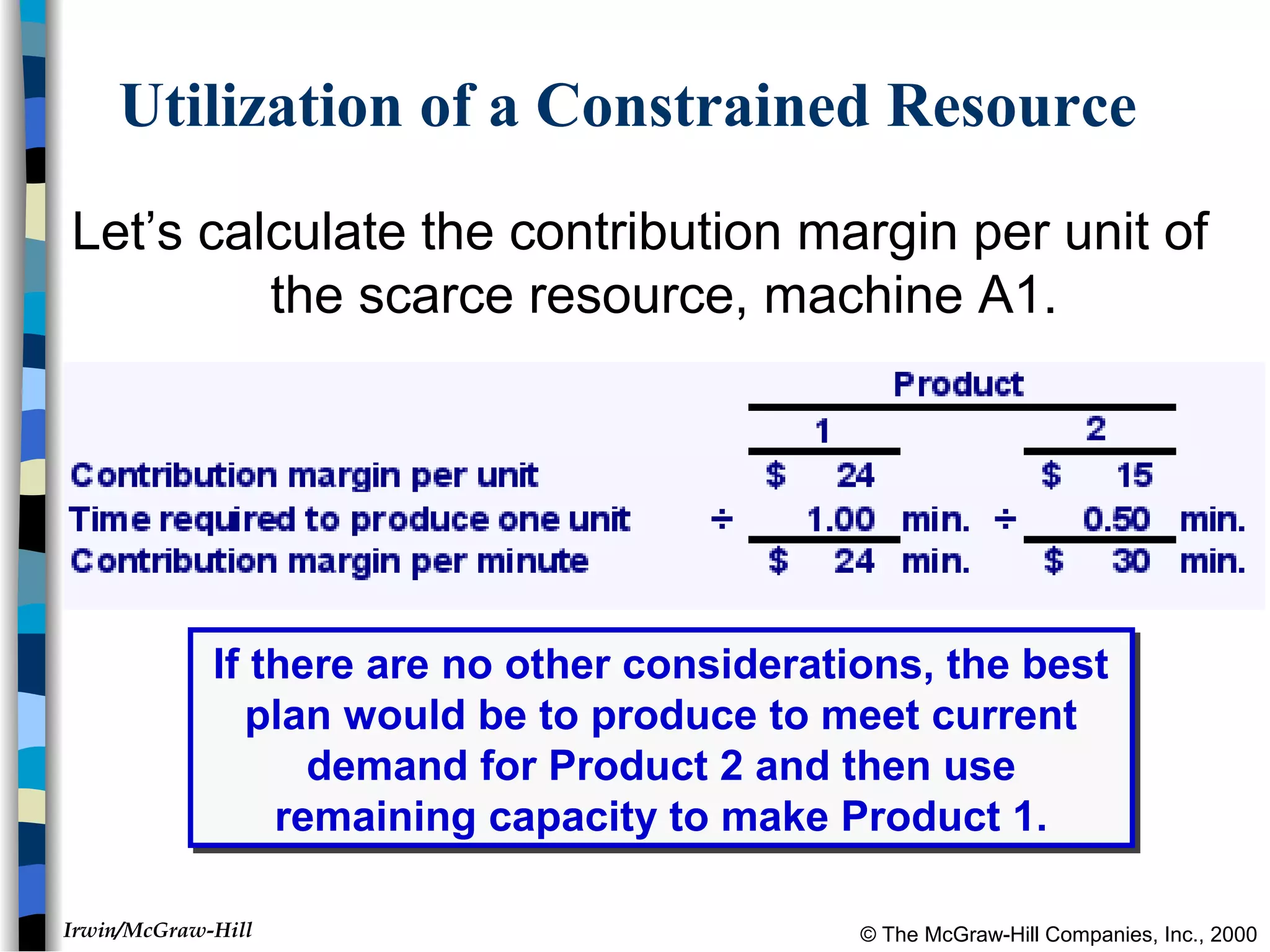
Let’s calculate the contribution margin per unit of
the scarce resource, machine A1.
If there are no other considerations, the best
plan would be to produce to meet current
demand for Product 2 and then use
remaining capacity to make Product 1.
If there are no other considerations, the best
plan would be to produce to meet current
demand for Product 2 and then use
remaining capacity to make Product 1.
© The McGraw-Hill Companies, Inc., 2000Irwin/McGraw-Hill
Utilization of a Constrained Resource
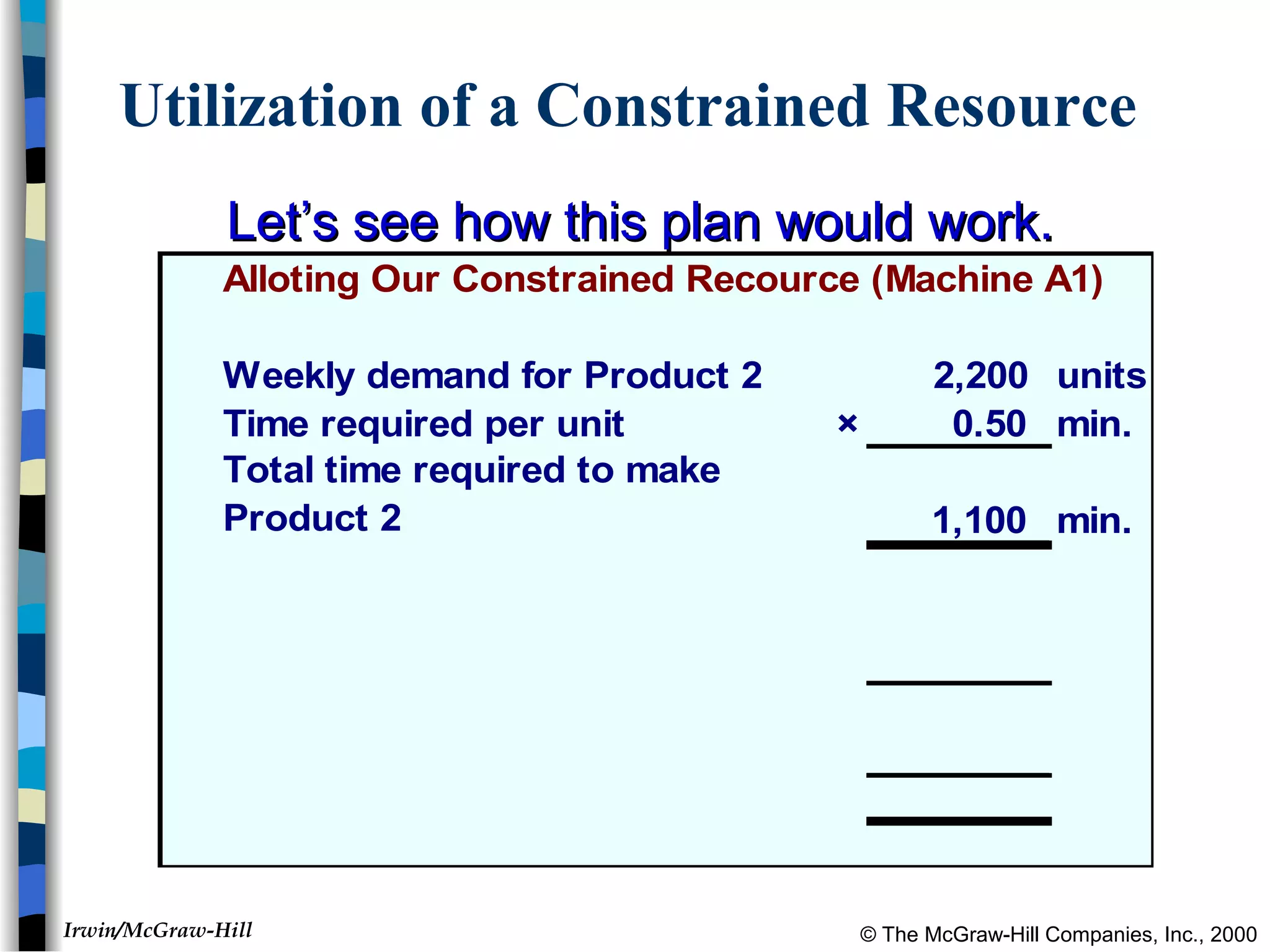
Let’s see how this plan would work.Let’s see how this plan would work.
Alloting Our Constrained Recource (Machine A1)
Weekly demand for Product 2 2,200 units
Time required per unit × 0.50 min.
Total time required to make
Product 2 1,100 min.
© The McGraw-Hill Companies, Inc., 2000Irwin/McGraw-Hill
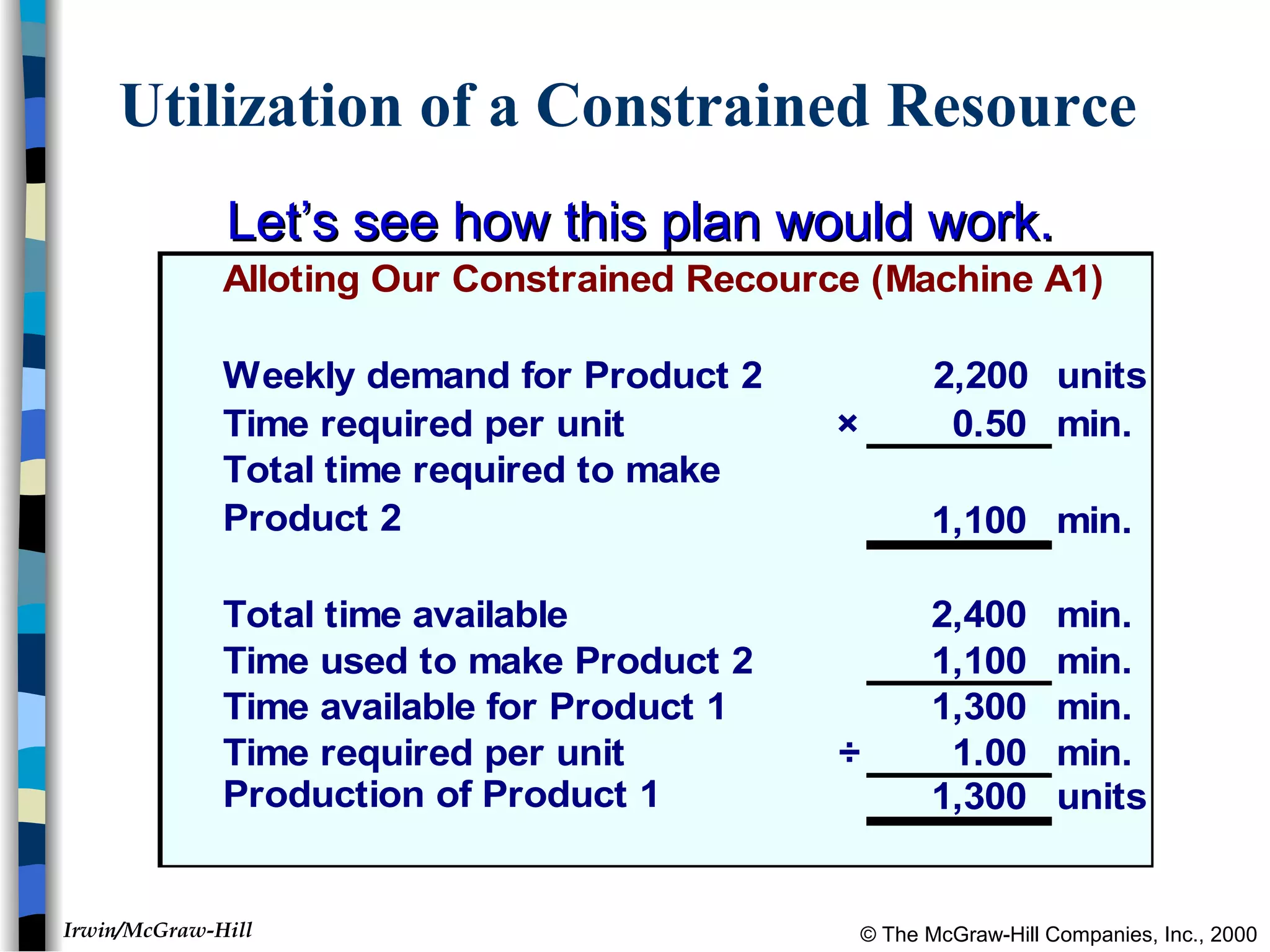
Alloting Our Constrained Recource (Machine A1)
Weekly demand for Product 2 2,200 units
Time required per unit × 0.50 min.
Total time required to make
Product 2 1,100 min.
Total time available 2,400 min.
Time used to make Product 2 1,100 min.
Time available for Product 1 1,300 min.
Utilization of a Constrained Resource
Let’s see how this plan would work.Let’s see how this plan would work.
© The McGraw-Hill Companies, Inc., 2000Irwin/McGraw-Hill
Utilization of a Constrained Resource
Let’s see how this plan would work.Let’s see how this plan would work.
Alloting Our Constrained Recource (Machine A1)
Weekly demand for Product 2 2,200 units
Time required per unit × 0.50 min.
Total time required to make
Product 2 1,100 min.
Total time available 2,400 min.
Time used to make Product 2 1,100 min.
Time available for Product 1 1,300 min.
Time required per unit ÷ 1.00 min.
Production of Product 1 1,300 units
© The McGraw-Hill Companies, Inc., 2000Irwin/McGraw-Hill
Utilization of a Constrained Resource
According to the plan, we will produceAccording to the plan, we will produce
2,200 units of Product 2 and 1,300 of2,200 units of Product 2 and 1,300 of
Product 1. Our contribution margin looksProduct 1. Our contribution margin looks
like this.like this.
Product 1 Product 2
Production and sales (units) 1,300 2,200
Contribution margin per unit 24$ 15$
Total contribution margin 31,200$ 33,000$
The total contribution margin for Ensign is $64,200.
© The McGraw-Hill Companies, Inc., 2000Irwin/McGraw-Hill
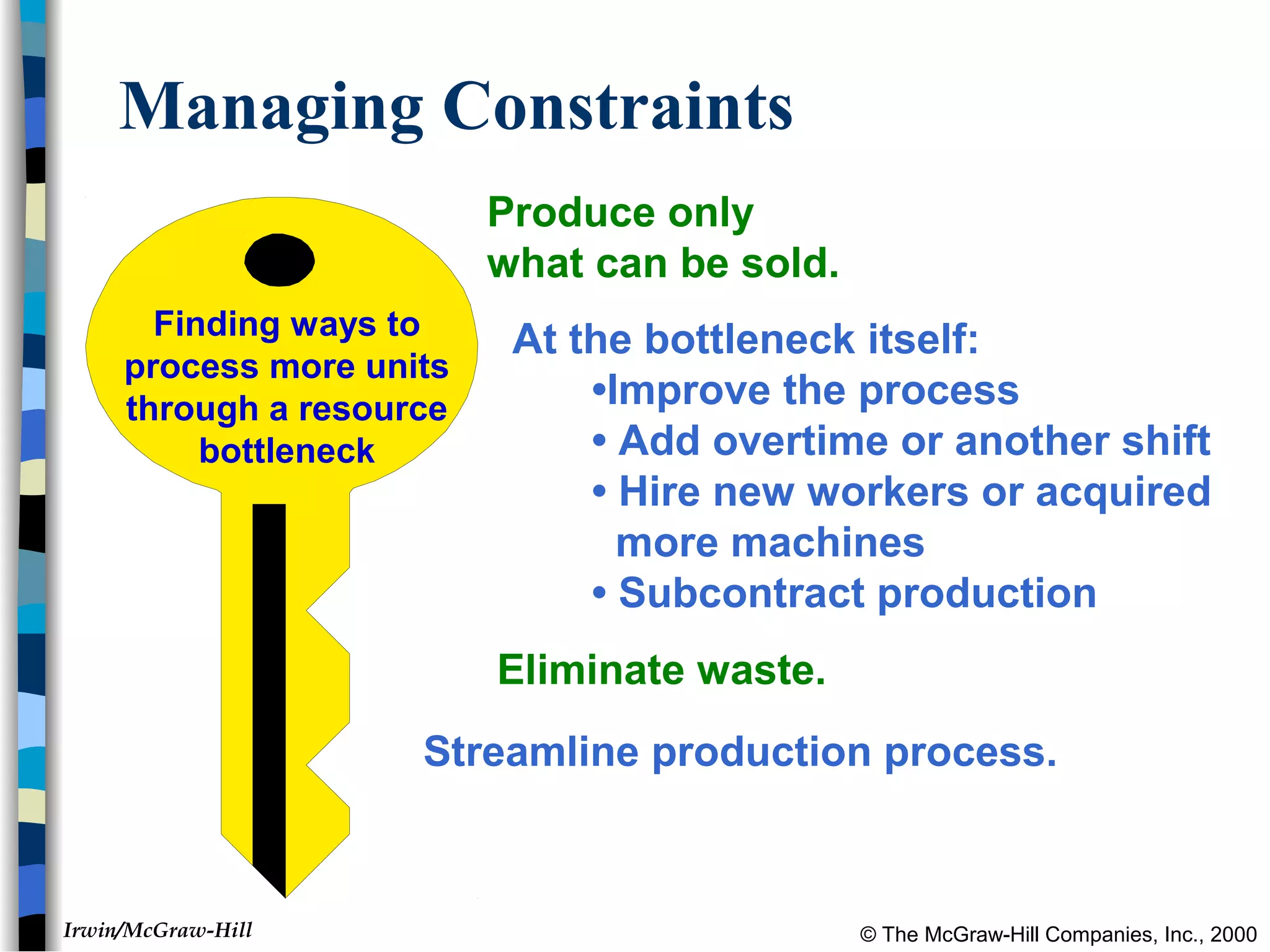
Managing Constraints
Finding ways to
process more units
through a resource
bottleneck
Produce only
what can be sold.
Streamline production process.
Eliminate waste.
At the bottleneck itself:
•Improve the process
• Add overtime or another shift
• Hire new workers or acquired
more machines
• Subcontract production
© The McGraw-Hill Companies, Inc., 2000Irwin/McGraw-Hill
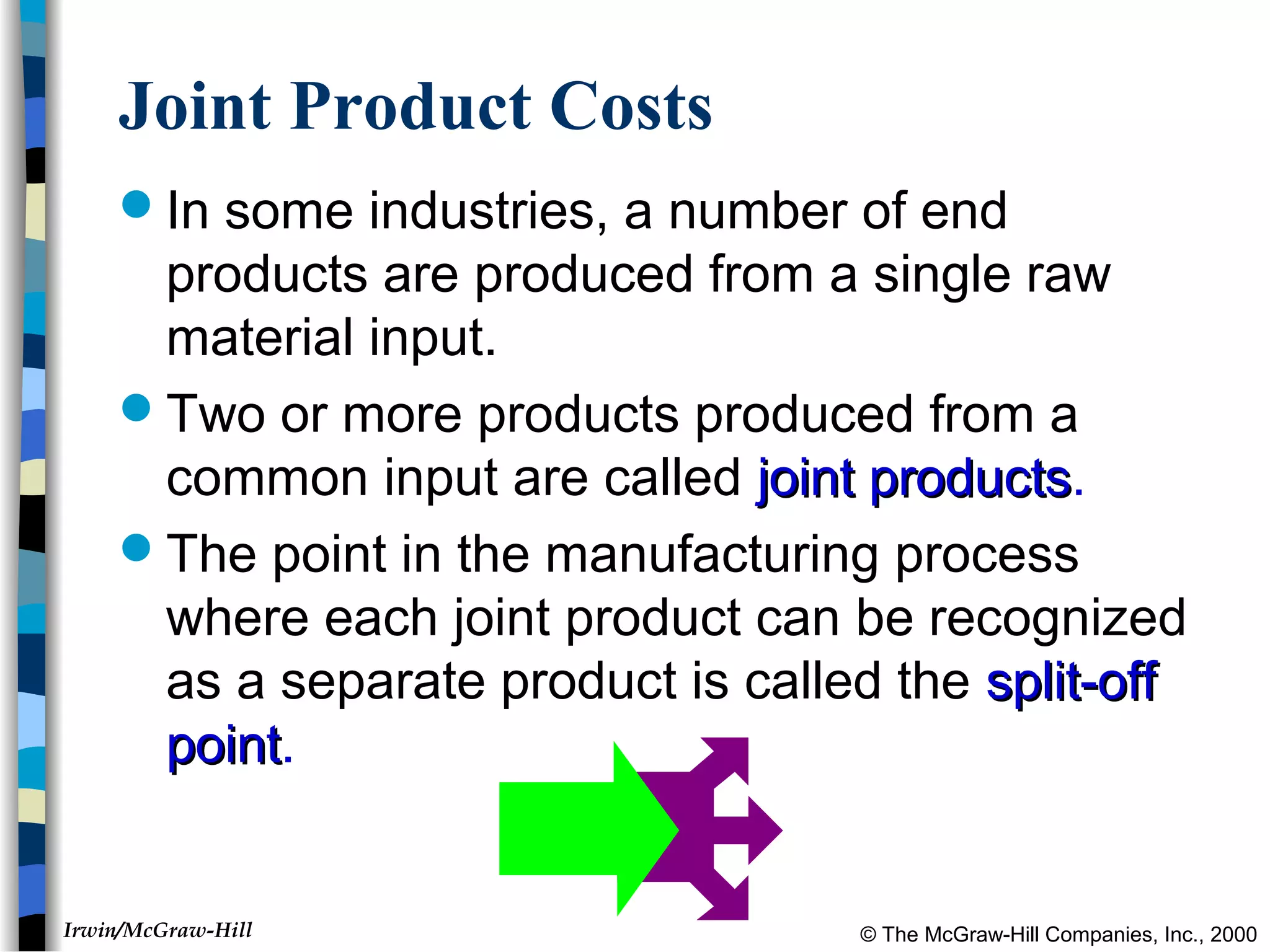
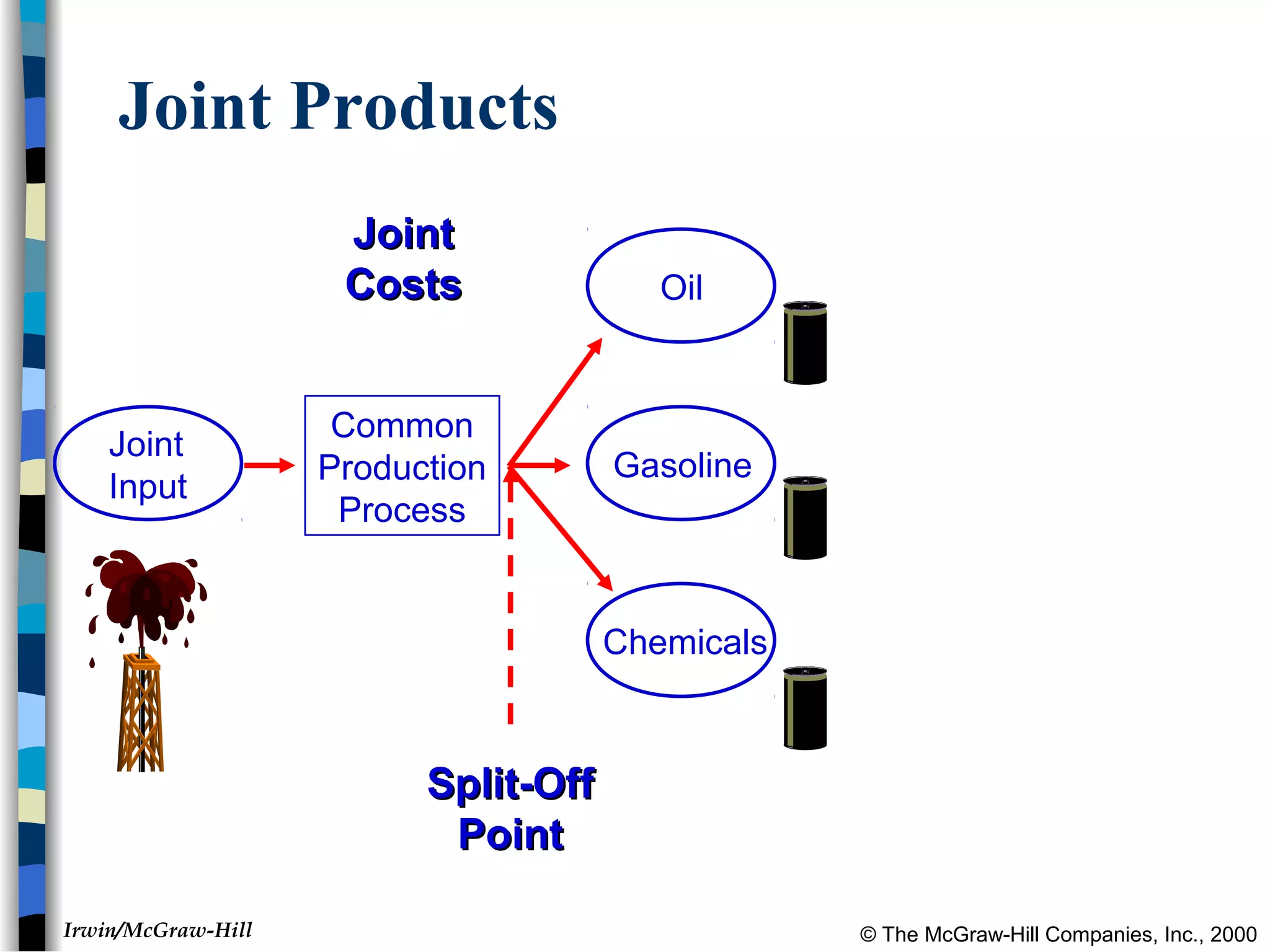
Joint Product Costs
In some industries, a number of end
products are produced from a single raw
material input.
Two or more products produced from a
common input are called joint productsjoint products.
The point in the manufacturing process
where each joint product can be recognized
as a separate product is called the split-offsplit-off
pointpoint.
© The McGraw-Hill Companies, Inc., 2000Irwin/McGraw-Hill
Joint Products
Joint
Input
Common
Production
Process
Split-OffSplit-Off
PointPoint
JointJoint
CostsCosts Oil
Gasoline
Chemicals
© The McGraw-Hill Companies, Inc., 2000Irwin/McGraw-Hill
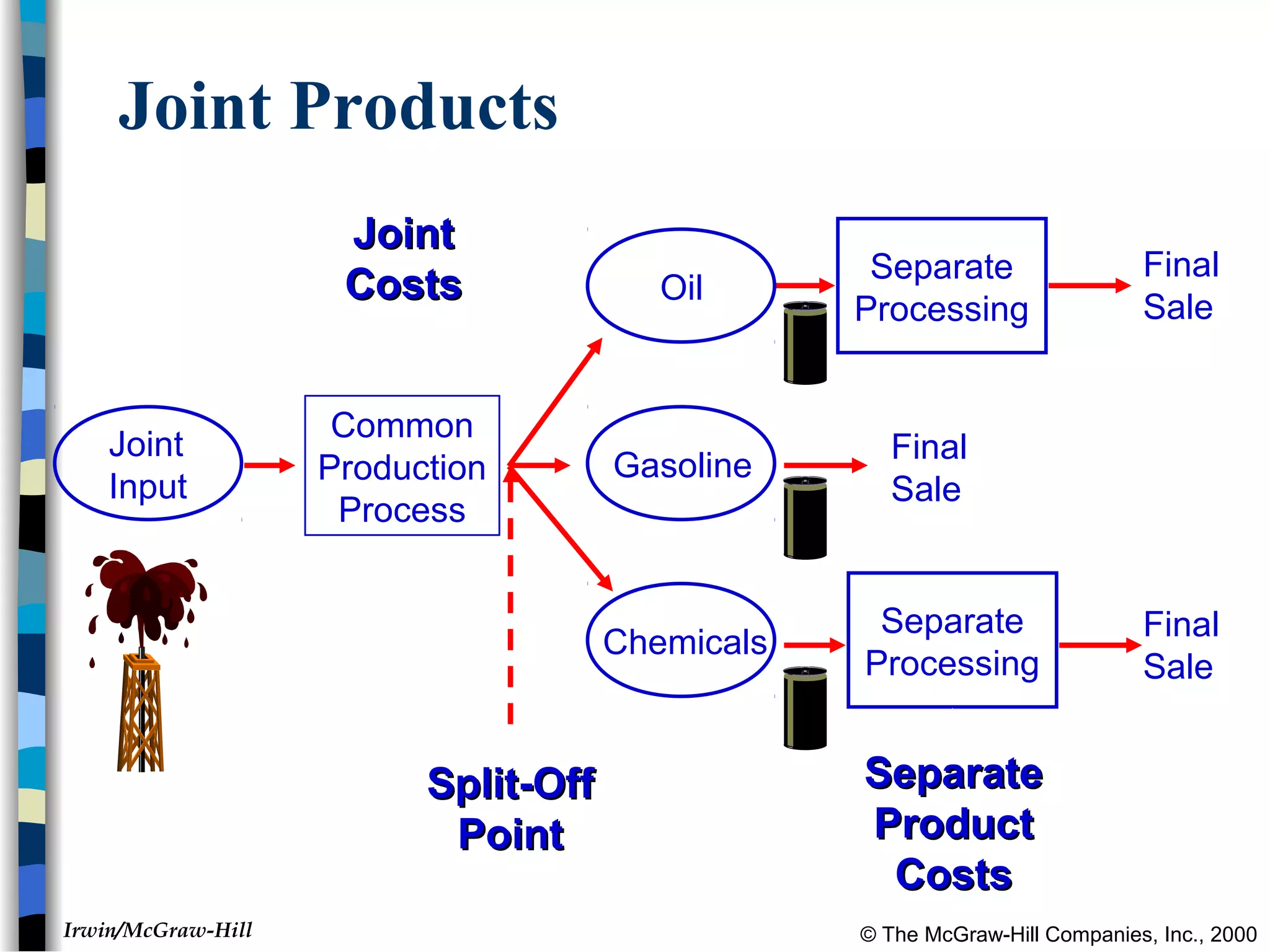
Joint Products
Joint
Input
Common
Production
Process
Separate
Processing
Separate
Processing
Final
Sale
Final
Sale
Final
Sale
Split-OffSplit-Off
PointPoint
JointJoint
CostsCosts
SeparateSeparate
ProductProduct
CostsCosts
Oil
Gasoline
Chemicals
© The McGraw-Hill Companies, Inc., 2000Irwin/McGraw-Hill
The Pitfalls of Allocation
Joint costs are really
common costs incurred to
simultaneously produce a
variety of end products.
Joint costs are often
allocated to end products on
the basis of the relativerelative
sales valuesales value of each product
or on some other basis.
© The McGraw-Hill Companies, Inc., 2000Irwin/McGraw-Hill
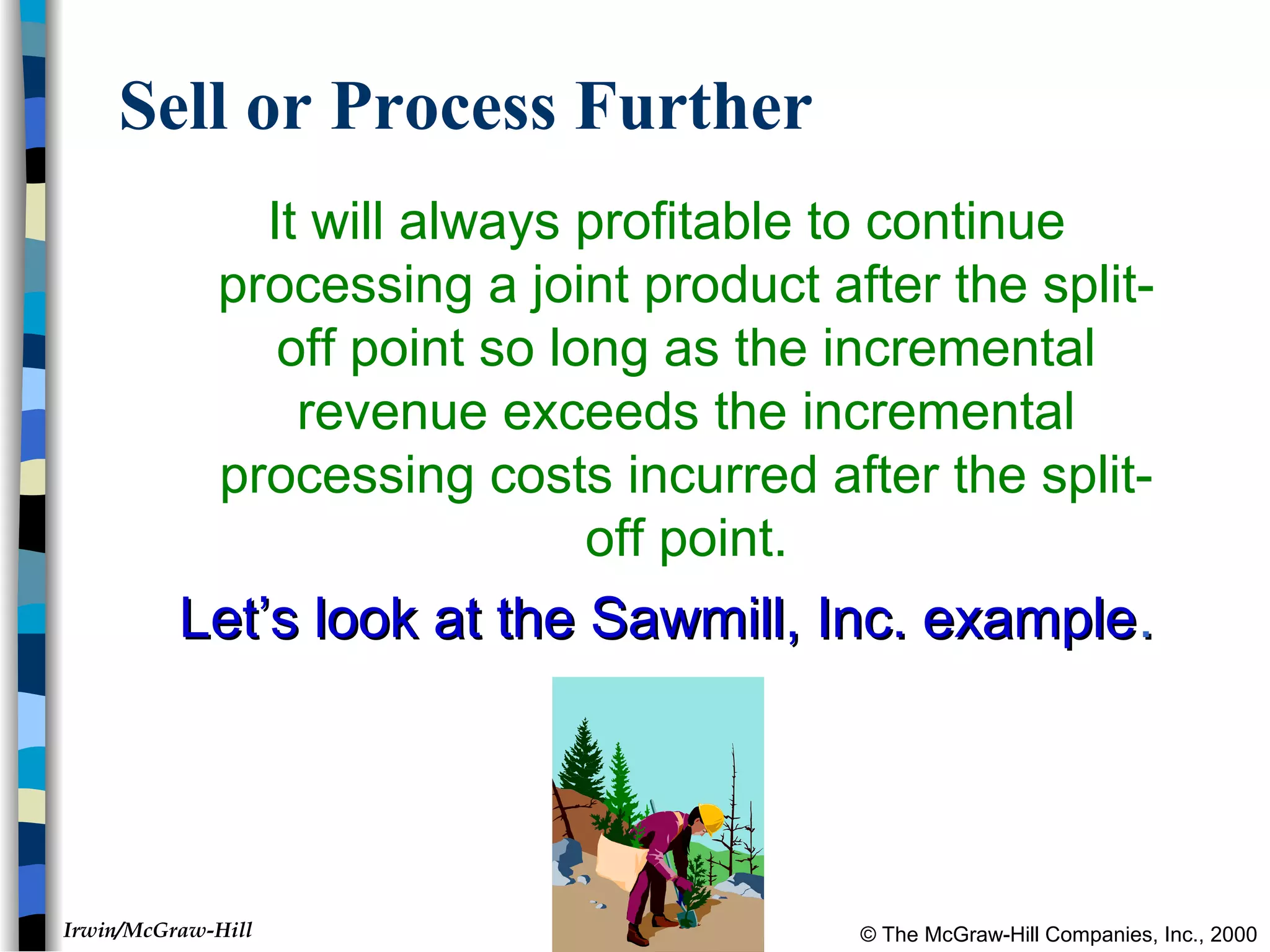
Sell or Process Further
It will always profitable to continue
processing a joint product after the split-
off point so long as the incremental
revenue exceeds the incremental
processing costs incurred after the split-
off point.
Let’s look at the Sawmill, Inc. exampleLet’s look at the Sawmill, Inc. example..
© The McGraw-Hill Companies, Inc., 2000Irwin/McGraw-Hill
Sell or Process Further
Sawmill, Inc. cuts logs from which
unfinished lumber and sawdust are the
immediate joint products.
Unfinished lumber is sold “as is” or
processed further into finished lumber.
Sawdust can also be sold “as is” to
gardening wholesalers or processed further
into “presto-logs.”
© The McGraw-Hill Companies, Inc., 2000Irwin/McGraw-Hill
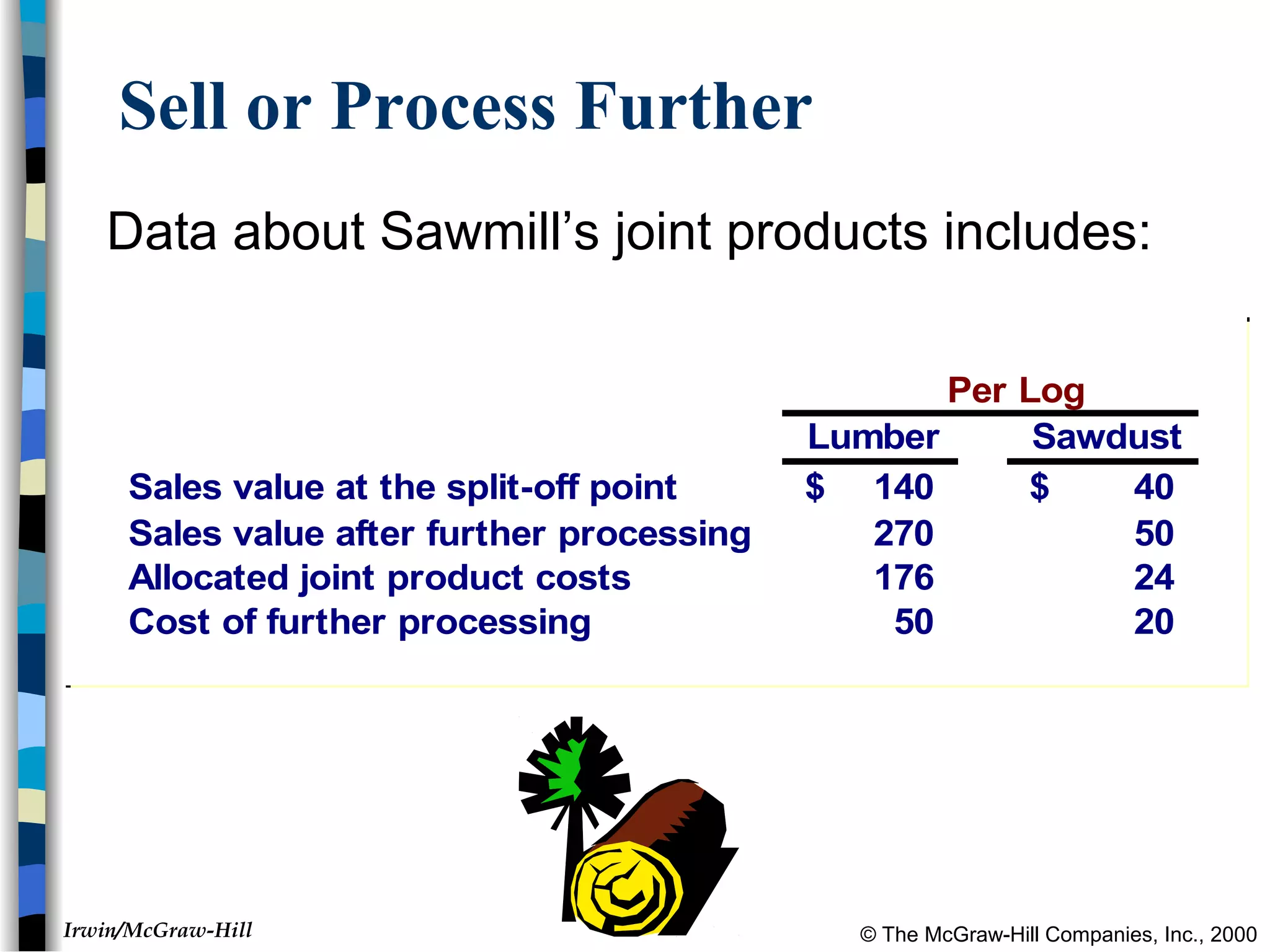
Sell or Process Further
Data about Sawmill’s joint products includes:
Per Log
Lumber Sawdust
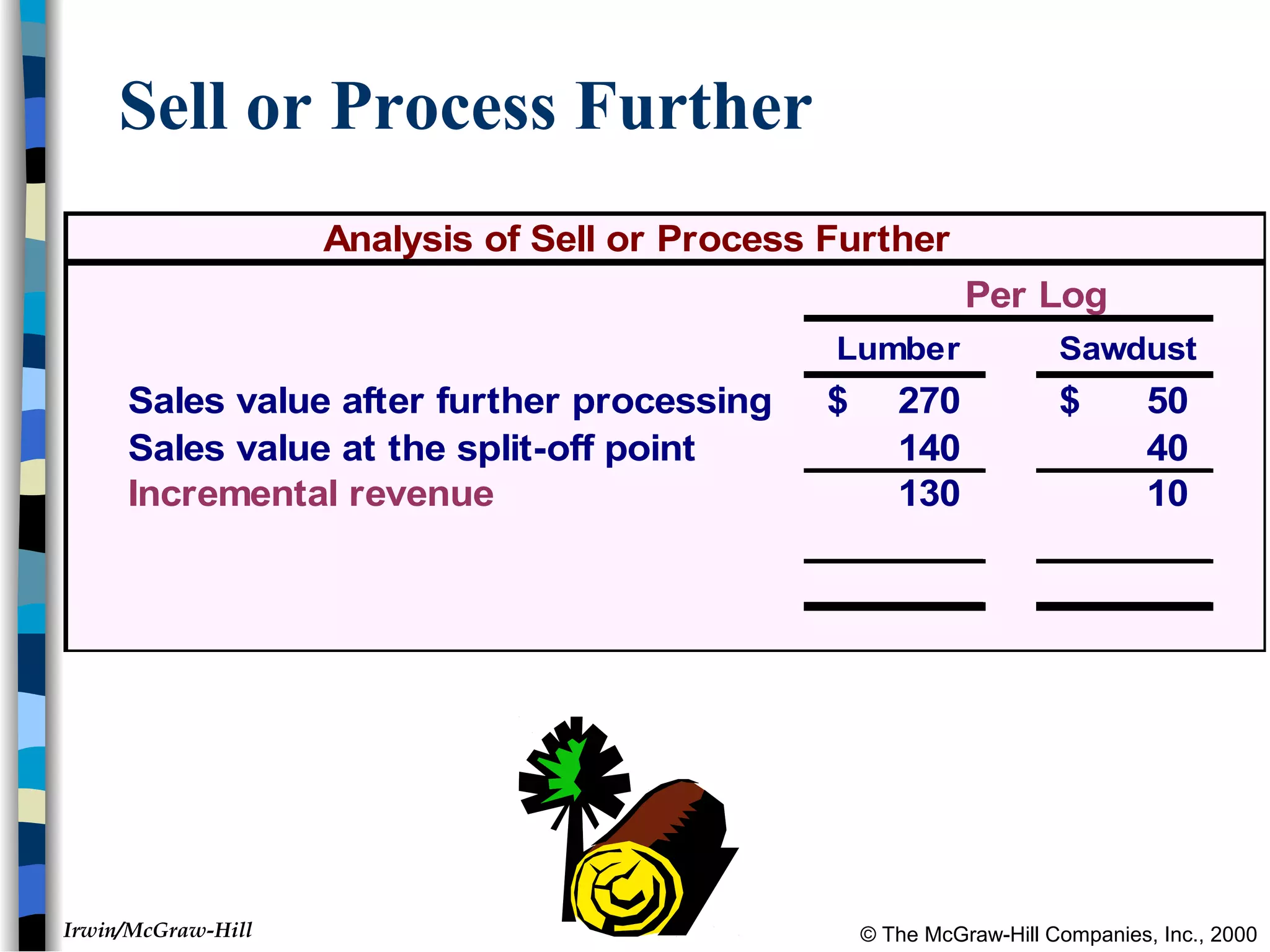
Sales value at the split-off point 140$ 40$
Sales value after further processing 270 50
Allocated joint product costs 176 24
Cost of further processing 50 20
© The McGraw-Hill Companies, Inc., 2000Irwin/McGraw-Hill
Sell or Process Further
Analysis of Sell or Process Further
Per Log
Lumber Sawdust
Sales value after further processing 270$ 50$
Sales value at the split-off point 140 40
Incremental revenue 130 10
© The McGraw-Hill Companies, Inc., 2000Irwin/McGraw-Hill
Sell or Process Further
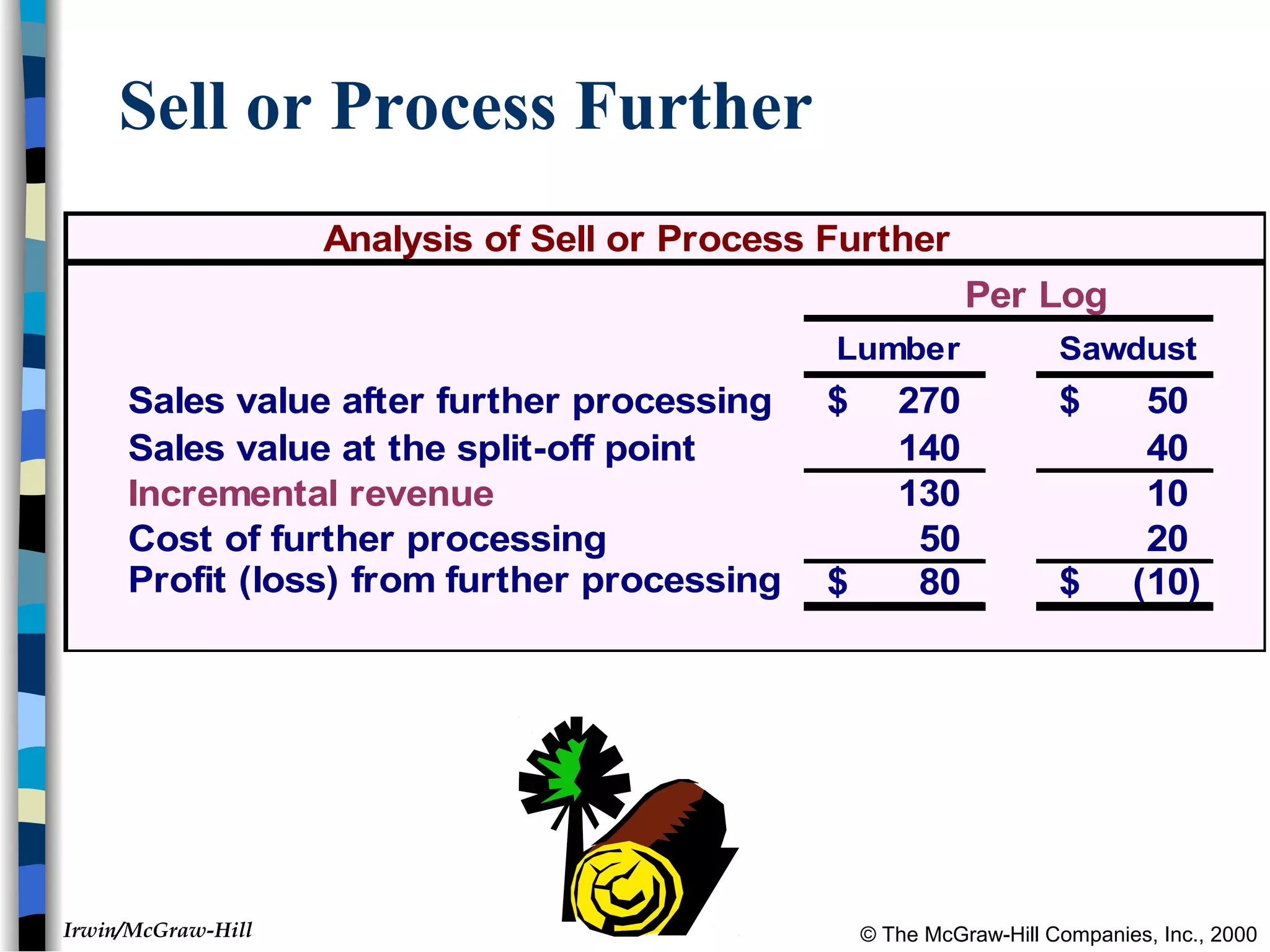
Analysis of Sell or Process Further
Per Log
Lumber Sawdust
Sales value after further processing 270$ 50$
Sales value at the split-off point 140 40
Incremental revenue 130 10
Cost of further processing 50 20
Profit (loss) from further processing 80$ (10)$
© The McGraw-Hill Companies, Inc., 2000Irwin/McGraw-Hill
Sell or Process Further
Analysis of Sell or Process Further
Per Log
Lumber Sawdust
Sales value after further processing 270$ 50$
Sales value at the split-off point 140 40
Incremental revenue 130 10
Cost of further processing 50 20
Profit (loss) from further processing 80$ (10)$
Should we process the lumber
further and sell the sawdust “as is?”
Should we process the lumber
further and sell the sawdust “as is?”
© The McGraw-Hill Companies, Inc., 2000Irwin/McGraw-Hill
End of Chapter 13End of Chapter 13

B8 relevan cost

  • 1.
  • 2.
    © The McGraw-HillCompanies, Inc., 2000Irwin/McGraw-Hill Cost Concepts for Decision Making A relevant cost is a cost that differs between alternatives. 1 2
  • 3.
    © The McGraw-HillCompanies, Inc., 2000Irwin/McGraw-Hill Identifying Relevant Costs Costs that can be eliminated (in whole or in part) by choosing one alternative over another are avoidable costs. Avoidable costs are relevant costs. Unavoidable costs are never relevant and include: Sunk costs. Future costs that do not differ between the alternatives.
  • 4.
    © The McGraw-HillCompanies, Inc., 2000Irwin/McGraw-Hill Identifying Relevant Costs Sunk cost -- a cost that has already been incurred and that cannot be avoided regardless of what a manager decides to do.
  • 5.
    © The McGraw-HillCompanies, Inc., 2000Irwin/McGraw-Hill Identifying Relevant Costs Well, I’ve assembled all the costs associated with the alternatives we are considering.
  • 6.
    © The McGraw-HillCompanies, Inc., 2000Irwin/McGraw-Hill Identifying Relevant Costs Great! The first thing we need to do is eliminate all the sunk costs.
  • 7.
    © The McGraw-HillCompanies, Inc., 2000Irwin/McGraw-Hill Identifying Relevant Costs Now that we have eliminated the sunk costs, we need to eliminate the future costs that don’t differ between alternatives.
  • 8.
    © The McGraw-HillCompanies, Inc., 2000Irwin/McGraw-Hill Identifying Relevant Costs The decision will be easier now. All we have left are the avoidable costs.
  • 9.
    © The McGraw-HillCompanies, Inc., 2000Irwin/McGraw-Hill Sunk Costs are not Relevant Costs Let’s look at the White Company example.
  • 10.
    © The McGraw-HillCompanies, Inc., 2000Irwin/McGraw-Hill Sunk Costs are not Relevant Costs A manager at White Co. wants to replace an old machine with a new, more efficient machine. New machine: List price 90,000$ Annual variable expenses 80,000 Expected life in years 5 Old machine: Original cost 72,000$ Remaining book value 60,000 Disposal value now 15,000 Annual variable expenses 100,000 Remaining life in years 5
  • 11.
    © The McGraw-HillCompanies, Inc., 2000Irwin/McGraw-Hill Sunk Costs are not Relevant Costs White’s sales are $200,000 per year. Fixed expenses, other than depreciation, are $70,000 per year. Should the manager purchase the new machine?
  • 12.
    © The McGraw-HillCompanies, Inc., 2000Irwin/McGraw-Hill Incorrect Analysis The manager recommends that the company not purchase the new machine since disposal of the old machine would result in a loss: Remaining book value 60,000$ Disposal value (15,000) Loss from disposal 45,000$
  • 13.
    © The McGraw-HillCompanies, Inc., 2000Irwin/McGraw-Hill For Five Years Keep Old Machine Purchase New Machine Difference Sales 1,000,000$ Variable expenses (500,000) Other fixed expenses Depreciation - new Depreciation - old Disposal of old machine Total net income Correct Analysis Look at the comparative cost and revenue for the next five years. $200,000 per year × 5 years$200,000 per year × 5 years $100,000 per year × 5 years$100,000 per year × 5 years
  • 14.
    © The McGraw-HillCompanies, Inc., 2000Irwin/McGraw-Hill For Five Years Keep Old Machine Purchase New Machine Difference Sales 1,000,000$ Variable expenses (500,000) Other fixed expenses (350,000) Depreciation - new Depreciation - old Disposal of old machine Total net income Correct Analysis $70,000 per year × 5 years$70,000 per year × 5 years Look at the comparative cost and revenue for the next five years.
  • 15.
    © The McGraw-HillCompanies, Inc., 2000Irwin/McGraw-Hill For Five Years Keep Old Machine Purchase New Machine Difference Sales 1,000,000$ Variable expenses (500,000) Other fixed expenses (350,000) Depreciation - new Depreciation - old (60,000) Disposal of old machine Total net income 90,000$ Correct Analysis The remaining book value of the old machine. The remaining book value of the old machine. Look at the comparative cost and revenue for the next five years.
  • 16.
    © The McGraw-HillCompanies, Inc., 2000Irwin/McGraw-Hill For Five Years Keep Old Machine Purchase New Machine Difference Sales 1,000,000$ 1,000,000$ -$ Variable expenses (500,000) (400,000) 100,000 Other fixed expenses (350,000) Depreciation - new Depreciation - old (60,000) Disposal of old machine Total net income 90,000$ Correct Analysis $80,000 per year × 5 years$80,000 per year × 5 years Look at the comparative cost and revenue for the next five years.
  • 17.
    © The McGraw-HillCompanies, Inc., 2000Irwin/McGraw-Hill For Five Years Keep Old Machine Purchase New Machine Difference Sales 1,000,000$ 1,000,000$ -$ Variable expenses (500,000) (400,000) 100,000 Other fixed expenses (350,000) (350,000) - Depreciation - new (90,000) (90,000) Depreciation - old (60,000) Disposal of old machine Total net income 90,000$ Correct Analysis Look at the comparative cost and revenue for the next five years. The total cost will be depreciated over the five year period. The total cost will be depreciated over the five year period.
  • 18.
    © The McGraw-HillCompanies, Inc., 2000Irwin/McGraw-Hill For Five Years Keep Old Machine Purchase New Machine Difference Sales 1,000,000$ 1,000,000$ -$ Variable expenses (500,000) (400,000) 100,000 Other fixed expenses (350,000) (350,000) - Depreciation - new (90,000) (90,000) Depreciation - old (60,000) (60,000) - Disposal of old machine 15,000 15,000 Total net income 90,000$ 115,000$ 25,000$ Correct Analysis Look at the comparative cost and revenue for the next five years. The remaining book value of the old machine is a sunk cost and is not relevant to the decision. The remaining book value of the old machine is a sunk cost and is not relevant to the decision.
  • 19.
    © The McGraw-HillCompanies, Inc., 2000Irwin/McGraw-Hill For Five Years Keep Old Machine Purchase New Machine Difference Sales 1,000,000$ 1,000,000$ -$ Variable expenses (500,000) (400,000) 100,000 Other fixed expenses (350,000) (350,000) - Depreciation - new (90,000) (90,000) Depreciation - old (60,000) (60,000) - Disposal of old machine 15,000 15,000 Total net income 90,000$ 115,000$ 25,000$ Correct Analysis Look at the comparative cost and revenue for the next five years. Would you recommend purchasing the new machine even though we will show a $45,000 loss on the old machine?
  • 20.
    © The McGraw-HillCompanies, Inc., 2000Irwin/McGraw-Hill Correct Analysis Let’s look at a more efficient way to analyze this decision.
  • 21.
    © The McGraw-HillCompanies, Inc., 2000Irwin/McGraw-Hill Relevant Cost Analysis Savings in variable expenses provided by the new machine ($20,000 × 5 yrs.) 100,000$ Net effect Correct Analysis $100,000 - $80,000 = $20,000 variable cost savings
  • 22.
    © The McGraw-HillCompanies, Inc., 2000Irwin/McGraw-Hill Correct Analysis Relevant Cost Analysis Savings in variable expenses provided by the new machine ($20,000 × 5 yrs.) 100,000$ Cost of the new machine (90,000) Disposal value of old machine 15,000 Net effect 25,000$
  • 23.
    © The McGraw-HillCompanies, Inc., 2000Irwin/McGraw-Hill Adding/Dropping Segments One of the most important decisions managers make is whether to add or drop a business segment such as a product or a store. Let’s see how relevant costs should be used in this decision.
  • 24.
    © The McGraw-HillCompanies, Inc., 2000Irwin/McGraw-Hill Adding/Dropping Segments Due to the declining popularity of digital watches, Lovell Company’s digital watch line has not reported a profit for several years. An income statement for last year is shown on the next screen.
  • 25.
    © The McGraw-HillCompanies, Inc., 2000Irwin/McGraw-Hill Adding/Dropping Segments Segment Income Statement Digital Watches Sales 500,000$ Less: variable expenses Variable mfg. costs 120,000$ Variable shipping costs 5,000 Commissions 75,000 200,000 Contribution margin 300,000$ Less: fixed expenses General factory overhead 60,000$ Salary of line manager 90,000 Depreciation of equipment 50,000 Advertising - direct 100,000 Rent - factory space 70,000 General admin. expenses 30,000 400,000 Net loss (100,000)$
  • 26.
    © The McGraw-HillCompanies, Inc., 2000Irwin/McGraw-Hill Segment Income Statement Digital Watches Sales 500,000$ Less: variable expenses Variable mfg. costs 120,000$ Variable shipping costs 5,000 Commissions 75,000 200,000 Contribution margin 300,000$ Less: fixed expenses General factory overhead 60,000$ Salary of line manager 90,000 Depreciation of equipment 50,000 Advertising - direct 100,000 Rent - factory space 70,000 General admin. expenses 30,000 400,000 Net loss (100,000)$ Adding/Dropping Segments If the digital watch line is dropped, the fixed general factory overhead and general administrative expenses will be allocated to other product lines because they are not avoidable. If the digital watch line is dropped, the fixed general factory overhead and general administrative expenses will be allocated to other product lines because they are not avoidable.
  • 27.
    © The McGraw-HillCompanies, Inc., 2000Irwin/McGraw-Hill Adding/Dropping Segments Segment Income Statement Digital Watches Sales 500,000$ Less: variable expenses Variable mfg. costs 120,000$ Variable shipping costs 5,000 Commissions 75,000 200,000 Contribution margin 300,000$ Less: fixed expenses General factory overhead 60,000$ Salary of line manager 90,000 Depreciation of equipment 50,000 Advertising - direct 100,000 Rent - factory space 70,000 General admin. expenses 30,000 400,000 Net loss (100,000)$ The equipment used to manufacture digital watches has no resale value or alternative use. The equipment used to manufacture digital watches has no resale value or alternative use. Should Lovell retain or drop the digital watch segment? Should Lovell retain or drop the digital watch segment?
  • 28.
    © The McGraw-HillCompanies, Inc., 2000Irwin/McGraw-Hill A Contribution Margin Approach DECISION RULEDECISION RULE Lovell should drop the digital watch segment only if its fixed cost savings exceed lost contribution margin. Let’s look at this solution.Let’s look at this solution. DECISION RULEDECISION RULE Lovell should drop the digital watch segment only if its fixed cost savings exceed lost contribution margin. Let’s look at this solution.Let’s look at this solution.
  • 29.
    © The McGraw-HillCompanies, Inc., 2000Irwin/McGraw-Hill A Contribution Margin Approach Contribution Margin Solution Contribution margin lost if digital watches are dropped (300,000)$ Less fixed costs that can be avoided Salary of the line manager 90,000$ Advertising - direct 100,000 Rent - factory space 70,000 260,000 Net disadvantage (40,000)$ Remember, depreciation on equipment with no resale value is not relevant to the decision since it is a sunk cost and is not avoidable. Remember, depreciation on equipment with no resale value is not relevant to the decision since it is a sunk cost and is not avoidable.
  • 30.
    © The McGraw-HillCompanies, Inc., 2000Irwin/McGraw-Hill Comparative Income Approach The Lovell solution can also be obtained by preparing comparative income statements showing results with and without the digital watch segment. Let’s look at this second approach.Let’s look at this second approach.
  • 31.
    © The McGraw-HillCompanies, Inc., 2000Irwin/McGraw-Hill Comparative Income Approach Solution Keep Digital Watches Drop Digital Watches Difference Sales 500,000$ -$ (500,000)$ Less variable expenses: - Mfg. expenses 120,000 - 120,000 Freight out 5,000 - 5,000 Commissions 75,000 - 75,000 Total variable expenses 200,000 - 200,000 Contribution margin 300,000 - (300,000) Less fixed expenses: General factory overhead 60,000 60,000 - Salary of line manager 90,000 - 90,000 Depreciation 50,000 50,000 - Advertising - direct 100,000 - 100,000 Rent - factory space 70,000 - 70,000 General admin. expenses 30,000 30,000 - Total fixed expenses 400,000 140,000 260,000 Net loss (100,000)$ (140,000)$ (40,000)$
  • 32.
    © The McGraw-HillCompanies, Inc., 2000Irwin/McGraw-Hill Beware of Allocated Fixed Costs Why should we keep the digital watch segment when it’s showing a loss?
  • 33.
    © The McGraw-HillCompanies, Inc., 2000Irwin/McGraw-Hill Beware of Allocated Fixed Costs Part of the answer lies in the way we allocate common fixed costs to our products.
  • 34.
    © The McGraw-HillCompanies, Inc., 2000Irwin/McGraw-Hill Beware of Allocated Fixed Costs Our allocations can make a segment look less profitable than it really is.
  • 35.
    © The McGraw-HillCompanies, Inc., 2000Irwin/McGraw-Hill The Make or Buy Decision A decision concerning whether an item should be produced internally or purchased from an outside supplier is called a “make or buy” decision. Let’s look at the Essex Company example.Let’s look at the Essex Company example.
  • 36.
    © The McGraw-HillCompanies, Inc., 2000Irwin/McGraw-Hill The Make or Buy Decision Essex manufactures part 4A that is currently used in one of its products. The unit cost to make this part is: Direct materials $ 9 Direct labor 5 Variable overhead 1 Depreciation of special equip. 3 Supervisor's salary 2 General factory overhead 10 Total cost per unit 30$
  • 37.
    © The McGraw-HillCompanies, Inc., 2000Irwin/McGraw-Hill The Make or Buy Decision The special equipment used to manufacture part 4A has no resale value. General factory overhead is allocated on the basis of direct labor hours. The $30 total unit cost is based on 20,000 parts produced each year. An outside supplier has offered to provide the 20,000 parts at a cost of $25 per part. Should we accept the supplier’s offer?Should we accept the supplier’s offer?
  • 38.
    © The McGraw-HillCompanies, Inc., 2000Irwin/McGraw-Hill Cost Per Unit Cost of 20,000 Units Make Buy Outside purchase price $ 25 $ 500,000 Direct materials 9$ 180,000 Direct labor 5 100,000 Variable overhead 1 20,000 Depreciation of equip. 3 - Supervisor's salary 2 40,000 General factory overhead 10 - Total cost 30$ 340,000$ 500,000$ The Make or Buy Decision 20,000 × $9 per unit = $180,000
  • 39.
    © The McGraw-HillCompanies, Inc., 2000Irwin/McGraw-Hill Cost Per Unit Cost of 20,000 Units Make Buy Outside purchase price $ 25 $ 500,000 Direct materials 9$ 180,000 Direct labor 5 100,000 Variable overhead 1 20,000 Depreciation of equip. 3 - Supervisor's salary 2 40,000 General factory overhead 10 - Total cost 30$ 340,000$ 500,000$ The Make or Buy Decision The special equipment has no resale value and is a sunk cost. The special equipment has no resale value and is a sunk cost.
  • 40.
    © The McGraw-HillCompanies, Inc., 2000Irwin/McGraw-Hill Cost Per Unit Cost of 20,000 Units Make Buy Outside purchase price $ 25 $ 500,000 Direct materials 9$ 180,000 Direct labor 5 100,000 Variable overhead 1 20,000 Depreciation of equip. 3 - Supervisor's salary 2 40,000 General factory overhead 10 - Total cost 30$ 340,000$ 500,000$ The Make or Buy Decision Not avoidable and is irrelevant. If the product is dropped, it will be reallocated to other products. Not avoidable and is irrelevant. If the product is dropped, it will be reallocated to other products.
  • 41.
    © The McGraw-HillCompanies, Inc., 2000Irwin/McGraw-Hill The Make or Buy Decision Should we make or buy part 4A?Should we make or buy part 4A? Cost Per Unit Cost of 20,000 Units Make Buy Outside purchase price $ 25 $ 500,000 Direct materials 9$ 180,000 Direct labor 5 100,000 Variable overhead 1 20,000 Depreciation of equip. 3 - Supervisor's salary 2 40,000 General factory overhead 10 - Total cost 30$ 340,000$ 500,000$
  • 42.
    © The McGraw-HillCompanies, Inc., 2000Irwin/McGraw-Hill The Make or Buy Decision DECISION RULE In deciding whether to accept the outside supplier’s offer, Essex isolated the relevant costs of making the part by eliminatingeliminating: The sunk costs. The future costs that will not differ between making or buying the parts. DECISION RULE In deciding whether to accept the outside supplier’s offer, Essex isolated the relevant costs of making the part by eliminatingeliminating: The sunk costs. The future costs that will not differ between making or buying the parts.
  • 43.
    © The McGraw-HillCompanies, Inc., 2000Irwin/McGraw-Hill The Matter of Opportunity Cost The economic benefits that are foregone as a result of pursuing some course of action. Opportunity costs are not actual dollar outlays and are not recorded in the accounts of an organization.
  • 44.
    © The McGraw-HillCompanies, Inc., 2000Irwin/McGraw-Hill Special Orders  Jet, Inc. receives a one-time order that is not considered part of its normal ongoing business.  Jet, Inc. makes a single product with a unit variable cost of $8. Normal selling price is $20 per unit.  A foreign distributor offers to purchase 3,000 units for $10 per unit.  Annual capacity is 10,000 units, and annual fixed costs total $48,000, but Jet, Inc. is currently producing and selling only 5,000 units. Should Jet accept the offer?Should Jet accept the offer?
  • 45.
    © The McGraw-HillCompanies, Inc., 2000Irwin/McGraw-Hill Special Orders
  • 46.
    © The McGraw-HillCompanies, Inc., 2000Irwin/McGraw-Hill Special Orders If Jet accepts the offer, net income will increase by $6,000. Increase in revenue (3,000 × $10) 30,000$ Increase in costs (3,000 × $8 variable cost) 24,000 Increase in net income 6,000$ We can reach the same results more quickly like this: Special order contribution margin = $10 – $8 = $2 Change in income = $2 × 3,000 units = $6,000.
  • 47.
    © The McGraw-HillCompanies, Inc., 2000Irwin/McGraw-Hill Utilization of a Constrained Resource Firms often face the problem of deciding how to best utilize a constrained resource. Usually, fixed costs are not affected by this particular decision, so management can focus on maximizing total contribution margin. Let’s look at the Ensign Company example.Let’s look at the Ensign Company example.
  • 48.
    © The McGraw-HillCompanies, Inc., 2000Irwin/McGraw-Hill Utilization of a Constrained Resource Ensign Company produces two products and selected data is shown below:
  • 49.
    © The McGraw-HillCompanies, Inc., 2000Irwin/McGraw-Hill Utilization of a Constrained Resource Machine A1 is the constrained resource. There is excess capacity on all other machines. Machine A1 is being used at 100% of its capacity, and has a capacity of 2,400 minutes per week. Should Ensign focus its efforts onShould Ensign focus its efforts on Product 1 or 2?Product 1 or 2?
  • 50.
    © The McGraw-HillCompanies, Inc., 2000Irwin/McGraw-Hill Utilization of a Constrained Resource Let’s calculate the contribution margin per unit of the constrained resource, machine A1. Product 2 should be emphasized. Provides more valuable use of the constrained resource machine A1, yielding a contribution margin of $30 per minute as opposed to $24 for Product 1.
  • 51.
    © The McGraw-HillCompanies, Inc., 2000Irwin/McGraw-Hill Utilization of a Constrained Resource Let’s calculate the contribution margin per unit of the scarce resource, machine A1. If there are no other considerations, the best plan would be to produce to meet current demand for Product 2 and then use remaining capacity to make Product 1. If there are no other considerations, the best plan would be to produce to meet current demand for Product 2 and then use remaining capacity to make Product 1.
  • 52.
    © The McGraw-HillCompanies, Inc., 2000Irwin/McGraw-Hill Utilization of a Constrained Resource Let’s see how this plan would work.Let’s see how this plan would work. Alloting Our Constrained Recource (Machine A1) Weekly demand for Product 2 2,200 units Time required per unit × 0.50 min. Total time required to make Product 2 1,100 min.
  • 53.
    © The McGraw-HillCompanies, Inc., 2000Irwin/McGraw-Hill Alloting Our Constrained Recource (Machine A1) Weekly demand for Product 2 2,200 units Time required per unit × 0.50 min. Total time required to make Product 2 1,100 min. Total time available 2,400 min. Time used to make Product 2 1,100 min. Time available for Product 1 1,300 min. Utilization of a Constrained Resource Let’s see how this plan would work.Let’s see how this plan would work.
  • 54.
    © The McGraw-HillCompanies, Inc., 2000Irwin/McGraw-Hill Utilization of a Constrained Resource Let’s see how this plan would work.Let’s see how this plan would work. Alloting Our Constrained Recource (Machine A1) Weekly demand for Product 2 2,200 units Time required per unit × 0.50 min. Total time required to make Product 2 1,100 min. Total time available 2,400 min. Time used to make Product 2 1,100 min. Time available for Product 1 1,300 min. Time required per unit ÷ 1.00 min. Production of Product 1 1,300 units
  • 55.
    © The McGraw-HillCompanies, Inc., 2000Irwin/McGraw-Hill Utilization of a Constrained Resource According to the plan, we will produceAccording to the plan, we will produce 2,200 units of Product 2 and 1,300 of2,200 units of Product 2 and 1,300 of Product 1. Our contribution margin looksProduct 1. Our contribution margin looks like this.like this. Product 1 Product 2 Production and sales (units) 1,300 2,200 Contribution margin per unit 24$ 15$ Total contribution margin 31,200$ 33,000$ The total contribution margin for Ensign is $64,200.
  • 56.
    © The McGraw-HillCompanies, Inc., 2000Irwin/McGraw-Hill Managing Constraints Finding ways to process more units through a resource bottleneck Produce only what can be sold. Streamline production process. Eliminate waste. At the bottleneck itself: •Improve the process • Add overtime or another shift • Hire new workers or acquired more machines • Subcontract production
  • 57.
    © The McGraw-HillCompanies, Inc., 2000Irwin/McGraw-Hill Joint Product Costs In some industries, a number of end products are produced from a single raw material input. Two or more products produced from a common input are called joint productsjoint products. The point in the manufacturing process where each joint product can be recognized as a separate product is called the split-offsplit-off pointpoint.
  • 58.
    © The McGraw-HillCompanies, Inc., 2000Irwin/McGraw-Hill Joint Products Joint Input Common Production Process Split-OffSplit-Off PointPoint JointJoint CostsCosts Oil Gasoline Chemicals
  • 59.
    © The McGraw-HillCompanies, Inc., 2000Irwin/McGraw-Hill Joint Products Joint Input Common Production Process Separate Processing Separate Processing Final Sale Final Sale Final Sale Split-OffSplit-Off PointPoint JointJoint CostsCosts SeparateSeparate ProductProduct CostsCosts Oil Gasoline Chemicals
  • 60.
    © The McGraw-HillCompanies, Inc., 2000Irwin/McGraw-Hill The Pitfalls of Allocation Joint costs are really common costs incurred to simultaneously produce a variety of end products. Joint costs are often allocated to end products on the basis of the relativerelative sales valuesales value of each product or on some other basis.
  • 61.
    © The McGraw-HillCompanies, Inc., 2000Irwin/McGraw-Hill Sell or Process Further It will always profitable to continue processing a joint product after the split- off point so long as the incremental revenue exceeds the incremental processing costs incurred after the split- off point. Let’s look at the Sawmill, Inc. exampleLet’s look at the Sawmill, Inc. example..
  • 62.
    © The McGraw-HillCompanies, Inc., 2000Irwin/McGraw-Hill Sell or Process Further Sawmill, Inc. cuts logs from which unfinished lumber and sawdust are the immediate joint products. Unfinished lumber is sold “as is” or processed further into finished lumber. Sawdust can also be sold “as is” to gardening wholesalers or processed further into “presto-logs.”
  • 63.
    © The McGraw-HillCompanies, Inc., 2000Irwin/McGraw-Hill Sell or Process Further Data about Sawmill’s joint products includes: Per Log Lumber Sawdust Sales value at the split-off point 140$ 40$ Sales value after further processing 270 50 Allocated joint product costs 176 24 Cost of further processing 50 20
  • 64.
    © The McGraw-HillCompanies, Inc., 2000Irwin/McGraw-Hill Sell or Process Further Analysis of Sell or Process Further Per Log Lumber Sawdust Sales value after further processing 270$ 50$ Sales value at the split-off point 140 40 Incremental revenue 130 10
  • 65.
    © The McGraw-HillCompanies, Inc., 2000Irwin/McGraw-Hill Sell or Process Further Analysis of Sell or Process Further Per Log Lumber Sawdust Sales value after further processing 270$ 50$ Sales value at the split-off point 140 40 Incremental revenue 130 10 Cost of further processing 50 20 Profit (loss) from further processing 80$ (10)$
  • 66.
    © The McGraw-HillCompanies, Inc., 2000Irwin/McGraw-Hill Sell or Process Further Analysis of Sell or Process Further Per Log Lumber Sawdust Sales value after further processing 270$ 50$ Sales value at the split-off point 140 40 Incremental revenue 130 10 Cost of further processing 50 20 Profit (loss) from further processing 80$ (10)$ Should we process the lumber further and sell the sawdust “as is?” Should we process the lumber further and sell the sawdust “as is?”
  • 67.
    © The McGraw-HillCompanies, Inc., 2000Irwin/McGraw-Hill End of Chapter 13End of Chapter 13