
+

B2B in the energy sector
Dr Shaun West
+

What have you ever sold?
… a very common question…


EPC project





Consultancy services




2M EUR repair contract at +50% GM

Long-term service agreements





Intergen (one engineer at 2000GBP per day plus costs)

Transactional services




Idoha Power rapid install gas turbine power plant
16M USD

800M USD +12 year agreement with EDF (in France, in French)
16M EUR 6 year agreement on 4 new units in Iraq

The sale of a dream


220M CHF acquisition of a service company
+

Objectives
①

Be able to build a picture of the market

②

Be able to understand your customer in detail

③

Work out what and when you could sell
+

Not everyone buys white sliced
bread...
… so why sell as if they do
+

First a bit about Sales and
Marketing
Sales


What is it?

Marketing


What is it?
+

Discussion 300 seconds
+

First a bit about Sales and
Marketing
Sales


The tactical selling process



…

Marketing


The strategic view



…




Business Market Management, Anderson and Narus, Pearson Education
International, 2004
Principles of Marketing, Kotler et al, Pretince Hall, 1999
+
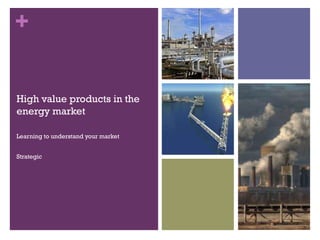
High value products in the
energy market
Learning to understand your market
Strategic
+

Objectives of this section
①

To be able to build a story board for a market study

②

To understand the customers needs and wants

③

To value the market
+

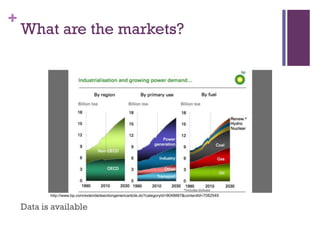
What are the markets?

http://www.bp.com/extendedsectiongenericarticle.do?categoryId=9048887&contentId=7082549

Data is available
+

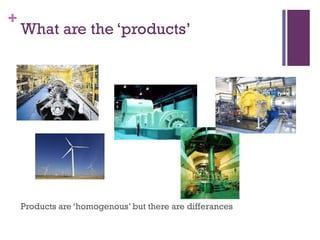
What are the ‘products’

Products are ‘homogenous’ but there are differances
+

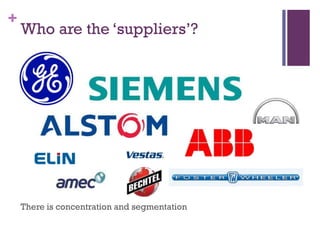
Who are the ‘suppliers’?

There is concentration and segmentation
+

Who are the ‘customers’?

Half are stare owned – half are commercial companies
+

Where are the installations?

There is no hiding!
+

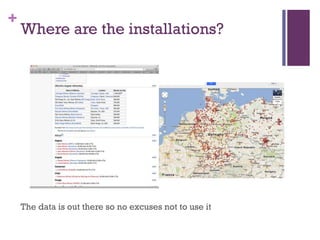
Where are the installations?

The data is out there so no excuses not to use it
+

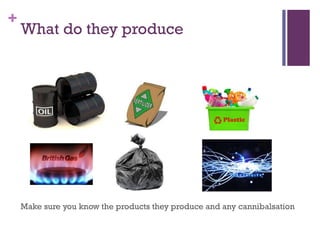
What do they produce

Make sure you know the products they produce and any cannibalsation
+

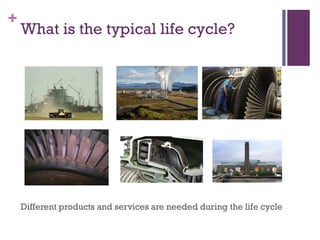
What is the typical life cycle?

Different products and services are needed during the life cycle
+

What are their needs?


New build



Routine maintenance



Scheduled maintenance



Breakdown maintenance



Rehabilitation



De-commissioning/demolition
+

What is annual size the (power)
market?


New build




GW installed per year x cost per kWh

Maintenance (routine, planned and unplanned)






Fixed cost per kW installed

Cost per MWh x TWh generated

Rehabilitation




GW installed x 1/15 x cost per kWh

De-commissioning/demolition

http://www.westgov.org/wieb/electric/Transmission%20Protocol/SSG-WI/pnw_5pp_02.pdf
+
High value products in the
energy market
Learning to understand your customer’s needs
Tactical
+

Objectives of this section
①

Be able to map relationships

②

Be able to improve the odds of closing

③

Be able to use some basic account management tools
+

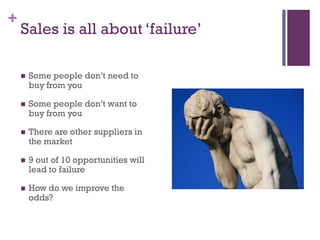
Sales is all about ‘failure’


Some people don’t need to
buy from you



Some people don’t want to
buy from you



There are other suppliers in
the market



9 out of 10 opportunities will
lead to failure



How do we improve the
odds?
+

Who/what should we target first?


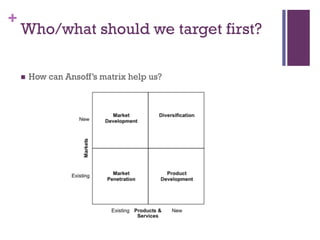
How can Ansoff’s matrix help us?
+

Who/what should we target first?
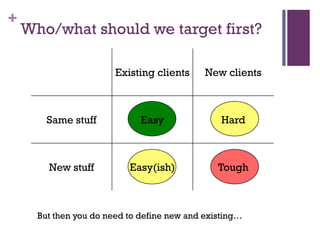
Existing clients

New clients

Same stuff

Easy

Hard

New stuff

Easy(ish)

Tough

But then you do need to define new and existing…
+

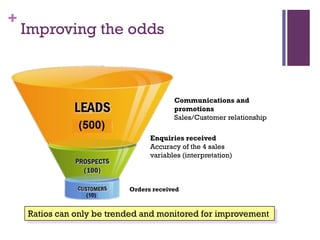
Improving the odds

Communications and
promotions
Sales/Customer relationship
Enquiries received
Accuracy of the 4 sales
variables (interpretation)

Orders received

Ratios can only be trended and monitored for improvement
+

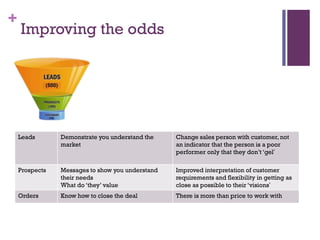
Improving the odds

Leads

Demonstrate you understand the
market

Change sales person with customer, not
an indicator that the person is a poor
performer only that they don’t ‘gel’

Prospects

Messages to show you understand
their needs
What do ‘they’ value

Improved interpretation of customer
requirements and flexibility in getting as
close as possible to their ‘visions’

Orders

Know how to close the deal

There is more than price to work with
+



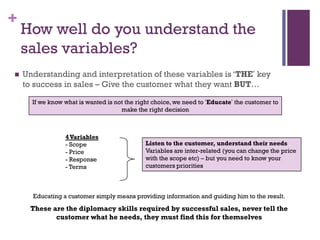
How well do you understand the
sales variables?
Understanding and interpretation of these variables is ‘THE’ key
to success in sales – Give the customer what they want BUT…
If we know what is wanted is not the right choice, we need to ‘Educate’ the customer to
make the right decision

4 Variables
- Scope
- Price
- Response
- Terms

Listen to the customer, understand their needs
Variables are inter-related (you can change the price
with the scope etc) – but you need to know your
customers priorities

Educating a customer simply means providing information and guiding him to the result.

These are the diplomacy skills required by successful sales, never tell the
customer what he needs, they must find this for themselves
+

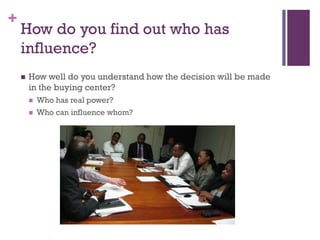
How do you find out who has
influence?


How well do you understand how the decision will be made
in the buying center?


Who has real power?



Who can influence whom?
+

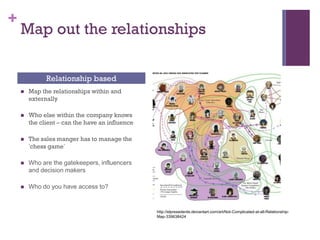
Map out the relationships
Relationship based


Map the relationships within and
externally



Who else within the company knows
the client – can the have an influence



The sales manger has to manage the
‘chess game’



Who are the gatekeepers, influencers
and decision makers



Who do you have access to?

http://elpresedente.deviantart.com/art/Not-Complicated-at-all-RelationshipMap-339638424
+

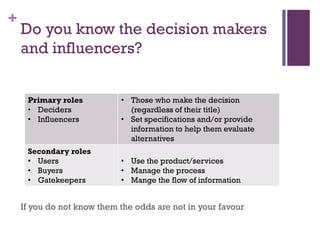
Do you know the decision makers
and influencers?
Primary roles
• Deciders
• Influencers

Secondary roles
• Users
• Buyers
• Gatekeepers

• Those who make the decision
(regardless of their title)
• Set specifications and/or provide
information to help them evaluate
alternatives
• Use the product/services
• Manage the process
• Mange the flow of information

If you do not know them the odds are not in your favour
+

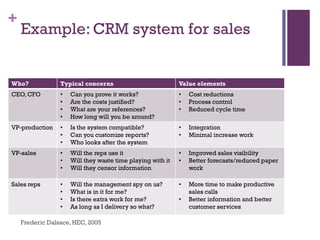
Example: CRM system for sales

Who?

Typical concerns

CEO, CFO

•
•
•
•

Can you prove it works?
Are the costs justified?
What are your references?
How long will you be around?

•
•
•

Cost reductions
Process control
Reduced cycle time

VP-production

•
•
•

Is the system compatible?
Can you customize reports?
Who looks after the system

•
•

Integration
Minimal increase work

VP-sales

•
•
•

Will the reps use it
Will they waste time playing with it
Will they censor information

•
•

Improved sales visibility
Better forecasts/reduced paper
work

Sales reps

•
•
•
•

Will the management spy on us?
What is in it for me?
Is there extra work for me?
As long as I delivery so what?

•

More time to make productive
sales calls
Better information and better
customer services

Frederic Dalsace, HEC, 2005

Value elements

•
+

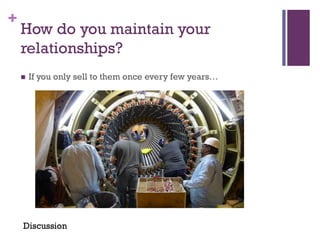
How do you maintain your
relationships?


If you only sell to them once every few years…

Discussion
+

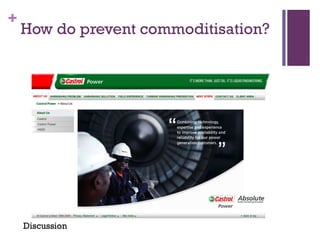
How do prevent commoditisation?

Discussion
+

Do you know what your customers
have bought?


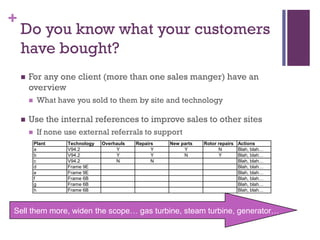
For any one client (more than one sales manger) have an
overview




What have you sold to them by site and technology

Use the internal references to improve sales to other sites


If none use external referrals to support
Plant
a
b
c
d
e
f
g
h

Technology
V94.2
V94.2
V94.2
Frame 9E
Frame 9E
Frame 6B
Frame 6B
Frame 6B

Overhauls
Y
Y
N

Repairs
Y
Y
N

New parts
Y
N

Rotor repairs Actions
N
Blah, blah…
Y
Blah, blah…
Blah, blah…
Blah, blah…
Blah, blah…
Blah, blah…
Blah, blah…
Blah, blah…

Sell them more, widen the scope… gas turbine, steam turbine, generator…
+

How well do you know your
customers?
Hard data based


Do you have the list of late payers?




Higher margin clients are worth
more than low margin clients

Do you know which clients recognize
value




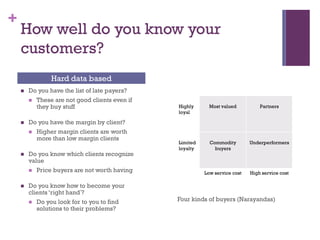
Highly
loyal

Most valued

Partners

Limited
loyalty

Commodity
buyers

Underperformers

Low service cost

High service cost

Do you have the margin by client?




These are not good clients even if
they buy stuff

Price buyers are not worth having

Do you know how to become your
clients ‘right hand’?


Do you look for to you to find
solutions to their problems?

Four kinds of buyers (Narayandas)
+

How do your top customers make
their money?


Find out how and why they make money




Most power plants are different (layout)




What are their business drivers?

Different operational challenges

Most make money by selling different ‘products’




Utility, IPP, CHP….
PPA, FPA, merchant operation, reliability, availability payments,
ancillaries services
Base load, mid-merit, peaking, peak load
+

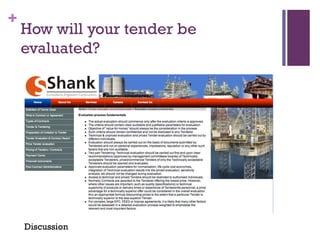
How will your tender be
evaluated?

Discussion
+

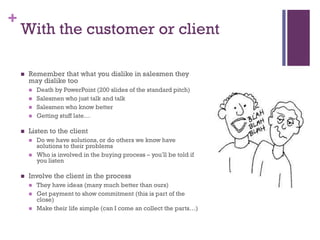
With the customer or client


Remember that what you dislike in salesmen they
may dislike too







Listen to the client





Death by PowerPoint (200 slides of the standard pitch)
Salesmen who just talk and talk
Salesmen who know better
Getting stuff late…

Do we have solutions, or do others we know have
solutions to their problems
Who is involved in the buying process – you’ll be told if
you listen

Involve the client in the process





They have ideas (many much better than ours)
Get payment to show commitment (this is part of the
close)
Make their life simple (can I come an collect the parts…)
+

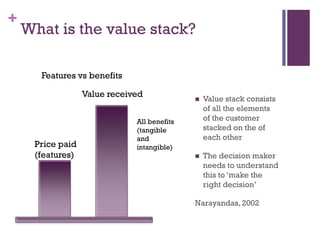
What is the value stack?
Features vs benefits
Value received

Price paid
(features)



Value stack consists
of all the elements
of the customer
stacked on the of
each other



The decision maker
needs to understand
this to ‘make the
right decision’

All benefits
(tangible
and
intangible)

Narayandas, 2002
+

How do you chase leads and close
deals?


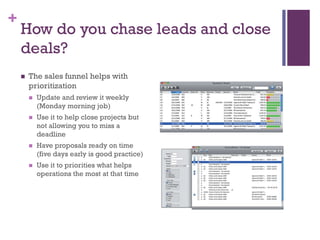
The sales funnel helps with
prioritization


Update and review it weekly
(Monday morning job)



Use it to help close projects but
not allowing you to miss a
deadline



Have proposals ready on time
(five days early is good practice)



Use it to priorities what helps
operations the most at that time
+

How do you chase leads and close
deals?


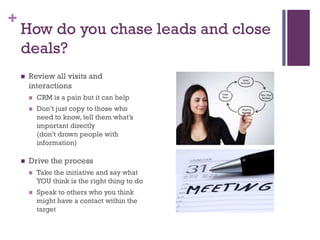
Review all visits and
interactions





CRM is a pain but it can help
Don’t just copy to those who
need to know, tell them what’s
important directly
(don’t drown people with
information)

Drive the process


Take the initiative and say what
YOU think is the right thing to do



Speak to others who you think
might have a contact within the
target
+
High value products in the
energy market
Have we achieved the objectives?
+

Objectives
①

Be able to build a picture of the market

②

Be able to understand your customer in detail

③

Work out what and when you could sell
+

B2B in the energy sector
Dr Shaun West

B2B marketing - a guest presentation at HSLU

  • 1.
    + B2B in theenergy sector Dr Shaun West
  • 2.
    + What have youever sold? … a very common question…  EPC project    Consultancy services   2M EUR repair contract at +50% GM Long-term service agreements    Intergen (one engineer at 2000GBP per day plus costs) Transactional services   Idoha Power rapid install gas turbine power plant 16M USD 800M USD +12 year agreement with EDF (in France, in French) 16M EUR 6 year agreement on 4 new units in Iraq The sale of a dream  220M CHF acquisition of a service company
  • 3.
    + Objectives ① Be able tobuild a picture of the market ② Be able to understand your customer in detail ③ Work out what and when you could sell
  • 4.
    + Not everyone buyswhite sliced bread... … so why sell as if they do
  • 6.
    + First a bitabout Sales and Marketing Sales  What is it? Marketing  What is it?
  • 7.
  • 8.
    + First a bitabout Sales and Marketing Sales  The tactical selling process  … Marketing  The strategic view  …   Business Market Management, Anderson and Narus, Pearson Education International, 2004 Principles of Marketing, Kotler et al, Pretince Hall, 1999
  • 9.
    + High value productsin the energy market Learning to understand your market Strategic
  • 10.
    + Objectives of thissection ① To be able to build a story board for a market study ② To understand the customers needs and wants ③ To value the market
  • 11.
    + What are themarkets? http://www.bp.com/extendedsectiongenericarticle.do?categoryId=9048887&contentId=7082549 Data is available
  • 12.
    + What are the‘products’ Products are ‘homogenous’ but there are differances
  • 13.
    + Who are the‘suppliers’? There is concentration and segmentation
  • 14.
    + Who are the‘customers’? Half are stare owned – half are commercial companies
  • 15.
    + Where are theinstallations? There is no hiding!
  • 16.
    + Where are theinstallations? The data is out there so no excuses not to use it
  • 17.
    + What do theyproduce Make sure you know the products they produce and any cannibalsation
  • 18.
    + What is thetypical life cycle? Different products and services are needed during the life cycle
  • 19.
    + What are theirneeds?  New build  Routine maintenance  Scheduled maintenance  Breakdown maintenance  Rehabilitation  De-commissioning/demolition
  • 20.
    + What is annualsize the (power) market?  New build   GW installed per year x cost per kWh Maintenance (routine, planned and unplanned)    Fixed cost per kW installed Cost per MWh x TWh generated Rehabilitation   GW installed x 1/15 x cost per kWh De-commissioning/demolition http://www.westgov.org/wieb/electric/Transmission%20Protocol/SSG-WI/pnw_5pp_02.pdf
  • 21.
    + High value productsin the energy market Learning to understand your customer’s needs Tactical
  • 22.
    + Objectives of thissection ① Be able to map relationships ② Be able to improve the odds of closing ③ Be able to use some basic account management tools
  • 23.
    + Sales is allabout ‘failure’  Some people don’t need to buy from you  Some people don’t want to buy from you  There are other suppliers in the market  9 out of 10 opportunities will lead to failure  How do we improve the odds?
  • 24.
    + Who/what should wetarget first?  How can Ansoff’s matrix help us?
  • 25.
    + Who/what should wetarget first? Existing clients New clients Same stuff Easy Hard New stuff Easy(ish) Tough But then you do need to define new and existing…
  • 26.
    + Improving the odds Communicationsand promotions Sales/Customer relationship Enquiries received Accuracy of the 4 sales variables (interpretation) Orders received Ratios can only be trended and monitored for improvement
  • 27.
    + Improving the odds Leads Demonstrateyou understand the market Change sales person with customer, not an indicator that the person is a poor performer only that they don’t ‘gel’ Prospects Messages to show you understand their needs What do ‘they’ value Improved interpretation of customer requirements and flexibility in getting as close as possible to their ‘visions’ Orders Know how to close the deal There is more than price to work with
  • 28.
    +  How well doyou understand the sales variables? Understanding and interpretation of these variables is ‘THE’ key to success in sales – Give the customer what they want BUT… If we know what is wanted is not the right choice, we need to ‘Educate’ the customer to make the right decision 4 Variables - Scope - Price - Response - Terms Listen to the customer, understand their needs Variables are inter-related (you can change the price with the scope etc) – but you need to know your customers priorities Educating a customer simply means providing information and guiding him to the result. These are the diplomacy skills required by successful sales, never tell the customer what he needs, they must find this for themselves
  • 29.
    + How do youfind out who has influence?  How well do you understand how the decision will be made in the buying center?  Who has real power?  Who can influence whom?
  • 30.
    + Map out therelationships Relationship based  Map the relationships within and externally  Who else within the company knows the client – can the have an influence  The sales manger has to manage the ‘chess game’  Who are the gatekeepers, influencers and decision makers  Who do you have access to? http://elpresedente.deviantart.com/art/Not-Complicated-at-all-RelationshipMap-339638424
  • 31.
    + Do you knowthe decision makers and influencers? Primary roles • Deciders • Influencers Secondary roles • Users • Buyers • Gatekeepers • Those who make the decision (regardless of their title) • Set specifications and/or provide information to help them evaluate alternatives • Use the product/services • Manage the process • Mange the flow of information If you do not know them the odds are not in your favour
  • 32.
    + Example: CRM systemfor sales Who? Typical concerns CEO, CFO • • • • Can you prove it works? Are the costs justified? What are your references? How long will you be around? • • • Cost reductions Process control Reduced cycle time VP-production • • • Is the system compatible? Can you customize reports? Who looks after the system • • Integration Minimal increase work VP-sales • • • Will the reps use it Will they waste time playing with it Will they censor information • • Improved sales visibility Better forecasts/reduced paper work Sales reps • • • • Will the management spy on us? What is in it for me? Is there extra work for me? As long as I delivery so what? • More time to make productive sales calls Better information and better customer services Frederic Dalsace, HEC, 2005 Value elements •
  • 33.
    + How do youmaintain your relationships?  If you only sell to them once every few years… Discussion
  • 34.
    + How do preventcommoditisation? Discussion
  • 35.
    + Do you knowwhat your customers have bought?  For any one client (more than one sales manger) have an overview   What have you sold to them by site and technology Use the internal references to improve sales to other sites  If none use external referrals to support Plant a b c d e f g h Technology V94.2 V94.2 V94.2 Frame 9E Frame 9E Frame 6B Frame 6B Frame 6B Overhauls Y Y N Repairs Y Y N New parts Y N Rotor repairs Actions N Blah, blah… Y Blah, blah… Blah, blah… Blah, blah… Blah, blah… Blah, blah… Blah, blah… Blah, blah… Sell them more, widen the scope… gas turbine, steam turbine, generator…
  • 36.
    + How well doyou know your customers? Hard data based  Do you have the list of late payers?   Higher margin clients are worth more than low margin clients Do you know which clients recognize value   Highly loyal Most valued Partners Limited loyalty Commodity buyers Underperformers Low service cost High service cost Do you have the margin by client?   These are not good clients even if they buy stuff Price buyers are not worth having Do you know how to become your clients ‘right hand’?  Do you look for to you to find solutions to their problems? Four kinds of buyers (Narayandas)
  • 37.
    + How do yourtop customers make their money?  Find out how and why they make money   Most power plants are different (layout)   What are their business drivers? Different operational challenges Most make money by selling different ‘products’    Utility, IPP, CHP…. PPA, FPA, merchant operation, reliability, availability payments, ancillaries services Base load, mid-merit, peaking, peak load
  • 38.
    + How will yourtender be evaluated? Discussion
  • 39.
    + With the customeror client  Remember that what you dislike in salesmen they may dislike too      Listen to the client    Death by PowerPoint (200 slides of the standard pitch) Salesmen who just talk and talk Salesmen who know better Getting stuff late… Do we have solutions, or do others we know have solutions to their problems Who is involved in the buying process – you’ll be told if you listen Involve the client in the process    They have ideas (many much better than ours) Get payment to show commitment (this is part of the close) Make their life simple (can I come an collect the parts…)
  • 40.
    + What is thevalue stack? Features vs benefits Value received Price paid (features)  Value stack consists of all the elements of the customer stacked on the of each other  The decision maker needs to understand this to ‘make the right decision’ All benefits (tangible and intangible) Narayandas, 2002
  • 41.
    + How do youchase leads and close deals?  The sales funnel helps with prioritization  Update and review it weekly (Monday morning job)  Use it to help close projects but not allowing you to miss a deadline  Have proposals ready on time (five days early is good practice)  Use it to priorities what helps operations the most at that time
  • 42.
    + How do youchase leads and close deals?  Review all visits and interactions    CRM is a pain but it can help Don’t just copy to those who need to know, tell them what’s important directly (don’t drown people with information) Drive the process  Take the initiative and say what YOU think is the right thing to do  Speak to others who you think might have a contact within the target
  • 43.
    + High value productsin the energy market Have we achieved the objectives?
  • 44.
    + Objectives ① Be able tobuild a picture of the market ② Be able to understand your customer in detail ③ Work out what and when you could sell
  • 45.
    + B2B in theenergy sector Dr Shaun West