Macroeconomic Concepts of Investment & Indian Technological EnvironmentGroup Members: Arushi (16)Beenu (19)J.Arjun (28)Karthik R (32)NitinTiwari (45)Saurabh Singh (59)
AgendaIntroduction Trends of Investment in the Five Year PlansIndian Technological EnvironmentEvolution of Technological EnvironmentShaping Technological environment with InvestmentFuture prospects
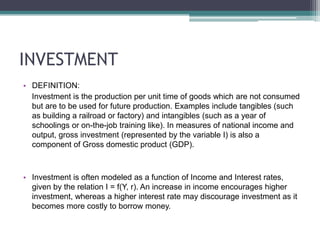
INVESTMENT	DEFINITION:    Investment is the production per unit time of goods which are not consumed but are to be used for future production. Examples include tangibles (such as building a railroad or factory) and intangibles (such as a year of schoolings or on-the-job training like). In measures of national income and output, gross investment (represented by the variable I) is also a component of Gross domestic product (GDP).Investment is often modeled as a function of Income and Interest rates, given by the relation I = f(Y, r). An increase in income encourages higher investment, whereas a higher interest rate may discourage investment as it becomes more costly to borrow money.
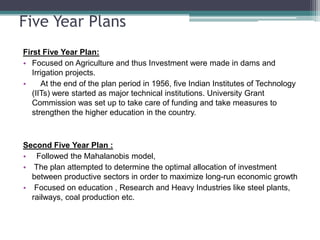
Five Year PlansFirst Five Year Plan: Focused on Agriculture and thus Investment were made in dams and Irrigation projects.    At the end of the plan period in 1956, five Indian Institutes of Technology (IITs) were started as major technical institutions. University Grant Commission was set up to take care of funding and take measures to strengthen the higher education in the country.Second Five Year Plan :  Followed the Mahalanobis model,  The plan attempted to determine the optimal allocation of investment   between productive sectors in order to maximize long-run economic growth  Focused on education , Research and Heavy Industries like steel plants, railways, coal production etc.
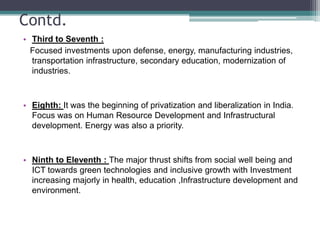
Contd.Third to Seventh :   Focused investments upon defense, energy, manufacturing industries, transportation infrastructure, secondary education, modernization of industries.Eighth: It was the beginning of privatization and liberalization in India. Focus was on Human Resource Development and Infrastructural development. Energy was also a priority.Ninth to Eleventh : The major thrust shifts from social well being and ICT towards green technologies and inclusive growth with Investment increasing majorly in health, education ,Infrastructure development and environment.
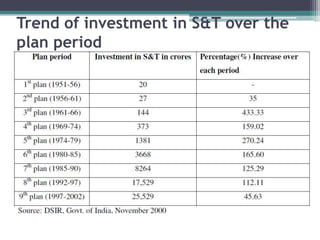
Trend of investment in S&T over the plan period
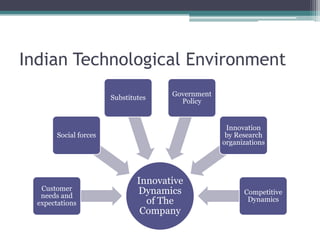
Indian Technological Environment
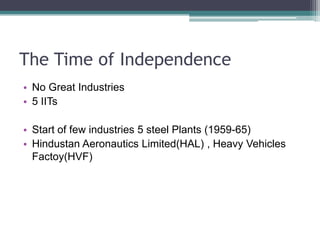
The Time of IndependenceNo Great Industries5 IITsStart of few industries 5 steel Plants (1959-65)Hindustan Aeronautics Limited(HAL) , Heavy Vehicles Factoy(HVF)
Licence RajAlmost every Indian company went into Technical collaboration with a foreign company and produced them in India Kawasaki-Bajaj, TVS-Suzuki, Hero Honda , BPL-SanyoEven The Products were advertised as Japanese/German technology etc
Even the green revolution was largely on the Hybrid’s developed outside India.After LiberalizationForeign companies came to India and brought the competition to India. Few companies succumbed to competition. Those that survived, grew stronger and are now challenging them.Also their arrival has meant flow of knowledge.Towards the end of 90’s Indian companies began Investing in R&D and came out with Products developed in India.Tata Indica –First Indian Car,  M & M Scorpio, Indica V2, Bajaj’s DTSIAlso a Change in Perspective towards technology, because of globalisation.Today we consider Maruti to be an Indian company though its substantially owned by Suzuki
Innovations from IndiaIT companies are beginning to make Products.     Infosys – Finacle, TCS –BANCSEveryone said Its impossible to build a car for Rs 1 lac, which meets all Safety standards and Emission Norms			2008 – Tata Nano made it possibleMany Small cars are now Developed in India and Sold worldwideIndia is now the Small Car Hub of the world, Exporting more than China.Nokia’s Largest production by volume is in India.
Made in India is now beginning to get respect worldwide, Thanks in Part to the Indian IT Sector.Nokia 1100, Hyundai i10, are some products that are developed for and launched in India but sold worldwideMost of the VAS of Mobile/telecom are developed and first launched in India. This was largely aided by Government policy and arrival of Private players.Popping from nowhere Micromax is now India’s 3rd largest Mobile phone Manufacturer selling 7 lac units a month. They didn’t develop the product, Nor do they manufacture it!!
Defense & Space TechnologiesLCA is 4th generation Multirole aircraft developed by India. No other country has done this with crossing previos Stages.India is Developing 2 Aircraft carriers and Submarine.Is Developing 5th gen aircraft in Collaboration with RussiaPSLV/GSLV Launch satellite. INSAT Satellites.IRS satellites have a resolution of 1m and is among the best in worldChandrayanISRO now makes commercial launches, satellites and also provides Remote Sensing services.
Indian R&D spending is very low as compared to its GDP.But still India is fast emerging as an R&D hub for MNC’s because of the human Resource factorThe respective ranks of India and China are 26 and 57 in business sophastication and 28 and 38 in innovation.Apart from this technology transfer and rich human capital is working hard towards developing real estate infrastructure, which is very necessary for growth of a country.
Time lag in technology introduction and absorption is decreasing in India. e.g. wifi , wimax, dish tv, DTH.FDIs and technology partnership with developed nations is possible because of sustainable infrastructure which started developing around 2000-2001.Areas of Promotion and Regulation for foreign technology Following needs to be considered :The extent and terms of equity participation.Phasing of Domestic manufacturing.Appropriateness of technology.Payment terms and Forex outflow.Restrictive terms in Agreement.
S&T PolicyTill now S&T institutions and Industry interaction was minimum.Former was working on strategic and non competitive areas of R&D whereas industrial R&D was more towards incremental production problem.Move towards a market economy is compelling both to work together and synergize the alliance.Government can provide economic environment for development of  different kinds of business and also to synergistic technological development, its absorption and upgradation.The increased participation of industry in decision making bodies of R&D institutions will make their programmes more attractive to industry as well as to financing such programs will be much easier.
Future ProspectsAs mentioned in 11th Five year plan and also from current global situation the next big investment by government will be towards Green technologies.Also the technological environment will have to develop while taking care of Nature and emission laws.Policies are and will come with more focus towards nature friendly technologies.Apart from this digital as well as social inclusion  will carry the mantra of success in market.
Thank You!!

Macroeconomic Concepts of Investment & Indian Technological Environment

  • 1.
    Macroeconomic Concepts ofInvestment & Indian Technological EnvironmentGroup Members: Arushi (16)Beenu (19)J.Arjun (28)Karthik R (32)NitinTiwari (45)Saurabh Singh (59)
  • 2.
    AgendaIntroduction Trends ofInvestment in the Five Year PlansIndian Technological EnvironmentEvolution of Technological EnvironmentShaping Technological environment with InvestmentFuture prospects
  • 3.
    INVESTMENT DEFINITION: Investment is the production per unit time of goods which are not consumed but are to be used for future production. Examples include tangibles (such as building a railroad or factory) and intangibles (such as a year of schoolings or on-the-job training like). In measures of national income and output, gross investment (represented by the variable I) is also a component of Gross domestic product (GDP).Investment is often modeled as a function of Income and Interest rates, given by the relation I = f(Y, r). An increase in income encourages higher investment, whereas a higher interest rate may discourage investment as it becomes more costly to borrow money.
  • 4.
    Five Year PlansFirstFive Year Plan: Focused on Agriculture and thus Investment were made in dams and Irrigation projects. At the end of the plan period in 1956, five Indian Institutes of Technology (IITs) were started as major technical institutions. University Grant Commission was set up to take care of funding and take measures to strengthen the higher education in the country.Second Five Year Plan : Followed the Mahalanobis model, The plan attempted to determine the optimal allocation of investment between productive sectors in order to maximize long-run economic growth Focused on education , Research and Heavy Industries like steel plants, railways, coal production etc.
  • 5.
    Contd.Third to Seventh: Focused investments upon defense, energy, manufacturing industries, transportation infrastructure, secondary education, modernization of industries.Eighth: It was the beginning of privatization and liberalization in India. Focus was on Human Resource Development and Infrastructural development. Energy was also a priority.Ninth to Eleventh : The major thrust shifts from social well being and ICT towards green technologies and inclusive growth with Investment increasing majorly in health, education ,Infrastructure development and environment.
  • 6.
    Trend of investmentin S&T over the plan period
  • 7.
  • 8.
    The Time ofIndependenceNo Great Industries5 IITsStart of few industries 5 steel Plants (1959-65)Hindustan Aeronautics Limited(HAL) , Heavy Vehicles Factoy(HVF)
  • 9.
    Licence RajAlmost everyIndian company went into Technical collaboration with a foreign company and produced them in India Kawasaki-Bajaj, TVS-Suzuki, Hero Honda , BPL-SanyoEven The Products were advertised as Japanese/German technology etc
  • 10.
    Even the greenrevolution was largely on the Hybrid’s developed outside India.After LiberalizationForeign companies came to India and brought the competition to India. Few companies succumbed to competition. Those that survived, grew stronger and are now challenging them.Also their arrival has meant flow of knowledge.Towards the end of 90’s Indian companies began Investing in R&D and came out with Products developed in India.Tata Indica –First Indian Car, M & M Scorpio, Indica V2, Bajaj’s DTSIAlso a Change in Perspective towards technology, because of globalisation.Today we consider Maruti to be an Indian company though its substantially owned by Suzuki
  • 11.
    Innovations from IndiaITcompanies are beginning to make Products. Infosys – Finacle, TCS –BANCSEveryone said Its impossible to build a car for Rs 1 lac, which meets all Safety standards and Emission Norms 2008 – Tata Nano made it possibleMany Small cars are now Developed in India and Sold worldwideIndia is now the Small Car Hub of the world, Exporting more than China.Nokia’s Largest production by volume is in India.
  • 12.
    Made in Indiais now beginning to get respect worldwide, Thanks in Part to the Indian IT Sector.Nokia 1100, Hyundai i10, are some products that are developed for and launched in India but sold worldwideMost of the VAS of Mobile/telecom are developed and first launched in India. This was largely aided by Government policy and arrival of Private players.Popping from nowhere Micromax is now India’s 3rd largest Mobile phone Manufacturer selling 7 lac units a month. They didn’t develop the product, Nor do they manufacture it!!
  • 13.
    Defense & SpaceTechnologiesLCA is 4th generation Multirole aircraft developed by India. No other country has done this with crossing previos Stages.India is Developing 2 Aircraft carriers and Submarine.Is Developing 5th gen aircraft in Collaboration with RussiaPSLV/GSLV Launch satellite. INSAT Satellites.IRS satellites have a resolution of 1m and is among the best in worldChandrayanISRO now makes commercial launches, satellites and also provides Remote Sensing services.
  • 14.
    Indian R&D spendingis very low as compared to its GDP.But still India is fast emerging as an R&D hub for MNC’s because of the human Resource factorThe respective ranks of India and China are 26 and 57 in business sophastication and 28 and 38 in innovation.Apart from this technology transfer and rich human capital is working hard towards developing real estate infrastructure, which is very necessary for growth of a country.
  • 15.
    Time lag intechnology introduction and absorption is decreasing in India. e.g. wifi , wimax, dish tv, DTH.FDIs and technology partnership with developed nations is possible because of sustainable infrastructure which started developing around 2000-2001.Areas of Promotion and Regulation for foreign technology Following needs to be considered :The extent and terms of equity participation.Phasing of Domestic manufacturing.Appropriateness of technology.Payment terms and Forex outflow.Restrictive terms in Agreement.
  • 16.
    S&T PolicyTill nowS&T institutions and Industry interaction was minimum.Former was working on strategic and non competitive areas of R&D whereas industrial R&D was more towards incremental production problem.Move towards a market economy is compelling both to work together and synergize the alliance.Government can provide economic environment for development of different kinds of business and also to synergistic technological development, its absorption and upgradation.The increased participation of industry in decision making bodies of R&D institutions will make their programmes more attractive to industry as well as to financing such programs will be much easier.
  • 17.
    Future ProspectsAs mentionedin 11th Five year plan and also from current global situation the next big investment by government will be towards Green technologies.Also the technological environment will have to develop while taking care of Nature and emission laws.Policies are and will come with more focus towards nature friendly technologies.Apart from this digital as well as social inclusion will carry the mantra of success in market.
  • 18.