



PRESENTS
Microsoft, DLF Cyber City August 20, 2017
MICROSOFT AZURE DAY
Sunny Sharma
Microsoft MVP
Azure Service Bus - Brokered Messaging
Azure Service Bus
Brokered Messaging
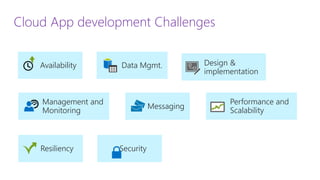
Security
Cloud App development Challenges
Data Mgmt. Design &
implementation
Availability
Management and
Monitoring
Messaging
Performance and
Scalability
Resiliency
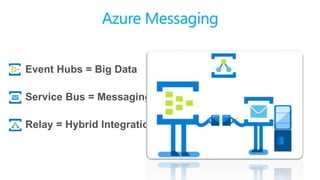
Azure Messaging
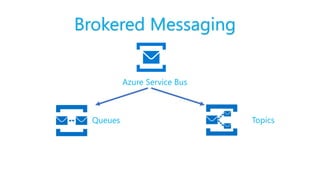
Brokered Messaging
Azure Service Bus
Queues Topics
Brokered Messaging
Azure Service Bus
• Brokered messaging communication model
• components of an application don’t communicate directly, but
rather exchange messages via an intermediary queue
• One-to-one, asynchronous, follows FIFO
Brokered Messaging
• Brokered messaging supports the scenario of truly temporal
decoupled systems where either message producer or
consumers availability is not guaranteed.
• the “broker” comes into play where the messages which are
not immediately delivered must live somewhere.
Relay Messaging
• Relay messaging provides the ability to “bounce” a message off
of a service to an connected receiver.
• It requires that the receiver expecting the message is online
and available.
Brokered Messaging
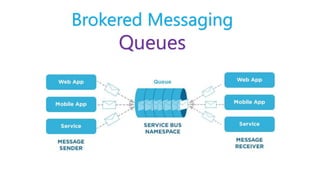
Queues
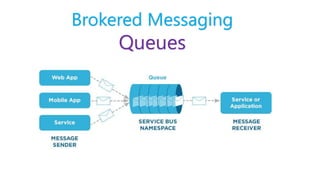
• Brokered messaging communication model
• components of an application don’t communicate directly, but
rather exchange messages via an intermediary queue
• One-to-one, asynchronous, follows FIFO
Brokered Messaging
Queues
Brokered Messaging
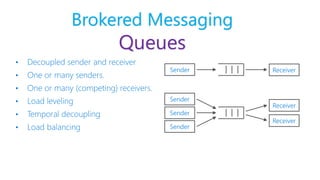
Queues
• Decoupled sender and receiver
• One or many senders.
• One or many (competing) receivers.
• Load leveling
• Temporal decoupling
• Load balancing
Sender Receiver
Sender
Receiver
Sender
Sender
Receiver
Brokered Messaging
Queues
Brokered Messaging
Topics
• pub/sub messaging communication model
• components of an application don’t communicate directly, but
rather exchange messages via an intermediary topic
• one-to-many, can register multiple subscriptions to a topic,
each message sent to a topic is available for each subscription
to handle independently
Brokered Messaging
Topics
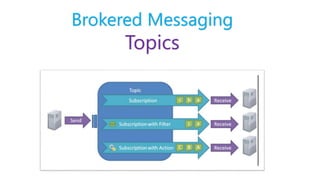
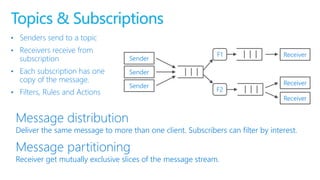
Topics & Subscriptions
• Senders send to a topic
• Receivers receive from
subscription
• Each subscription has one
copy of the message.
• Filters, Rules and Actions
Message distribution
Deliver the same message to more than one client. Subscribers can filter by interest.
Message partitioning
Receiver get mutually exclusive slices of the message stream.
Sender
Receiver
Sender
Sender Receiver
F1
F2
Receiver
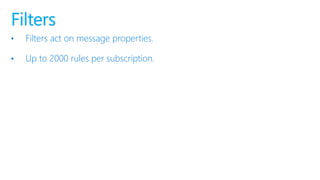
Filters
• Filters act on message properties.
• Up to 2000 rules per subscription.
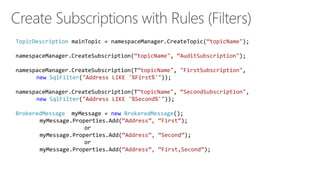
TopicDescription mainTopic = namespaceManager.CreateTopic(“topicName");
namespaceManager.CreateSubscription(“topicName", “AuditSubscription");
namespaceManager.CreateSubscription(T“topicName", "FirstSubscription",
new SqlFilter("Address LIKE '%First%'"));
namespaceManager.CreateSubscription(T“topicName", “SecondSubscription",
new SqlFilter("Address LIKE '%Second%'"));
BrokeredMessage myMessage = new BrokeredMessage();
myMessage.Properties.Add(“Address”, “First”);
or
myMessage.Properties.Add(“Address”, “Second”);
or
myMessage.Properties.Add(“Address”, “First,Second”);
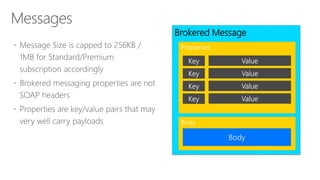
Brokered Message
Body
Properties
Demo
Questions?
Thank You!

Azure Service Bus Brokered Messaging

  • 1.
    PRESENTS Microsoft, DLF CyberCity August 20, 2017 MICROSOFT AZURE DAY Sunny Sharma Microsoft MVP Azure Service Bus - Brokered Messaging
  • 2.
  • 3.
    Security Cloud App developmentChallenges Data Mgmt. Design & implementation Availability Management and Monitoring Messaging Performance and Scalability Resiliency
  • 4.
  • 5.
  • 6.
    Brokered Messaging Azure ServiceBus • Brokered messaging communication model • components of an application don’t communicate directly, but rather exchange messages via an intermediary queue • One-to-one, asynchronous, follows FIFO
  • 7.
    Brokered Messaging • Brokeredmessaging supports the scenario of truly temporal decoupled systems where either message producer or consumers availability is not guaranteed. • the “broker” comes into play where the messages which are not immediately delivered must live somewhere.
  • 8.
    Relay Messaging • Relaymessaging provides the ability to “bounce” a message off of a service to an connected receiver. • It requires that the receiver expecting the message is online and available.
  • 9.
    Brokered Messaging Queues • Brokeredmessaging communication model • components of an application don’t communicate directly, but rather exchange messages via an intermediary queue • One-to-one, asynchronous, follows FIFO
  • 10.
  • 11.
  • 12.
    • Decoupled senderand receiver • One or many senders. • One or many (competing) receivers. • Load leveling • Temporal decoupling • Load balancing Sender Receiver Sender Receiver Sender Sender Receiver Brokered Messaging Queues
  • 13.
    Brokered Messaging Topics • pub/submessaging communication model • components of an application don’t communicate directly, but rather exchange messages via an intermediary topic • one-to-many, can register multiple subscriptions to a topic, each message sent to a topic is available for each subscription to handle independently
  • 14.
  • 15.
    Topics & Subscriptions •Senders send to a topic • Receivers receive from subscription • Each subscription has one copy of the message. • Filters, Rules and Actions Message distribution Deliver the same message to more than one client. Subscribers can filter by interest. Message partitioning Receiver get mutually exclusive slices of the message stream. Sender Receiver Sender Sender Receiver F1 F2 Receiver
  • 16.
    Filters • Filters acton message properties. • Up to 2000 rules per subscription.
  • 17.
    TopicDescription mainTopic =namespaceManager.CreateTopic(“topicName"); namespaceManager.CreateSubscription(“topicName", “AuditSubscription"); namespaceManager.CreateSubscription(T“topicName", "FirstSubscription", new SqlFilter("Address LIKE '%First%'")); namespaceManager.CreateSubscription(T“topicName", “SecondSubscription", new SqlFilter("Address LIKE '%Second%'")); BrokeredMessage myMessage = new BrokeredMessage(); myMessage.Properties.Add(“Address”, “First”); or myMessage.Properties.Add(“Address”, “Second”); or myMessage.Properties.Add(“Address”, “First,Second”);
  • 18.
  • 19.
  • 20.
  • 21.

Editor's Notes

  • #5 When two or more parties want to exchange information, they need a communication facilitator. Service Bus is a brokered, or third-party communication mechanism. This is similar to a postal service in the physical world. Postal services make it very easy to send different kinds of letters and packages with a variety of delivery guarantees, anywhere in the world.
  • #13 Load leveling Receiver is never overloaded, process at its own pace. Temporal decoupling Allows taking the receiver offline for servicing. Load balancing Multiple receivers compete for messages.