32089CCD4065D8007AAC70B72B479F83
AZ-400
AZ-400
Designing and Implementing Microsoft DevOps
32089CCD4065D8007AAC70B72B479F83
Develop a Site Reliability Engineering (SRE) strategy
Question No. Set 1
Question No. 1
DRAG DROP
You need to recommend project metrics for dashboards in Azure DevOps.
Which chart widgets should you recommend for each metric? To answer, drag the appropriate chart widgets to the correct metrics. Each chart widget
may be used once, more than once, or not at all. You may need to drag the split bar between panes or scroll to view content.
NOTE: Each correct selection is worth one point.
Select and Place:
Correct Answer:
32089CCD4065D8007AAC70B72B479F83
Explanation:
Box 1: Lead time
Lead time measures the total time elapsed from the creation of work items to their completion.
Box 2: Cycle time
Cycle time measures the time it takes for your team to complete work items once they begin actively working on them.
Box 3: Burndown
Burndown charts focus on remaining work within a specific time period.
Incorrect Answers:
Velocity provides a useful metric for these activities:
Support sprint planning
Forecast future sprints and the backlog items that can be completed
A guide for determining how well the team estimates and meets their planned commitments
Reference:
https://docs.microsoft.com/en-us/azure/devops/report/dashboards/velocity-guidance?view=vsts
https://docs.microsoft.com/en-us/azure/devops/report/dashboards/cycle-time-and-lead-time?view=vsts
https://docs.microsoft.com/en-us/azure/devops/report/dashboards/configure-burndown-burnup-widgets?view=vsts
32089CCD4065D8007AAC70B72B479F83
Question
No. 2
HOTSPOT
You plan to create alerts that will be triggered based on the page load performance of a home page.
You have the Application Insights log query shown in the following exhibit.
Use the drop-down menus to select the answer choice that completes each statement based on the information presented in the graphic.
NOTE: Each correct selection is worth one point.
Hot Area:
32089CCD4065D8007AAC70B72B479F83
Correct Answer:
Explanation:
Box 1: percentile_duration_95
32089CCD4065D8007AAC70B72B479F83
Box 2: success
For example –
requests
| project name, url, success
| where success == "False"
This will return all the failed requests in my App Insights within the specified time range.
Reference:
https://devblogs.microsoft.com/premier-developer/alerts-based-on-analytics-query-using-custom-log-search/
Question No. 3
You manage an Azure web app that supports an e-commerce website.
You need to increase the logging level when the web app exceeds normal usage patterns. The solution must minimize administrative overhead.
Which two resources should you include in the solution? Each correct answer presents part of the solution.
NOTE: Each correct selection is worth one point.
A. an Azure Automation runbook
B. an Azure Monitor alert that has a dynamic threshold
C. an Azure Monitor alert that has a static threshold
D. the Azure Monitor autoscale settings
E. an Azure Monitor alert that uses an action group that has an email action
Correct Answer: AB
Explanation:
B: Metric Alert with Dynamic Thresholds detection leverages advanced machine learning (ML) to learn metrics' historical behavior, identify patterns and
anomalies that indicate possible service issues. It provides support of both a simple UI and operations at scale by allowing users to configure alert rules
through the Azure Resource Manager API, in a fully automated manner.
A: You can use Azure Monitor to monitor base-level metrics and logs for most services in Azure. You can call Azure Automation runbooks by using
action groups or by using classic alerts to automate tasks based on alerts.
Reference:
https://docs.microsoft.com/en-us/azure/azure-monitor/platform/alerts-dynamic-thresholds
https://docs.microsoft.com/en-us/azure/automation/automation-create-alert-triggered-runbook
32089CCD4065D8007AAC70B72B479F83
Question No. 4
HOTSPOT
You have an Azure Kubernetes Service (AKS) pod.
You need to configure a probe to perform the following actions:
Confirm that the pod is responding to service requests.
Check the status of the pod four times a minute.
Initiate a shutdown if the pod is unresponsive.
How should you complete the YAML configuration file? To answer, select the appropriate options in the answer area.
NOTE: Each correct selection is worth one point.
Hot Area:
32089CCD4065D8007AAC70B72B479F83
Correct Answer:
32089CCD4065D8007AAC70B72B479F83
Explanation:
Box 1: readinessProbe:
For containerized applications that serve traffic, you might want to verify that your container is ready to handle incoming requests. Azure Container
Instances supports readiness probes to include configurations so that your container can't be accessed under certain conditions.
Incorrect Answers:
livenessProbe: Containerized applications may run for extended periods of time, resulting in broken states that may need to be repaired by restarting the
container. Azure Container Instances supports liveness probes so that you can configure your containers within your container group to restart if critical
functionality is not working.
Box 2: periodSeconds: 15
The periodSeconds property designates the readiness command should execute every 15 seconds.
Reference:
https://docs.microsoft.com/en-us/azure/container-instances/container-instances-readiness-probe
Question No. 5
You have a Microsoft ASP.NET Core web app in Azure that is accessed worldwide.
You need to run a URL ping test once every five minutes and create an alert when the web app is unavailable from specific Azure regions. The solution
must minimize development time.
What should you do?
A. Create an Azure Monitor Availability metric and alert.
B. Create an Azure Application Insights availability test and alert.
C. Write an Azure function and deploy the function to the specific regions.
D. Create an Azure Service Health alert for the specific regions.
Correct Answer: B
Explanation:
There are three types of Application Insights availability tests:
URL ping test: a simple test that you can create in the Azure portal.
Multi-step web test
Custom Track Availability Tests
32089CCD4065D8007AAC70B72B479F83
Note: After you've deployed your web app/website, you can set up recurring tests to monitor availability and responsiveness. Azure Application Insights
sends web requests to your application at regular intervals from points around the world. It can alert you if your application isn't responding, or if it
responds too slowly.
You can set up availability tests for any HTTP or HTTPS endpoint that is accessible from the public internet. You don't have to make any changes to the
website you're testing. In fact, it doesn't even have to be a site you own. You can test the availability of a REST API that your service depends on.
Reference:
https://docs.microsoft.com/en-us/azure/azure-monitor/app/monitor-web-app-availability#create-a-url-ping-test
Question No. 6
You have a multi-tier application. The front end of the application is hosted in Azure App Service.
You need to identify the average load times of the application pages.
What should you use?
A. Azure Application Insights
B. the activity log of the App Service
C. the diagnostics logs of the App Service
D. Azure Advisor
Correct Answer: A
Explanation:
Application Insights will tell you about any performance issues and exceptions, and help you find and diagnose the root causes.
Application Insights can monitor both Java and ASP.NET web applications and services, WCF services. They can be hosted on-premises, on virtual
machines, or as Microsoft Azure websites.
On the client side, Application Insights can take telemetry from web pages and a wide variety of devices including iOS, Android, and Windows Store
apps.
Reference:
https://docs.microsoft.com/en-us/azure/azure-monitor/app/web-monitor-performance
Question No. 7
SIMULATION
You need to create an instance of Azure Application Insights named az400-9940427-main and configure the instance to receive telemetry data from an
32089CCD4065D8007AAC70B72B479F83
Azure web app named az400-9940427-main.
To complete this task, sign in to the Microsoft Azure portal.
Correct Answer: See solution below.
Explanation:
Step 1: Create an instance of Azure Application Insights
1. Open Microsoft Azure Portal
2. Log into your Azure account, Select Create a resource > Developer tools > Application Insights.
32089CCD4065D8007AAC70B72B479F83
3. Enter the following settings, and then select Review + create.
Name: az400-9940427-main
32089CCD4065D8007AAC70B72B479F83
Step 2: Configure App Insights SDK
1. Open your ASP.NET Core Web App project in Visual Studio > Right-click on the AppName in the Solution Explorer > Select Add > Application
Insights Telemetry.
2. Click the Get Started button
3. Select your account and subscription > Select the Existing resource you created in the Azure portal > Click Register.
Reference:
https://docs.microsoft.com/bs-latn-ba/azure/azure-monitor/learn/dotnetcore-quick-start?view=vs-2017
Question No. 8
Your company uses ServiceNow for incident management.
You develop an application that runs on Azure.
The company needs to generate a ticket in ServiceNow when the application fails to authenticate.
Which Azure Log Analytics solution should you use?
A. Application Insights Connector
32089CCD4065D8007AAC70B72B479F83
B. Automation & Control
C. IT Service Management Connector (ITSM)
D. Insight & Analytics
Correct Answer: C
Explanation:
The IT Service Management Connector (ITSMC) allows you to connect Azure and a supported IT Service Management (ITSM) product/service.
ITSMC supports connections with the following ITSM tools:
ServiceNow
System Center Service Manager
Provance
Cherwell
With ITSMC, you can
Create work items in ITSM tool, based on your Azure alerts (metric alerts, Activity Log alerts and Log Analytics alerts).
Optionally, you can sync your incident and change request data from your ITSM tool to an Azure Log Analytics workspace.
Reference:
https://docs.microsoft.com/en-us/azure/azure-monitor/platform/itsmc-overview
Question No. 9
HOTSPOT
Your company is building a new web application.
You plan to collect feedback from pilot users on the features being delivered.
All the pilot users have a corporate computer that has Google Chrome and the Microsoft Test & Feedback extension installed. The pilot users will test
the application by using Chrome.
You need to identify which access levels are required to ensure that developers can request and gather feedback from the pilot users. The solution
must use the principle of least privilege.
Which access levels in Azure DevOps should you identify? To answer, select the appropriate options in the answer area.
NOTE: Each correct selection is worth one point.
Hot Area:
32089CCD4065D8007AAC70B72B479F83
Correct Answer:
32089CCD4065D8007AAC70B72B479F83
Explanation:
Box 1: Basic
Assign Basic to users with a TFS CAL, with a Visual Studio Professional subscription, and to users for whom you are paying for Azure Boards & Repos
in an organization.
Box 2: Stakeholder
Assign Stakeholders to users with no license or subscriptions who need access to a limited set of features.
Note:
You assign users or groups of users to one of the following access levels:
Basic: provides access to most features
VS Enterprise: provides access to premium features
Stakeholders: provides partial access, can be assigned to unlimited users for free
Reference:
https://docs.microsoft.com/en-us/azure/devops/organizations/security/access-levels?view=vsts
Question No. 10
You use Azure SQL Database Intelligent Insights and Azure Application Insights for monitoring.
You need to write ad-hoc queries against the monitoring data.
Which query language should you use?
A. Kusto Query Language (KQL)
B. PL/pgSQL
C. PL/SQL
D. Transact-SQL
Correct Answer: A
Explanation:
Azure Monitor Logs is based on Azure Data Explorer, and log queries are written using the same Kusto query language (KQL). This is a rich language
designed to be easy to read and author, and you should be able to start using it with minimal guidance.
Reference:
32089CCD4065D8007AAC70B72B479F83
https://docs.microsoft.com/en-us/azure/azure-monitor/log-query/log-query-overview
Question No. 11
Your company creates a web application.
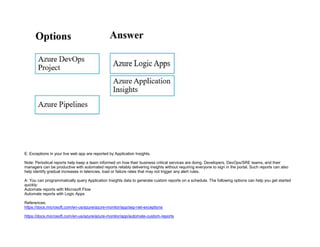
You need to recommend a solution that automatically sends to Microsoft Teams a daily summary of the exceptions that occur in the application.
Which two Azure services should you recommend? Each correct answer presents part of the solution.
NOTE: Each correct selection is worth one point.
A. Azure Logic Apps
B. Azure Pipelines
C. Microsoft Visual Studio App Center
D. Azure DevOps Project
E. Azure Application Insights
Correct Answer: AE
Explanation:
E: Exceptions in your live web app are reported by Application Insights.
Note: Periodical reports help keep a team informed on how their business critical services are doing. Developers, DevOps/SRE teams, and their
managers can be productive with automated reports reliably delivering insights without requiring everyone to sign in the portal. Such reports can also
help identify gradual increases in latencies, load or failure rates that may not trigger any alert rules.
A: You can programmatically query Application Insights data to generate custom reports on a schedule. The following options can help you get started
quickly:
Automate reports with Microsoft Flow
Automate reports with Logic Apps
Reference:
https://docs.microsoft.com/en-us/azure/azure-monitor/app/asp-net-exceptions
https://docs.microsoft.com/en-us/azure/azure-monitor/app/automate-custom-reports
Question No.
12 DRAG
DROP
32089CCD4065D8007AAC70B72B479F83
Your company wants to use Azure Application Insights to understand how user behaviors affect an application.
Which Application Insights tool should you use to analyze each behavior? To answer, drag the appropriate tools to the correct behaviors. Each tool may
be used once, more than once, or not at all. You may need to drag the split bar between panes or scroll to view content.
NOTE: Each correct selection is worth one point.
Select and Place:
Correct Answer:
32089CCD4065D8007AAC70B72B479F83
Explanation:
Box 1: User Flows
The User Flows tool visualizes how users navigate between the pages and features of your site. It's great for answering Question No.s like:
How do users navigate away from a page on your site?
What do users click on a page on your site?
Where are the places that users churn most from your site?
Are there places where users repeat the same action over and over?
Box 2: Users
Counting Users: The user behavior analytics tools don't currently support counting users or sessions based on properties other than anonymous user
ID, authenticated user ID, or session ID.
Box 3: Impact
Impact analyzes how load times and other properties influence conversion rates for various parts of your app. To put it more precisely, it discovers how
any dimension of a page view, custom event, or request affects the usage of a different page view or custom event.
Reference:
https://docs.microsoft.com/en-us/azure/azure-monitor/app/usage-flows
https://docs.microsoft.com/en-us/azure/azure-monitor/app/usage-impact
https://docs.microsoft.com/en-us/azure/azure-monitor/app/usage-troubleshoot
Question No. 13
Your company is building a mobile app that targets Android and iOS devices.
Your team uses Azure DevOps to manage all work items and release cycles.
You need to recommend a solution to perform the following tasks:
Collect crash reports for issue analysis.
Distribute beta releases to your testers.
Get user feedback on the functionality of new apps.
What should you include in the recommendation?
32089CCD4065D8007AAC70B72B479F83
A. the Microsoft Test & Feedback extension
B. Microsoft Visual Studio App Center integration
C. Azure Application Insights widgets
D. Jenkins integration
Correct Answer: A
Explanation:
The "Exploratory Testing" extension is now "Test & Feedback" and is now Generally Available.
Anyone can now test web apps and give feedback, all directly from the browser on any platform: Windows, Mac, or Linux. Available for Google Chrome
and Mozilla Firefox (required version 50.0 or above) currently. Support for Microsoft Edge is in the pipeline and will be enabled once Edge moves to a
Chromium-compatible web platform.
Reference:
https://marketplace.visualstudio.com/items?itemName=ms.vss-exploratorytesting-web
Question No. 14
You have an Azure DevOps project named Project1 and an Azure subscription named Sub1. Sub1 contains an Azure virtual machine scale set named
VMSS1. VMSS1 hosts a web application named WebApp1. WebApp1 uses stateful sessions.
The WebApp1 installation is managed by using the Custom Script extension. The script resides in an Azure Storage account named sa1.
You plan to make a minor change to a UI element of WebApp1 and to gather user feedback about the change.
You need to implement limited user testing for the new version of WebApp1 on VMSS1.
Which three actions should you perform? Each correct answer presents part of the solution.
NOTE: Each correct selection is worth one point.
A. Modify the load balancer settings of VMSS1.
B. Redeploy VMSS1.
C. Upload a custom script file to sa1.
D. Modify the Custom Script extension settings of VMSS1.
E. Update the configuration of a virtual machine in VMSS1.
Correct Answer: BCD
32089CCD4065D8007AAC70B72B479F83
Question No.
15
SIMULATION
You need to create a notification if the peak average response time of an Azure web app named az400-9940427-main is more than five seconds when
evaluated during a five-minute period. The notification must trigger the “https://contoso.com/notify” webhook.
To complete this task, sign in to the Microsoft Azure portal.
Correct Answer: See solution below.
Explanation:
1. Open Microsoft Azure Portal
2. Log into your Azure account and go to App Service and look under Monitoring then you will see Alert.
3. Select Add an alert rule
4. Configure the alert rule as per below and click Ok.
Source: Alert on Metrics
Resource Group: az400-9940427-main
Resource: az400-9940427-main
Threshold: 5
Period: Over the last 5 minutes
Webhook: https://contoso.com/notify
32089CCD4065D8007AAC70B72B479F83
Reference:
https://azure.microsoft.com/es-es/blog/webhooks-for-azure-alerts/
32089CCD4065D8007AAC70B72B479F83
Question No.
16
SIMULATION
You need to create and configure an Azure Storage account named az400lod11566895stor in a resource group named RG1lod11566895 to store the
boot diagnostics for a virtual machine named VM1.
To complete this task, sign in to the Microsoft Azure portal.
Correct Answer: See solution below.
Explanation:
Step 1: To create a general-purpose v2 storage account in the Azure portal, follow these steps:
On the Azure portal menu, select All services. In the list of resources, type Storage Accounts. As you begin typing, the list filters based on your input.
Select Storage Accounts.
On the Storage Accounts window that appears, choose Add.
Select the subscription in which to create the storage account.
Under the Resource group field, select RG1lod11566895
Next, enter a name for your storage account named: az400lod11566895stor
Select Create.
Step 2: Enable boot diagnostics on existing virtual machine
To enable Boot diagnostics on an existing virtual machine, follow these steps:
Sign in to the Azure portal, and then select the virtual machine VM1.
In the Support + troubleshooting section, select Boot diagnostics, then select the Settings tab.
In Boot diagnostics settings, change the status to On, and from the Storage account drop-down list, select the storage account az400lod11566895stor.
Save the change.
32089CCD4065D8007AAC70B72B479F83
You must restart the virtual machine for the change to take effect.
Reference:
https://docs.microsoft.com/en-us/azure/storage/common/storage-account-create
https://docs.microsoft.com/en-us/azure/virtual-machines/troubleshooting/boot-diagnostics
Question No. 17
SIMULATION
You have a web app that connects to an Azure SQL Database named db1.
You need to configure db1 to send Query Store runtime statistics to Azure Log Analytics.
To complete this task, sign in to the Microsoft Azure portal.
Correct Answer: See solution below.
Explanation:
To enable streaming of diagnostic telemetry for a single or a pooled database, follow these steps:
1. Go to Azure SQL database resource.
32089CCD4065D8007AAC70B72B479F83
2. Select Diagnostics settings.
3. Select Turn on diagnostics if no previous settings exist, or select Edit setting to edit a previous setting. You can create up to three parallel
connections to stream diagnostic telemetry.
4. Select Add diagnostic setting to configure parallel streaming of diagnostics data to multiple resources.
5. Enter a setting name for your own reference.
6. Select a destination resource for the streaming diagnostics data: Archive to storage account, Stream to an event hub, or Send to Log Analytics.
7. For the standard, event-based monitoring experience, select the following check boxes for database diagnostics log telemetry:
QueryStoreRuntimeStatistics
32089CCD4065D8007AAC70B72B479F83
8. For an advanced, one-minute-based monitoring experience, select the check box for Basic metrics.
9. Select Save.
32089CCD4065D8007AAC70B72B479F83
Reference:
https://docs.microsoft.com/en-us/azure/azure-sql/database/metrics-diagnostic-telemetry-logging-streaming-export-configure
Question No. 18
DRAG DROP
You have several Azure virtual machines that run Windows Server 2019.
You need to identify the distinct event IDs of each virtual machine as shown in the following table.
How should you complete the Azure Monitor query? To answer, drag the appropriate values to the correct locations. Each value may be used once,
more than once, or not at all. You may need to drag the split bar between panes or scroll to view content.
NOTE: Each correct selection is worth one point.
Select and Place:
Correct Answer:
32089CCD4065D8007AAC70B72B479F83
Explanation:
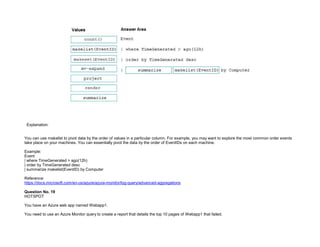
You can use makelist to pivot data by the order of values in a particular column. For example, you may want to explore the most common order events
take place on your machines. You can essentially pivot the data by the order of EventIDs on each machine.
Example:
Event
| where TimeGenerated > ago(12h)
| order by TimeGenerated desc
| summarize makelist(EventID) by Computer
Reference:
https://docs.microsoft.com/en-us/azure/azure-monitor/log-query/advanced-aggregations
Question No. 19
HOTSPOT
You have an Azure web app named Webapp1.
You need to use an Azure Monitor query to create a report that details the top 10 pages of Webapp1 that failed.
32089CCD4065D8007AAC70B72B479F83
How should you complete the query? To answer, select the appropriate options in the answer area.
NOTE: Each correct selection is worth one point.
Hot Area:
Correct Answer:
32089CCD4065D8007AAC70B72B479F83
Explanation:
Box 1: requests
Failed requests (requests/failed):
The count of tracked server requests that were marked as failed.
Kusto code:
requests
| where success == 'False'
Box 2: success == false
Reference:
https://docs.microsoft.com/en-us/azure/azure-monitor/platform/app-insights-metrics
32089CCD4065D8007AAC70B72B479F83
Question No. 20
You are monitoring the health and performance of an Azure web app by using Azure Application Insights.
You need to ensure that an alert is sent when the web app has a sudden rise in performance issues and failures.
What should you use?
A. custom events
B. Application Insights Profiler
C. usage analysis
D. Smart Detection
E. Continuous export
Correct Answer: D
Explanation:
Smart Detection automatically warns you of potential performance problems and failure anomalies in your web application. It performs proactive
analysis of the telemetry that your app sends to Application Insights. If there is a sudden rise in failure rates, or abnormal patterns in client or server
performance, you get an alert.
Reference:
https://docs.microsoft.com/en-us/azure/azure-monitor/app/proactive-diagnostics
Question No. 21
HOTSPOT
You have a project in Azure DevOps named Contoso App that contains pipelines in Azure Pipelines for GitHub repositories.
You need to ensure that developers receive Microsoft Teams notifications when there are failures in a pipeline of Contoso App.
What should you run in Teams? To answer, select the appropriate options in the answer area.
NOTE: Each correct selection is worth one point.
Hot Area:
32089CCD4065D8007AAC70B72B479F83
Correct Answer:
Explanation:
Box 1: subscribe
To start monitoring all pipelines in a project, use the following command inside a channel:
@azure pipelines subscribe [project url]
Box 2: https://dev.azure.com/contoso/contoso-app/
Subscribe to a pipeline or all pipelines in a project to receive notifications:
@azure pipelines subscribe [pipeline url/ project url]
Question No. 22
You have a private GitHub repository.
You need to displaythe commit status of the repository on Azure Boards.
32089CCD4065D8007AAC70B72B479F83
What should you do first?
A. Configure multi-factor authentication (MFA) for your GitHub account.
B. Add the Azure Pipelines app to the GitHub repository.
C. Add the Azure Boards app to the repository.
D. Create a GitHub action in GitHub.
Correct Answer: C
Explanation:
To connect Azure Boards to GitHub.com, connect and configure from Azure Boards. Or, alternatively, install and configure the Azure Boards app from
GitHub. Both methods have been streamlined and support authenticating and operating via the app rather than an individual.
Note (see step 4 below):
Add a GitHub connection:
Sign into Azure Boards.
Choose (1) Project Settings, choose (2) GitHub connections and then (3) Connect your GitHub account.
If this is your first time connecting to GitHub from Azure Boards, you will be asked to sign in using your GitHub credentials. Choose an account for which
you are an administrator for the repositories you want to connect to.
The Add GitHub Repositories dialog automatically displays and selects all GitHub.com repositories for which you are an administrator. Unselect any
repositories that you don't want to participate in the integration.
32089CCD4065D8007AAC70B72B479F83
Reference:
https://docs.microsoft.com/en-us/azure/devops/boards/github/connect-to-github
Question No. 23
You are integrating Azure Pipelines and Microsoft Teams.
You install the Azure Pipelines app in Microsoft Teams.
32089CCD4065D8007AAC70B72B479F83
You have an Azure DevOps organization named Contoso that contains a project name Project1.
You subscribe to Project1 in Microsoft Teams.
You need to ensure that you only receive events about failed builds in Microsoft Teams.
What should you do first?
A. From Microsoft Teams, run @azure pipelines subscribe https://dev.azure.com/Contoso/Project1.
B. From Azure Pipelines, add a Publish Build Artifacts task to Project1.
C. From Microsoft Teams, run @azure pipelines subscriptions.
D. From Azure Pipelines, enable continuous integration for Project1.
Correct Answer: A
Explanation:
To start monitoring all pipelines in a project, use the following command inside a channel:
@azure pipelines subscribe [project url]
The project URL can be to any page within your project (except URLs to pipelines).
For example:
@azure pipelines subscribe https://dev.azure.com/myorg/myproject/
Reference:
https://docs.microsoft.com/en-us/azure/devops/pipelines/integrations/microsoft-teams
Question No. 24
You have an Azure DevOps organization named Contoso.
You need to receive Microsoft Teams notifications when work items are updated.
What should you do?
A. From Azure DevOps, configure a service hook subscription
B. From Microsoft Teams, configure a connector
C. From Microsoft Teams admin center, configure external access
D. From Microsoft Teams, add a channel
32089CCD4065D8007AAC70B72B479F83
E. From Azure DevOps, install an extension
Correct Answer: A
Explanation:
Service hooks let you run tasks on other services when events happen in your Azure DevOps projects. For example, create a card in Trello when a
work item is created or send a push notification to your team's mobile devices when a build fails. You can also use service hooks in custom apps and
services as a more efficient way to drive activities when events happen in your projects.
Note: Service hook publishers define a set of events. Subscriptions listen for the events and define actions to take based on the event. Subscriptions
also target consumers, which are external services that can run their own actions, when an event occurs.
Reference:
https://docs.microsoft.com/en-us/azure/devops/service-hooks/overview
Question No. 25
You create an alert rule in Azure Monitor as shown in the following exhibit.
32089CCD4065D8007AAC70B72B479F83
Which action will trigger an alert?
A. a failed attempt to delete the ASP-9bb7 resource
B. a change to a role assignment for the ASP-9bb7 resource
C. a successful attempt to delete the ASP-9bb7 resource
D. a failed attempt to scale up the ASP-9bb7 resource
Correct Answer: A
Question No. 26
You have a web app hosted on Azure App Service. The web app stores data in an Azure SQL database.
32089CCD4065D8007AAC70B72B479F83
You need to generate an alert when there are 10,000 simultaneous connections to the database. The solution must minimize development effort.
Which option should you select in the Diagnostics settings of the database?
A. Send to Log Analytics
B. Stream to an event hub
C. Archive to a storage account
Correct Answer: A
Explanation:
ENABLE DIAGNOSTICS TO LOG ANALYTICS
This configuration is done PER DATABASE
1. Click on Diagnostics Settings and then Turn On Diagnostics
32089CCD4065D8007AAC70B72B479F83
2. Select to Send to Log Analytics and select the Log Analytics workspace. For this sample I will selected only Errors
32089CCD4065D8007AAC70B72B479F83
Reference:
https://techcommunity.microsoft.com/t5/azure-database-support-blog/azure-sql-db-and-log-analytics-better-together-part-1/ba-p/794833
Question No. 27
HOTSPOT
You use Azure DevOps to manage the build and deployment of an app named App1.
You have a release pipeline that deploys a virtual machine named VM1.
You plan to monitor the release pipeline by using Azure Monitor.
You need to create an alert to monitor the performance of VM1. The alert must be triggered when the average CPU usage exceeds 70 percent for five
minutes. The alert must calculate the average once every minute.
How should you configure the alert rule? To answer, select the appropriate options in the answer area.
32089CCD4065D8007AAC70B72B479F83
NOTE: Each correct selection is worth one point.
Hot Area:
Correct Answer:
32089CCD4065D8007AAC70B72B479F83
Explanation:
Box 1: 5 minutes
The alert must calculate the average once every minute.
Note: We [Microsoft] recommend choosing an Aggregation granularity (Period) that is larger than the Frequency of evaluation, to reduce the likelihood of
missing the first evaluation of added time series
Box 2: Static
Box 3: Greater than
Example, say you have an App Service plan for your website. You want to monitor CPU usage on multiple instances running your web site/app. You can
do that using a metric alert rule as follows:
Target resource: myAppServicePlan
32089CCD4065D8007AAC70B72B479F83
Metric: Percentage CPU
Condition Type: Static
Dimensions
Instance = InstanceName1, InstanceName2
Time Aggregation: Average
Period: Over the last 5 mins
Frequency: 1 min
Operator: GreaterThan
Threshold: 70
Like before, this rule monitors if the average CPU usage for the last 5 minutes exceeds 70%.
Aggregation granularity
Reference:
https://docs.microsoft.com/en-us/azure/azure-monitor/platform/alerts-metric-overview
32089CCD4065D8007AAC70B72B479F83
Develop a security and compliance plan
Question No. Set 1
Question No. 1
DRAG DROP
You are planning projects for three customers. Each customer’s preferred process for work items is shown in the following table.
The customers all plan to use Azure DevOps for work item management.
Which work item process should you use for each customer? To answer, drag the appropriate work item processes to the correct customers. Each
work item process may be used once, more than once, or not at all. You may need to drag the split bar between panes or scroll to view content.
NOTE: Each correct selection is worth one point.
Select and Place:
32089CCD4065D8007AAC70B72B479F83
Correct Answer:
Explanation:
Box 1: Scrum
Choose Scrum when your team practices Scrum. This process works great if you want to track product backlog items (PBIs) and bugs on the Kanban
board, or break PBIs and bugs down into tasks on the taskboard.
32089CCD4065D8007AAC70B72B479F83
Box 2: Agile
Choose Agile when your team uses Agile planning methods, including Scrum, and tracks development and test activities separately. This process works
great if you want to track user stories and (optionally) bugs on the Kanban board, or track bugs and tasks on the taskboard.
Box 3: CMMI
Choose CMMI when your team follows more formal project methods that require a framework for process improvement and an auditable record of
decisions. With this process, you can track requirements, change requests, risks, and reviews.
Incorrect Answers:
XP:
The work tracking objects contained within the default DevOps processes and DevOps process templates are Basic, Agile, CMMI, and Scrum
XP (Extreme Programming) and DevOps are different things. They don't contradict with each other, they can be used together, but they have different
base concepts inside them.
Reference:
https://docs.microsoft.com/en-us/azure/devops/boards/work-items/guidance/choose-process?view=azure-devops
Question No. 2
You configure an Azure Application Insights availability test.
You need to notify the customer services department at your company by email when availability is degraded.
You create an Azure logic app that will handle the email and follow up actions.
Which type of trigger should you use to invoke the logic app?
A. an HTTPWebhook trigger
B. an HTTP trigger
C. a Request trigger
D. an ApiConnection trigger
Correct Answer: A
Explanation:
You can use webhooks to route an Azure alert notification to other systems for post-processing or custom actions. You can use a webhook on an alert
to route it to services that send SMS messages, to log bugs, to notify a team via chat or messaging services, or for various other actions.
Reference:
https://docs.microsoft.com/en-us/azure/azure-monitor/platform/alerts-webhooks
32089CCD4065D8007AAC70B72B479F83
Question No. 3
You have an Azure DevOps organization named Contoso and an Azure subscription.
You use Azure DevOps to build a containerized app named App1 and deploy App1 to an Azure container instance named ACI1.
You need to restart ACI1 when App1 stops responding.
What should you do?
A. Add a liveness probe to the YAML configuration of App1.
B. Add a readiness probe to the YAML configuration of App1.
C. Use Connection Monitor in Azure Network Watcher.
D. Use IP flow verify in Azure Network Watcher.
Correct Answer: B
Explanation:
For containerized applications that serve traffic, you might want to verify that your container is ready to handle incoming requests. Azure Container
Instances supports readiness probes to include configurations so that your container can't be accessed under certain conditions. The readiness probe
behaves like a Kubernetes readiness probe. For example, a container app might need to load a large data set during startup, and you don't want it to
receive requests during this time.
YAML is used to setup a liveness probe.
Reference:
https://docs.microsoft.com/en-us/azure/container-instances/container-instances-readiness-probe
Question No. 4
You have a multi-tier application that has an Azure Web Apps front end and an Azure SQL Database back end.
You need to recommend a solution to capture and store telemetry data. The solution must meet the following requirements:
Support using ad-hoc queries to identify baselines.
Trigger alerts when metrics in the baseline are exceeded.
Store application and database metrics in a central location.
What should you include in the recommendation?
32089CCD4065D8007AAC70B72B479F83
A. Azure Event Hubs
B. Azure SQL Database Intelligent Insights
C. Azure Application Insights
D. Azure Log Analytics
Correct Answer: D
Explanation:
Azure Platform as a Service (PaaS) resources, like Azure SQL and Web Sites (Web Apps), can emit performance metrics data natively to Log
Analytics.
The Premium plan will retain up to 12 months of data, giving you an excellent baseline ability.
There are two options available in the Azure portal for analyzing data stored in Log analytics and for creating queries for ad hoc analysis.
Incorrect Answers:
B: Intelligent Insights analyzes database performance by comparing the database workload from the last hour with the past seven-day baseline
workload. However, we need handle application metrics as well.
Reference:
https://docs.microsoft.com/en-us/azure/azure-monitor/platform/collect-azurepass-posh
Question No. 5
You have an Azure DevOps organization named Contoso and an Azure subscription. The subscription contains an Azure virtual machine scale set
named VMSS1 that is configured for autoscaling.
You use Azure DevOps to build a web app named App1 and deploy App1 to VMSS1. App1 is used heavily and has usage patterns that vary on a weekly
basis.
You need to recommend a solution to detect an abnormal rise in the rate of failed requests to App1. The solution must minimize administrative effort.
What should you include in the recommendation?
A. the Smart Detection feature in Azure Application Insights
B. the Failures feature in Azure Application Insights
C. an Azure Service Health alert
D. an Azure Monitor alert that uses an Azure Log Analytics query
Correct Answer: A
Section: (none)
32089CCD4065D8007AAC70B72B479F83
Explanation
Explanation:
After setting up Application Insights for your project, and if your app generates a certain minimum amount of data, Smart Detection of failure anomalies
takes 24 hours to learn the normal behavior of your app, before it is switched on and can send alerts.
Reference:
https://docs.microsoft.com/en-us/azure/azure-monitor/app/proactive-failure-diagnostics
Question No.
6
SIMULATION
You need to ensure that Microsoft Visual Studio 2017 can remotely attach to an Azure Function named fa-11566895.
To complete this task, sign in to the Microsoft Azure portal.
Correct Answer: See solution below.
Explanation:
Enable Remote Debugging
Before we start a debugging session to our Azure Function app we need to enable the functionality.
Navigate in the Azure portal to your function app fa-11566895
Go to the “Application settings”
Under “Debugging” set Remote Debugging to On and set Remote Visual Studio version to 2017.
Reference:
https://www.locktar.nl/uncategorized/azure-remote-debugging-manually-in-visual-studio-2017/
Question No. 7
You have an Azure subscription that contains resources in several resource groups.
You need to design a monitoring strategy that will provide a consolidated view. The solution must support the following requirements:
Support role-based access control (RBAC) by using Azure Active Directory (Azure AD) identifies.
Include visuals from Azure Monitor that are generated by using the Kusto query language.
Support documentation written in markdown.
Use the latest data available for each visual.
32089CCD4065D8007AAC70B72B479F83
What should you use to create the consolidated view?
A. Azure Monitor
B. Microsoft Power BI
C. Azure Data Explorer
D. Azure dashboards
Correct Answer: C
Explanation:
There are several tools available for running queries in Azure Data Explorer, including Kusto.
Kusto uses a role-based access control (RBAC) model, under which authenticated principals are mapped to roles, and get access according to the roles
they're assigned.
Note: Azure Data Explorer is a highly scalable and secure analytics service that enables you to do rich exploration of structured and unstructured data
for instant insights. Optimized for ad-hoc queries, Azure Data Explorer enables rich data exploration over raw, structured, and semi-structured data
delivering fast time to insight. Query with a modern, intuitive query language that offers fast, ad-hoc, and advanced query capabilities over high-rate data
volumes and varieties
Reference:
https://docs.microsoft.com/en-us/azure/data-explorer/tools-integrations-overview
Question No. 8
You are automating the testing process for your company.
You need to automate UI testing of a web application.
Which framework should you use?
A. JaCoco
B. Selenium
C. Xamarin.UITest
D. Microsoft.CodeAnalysis
Correct Answer: B
Section: (none)
32089CCD4065D8007AAC70B72B479F83
Explanation
Explanation:
Performing user interface (UI) testing as part of the release pipeline is a great way of detecting unexpected changes, and need not be difficult. Selenium
can be used to test your website during a continuous deployment release and test automation.
Reference:
https://docs.microsoft.com/en-us/azure/devops/pipelines/test/continuous-test-selenium?view=azure-devops
Question No. 9
You are building an ASP.NET Core application.
You plan to create an application utilization baseline by capturing telemetry data.
You need to add code to the application to capture the telemetry data. The solution must minimize the costs of storing the telemetry data.
Which two actions should you perform? Each correct answer presents part of the solution.
NOTE: Each correct selection is worth one point
A. Add the <InitialSamplingPercentage>99</InitialSamplingPercentage> parameter to the ApplicationInsights.config file.
B. From the code of the application, enable adaptive sampling.
C. From the code of the application, add Azure Application Insights telemetry.
D. Add the <MaxTelemetryItemsPerSecond>5</MaxTelemetryItemsPerSecond> parameter to the ApplicationInsights.config file.
E. From the code of the application, disable adaptive sampling.
Correct Answer: BD
Explanation:
Sampling is a feature in Azure Application Insights. It is the recommended way to reduce telemetry traffic, data costs, and storage costs, while
preserving a statistically correct analysis of application data.
The Application Insights SDK for ASP.NET Core supports both fixed-rate and adaptive sampling. Adaptive sampling is enabled by default.
D: For adaptive sampling: The volume is adjusted automatically to keep within a specified maximum rate of traffic, and is controlled via the setting
MaxTelemetryItemsPerSecond. If the application produces a low amount of telemetry, such as when debugging or due to low usage, items won't be
dropped by the sampling processor as long as volume is below MaxTelemetryItemsPerSecond.
32089CCD4065D8007AAC70B72B479F83
Note: In ApplicationInsights.config, you can adjust several parameters in the AdaptiveSamplingTelemetryProcessor node. The figures shown are the
default values:
<MaxTelemetryItemsPerSecond>5</MaxTelemetryItemsPerSecond>
Reference:
https://docs.microsoft.com/en-us/azure/azure-monitor/app/sampling
Question No. 10
You have an Azure DevOps organization named Contoso and an Azure subscription. The subscription contains an Azure virtual machine scale set
named VMSS1 and an Azure Standard Load Balancer named LB1. LB1 distributes incoming requests across VMSS1 instances.
You use Azure DevOps to build a web app named App1 and deploy App1 to VMSS1. App1 is accessible via HTTPS only and configured to require
mutual authentication by using a client certificate.
You need to recommend a solution for implementing a health check of App1. The solution must meet the following requirements:
Identify whether individual instances of VMSS1 are eligible for an upgrade operation.
Minimize administrative effort.
What should you include in the recommendation?
A. an Azure Load Balancer health probe
B. Azure Monitor autoscale
C. the Custom Script Extension
D. the Application Health extension
Correct Answer: D
Explanation:
Monitoring your application health is an important signal for managing and upgrading your deployment. Azure virtual machine scale sets provide support
for rolling upgrades including automatic OS-image upgrades, which rely on health monitoring of the individual instances to upgrade your deployment.
You can also use health extension to monitor the application health of each instance in your scale set and perform instance repairs using automatic
instance repairs.
Reference:
https://docs.microsoft.com/en-us/azure/virtual-machine-scale-sets/virtual-machine-scale-sets-health-extension
Question No.
11 HOTSPOT
32089CCD4065D8007AAC70B72B479F83
You have an application named App1 that has a custom domain of app.contoso.com.
You create a test in Azure Application Insights as shown in the following exhibit.
32089CCD4065D8007AAC70B72B479F83
Use the drop-down menus to select the answer choice that completes each statement based on the information presented in the graphic.
32089CCD4065D8007AAC70B72B479F83
NOTE: Each correct selection is worth one point.
Hot Area:
Correct Answer:
Explanation:
32089CCD4065D8007AAC70B72B479F83
Box 1: every five minutes at a random location
Test frequency: Sets how often the test is run from each test location. With a default frequency of five minutes and five test locations, your site is tested
on average every minute.
Box 2:
Parse dependent requests: Test requests images, scripts, style files, and other files that are part of the web page under test. The recorded response
time includes the time taken to get these files. The test fails if any of these resources cannot be successfully downloaded within the timeout for the
whole test.
Reference:
https://docs.microsoft.com/en-us/azure/azure-monitor/app/monitor-web-app-availability
Question No. 12
You have a build pipeline in Azure Pipelines that occasionally fails.
You discover that a test measuring the response time of an API endpoint causes the failures.
You need to prevent the build pipeline from failing due to the test.
Which two actions should you perform? Each correct answer presents part of the solution.
NOTE: Each correct selection is worth one point.
A. Set Flaky test detection to Off.
B. Clear Flaky tests included in test pass percentage.
C. Enable Test Impact Analysis (TIA).
D. Manually mark the test as flaky.
E. Enable test slicing.
Correct Answer: BD
Explanation:
D: You can mark or unmark a test as flaky based on analysis or context, by choosing Flaky.
To configure flaky test management, choose Project settings, and select Test management in the Pipelines section.
B:
Slide the On/Off button to On.
32089CCD4065D8007AAC70B72B479F83
Reference:
https://docs.microsoft.com/en-us/azure/devops/pipelines/test/flaky-test-management
Question No. 13
Your company hosts a web application in Azure. The company uses Azure Pipelines for the build and release management of the application.
Stakeholders report that the past few releases have negatively affected system performance.
You configure alerts in Azure Monitor.
You need to ensure that new releases are only deployed to production if the releases meet defined performance baseline criteria in the staging
environment first.
What should you use to prevent the deployment of releases that fall to meet the performance baseline?
A. an Azure Scheduler job
B. a trigger
C. a gate
D. an Azure function
Correct Answer: C
Explanation:
Scenarios and use cases for gates include:
Quality validation. Query metrics from tests on the build artifacts such as pass rate or code coverage and deploy only if they are within required
32089CCD4065D8007AAC70B72B479F83
thresholds.
Use Quality Gates to integrate monitoring into your pre-deployment or post-deployment. This ensures that you are meeting the key health/performance
metrics (KPIs) as your applications move from dev to production and any differences in the infrastructure environment or scale is not negatively
impacting your KPIs.
Note: Gates allow automatic collection of health signals from external services, and then promote the release when all the signals are successful at the
same time or stop the deployment on timeout. Typically, gates are used in connection with incident management, problem management, change
management, monitoring, and external approval systems.
Reference:
https://docs.microsoft.com/en-us/azure/azure-monitor/continuous-monitoring
https://docs.microsoft.com/en-us/azure/devops/pipelines/release/approvals/gates?view=azure-devops
Question No. 14
Note: This Question No. is part of a series of Question No.s that present the same scenario. Each Question No. in the series contains a
unique solution that might meet the stated goals. Some Question No. sets might have more than one correct solution, while others might
not have a correct solution.
After you answer a Question No. in this section, you will NOT be able to return to it. As a result, these Question No.s will not appear in the
review screen.
You manage a project in Azure DevOps.
You need to prevent the configuration of the project from changing over time.
Solution: Perform a Subscription Health scan when packages are created.
Does this meet the goal?
A. Yes
B. No
Correct Answer: B
Explanation:
Instead implement Continuous Assurance for the project.
Note: The Subscription Security health check features in AzSK contains a set of scripts that examines a subscription and flags off security issues,
32089CCD4065D8007AAC70B72B479F83
misconfigurations or obsolete artifacts/settings which can put your subscription at higher risk.
Reference:
https://azsk.azurewebsites.net/04-Continous-Assurance/Readme.html
Question No. 15
Your company uses the following resources:
Windows Server 2019 container images hosted in an Azure Container Registry.
Azure virtual machines that run the latest version of Ubuntu
An Azure Log Analytics workspace
Azure Active Directory (Azure AD)
An Azure key vault
For which two resources can you receive vulnerability assessments in Azure Security Center? Each correct answer presents part of the solution.
NOTE: Each correct selection is worth one point.
A. the Azure Log Analytics workspace
B. the Azure key vault
C. the Azure virtual machines that run the latest version of Ubuntu
D. Azure Active Directory (Azure AD)
E. The Windows Server 2019 container images hosted in the Azure Container Registry.
Correct Answer: BC
Explanation:
B: Azure Security Center includes Azure-native, advanced threat protection for Azure Key Vault, providing an additional layer of security intelligence.
C: When Security Center discovers a connected VM without a vulnerability assessment solution deployed, it provides the security recommendation "A
vulnerability assessment solution should be enabled on your virtual machines".
Ubuntu supported versions: 12.04 LTS, 14.04 LTS, 15.x, 16.04 LTS, 18.04 LTS
Reference:
https://docs.microsoft.com/en-us/azure/security-center/deploy-vulnerability-assessment-vm
Question No. 16
You use Azure Pipelines to manage build pipelines, GitHub to store source code, and Dependabot to manage dependencies.
32089CCD4065D8007AAC70B72B479F83
You have an app named App1.
Dependabot detects a dependency in App1 that requires an update.
What should you do first to apply the update?
A. Create a pull request.
B. Approve the pull request.
C. Create a branch.
D. Perform a commit.
Correct Answer: B
Explanation:
DependaBot is a useful tool to regularly check for dependency updates. By helping to keep your project up to date, DependaBot can reduce technical
debt and immediately apply security vulnerabilities when patches are released. How does DependaBot work?
DependaBot regularly checks dependencies for updates
If an update is found, DependaBot creates a new branch with this upgrade and Pull Request for approval
You review the new Pull Request, ensure the tests passed, review the code, and decide if you can merge the change
Reference:
https://samlearnsazure.blog/2019/12/20/github-using-dependabot/
Question No. 17
Note: This Question No. is part of a series of Question No.s that present the same scenario. Each Question No. in the series contains a
unique solution that might meet the stated goals. Some Question No. sets might have more than one correct solution, while others might
not have a correct solution.
After you answer a Question No. in this section, you will NOT be able to return to it. As a result, these Question No.s will not appear in the
review screen.
You manage a project in Azure DevOps.
You need to prevent the configuration of the project from changing over time.
Solution: Add a code coverage step to the build pipelines.
Does this meet the goal?
32089CCD4065D8007AAC70B72B479F83
A. Yes
B. No
Correct Answer: B
Explanation:
Instead implement Continuous Assurance for the project.
Reference:
https://azsk.azurewebsites.net/04-Continous-Assurance/Readme.html
Question No. 18
Note: This Question No. is part of a series of Question No.s that present the same scenario. Each Question No. in the series contains a
unique solution that might meet the stated goals. Some Question No. sets might have more than one correct solution, while others might
not have a correct solution.
After you answer a Question No. in this section, you will NOT be able to return to it. As a result, these Question No.s will not appear in the
review screen.
You manage a project in Azure DevOps.
You need to prevent the configuration of the project from changing over time.
Solution: Implement Continuous Integration for the project.
Does this meet the goal?
A. Yes
B. No
Correct Answer: B
Explanation:
Instead implement Continuous Assurance for the project.
32089CCD4065D8007AAC70B72B479F83
Reference:
https://azsk.azurewebsites.net/04-Continous-Assurance/Readme.html
Question No. 19
Note: This Question No. is part of a series of Question No.s that present the same scenario. Each Question No. in the series contains a
unique solution that might meet the stated goals. Some Question No. sets might have more than one correct solution, while others might
not have a correct solution.
After you answer a Question No. in this section, you will NOT be able to return to it. As a result, these Question No.s will not appear in the
review screen.
You manage a project in Azure DevOps.
You need to prevent the configuration of the project from changing over time.
Solution: Implement Continuous Assurance for the project.
Does this meet the goal?
A. Yes
B. No
Correct Answer: A
Explanation:
The basic idea behind Continuous Assurance (CA) is to setup the ability to check for "drift" from what is considered a secure snapshot of a system.
Support for Continuous Assurance lets us treat security truly as a 'state' as opposed to a 'point in time' achievement. This is particularly important in
today's context when 'continuous change' has become a norm.
There can be two types of drift:
Drift involving 'baseline' configuration: This involves settings that have a fixed number of possible states (often pre-defined/statically determined ones).
For instance, a SQL DB can have TDE encryption turned ON or OFF…or a Storage Account may have auditing turned ON however the log retention
period may be less than 365 days.
Drift involving 'stateful' configuration: There are settings which cannot be constrained within a finite set of well-known states. For instance, the IP
addresses configured to have access to a SQL DB can be any (arbitrary) set of IP addresses. In such scenarios, usually human judgment is initially
required to determine whether a particular configuration should be considered 'secure' or not. However, once that is done, it is important to ensure that
there is no "stateful drift" from the attested configuration. (E.g., if, in a troubleshooting session, someone adds the IP address of a developer machine to
the list, the Continuous Assurance feature should be able to identify the drift and generate notifications/alerts or even trigger 'auto-remediation'
depending on the severity of the change).
32089CCD4065D8007AAC70B72B479F83
Reference:
https://azsk.azurewebsites.net/04-Continous-Assurance/Readme.html
Question No. 20
You are designing a configuration management solution to support five apps hosted on Azure App Service. Each app is available in the following three
environments: development, test, and production.
You need to recommend a configuration management solution that meets the following requirements:
Supports feature flags
Tracks configuration changes from the past 30 days
Stores hierarchically structured configuration values
Controls access to the configurations by using role-based access control (RBAC) permissions
Stores shared values as key/value pairs that can be used by all the apps
Which Azure service should you recommend as the configuration management solution?
A. Azure Cosmos DB
B. Azure App Service
C. Azure App Configuration
D. Azure Key Vault
Correct Answer: C
Explanation:
The Feature Manager in the Azure portal for App Configuration provides a UI for creating and managing the feature flags that you use in your
applications.
App Configuration offers the following benefits:
A fully managed service that can be set up in minutes
Flexible key representations and mappings
Tagging with labels
Point-in-time replay of settings
Dedicated UI for feature flag management
Comparison of two sets of configurations on custom-defined dimensions
Enhanced security through Azure-managed identities
Encryption of sensitive information at rest and in transit
Native integration with popular frameworks
App Configuration complements Azure Key Vault, which is used to store application secrets.
32089CCD4065D8007AAC70B72B479F83
Reference:
https://docs.microsoft.com/en-us/azure/azure-app-configuration/overview
Question No. 21
You have a containerized solution that runs in Azure Container Instances. The solution contains a frontend container named App1 and a backend
container named DB1. DB1 loads a large amount of data during startup.
You need to verify that DB1 can handle incoming requests before users can submit requests to App1.
What should you configure?
A. a liveness probe
B. a performance log
C. a readiness probe
D. an Azure Load Balancer health probe
Correct Answer: C
Explanation:
For containerized applications that serve traffic, you might want to verify that your container is ready to handle incoming requests. Azure Container
Instances supports readiness probes to include configurations so that your container can't be accessed under certain conditions.
Incorrect Answers:
A: Containerized applications may run for extended periods of time, resulting in broken states that may need to be repaired by restarting the container.
Azure Container Instances supports liveness probes so that you can configure your containers within your container group to restart if critical
functionality is not working.
Reference:
https://docs.microsoft.com/en-us/azure/container-instances/container-instances-readiness-probe
Question No. 22
You are designing a strategy to monitor the baseline metrics of Azure virtual machines that run Windows Server.
You need to collect detailed data about the processes running in the guest operating system.
Which two agents should you deploy? Each correct answer presents part of the solution.
NOTE: Each correct selection is worth one point.
32089CCD4065D8007AAC70B72B479F83
A. the Telegraf agent
B. the Azure Log Analytics agent
C. the Azure Network Watcher Agent for Windows
D. the Dependency agent
Correct Answer: BD
Explanation:
The following table provide a quick comparison of the Azure Monitor agents for Windows.
32089CCD4065D8007AAC70B72B479F83
Reference:
https://docs.microsoft.com/en-us/azure/azure-monitor/platform/agents-overview
32089CCD4065D8007AAC70B72B479F83
Develop a security and compliance plan
Testlet 2
Case Study
This is a case study. Case studies are not timed separately. You can use as much exam time as you would like to complete each case.
However, there may be additional case studies and sections on this exam. You must manage your time to ensure that you are able to complete all
Question No.s included on this exam in the time provided.
To answer the Question No.s included in a case study, you will need to reference information that is provided in the case study. Case studies might
contain exhibits and other resources that provide more information about the scenario that is described in the case study. Each Question No. is
independent of the other Question No.s in this case study.
At the end of this case study, a review screen will appear. This screen allows you to review your answers and to make changes before you move to the
next section of the exam. After you begin a new section, you cannot return to this section.
To start the case study
To display the first Question No. in this case study, click the Next button. Use the buttons in the left pane to explore the content of the case study before
you answer the Question No.s. Clicking these buttons displays information such as business requirements, existing environment, and problem
statements. If the case study has an All Information tab, note that the information displayed is identical to the information displayed on the subsequent
tabs. When you are ready to answer a Question No., click the Question No. button to return to the Question No..
Overview
Litware, Inc. is an independent software vendor (ISV). Litware has a main office and five branch offices.
Existing Environment
Application Architecture
The company’s primary application is a single monolithic retirement fund management system based on ASP.NET web forms that use logic written in
VB.NET. Some new sections of the application are written in C#.
Variations of the application are created for individual customers. Currently, there are more than 80 live code branches in the application’s code base.
The application was developed by using Microsoft Visual Studio. Source code is stored in Team Foundation Server (TFS) in the main office. The branch
offices access the source code by using TFS proxy servers.
Architectural Issues
Litware focuses on writing new code for customers. No resources are provided to refactor or remove existing code. Changes to the code base take a long
time, as dependencies are not obvious to individual developers.
32089CCD4065D8007AAC70B72B479F83
Merge operations of the code often take months and involve many developers. Code merging frequently introduces bugs that are difficult to locate and
resolve.
Customers report that ownership costs of the retirement fund management system increase continually. The need to merge unrelated code makes even
minor code changes expensive.
Customers report that bug reporting is overly complex.
Requirements
Planned Changes
Litware plans to develop a new suite of applications for investment planning. The investment planning applications will require only minor integration with
the existing retirement fund management system.
The investment planning applications suite will include one multi-tier web application and two iOS mobile applications. One mobile application will be
used by employees; the other will be used by customers.
Litware plans to move to a more agile development methodology. Shared code will be extracted into a series of packages.
Litware has started an internal cloud transformation process and plans to use cloud-based services whenever suitable.
Litware wants to become proactive in detecting failures, rather than always waiting for customer bug reports.
Technical Requirements
The company’s investment planning applications suite must meet the following requirements:
New incoming connections through the firewall must be minimized.
Members of a group named Developers must be able to install packages.
The principle of least privilege must be used for all permission assignments.
A branching strategy that supports developing new functionality in isolation must be used.
Members of a group named Team Leaders must be able to create new packages and edit the permissions of package feeds.
Visual Studio App Center must be used to centralize the reporting of mobile application crashes and device types in use.
By default, all releases must remain available for 30 days, except for production releases, which must be kept for 60 days.
Code quality and release quality are critical. During release, deployments must not proceed between stages if any active bugs are logged against the
release.
The mobile applications must be able to call the share pricing service of the existing retirement fund management system. Until the system is
upgraded, the service will only support basic authentication over HTTPS.
The required operating system configuration for the test servers changes weekly. Azure Automation State Configuration must be used to ensure that
the operating system on each test server is configured the same way when the servers are created and checked periodically.
Current Technical Issue
32089CCD4065D8007AAC70B72B479F83
The test servers are configured correctly when first deployed, but they experience configuration drift over time. Azure Automation State Configuration
fails to correct the configurations.
Azure Automation State Configuration nodes are registered by using the following command.
Question No. 1
HOTSPOT
How should you complete the code to initialize App Center in the mobile application? To answer, select the appropriate options in the answer area.
NOTE: Each correct selection is worth one point.
Hot Area:
Correct Answer:
32089CCD4065D8007AAC70B72B479F83
Explanation:
Scenario: Visual Studio App Center must be used to centralize the reporting of mobile application crashes and device types in use.
In order to use App Center, you need to opt in to the service(s) that you want to use, meaning by default no services are started and you will have to
explicitly call each of them when starting the SDK.
Insert the following line to start the SDK in your app's AppDelegate class in the didFinishLaunchingWithOptions method.
MSAppCenter.start("{Your App Secret}", withServices: [MSAnalytics.self, MSCrashes.self])
Reference:
https://docs.microsoft.com/en-us/appcenter/sdk/getting-started/ios
32089CCD4065D8007AAC70B72B479F83
Develop a security and compliance plan
Testlet 3
Case Study
This is a case study. Case studies are not timed separately. You can use as much exam time as you would like to complete each case.
However, there may be additional case studies and sections on this exam. You must manage your time to ensure that you are able to complete all
Question No.s included on this exam in the time provided.
To answer the Question No.s included in a case study, you will need to reference information that is provided in the case study. Case studies might
contain exhibits and other resources that provide more information about the scenario that is described in the case study. Each Question No. is
independent of the other Question No.s in this case study.
At the end of this case study, a review screen will appear. This screen allows you to review your answers and to make changes before you move to the
next section of the exam. After you begin a new section, you cannot return to this section.
To start the case study
To display the first Question No. in this case study, click the Next button. Use the buttons in the left pane to explore the content of the case study
before you answer the Question No.s. Clicking these buttons displays information such as business requirements, existing environment, and problem
statements. If the case study has an All Information tab, note that the information displayed is identical to the information displayed on the subsequent
tabs. When you are ready to answer a Question No., click the Question No. button to return to the Question No..
Overview
Contoso, Ltd. is a manufacturing company that has a main office in Chicago.
Existing Environment
Contoso plans to improve its IT development and operations processes by implementing Azure DevOps principles. Contoso has an Azure subscription
and creates an Azure DevOps organization.
The Azure DevOps organization includes:
The Docker extension
A deployment pool named Pool7 that contains 10 Azure virtual machines that run Windows Server 2019
The Azure subscription contains an Azure Automation account.
Requirements
Planned changes
32089CCD4065D8007AAC70B72B479F83
Contoso plans to create projects in Azure DevOps as shown in the following table.
Technical requirements
Contoso identifies the following technical requirements:
Implement build agents for Project1.
Whenever possible, use Azure resources.
Avoid using deprecated technologies.
Implement a code flow strategy for Project2 that will:
- Enable Team2 to submit pull requests for Project2.
- Enable Team2 to work independently on changes to a copy of Project2.
- Ensure that any intermediary changes performed by Team2 on a copy of Project2 will be subject to the same restrictions as the ones defined in
the build policy of Project2.
Whenever possible, implement automation and minimize administrative effort.
Implement Project3, Project5, Project6, and Project7 based on the planned changes.
Implement Project4 and configure the project to push Docker images to Azure Container Registry.
32089CCD4065D8007AAC70B72B479F83
Question No. 1
You add the virtual machines as managed nodes in Azure Automation State Configuration.
You need to configure the managed computers in Pool7.
What should you do next?
A. Modify the RefreshMode property of the Local Configuration Manager (LCM).
B. Run the Register-AzureRmAutomationDscNode Azure Powershell cmdlet.
C. Modify the ConfigurationMode property of the Local Configuration Manager (LCM).
D. Install PowerShell Core.
Correct Answer: B
Explanation:
The Register-AzureRmAutomationDscNode cmdlet registers an Azure virtual machine as an APS Desired State Configuration (DSC) node in an Azure
Automation account.
Scenario: The Azure DevOps organization includes:
The Docker extension
A deployment pool named Pool7 that contains 10 Azure virtual machines that run Windows Server 2019
Reference:
https://docs.microsoft.com/en-us/powershell/module/azurerm.automation/register-azurermautomationdscnode
Question No. 2
DRAG DROP
You need to implement the code flow strategy for Project2 in Azure DevOps.
Which three actions should you perform in sequence? To answer, move the appropriate actions from the list of actions to the answer area and arrange
them in the correct order.
Select and Place:
32089CCD4065D8007AAC70B72B479F83
Correct Answer:
32089CCD4065D8007AAC70B72B479F83
Explanation:
Step 1: Create a repository
A Git repository, or repo, is a folder that you've told Git to help you track file changes in. You can have any number of repos on your computer, each
stored in their own folder.
Step 2: Create a fork
Step 3: Add a build policy for the fork
Build policies help teams protect their important branches of development. Policies enforce your team's code quality and change management
standards.
Scenario:
Implement a code flow strategy for Project2 that will:
Enable Team2 to submit pull requests for Project2.
Enable Team2 to work independently on changes to a copy of Project2.
Ensure that any intermediary changes performed by Team2 on a copy of Project2 will be subject to the same restrictions as the ones defined in the
build policy of Project2.
Reference:
https://docs.microsoft.com/en-us/azure/devops/repos/git/manage-your-branches
Question No. 3
DRAG DROP
You need to configure Azure Automation for the computers in Pool7.
Which three actions should you perform in sequence? To answer, move the appropriate actions from the list of actions to the answer area and arrange
them in the correct order.
Select and Place:
32089CCD4065D8007AAC70B72B479F83
Correct Answer:
Explanation:
Step 1: Create a Desired State Configuration (DSC) configuration file that has an extension of .ps1.
Step 2: Run the Import-AzureRmAutomationDscConfiguration Azure Powershell cmdlet
32089CCD4065D8007AAC70B72B479F83
The Import-AzureRmAutomationDscConfiguration cmdlet imports an APS Desired State Configuration (DSC) configuration into Azure Automation.
Specify the path of an APS script that contains a single DSC configuration.
Example:
PS C:>Import-AzureRmAutomationDscConfiguration -AutomationAccountName "Contoso17"-ResourceGroupName "ResourceGroup01" -SourcePath
"C:DSCclient.ps1" -Force
This command imports the DSC configuration in the file named client.ps1 into the Automation account named Contoso17. The command specifies the
Force parameter. If there is an existing DSC configuration, this command replaces it.
Step 3: Run the Start-AzureRmAutomationDscCompilationJob Azure Powershell cmdlet
The Start-AzureRmAutomationDscCompilationJob cmdlet compiles an APS Desired State Configuration (DSC) configuration in Azure Automation.
Reference:
https://docs.microsoft.com/en-us/powershell/module/azurerm.automation/import-azurermautomationdscconfiguration
https://docs.microsoft.com/en-us/powershell/module/azurerm.automation/start-azurermautomationdsccompilationjob
32089CCD4065D8007AAC70B72B479F83
Manage source control
Question No. Set 1
Question No. 1
HOTSPOT
You have a project in Azure DevOps that has three teams as shown in the Teams exhibit. (Click the Teams tab.)
You create a new dashboard named Dash1.
You configure the dashboard permissions for the Contoso project as shown in the Permissions exhibit. (Click the Permissions tab.)
32089CCD4065D8007AAC70B72B479F83
All other permissions have the default values set.
For each of the following statements, select Yes if the statement is true. Otherwise, select No.
NOTE: Each correct selection is worth one point.
Hot Area:
32089CCD4065D8007AAC70B72B479F83
Correct Answer:
Reference:
https://docs.microsoft.com/en-us/azure/devops/report/dashboards/charts-dashboard-permissions-access
Question No. 2
Your company is concerned that when developers introduce open source libraries, it creates licensing compliance issues.
You need to add an automated process to the build pipeline to detect when common open source libraries are added to the code base.
What should you use?
A. OWASP ZAP
B. Jenkins
C. Code Style
D. WhiteSource Bolt
Correct Answer: D
32089CCD4065D8007AAC70B72B479F83
Explanation:
WhiteSource provides WhiteSource Bolt, a lightweight open source security and management solution developed specifically for integration with Azure
DevOps and Azure DevOps Server.
Note: WhiteSource is the leader in continuous open source software security and compliance management. WhiteSource integrates into your build
process, irrespective of your programming languages, build tools, or development environments. It works automatically, continuously, and silently in the
background, checking the security, licensing, and quality of your open source components against WhiteSource constantly-updated definitive database
of open source repositories.
Reference:
https://www.azuredevopslabs.com/labs/vstsextend/whitesource/
Question No. 3
You plan to use a NuGet package in a project in Azure DevOps. The NuGet package is in a feed that requires authentication.
You need to ensure that the project can restore the NuGet package automatically.
What should the project use to automate the authentication?
A. an Azure Automation account
B. an Azure Artifacts Credential Provider
C. an Azure Active Directory (Azure AD) account that has multi-factor authentication (MFA) enabled
D. an Azure Active Directory (Azure AD) service principal
Correct Answer: B
Explanation:
The Azure Artifacts Credential Provider automates the acquisition of credentials needed to restore NuGet packages as part of your .NET development
workflow. It integrates with MSBuild, dotnet, and NuGet(.exe) and works on Windows, Mac, and Linux. Any time you want to use packages from an
Azure Artifacts feed, the Credential Provider will automatically acquire and securely store a token on behalf of the NuGet client you're using.
Reference:
https://github.com/Microsoft/artifacts-credprovider
Question No. 4
You use Azure Pipelines to manage project builds and deployments.
You plan to use Azure Pipelines for Microsoft Teams to notify the legal team when a new build is ready for release.
32089CCD4065D8007AAC70B72B479F83
You need to configure the Organization Settings in Azure DevOps to support Azure Pipelines for Microsoft Teams.
What should you turn on?
A. Third-party application access via OAuth
B. Azure Active Directory Conditional Access Policy Validation
C. Alternate authentication credentials
D. SSH authentication
Correct Answer: A
Explanation:
The Azure Pipelines app uses the OAuth authentication protocol, and requires Third-party application access via OAuth for the organization to be
enabled. To enable this setting, navigate to Organization Settings > Security > Policies, and set the Third-party application access via OAuth for the
organization setting to On.
Reference:
https://docs.microsoft.com/en-us/azure/devops/pipelines/integrations/microsoft-teams
Question No. 5
You have an existing project in Azure DevOps.
You plan to integrate GitHub as the repository for the project.
You need to ensure that Azure Pipelines runs under the Azure Pipelines identity.
Which authentication mechanism should you use?
A. personal access token (PAT)
B. GitHub App
C. Azure Active Directory (Azure AD)
D. OAuth
Correct Answer: B
32089CCD4065D8007AAC70B72B479F83
Explanation:
GitHub App uses the Azure Pipelines identity.
Incorrect Answers:
A: Personal access token and OAuth use your personal GitHub identity.
Reference:
https://docs.microsoft.com/en-us/azure/devops/pipelines/repos/github
Question No. 6
You plan to provision a self-hosted Linux agent.
Which authentication mechanism should you use to register the self-hosted agent?
A. personal access token (PAT)
B. SSH key
C. Alternate credentials
D. certificate
Correct Answer: A
Explanation:
Note: PAT Supported only on Azure Pipelines and TFS 2017 and newer. After you choose PAT, paste the PAT token you created into the command
prompt window. Use a personal access token (PAT) if your Azure DevOps Server or TFS instance and the agent machine are not in a trusted domain.
PAT authentication is handled by your Azure DevOps Server or TFS instance instead of the domain controller.
Reference:
https://docs.microsoft.com/en-us/azure/devops/pipelines/agents/v2-linux
Question No. 7
You are building a Microsoft ASP.NET application that requires authentication.
You need to authenticate users by using Azure Active Directory (Azure AD).
What should you do first?
A. Assign an enterprise application to users and groups
B. Create an app registration in Azure AD
32089CCD4065D8007AAC70B72B479F83
C. Configure the application to use a SAML endpoint
D. Create a new OAuth token from the application
E. Create a membership database in an Azure SQL database
Correct Answer: B
Explanation:
Register your application to use Azure Active Directory. Registering the application means that your developers can use Azure AD to authenticate users
and request access to user resources such as email, calendar, and documents.
Reference:
https://docs.microsoft.com/en-us/azure/active-directory/manage-apps/developer-guidance-for-integrating-applications
Question No. 8
You have an Azure DevOps organization named Contoso.
You need to recommend an authentication mechanism that meets the following requirements:
Supports authentication from Git
Minimizes the need to provide credentials during authentication
What should you recommend?
A. personal access tokens (PATs) in Azure DevOps
B. Alternate credentials in Azure DevOps
C. user accounts in Azure Active Directory (Azure AD)
D. managed identities in Azure Active Directory (Azure AD)
Correct Answer: A
Explanation:
Personal access tokens (PATs) give you access to Azure DevOps and Team Foundation Server (TFS), without using your username and password
directly. These tokens have an expiration date from when they're created. You can restrict the scope of the data they can access. Use PATs to
authenticate if you don't already have SSH keys set up on your system or if you need to restrict the permissions that are granted by the credential.
Incorrect Answers:
32089CCD4065D8007AAC70B72B479F83
B: Azure DevOps no longer supports Alternate Credentials authentication since the beginning of March 2, 2020. If you're still using Alternate
Credentials, we [Microsoft] strongly encourage you to switch to a more secure authentication method (for example, personal access tokens).
Reference:
https://docs.microsoft.com/en-us/azure/devops/repos/git/auth-overview
Question No. 9
You have an application that consists of several Azure App Service web apps and Azure functions.
You need to assess the security of the web apps and the functions.
Which Azure feature can you use to provide a recommendation for the security of the application?
A. Security & Compliance in Azure Log Analytics
B. Resource health in Azure Service Health
C. Smart Detection in Azure Application Insights
D. Compute & apps in Azure Security Center
Correct Answer: D
Explanation:
Monitor compute and app services: Compute & apps include the App Services tab, which App services: list of your App service environments and
current security state of each.
Recommendations
This section has a set of recommendations for each VM and computer, web and worker roles, Azure App Service Web Apps, and Azure App Service
Environment that Security Center monitors. The first column lists the recommendation. The second column shows the total number of resources that
are affected by that recommendation. The third column shows the severity of the issue.
Incorrect Answers:
C: Smart Detection automatically warns you of potential performance problems, not security problems in your web application.
Reference:
https://docs.microsoft.com/en-us/azure/azure-monitor/app/proactive-diagnostics
Question No. 10
Your company has a project in Azure DevOps for a new web application.
The company identifies security as one of the highest priorities.
32089CCD4065D8007AAC70B72B479F83
You need to recommend a solution to minimize the likelihood that infrastructure credentials will be leaked.
What should you recommend?
A. Add a Run Inline Azure PowerShell task to the pipeline.
B. Add a PowerShell task to the pipeline and run Set-AzureKeyVaultSecret.
C. Add an Azure Key Vault task to the pipeline.
D. Add Azure Key Vault references to Azure Resource Manger templates.
Correct Answer: B
Explanation:
Azure Key Vault provides a way to securely store credentials and other keys and secrets.
The Set-AzureKeyVaultSecret cmdlet creates or updates a secret in a key vault in Azure Key Vault.
Reference:
https://docs.microsoft.com/en-us/powershell/module/azurerm.keyvault/set-azurekeyvaultsecret
Question No.
11
SIMULATION
You need to ensure that an Azure web app named az400-9940427-main can retrieve secrets from an Azure key vault named az400-9940427-kv1 by
using a system managed identity.
The solution must use the principle of least privilege.
To complete this task, sign in to the Microsoft Azure portal.
Correct Answer: See solution below.
Explanation:
In Azure portal navigate to the az400-9940427-main app.
Scroll down to the Settings group in the left navigation.
Select Managed identity.
Within the System assigned tab, switch Status to On. Click Save.
32089CCD4065D8007AAC70B72B479F83
Reference:
https://docs.microsoft.com/en-us/azure/app-service/overview-managed-identity
Question No. 12
You create a Microsoft ASP.NET Core application.
You plan to use Azure Key Vault to provide secrets to the application as configuration data.
You need to create a Key Vault access policy to assign secret permissions to the application. The solution must use the principle of least privilege.
Which secret permissions should you use?
A. List only
B. Get only
C. Get and List
Correct Answer: B
32089CCD4065D8007AAC70B72B479F83
Explanation:
Application data plane permissions:
Keys: sign
Secrets: get
Reference:
https://docs.microsoft.com/en-us/azure/key-vault/key-vault-secure-your-key-vault
Question No. 13
DRAG DROP
Your company has a project in Azure DevOps.
You plan to create a release pipeline that will deploy resources by using Azure Resource Manager templates. The templates will reference secrets
stored in Azure Key Vault.
You need to recommend a solution for accessing the secrets stored in the key vault during deployments. The solution must use the principle of least
privilege.
What should you include in the recommendation? To answer, drag the appropriate configurations to the correct targets. Each configuration may be used
once, more than once, or not at all. You may need to drag the split bar between panes or scroll to view content.
NOTE: Each correct selection is worth one point.
Select and Place:
Correct Answer:
32089CCD4065D8007AAC70B72B479F83
Explanation:
Box 1: A key Vault advanced access policy
32089CCD4065D8007AAC70B72B479F83
Box 2: RBAC
Management plane access control uses RBAC.
The management plane consists of operations that affect the key vault itself, such as:
Creating or deleting a key vault.
Getting a list of vaults in a subscription.
Retrieving Key Vault properties (such as SKU and tags).
Setting Key Vault access policies that control user and application access to keys and secrets.
Reference:
https://docs.microsoft.com/en-us/azure/azure-resource-manager/resource-manager-tutorial-use-key-vault
Question No. 14
DRAG DROP
You need to configure access to Azure DevOps agent pools to meet the following requirements:
32089CCD4065D8007AAC70B72B479F83
Use a project agent pool when authoring build or release pipelines.
View the agent pool and agents of the organization.
Use the principle of least privilege.
Which role memberships are required for the Azure DevOps organization and the project? To answer, drag the appropriate role memberships to the
correct targets. Each role membership may be used once, more than once, or not at all. You may need to drag the split bar between panes or scroll to
view content.
NOTE: Each correct selection is worth one point.
Select and Place:
Correct Answer:
32089CCD4065D8007AAC70B72B479F83
Explanation:
Box 1: Reader
Members of the Reader role can view the organization agent pool as well as agents. You typically use this to add operators that are responsible for
monitoring the agents and their health.
Box 2: Service account
Members of the Service account role can use the organization agent pool to create a project agent pool in a project. If you follow the guidelines above
for creating new project agent pools,
you typically do not have to add any members here.
Incorrect Answers:
In addition to all the permissions given the Reader and the Service Account role, members of the administrator role can register or unregister agents
from the organization agent pool. They can also refer to the organization agent pool when creating a project agent pool in a project. Finally, they can
also manage membership for all roles of the organization agent pool. The user that created the organization agent pool is automatically added to the
Administrator role for that pool.
Reference:
https://docs.microsoft.com/en-us/azure/devops/pipelines/agents/pools-queues
Question No. 15
You have a branch policy in a project in Azure DevOps. The policy requires that code always builds successfully.
32089CCD4065D8007AAC70B72B479F83
You need to ensure that a specific user can always merge changes to the master branch, even if the code fails to compile. The solution must use the
principle of least privilege.
What should you do?
A. Add the user to the Build Administrators group.
B. Add the user to the Project Administrators group.
C. From the Security settings of the repository, modify the access control for the user.
D. From the Security settings of the branch, modify the access control for the user.
Correct Answer: D
Explanation:
In some cases, you need to bypass policy requirements so you can push changes to the branch directly or complete a pull request even if branch
policies are not satisfied. For these situations, grant the desired permission from the previous list to a user or group. You can scope this permission to
an entire project, a repo, or a single branch. Manage this permission along the with other Git permissions.
Reference:
https://docs.microsoft.com/en-us/azure/devops/repos/git/branch-policies
Question No. 16
You have an Azure Resource Manager template that deploys a multi-tier application.
You need to prevent the user who performs the deployment from viewing the account credentials and connection strings used by the application.
What should you use?
A. Azure Key Vault
B. a Web.config file
C. an Appsettings.json file
D. an Azure Storage table
E. an Azure Resource Manager parameter file
Correct Answer: A
32089CCD4065D8007AAC70B72B479F83
Explanation:
When you need to pass a secure value (like a password) as a parameter during deployment, you can retrieve the value from an Azure Key Vault. You
retrieve the value by referencing the key vault and secret in your parameter file. The value is never exposed because you only reference its key vault ID.
The key vault can exist in a different subscription than the resource group you are deploying to.
Reference:
https://docs.microsoft.com/en-us/azure/azure-resource-manager/resource-manager-keyvault-parameter
Question No. 17
SIMULATION
Your company plans to implement a new compliance strategy that will require all Azure web apps to be backed up every five hours.
You need to back up an Azure web app named az400-11566895-main every five hours to an Azure Storage account in your resource group.
To complete this task, sign in to the Microsoft Azure portal.
Correct Answer: See solution below.
Explanation:
With the storage account ready, you can configure backs up in the web app or App Service.
Open the App Service az400-11566895-main, which you want to protect, in the Azure Portal and browse to Settings > Backups. Click Configure and a
Backup Configuration blade should appear.
Select the storage account.
Click + to create a private container. You could name this container after the web app or App Service.
Select the container.
If you want to schedule backups, then set Scheduled Backup to On and configure a schedule: every five hours
Select your retention. Note that 0 means never delete backups.
Decide if at least one backup should always be retained.
Choose if any connected databases should be included in the web app backup.
Click Save to finalize the backup configuration.
32089CCD4065D8007AAC70B72B479F83
Reference:
https://petri.com/backing-azure-app-service
Question No.
18
SIMULATION
You need to configure a virtual machine named VM1 to securely access stored secrets in an Azure Key Vault named az400-11566895-kv.
To complete this task, sign in to the Microsoft Azure portal.
Correct Answer: See solution below.
Explanation:
You can use a system-assigned managed identity for a Windows virtual machine (VM) to access Azure Key Vault.
32089CCD4065D8007AAC70B72B479F83
Sign in to Azure portal
Locate virtual machine VM1.
Select Identity
Enable the system-assigned identity for VM1 by setting the Status to On.
Note: Enabling a system-assigned managed identity is a one-click experience. You can either enable it during the creation of a VM or in the properties
of an existing VM.
Reference:
https://docs.microsoft.com/en-us/azure/active-directory/managed-identities-azure-resources/tutorial-windows-vm-access-nonaad
Question No. 19
DRAG DROP
Your company has an Azure subscription named Subscription1. Subscription1 is associated to an Azure Active Directory tenant named contoso.com.
You need to provision an Azure Kubernetes Services (AKS) cluster in Subscription1 and set the permissions for the cluster by using RBAC roles that
reference the identities in contoso.com.
Which three objects should you create in sequence? To answer, move the appropriate objects from the list of objects to the answer area and arrange
them in the correct order.
Select and Place:
32089CCD4065D8007AAC70B72B479F83
Correct Answer:
Explanation:
Step 1: Create an AKS cluster
Step 2: a system-assigned managed identity
To create an RBAC binding, you first need to get the Azure AD Object ID.
32089CCD4065D8007AAC70B72B479F83
Sign in to the Azure portal.
In the search field at the top of the page, enter Azure Active Directory.
Click Enter.
In the Manage menu, select Users.
In the name field, search for your account.
In the Name column, select the link to your account.
In the Identity section, copy the Object ID.
Step 3: a RBAC binding
Reference:
https://docs.microsoft.com/en-us/azure/developer/ansible/aks-configure-rbac
Question No. 20
HOTSPOT
You manage build and release pipelines by using Azure DevOps. Your entire managed environment resides in Azure.
You need to configure a service endpoint for accessing Azure Key Vault secrets. The solution must meet the following requirements:
Ensure that the secrets are retrieved by Azure DevOps.
Avoid persisting credentials and tokens in Azure DevOps.
How should you configure the service endpoint? To answer, select the appropriate options in the answer area.
NOTE: Each correct selection is worth one point.
Hot Area:
32089CCD4065D8007AAC70B72B479F83
Correct Answer:
Explanation:
Box 1: Azure Pipelines service connection
Box 2: Managed Service Identity Authentication
The managed identities for Azure resources feature in Azure Active Directory (Azure AD) provides Azure services with an automatically managed
identity in Azure AD. You can use the identity to authenticate to any service that supports Azure AD authentication, including Key Vault, without any
credentials in your code.
32089CCD4065D8007AAC70B72B479F83
Reference:
https://docs.microsoft.com/en-us/azure/devops/pipelines/tasks/deploy/azure-key-vault
https://docs.microsoft.com/en-us/azure/active-directory/managed-identities-azure-resources/overview
Question No. 21
You are deploying a server application that will run on a Server Core installation of Windows Server 2019.
You create an Azure key vault and a secret.
You need to use the key vault to secure API secrets for third-party integrations.
Which three actions should you perform? Each correct answer presents part of the solution.
NOTE: Each correct selection is worth one point.
A. Configure RBAC for the key vault.
B. Modify the application to access the key vault.
C. Configure a Key Vault access policy.
D. Deploy an Azure Desired State Configuration (DSC) extension.
E. Deploy a virtual machine that uses a system-assigned managed identity.
Correct Answer: BCE
Explanation:
BE: An app deployed to Azure can take advantage of Managed identities for Azure resources, which allows the app to authenticate with Azure Key Vault
using Azure AD authentication without credentials (Application ID and Password/Client Secret) stored in the app.
C:
Select Add Access Policy.
Open Secret permissions and provide the app with Get and List permissions.
Select Select principal and select the registered app by name. Select the Select button.
Select OK.
Select Save.
Deploy the app.
Reference:
https://docs.microsoft.com/en-us/aspnet/core/security/key-vault-configuration
32089CCD4065D8007AAC70B72B479F83
Question No. 22
HOTSPOT
Your company is creating a suite of three mobile applications.
You need to control access to the application builds. The solution must be managed at the organization level.
What should you use? To answer, select the appropriate options in the answer area.
NOTE: Each correct selection is worth one point.
Hot Area:
Correct Answer:
32089CCD4065D8007AAC70B72B479F83
Explanation:
Box 1: Microsoft Visual Studio App Center distribution Groups
Distribution Groups are used to control access to releases. A Distribution Group represents a set of users that can be managed jointly and can have
common access to releases. Example of Distribution Groups can be teams of users, like the QA Team or External Beta Testers or can represent
stages or rings of releases, such as Staging.
Box 2: Shared
Shared distribution groups are private or public distribution groups that are shared across multiple apps in a single organization. Shared distribution
groups eliminate the need to replicate distribution groups across multiple apps.
Note: With the Deploy with App Center Task in Visual Studio Team Services, you can deploy your apps from Azure DevOps (formerly known as VSTS) to
App Center. By deploying to App Center, you will be able to distribute your builds to your users.
Reference:
https://docs.microsoft.com/en-us/appcenter/distribution/groups
Question No. 23
You have an Azure DevOps organization named Contoso that contains a project named Project1.
32089CCD4065D8007AAC70B72B479F83
You provision an Azure key vault named Keyvault1.
You need to reference Keyvault1 secrets in a build pipeline of Project1.
What should you do first?
A. Add a secure file to Project1.
B. Create an XAML build service.
C. Create a variable group in Project1.
D. Configure the security policy of Contoso.
Correct Answer: D
Explanation:
Before this will work, the build needs permission to access the Azure Key Vault. This can be added in the Azure Portal.
Open the Access Policies in the Key Vault and add a new one. Choose the principle used in the DevOps build.
Reference:
https://docs.microsoft.com/en-us/azure/devops/pipelines/release/azure-key-vault
Question No. 24
Your company uses Azure DevOps.
Only users who have accounts in Azure Active Directory can access the Azure DevOps environment.
You need to ensure that only devices that are connected to the on-premises network can access the Azure DevOps environment.
What should you do?
A. Assign the Stakeholder access level to all users.
B. In Azure Active Directory, configure risky sign-ins.
C. In Azure DevOps, configure Security in Project Settings.
D. In Azure Active Directory, configure conditional access.
Correct Answer: D
Section: (none)
32089CCD4065D8007AAC70B72B479F83
Explanation
Explanation:
Conditional Access is a capability of Azure Active Directory. With Conditional Access, you can implement automated access control decisions for
accessing your cloud apps that are based on conditions.
Conditional Access policies are enforced after the first-factor authentication has been completed.
Reference:
https://docs.microsoft.com/en-us/azure/active-directory/conditional-access/overview
Question No. 25
You have the following Azure policy.
You assign the policy to the Tenant root group.
What is the effect of the policy?
A. prevents all HTTP traffic to existing Azure Storage accounts
B. ensures that all traffic to new Azure Storage accounts is encrypted
C. prevents HTTPS traffic to new Azure Storage accounts when the accounts are accessed over the Internet
D. ensures that all data for new Azure Storage accounts is encrypted at rest
32089CCD4065D8007AAC70B72B479F83
Correct Answer: B
Explanation:
Denies non HTTPS traffic.
Question No. 26
You have an Azure DevOps organization named Contoso, an Azure DevOps project named Project1, an Azure subscription named Sub1, and an Azure
key vault named vault1.
You need to ensure that you can reference the values of the secrets stored in vault1 in all the pipelines of Project1. The solution must prevent the
values from being stored in the pipelines.
What should you do?
A. Create a variable group in Project1.
B. Add a secure file to Project1.
C. Modify the security settings of the pipelines.
D. Configure the security policy of Contoso.
Correct Answer: A
Explanation:
Use a variable group to store values that you want to control and make available across multiple pipelines.
Reference:
https://docs.microsoft.com/en-us/azure/devops/pipelines/library/variable-groups
Question No. 27
DRAG DROP
You use GitHub Enterprise Server as a source code repository.
You create an Azure DevOps organization named Contoso.
In the Contoso organization, you create a project named Project1.
32089CCD4065D8007AAC70B72B479F83
You need to link GitHub commits, pull requests, and issues to the work items of Project1. The solution must use OAuth-based authentication.
Which three actions should you perform in sequence? To answer, move the appropriate actions from the list of actions to the answer area and arrange
them in the correct order.
Select and Place:
Correct Answer:
Section: (none)
Explanation
32089CCD4065D8007AAC70B72B479F83
Explanation:
Step 1: From Developer settings in GitHub Enterprise Server, register a new OAuth app.
If you plan to use OAuth to connect Azure DevOps Services or Azure DevOps Server with your GitHub Enterprise Server, you first need to register the
application as an OAuth App
Step 2: Organization settings in Azure DevOps, add an OAuth configuration
Register your OAuth configuration in Azure DevOps Services.
Note:
Sign into the web portal for Azure DevOps Services.
Add the GitHub Enterprise Oauth configuration to your organization.
Open Organization settings>Oauth configurations, and choose Add Oauth configuration.
Fill in the form that appears, and then choose Create.
Step 3: From Project Settings in Azure DevOps, add a GitHub connection.
Connect Azure DevOps Services to GitHub Enterprise Server
Choose the Azure DevOps logo to open Projects, and then choose the Azure Boards project you want to configure to connect to your GitHub Enterprise
repositories.
Choose (1) Project Settings, choose (2) GitHub connections and then (3) Click here to connect to your GitHub Enterprise organization.
Reference:
https://docs.microsoft.com/en-us/azure/devops/boards/github/connect-to-github
Question No.
28 DRAG
DROP
You are configuring an Azure DevOps deployment pipeline. The deployed application will authenticate to a web service by using a secret stored in an
Azure key vault.
You need to use the secret in the deployment pipeline.
Which three actions should you perform in sequence? To answer, move the appropriate actions from the list of actions to the answer area and arrange
them in the correct order.
Select and Place:
32089CCD4065D8007AAC70B72B479F83
Correct Answer:
Explanation:
Step 1: Create a service principal in Azure Active Directory (Azure AD).
You will need a service principal to deploy an app to an Azure resource from Azure Pipelines.
Step 2: Configure an access policy in the key vault.
32089CCD4065D8007AAC70B72B479F83
You need to secure access to your key vaults by allowing only authorized applications and users. To access the data from the vault, you will need to
provide read (Get) permissions to the service principal that you will be using for authentication in the pipeline.
Select Access policy and then select + Add Access Policy to setup a new policy.
Step 3: Add an Azure Resource Manager service connection to the pipeline
You need to authorize the pipeline to deploy to Azure:
1. Select Pipelines | Pipelines,
2. Go to Releases under Pipelines and then select and Edit your pipeline.
3. Under Tasks, notice the release definition for Dev stage has a Azure Key Vault task. This task downloads Secrets from an Azure Key Vault. You will
need to point to the subscription and the Azure Key Vault resource.
4. Click Manage, this will redirect to the Service connections page.
32089CCD4065D8007AAC70B72B479F83
5.Click on New Service connection -> Azure Resource Manager -> Service Principal (manual). Fill the information from previously created service
principal.
Reference:
https://azuredevopslabs.com/labs/vstsextend/azurekeyvault/
Question No.
29 DRAG
DROP
You have a private project in Azure DevOps and two users named User1 and User2.
You need to add User1 and User2 to groups to meet the following requirements:
User1 must be able to create a code wiki.
User2 must be able to edit wiki pages.
The solution must use the principle of least privilege.
To which group should you add each user? To answer, drag the appropriate groups to the correct users. Each group may be used once, more than
once, or not at all. You may need to drag the split bar between panes or scroll to view content.
NOTE: Each correct selection is worth one point.
Select and Place:
32089CCD4065D8007AAC70B72B479F83
Correct Answer:
Section: (none)
Explanation
32089CCD4065D8007AAC70B72B479F83
Explanation:
User1: Project Administrators
You must have the permission Create Repository to publish code as wiki. By default, this permission is set for members of the Project Administrators
group.
User2: Contributors
Anyone who is a member of the Contributors security group can add or edit wiki pages.
Anyone with access to the team project, including stakeholders, can view the wiki.
Reference:
https://docs.microsoft.com/en-us/azure/devops/project/wiki/wiki-create-repo
Question No. 30
You use WhiteSource Bolt to scan a Node.js application.
The WhiteSource Bolt scan identifies numerous libraries that have invalid licenses. The libraries are used only during development and are not part of a
production deployment.
You need to ensure that WhiteSource Bolt only scans production dependencies.
Which two actions should you perform? Each correct answer presents part of the solution.
NOTE: Each correct selection is worth one point.
A. Run npm install and specify the --production flag.
B. Modify the WhiteSource Bolt policy and set the action for the licenses used by the development tools to Reassign.
C. Modify the devDependencies section of the project’s Package.json file.
D. Configure WhiteSource Bolt to scan the node_modules directory only.
Correct Answer: AC
Explanation:
A: To resolve NPM dependencies, you should first run "npm install" command on the relevant folders before executing the plugin.
C: All npm packages contain a file, usually in the project root, called package.json – this file holds various metadata relevant to the project. This file is
used to give information to npm that allows it to identify the project as well as handle the project's dependencies. It can also contain other metadata
such as a project description, the version of the project in a particular distribution, license information, even configuration data – all of which can be vital
32089CCD4065D8007AAC70B72B479F83
to both npm and to the end users of the package.
Reference:
https://whitesource.atlassian.net/wiki/spaces/WD/pages/34209870/NPM+Plugin
https://nodejs.org/en/knowledge/getting-started/npm/what-is-the-file-package-json
Question No. 31
Note: This Question No. is part of a series of Question No.s that present the same scenario. Each Question No. in the series contains a
unique solution that might meet the stated goals. Some Question No. sets might have more than one correct solution, while others might
not have a correct solution.
After you answer a Question No. in this section, you will NOT be able to return to it. As a result, these Question No.s will not appear in the
review screen.
You plan to update the Azure DevOps strategy of your company.
You need to identify the following issues as they occur during the company’s development process:
Licensing violations
Prohibited libraries
Solution: You implement continuous integration.
Does this meet the goal?
A. Yes
B. No
Correct Answer: A
Explanation:
WhiteSource is the leader in continuous open source software security and compliance management. WhiteSource integrates into your build process,
irrespective of your programming languages, build tools, or development environments. It works automatically, continuously, and silently in the
background, checking the security, licensing, and quality of your open source components against WhiteSource constantly-updated definitive database
of open source repositories.
Reference:
https://azuredevopslabs.com/labs/vstsextend/whitesource/
32089CCD4065D8007AAC70B72B479F83
Question No. 32
Note: This Question No. is part of a series of Question No.s that present the same scenario. Each Question No. in the series contains a
unique solution that might meet the stated goals. Some Question No. sets might have more than one correct solution, while others might
not have a correct solution.
After you answer a Question No. in this section, you will NOT be able to return to it. As a result, these Question No.s will not appear in the
review screen.
You plan to update the Azure DevOps strategy of your company.
You need to identify the following issues as they occur during the company’s development process:
Licensing violations
Prohibited libraries
Solution: You implement pre-deployment gates.
Does this meet the goal?
A. Yes
B. No
Correct Answer: B
Explanation:
Instead use implement continuous integration.
Note: WhiteSource is the leader in continuous open source software security and compliance management. WhiteSource integrates into your build
process, irrespective of your programming languages, build tools, or development environments. It works automatically, continuously, and silently in the
background, checking the security, licensing, and quality of your open source components against WhiteSource constantly-updated definitive database
of open source repositories.
Reference:
https://azuredevopslabs.com/labs/vstsextend/whitesource/
Question No. 33
Note: This Question No. is part of a series of Question No.s that present the same scenario. Each Question No. in the series contains a
unique solution that might meet the stated goals. Some Question No. sets might have more than one correct solution, while others might
not have a correct solution.
32089CCD4065D8007AAC70B72B479F83
After you answer a Question No. in this section, you will NOT be able to return to it. As a result, these Question No.s will not appear in the
review screen.
You plan to update the Azure DevOps strategy of your company.
You need to identify the following issues as they occur during the company’s development process:
Licensing violations
Prohibited libraries
Solution: You implement automated security testing.
Does this meet the goal?
A. Yes
B. No
Correct Answer: B
Explanation:
Instead use implement continuous integration.
Note: WhiteSource is the leader in continuous open source software security and compliance management. WhiteSource integrates into your build
process, irrespective of your programming languages, build tools, or development environments. It works automatically, continuously, and silently in the
background, checking the security, licensing, and quality of your open source components against WhiteSource constantly-updated definitive database
of open source repositories.
Reference:
https://azuredevopslabs.com/labs/vstsextend/whitesource/
Question No. 34
Note: This Question No. is part of a series of Question No.s that present the same scenario. Each Question No. in the series contains a
unique solution that might meet the stated goals. Some Question No. sets might have more than one correct solution, while others might
not have a correct solution.
After you answer a Question No. in this section, you will NOT be able to return to it. As a result, these Question No.s will not appear in the
review screen.
You plan to update the Azure DevOps strategy of your company.
32089CCD4065D8007AAC70B72B479F83
You need to identify the following issues as they occur during the company’s development process:
Licensing violations
Prohibited libraries
Solution: You implement continuous deployment.
Does this meet the goal?
A. Yes
B. No
Correct Answer: B
Explanation:
Instead implement continuous integration.
Note: WhiteSource is the leader in continuous open source software security and compliance management. WhiteSource integrates into your build
process, irrespective of your programming languages, build tools, or development environments. It works automatically, continuously, and silently in the
background, checking the security, licensing, and quality of your open source components against WhiteSource constantly-updated definitive database
of open source repositories.
Reference:
https://azuredevopslabs.com/labs/vstsextend/whitesource/
Question No. 35
SIMULATION
You manage a website that uses an Azure SQL Database named db1 in a resource group named RG1lod11566895.
You need to modify the SQL database to protect against SQL injection.
To complete this task, sign in to the Microsoft Azure portal.
Correct Answer: See solution below.
Explanation:
32089CCD4065D8007AAC70B72B479F83
Set up Advanced Threat Protection in the Azure portal
1. Sign into the Azure portal.
2. Navigate to the configuration page of the server you want to protect. In the security settings, select Advanced Data Security.
3. On the Advanced Data Security configuration page:
4. Enable Advanced Data Security on the server.
Note: Advanced Threat Protection for Azure SQL Database detects anomalous activities indicating unusual and potentially harmful attempts to access
or exploit databases. Advanced Threat Protection can identify Potential SQL injection, Access from unusual location or data center, Access from
32089CCD4065D8007AAC70B72B479F83
unfamiliar principal or potentially harmful application, and Brute force SQL credentials
Reference:
https://docs.microsoft.com/en-us/azure/storage/common/storage-account-create
https://docs.microsoft.com/en-us/azure/azure-sql/database/threat-detection-configure
Question No. 36
HOTSPOT
Your company has an Azure subscription.
The company requires that all resource groups in the subscription have a tag named organization set to a value of Contoso.
You need to implement a policy to meet the tagging requirement.
How should you complete the policy? To answer, select the appropriate options in the answer area.
NOTE: Each correct selection is worth one point.
Hot Area:
32089CCD4065D8007AAC70B72B479F83
Correct Answer:
32089CCD4065D8007AAC70B72B479F83
Explanation:
Box 1: " Microsoft.Resources/subscriptions/resourceGroups"
Box 2: "Deny",
Sample - Enforce tag and its value on resource groups
},
"policyRule": {
"if": {
"allOf": [
{
"field": "type",
"equals": "Microsoft.Resources/subscriptions/resourceGroups"
},
{
"not": {
"field": "[concat('tags[',parameters('tagName'), ']')]",
"equals": "[parameters('tagValue')]"
}
}
]
},
"then": {
"effect": "deny"
}
}
}
}
Reference:
https://docs.microsoft.com/en-us/azure/governance/policy/samples/enforce-tag-on-resource-groups
Question No. 37
You need to configure GitHub to use Azure Active Directory (Azure AD) for authentication.
What should you do first?
A. Create a conditional access policy in Azure AD.
B. Register GitHub in Azure AD.
C. Create an Azure Active Directory B2C (Azure AD B2C) tenant.
D. Modify the Security settings of the GitHub organization.
32089CCD4065D8007AAC70B72B479F83
Correct Answer: B
Explanation:
When you connect to a Git repository from your Git client for the first time, the credential manager prompts for credentials. Provide your Microsoft
account or Azure AD credentials.
Note: Git Credential Managers simplify authentication with your Azure Repos Git repositories. Credential managers let you use the same credentials
that you use for the Azure DevOps Services web portal. Credential managers support multi-factor authentication through Microsoft account or Azure
Active Directory (Azure AD). Besides supporting multi-factor authentication with Azure Repos, credential managers also support two-factor
authentication with GitHub repositories.
Reference:
https://docs.microsoft.com/en-us/azure/devops/repos/git/set-up-credential-managers
Question No. 38
You have an Azure DevOps project named Project1 and an Azure subscription named Sub1.
You need to prevent releases from being deployed unless the releases comply with the Azure Policy rules assigned to Sub1.
What should you do in the release pipeline of Project1?
A. Add a deployment gate.
B. Modify the Deployment queue settings.
C. Configure a deployment trigger.
D. Create a pipeline variable.
Correct Answer: A
Explanation:
You can check policy compliance with gates.
You can extend the approval process for the release by adding a gate. Gates allow you to configure automated calls to external services, where the
results are used to approve or reject a deployment.
You can use gates to ensure that the release meets a wide range or criteria, without requiring user intervention.
Reference:
https://docs.microsoft.com/en-us/azure/devops/pipelines/release/deploy-using-approvals
32089CCD4065D8007AAC70B72B479F83
Question No. 39
DRAG DROP
You have an Azure Kubernetes Service (AKS) implementation that is RBAC-enabled.
You plan to use Azure Container Instances as a hosted development environment to run containers in the AKS implementation.
You need to configure Azure Container Instances as a hosted environment for running the containers in AKS.
Which three actions should you perform in sequence? To answer, move the appropriate actions from the list of actions to the answer area and arrange
them in the correct order.
Select and Place:
Correct Answer:
32089CCD4065D8007AAC70B72B479F83
Explanation:
Step 1: Create a YAML file.
If your AKS cluster is RBAC-enabled, you must create a service account and role binding for use with Tiller. To create a service account and role
binding, create a file named rbac-virtual-kubelet.yaml
Step 2: Run kubectl apply.
Apply the service account and binding with kubectl apply and specify your rbac-virtual-kubelet.yaml file.
Step 3: Run helm init.
Configure Helm to use the tiller service account:
helm init --service-account tiller
You can now continue to installing the Virtual Kubelet into your AKS cluster.
Reference:
https://docs.microsoft.com/en-us/azure/aks/virtual-kubelet
Question No.
40
32089CCD4065D8007AAC70B72B479F83
You have an Azure DevOps project that contains a build pipeline. The build pipeline uses approximately 50 open source libraries.
You need to ensure that all the open source libraries comply with your company’s licensing standards.
Which service should you use?
A. Ansible
B. Maven
C. WhiteSource Bolt
D. Helm
Correct Answer: C
Explanation:
WhiteSource provides WhiteSource Bolt, a lightweight open source security and management solution developed specifically for integration with Azure
DevOps and Azure DevOps Server.
Note: WhiteSource is the leader in continuous open source software security and compliance management. WhiteSource integrates into your build
process, irrespective of your programming languages, build tools, or development environments. It works automatically, continuously, and silently in the
background, checking the security, licensing, and quality of your open source components against WhiteSource constantly-updated definitive database
of open source repositories.
Note: Blackduck would also be a good answer, but it is not an option here.
Reference:
https://www.azuredevopslabs.com/labs/vstsextend/whitesource/
Question No. 41
You are designing the security validation strategy for a project in Azure DevOps.
You need to identify package dependencies that have known security issues and can be resolved by an update.
What should you use?
A. Octopus Deploy
B. Jenkins
C. Gradle
D. SonarQube
32089CCD4065D8007AAC70B72B479F83
Correct Answer: A
Explanation:
Incorrect Answers:
B: Jenkins is a popular open-source automation server used to set up continuous integration and delivery (CI/CD) for your software projects.
D: SonarQube is a set of static analyzers that can be used to identify areas of improvement in your code. It allows you to analyze the technical debt in
your project and keep track of it in the future.
Reference:
https://octopus.com/docs/packaging-applications
Question No. 42
You administer an Azure DevOps project that includes package feeds.
You need to ensure that developers can unlist and deprecate packages. The solution must use the principle of least privilege.
Which access level should you grant to the developers?
A. Collaborator
B. Contributor
C. Owner
Correct Answer: B
Explanation:
Feeds have four levels of access: Owners, Contributors, Collaborators, and Readers. Owners can add any type of identity-individuals, teams, and
groups-to any access level.
32089CCD4065D8007AAC70B72B479F83
Reference:
https://docs.microsoft.com/en-us/azure/devops/artifacts/feeds/feed-permissions
Question No. 43
Your company is concerned that when developers introduce open source libraries, it creates licensing compliance issues.
You need to add an automated process to the build pipeline to detect when common open source libraries are added to the code base.
What should you use?
A. Microsoft Visual SourceSafe
B. PDM
C. WhiteSource
D. OWASP ZAP
Correct Answer: C
32089CCD4065D8007AAC70B72B479F83
Explanation:
WhiteSource is the leader in continuous open source software security and compliance management. WhiteSource integrates into your build process,
irrespective of your programming languages, build tools, or development environments. It works automatically, continuously, and silently in the
background, checking the security, licensing, and quality of your open source components against WhiteSource constantly-updated definitive database
of open source repositories.
Azure DevOps integration with WhiteSource Bolt will enable you to:
Detect and remedy vulnerable open source components.
Generate comprehensive open source inventory reports per project or build.
Enforce open source license compliance, including dependencies’ licenses.
Identify outdated open source libraries with recommendations to update.
Note: Black duck would also be a good answer, but it is not an option here.
Reference:
https://www.azuredevopslabs.com/labs/vstsextend/WhiteSource/
Question No. 44
Your company is concerned that when developers introduce open source libraries, it creates licensing compliance issues.
You need to add an automated process to the build pipeline to detect when common open source libraries are added to the code base.
What should you use?
A. Microsoft Visual SourceSafe
B. Code Style
C. Black Duck
D. Jenkins
E. SourceGear
F. OWASP ZAP
Correct Answer: C
Explanation:
Secure and Manage Open Source Software
Black Duck helps organizations identify and mitigate open source security, license compliance and code-quality risks across application and container
portfolios.
Black Duck Hub and its plugin for Team Foundation Server (TFS) allows you to automatically find and fix open source security vulnerabilities during the
build process, so you can proactively manage risk. The integration allows you to receive alerts and fail builds when any Black Duck Hub policy violations
32089CCD4065D8007AAC70B72B479F83
are met.
Note: WhiteSource would also be a good answer, but it is not an option here.
Reference:
https://marketplace.visualstudio.com/items?itemName=black-duck-software.hub-tfs
Question No. 45
DRAG DROP
You are implementing a package management solution for a Node.js application by using Azure Artifacts.
You need to configure the development environment to connect to the package repository. The solution must minimize the likelihood that credentials will
be leaked.
Which file should you use to configure each connection? To answer, drag the appropriate files to the correct connections. Each file may be used once,
more than once, or not at all. You may need to drag the split bar between panes or scroll to view content.
NOTE: Each correct selection is worth one point.
Select and Place:
Correct Answer:
32089CCD4065D8007AAC70B72B479F83
Explanation:
All Azure Artifacts feeds require authentication, so you'll need to store credentials for the feed before you can install or publish packages. npm uses
.npmrc configuration files to store feed URLs and credentials. Azure DevOps Services recommends using two .npmrc files.
Feed registry information: The .npmrc file in the project
One .npmrc should live at the root of your git repo adjacent to your project's package.json. It should contain a "registry" line for your feed and it should
not contain credentials since it will be checked into git.
Credentials: The .npmrc file in the user's home folder
On your development machine, you will also have a .npmrc in $home for Linux or Mac systems or $env.HOME for win systems. This .npmrc should
contain credentials for all of the registries that you need to connect to. The NPM client will look at your project's .npmrc, discover the registry, and fetch
matching credentials from $home/.npmrc or $env.HOME/.npmrc.
Reference:
https://docs.microsoft.com/en-us/azure/devops/artifacts/npm/npmrc?view=azure-devops&tabs=windows
Question No. 46
HOTSPOT
You have an Azure DevOps project that contains a build pipeline. The build pipeline uses approximately 50 open source libraries.
You need to ensure that the project can be scanned for known security vulnerabilities in the open source libraries.
What should you do? To answer, select the appropriate options in the answer area.
NOTE: Each correct selection is worth one point.
Hot Area:
32089CCD4065D8007AAC70B72B479F83
Correct Answer:
32089CCD4065D8007AAC70B72B479F83
Explanation:
Box 1: A Build task
Trigger a build
You have a Java code provisioned by the Azure DevOps demo generator. You will use WhiteSource Bolt extension to check the vulnerable components
present in this code.
Go to Builds section under Pipelines tab, select the build definition WhiteSourceBolt and click on Queue to trigger a build.
To view the build in progress status, click on ellipsis and select View build results.
Box 2: WhiteSource Bolt
WhiteSource is the leader in continuous open source software security and compliance management. WhiteSource integrates into your build process,
irrespective of your programming languages, build tools, or development environments. It works automatically, continuously, and silently in the
background, checking the security, licensing, and quality of your open source components against WhiteSource constantly-updated definitive database
of open source repositories.
Reference:
https://www.azuredevopslabs.com/labs/vstsextend/whitesource/
Question No. 47
You have an Azure DevOps project that contains a build pipeline. The build pipeline uses approximately 50 open source libraries.
You need to ensure that all the open source libraries comply with your company’s licensing standards.
Which service should you use?
A. NuGet
B. Maven
C. Black Duck
D. Helm
Correct Answer: C
Explanation:
Secure and Manage Open Source Software
32089CCD4065D8007AAC70B72B479F83
Black Duck helps organizations identify and mitigate open source security, license compliance and code-quality risks across application and container
portfolios.
Black Duck Hub and its plugin for Team Foundation Server (TFS) allows you to automatically find and fix open source security vulnerabilities during the
build process, so you can proactively manage risk. The integration allows you to receive alerts and fail builds when any Black Duck Hub policy violations
are met.
Note: WhiteSource would also be a good answer, but it is not an option here.
Reference:
https://marketplace.visualstudio.com/items?itemName=black-duck-software.hub-tfs
Question No. 48
DRAG DROP
You plan to use Azure Kubernetes Service (AKS) to host containers deployed from images hosted in a Docker Trusted Registry.
You need to recommend a solution for provisioning and connecting to AKS. The solution must ensure that AKS is RBAC-enabled and uses a custom
service principal.
Which three commands should you recommend be run in sequence? To answer, move the appropriate commands from the list of commands to the
answer area and arrange them in the correct order.
Select and Place:
Correct Answer:
32089CCD4065D8007AAC70B72B479F83
Explanation:
Step 1 : az acr create
An Azure Container Registry (ACR) can also be created using the new Azure CLI.
az acr create
--name <REGISTRY_NAME>
--resource-group <RESOURCE_GROUP_NAME>
--sku Basic
Step 2: az ad sp create-for-rbac
Once the ACR has been provisioned, you can either enable administrative access (which is okay for testing) or you create a Service Principal (sp) which
will provide a client_id and a client_secret.
az ad sp create-for-rbac
--scopes /subscriptions/<SUBSCRIPTION_ID>/resourcegroups/<RG_NAME>/providers/Microsoft.ContainerRegistry/registries/<REGISTRY_NAME>
--role Contributor
--name <SERVICE_PRINCIPAL_NAME>
Step 3: kubectl create
Create a new Kubernetes Secret.
32089CCD4065D8007AAC70B72B479F83
kubectl create secret docker-registry <SECRET_NAME>
--docker-server <REGISTRY_NAME>.azurecr.io
--docker-email <YOUR_MAIL>
--docker-username=<SERVICE_PRINCIPAL_ID>
--docker-password <YOUR_PASSWORD>
Reference:
https://thorsten-hans.com/how-to-use-private-azure-container-registry-with-kubernetes
Question No. 49
Your company develops an app for iOS. All users of the app have devices that are members of a private distribution group in Microsoft Visual Studio
App Center.
You plan to distribute a new release of the app.
You need to identify which certificate file you require to distribute the new release from App Center.
Which file type should you upload to App Center?
A. .cer
B. .pfx
C. .p12
D. .pvk
Correct Answer: C
Explanation:
A successful IOS device build will produce an ipa file. In order to install the build on a device, it needs to be signed with a valid provisioning profile and
certificate. To sign the builds produced from a branch, enable code signing in the configuration pane and upload a provisioning profile (.mobileprovision)
and a valid certificate (.p12), along with the password for the certificate.
Reference:
https://docs.microsoft.com/en-us/appcenter/build/xamarin/ios/
Question No.
50
SIMULATION
You need to prepare a network security group (NSG) named az400-9940427-nsg1 to host an Azure DevOps pipeline agent. The solution must allow
only the required outbound port for Azure DevOps and deny all other inbound and outbound access to the Internet.
32089CCD4065D8007AAC70B72B479F83
To complete this task, sign in to the Microsoft Azure portal.
Correct Answer: See solution below.
Explanation:
1. Open Microsoft Azure Portal and Log into your Azure account.
2. Select network security group (NSG) named az400-9940427-nsg1
3. Select Settings, Outbound security rules, and click Add
4. Click Advanced
5. Change the following settings:
Destination Port range: 8080
Protocol. TCP
Action: Allow
Note: By default, Azure DevOps Server uses TCP Port 8080.
Reference:
https://robertsmit.wordpress.com/2017/09/11/step-by-step-azure-network-security-groups-nsg-security-center-azure-nsg-network/
https://docs.microsoft.com/en-us/azure/devops/server/architecture/required-ports?view=azure-devops
Question No. 51
DRAG DROP
You have a project in Azure DevOps named Project1 that contains two Azure DevOps pipelines named Pipeline1 and Pipeline2.
You need to ensure that Pipeline1 can deploy code successfully to an Azure web app named webapp1. The solution must ensure that Pipeline2 does
not have permission to webapp1.
Which three actions should you perform in sequence? To answer, move the appropriate actions from the list of actions to the answer area and arrange
32089CCD4065D8007AAC70B72B479F83
them in the correct order.
Select and Place:
Correct Answer:
32089CCD4065D8007AAC70B72B479F83
Reference:
https://docs.microsoft.com/en-us/azure/devops/pipelines/library/connect-to-azure?view=azure-devops
Question No. 52
DRAG DROP
You need to increase the security of your team’s development process.
Which type of security tool should you recommend for each stage of the development process? To answer, drag the appropriate security tools to the
correct stages. Each security tool may be used once, more than once, or not at all. You may need to drag the split bar between panes or scroll to view
content.
NOTE: Each correct selection is worth one point.
32089CCD4065D8007AAC70B72B479F83
Select and Place:
Correct Answer:
Explanation:
Box 1: Threat modeling -
Threat modeling’s motto should be, “The earlier the better, but not too late and never ignore.”
Box 2: Static code analysis -
Validation in the CI/CD begins before the developer commits his or her code. Static code analysis tools in the IDE provide the first line of defense to
help ensure that security vulnerabilities are not introduced into the CI/CD process.
32089CCD4065D8007AAC70B72B479F83
Box 3: Penetration testing -
Once your code quality is verified, and the application is deployed to a lower environment like development or QA, the process should verify that there
are not any security vulnerabilities in the running application. This can be accomplished by executing automated penetration test against the running
application to scan it for vulnerabilities.
Reference:
https://docs.microsoft.com/en-us/azure/devops/articles/security-validation-cicd-pipeline?view=vsts
32089CCD4065D8007AAC70B72B479F83
Manage source control
Testlet 2
Case Study
This is a case study. Case studies are not timed separately. You can use as much exam time as you would like to complete each case.
However, there may be additional case studies and sections on this exam. You must manage your time to ensure that you are able to complete all
Question No.s included on this exam in the time provided.
To answer the Question No.s included in a case study, you will need to reference information that is provided in the case study. Case studies might
contain exhibits and other resources that provide more information about the scenario that is described in the case study. Each Question No. is
independent of the other Question No.s in this case study.
At the end of this case study, a review screen will appear. This screen allows you to review your answers and to make changes before you move to the
next section of the exam. After you begin a new section, you cannot return to this section.
To start the case study
To display the first Question No. in this case study, click the Next button. Use the buttons in the left pane to explore the content of the case study before
you answer the Question No.s. Clicking these buttons displays information such as business requirements, existing environment, and problem
statements. If the case study has an All Information tab, note that the information displayed is identical to the information displayed on the subsequent
tabs. When you are ready to answer a Question No., click the Question No. button to return to the Question No..
Overview
Litware, Inc. is an independent software vendor (ISV). Litware has a main office and five branch offices.
Existing Environment
Application Architecture
The company’s primary application is a single monolithic retirement fund management system based on ASP.NET web forms that use logic written in
VB.NET. Some new sections of the application are written in C#.
Variations of the application are created for individual customers. Currently, there are more than 80 live code branches in the application’s code base.
The application was developed by using Microsoft Visual Studio. Source code is stored in Team Foundation Server (TFS) in the main office. The branch
offices access the source code by using TFS proxy servers.
Architectural Issues
Litware focuses on writing new code for customers. No resources are provided to refactor or remove existing code. Changes to the code base take a long
time, as dependencies are not obvious to individual developers.
32089CCD4065D8007AAC70B72B479F83
Merge operations of the code often take months and involve many developers. Code merging frequently introduces bugs that are difficult to locate and
resolve.
Customers report that ownership costs of the retirement fund management system increase continually. The need to merge unrelated code makes even
minor code changes expensive.
Customers report that bug reporting is overly complex.
Requirements
Planned Changes
Litware plans to develop a new suite of applications for investment planning. The investment planning applications will require only minor integration with
the existing retirement fund management system.
The investment planning applications suite will include one multi-tier web application and two iOS mobile applications. One mobile application will be
used by employees; the other will be used by customers.
Litware plans to move to a more agile development methodology. Shared code will be extracted into a series of packages.
Litware has started an internal cloud transformation process and plans to use cloud-based services whenever suitable.
Litware wants to become proactive in detecting failures, rather than always waiting for customer bug reports.
Technical Requirements
The company’s investment planning applications suite must meet the following requirements:
New incoming connections through the firewall must be minimized.
Members of a group named Developers must be able to install packages.
The principle of least privilege must be used for all permission assignments.
A branching strategy that supports developing new functionality in isolation must be used.
Members of a group named Team Leaders must be able to create new packages and edit the permissions of package feeds.
Visual Studio App Center must be used to centralize the reporting of mobile application crashes and device types in use.
By default, all releases must remain available for 30 days, except for production releases, which must be kept for 60 days.
Code quality and release quality are critical. During release, deployments must not proceed between stages if any active bugs are logged against the
release.
The mobile applications must be able to call the share pricing service of the existing retirement fund management system. Until the system is
upgraded, the service will only support basic authentication over HTTPS.
The required operating system configuration for the test servers changes weekly. Azure Automation State Configuration must be used to ensure that
the operating system on each test server is configured the same way when the servers are created and checked periodically.
Current Technical Issue
32089CCD4065D8007AAC70B72B479F83
The test servers are configured correctly when first deployed, but they experience configuration drift over time. Azure Automation State Configuration
fails to correct the configurations.
Azure Automation State Configuration nodes are registered by using the following command.
Question
No. 1
HOTSPOT
How should you configure the release retention policy for the investment planning depletions suite? To answer, select the appropriate options in the
answer area.
NOTE: Each correct selection is worth one point.
Hot Area:
32089CCD4065D8007AAC70B72B479F83
Correct Answer:
32089CCD4065D8007AAC70B72B479F83
Explanation:
Box 1: Shared Access Authorization token
Every request made against a storage service must be authorized, unless the request is for a blob or container resource that has been made available
for public or signed access. One option for authorizing a request is by using Shared Key.
Box 2: Azure Storage with HTTPS access
Scenario: The mobile applications must be able to call the share pricing service of the existing retirement fund management system. Until the system is
upgraded, the service will only support basic authentication over HTTPS.
The investment planning application suite will include one multi-tier web application and two iOS mobile application. One mobile application will be used
by employees; the other will be used by customers.
Reference:
https://docs.microsoft.com/en-us/rest/api/storageservices/authorize-with-shared-key
32089CCD4065D8007AAC70B72B479F83
Question No. 2
HOTSPOT
You need to configure a cloud service to store the secrets required by the mobile applications to call the share pricing service.
What should you include in the solution? To answer, select the appropriate options in the answer area.
NOTE: Each correct selection is worth one point.
Hot Area:
Correct Answer:
32089CCD4065D8007AAC70B72B479F83
Explanation:
Every request made against a storage service must be authorized, unless the request is for a blob or container resource that has been made available
for public or signed access. One option for authorizing a request is by using Shared Key.
Scenario: The mobile applications must be able to call the share pricing service of the existing retirement fund management system. Until the system is
upgraded, the service will only support basic authentication over HTTPS.
The investment planning applications suite will include one multi-tier web application and two iOS mobile applications. One mobile application will be
used by employees; the other will be used by customers.
Reference:
https://docs.microsoft.com/en-us/rest/api/storageservices/authorize-with-shared-key
Question
No. 3 DRAG
DROP
32089CCD4065D8007AAC70B72B479F83
Which package feed access levels should be assigned to the Developers and Team Leaders groups for the investment planning applications suite? To
answer, drag the appropriate access levels to the correct groups. Each access level may be used once, more than once, or not at all. You may need to
drag the split bar between panes or scroll to view content.
NOTE: Each correct selection is worth one point.
Select and Place:
Correct Answer:
32089CCD4065D8007AAC70B72B479F83
Explanation:
Box 1: Reader
Members of a group named Developers must be able to install packages.
Feeds have four levels of access: Owners, Contributors, Collaborators, and Readers. Owners can add any type of identity-individuals, teams, and
groups-to any access level.
Box 2: Owner
Members of a group named Team Leaders must be able to create new packages and edit the permissions of package feeds.
32089CCD4065D8007AAC70B72B479F83
Facilitate communication and collaboration
Question No. Set 1
Question No. 1
You have a GitHub repository.
You create a new repository in Azure DevOps.
You need to recommend a procedure to clone the repository from GitHub to Azure DevOps.
What should you recommend?
A. Create a pull request.
B. Create a webhook.
C. Create a service connection for GitHub.
D. From Import a Git repository, click Import.
E. Create a personal access token in Azure DevOps.
Correct Answer: D
Explanation:
You can import an existing Git repo from GitHub, Bitbucket, GitLab, or other location into a new or empty existing repo in your project in Azure DevOps.
Import into a new repo
Select Repos, Files.
From the repo drop-down, select Import repository.
If the source repo is publicly available, just enter the clone URL of the source repository and a name for your new Git repository.
Reference:
https://docs.microsoft.com/en-us/azure/devops/repos/git/import-git-repository?view=azure-devops
Question No. 2
Note: This Question No. is part of a series of Question No.s that present the same scenario. Each Question No. in the series contains a
unique solution that might meet the stated goals. Some Question No. sets might have more than one correct solution, while others might
not have a correct solution.
After you answer a Question No. in this section, you will NOT be able to return to it. As a result, these Question No.s will not appear in the
review screen.
32089CCD4065D8007AAC70B72B479F83
The lead developer at your company reports that adding new application features takes longer than expected due to a large accumulated technical debt.
You need to recommend changes to reduce the accumulated technical debt.
Solution: You recommend increasing the code duplication.
Does this meet the goal?
A. Yes
B. No
Correct Answer: B
Explanation:
Instead reduce the code complexity.
Note: Technical debt is the accumulation of sub-optimal technical decisions made over the lifetime of an application. Eventually, it gets harder and
harder to change things: it’s the ‘sand in the gears’ that sees IT initiatives grind to a halt.
Reference:
https://dzone.com/articles/fight-through-the-pain-how-to-deal-with-technical
https://www.devopsgroup.com/blog/five-ways-devops-helps-with-technical-debt/
Question No. 3
Note: This Question No. is part of a series of Question No.s that present the same scenario. Each Question No. in the series contains a
unique solution that might meet the stated goals. Some Question No. sets might have more than one correct solution, while others might not
have a correct solution.
After you answer a Question No. in this section, you will NOT be able to return to it. As a result, these Question No.s will not appear in the
review screen.
The lead developer at your company reports that adding new application features takes longer than expected due to a large accumulated technical debt.
You need to recommend changes to reduce the accumulated technical debt.
Solution: You recommend increasing the test coverage.
Does this meet the goal?
32089CCD4065D8007AAC70B72B479F83
A. Yes
B. No
Correct Answer: B
Explanation:
Instead reduce the code complexity.
Note: Technical debt is the accumulation of sub-optimal technical decisions made over the lifetime of an application. Eventually, it gets harder and
harder to change things: it’s the ‘sand in the gears’ that sees IT initiatives grind to a halt.
Reference:
https://dzone.com/articles/fight-through-the-pain-how-to-deal-with-technical
https://www.devopsgroup.com/blog/five-ways-devops-helps-with-technical-debt/
Question No. 4
Note: This Question No. is part of a series of Question No.s that present the same scenario. Each Question No. in the series contains a
unique solution that might meet the stated goals. Some Question No. sets might have more than one correct solution, while others might not
have a correct solution.
After you answer a Question No. in this section, you will NOT be able to return to it. As a result, these Question No.s will not appear in the
review screen.
The lead developer at your company reports that adding new application features takes longer than expected due to a large accumulated technical debt.
You need to recommend changes to reduce the accumulated technical debt.
Solution: You recommend reducing the code complexity.
Does this meet the goal?
A. Yes
B. No
Correct Answer: A
32089CCD4065D8007AAC70B72B479F83
Explanation:
Note: Technical debt is the accumulation of sub-optimal technical decisions made over the lifetime of an application. Eventually, it gets harder and
harder to change things: it's the 'sand in the gears' that sees IT initiatives grind to a halt.
Reference:
https://dzone.com/articles/fight-through-the-pain-how-to-deal-with-technical
https://www.devopsgroup.com/blog/five-ways-devops-helps-with-technical-debt/
Question No. 5
During a code review, you discover quality issues in a Java application.
You need to recommend a solution to detect quality issues including unused variables and empty catch blocks.
What should you recommend?
A. In a Maven build task, select Run PMD.
B. In an Xcode build task, select Use xcpretty from Advanced.
C. In a Gulp build task, specify a custom condition expression.
D. In a Grunt build task, select Enabled from Control Options.
Correct Answer: A
Explanation:
PMD is a source code analyzer. It finds common programming flaws like unused variables, empty catch blocks, unnecessary object creation, and so
forth.
There is an Apache Maven PMD Plugin which allows you to automatically run the PMD code analysis tool on your project's source code and generate a
site report with its results.
Incorrect Answers:
B: xcpretty is a fast and flexible formatter for xcodebuild.
Reference:
https://pmd.github.io/
32089CCD4065D8007AAC70B72B479F83
Question No. 6
You use Azure Artifacts to host NuGet packages that you create.
You need to make one of the packages available to anonymous users outside your organization. The solution must minimize the number of publication
points.
What should you do?
A. Change the feed URL of the package
B. Create a new feed for the package
C. Promote the package to a release view.
D. Publish the package to a public NuGet repository.
Correct Answer: B
Explanation:
Azure Artifacts introduces the concept of multiple feeds that you can use to organize and control access to your packages.
Packages you host in Azure Artifacts are stored in a feed. Setting permissions on the feed allows you to share your packages with as many or as few
people as your scenario requires.
Feeds have four levels of access: Owners, Contributors, Collaborators, and Readers.
Reference:
https://docs.microsoft.com/en-us/azure/devops/artifacts/feeds/feed-permissions?view=vsts&tabs=new-nav
Question No. 7
You are designing the development process for your company.
You need to recommend a solution for continuous inspection of the company’s code base to locate common code patterns that are known to be
problematic.
What should you include in the recommendation?
A. Microsoft Visual Studio test plans
B. Gradle wrapper scripts
C. SonarCloud analysis
D. the JavaScript task runner
Correct Answer: C
32089CCD4065D8007AAC70B72B479F83
Explanation:
SonarCloud is a cloud service offered by SonarSource and based on SonarQube. SonarQube is a widely adopted open source platform to inspect
continuously the quality of source code and detect bugs, vulnerabilities and code smells in more than 20 different languages.
Note: The SonarCloud Azure DevOps extension brings everything you need to have your projects analyzed on SonarCloud very quickly.
Incorrect Answers:
A: Test plans are used to group together test suites and individual test cases. This includes static test suites, requirement-based suites, and query-
based suites.
Reference:
https://docs.travis-ci.com/user/sonarcloud/
https://sonarcloud.io/documentation/integrations/vsts/
Question No. 8
Note: This Question No. is part of a series of Question No.s that present the same scenario. Each Question No. in the series contains a
unique solution that might meet the stated goals. Some Question No. sets might have more than one correct solution, while others might not
have a correct solution.
After you answer a Question No. in this section, you will NOT be able to return to it. As a result, these Question No.s will not appear in the
review screen.
The lead developer at your company reports that adding new application features takes longer than expected due to a large accumulated technical debt.
You need to recommend changes to reduce the accumulated technical debt.
Solution: You recommend reducing the code coupling and the dependency cycles?
Does this meet the goal?
A. Yes
B. No
Correct Answer: B
32089CCD4065D8007AAC70B72B479F83
Explanation:
Instead reduce the code complexity.
Note: Technical debt is the accumulation of sub-optimal technical decisions made over the lifetime of an application. Eventually, it gets harder and
harder to change things: it’s the ‘sand in the gears’ that sees IT initiatives grind to a halt.
Reference:
https://dzone.com/articles/fight-through-the-pain-how-to-deal-with-technical
https://www.devopsgroup.com/blog/five-ways-devops-helps-with-technical-debt/
Question No. 9
Your company uses Azure DevOps for the build pipelines and deployment pipelines of Java-based projects.
You need to recommend a strategy for managing technical debt.
Which two actions should you include in the recommendation? Each correct answer presents part of the solution.
NOTE: Each correct selection is worth one point.
A. Configure post-deployment approvals in the deployment pipeline.
B. Configure pre-deployment approvals in the deployment pipeline.
C. Integrate Azure DevOps and SonarQube.
D. Integrate Azure DevOps and Azure DevTest Labs.
Correct Answer: BC
Explanation:
B: With SonarQube pre-approval, you can set quality gate.
C: You can manage technical debt with SonarQube and Azure DevOps.
Note: Technical debt is the set of problems in a development effort that make forward progress on customer value inefficient. Technical debt saps
productivity by making code hard to understand, fragile, time-consuming to change, difficult to validate, and creates unplanned work that blocks
progress. Unless they are managed, technical debt can accumulate and hurt the overall quality of the software and the productivity of the development
team in the long term
SonarQube an open source platform for continuous inspection of code quality to perform automatic reviews with static analysis of code to:
Detect Bugs
Code Smells
Security Vulnerabilities
32089CCD4065D8007AAC70B72B479F83
Centralize Quality
What’s covered in this lab
Reference:
https://azuredevopslabs.com/labs/vstsextend/sonarqube/
Question No. 10
Your company is building a new solution in Java.
The company currently uses a SonarQube server to analyze the code of .NET solutions.
You need to analyze and monitor the code quality of the Java solution.
Which task types should you add to the build pipeline?
A. Gradle
B. CocoaPods
C. Grunt
D. Gulp
Correct Answer: A
Explanation:
SonarQube is a set of static analyzers that can be used to identify areas of improvement in your code. It allows you to analyze the technical debt in your
project and keep track of it in the future. With Maven and Gradle build tasks, you can run SonarQube analysis with minimal setup in a new or existing
Azure DevOps Services build task.
Prepare Analysis Configuration task, to configure all the required settings before executing the build.
This task is mandatory.
In case of .NET solutions or Java projects, it helps to integrate seamlessly with MSBuild, Maven and Gradle tasks.
Incorrect Answers:
B: CocoaPods is the dependency manager for Swift and Objective-C Cocoa projects.
Note: There are several versions of this Question No. in the exam. The Question No. can have three correct answers:
MSBuild
Maven
Gradle
The Question No. can also have different incorrect options, including:
32089CCD4065D8007AAC70B72B479F83
Chef
Octopus
xCODE
Reference:
https://docs3.sonarqube.org/latest/analysis/scan/sonarscanner-for-azure-devops/
https://docs.microsoft.com/en-us/azure/devops/java/sonarqube?view=azure-devops
Question No. 11
Your company is building a new solution in Java.
The company currently uses a SonarQube server to analyze the code of .NET solutions.
You need to analyze and monitor the code quality of the Java solution.
Which task types should you add to the build pipeline?
A. Grunt
B. Octopus
C. Maven
D. Gulp
Correct Answer: C
Explanation:
SonarQube is a set of static analyzers that can be used to identify areas of improvement in your code. It allows you to analyze the technical debt in your
project and keep track of it in the future. With Maven and Gradle build tasks, you can run SonarQube analysis with minimal setup in a new or existing
Azure DevOps Services build task.
Prepare Analysis Configuration task, to configure all the required settings before executing the build.
This task is mandatory.
In case of .NET solutions or Java projects, it helps to integrate seamlessly with MSBuild, Maven and Gradle tasks.
Note: There are several versions of this Question No. in the exam. The Question No. can have three correct answers:
MSBuild
Maven
Gradle
The Question No. can also have different incorrect options, including:
32089CCD4065D8007AAC70B72B479F83
Chef
xCODE
CocoaPods
Reference:
https://docs3.sonarqube.org/latest/analysis/scan/sonarscanner-for-azure-devops/
https://docs.microsoft.com/en-us/azure/devops/java/sonarqube?view=azure-devops
Question No. 12
DRAG DROP
You are developing a full Microsoft .NET Framework solution that includes unit tests.
You need to configure SonarQube to perform a code quality validation of the C# code as part of the build pipelines.
Which four tasks should you perform in sequence? To answer, move the appropriate tasks from the list of tasks to the answer area and arrange them in
the correct order.
Select and Place:
Correct Answer:
32089CCD4065D8007AAC70B72B479F83
Explanation:
Step 1: Prepare Analysis Configuration
Prepare Analysis Configuration task, to configure all the required settings before executing the build.
This task is mandatory.
In case of .NET solutions or Java projects, it helps to integrate seamlessly with MSBuild, Maven and Gradle tasks.
Step 2: Visual Studio Build
Reorder the tasks to respect the following order:
Prepare Analysis Configuration task before any MSBuild or Visual Studio Build task.
Step 3: Visual Studio Test
Reorder the tasks to respect the following order:
Run Code Analysis task after the Visual Studio Test task.
Step 4: Run Code Analysis
Run Code Analysis task, to actually execute the analysis of the source code.
This task is not required for Maven or Gradle projects, because scanner will be run as part of the Maven/Gradle build.
Note:
32089CCD4065D8007AAC70B72B479F83
Reference:
https://docs.sonarqube.org/display/SCAN/Analyzing+with+SonarQube+Extension+for+VSTS-TFS
Question No. 13
Your company uses Azure DevOps for the build pipelines and deployment pipelines of Java-based projects.
You need to recommend a strategy for managing technical debt.
Which action should you include in the recommendation?
A. Configure post-deployment approvals in the deployment pipeline.
B. Integrate Azure DevOps and SonarQube.
C. Integrate Azure DevOps and Azure DevTest Labs.
Correct Answer: B
Explanation:
You can manage technical debt with SonarQube and Azure DevOps.
32089CCD4065D8007AAC70B72B479F83
Note: Technical debt is the set of problems in a development effort that make forward progress on customer value inefficient. Technical debt saps
productivity by making code hard to understand, fragile, time-consuming to change, difficult to validate, and creates unplanned work that blocks
progress. Unless they are managed, technical debt can accumulate and hurt the overall quality of the software and the productivity of the development
team in the long term
SonarQube an open source platform for continuous inspection of code quality to perform automatic reviews with static analysis of code to:
Detect Bugs
Code Smells
Security Vulnerabilities
Centralize Quality
What’s covered in this lab
Reference:
https://azuredevopslabs.com/labs/vstsextend/sonarqube/
Question No. 14
DRAG DROP
You need to find and isolate shared code. The shared code will be maintained in a series of packages.
Which three actions should you perform in sequence? To answer, move the appropriate actions from the list of actions to the answer area and arrange
them in the correct order.
Select and Place:
Correct Answer:
32089CCD4065D8007AAC70B72B479F83
Explanation:
Step 1: Create a dependency graph for the application
By linking work items and other objects, you can track related work, dependencies, and changes made over time. All links are defined with a specific
link type. For example, you can use Parent/Child links to link work items to support a hierarchical tree structure. Whereas, the Commit and Branch link
types support links between work items and commits and branches, respectively.
Step 2: Group the related components.
Packages enable you to share code across your organization: you can compose a large product, develop multiple products based on a common shared
framework, or create and share reusable components and libraries.
Step 3: Assign ownership to each component graph
Reference:
https://docs.microsoft.com/en-us/azure/devops/boards/queries/link-work-items-support-traceability?view=azure-devops&tabs=new-web-form
https://docs.microsoft.com/en-us/visualstudio/releasenotes/tfs2017-relnotes
Question No. 15
DRAG DROP
You are creating a NuGet package.
You plan to distribute the package to your development team privately.
You need to share the package and test that the package can be consumed.
32089CCD4065D8007AAC70B72B479F83
Which four actions should you perform in sequence? To answer, move the appropriate actions from the list of actions to the answer area and arrange
them in the correct order.
Select and Place:
Correct Answer:
Section: (none)
32089CCD4065D8007AAC70B72B479F83
Explanation
Explanation:
Step 1: Configure a self-hosted agent.
The build will run on a Microsoft hosted agent.
Step 2: Create a new Azure Artifacts feed
Microsoft offers an official extension for publishing and managing your private NuGet feeds.
Step 3: Publish the package.
Publish, pack and push the built project to your NuGet feed.
Step 4: Connect to an Azure Artifacts feed.
With the package now available, you can point Visual Studio to the feed, and download the newly published package
Reference:
https://medium.com/@dan.cokely/creating-nuget-packages-in-azure-devops-with-azure-pipelines-and-yaml-d6fa30f0f15e
Question No. 16
During a code review, you discover many quality issues. Many modules contain unused variables and empty catch blocks.
You need to recommend a solution to improve the quality of the code.
What should you recommend?
A. In a Grunt build task, select Enabled from Control Options.
B. In a Maven build task, select Run PMD.
C. In a Xcode build task, select Use xcpretty from Advanced.
D. In a Gradle build task, select Run Checkstyle.
Correct Answer: B
Explanation:
PMD is a source code analyzer. It finds common programming flaws like unused variables, empty catch blocks, unnecessary object creation, and so
forth.
There is an Apache Maven PMD Plugin which allows you to automatically run the PMD code analysis tool on your project's source code and generate a
32089CCD4065D8007AAC70B72B479F83
site report with its results.
Incorrect Answers:
C: xcpretty is a fast and flexible formatter for xcodebuild.
Reference:
https://pmd.github.io/
Question No. 17
Your development team is building a new web solution by using the Microsoft Visual Studio integrated development environment (IDE).
You need to make a custom package available to all the developers. The package must be managed centrally, and the latest version must be available
for consumption in Visual Studio automatically.
Which three actions should you perform? Each correct answer presents part of the solution.
NOTE: Each correct selection is worth one point.
A. Publish the package to a feed.
B. Create a new feed in Azure Artifacts.
C. Upload a package to a Git repository.
D. Add the package URL to the Environment settings in Visual Studio.
E. Add the package URL to the NuGet Package Manager settings in Visual Studio.
F. Create a Git repository in Azure Repos.
Correct Answer: ABE
Explanation:
B: By using your custom NuGet package feed within your Azure DevOps (previously VSTS) instance, you’ll be able to distribute your packages within
your organization with ease.
Start by creating a new feed.
A: We can publish, pack and push the built project to our NuGet feed.
E: Consume your private NuGet Feed
Go back to the Packages area in Azure DevOps, select your feed and hit “Connect to feed”. You’ll see some instructions for your feed, but it’s fairly
simple to set up.
Just copy your package source URL, go to Visual Studio, open the NuGet Package Manager, go to its settings and add a new source. Choose a fancy
32089CCD4065D8007AAC70B72B479F83
name, insert the source URL. Done.
Search for your package in the NuGet Package Manager and it should appear there, ready for installation. Make sure to select the appropriate feed (or
just all feeds) from the top right select box.
Reference:
https://medium.com/medialesson/get-started-with-private-nuget-feeds-in-azure-devops-8c7b5f022a68
32089CCD4065D8007AAC70B72B479F83
Define and implement continuous integration
Question No. Set 1
Question No. 1
Your company plans to use an agile approach to software development.
You need to recommend an application to provide communication between members of the development team who work in locations around the world.
The applications must meet the following requirements:
Provide the ability to isolate the members of different project teams into separate communication channels and to keep a history of the chats within
those channels.
Be available on Windows 10, Mac OS, iOS, and Android operating systems.
Provide the ability to add external contractors and suppliers to projects.
Integrate directly with Azure DevOps.
What should you recommend?
A. Skype for Business
B. Bamboo
C. Octopus
D. Slack
Correct Answer: D
Explanation:
Slack is a popular team collaboration service that helps teams be more productive by keeping all communications in one place and easily searchable
from virtually anywhere. All your messages, your files, and everything from Twitter, Dropbox, Google Docs, Azure DevOps, and more all together. Slack
also has fully native apps for iOS and Android to give you the full functionality of Slack wherever you go.
Integrated with Azure DevOps
This integration keeps your team informed of activity happening in its Azure DevOps projects. With this integration, code check-ins, pull requests, work
item updates, and build events show up directly in your team's Slack channel.
Note: Microsoft Teams would also be a correct answer, but it is not an option here.
Reference:
https://marketplace.visualstudio.com/items?itemName=ms-vsts.vss-services-slack
Question
No. 2
32089CCD4065D8007AAC70B72B479F83
Your company has 60 developers who are assigned to four teams. Each team has 15 members.
The company uses an agile development methodology.
You need to structure the work of the development teams so that each team owns their respective work while working together to reach a common
goal.
Which parts of the taxonomy should you enable the team to perform autonomously?
A. Features and Tasks
B. Initiatives and Epics
C. Epics and Features
D. Stories and Tasks
Correct Answer: A
Explanation:
A feature typically represents a shippable component of software.
Features, examples:
Add view options to the new work hub
Add mobile shopping cart
Support text alerts
Refresh the web portal with new look and feel
User Stories and Tasks are used to track work. Teams can choose how they track bugs, either as requirements or as tasks
Incorrect Answers:
B, C: An epic represents a business initiative to be accomplished.
Epics, examples:
Increase customer engagement
Improve and simplify the user experience
Implement new architecture to improve performance
Engineer the application to support future growth
Support integration with external services
Support mobile apps
Reference:
https://docs.microsoft.com/en-us/azure/devops/boards/backlogs/define-features-epics
32089CCD4065D8007AAC70B72B479F83
https://docs.microsoft.com/en-us/azure/devops/boards/work-items/about-work-items
Question No. 3
Your company creates a new Azure DevOps team.
You plan to use Azure DevOps for sprint planning.
You need to visualize the flow of your work by using an agile methodology.
Which Azure DevOps component should you use?
A. Kanban boards
B. sprint planning
C. delivery plans
D. portfolio backlogs
Correct Answer: A
Explanation:
Customizing Kanban boards
To maximize a team’s ability to consistently deliver high quality software, Kanban emphasize two main practices. The first, visualize the flow of work,
requires you to map your team’s workflow stages and configure your Kanban board to match. Your Kanban board turns your backlog into an interactive
signboard, providing a visual flow of work.
Reference:
https://azuredevopslabs.com/labs/azuredevops/agile/
Question No. 4
Your company implements an Agile development methodology.
You plan to implement retrospectives at the end of each sprint.
Which three Question No.s should you include? Each correct answer presents part of the
solution. NOTE: Each correct selection is worth one point.
A. Who performed well?
B. Who should have performed better?
C. What could have gone better?
32089CCD4065D8007AAC70B72B479F83
D. What went well?
E. What should we try next?
Correct Answer: BCE
Explanation:
Sprint retrospective meetings
The sprint retrospective meeting typically occurs on the last day of the sprint, after the sprint review meeting. In this meeting, your team explores its
execution of Scrum and what might need tweaking.
Based on discussions, your team might decide to change one or more processes to improve its own effectiveness, productivity, quality, and satisfaction.
This meeting and the resulting improvements are critical to the agile principle of self-organization.
Look to address these areas during your team sprint retrospectives:
Issues that affected your team's general effectiveness, productivity, and quality.
Elements that impacted your team's overall satisfaction and project flow.
What happened to cause incomplete backlog items? What actions will the team take to prevent these issues in the future?
Reference:
https://docs.microsoft.com/en-us/azure/devops/boards/sprints/best-practices-scrum
Question No. 5
Your team uses an agile development approach.
You need to recommend a branching strategy for the team’s Git repository. The strategy must meet the following requirements.
Provide the ability to work on multiple independent tasks in parallel.
Ensure that checked-in code remains in a releasable state always.
Ensure that new features can be abandoned at any time.
Encourage experimentation.
What should you recommend?
A. a single long-running branch without forking
B. multiple long-running branches
C. a single fork per team member
D. a single long-running branch with multiple short-lived feature branches
Correct Answer: D
32089CCD4065D8007AAC70B72B479F83
Explanation:
Topic/feature branches, however, are useful in projects of any size. A topic branch is a short-lived branch that you create and use for a single particular
feature or related work. This is something you’ve likely never done with a VCS before because it’s generally too expensive to create and merge
branches. But in Git it’s common to create, work on, merge, and delete branches several times a day.
Reference:
https://git-scm.com/book/en/v2/Git-Branching-Branching-Workflows
Question No. 6
Note: This Question No. is part of a series of Question No.s that present the same scenario. Each Question No. in the series contains a
unique solution that might meet the stated goals. Some Question No. sets might have more than one correct solution, while others might
not have a correct solution.
After you answer a Question No. in this section, you will NOT be able to return to it. As a result, these Question No.s will not appear in the
review screen.
You integrate a cloud-hosted Jenkins server and a new Azure DevOps deployment.
You need Azure DevOps to send a notification to Jenkins when a developer commits changes to a branch in Azure Repos.
Solution: You create a service hook subscription that uses the build completed event.
Does this meet the goal?
A. Yes
B. No
Correct Answer: B
Explanation:
You can create a service hook for Azure DevOps Services and TFS with Jenkins.
However, the service subscription event should use the code pushed event, is triggered when the code is pushed to a Git repository.
Question No. 7
Note: This Question No. is part of a series of Question No.s that present the same scenario. Each Question No. in the series contains a
unique solution that might meet the stated goals. Some Question No. sets might have more than one correct solution, while others might
not have a correct
32089CCD4065D8007AAC70B72B479F83
solution.
After you answer a Question No. in this section, you will NOT be able to return to it. As a result, these Question No.s will not appear in
the review screen.
You integrate a cloud-hosted Jenkins server and a new Azure DevOps deployment.
You need Azure DevOps to send a notification to Jenkins when a developer commits changes to a branch in Azure Repos.
Solution: You create an email subscription to an Azure DevOps notification.
Does this meet the goal?
A. Yes
B. No
Correct Answer: B
Explanation:
You can create a service hook for Azure DevOps Services and TFS with Jenkins.
Reference:
https://docs.microsoft.com/en-us/azure/devops/service-hooks/services/jenkins
Question No. 8
Note: This Question No. is part of a series of Question No.s that present the same scenario. Each Question No. in the series contains a
unique solution that might meet the stated goals. Some Question No. sets might have more than one correct solution, while others might
not have a correct solution.
After you answer a Question No. in this section, you will NOT be able to return to it. As a result, these Question No.s will not appear in the
review screen.
You integrate a cloud-hosted Jenkins server and a new Azure DevOps deployment.
You need Azure DevOps to send a notification to Jenkins when a developer commits changes to a branch in Azure Repos.
Solution: You create a service hook subscription that uses the code pushed event.
Does this meet the goal?
32089CCD4065D8007AAC70B72B479F83
A. Yes
B. No
Correct Answer: A
Explanation:
You can create a service hook for Azure DevOps Services and TFS with Jenkins.
The code push event is triggered when the code is pushed to a Git repository.
Reference:
https://docs.microsoft.com/en-us/azure/devops/service-hooks/services/jenkins
https://docs.microsoft.com/en-us/azure/devops/service-hooks/events
Question No. 9
Note: This Question No. is part of a series of Question No.s that present the same scenario. Each Question No. in the series contains a
unique solution that might meet the stated goals. Some Question No. sets might have more than one correct solution, while others might
not have a correct solution.
After you answer a Question No. in this section, you will NOT be able to return to it. As a result, these Question No.s will not appear in the
review screen.
You integrate a cloud-hosted Jenkins server and a new Azure DevOps deployment.
You need Azure DevOps to send a notification to Jenkins when a developer commits changes to a branch in Azure Repos.
Solution: You add a trigger to the build pipeline.
Does this meet the goal?
A. Yes
B. No
Correct Answer: B
Explanation:
32089CCD4065D8007AAC70B72B479F83
You can create a service hook for Azure DevOps Services and TFS with Jenkins.
Reference:
https://docs.microsoft.com/en-us/azure/devops/service-hooks/services/jenkins
Question No. 10
You plan to create in Azure DevOps. Multiple developers will work on the project. The developers will work offline frequently and will require access to
the full project history while they are offline.
Which version control solution should you use?
A. Team Foundation Version Control
B. Git
C. TortoiseSVN
D. Subversion
Correct Answer: B
Explanation:
Git history: File history is replicated on the client dev machine and can be viewed even when not connected to the server. You can view history in Visual
Studio and on the web portal.
Note: Azure Repos supports two types of version control: Git and Team Foundation Version Control (TFVC).
Incorrect Answers:
A: Team Foundation Version Control: File history is not replicated on the client dev machine and so can be viewed only when you're connected to the
server.
Reference:
https://docs.microsoft.com/en-us/azure/devops/repos/tfvc/comparison-git-tfvc
Question No. 11
You plan to onboard 10 new developers.
You need to recommend a development environment that meets the following requirements:
Integrates with GitHub
Provides integrated debugging tools
Supports remote workers and hot-desking environments
Supports developers who use browsers, tablets, and Chromebooks
32089CCD4065D8007AAC70B72B479F83
What should you recommend?
A. VS Code
B. Xamarin Studio
C. MonoDevelop
D. Visual Studio Codespaces
Correct Answer: D
Explanation:
Visual Studio Codespaces is built to accommodate the widest variety of projects or tasks, including GitHub and integrating debugging.
Visual Studio Codespaces conceptually and technically extends the Visual Studio Code Remote Development extensions.
In addition to "backend" environments, Visual Studio Codespaces supports these "frontend" editors:
Visual Studio Code
Visual Studio Code-based editor in the browser
Reference:
https://docs.microsoft.com/sv-se/visualstudio/codespaces/overview/what-is-vsonline
Question No. 12
You have a build pipeline in Azure Pipelines.
You create a Slack App Integration.
You need to send build notifications to a Slack channel named #Development.
What should you do first?
A. Create a project-level notification.
B. Configure a service connection.
C. Create a global notification.
D. Creates a service hook subscription.
Correct Answer: D
Section: (none)
32089CCD4065D8007AAC70B72B479F83
Explanation
Explanation:
Create a service hook for Azure DevOps with Slack to post messages to Slack in response to events in your Azure DevOps organization, such as
completed builds, code changes, pull requests, releases, work items changes, and more.
Note:
1. Go to your project Service Hooks page:
https://{orgName}/{project_name}/_settings/serviceHooks
Select Create Subscription.
2. Choose the types of events you want to appear in your Slack channel.
3. Paste the Web Hook URL from the Slack integration that you created and select Finish.
4. Now, when the event you configured occurs in your project, a notification appears in your team's Slack channel.
Reference:
https://docs.microsoft.com/en-us/azure/devops/service-hooks/services/slack
Question No. 13
You have an Azure DevOps organization named Contoso and an Azure subscription.
You use Azure DevOps to build and deploy a web app named App1. Azure Monitor is configured to generate an email notification in response to alerts
generated whenever App1 generates a server-side error.
You need to receive notifications in Microsoft Teams whenever an Azure Monitor alert is generated.
Which two actions should you perform? Each correct answer presents part of the solution.
NOTE: Each correct selection is worth one point.
A. Create an Azure Monitor workbook.
B. Create an Azure logic app that has an HTTP request trigger.
C. Create an Azure logic app that has an Azure DevOps trigger.
D. Modify an action group in Azure Monitor.
E. Modify the Diagnostics settings in Azure Monitor.
Correct Answer: CD
Explanation:
32089CCD4065D8007AAC70B72B479F83
Reference:
https://dirteam.com/dave/2019/05/14/getting-azure-devops-tasks-in-to-do-with-flow/
Question No. 14
HOTSPOT
Your company uses Azure DevOps for Git source control.
You have a project in Azure DevOps named Contoso App that contains the following repositories:
https://dev.azure.com/contoso/contoso-app/core-api
https://dev.azure.com/contoso/contoso-app/core-spa
https://dev.azure.com/contoso/contoso-app/core-db
You need to ensure that developers receive Slack notifications when there are pull requests created for Contoso App.
What should you run in Slack? To answer, select the appropriate options in the answer area.
NOTE: Each correct selection is worth one point.
Hot Area:
Correct Answer:
32089CCD4065D8007AAC70B72B479F83
Explanation:
Box 1: subscribe
To start monitoring all Git repositories in a project, use the following slash command inside a channel:
/azrepos subscribe [project url]
Box 2: https://dev.azure.com/contoso/contoso-app
You can also monitor a specific repository using the following command:
/azrepos subscribe [repository url]
The repository URL can be to any page within your repository that has your repository name.
For example, for Git repositories, use:
/azrepos subscribe https://dev.azure.com/myorg/myproject/_git/myrepository
Reference:
https://docs.microsoft.com/en-us/azure/devops/repos/integrations/repos-slack
Question No. 15
You have an Azure DevOps organization that contains a project named Project1.
You need to create a published wiki in Project1.
What should you do first?
32089CCD4065D8007AAC70B72B479F83
A. Modify the Storage settings of Project1.
B. In Project1, create an Azure DevOps pipeline.
C. In Project1, create an Azure DevOps repository.
D. Modify the Team configuration settings of Project1.
Correct Answer: C
Reference:
https://docs.microsoft.com/en-us/azure/devops/project/wiki/publish-repo-to-wiki?view=azure-devops&tabs=browser
Question No. 16
Your company plans to use an agile approach to software development.
You need to recommend an application to provide communication between members of the development team who work in locations around the world.
The applications must meet the following requirements:
Provide the ability to isolate the members of different project teams into separate communication channels and to keep a history of the chats within
those channels.
Be available on Windows 10, Mac OS, iOS, and Android operating systems.
Provide the ability to add external contractors and suppliers to projects.
Integrate directly with Azure DevOps.
What should you recommend?
A. Microsoft Project
B. Bamboo
C. Microsoft Lync
D. Microsoft Teams
Correct Answer: D
Explanation:
Within each team, users can create different channels to organize their communications by topic. Each channel can include a couple of users or scale
to thousands of users.
Microsoft Teams works on Android, iOS, Mac and Windows systems and devices. It also works in Chrome, Firefox, Internet Explorer 11 and Microsoft
32089CCD4065D8007AAC70B72B479F83
Edge web browsers.
The guest-access feature in Microsoft Teams allows users to invite people outside their organizations to join internal channels for messaging, meetings
and file sharing. This capability helps to facilitate business-to-business project management.
Teams integrates with Azure DevOps.
Note: Slack would also be a correct answer, but it is not an option here.
Reference:
https://searchunifiedcommunications.techtarget.com/definition/Microsoft-Teams
Question No. 17
You are developing a multi-tier application. The application will use Azure App Service web apps as the front end and an Azure SQL database as the
back end. The application will use Azure functions to write some data to Azure Storage.
You need to send the Azure DevOps team an email message when the front end fails to return a status code of 200.
Which feature should you use?
A. Service Map in Azure Log Analytics
B. availability tests in Azure Application Insights
C. Profiler in Azure Application Insights
D. Application Map in Azure Application Insights
Correct Answer: D
Explanation:
Application Map helps you spot performance bottlenecks or failure hotspots across all components of your distributed application. Each node on the
map represents an application component or its dependencies; and has health KPI and alerts status.
Incorrect Answers:
A: Service Map automatically discovers application components on Windows and Linux systems and maps the communication between services. You
can use it to view your servers as you think of them--interconnected systems that deliver critical services. Service Map shows connections between
servers, processes, and ports across any TCP-connected architecture with no configuration required, other than installation of an agent.
Reference:
https://docs.microsoft.com/en-us/azure/azure-monitor/app/app-map
32089CCD4065D8007AAC70B72B479F83
Define and implement a continuous delivery and release management strategy
Question No. Set 1
Question No. 1
You store source code in a Git repository in Azure Repos. You use a third-party continuous integration (CI) tool to control builds.
What will Azure DevOps use to authenticate with the tool?
A. certificate authentication
B. a personal access token (PAT)
C. a Shared Access Signature (SAS) token
D. NTLM authentication
Correct Answer: B
Explanation:
Personal access tokens (PATs) give you access to Azure DevOps and Team Foundation Server (TFS), without using your username and password
directly.
Reference:
https://docs.microsoft.com/en-us/azure/devops/repos/git/auth-overview
Question No. 2
DRAG DROP
You are configuring Azure Pipelines for three projects in Azure DevOps as shown in the following table.
32089CCD4065D8007AAC70B72B479F83
Which version control system should you recommend for each project? To answer, drag the appropriate version control systems to the correct projects.
Each version control system may be used once, more than once, or not at all. You may need to drag the split bar between panes or scroll to view
content.
NOTE: Each correct selection is worth one point.
Select and Place:
Correct Answer:
32089CCD4065D8007AAC70B72B479F83
Explanation:
Project1:Git in Azure Repos
Project2: Github Enterprise
GitHub Enterprise is the on-premises version of GitHub.com. GitHub Enterprise includes the same great set of features as GitHub.com but packaged
for running on your organization's local network. All repository data is stored on machines that you control, and access is integrated with your
organization's authentication system (LDAP, SAML, or CAS).
Project3: Bitbucket cloud
One downside, however, is that Bitubucket does not include support for SVN but this can be easily amended migrating the SVN repos to Git with tools
such as SVN Mirror for Bitbucket .
Note: SVN is a centralized version control system.
Incorrect Answers:
Bitbucket:
Bitbucket comes as a distributed version control system based on Git.
Note: A source control system, also called a version control system, allows developers to collaborate on code and track changes. Source control is an
essential tool for multi-developer projects.
Our systems support two types of source control: Git (distributed) and Team Foundation Version Control (TFVC). TFVC is a centralized, client-server
32089CCD4065D8007AAC70B72B479F83
system. In both Git and TFVC, you can check in files and organize files in folders, branches, and repositories.
Reference:
https://www.azuredevopslabs.com/labs/azuredevops/yaml/
https://enterprise.github.com/faq
Question No. 3
Note: This Question No. is part of a series of Question No.s that present the same scenario. Each Question No. in the series contains a
unique solution that might meet the stated goals. Some Question No. sets might have more than one correct solution, while others might
not have a correct solution.
After you answer a Question No. in this section, you will NOT be able to return to it. As a result, these Question No.s will not appear in the
review screen.
You need to recommend an integration strategy for the build process of a Java application. The solution must meet the following requirements:
The builds must access an on-premises dependency management system.
The build outputs must be stored as Server artifacts in Azure DevOps.
The source code must be stored in a Git repository in Azure DevOps.
Solution: Configure an Octopus Tentacle on an on-premises machine. Use the Package Application task in the build pipeline.
Does this meet the goal?
A. Yes
B. No
Correct Answer: A
Explanation:
Octopus Deploy is an automated deployment server that makes it easy to automate deployment of ASP.NET web applications, Java applications,
NodeJS application and custom scripts to multiple environments.
Octopus can be installed on various platforms including Windows, Mac and Linux. It can also be integrated with most version control tools including
VSTS and GIT.
When you deploy software to Windows servers, you need to install Tentacle, a lightweight agent service, on your Windows servers so they can
communicate with the Octopus server.
32089CCD4065D8007AAC70B72B479F83
When defining your deployment process, the most common step type will be a package step. This step deploys your packaged application onto one or
more deployment targets.
When deploying a package you will need to select the machine role that the package will be deployed to.
Reference:
https://octopus.com/docs/deployment-examples/package-deployments
https://explore.emtecinc.com/blog/octopus-for-automated-deployment-in-devops-models
Question No. 4
Note: This Question No. is part of a series of Question No.s that present the same scenario. Each Question No. in the series contains a
unique solution that might meet the stated goals. Some Question No. sets might have more than one correct solution, while others might
not have a correct solution.
After you answer a Question No. in this section, you will NOT be able to return to it. As a result, these Question No.s will not appear in the
review screen.
You need to recommend an integration strategy for the build process of a Java application. The solution must meet the following requirements:
The builds must access an on-premises dependency management system.
The build outputs must be stored as Server artifacts in Azure DevOps.
The source code must be stored in a Git repository in Azure DevOps.
Solution: Install and configure a self-hosted build agent on an on-premises machine. Configure the build pipeline to use the Default agent pool. Include
the Java Tool Installer task in the build pipeline.
Does this meet the goal?
A. Yes
B. No
Correct Answer: B
Explanation:
Instead use Octopus Tentacle.
Reference:
https://explore.emtecinc.com/blog/octopus-for-automated-deployment-in-devops-models
32089CCD4065D8007AAC70B72B479F83
Question No. 5
Note: This Question No. is part of a series of Question No.s that present the same scenario. Each Question No. in the series contains a
unique solution that might meet the stated goals. Some Question No. sets might have more than one correct solution, while others might
not have a correct solution.
After you answer a Question No. in this section, you will NOT be able to return to it. As a result, these Question No.s will not appear in the
review screen.
You need to recommend an integration strategy for the build process of a Java application. The solution must meet the following requirements:
The builds must access an on-premises dependency management system.
The build outputs must be stored as Server artifacts in Azure DevOps.
The source code must be stored in a Git repository in Azure DevOps.
Solution: Configure the build pipeline to use a Hosted VS 2019 agent pool. Include the Java Tool Installer task in the build pipeline.
Does this meet the goal?
A. Yes
B. No
Correct Answer: B
Explanation:
Instead use Octopus Tentacle.
Reference:
https://explore.emtecinc.com/blog/octopus-for-automated-deployment-in-devops-models
Question No. 6
Note: This Question No. is part of a series of Question No.s that present the same scenario. Each Question No. in the series contains a
unique solution that might meet the stated goals. Some Question No. sets might have more than one correct solution, while others might
not have a correct solution.
After you answer a Question No. in this section, you will NOT be able to return to it. As a result, these Question No.s will not appear in the
review screen.
You need to recommend an integration strategy for the build process of a Java application. The solution must meet the following requirements:
The builds must access an on-premises dependency management system.
32089CCD4065D8007AAC70B72B479F83
The build outputs must be stored as Server artifacts in Azure DevOps.
The source code must be stored in a Git repository in Azure DevOps.
Solution: Configure the build pipeline to use a Hosted Ubuntu agent pool. Include the Java Tool Installer task in the build pipeline.
Does this meet the goal?
A. Yes
B. No
Correct Answer: B
Explanation:
Instead use Octopus Tentacle.
Reference:
https://explore.emtecinc.com/blog/octopus-for-automated-deployment-in-devops-models
Question No. 7
Your company uses a Git repository in Azure Repos to manage the source code of a web application. The master branch is protected from direct
updates. Developers work on new features in the topic branches.
Because of the high volume of requested features, it is difficult to follow the history of the changes to the master branch.
You need to enforce a pull request merge strategy. The strategy must meet the following requirements:
Consolidate commit histories.
Merge the changes into a single commit.
Which merge strategy should you use in the branch policy?
A. squash merge
B. fast-forward merge
C. Git fetch
D. no-fast-forward merge
Correct Answer: A
32089CCD4065D8007AAC70B72B479F83
Explanation:
Squash merging is a merge option that allows you to condense the Git history of topic branches when you complete a pull request. Instead of each
commit on the topic branch being added to the history of the default branch, a squash merge takes all the file changes and adds them to a single new
commit on the default branch.
A simple way to think about this is that squash merge gives you just the file changes, and a regular merge gives you the file changes and the commit
history.
Note: Squash merging keeps your default branch histories clean and easy to follow without demanding any workflow changes on your team.
Contributors to the topic branch work how they want in the topic branch, and the default branches keep a linear history through the use of squash
merges. The commit history of a master branch updated with squash merges will have one commit for each merged branch. You can step through this
history commit by commit to find out exactly when work was done.
Reference:
https://docs.microsoft.com/en-us/azure/devops/repos/git/merging-with-squash
Question No. 8
Your company uses cloud-hosted Jenkins for builds.
You need to ensure that Jenkins can retrieve source code from Azure Repos.
Which three actions should you perform? Each correct answer presents part of the solution.
NOTE: Each correct selection is worth one point.
A. Create a webhook in Jenkins.
B. Add the Team Foundation Server (TFS) plug-in to Jenkins.
C. Add a personal access token to your Jenkins account.
D. Create a personal access token (PAT) in your Azure DevOps account.
E. Create a service hook in Azure DevOps.
Correct Answer: BCD
Explanation:
B: Jenkins requires a plug-in to connect to TFS and check for updates to a project.
Jenkins’ built-in Git Plugin or Team Foundation Server Plugin can poll a Team Services repository every few minutes and queue a job when changes
are detected.
32089CCD4065D8007AAC70B72B479F83
C: Use Azure DevOps/ Visual Studio Team Services to create a Personal access token.
D: After you have generated credentials using Visual Studio Team Services, you need to use those credentials in Jenkins.
Reference:
http://www.aisoftwarellc.com/blog/post/how-to-setup-automated-builds-using-jenkins-and-visual-studio-team-foundation-server/2044
Question No. 9
DRAG DROP
Your company has four projects. The version control requirements for each project are shown in the following table.
You plan to use Azure Repos for all the projects.
Which version control system should you use for each project? To answer, drag the appropriate version control systems to the correct projects. Each
version control system may be used once, more than once, or not at all. You may need to drag the split bar between panes or scroll to view content.
NOTE: Each correct selection is worth one point.
Select and Place:
32089CCD4065D8007AAC70B72B479F83
Correct Answer:
Explanation:
Box 1: Team Foundation Version Control
TFVC lets you apply granular permissions and restrict access down to a file level.
32089CCD4065D8007AAC70B72B479F83
Box 2: Git
Git is the default version control provider for new projects. You should use Git for version control in your projects unless you have a specific need for
centralized version control features in TFVC.
Box 3: Subversion
Note: Xcode is an integrated development environment (IDE) for macOS containing a suite of software development tools developed by Apple
Box 4: Git
Note: Perforce: Due to its multitenant nature, many groups can work on versioned files. The server tracks changes in a central database of MD5 hashes
of file content, along with descriptive meta data and separately retains a master repository of file versions that can be verified through the hashes.
Reference:
https://searchitoperations.techtarget.com/definition/Perforce-Software
https://docs.microsoft.com/en-us/azure/devops/repos/git/share-your-code-in-git-xcode
https://docs.microsoft.com/en-us/azure/devops/repos/tfvc/overview
Question No. 10
You are automating the build process for a Java-based application by using Azure DevOps.
You need to add code coverage testing and publish the outcomes to the pipeline.
What should you use?
A. Bullseye Coverage
B. JUnit
C. JaCoCo
D. MSTest
Correct Answer: C
Explanation:
Use Publish Code Coverage Results task in a build pipeline to publish code coverage results to Azure Pipelines or TFS, which were produced by a build
in Cobertura or JaCoCo format.
Incorrect Answers:
A: Bullseye Coverage is used for C++ code, and not for Java.
32089CCD4065D8007AAC70B72B479F83
Reference:
https://docs.microsoft.com/en-us/azure/devops/pipelines/tasks/test/publish-code-coverage-results
Question No. 11
HOTSPOT
You company uses Azure DevOps to deploy infrastructures to Azure.
Pipelines are developed by using YAML.
You execute a pipeline and receive the results in the web portal for Azure Pipelines as shown in the following exhibit.
Use the drop-down menus to select the answer choice that completes each statement based on the information presented in the graphic.
NOTE: Each correct selection is worth one point.
32089CCD4065D8007AAC70B72B479F83
Hot Area:
Correct Answer:
32089CCD4065D8007AAC70B72B479F83
Reference:
https://dev.to/rajikaimal/azure-devops-ci-cd-yaml-pipeline-4glj
Question No.
12 DRAG
DROP
You are configuring Azure DevOps build pipelines.
You plan to use hosted build agents.
32089CCD4065D8007AAC70B72B479F83
Which build agent pool should you use to compile each application type? To answer, drag the appropriate build agent pools to the correct application
types. Each build agent pool may be used once, more than once, or not at all. You may need to drag the split bar between panes or scroll to view
content.
NOTE: Each correct selection is worth one point.
Select and Place:
Correct Answer:
Section: (none)
Explanation
32089CCD4065D8007AAC70B72B479F83
Explanation:
Box 1: Hosted macOS
Hosted macOS pool (Azure Pipelines only): Enables you to build and release on macOS without having to configure a self-hosted macOS agent. This
option affects where your data is stored.
Box 2: Hosted
Hosted pool (Azure Pipelines only): The Hosted pool is the built-in pool that is a collection of Microsoft-hosted agents.
Incorrect Answers:
Default pool: Use it to register self-hosted agents that you've set up.
Hosted Windows Container pool (Azure Pipelines only): Enabled you to build and release inside Windows containers. Unless you're building using
containers, Windows builds should run in the Hosted VS2017 or Hosted pools.
Hosted Linux/Ubuntu 18.04 does not apply for Mac OS or for Microsoft IIS.
Reference:
https://docs.microsoft.com/en-us/azure/devops/pipelines/agents/agents
Question No. 13
You are automating the build process for a Java-based application by using Azure DevOps.
You need to add code coverage testing and publish the outcomes to the pipeline.
What should you use?
A. Cobertura
B. Bullseye Coverage
C. MSTest
D. Coverlet
E. NUnit
F. Coverage.py
Correct Answer: A
Explanation:
Use Publish Code Coverage Results task in a build pipeline to publish code coverage results to Azure Pipelines or TFS, which were produced by a build
in Cobertura or JaCoCo format.
32089CCD4065D8007AAC70B72B479F83
Incorrect Answers:
B: Bullseye Coverage is used for C++ code, and not for Java.
D: If you're building on Linux or macOS, you can use Coverlet or a similar tool to collect code coverage metrics. Code coverage results can be
published to the server by using the Publish Code Coverage Results task. To leverage this functionality, the coverage tool must be configured to
generate results in Cobertura or JaCoCo coverage format.
F: Coverage.py is used for Python, not for Java.
Reference:
https://docs.microsoft.com/en-us/azure/devops/pipelines/tasks/test/publish-code-coverage-results
Question No. 14
You have an existing build pipeline in Azure Pipelines.
You need to use incremental builds without purging the environment between pipeline executions.
What should you use?
A. a self-hosted agent
B. Microsoft-hosted parallel jobs
C. a File Transform task
Correct Answer: A
Explanation:
When you run a pipeline on a self-hosted agent, by default, none of the subdirectories are cleaned in between two consecutive runs. As a result, you
can do incremental builds and deployments, provided that tasks are implemented to make use of that. You can override this behavior using the
workspace setting on the job.
Incorrect Answers:
B: The workspace clean options are applicable only for self-hosted agents. When using Microsoft-hosted agents job are always run on a new agent.
Reference:
https://docs.microsoft.com/en-us/azure/devops/pipelines/process/phases
Question No.
15 HOTSPOT
32089CCD4065D8007AAC70B72B479F83
You are designing YAML-based Azure pipelines for the apps shown in the following table.
You need to configure the YAML strategy value for each app. The solution must minimize app downtime.
Which value should you configure for each app? To answer, select the appropriate options in the answer area.
NOTE: Each correct selection is worth one point.
Hot Area:
32089CCD4065D8007AAC70B72B479F83
Correct Answer:
Explanation:
App1: rolling
A rolling deployment replaces instances of the previous version of an application with instances of the new version of the application on a fixed set of
virtual machines (rolling set) in each iteration.
App2: canary
Canary deployment strategy is an advanced deployment strategy that helps mitigate the risk involved in rolling out new versions of applications. By
using this strategy, you can roll out the changes to a small subset of servers first. As you gain more confidence in the new version, you can release it to
more servers in your infrastructure and route more traffic to it.
Incorrect Answers:
runonce:
32089CCD4065D8007AAC70B72B479F83
runOnce is the simplest deployment strategy wherein all the lifecycle hooks, namely preDeploy deploy, routeTraffic, and postRouteTraffic, are executed
once. Then, either on: success or on: failure is executed.
Reference:
https://docs.microsoft.com/en-us/azure/devops/pipelines/process/deployment-jobs
Question No. 16
You have a private project in Azure DevOps.
You need to ensure that a project manager can create custom work item queries to report on the project’s progress. The solution must use the principle
of least privilege.
To which security group should you add the project manager?
A. Reader
B. Project Collection Administrators
C. Project Administrators
D. Contributor
Correct Answer: D
Explanation:
Contributors have permissions to contribute fully to the project code base and work item tracking. The main permissions they don't have or those that
manage or administer resources.
Reference:
https://docs.microsoft.com/en-us/azure/devops/organizations/security/permissions
Question No. 17
Your company has a project in Azure DevOps for a new application. The application will be deployed to several Azure virtual machines that run
Windows Server 2019.
You need to recommend a deployment strategy for the virtual machines. The strategy must meet the following requirements:
Ensure that the virtual machines maintain a consistent configuration.
Minimize administrative effort to configure the virtual machines.
What should you include in the recommendation?
32089CCD4065D8007AAC70B72B479F83
A. Azure Resource Manager templates and the PowerShell Desired State Configuration (DSC) extension for Windows
B. Deployment YAML and Azure pipeline deployment groups
C. Azure Resource Manager templates and the Custom Script Extension for Windows
D. Deployment YAML and Azure pipeline stage templates
Correct Answer: C
Explanation:
The Custom Script Extension downloads and executes scripts on Azure virtual machines. This extension is useful for post deployment configuration,
software installation, or any other configuration or management tasks. Scripts can be downloaded from Azure storage or GitHub, or provided to the
Azure portal at extension run time. The Custom Script Extension integrates with Azure Resource Manager templates, and can be run using the Azure
CLI, PowerShell, Azure portal, or the Azure Virtual Machine REST API.
Incorrect Answers:
B: YAML doesn't work with Azure pipeline deployment groups.
Reference:
https://docs.microsoft.com/en-us/azure/virtual-machines/extensions/custom-script-windows
Question No. 18
You have an Azure DevOps project that uses many package feeds.
You need to simplify the project by using a single feed that stores packages produced by your company and packages consumed from remote feeds.
The solution must support public feeds and authenticated feeds.
What should you enable in DevOps?
A. Universal Packages
B. upstream sources
C. views in Azure Artifacts
D. a symbol server
Correct Answer: B
Explanation:
32089CCD4065D8007AAC70B72B479F83
Upstream sources enable you to use a single feed to store both the packages you produce and the packages you consume from "remote feeds". This
includes both public feeds, such as npmjs.com and nuget.org, and authenticated feeds, such as other Azure DevOps feeds in your organization. Once
you've enabled an upstream source, any user connected to your feed can install a package from the remote feed, and your feed will save a copy.
Reference:
https://azure.microsoft.com/en-us/blog/deep-dive-into-azure-artifacts/
Question No. 19
DRAG DROP
Your company has two virtual machines that run Linux in a third-party public cloud.
You plan to use the company’s Azure Automation State Configuration implementation to manage the two virtual machines and detect configuration drift.
You need to onboard the Linux virtual machines.
You install PowerShell Desired State Configuration (DSC) on the virtual machines, and then run register.py.
Which three actions should you perform next in sequence? To answer, move the actions from the list of actions to the answer area and arrange them in
the correct order.
Select and Place:
Correct Answer:
32089CCD4065D8007AAC70B72B479F83
Explanation:
Step 1: Create a DSC metaconfiguration
Load up the DSC Configuration into Azure Automation.
Step 2: Copy the metaconfiguration to the virtual machines.
Linking the Node Configuration to the Linux Host
Step 3: Add the virtual machines as DSC nodes in Azure Automation.
go to DSC Nodes, select your node, and then click Assign node configuration. This step assigns the DSC configuration to the Linux machine.
Next up will be to link the node configuration to the host. Go to the host and press the “Assign node…”-button. Next up you can select your node
configuration.
Question No. 20
SIMULATION
You plan to deploy a runbook that will create Azure AD user accounts.
You need to ensure that runbooks can run the Azure PowerShell cmdlets for Azure Active Directory.
32089CCD4065D8007AAC70B72B479F83
To complete this task, sign in to the Microsoft Azure portal.
Correct Answer: See solution below.
Explanation:
Azure Automation now ships with the Azure PowerShell module of version 0.8.6, which introduced the ability to non-interactively authenticate to Azure
using OrgId (Azure Active Directory user) credential-based authentication. Using the steps below, you can set up Azure Automation to talk to Azure
using this authentication type.
Step 1: Find the Azure Active Directory associated with the Azure subscription to manage:
1. Log in to the Azure portal as the service administrator for the Azure subscription you want to manage using Azure Automation. You can find this user
by logging in to the Azure portal as any user with access to this Azure subscription, then clicking Settings, then Administrators.
32089CCD4065D8007AAC70B72B479F83
2. Note the name of the directory associated with the Azure subscription you want to manage. You can find this directory by clicking Settings, then
Subscriptions.
Step 2: Create an Azure Active Directory user in the directory associated with the Azure subscription to manage:
You can skip this step if you already have an Azure Active Directory user in this directory. and plan to use this OrgId to manage Azure.
1. In the Azure portal click on Active Directory service.
32089CCD4065D8007AAC70B72B479F83
2. Click the directory name that is associated with this Azure subscription.
3. Click on the Users tab and then click the Add User button.
4. For type of user, select “New user in your organization.” Enter a username for the user to create.
5. Fill out the user’s profile. For role, pick “User.” Don’t enable multi-factor authentication. Multi-factor accounts cannot be used with Azure Automation.
6. Click Create.
7. Jot down the full username (including part after @ symbol) and temporary password.
Step 3: Allow this Azure Active Directory user to manage this Azure subscription.
1. Click on Settings (bottom Azure tab under StorSimple)
32089CCD4065D8007AAC70B72B479F83
2. Click Administrators
3. Click the Add button. Type the full user name (including part after @ symbol) of the Azure Active Directory user you want to set up to manage Azure.
For subscriptions, choose the Azure subscriptions you want this user to be able to manage. Click the check mark.
Step 4: Configure Azure Automation to use this Azure Active Directory user to manage this Azure subscription
Create an Azure Automation credential asset containing the username and password of the Azure Active Directory user that you have just created. You
can create a credential asset in Azure Automation by clicking into an Automation Account and then clicking the Assets tab, then the Add Setting button.
32089CCD4065D8007AAC70B72B479F83
Note: Once you have set up the Azure Active Directory credential in Azure and Azure Automation, you can now manage Azure from Azure Automation
runbooks using this credential.
Reference:
https://azure.microsoft.com/sv-se/blog/azure-automation-authenticating-to-azure-using-azure-active-directory/
Question No. 21
DRAG DROP
You are creating a container for an ASP.NET Core app.
You need to create a Dockerfile file to build the image. The solution must ensure that the size of the image is minimized.
How should you configure the file? To answer, drag the appropriate values to the correct targets. Each value must be used once, more than once, or not
at all. You may need to drag the split bar between panes or scroll to view content.
NOTE: Each correct selection is worth one point.
32089CCD4065D8007AAC70B72B479F83
Select and Place:
Correct Answer:
Explanation:
Box 1: microsoft.com/dotnet/sdk:2.3
The first group of lines declares from which base image we will use to build our container on top of. If the local system does not have this image already,
then docker will automatically try and fetch it. The mcr.microsoft.com/dotnet/core/sdk:2.1 comes packaged with the .NET core 2.1 SDK installed, so it's
32089CCD4065D8007AAC70B72B479F83
up to the task of building ASP .NET core projects targeting version 2.1
Box 2: dotnet restore
The next instruction changes the working directory in our container to be /app, so all commands following this one execute under this context.
COPY *.csproj ./
RUN dotnet restore
Box 3: microsoft.com/dotnet/2.2-aspnetcore-runtime
When building container images, it's good practice to include only the production payload and its dependencies in the container image. We don't want
the .NET core SDK included in our final image because we only need the .NET core runtime, so the dockerfile is written to use a temporary container
that is packaged with the SDK called build-env to build the app.
Reference:
https://docs.microsoft.com/de-DE/virtualization/windowscontainers/quick-start/building-sample-app
Question No. 22
DRAG DROP
You are configuring the settings of a new Git repository in Azure Repos.
You need to ensure that pull requests in a branch meet the following criteria before they are merged:
Committed code must compile successfully.
Pull requests must have a Quality Gate status of Passed in SonarCloud.
Which policy type should you configure for each requirement? To answer, drag the appropriate policy types to the correct requirements. Each policy
type may be used once, more than once, or not at all. You may need to drag the split bar between panes or scroll to view content.
NOTE: Each correct selection is worth one point.
Select and Place:
32089CCD4065D8007AAC70B72B479F83
Correct Answer:
Explanation:
Box 1: A check-in policy
Administrators of Team Foundation version control can add check-in policy requirements. These check-in policies require the user to take actions when
they conduct a check-in to source control.
By default, the following check-in policy types are available:
Builds Requires that the last build was successful before a check-in.
Code Analysis Requires that code analysis is run before check-in.
Work Items Requires that one or more work items be associated with the check-in.
Box 2: Build policy
Reference:
https://docs.microsoft.com/en-us/azure/devops/repos/tfvc/add-check-policies
https://azuredevopslabs.com/labs/vstsextend/sonarcloud/
Question No. 23
You use a Git repository in Azure Repos to manage the source code of a web application. Developers commit changes directly to the default branch.
You need to implement a change management procedure that meets the following requirements:
The default branch must be protected, and new changes must be built in the feature branches first.
Changes must be reviewed and approved by at least one release manager before each merge.
Changes must be brought into the default branch by using pull requests.
32089CCD4065D8007AAC70B72B479F83
What should you configure in Azure Repos?
A. branch policies of the default branch
B. Services in Project Settings
C. Deployment pools in Project Settings
D. branch security of the default branch
Correct Answer: A
Explanation:
Branch policies help teams protect their important branches of development. Policies enforce your team's code quality and change management
standards.
Reference:
https://docs.microsoft.com/en-us/azure/devops/repos/git/branch-policies
Question No. 24
Note: This Question No. is part of a series of Question No.s that present the same scenario. Each Question No. in the series contains a
unique solution that might meet the stated goals. Some Question No. sets might have more than one correct solution, while others might
not have a correct solution.
After you answer a Question No. in this section, you will NOT be able to return to it. As a result, these Question No.s will not appear in the
review screen.
Your company uses Azure DevOps to manage the build and release processes for applications.
You use a Git repository for applications source control.
You need to implement a pull request strategy that reduces the history volume in the master branch.
Solution: You implement a pull request strategy that uses fast-forward merges.
Does this meet the goal?
A. Yes
B. No
Correct Answer: A
32089CCD4065D8007AAC70B72B479F83
Explanation:
No fast-forward merge - This option merges the commit history of the source branch when the pull request closes and creates a merge commit in the
target branch.
Reference:
https://docs.microsoft.com/en-us/azure/devops/repos/git/branch-policies
Question No. 25
Note: This Question No. is part of a series of Question No.s that present the same scenario. Each Question No. in the series contains a
unique solution that might meet the stated goals. Some Question No. sets might have more than one correct solution, while others might
not have a correct solution.
After you answer a Question No. in this section, you will NOT be able to return to it. As a result, these Question No.s will not appear in the
review screen.
Your company uses Azure DevOps to manage the build and release processes for applications.
You use a Git repository for applications source control.
You need to implement a pull request strategy that reduces the history volume in the master branch.
Solution: You implement a pull request strategy that uses squash merges.
Does this meet the goal?
A. Yes
B. No
Correct Answer: B
Explanation:
Instead use fast-forward merge.
Note:
Squash merge - Complete all pull requests with a squash merge, creating a single commit in the target branch with the changes from the source
branch.
32089CCD4065D8007AAC70B72B479F83
No fast-forward merge - This option merges the commit history of the source branch when the pull request closes and creates a merge commit in the
target branch.
Reference:
https://docs.microsoft.com/en-us/azure/devops/repos/git/branch-policies
Question No. 26
Note: This Question No. is part of a series of Question No.s that present the same scenario. Each Question No. in the series contains a
unique solution that might meet the stated goals. Some Question No. sets might have more than one correct solution, while others might
not have a correct solution.
After you answer a Question No. in this section, you will NOT be able to return to it. As a result, these Question No.s will not appear in the
review screen.
Your company uses Azure DevOps to manage the build and release processes for applications.
You use a Git repository for applications source control.
You need to implement a pull request strategy that reduces the history volume in the master branch.
Solution: You implement a pull request strategy that uses an explicit merge.
Does this meet the goal?
A. Yes
B. No
Correct Answer: B
Explanation:
Instead use fast-forward merge.
Note:
No fast-forward merge - This option merges the commit history of the source branch when the pull request closes and creates a merge commit in the
target branch.
Reference:
https://docs.microsoft.com/en-us/azure/devops/repos/git/branch-policies
32089CCD4065D8007AAC70B72B479F83
Question No. 27
Note: This Question No. is part of a series of Question No.s that present the same scenario. Each Question No. in the series contains a
unique solution that might meet the stated goals. Some Question No. sets might have more than one correct solution, while others might
not have a correct solution.
After you answer a Question No. in this section, you will NOT be able to return to it. As a result, these Question No.s will not appear in the
review screen.
Your company uses Azure DevOps to manage the build and release processes for applications.
You use a Git repository for applications source control.
You need to implement a pull request strategy that reduces the history volume in the master branch.
Solution: You implement a pull request strategy that uses a three-way merge.
Does this meet the goal?
A. Yes
B. No
Correct Answer: B
Explanation:
Instead use fast-forward merge.
Note:
No fast-forward merge - This option merges the commit history of the source branch when the pull request closes and creates a merge commit in the
target branch.
Reference:
https://docs.microsoft.com/en-us/azure/devops/repos/git/branch-policies
Question No. 28
You need to recommend a Docker container build strategy that meets the following requirements:
Minimizes image sizes
Minimizes the security surface area of the final image
What should you include in the recommendation?
32089CCD4065D8007AAC70B72B479F83
A. multi-stage builds
B. PowerShell Desired State Configuration (DSC)
C. Docker Swarm
D. single-stage builds
Correct Answer: A
Explanation:
Multi-stage builds are a new feature requiring Docker 17.05 or higher on the daemon and client. Multistage builds are useful to anyone who has
struggled to optimize Dockerfiles while keeping them easy to read and maintain.
Incorrect Answers:
C: A swarm consists of multiple Docker hosts which run in swarm mode and act as managers (to manage membership and delegation) and workers
(which run swarm services).
Reference:
https://docs.docker.com/develop/develop-images/multistage-build/
Question No. 29
You plan to create an image that will contain a .NET Core application.
You have a Dockerfile file that contains the following code. (Line numbers are included for reference only.)
You need to ensure that the image is as small as possible when the image is built.
Which line should you modify in the file?
32089CCD4065D8007AAC70B72B479F83
A. 1
B. 3
C. 4
D. 7
Correct Answer: A
Explanation:
Multi-stage builds (in Docker 17.05 or higher) allow you to drastically reduce the size of your final image, without struggling to reduce the number of
intermediate layers and files.
With multi-stage builds, you use multiple FROM statements in your Dockerfile. Each FROM instruction can use a different base, and each of them
begins a new stage of the build. You can selectively copy artifacts from one stage to another, leaving behind everything you don’t want in the final
image.
Reference:
https://docs.docker.com/develop/develop-images/multistage-build/#use-multi-stage-builds
Question No. 30
Note: This Question No. is part of a series of Question No.s that present the same scenario. Each Question No. in the series contains a
unique solution that might meet the stated goals. Some Question No. sets might have more than one correct solution, while others might
not have a correct solution.
After you answer a Question No. in this section, you will NOT be able to return to it. As a result, these Question No.s will not appear in the
review screen.
Your company has a project in Azure DevOps for a new web application.
You need to ensure that when code is checked in, a build runs automatically.
Solution: From the Triggers tab of the build pipeline, you select Batch changes while a build is in progress.
Does this meet the goal?
A. Yes
B. No
Correct Answer: B
Section: (none)
32089CCD4065D8007AAC70B72B479F83
Explanation
Explanation:
Instead, In Visual Designer you enable continuous integration (CI) by:
Select the Triggers tab.
Enable Continuous integration.
Note: Batch changes
Select this check box if you have many team members uploading changes often and you want to reduce the number of builds you are running. If you
select this option, when a build is running, the system waits until the build is completed and then queues another build of all changes that have not yet
been built.
Reference:
https://docs.microsoft.com/en-us/azure/devops/pipelines/get-started-designer
Question No. 31
HOTSPOT
You need to deploy Azure Kubernetes Service (AKS) to host an application. The solution must meet the following requirements:
Containers must only be published internally.
AKS clusters must be able to create and manage containers in Azure.
What should you use for each requirement? To answer, select the appropriate options in the answer area.
NOTE: Each correct selection is worth one point.
Hot Area:
32089CCD4065D8007AAC70B72B479F83
Correct Answer:
Explanation:
Box 1: Azure Container Registry
Azure services like Azure Container Registry (ACR) and Azure Container Instances (ACI) can be used and connected from independent container
orchestrators like kubernetes (k8s). You can set up a custom ACR and connect it to an existing k8s cluster to ensure images will be pulled from the
private container registry instead of the public docker hub.
Box 2: An Azure service principal
When you're using Azure Container Registry (ACR) with Azure Kubernetes Service (AKS), an authentication mechanism needs to be established. You
can set up AKS and ACR integration during the initial creation of your AKS cluster. To allow an AKS cluster to interact with ACR, an Azure Active
Directory service principal is used.
Reference:
https://thorsten-hans.com/how-to-use-private-azure-container-registry-with-kubernetes
https://docs.microsoft.com/en-us/azure/aks/cluster-container-registry-integration
Question No. 32
You have 50 Node.js-based projects that you scan by using WhiteSource. Each project includes Package.json, Package-lock.json, and Npm-
shrinkwrap.json files.
You need to minimize the number of libraries reports by WhiteSource to only the libraries that you explicitly reference.
32089CCD4065D8007AAC70B72B479F83
What should you do?
A. Configure the File System Agent plug-in.
B. Add a devDependencies section to Package-lock.json.
C. Configure the Artifactory plug-in.
D. Delete Package-lock.json.
Correct Answer: B
Explanation:
Separate Your Dependencies
Within your package.json file be sure you split out your npm dependencies between devDependencies and (production) dependencies. The key part is
that you must then make use of the --production flag when installing the npm packages. The --production flag will exclude all packages defined in the
devDependencies section.
Reference:
https://blogs.msdn.microsoft.com/visualstudioalmrangers/2017/06/08/manage-your-open-source-usage-and-security-as-reported-by-your-cicd-pipeline/
Question No. 33
Your company deploys applications in Docker containers.
You want to detect known exploits in the Docker images used to provision the Docker containers.
You need to integrate image scanning into the application lifecycle. The solution must expose the exploits as early as possible during the application
lifecycle.
What should you configure?
A. a task executed in the continuous integration pipeline and a scheduled task that analyzes the image registry
B. manual tasks performed during the planning phase and the deployment phase
C. a task executed in the continuous deployment pipeline and a scheduled task against a running production container
D. a task executed in the continuous integration pipeline and a scheduled task that analyzes the production container
Correct Answer: A
32089CCD4065D8007AAC70B72B479F83
Explanation:
You can use the Docker task to sign into ACR and then use a subsequent script to pull an image and scan the container image for vulnerabilities.
Use the docker task in a build or release pipeline. This task can be used with Docker or Azure Container registry.
Incorrect Answers:
C: We should not wait until deployment. We want to detect the exploits as early as possible.
D: We should wait until the image is in the product container. We want to detect the exploits as early as possible.
Reference:
https://docs.microsoft.com/en-us/azure/devops/articles/security-validation-cicd-pipeline?view=vsts
Question No. 34
Your company has a hybrid cloud between Azure and Azure Stack.
The company uses Azure DevOps for its full CI/CD pipelines. Some applications are built by using Erlang and Hack.
You need to ensure that Erlang and Hack are supported as part of the build strategy across the hybrid cloud. The solution must minimize management
overhead.
What should you use to execute the build pipeline?
A. a Microsoft-hosted agent
B. Azure DevOps self-hosted agents on Azure DevTest Labs virtual machines.
C. Azure DevOps self-hosted agents on Hyper-V virtual machines
D. Azure DevOps self-hosted agents on virtual machines that run on Azure Stack
Correct Answer: D
Explanation:
Azure Stack offers virtual machines (VMs) as one type of an on-demand, scalable computing resource. You can choose a VM when you need more
control over the computing environment.
Reference:
https://docs.microsoft.com/en-us/azure/azure-stack/user/azure-stack-compute-overview
Question No. 35
Your company has an Azure DevOps project,
The source code for the project is stored in an on-premises repository and uses on an on-premises build server.
32089CCD4065D8007AAC70B72B479F83
You plan to use Azure DevOps to control the build process on the build server by using a self-hosted agent.
You need to implement the self-hosted agent.
You download and install the agent on the build server.
Which two actions should you perform next? Each correct answer presents part of the solution.
A. From Azure, create a shared access signature (SAS).
B. From the build server, create a certificate, and then upload the certificate to Azure Storage.
C. From the build server, create a certificate, and then upload the certificate to Azure Key Vault.
D. From DevOps, create a personal access token (PAT).
E. From the build server, run config.cmd.
Correct Answer: BE
Explanation:
B: Make sure you install your self-signed ssl server certificate into the OS certificate store.
E: When you have a self-signed SSL certificate for your on-premises TFS server, make sure to configure the Git we shipped to allow that self-signed
SSL certificate.
Enable git to use SChannel during configure with 2.129.0 or higher version agent Pass --gituseschannel during agent configuration
./config.cmd --gituseschannel
Reference:
https://docs.microsoft.com/en-us/azure/devops/pipelines/agents/certificate
Question No. 36
You have an Azure subscription that contains an Azure Active Directory (Azure AD) tenant.
You are configuring a build pipeline in Azure Pipelines that will include a task named Task1. Task1 will authenticate by using an Azure AD service
principal.
Which three values should you configure for Task1? Each correct answer presents part of the solution.
NOTE: Each correct selection is worth one point.
32089CCD4065D8007AAC70B72B479F83
A. the tenant ID
B. the subscription ID
C. the client secret
D. the app ID
E. the object ID
Correct Answer: ABD
Explanation:
Create an Azure Resource Manager service connection with an existing service principal
AB: Enter the information about your service principal into the Azure subscription dialog textboxes:
Tenant ID
Subscription ID
Subscription name
Service principal ID
Either the service principal client key or, if you have selected Certificate, enter the contents of both the certificate and private key sections of the *.pem
file.
D: To deploy to a specific Azure resource, the task will need additional data about that resource.
If you're using the classic editor, select data you need. For example, the App service name.
If you're using YAML, then go to the resource in the Azure portal, and then copy the data into your code. For example, to deploy a web app, you would
copy the name of the App Service into the WebAppName value.
Reference:
https://docs.microsoft.com/en-us/azure/devops/pipelines/library/connect-to-azure
Question No. 37
DRAG DROP
You are deploying a new application that uses Azure virtual machines.
You plan to use the Desired State Configuration (DSC) extension on the virtual machines.
You need to ensure that the virtual machines always have the same Windows feature installed.
Which three actions should you perform in sequence? To answer, move the appropriate actions from the list of actions to the answer area and arrange
32089CCD4065D8007AAC70B72B479F83
them in the correct order.
Select and Place:
Correct Answer:
32089CCD4065D8007AAC70B72B479F83
Explanation:
Step 1: Create a PowerShell configuration file
You create a simple PowerShell DSC configuration file.
Step 2: Load the file to Azure Blob storage
Package and publish the module to a publically accessible blob container URL
Step 3: Configure the Custom Script Extension on the virtual machines.
The Custom Script Extension downloads and executes scripts on Azure virtual machines.
Reference:
https://docs.microsoft.com/en-us/azure/automation/automation-dsc-getting-started
32089CCD4065D8007AAC70B72B479F83
https://docs.microsoft.com/en-us/azure/virtual-machines/extensions/custom-script-windows
Question No. 38
You need to execute inline testing of an Azure DevOps pipeline that uses a Docker deployment model. The solution must prevent the results from being
published to the pipeline.
What should you use for the inline testing?
A. a single stage Dockerfile
B. an Azure Kubernetes Service (AKS) pod
C. a multi-stage Dockerfile
D. a Docker Compose file
Correct Answer: D
Explanation:
Use Docker when running integration tests with Azure Pipelines.
Reference:
https://crossprogramming.com/2019/12/27/use-docker-when-running-integration-tests-with-azure-pipelines.html
Question No. 39
You are designing an Azure DevOps strategy for your company’s development team.
You suspect that the team’s productivity is low due to accumulate technical debt.
You need to recommend a metric to assess the amount of the team’s technical debt.
What should you recommend?
A. the number of code modules in an application
B. the number of unit test failures
C. the percentage of unit test failures
D. the percentage of overall time spent on rework
Correct Answer: D
32089CCD4065D8007AAC70B72B479F83
Explanation:
Technical Debt is the estimated cost to fix code elements issues.
Technical Debt Ratio: Ratio between the cost to develop the software and the cost to fix it. The Technical Debt Ratio formula is:
Remediation cost / Development cost
Which can be restated as:
Remediation cost / (Cost to develop 1 line of code * Number of lines of code)
Reference:
http://www.azure365.co.in/devops/3PDevOps-4
Question No. 40
You are developing an open source solution that uses a GitHub repository.
You create a new public project in Azure DevOps.
You plan to use Azure Pipelines for continuous build. The solution will use the GitHub Checks API.
Which authentication type should you use?
A. OpenID
B. GitHub App
C. a personal access token (PAT)
D. SAML
Correct Answer: B
Explanation:
Write permission for the Checks API is only available to GitHub Apps.
Note: Authenticating as a GitHub App lets you do a couple of things:
You can retrieve high-level management information about your GitHub App.
You can request access tokens for an installation of the app.
Reference:
https://docs.github.com/en/rest/guides/getting-started-with-the-checks-api
32089CCD4065D8007AAC70B72B479F83
Question No. 41
Note: This Question No. is part of a series of Question No.s that present the same scenario. Each Question No. in the series contains a
unique solution that might meet the stated goals. Some Question No. sets might have more than one correct solution, while others might
not have a correct solution.
After you answer a Question No. in this section, you will NOT be able to return to it. As a result, these Question No.s will not appear in the
review screen.
Your company has a project in Azure DevOps for a new web application.
You need to ensure that when code is checked in, a build runs automatically.
Solution: From the Continuous deployment trigger settings of the release pipeline, you enable the Pull request trigger setting.
Does this meet the goal?
A. Yes
B. No
Correct Answer: B
Explanation:
In Visual Designer you enable continuous integration (CI) by:
Select the Triggers tab.
Enable Continuous integration.
Reference:
https://docs.microsoft.com/en-us/azure/devops/pipelines/get-started-designer
Question No. 42
Note: This Question No. is part of a series of Question No.s that present the same scenario. Each Question No. in the series contains a
unique solution that might meet the stated goals. Some Question No. sets might have more than one correct solution, while others might
not have a correct solution.
After you answer a Question No. in this section, you will NOT be able to return to it. As a result, these Question No.s will not appear in the
review screen.
Your company has a project in Azure DevOps for a new web application.
32089CCD4065D8007AAC70B72B479F83
You need to ensure that when code is checked in, a build runs automatically.
Solution: From the Pre-deployment conditions settings of the release pipeline, you select After stage.
Does this meet the goal?
A. Yes
B. No
Correct Answer: B
Explanation:
Instead, In Visual Designer you enable continuous integration (CI) by:
Select the Triggers tab.
Enable Continuous integration.
Reference:
https://docs.microsoft.com/en-us/azure/devops/pipelines/get-started-designer
Question No. 43
Note: This Question No. is part of a series of Question No.s that present the same scenario. Each Question No. in the series contains a
unique solution that might meet the stated goals. Some Question No. sets might have more than one correct solution, while others might
not have a correct solution.
After you answer a Question No. in this section, you will NOT be able to return to it. As a result, these Question No.s will not appear in the
review screen.
Your company has a project in Azure DevOps for a new web application.
You need to ensure that when code is checked in, a build runs automatically.
Solution: From the Pre-deployment conditions settings of the release pipeline, you select Batch changes while a build is in progress.
Does this meet the goal?
A. Yes
B. No
Correct Answer: B
32089CCD4065D8007AAC70B72B479F83
Explanation:
Instead, In Visual Designer you enable continuous integration (CI) by:
Select the Triggers tab.
Enable Continuous integration.
Reference:
https://docs.microsoft.com/en-us/azure/devops/pipelines/get-started-designer
Question No. 44
DRAG DROP
You have an Azure DevOps release pipeline as shown in the following exhibit.
You need to complete the pipeline to configure OWASP ZAP for security testing.
Which five Azure CLI tasks should you add in sequence? To answer, move the tasks from the list of tasks to the answer area and arrange them in the
correct order.
Select and Place:
32089CCD4065D8007AAC70B72B479F83
Correct Answer:
32089CCD4065D8007AAC70B72B479F83
Explanation:
Defining the Release Pipeline
Once the application portion of the Release pipeline has been configured, the security scan portion can be defined. In our example, this consists of 8
tasks, primarily using the Azure CLI task to create and use the ACI instance (and supporting structures).
Otherwise specified, all the Azure CLI tasks are Inline tasks, using the default configuration options.
32089CCD4065D8007AAC70B72B479F83
Reference:
https://devblogs.microsoft.com/premier-developer/azure-devops-pipelines-leveraging-owasp-zap-in-the-release-pipeline/
Question No. 45
HOTSPOT
You company uses a Git source-code repository.
You plan to implement GitFlow as a workflow strategy.
You need to identify which branch types are used for production code and preproduction code in the strategy.
Which branch type should you identify for each code type? To answer, select the appropriate options in the answer area.
32089CCD4065D8007AAC70B72B479F83
NOTE: Each correct selection is worth one point.
Hot Area:
Correct Answer:
32089CCD4065D8007AAC70B72B479F83
Explanation:
Box 1: Master
The Master branch contains production code. All development code is merged into master in sometime.
Box 2: Develop
The Develop branch contains pre-production code. When the features are finished then they are merged into develop.
Incorrect Answers:
During the development cycle, a variety of supporting branches are used:
Feature branches are used to develop new features for the upcoming releases. May branch off from develop and must merge into develop.
Reference:
https://medium.com/@patrickporto/4-branching-workflows-for-git-30d0aaee7bf
Question No. 46
You have a build pipeline in Azure Pipelines that uses different jobs to compile an application for 10 different architectures.
The build pipeline takes approximately one day to complete.
You need to reduce the time it takes to execute the build pipeline.
Which two actions should you perform? Each correct answer presents part of the solution.
NOTE: Each correct selection is worth one point.
A. Move to a blue/green deployment pattern
B. Create a deployment group
C. Increase the number of parallel jobs
D. Reduce the size of the repository
E. Create an agent pool
Correct Answer: CE
Explanation:
32089CCD4065D8007AAC70B72B479F83
Question No.: I need more hosted build resources. What can I do?
Answer: The Azure Pipelines pool provides all Azure DevOps organizations with cloud-hosted build agents and free build minutes each month. If you
need more Microsoft-hosted build resources, or need to run more jobs in parallel, then you can either:
Host your own agents on infrastructure that you manage.
Buy additional parallel jobs.
Reference:
https://docs.microsoft.com/en-us/azure/devops/pipelines/agents/pools-queues
Question No. 47
You are creating a build pipeline in Azure Pipelines.
You define several tests that might fail due to third-party applications.
You need to ensure that the build pipeline completes successfully if the third-party applications are unavailable.
What should you do?
A. Configure the build pipeline to use parallel jobs
B. Configure flaky tests
C. Increase the test pass percentage
D. Add the Requirements quality widget to your dashboard
Correct Answer: D
Explanation:
Requirements traceability is the ability to relate and document two or more phases of a development process, which can then be traced both forward or
backward from its origin. Requirements traceability help teams to get insights into indicators such as quality of requirements or readiness to ship the
requirement. A fundamental aspect of requirements traceability is association of the requirements to test cases, bugs and code changes.
Reference:
https://docs.microsoft.com/en-us/azure/devops/pipelines/test/requirements-traceability
Question No. 48
DRAG DROP
You have an Azure subscription that contains a resources group named RG1. RG1 contains the following resources:
Four Azure virtual machines that run Windows Server and have Internet Information Services (IIS) installed.
SQL Server on an Azure virtual machine.
32089CCD4065D8007AAC70B72B479F83
An Azure Load Balancer.
You need to deploy an application to the virtual machines in RG1 by using Azure Pipelines.
Which four actions should you perform in sequence? To answer, move the appropriate actions from the list of actions to the answer area and arrange
them in the correct order.
NOTE: More than one order of answer choices is correct. You will receive credit for any of the correct orders you select.
Select and Place:
Correct Answer:
32089CCD4065D8007AAC70B72B479F83
Explanation:
Step 1: Create an agent pool
Azure Pipelines provides a pre-defined agent pool named Azure Pipelines with Microsoft-hosted agents.
Step 2: Create a deployment group
Deployment groups make it easy to define logical groups of target machines for deployment, and install the required agent on each machine.
Step 3: Add the Azure Pipelines Agent extension to the virtual machines
Install the Azure Pipelines Agent Azure VM extension
Step 4: Add and configure a deployment group job for the pipeline
Tasks that you define in a deployment group job run on some or all of the target servers, depending on the arguments you specify for the tasks and the
job itself.
Reference:
https://docs.microsoft.com/en-us/azure/devops/pipelines/release/deployment-groups/howto-provision-deployment-group-agents
32089CCD4065D8007AAC70B72B479F83
Question No. 49
Note: This Question No. is part of a series of Question No.s that present the same scenario. Each Question No. in the series contains a
unique solution that might meet the stated goals. Some Question No. sets might have more than one correct solution, while others might
not have a correct solution.
After you answer a Question No. in this section, you will NOT be able to return to it. As a result, these Question No.s will not appear in the
review screen.
Your company has a project in Azure DevOps for a new web application.
You need to ensure that when code is checked in, a build runs automatically.
Solution: From the Triggers tab of the build pipeline, you select Enable continuous integration.
Does this meet the goal?
A. Yes
B. No
Correct Answer: A
Explanation:
In Visual Designer you enable continuous integration (CI) by:
Select the Triggers tab.
Enable Continuous integration.
A continuous integration trigger on a build pipeline indicates that the system should automatically queue a new build whenever a code change is
committed.
Reference:
https://docs.microsoft.com/en-us/azure/devops/pipelines/get-started-designer
Question No. 50
You have an Azure DevOps organization named Contoso and an Azure DevOps project named Project1.
You plan to use Microsoft-hosted agents to build container images that will host full Microsoft .NET Framework apps in a YAML pipeline in Project1.
What are two possible virtual machine images that you can use for the Microsoft-hosted agent pool? Each correct answer presents a complete solution.
32089CCD4065D8007AAC70B72B479F83
NOTE: Each correct selection is worth one point.
A. vs2017-win2016
B. ubuntu-16.04
C. win1803
D. macOS-10.13
E. vs.2015-win2012r2
Correct Answer: BC
Explanation:
The Microsoft-hosted agent pool provides 7 virtual machine images to choose from:
Ubuntu 16.04 (ubuntu-16.04)
Windows Server 1803 (win1803) - for running Windows containers
Visual Studio 2019 Preview on Windows Server 2019 (windows-2019)
Visual Studio 2017 on Windows Server 2016 (vs2017-win2016)
Visual Studio 2015 on Windows Server 2012R2 (vs2015-win2012r2)
macOS X Mojave 10.14 (macOS-10.14)
macOS X High Sierra 10.13 (macOS-10.13)
Reference:
https://docs.microsoft.com/en-us/azure/devops/pipelines/agents/hosted?view=azure-devops
Question No. 51
HOTSPOT
You currently use JIRA, Jenkins, and Octopus as part of your DevOps processes.
You plan to use Azure DevOps to replace these tools.
Which Azure DevOps service should you use to replace each tool? To answer, select the appropriate options in the answer area.
NOTE: Each correct selection is worth one point.
Hot Area:
32089CCD4065D8007AAC70B72B479F83
Correct Answer:
32089CCD4065D8007AAC70B72B479F83
Explanation:
JIRA: Release pipelines
Atlassian's Jira Software is a popular application that helps teams to plan, track, and manage software releases, whereas Octopus Deploy helps teams
automate their development and operations processes in a fast, repeatable, and reliable manner. Together, they enable teams to get better end-to-end
visibility into their software pipelines from idea to production.
Jenkins: Repos
One way to integrate Jenkins with Azure Pipelines is to run CI jobs in Jenkins separately. This involves configuration of a CI pipeline in Jenkins and a
web hook in Azure DevOps that invokes the CI process when source code is pushed to a repository or a branch.
32089CCD4065D8007AAC70B72B479F83
Octopus: Build pipelines
Reference:
https://octopus.com/blog/octopus-jira-integration
https://www.azuredevopslabs.com/labs/vstsextend/jenkins/
Question No. 52
Your company has a project in Azure DevOps.
You need to ensure that when there are multiple builds pending deployment, only the most recent build is deployed.
What should you use?
A. deployment conditions
B. deployment queue settings
C. release gates
D. pull request triggers
Correct Answer: B
Explanation:
The options you can choose for a queuing policy are:
Number of parallel deployments
If you specify a maximum number of deployments, two more options appear:
- Deploy all in sequence
- Deploy latest and cancel the others: Use this option if you are producing releases faster than builds, and you only want to deploy the latest build.
Incorrect Answers:
C: Release gates allow automatic collection of health signals from external services, and then promote the release when all the signals are successful
at the same time or stop the deployment on timeout. Typically, gates are used in connection with incident management, problem management, change
management, monitoring, and external approval systems.
Reference:
https://docs.microsoft.com/en-us/azure/devops/pipelines/process/stages?tabs=classic&view=azure-devops#queuing-policies
Question No. 53
Your company develops a client banking application that processes a large volume of data.
32089CCD4065D8007AAC70B72B479F83
Code quality is an ongoing issue for the company. Recently, the code quality has deteriorated because of an increase in time pressure on the
development team.
You need to implement static code analysis.
During which phase should you use static code analysis?
A. integration testing
B. staging
C. production release
D. build
Correct Answer: A
Explanation:
The Secure Development Lifecycle (SDL) Guidelines recommend that teams perform static analysis during the implementation phase of their
development cycle.
Note: The company should focus in particular on the implementation of DevOps tests to assess the quality of the software from the planning stage to
the implementation phase of the project.
Reference:
https://secdevtools.azurewebsites.net/
Question No.
54 DRAG
DROP
You have a project in Azure DevOps that uses packages from multiple public feeds. Some of the feeds are unreliable.
You need to consolidate the packages into a single feed.
Which three actions should you perform in sequence? To answer, move the appropriate actions from the list of actions to the answer area and arrange
them in the correct order.
Select and Place:
32089CCD4065D8007AAC70B72B479F83
Correct Answer:
Explanation:
Step 1: Create a NuGet package.
NuGet and Maven are public package managers that support multiple feeds.
Step 2: Create an Azure Artifacts feed that uses upstream sources
32089CCD4065D8007AAC70B72B479F83
If you want to use packages from multiple feeds, use upstream sources to bring packages from multiple feeds together into a single feed.
Step 3: Create a Micrtosoft Visual Studio project that includes all the packages
Consume NuGet packages from upstream sources: Now you can open Visual Studio and install packages from the upstream sources you just
configured.
Reference:
https://docs.microsoft.com/en-us/azure/devops/artifacts/how-to/set-up-upstream-sources
Question No. 55
HOTSPOT
You have the Azure DevOps pipeline shown in the following exhibit.
Use the drop-down menus to select the answer choice that completes each statement based on the information presented in the graphic.
NOTE: Each correct selection is worth one point.
32089CCD4065D8007AAC70B72B479F83
Hot Area:
Correct Answer:
32089CCD4065D8007AAC70B72B479F83
Explanation:
Box 1: 1
The Cloud agent job only.
Box 2: 4
The pipeline has the four tasks: NuGet restore, Compile Application, Copy Files, and Publish Artifact.
Reference:
https://azuredevopslabs.com/labs/azuredevops/continuousintegration/
Question No. 56
SIMULATION
You have an Azure function hosted in an App Service plan named az400-9940427-func1.
You need to configure az400-9940427-func1 to upgrade the functions automatically whenever new code is committed to the master branch of https://
github.com/Azure-Samples/functions-quickstart.
To complete this task, sign in to the Microsoft Azure portal.
Correct Answer: See solution below.
Explanation:
1. Open Microsoft Azure Portal
2. Log into your Azure account, select App Services in the Azure portal left navigation, and then select configure az400-9940427-func1.
3. On the app page, select Deployment Center in the left menu.
4. On the Build provider page, select Azure Pipelines (Preview), and then select Continue.
5. On the Configure page, in the Code section:
For GitHub, drop down and select the Organization, Repository, and Branch you want to deploy continuously.
6. Select Continue.
7. On the Test page, choose whether to enable load tests, and then select Continue.
8. Depending on your App Service plan pricing tier, you may see a Deploy to staging page. Choose whether to enable deployment slots, and then select
Continue.
32089CCD4065D8007AAC70B72B479F83
9. After you configure the build provider, review the settings on the Summary page, and then select Finish.
Reference:
https://docs.microsoft.com/en-us/azure/app-service/deploy-continuous-deployment
Question No. 57
DRAG DROP
You need to use Azure Automation State Configuration to manage the ongoing consistency of virtual machine configurations.
Which five actions should you perform in sequence? To answer, move the appropriate actions from the list of actions to the answer area and arrange
them in the correct order.
NOTE: More than one order of answer choices is correct. You will receive credit for any of the correct orders you select.
Select and Place:
32089CCD4065D8007AAC70B72B479F83
Correct Answer:
Explanation:
Step 1: Assign the node configuration.
You create a simple DSC configuration that ensures either the presence or absence of the Web-Server Windows Feature (IIS), depending on how you
assign nodes.
Step 2: Upload a configuration to Azure Automation State Configuration.
You import the configuration into the Automation account.
32089CCD4065D8007AAC70B72B479F83
Step 3: Compiling a configuration into a node configuration
Compiling a configuration in Azure Automation
Before you can apply a desired state to a node, a DSC configuration defining that state must be compiled into one or more node configurations (MOF
document), and placed on the Automation DSC Pull Server.
Step 4: Onboard the virtual machines to Azure State Configuration
Onboarding an Azure VM for management with Azure Automation State Configuration
Step 5: Check the compliance status of the node.
Viewing reports for managed nodes. Each time Azure Automation State Configuration performs a consistency check on a managed node, the node
sends a status report back to the pull server. You can view these reports on the page for that node.
On the blade for an individual report, you can see the following status information for the corresponding consistency check:
The report status — whether the node is "Compliant", the configuration "Failed", or the node is "Not Compliant" (when the node is in ApplyandMonitor
mode and the machine is not in the desired state).
Reference:
https://docs.microsoft.com/en-us/azure/automation/automation-dsc-getting-started
Question No. 58
You are developing an application. The application source has multiple branches.
You make several changes to a branch used for experimentation.
You need to update the main branch to capture the changes made to the experimentation branch and override the history of the Git repository.
Which Git option should you use?
A. Rebase
B. Fetch
C. Merge
D. Push
Correct Answer: C
Explanation:
Create pull requests to review and merge code in a Git project. Pull requests let your team review code and give feedback on changes before merging it
into the master branch.
Incorrect Answers:
32089CCD4065D8007AAC70B72B479F83
A: Use rebase to address the problem of updating your branch with the latest changes from the main branch. Rebase takes the changes made in the
commits in your current branch and replays them on the history of another branch. The commit history of your current branch will be rewritten so that it
starts from the most recent commit in the target branch of the rebase. Rebasing your changes in your feature branch off the latest changes in the main
branch lets you test your changes on the most recent version in the main branch while keeping a clean Git history.
D: Share changes made in commits and branches using the push command. Push your branches to the remote repository. Git adds your commits to an
existing branch on the remote or creates a new branch with the same commits as your local branch.
Reference:
https://docs.microsoft.com/en-us/azure/devops/repos/git/pull-requests
Question No. 59
Note: This Question No. is part of a series of Question No.s that present the same scenario. Each Question No. in the series contains a
unique solution that might meet the stated goals. Some Question No. sets might have more than one correct solution, while others might
not have a correct solution.
After you answer a Question No. in this section, you will NOT be able to return to it. As a result, these Question No.s will not appear in the
review screen.
You use Azure Pipelines to build and test a React.js application.
You have a pipeline that has a single job.
You discover that installing JavaScript packages from npm takes approximately five minutes each time you run the pipeline.
You need to recommend a solution to reduce the pipeline execution time.
Solution: You recommend defining a container job that uses a custom container that has the JavaScript packages preinstalled.
Does this meet the goal?
A. Yes
B. No
Correct Answer: B
Explanation:
Instead enable pipeline caching.
Note:
32089CCD4065D8007AAC70B72B479F83
npm-cache is a command line utility that caches dependencies installed via npm, bower, jspm and composer.
It is useful for build processes that run [npm|bower|composer|jspm] install every time as part of their build process. Since dependencies don't change
often, this often means slower build times. npm-cache helps alleviate this problem by caching previously installed dependencies on the build machine.
Reference:
https://www.npmjs.com/package/npm-cache
Question No. 60
Note: This Question No. is part of a series of Question No.s that present the same scenario. Each Question No. in the series contains a
unique solution that might meet the stated goals. Some Question No. sets might have more than one correct solution, while others might
not have a correct solution.
After you answer a Question No. in this section, you will NOT be able to return to it. As a result, these Question No.s will not appear in the
review screen.
You use Azure Pipelines to build and test a React.js application.
You have a pipeline that has a single job.
You discover that installing JavaScript packages from npm takes approximately five minutes each time you run the pipeline.
You need to recommend a solution to reduce the pipeline execution time.
Solution: You recommend enabling pipeline caching.
Does this meet the goal?
A. Yes
B. No
Correct Answer: A
Explanation:
npm-cache is a command line utility that caches dependencies installed via npm, bower, jspm and composer.
It is useful for build processes that run [npm|bower|composer|jspm] install every time as part of their build process. Since dependencies don't change
often, this often means slower build times. npm-cache helps alleviate this problem by caching previously installed dependencies on the build machine.
Reference:
32089CCD4065D8007AAC70B72B479F83
https://www.npmjs.com/package/npm-cache
Question No. 61
Note: This Question No. is part of a series of Question No.s that present the same scenario. Each Question No. in the series contains a
unique solution that might meet the stated goals. Some Question No. sets might have more than one correct solution, while others might
not have a correct solution.
After you answer a Question No. in this section, you will NOT be able to return to it. As a result, these Question No.s will not appear in the
review screen.
You use Azure Pipelines to build and test a React.js application.
You have a pipeline that has a single job.
You discover that installing JavaScript packages from npm takes approximately five minutes each time you run the pipeline.
You need to recommend a solution to reduce the pipeline execution time.
Solution: You recommend enabling parallel jobs for the pipeline.
Does this meet the goal?
A. Yes
B. No
Correct Answer: B
Explanation:
Instead enable pipeline caching.
Note:
npm-cache is a command line utility that caches dependencies installed via npm, bower, jspm and composer.
It is useful for build processes that run [npm|bower|composer|jspm] install every time as part of their build process. Since dependencies don't change
often, this often means slower build times. npm-cache helps alleviate this problem by caching previously installed dependencies on the build machine.
Reference:
https://www.npmjs.com/package/npm-cache
Question No.
62
32089CCD4065D8007AAC70B72B479F83
Note: This Question No. is part of a series of Question No.s that present the same scenario. Each Question No. in the series contains a
unique solution that might meet the stated goals. Some Question No. sets might have more than one correct solution, while others might
not have a correct solution.
After you answer a Question No. in this section, you will NOT be able to return to it. As a result, these Question No.s will not appear in the
review screen.
You plan to create a release pipeline that will deploy Azure resources by using Azure Resource Manager templates. The release pipeline will create the
following resources:
Two resource groups
Four Azure virtual machines in one resource group
Two Azure SQL databases in other resource group
You need to recommend a solution to deploy the resources.
Solution: Create two standalone templates, each of which will deploy the resources in its respective group.
Does this meet the goal?
A. Yes
B. No
Correct Answer: B
Explanation:
Use a main template and two linked templates.
Reference:
https://docs.microsoft.com/en-us/azure/azure-resource-manager/resource-group-linked-templates
Question No. 63
Note: This Question No. is part of a series of Question No.s that present the same scenario. Each Question No. in the series contains a
unique solution that might meet the stated goals. Some Question No. sets might have more than one correct solution, while others might
not have a correct solution.
After you answer a Question No. in this section, you will NOT be able to return to it. As a result, these Question No.s will not appear in the
review screen.
You plan to create a release pipeline that will deploy Azure resources by using Azure Resource Manager templates. The release pipeline will create the
32089CCD4065D8007AAC70B72B479F83
following resources:
Two resource groups
Four Azure virtual machines in one resource group
Two Azure SQL databases in other resource group
You need to recommend a solution to deploy the resources.
Solution: Create a single standalone template that will deploy all the resources.
Does this meet the goal?
A. Yes
B. No
Correct Answer: B
Explanation:
Use two templates, one for each resource group, and link the templates.
Reference:
https://docs.microsoft.com/en-us/azure/azure-resource-manager/resource-group-linked-templates
Question No. 64
Note: This Question No. is part of a series of Question No.s that present the same scenario. Each Question No. in the series contains a
unique solution that might meet the stated goals. Some Question No. sets might have more than one correct solution, while others might
not have a correct solution.
After you answer a Question No. in this section, you will NOT be able to return to it. As a result, these Question No.s will not appear in the
review screen.
You have an Azure DevOps project.
Your build process creates several artifacts.
You need to deploy the artifacts to on-premises servers.
Solution: You deploy a Kubernetes cluster on-premises. You deploy a Helm agent to the cluster. You add a Download Build Artifacts task to the
deployment pipeline.
32089CCD4065D8007AAC70B72B479F83
Does this meet the goal?
A. Yes
B. No
Correct Answer: B
Explanation:
Instead you should deploy an Azure self-hosted agent to an on-premises server.
Note: To build your code or deploy your software using Azure Pipelines, you need at least one agent.
If your on-premises environments do not have connectivity to a Microsoft-hosted agent pool (which is typically the case due to intermediate firewalls),
you'll need to manually configure a self-hosted agent on on-premises computer(s).
Note 2: As we [Microsoft] are launching this new experience in preview, we are currently optimizing it for Azure Kubernetes Service (AKS) and Azure
Container Registry (ACR). Other Kubernetes clusters, for example running on-premises or in other clouds, as well as other container registries, can be
used, but require setting up a Service Account and connection manually.
Reference:
https://docs.microsoft.com/en-us/azure/devops/pipelines/agents/agents?view=azure-devops
Question No. 65
Note: This Question No. is part of a series of Question No.s that present the same scenario. Each Question No. in the series contains a
unique solution that might meet the stated goals. Some Question No. sets might have more than one correct solution, while others might
not have a correct solution.
After you answer a Question No. in this section, you will NOT be able to return to it. As a result, these Question No.s will not appear in the
review screen.
You have an Azure DevOps project.
Your build process creates several artifacts.
You need to deploy the artifacts to on-premises servers.
Solution: You deploy a Docker build to an on-premises server. You add a Download Build Artifacts task to the deployment pipeline.
Does this meet the goal?
32089CCD4065D8007AAC70B72B479F83
A. Yes
B. No
Correct Answer: B
Explanation:
Instead you should deploy an Azure self-hosted agent to an on-premises server.
Note: To build your code or deploy your software using Azure Pipelines, you need at least one agent.
If your on-premises environments do not have connectivity to a Microsoft-hosted agent pool (which is typically the case due to intermediate firewalls),
you'll need to manually configure a self-hosted agent on on-premises computer(s).
Reference:
https://docs.microsoft.com/en-us/azure/devops/pipelines/agents/agents?view=azure-devops
Question No. 66
Note: This Question No. is part of a series of Question No.s that present the same scenario. Each Question No. in the series contains a
unique solution that might meet the stated goals. Some Question No. sets might have more than one correct solution, while others might
not have a correct solution.
After you answer a Question No. in this section, you will NOT be able to return to it. As a result, these Question No.s will not appear in the
review screen.
You have an Azure DevOps project.
Your build process creates several artifacts.
You need to deploy the artifacts to on-premises servers.
Solution: You deploy an Azure self-hosted agent to an on-premises server. You add a Copy and Publish Build Artifacts task to the deployment pipeline.
Does this meet the goal?
A. Yes
B. No
Correct Answer: A
Section: (none)
32089CCD4065D8007AAC70B72B479F83
Explanation
Explanation:
To build your code or deploy your software using Azure Pipelines, you need at least one agent.
If your on-premises environments do not have connectivity to a Microsoft-hosted agent pool (which is typically the case due to intermediate firewalls),
you'll need to manually configure a self-hosted agent on on-premises computer(s). The agents must have connectivity to the target on-premises
environments, and access to the Internet to connect to Azure Pipelines or Team Foundation Server.
Reference:
https://docs.microsoft.com/en-us/azure/devops/pipelines/agents/agents?view=azure-devops
Question No. 67
You have a project in Azure DevOps named Project1. Project1 contains a pipeline that builds a container image named Image1 and pushes Image1 to
an Azure container registry named ACR1. Image1 uses a base image stored in Docker Hub.
You need to ensure that Image1 is updated automatically whenever the base image is updated.
What should you do?
A. Enable the Azure Event Grid resource provider and subscribe to registry events.
B. Add a Docker Hub service connection to Azure Pipelines.
C. Create and run an Azure Container Registry task.
D. Create a service hook in Project1.
Correct Answer: C
Explanation:
ACR Tasks supports automated container image builds when a container's base image is updated, such as when you patch the OS or application
framework in one of your base images.
Reference:
https://docs.microsoft.com/en-us/azure/container-registry/container-registry-tutorial-base-image-update
Question No. 68
Note: This Question No. is part of a series of Question No.s that present the same scenario. Each Question No. in the series contains a
unique solution that might meet the stated goals. Some Question No. sets might have more than one correct solution, while others might
not have a correct solution.
32089CCD4065D8007AAC70B72B479F83
After you answer a Question No. in this section, you will NOT be able to return to it. As a result, these Question No.s will not appear in the
review screen.
You have an Azure DevOps project.
Your build process creates several artifacts.
You need to deploy the artifacts to on-premises servers.
Solution: You deploy an Octopus Deploy server. You deploy a polled Tentacle agent to an on-premises server. You add an Octopus task to the
deployment pipeline.
Does this meet the goal?
A. Yes
B. No
Correct Answer: B
Explanation:
Instead you should deploy an Azure self-hosted agent to an on-premises server.
Note: To build your code or deploy your software using Azure Pipelines, you need at least one agent.
If your on-premises environments do not have connectivity to a Microsoft-hosted agent pool (which is typically the case due to intermediate firewalls),
you'll need to manually configure a self-hosted agent on on-premises computer(s).
Reference:
https://docs.microsoft.com/en-us/azure/devops/pipelines/agents/agents?view=azure-devops
Question No. 69
Note: This Question No. is part of a series of Question No.s that present the same scenario. Each Question No. in the series contains a
unique solution that might meet the stated goals. Some Question No. sets might have more than one correct solution, while others might
not have a correct solution.
After you answer a Question No. in this section, you will NOT be able to return to it. As a result, these Question No.s will not appear in the
review screen.
You plan to create a release pipeline that will deploy Azure resources by using Azure Resource Manager templates. The release pipeline will create the
32089CCD4065D8007AAC70B72B479F83
following resources:
Two resource groups
Four Azure virtual machines in one resource group
Two Azure SQL databases in other resource group
You need to recommend a solution to deploy the resources.
Solution: Create a main template that will deploy the resources in one resource group and a nested template that will deploy the resources in the other
resource group.
Does this meet the goal?
A. Yes
B. No
Correct Answer: B
Explanation:
Use two linked templates, instead of the nested template.
Reference:
https://docs.microsoft.com/en-us/azure/azure-resource-manager/resource-group-linked-templates
Question No. 70
Note: This Question No. is part of a series of Question No.s that present the same scenario. Each Question No. in the series contains a
unique solution that might meet the stated goals. Some Question No. sets might have more than one correct solution, while others might
not have a correct solution.
After you answer a Question No. in this section, you will NOT be able to return to it. As a result, these Question No.s will not appear in the
review screen.
You plan to create a release pipeline that will deploy Azure resources by using Azure Resource Manager templates. The release pipeline will create the
following resources:
Two resource groups
Four Azure virtual machines in one resource group
Two Azure SQL databases in other resource group
You need to recommend a solution to deploy the resources.
32089CCD4065D8007AAC70B72B479F83
Solution: Create a main template that has two linked templates, each of which will deploy the resources in its respective group.
Does this meet the goal?
A. Yes
B. No
Correct Answer: A
Explanation:
To deploy your solution, you can use either a single template or a main template with many related templates. The related template can be either a
separate file that is linked to from the main template, or a template that is nested within the main template.
Reference:
https://docs.microsoft.com/en-us/azure/azure-resource-manager/resource-group-linked-templates
Question No. 71
DRAG DROP
You are building an application that has the following assets:
Source code
Logs from automated tests and builds
Large and frequently updated binary assets
A common library used by multiple applications
Where should you store each asset? To answer, drag the appropriate Azure services to the correct assets. Each service may be used once. You may
need to drag the split bar between panes or scroll to view content.
NOTE: Each correct selection is worth one point.
Select and Place:
32089CCD4065D8007AAC70B72B479F83
Correct Answer:
Explanation:
Box 1: Azure Repos
Box 2: Azure Artifacts
32089CCD4065D8007AAC70B72B479F83
Use Azure Artifacts to create, host, and share packages with your team.
Box 3: Azure Pipelines
In the pipeline view you can see all the stages and associated tests. The view provides a summary of the test results
Box 4: Azure Storage
Reference:
https://docs.microsoft.com/en-us/azure/devops/repos/get-started/what-is-repos
https://azure.microsoft.com/en-us/services/devops/artifacts/
https://docs.microsoft.com/en-us/azure/devops/pipelines/test/review-continuous-test-results-after-build
Question No. 72
You plan to share packages that you wrote, tested, validated, and deployed by using Azure Artifacts.
You need to release multiple builds of each package by using a single feed. The solution must limit the release of packages that are in development.
What should you use?
A. local symbols
B. views
C. global symbols
D. upstream sources
Correct Answer: D
Explanation:
Upstream sources enable you to manage all of your product's dependencies in a single feed. We recommend publishing all of the packages for a given
product to that product's feed, and managing that product's dependencies from remote feeds in the same feed, via upstream sources. This setup has a
few benefits:
Simplicity: your NuGet.config, .npmrc, or settings.xml contains exactly one feed (your feed).
Determinism: your feed resolves package requests in order, so rebuilding the same codebase at the same commit or changeset uses the same set of
packages
Provenance: your feed knows the provenance of packages it saved via upstream sources, so you can verify that you're using the original package, not a
custom or malicious copy published to your feed
Peace of mind: packages used via upstream sources are guaranteed to be saved in the feed on first use; if the upstream source is disabled/removed,
or the remote feed goes down or deletes a package you depend on, you can continue to develop and build
32089CCD4065D8007AAC70B72B479F83
Reference:
https://docs.microsoft.com/en-us/azure/devops/artifacts/concepts/upstream-sources?view=vsts
Question No. 73
You have a project in Azure DevOps named Project1. Project1 contains a build pipeline named Pipe1 that builds an application named App1.
You have an agent pool named Pool1 that contains a Windows Server 2019-based self-hosted agent. Pipe1 uses Pool1.
You plan to implement another project named Project2. Project2 will have a build pipeline named Pipe2 that builds an application named App2.
App1 and App2 have conflicting dependencies.
You need to minimize the possibility that the two build pipelines will conflict with each other. The solution must minimize infrastructure costs.
What should you do?
A. Add another self-hosted agent.
B. Add a Docker Compose task to the build pipelines.
C. Change the self-hosted agent to use Red Hat Enterprise Linux (RHEL) 8.
D. Create two container jobs.
Correct Answer: D
Explanation:
To get more control over software dependencies and operating system, you can use Container jobs. Note that the decisions whether to run your pipeline
inside a container and whether to use a self-hosted agent are independent. You can directly run your pipeline on a self-hosted agent, or inside a
container. You can also execute your pipeline in a container on a Microsoft-hosted agent or on a self-hosted agent.
Incorrect Answers:
A: For additional control over hardware, you can use a self-hosted build agent.
Reference:
http://thewindowsupdate.com/2019/09/09/resolving-complex-software-and-hardware-dependencies-in-azure-devops-pipelines/
Question No. 74
SIMULATION
You plan to store signed images in an Azure Container Registry instance named az4009940427acr1.
You need to modify the SKU for az4009940427acr1 to support the planned images. The solution must minimize costs.
32089CCD4065D8007AAC70B72B479F83
To complete this task, sign in to the Microsoft Azure portal.
Correct Answer: See solution below.
Explanation:
1. Open Microsoft Azure Portal, and select the Azure Container Registry instance named az4009940427acr1.
2. Under Policies, select Content Trust > Enabled > Save.
Reference:
https://docs.microsoft.com/en-us/azure/container-registry/container-registry-content-trust
Question No. 75
You manage build pipelines and deployment pipelines by using Azure DevOps.
Your company has a team of 500 developers. New members are added continually to the team.
You need to automate the management of users and licenses whenever possible.
Which task must you perform manually?
32089CCD4065D8007AAC70B72B479F83
A. modifying group memberships
B. adding users
C. assigning entitlements
D. procuring licenses
Correct Answer: D
Incorrect Answers:
A: You can seamlessly replace existing solutions with group-based licensing to more easily manage licenses in Azure DevOps. You can use Group
rules.
C: Member Entitlement Management APIs allow managing Entitlements that include -
License
Extensions
Project/Team memberships
Reference:
https://docs.microsoft.com/en-us/azure/devops/organizations/accounts/migrate-to-group-based-resource-management?view=vsts&tabs=new-nav
https://docs.microsoft.com/en-us/rest/api/azure/devops/memberentitlementmanagement/?view=azure-devops-rest-5.0
Question No. 76
HOTSPOT
Your company uses Team Foundation Server 2013 (TFS 2013).
You plan to migrate to Azure DevOps.
You need to recommend a migration strategy that meets the following requirements:
Preserves the dates of Team Foundation Version Control changesets
Preserves the changes dates of work items revisions
Minimizes migration effort
Migrates all TFS artifacts
What should you recommend? To answer, select the appropriate options in the answer area.
NOTE: Each correct selection is worth one point.
Hot Area:
32089CCD4065D8007AAC70B72B479F83
Correct Answer:
32089CCD4065D8007AAC70B72B479F83
Explanation:
Box 1: Upgrade TFS to the most recent RTM release.
One of the major prerequisites for migrating your Team Foundation Server database is to get your database schema version as close as possible to
what is currently deployed in Azure Devops Services.
Box 2: Use the TFS Database Import Service
In Phase 3 of your migration project, you will work on upgrading your Team Foundation Server to one of the supported versions for the Database Import
Service in Azure Devops Services.
32089CCD4065D8007AAC70B72B479F83
Define and implement a continuous delivery and release management strategy
Testlet 2
Case Study
This is a case study. Case studies are not timed separately. You can use as much exam time as you would like to complete each case.
However, there may be additional case studies and sections on this exam. You must manage your time to ensure that you are able to complete all
Question No.s included on this exam in the time provided.
To answer the Question No.s included in a case study, you will need to reference information that is provided in the case study. Case studies might
contain exhibits and other resources that provide more information about the scenario that is described in the case study. Each Question No. is
independent of the other Question No.s in this case study.
At the end of this case study, a review screen will appear. This screen allows you to review your answers and to make changes before you move to the
next section of the exam. After you begin a new section, you cannot return to this section.
To start the case study
To display the first Question No. in this case study, click the Next button. Use the buttons in the left pane to explore the content of the case study
before you answer the Question No.s. Clicking these buttons displays information such as business requirements, existing environment, and problem
statements. If the case study has an All Information tab, note that the information displayed is identical to the information displayed on the subsequent
tabs. When you are ready to answer a Question No., click the Question No. button to return to the Question No..
Overview
Contoso, Ltd. is a manufacturing company that has a main office in Chicago.
Existing Environment
Contoso plans to improve its IT development and operations processes by implementing Azure DevOps principles. Contoso has an Azure subscription
and creates an Azure DevOps organization.
The Azure DevOps organization includes:
The Docker extension
A deployment pool named Pool7 that contains 10 Azure virtual machines that run Windows Server 2019
The Azure subscription contains an Azure Automation account.
Requirements
Planned changes
Contoso plans to create projects in Azure DevOps as shown in the following table.
32089CCD4065D8007AAC70B72B479F83
Technical requirements
Contoso identifies the following technical requirements:
Implement build agents for Project1.
Whenever possible, use Azure resources.
Avoid using deprecated technologies.
Implement a code flow strategy for Project2 that will:
- Enable Team2 to submit pull requests for Project2.
- Enable Team2 to work independently on changes to a copy of Project2.
- Ensure that any intermediary changes performed by Team2 on a copy of Project2 will be subject to the same restrictions as the ones defined in
the build policy of Project2.
Whenever possible, implement automation and minimize administrative effort.
Implement Project3, Project5, Project6, and Project7 based on the planned changes.
Implement Project4 and configure the project to push Docker images to Azure Container Registry.
Question
No. 1
32089CCD4065D8007AAC70B72B479F83
HOTSPOT
How should you configure the filters for the Project5 trigger? To answer, select the appropriate options in the answer area.
NOTE: Each correct selection is worth one point.
Hot Area:
Correct Answer:
32089CCD4065D8007AAC70B72B479F83
Explanation:
Box 1: branch filter to exclude
Scenario:
Continuous integration (CI) triggers cause a build to run whenever a push is made to the specified branches or a specified tag is pushed.
Box 2: branch filter to include
You can specify branches to include and exclude. For example:
# specific branch build
trigger:
32089CCD4065D8007AAC70B72B479F83
branches:
include:
- master
- releases/*
exclude:
- releases/old*
Reference:
https://docs.microsoft.com/en-us/azure/devops/pipelines/build/triggers
Question No. 2
In Azure DevOps, you create Project3.
You need to meet the requirements of the project.
What should you do first?
A. From Azure DevOps, modify the build definition.
B. From SonarQube, obtain an authentication token.
C. From Azure DevOps, create a service endpoint.
D. From SonarQube, create a project.
Correct Answer: C
Explanation:
The first thing to do is to declare your SonarQube server as a service endpoint in your VSTS/DevOps project settings.
Reference:
https://docs.sonarqube.org/display/SCAN/Analyzing+with+SonarQube+Extension+for+vsts-TFS
Question No. 3
You need to implement Project4.
What should you do first?
A. Add the FROM instruction in the Dockerfile file.
B. Add a Copy and Publish Build Artifacts task to the build pipeline.
C. Add a Docker task to the build pipeline.
32089CCD4065D8007AAC70B72B479F83
D. Add the MAINTAINER instruction in the Dockerfile file.
Correct Answer: C
Explanation:
Scenario: Implement Project4 and configure the project to push Docker images to Azure Container Registry.
You use Azure Container Registry Tasks commands to quickly build, push, and run a Docker container image natively within Azure, showing how to
offload your "inner-loop" development cycle to the cloud. ACR Tasks is a suite of features within Azure Container Registry to help you manage and
modify container images across the container lifecycle.
Reference:
https://docs.microsoft.com/en-us/azure/container-registry/container-registry-quickstart-task-cli
Question No. 4
DRAG DROP
You need to recommend a procedure to implement the build agent for Project1.
Which three actions should you recommend be performed in sequence? To answer, move the appropriate actions from the list of actions to the answer
area and arrange them in the correct order.
Select and Place:
32089CCD4065D8007AAC70B72B479F83
Correct Answer:
32089CCD4065D8007AAC70B72B479F83
Explanation:
Scenario:
Step 1: Sign in to Azure Devops by using an account that is assigned the Administrator service connection security role.
Note: Under Agent Phase, click Deploy Service Fabric Application. Click Docker Settings and then click Configure Docker settings. In Registry
Credentials Source, select Azure Resource Manager Service Connection. Then select your Azure subscription.
Step 2: Create a personal access token..
A personal access token or PAT is required so that a machine can join the pool created with the Agent Pools (read, manage) scope.
Step 3: Install and register the Azure Pipelines agent on an Azure virtual machine.
By running a Azure Pipeline agent in the cluster, we make it possible to test any service, regardless of type.
Reference:
https://docs.microsoft.com/en-us/azure/service-fabric/service-fabric-tutorial-deploy-container-app-with-cicd-vsts
https://mohitgoyal.co/2019/01/10/run-azure-devops-private-agents-in-kubernetes-clusters/
Question No. 5
DRAG DROP
You need to implement Project6.
Which three actions should you perform in sequence? To answer, move the appropriate actions from the list of actions to the answer area and arrange
them in the correct order.
Select and Place:
32089CCD4065D8007AAC70B72B479F83
Correct Answer:
32089CCD4065D8007AAC70B72B479F83
Explanation:
Scenario: Implement Project3, Project5, Project6, and Project7 based on the planned changes
Step 1: Open the release pipeline editor.
In the Releases tab of Azure Pipelines, select your release pipeline and choose Edit to open the pipeline editor.
Step 2: Enable Gates.
Choose the pre-deployment conditions icon for the Production stage to open the conditions panel. Enable gates by using the switch control in the Gates
section.
Step 3: Add Query Work items.
Choose + Add and select the Query Work Items gate.
Configure the gate by selecting an existing work item query.
32089CCD4065D8007AAC70B72B479F83
Note: A case for release gate is:
Incident and issues management. Ensure the required status for work items, incidents, and issues. For example, ensure deployment occurs only if no
priority zero bugs exist, and validation that there are no active incidents takes place after deployment.
Reference:
https://docs.microsoft.com/en-us/azure/devops/pipelines/release/deploy-using-approvals?view=azure-devops#configure-gate
32089CCD4065D8007AAC70B72B479F83
2021-06
Question No. Set 1
Question No. 1
Your company uses Azure Artifacts for package management.
You need to configure an upstream source in Azure Artifacts for Python packages.
Which repository type should you use as an upstream source?
A. npmjs.org
B. PyPI
C. Maven Central
D. third-party trusted Python
Correct Answer: B
Explanation:
Get started with Python packages in Azure Artifacts
Create a feed
Select Artifacts (in the left navigation of your Azure DevOps project).
On the Artifacts page, select Create Feed.
In the Create new feed dialog box:
In the Name field, give the feed a name.
PyPI is the default repository name for twine, which is a tool for publishing Python packages.
Reference:
https://docs.microsoft.com/en-us/azure/devops/artifacts/quickstarts/python-packages
Question
No. 2
HOTSPOT
You manage the Git repository for a large enterprise application.
You need to minimize the data size of the repository.
32089CCD4065D8007AAC70B72B479F83
How should you complete the commands? To answer, select the appropriate options in the answer area.
NOTE: Each correct selection is worth one point.
Hot Area:
Correct Answer:
32089CCD4065D8007AAC70B72B479F83
Explanation:
Box 1: --aggressive
Cleanup unnecessary files and optimize the local repository:
git gc --aggressive
Box 2: prune
Prune all unreachable objects from the object database:
git prune
Reference:
https://gist.github.com/Zoramite/2039636
Question No.
3
SIMULATION
32089CCD4065D8007AAC70B72B479F83
You plan to deploy a template named D:Deploy.json to a resource group named Deploy-lod9940427.
You need to modify the template to meet the following requirements, and then to deploy the template:
The address space must be reduced to support only 256 total IP addresses.
The subnet address space must be reduced to support only 64 total IP addresses.
To complete this task, sign in to the Microsoft Azure portal.
Correct Answer: See solution below.
Explanation:
1. Sign in to the portal.
2. Choose template Deploy-lod9940427
3. Select Edit template, and then paste your JSON template code into the code window.
4. Change the ASddressPrefixes to 10.0.0.0/24 in order to support only 256 total IP addresses.
addressSpace":{"addressPrefixes": ["10.0.0.0/24"]},
5. Change the firstSubnet addressprefix to 10.0.0.0/26 to support only 64 total IP addresses.
"subnets":[
{
"name":"firstSubnet",
"properties":{
"addressPrefix":"10.0.0.0/24"
}
6. Select Save.
32089CCD4065D8007AAC70B72B479F83
7. Select Edit parameters, provide values for the parameters that are shown, and then select OK.
8. Select Subscription. Choose the subscription you want to use, and then select OK.
9. Select Resource group. Choose an existing resource group or create a new one, and then select OK.
32089CCD4065D8007AAC70B72B479F83
10. Select Create. A new tile on the dashboard tracks the progress of your template deployment.
Reference:
https://docs.microsoft.com/en-us/azure-stack/user/azure-stack-deploy-template-portal?view=azs-1908
https://docs.microsoft.com/en-us/azure/architecture/building-blocks/extending-templates/update-resource
Question No.
4
SIMULATION
You need to configure an Azure web app named az400-9940427-main to contain an environmental variable named “MAX_ITEMS”. The environmental
variable must have a value of 50.
To complete this task, sign in to the Microsoft Azure portal.
Correct Answer: See solution below.
Explanation:
1. In the Azure portal, navigate to the az400-9940427-main app's management page. In the app's left menu, click Configuration > Application settings.
32089CCD4065D8007AAC70B72B479F83
2. Click New Application settings
3. Enter the following:
Name: MAX_ITEMS
Value: 50
Reference:
https://docs.microsoft.com/en-us/azure/app-service/configure-common
Question
No. 5 DRAG
DROP
You provision an Azure Kubernetes Service (AKS) cluster that has RBAC enabled. You have a Helm chart for a client application.
You need to configure Helm and Tiller on the cluster and install the chart.
Which three commands should you recommend be run in sequence? To answer, move the appropriate commands from the list of commands to the
answer area and arrange them in the correct order.
Select and Place:
32089CCD4065D8007AAC70B72B479F83
Correct Answer:
32089CCD4065D8007AAC70B72B479F83
Explanation:
Step 1: Kubectl create
You can add a service account to Tiller using the --service-account <NAME> flag while you’re configuring Helm (step 2 below). As a prerequisite, you’ll
have to create a role binding which specifies a role and a service account name that have been set up in advance.
Example: Service account with cluster-admin role
$ kubectl create -f rbac-config.yaml
serviceaccount "tiller" created
clusterrolebinding "tiller" created
$ helm init --service-account tiller
Step 2: helm init
To deploy a basic Tiller into an AKS cluster, use the helm init command.
Step 3: helm install
To install charts with Helm, use the helm install command and specify the name of the chart to install.
Reference:
https://docs.microsoft.com/en-us/azure/aks/kubernetes-helm
https://docs.helm.sh/using_helm/#tiller-namespaces-and-rbac
Question No. 6
Your company builds a multi-tier web application.
You use Azure DevOps and host the production application on Azure virtual machines.
Your team prepares an Azure Resource Manager template of the virtual machine that you will use to test new features.
You need to create a staging environment in Azure that meets the following requirements:
Minimizes the cost of Azure hosting
Provisions the virtual machines automatically
Uses the custom Azure Resource Manager template to provision the virtual machines
What should you do?
A. In Azure Cloud Shell, run Azure CLI commands to create and delete the new virtual machines in a staging resource group.
B. In Azure DevOps, configure new tasks in the release pipeline to deploy to Azure Cloud Services.
C. From Azure Cloud Shell, run Azure PowerShell commands to create and delete the new virtual machines in a staging resource group.
D. In Azure DevOps, configure new tasks in the release pipeline to create and delete the virtual machines in Azure DevTest Labs.
32089CCD4065D8007AAC70B72B479F83
Correct Answer: D
Explanation:
You can use the Azure DevTest Labs Tasks extension that's installed in Azure DevOps to easily integrate your CI/CD build-and-release pipeline with
Azure DevTest Labs. The extension installs three tasks:
Create a VM
Create a custom image from a VM
Delete a VM
The process makes it easy to, for example, quickly deploy a "golden image" for a specific test task and then delete it when the test is finished.
Reference:
https://docs.microsoft.com/en-us/azure/lab-services/devtest-lab-integrate-ci-cd-vsts
Question No. 7
DRAG DROP
You are implementing an Azure DevOps strategy for mobile devices using App Center.
You plan to use distribution groups to control access to releases.
You need to create the distribution groups shown in the following table.
Which type of distribution group should you use for each group? To answer, drag the appropriate group types to the correct locations. Each group type
may be used once, more than once, or not at all. You may need to drag the split bar between panes or scroll to view content.
NOTE: Each correct selection is worth one point.
Select and Place:
32089CCD4065D8007AAC70B72B479F83
Correct Answer:
Explanation:
Box1: Private
In App Center, distribution groups are private by default. Only testers invited via email can access the releases available to this group.
Box 2: Public
32089CCD4065D8007AAC70B72B479F83
Distribution groups must be public to enable unauthenticated installs from public links.
Box 3: Shared
Shared distribution groups are private or public distribution groups that are shared across multiple apps in a single organization.
Reference:
https://docs.microsoft.com/en-us/appcenter/distribution/groups
Question No.
8
SIMULATION
You need to ensure that the https://contoso.com/statushook webhook is called every time a repository named az40010480345acr1 receives a new
version of an image named dotnetapp.
To complete this task, sign in to the Microsoft Azure portal.
Correct Answer: See solution below.
Explanation:
Sign in to the Azure portal.
Navigate to the container registry az40010480345acr1.
Under Services, select Webhooks.
Select the existing webhook https://contoso.com/statushook, and double-click on it to get its properties.
For Trigger actions select image push
Example web hook:
32089CCD4065D8007AAC70B72B479F83
Reference:
https://docs.microsoft.com/en-us/azure/container-registry/container-registry-webhook
Question
No. 9
HOTSPOT
You need to create deployment files for an Azure Kubernetes Service (AKS) cluster. The deployments must meet the provisioning storage requirements
shown in the following table.
32089CCD4065D8007AAC70B72B479F83
Which resource type should you use for each deployment? To answer, select the appropriate options in the answer area.
NOTE: Each correct selection is worth one point.
Hot Area:
32089CCD4065D8007AAC70B72B479F83
Correct Answer:
32089CCD4065D8007AAC70B72B479F83
Explanation:
Deployment 1: Kubernetes.io/azure-file
You can use Azure Files to connect using the Server Message Block (SMB) protocol.
32089CCD4065D8007AAC70B72B479F83
Deployment 2: Kubernetes.io/azure-disk
Deployment 3: azurekeyvault-flexvolume
azurekeyvault-flexvolume: Key Vault FlexVolume: Seamlessly integrate your key management systems with Kubernetes.
Secrets, keys, and certificates in a key management system become a volume accessible to pods. Once the volume is mounted, its data is available
directly in the container filesystem for your application.
Incorrect Answers:
blobfuse-flexvolume: This driver allows Kubernetes to access virtual filesystem backed by the Azure Blob storage.
Reference:
https://docs.microsoft.com/bs-cyrl-ba/azure/aks/azure-files-dynamic-pv
https://docs.microsoft.com/en-us/azure/aks/azure-disks-dynamic-pv
Question No. 10
Your company uses Azure DevOps to manage the build and release processes for applications.
You use a Git repository for applications source control.
You plan to create a new branch from an existing pull request. Later, you plan to merge the new branch and the target branch of the pull request.
You need to use a pull request action to create the new branch. The solution must ensure that the branch uses only a portion of the code in the pull
request.
Which pull request action should you use?
A. Set as default branch
B. Approve with suggestions
C. Cherry-pick
D. Reactivate
E. Revert
Correct Answer: C
Explanation:
Cherry-pick a pull request
To copy changes made in a pull request to another branch in your repo, follow these steps:
In a completed pull request, select Cherry-pick, or for an active pull request, select Cherry-pick from the ... menu. Cherry-picking a pull request in this
32089CCD4065D8007AAC70B72B479F83
way creates a new branch with the copied changes. Merge into a target branch in a second pull request.
In Target branch, enter the branch you want to merge the copied changes.
In Topic branch name, enter a new branch to contain the copied changes, then select Cherry-pick.
Select Create pull request to merge the topic branch into the target branch to complete the cherry-pick.
Reference:
https://docs.microsoft.com/en-us/azure/devops/repos/git/pull-requests
Question No. 11
DRAG DROP
You manage the Git repository for a large enterprise application.
During the development of the application, you use a file named Config.json.
You need to prevent Config.json from being committed to the source control whenever changes to the application are committed.
Which three actions should you perform in sequence? To answer, move the appropriate actions from the list of actions to the answer area and arrange
them in the correct order.
Select and Place:
Correct Answer:
32089CCD4065D8007AAC70B72B479F83
Explanation:
Step 1: Delete and recreate the repository.
Step 2: Add Config.json to the .gitignore file
Each line in the .gitignore excludes a file or set of files that match a pattern.
Example:
# ignore a single file
Config.json
Step 3: Run the git add .gitignore command
At the initial commit we want basically move from Untracked to Staged, for staging we have to indicate which file we want to move or specify a pattern,
as example:
Reference:
http://hermit.no/how-to-find-the-best-gitignore-for-visual-studio-and-azure-devops/
https://geohernandez.net/how-to-add-an-existing-repository-into-azure-devops-repo-with-git/
Question No. 12
You are designing a build pipeline in Azure Pipelines.
The pipeline requires a self-hosted agent. The build pipeline will run once daily and will take 30 minutes to complete.
You need to recommend a compute type for the agent. The solution must minimize costs.
32089CCD4065D8007AAC70B72B479F83
What should you recommend?
A. an Azure Kubernetes Service (AKS) cluster
B. Azure Container Instances
C. an Azure virtual machine scale set
D. Azure virtual machines
Correct Answer: B
Explanation:
If your pipelines are in Azure Pipelines, then you've got a convenient option to run your jobs using a Microsoft-hosted agent. With Microsoft-hosted
agents, maintenance and upgrades are taken care of for you. Each time you run a pipeline, you get a fresh virtual machine. The virtual machine is
discarded after one use. Microsoft-hosted agents can run jobs directly on the VM or in a container.
Note: You can try a Microsoft-hosted agent for no charge.
Reference:
https://docs.microsoft.com/en-us/azure/devops/pipelines/agents/hosted
Question No. 13
HOTSPOT
You are finalizing a release in GitHub.
You need to apply the following labels to the release:
Name
Email
Release v3.0
Release date
How should you complete the git command? To answer, select the appropriate options in the answer area.
NOTE: Each correct selection is worth one point.
Hot Area:
32089CCD4065D8007AAC70B72B479F83
Correct Answer:
Explanation:
Box 1; tag
Tagging. Like most VCSs, Git has the ability to tag specific points in a repository’s history as being important. Typically, people use this functionality to
mark release points (v1.0, v2.0 and so on).
Box 2: -a
Creating an annotated tag in Git is simple. The easiest way is to specify -a when you run the tag command:
Example:
$ git tag -a v1.4 -m "my version 1.4"
Box 3: -m
32089CCD4065D8007AAC70B72B479F83
Reference:
https://git-scm.com/book/en/v2/Git-Basics-Tagging
Question No. 14
You have a project in Azure DevOps. You have an Azure Resource Group deployment project in Microsoft Visual Studio that is checked in to the Azure
DevOps project.
You need to create a release pipeline that will deploy resources by using Azure Resource Manager templates. The solution must minimize
administrative effort.
Which task type should you include in the solution?
A. Azure Cloud Service Deployment
B. Azure RM Web App Deployment
C. Azure PowerShell
D. Azure App Service Manage
Correct Answer: C
Explanation:
There are two different ways to deploy templates to Azure DevOps Services. Both methods provide the same results, so choose the one that best fits
your workflow.
Add a single step to your build pipeline that runs the PowerShell script that’s included in the Azure Resource Group deployment project (Deploy-
AzureResourceGroup.ps1). The script copies artifacts and then deploys the template.
Add multiple Azure DevOps Services build steps, each one performing a stage task.
The first option has the advantage of using the same script used by developers in Visual Studio and providing consistency throughout the lifecycle.
Reference:
https://docs.microsoft.com/en-us/azure/vs-azure-tools-resource-groups-ci-in-vsts
Question No. 15
DRAG DROP
Your company has a project in Azure DevOps.
You plan to create a release pipeline that will deploy resources by using Azure Resource Manager templates. The templates will reference secrets
stored in Azure Key Vault.
32089CCD4065D8007AAC70B72B479F83
You need to recommend a solution for accessing the secrets stored in the key vault during deployments. The solution must use the principle of least
privilege.
What should you include in the recommendation? To answer, drag the appropriate configurations to the correct targets. Each configuration may be used
once, more than once, or not at all. You may need to drag the split bar between panes or scroll to view content.
NOTE: Each correct selection is worth one point.
Select and Place:
Correct Answer:
Explanation:
Box 1: An Azure Key Vault access policy
32089CCD4065D8007AAC70B72B479F83
Box 2: RBAC
Management plane access control uses RBAC.
The management plane consists of operations that affect the key vault itself, such as:
Creating or deleting a key vault.
Getting a list of vaults in a subscription.
Retrieving Key Vault properties (such as SKU and tags).
Setting Key Vault access policies that control user and application access to keys and secrets.
Reference:
https://docs.microsoft.com/en-us/azure/azure-resource-manager/resource-manager-tutorial-use-key-vault
Question No. 16
DRAG DROP
As part of your application build process, you need to deploy a group of resources to Azure by using an Azure Resource Manager template located on
32089CCD4065D8007AAC70B72B479F83
GitHub.
Which three action should you perform in sequence? To answer, move the appropriate actions from the list of actions to the answer area and arrange
them in the correct order.
Select and Place:
Correct Answer:
32089CCD4065D8007AAC70B72B479F83
Explanation:
Step 1: Create a release pipeline
You need to create a new pipeline.
You can integrate Azure Resource Manager templates (ARM templates) with Azure Pipelines for continuous integration and continuous deployment (CI/
CD).
Step 2: Add an Azure Resource Group Deployment task
Step 3: Set the template parameters
Reference:
https://docs.microsoft.com/en-us/azure/azure-resource-manager/templates/add-template-to-azure-pipelines
Question No. 17
You have an Azure DevOps project that contains a release pipeline and a Git repository.
When a new code revision is committed to the repository, a build and release is triggered.
You need to ensure that release information for the pipeline is added automatically to the work items associated to the Git commit.
What should you do?
A. Modify the Integrations options for the pipeline.
B. Modify the post-deployment conditions for the last stage of the pipeline.
C. Add an agentless job to the pipeline.
D. Modify the service hooks for the project.
Correct Answer: B
Explanation:
Configure your release definition to post deployment information to Work items.
1. Open Pipelines>Releases, choose to edit your release pipeline, then choose Options>Integrations.
32089CCD4065D8007AAC70B72B479F83
Reference:
https://docs.microsoft.com/en-us/azure/devops/boards/work-items/work-item-deployments-control
Question No. 18
SIMULATION
You plan to add a new web farm that will be published by using an IP address of 10.0.0.5.
You need to allow traffic from the web farm to an Azure Database for MySQL server named az400-11566895-mysql.
To complete this task, sign in to the Microsoft Azure portal.
Correct Answer: See solution below.
Explanation:
Server-level firewall rules can be used to manage access to an Azure Database for MySQL Server from a specified IP address or a range of IP
addresses.
32089CCD4065D8007AAC70B72B479F83
Create a server-level firewall rule in the Azure portal
1. On the MySQL server page, under Settings heading, click Connection Security to open the Connection Security page for the Azure Database for
MySQL.
2. In the firewall rules for the Azure Database for MySQL, you can specify a single IP address or a range of addresses. If you want to limit the rule to a
single IP address, type the same address in the Start IP and End IP fields. Opening the firewall enables administrators, users, and application to access
any database on the MySQL server to which they have valid credentials.
32089CCD4065D8007AAC70B72B479F83
3. Click Save on the toolbar to save this server-level firewall rule. Wait for the confirmation that the update to the firewall rules is successful.
Reference:
https://docs.microsoft.com/en-us/azure/mysql/howto-manage-firewall-using-portal#create-a-server-level-firewall-rule-in-the-azure-portal
Question No. 19
Your company has a release pipeline in an Azure DevOps project.
You plan to deploy to an Azure Kubernetes Services (AKS) cluster by using the Helm package and deploy task.
You need to install a service in the AKS namespace for the planned deployment.
Which service should you install?
A. Azure Container Registry
B. Chart
C. Kubectl
32089CCD4065D8007AAC70B72B479F83
D. Tiller
Correct Answer: D
Explanation:
Before you can deploy Helm in an RBAC-enabled AKS cluster, you need a service account and role binding for the Tiller service.
Incorrect Answers:
C: Kubectl is a command line interface for running commands against Kubernetes clusters.
Reference:
https://docs.microsoft.com/en-us/azure/aks/kubernetes-helm
Question No.
20
SIMULATION
You need to create a virtual machine template in an Azure DevTest Labs environment named az400-9940427-dtl1. The template must be based on
Windows Server 2019 Datacenter. Virtual machines created from the template must include the selenium tool and the Google Chrome browser.
To complete this task, sign in to the Microsoft Azure portal.
Correct Answer: See solution below.
Explanation:
1. Open Microsoft Azure Portal
2. Select All Services, and then select DevTest Labs in the DEVOPS section.
32089CCD4065D8007AAC70B72B479F83
3. From the list of labs, select the az400-9940427-dtl1 lab
4. On the home page for your lab, select + Add on the toolbar.
5. Select the Windows Server 2019 Datacenter base image for the VM.
6. Select automation options at the bottom of the page above the Submit button.
7. You see the Azure Resource Manager template for creating the virtual machine.
8. The JSON segment in the resources section has the definition for the image type you selected earlier.
Reference:
https://docs.microsoft.com/bs-cyrl-ba/azure//lab-services/devtest-lab-vm-powershell
Question No. 21
HOTSPOT
You are configuring a release pipeline in Azure DevOps as shown in the exhibit.
32089CCD4065D8007AAC70B72B479F83
Use the drop-down menus to select the answer choice that answers each Question No. based on the information presented in the
graphic. NOTE: Each correct selection is worth one point.
Hot Area:
32089CCD4065D8007AAC70B72B479F83
Correct Answer:
Explanation:
Box 1: 5
There are five stages: Development, QA, Pre-production, Load Test and Production. They all have triggers.
Box 2: The Internal Review stage
Reference:
https://docs.microsoft.com/en-us/azure/devops/pipelines/release/triggers
Question No. 22
DRAG DROP
Your company plans to deploy an application to the following endpoints:
32089CCD4065D8007AAC70B72B479F83
Ten virtual machines hosted in Azure
Ten virtual machines hosted in an on-premises data center environment
All the virtual machines have the Azure Pipelines agent.
You need to implement a release strategy for deploying the application to the endpoints.
What should you recommend using to deploy the application to the endpoints? To answer, drag the appropriate components to the correct endpoints.
Each component may be used once, more than once, or not at all. You may need to drag the split bar between panes or scroll to view content.
NOTE: Each correct selection is worth one point.
Select and Place:
Correct Answer:
32089CCD4065D8007AAC70B72B479F83
Explanation:
Box 1: A deployment group
When authoring an Azure Pipelines or TFS Release pipeline, you can specify the deployment targets for a job using a deployment group.
If the target machines are Azure VMs, you can quickly and easily prepare them by installing the Azure Pipelines Agent Azure VM extension on each of
the VMs, or by using the Azure Resource Group Deployment task in your release pipeline to create a deployment group dynamically.
Box 2: A deployment group
Reference:
https://docs.microsoft.com/en-us/azure/devops/pipelines/release/deployment-groups
Question No. 23
You plan to use Terraform to deploy an Azure resource group.
You need to install the required frameworks to support the planned deployment.
Which two frameworks should you install? Each correct answer presents part of the solution.
NOTE: Each correct selection is worth one point.
A. Vault
32089CCD4065D8007AAC70B72B479F83
B. Terratest
C. Node.js
D. Yeoman
E. Tiller
Correct Answer: BD
Explanation:
You can use the combination of Terraform and Yeoman. Terraform is a tool for creating infrastructure on Azure. Yeoman makes it easy to create
Terraform modules.
Terratest provides a collection of helper functions and patterns for common infrastructure testing tasks, like making HTTP requests and using SSH to
access a specific virtual machine. The following list describes some of the major advantages of using Terratest:
Convenient helpers to check infrastructure - This feature is useful when you want to verify your real infrastructure in the real environment.
Organized folder structure - Your test cases are organized clearly and follow the standard Terraform module folder structure.
Test cases are written in Go - Many developers who use Terraform are Go developers. If you're a Go developer, you don't have to learn another
programming language to use Terratest.
Extensible infrastructure - You can extend additional functions on top of Terratest, including Azure-specific features.
Reference:
https://docs.microsoft.com/en-us/azure/developer/terraform/create-base-template-using-yeoman
https://docs.microsoft.com/en-us/azure/developer/terraform/test-modules-using-terratest
Question No. 24
SIMULATION
You plan to implement a CI/CD strategy for an Azure Web App named az400-11566895-main.
You need to configure a staging environment for az400-11566895-main.
To complete this task, sign in to the Microsoft Azure portal.
Correct Answer: See solution below.
Explanation:
32089CCD4065D8007AAC70B72B479F83
Add a slot
1. In the Azure portal, search for and select App Services and select your app az400-11566895-main.
2. In the left pane, select Deployment slots > Add Slot.
32089CCD4065D8007AAC70B72B479F83
3. In the Add a slot dialog box, give the slot a name, and select whether to clone an app configuration from another deployment slot. Select Add to
continue.
32089CCD4065D8007AAC70B72B479F83
4. After the slot is added, select Close to close the dialog box. The new slot is now shown on the Deployment slots page.
32089CCD4065D8007AAC70B72B479F83
Reference:
https://docs.microsoft.com/en-us/azure/app-service/deploy-staging-slots
Question No. 25
SIMULATION
You have several apps that use an Azure SQL Database named db1.
You need to ensure that queries to db1 are tuned by Azure over time. The solution must only apply to db1.
To complete this task, sign in to the Microsoft Azure portal.
Correct Answer: See solution below.
Explanation:
1. To enable automatic tuning on a single database, navigate to the database in the Azure portal and select Automatic tuning.
32089CCD4065D8007AAC70B72B479F83
2. Select the automatic tuning options you want to enable and select Apply.
Note: Individual automatic tuning settings can be separately configured for each database. You can manually configure an individual automatic tuning
option, or specify that an option inherits its settings from the server.
Reference:
https://docs.microsoft.com/en-us/azure/azure-sql/database/automatic-tuning-enable
Question No. 26
HOTSPOT
You use Azure Pipelines to manage the build and deployment of apps.
You are planning the release strategies for a new app.
You need to choose strategies for the following scenarios:
Releases will be made available to users who are grouped by their tolerance for software faults.
Code will be deployed to enable functionality that will be available in later releases of the app.
When a new release occurs, the existing deployment will remain active to minimize recovery time if a return to the previous version is required.
Which strategy should you choose for each scenario? To answer, select the appropriate options in the answer area.
32089CCD4065D8007AAC70B72B479F83
NOTE: Each correct selection is worth one point.
Hot Area:
Correct Answer:
32089CCD4065D8007AAC70B72B479F83
Explanation:
Box 1: Progressive exposure
Continuous Delivery may sequence multiple deployment “rings” for progressive exposure (also known as “controlling the blast radius”). Progressive
exposure groups users who get to try new releases to monitor their experience in “rings.” The first deployment ring is often a “canary” used to test new
versions in production before a broader rollout. CD automates deployment from one ring to the next and may optionally depend on an approval step, in
which a decision maker signs off on the changes electronically. CD may create an auditable record of the approval in order to satisfy regulatory
procedures or other control objectives.
32089CCD4065D8007AAC70B72B479F83
Box 2: Feature flags
Feature flags support a customer-first DevOps mindset, to enable (expose) and disable (hide) features in a solution, even before they are complete and
ready for release.
Box 3: Blue/green
Blue/green deployments which means that instead of replacing the previous version (here we refer to this version as blue), we bring up the new version
(here referred to as the green version) next to the existing version, but not expose it to the actual users right away. On the condition of having
successfully validated that the green version works correctly, we will promote this version to the public version by changing the routing configuration
without downtime. If something is wrong with the green version we can revert back without users every noticing interruptions.
Reference:
https://docs.microsoft.com/en-us/azure/devops/learn/what-is-continuous-delivery
https://docs.microsoft.com/en-us/azure/devops/migrate/phase-features-with-feature-flags
https://medium.com/@denniszielke/continuous-kubernetes-blue-green-deployments-on-azure-using-nginx-appgateway-or-trafficmanager-4490bce29cb
Question No. 27
DRAG DROP
You have a project in Azure DevOps.
32089CCD4065D8007AAC70B72B479F83
You need to associate an automated test to a test case.
Which three actions should you perform in sequence? To answer, move the appropriate actions from the list of actions to the answer area and arrange
them in the correct order.
Select and Place:
Correct Answer:
32089CCD4065D8007AAC70B72B479F83
Explanation:
The process to associate an automated test with a test case is:
Create a test project containing your automated test. What types of tests are supported?
Check your test project into an Azure DevOps or Team Foundation Server (TFS) repository.
Create a build pipeline for your project, ensuring that it contains the automated test. What are the differences if I am still using a XAML build?
Use Visual Studio Enterprise or Professional 2017 or a later version to associate the automated test with a test case as shown below. The test case
must have been added to a test plan that uses the build you just defined.
Reference:
https://docs.microsoft.com/en-us/azure/devops/test/associate-automated-test-with-test-case
Question No. 28
DRAG DROP
You have an Azure Kubernetes Service (AKS) cluster.
You need to deploy an application to the cluster by using Azure DevOps.
Which three actions should you perform in sequence? To answer, move the appropriate actions from the list of actions to the answer area and arrange
32089CCD4065D8007AAC70B72B479F83
them in the correct order.
Select and Place:
Correct Answer:
32089CCD4065D8007AAC70B72B479F83
Explanation:
You can set up a CI/CD pipeline to deploy your apps on a Kubernetes cluster with Azure DevOps by leveraging a Linux agent, Docker, and Helm.
Step 1: Create a service principle in Azure Active Directory (Azure AD)
We need to assign 3 specific service principals with specific Azure Roles that need to interact with our ACR and our AKS.
Create a specific Service Principal for our Azure DevOps pipelines to be able to push and pull images and charts of our ACR.
Create a specific Service Principal for our Azure DevOps pipelines to be able to deploy our application in our AKS.
Step 2: Add a Helm package and deploy a task to the deployment pipeline
This is the DevOps workflow with containers:
32089CCD4065D8007AAC70B72B479F83
Step 3: Add a Docker Compose task to the deployment pipeline.
Dockerfile file is a script leveraged by Docker, composed of various commands (instructions) and arguments listed successively to automatically
perform actions on a base image in order to create a new Docker image by packaging the app.
Reference:
https://cloudblogs.microsoft.com/opensource/2018/11/27/tutorial-azure-devops-setup-cicd-pipeline-kubernetes-docker-helm/
Question No. 29
Note: This Question No. is part of a series of Question No.s that present the same scenario. Each Question No. in the series contains a
unique solution that might meet the stated goals. Some Question No. sets might have more than one correct solution, while others might
not have a correct solution.
32089CCD4065D8007AAC70B72B479F83
After you answer a Question No. in this section, you will NOT be able to return to it. As a result, these Question No.s will not appear in the
review screen.
You have an approval process that contains a condition. The condition requires that releases be approved by a team leader before they are deployed.
You have a policy stating that approvals must occur within eight hours.
You discover that deployment fail if the approvals take longer than two hours.
You need to ensure that the deployments only fail if the approvals take longer than eight hours.
Solution: From Post-deployment conditions, you modify the Time between re-evaluation of gates option.
Does this meet the goal?
A. Yes
B. No
Correct Answer: B
Explanation:
Use a gate From Pre-deployment conditions instead.
Reference:
https://docs.microsoft.com/en-us/azure/devops/pipelines/release/approvals/gates
Question No. 30
Note: This Question No. is part of a series of Question No.s that present the same scenario. Each Question No. in the series contains a
unique solution that might meet the stated goals. Some Question No. sets might have more than one correct solution, while others might
not have a correct solution.
After you answer a Question No. in this section, you will NOT be able to return to it. As a result, these Question No.s will not appear in the
review screen.
You have an approval process that contains a condition. The condition requires that releases be approved by a team leader before they are deployed.
You have a policy stating that approvals must occur within eight hours.
You discover that deployment fail if the approvals take longer than two hours.
32089CCD4065D8007AAC70B72B479F83
You need to ensure that the deployments only fail if the approvals take longer than eight hours.
Solution: From Pre-deployment conditions, you modify the Time between re-evaluation of gates option.
Does this meet the goal?
A. Yes
B. No
Correct Answer: A
Explanation:
Gates allow automatic collection of health signals from external services, and then promote the release when all the signals are successful at the same
time or stop the deployment on timeout. Typically, gates are used in connection with incident management, problem management, change
management, monitoring, and external approval systems.
Approvals and gates give you additional control over the start and completion of the deployment pipeline. Each stage in a release pipeline can be
configured with pre-deployment and post-deployment conditions that can include waiting for users to manually approve or reject deployments, and
checking with other automated systems until specific conditions are verified.
Reference:
https://docs.microsoft.com/en-us/azure/devops/pipelines/release/approvals/gates
Question No. 31
Note: This Question No. is part of a series of Question No.s that present the same scenario. Each Question No. in the series contains a
unique solution that might meet the stated goals. Some Question No. sets might have more than one correct solution, while others might
not have a correct solution.
After you answer a Question No. in this section, you will NOT be able to return to it. As a result, these Question No.s will not appear in the
review screen.
You have an approval process that contains a condition. The condition requires that releases be approved by a team leader before they are deployed.
You have a policy stating that approvals must occur within eight hours.
You discover that deployment fail if the approvals take longer than two hours.
You need to ensure that the deployments only fail if the approvals take longer than eight hours.
Solution: From Pre-deployment conditions, you modify the Timeout setting for pre-deployment approvals.
32089CCD4065D8007AAC70B72B479F83
Does this meet the goal?
A. Yes
B. No
Correct Answer: B
Explanation:
Use a gate instead of an approval instead.
Reference:
https://docs.microsoft.com/en-us/azure/devops/pipelines/release/approvals/gates
Question No. 32
DRAG DROP
You are defining release strategies for two applications as shown in the following table.
Which release strategy should you use for each application? To answer, drag the appropriate release strategies to the correct applications. Each
release strategy may be used once, more than once, or not at all. You may need to drag the split bar between panes or scroll to view content.
NOTE: Each correct selection is worth one point.
Select and Place:
32089CCD4065D8007AAC70B72B479F83
Correct Answer:
Explanation:
App1: Canary deployment
With canary deployment, you deploy a new application code in a small part of the production infrastructure. Once the application is signed off for
release, only a few users are routed to it. This minimizes any impact.
With no errors reported, the new version can gradually roll out to the rest of the infrastructure.
App2: Rolling deployment:
In a rolling deployment, an application’s new version gradually replaces the old one. The actual deployment happens over a period of time. During that
time, new and old versions will coexist without affecting functionality or user experience. This process makes it easier to roll back any new component
incompatible with the old components.
32089CCD4065D8007AAC70B72B479F83
Incorrect Answers:
Blue/Green deployment
A blue/green deployment is a change management strategy for releasing software code. Blue/green deployments, which may also be referred to as A/B
deployments require two identical hardware environments that are configured exactly the same way. While one environment is active and serving end
users, the other environment remains idle.
Blue/green deployments are often used for consumer-facing applications and applications with critical uptime requirements. New code is released to the
inactive environment, where it is thoroughly tested. Once the code has been vetted, the team makes the idle environment active, typically by adjusting a
router configuration to redirect application program traffic. The process reverses when the next software iteration is ready for release.
Reference:
https://dev.to/mostlyjason/intro-to-deployment-strategies-blue-green-canary-and-more-3a3
Question No. 33
Note: This Question No. is part of a series of Question No.s that present the same scenario. Each Question No. in the series contains a
unique solution that might meet the stated goals. Some Question No. sets might have more than one correct solution, while others might
not have a correct solution.
After you answer a Question No. in this section, you will NOT be able to return to it. As a result, these Question No.s will not appear in the
review screen.
You have an approval process that contains a condition. The condition requires that releases be approved by a team leader before they are deployed.
You have a policy stating that approvals must occur within eight hours.
You discover that deployment fail if the approvals take longer than two hours.
You need to ensure that the deployments only fail if the approvals take longer than eight hours.
Solution: From Post-deployment conditions, you modify the Timeout setting for post-deployment approvals.
Does this meet the goal?
A. Yes
B. No
Correct Answer: B
Explanation:
32089CCD4065D8007AAC70B72B479F83
Use Pre-deployments conditions instead.
Use a gate instead of an approval instead.
Reference:
https://docs.microsoft.com/en-us/azure/devops/pipelines/release/approvals/gates
Question No. 34
DRAG DROP
You have an Azure DevOps organization named Contoso.
You have 10 Azure virtual machines that run Windows Server 2019. The virtual machines host an application that you build and deploy by using Azure
Pipelines. Each virtual machine has the Web Server (IIS) role installed and configured.
You need to ensure that the web server configurations on the virtual machines is maintained automatically. The solution must provide centralized
management of the configuration settings and minimize management overhead.
Which four actions should you perform in sequence? To answer, move the appropriate actions from the list of actions to the answer area and arrange
them in the correct order.
Select and Place:
Correct Answer:
32089CCD4065D8007AAC70B72B479F83
Explanation:
Step1: Create an Azure Automation account.
An Azure Automation account is required.
Step 2: Install the custom Desired State Configuration (DSC) extension on the virtual machines
Under the hood, and without an administrator having to remote into a VM, the Azure VM Desired State Configuration extension registers the VM with
Azure Automation State Configuration.
Step 3: Onboard the virtual machines to the Azure Automation account.
Step 4: Compile the Desired State Configuration (DSC) configuration.
Create a DSC configuration and compile it.
Reference:
https://docs.microsoft.com/en-us/azure/automation/automation-dsc-onboarding
Question No. 35
You have a free tier of an Azure DevOps organization named Contoso. Contoso contains 10 private projects. Each project has multiple jobs with no
dependencies. The build process requires access to resource files located in an on-premises file system.
You frequently run the jobs on five self-hosted agents but experience long build times and frequently queued builds.
You need to minimize the number of queued builds and the time it takes to run the builds.
32089CCD4065D8007AAC70B72B479F83
What should you do?
A. Configure the pipelines to use the Microsoft-hosted agents.
B. Register additional self-hosted agents.
C. Purchase self-hosted parallel jobs.
D. Purchase Microsoft-hosted parallel jobs.
Correct Answer: B
Explanation:
If you want Azure Pipelines to orchestrate your builds and releases, but use your own machines to run them, use self-hosted parallel jobs. For self-
hosted parallel jobs, you'll start by deploying our self-hosted agents on your machines. You can register any number of these self-hosted agents in your
organization.
Incorrect:
Not D: Microsoft-hosted CI/CD
If you want to run your jobs on machines that Microsoft manages, use Microsoft-hosted parallel jobs. Your jobs run on our pool of Microsoft-hosted
agents.
We provide a free tier of service by default in every organization.
Reference:
https://docs.microsoft.com/en-us/azure/devops/pipelines/licensing/concurrent-jobs
Question No.
36
SIMULATION
You need to ensure that an Azure web app named az400-9940427-main supports rolling upgrades. The solution must ensure that only 10 percent of
users who connect to az400-9940427-main use update versions of the app.
The solution must minimize administrative effort.
To complete this task, sign in to the Microsoft Azure portal.
Correct Answer: See solution below.
32089CCD4065D8007AAC70B72B479F83
Explanation:
Set up staging environments in Azure App Service
1. Open Microsoft Azure Portal
2. Log into your Azure account, select your app's resource page, in the left pane, select Deployment slots > Add Slot.
3. In the Add a slot dialog box, give the slot a name, and select whether to clone an app configuration from another deployment slot. Select Add to
continue.
32089CCD4065D8007AAC70B72B479F83
4. After the slot is added, select Close to close the dialog box. The new slot is now shown on the Deployment slots page. By default, Traffic % is set to 0
for the new slot, with all customer traffic routed to the production slot.
5. Select the new deployment slot to open that slot's resource page.
32089CCD4065D8007AAC70B72B479F83
6. Change TRAFFIC % to 10
Reference:
https://docs.microsoft.com/en-us/azure/app-service/deploy-staging-slots
Question No. 37
You have an Azure DevOps project named Project1 and an Azure subscription named Sub1. Sub1 contains an Azure SQL database named DB1.
You need to create a release pipeline that uses the Azure SQL Database Deployment task to update DB1.
Which artifact should you deploy?
A. a BACPAC
B. a DACPAC
C. an LDF file
D. an MDF file
Correct Answer: B
32089CCD4065D8007AAC70B72B479F83
Explanation:
Use Azure SQL Database Deployment task in a build or release pipeline to deploy to Azure SQL DB using a DACPAC or run scripts using SQLCMD.
Reference:
https://docs.microsoft.com/en-us/azure/devops/pipelines/tasks/deploy/sql-azure-dacpac-deployment
Question No. 38
HOTSPOT
You have a project in Azure DevOps.
You plan to create a build pipeline that will deploy resources by using Azure Resource Manager templates. The templates will reference secrets stored
in Azure Key Vault.
You need to ensure that you can dynamically generate the resource ID of the key vault during template deployment.
What should you include in the template? To answer, select the appropriate options in the answer area.
NOTE: Each correct selection is worth one point.
Hot Area:
32089CCD4065D8007AAC70B72B479F83
Correct Answer:
32089CCD4065D8007AAC70B72B479F83
Explanation:
Box 1: "Microsoft.Resources/deployments"
Reference a secret with dynamic ID. You need to reference a key vault secret that varies based on the current deployment.
32089CCD4065D8007AAC70B72B479F83
Example:
"resources": [
{
"apiVersion": "2018-05-01",
"name": "dynamicSecret",
"type": "Microsoft.Resources/deployments",
"properties": {
"mode": "Incremental",
"templateLink": {
Box 2: "templateLink"
In your parent template, you add the linked template and pass in a parameter that contains the dynamically generated resource ID.
Reference:
https://docs.microsoft.com/en-us/azure/azure-resource-manager/resource-manager-keyvault-parameter
Question No. 39
Your company has a project in Azure DevOps for a new web application.
The company uses ServiceNow for change management.
You need to ensure that a change request is processed before any components can be deployed to the production environment.
What are two ways to integrate ServiceNow into the Azure DevOps release pipeline? Each correct answer presents a complete solution.
NOTE: Each correct selection is worth one point.
A. Define a deployment control that invokes the ServiceNow REST API.
B. Define a pre-deployment gate before the deployment to the Prod stage.
C. Define a deployment control that invokes the ServiceNow SOAP API.
D. Define a post-deployment gate after the deployment to the QA stage.
Correct Answer: BD
Explanation:
An example of a release pipeline that can be modeled through a release pipeline in shown below:
32089CCD4065D8007AAC70B72B479F83
In this example, a release of a website is created by collecting specific versions of two builds (artifacts), each from a different build pipeline. The release
is first deployed to a Dev stage and then forked to two QA stages in parallel. If the deployment succeeds in both the QA stages, the release is deployed
to Prod ring 1 and then to Prod ring 2. Each production ring represents multiple instances of the same website deployed at various locations around the
globe.
Reference:
https://docs.microsoft.com/en-us/azure/devops/pipelines/release
Question No. 40
Your company develops an application named App1 that is deployed in production.
As part of an application update, a new service is being added to App1. The new service requires access to an application named App2 that is currently in
development.
You need to ensure that you can deploy the update to App1 before App2 becomes available. You must be able to enable the service in App1 once App2
is deployed.
What should you do?
A. Implement a feature flag.
B. Create a fork in the build.
C. Create a branch in the build.
D. Implement a branch policy.
Correct Answer: A
32089CCD4065D8007AAC70B72B479F83
Explanation:
Feature flags support a customer-first DevOps mindset, to enable (expose) and disable (hide) features in a solution, even before they are complete and
ready for release.
Incorrect Answers:
C: Branch policies are an important part of the Git workflow and enable you to:
Isolate work in progress from the completed work in your master branch
Guarantee changes build before they get to master
Reference:
https://docs.microsoft.com/en-us/azure/devops/migrate/phase-features-with-feature-flags
Question No. 41
You have a private distribution group that contains provisioned and unprovisioned devices.
You need to distribute a new iOS application to the distribution group by using Microsoft Visual Studio App Center.
What should you do?
A. Request the Apple ID associated with the user of each device.
B. Register the devices on the Apple Developer portal.
C. Create an active subscription in App Center Test.
D. Add the device owner to the organization in App Center.
Correct Answer: B
Explanation:
When releasing an iOS app signed with an ad-hoc or development provisioning profile, you must obtain tester's device IDs (UDIDs), and add them to
the provisioning profile before compiling a release. When you enable the distribution group's Automatically manage devices setting, App Center
automates the before mentioned operations and removes the constraint for you to perform any manual tasks. As part of automating the workflow, you
must provide the user name and password for your Apple ID and your production certificate in a .p12 format.
App Center starts the automated tasks when you distribute a new release or one of your testers registers a new device. First, all devices from the target
distribution group will be registered, using your Apple ID, in your developer portal and all provisioning profiles used in the app will be generated with both
new and existing device ID. Afterward, the newly generated provisioning profiles are downloaded to App Center servers.
Reference:
https://docs.microsoft.com/en-us/appcenter/distribution/groups
32089CCD4065D8007AAC70B72B479F83
Question No. 42
You are developing an iOS application by using Azure DevOps.
You need to test the application manually on 10 devices without releasing the application to the public.
Which two actions should you perform? Each correct answer presents part of the solution.
NOTE: Each correct selection is worth one point.
A. Create a Microsoft Intune device compliance policy.
B. Deploy a certificate from an internal certification authority (CA) to each device.
C. Register the application in the iTunes store.
D. Onboard the devices into Microsoft Intune.
E. Distribute a new release of the application.
F. Register the IDs of the devices in the Apple Developer portal.
Correct Answer: BF
Explanation:
B: Follow these steps to register the devices:
Select the Register devices button.
A dialog prompts for your username and password used in the Apple Developer portal.
Once you sign in with your Apple username and password, App Center adds the unprovisioned devices to both your Apple developer account and the
releases provisioning profile.
Optionally you can upload a .p12 file to re-sign the app and distribute it to the newly added devices. Read more on how to generate a .p12 file.
F: Registering a device means making it part of the list of devices on the Apple Developer portal that can then be included in a provisioning profile.
Incorrect Answers:
C: Only register the application in the iTunes store when it is ready for public release.
Reference:
https://docs.microsoft.com/en-us/appcenter/distribution/auto-provisioning
Question No. 43
You have a private distribution group that contains provisioned and unprovisioned devices.
You need to distribute a new iOS application to the distribution group by using Microsoft Visual Studio App Center.
32089CCD4065D8007AAC70B72B479F83
What should you do?
A. Select Register devices and sign my app.
B. Create an active subscription in App Center Test.
C. Create an unsigned build.
D. Add the device owner to the collaborators group.
Correct Answer: A
Explanation:
The following diagram displays the entire app re-signing flow in App Center.
32089CCD4065D8007AAC70B72B479F83
Incorrect Answers:
C: The application build must be signed.
32089CCD4065D8007AAC70B72B479F83
D: The device owner does not need to be added.
Reference:
https://docs.microsoft.com/hu-hu/appcenter/distribution/auto-provisioning
Question No. 44
SIMULATION
You plan to deploy a website that will be hosted in two Azure regions.
You need to create an Azure Traffic Manager profile named az40011566895n1-tm in a resource group named RG1lod11566895. The solution must
ensure that users will always connect to a copy of the website that is in the same country.
To complete this task, sign in to the Microsoft Azure portal.
Correct Answer: See solution below.
Explanation:
1. Go to the Azure portal, navigate to Traffic Manager profiles and click on the Add button to create a routing profile.
2, In the Create Traffic Manager profile, enter, or select these settings:
Name: az40011566895n1-tm
Routing method: Geographic
Resource group: RG1lod11566895
32089CCD4065D8007AAC70B72B479F83
Note: Traffic Manager profiles can be configured to use the Geographic routing method so that users are directed to specific endpoints (Azure, External
or Nested) based on which geographic location their DNS query originates from. This empowers Traffic Manager customers to enable scenarios where
knowing a user’s geographic region and routing them based on that is important.
Reference:
https://azure.microsoft.com/en-us/blog/announcing-the-general-availability-of-geographic-routing-capability-in-azure-traffic-manager/
Question No. 45
Your company has an on-premises Bitbucket Server that is used for Git-based source control. The server is protected by a firewall that blocks inbound
Internet traffic.
32089CCD4065D8007AAC70B72B479F83
You plan to use Azure DevOps to manage the build and release processes.
Which two components are required to integrate Azure DevOps and Bitbucket? Each correct answer presents part of the solution.
NOTE: Each correct selection is worth one point.
A. a deployment group
B. a Microsoft-hosted agent
C. service hooks
D. a self-hosted agent
E. an External Git service connection
Correct Answer: DE
Explanation:
E: GitLab CI/CD can be used with GitHub or any other Git server such as BitBucket. Instead of moving your entire project to GitLab, you can connect
your external repository to get the benefits of GitLab CI/CD.
Note: When a pipeline uses a remote, 3rd-party repository host such as Bitbucket Cloud, the repository is configured with webhooks that notify Azure
Pipelines Server or TFS when code has changed and a build should be triggered. Since on-premises installations are normally protected behind a
firewall, 3rd-party webhooks are unable to reach the on-premises server. As a workaround, you can use the External Git repository type which uses
polling instead of webhooks to trigger a build when code has changed.
Reference:
https://docs.microsoft.com/en-us/azure/devops/pipelines/repos/pipeline-options-for-git
Question No. 46
HOTSPOT
Your company uses Git as a source code control system for a complex app named App1.
You plan to add a new functionality to App1.
You need to design a branching model for the new functionality.
Which branch lifetime and branch time should you use in the branching model? To answer, select the appropriate options in the answer area.
NOTE: Each correct selection is worth one point.
32089CCD4065D8007AAC70B72B479F83
Hot Area:
Correct Answer:
32089CCD4065D8007AAC70B72B479F83
Explanation:
Branch lifetime: Short-lived
Branch type: Feature
Feature branches are used when developing a new feature or enhancement which has the potential of a development lifespan longer than a single
deployment. When starting development, the deployment in which this feature will be released may not be known. No matter when the feature branch
will be finished, it will always be merged back into the master branch.
Reference:
https://gist.github.com/digitaljhelms/4287848
32089CCD4065D8007AAC70B72B479F83
2021-06
Testlet 2
Case Study
This is a case study. Case studies are not timed separately. You can use as much exam time as you would like to complete each case.
However, there may be additional case studies and sections on this exam. You must manage your time to ensure that you are able to complete all
Question No.s included on this exam in the time provided.
To answer the Question No.s included in a case study, you will need to reference information that is provided in the case study. Case studies might
contain exhibits and other resources that provide more information about the scenario that is described in the case study. Each Question No. is
independent of the other Question No.s in this case study.
At the end of this case study, a review screen will appear. This screen allows you to review your answers and to make changes before you move to the
next section of the exam. After you begin a new section, you cannot return to this section.
To start the case study
To display the first Question No. in this case study, click the Next button. Use the buttons in the left pane to explore the content of the case study before
you answer the Question No.s. Clicking these buttons displays information such as business requirements, existing environment, and problem
statements. If the case study has an All Information tab, note that the information displayed is identical to the information displayed on the subsequent
tabs. When you are ready to answer a Question No., click the Question No. button to return to the Question No..
Overview
Litware, Inc. is an independent software vendor (ISV). Litware has a main office and five branch offices.
Existing Environment
Application Architecture
The company’s primary application is a single monolithic retirement fund management system based on ASP.NET web forms that use logic written in
VB.NET. Some new sections of the application are written in C#.
Variations of the application are created for individual customers. Currently, there are more than 80 live code branches in the application’s code base.
The application was developed by using Microsoft Visual Studio. Source code is stored in Team Foundation Server (TFS) in the main office. The branch
offices access the source code by using TFS proxy servers.
Architectural Issues
Litware focuses on writing new code for customers. No resources are provided to refactor or remove existing code. Changes to the code base take a long
time, as dependencies are not obvious to individual developers.
32089CCD4065D8007AAC70B72B479F83
Merge operations of the code often take months and involve many developers. Code merging frequently introduces bugs that are difficult to locate and
resolve.
Customers report that ownership costs of the retirement fund management system increase continually. The need to merge unrelated code makes even
minor code changes expensive.
Customers report that bug reporting is overly complex.
Requirements
Planned Changes
Litware plans to develop a new suite of applications for investment planning. The investment planning applications will require only minor integration with
the existing retirement fund management system.
The investment planning applications suite will include one multi-tier web application and two iOS mobile applications. One mobile application will be
used by employees; the other will be used by customers.
Litware plans to move to a more agile development methodology. Shared code will be extracted into a series of packages.
Litware has started an internal cloud transformation process and plans to use cloud-based services whenever suitable.
Litware wants to become proactive in detecting failures, rather than always waiting for customer bug reports.
Technical Requirements
The company’s investment planning applications suite must meet the following requirements:
New incoming connections through the firewall must be minimized.
Members of a group named Developers must be able to install packages.
The principle of least privilege must be used for all permission assignments.
A branching strategy that supports developing new functionality in isolation must be used.
Members of a group named Team Leaders must be able to create new packages and edit the permissions of package feeds.
Visual Studio App Center must be used to centralize the reporting of mobile application crashes and device types in use.
By default, all releases must remain available for 30 days, except for production releases, which must be kept for 60 days.
Code quality and release quality are critical. During release, deployments must not proceed between stages if any active bugs are logged against the
release.
The mobile applications must be able to call the share pricing service of the existing retirement fund management system. Until the system is
upgraded, the service will only support basic authentication over HTTPS.
The required operating system configuration for the test servers changes weekly. Azure Automation State Configuration must be used to ensure that
the operating system on each test server is configured the same way when the servers are created and checked periodically.
Current Technical Issue
32089CCD4065D8007AAC70B72B479F83
The test servers are configured correctly when first deployed, but they experience configuration drift over time. Azure Automation State Configuration
fails to correct the configurations.
Azure Automation State Configuration nodes are registered by using the following command.
Question No. 1
To resolve the current technical issue, what should you do to the Register-AzureRmAutomationDscNode command?
A. Change the value of the ConfigurationMode parameter.
B. Replace the Register-AzureRmAutomationDscNode cmdlet with
Register-AzureRmAutomationScheduledRunbook
C. Add the AllowModuleOverwrite parameter.
D. Add the DefaultProfile parameter.
Correct Answer: A
Explanation:
Change the ConfigurationMode parameter from ApplyOnly to ApplyAndAutocorrect.
The Register-AzureRmAutomationDscNode cmdlet registers an Azure virtual machine as an APS Desired State Configuration (DSC) node in an Azure
Automation account.
Scenario: Current Technical Issue
The test servers are configured correctly when first deployed, but they experience configuration drift over time. Azure Automation State Configuration
fails to correct the configurations.
Azure Automation State Configuration nodes are registered by using the following command.
32089CCD4065D8007AAC70B72B479F83
Reference:
https://docs.microsoft.com/en-us/powershell/module/azurerm.automation/register-azurermautomationdscnode?view=azurermps-6.13.0
Question No. 2
Which branching strategy should you recommend for the investment planning applications suite?
A. release isolation
B. main only
C. development isolation
D. feature isolation
Correct Answer: D
Explanation:
Scenario: A branching strategy that supports developing new functionality in isolation must be used.
Feature isolation is a special derivation of the development isolation, allowing you to branch one or more feature branches from main, as shown, or from
your dev branches.
When you need to work on a particular feature, it might be a good idea to create a feature branch.
32089CCD4065D8007AAC70B72B479F83
Incorrect Answers:
A: Release isolation introduces one or more release branches from main. The strategy allows concurrent release management, multiple and parallel
releases, and codebase snapshots at release time.
B: The Main Only strategy can be folder-based or with the main folder converted to a Branch, to enable additional visibility features. You commit your
changes to the main branch and optionally indicate development and release milestones with labels.
C: Development isolation: When you need to maintain and protect a stable main branch, you can branch one or more dev branches from main. It
enables isolation and concurrent development. Work can be isolated in development branches by feature, organization, or temporary collaboration.
Reference:
https://docs.microsoft.com/en-us/azure/devops/repos/tfvc/branching-strategies-with-tfvc?view=azure-devops
Question No. 3
What should you use to implement the code quality restriction on the release pipeline for the investment planning applications suite?
A. a pre-deployment approval
B. a deployment gate
C. a post-deployment approval
D. a trigger
Correct Answer: A
Explanation:
When a release is created from a release pipeline that defines approvals, the deployment stops at each point where approval is required until the
specified approver grants approval or rejects the release (or re-assigns the approval to another user).
Scenario: Code quality and release quality are critical. During release, deployments must not proceed between stages if any active bugs are logged
against the release.
Reference:
https://docs.microsoft.com/en-us/azure/devops/pipelines/release/approvals/approvals
Question
No. 4
HOTSPOT
How should you configure the release retention policy for the investment planning applications suite? To answer, select the appropriate options in the
answer area.
32089CCD4065D8007AAC70B72B479F83
NOTE: Each correct selection is worth one point.
Hot Area:
Correct Answer:
32089CCD4065D8007AAC70B72B479F83
Explanation:
Scenario: By default, all releases must remain available for 30 days, except for production releases, which must be kept for 60 days.
Box 1: Set the default retention policy to 30 days
The Global default retention policy sets the default retention values for all the build pipelines. Authors of build pipelines can override these values.
Box 2: Set the stage retention policy to 60 days
You may want to retain more releases that have been deployed to specific stages.
Reference:
https://docs.microsoft.com/en-us/azure/devops/pipelines/policies/retention
Question
No. 5
HOTSPOT
32089CCD4065D8007AAC70B72B479F83
Where should the build and release agents for the investment planning application suite run? To answer, select the appropriate options in the answer
area.
NOTE: Each correct selection is worth one point.
Hot Area:
Correct Answer:
32089CCD4065D8007AAC70B72B479F83
Explanation:
Box 1: A source control system
A source control system, also called a version control system, allows developers to collaborate on code and track changes. Source control is an
essential tool for multi-developer projects.
Box 2: A hosted service
To build and deploy Xcode apps or Xamarin.iOS projects, you'll need at least one macOS agent. If your pipelines are in Azure Pipelines and a Microsoft-
hosted agent meets your needs, you can skip setting up a self-hosted macOS agent.
Scenario: The investment planning applications suite will include one multi-tier web application and two iOS mobile applications. One mobile application will
be used by employees; the other will be used by customers.
Reference:
https://docs.microsoft.com/en-us/azure/devops/pipelines/agents/v2-osx?view=azure-devops
32089CCD4065D8007AAC70B72B479F83
Develop an instrumentation strategy
Question No. Set 1
Question No. 1
You create NuGet packages and host them via Azure Artifacts.
You want to grant availability to external anonymous users for one of the packages, while keeping the number of publication points to a minimum.
Which of the following actions should you take?
A. Change the feed URL of the package
B. Create a new feed for the package
C. Upload the package to a Git repository.
D. Add the package URL to the Environment settings in Visual Studio.
Correct Answer: B
Explanation:
Azure Artifacts introduces the concept of multiple feeds that you can use to organize and control access to your packages.
Packages you host in Azure Artifacts are stored in a feed. Setting permissions on the feed allows you to share your packages with as many or as few
people as your scenario requires.
Feeds have four levels of access: Owners, Contributors, Collaborators, and Readers.
References:
https://docs.microsoft.com/en-us/azure/devops/artifacts/feeds/feed-permissions?view=vsts&tabs=new-nav
Question No. 2
You are configuring project metrics for dashboards in Azure DevOps.
You need to configure a chart widget that measures the elapsed time to complete work items once they become active.
Which of the following is the widget you should use?
A. Cumulative Flow Diagram
B. Burnup
C. Cycle time
D. Burndown
32089CCD4065D8007AAC70B72B479F83
Correct Answer: C
Explanation:
Cycle time measures the time it takes for your team to complete work items once they begin actively working on them.
References:
https://docs.microsoft.com/en-us/azure/devops/report/dashboards/cycle-time-and-lead-time?view=vsts
Question No. 3
You need to consider the underlined segment to establish whether it is accurate.
The Burnup widget measures the elapsed time from creation of work items to their completion.
Select “No adjustment required” if the underlined segment is accurate. If the underlined segment is inaccurate, select the accurate option.
A. No adjustment required.
B. Lead time
C. Test results trend
D. Burndown
Correct Answer: B
References:
https://docs.microsoft.com/en-us/azure/devops/report/dashboards/cycle-time-and-lead-time?view=vsts
Question No. 4
You are making use of Azure DevOps manage build pipelines, and also deploy pipelines.
The development team is quite large, and is regularly added to.
You have been informed that the management of users and licenses must be automated when it can be.
Which of the following is a task that can’t be automated?
A. Group membership changes
32089CCD4065D8007AAC70B72B479F83
B. License assignment
C. Assigning entitlements
D. License procurement
Correct Answer: D
Question No. 5
You have been tasked with strengthening the security of your team’s development process.
You need to suggest a security tool type for the Continuous Integration (CI) phase of the development process.
Which of the following is the option you would suggest?
A. Penetration testing
B. Static code analysis
C. Threat modeling
D. Dynamic code analysis
Correct Answer: B
Explanation:
Validation in the CI/CD begins before the developer commits his or her code. Static code analysis tools in the IDE provide the first line of defense to
help ensure that security vulnerabilities are not introduced into the CI/CD process.
References:
https://docs.microsoft.com/en-us/azure/devops/articles/security-validation-cicd-pipeline?view=vsts
Question No. 6
Your company is currently making use of Team Foundation Server 2013 (TFS 2013), but intend to migrate to Azure DevOps.
You have been tasked with supplying a migration approach that allows for the preservation of Team Foundation Version Control changesets dates, as
well as the changes dates of work items revisions. The approach should also allow for the migration of all TFS artifacts, while keeping migration effort to
a minimum.
32089CCD4065D8007AAC70B72B479F83
You have suggested upgrading TFS to the most recent RTW release.
Which of the following should also be suggested?
A. Installing the TFS kava SDK
B. Using the TFS Database Import Service to perform the upgrade.
C. Upgrading PowerShell Core to the latest version.
D. Using the TFS Integration Platform to perform the upgrade.
Correct Answer: B
Explanation:
In Phase 3 of your migration project, you will work on upgrading your Team Foundation Server to one of the supported versions for the Database Import
Service in Azure Devops Services.
Q7 DRAG DROP
You have an on-premises Bitbucket Server with a firewall configured to block inbound Internet traffic. The server is used for Git-based source control.
You intend to manage the build and release processes using Azure DevOps. This plan requires you to integrate Azure DevOps and Bitbucket.
Which of the following will allow for this integration? Answer by dragging the correct options from the list to the answer area.
32089CCD4065D8007AAC70B72B479F83
Answer: <map><m x1="14" x2="235" y1="98" y2="168" ss="0" a="0" /><m x1="15" x2="236" y1="176" y2="237" ss="0" a="0" /><m x1="14" x2="233"
y1="243" y2="307" ss="0" a="0" /><m x1="14" x2="235" y1="313" y2="382" ss="0" a="0" /><m x1="268" x2="472" y1="100" y2="167" ss="1" a="0" /><m
x1="267" x2="471" y1="177" y2="239" ss="1" a="0" /><c start="0" stop="0" /><c start="2" stop="1" /></map>
Explanation:
32089CCD4065D8007AAC70B72B479F83
References:
https://docs.microsoft.com/en-us/azure/devops/pipelines/repos/pipeline-options-for-git
Question No. 7
You are currently developing a project for a client that will be managing work items via Azure DevOps.
You want to make sure that the work item process you use for the client allows for requirements, change requests, risks, and reviews to be tracked.
Which of the following is the option you would choose?
A. Basic
B. Agile
32089CCD4065D8007AAC70B72B479F83
C. Scrum
D. CMMI
Correct Answer: D
Explanation:
Choose CMMI when your team follows more formal project methods that require a framework for process improvement and an auditable record of
decisions. With this process, you can track requirements, change requests, risks, and reviews.
Incorrect Answers:
A. Choose Basic when your team wants the simplest model that uses Issues, Tasks, and Epics to track work.
B. This process works great if you want to track user stories and (optionally) bugs on the Kanban board, or track bugs and tasks on the taskboard.
C. This process works great if you want to track product backlog items (PBIs) and bugs on the Kanban board, or break PBIs and bugs down into tasks
on the taskboard.
References:
https://docs.microsoft.com/en-us/azure/devops/boards/work-items/guidance/choose-process?view=azure-devops
Topic 2, Implement DevOps Development Processes
Question No. 8
Note: The Question No. is included in a number of Question No.s that depicts the identical set-up. However, every Question No. has a
distinctive result. Establish if the solution satisfies the requirements.
You run the Register-AzureRmAutomationDscNode command in your company’s environment.
You need to make sure that your company’s test servers remain correctly configured, regardless of configuration drift.
Solution: You set the -ConfigurationMode parameter to ApplyOnly.
Does the solution meet the goal?
A. Yes
B. No
Correct Answer: B
32089CCD4065D8007AAC70B72B479F83
References:
https://docs.microsoft.com/en-us/powershell/module/azurerm.automation/register-azurermautomationdscnode?view=azurermps-6.13.0
Question No. 9
Note: The Question No. is included in a number of Question No.s that depicts the identical set-up. However, every Question No. has a
distinctive result. Establish if the solution satisfies the requirements.
You run the Register-AzureRmAutomationDscNode command in your company’s environment.
You need to make sure that your company’s test servers remain correctly configured, regardless of configuration drift.
Solution: You set the -ConfigurationMode parameter to ApplyAndMonitor.
Does the solution meet the goal?
A. Yes
B. No
Correct Answer: B
References:
https://docs.microsoft.com/en-us/powershell/module/azurerm.automation/register-azurermautomationdscnode?view=azurermps-6.13.0
Question No. 10
Note: The Question No. is included in a number of Question No.s that depicts the identical set-up. However, every Question No. has a
distinctive result. Establish if the solution satisfies the requirements.
You run the Register-AzureRmAutomationDscNode command in your company’s environment.
You need to make sure that your company’s test servers remain correctly configured, regardless of configuration drift.
Solution: You set the -ConfigurationMode parameter to ApplyAndAutocorrect.
Does the solution meet the goal?
32089CCD4065D8007AAC70B72B479F83
A. Yes
B. No
Correct Answer: A
References:
https://docs.microsoft.com/en-us/powershell/module/azurerm.automation/register-azurermautomationdscnode?view=azurermps-6.13.0
Question No. 11
You need to consider the underlined segment to establish whether it is accurate.
To compile an Internet Information Services (IIS) web application that runs docker, you should use a Default build agent pool.
Select “No adjustment required” if the underlined segment is accurate. If the underlined segment is inaccurate, select the accurate option.
A. No adjustment required.
B. Hosted Windows Container
C. Hosted
D. Hosted macOS
Correct Answer: C
Explanation:
Hosted pool (Azure Pipelines only): The Hosted pool is the built-in pool that is a collection of Microsoft-hosted agents.
Reference:
https://docs.microsoft.com/en-us/azure/devops/pipelines/agents/v2-osx
https://docs.microsoft.com/en-us/azure/devops/pipelines/agents
Question No. 12
You are making use of Azure DevOps to automate the build process for a Java-based application.
You are required to include code coverage testing and publish the results to the pipeline.
Which two of the following tools could you use?
32089CCD4065D8007AAC70B72B479F83
A. Cobertura
B. Coverlet
C. JaCoCo
D. Coverage.py
Correct Answer: AC
Explanation:
Use Publish Code Coverage Results task in a build pipeline to publish code coverage results to Azure Pipelines or TFS, which were produced by a build
in Cobertura or JaCoCo format.
Incorrect Answers:
B. If you're building on Linux or macOS, you can use Coverlet or a similar tool to collect code coverage metrics. Code coverage results can be published
to the server by using the Publish Code Coverage Results task. To leverage this functionality, the coverage tool must be configured to generate results
in Cobertura or JaCoCo coverage format.
D. Coverage.py is used for Python, not for Java.
References:
https://docs.microsoft.com/en-us/azure/devops/pipelines/tasks/test/publish-code-coverage-results
Question No. 13
Your company has an Azure DevOps environment that can only be accessed by Azure Active Directory users
You are instructed to make sure that the Azure DevOps environment can only be accessed from devices connected to the company’s on-premises
network.
Which of the following actions should you take?
A. Assign the devices to a security group.
B. Create a GPO.
C. Configure Security in Project Settings from Azure DevOps.
D. Configure conditional access in Azure Active Directory.
Correct Answer: D
32089CCD4065D8007AAC70B72B479F83
Explanation:
Conditional Access is a capability of Azure Active Directory. With Conditional Access, you can implement automated access control decisions for
accessing your cloud apps that are based on conditions.
Conditional Access policies are enforced after the first-factor authentication has been completed.
References:
https://docs.microsoft.com/en-us/azure/active-directory/conditional-access/overview
Question No. 14
You are making use of Azure DevOps to configure Azure Pipelines for project, named PROJ-01.
You are preparing to use a version control system that allows for source code to be stored on a managed Windows server located on the company
network.
Which of the following is the version control system you should use?
A. Github Enterprise
B. Bitbucket cloud
C. Github Professional
D. Git in Azure Repos
Correct Answer: A
Explanation:
GitHub Enterprise is the on-premises version of GitHub.com. GitHub Enterprise includes the same great set of features as GitHub.com but packaged
for running on your organization's local network. All repository data is stored on machines that you control, and access is integrated with your
organization's authentication system (LDAP, SAML, or CAS).
References:
https://www.azuredevopslabs.com/labs/azuredevops/yaml/
https://enterprise.github.com/faq
Topic 3, Implement Continuous Integration
32089CCD4065D8007AAC70B72B479F83
Question No. 15
You are in the process of creating a new Java application.
You analyze the code of .NET applications via a SonarQube server.
You are preparing to add a task type to the build pipeline that will allow you to analyze and monitor the code quality of the Java application.
Which two of the following task types could you use?
A. Chef
B. Gradle
C. Maven
D. xCODE
Correct Answer: BC
Explanation:
SonarQube is a set of static analyzers that can be used to identify areas of improvement in your code. It allows you to analyze the technical debt in your
project and keep track of it in the future. With Maven and Gradle build tasks, you can run SonarQube analysis with minimal setup in a new or existing
Azure DevOps Services build task.
Reference:
https://docs.microsoft.com/en-us/azure/devops/java/sonarqube?view=azure-devops
Question No. 16
You need to consider the underlined segment to establish whether it is accurate.
When moving to Azure DevOps, JIRA must be replaced with the build pipelines Azure DevOps service.
Select “No adjustment required” if the underlined segment is accurate. If the underlined segment is inaccurate, select the accurate option.
A. No adjustment required.
B. repos
C. release pipelines
D. boards
Correct Answer: C
Section: (none)
32089CCD4065D8007AAC70B72B479F83
Explanation
Explanation:
Atlassian's Jira Software is a popular application that helps teams to plan, track, and manage software releases, whereas Octopus Deploy helps teams
automate their development and operations processes in a fast, repeatable, and reliable manner. Together, they enable teams to get better end-to-end
visibility into their software pipelines from idea to production.
References:
https://octopus.com/blog/octopus-jira-integration
https://www.azuredevopslabs.com/labs/vstsextend/jenkins/
Question No. 17
You scan a Node.js application using WhiteSource Bolt.
The scan finds numerous libraries with invalid licenses, but are only used during development.
You have to make sure that only production dependencies are scanned by WhiteSource Bolt.
Which of the following is a command you should run?
A. npm edit
B. npm publish
C. npm install
D. npm update
Correct Answer: C
References:
https://whitesource.atlassian.net/wiki/spaces/WD/pages/34209870/NPM+Plugin
https://nodejs.org/en/knowledge/getting-started/npm/what-is-the-file-package-json
Question No. 18
Note: The Question No. is included in a number of Question No.s that depicts the identical set-up. However, every Question No. has a
distinctive result. Establish if the solution satisfies the requirements.
You are in the process of configuring the settings of a new Git repository in Azure Repos.
32089CCD4065D8007AAC70B72B479F83
You want to ensure that pull requests in a branch allows for committed code to be compiled successfully prior to being merged.
Solution: You configure a build policy.
Does the solution meet the goal?
A. Yes
B. No
Correct Answer: B
Reference:
https://docs.microsoft.com/en-us/azure/devops/repos/tfvc/add-check-policies
Question No. 19
Note: The Question No. is included in a number of Question No.s that depicts the identical set-up. However, every Question No. has a
distinctive result. Establish if the solution satisfies the requirements.
You are in the process of configuring the settings of a new Git repository in Azure Repos.
You want to ensure that pull requests in a branch allows for committed code to be compiled successfully prior to being merged.
Solution: You configure a status policy.
Does the solution meet the goal?
A. Yes
B. No
Correct Answer: B
Reference:
https://docs.microsoft.com/en-us/azure/devops/repos/tfvc/add-check-policies
Question No.
20
32089CCD4065D8007AAC70B72B479F83
Note: The Question No. is included in a number of Question No.s that depicts the identical set-up. However, every Question No. has a
distinctive result. Establish if the solution satisfies the requirements.
You are in the process of configuring the settings of a new Git repository in Azure Repos.
You want to ensure that pull requests in a branch allows for committed code to be compiled successfully prior to being merged.
Solution: You configure a check-in policy.
Does the solution meet the goal?
A. Yes
B. No
Correct Answer: A
Reference:
https://docs.microsoft.com/en-us/azure/devops/repos/tfvc/add-check-policies
Question No. 21
You are in the process of developing an application, whose source has several branches.
After making a number of alterations to a branch used for testing, you are required to update the main branch to capture the alterations made to the
testing branch and override the Git repository’s history.
You need to select the Git option that will achieve this.
Which of the following is the option you should select?
A. Join
B. Fetch
C. Merge
D. Force
Correct Answer: C
32089CCD4065D8007AAC70B72B479F83
Explanation:
Create pull requests to review and merge code in a Git project. Pull requests let your team review code and give feedback on changes before merging it
into the master branch.
Reference:
https://docs.microsoft.com/en-us/azure/devops/repos/git/pull-requests
Topic 4, Implement Continuous Delivery
Question No. 22
You are currently defining a release strategy for an app, named APP-01.
The strategy should allow you to keep the time it takes to deploy new releases of the app to a minimum. The strategy should also allow you to roll back
in the shortest time required.
Which of the following is the release strategy you should use?
A. Red/Black deployment
B. Rolling deployment
C. “Big Bang” deployment
D. Canary deployment
Correct Answer: A
Explanation:
Canary deployment
With canary deployment, you deploy a new application code in a small part of the production infrastructure. Once the application is signed off for
release, only a few users are routed to it. This minimizes any impact.
With no errors reported, the new version can gradually roll out to the rest of the infrastructure.
References:
https://dev.to/mostlyjason/intro-to-deployment-strategies-blue-green-canary-and-more-3a3
Question No. 23
Your company hosts a web application in Azure, and makes use of Azure Pipelines for managing the build and release of the application.
When stakeholders report that system performance has been adversely affected by the most recent releases, you configure alerts in Azure Monitor.
32089CCD4065D8007AAC70B72B479F83
You are informed that new releases must satisfy specified performance baseline conditions in the staging environment before they can be deployed to
production.
You need to make sure that releases not satisfying the performance baseline are prevented from being deployed.
Which of the following actions should you take?
A. You should make use of a branch control check.
B. You should make use of an alert trigger.
C. You should make use of a gate.
D. You should make use of an approval check
Correct Answer: C
Explanation:
Scenarios and use cases for gates include:
Quality validation. Query metrics from tests on the build artifacts such as pass rate or code coverage and deploy only if they are within required
thresholds.
Use Quality Gates to integrate monitoring into your pre-deployment or post-deployment. This ensures that you are meeting the key health/performance
metrics (KPIs) as your applications move from dev to production and any differences in the infrastructure environment or scale is not negatively
impacting your KPIs.
Note: Gates allow automatic collection of health signals from external services, and then promote the release when all the signals are successful at the
same time or stop the deployment on timeout. Typically, gates are used in connection with incident management, problem management, change
management, monitoring, and external approval systems.
References:
https://docs.microsoft.com/en-us/azure/azure-monitor/continuous-monitoring
https://docs.microsoft.com/en-us/azure/devops/pipelines/release/approvals/gates?view=azure-devops
Question No. 24
Note: The Question No. is included in a number of Question No.s that depicts the identical set-up. However, every Question No. has a
distinctive result. Establish if the solution satisfies the requirements.
Your company has an Azure subscription that includes an Azure SQL database. Your company also has an Azure DevOps project, named PROJ-01.
You plan to update the Azure SQL database by creating a release pipeline that employs the Azure SQL Database Deployment task.
32089CCD4065D8007AAC70B72B479F83
You need to deploy the necessary artifact.
Solution: You deploy a config file.
Does the solution meet the goal?
A. Yes
B. No
Correct Answer: B
References:
https://docs.microsoft.com/en-us/azure/devops/pipelines/tasks/deploy/sql-azure-dacpac-deployment
Question No. 25
Note: The Question No. is included in a number of Question No.s that depicts the identical set-up. However, every Question No. has a
distinctive result. Establish if the solution satisfies the requirements.
Your company has an Azure subscription that includes an Azure SQL database. Your company also has an Azure DevOps project, named PROJ-01.
You plan to update the Azure SQL database by creating a release pipeline that employs the Azure SQL Database Deployment task.
You need to deploy the necessary artifact.
Solution: You deploy an LDF file.
Does the solution meet the goal?
A. Yes
B. No
Correct Answer: B
References:
https://docs.microsoft.com/en-us/azure/devops/pipelines/tasks/deploy/sql-azure-dacpac-deployment
32089CCD4065D8007AAC70B72B479F83
Question No. 26
Note: The Question No. is included in a number of Question No.s that depicts the identical set-up. However, every Question No. has a
distinctive result. Establish if the solution satisfies the requirements.
Your company has an Azure subscription that includes an Azure SQL database. Your company also has an Azure DevOps project, named PROJ-01.
You plan to update the Azure SQL database by creating a release pipeline that employs the Azure SQL Database Deployment task.
You need to deploy the necessary artifact.
Solution: You deploy a DACPAC file.
Does the solution meet the goal?
A. Yes
B. No
Correct Answer: A
Explanation:
Use Azure SQL Database Deployment task in a build or release pipeline to deploy to Azure SQL DB using a DACPAC or run scripts using SQLCMD.
References:
https://docs.microsoft.com/en-us/azure/devops/pipelines/tasks/deploy/sql-azure-dacpac-deployment
Question No. 27
You need to consider the underlined segment to establish whether it is accurate.
To deploy an application to a number of Azure virtual machines, you should create a universal group.
Select “No adjustment required” if the underlined segment is accurate. If the underlined segment is inaccurate, select the accurate option.
A. No adjustment required.
B. security
C. deployment
D. resource
Correct Answer: C
Section: (none)
32089CCD4065D8007AAC70B72B479F83
Explanation
Explanation:
When authoring an Azure Pipelines or TFS Release pipeline, you can specify the deployment targets for a job using a deployment group.
If the target machines are Azure VMs, you can quickly and easily prepare them by installing the Azure Pipelines Agent Azure VM extension on each of
the VMs, or by using the Azure Resource Group Deployment task in your release pipeline to create a deployment group dynamically.
References:
https://docs.microsoft.com/en-us/azure/devops/pipelines/release/deployment-groups
Q29 DRAG DROP
You are preparing to deploy an Azure resource group via Terraform.
To achieve your goal, you have to install the necessary frameworks.
Which of the following are the frameworks you should use? Answer by dragging the correct options from the list to the answer area.
32089CCD4065D8007AAC70B72B479F83
Answer: <map><m x1="30" x2="248" y1="99" y2="169" ss="0" a="0" /><m x1="28" x2="248" y1="176" y2="236" ss="0" a="0" /><m x1="29" x2="248"
y1="242" y2="305" ss="0" a="0" /><m x1="31" x2="250" y1="313" y2="383" ss="0" a="0" /><m x1="278" x2="506" y1="99" y2="171" ss="1" a="0" /><m
x1="278" x2="506" y1="176" y2="240" ss="1" a="0" /><c start="0" stop="0" /><c start="2" stop="1" /></map>
Explanation:
32089CCD4065D8007AAC70B72B479F83
You can use the combination of Terraform and Yeoman. Terraform is a tool for creating infrastructure on Azure. Yeoman makes it easy to create
Terraform modules.
Terratest provides a collection of helper functions and patterns for common infrastructure testing tasks, like making HTTP requests and using SSH to
access a specific virtual machine. The following list describes some of the major advantages of using Terratest:
Convenient helpers to check infrastructure - This feature is useful when you want to verify your real infrastructure in the real environment.
Organized folder structure - Your test cases are organized clearly and follow the standard Terraform module folder structure.
Test cases are written in Go - Many developers who use Terraform are Go developers. If you're a Go developer, you don't have to learn another
programming language to use Terratest.
Extensible infrastructure - You can extend additional functions on top of Terratest, including Azure-specific features.
Reference:
https://docs.microsoft.com/en-us/azure/developer/terraform/create-base-template-using-yeoman
https://docs.microsoft.com/en-us/azure/developer/terraform/test-modules-using-terratest
Topic 5, Implement Dependency Management
32089CCD4065D8007AAC70B72B479F83
Question No. 28
Note: The Question No. is included in a number of Question No.s that depicts the identical set-up. However, every Question No. has a
distinctive result. Establish if the solution satisfies the requirements.
You are responsible for an Azure DevOps project, which contains package feeds.
You are preparing to assign a number of developers access that allows them to save packages from upstream sources, without giving them more
permissions than necessary.
Solution: You assign the Owner access level.
Does the solution meet the goal?
A. Yes
B. No
Correct Answer: B
Explanation:
Feeds have four levels of access: Owners, Contributors, Collaborators, and Readers. Owners can add any type of identity-individuals, teams, and
groups-to any access level.
32089CCD4065D8007AAC70B72B479F83
Reference:
https://docs.microsoft.com/en-us/azure/devops/artifacts/feeds/feed-permissions
Question No. 29
Note: The Question No. is included in a number of Question No.s that depicts the identical set-up. However, every Question No. has a
distinctive result. Establish if the solution satisfies the requirements.
You are responsible for an Azure DevOps project, which contains package feeds.
You are preparing to assign a number of developers access that allows them to save packages from upstream sources, without giving them more
permissions than necessary.
Solution: You assign the Reader access level.
Does the solution meet the goal?
A. Yes
B. No
Correct Answer: B
32089CCD4065D8007AAC70B72B479F83
Explanation:
Feeds have four levels of access: Owners, Contributors, Collaborators, and Readers. Owners can add any type of identity-individuals, teams, and
groups-to any access level.
Reference:
https://docs.microsoft.com/en-us/azure/devops/artifacts/feeds/feed-permissions
Question No. 30
Note: The Question No. is included in a number of Question No.s that depicts the identical set-up. However, every Question No. has a
distinctive result. Establish if the solution satisfies the requirements.
You are responsible for an Azure DevOps project, which contains package feeds.
You are preparing to assign a number of developers access that allows them to save packages from upstream sources, without giving them more
permissions than necessary.
Solution: You assign the Collaborator access level.
32089CCD4065D8007AAC70B72B479F83
Does the solution meet the goal?
A. Yes
B. No
Correct Answer: A
Explanation:
Feeds have four levels of access: Owners, Contributors, Collaborators, and Readers. Owners can add any type of identity-individuals, teams, and
groups-to any access level.
Reference:
https://docs.microsoft.com/en-us/azure/devops/artifacts/feeds/feed-permissions
Question No. 31
You intend to make use of Azure Artifacts to share packages that you wrote, tested, validated, and deployed.
32089CCD4065D8007AAC70B72B479F83
You want to use a solitary feed to release several builds of each package. You have to make sure that the release of packages that are in development
is restricted.
Which of the following actions should you take?
A. You should make use of static code analysis.
B. You should make use of views.
C. You should make use of dynamic code analysis.
D. You should make use of upstream sources.
Correct Answer: D
Explanation:
Upstream sources enable you to manage all of your product's dependencies in a single feed. We recommend publishing all of the packages for a given
product to that product's feed, and managing that product's dependencies from remote feeds in the same feed, via upstream sources. This setup has a
few benefits:
Simplicity: your NuGet.config, .npmrc, or settings.xml contains exactly one feed (your feed).
Determinism: your feed resolves package requests in order, so rebuilding the same codebase at the same commit or changeset uses the same set of
packages
Provenance: your feed knows the provenance of packages it saved via upstream sources, so you can verify that you're using the original package, not a
custom or malicious copy published to your feed
Peace of mind: packages used via upstream sources are guaranteed to be saved in the feed on first use; if the upstream source is disabled/removed,
or the remote feed goes down or deletes a package you depend on, you can continue to develop and build
References:
https://docs.microsoft.com/en-us/azure/devops/artifacts/concepts/upstream-sources?view=vsts
Question No. 32
You need to consider the underlined segment to establish whether it is accurate.
To find when common open source libraries are added to the code base, you should add Jenkins to the build pipeline.
Select “No adjustment required” if the underlined segment is accurate. If the underlined segment is inaccurate, select the accurate option.
A. No adjustment required.
B. SourceGear Vault
C. WhiteSource
32089CCD4065D8007AAC70B72B479F83
D. OWASP ZAP
Correct Answer: C
Explanation:
WhiteSource is the leader in continuous open source software security and compliance management. WhiteSource integrates into your build process,
irrespective of your programming languages, build tools, or development environments. It works automatically, continuously, and silently in the
background, checking the security, licensing, and quality of your open source components against WhiteSource constantly-updated definitive database
of open source repositories.
Azure DevOps integration with WhiteSource Bolt will enable you to:
Detect and remedy vulnerable open source components.
Generate comprehensive open source inventory reports per project or build.
Enforce open source license compliance, including dependencies’ licenses.
Identify outdated open source libraries with recommendations to update.
Note: Black duck would also be a good answer, but it is not an option here.
References:
https://www.azuredevopslabs.com/labs/vstsextend/WhiteSource/
Question No. 33
Your company has an Azure DevOps project, which includes a build pipeline that makes use of roughly fifty open source libraries.
You have been tasked with making sure that you are able to scan project for common security weaknesses in the open source libraries.
Which of the following actions should you take?
A. You should create a build task and use the WhiteSource Bolt service.
B. You should create a deployment task and use the WhiteSource Bolt service.
C. You should create a build task and use the Chef service.
D. You should create a deployment task and use the Chef service.
Correct Answer: A
References:
32089CCD4065D8007AAC70B72B479F83
https://www.azuredevopslabs.com/labs/vstsextend/whitesource/
Question No. 34
You need to consider the underlined segment to establish whether it is accurate.
Black Duck can be used to make sure that all the open source libraries conform to your company’s licensing criteria.
Select “No adjustment required” if the underlined segment is accurate. If the underlined segment is inaccurate, select the accurate option.
A. No adjustment required.
B. Maven
C. Bamboo
D. CMAKE
Correct Answer: A
Explanation:
Secure and Manage Open Source Software
Black Duck helps organizations identify and mitigate open source security, license compliance and code-quality risks across application and container
portfolios.
Black Duck Hub and its plugin for Team Foundation Server (TFS) allows you to automatically find and fix open source security vulnerabilities during the
build process, so you can proactively manage risk. The integration allows you to receive alerts and fail builds when any Black Duck Hub policy violations
are met.
References:
https://marketplace.visualstudio.com/items?itemName=black-duck-software.hub-tfs
Topic 6, Implement Application Infrastructure
Question No. 35
You have created an Azure DevOps project for a new application that will be deployed to a number of Windows Server 2016 Azure virtual machines.
You are preparing a deployment solution that allows for the virtual machines to maintain a uniform configuration, and also keep administrative effort with
regards to configuring the virtual machines to a minimum.
Which of the following should be part of your solution? (Choose two.)
A. Azure Resource Manager templates
32089CCD4065D8007AAC70B72B479F83
B. The PowerShell Desired State Configuration (DSC) extension for Windows
C. Azure pipeline deployment groups
D. The Custom Script Extension for Windows
E. Azure pipeline stage templates
Correct Answer: AD
Explanation:
The Custom Script Extension downloads and executes scripts on Azure virtual machines. This extension is useful for post deployment configuration,
software installation, or any other configuration or management tasks. Scripts can be downloaded from Azure storage or GitHub, or provided to the
Azure portal at extension run time. The Custom Script Extension integrates with Azure Resource Manager templates, and can be run using the Azure
CLI, PowerShell, Azure portal, or the Azure Virtual Machine REST API.
References:
https://docs.microsoft.com/en-us/azure/virtual-machines/extensions/custom-script-windows
Question No. 36
Note: The Question No. is included in a number of Question No.s that depicts the identical set-up. However, every Question No. has a
distinctive result. Establish if the solution satisfies the requirements.
Your company has an Azure DevOps project that includes a release pipeline.
You want to make use of the Helm package and deploy task to deploy to an Azure Kubernetes Services (AKS) cluster.
To make sure that the intended deployment is successful, you are required to install the necessary service in the AKS namespace.
Solution: You install the Azure Container Registry service.
Does the solution meet the goal?
A. Yes
B. No
Correct Answer: B
References:
32089CCD4065D8007AAC70B72B479F83
https://docs.microsoft.com/en-us/azure/aks/kubernetes-helm
Question No. 37
Note: The Question No. is included in a number of Question No.s that depicts the identical set-up. However, every Question No. has a
distinctive result. Establish if the solution satisfies the requirements.
Your company has an Azure DevOps project that includes a release pipeline.
You want to make use of the Helm package and deploy task to deploy to an Azure Kubernetes Services (AKS) cluster.
To make sure that the intended deployment is successful, you are required to install the necessary service in the AKS namespace.
Solution: You install the Yeoman service.
Does the solution meet the goal?
A. Yes
B. No
Correct Answer: B
References:
https://docs.microsoft.com/en-us/azure/aks/kubernetes-helm
Question No. 38
Note: The Question No. is included in a number of Question No.s that depicts the identical set-up. However, every Question No. has a
distinctive result. Establish if the solution satisfies the requirements.
Your company has an Azure DevOps project that includes a release pipeline.
You want to make use of the Helm package and deploy task to deploy to an Azure Kubernetes Services (AKS) cluster.
To make sure that the intended deployment is successful, you are required to install the necessary service in the AKS namespace.
Solution: You install the Tiller service.
Does the solution meet the goal?
A. Yes
32089CCD4065D8007AAC70B72B479F83
B. No
Correct Answer: A
Explanation:
Before you can deploy Helm in an RBAC-enabled AKS cluster, you need a service account and role binding for the Tiller service.
References:
https://docs.microsoft.com/en-us/azure/aks/kubernetes-helm
Question No. 39
You have developed an app for iOS. The devices of all the app users belong to a private distribution group in Microsoft Visual Studio App Center.
You are tasked with distributing a new release of the app from App Center.
You require a specific certificate file to achieve your goal.
Which of the following is the file extension of the certificate file?
A. .crt
B. .pfx
C. .p12
D. .pem
Correct Answer: C
Explanation:
A successful IOS device build will produce an ipa file. In order to install the build on a device, it needs to be signed with a valid provisioning profile and
certificate. To sign the builds produced from a branch, enable code signing in the configuration pane and upload a provisioning profile (.mobileprovision)
and a valid certificate (.p12), along with the password for the certificate.
References:
https://docs.microsoft.com/en-us/appcenter/build/xamarin/ios/
Question No. 40
Your company has an application that contains a number of Azure App Service web apps and Azure functions.
32089CCD4065D8007AAC70B72B479F83
You would like to view recommendations with regards to the security of the web apps and functions. You plan to navigate to Compute and Apps to
achieve your goal.
Which of the following should you access to make use of Compute and Apps?
A. Azure Log Analytics
B. Azure Event Hubs
C. Azure Advisor
D. Azure Security Center
Correct Answer: D
Explanation:
Monitor compute and app services: Compute & apps include the App Services tab, which App services: list of your App service environments and
current security state of each.
Recommendations
This section has a set of recommendations for each VM and computer, web and worker roles, Azure App Service Web Apps, and Azure App Service
Environment that Security Center monitors. The first column lists the recommendation. The second column shows the total number of resources that
are affected by that recommendation. The third column shows the severity of the issue.
References:
https://docs.microsoft.com/en-us/azure/azure-monitor/app/proactive-diagnostics
Topic 7, Implement Continuous Feedback
Question No. 41
You need to consider the underlined segment to establish whether it is accurate.
Your company has a multi-tier application that has its front end hosted in Azure App Service.
To pinpoint the average load times of the application pages, you should make use of Azure Event Hubs.
Select “No adjustment required” if the underlined segment is accurate. If the underlined segment is inaccurate, select the accurate option.
A. No adjustment required.
B. Azure Application Insights
32089CCD4065D8007AAC70B72B479F83
C. Azure Log Analytics
D. Azure Advisor
Correct Answer: B
Explanation:
Application Insights will tell you about any performance issues and exceptions, and help you find and diagnose the root causes.
Application Insights can monitor both Java and ASP.NET web applications and services, WCF services. They can be hosted on-premises, on virtual
machines, or as Microsoft Azure websites.
On the client side, Application Insights can take telemetry from web pages and a wide variety of devices including iOS, Android, and Windows Store
apps.
Reference:
https://docs.microsoft.com/en-us/azure/azure-monitor/app/web-monitor-performance
Question No. 42
Your company manages incidents via ServiceNow.
You have recently created an application that runs on Azure.
You have to make sure that application authentication failure produces a ticket in ServiceNow.
Which Azure Log Analytics solution should you use?
A. Application Insights Connector
B. Microsoft Azure Connector
C. IT Service Management Connector (ITSM)
D. SQL Server Connector
Correct Answer: C
Explanation:
The IT Service Management Connector (ITSMC) allows you to connect Azure and a supported IT Service Management (ITSM) product/service.
32089CCD4065D8007AAC70B72B479F83
ITSMC supports connections with the following ITSM tools:
ServiceNow
System Center Service Manager
Provance
Cherwell
With ITSMC, you can
Create work items in ITSM tool, based on your Azure alerts (metric alerts, Activity Log alerts and Log Analytics alerts).
Optionally, you can sync your incident and change request data from your ITSM tool to an Azure Log Analytics workspace.
References:
https://docs.microsoft.com/en-us/azure/azure-monitor/platform/itsmc-overview
Question No. 43
Your company makes use of Azure SQL Database Intelligent Insights and Azure Application Insights for monitoring purposes.
You have been tasked with analyzing the monitoring using ad-hoc queries. You need to utilize the correct query language.
Solution: You use the Contextual Query Language (CQL).
Does the solution meet the goal?
A. Yes
B. No
Correct Answer: B
References:
https://docs.microsoft.com/en-us/azure/azure-monitor/insights/azure-sql
Question No. 44
Your company makes use of Azure SQL Database Intelligent Insights and Azure Application Insights for monitoring purposes.
You have been tasked with analyzing the monitoring using ad-hoc queries. You need to utilize the correct query language.
Solution: You use the Transact-SQL.
Does the solution meet the goal?
A. Yes
32089CCD4065D8007AAC70B72B479F83
B. No
Correct Answer: B
References:
https://docs.microsoft.com/en-us/azure/azure-monitor/insights/azure-sql
Question No. 45
Your company makes use of Azure SQL Database Intelligent Insights and Azure Application Insights for monitoring purposes.
You have been tasked with analyzing the monitoring using ad-hoc queries. You need to utilize the correct query language.
Solution: You use Azure Log Analytics.
Does the solution meet the goal?
A. Yes
B. No
Correct Answer: B
Explanation:
Data analysis in Azure SQL Analytics is based on Log Analytics language for your custom querying and reporting.
References:
https://docs.microsoft.com/en-us/azure/azure-monitor/insights/azure-sql
Question No. 46
Your company has a multi-tier application. The application is configured to have an Azure Web Apps front end, with an Azure SQL Database back end.
You are designing a strategy for capturing and storing telemetry data. Your strategy should allow for baselines to be pinpointed via ad-hoc queries. Also,
alerts must be triggered once baseline metrics are surpassed. Furthermore, application and database metrics must be stored centrally.
Which of the following should be part of your strategy?
A. Azure Advisor
32089CCD4065D8007AAC70B72B479F83
B. Azure Security Center
C. Azure Application Insights
D. Azure Log Analytics
Correct Answer: D
Explanation:
Azure Platform as a Service (PaaS) resources, like Azure SQL and Web Sites (Web Apps), can emit performance metrics data natively to Log
Analytics.
The Premium plan will retain up to 12 months of data, giving you an excellent baseline ability.
There are two options available in the Azure portal for analyzing data stored in Log analytics and for creating queries for ad hoc analysis.
Incorrect Answers:
B: Intelligent Insights analyzes database performance by comparing the database workload from the last hour with the past seven-day baseline
workload. However, we need handle application metrics as well.
References:
https://docs.microsoft.com/en-us/azure/azure-monitor/platform/collect-azurepass-posh
Q49 DRAG DROP
You have recently created a web application for your company.
You have been tasked with making sure that a summary of the exceptions that transpire in the application is automatically sent to Microsoft Teams on a
daily basis.
Which of the following Azure services should you use? Answer by dragging the correct options from the list to the answer area.
32089CCD4065D8007AAC70B72B479F83
Answer: <map><m x1="37" x2="256" y1="99" y2="168" ss="0" a="0" /><m x1="36" x2="256" y1="175" y2="238" ss="0" a="0" /><m x1="35" x2="256"
y1="243" y2="305" ss="0" a="0" /><m x1="35" x2="255" y1="313" y2="381" ss="0" a="0" /><m x1="275" x2="518" y1="98" y2="169" ss="1" a="0" /><m
x1="275" x2="518" y1="174" y2="238" ss="1" a="0" /><c start="1" stop="0" /><c start="3" stop="1" /></map>
Explanation:
32089CCD4065D8007AAC70B72B479F83
E: Exceptions in your live web app are reported by Application Insights.
Note: Periodical reports help keep a team informed on how their business critical services are doing. Developers, DevOps/SRE teams, and their
managers can be productive with automated reports reliably delivering insights without requiring everyone to sign in the portal. Such reports can also
help identify gradual increases in latencies, load or failure rates that may not trigger any alert rules.
A: You can programmatically query Application Insights data to generate custom reports on a schedule. The following options can help you get started
quickly:
Automate reports with Microsoft Flow
Automate reports with Logic Apps
References:
https://docs.microsoft.com/en-us/azure/azure-monitor/app/asp-net-exceptions
https://docs.microsoft.com/en-us/azure/azure-monitor/app/automate-custom-reports
32089CCD4065D8007AAC70B72B479F83
Question No. 47
You are in the process of building a mobile app aimed at Android and iOS devices.
All work items and release cycles are managed via Azure DevOps.
You want to make sure that crash reports for issue analysis is collected, and that beta releases are distributed to your testers. Also, you want to ensure
that user feedback on the functionality of new apps is received.
Which of the following must be part of your solution?
A. The Microsoft Test & Feedback extension.
B. OWASP ZAP
C. TFS Integration Platform
D. Code Style
Correct Answer: A
Explanation:
The "Exploratory Testing" extension is now "Test & Feedback" and is now Generally Available.
Anyone can now test web apps and give feedback, all directly from the browser on any platform: Windows, Mac, or Linux. Available for Google Chrome
and Mozilla Firefox (required version 50.0 or above) currently. Support for Microsoft Edge is in the pipeline and will be enabled once Edge moves to a
Chromium-compatible web platform.
References:
https://marketplace.visualstudio.com/items?itemName=ms.vss-exploratorytesting-web
BD6DBD063F5AB7394879E3C08781CD72
one in last
Testlet 1
This is a case study. Case studies are not timed separately. You can use as much exam time as you would like to complete each case.
However, there may be additional case studies and sections on this exam. You must manage your time to ensure that you are able to complete all
Question No.s included on this exam in the time provided.
To answer the Question No.s included in a case study, you will need to reference information that is provided in the case study. Case studies might
contain exhibits and other resources that provide more information about the scenario that is described in the case study. Each Question No. is
independent of the other Question No.s in this case study.
At the end of this case study, a review screen will appear. This screen allows you to review your answers and to make changes before you move to the
next section of the exam. After you begin a new section, you cannot return to this section.
To start the case study
To display the first Question No. in this case study, click the Next button. Use the buttons in the left pane to explore the content of the case study before
you answer the Question No.s. Clicking these buttons displays information such as business requirements, existing environment, and problem
statements. If the case study has an All Information tab, note that the information displayed is identical to the information displayed on the subsequent
tabs. When you are ready to answer a Question No., click the Question No. button to return to the Question No..
Overview
General Overview
Woodgrove Bank is a financial services company that has a main office in the United Kingdom.
Technical Requirements and Planned Changes
Planned Changes
Woodgrove Bank plans to implement the following project management changes:
Implement Azure DevOps for project tracking.
Centralize source code control in private GitHub repositories.
Implement Azure Pipelines for build pipelines and release pipelines.
Woodgrove Bank plans to implement the following changes to the identity environment:
Deploy an Azure AD tenant named woodgrovebank.com.
Sync the Active Directory domain to Azure AD.
Configure App1 to use a service principal.
Integrate GitHub with Azure AD.
BD6DBD063F5AB7394879E3C08781CD72
Woodgrove Bank plans to implement the following changes to the core apps:
Migrate App1 to ASP.NET Core.
Integrate Azure Pipelines and the third-party build tool used to develop App2.
Woodgrove Bank plans to implement the following changes to the DevOps environment:
Deploy App1 to Azure App Service.
Implement source control for the DB1 schema.
Migrate all the source code from TFS1 to GitHub.
Deploy App2 to an Azure virtual machine named VM1.
Merge the POC branch into the GitHub default branch.
Implement an Azure DevOps dashboard for stakeholders to monitor development progress.
Technical Requirements
Woodgrove Bank identifies the following technical requirements:
The initial databases for new environments must contain both schema and reference data.
An Azure Monitor alert for VM1 must be configured to meet the following requirements:
- Be triggered when average CPU usage exceeds 80 percent for 15 minutes.
- Calculate CPU usage averages once every minute.
The commit history of the POC branch must replace the history of the default branch.
The Azure DevOps dashboard must display the metrics shown in the following table.
Access to Azure DevOps must be restricted to specific IP addresses.
Page load times for App1 must be captured and monitored.
Required Data:
1. A comparison between the work the development team planned to
deliver and what was delivered
2. The status of the environments in a release definition
3. The total number of results from a work item query
BD6DBD063F5AB7394879E3C08781CD72
Administrative effort must be minimized.
Question No. 1
HOTSPOT
You need to configure the alert for VM1. The solution must meet the technical requirements.
Which two settings should you configure? To answer, select the appropriate settings in the answer area.
NOTE: Each correct selection is worth one point.
Hot Area:
Correct Answer:
BD6DBD063F5AB7394879E3C08781CD72
Explanation:
Setting 1: Threshold value
Set to 80 %
Scenario: An Azure Monitor alert for VM1 must be configured to meet the following requirements:
Be triggered when average CPU usage exceeds 80 percent for 15 minutes.
Calculate CPU usage averages once every minute.
Setting 2: Aggregation granularity
Set to 15 minutes.
Question No. 2
DRAG DROP
You are configuring the Azure DevOps dashboard. The solution must meet the technical requirements.
Which widget should you use for each metric? To answer, drag the appropriate widgets to the correct metrics. Each widget may
be used once, more than once, or not at all. You may need to drag the split bar between panes or scroll to view content.
NOTE: Each correct selection is worth one point.
Explanation:
Woodgrove Bank identifies the following technical requirements:
The Azure DevOps dashboard must display the metrics shown in the following table:
Box 1: Velocity
Velocity displays your team velocity. It shows what your team delivered as compared to plan.
Box 2: Release pipeline overview
Release pipeline overview shows the status of environments in a release definition.
Box 3: Query tile
Query tile displays the total number of results from a query.
Reference:
https://docs.microsoft.com/en-us/azure/devops/report/dashboards/widget-catalog?view=azure-devops
Question No. 3
You need to perform the GitHub code migration. The solution must support the planned changes for the DevOps environment.
What should you use?
A. git clone
B. GitHub Importer
C. Import repository in Azure Repos
D. git-tfs
Correct Answer: D
Explanation:
Woodgrove Bank plans to implement the following changes to the DevOps environment:
Migrate all the source code from TFS1 to GitHub.
The Git-TFS tool is a two-way bridge between Team Foundation Version Control and Git, and can be used to perform a
migration.
Reference:
https://docs.microsoft.com/en-us/devops/develop/git/migrate-from-tfvc-to-git

AZ - 400 olih orcle Implementing Microsoft DevOps (1).pdf

  • 1.
  • 2.
    32089CCD4065D8007AAC70B72B479F83 Develop a SiteReliability Engineering (SRE) strategy Question No. Set 1 Question No. 1 DRAG DROP You need to recommend project metrics for dashboards in Azure DevOps. Which chart widgets should you recommend for each metric? To answer, drag the appropriate chart widgets to the correct metrics. Each chart widget may be used once, more than once, or not at all. You may need to drag the split bar between panes or scroll to view content. NOTE: Each correct selection is worth one point. Select and Place: Correct Answer:
  • 3.
    32089CCD4065D8007AAC70B72B479F83 Explanation: Box 1: Leadtime Lead time measures the total time elapsed from the creation of work items to their completion. Box 2: Cycle time Cycle time measures the time it takes for your team to complete work items once they begin actively working on them. Box 3: Burndown Burndown charts focus on remaining work within a specific time period. Incorrect Answers: Velocity provides a useful metric for these activities: Support sprint planning Forecast future sprints and the backlog items that can be completed A guide for determining how well the team estimates and meets their planned commitments Reference: https://docs.microsoft.com/en-us/azure/devops/report/dashboards/velocity-guidance?view=vsts https://docs.microsoft.com/en-us/azure/devops/report/dashboards/cycle-time-and-lead-time?view=vsts https://docs.microsoft.com/en-us/azure/devops/report/dashboards/configure-burndown-burnup-widgets?view=vsts
  • 4.
    32089CCD4065D8007AAC70B72B479F83 Question No. 2 HOTSPOT You planto create alerts that will be triggered based on the page load performance of a home page. You have the Application Insights log query shown in the following exhibit. Use the drop-down menus to select the answer choice that completes each statement based on the information presented in the graphic. NOTE: Each correct selection is worth one point. Hot Area:
  • 5.
  • 6.
    32089CCD4065D8007AAC70B72B479F83 Box 2: success Forexample – requests | project name, url, success | where success == "False" This will return all the failed requests in my App Insights within the specified time range. Reference: https://devblogs.microsoft.com/premier-developer/alerts-based-on-analytics-query-using-custom-log-search/ Question No. 3 You manage an Azure web app that supports an e-commerce website. You need to increase the logging level when the web app exceeds normal usage patterns. The solution must minimize administrative overhead. Which two resources should you include in the solution? Each correct answer presents part of the solution. NOTE: Each correct selection is worth one point. A. an Azure Automation runbook B. an Azure Monitor alert that has a dynamic threshold C. an Azure Monitor alert that has a static threshold D. the Azure Monitor autoscale settings E. an Azure Monitor alert that uses an action group that has an email action Correct Answer: AB Explanation: B: Metric Alert with Dynamic Thresholds detection leverages advanced machine learning (ML) to learn metrics' historical behavior, identify patterns and anomalies that indicate possible service issues. It provides support of both a simple UI and operations at scale by allowing users to configure alert rules through the Azure Resource Manager API, in a fully automated manner. A: You can use Azure Monitor to monitor base-level metrics and logs for most services in Azure. You can call Azure Automation runbooks by using action groups or by using classic alerts to automate tasks based on alerts. Reference: https://docs.microsoft.com/en-us/azure/azure-monitor/platform/alerts-dynamic-thresholds https://docs.microsoft.com/en-us/azure/automation/automation-create-alert-triggered-runbook
  • 7.
    32089CCD4065D8007AAC70B72B479F83 Question No. 4 HOTSPOT Youhave an Azure Kubernetes Service (AKS) pod. You need to configure a probe to perform the following actions: Confirm that the pod is responding to service requests. Check the status of the pod four times a minute. Initiate a shutdown if the pod is unresponsive. How should you complete the YAML configuration file? To answer, select the appropriate options in the answer area. NOTE: Each correct selection is worth one point. Hot Area:
  • 8.
  • 9.
  • 10.
    32089CCD4065D8007AAC70B72B479F83 Explanation: Box 1: readinessProbe: Forcontainerized applications that serve traffic, you might want to verify that your container is ready to handle incoming requests. Azure Container Instances supports readiness probes to include configurations so that your container can't be accessed under certain conditions. Incorrect Answers: livenessProbe: Containerized applications may run for extended periods of time, resulting in broken states that may need to be repaired by restarting the container. Azure Container Instances supports liveness probes so that you can configure your containers within your container group to restart if critical functionality is not working. Box 2: periodSeconds: 15 The periodSeconds property designates the readiness command should execute every 15 seconds. Reference: https://docs.microsoft.com/en-us/azure/container-instances/container-instances-readiness-probe Question No. 5 You have a Microsoft ASP.NET Core web app in Azure that is accessed worldwide. You need to run a URL ping test once every five minutes and create an alert when the web app is unavailable from specific Azure regions. The solution must minimize development time. What should you do? A. Create an Azure Monitor Availability metric and alert. B. Create an Azure Application Insights availability test and alert. C. Write an Azure function and deploy the function to the specific regions. D. Create an Azure Service Health alert for the specific regions. Correct Answer: B Explanation: There are three types of Application Insights availability tests: URL ping test: a simple test that you can create in the Azure portal. Multi-step web test Custom Track Availability Tests
  • 11.
    32089CCD4065D8007AAC70B72B479F83 Note: After you'vedeployed your web app/website, you can set up recurring tests to monitor availability and responsiveness. Azure Application Insights sends web requests to your application at regular intervals from points around the world. It can alert you if your application isn't responding, or if it responds too slowly. You can set up availability tests for any HTTP or HTTPS endpoint that is accessible from the public internet. You don't have to make any changes to the website you're testing. In fact, it doesn't even have to be a site you own. You can test the availability of a REST API that your service depends on. Reference: https://docs.microsoft.com/en-us/azure/azure-monitor/app/monitor-web-app-availability#create-a-url-ping-test Question No. 6 You have a multi-tier application. The front end of the application is hosted in Azure App Service. You need to identify the average load times of the application pages. What should you use? A. Azure Application Insights B. the activity log of the App Service C. the diagnostics logs of the App Service D. Azure Advisor Correct Answer: A Explanation: Application Insights will tell you about any performance issues and exceptions, and help you find and diagnose the root causes. Application Insights can monitor both Java and ASP.NET web applications and services, WCF services. They can be hosted on-premises, on virtual machines, or as Microsoft Azure websites. On the client side, Application Insights can take telemetry from web pages and a wide variety of devices including iOS, Android, and Windows Store apps. Reference: https://docs.microsoft.com/en-us/azure/azure-monitor/app/web-monitor-performance Question No. 7 SIMULATION You need to create an instance of Azure Application Insights named az400-9940427-main and configure the instance to receive telemetry data from an
  • 12.
    32089CCD4065D8007AAC70B72B479F83 Azure web appnamed az400-9940427-main. To complete this task, sign in to the Microsoft Azure portal. Correct Answer: See solution below. Explanation: Step 1: Create an instance of Azure Application Insights 1. Open Microsoft Azure Portal 2. Log into your Azure account, Select Create a resource > Developer tools > Application Insights.
  • 13.
    32089CCD4065D8007AAC70B72B479F83 3. Enter thefollowing settings, and then select Review + create. Name: az400-9940427-main
  • 14.
    32089CCD4065D8007AAC70B72B479F83 Step 2: ConfigureApp Insights SDK 1. Open your ASP.NET Core Web App project in Visual Studio > Right-click on the AppName in the Solution Explorer > Select Add > Application Insights Telemetry. 2. Click the Get Started button 3. Select your account and subscription > Select the Existing resource you created in the Azure portal > Click Register. Reference: https://docs.microsoft.com/bs-latn-ba/azure/azure-monitor/learn/dotnetcore-quick-start?view=vs-2017 Question No. 8 Your company uses ServiceNow for incident management. You develop an application that runs on Azure. The company needs to generate a ticket in ServiceNow when the application fails to authenticate. Which Azure Log Analytics solution should you use? A. Application Insights Connector
  • 15.
    32089CCD4065D8007AAC70B72B479F83 B. Automation &Control C. IT Service Management Connector (ITSM) D. Insight & Analytics Correct Answer: C Explanation: The IT Service Management Connector (ITSMC) allows you to connect Azure and a supported IT Service Management (ITSM) product/service. ITSMC supports connections with the following ITSM tools: ServiceNow System Center Service Manager Provance Cherwell With ITSMC, you can Create work items in ITSM tool, based on your Azure alerts (metric alerts, Activity Log alerts and Log Analytics alerts). Optionally, you can sync your incident and change request data from your ITSM tool to an Azure Log Analytics workspace. Reference: https://docs.microsoft.com/en-us/azure/azure-monitor/platform/itsmc-overview Question No. 9 HOTSPOT Your company is building a new web application. You plan to collect feedback from pilot users on the features being delivered. All the pilot users have a corporate computer that has Google Chrome and the Microsoft Test & Feedback extension installed. The pilot users will test the application by using Chrome. You need to identify which access levels are required to ensure that developers can request and gather feedback from the pilot users. The solution must use the principle of least privilege. Which access levels in Azure DevOps should you identify? To answer, select the appropriate options in the answer area. NOTE: Each correct selection is worth one point. Hot Area:
  • 16.
  • 17.
    32089CCD4065D8007AAC70B72B479F83 Explanation: Box 1: Basic AssignBasic to users with a TFS CAL, with a Visual Studio Professional subscription, and to users for whom you are paying for Azure Boards & Repos in an organization. Box 2: Stakeholder Assign Stakeholders to users with no license or subscriptions who need access to a limited set of features. Note: You assign users or groups of users to one of the following access levels: Basic: provides access to most features VS Enterprise: provides access to premium features Stakeholders: provides partial access, can be assigned to unlimited users for free Reference: https://docs.microsoft.com/en-us/azure/devops/organizations/security/access-levels?view=vsts Question No. 10 You use Azure SQL Database Intelligent Insights and Azure Application Insights for monitoring. You need to write ad-hoc queries against the monitoring data. Which query language should you use? A. Kusto Query Language (KQL) B. PL/pgSQL C. PL/SQL D. Transact-SQL Correct Answer: A Explanation: Azure Monitor Logs is based on Azure Data Explorer, and log queries are written using the same Kusto query language (KQL). This is a rich language designed to be easy to read and author, and you should be able to start using it with minimal guidance. Reference:
  • 18.
    32089CCD4065D8007AAC70B72B479F83 https://docs.microsoft.com/en-us/azure/azure-monitor/log-query/log-query-overview Question No. 11 Yourcompany creates a web application. You need to recommend a solution that automatically sends to Microsoft Teams a daily summary of the exceptions that occur in the application. Which two Azure services should you recommend? Each correct answer presents part of the solution. NOTE: Each correct selection is worth one point. A. Azure Logic Apps B. Azure Pipelines C. Microsoft Visual Studio App Center D. Azure DevOps Project E. Azure Application Insights Correct Answer: AE Explanation: E: Exceptions in your live web app are reported by Application Insights. Note: Periodical reports help keep a team informed on how their business critical services are doing. Developers, DevOps/SRE teams, and their managers can be productive with automated reports reliably delivering insights without requiring everyone to sign in the portal. Such reports can also help identify gradual increases in latencies, load or failure rates that may not trigger any alert rules. A: You can programmatically query Application Insights data to generate custom reports on a schedule. The following options can help you get started quickly: Automate reports with Microsoft Flow Automate reports with Logic Apps Reference: https://docs.microsoft.com/en-us/azure/azure-monitor/app/asp-net-exceptions https://docs.microsoft.com/en-us/azure/azure-monitor/app/automate-custom-reports Question No. 12 DRAG DROP
  • 19.
    32089CCD4065D8007AAC70B72B479F83 Your company wantsto use Azure Application Insights to understand how user behaviors affect an application. Which Application Insights tool should you use to analyze each behavior? To answer, drag the appropriate tools to the correct behaviors. Each tool may be used once, more than once, or not at all. You may need to drag the split bar between panes or scroll to view content. NOTE: Each correct selection is worth one point. Select and Place: Correct Answer:
  • 20.
    32089CCD4065D8007AAC70B72B479F83 Explanation: Box 1: UserFlows The User Flows tool visualizes how users navigate between the pages and features of your site. It's great for answering Question No.s like: How do users navigate away from a page on your site? What do users click on a page on your site? Where are the places that users churn most from your site? Are there places where users repeat the same action over and over? Box 2: Users Counting Users: The user behavior analytics tools don't currently support counting users or sessions based on properties other than anonymous user ID, authenticated user ID, or session ID. Box 3: Impact Impact analyzes how load times and other properties influence conversion rates for various parts of your app. To put it more precisely, it discovers how any dimension of a page view, custom event, or request affects the usage of a different page view or custom event. Reference: https://docs.microsoft.com/en-us/azure/azure-monitor/app/usage-flows https://docs.microsoft.com/en-us/azure/azure-monitor/app/usage-impact https://docs.microsoft.com/en-us/azure/azure-monitor/app/usage-troubleshoot Question No. 13 Your company is building a mobile app that targets Android and iOS devices. Your team uses Azure DevOps to manage all work items and release cycles. You need to recommend a solution to perform the following tasks: Collect crash reports for issue analysis. Distribute beta releases to your testers. Get user feedback on the functionality of new apps. What should you include in the recommendation?
  • 21.
    32089CCD4065D8007AAC70B72B479F83 A. the MicrosoftTest & Feedback extension B. Microsoft Visual Studio App Center integration C. Azure Application Insights widgets D. Jenkins integration Correct Answer: A Explanation: The "Exploratory Testing" extension is now "Test & Feedback" and is now Generally Available. Anyone can now test web apps and give feedback, all directly from the browser on any platform: Windows, Mac, or Linux. Available for Google Chrome and Mozilla Firefox (required version 50.0 or above) currently. Support for Microsoft Edge is in the pipeline and will be enabled once Edge moves to a Chromium-compatible web platform. Reference: https://marketplace.visualstudio.com/items?itemName=ms.vss-exploratorytesting-web Question No. 14 You have an Azure DevOps project named Project1 and an Azure subscription named Sub1. Sub1 contains an Azure virtual machine scale set named VMSS1. VMSS1 hosts a web application named WebApp1. WebApp1 uses stateful sessions. The WebApp1 installation is managed by using the Custom Script extension. The script resides in an Azure Storage account named sa1. You plan to make a minor change to a UI element of WebApp1 and to gather user feedback about the change. You need to implement limited user testing for the new version of WebApp1 on VMSS1. Which three actions should you perform? Each correct answer presents part of the solution. NOTE: Each correct selection is worth one point. A. Modify the load balancer settings of VMSS1. B. Redeploy VMSS1. C. Upload a custom script file to sa1. D. Modify the Custom Script extension settings of VMSS1. E. Update the configuration of a virtual machine in VMSS1. Correct Answer: BCD
  • 22.
    32089CCD4065D8007AAC70B72B479F83 Question No. 15 SIMULATION You needto create a notification if the peak average response time of an Azure web app named az400-9940427-main is more than five seconds when evaluated during a five-minute period. The notification must trigger the “https://contoso.com/notify” webhook. To complete this task, sign in to the Microsoft Azure portal. Correct Answer: See solution below. Explanation: 1. Open Microsoft Azure Portal 2. Log into your Azure account and go to App Service and look under Monitoring then you will see Alert. 3. Select Add an alert rule 4. Configure the alert rule as per below and click Ok. Source: Alert on Metrics Resource Group: az400-9940427-main Resource: az400-9940427-main Threshold: 5 Period: Over the last 5 minutes Webhook: https://contoso.com/notify
  • 23.
  • 24.
    32089CCD4065D8007AAC70B72B479F83 Question No. 16 SIMULATION You needto create and configure an Azure Storage account named az400lod11566895stor in a resource group named RG1lod11566895 to store the boot diagnostics for a virtual machine named VM1. To complete this task, sign in to the Microsoft Azure portal. Correct Answer: See solution below. Explanation: Step 1: To create a general-purpose v2 storage account in the Azure portal, follow these steps: On the Azure portal menu, select All services. In the list of resources, type Storage Accounts. As you begin typing, the list filters based on your input. Select Storage Accounts. On the Storage Accounts window that appears, choose Add. Select the subscription in which to create the storage account. Under the Resource group field, select RG1lod11566895 Next, enter a name for your storage account named: az400lod11566895stor Select Create. Step 2: Enable boot diagnostics on existing virtual machine To enable Boot diagnostics on an existing virtual machine, follow these steps: Sign in to the Azure portal, and then select the virtual machine VM1. In the Support + troubleshooting section, select Boot diagnostics, then select the Settings tab. In Boot diagnostics settings, change the status to On, and from the Storage account drop-down list, select the storage account az400lod11566895stor. Save the change.
  • 25.
    32089CCD4065D8007AAC70B72B479F83 You must restartthe virtual machine for the change to take effect. Reference: https://docs.microsoft.com/en-us/azure/storage/common/storage-account-create https://docs.microsoft.com/en-us/azure/virtual-machines/troubleshooting/boot-diagnostics Question No. 17 SIMULATION You have a web app that connects to an Azure SQL Database named db1. You need to configure db1 to send Query Store runtime statistics to Azure Log Analytics. To complete this task, sign in to the Microsoft Azure portal. Correct Answer: See solution below. Explanation: To enable streaming of diagnostic telemetry for a single or a pooled database, follow these steps: 1. Go to Azure SQL database resource.
  • 26.
    32089CCD4065D8007AAC70B72B479F83 2. Select Diagnosticssettings. 3. Select Turn on diagnostics if no previous settings exist, or select Edit setting to edit a previous setting. You can create up to three parallel connections to stream diagnostic telemetry. 4. Select Add diagnostic setting to configure parallel streaming of diagnostics data to multiple resources. 5. Enter a setting name for your own reference. 6. Select a destination resource for the streaming diagnostics data: Archive to storage account, Stream to an event hub, or Send to Log Analytics. 7. For the standard, event-based monitoring experience, select the following check boxes for database diagnostics log telemetry: QueryStoreRuntimeStatistics
  • 27.
    32089CCD4065D8007AAC70B72B479F83 8. For anadvanced, one-minute-based monitoring experience, select the check box for Basic metrics. 9. Select Save.
  • 28.
    32089CCD4065D8007AAC70B72B479F83 Reference: https://docs.microsoft.com/en-us/azure/azure-sql/database/metrics-diagnostic-telemetry-logging-streaming-export-configure Question No. 18 DRAGDROP You have several Azure virtual machines that run Windows Server 2019. You need to identify the distinct event IDs of each virtual machine as shown in the following table. How should you complete the Azure Monitor query? To answer, drag the appropriate values to the correct locations. Each value may be used once, more than once, or not at all. You may need to drag the split bar between panes or scroll to view content. NOTE: Each correct selection is worth one point. Select and Place: Correct Answer:
  • 29.
    32089CCD4065D8007AAC70B72B479F83 Explanation: You can usemakelist to pivot data by the order of values in a particular column. For example, you may want to explore the most common order events take place on your machines. You can essentially pivot the data by the order of EventIDs on each machine. Example: Event | where TimeGenerated > ago(12h) | order by TimeGenerated desc | summarize makelist(EventID) by Computer Reference: https://docs.microsoft.com/en-us/azure/azure-monitor/log-query/advanced-aggregations Question No. 19 HOTSPOT You have an Azure web app named Webapp1. You need to use an Azure Monitor query to create a report that details the top 10 pages of Webapp1 that failed.
  • 30.
    32089CCD4065D8007AAC70B72B479F83 How should youcomplete the query? To answer, select the appropriate options in the answer area. NOTE: Each correct selection is worth one point. Hot Area: Correct Answer:
  • 31.
    32089CCD4065D8007AAC70B72B479F83 Explanation: Box 1: requests Failedrequests (requests/failed): The count of tracked server requests that were marked as failed. Kusto code: requests | where success == 'False' Box 2: success == false Reference: https://docs.microsoft.com/en-us/azure/azure-monitor/platform/app-insights-metrics
  • 32.
    32089CCD4065D8007AAC70B72B479F83 Question No. 20 Youare monitoring the health and performance of an Azure web app by using Azure Application Insights. You need to ensure that an alert is sent when the web app has a sudden rise in performance issues and failures. What should you use? A. custom events B. Application Insights Profiler C. usage analysis D. Smart Detection E. Continuous export Correct Answer: D Explanation: Smart Detection automatically warns you of potential performance problems and failure anomalies in your web application. It performs proactive analysis of the telemetry that your app sends to Application Insights. If there is a sudden rise in failure rates, or abnormal patterns in client or server performance, you get an alert. Reference: https://docs.microsoft.com/en-us/azure/azure-monitor/app/proactive-diagnostics Question No. 21 HOTSPOT You have a project in Azure DevOps named Contoso App that contains pipelines in Azure Pipelines for GitHub repositories. You need to ensure that developers receive Microsoft Teams notifications when there are failures in a pipeline of Contoso App. What should you run in Teams? To answer, select the appropriate options in the answer area. NOTE: Each correct selection is worth one point. Hot Area:
  • 33.
    32089CCD4065D8007AAC70B72B479F83 Correct Answer: Explanation: Box 1:subscribe To start monitoring all pipelines in a project, use the following command inside a channel: @azure pipelines subscribe [project url] Box 2: https://dev.azure.com/contoso/contoso-app/ Subscribe to a pipeline or all pipelines in a project to receive notifications: @azure pipelines subscribe [pipeline url/ project url] Question No. 22 You have a private GitHub repository. You need to displaythe commit status of the repository on Azure Boards.
  • 34.
    32089CCD4065D8007AAC70B72B479F83 What should youdo first? A. Configure multi-factor authentication (MFA) for your GitHub account. B. Add the Azure Pipelines app to the GitHub repository. C. Add the Azure Boards app to the repository. D. Create a GitHub action in GitHub. Correct Answer: C Explanation: To connect Azure Boards to GitHub.com, connect and configure from Azure Boards. Or, alternatively, install and configure the Azure Boards app from GitHub. Both methods have been streamlined and support authenticating and operating via the app rather than an individual. Note (see step 4 below): Add a GitHub connection: Sign into Azure Boards. Choose (1) Project Settings, choose (2) GitHub connections and then (3) Connect your GitHub account. If this is your first time connecting to GitHub from Azure Boards, you will be asked to sign in using your GitHub credentials. Choose an account for which you are an administrator for the repositories you want to connect to. The Add GitHub Repositories dialog automatically displays and selects all GitHub.com repositories for which you are an administrator. Unselect any repositories that you don't want to participate in the integration.
  • 35.
    32089CCD4065D8007AAC70B72B479F83 Reference: https://docs.microsoft.com/en-us/azure/devops/boards/github/connect-to-github Question No. 23 Youare integrating Azure Pipelines and Microsoft Teams. You install the Azure Pipelines app in Microsoft Teams.
  • 36.
    32089CCD4065D8007AAC70B72B479F83 You have anAzure DevOps organization named Contoso that contains a project name Project1. You subscribe to Project1 in Microsoft Teams. You need to ensure that you only receive events about failed builds in Microsoft Teams. What should you do first? A. From Microsoft Teams, run @azure pipelines subscribe https://dev.azure.com/Contoso/Project1. B. From Azure Pipelines, add a Publish Build Artifacts task to Project1. C. From Microsoft Teams, run @azure pipelines subscriptions. D. From Azure Pipelines, enable continuous integration for Project1. Correct Answer: A Explanation: To start monitoring all pipelines in a project, use the following command inside a channel: @azure pipelines subscribe [project url] The project URL can be to any page within your project (except URLs to pipelines). For example: @azure pipelines subscribe https://dev.azure.com/myorg/myproject/ Reference: https://docs.microsoft.com/en-us/azure/devops/pipelines/integrations/microsoft-teams Question No. 24 You have an Azure DevOps organization named Contoso. You need to receive Microsoft Teams notifications when work items are updated. What should you do? A. From Azure DevOps, configure a service hook subscription B. From Microsoft Teams, configure a connector C. From Microsoft Teams admin center, configure external access D. From Microsoft Teams, add a channel
  • 37.
    32089CCD4065D8007AAC70B72B479F83 E. From AzureDevOps, install an extension Correct Answer: A Explanation: Service hooks let you run tasks on other services when events happen in your Azure DevOps projects. For example, create a card in Trello when a work item is created or send a push notification to your team's mobile devices when a build fails. You can also use service hooks in custom apps and services as a more efficient way to drive activities when events happen in your projects. Note: Service hook publishers define a set of events. Subscriptions listen for the events and define actions to take based on the event. Subscriptions also target consumers, which are external services that can run their own actions, when an event occurs. Reference: https://docs.microsoft.com/en-us/azure/devops/service-hooks/overview Question No. 25 You create an alert rule in Azure Monitor as shown in the following exhibit.
  • 38.
    32089CCD4065D8007AAC70B72B479F83 Which action willtrigger an alert? A. a failed attempt to delete the ASP-9bb7 resource B. a change to a role assignment for the ASP-9bb7 resource C. a successful attempt to delete the ASP-9bb7 resource D. a failed attempt to scale up the ASP-9bb7 resource Correct Answer: A Question No. 26 You have a web app hosted on Azure App Service. The web app stores data in an Azure SQL database.
  • 39.
    32089CCD4065D8007AAC70B72B479F83 You need togenerate an alert when there are 10,000 simultaneous connections to the database. The solution must minimize development effort. Which option should you select in the Diagnostics settings of the database? A. Send to Log Analytics B. Stream to an event hub C. Archive to a storage account Correct Answer: A Explanation: ENABLE DIAGNOSTICS TO LOG ANALYTICS This configuration is done PER DATABASE 1. Click on Diagnostics Settings and then Turn On Diagnostics
  • 40.
    32089CCD4065D8007AAC70B72B479F83 2. Select toSend to Log Analytics and select the Log Analytics workspace. For this sample I will selected only Errors
  • 41.
    32089CCD4065D8007AAC70B72B479F83 Reference: https://techcommunity.microsoft.com/t5/azure-database-support-blog/azure-sql-db-and-log-analytics-better-together-part-1/ba-p/794833 Question No. 27 HOTSPOT Youuse Azure DevOps to manage the build and deployment of an app named App1. You have a release pipeline that deploys a virtual machine named VM1. You plan to monitor the release pipeline by using Azure Monitor. You need to create an alert to monitor the performance of VM1. The alert must be triggered when the average CPU usage exceeds 70 percent for five minutes. The alert must calculate the average once every minute. How should you configure the alert rule? To answer, select the appropriate options in the answer area.
  • 42.
    32089CCD4065D8007AAC70B72B479F83 NOTE: Each correctselection is worth one point. Hot Area: Correct Answer:
  • 43.
    32089CCD4065D8007AAC70B72B479F83 Explanation: Box 1: 5minutes The alert must calculate the average once every minute. Note: We [Microsoft] recommend choosing an Aggregation granularity (Period) that is larger than the Frequency of evaluation, to reduce the likelihood of missing the first evaluation of added time series Box 2: Static Box 3: Greater than Example, say you have an App Service plan for your website. You want to monitor CPU usage on multiple instances running your web site/app. You can do that using a metric alert rule as follows: Target resource: myAppServicePlan
  • 44.
    32089CCD4065D8007AAC70B72B479F83 Metric: Percentage CPU ConditionType: Static Dimensions Instance = InstanceName1, InstanceName2 Time Aggregation: Average Period: Over the last 5 mins Frequency: 1 min Operator: GreaterThan Threshold: 70 Like before, this rule monitors if the average CPU usage for the last 5 minutes exceeds 70%. Aggregation granularity Reference: https://docs.microsoft.com/en-us/azure/azure-monitor/platform/alerts-metric-overview
  • 45.
    32089CCD4065D8007AAC70B72B479F83 Develop a securityand compliance plan Question No. Set 1 Question No. 1 DRAG DROP You are planning projects for three customers. Each customer’s preferred process for work items is shown in the following table. The customers all plan to use Azure DevOps for work item management. Which work item process should you use for each customer? To answer, drag the appropriate work item processes to the correct customers. Each work item process may be used once, more than once, or not at all. You may need to drag the split bar between panes or scroll to view content. NOTE: Each correct selection is worth one point. Select and Place:
  • 46.
    32089CCD4065D8007AAC70B72B479F83 Correct Answer: Explanation: Box 1:Scrum Choose Scrum when your team practices Scrum. This process works great if you want to track product backlog items (PBIs) and bugs on the Kanban board, or break PBIs and bugs down into tasks on the taskboard.
  • 47.
    32089CCD4065D8007AAC70B72B479F83 Box 2: Agile ChooseAgile when your team uses Agile planning methods, including Scrum, and tracks development and test activities separately. This process works great if you want to track user stories and (optionally) bugs on the Kanban board, or track bugs and tasks on the taskboard. Box 3: CMMI Choose CMMI when your team follows more formal project methods that require a framework for process improvement and an auditable record of decisions. With this process, you can track requirements, change requests, risks, and reviews. Incorrect Answers: XP: The work tracking objects contained within the default DevOps processes and DevOps process templates are Basic, Agile, CMMI, and Scrum XP (Extreme Programming) and DevOps are different things. They don't contradict with each other, they can be used together, but they have different base concepts inside them. Reference: https://docs.microsoft.com/en-us/azure/devops/boards/work-items/guidance/choose-process?view=azure-devops Question No. 2 You configure an Azure Application Insights availability test. You need to notify the customer services department at your company by email when availability is degraded. You create an Azure logic app that will handle the email and follow up actions. Which type of trigger should you use to invoke the logic app? A. an HTTPWebhook trigger B. an HTTP trigger C. a Request trigger D. an ApiConnection trigger Correct Answer: A Explanation: You can use webhooks to route an Azure alert notification to other systems for post-processing or custom actions. You can use a webhook on an alert to route it to services that send SMS messages, to log bugs, to notify a team via chat or messaging services, or for various other actions. Reference: https://docs.microsoft.com/en-us/azure/azure-monitor/platform/alerts-webhooks
  • 48.
    32089CCD4065D8007AAC70B72B479F83 Question No. 3 Youhave an Azure DevOps organization named Contoso and an Azure subscription. You use Azure DevOps to build a containerized app named App1 and deploy App1 to an Azure container instance named ACI1. You need to restart ACI1 when App1 stops responding. What should you do? A. Add a liveness probe to the YAML configuration of App1. B. Add a readiness probe to the YAML configuration of App1. C. Use Connection Monitor in Azure Network Watcher. D. Use IP flow verify in Azure Network Watcher. Correct Answer: B Explanation: For containerized applications that serve traffic, you might want to verify that your container is ready to handle incoming requests. Azure Container Instances supports readiness probes to include configurations so that your container can't be accessed under certain conditions. The readiness probe behaves like a Kubernetes readiness probe. For example, a container app might need to load a large data set during startup, and you don't want it to receive requests during this time. YAML is used to setup a liveness probe. Reference: https://docs.microsoft.com/en-us/azure/container-instances/container-instances-readiness-probe Question No. 4 You have a multi-tier application that has an Azure Web Apps front end and an Azure SQL Database back end. You need to recommend a solution to capture and store telemetry data. The solution must meet the following requirements: Support using ad-hoc queries to identify baselines. Trigger alerts when metrics in the baseline are exceeded. Store application and database metrics in a central location. What should you include in the recommendation?
  • 49.
    32089CCD4065D8007AAC70B72B479F83 A. Azure EventHubs B. Azure SQL Database Intelligent Insights C. Azure Application Insights D. Azure Log Analytics Correct Answer: D Explanation: Azure Platform as a Service (PaaS) resources, like Azure SQL and Web Sites (Web Apps), can emit performance metrics data natively to Log Analytics. The Premium plan will retain up to 12 months of data, giving you an excellent baseline ability. There are two options available in the Azure portal for analyzing data stored in Log analytics and for creating queries for ad hoc analysis. Incorrect Answers: B: Intelligent Insights analyzes database performance by comparing the database workload from the last hour with the past seven-day baseline workload. However, we need handle application metrics as well. Reference: https://docs.microsoft.com/en-us/azure/azure-monitor/platform/collect-azurepass-posh Question No. 5 You have an Azure DevOps organization named Contoso and an Azure subscription. The subscription contains an Azure virtual machine scale set named VMSS1 that is configured for autoscaling. You use Azure DevOps to build a web app named App1 and deploy App1 to VMSS1. App1 is used heavily and has usage patterns that vary on a weekly basis. You need to recommend a solution to detect an abnormal rise in the rate of failed requests to App1. The solution must minimize administrative effort. What should you include in the recommendation? A. the Smart Detection feature in Azure Application Insights B. the Failures feature in Azure Application Insights C. an Azure Service Health alert D. an Azure Monitor alert that uses an Azure Log Analytics query Correct Answer: A Section: (none)
  • 50.
    32089CCD4065D8007AAC70B72B479F83 Explanation Explanation: After setting upApplication Insights for your project, and if your app generates a certain minimum amount of data, Smart Detection of failure anomalies takes 24 hours to learn the normal behavior of your app, before it is switched on and can send alerts. Reference: https://docs.microsoft.com/en-us/azure/azure-monitor/app/proactive-failure-diagnostics Question No. 6 SIMULATION You need to ensure that Microsoft Visual Studio 2017 can remotely attach to an Azure Function named fa-11566895. To complete this task, sign in to the Microsoft Azure portal. Correct Answer: See solution below. Explanation: Enable Remote Debugging Before we start a debugging session to our Azure Function app we need to enable the functionality. Navigate in the Azure portal to your function app fa-11566895 Go to the “Application settings” Under “Debugging” set Remote Debugging to On and set Remote Visual Studio version to 2017. Reference: https://www.locktar.nl/uncategorized/azure-remote-debugging-manually-in-visual-studio-2017/ Question No. 7 You have an Azure subscription that contains resources in several resource groups. You need to design a monitoring strategy that will provide a consolidated view. The solution must support the following requirements: Support role-based access control (RBAC) by using Azure Active Directory (Azure AD) identifies. Include visuals from Azure Monitor that are generated by using the Kusto query language. Support documentation written in markdown. Use the latest data available for each visual.
  • 51.
    32089CCD4065D8007AAC70B72B479F83 What should youuse to create the consolidated view? A. Azure Monitor B. Microsoft Power BI C. Azure Data Explorer D. Azure dashboards Correct Answer: C Explanation: There are several tools available for running queries in Azure Data Explorer, including Kusto. Kusto uses a role-based access control (RBAC) model, under which authenticated principals are mapped to roles, and get access according to the roles they're assigned. Note: Azure Data Explorer is a highly scalable and secure analytics service that enables you to do rich exploration of structured and unstructured data for instant insights. Optimized for ad-hoc queries, Azure Data Explorer enables rich data exploration over raw, structured, and semi-structured data delivering fast time to insight. Query with a modern, intuitive query language that offers fast, ad-hoc, and advanced query capabilities over high-rate data volumes and varieties Reference: https://docs.microsoft.com/en-us/azure/data-explorer/tools-integrations-overview Question No. 8 You are automating the testing process for your company. You need to automate UI testing of a web application. Which framework should you use? A. JaCoco B. Selenium C. Xamarin.UITest D. Microsoft.CodeAnalysis Correct Answer: B Section: (none)
  • 52.
    32089CCD4065D8007AAC70B72B479F83 Explanation Explanation: Performing user interface(UI) testing as part of the release pipeline is a great way of detecting unexpected changes, and need not be difficult. Selenium can be used to test your website during a continuous deployment release and test automation. Reference: https://docs.microsoft.com/en-us/azure/devops/pipelines/test/continuous-test-selenium?view=azure-devops Question No. 9 You are building an ASP.NET Core application. You plan to create an application utilization baseline by capturing telemetry data. You need to add code to the application to capture the telemetry data. The solution must minimize the costs of storing the telemetry data. Which two actions should you perform? Each correct answer presents part of the solution. NOTE: Each correct selection is worth one point A. Add the <InitialSamplingPercentage>99</InitialSamplingPercentage> parameter to the ApplicationInsights.config file. B. From the code of the application, enable adaptive sampling. C. From the code of the application, add Azure Application Insights telemetry. D. Add the <MaxTelemetryItemsPerSecond>5</MaxTelemetryItemsPerSecond> parameter to the ApplicationInsights.config file. E. From the code of the application, disable adaptive sampling. Correct Answer: BD Explanation: Sampling is a feature in Azure Application Insights. It is the recommended way to reduce telemetry traffic, data costs, and storage costs, while preserving a statistically correct analysis of application data. The Application Insights SDK for ASP.NET Core supports both fixed-rate and adaptive sampling. Adaptive sampling is enabled by default. D: For adaptive sampling: The volume is adjusted automatically to keep within a specified maximum rate of traffic, and is controlled via the setting MaxTelemetryItemsPerSecond. If the application produces a low amount of telemetry, such as when debugging or due to low usage, items won't be dropped by the sampling processor as long as volume is below MaxTelemetryItemsPerSecond.
  • 53.
    32089CCD4065D8007AAC70B72B479F83 Note: In ApplicationInsights.config,you can adjust several parameters in the AdaptiveSamplingTelemetryProcessor node. The figures shown are the default values: <MaxTelemetryItemsPerSecond>5</MaxTelemetryItemsPerSecond> Reference: https://docs.microsoft.com/en-us/azure/azure-monitor/app/sampling Question No. 10 You have an Azure DevOps organization named Contoso and an Azure subscription. The subscription contains an Azure virtual machine scale set named VMSS1 and an Azure Standard Load Balancer named LB1. LB1 distributes incoming requests across VMSS1 instances. You use Azure DevOps to build a web app named App1 and deploy App1 to VMSS1. App1 is accessible via HTTPS only and configured to require mutual authentication by using a client certificate. You need to recommend a solution for implementing a health check of App1. The solution must meet the following requirements: Identify whether individual instances of VMSS1 are eligible for an upgrade operation. Minimize administrative effort. What should you include in the recommendation? A. an Azure Load Balancer health probe B. Azure Monitor autoscale C. the Custom Script Extension D. the Application Health extension Correct Answer: D Explanation: Monitoring your application health is an important signal for managing and upgrading your deployment. Azure virtual machine scale sets provide support for rolling upgrades including automatic OS-image upgrades, which rely on health monitoring of the individual instances to upgrade your deployment. You can also use health extension to monitor the application health of each instance in your scale set and perform instance repairs using automatic instance repairs. Reference: https://docs.microsoft.com/en-us/azure/virtual-machine-scale-sets/virtual-machine-scale-sets-health-extension Question No. 11 HOTSPOT
  • 54.
    32089CCD4065D8007AAC70B72B479F83 You have anapplication named App1 that has a custom domain of app.contoso.com. You create a test in Azure Application Insights as shown in the following exhibit.
  • 55.
    32089CCD4065D8007AAC70B72B479F83 Use the drop-downmenus to select the answer choice that completes each statement based on the information presented in the graphic.
  • 56.
    32089CCD4065D8007AAC70B72B479F83 NOTE: Each correctselection is worth one point. Hot Area: Correct Answer: Explanation:
  • 57.
    32089CCD4065D8007AAC70B72B479F83 Box 1: everyfive minutes at a random location Test frequency: Sets how often the test is run from each test location. With a default frequency of five minutes and five test locations, your site is tested on average every minute. Box 2: Parse dependent requests: Test requests images, scripts, style files, and other files that are part of the web page under test. The recorded response time includes the time taken to get these files. The test fails if any of these resources cannot be successfully downloaded within the timeout for the whole test. Reference: https://docs.microsoft.com/en-us/azure/azure-monitor/app/monitor-web-app-availability Question No. 12 You have a build pipeline in Azure Pipelines that occasionally fails. You discover that a test measuring the response time of an API endpoint causes the failures. You need to prevent the build pipeline from failing due to the test. Which two actions should you perform? Each correct answer presents part of the solution. NOTE: Each correct selection is worth one point. A. Set Flaky test detection to Off. B. Clear Flaky tests included in test pass percentage. C. Enable Test Impact Analysis (TIA). D. Manually mark the test as flaky. E. Enable test slicing. Correct Answer: BD Explanation: D: You can mark or unmark a test as flaky based on analysis or context, by choosing Flaky. To configure flaky test management, choose Project settings, and select Test management in the Pipelines section. B: Slide the On/Off button to On.
  • 58.
    32089CCD4065D8007AAC70B72B479F83 Reference: https://docs.microsoft.com/en-us/azure/devops/pipelines/test/flaky-test-management Question No. 13 Yourcompany hosts a web application in Azure. The company uses Azure Pipelines for the build and release management of the application. Stakeholders report that the past few releases have negatively affected system performance. You configure alerts in Azure Monitor. You need to ensure that new releases are only deployed to production if the releases meet defined performance baseline criteria in the staging environment first. What should you use to prevent the deployment of releases that fall to meet the performance baseline? A. an Azure Scheduler job B. a trigger C. a gate D. an Azure function Correct Answer: C Explanation: Scenarios and use cases for gates include: Quality validation. Query metrics from tests on the build artifacts such as pass rate or code coverage and deploy only if they are within required
  • 59.
    32089CCD4065D8007AAC70B72B479F83 thresholds. Use Quality Gatesto integrate monitoring into your pre-deployment or post-deployment. This ensures that you are meeting the key health/performance metrics (KPIs) as your applications move from dev to production and any differences in the infrastructure environment or scale is not negatively impacting your KPIs. Note: Gates allow automatic collection of health signals from external services, and then promote the release when all the signals are successful at the same time or stop the deployment on timeout. Typically, gates are used in connection with incident management, problem management, change management, monitoring, and external approval systems. Reference: https://docs.microsoft.com/en-us/azure/azure-monitor/continuous-monitoring https://docs.microsoft.com/en-us/azure/devops/pipelines/release/approvals/gates?view=azure-devops Question No. 14 Note: This Question No. is part of a series of Question No.s that present the same scenario. Each Question No. in the series contains a unique solution that might meet the stated goals. Some Question No. sets might have more than one correct solution, while others might not have a correct solution. After you answer a Question No. in this section, you will NOT be able to return to it. As a result, these Question No.s will not appear in the review screen. You manage a project in Azure DevOps. You need to prevent the configuration of the project from changing over time. Solution: Perform a Subscription Health scan when packages are created. Does this meet the goal? A. Yes B. No Correct Answer: B Explanation: Instead implement Continuous Assurance for the project. Note: The Subscription Security health check features in AzSK contains a set of scripts that examines a subscription and flags off security issues,
  • 60.
    32089CCD4065D8007AAC70B72B479F83 misconfigurations or obsoleteartifacts/settings which can put your subscription at higher risk. Reference: https://azsk.azurewebsites.net/04-Continous-Assurance/Readme.html Question No. 15 Your company uses the following resources: Windows Server 2019 container images hosted in an Azure Container Registry. Azure virtual machines that run the latest version of Ubuntu An Azure Log Analytics workspace Azure Active Directory (Azure AD) An Azure key vault For which two resources can you receive vulnerability assessments in Azure Security Center? Each correct answer presents part of the solution. NOTE: Each correct selection is worth one point. A. the Azure Log Analytics workspace B. the Azure key vault C. the Azure virtual machines that run the latest version of Ubuntu D. Azure Active Directory (Azure AD) E. The Windows Server 2019 container images hosted in the Azure Container Registry. Correct Answer: BC Explanation: B: Azure Security Center includes Azure-native, advanced threat protection for Azure Key Vault, providing an additional layer of security intelligence. C: When Security Center discovers a connected VM without a vulnerability assessment solution deployed, it provides the security recommendation "A vulnerability assessment solution should be enabled on your virtual machines". Ubuntu supported versions: 12.04 LTS, 14.04 LTS, 15.x, 16.04 LTS, 18.04 LTS Reference: https://docs.microsoft.com/en-us/azure/security-center/deploy-vulnerability-assessment-vm Question No. 16 You use Azure Pipelines to manage build pipelines, GitHub to store source code, and Dependabot to manage dependencies.
  • 61.
    32089CCD4065D8007AAC70B72B479F83 You have anapp named App1. Dependabot detects a dependency in App1 that requires an update. What should you do first to apply the update? A. Create a pull request. B. Approve the pull request. C. Create a branch. D. Perform a commit. Correct Answer: B Explanation: DependaBot is a useful tool to regularly check for dependency updates. By helping to keep your project up to date, DependaBot can reduce technical debt and immediately apply security vulnerabilities when patches are released. How does DependaBot work? DependaBot regularly checks dependencies for updates If an update is found, DependaBot creates a new branch with this upgrade and Pull Request for approval You review the new Pull Request, ensure the tests passed, review the code, and decide if you can merge the change Reference: https://samlearnsazure.blog/2019/12/20/github-using-dependabot/ Question No. 17 Note: This Question No. is part of a series of Question No.s that present the same scenario. Each Question No. in the series contains a unique solution that might meet the stated goals. Some Question No. sets might have more than one correct solution, while others might not have a correct solution. After you answer a Question No. in this section, you will NOT be able to return to it. As a result, these Question No.s will not appear in the review screen. You manage a project in Azure DevOps. You need to prevent the configuration of the project from changing over time. Solution: Add a code coverage step to the build pipelines. Does this meet the goal?
  • 62.
    32089CCD4065D8007AAC70B72B479F83 A. Yes B. No CorrectAnswer: B Explanation: Instead implement Continuous Assurance for the project. Reference: https://azsk.azurewebsites.net/04-Continous-Assurance/Readme.html Question No. 18 Note: This Question No. is part of a series of Question No.s that present the same scenario. Each Question No. in the series contains a unique solution that might meet the stated goals. Some Question No. sets might have more than one correct solution, while others might not have a correct solution. After you answer a Question No. in this section, you will NOT be able to return to it. As a result, these Question No.s will not appear in the review screen. You manage a project in Azure DevOps. You need to prevent the configuration of the project from changing over time. Solution: Implement Continuous Integration for the project. Does this meet the goal? A. Yes B. No Correct Answer: B Explanation: Instead implement Continuous Assurance for the project.
  • 63.
    32089CCD4065D8007AAC70B72B479F83 Reference: https://azsk.azurewebsites.net/04-Continous-Assurance/Readme.html Question No. 19 Note:This Question No. is part of a series of Question No.s that present the same scenario. Each Question No. in the series contains a unique solution that might meet the stated goals. Some Question No. sets might have more than one correct solution, while others might not have a correct solution. After you answer a Question No. in this section, you will NOT be able to return to it. As a result, these Question No.s will not appear in the review screen. You manage a project in Azure DevOps. You need to prevent the configuration of the project from changing over time. Solution: Implement Continuous Assurance for the project. Does this meet the goal? A. Yes B. No Correct Answer: A Explanation: The basic idea behind Continuous Assurance (CA) is to setup the ability to check for "drift" from what is considered a secure snapshot of a system. Support for Continuous Assurance lets us treat security truly as a 'state' as opposed to a 'point in time' achievement. This is particularly important in today's context when 'continuous change' has become a norm. There can be two types of drift: Drift involving 'baseline' configuration: This involves settings that have a fixed number of possible states (often pre-defined/statically determined ones). For instance, a SQL DB can have TDE encryption turned ON or OFF…or a Storage Account may have auditing turned ON however the log retention period may be less than 365 days. Drift involving 'stateful' configuration: There are settings which cannot be constrained within a finite set of well-known states. For instance, the IP addresses configured to have access to a SQL DB can be any (arbitrary) set of IP addresses. In such scenarios, usually human judgment is initially required to determine whether a particular configuration should be considered 'secure' or not. However, once that is done, it is important to ensure that there is no "stateful drift" from the attested configuration. (E.g., if, in a troubleshooting session, someone adds the IP address of a developer machine to the list, the Continuous Assurance feature should be able to identify the drift and generate notifications/alerts or even trigger 'auto-remediation' depending on the severity of the change).
  • 64.
    32089CCD4065D8007AAC70B72B479F83 Reference: https://azsk.azurewebsites.net/04-Continous-Assurance/Readme.html Question No. 20 Youare designing a configuration management solution to support five apps hosted on Azure App Service. Each app is available in the following three environments: development, test, and production. You need to recommend a configuration management solution that meets the following requirements: Supports feature flags Tracks configuration changes from the past 30 days Stores hierarchically structured configuration values Controls access to the configurations by using role-based access control (RBAC) permissions Stores shared values as key/value pairs that can be used by all the apps Which Azure service should you recommend as the configuration management solution? A. Azure Cosmos DB B. Azure App Service C. Azure App Configuration D. Azure Key Vault Correct Answer: C Explanation: The Feature Manager in the Azure portal for App Configuration provides a UI for creating and managing the feature flags that you use in your applications. App Configuration offers the following benefits: A fully managed service that can be set up in minutes Flexible key representations and mappings Tagging with labels Point-in-time replay of settings Dedicated UI for feature flag management Comparison of two sets of configurations on custom-defined dimensions Enhanced security through Azure-managed identities Encryption of sensitive information at rest and in transit Native integration with popular frameworks App Configuration complements Azure Key Vault, which is used to store application secrets.
  • 65.
    32089CCD4065D8007AAC70B72B479F83 Reference: https://docs.microsoft.com/en-us/azure/azure-app-configuration/overview Question No. 21 Youhave a containerized solution that runs in Azure Container Instances. The solution contains a frontend container named App1 and a backend container named DB1. DB1 loads a large amount of data during startup. You need to verify that DB1 can handle incoming requests before users can submit requests to App1. What should you configure? A. a liveness probe B. a performance log C. a readiness probe D. an Azure Load Balancer health probe Correct Answer: C Explanation: For containerized applications that serve traffic, you might want to verify that your container is ready to handle incoming requests. Azure Container Instances supports readiness probes to include configurations so that your container can't be accessed under certain conditions. Incorrect Answers: A: Containerized applications may run for extended periods of time, resulting in broken states that may need to be repaired by restarting the container. Azure Container Instances supports liveness probes so that you can configure your containers within your container group to restart if critical functionality is not working. Reference: https://docs.microsoft.com/en-us/azure/container-instances/container-instances-readiness-probe Question No. 22 You are designing a strategy to monitor the baseline metrics of Azure virtual machines that run Windows Server. You need to collect detailed data about the processes running in the guest operating system. Which two agents should you deploy? Each correct answer presents part of the solution. NOTE: Each correct selection is worth one point.
  • 66.
    32089CCD4065D8007AAC70B72B479F83 A. the Telegrafagent B. the Azure Log Analytics agent C. the Azure Network Watcher Agent for Windows D. the Dependency agent Correct Answer: BD Explanation: The following table provide a quick comparison of the Azure Monitor agents for Windows.
  • 67.
  • 68.
    32089CCD4065D8007AAC70B72B479F83 Develop a securityand compliance plan Testlet 2 Case Study This is a case study. Case studies are not timed separately. You can use as much exam time as you would like to complete each case. However, there may be additional case studies and sections on this exam. You must manage your time to ensure that you are able to complete all Question No.s included on this exam in the time provided. To answer the Question No.s included in a case study, you will need to reference information that is provided in the case study. Case studies might contain exhibits and other resources that provide more information about the scenario that is described in the case study. Each Question No. is independent of the other Question No.s in this case study. At the end of this case study, a review screen will appear. This screen allows you to review your answers and to make changes before you move to the next section of the exam. After you begin a new section, you cannot return to this section. To start the case study To display the first Question No. in this case study, click the Next button. Use the buttons in the left pane to explore the content of the case study before you answer the Question No.s. Clicking these buttons displays information such as business requirements, existing environment, and problem statements. If the case study has an All Information tab, note that the information displayed is identical to the information displayed on the subsequent tabs. When you are ready to answer a Question No., click the Question No. button to return to the Question No.. Overview Litware, Inc. is an independent software vendor (ISV). Litware has a main office and five branch offices. Existing Environment Application Architecture The company’s primary application is a single monolithic retirement fund management system based on ASP.NET web forms that use logic written in VB.NET. Some new sections of the application are written in C#. Variations of the application are created for individual customers. Currently, there are more than 80 live code branches in the application’s code base. The application was developed by using Microsoft Visual Studio. Source code is stored in Team Foundation Server (TFS) in the main office. The branch offices access the source code by using TFS proxy servers. Architectural Issues Litware focuses on writing new code for customers. No resources are provided to refactor or remove existing code. Changes to the code base take a long time, as dependencies are not obvious to individual developers.
  • 69.
    32089CCD4065D8007AAC70B72B479F83 Merge operations ofthe code often take months and involve many developers. Code merging frequently introduces bugs that are difficult to locate and resolve. Customers report that ownership costs of the retirement fund management system increase continually. The need to merge unrelated code makes even minor code changes expensive. Customers report that bug reporting is overly complex. Requirements Planned Changes Litware plans to develop a new suite of applications for investment planning. The investment planning applications will require only minor integration with the existing retirement fund management system. The investment planning applications suite will include one multi-tier web application and two iOS mobile applications. One mobile application will be used by employees; the other will be used by customers. Litware plans to move to a more agile development methodology. Shared code will be extracted into a series of packages. Litware has started an internal cloud transformation process and plans to use cloud-based services whenever suitable. Litware wants to become proactive in detecting failures, rather than always waiting for customer bug reports. Technical Requirements The company’s investment planning applications suite must meet the following requirements: New incoming connections through the firewall must be minimized. Members of a group named Developers must be able to install packages. The principle of least privilege must be used for all permission assignments. A branching strategy that supports developing new functionality in isolation must be used. Members of a group named Team Leaders must be able to create new packages and edit the permissions of package feeds. Visual Studio App Center must be used to centralize the reporting of mobile application crashes and device types in use. By default, all releases must remain available for 30 days, except for production releases, which must be kept for 60 days. Code quality and release quality are critical. During release, deployments must not proceed between stages if any active bugs are logged against the release. The mobile applications must be able to call the share pricing service of the existing retirement fund management system. Until the system is upgraded, the service will only support basic authentication over HTTPS. The required operating system configuration for the test servers changes weekly. Azure Automation State Configuration must be used to ensure that the operating system on each test server is configured the same way when the servers are created and checked periodically. Current Technical Issue
  • 70.
    32089CCD4065D8007AAC70B72B479F83 The test serversare configured correctly when first deployed, but they experience configuration drift over time. Azure Automation State Configuration fails to correct the configurations. Azure Automation State Configuration nodes are registered by using the following command. Question No. 1 HOTSPOT How should you complete the code to initialize App Center in the mobile application? To answer, select the appropriate options in the answer area. NOTE: Each correct selection is worth one point. Hot Area: Correct Answer:
  • 71.
    32089CCD4065D8007AAC70B72B479F83 Explanation: Scenario: Visual StudioApp Center must be used to centralize the reporting of mobile application crashes and device types in use. In order to use App Center, you need to opt in to the service(s) that you want to use, meaning by default no services are started and you will have to explicitly call each of them when starting the SDK. Insert the following line to start the SDK in your app's AppDelegate class in the didFinishLaunchingWithOptions method. MSAppCenter.start("{Your App Secret}", withServices: [MSAnalytics.self, MSCrashes.self]) Reference: https://docs.microsoft.com/en-us/appcenter/sdk/getting-started/ios
  • 72.
    32089CCD4065D8007AAC70B72B479F83 Develop a securityand compliance plan Testlet 3 Case Study This is a case study. Case studies are not timed separately. You can use as much exam time as you would like to complete each case. However, there may be additional case studies and sections on this exam. You must manage your time to ensure that you are able to complete all Question No.s included on this exam in the time provided. To answer the Question No.s included in a case study, you will need to reference information that is provided in the case study. Case studies might contain exhibits and other resources that provide more information about the scenario that is described in the case study. Each Question No. is independent of the other Question No.s in this case study. At the end of this case study, a review screen will appear. This screen allows you to review your answers and to make changes before you move to the next section of the exam. After you begin a new section, you cannot return to this section. To start the case study To display the first Question No. in this case study, click the Next button. Use the buttons in the left pane to explore the content of the case study before you answer the Question No.s. Clicking these buttons displays information such as business requirements, existing environment, and problem statements. If the case study has an All Information tab, note that the information displayed is identical to the information displayed on the subsequent tabs. When you are ready to answer a Question No., click the Question No. button to return to the Question No.. Overview Contoso, Ltd. is a manufacturing company that has a main office in Chicago. Existing Environment Contoso plans to improve its IT development and operations processes by implementing Azure DevOps principles. Contoso has an Azure subscription and creates an Azure DevOps organization. The Azure DevOps organization includes: The Docker extension A deployment pool named Pool7 that contains 10 Azure virtual machines that run Windows Server 2019 The Azure subscription contains an Azure Automation account. Requirements Planned changes
  • 73.
    32089CCD4065D8007AAC70B72B479F83 Contoso plans tocreate projects in Azure DevOps as shown in the following table. Technical requirements Contoso identifies the following technical requirements: Implement build agents for Project1. Whenever possible, use Azure resources. Avoid using deprecated technologies. Implement a code flow strategy for Project2 that will: - Enable Team2 to submit pull requests for Project2. - Enable Team2 to work independently on changes to a copy of Project2. - Ensure that any intermediary changes performed by Team2 on a copy of Project2 will be subject to the same restrictions as the ones defined in the build policy of Project2. Whenever possible, implement automation and minimize administrative effort. Implement Project3, Project5, Project6, and Project7 based on the planned changes. Implement Project4 and configure the project to push Docker images to Azure Container Registry.
  • 74.
    32089CCD4065D8007AAC70B72B479F83 Question No. 1 Youadd the virtual machines as managed nodes in Azure Automation State Configuration. You need to configure the managed computers in Pool7. What should you do next? A. Modify the RefreshMode property of the Local Configuration Manager (LCM). B. Run the Register-AzureRmAutomationDscNode Azure Powershell cmdlet. C. Modify the ConfigurationMode property of the Local Configuration Manager (LCM). D. Install PowerShell Core. Correct Answer: B Explanation: The Register-AzureRmAutomationDscNode cmdlet registers an Azure virtual machine as an APS Desired State Configuration (DSC) node in an Azure Automation account. Scenario: The Azure DevOps organization includes: The Docker extension A deployment pool named Pool7 that contains 10 Azure virtual machines that run Windows Server 2019 Reference: https://docs.microsoft.com/en-us/powershell/module/azurerm.automation/register-azurermautomationdscnode Question No. 2 DRAG DROP You need to implement the code flow strategy for Project2 in Azure DevOps. Which three actions should you perform in sequence? To answer, move the appropriate actions from the list of actions to the answer area and arrange them in the correct order. Select and Place:
  • 75.
  • 76.
    32089CCD4065D8007AAC70B72B479F83 Explanation: Step 1: Createa repository A Git repository, or repo, is a folder that you've told Git to help you track file changes in. You can have any number of repos on your computer, each stored in their own folder. Step 2: Create a fork Step 3: Add a build policy for the fork Build policies help teams protect their important branches of development. Policies enforce your team's code quality and change management standards. Scenario: Implement a code flow strategy for Project2 that will: Enable Team2 to submit pull requests for Project2. Enable Team2 to work independently on changes to a copy of Project2. Ensure that any intermediary changes performed by Team2 on a copy of Project2 will be subject to the same restrictions as the ones defined in the build policy of Project2. Reference: https://docs.microsoft.com/en-us/azure/devops/repos/git/manage-your-branches Question No. 3 DRAG DROP You need to configure Azure Automation for the computers in Pool7. Which three actions should you perform in sequence? To answer, move the appropriate actions from the list of actions to the answer area and arrange them in the correct order. Select and Place:
  • 77.
    32089CCD4065D8007AAC70B72B479F83 Correct Answer: Explanation: Step 1:Create a Desired State Configuration (DSC) configuration file that has an extension of .ps1. Step 2: Run the Import-AzureRmAutomationDscConfiguration Azure Powershell cmdlet
  • 78.
    32089CCD4065D8007AAC70B72B479F83 The Import-AzureRmAutomationDscConfiguration cmdletimports an APS Desired State Configuration (DSC) configuration into Azure Automation. Specify the path of an APS script that contains a single DSC configuration. Example: PS C:>Import-AzureRmAutomationDscConfiguration -AutomationAccountName "Contoso17"-ResourceGroupName "ResourceGroup01" -SourcePath "C:DSCclient.ps1" -Force This command imports the DSC configuration in the file named client.ps1 into the Automation account named Contoso17. The command specifies the Force parameter. If there is an existing DSC configuration, this command replaces it. Step 3: Run the Start-AzureRmAutomationDscCompilationJob Azure Powershell cmdlet The Start-AzureRmAutomationDscCompilationJob cmdlet compiles an APS Desired State Configuration (DSC) configuration in Azure Automation. Reference: https://docs.microsoft.com/en-us/powershell/module/azurerm.automation/import-azurermautomationdscconfiguration https://docs.microsoft.com/en-us/powershell/module/azurerm.automation/start-azurermautomationdsccompilationjob
  • 79.
    32089CCD4065D8007AAC70B72B479F83 Manage source control QuestionNo. Set 1 Question No. 1 HOTSPOT You have a project in Azure DevOps that has three teams as shown in the Teams exhibit. (Click the Teams tab.) You create a new dashboard named Dash1. You configure the dashboard permissions for the Contoso project as shown in the Permissions exhibit. (Click the Permissions tab.)
  • 80.
    32089CCD4065D8007AAC70B72B479F83 All other permissionshave the default values set. For each of the following statements, select Yes if the statement is true. Otherwise, select No. NOTE: Each correct selection is worth one point. Hot Area:
  • 81.
    32089CCD4065D8007AAC70B72B479F83 Correct Answer: Reference: https://docs.microsoft.com/en-us/azure/devops/report/dashboards/charts-dashboard-permissions-access Question No.2 Your company is concerned that when developers introduce open source libraries, it creates licensing compliance issues. You need to add an automated process to the build pipeline to detect when common open source libraries are added to the code base. What should you use? A. OWASP ZAP B. Jenkins C. Code Style D. WhiteSource Bolt Correct Answer: D
  • 82.
    32089CCD4065D8007AAC70B72B479F83 Explanation: WhiteSource provides WhiteSourceBolt, a lightweight open source security and management solution developed specifically for integration with Azure DevOps and Azure DevOps Server. Note: WhiteSource is the leader in continuous open source software security and compliance management. WhiteSource integrates into your build process, irrespective of your programming languages, build tools, or development environments. It works automatically, continuously, and silently in the background, checking the security, licensing, and quality of your open source components against WhiteSource constantly-updated definitive database of open source repositories. Reference: https://www.azuredevopslabs.com/labs/vstsextend/whitesource/ Question No. 3 You plan to use a NuGet package in a project in Azure DevOps. The NuGet package is in a feed that requires authentication. You need to ensure that the project can restore the NuGet package automatically. What should the project use to automate the authentication? A. an Azure Automation account B. an Azure Artifacts Credential Provider C. an Azure Active Directory (Azure AD) account that has multi-factor authentication (MFA) enabled D. an Azure Active Directory (Azure AD) service principal Correct Answer: B Explanation: The Azure Artifacts Credential Provider automates the acquisition of credentials needed to restore NuGet packages as part of your .NET development workflow. It integrates with MSBuild, dotnet, and NuGet(.exe) and works on Windows, Mac, and Linux. Any time you want to use packages from an Azure Artifacts feed, the Credential Provider will automatically acquire and securely store a token on behalf of the NuGet client you're using. Reference: https://github.com/Microsoft/artifacts-credprovider Question No. 4 You use Azure Pipelines to manage project builds and deployments. You plan to use Azure Pipelines for Microsoft Teams to notify the legal team when a new build is ready for release.
  • 83.
    32089CCD4065D8007AAC70B72B479F83 You need toconfigure the Organization Settings in Azure DevOps to support Azure Pipelines for Microsoft Teams. What should you turn on? A. Third-party application access via OAuth B. Azure Active Directory Conditional Access Policy Validation C. Alternate authentication credentials D. SSH authentication Correct Answer: A Explanation: The Azure Pipelines app uses the OAuth authentication protocol, and requires Third-party application access via OAuth for the organization to be enabled. To enable this setting, navigate to Organization Settings > Security > Policies, and set the Third-party application access via OAuth for the organization setting to On. Reference: https://docs.microsoft.com/en-us/azure/devops/pipelines/integrations/microsoft-teams Question No. 5 You have an existing project in Azure DevOps. You plan to integrate GitHub as the repository for the project. You need to ensure that Azure Pipelines runs under the Azure Pipelines identity. Which authentication mechanism should you use? A. personal access token (PAT) B. GitHub App C. Azure Active Directory (Azure AD) D. OAuth Correct Answer: B
  • 84.
    32089CCD4065D8007AAC70B72B479F83 Explanation: GitHub App usesthe Azure Pipelines identity. Incorrect Answers: A: Personal access token and OAuth use your personal GitHub identity. Reference: https://docs.microsoft.com/en-us/azure/devops/pipelines/repos/github Question No. 6 You plan to provision a self-hosted Linux agent. Which authentication mechanism should you use to register the self-hosted agent? A. personal access token (PAT) B. SSH key C. Alternate credentials D. certificate Correct Answer: A Explanation: Note: PAT Supported only on Azure Pipelines and TFS 2017 and newer. After you choose PAT, paste the PAT token you created into the command prompt window. Use a personal access token (PAT) if your Azure DevOps Server or TFS instance and the agent machine are not in a trusted domain. PAT authentication is handled by your Azure DevOps Server or TFS instance instead of the domain controller. Reference: https://docs.microsoft.com/en-us/azure/devops/pipelines/agents/v2-linux Question No. 7 You are building a Microsoft ASP.NET application that requires authentication. You need to authenticate users by using Azure Active Directory (Azure AD). What should you do first? A. Assign an enterprise application to users and groups B. Create an app registration in Azure AD
  • 85.
    32089CCD4065D8007AAC70B72B479F83 C. Configure theapplication to use a SAML endpoint D. Create a new OAuth token from the application E. Create a membership database in an Azure SQL database Correct Answer: B Explanation: Register your application to use Azure Active Directory. Registering the application means that your developers can use Azure AD to authenticate users and request access to user resources such as email, calendar, and documents. Reference: https://docs.microsoft.com/en-us/azure/active-directory/manage-apps/developer-guidance-for-integrating-applications Question No. 8 You have an Azure DevOps organization named Contoso. You need to recommend an authentication mechanism that meets the following requirements: Supports authentication from Git Minimizes the need to provide credentials during authentication What should you recommend? A. personal access tokens (PATs) in Azure DevOps B. Alternate credentials in Azure DevOps C. user accounts in Azure Active Directory (Azure AD) D. managed identities in Azure Active Directory (Azure AD) Correct Answer: A Explanation: Personal access tokens (PATs) give you access to Azure DevOps and Team Foundation Server (TFS), without using your username and password directly. These tokens have an expiration date from when they're created. You can restrict the scope of the data they can access. Use PATs to authenticate if you don't already have SSH keys set up on your system or if you need to restrict the permissions that are granted by the credential. Incorrect Answers:
  • 86.
    32089CCD4065D8007AAC70B72B479F83 B: Azure DevOpsno longer supports Alternate Credentials authentication since the beginning of March 2, 2020. If you're still using Alternate Credentials, we [Microsoft] strongly encourage you to switch to a more secure authentication method (for example, personal access tokens). Reference: https://docs.microsoft.com/en-us/azure/devops/repos/git/auth-overview Question No. 9 You have an application that consists of several Azure App Service web apps and Azure functions. You need to assess the security of the web apps and the functions. Which Azure feature can you use to provide a recommendation for the security of the application? A. Security & Compliance in Azure Log Analytics B. Resource health in Azure Service Health C. Smart Detection in Azure Application Insights D. Compute & apps in Azure Security Center Correct Answer: D Explanation: Monitor compute and app services: Compute & apps include the App Services tab, which App services: list of your App service environments and current security state of each. Recommendations This section has a set of recommendations for each VM and computer, web and worker roles, Azure App Service Web Apps, and Azure App Service Environment that Security Center monitors. The first column lists the recommendation. The second column shows the total number of resources that are affected by that recommendation. The third column shows the severity of the issue. Incorrect Answers: C: Smart Detection automatically warns you of potential performance problems, not security problems in your web application. Reference: https://docs.microsoft.com/en-us/azure/azure-monitor/app/proactive-diagnostics Question No. 10 Your company has a project in Azure DevOps for a new web application. The company identifies security as one of the highest priorities.
  • 87.
    32089CCD4065D8007AAC70B72B479F83 You need torecommend a solution to minimize the likelihood that infrastructure credentials will be leaked. What should you recommend? A. Add a Run Inline Azure PowerShell task to the pipeline. B. Add a PowerShell task to the pipeline and run Set-AzureKeyVaultSecret. C. Add an Azure Key Vault task to the pipeline. D. Add Azure Key Vault references to Azure Resource Manger templates. Correct Answer: B Explanation: Azure Key Vault provides a way to securely store credentials and other keys and secrets. The Set-AzureKeyVaultSecret cmdlet creates or updates a secret in a key vault in Azure Key Vault. Reference: https://docs.microsoft.com/en-us/powershell/module/azurerm.keyvault/set-azurekeyvaultsecret Question No. 11 SIMULATION You need to ensure that an Azure web app named az400-9940427-main can retrieve secrets from an Azure key vault named az400-9940427-kv1 by using a system managed identity. The solution must use the principle of least privilege. To complete this task, sign in to the Microsoft Azure portal. Correct Answer: See solution below. Explanation: In Azure portal navigate to the az400-9940427-main app. Scroll down to the Settings group in the left navigation. Select Managed identity. Within the System assigned tab, switch Status to On. Click Save.
  • 88.
    32089CCD4065D8007AAC70B72B479F83 Reference: https://docs.microsoft.com/en-us/azure/app-service/overview-managed-identity Question No. 12 Youcreate a Microsoft ASP.NET Core application. You plan to use Azure Key Vault to provide secrets to the application as configuration data. You need to create a Key Vault access policy to assign secret permissions to the application. The solution must use the principle of least privilege. Which secret permissions should you use? A. List only B. Get only C. Get and List Correct Answer: B
  • 89.
    32089CCD4065D8007AAC70B72B479F83 Explanation: Application data planepermissions: Keys: sign Secrets: get Reference: https://docs.microsoft.com/en-us/azure/key-vault/key-vault-secure-your-key-vault Question No. 13 DRAG DROP Your company has a project in Azure DevOps. You plan to create a release pipeline that will deploy resources by using Azure Resource Manager templates. The templates will reference secrets stored in Azure Key Vault. You need to recommend a solution for accessing the secrets stored in the key vault during deployments. The solution must use the principle of least privilege. What should you include in the recommendation? To answer, drag the appropriate configurations to the correct targets. Each configuration may be used once, more than once, or not at all. You may need to drag the split bar between panes or scroll to view content. NOTE: Each correct selection is worth one point. Select and Place: Correct Answer:
  • 90.
  • 91.
    32089CCD4065D8007AAC70B72B479F83 Box 2: RBAC Managementplane access control uses RBAC. The management plane consists of operations that affect the key vault itself, such as: Creating or deleting a key vault. Getting a list of vaults in a subscription. Retrieving Key Vault properties (such as SKU and tags). Setting Key Vault access policies that control user and application access to keys and secrets. Reference: https://docs.microsoft.com/en-us/azure/azure-resource-manager/resource-manager-tutorial-use-key-vault Question No. 14 DRAG DROP You need to configure access to Azure DevOps agent pools to meet the following requirements:
  • 92.
    32089CCD4065D8007AAC70B72B479F83 Use a projectagent pool when authoring build or release pipelines. View the agent pool and agents of the organization. Use the principle of least privilege. Which role memberships are required for the Azure DevOps organization and the project? To answer, drag the appropriate role memberships to the correct targets. Each role membership may be used once, more than once, or not at all. You may need to drag the split bar between panes or scroll to view content. NOTE: Each correct selection is worth one point. Select and Place: Correct Answer:
  • 93.
    32089CCD4065D8007AAC70B72B479F83 Explanation: Box 1: Reader Membersof the Reader role can view the organization agent pool as well as agents. You typically use this to add operators that are responsible for monitoring the agents and their health. Box 2: Service account Members of the Service account role can use the organization agent pool to create a project agent pool in a project. If you follow the guidelines above for creating new project agent pools, you typically do not have to add any members here. Incorrect Answers: In addition to all the permissions given the Reader and the Service Account role, members of the administrator role can register or unregister agents from the organization agent pool. They can also refer to the organization agent pool when creating a project agent pool in a project. Finally, they can also manage membership for all roles of the organization agent pool. The user that created the organization agent pool is automatically added to the Administrator role for that pool. Reference: https://docs.microsoft.com/en-us/azure/devops/pipelines/agents/pools-queues Question No. 15 You have a branch policy in a project in Azure DevOps. The policy requires that code always builds successfully.
  • 94.
    32089CCD4065D8007AAC70B72B479F83 You need toensure that a specific user can always merge changes to the master branch, even if the code fails to compile. The solution must use the principle of least privilege. What should you do? A. Add the user to the Build Administrators group. B. Add the user to the Project Administrators group. C. From the Security settings of the repository, modify the access control for the user. D. From the Security settings of the branch, modify the access control for the user. Correct Answer: D Explanation: In some cases, you need to bypass policy requirements so you can push changes to the branch directly or complete a pull request even if branch policies are not satisfied. For these situations, grant the desired permission from the previous list to a user or group. You can scope this permission to an entire project, a repo, or a single branch. Manage this permission along the with other Git permissions. Reference: https://docs.microsoft.com/en-us/azure/devops/repos/git/branch-policies Question No. 16 You have an Azure Resource Manager template that deploys a multi-tier application. You need to prevent the user who performs the deployment from viewing the account credentials and connection strings used by the application. What should you use? A. Azure Key Vault B. a Web.config file C. an Appsettings.json file D. an Azure Storage table E. an Azure Resource Manager parameter file Correct Answer: A
  • 95.
    32089CCD4065D8007AAC70B72B479F83 Explanation: When you needto pass a secure value (like a password) as a parameter during deployment, you can retrieve the value from an Azure Key Vault. You retrieve the value by referencing the key vault and secret in your parameter file. The value is never exposed because you only reference its key vault ID. The key vault can exist in a different subscription than the resource group you are deploying to. Reference: https://docs.microsoft.com/en-us/azure/azure-resource-manager/resource-manager-keyvault-parameter Question No. 17 SIMULATION Your company plans to implement a new compliance strategy that will require all Azure web apps to be backed up every five hours. You need to back up an Azure web app named az400-11566895-main every five hours to an Azure Storage account in your resource group. To complete this task, sign in to the Microsoft Azure portal. Correct Answer: See solution below. Explanation: With the storage account ready, you can configure backs up in the web app or App Service. Open the App Service az400-11566895-main, which you want to protect, in the Azure Portal and browse to Settings > Backups. Click Configure and a Backup Configuration blade should appear. Select the storage account. Click + to create a private container. You could name this container after the web app or App Service. Select the container. If you want to schedule backups, then set Scheduled Backup to On and configure a schedule: every five hours Select your retention. Note that 0 means never delete backups. Decide if at least one backup should always be retained. Choose if any connected databases should be included in the web app backup. Click Save to finalize the backup configuration.
  • 96.
    32089CCD4065D8007AAC70B72B479F83 Reference: https://petri.com/backing-azure-app-service Question No. 18 SIMULATION You needto configure a virtual machine named VM1 to securely access stored secrets in an Azure Key Vault named az400-11566895-kv. To complete this task, sign in to the Microsoft Azure portal. Correct Answer: See solution below. Explanation: You can use a system-assigned managed identity for a Windows virtual machine (VM) to access Azure Key Vault.
  • 97.
    32089CCD4065D8007AAC70B72B479F83 Sign in toAzure portal Locate virtual machine VM1. Select Identity Enable the system-assigned identity for VM1 by setting the Status to On. Note: Enabling a system-assigned managed identity is a one-click experience. You can either enable it during the creation of a VM or in the properties of an existing VM. Reference: https://docs.microsoft.com/en-us/azure/active-directory/managed-identities-azure-resources/tutorial-windows-vm-access-nonaad Question No. 19 DRAG DROP Your company has an Azure subscription named Subscription1. Subscription1 is associated to an Azure Active Directory tenant named contoso.com. You need to provision an Azure Kubernetes Services (AKS) cluster in Subscription1 and set the permissions for the cluster by using RBAC roles that reference the identities in contoso.com. Which three objects should you create in sequence? To answer, move the appropriate objects from the list of objects to the answer area and arrange them in the correct order. Select and Place:
  • 98.
    32089CCD4065D8007AAC70B72B479F83 Correct Answer: Explanation: Step 1:Create an AKS cluster Step 2: a system-assigned managed identity To create an RBAC binding, you first need to get the Azure AD Object ID.
  • 99.
    32089CCD4065D8007AAC70B72B479F83 Sign in tothe Azure portal. In the search field at the top of the page, enter Azure Active Directory. Click Enter. In the Manage menu, select Users. In the name field, search for your account. In the Name column, select the link to your account. In the Identity section, copy the Object ID. Step 3: a RBAC binding Reference: https://docs.microsoft.com/en-us/azure/developer/ansible/aks-configure-rbac Question No. 20 HOTSPOT You manage build and release pipelines by using Azure DevOps. Your entire managed environment resides in Azure. You need to configure a service endpoint for accessing Azure Key Vault secrets. The solution must meet the following requirements: Ensure that the secrets are retrieved by Azure DevOps. Avoid persisting credentials and tokens in Azure DevOps. How should you configure the service endpoint? To answer, select the appropriate options in the answer area. NOTE: Each correct selection is worth one point. Hot Area:
  • 100.
    32089CCD4065D8007AAC70B72B479F83 Correct Answer: Explanation: Box 1:Azure Pipelines service connection Box 2: Managed Service Identity Authentication The managed identities for Azure resources feature in Azure Active Directory (Azure AD) provides Azure services with an automatically managed identity in Azure AD. You can use the identity to authenticate to any service that supports Azure AD authentication, including Key Vault, without any credentials in your code.
  • 101.
    32089CCD4065D8007AAC70B72B479F83 Reference: https://docs.microsoft.com/en-us/azure/devops/pipelines/tasks/deploy/azure-key-vault https://docs.microsoft.com/en-us/azure/active-directory/managed-identities-azure-resources/overview Question No. 21 Youare deploying a server application that will run on a Server Core installation of Windows Server 2019. You create an Azure key vault and a secret. You need to use the key vault to secure API secrets for third-party integrations. Which three actions should you perform? Each correct answer presents part of the solution. NOTE: Each correct selection is worth one point. A. Configure RBAC for the key vault. B. Modify the application to access the key vault. C. Configure a Key Vault access policy. D. Deploy an Azure Desired State Configuration (DSC) extension. E. Deploy a virtual machine that uses a system-assigned managed identity. Correct Answer: BCE Explanation: BE: An app deployed to Azure can take advantage of Managed identities for Azure resources, which allows the app to authenticate with Azure Key Vault using Azure AD authentication without credentials (Application ID and Password/Client Secret) stored in the app. C: Select Add Access Policy. Open Secret permissions and provide the app with Get and List permissions. Select Select principal and select the registered app by name. Select the Select button. Select OK. Select Save. Deploy the app. Reference: https://docs.microsoft.com/en-us/aspnet/core/security/key-vault-configuration
  • 102.
    32089CCD4065D8007AAC70B72B479F83 Question No. 22 HOTSPOT Yourcompany is creating a suite of three mobile applications. You need to control access to the application builds. The solution must be managed at the organization level. What should you use? To answer, select the appropriate options in the answer area. NOTE: Each correct selection is worth one point. Hot Area: Correct Answer:
  • 103.
    32089CCD4065D8007AAC70B72B479F83 Explanation: Box 1: MicrosoftVisual Studio App Center distribution Groups Distribution Groups are used to control access to releases. A Distribution Group represents a set of users that can be managed jointly and can have common access to releases. Example of Distribution Groups can be teams of users, like the QA Team or External Beta Testers or can represent stages or rings of releases, such as Staging. Box 2: Shared Shared distribution groups are private or public distribution groups that are shared across multiple apps in a single organization. Shared distribution groups eliminate the need to replicate distribution groups across multiple apps. Note: With the Deploy with App Center Task in Visual Studio Team Services, you can deploy your apps from Azure DevOps (formerly known as VSTS) to App Center. By deploying to App Center, you will be able to distribute your builds to your users. Reference: https://docs.microsoft.com/en-us/appcenter/distribution/groups Question No. 23 You have an Azure DevOps organization named Contoso that contains a project named Project1.
  • 104.
    32089CCD4065D8007AAC70B72B479F83 You provision anAzure key vault named Keyvault1. You need to reference Keyvault1 secrets in a build pipeline of Project1. What should you do first? A. Add a secure file to Project1. B. Create an XAML build service. C. Create a variable group in Project1. D. Configure the security policy of Contoso. Correct Answer: D Explanation: Before this will work, the build needs permission to access the Azure Key Vault. This can be added in the Azure Portal. Open the Access Policies in the Key Vault and add a new one. Choose the principle used in the DevOps build. Reference: https://docs.microsoft.com/en-us/azure/devops/pipelines/release/azure-key-vault Question No. 24 Your company uses Azure DevOps. Only users who have accounts in Azure Active Directory can access the Azure DevOps environment. You need to ensure that only devices that are connected to the on-premises network can access the Azure DevOps environment. What should you do? A. Assign the Stakeholder access level to all users. B. In Azure Active Directory, configure risky sign-ins. C. In Azure DevOps, configure Security in Project Settings. D. In Azure Active Directory, configure conditional access. Correct Answer: D Section: (none)
  • 105.
    32089CCD4065D8007AAC70B72B479F83 Explanation Explanation: Conditional Access isa capability of Azure Active Directory. With Conditional Access, you can implement automated access control decisions for accessing your cloud apps that are based on conditions. Conditional Access policies are enforced after the first-factor authentication has been completed. Reference: https://docs.microsoft.com/en-us/azure/active-directory/conditional-access/overview Question No. 25 You have the following Azure policy. You assign the policy to the Tenant root group. What is the effect of the policy? A. prevents all HTTP traffic to existing Azure Storage accounts B. ensures that all traffic to new Azure Storage accounts is encrypted C. prevents HTTPS traffic to new Azure Storage accounts when the accounts are accessed over the Internet D. ensures that all data for new Azure Storage accounts is encrypted at rest
  • 106.
    32089CCD4065D8007AAC70B72B479F83 Correct Answer: B Explanation: Deniesnon HTTPS traffic. Question No. 26 You have an Azure DevOps organization named Contoso, an Azure DevOps project named Project1, an Azure subscription named Sub1, and an Azure key vault named vault1. You need to ensure that you can reference the values of the secrets stored in vault1 in all the pipelines of Project1. The solution must prevent the values from being stored in the pipelines. What should you do? A. Create a variable group in Project1. B. Add a secure file to Project1. C. Modify the security settings of the pipelines. D. Configure the security policy of Contoso. Correct Answer: A Explanation: Use a variable group to store values that you want to control and make available across multiple pipelines. Reference: https://docs.microsoft.com/en-us/azure/devops/pipelines/library/variable-groups Question No. 27 DRAG DROP You use GitHub Enterprise Server as a source code repository. You create an Azure DevOps organization named Contoso. In the Contoso organization, you create a project named Project1.
  • 107.
    32089CCD4065D8007AAC70B72B479F83 You need tolink GitHub commits, pull requests, and issues to the work items of Project1. The solution must use OAuth-based authentication. Which three actions should you perform in sequence? To answer, move the appropriate actions from the list of actions to the answer area and arrange them in the correct order. Select and Place: Correct Answer: Section: (none) Explanation
  • 108.
    32089CCD4065D8007AAC70B72B479F83 Explanation: Step 1: FromDeveloper settings in GitHub Enterprise Server, register a new OAuth app. If you plan to use OAuth to connect Azure DevOps Services or Azure DevOps Server with your GitHub Enterprise Server, you first need to register the application as an OAuth App Step 2: Organization settings in Azure DevOps, add an OAuth configuration Register your OAuth configuration in Azure DevOps Services. Note: Sign into the web portal for Azure DevOps Services. Add the GitHub Enterprise Oauth configuration to your organization. Open Organization settings>Oauth configurations, and choose Add Oauth configuration. Fill in the form that appears, and then choose Create. Step 3: From Project Settings in Azure DevOps, add a GitHub connection. Connect Azure DevOps Services to GitHub Enterprise Server Choose the Azure DevOps logo to open Projects, and then choose the Azure Boards project you want to configure to connect to your GitHub Enterprise repositories. Choose (1) Project Settings, choose (2) GitHub connections and then (3) Click here to connect to your GitHub Enterprise organization. Reference: https://docs.microsoft.com/en-us/azure/devops/boards/github/connect-to-github Question No. 28 DRAG DROP You are configuring an Azure DevOps deployment pipeline. The deployed application will authenticate to a web service by using a secret stored in an Azure key vault. You need to use the secret in the deployment pipeline. Which three actions should you perform in sequence? To answer, move the appropriate actions from the list of actions to the answer area and arrange them in the correct order. Select and Place:
  • 109.
    32089CCD4065D8007AAC70B72B479F83 Correct Answer: Explanation: Step 1:Create a service principal in Azure Active Directory (Azure AD). You will need a service principal to deploy an app to an Azure resource from Azure Pipelines. Step 2: Configure an access policy in the key vault.
  • 110.
    32089CCD4065D8007AAC70B72B479F83 You need tosecure access to your key vaults by allowing only authorized applications and users. To access the data from the vault, you will need to provide read (Get) permissions to the service principal that you will be using for authentication in the pipeline. Select Access policy and then select + Add Access Policy to setup a new policy. Step 3: Add an Azure Resource Manager service connection to the pipeline You need to authorize the pipeline to deploy to Azure: 1. Select Pipelines | Pipelines, 2. Go to Releases under Pipelines and then select and Edit your pipeline. 3. Under Tasks, notice the release definition for Dev stage has a Azure Key Vault task. This task downloads Secrets from an Azure Key Vault. You will need to point to the subscription and the Azure Key Vault resource. 4. Click Manage, this will redirect to the Service connections page.
  • 111.
    32089CCD4065D8007AAC70B72B479F83 5.Click on NewService connection -> Azure Resource Manager -> Service Principal (manual). Fill the information from previously created service principal. Reference: https://azuredevopslabs.com/labs/vstsextend/azurekeyvault/ Question No. 29 DRAG DROP You have a private project in Azure DevOps and two users named User1 and User2. You need to add User1 and User2 to groups to meet the following requirements: User1 must be able to create a code wiki. User2 must be able to edit wiki pages. The solution must use the principle of least privilege. To which group should you add each user? To answer, drag the appropriate groups to the correct users. Each group may be used once, more than once, or not at all. You may need to drag the split bar between panes or scroll to view content. NOTE: Each correct selection is worth one point. Select and Place:
  • 112.
  • 113.
    32089CCD4065D8007AAC70B72B479F83 Explanation: User1: Project Administrators Youmust have the permission Create Repository to publish code as wiki. By default, this permission is set for members of the Project Administrators group. User2: Contributors Anyone who is a member of the Contributors security group can add or edit wiki pages. Anyone with access to the team project, including stakeholders, can view the wiki. Reference: https://docs.microsoft.com/en-us/azure/devops/project/wiki/wiki-create-repo Question No. 30 You use WhiteSource Bolt to scan a Node.js application. The WhiteSource Bolt scan identifies numerous libraries that have invalid licenses. The libraries are used only during development and are not part of a production deployment. You need to ensure that WhiteSource Bolt only scans production dependencies. Which two actions should you perform? Each correct answer presents part of the solution. NOTE: Each correct selection is worth one point. A. Run npm install and specify the --production flag. B. Modify the WhiteSource Bolt policy and set the action for the licenses used by the development tools to Reassign. C. Modify the devDependencies section of the project’s Package.json file. D. Configure WhiteSource Bolt to scan the node_modules directory only. Correct Answer: AC Explanation: A: To resolve NPM dependencies, you should first run "npm install" command on the relevant folders before executing the plugin. C: All npm packages contain a file, usually in the project root, called package.json – this file holds various metadata relevant to the project. This file is used to give information to npm that allows it to identify the project as well as handle the project's dependencies. It can also contain other metadata such as a project description, the version of the project in a particular distribution, license information, even configuration data – all of which can be vital
  • 114.
    32089CCD4065D8007AAC70B72B479F83 to both npmand to the end users of the package. Reference: https://whitesource.atlassian.net/wiki/spaces/WD/pages/34209870/NPM+Plugin https://nodejs.org/en/knowledge/getting-started/npm/what-is-the-file-package-json Question No. 31 Note: This Question No. is part of a series of Question No.s that present the same scenario. Each Question No. in the series contains a unique solution that might meet the stated goals. Some Question No. sets might have more than one correct solution, while others might not have a correct solution. After you answer a Question No. in this section, you will NOT be able to return to it. As a result, these Question No.s will not appear in the review screen. You plan to update the Azure DevOps strategy of your company. You need to identify the following issues as they occur during the company’s development process: Licensing violations Prohibited libraries Solution: You implement continuous integration. Does this meet the goal? A. Yes B. No Correct Answer: A Explanation: WhiteSource is the leader in continuous open source software security and compliance management. WhiteSource integrates into your build process, irrespective of your programming languages, build tools, or development environments. It works automatically, continuously, and silently in the background, checking the security, licensing, and quality of your open source components against WhiteSource constantly-updated definitive database of open source repositories. Reference: https://azuredevopslabs.com/labs/vstsextend/whitesource/
  • 115.
    32089CCD4065D8007AAC70B72B479F83 Question No. 32 Note:This Question No. is part of a series of Question No.s that present the same scenario. Each Question No. in the series contains a unique solution that might meet the stated goals. Some Question No. sets might have more than one correct solution, while others might not have a correct solution. After you answer a Question No. in this section, you will NOT be able to return to it. As a result, these Question No.s will not appear in the review screen. You plan to update the Azure DevOps strategy of your company. You need to identify the following issues as they occur during the company’s development process: Licensing violations Prohibited libraries Solution: You implement pre-deployment gates. Does this meet the goal? A. Yes B. No Correct Answer: B Explanation: Instead use implement continuous integration. Note: WhiteSource is the leader in continuous open source software security and compliance management. WhiteSource integrates into your build process, irrespective of your programming languages, build tools, or development environments. It works automatically, continuously, and silently in the background, checking the security, licensing, and quality of your open source components against WhiteSource constantly-updated definitive database of open source repositories. Reference: https://azuredevopslabs.com/labs/vstsextend/whitesource/ Question No. 33 Note: This Question No. is part of a series of Question No.s that present the same scenario. Each Question No. in the series contains a unique solution that might meet the stated goals. Some Question No. sets might have more than one correct solution, while others might not have a correct solution.
  • 116.
    32089CCD4065D8007AAC70B72B479F83 After you answera Question No. in this section, you will NOT be able to return to it. As a result, these Question No.s will not appear in the review screen. You plan to update the Azure DevOps strategy of your company. You need to identify the following issues as they occur during the company’s development process: Licensing violations Prohibited libraries Solution: You implement automated security testing. Does this meet the goal? A. Yes B. No Correct Answer: B Explanation: Instead use implement continuous integration. Note: WhiteSource is the leader in continuous open source software security and compliance management. WhiteSource integrates into your build process, irrespective of your programming languages, build tools, or development environments. It works automatically, continuously, and silently in the background, checking the security, licensing, and quality of your open source components against WhiteSource constantly-updated definitive database of open source repositories. Reference: https://azuredevopslabs.com/labs/vstsextend/whitesource/ Question No. 34 Note: This Question No. is part of a series of Question No.s that present the same scenario. Each Question No. in the series contains a unique solution that might meet the stated goals. Some Question No. sets might have more than one correct solution, while others might not have a correct solution. After you answer a Question No. in this section, you will NOT be able to return to it. As a result, these Question No.s will not appear in the review screen. You plan to update the Azure DevOps strategy of your company.
  • 117.
    32089CCD4065D8007AAC70B72B479F83 You need toidentify the following issues as they occur during the company’s development process: Licensing violations Prohibited libraries Solution: You implement continuous deployment. Does this meet the goal? A. Yes B. No Correct Answer: B Explanation: Instead implement continuous integration. Note: WhiteSource is the leader in continuous open source software security and compliance management. WhiteSource integrates into your build process, irrespective of your programming languages, build tools, or development environments. It works automatically, continuously, and silently in the background, checking the security, licensing, and quality of your open source components against WhiteSource constantly-updated definitive database of open source repositories. Reference: https://azuredevopslabs.com/labs/vstsextend/whitesource/ Question No. 35 SIMULATION You manage a website that uses an Azure SQL Database named db1 in a resource group named RG1lod11566895. You need to modify the SQL database to protect against SQL injection. To complete this task, sign in to the Microsoft Azure portal. Correct Answer: See solution below. Explanation:
  • 118.
    32089CCD4065D8007AAC70B72B479F83 Set up AdvancedThreat Protection in the Azure portal 1. Sign into the Azure portal. 2. Navigate to the configuration page of the server you want to protect. In the security settings, select Advanced Data Security. 3. On the Advanced Data Security configuration page: 4. Enable Advanced Data Security on the server. Note: Advanced Threat Protection for Azure SQL Database detects anomalous activities indicating unusual and potentially harmful attempts to access or exploit databases. Advanced Threat Protection can identify Potential SQL injection, Access from unusual location or data center, Access from
  • 119.
    32089CCD4065D8007AAC70B72B479F83 unfamiliar principal orpotentially harmful application, and Brute force SQL credentials Reference: https://docs.microsoft.com/en-us/azure/storage/common/storage-account-create https://docs.microsoft.com/en-us/azure/azure-sql/database/threat-detection-configure Question No. 36 HOTSPOT Your company has an Azure subscription. The company requires that all resource groups in the subscription have a tag named organization set to a value of Contoso. You need to implement a policy to meet the tagging requirement. How should you complete the policy? To answer, select the appropriate options in the answer area. NOTE: Each correct selection is worth one point. Hot Area:
  • 120.
  • 121.
  • 122.
    32089CCD4065D8007AAC70B72B479F83 Explanation: Box 1: "Microsoft.Resources/subscriptions/resourceGroups" Box 2: "Deny", Sample - Enforce tag and its value on resource groups }, "policyRule": { "if": { "allOf": [ { "field": "type", "equals": "Microsoft.Resources/subscriptions/resourceGroups" }, { "not": { "field": "[concat('tags[',parameters('tagName'), ']')]", "equals": "[parameters('tagValue')]" } } ] }, "then": { "effect": "deny" } } } } Reference: https://docs.microsoft.com/en-us/azure/governance/policy/samples/enforce-tag-on-resource-groups Question No. 37 You need to configure GitHub to use Azure Active Directory (Azure AD) for authentication. What should you do first? A. Create a conditional access policy in Azure AD. B. Register GitHub in Azure AD. C. Create an Azure Active Directory B2C (Azure AD B2C) tenant. D. Modify the Security settings of the GitHub organization.
  • 123.
    32089CCD4065D8007AAC70B72B479F83 Correct Answer: B Explanation: Whenyou connect to a Git repository from your Git client for the first time, the credential manager prompts for credentials. Provide your Microsoft account or Azure AD credentials. Note: Git Credential Managers simplify authentication with your Azure Repos Git repositories. Credential managers let you use the same credentials that you use for the Azure DevOps Services web portal. Credential managers support multi-factor authentication through Microsoft account or Azure Active Directory (Azure AD). Besides supporting multi-factor authentication with Azure Repos, credential managers also support two-factor authentication with GitHub repositories. Reference: https://docs.microsoft.com/en-us/azure/devops/repos/git/set-up-credential-managers Question No. 38 You have an Azure DevOps project named Project1 and an Azure subscription named Sub1. You need to prevent releases from being deployed unless the releases comply with the Azure Policy rules assigned to Sub1. What should you do in the release pipeline of Project1? A. Add a deployment gate. B. Modify the Deployment queue settings. C. Configure a deployment trigger. D. Create a pipeline variable. Correct Answer: A Explanation: You can check policy compliance with gates. You can extend the approval process for the release by adding a gate. Gates allow you to configure automated calls to external services, where the results are used to approve or reject a deployment. You can use gates to ensure that the release meets a wide range or criteria, without requiring user intervention. Reference: https://docs.microsoft.com/en-us/azure/devops/pipelines/release/deploy-using-approvals
  • 124.
    32089CCD4065D8007AAC70B72B479F83 Question No. 39 DRAGDROP You have an Azure Kubernetes Service (AKS) implementation that is RBAC-enabled. You plan to use Azure Container Instances as a hosted development environment to run containers in the AKS implementation. You need to configure Azure Container Instances as a hosted environment for running the containers in AKS. Which three actions should you perform in sequence? To answer, move the appropriate actions from the list of actions to the answer area and arrange them in the correct order. Select and Place: Correct Answer:
  • 125.
    32089CCD4065D8007AAC70B72B479F83 Explanation: Step 1: Createa YAML file. If your AKS cluster is RBAC-enabled, you must create a service account and role binding for use with Tiller. To create a service account and role binding, create a file named rbac-virtual-kubelet.yaml Step 2: Run kubectl apply. Apply the service account and binding with kubectl apply and specify your rbac-virtual-kubelet.yaml file. Step 3: Run helm init. Configure Helm to use the tiller service account: helm init --service-account tiller You can now continue to installing the Virtual Kubelet into your AKS cluster. Reference: https://docs.microsoft.com/en-us/azure/aks/virtual-kubelet Question No. 40
  • 126.
    32089CCD4065D8007AAC70B72B479F83 You have anAzure DevOps project that contains a build pipeline. The build pipeline uses approximately 50 open source libraries. You need to ensure that all the open source libraries comply with your company’s licensing standards. Which service should you use? A. Ansible B. Maven C. WhiteSource Bolt D. Helm Correct Answer: C Explanation: WhiteSource provides WhiteSource Bolt, a lightweight open source security and management solution developed specifically for integration with Azure DevOps and Azure DevOps Server. Note: WhiteSource is the leader in continuous open source software security and compliance management. WhiteSource integrates into your build process, irrespective of your programming languages, build tools, or development environments. It works automatically, continuously, and silently in the background, checking the security, licensing, and quality of your open source components against WhiteSource constantly-updated definitive database of open source repositories. Note: Blackduck would also be a good answer, but it is not an option here. Reference: https://www.azuredevopslabs.com/labs/vstsextend/whitesource/ Question No. 41 You are designing the security validation strategy for a project in Azure DevOps. You need to identify package dependencies that have known security issues and can be resolved by an update. What should you use? A. Octopus Deploy B. Jenkins C. Gradle D. SonarQube
  • 127.
    32089CCD4065D8007AAC70B72B479F83 Correct Answer: A Explanation: IncorrectAnswers: B: Jenkins is a popular open-source automation server used to set up continuous integration and delivery (CI/CD) for your software projects. D: SonarQube is a set of static analyzers that can be used to identify areas of improvement in your code. It allows you to analyze the technical debt in your project and keep track of it in the future. Reference: https://octopus.com/docs/packaging-applications Question No. 42 You administer an Azure DevOps project that includes package feeds. You need to ensure that developers can unlist and deprecate packages. The solution must use the principle of least privilege. Which access level should you grant to the developers? A. Collaborator B. Contributor C. Owner Correct Answer: B Explanation: Feeds have four levels of access: Owners, Contributors, Collaborators, and Readers. Owners can add any type of identity-individuals, teams, and groups-to any access level.
  • 128.
    32089CCD4065D8007AAC70B72B479F83 Reference: https://docs.microsoft.com/en-us/azure/devops/artifacts/feeds/feed-permissions Question No. 43 Yourcompany is concerned that when developers introduce open source libraries, it creates licensing compliance issues. You need to add an automated process to the build pipeline to detect when common open source libraries are added to the code base. What should you use? A. Microsoft Visual SourceSafe B. PDM C. WhiteSource D. OWASP ZAP Correct Answer: C
  • 129.
    32089CCD4065D8007AAC70B72B479F83 Explanation: WhiteSource is theleader in continuous open source software security and compliance management. WhiteSource integrates into your build process, irrespective of your programming languages, build tools, or development environments. It works automatically, continuously, and silently in the background, checking the security, licensing, and quality of your open source components against WhiteSource constantly-updated definitive database of open source repositories. Azure DevOps integration with WhiteSource Bolt will enable you to: Detect and remedy vulnerable open source components. Generate comprehensive open source inventory reports per project or build. Enforce open source license compliance, including dependencies’ licenses. Identify outdated open source libraries with recommendations to update. Note: Black duck would also be a good answer, but it is not an option here. Reference: https://www.azuredevopslabs.com/labs/vstsextend/WhiteSource/ Question No. 44 Your company is concerned that when developers introduce open source libraries, it creates licensing compliance issues. You need to add an automated process to the build pipeline to detect when common open source libraries are added to the code base. What should you use? A. Microsoft Visual SourceSafe B. Code Style C. Black Duck D. Jenkins E. SourceGear F. OWASP ZAP Correct Answer: C Explanation: Secure and Manage Open Source Software Black Duck helps organizations identify and mitigate open source security, license compliance and code-quality risks across application and container portfolios. Black Duck Hub and its plugin for Team Foundation Server (TFS) allows you to automatically find and fix open source security vulnerabilities during the build process, so you can proactively manage risk. The integration allows you to receive alerts and fail builds when any Black Duck Hub policy violations
  • 130.
    32089CCD4065D8007AAC70B72B479F83 are met. Note: WhiteSourcewould also be a good answer, but it is not an option here. Reference: https://marketplace.visualstudio.com/items?itemName=black-duck-software.hub-tfs Question No. 45 DRAG DROP You are implementing a package management solution for a Node.js application by using Azure Artifacts. You need to configure the development environment to connect to the package repository. The solution must minimize the likelihood that credentials will be leaked. Which file should you use to configure each connection? To answer, drag the appropriate files to the correct connections. Each file may be used once, more than once, or not at all. You may need to drag the split bar between panes or scroll to view content. NOTE: Each correct selection is worth one point. Select and Place: Correct Answer:
  • 131.
    32089CCD4065D8007AAC70B72B479F83 Explanation: All Azure Artifactsfeeds require authentication, so you'll need to store credentials for the feed before you can install or publish packages. npm uses .npmrc configuration files to store feed URLs and credentials. Azure DevOps Services recommends using two .npmrc files. Feed registry information: The .npmrc file in the project One .npmrc should live at the root of your git repo adjacent to your project's package.json. It should contain a "registry" line for your feed and it should not contain credentials since it will be checked into git. Credentials: The .npmrc file in the user's home folder On your development machine, you will also have a .npmrc in $home for Linux or Mac systems or $env.HOME for win systems. This .npmrc should contain credentials for all of the registries that you need to connect to. The NPM client will look at your project's .npmrc, discover the registry, and fetch matching credentials from $home/.npmrc or $env.HOME/.npmrc. Reference: https://docs.microsoft.com/en-us/azure/devops/artifacts/npm/npmrc?view=azure-devops&tabs=windows Question No. 46 HOTSPOT You have an Azure DevOps project that contains a build pipeline. The build pipeline uses approximately 50 open source libraries. You need to ensure that the project can be scanned for known security vulnerabilities in the open source libraries. What should you do? To answer, select the appropriate options in the answer area. NOTE: Each correct selection is worth one point. Hot Area:
  • 132.
  • 133.
    32089CCD4065D8007AAC70B72B479F83 Explanation: Box 1: ABuild task Trigger a build You have a Java code provisioned by the Azure DevOps demo generator. You will use WhiteSource Bolt extension to check the vulnerable components present in this code. Go to Builds section under Pipelines tab, select the build definition WhiteSourceBolt and click on Queue to trigger a build. To view the build in progress status, click on ellipsis and select View build results. Box 2: WhiteSource Bolt WhiteSource is the leader in continuous open source software security and compliance management. WhiteSource integrates into your build process, irrespective of your programming languages, build tools, or development environments. It works automatically, continuously, and silently in the background, checking the security, licensing, and quality of your open source components against WhiteSource constantly-updated definitive database of open source repositories. Reference: https://www.azuredevopslabs.com/labs/vstsextend/whitesource/ Question No. 47 You have an Azure DevOps project that contains a build pipeline. The build pipeline uses approximately 50 open source libraries. You need to ensure that all the open source libraries comply with your company’s licensing standards. Which service should you use? A. NuGet B. Maven C. Black Duck D. Helm Correct Answer: C Explanation: Secure and Manage Open Source Software
  • 134.
    32089CCD4065D8007AAC70B72B479F83 Black Duck helpsorganizations identify and mitigate open source security, license compliance and code-quality risks across application and container portfolios. Black Duck Hub and its plugin for Team Foundation Server (TFS) allows you to automatically find and fix open source security vulnerabilities during the build process, so you can proactively manage risk. The integration allows you to receive alerts and fail builds when any Black Duck Hub policy violations are met. Note: WhiteSource would also be a good answer, but it is not an option here. Reference: https://marketplace.visualstudio.com/items?itemName=black-duck-software.hub-tfs Question No. 48 DRAG DROP You plan to use Azure Kubernetes Service (AKS) to host containers deployed from images hosted in a Docker Trusted Registry. You need to recommend a solution for provisioning and connecting to AKS. The solution must ensure that AKS is RBAC-enabled and uses a custom service principal. Which three commands should you recommend be run in sequence? To answer, move the appropriate commands from the list of commands to the answer area and arrange them in the correct order. Select and Place: Correct Answer:
  • 135.
    32089CCD4065D8007AAC70B72B479F83 Explanation: Step 1 :az acr create An Azure Container Registry (ACR) can also be created using the new Azure CLI. az acr create --name <REGISTRY_NAME> --resource-group <RESOURCE_GROUP_NAME> --sku Basic Step 2: az ad sp create-for-rbac Once the ACR has been provisioned, you can either enable administrative access (which is okay for testing) or you create a Service Principal (sp) which will provide a client_id and a client_secret. az ad sp create-for-rbac --scopes /subscriptions/<SUBSCRIPTION_ID>/resourcegroups/<RG_NAME>/providers/Microsoft.ContainerRegistry/registries/<REGISTRY_NAME> --role Contributor --name <SERVICE_PRINCIPAL_NAME> Step 3: kubectl create Create a new Kubernetes Secret.
  • 136.
    32089CCD4065D8007AAC70B72B479F83 kubectl create secretdocker-registry <SECRET_NAME> --docker-server <REGISTRY_NAME>.azurecr.io --docker-email <YOUR_MAIL> --docker-username=<SERVICE_PRINCIPAL_ID> --docker-password <YOUR_PASSWORD> Reference: https://thorsten-hans.com/how-to-use-private-azure-container-registry-with-kubernetes Question No. 49 Your company develops an app for iOS. All users of the app have devices that are members of a private distribution group in Microsoft Visual Studio App Center. You plan to distribute a new release of the app. You need to identify which certificate file you require to distribute the new release from App Center. Which file type should you upload to App Center? A. .cer B. .pfx C. .p12 D. .pvk Correct Answer: C Explanation: A successful IOS device build will produce an ipa file. In order to install the build on a device, it needs to be signed with a valid provisioning profile and certificate. To sign the builds produced from a branch, enable code signing in the configuration pane and upload a provisioning profile (.mobileprovision) and a valid certificate (.p12), along with the password for the certificate. Reference: https://docs.microsoft.com/en-us/appcenter/build/xamarin/ios/ Question No. 50 SIMULATION You need to prepare a network security group (NSG) named az400-9940427-nsg1 to host an Azure DevOps pipeline agent. The solution must allow only the required outbound port for Azure DevOps and deny all other inbound and outbound access to the Internet.
  • 137.
    32089CCD4065D8007AAC70B72B479F83 To complete thistask, sign in to the Microsoft Azure portal. Correct Answer: See solution below. Explanation: 1. Open Microsoft Azure Portal and Log into your Azure account. 2. Select network security group (NSG) named az400-9940427-nsg1 3. Select Settings, Outbound security rules, and click Add 4. Click Advanced 5. Change the following settings: Destination Port range: 8080 Protocol. TCP Action: Allow Note: By default, Azure DevOps Server uses TCP Port 8080. Reference: https://robertsmit.wordpress.com/2017/09/11/step-by-step-azure-network-security-groups-nsg-security-center-azure-nsg-network/ https://docs.microsoft.com/en-us/azure/devops/server/architecture/required-ports?view=azure-devops Question No. 51 DRAG DROP You have a project in Azure DevOps named Project1 that contains two Azure DevOps pipelines named Pipeline1 and Pipeline2. You need to ensure that Pipeline1 can deploy code successfully to an Azure web app named webapp1. The solution must ensure that Pipeline2 does not have permission to webapp1. Which three actions should you perform in sequence? To answer, move the appropriate actions from the list of actions to the answer area and arrange
  • 138.
    32089CCD4065D8007AAC70B72B479F83 them in thecorrect order. Select and Place: Correct Answer:
  • 139.
    32089CCD4065D8007AAC70B72B479F83 Reference: https://docs.microsoft.com/en-us/azure/devops/pipelines/library/connect-to-azure?view=azure-devops Question No. 52 DRAGDROP You need to increase the security of your team’s development process. Which type of security tool should you recommend for each stage of the development process? To answer, drag the appropriate security tools to the correct stages. Each security tool may be used once, more than once, or not at all. You may need to drag the split bar between panes or scroll to view content. NOTE: Each correct selection is worth one point.
  • 140.
    32089CCD4065D8007AAC70B72B479F83 Select and Place: CorrectAnswer: Explanation: Box 1: Threat modeling - Threat modeling’s motto should be, “The earlier the better, but not too late and never ignore.” Box 2: Static code analysis - Validation in the CI/CD begins before the developer commits his or her code. Static code analysis tools in the IDE provide the first line of defense to help ensure that security vulnerabilities are not introduced into the CI/CD process.
  • 141.
    32089CCD4065D8007AAC70B72B479F83 Box 3: Penetrationtesting - Once your code quality is verified, and the application is deployed to a lower environment like development or QA, the process should verify that there are not any security vulnerabilities in the running application. This can be accomplished by executing automated penetration test against the running application to scan it for vulnerabilities. Reference: https://docs.microsoft.com/en-us/azure/devops/articles/security-validation-cicd-pipeline?view=vsts
  • 142.
    32089CCD4065D8007AAC70B72B479F83 Manage source control Testlet2 Case Study This is a case study. Case studies are not timed separately. You can use as much exam time as you would like to complete each case. However, there may be additional case studies and sections on this exam. You must manage your time to ensure that you are able to complete all Question No.s included on this exam in the time provided. To answer the Question No.s included in a case study, you will need to reference information that is provided in the case study. Case studies might contain exhibits and other resources that provide more information about the scenario that is described in the case study. Each Question No. is independent of the other Question No.s in this case study. At the end of this case study, a review screen will appear. This screen allows you to review your answers and to make changes before you move to the next section of the exam. After you begin a new section, you cannot return to this section. To start the case study To display the first Question No. in this case study, click the Next button. Use the buttons in the left pane to explore the content of the case study before you answer the Question No.s. Clicking these buttons displays information such as business requirements, existing environment, and problem statements. If the case study has an All Information tab, note that the information displayed is identical to the information displayed on the subsequent tabs. When you are ready to answer a Question No., click the Question No. button to return to the Question No.. Overview Litware, Inc. is an independent software vendor (ISV). Litware has a main office and five branch offices. Existing Environment Application Architecture The company’s primary application is a single monolithic retirement fund management system based on ASP.NET web forms that use logic written in VB.NET. Some new sections of the application are written in C#. Variations of the application are created for individual customers. Currently, there are more than 80 live code branches in the application’s code base. The application was developed by using Microsoft Visual Studio. Source code is stored in Team Foundation Server (TFS) in the main office. The branch offices access the source code by using TFS proxy servers. Architectural Issues Litware focuses on writing new code for customers. No resources are provided to refactor or remove existing code. Changes to the code base take a long time, as dependencies are not obvious to individual developers.
  • 143.
    32089CCD4065D8007AAC70B72B479F83 Merge operations ofthe code often take months and involve many developers. Code merging frequently introduces bugs that are difficult to locate and resolve. Customers report that ownership costs of the retirement fund management system increase continually. The need to merge unrelated code makes even minor code changes expensive. Customers report that bug reporting is overly complex. Requirements Planned Changes Litware plans to develop a new suite of applications for investment planning. The investment planning applications will require only minor integration with the existing retirement fund management system. The investment planning applications suite will include one multi-tier web application and two iOS mobile applications. One mobile application will be used by employees; the other will be used by customers. Litware plans to move to a more agile development methodology. Shared code will be extracted into a series of packages. Litware has started an internal cloud transformation process and plans to use cloud-based services whenever suitable. Litware wants to become proactive in detecting failures, rather than always waiting for customer bug reports. Technical Requirements The company’s investment planning applications suite must meet the following requirements: New incoming connections through the firewall must be minimized. Members of a group named Developers must be able to install packages. The principle of least privilege must be used for all permission assignments. A branching strategy that supports developing new functionality in isolation must be used. Members of a group named Team Leaders must be able to create new packages and edit the permissions of package feeds. Visual Studio App Center must be used to centralize the reporting of mobile application crashes and device types in use. By default, all releases must remain available for 30 days, except for production releases, which must be kept for 60 days. Code quality and release quality are critical. During release, deployments must not proceed between stages if any active bugs are logged against the release. The mobile applications must be able to call the share pricing service of the existing retirement fund management system. Until the system is upgraded, the service will only support basic authentication over HTTPS. The required operating system configuration for the test servers changes weekly. Azure Automation State Configuration must be used to ensure that the operating system on each test server is configured the same way when the servers are created and checked periodically. Current Technical Issue
  • 144.
    32089CCD4065D8007AAC70B72B479F83 The test serversare configured correctly when first deployed, but they experience configuration drift over time. Azure Automation State Configuration fails to correct the configurations. Azure Automation State Configuration nodes are registered by using the following command. Question No. 1 HOTSPOT How should you configure the release retention policy for the investment planning depletions suite? To answer, select the appropriate options in the answer area. NOTE: Each correct selection is worth one point. Hot Area:
  • 145.
  • 146.
    32089CCD4065D8007AAC70B72B479F83 Explanation: Box 1: SharedAccess Authorization token Every request made against a storage service must be authorized, unless the request is for a blob or container resource that has been made available for public or signed access. One option for authorizing a request is by using Shared Key. Box 2: Azure Storage with HTTPS access Scenario: The mobile applications must be able to call the share pricing service of the existing retirement fund management system. Until the system is upgraded, the service will only support basic authentication over HTTPS. The investment planning application suite will include one multi-tier web application and two iOS mobile application. One mobile application will be used by employees; the other will be used by customers. Reference: https://docs.microsoft.com/en-us/rest/api/storageservices/authorize-with-shared-key
  • 147.
    32089CCD4065D8007AAC70B72B479F83 Question No. 2 HOTSPOT Youneed to configure a cloud service to store the secrets required by the mobile applications to call the share pricing service. What should you include in the solution? To answer, select the appropriate options in the answer area. NOTE: Each correct selection is worth one point. Hot Area: Correct Answer:
  • 148.
    32089CCD4065D8007AAC70B72B479F83 Explanation: Every request madeagainst a storage service must be authorized, unless the request is for a blob or container resource that has been made available for public or signed access. One option for authorizing a request is by using Shared Key. Scenario: The mobile applications must be able to call the share pricing service of the existing retirement fund management system. Until the system is upgraded, the service will only support basic authentication over HTTPS. The investment planning applications suite will include one multi-tier web application and two iOS mobile applications. One mobile application will be used by employees; the other will be used by customers. Reference: https://docs.microsoft.com/en-us/rest/api/storageservices/authorize-with-shared-key Question No. 3 DRAG DROP
  • 149.
    32089CCD4065D8007AAC70B72B479F83 Which package feedaccess levels should be assigned to the Developers and Team Leaders groups for the investment planning applications suite? To answer, drag the appropriate access levels to the correct groups. Each access level may be used once, more than once, or not at all. You may need to drag the split bar between panes or scroll to view content. NOTE: Each correct selection is worth one point. Select and Place: Correct Answer:
  • 150.
    32089CCD4065D8007AAC70B72B479F83 Explanation: Box 1: Reader Membersof a group named Developers must be able to install packages. Feeds have four levels of access: Owners, Contributors, Collaborators, and Readers. Owners can add any type of identity-individuals, teams, and groups-to any access level. Box 2: Owner Members of a group named Team Leaders must be able to create new packages and edit the permissions of package feeds.
  • 151.
  • 152.
    32089CCD4065D8007AAC70B72B479F83 Facilitate communication andcollaboration Question No. Set 1 Question No. 1 You have a GitHub repository. You create a new repository in Azure DevOps. You need to recommend a procedure to clone the repository from GitHub to Azure DevOps. What should you recommend? A. Create a pull request. B. Create a webhook. C. Create a service connection for GitHub. D. From Import a Git repository, click Import. E. Create a personal access token in Azure DevOps. Correct Answer: D Explanation: You can import an existing Git repo from GitHub, Bitbucket, GitLab, or other location into a new or empty existing repo in your project in Azure DevOps. Import into a new repo Select Repos, Files. From the repo drop-down, select Import repository. If the source repo is publicly available, just enter the clone URL of the source repository and a name for your new Git repository. Reference: https://docs.microsoft.com/en-us/azure/devops/repos/git/import-git-repository?view=azure-devops Question No. 2 Note: This Question No. is part of a series of Question No.s that present the same scenario. Each Question No. in the series contains a unique solution that might meet the stated goals. Some Question No. sets might have more than one correct solution, while others might not have a correct solution. After you answer a Question No. in this section, you will NOT be able to return to it. As a result, these Question No.s will not appear in the review screen.
  • 153.
    32089CCD4065D8007AAC70B72B479F83 The lead developerat your company reports that adding new application features takes longer than expected due to a large accumulated technical debt. You need to recommend changes to reduce the accumulated technical debt. Solution: You recommend increasing the code duplication. Does this meet the goal? A. Yes B. No Correct Answer: B Explanation: Instead reduce the code complexity. Note: Technical debt is the accumulation of sub-optimal technical decisions made over the lifetime of an application. Eventually, it gets harder and harder to change things: it’s the ‘sand in the gears’ that sees IT initiatives grind to a halt. Reference: https://dzone.com/articles/fight-through-the-pain-how-to-deal-with-technical https://www.devopsgroup.com/blog/five-ways-devops-helps-with-technical-debt/ Question No. 3 Note: This Question No. is part of a series of Question No.s that present the same scenario. Each Question No. in the series contains a unique solution that might meet the stated goals. Some Question No. sets might have more than one correct solution, while others might not have a correct solution. After you answer a Question No. in this section, you will NOT be able to return to it. As a result, these Question No.s will not appear in the review screen. The lead developer at your company reports that adding new application features takes longer than expected due to a large accumulated technical debt. You need to recommend changes to reduce the accumulated technical debt. Solution: You recommend increasing the test coverage. Does this meet the goal?
  • 154.
    32089CCD4065D8007AAC70B72B479F83 A. Yes B. No CorrectAnswer: B Explanation: Instead reduce the code complexity. Note: Technical debt is the accumulation of sub-optimal technical decisions made over the lifetime of an application. Eventually, it gets harder and harder to change things: it’s the ‘sand in the gears’ that sees IT initiatives grind to a halt. Reference: https://dzone.com/articles/fight-through-the-pain-how-to-deal-with-technical https://www.devopsgroup.com/blog/five-ways-devops-helps-with-technical-debt/ Question No. 4 Note: This Question No. is part of a series of Question No.s that present the same scenario. Each Question No. in the series contains a unique solution that might meet the stated goals. Some Question No. sets might have more than one correct solution, while others might not have a correct solution. After you answer a Question No. in this section, you will NOT be able to return to it. As a result, these Question No.s will not appear in the review screen. The lead developer at your company reports that adding new application features takes longer than expected due to a large accumulated technical debt. You need to recommend changes to reduce the accumulated technical debt. Solution: You recommend reducing the code complexity. Does this meet the goal? A. Yes B. No Correct Answer: A
  • 155.
    32089CCD4065D8007AAC70B72B479F83 Explanation: Note: Technical debtis the accumulation of sub-optimal technical decisions made over the lifetime of an application. Eventually, it gets harder and harder to change things: it's the 'sand in the gears' that sees IT initiatives grind to a halt. Reference: https://dzone.com/articles/fight-through-the-pain-how-to-deal-with-technical https://www.devopsgroup.com/blog/five-ways-devops-helps-with-technical-debt/ Question No. 5 During a code review, you discover quality issues in a Java application. You need to recommend a solution to detect quality issues including unused variables and empty catch blocks. What should you recommend? A. In a Maven build task, select Run PMD. B. In an Xcode build task, select Use xcpretty from Advanced. C. In a Gulp build task, specify a custom condition expression. D. In a Grunt build task, select Enabled from Control Options. Correct Answer: A Explanation: PMD is a source code analyzer. It finds common programming flaws like unused variables, empty catch blocks, unnecessary object creation, and so forth. There is an Apache Maven PMD Plugin which allows you to automatically run the PMD code analysis tool on your project's source code and generate a site report with its results. Incorrect Answers: B: xcpretty is a fast and flexible formatter for xcodebuild. Reference: https://pmd.github.io/
  • 156.
    32089CCD4065D8007AAC70B72B479F83 Question No. 6 Youuse Azure Artifacts to host NuGet packages that you create. You need to make one of the packages available to anonymous users outside your organization. The solution must minimize the number of publication points. What should you do? A. Change the feed URL of the package B. Create a new feed for the package C. Promote the package to a release view. D. Publish the package to a public NuGet repository. Correct Answer: B Explanation: Azure Artifacts introduces the concept of multiple feeds that you can use to organize and control access to your packages. Packages you host in Azure Artifacts are stored in a feed. Setting permissions on the feed allows you to share your packages with as many or as few people as your scenario requires. Feeds have four levels of access: Owners, Contributors, Collaborators, and Readers. Reference: https://docs.microsoft.com/en-us/azure/devops/artifacts/feeds/feed-permissions?view=vsts&tabs=new-nav Question No. 7 You are designing the development process for your company. You need to recommend a solution for continuous inspection of the company’s code base to locate common code patterns that are known to be problematic. What should you include in the recommendation? A. Microsoft Visual Studio test plans B. Gradle wrapper scripts C. SonarCloud analysis D. the JavaScript task runner Correct Answer: C
  • 157.
    32089CCD4065D8007AAC70B72B479F83 Explanation: SonarCloud is acloud service offered by SonarSource and based on SonarQube. SonarQube is a widely adopted open source platform to inspect continuously the quality of source code and detect bugs, vulnerabilities and code smells in more than 20 different languages. Note: The SonarCloud Azure DevOps extension brings everything you need to have your projects analyzed on SonarCloud very quickly. Incorrect Answers: A: Test plans are used to group together test suites and individual test cases. This includes static test suites, requirement-based suites, and query- based suites. Reference: https://docs.travis-ci.com/user/sonarcloud/ https://sonarcloud.io/documentation/integrations/vsts/ Question No. 8 Note: This Question No. is part of a series of Question No.s that present the same scenario. Each Question No. in the series contains a unique solution that might meet the stated goals. Some Question No. sets might have more than one correct solution, while others might not have a correct solution. After you answer a Question No. in this section, you will NOT be able to return to it. As a result, these Question No.s will not appear in the review screen. The lead developer at your company reports that adding new application features takes longer than expected due to a large accumulated technical debt. You need to recommend changes to reduce the accumulated technical debt. Solution: You recommend reducing the code coupling and the dependency cycles? Does this meet the goal? A. Yes B. No Correct Answer: B
  • 158.
    32089CCD4065D8007AAC70B72B479F83 Explanation: Instead reduce thecode complexity. Note: Technical debt is the accumulation of sub-optimal technical decisions made over the lifetime of an application. Eventually, it gets harder and harder to change things: it’s the ‘sand in the gears’ that sees IT initiatives grind to a halt. Reference: https://dzone.com/articles/fight-through-the-pain-how-to-deal-with-technical https://www.devopsgroup.com/blog/five-ways-devops-helps-with-technical-debt/ Question No. 9 Your company uses Azure DevOps for the build pipelines and deployment pipelines of Java-based projects. You need to recommend a strategy for managing technical debt. Which two actions should you include in the recommendation? Each correct answer presents part of the solution. NOTE: Each correct selection is worth one point. A. Configure post-deployment approvals in the deployment pipeline. B. Configure pre-deployment approvals in the deployment pipeline. C. Integrate Azure DevOps and SonarQube. D. Integrate Azure DevOps and Azure DevTest Labs. Correct Answer: BC Explanation: B: With SonarQube pre-approval, you can set quality gate. C: You can manage technical debt with SonarQube and Azure DevOps. Note: Technical debt is the set of problems in a development effort that make forward progress on customer value inefficient. Technical debt saps productivity by making code hard to understand, fragile, time-consuming to change, difficult to validate, and creates unplanned work that blocks progress. Unless they are managed, technical debt can accumulate and hurt the overall quality of the software and the productivity of the development team in the long term SonarQube an open source platform for continuous inspection of code quality to perform automatic reviews with static analysis of code to: Detect Bugs Code Smells Security Vulnerabilities
  • 159.
    32089CCD4065D8007AAC70B72B479F83 Centralize Quality What’s coveredin this lab Reference: https://azuredevopslabs.com/labs/vstsextend/sonarqube/ Question No. 10 Your company is building a new solution in Java. The company currently uses a SonarQube server to analyze the code of .NET solutions. You need to analyze and monitor the code quality of the Java solution. Which task types should you add to the build pipeline? A. Gradle B. CocoaPods C. Grunt D. Gulp Correct Answer: A Explanation: SonarQube is a set of static analyzers that can be used to identify areas of improvement in your code. It allows you to analyze the technical debt in your project and keep track of it in the future. With Maven and Gradle build tasks, you can run SonarQube analysis with minimal setup in a new or existing Azure DevOps Services build task. Prepare Analysis Configuration task, to configure all the required settings before executing the build. This task is mandatory. In case of .NET solutions or Java projects, it helps to integrate seamlessly with MSBuild, Maven and Gradle tasks. Incorrect Answers: B: CocoaPods is the dependency manager for Swift and Objective-C Cocoa projects. Note: There are several versions of this Question No. in the exam. The Question No. can have three correct answers: MSBuild Maven Gradle The Question No. can also have different incorrect options, including:
  • 160.
    32089CCD4065D8007AAC70B72B479F83 Chef Octopus xCODE Reference: https://docs3.sonarqube.org/latest/analysis/scan/sonarscanner-for-azure-devops/ https://docs.microsoft.com/en-us/azure/devops/java/sonarqube?view=azure-devops Question No. 11 Yourcompany is building a new solution in Java. The company currently uses a SonarQube server to analyze the code of .NET solutions. You need to analyze and monitor the code quality of the Java solution. Which task types should you add to the build pipeline? A. Grunt B. Octopus C. Maven D. Gulp Correct Answer: C Explanation: SonarQube is a set of static analyzers that can be used to identify areas of improvement in your code. It allows you to analyze the technical debt in your project and keep track of it in the future. With Maven and Gradle build tasks, you can run SonarQube analysis with minimal setup in a new or existing Azure DevOps Services build task. Prepare Analysis Configuration task, to configure all the required settings before executing the build. This task is mandatory. In case of .NET solutions or Java projects, it helps to integrate seamlessly with MSBuild, Maven and Gradle tasks. Note: There are several versions of this Question No. in the exam. The Question No. can have three correct answers: MSBuild Maven Gradle The Question No. can also have different incorrect options, including:
  • 161.
    32089CCD4065D8007AAC70B72B479F83 Chef xCODE CocoaPods Reference: https://docs3.sonarqube.org/latest/analysis/scan/sonarscanner-for-azure-devops/ https://docs.microsoft.com/en-us/azure/devops/java/sonarqube?view=azure-devops Question No. 12 DRAGDROP You are developing a full Microsoft .NET Framework solution that includes unit tests. You need to configure SonarQube to perform a code quality validation of the C# code as part of the build pipelines. Which four tasks should you perform in sequence? To answer, move the appropriate tasks from the list of tasks to the answer area and arrange them in the correct order. Select and Place: Correct Answer:
  • 162.
    32089CCD4065D8007AAC70B72B479F83 Explanation: Step 1: PrepareAnalysis Configuration Prepare Analysis Configuration task, to configure all the required settings before executing the build. This task is mandatory. In case of .NET solutions or Java projects, it helps to integrate seamlessly with MSBuild, Maven and Gradle tasks. Step 2: Visual Studio Build Reorder the tasks to respect the following order: Prepare Analysis Configuration task before any MSBuild or Visual Studio Build task. Step 3: Visual Studio Test Reorder the tasks to respect the following order: Run Code Analysis task after the Visual Studio Test task. Step 4: Run Code Analysis Run Code Analysis task, to actually execute the analysis of the source code. This task is not required for Maven or Gradle projects, because scanner will be run as part of the Maven/Gradle build. Note:
  • 163.
    32089CCD4065D8007AAC70B72B479F83 Reference: https://docs.sonarqube.org/display/SCAN/Analyzing+with+SonarQube+Extension+for+VSTS-TFS Question No. 13 Yourcompany uses Azure DevOps for the build pipelines and deployment pipelines of Java-based projects. You need to recommend a strategy for managing technical debt. Which action should you include in the recommendation? A. Configure post-deployment approvals in the deployment pipeline. B. Integrate Azure DevOps and SonarQube. C. Integrate Azure DevOps and Azure DevTest Labs. Correct Answer: B Explanation: You can manage technical debt with SonarQube and Azure DevOps.
  • 164.
    32089CCD4065D8007AAC70B72B479F83 Note: Technical debtis the set of problems in a development effort that make forward progress on customer value inefficient. Technical debt saps productivity by making code hard to understand, fragile, time-consuming to change, difficult to validate, and creates unplanned work that blocks progress. Unless they are managed, technical debt can accumulate and hurt the overall quality of the software and the productivity of the development team in the long term SonarQube an open source platform for continuous inspection of code quality to perform automatic reviews with static analysis of code to: Detect Bugs Code Smells Security Vulnerabilities Centralize Quality What’s covered in this lab Reference: https://azuredevopslabs.com/labs/vstsextend/sonarqube/ Question No. 14 DRAG DROP You need to find and isolate shared code. The shared code will be maintained in a series of packages. Which three actions should you perform in sequence? To answer, move the appropriate actions from the list of actions to the answer area and arrange them in the correct order. Select and Place: Correct Answer:
  • 165.
    32089CCD4065D8007AAC70B72B479F83 Explanation: Step 1: Createa dependency graph for the application By linking work items and other objects, you can track related work, dependencies, and changes made over time. All links are defined with a specific link type. For example, you can use Parent/Child links to link work items to support a hierarchical tree structure. Whereas, the Commit and Branch link types support links between work items and commits and branches, respectively. Step 2: Group the related components. Packages enable you to share code across your organization: you can compose a large product, develop multiple products based on a common shared framework, or create and share reusable components and libraries. Step 3: Assign ownership to each component graph Reference: https://docs.microsoft.com/en-us/azure/devops/boards/queries/link-work-items-support-traceability?view=azure-devops&tabs=new-web-form https://docs.microsoft.com/en-us/visualstudio/releasenotes/tfs2017-relnotes Question No. 15 DRAG DROP You are creating a NuGet package. You plan to distribute the package to your development team privately. You need to share the package and test that the package can be consumed.
  • 166.
    32089CCD4065D8007AAC70B72B479F83 Which four actionsshould you perform in sequence? To answer, move the appropriate actions from the list of actions to the answer area and arrange them in the correct order. Select and Place: Correct Answer: Section: (none)
  • 167.
    32089CCD4065D8007AAC70B72B479F83 Explanation Explanation: Step 1: Configurea self-hosted agent. The build will run on a Microsoft hosted agent. Step 2: Create a new Azure Artifacts feed Microsoft offers an official extension for publishing and managing your private NuGet feeds. Step 3: Publish the package. Publish, pack and push the built project to your NuGet feed. Step 4: Connect to an Azure Artifacts feed. With the package now available, you can point Visual Studio to the feed, and download the newly published package Reference: https://medium.com/@dan.cokely/creating-nuget-packages-in-azure-devops-with-azure-pipelines-and-yaml-d6fa30f0f15e Question No. 16 During a code review, you discover many quality issues. Many modules contain unused variables and empty catch blocks. You need to recommend a solution to improve the quality of the code. What should you recommend? A. In a Grunt build task, select Enabled from Control Options. B. In a Maven build task, select Run PMD. C. In a Xcode build task, select Use xcpretty from Advanced. D. In a Gradle build task, select Run Checkstyle. Correct Answer: B Explanation: PMD is a source code analyzer. It finds common programming flaws like unused variables, empty catch blocks, unnecessary object creation, and so forth. There is an Apache Maven PMD Plugin which allows you to automatically run the PMD code analysis tool on your project's source code and generate a
  • 168.
    32089CCD4065D8007AAC70B72B479F83 site report withits results. Incorrect Answers: C: xcpretty is a fast and flexible formatter for xcodebuild. Reference: https://pmd.github.io/ Question No. 17 Your development team is building a new web solution by using the Microsoft Visual Studio integrated development environment (IDE). You need to make a custom package available to all the developers. The package must be managed centrally, and the latest version must be available for consumption in Visual Studio automatically. Which three actions should you perform? Each correct answer presents part of the solution. NOTE: Each correct selection is worth one point. A. Publish the package to a feed. B. Create a new feed in Azure Artifacts. C. Upload a package to a Git repository. D. Add the package URL to the Environment settings in Visual Studio. E. Add the package URL to the NuGet Package Manager settings in Visual Studio. F. Create a Git repository in Azure Repos. Correct Answer: ABE Explanation: B: By using your custom NuGet package feed within your Azure DevOps (previously VSTS) instance, you’ll be able to distribute your packages within your organization with ease. Start by creating a new feed. A: We can publish, pack and push the built project to our NuGet feed. E: Consume your private NuGet Feed Go back to the Packages area in Azure DevOps, select your feed and hit “Connect to feed”. You’ll see some instructions for your feed, but it’s fairly simple to set up. Just copy your package source URL, go to Visual Studio, open the NuGet Package Manager, go to its settings and add a new source. Choose a fancy
  • 169.
    32089CCD4065D8007AAC70B72B479F83 name, insert thesource URL. Done. Search for your package in the NuGet Package Manager and it should appear there, ready for installation. Make sure to select the appropriate feed (or just all feeds) from the top right select box. Reference: https://medium.com/medialesson/get-started-with-private-nuget-feeds-in-azure-devops-8c7b5f022a68
  • 170.
    32089CCD4065D8007AAC70B72B479F83 Define and implementcontinuous integration Question No. Set 1 Question No. 1 Your company plans to use an agile approach to software development. You need to recommend an application to provide communication between members of the development team who work in locations around the world. The applications must meet the following requirements: Provide the ability to isolate the members of different project teams into separate communication channels and to keep a history of the chats within those channels. Be available on Windows 10, Mac OS, iOS, and Android operating systems. Provide the ability to add external contractors and suppliers to projects. Integrate directly with Azure DevOps. What should you recommend? A. Skype for Business B. Bamboo C. Octopus D. Slack Correct Answer: D Explanation: Slack is a popular team collaboration service that helps teams be more productive by keeping all communications in one place and easily searchable from virtually anywhere. All your messages, your files, and everything from Twitter, Dropbox, Google Docs, Azure DevOps, and more all together. Slack also has fully native apps for iOS and Android to give you the full functionality of Slack wherever you go. Integrated with Azure DevOps This integration keeps your team informed of activity happening in its Azure DevOps projects. With this integration, code check-ins, pull requests, work item updates, and build events show up directly in your team's Slack channel. Note: Microsoft Teams would also be a correct answer, but it is not an option here. Reference: https://marketplace.visualstudio.com/items?itemName=ms-vsts.vss-services-slack Question No. 2
  • 171.
    32089CCD4065D8007AAC70B72B479F83 Your company has60 developers who are assigned to four teams. Each team has 15 members. The company uses an agile development methodology. You need to structure the work of the development teams so that each team owns their respective work while working together to reach a common goal. Which parts of the taxonomy should you enable the team to perform autonomously? A. Features and Tasks B. Initiatives and Epics C. Epics and Features D. Stories and Tasks Correct Answer: A Explanation: A feature typically represents a shippable component of software. Features, examples: Add view options to the new work hub Add mobile shopping cart Support text alerts Refresh the web portal with new look and feel User Stories and Tasks are used to track work. Teams can choose how they track bugs, either as requirements or as tasks Incorrect Answers: B, C: An epic represents a business initiative to be accomplished. Epics, examples: Increase customer engagement Improve and simplify the user experience Implement new architecture to improve performance Engineer the application to support future growth Support integration with external services Support mobile apps Reference: https://docs.microsoft.com/en-us/azure/devops/boards/backlogs/define-features-epics
  • 172.
    32089CCD4065D8007AAC70B72B479F83 https://docs.microsoft.com/en-us/azure/devops/boards/work-items/about-work-items Question No. 3 Yourcompany creates a new Azure DevOps team. You plan to use Azure DevOps for sprint planning. You need to visualize the flow of your work by using an agile methodology. Which Azure DevOps component should you use? A. Kanban boards B. sprint planning C. delivery plans D. portfolio backlogs Correct Answer: A Explanation: Customizing Kanban boards To maximize a team’s ability to consistently deliver high quality software, Kanban emphasize two main practices. The first, visualize the flow of work, requires you to map your team’s workflow stages and configure your Kanban board to match. Your Kanban board turns your backlog into an interactive signboard, providing a visual flow of work. Reference: https://azuredevopslabs.com/labs/azuredevops/agile/ Question No. 4 Your company implements an Agile development methodology. You plan to implement retrospectives at the end of each sprint. Which three Question No.s should you include? Each correct answer presents part of the solution. NOTE: Each correct selection is worth one point. A. Who performed well? B. Who should have performed better? C. What could have gone better?
  • 173.
    32089CCD4065D8007AAC70B72B479F83 D. What wentwell? E. What should we try next? Correct Answer: BCE Explanation: Sprint retrospective meetings The sprint retrospective meeting typically occurs on the last day of the sprint, after the sprint review meeting. In this meeting, your team explores its execution of Scrum and what might need tweaking. Based on discussions, your team might decide to change one or more processes to improve its own effectiveness, productivity, quality, and satisfaction. This meeting and the resulting improvements are critical to the agile principle of self-organization. Look to address these areas during your team sprint retrospectives: Issues that affected your team's general effectiveness, productivity, and quality. Elements that impacted your team's overall satisfaction and project flow. What happened to cause incomplete backlog items? What actions will the team take to prevent these issues in the future? Reference: https://docs.microsoft.com/en-us/azure/devops/boards/sprints/best-practices-scrum Question No. 5 Your team uses an agile development approach. You need to recommend a branching strategy for the team’s Git repository. The strategy must meet the following requirements. Provide the ability to work on multiple independent tasks in parallel. Ensure that checked-in code remains in a releasable state always. Ensure that new features can be abandoned at any time. Encourage experimentation. What should you recommend? A. a single long-running branch without forking B. multiple long-running branches C. a single fork per team member D. a single long-running branch with multiple short-lived feature branches Correct Answer: D
  • 174.
    32089CCD4065D8007AAC70B72B479F83 Explanation: Topic/feature branches, however,are useful in projects of any size. A topic branch is a short-lived branch that you create and use for a single particular feature or related work. This is something you’ve likely never done with a VCS before because it’s generally too expensive to create and merge branches. But in Git it’s common to create, work on, merge, and delete branches several times a day. Reference: https://git-scm.com/book/en/v2/Git-Branching-Branching-Workflows Question No. 6 Note: This Question No. is part of a series of Question No.s that present the same scenario. Each Question No. in the series contains a unique solution that might meet the stated goals. Some Question No. sets might have more than one correct solution, while others might not have a correct solution. After you answer a Question No. in this section, you will NOT be able to return to it. As a result, these Question No.s will not appear in the review screen. You integrate a cloud-hosted Jenkins server and a new Azure DevOps deployment. You need Azure DevOps to send a notification to Jenkins when a developer commits changes to a branch in Azure Repos. Solution: You create a service hook subscription that uses the build completed event. Does this meet the goal? A. Yes B. No Correct Answer: B Explanation: You can create a service hook for Azure DevOps Services and TFS with Jenkins. However, the service subscription event should use the code pushed event, is triggered when the code is pushed to a Git repository. Question No. 7 Note: This Question No. is part of a series of Question No.s that present the same scenario. Each Question No. in the series contains a unique solution that might meet the stated goals. Some Question No. sets might have more than one correct solution, while others might not have a correct
  • 175.
    32089CCD4065D8007AAC70B72B479F83 solution. After you answera Question No. in this section, you will NOT be able to return to it. As a result, these Question No.s will not appear in the review screen. You integrate a cloud-hosted Jenkins server and a new Azure DevOps deployment. You need Azure DevOps to send a notification to Jenkins when a developer commits changes to a branch in Azure Repos. Solution: You create an email subscription to an Azure DevOps notification. Does this meet the goal? A. Yes B. No Correct Answer: B Explanation: You can create a service hook for Azure DevOps Services and TFS with Jenkins. Reference: https://docs.microsoft.com/en-us/azure/devops/service-hooks/services/jenkins Question No. 8 Note: This Question No. is part of a series of Question No.s that present the same scenario. Each Question No. in the series contains a unique solution that might meet the stated goals. Some Question No. sets might have more than one correct solution, while others might not have a correct solution. After you answer a Question No. in this section, you will NOT be able to return to it. As a result, these Question No.s will not appear in the review screen. You integrate a cloud-hosted Jenkins server and a new Azure DevOps deployment. You need Azure DevOps to send a notification to Jenkins when a developer commits changes to a branch in Azure Repos. Solution: You create a service hook subscription that uses the code pushed event. Does this meet the goal?
  • 176.
    32089CCD4065D8007AAC70B72B479F83 A. Yes B. No CorrectAnswer: A Explanation: You can create a service hook for Azure DevOps Services and TFS with Jenkins. The code push event is triggered when the code is pushed to a Git repository. Reference: https://docs.microsoft.com/en-us/azure/devops/service-hooks/services/jenkins https://docs.microsoft.com/en-us/azure/devops/service-hooks/events Question No. 9 Note: This Question No. is part of a series of Question No.s that present the same scenario. Each Question No. in the series contains a unique solution that might meet the stated goals. Some Question No. sets might have more than one correct solution, while others might not have a correct solution. After you answer a Question No. in this section, you will NOT be able to return to it. As a result, these Question No.s will not appear in the review screen. You integrate a cloud-hosted Jenkins server and a new Azure DevOps deployment. You need Azure DevOps to send a notification to Jenkins when a developer commits changes to a branch in Azure Repos. Solution: You add a trigger to the build pipeline. Does this meet the goal? A. Yes B. No Correct Answer: B Explanation:
  • 177.
    32089CCD4065D8007AAC70B72B479F83 You can createa service hook for Azure DevOps Services and TFS with Jenkins. Reference: https://docs.microsoft.com/en-us/azure/devops/service-hooks/services/jenkins Question No. 10 You plan to create in Azure DevOps. Multiple developers will work on the project. The developers will work offline frequently and will require access to the full project history while they are offline. Which version control solution should you use? A. Team Foundation Version Control B. Git C. TortoiseSVN D. Subversion Correct Answer: B Explanation: Git history: File history is replicated on the client dev machine and can be viewed even when not connected to the server. You can view history in Visual Studio and on the web portal. Note: Azure Repos supports two types of version control: Git and Team Foundation Version Control (TFVC). Incorrect Answers: A: Team Foundation Version Control: File history is not replicated on the client dev machine and so can be viewed only when you're connected to the server. Reference: https://docs.microsoft.com/en-us/azure/devops/repos/tfvc/comparison-git-tfvc Question No. 11 You plan to onboard 10 new developers. You need to recommend a development environment that meets the following requirements: Integrates with GitHub Provides integrated debugging tools Supports remote workers and hot-desking environments Supports developers who use browsers, tablets, and Chromebooks
  • 178.
    32089CCD4065D8007AAC70B72B479F83 What should yourecommend? A. VS Code B. Xamarin Studio C. MonoDevelop D. Visual Studio Codespaces Correct Answer: D Explanation: Visual Studio Codespaces is built to accommodate the widest variety of projects or tasks, including GitHub and integrating debugging. Visual Studio Codespaces conceptually and technically extends the Visual Studio Code Remote Development extensions. In addition to "backend" environments, Visual Studio Codespaces supports these "frontend" editors: Visual Studio Code Visual Studio Code-based editor in the browser Reference: https://docs.microsoft.com/sv-se/visualstudio/codespaces/overview/what-is-vsonline Question No. 12 You have a build pipeline in Azure Pipelines. You create a Slack App Integration. You need to send build notifications to a Slack channel named #Development. What should you do first? A. Create a project-level notification. B. Configure a service connection. C. Create a global notification. D. Creates a service hook subscription. Correct Answer: D Section: (none)
  • 179.
    32089CCD4065D8007AAC70B72B479F83 Explanation Explanation: Create a servicehook for Azure DevOps with Slack to post messages to Slack in response to events in your Azure DevOps organization, such as completed builds, code changes, pull requests, releases, work items changes, and more. Note: 1. Go to your project Service Hooks page: https://{orgName}/{project_name}/_settings/serviceHooks Select Create Subscription. 2. Choose the types of events you want to appear in your Slack channel. 3. Paste the Web Hook URL from the Slack integration that you created and select Finish. 4. Now, when the event you configured occurs in your project, a notification appears in your team's Slack channel. Reference: https://docs.microsoft.com/en-us/azure/devops/service-hooks/services/slack Question No. 13 You have an Azure DevOps organization named Contoso and an Azure subscription. You use Azure DevOps to build and deploy a web app named App1. Azure Monitor is configured to generate an email notification in response to alerts generated whenever App1 generates a server-side error. You need to receive notifications in Microsoft Teams whenever an Azure Monitor alert is generated. Which two actions should you perform? Each correct answer presents part of the solution. NOTE: Each correct selection is worth one point. A. Create an Azure Monitor workbook. B. Create an Azure logic app that has an HTTP request trigger. C. Create an Azure logic app that has an Azure DevOps trigger. D. Modify an action group in Azure Monitor. E. Modify the Diagnostics settings in Azure Monitor. Correct Answer: CD Explanation:
  • 180.
    32089CCD4065D8007AAC70B72B479F83 Reference: https://dirteam.com/dave/2019/05/14/getting-azure-devops-tasks-in-to-do-with-flow/ Question No. 14 HOTSPOT Yourcompany uses Azure DevOps for Git source control. You have a project in Azure DevOps named Contoso App that contains the following repositories: https://dev.azure.com/contoso/contoso-app/core-api https://dev.azure.com/contoso/contoso-app/core-spa https://dev.azure.com/contoso/contoso-app/core-db You need to ensure that developers receive Slack notifications when there are pull requests created for Contoso App. What should you run in Slack? To answer, select the appropriate options in the answer area. NOTE: Each correct selection is worth one point. Hot Area: Correct Answer:
  • 181.
    32089CCD4065D8007AAC70B72B479F83 Explanation: Box 1: subscribe Tostart monitoring all Git repositories in a project, use the following slash command inside a channel: /azrepos subscribe [project url] Box 2: https://dev.azure.com/contoso/contoso-app You can also monitor a specific repository using the following command: /azrepos subscribe [repository url] The repository URL can be to any page within your repository that has your repository name. For example, for Git repositories, use: /azrepos subscribe https://dev.azure.com/myorg/myproject/_git/myrepository Reference: https://docs.microsoft.com/en-us/azure/devops/repos/integrations/repos-slack Question No. 15 You have an Azure DevOps organization that contains a project named Project1. You need to create a published wiki in Project1. What should you do first?
  • 182.
    32089CCD4065D8007AAC70B72B479F83 A. Modify theStorage settings of Project1. B. In Project1, create an Azure DevOps pipeline. C. In Project1, create an Azure DevOps repository. D. Modify the Team configuration settings of Project1. Correct Answer: C Reference: https://docs.microsoft.com/en-us/azure/devops/project/wiki/publish-repo-to-wiki?view=azure-devops&tabs=browser Question No. 16 Your company plans to use an agile approach to software development. You need to recommend an application to provide communication between members of the development team who work in locations around the world. The applications must meet the following requirements: Provide the ability to isolate the members of different project teams into separate communication channels and to keep a history of the chats within those channels. Be available on Windows 10, Mac OS, iOS, and Android operating systems. Provide the ability to add external contractors and suppliers to projects. Integrate directly with Azure DevOps. What should you recommend? A. Microsoft Project B. Bamboo C. Microsoft Lync D. Microsoft Teams Correct Answer: D Explanation: Within each team, users can create different channels to organize their communications by topic. Each channel can include a couple of users or scale to thousands of users. Microsoft Teams works on Android, iOS, Mac and Windows systems and devices. It also works in Chrome, Firefox, Internet Explorer 11 and Microsoft
  • 183.
    32089CCD4065D8007AAC70B72B479F83 Edge web browsers. Theguest-access feature in Microsoft Teams allows users to invite people outside their organizations to join internal channels for messaging, meetings and file sharing. This capability helps to facilitate business-to-business project management. Teams integrates with Azure DevOps. Note: Slack would also be a correct answer, but it is not an option here. Reference: https://searchunifiedcommunications.techtarget.com/definition/Microsoft-Teams Question No. 17 You are developing a multi-tier application. The application will use Azure App Service web apps as the front end and an Azure SQL database as the back end. The application will use Azure functions to write some data to Azure Storage. You need to send the Azure DevOps team an email message when the front end fails to return a status code of 200. Which feature should you use? A. Service Map in Azure Log Analytics B. availability tests in Azure Application Insights C. Profiler in Azure Application Insights D. Application Map in Azure Application Insights Correct Answer: D Explanation: Application Map helps you spot performance bottlenecks or failure hotspots across all components of your distributed application. Each node on the map represents an application component or its dependencies; and has health KPI and alerts status. Incorrect Answers: A: Service Map automatically discovers application components on Windows and Linux systems and maps the communication between services. You can use it to view your servers as you think of them--interconnected systems that deliver critical services. Service Map shows connections between servers, processes, and ports across any TCP-connected architecture with no configuration required, other than installation of an agent. Reference: https://docs.microsoft.com/en-us/azure/azure-monitor/app/app-map
  • 184.
    32089CCD4065D8007AAC70B72B479F83 Define and implementa continuous delivery and release management strategy Question No. Set 1 Question No. 1 You store source code in a Git repository in Azure Repos. You use a third-party continuous integration (CI) tool to control builds. What will Azure DevOps use to authenticate with the tool? A. certificate authentication B. a personal access token (PAT) C. a Shared Access Signature (SAS) token D. NTLM authentication Correct Answer: B Explanation: Personal access tokens (PATs) give you access to Azure DevOps and Team Foundation Server (TFS), without using your username and password directly. Reference: https://docs.microsoft.com/en-us/azure/devops/repos/git/auth-overview Question No. 2 DRAG DROP You are configuring Azure Pipelines for three projects in Azure DevOps as shown in the following table.
  • 185.
    32089CCD4065D8007AAC70B72B479F83 Which version controlsystem should you recommend for each project? To answer, drag the appropriate version control systems to the correct projects. Each version control system may be used once, more than once, or not at all. You may need to drag the split bar between panes or scroll to view content. NOTE: Each correct selection is worth one point. Select and Place: Correct Answer:
  • 186.
    32089CCD4065D8007AAC70B72B479F83 Explanation: Project1:Git in AzureRepos Project2: Github Enterprise GitHub Enterprise is the on-premises version of GitHub.com. GitHub Enterprise includes the same great set of features as GitHub.com but packaged for running on your organization's local network. All repository data is stored on machines that you control, and access is integrated with your organization's authentication system (LDAP, SAML, or CAS). Project3: Bitbucket cloud One downside, however, is that Bitubucket does not include support for SVN but this can be easily amended migrating the SVN repos to Git with tools such as SVN Mirror for Bitbucket . Note: SVN is a centralized version control system. Incorrect Answers: Bitbucket: Bitbucket comes as a distributed version control system based on Git. Note: A source control system, also called a version control system, allows developers to collaborate on code and track changes. Source control is an essential tool for multi-developer projects. Our systems support two types of source control: Git (distributed) and Team Foundation Version Control (TFVC). TFVC is a centralized, client-server
  • 187.
    32089CCD4065D8007AAC70B72B479F83 system. In bothGit and TFVC, you can check in files and organize files in folders, branches, and repositories. Reference: https://www.azuredevopslabs.com/labs/azuredevops/yaml/ https://enterprise.github.com/faq Question No. 3 Note: This Question No. is part of a series of Question No.s that present the same scenario. Each Question No. in the series contains a unique solution that might meet the stated goals. Some Question No. sets might have more than one correct solution, while others might not have a correct solution. After you answer a Question No. in this section, you will NOT be able to return to it. As a result, these Question No.s will not appear in the review screen. You need to recommend an integration strategy for the build process of a Java application. The solution must meet the following requirements: The builds must access an on-premises dependency management system. The build outputs must be stored as Server artifacts in Azure DevOps. The source code must be stored in a Git repository in Azure DevOps. Solution: Configure an Octopus Tentacle on an on-premises machine. Use the Package Application task in the build pipeline. Does this meet the goal? A. Yes B. No Correct Answer: A Explanation: Octopus Deploy is an automated deployment server that makes it easy to automate deployment of ASP.NET web applications, Java applications, NodeJS application and custom scripts to multiple environments. Octopus can be installed on various platforms including Windows, Mac and Linux. It can also be integrated with most version control tools including VSTS and GIT. When you deploy software to Windows servers, you need to install Tentacle, a lightweight agent service, on your Windows servers so they can communicate with the Octopus server.
  • 188.
    32089CCD4065D8007AAC70B72B479F83 When defining yourdeployment process, the most common step type will be a package step. This step deploys your packaged application onto one or more deployment targets. When deploying a package you will need to select the machine role that the package will be deployed to. Reference: https://octopus.com/docs/deployment-examples/package-deployments https://explore.emtecinc.com/blog/octopus-for-automated-deployment-in-devops-models Question No. 4 Note: This Question No. is part of a series of Question No.s that present the same scenario. Each Question No. in the series contains a unique solution that might meet the stated goals. Some Question No. sets might have more than one correct solution, while others might not have a correct solution. After you answer a Question No. in this section, you will NOT be able to return to it. As a result, these Question No.s will not appear in the review screen. You need to recommend an integration strategy for the build process of a Java application. The solution must meet the following requirements: The builds must access an on-premises dependency management system. The build outputs must be stored as Server artifacts in Azure DevOps. The source code must be stored in a Git repository in Azure DevOps. Solution: Install and configure a self-hosted build agent on an on-premises machine. Configure the build pipeline to use the Default agent pool. Include the Java Tool Installer task in the build pipeline. Does this meet the goal? A. Yes B. No Correct Answer: B Explanation: Instead use Octopus Tentacle. Reference: https://explore.emtecinc.com/blog/octopus-for-automated-deployment-in-devops-models
  • 189.
    32089CCD4065D8007AAC70B72B479F83 Question No. 5 Note:This Question No. is part of a series of Question No.s that present the same scenario. Each Question No. in the series contains a unique solution that might meet the stated goals. Some Question No. sets might have more than one correct solution, while others might not have a correct solution. After you answer a Question No. in this section, you will NOT be able to return to it. As a result, these Question No.s will not appear in the review screen. You need to recommend an integration strategy for the build process of a Java application. The solution must meet the following requirements: The builds must access an on-premises dependency management system. The build outputs must be stored as Server artifacts in Azure DevOps. The source code must be stored in a Git repository in Azure DevOps. Solution: Configure the build pipeline to use a Hosted VS 2019 agent pool. Include the Java Tool Installer task in the build pipeline. Does this meet the goal? A. Yes B. No Correct Answer: B Explanation: Instead use Octopus Tentacle. Reference: https://explore.emtecinc.com/blog/octopus-for-automated-deployment-in-devops-models Question No. 6 Note: This Question No. is part of a series of Question No.s that present the same scenario. Each Question No. in the series contains a unique solution that might meet the stated goals. Some Question No. sets might have more than one correct solution, while others might not have a correct solution. After you answer a Question No. in this section, you will NOT be able to return to it. As a result, these Question No.s will not appear in the review screen. You need to recommend an integration strategy for the build process of a Java application. The solution must meet the following requirements: The builds must access an on-premises dependency management system.
  • 190.
    32089CCD4065D8007AAC70B72B479F83 The build outputsmust be stored as Server artifacts in Azure DevOps. The source code must be stored in a Git repository in Azure DevOps. Solution: Configure the build pipeline to use a Hosted Ubuntu agent pool. Include the Java Tool Installer task in the build pipeline. Does this meet the goal? A. Yes B. No Correct Answer: B Explanation: Instead use Octopus Tentacle. Reference: https://explore.emtecinc.com/blog/octopus-for-automated-deployment-in-devops-models Question No. 7 Your company uses a Git repository in Azure Repos to manage the source code of a web application. The master branch is protected from direct updates. Developers work on new features in the topic branches. Because of the high volume of requested features, it is difficult to follow the history of the changes to the master branch. You need to enforce a pull request merge strategy. The strategy must meet the following requirements: Consolidate commit histories. Merge the changes into a single commit. Which merge strategy should you use in the branch policy? A. squash merge B. fast-forward merge C. Git fetch D. no-fast-forward merge Correct Answer: A
  • 191.
    32089CCD4065D8007AAC70B72B479F83 Explanation: Squash merging isa merge option that allows you to condense the Git history of topic branches when you complete a pull request. Instead of each commit on the topic branch being added to the history of the default branch, a squash merge takes all the file changes and adds them to a single new commit on the default branch. A simple way to think about this is that squash merge gives you just the file changes, and a regular merge gives you the file changes and the commit history. Note: Squash merging keeps your default branch histories clean and easy to follow without demanding any workflow changes on your team. Contributors to the topic branch work how they want in the topic branch, and the default branches keep a linear history through the use of squash merges. The commit history of a master branch updated with squash merges will have one commit for each merged branch. You can step through this history commit by commit to find out exactly when work was done. Reference: https://docs.microsoft.com/en-us/azure/devops/repos/git/merging-with-squash Question No. 8 Your company uses cloud-hosted Jenkins for builds. You need to ensure that Jenkins can retrieve source code from Azure Repos. Which three actions should you perform? Each correct answer presents part of the solution. NOTE: Each correct selection is worth one point. A. Create a webhook in Jenkins. B. Add the Team Foundation Server (TFS) plug-in to Jenkins. C. Add a personal access token to your Jenkins account. D. Create a personal access token (PAT) in your Azure DevOps account. E. Create a service hook in Azure DevOps. Correct Answer: BCD Explanation: B: Jenkins requires a plug-in to connect to TFS and check for updates to a project. Jenkins’ built-in Git Plugin or Team Foundation Server Plugin can poll a Team Services repository every few minutes and queue a job when changes are detected.
  • 192.
    32089CCD4065D8007AAC70B72B479F83 C: Use AzureDevOps/ Visual Studio Team Services to create a Personal access token. D: After you have generated credentials using Visual Studio Team Services, you need to use those credentials in Jenkins. Reference: http://www.aisoftwarellc.com/blog/post/how-to-setup-automated-builds-using-jenkins-and-visual-studio-team-foundation-server/2044 Question No. 9 DRAG DROP Your company has four projects. The version control requirements for each project are shown in the following table. You plan to use Azure Repos for all the projects. Which version control system should you use for each project? To answer, drag the appropriate version control systems to the correct projects. Each version control system may be used once, more than once, or not at all. You may need to drag the split bar between panes or scroll to view content. NOTE: Each correct selection is worth one point. Select and Place:
  • 193.
    32089CCD4065D8007AAC70B72B479F83 Correct Answer: Explanation: Box 1:Team Foundation Version Control TFVC lets you apply granular permissions and restrict access down to a file level.
  • 194.
    32089CCD4065D8007AAC70B72B479F83 Box 2: Git Gitis the default version control provider for new projects. You should use Git for version control in your projects unless you have a specific need for centralized version control features in TFVC. Box 3: Subversion Note: Xcode is an integrated development environment (IDE) for macOS containing a suite of software development tools developed by Apple Box 4: Git Note: Perforce: Due to its multitenant nature, many groups can work on versioned files. The server tracks changes in a central database of MD5 hashes of file content, along with descriptive meta data and separately retains a master repository of file versions that can be verified through the hashes. Reference: https://searchitoperations.techtarget.com/definition/Perforce-Software https://docs.microsoft.com/en-us/azure/devops/repos/git/share-your-code-in-git-xcode https://docs.microsoft.com/en-us/azure/devops/repos/tfvc/overview Question No. 10 You are automating the build process for a Java-based application by using Azure DevOps. You need to add code coverage testing and publish the outcomes to the pipeline. What should you use? A. Bullseye Coverage B. JUnit C. JaCoCo D. MSTest Correct Answer: C Explanation: Use Publish Code Coverage Results task in a build pipeline to publish code coverage results to Azure Pipelines or TFS, which were produced by a build in Cobertura or JaCoCo format. Incorrect Answers: A: Bullseye Coverage is used for C++ code, and not for Java.
  • 195.
    32089CCD4065D8007AAC70B72B479F83 Reference: https://docs.microsoft.com/en-us/azure/devops/pipelines/tasks/test/publish-code-coverage-results Question No. 11 HOTSPOT Youcompany uses Azure DevOps to deploy infrastructures to Azure. Pipelines are developed by using YAML. You execute a pipeline and receive the results in the web portal for Azure Pipelines as shown in the following exhibit. Use the drop-down menus to select the answer choice that completes each statement based on the information presented in the graphic. NOTE: Each correct selection is worth one point.
  • 196.
  • 197.
  • 198.
    32089CCD4065D8007AAC70B72B479F83 Which build agentpool should you use to compile each application type? To answer, drag the appropriate build agent pools to the correct application types. Each build agent pool may be used once, more than once, or not at all. You may need to drag the split bar between panes or scroll to view content. NOTE: Each correct selection is worth one point. Select and Place: Correct Answer: Section: (none) Explanation
  • 199.
    32089CCD4065D8007AAC70B72B479F83 Explanation: Box 1: HostedmacOS Hosted macOS pool (Azure Pipelines only): Enables you to build and release on macOS without having to configure a self-hosted macOS agent. This option affects where your data is stored. Box 2: Hosted Hosted pool (Azure Pipelines only): The Hosted pool is the built-in pool that is a collection of Microsoft-hosted agents. Incorrect Answers: Default pool: Use it to register self-hosted agents that you've set up. Hosted Windows Container pool (Azure Pipelines only): Enabled you to build and release inside Windows containers. Unless you're building using containers, Windows builds should run in the Hosted VS2017 or Hosted pools. Hosted Linux/Ubuntu 18.04 does not apply for Mac OS or for Microsoft IIS. Reference: https://docs.microsoft.com/en-us/azure/devops/pipelines/agents/agents Question No. 13 You are automating the build process for a Java-based application by using Azure DevOps. You need to add code coverage testing and publish the outcomes to the pipeline. What should you use? A. Cobertura B. Bullseye Coverage C. MSTest D. Coverlet E. NUnit F. Coverage.py Correct Answer: A Explanation: Use Publish Code Coverage Results task in a build pipeline to publish code coverage results to Azure Pipelines or TFS, which were produced by a build in Cobertura or JaCoCo format.
  • 200.
    32089CCD4065D8007AAC70B72B479F83 Incorrect Answers: B: BullseyeCoverage is used for C++ code, and not for Java. D: If you're building on Linux or macOS, you can use Coverlet or a similar tool to collect code coverage metrics. Code coverage results can be published to the server by using the Publish Code Coverage Results task. To leverage this functionality, the coverage tool must be configured to generate results in Cobertura or JaCoCo coverage format. F: Coverage.py is used for Python, not for Java. Reference: https://docs.microsoft.com/en-us/azure/devops/pipelines/tasks/test/publish-code-coverage-results Question No. 14 You have an existing build pipeline in Azure Pipelines. You need to use incremental builds without purging the environment between pipeline executions. What should you use? A. a self-hosted agent B. Microsoft-hosted parallel jobs C. a File Transform task Correct Answer: A Explanation: When you run a pipeline on a self-hosted agent, by default, none of the subdirectories are cleaned in between two consecutive runs. As a result, you can do incremental builds and deployments, provided that tasks are implemented to make use of that. You can override this behavior using the workspace setting on the job. Incorrect Answers: B: The workspace clean options are applicable only for self-hosted agents. When using Microsoft-hosted agents job are always run on a new agent. Reference: https://docs.microsoft.com/en-us/azure/devops/pipelines/process/phases Question No. 15 HOTSPOT
  • 201.
    32089CCD4065D8007AAC70B72B479F83 You are designingYAML-based Azure pipelines for the apps shown in the following table. You need to configure the YAML strategy value for each app. The solution must minimize app downtime. Which value should you configure for each app? To answer, select the appropriate options in the answer area. NOTE: Each correct selection is worth one point. Hot Area:
  • 202.
    32089CCD4065D8007AAC70B72B479F83 Correct Answer: Explanation: App1: rolling Arolling deployment replaces instances of the previous version of an application with instances of the new version of the application on a fixed set of virtual machines (rolling set) in each iteration. App2: canary Canary deployment strategy is an advanced deployment strategy that helps mitigate the risk involved in rolling out new versions of applications. By using this strategy, you can roll out the changes to a small subset of servers first. As you gain more confidence in the new version, you can release it to more servers in your infrastructure and route more traffic to it. Incorrect Answers: runonce:
  • 203.
    32089CCD4065D8007AAC70B72B479F83 runOnce is thesimplest deployment strategy wherein all the lifecycle hooks, namely preDeploy deploy, routeTraffic, and postRouteTraffic, are executed once. Then, either on: success or on: failure is executed. Reference: https://docs.microsoft.com/en-us/azure/devops/pipelines/process/deployment-jobs Question No. 16 You have a private project in Azure DevOps. You need to ensure that a project manager can create custom work item queries to report on the project’s progress. The solution must use the principle of least privilege. To which security group should you add the project manager? A. Reader B. Project Collection Administrators C. Project Administrators D. Contributor Correct Answer: D Explanation: Contributors have permissions to contribute fully to the project code base and work item tracking. The main permissions they don't have or those that manage or administer resources. Reference: https://docs.microsoft.com/en-us/azure/devops/organizations/security/permissions Question No. 17 Your company has a project in Azure DevOps for a new application. The application will be deployed to several Azure virtual machines that run Windows Server 2019. You need to recommend a deployment strategy for the virtual machines. The strategy must meet the following requirements: Ensure that the virtual machines maintain a consistent configuration. Minimize administrative effort to configure the virtual machines. What should you include in the recommendation?
  • 204.
    32089CCD4065D8007AAC70B72B479F83 A. Azure ResourceManager templates and the PowerShell Desired State Configuration (DSC) extension for Windows B. Deployment YAML and Azure pipeline deployment groups C. Azure Resource Manager templates and the Custom Script Extension for Windows D. Deployment YAML and Azure pipeline stage templates Correct Answer: C Explanation: The Custom Script Extension downloads and executes scripts on Azure virtual machines. This extension is useful for post deployment configuration, software installation, or any other configuration or management tasks. Scripts can be downloaded from Azure storage or GitHub, or provided to the Azure portal at extension run time. The Custom Script Extension integrates with Azure Resource Manager templates, and can be run using the Azure CLI, PowerShell, Azure portal, or the Azure Virtual Machine REST API. Incorrect Answers: B: YAML doesn't work with Azure pipeline deployment groups. Reference: https://docs.microsoft.com/en-us/azure/virtual-machines/extensions/custom-script-windows Question No. 18 You have an Azure DevOps project that uses many package feeds. You need to simplify the project by using a single feed that stores packages produced by your company and packages consumed from remote feeds. The solution must support public feeds and authenticated feeds. What should you enable in DevOps? A. Universal Packages B. upstream sources C. views in Azure Artifacts D. a symbol server Correct Answer: B Explanation:
  • 205.
    32089CCD4065D8007AAC70B72B479F83 Upstream sources enableyou to use a single feed to store both the packages you produce and the packages you consume from "remote feeds". This includes both public feeds, such as npmjs.com and nuget.org, and authenticated feeds, such as other Azure DevOps feeds in your organization. Once you've enabled an upstream source, any user connected to your feed can install a package from the remote feed, and your feed will save a copy. Reference: https://azure.microsoft.com/en-us/blog/deep-dive-into-azure-artifacts/ Question No. 19 DRAG DROP Your company has two virtual machines that run Linux in a third-party public cloud. You plan to use the company’s Azure Automation State Configuration implementation to manage the two virtual machines and detect configuration drift. You need to onboard the Linux virtual machines. You install PowerShell Desired State Configuration (DSC) on the virtual machines, and then run register.py. Which three actions should you perform next in sequence? To answer, move the actions from the list of actions to the answer area and arrange them in the correct order. Select and Place: Correct Answer:
  • 206.
    32089CCD4065D8007AAC70B72B479F83 Explanation: Step 1: Createa DSC metaconfiguration Load up the DSC Configuration into Azure Automation. Step 2: Copy the metaconfiguration to the virtual machines. Linking the Node Configuration to the Linux Host Step 3: Add the virtual machines as DSC nodes in Azure Automation. go to DSC Nodes, select your node, and then click Assign node configuration. This step assigns the DSC configuration to the Linux machine. Next up will be to link the node configuration to the host. Go to the host and press the “Assign node…”-button. Next up you can select your node configuration. Question No. 20 SIMULATION You plan to deploy a runbook that will create Azure AD user accounts. You need to ensure that runbooks can run the Azure PowerShell cmdlets for Azure Active Directory.
  • 207.
    32089CCD4065D8007AAC70B72B479F83 To complete thistask, sign in to the Microsoft Azure portal. Correct Answer: See solution below. Explanation: Azure Automation now ships with the Azure PowerShell module of version 0.8.6, which introduced the ability to non-interactively authenticate to Azure using OrgId (Azure Active Directory user) credential-based authentication. Using the steps below, you can set up Azure Automation to talk to Azure using this authentication type. Step 1: Find the Azure Active Directory associated with the Azure subscription to manage: 1. Log in to the Azure portal as the service administrator for the Azure subscription you want to manage using Azure Automation. You can find this user by logging in to the Azure portal as any user with access to this Azure subscription, then clicking Settings, then Administrators.
  • 208.
    32089CCD4065D8007AAC70B72B479F83 2. Note thename of the directory associated with the Azure subscription you want to manage. You can find this directory by clicking Settings, then Subscriptions. Step 2: Create an Azure Active Directory user in the directory associated with the Azure subscription to manage: You can skip this step if you already have an Azure Active Directory user in this directory. and plan to use this OrgId to manage Azure. 1. In the Azure portal click on Active Directory service.
  • 209.
    32089CCD4065D8007AAC70B72B479F83 2. Click thedirectory name that is associated with this Azure subscription. 3. Click on the Users tab and then click the Add User button. 4. For type of user, select “New user in your organization.” Enter a username for the user to create. 5. Fill out the user’s profile. For role, pick “User.” Don’t enable multi-factor authentication. Multi-factor accounts cannot be used with Azure Automation. 6. Click Create. 7. Jot down the full username (including part after @ symbol) and temporary password. Step 3: Allow this Azure Active Directory user to manage this Azure subscription. 1. Click on Settings (bottom Azure tab under StorSimple)
  • 210.
    32089CCD4065D8007AAC70B72B479F83 2. Click Administrators 3.Click the Add button. Type the full user name (including part after @ symbol) of the Azure Active Directory user you want to set up to manage Azure. For subscriptions, choose the Azure subscriptions you want this user to be able to manage. Click the check mark. Step 4: Configure Azure Automation to use this Azure Active Directory user to manage this Azure subscription Create an Azure Automation credential asset containing the username and password of the Azure Active Directory user that you have just created. You can create a credential asset in Azure Automation by clicking into an Automation Account and then clicking the Assets tab, then the Add Setting button.
  • 211.
    32089CCD4065D8007AAC70B72B479F83 Note: Once youhave set up the Azure Active Directory credential in Azure and Azure Automation, you can now manage Azure from Azure Automation runbooks using this credential. Reference: https://azure.microsoft.com/sv-se/blog/azure-automation-authenticating-to-azure-using-azure-active-directory/ Question No. 21 DRAG DROP You are creating a container for an ASP.NET Core app. You need to create a Dockerfile file to build the image. The solution must ensure that the size of the image is minimized. How should you configure the file? To answer, drag the appropriate values to the correct targets. Each value must be used once, more than once, or not at all. You may need to drag the split bar between panes or scroll to view content. NOTE: Each correct selection is worth one point.
  • 212.
    32089CCD4065D8007AAC70B72B479F83 Select and Place: CorrectAnswer: Explanation: Box 1: microsoft.com/dotnet/sdk:2.3 The first group of lines declares from which base image we will use to build our container on top of. If the local system does not have this image already, then docker will automatically try and fetch it. The mcr.microsoft.com/dotnet/core/sdk:2.1 comes packaged with the .NET core 2.1 SDK installed, so it's
  • 213.
    32089CCD4065D8007AAC70B72B479F83 up to thetask of building ASP .NET core projects targeting version 2.1 Box 2: dotnet restore The next instruction changes the working directory in our container to be /app, so all commands following this one execute under this context. COPY *.csproj ./ RUN dotnet restore Box 3: microsoft.com/dotnet/2.2-aspnetcore-runtime When building container images, it's good practice to include only the production payload and its dependencies in the container image. We don't want the .NET core SDK included in our final image because we only need the .NET core runtime, so the dockerfile is written to use a temporary container that is packaged with the SDK called build-env to build the app. Reference: https://docs.microsoft.com/de-DE/virtualization/windowscontainers/quick-start/building-sample-app Question No. 22 DRAG DROP You are configuring the settings of a new Git repository in Azure Repos. You need to ensure that pull requests in a branch meet the following criteria before they are merged: Committed code must compile successfully. Pull requests must have a Quality Gate status of Passed in SonarCloud. Which policy type should you configure for each requirement? To answer, drag the appropriate policy types to the correct requirements. Each policy type may be used once, more than once, or not at all. You may need to drag the split bar between panes or scroll to view content. NOTE: Each correct selection is worth one point. Select and Place:
  • 214.
    32089CCD4065D8007AAC70B72B479F83 Correct Answer: Explanation: Box 1:A check-in policy Administrators of Team Foundation version control can add check-in policy requirements. These check-in policies require the user to take actions when they conduct a check-in to source control. By default, the following check-in policy types are available: Builds Requires that the last build was successful before a check-in. Code Analysis Requires that code analysis is run before check-in. Work Items Requires that one or more work items be associated with the check-in. Box 2: Build policy Reference: https://docs.microsoft.com/en-us/azure/devops/repos/tfvc/add-check-policies https://azuredevopslabs.com/labs/vstsextend/sonarcloud/ Question No. 23 You use a Git repository in Azure Repos to manage the source code of a web application. Developers commit changes directly to the default branch. You need to implement a change management procedure that meets the following requirements: The default branch must be protected, and new changes must be built in the feature branches first. Changes must be reviewed and approved by at least one release manager before each merge. Changes must be brought into the default branch by using pull requests.
  • 215.
    32089CCD4065D8007AAC70B72B479F83 What should youconfigure in Azure Repos? A. branch policies of the default branch B. Services in Project Settings C. Deployment pools in Project Settings D. branch security of the default branch Correct Answer: A Explanation: Branch policies help teams protect their important branches of development. Policies enforce your team's code quality and change management standards. Reference: https://docs.microsoft.com/en-us/azure/devops/repos/git/branch-policies Question No. 24 Note: This Question No. is part of a series of Question No.s that present the same scenario. Each Question No. in the series contains a unique solution that might meet the stated goals. Some Question No. sets might have more than one correct solution, while others might not have a correct solution. After you answer a Question No. in this section, you will NOT be able to return to it. As a result, these Question No.s will not appear in the review screen. Your company uses Azure DevOps to manage the build and release processes for applications. You use a Git repository for applications source control. You need to implement a pull request strategy that reduces the history volume in the master branch. Solution: You implement a pull request strategy that uses fast-forward merges. Does this meet the goal? A. Yes B. No Correct Answer: A
  • 216.
    32089CCD4065D8007AAC70B72B479F83 Explanation: No fast-forward merge- This option merges the commit history of the source branch when the pull request closes and creates a merge commit in the target branch. Reference: https://docs.microsoft.com/en-us/azure/devops/repos/git/branch-policies Question No. 25 Note: This Question No. is part of a series of Question No.s that present the same scenario. Each Question No. in the series contains a unique solution that might meet the stated goals. Some Question No. sets might have more than one correct solution, while others might not have a correct solution. After you answer a Question No. in this section, you will NOT be able to return to it. As a result, these Question No.s will not appear in the review screen. Your company uses Azure DevOps to manage the build and release processes for applications. You use a Git repository for applications source control. You need to implement a pull request strategy that reduces the history volume in the master branch. Solution: You implement a pull request strategy that uses squash merges. Does this meet the goal? A. Yes B. No Correct Answer: B Explanation: Instead use fast-forward merge. Note: Squash merge - Complete all pull requests with a squash merge, creating a single commit in the target branch with the changes from the source branch.
  • 217.
    32089CCD4065D8007AAC70B72B479F83 No fast-forward merge- This option merges the commit history of the source branch when the pull request closes and creates a merge commit in the target branch. Reference: https://docs.microsoft.com/en-us/azure/devops/repos/git/branch-policies Question No. 26 Note: This Question No. is part of a series of Question No.s that present the same scenario. Each Question No. in the series contains a unique solution that might meet the stated goals. Some Question No. sets might have more than one correct solution, while others might not have a correct solution. After you answer a Question No. in this section, you will NOT be able to return to it. As a result, these Question No.s will not appear in the review screen. Your company uses Azure DevOps to manage the build and release processes for applications. You use a Git repository for applications source control. You need to implement a pull request strategy that reduces the history volume in the master branch. Solution: You implement a pull request strategy that uses an explicit merge. Does this meet the goal? A. Yes B. No Correct Answer: B Explanation: Instead use fast-forward merge. Note: No fast-forward merge - This option merges the commit history of the source branch when the pull request closes and creates a merge commit in the target branch. Reference: https://docs.microsoft.com/en-us/azure/devops/repos/git/branch-policies
  • 218.
    32089CCD4065D8007AAC70B72B479F83 Question No. 27 Note:This Question No. is part of a series of Question No.s that present the same scenario. Each Question No. in the series contains a unique solution that might meet the stated goals. Some Question No. sets might have more than one correct solution, while others might not have a correct solution. After you answer a Question No. in this section, you will NOT be able to return to it. As a result, these Question No.s will not appear in the review screen. Your company uses Azure DevOps to manage the build and release processes for applications. You use a Git repository for applications source control. You need to implement a pull request strategy that reduces the history volume in the master branch. Solution: You implement a pull request strategy that uses a three-way merge. Does this meet the goal? A. Yes B. No Correct Answer: B Explanation: Instead use fast-forward merge. Note: No fast-forward merge - This option merges the commit history of the source branch when the pull request closes and creates a merge commit in the target branch. Reference: https://docs.microsoft.com/en-us/azure/devops/repos/git/branch-policies Question No. 28 You need to recommend a Docker container build strategy that meets the following requirements: Minimizes image sizes Minimizes the security surface area of the final image What should you include in the recommendation?
  • 219.
    32089CCD4065D8007AAC70B72B479F83 A. multi-stage builds B.PowerShell Desired State Configuration (DSC) C. Docker Swarm D. single-stage builds Correct Answer: A Explanation: Multi-stage builds are a new feature requiring Docker 17.05 or higher on the daemon and client. Multistage builds are useful to anyone who has struggled to optimize Dockerfiles while keeping them easy to read and maintain. Incorrect Answers: C: A swarm consists of multiple Docker hosts which run in swarm mode and act as managers (to manage membership and delegation) and workers (which run swarm services). Reference: https://docs.docker.com/develop/develop-images/multistage-build/ Question No. 29 You plan to create an image that will contain a .NET Core application. You have a Dockerfile file that contains the following code. (Line numbers are included for reference only.) You need to ensure that the image is as small as possible when the image is built. Which line should you modify in the file?
  • 220.
    32089CCD4065D8007AAC70B72B479F83 A. 1 B. 3 C.4 D. 7 Correct Answer: A Explanation: Multi-stage builds (in Docker 17.05 or higher) allow you to drastically reduce the size of your final image, without struggling to reduce the number of intermediate layers and files. With multi-stage builds, you use multiple FROM statements in your Dockerfile. Each FROM instruction can use a different base, and each of them begins a new stage of the build. You can selectively copy artifacts from one stage to another, leaving behind everything you don’t want in the final image. Reference: https://docs.docker.com/develop/develop-images/multistage-build/#use-multi-stage-builds Question No. 30 Note: This Question No. is part of a series of Question No.s that present the same scenario. Each Question No. in the series contains a unique solution that might meet the stated goals. Some Question No. sets might have more than one correct solution, while others might not have a correct solution. After you answer a Question No. in this section, you will NOT be able to return to it. As a result, these Question No.s will not appear in the review screen. Your company has a project in Azure DevOps for a new web application. You need to ensure that when code is checked in, a build runs automatically. Solution: From the Triggers tab of the build pipeline, you select Batch changes while a build is in progress. Does this meet the goal? A. Yes B. No Correct Answer: B Section: (none)
  • 221.
    32089CCD4065D8007AAC70B72B479F83 Explanation Explanation: Instead, In VisualDesigner you enable continuous integration (CI) by: Select the Triggers tab. Enable Continuous integration. Note: Batch changes Select this check box if you have many team members uploading changes often and you want to reduce the number of builds you are running. If you select this option, when a build is running, the system waits until the build is completed and then queues another build of all changes that have not yet been built. Reference: https://docs.microsoft.com/en-us/azure/devops/pipelines/get-started-designer Question No. 31 HOTSPOT You need to deploy Azure Kubernetes Service (AKS) to host an application. The solution must meet the following requirements: Containers must only be published internally. AKS clusters must be able to create and manage containers in Azure. What should you use for each requirement? To answer, select the appropriate options in the answer area. NOTE: Each correct selection is worth one point. Hot Area:
  • 222.
    32089CCD4065D8007AAC70B72B479F83 Correct Answer: Explanation: Box 1:Azure Container Registry Azure services like Azure Container Registry (ACR) and Azure Container Instances (ACI) can be used and connected from independent container orchestrators like kubernetes (k8s). You can set up a custom ACR and connect it to an existing k8s cluster to ensure images will be pulled from the private container registry instead of the public docker hub. Box 2: An Azure service principal When you're using Azure Container Registry (ACR) with Azure Kubernetes Service (AKS), an authentication mechanism needs to be established. You can set up AKS and ACR integration during the initial creation of your AKS cluster. To allow an AKS cluster to interact with ACR, an Azure Active Directory service principal is used. Reference: https://thorsten-hans.com/how-to-use-private-azure-container-registry-with-kubernetes https://docs.microsoft.com/en-us/azure/aks/cluster-container-registry-integration Question No. 32 You have 50 Node.js-based projects that you scan by using WhiteSource. Each project includes Package.json, Package-lock.json, and Npm- shrinkwrap.json files. You need to minimize the number of libraries reports by WhiteSource to only the libraries that you explicitly reference.
  • 223.
    32089CCD4065D8007AAC70B72B479F83 What should youdo? A. Configure the File System Agent plug-in. B. Add a devDependencies section to Package-lock.json. C. Configure the Artifactory plug-in. D. Delete Package-lock.json. Correct Answer: B Explanation: Separate Your Dependencies Within your package.json file be sure you split out your npm dependencies between devDependencies and (production) dependencies. The key part is that you must then make use of the --production flag when installing the npm packages. The --production flag will exclude all packages defined in the devDependencies section. Reference: https://blogs.msdn.microsoft.com/visualstudioalmrangers/2017/06/08/manage-your-open-source-usage-and-security-as-reported-by-your-cicd-pipeline/ Question No. 33 Your company deploys applications in Docker containers. You want to detect known exploits in the Docker images used to provision the Docker containers. You need to integrate image scanning into the application lifecycle. The solution must expose the exploits as early as possible during the application lifecycle. What should you configure? A. a task executed in the continuous integration pipeline and a scheduled task that analyzes the image registry B. manual tasks performed during the planning phase and the deployment phase C. a task executed in the continuous deployment pipeline and a scheduled task against a running production container D. a task executed in the continuous integration pipeline and a scheduled task that analyzes the production container Correct Answer: A
  • 224.
    32089CCD4065D8007AAC70B72B479F83 Explanation: You can usethe Docker task to sign into ACR and then use a subsequent script to pull an image and scan the container image for vulnerabilities. Use the docker task in a build or release pipeline. This task can be used with Docker or Azure Container registry. Incorrect Answers: C: We should not wait until deployment. We want to detect the exploits as early as possible. D: We should wait until the image is in the product container. We want to detect the exploits as early as possible. Reference: https://docs.microsoft.com/en-us/azure/devops/articles/security-validation-cicd-pipeline?view=vsts Question No. 34 Your company has a hybrid cloud between Azure and Azure Stack. The company uses Azure DevOps for its full CI/CD pipelines. Some applications are built by using Erlang and Hack. You need to ensure that Erlang and Hack are supported as part of the build strategy across the hybrid cloud. The solution must minimize management overhead. What should you use to execute the build pipeline? A. a Microsoft-hosted agent B. Azure DevOps self-hosted agents on Azure DevTest Labs virtual machines. C. Azure DevOps self-hosted agents on Hyper-V virtual machines D. Azure DevOps self-hosted agents on virtual machines that run on Azure Stack Correct Answer: D Explanation: Azure Stack offers virtual machines (VMs) as one type of an on-demand, scalable computing resource. You can choose a VM when you need more control over the computing environment. Reference: https://docs.microsoft.com/en-us/azure/azure-stack/user/azure-stack-compute-overview Question No. 35 Your company has an Azure DevOps project, The source code for the project is stored in an on-premises repository and uses on an on-premises build server.
  • 225.
    32089CCD4065D8007AAC70B72B479F83 You plan touse Azure DevOps to control the build process on the build server by using a self-hosted agent. You need to implement the self-hosted agent. You download and install the agent on the build server. Which two actions should you perform next? Each correct answer presents part of the solution. A. From Azure, create a shared access signature (SAS). B. From the build server, create a certificate, and then upload the certificate to Azure Storage. C. From the build server, create a certificate, and then upload the certificate to Azure Key Vault. D. From DevOps, create a personal access token (PAT). E. From the build server, run config.cmd. Correct Answer: BE Explanation: B: Make sure you install your self-signed ssl server certificate into the OS certificate store. E: When you have a self-signed SSL certificate for your on-premises TFS server, make sure to configure the Git we shipped to allow that self-signed SSL certificate. Enable git to use SChannel during configure with 2.129.0 or higher version agent Pass --gituseschannel during agent configuration ./config.cmd --gituseschannel Reference: https://docs.microsoft.com/en-us/azure/devops/pipelines/agents/certificate Question No. 36 You have an Azure subscription that contains an Azure Active Directory (Azure AD) tenant. You are configuring a build pipeline in Azure Pipelines that will include a task named Task1. Task1 will authenticate by using an Azure AD service principal. Which three values should you configure for Task1? Each correct answer presents part of the solution. NOTE: Each correct selection is worth one point.
  • 226.
    32089CCD4065D8007AAC70B72B479F83 A. the tenantID B. the subscription ID C. the client secret D. the app ID E. the object ID Correct Answer: ABD Explanation: Create an Azure Resource Manager service connection with an existing service principal AB: Enter the information about your service principal into the Azure subscription dialog textboxes: Tenant ID Subscription ID Subscription name Service principal ID Either the service principal client key or, if you have selected Certificate, enter the contents of both the certificate and private key sections of the *.pem file. D: To deploy to a specific Azure resource, the task will need additional data about that resource. If you're using the classic editor, select data you need. For example, the App service name. If you're using YAML, then go to the resource in the Azure portal, and then copy the data into your code. For example, to deploy a web app, you would copy the name of the App Service into the WebAppName value. Reference: https://docs.microsoft.com/en-us/azure/devops/pipelines/library/connect-to-azure Question No. 37 DRAG DROP You are deploying a new application that uses Azure virtual machines. You plan to use the Desired State Configuration (DSC) extension on the virtual machines. You need to ensure that the virtual machines always have the same Windows feature installed. Which three actions should you perform in sequence? To answer, move the appropriate actions from the list of actions to the answer area and arrange
  • 227.
    32089CCD4065D8007AAC70B72B479F83 them in thecorrect order. Select and Place: Correct Answer:
  • 228.
    32089CCD4065D8007AAC70B72B479F83 Explanation: Step 1: Createa PowerShell configuration file You create a simple PowerShell DSC configuration file. Step 2: Load the file to Azure Blob storage Package and publish the module to a publically accessible blob container URL Step 3: Configure the Custom Script Extension on the virtual machines. The Custom Script Extension downloads and executes scripts on Azure virtual machines. Reference: https://docs.microsoft.com/en-us/azure/automation/automation-dsc-getting-started
  • 229.
    32089CCD4065D8007AAC70B72B479F83 https://docs.microsoft.com/en-us/azure/virtual-machines/extensions/custom-script-windows Question No. 38 Youneed to execute inline testing of an Azure DevOps pipeline that uses a Docker deployment model. The solution must prevent the results from being published to the pipeline. What should you use for the inline testing? A. a single stage Dockerfile B. an Azure Kubernetes Service (AKS) pod C. a multi-stage Dockerfile D. a Docker Compose file Correct Answer: D Explanation: Use Docker when running integration tests with Azure Pipelines. Reference: https://crossprogramming.com/2019/12/27/use-docker-when-running-integration-tests-with-azure-pipelines.html Question No. 39 You are designing an Azure DevOps strategy for your company’s development team. You suspect that the team’s productivity is low due to accumulate technical debt. You need to recommend a metric to assess the amount of the team’s technical debt. What should you recommend? A. the number of code modules in an application B. the number of unit test failures C. the percentage of unit test failures D. the percentage of overall time spent on rework Correct Answer: D
  • 230.
    32089CCD4065D8007AAC70B72B479F83 Explanation: Technical Debt isthe estimated cost to fix code elements issues. Technical Debt Ratio: Ratio between the cost to develop the software and the cost to fix it. The Technical Debt Ratio formula is: Remediation cost / Development cost Which can be restated as: Remediation cost / (Cost to develop 1 line of code * Number of lines of code) Reference: http://www.azure365.co.in/devops/3PDevOps-4 Question No. 40 You are developing an open source solution that uses a GitHub repository. You create a new public project in Azure DevOps. You plan to use Azure Pipelines for continuous build. The solution will use the GitHub Checks API. Which authentication type should you use? A. OpenID B. GitHub App C. a personal access token (PAT) D. SAML Correct Answer: B Explanation: Write permission for the Checks API is only available to GitHub Apps. Note: Authenticating as a GitHub App lets you do a couple of things: You can retrieve high-level management information about your GitHub App. You can request access tokens for an installation of the app. Reference: https://docs.github.com/en/rest/guides/getting-started-with-the-checks-api
  • 231.
    32089CCD4065D8007AAC70B72B479F83 Question No. 41 Note:This Question No. is part of a series of Question No.s that present the same scenario. Each Question No. in the series contains a unique solution that might meet the stated goals. Some Question No. sets might have more than one correct solution, while others might not have a correct solution. After you answer a Question No. in this section, you will NOT be able to return to it. As a result, these Question No.s will not appear in the review screen. Your company has a project in Azure DevOps for a new web application. You need to ensure that when code is checked in, a build runs automatically. Solution: From the Continuous deployment trigger settings of the release pipeline, you enable the Pull request trigger setting. Does this meet the goal? A. Yes B. No Correct Answer: B Explanation: In Visual Designer you enable continuous integration (CI) by: Select the Triggers tab. Enable Continuous integration. Reference: https://docs.microsoft.com/en-us/azure/devops/pipelines/get-started-designer Question No. 42 Note: This Question No. is part of a series of Question No.s that present the same scenario. Each Question No. in the series contains a unique solution that might meet the stated goals. Some Question No. sets might have more than one correct solution, while others might not have a correct solution. After you answer a Question No. in this section, you will NOT be able to return to it. As a result, these Question No.s will not appear in the review screen. Your company has a project in Azure DevOps for a new web application.
  • 232.
    32089CCD4065D8007AAC70B72B479F83 You need toensure that when code is checked in, a build runs automatically. Solution: From the Pre-deployment conditions settings of the release pipeline, you select After stage. Does this meet the goal? A. Yes B. No Correct Answer: B Explanation: Instead, In Visual Designer you enable continuous integration (CI) by: Select the Triggers tab. Enable Continuous integration. Reference: https://docs.microsoft.com/en-us/azure/devops/pipelines/get-started-designer Question No. 43 Note: This Question No. is part of a series of Question No.s that present the same scenario. Each Question No. in the series contains a unique solution that might meet the stated goals. Some Question No. sets might have more than one correct solution, while others might not have a correct solution. After you answer a Question No. in this section, you will NOT be able to return to it. As a result, these Question No.s will not appear in the review screen. Your company has a project in Azure DevOps for a new web application. You need to ensure that when code is checked in, a build runs automatically. Solution: From the Pre-deployment conditions settings of the release pipeline, you select Batch changes while a build is in progress. Does this meet the goal? A. Yes B. No Correct Answer: B
  • 233.
    32089CCD4065D8007AAC70B72B479F83 Explanation: Instead, In VisualDesigner you enable continuous integration (CI) by: Select the Triggers tab. Enable Continuous integration. Reference: https://docs.microsoft.com/en-us/azure/devops/pipelines/get-started-designer Question No. 44 DRAG DROP You have an Azure DevOps release pipeline as shown in the following exhibit. You need to complete the pipeline to configure OWASP ZAP for security testing. Which five Azure CLI tasks should you add in sequence? To answer, move the tasks from the list of tasks to the answer area and arrange them in the correct order. Select and Place:
  • 234.
  • 235.
    32089CCD4065D8007AAC70B72B479F83 Explanation: Defining the ReleasePipeline Once the application portion of the Release pipeline has been configured, the security scan portion can be defined. In our example, this consists of 8 tasks, primarily using the Azure CLI task to create and use the ACI instance (and supporting structures). Otherwise specified, all the Azure CLI tasks are Inline tasks, using the default configuration options.
  • 236.
    32089CCD4065D8007AAC70B72B479F83 Reference: https://devblogs.microsoft.com/premier-developer/azure-devops-pipelines-leveraging-owasp-zap-in-the-release-pipeline/ Question No. 45 HOTSPOT Youcompany uses a Git source-code repository. You plan to implement GitFlow as a workflow strategy. You need to identify which branch types are used for production code and preproduction code in the strategy. Which branch type should you identify for each code type? To answer, select the appropriate options in the answer area.
  • 237.
    32089CCD4065D8007AAC70B72B479F83 NOTE: Each correctselection is worth one point. Hot Area: Correct Answer:
  • 238.
    32089CCD4065D8007AAC70B72B479F83 Explanation: Box 1: Master TheMaster branch contains production code. All development code is merged into master in sometime. Box 2: Develop The Develop branch contains pre-production code. When the features are finished then they are merged into develop. Incorrect Answers: During the development cycle, a variety of supporting branches are used: Feature branches are used to develop new features for the upcoming releases. May branch off from develop and must merge into develop. Reference: https://medium.com/@patrickporto/4-branching-workflows-for-git-30d0aaee7bf Question No. 46 You have a build pipeline in Azure Pipelines that uses different jobs to compile an application for 10 different architectures. The build pipeline takes approximately one day to complete. You need to reduce the time it takes to execute the build pipeline. Which two actions should you perform? Each correct answer presents part of the solution. NOTE: Each correct selection is worth one point. A. Move to a blue/green deployment pattern B. Create a deployment group C. Increase the number of parallel jobs D. Reduce the size of the repository E. Create an agent pool Correct Answer: CE Explanation:
  • 239.
    32089CCD4065D8007AAC70B72B479F83 Question No.: Ineed more hosted build resources. What can I do? Answer: The Azure Pipelines pool provides all Azure DevOps organizations with cloud-hosted build agents and free build minutes each month. If you need more Microsoft-hosted build resources, or need to run more jobs in parallel, then you can either: Host your own agents on infrastructure that you manage. Buy additional parallel jobs. Reference: https://docs.microsoft.com/en-us/azure/devops/pipelines/agents/pools-queues Question No. 47 You are creating a build pipeline in Azure Pipelines. You define several tests that might fail due to third-party applications. You need to ensure that the build pipeline completes successfully if the third-party applications are unavailable. What should you do? A. Configure the build pipeline to use parallel jobs B. Configure flaky tests C. Increase the test pass percentage D. Add the Requirements quality widget to your dashboard Correct Answer: D Explanation: Requirements traceability is the ability to relate and document two or more phases of a development process, which can then be traced both forward or backward from its origin. Requirements traceability help teams to get insights into indicators such as quality of requirements or readiness to ship the requirement. A fundamental aspect of requirements traceability is association of the requirements to test cases, bugs and code changes. Reference: https://docs.microsoft.com/en-us/azure/devops/pipelines/test/requirements-traceability Question No. 48 DRAG DROP You have an Azure subscription that contains a resources group named RG1. RG1 contains the following resources: Four Azure virtual machines that run Windows Server and have Internet Information Services (IIS) installed. SQL Server on an Azure virtual machine.
  • 240.
    32089CCD4065D8007AAC70B72B479F83 An Azure LoadBalancer. You need to deploy an application to the virtual machines in RG1 by using Azure Pipelines. Which four actions should you perform in sequence? To answer, move the appropriate actions from the list of actions to the answer area and arrange them in the correct order. NOTE: More than one order of answer choices is correct. You will receive credit for any of the correct orders you select. Select and Place: Correct Answer:
  • 241.
    32089CCD4065D8007AAC70B72B479F83 Explanation: Step 1: Createan agent pool Azure Pipelines provides a pre-defined agent pool named Azure Pipelines with Microsoft-hosted agents. Step 2: Create a deployment group Deployment groups make it easy to define logical groups of target machines for deployment, and install the required agent on each machine. Step 3: Add the Azure Pipelines Agent extension to the virtual machines Install the Azure Pipelines Agent Azure VM extension Step 4: Add and configure a deployment group job for the pipeline Tasks that you define in a deployment group job run on some or all of the target servers, depending on the arguments you specify for the tasks and the job itself. Reference: https://docs.microsoft.com/en-us/azure/devops/pipelines/release/deployment-groups/howto-provision-deployment-group-agents
  • 242.
    32089CCD4065D8007AAC70B72B479F83 Question No. 49 Note:This Question No. is part of a series of Question No.s that present the same scenario. Each Question No. in the series contains a unique solution that might meet the stated goals. Some Question No. sets might have more than one correct solution, while others might not have a correct solution. After you answer a Question No. in this section, you will NOT be able to return to it. As a result, these Question No.s will not appear in the review screen. Your company has a project in Azure DevOps for a new web application. You need to ensure that when code is checked in, a build runs automatically. Solution: From the Triggers tab of the build pipeline, you select Enable continuous integration. Does this meet the goal? A. Yes B. No Correct Answer: A Explanation: In Visual Designer you enable continuous integration (CI) by: Select the Triggers tab. Enable Continuous integration. A continuous integration trigger on a build pipeline indicates that the system should automatically queue a new build whenever a code change is committed. Reference: https://docs.microsoft.com/en-us/azure/devops/pipelines/get-started-designer Question No. 50 You have an Azure DevOps organization named Contoso and an Azure DevOps project named Project1. You plan to use Microsoft-hosted agents to build container images that will host full Microsoft .NET Framework apps in a YAML pipeline in Project1. What are two possible virtual machine images that you can use for the Microsoft-hosted agent pool? Each correct answer presents a complete solution.
  • 243.
    32089CCD4065D8007AAC70B72B479F83 NOTE: Each correctselection is worth one point. A. vs2017-win2016 B. ubuntu-16.04 C. win1803 D. macOS-10.13 E. vs.2015-win2012r2 Correct Answer: BC Explanation: The Microsoft-hosted agent pool provides 7 virtual machine images to choose from: Ubuntu 16.04 (ubuntu-16.04) Windows Server 1803 (win1803) - for running Windows containers Visual Studio 2019 Preview on Windows Server 2019 (windows-2019) Visual Studio 2017 on Windows Server 2016 (vs2017-win2016) Visual Studio 2015 on Windows Server 2012R2 (vs2015-win2012r2) macOS X Mojave 10.14 (macOS-10.14) macOS X High Sierra 10.13 (macOS-10.13) Reference: https://docs.microsoft.com/en-us/azure/devops/pipelines/agents/hosted?view=azure-devops Question No. 51 HOTSPOT You currently use JIRA, Jenkins, and Octopus as part of your DevOps processes. You plan to use Azure DevOps to replace these tools. Which Azure DevOps service should you use to replace each tool? To answer, select the appropriate options in the answer area. NOTE: Each correct selection is worth one point. Hot Area:
  • 244.
  • 245.
    32089CCD4065D8007AAC70B72B479F83 Explanation: JIRA: Release pipelines Atlassian'sJira Software is a popular application that helps teams to plan, track, and manage software releases, whereas Octopus Deploy helps teams automate their development and operations processes in a fast, repeatable, and reliable manner. Together, they enable teams to get better end-to-end visibility into their software pipelines from idea to production. Jenkins: Repos One way to integrate Jenkins with Azure Pipelines is to run CI jobs in Jenkins separately. This involves configuration of a CI pipeline in Jenkins and a web hook in Azure DevOps that invokes the CI process when source code is pushed to a repository or a branch.
  • 246.
    32089CCD4065D8007AAC70B72B479F83 Octopus: Build pipelines Reference: https://octopus.com/blog/octopus-jira-integration https://www.azuredevopslabs.com/labs/vstsextend/jenkins/ QuestionNo. 52 Your company has a project in Azure DevOps. You need to ensure that when there are multiple builds pending deployment, only the most recent build is deployed. What should you use? A. deployment conditions B. deployment queue settings C. release gates D. pull request triggers Correct Answer: B Explanation: The options you can choose for a queuing policy are: Number of parallel deployments If you specify a maximum number of deployments, two more options appear: - Deploy all in sequence - Deploy latest and cancel the others: Use this option if you are producing releases faster than builds, and you only want to deploy the latest build. Incorrect Answers: C: Release gates allow automatic collection of health signals from external services, and then promote the release when all the signals are successful at the same time or stop the deployment on timeout. Typically, gates are used in connection with incident management, problem management, change management, monitoring, and external approval systems. Reference: https://docs.microsoft.com/en-us/azure/devops/pipelines/process/stages?tabs=classic&view=azure-devops#queuing-policies Question No. 53 Your company develops a client banking application that processes a large volume of data.
  • 247.
    32089CCD4065D8007AAC70B72B479F83 Code quality isan ongoing issue for the company. Recently, the code quality has deteriorated because of an increase in time pressure on the development team. You need to implement static code analysis. During which phase should you use static code analysis? A. integration testing B. staging C. production release D. build Correct Answer: A Explanation: The Secure Development Lifecycle (SDL) Guidelines recommend that teams perform static analysis during the implementation phase of their development cycle. Note: The company should focus in particular on the implementation of DevOps tests to assess the quality of the software from the planning stage to the implementation phase of the project. Reference: https://secdevtools.azurewebsites.net/ Question No. 54 DRAG DROP You have a project in Azure DevOps that uses packages from multiple public feeds. Some of the feeds are unreliable. You need to consolidate the packages into a single feed. Which three actions should you perform in sequence? To answer, move the appropriate actions from the list of actions to the answer area and arrange them in the correct order. Select and Place:
  • 248.
    32089CCD4065D8007AAC70B72B479F83 Correct Answer: Explanation: Step 1:Create a NuGet package. NuGet and Maven are public package managers that support multiple feeds. Step 2: Create an Azure Artifacts feed that uses upstream sources
  • 249.
    32089CCD4065D8007AAC70B72B479F83 If you wantto use packages from multiple feeds, use upstream sources to bring packages from multiple feeds together into a single feed. Step 3: Create a Micrtosoft Visual Studio project that includes all the packages Consume NuGet packages from upstream sources: Now you can open Visual Studio and install packages from the upstream sources you just configured. Reference: https://docs.microsoft.com/en-us/azure/devops/artifacts/how-to/set-up-upstream-sources Question No. 55 HOTSPOT You have the Azure DevOps pipeline shown in the following exhibit. Use the drop-down menus to select the answer choice that completes each statement based on the information presented in the graphic. NOTE: Each correct selection is worth one point.
  • 250.
  • 251.
    32089CCD4065D8007AAC70B72B479F83 Explanation: Box 1: 1 TheCloud agent job only. Box 2: 4 The pipeline has the four tasks: NuGet restore, Compile Application, Copy Files, and Publish Artifact. Reference: https://azuredevopslabs.com/labs/azuredevops/continuousintegration/ Question No. 56 SIMULATION You have an Azure function hosted in an App Service plan named az400-9940427-func1. You need to configure az400-9940427-func1 to upgrade the functions automatically whenever new code is committed to the master branch of https:// github.com/Azure-Samples/functions-quickstart. To complete this task, sign in to the Microsoft Azure portal. Correct Answer: See solution below. Explanation: 1. Open Microsoft Azure Portal 2. Log into your Azure account, select App Services in the Azure portal left navigation, and then select configure az400-9940427-func1. 3. On the app page, select Deployment Center in the left menu. 4. On the Build provider page, select Azure Pipelines (Preview), and then select Continue. 5. On the Configure page, in the Code section: For GitHub, drop down and select the Organization, Repository, and Branch you want to deploy continuously. 6. Select Continue. 7. On the Test page, choose whether to enable load tests, and then select Continue. 8. Depending on your App Service plan pricing tier, you may see a Deploy to staging page. Choose whether to enable deployment slots, and then select Continue.
  • 252.
    32089CCD4065D8007AAC70B72B479F83 9. After youconfigure the build provider, review the settings on the Summary page, and then select Finish. Reference: https://docs.microsoft.com/en-us/azure/app-service/deploy-continuous-deployment Question No. 57 DRAG DROP You need to use Azure Automation State Configuration to manage the ongoing consistency of virtual machine configurations. Which five actions should you perform in sequence? To answer, move the appropriate actions from the list of actions to the answer area and arrange them in the correct order. NOTE: More than one order of answer choices is correct. You will receive credit for any of the correct orders you select. Select and Place:
  • 253.
    32089CCD4065D8007AAC70B72B479F83 Correct Answer: Explanation: Step 1:Assign the node configuration. You create a simple DSC configuration that ensures either the presence or absence of the Web-Server Windows Feature (IIS), depending on how you assign nodes. Step 2: Upload a configuration to Azure Automation State Configuration. You import the configuration into the Automation account.
  • 254.
    32089CCD4065D8007AAC70B72B479F83 Step 3: Compilinga configuration into a node configuration Compiling a configuration in Azure Automation Before you can apply a desired state to a node, a DSC configuration defining that state must be compiled into one or more node configurations (MOF document), and placed on the Automation DSC Pull Server. Step 4: Onboard the virtual machines to Azure State Configuration Onboarding an Azure VM for management with Azure Automation State Configuration Step 5: Check the compliance status of the node. Viewing reports for managed nodes. Each time Azure Automation State Configuration performs a consistency check on a managed node, the node sends a status report back to the pull server. You can view these reports on the page for that node. On the blade for an individual report, you can see the following status information for the corresponding consistency check: The report status — whether the node is "Compliant", the configuration "Failed", or the node is "Not Compliant" (when the node is in ApplyandMonitor mode and the machine is not in the desired state). Reference: https://docs.microsoft.com/en-us/azure/automation/automation-dsc-getting-started Question No. 58 You are developing an application. The application source has multiple branches. You make several changes to a branch used for experimentation. You need to update the main branch to capture the changes made to the experimentation branch and override the history of the Git repository. Which Git option should you use? A. Rebase B. Fetch C. Merge D. Push Correct Answer: C Explanation: Create pull requests to review and merge code in a Git project. Pull requests let your team review code and give feedback on changes before merging it into the master branch. Incorrect Answers:
  • 255.
    32089CCD4065D8007AAC70B72B479F83 A: Use rebaseto address the problem of updating your branch with the latest changes from the main branch. Rebase takes the changes made in the commits in your current branch and replays them on the history of another branch. The commit history of your current branch will be rewritten so that it starts from the most recent commit in the target branch of the rebase. Rebasing your changes in your feature branch off the latest changes in the main branch lets you test your changes on the most recent version in the main branch while keeping a clean Git history. D: Share changes made in commits and branches using the push command. Push your branches to the remote repository. Git adds your commits to an existing branch on the remote or creates a new branch with the same commits as your local branch. Reference: https://docs.microsoft.com/en-us/azure/devops/repos/git/pull-requests Question No. 59 Note: This Question No. is part of a series of Question No.s that present the same scenario. Each Question No. in the series contains a unique solution that might meet the stated goals. Some Question No. sets might have more than one correct solution, while others might not have a correct solution. After you answer a Question No. in this section, you will NOT be able to return to it. As a result, these Question No.s will not appear in the review screen. You use Azure Pipelines to build and test a React.js application. You have a pipeline that has a single job. You discover that installing JavaScript packages from npm takes approximately five minutes each time you run the pipeline. You need to recommend a solution to reduce the pipeline execution time. Solution: You recommend defining a container job that uses a custom container that has the JavaScript packages preinstalled. Does this meet the goal? A. Yes B. No Correct Answer: B Explanation: Instead enable pipeline caching. Note:
  • 256.
    32089CCD4065D8007AAC70B72B479F83 npm-cache is acommand line utility that caches dependencies installed via npm, bower, jspm and composer. It is useful for build processes that run [npm|bower|composer|jspm] install every time as part of their build process. Since dependencies don't change often, this often means slower build times. npm-cache helps alleviate this problem by caching previously installed dependencies on the build machine. Reference: https://www.npmjs.com/package/npm-cache Question No. 60 Note: This Question No. is part of a series of Question No.s that present the same scenario. Each Question No. in the series contains a unique solution that might meet the stated goals. Some Question No. sets might have more than one correct solution, while others might not have a correct solution. After you answer a Question No. in this section, you will NOT be able to return to it. As a result, these Question No.s will not appear in the review screen. You use Azure Pipelines to build and test a React.js application. You have a pipeline that has a single job. You discover that installing JavaScript packages from npm takes approximately five minutes each time you run the pipeline. You need to recommend a solution to reduce the pipeline execution time. Solution: You recommend enabling pipeline caching. Does this meet the goal? A. Yes B. No Correct Answer: A Explanation: npm-cache is a command line utility that caches dependencies installed via npm, bower, jspm and composer. It is useful for build processes that run [npm|bower|composer|jspm] install every time as part of their build process. Since dependencies don't change often, this often means slower build times. npm-cache helps alleviate this problem by caching previously installed dependencies on the build machine. Reference:
  • 257.
    32089CCD4065D8007AAC70B72B479F83 https://www.npmjs.com/package/npm-cache Question No. 61 Note:This Question No. is part of a series of Question No.s that present the same scenario. Each Question No. in the series contains a unique solution that might meet the stated goals. Some Question No. sets might have more than one correct solution, while others might not have a correct solution. After you answer a Question No. in this section, you will NOT be able to return to it. As a result, these Question No.s will not appear in the review screen. You use Azure Pipelines to build and test a React.js application. You have a pipeline that has a single job. You discover that installing JavaScript packages from npm takes approximately five minutes each time you run the pipeline. You need to recommend a solution to reduce the pipeline execution time. Solution: You recommend enabling parallel jobs for the pipeline. Does this meet the goal? A. Yes B. No Correct Answer: B Explanation: Instead enable pipeline caching. Note: npm-cache is a command line utility that caches dependencies installed via npm, bower, jspm and composer. It is useful for build processes that run [npm|bower|composer|jspm] install every time as part of their build process. Since dependencies don't change often, this often means slower build times. npm-cache helps alleviate this problem by caching previously installed dependencies on the build machine. Reference: https://www.npmjs.com/package/npm-cache Question No. 62
  • 258.
    32089CCD4065D8007AAC70B72B479F83 Note: This QuestionNo. is part of a series of Question No.s that present the same scenario. Each Question No. in the series contains a unique solution that might meet the stated goals. Some Question No. sets might have more than one correct solution, while others might not have a correct solution. After you answer a Question No. in this section, you will NOT be able to return to it. As a result, these Question No.s will not appear in the review screen. You plan to create a release pipeline that will deploy Azure resources by using Azure Resource Manager templates. The release pipeline will create the following resources: Two resource groups Four Azure virtual machines in one resource group Two Azure SQL databases in other resource group You need to recommend a solution to deploy the resources. Solution: Create two standalone templates, each of which will deploy the resources in its respective group. Does this meet the goal? A. Yes B. No Correct Answer: B Explanation: Use a main template and two linked templates. Reference: https://docs.microsoft.com/en-us/azure/azure-resource-manager/resource-group-linked-templates Question No. 63 Note: This Question No. is part of a series of Question No.s that present the same scenario. Each Question No. in the series contains a unique solution that might meet the stated goals. Some Question No. sets might have more than one correct solution, while others might not have a correct solution. After you answer a Question No. in this section, you will NOT be able to return to it. As a result, these Question No.s will not appear in the review screen. You plan to create a release pipeline that will deploy Azure resources by using Azure Resource Manager templates. The release pipeline will create the
  • 259.
    32089CCD4065D8007AAC70B72B479F83 following resources: Two resourcegroups Four Azure virtual machines in one resource group Two Azure SQL databases in other resource group You need to recommend a solution to deploy the resources. Solution: Create a single standalone template that will deploy all the resources. Does this meet the goal? A. Yes B. No Correct Answer: B Explanation: Use two templates, one for each resource group, and link the templates. Reference: https://docs.microsoft.com/en-us/azure/azure-resource-manager/resource-group-linked-templates Question No. 64 Note: This Question No. is part of a series of Question No.s that present the same scenario. Each Question No. in the series contains a unique solution that might meet the stated goals. Some Question No. sets might have more than one correct solution, while others might not have a correct solution. After you answer a Question No. in this section, you will NOT be able to return to it. As a result, these Question No.s will not appear in the review screen. You have an Azure DevOps project. Your build process creates several artifacts. You need to deploy the artifacts to on-premises servers. Solution: You deploy a Kubernetes cluster on-premises. You deploy a Helm agent to the cluster. You add a Download Build Artifacts task to the deployment pipeline.
  • 260.
    32089CCD4065D8007AAC70B72B479F83 Does this meetthe goal? A. Yes B. No Correct Answer: B Explanation: Instead you should deploy an Azure self-hosted agent to an on-premises server. Note: To build your code or deploy your software using Azure Pipelines, you need at least one agent. If your on-premises environments do not have connectivity to a Microsoft-hosted agent pool (which is typically the case due to intermediate firewalls), you'll need to manually configure a self-hosted agent on on-premises computer(s). Note 2: As we [Microsoft] are launching this new experience in preview, we are currently optimizing it for Azure Kubernetes Service (AKS) and Azure Container Registry (ACR). Other Kubernetes clusters, for example running on-premises or in other clouds, as well as other container registries, can be used, but require setting up a Service Account and connection manually. Reference: https://docs.microsoft.com/en-us/azure/devops/pipelines/agents/agents?view=azure-devops Question No. 65 Note: This Question No. is part of a series of Question No.s that present the same scenario. Each Question No. in the series contains a unique solution that might meet the stated goals. Some Question No. sets might have more than one correct solution, while others might not have a correct solution. After you answer a Question No. in this section, you will NOT be able to return to it. As a result, these Question No.s will not appear in the review screen. You have an Azure DevOps project. Your build process creates several artifacts. You need to deploy the artifacts to on-premises servers. Solution: You deploy a Docker build to an on-premises server. You add a Download Build Artifacts task to the deployment pipeline. Does this meet the goal?
  • 261.
    32089CCD4065D8007AAC70B72B479F83 A. Yes B. No CorrectAnswer: B Explanation: Instead you should deploy an Azure self-hosted agent to an on-premises server. Note: To build your code or deploy your software using Azure Pipelines, you need at least one agent. If your on-premises environments do not have connectivity to a Microsoft-hosted agent pool (which is typically the case due to intermediate firewalls), you'll need to manually configure a self-hosted agent on on-premises computer(s). Reference: https://docs.microsoft.com/en-us/azure/devops/pipelines/agents/agents?view=azure-devops Question No. 66 Note: This Question No. is part of a series of Question No.s that present the same scenario. Each Question No. in the series contains a unique solution that might meet the stated goals. Some Question No. sets might have more than one correct solution, while others might not have a correct solution. After you answer a Question No. in this section, you will NOT be able to return to it. As a result, these Question No.s will not appear in the review screen. You have an Azure DevOps project. Your build process creates several artifacts. You need to deploy the artifacts to on-premises servers. Solution: You deploy an Azure self-hosted agent to an on-premises server. You add a Copy and Publish Build Artifacts task to the deployment pipeline. Does this meet the goal? A. Yes B. No Correct Answer: A Section: (none)
  • 262.
    32089CCD4065D8007AAC70B72B479F83 Explanation Explanation: To build yourcode or deploy your software using Azure Pipelines, you need at least one agent. If your on-premises environments do not have connectivity to a Microsoft-hosted agent pool (which is typically the case due to intermediate firewalls), you'll need to manually configure a self-hosted agent on on-premises computer(s). The agents must have connectivity to the target on-premises environments, and access to the Internet to connect to Azure Pipelines or Team Foundation Server. Reference: https://docs.microsoft.com/en-us/azure/devops/pipelines/agents/agents?view=azure-devops Question No. 67 You have a project in Azure DevOps named Project1. Project1 contains a pipeline that builds a container image named Image1 and pushes Image1 to an Azure container registry named ACR1. Image1 uses a base image stored in Docker Hub. You need to ensure that Image1 is updated automatically whenever the base image is updated. What should you do? A. Enable the Azure Event Grid resource provider and subscribe to registry events. B. Add a Docker Hub service connection to Azure Pipelines. C. Create and run an Azure Container Registry task. D. Create a service hook in Project1. Correct Answer: C Explanation: ACR Tasks supports automated container image builds when a container's base image is updated, such as when you patch the OS or application framework in one of your base images. Reference: https://docs.microsoft.com/en-us/azure/container-registry/container-registry-tutorial-base-image-update Question No. 68 Note: This Question No. is part of a series of Question No.s that present the same scenario. Each Question No. in the series contains a unique solution that might meet the stated goals. Some Question No. sets might have more than one correct solution, while others might not have a correct solution.
  • 263.
    32089CCD4065D8007AAC70B72B479F83 After you answera Question No. in this section, you will NOT be able to return to it. As a result, these Question No.s will not appear in the review screen. You have an Azure DevOps project. Your build process creates several artifacts. You need to deploy the artifacts to on-premises servers. Solution: You deploy an Octopus Deploy server. You deploy a polled Tentacle agent to an on-premises server. You add an Octopus task to the deployment pipeline. Does this meet the goal? A. Yes B. No Correct Answer: B Explanation: Instead you should deploy an Azure self-hosted agent to an on-premises server. Note: To build your code or deploy your software using Azure Pipelines, you need at least one agent. If your on-premises environments do not have connectivity to a Microsoft-hosted agent pool (which is typically the case due to intermediate firewalls), you'll need to manually configure a self-hosted agent on on-premises computer(s). Reference: https://docs.microsoft.com/en-us/azure/devops/pipelines/agents/agents?view=azure-devops Question No. 69 Note: This Question No. is part of a series of Question No.s that present the same scenario. Each Question No. in the series contains a unique solution that might meet the stated goals. Some Question No. sets might have more than one correct solution, while others might not have a correct solution. After you answer a Question No. in this section, you will NOT be able to return to it. As a result, these Question No.s will not appear in the review screen. You plan to create a release pipeline that will deploy Azure resources by using Azure Resource Manager templates. The release pipeline will create the
  • 264.
    32089CCD4065D8007AAC70B72B479F83 following resources: Two resourcegroups Four Azure virtual machines in one resource group Two Azure SQL databases in other resource group You need to recommend a solution to deploy the resources. Solution: Create a main template that will deploy the resources in one resource group and a nested template that will deploy the resources in the other resource group. Does this meet the goal? A. Yes B. No Correct Answer: B Explanation: Use two linked templates, instead of the nested template. Reference: https://docs.microsoft.com/en-us/azure/azure-resource-manager/resource-group-linked-templates Question No. 70 Note: This Question No. is part of a series of Question No.s that present the same scenario. Each Question No. in the series contains a unique solution that might meet the stated goals. Some Question No. sets might have more than one correct solution, while others might not have a correct solution. After you answer a Question No. in this section, you will NOT be able to return to it. As a result, these Question No.s will not appear in the review screen. You plan to create a release pipeline that will deploy Azure resources by using Azure Resource Manager templates. The release pipeline will create the following resources: Two resource groups Four Azure virtual machines in one resource group Two Azure SQL databases in other resource group You need to recommend a solution to deploy the resources.
  • 265.
    32089CCD4065D8007AAC70B72B479F83 Solution: Create amain template that has two linked templates, each of which will deploy the resources in its respective group. Does this meet the goal? A. Yes B. No Correct Answer: A Explanation: To deploy your solution, you can use either a single template or a main template with many related templates. The related template can be either a separate file that is linked to from the main template, or a template that is nested within the main template. Reference: https://docs.microsoft.com/en-us/azure/azure-resource-manager/resource-group-linked-templates Question No. 71 DRAG DROP You are building an application that has the following assets: Source code Logs from automated tests and builds Large and frequently updated binary assets A common library used by multiple applications Where should you store each asset? To answer, drag the appropriate Azure services to the correct assets. Each service may be used once. You may need to drag the split bar between panes or scroll to view content. NOTE: Each correct selection is worth one point. Select and Place:
  • 266.
  • 267.
    32089CCD4065D8007AAC70B72B479F83 Use Azure Artifactsto create, host, and share packages with your team. Box 3: Azure Pipelines In the pipeline view you can see all the stages and associated tests. The view provides a summary of the test results Box 4: Azure Storage Reference: https://docs.microsoft.com/en-us/azure/devops/repos/get-started/what-is-repos https://azure.microsoft.com/en-us/services/devops/artifacts/ https://docs.microsoft.com/en-us/azure/devops/pipelines/test/review-continuous-test-results-after-build Question No. 72 You plan to share packages that you wrote, tested, validated, and deployed by using Azure Artifacts. You need to release multiple builds of each package by using a single feed. The solution must limit the release of packages that are in development. What should you use? A. local symbols B. views C. global symbols D. upstream sources Correct Answer: D Explanation: Upstream sources enable you to manage all of your product's dependencies in a single feed. We recommend publishing all of the packages for a given product to that product's feed, and managing that product's dependencies from remote feeds in the same feed, via upstream sources. This setup has a few benefits: Simplicity: your NuGet.config, .npmrc, or settings.xml contains exactly one feed (your feed). Determinism: your feed resolves package requests in order, so rebuilding the same codebase at the same commit or changeset uses the same set of packages Provenance: your feed knows the provenance of packages it saved via upstream sources, so you can verify that you're using the original package, not a custom or malicious copy published to your feed Peace of mind: packages used via upstream sources are guaranteed to be saved in the feed on first use; if the upstream source is disabled/removed, or the remote feed goes down or deletes a package you depend on, you can continue to develop and build
  • 268.
    32089CCD4065D8007AAC70B72B479F83 Reference: https://docs.microsoft.com/en-us/azure/devops/artifacts/concepts/upstream-sources?view=vsts Question No. 73 Youhave a project in Azure DevOps named Project1. Project1 contains a build pipeline named Pipe1 that builds an application named App1. You have an agent pool named Pool1 that contains a Windows Server 2019-based self-hosted agent. Pipe1 uses Pool1. You plan to implement another project named Project2. Project2 will have a build pipeline named Pipe2 that builds an application named App2. App1 and App2 have conflicting dependencies. You need to minimize the possibility that the two build pipelines will conflict with each other. The solution must minimize infrastructure costs. What should you do? A. Add another self-hosted agent. B. Add a Docker Compose task to the build pipelines. C. Change the self-hosted agent to use Red Hat Enterprise Linux (RHEL) 8. D. Create two container jobs. Correct Answer: D Explanation: To get more control over software dependencies and operating system, you can use Container jobs. Note that the decisions whether to run your pipeline inside a container and whether to use a self-hosted agent are independent. You can directly run your pipeline on a self-hosted agent, or inside a container. You can also execute your pipeline in a container on a Microsoft-hosted agent or on a self-hosted agent. Incorrect Answers: A: For additional control over hardware, you can use a self-hosted build agent. Reference: http://thewindowsupdate.com/2019/09/09/resolving-complex-software-and-hardware-dependencies-in-azure-devops-pipelines/ Question No. 74 SIMULATION You plan to store signed images in an Azure Container Registry instance named az4009940427acr1. You need to modify the SKU for az4009940427acr1 to support the planned images. The solution must minimize costs.
  • 269.
    32089CCD4065D8007AAC70B72B479F83 To complete thistask, sign in to the Microsoft Azure portal. Correct Answer: See solution below. Explanation: 1. Open Microsoft Azure Portal, and select the Azure Container Registry instance named az4009940427acr1. 2. Under Policies, select Content Trust > Enabled > Save. Reference: https://docs.microsoft.com/en-us/azure/container-registry/container-registry-content-trust Question No. 75 You manage build pipelines and deployment pipelines by using Azure DevOps. Your company has a team of 500 developers. New members are added continually to the team. You need to automate the management of users and licenses whenever possible. Which task must you perform manually?
  • 270.
    32089CCD4065D8007AAC70B72B479F83 A. modifying groupmemberships B. adding users C. assigning entitlements D. procuring licenses Correct Answer: D Incorrect Answers: A: You can seamlessly replace existing solutions with group-based licensing to more easily manage licenses in Azure DevOps. You can use Group rules. C: Member Entitlement Management APIs allow managing Entitlements that include - License Extensions Project/Team memberships Reference: https://docs.microsoft.com/en-us/azure/devops/organizations/accounts/migrate-to-group-based-resource-management?view=vsts&tabs=new-nav https://docs.microsoft.com/en-us/rest/api/azure/devops/memberentitlementmanagement/?view=azure-devops-rest-5.0 Question No. 76 HOTSPOT Your company uses Team Foundation Server 2013 (TFS 2013). You plan to migrate to Azure DevOps. You need to recommend a migration strategy that meets the following requirements: Preserves the dates of Team Foundation Version Control changesets Preserves the changes dates of work items revisions Minimizes migration effort Migrates all TFS artifacts What should you recommend? To answer, select the appropriate options in the answer area. NOTE: Each correct selection is worth one point. Hot Area:
  • 271.
  • 272.
    32089CCD4065D8007AAC70B72B479F83 Explanation: Box 1: UpgradeTFS to the most recent RTM release. One of the major prerequisites for migrating your Team Foundation Server database is to get your database schema version as close as possible to what is currently deployed in Azure Devops Services. Box 2: Use the TFS Database Import Service In Phase 3 of your migration project, you will work on upgrading your Team Foundation Server to one of the supported versions for the Database Import Service in Azure Devops Services.
  • 273.
    32089CCD4065D8007AAC70B72B479F83 Define and implementa continuous delivery and release management strategy Testlet 2 Case Study This is a case study. Case studies are not timed separately. You can use as much exam time as you would like to complete each case. However, there may be additional case studies and sections on this exam. You must manage your time to ensure that you are able to complete all Question No.s included on this exam in the time provided. To answer the Question No.s included in a case study, you will need to reference information that is provided in the case study. Case studies might contain exhibits and other resources that provide more information about the scenario that is described in the case study. Each Question No. is independent of the other Question No.s in this case study. At the end of this case study, a review screen will appear. This screen allows you to review your answers and to make changes before you move to the next section of the exam. After you begin a new section, you cannot return to this section. To start the case study To display the first Question No. in this case study, click the Next button. Use the buttons in the left pane to explore the content of the case study before you answer the Question No.s. Clicking these buttons displays information such as business requirements, existing environment, and problem statements. If the case study has an All Information tab, note that the information displayed is identical to the information displayed on the subsequent tabs. When you are ready to answer a Question No., click the Question No. button to return to the Question No.. Overview Contoso, Ltd. is a manufacturing company that has a main office in Chicago. Existing Environment Contoso plans to improve its IT development and operations processes by implementing Azure DevOps principles. Contoso has an Azure subscription and creates an Azure DevOps organization. The Azure DevOps organization includes: The Docker extension A deployment pool named Pool7 that contains 10 Azure virtual machines that run Windows Server 2019 The Azure subscription contains an Azure Automation account. Requirements Planned changes Contoso plans to create projects in Azure DevOps as shown in the following table.
  • 274.
    32089CCD4065D8007AAC70B72B479F83 Technical requirements Contoso identifiesthe following technical requirements: Implement build agents for Project1. Whenever possible, use Azure resources. Avoid using deprecated technologies. Implement a code flow strategy for Project2 that will: - Enable Team2 to submit pull requests for Project2. - Enable Team2 to work independently on changes to a copy of Project2. - Ensure that any intermediary changes performed by Team2 on a copy of Project2 will be subject to the same restrictions as the ones defined in the build policy of Project2. Whenever possible, implement automation and minimize administrative effort. Implement Project3, Project5, Project6, and Project7 based on the planned changes. Implement Project4 and configure the project to push Docker images to Azure Container Registry. Question No. 1
  • 275.
    32089CCD4065D8007AAC70B72B479F83 HOTSPOT How should youconfigure the filters for the Project5 trigger? To answer, select the appropriate options in the answer area. NOTE: Each correct selection is worth one point. Hot Area: Correct Answer:
  • 276.
    32089CCD4065D8007AAC70B72B479F83 Explanation: Box 1: branchfilter to exclude Scenario: Continuous integration (CI) triggers cause a build to run whenever a push is made to the specified branches or a specified tag is pushed. Box 2: branch filter to include You can specify branches to include and exclude. For example: # specific branch build trigger:
  • 277.
    32089CCD4065D8007AAC70B72B479F83 branches: include: - master - releases/* exclude: -releases/old* Reference: https://docs.microsoft.com/en-us/azure/devops/pipelines/build/triggers Question No. 2 In Azure DevOps, you create Project3. You need to meet the requirements of the project. What should you do first? A. From Azure DevOps, modify the build definition. B. From SonarQube, obtain an authentication token. C. From Azure DevOps, create a service endpoint. D. From SonarQube, create a project. Correct Answer: C Explanation: The first thing to do is to declare your SonarQube server as a service endpoint in your VSTS/DevOps project settings. Reference: https://docs.sonarqube.org/display/SCAN/Analyzing+with+SonarQube+Extension+for+vsts-TFS Question No. 3 You need to implement Project4. What should you do first? A. Add the FROM instruction in the Dockerfile file. B. Add a Copy and Publish Build Artifacts task to the build pipeline. C. Add a Docker task to the build pipeline.
  • 278.
    32089CCD4065D8007AAC70B72B479F83 D. Add theMAINTAINER instruction in the Dockerfile file. Correct Answer: C Explanation: Scenario: Implement Project4 and configure the project to push Docker images to Azure Container Registry. You use Azure Container Registry Tasks commands to quickly build, push, and run a Docker container image natively within Azure, showing how to offload your "inner-loop" development cycle to the cloud. ACR Tasks is a suite of features within Azure Container Registry to help you manage and modify container images across the container lifecycle. Reference: https://docs.microsoft.com/en-us/azure/container-registry/container-registry-quickstart-task-cli Question No. 4 DRAG DROP You need to recommend a procedure to implement the build agent for Project1. Which three actions should you recommend be performed in sequence? To answer, move the appropriate actions from the list of actions to the answer area and arrange them in the correct order. Select and Place:
  • 279.
  • 280.
    32089CCD4065D8007AAC70B72B479F83 Explanation: Scenario: Step 1: Signin to Azure Devops by using an account that is assigned the Administrator service connection security role. Note: Under Agent Phase, click Deploy Service Fabric Application. Click Docker Settings and then click Configure Docker settings. In Registry Credentials Source, select Azure Resource Manager Service Connection. Then select your Azure subscription. Step 2: Create a personal access token.. A personal access token or PAT is required so that a machine can join the pool created with the Agent Pools (read, manage) scope. Step 3: Install and register the Azure Pipelines agent on an Azure virtual machine. By running a Azure Pipeline agent in the cluster, we make it possible to test any service, regardless of type. Reference: https://docs.microsoft.com/en-us/azure/service-fabric/service-fabric-tutorial-deploy-container-app-with-cicd-vsts https://mohitgoyal.co/2019/01/10/run-azure-devops-private-agents-in-kubernetes-clusters/ Question No. 5 DRAG DROP You need to implement Project6. Which three actions should you perform in sequence? To answer, move the appropriate actions from the list of actions to the answer area and arrange them in the correct order. Select and Place:
  • 281.
  • 282.
    32089CCD4065D8007AAC70B72B479F83 Explanation: Scenario: Implement Project3,Project5, Project6, and Project7 based on the planned changes Step 1: Open the release pipeline editor. In the Releases tab of Azure Pipelines, select your release pipeline and choose Edit to open the pipeline editor. Step 2: Enable Gates. Choose the pre-deployment conditions icon for the Production stage to open the conditions panel. Enable gates by using the switch control in the Gates section. Step 3: Add Query Work items. Choose + Add and select the Query Work Items gate. Configure the gate by selecting an existing work item query.
  • 283.
  • 284.
    32089CCD4065D8007AAC70B72B479F83 Note: A casefor release gate is: Incident and issues management. Ensure the required status for work items, incidents, and issues. For example, ensure deployment occurs only if no priority zero bugs exist, and validation that there are no active incidents takes place after deployment. Reference: https://docs.microsoft.com/en-us/azure/devops/pipelines/release/deploy-using-approvals?view=azure-devops#configure-gate
  • 285.
    32089CCD4065D8007AAC70B72B479F83 2021-06 Question No. Set1 Question No. 1 Your company uses Azure Artifacts for package management. You need to configure an upstream source in Azure Artifacts for Python packages. Which repository type should you use as an upstream source? A. npmjs.org B. PyPI C. Maven Central D. third-party trusted Python Correct Answer: B Explanation: Get started with Python packages in Azure Artifacts Create a feed Select Artifacts (in the left navigation of your Azure DevOps project). On the Artifacts page, select Create Feed. In the Create new feed dialog box: In the Name field, give the feed a name. PyPI is the default repository name for twine, which is a tool for publishing Python packages. Reference: https://docs.microsoft.com/en-us/azure/devops/artifacts/quickstarts/python-packages Question No. 2 HOTSPOT You manage the Git repository for a large enterprise application. You need to minimize the data size of the repository.
  • 286.
    32089CCD4065D8007AAC70B72B479F83 How should youcomplete the commands? To answer, select the appropriate options in the answer area. NOTE: Each correct selection is worth one point. Hot Area: Correct Answer:
  • 287.
    32089CCD4065D8007AAC70B72B479F83 Explanation: Box 1: --aggressive Cleanupunnecessary files and optimize the local repository: git gc --aggressive Box 2: prune Prune all unreachable objects from the object database: git prune Reference: https://gist.github.com/Zoramite/2039636 Question No. 3 SIMULATION
  • 288.
    32089CCD4065D8007AAC70B72B479F83 You plan todeploy a template named D:Deploy.json to a resource group named Deploy-lod9940427. You need to modify the template to meet the following requirements, and then to deploy the template: The address space must be reduced to support only 256 total IP addresses. The subnet address space must be reduced to support only 64 total IP addresses. To complete this task, sign in to the Microsoft Azure portal. Correct Answer: See solution below. Explanation: 1. Sign in to the portal. 2. Choose template Deploy-lod9940427 3. Select Edit template, and then paste your JSON template code into the code window. 4. Change the ASddressPrefixes to 10.0.0.0/24 in order to support only 256 total IP addresses. addressSpace":{"addressPrefixes": ["10.0.0.0/24"]}, 5. Change the firstSubnet addressprefix to 10.0.0.0/26 to support only 64 total IP addresses. "subnets":[ { "name":"firstSubnet", "properties":{ "addressPrefix":"10.0.0.0/24" } 6. Select Save.
  • 289.
  • 290.
    32089CCD4065D8007AAC70B72B479F83 7. Select Editparameters, provide values for the parameters that are shown, and then select OK. 8. Select Subscription. Choose the subscription you want to use, and then select OK. 9. Select Resource group. Choose an existing resource group or create a new one, and then select OK.
  • 291.
  • 292.
    32089CCD4065D8007AAC70B72B479F83 10. Select Create.A new tile on the dashboard tracks the progress of your template deployment. Reference: https://docs.microsoft.com/en-us/azure-stack/user/azure-stack-deploy-template-portal?view=azs-1908 https://docs.microsoft.com/en-us/azure/architecture/building-blocks/extending-templates/update-resource Question No. 4 SIMULATION You need to configure an Azure web app named az400-9940427-main to contain an environmental variable named “MAX_ITEMS”. The environmental variable must have a value of 50. To complete this task, sign in to the Microsoft Azure portal. Correct Answer: See solution below. Explanation: 1. In the Azure portal, navigate to the az400-9940427-main app's management page. In the app's left menu, click Configuration > Application settings.
  • 293.
    32089CCD4065D8007AAC70B72B479F83 2. Click NewApplication settings 3. Enter the following: Name: MAX_ITEMS Value: 50 Reference: https://docs.microsoft.com/en-us/azure/app-service/configure-common Question No. 5 DRAG DROP You provision an Azure Kubernetes Service (AKS) cluster that has RBAC enabled. You have a Helm chart for a client application. You need to configure Helm and Tiller on the cluster and install the chart. Which three commands should you recommend be run in sequence? To answer, move the appropriate commands from the list of commands to the answer area and arrange them in the correct order. Select and Place:
  • 294.
  • 295.
    32089CCD4065D8007AAC70B72B479F83 Explanation: Step 1: Kubectlcreate You can add a service account to Tiller using the --service-account <NAME> flag while you’re configuring Helm (step 2 below). As a prerequisite, you’ll have to create a role binding which specifies a role and a service account name that have been set up in advance. Example: Service account with cluster-admin role $ kubectl create -f rbac-config.yaml serviceaccount "tiller" created clusterrolebinding "tiller" created $ helm init --service-account tiller Step 2: helm init To deploy a basic Tiller into an AKS cluster, use the helm init command. Step 3: helm install To install charts with Helm, use the helm install command and specify the name of the chart to install. Reference: https://docs.microsoft.com/en-us/azure/aks/kubernetes-helm https://docs.helm.sh/using_helm/#tiller-namespaces-and-rbac Question No. 6 Your company builds a multi-tier web application. You use Azure DevOps and host the production application on Azure virtual machines. Your team prepares an Azure Resource Manager template of the virtual machine that you will use to test new features. You need to create a staging environment in Azure that meets the following requirements: Minimizes the cost of Azure hosting Provisions the virtual machines automatically Uses the custom Azure Resource Manager template to provision the virtual machines What should you do? A. In Azure Cloud Shell, run Azure CLI commands to create and delete the new virtual machines in a staging resource group. B. In Azure DevOps, configure new tasks in the release pipeline to deploy to Azure Cloud Services. C. From Azure Cloud Shell, run Azure PowerShell commands to create and delete the new virtual machines in a staging resource group. D. In Azure DevOps, configure new tasks in the release pipeline to create and delete the virtual machines in Azure DevTest Labs.
  • 296.
    32089CCD4065D8007AAC70B72B479F83 Correct Answer: D Explanation: Youcan use the Azure DevTest Labs Tasks extension that's installed in Azure DevOps to easily integrate your CI/CD build-and-release pipeline with Azure DevTest Labs. The extension installs three tasks: Create a VM Create a custom image from a VM Delete a VM The process makes it easy to, for example, quickly deploy a "golden image" for a specific test task and then delete it when the test is finished. Reference: https://docs.microsoft.com/en-us/azure/lab-services/devtest-lab-integrate-ci-cd-vsts Question No. 7 DRAG DROP You are implementing an Azure DevOps strategy for mobile devices using App Center. You plan to use distribution groups to control access to releases. You need to create the distribution groups shown in the following table. Which type of distribution group should you use for each group? To answer, drag the appropriate group types to the correct locations. Each group type may be used once, more than once, or not at all. You may need to drag the split bar between panes or scroll to view content. NOTE: Each correct selection is worth one point. Select and Place:
  • 297.
    32089CCD4065D8007AAC70B72B479F83 Correct Answer: Explanation: Box1: Private InApp Center, distribution groups are private by default. Only testers invited via email can access the releases available to this group. Box 2: Public
  • 298.
    32089CCD4065D8007AAC70B72B479F83 Distribution groups mustbe public to enable unauthenticated installs from public links. Box 3: Shared Shared distribution groups are private or public distribution groups that are shared across multiple apps in a single organization. Reference: https://docs.microsoft.com/en-us/appcenter/distribution/groups Question No. 8 SIMULATION You need to ensure that the https://contoso.com/statushook webhook is called every time a repository named az40010480345acr1 receives a new version of an image named dotnetapp. To complete this task, sign in to the Microsoft Azure portal. Correct Answer: See solution below. Explanation: Sign in to the Azure portal. Navigate to the container registry az40010480345acr1. Under Services, select Webhooks. Select the existing webhook https://contoso.com/statushook, and double-click on it to get its properties. For Trigger actions select image push Example web hook:
  • 299.
    32089CCD4065D8007AAC70B72B479F83 Reference: https://docs.microsoft.com/en-us/azure/container-registry/container-registry-webhook Question No. 9 HOTSPOT You needto create deployment files for an Azure Kubernetes Service (AKS) cluster. The deployments must meet the provisioning storage requirements shown in the following table.
  • 300.
    32089CCD4065D8007AAC70B72B479F83 Which resource typeshould you use for each deployment? To answer, select the appropriate options in the answer area. NOTE: Each correct selection is worth one point. Hot Area:
  • 301.
  • 302.
    32089CCD4065D8007AAC70B72B479F83 Explanation: Deployment 1: Kubernetes.io/azure-file Youcan use Azure Files to connect using the Server Message Block (SMB) protocol.
  • 303.
    32089CCD4065D8007AAC70B72B479F83 Deployment 2: Kubernetes.io/azure-disk Deployment3: azurekeyvault-flexvolume azurekeyvault-flexvolume: Key Vault FlexVolume: Seamlessly integrate your key management systems with Kubernetes. Secrets, keys, and certificates in a key management system become a volume accessible to pods. Once the volume is mounted, its data is available directly in the container filesystem for your application. Incorrect Answers: blobfuse-flexvolume: This driver allows Kubernetes to access virtual filesystem backed by the Azure Blob storage. Reference: https://docs.microsoft.com/bs-cyrl-ba/azure/aks/azure-files-dynamic-pv https://docs.microsoft.com/en-us/azure/aks/azure-disks-dynamic-pv Question No. 10 Your company uses Azure DevOps to manage the build and release processes for applications. You use a Git repository for applications source control. You plan to create a new branch from an existing pull request. Later, you plan to merge the new branch and the target branch of the pull request. You need to use a pull request action to create the new branch. The solution must ensure that the branch uses only a portion of the code in the pull request. Which pull request action should you use? A. Set as default branch B. Approve with suggestions C. Cherry-pick D. Reactivate E. Revert Correct Answer: C Explanation: Cherry-pick a pull request To copy changes made in a pull request to another branch in your repo, follow these steps: In a completed pull request, select Cherry-pick, or for an active pull request, select Cherry-pick from the ... menu. Cherry-picking a pull request in this
  • 304.
    32089CCD4065D8007AAC70B72B479F83 way creates anew branch with the copied changes. Merge into a target branch in a second pull request. In Target branch, enter the branch you want to merge the copied changes. In Topic branch name, enter a new branch to contain the copied changes, then select Cherry-pick. Select Create pull request to merge the topic branch into the target branch to complete the cherry-pick. Reference: https://docs.microsoft.com/en-us/azure/devops/repos/git/pull-requests Question No. 11 DRAG DROP You manage the Git repository for a large enterprise application. During the development of the application, you use a file named Config.json. You need to prevent Config.json from being committed to the source control whenever changes to the application are committed. Which three actions should you perform in sequence? To answer, move the appropriate actions from the list of actions to the answer area and arrange them in the correct order. Select and Place: Correct Answer:
  • 305.
    32089CCD4065D8007AAC70B72B479F83 Explanation: Step 1: Deleteand recreate the repository. Step 2: Add Config.json to the .gitignore file Each line in the .gitignore excludes a file or set of files that match a pattern. Example: # ignore a single file Config.json Step 3: Run the git add .gitignore command At the initial commit we want basically move from Untracked to Staged, for staging we have to indicate which file we want to move or specify a pattern, as example: Reference: http://hermit.no/how-to-find-the-best-gitignore-for-visual-studio-and-azure-devops/ https://geohernandez.net/how-to-add-an-existing-repository-into-azure-devops-repo-with-git/ Question No. 12 You are designing a build pipeline in Azure Pipelines. The pipeline requires a self-hosted agent. The build pipeline will run once daily and will take 30 minutes to complete. You need to recommend a compute type for the agent. The solution must minimize costs.
  • 306.
    32089CCD4065D8007AAC70B72B479F83 What should yourecommend? A. an Azure Kubernetes Service (AKS) cluster B. Azure Container Instances C. an Azure virtual machine scale set D. Azure virtual machines Correct Answer: B Explanation: If your pipelines are in Azure Pipelines, then you've got a convenient option to run your jobs using a Microsoft-hosted agent. With Microsoft-hosted agents, maintenance and upgrades are taken care of for you. Each time you run a pipeline, you get a fresh virtual machine. The virtual machine is discarded after one use. Microsoft-hosted agents can run jobs directly on the VM or in a container. Note: You can try a Microsoft-hosted agent for no charge. Reference: https://docs.microsoft.com/en-us/azure/devops/pipelines/agents/hosted Question No. 13 HOTSPOT You are finalizing a release in GitHub. You need to apply the following labels to the release: Name Email Release v3.0 Release date How should you complete the git command? To answer, select the appropriate options in the answer area. NOTE: Each correct selection is worth one point. Hot Area:
  • 307.
    32089CCD4065D8007AAC70B72B479F83 Correct Answer: Explanation: Box 1;tag Tagging. Like most VCSs, Git has the ability to tag specific points in a repository’s history as being important. Typically, people use this functionality to mark release points (v1.0, v2.0 and so on). Box 2: -a Creating an annotated tag in Git is simple. The easiest way is to specify -a when you run the tag command: Example: $ git tag -a v1.4 -m "my version 1.4" Box 3: -m
  • 308.
    32089CCD4065D8007AAC70B72B479F83 Reference: https://git-scm.com/book/en/v2/Git-Basics-Tagging Question No. 14 Youhave a project in Azure DevOps. You have an Azure Resource Group deployment project in Microsoft Visual Studio that is checked in to the Azure DevOps project. You need to create a release pipeline that will deploy resources by using Azure Resource Manager templates. The solution must minimize administrative effort. Which task type should you include in the solution? A. Azure Cloud Service Deployment B. Azure RM Web App Deployment C. Azure PowerShell D. Azure App Service Manage Correct Answer: C Explanation: There are two different ways to deploy templates to Azure DevOps Services. Both methods provide the same results, so choose the one that best fits your workflow. Add a single step to your build pipeline that runs the PowerShell script that’s included in the Azure Resource Group deployment project (Deploy- AzureResourceGroup.ps1). The script copies artifacts and then deploys the template. Add multiple Azure DevOps Services build steps, each one performing a stage task. The first option has the advantage of using the same script used by developers in Visual Studio and providing consistency throughout the lifecycle. Reference: https://docs.microsoft.com/en-us/azure/vs-azure-tools-resource-groups-ci-in-vsts Question No. 15 DRAG DROP Your company has a project in Azure DevOps. You plan to create a release pipeline that will deploy resources by using Azure Resource Manager templates. The templates will reference secrets stored in Azure Key Vault.
  • 309.
    32089CCD4065D8007AAC70B72B479F83 You need torecommend a solution for accessing the secrets stored in the key vault during deployments. The solution must use the principle of least privilege. What should you include in the recommendation? To answer, drag the appropriate configurations to the correct targets. Each configuration may be used once, more than once, or not at all. You may need to drag the split bar between panes or scroll to view content. NOTE: Each correct selection is worth one point. Select and Place: Correct Answer: Explanation: Box 1: An Azure Key Vault access policy
  • 310.
    32089CCD4065D8007AAC70B72B479F83 Box 2: RBAC Managementplane access control uses RBAC. The management plane consists of operations that affect the key vault itself, such as: Creating or deleting a key vault. Getting a list of vaults in a subscription. Retrieving Key Vault properties (such as SKU and tags). Setting Key Vault access policies that control user and application access to keys and secrets. Reference: https://docs.microsoft.com/en-us/azure/azure-resource-manager/resource-manager-tutorial-use-key-vault Question No. 16 DRAG DROP As part of your application build process, you need to deploy a group of resources to Azure by using an Azure Resource Manager template located on
  • 311.
    32089CCD4065D8007AAC70B72B479F83 GitHub. Which three actionshould you perform in sequence? To answer, move the appropriate actions from the list of actions to the answer area and arrange them in the correct order. Select and Place: Correct Answer:
  • 312.
    32089CCD4065D8007AAC70B72B479F83 Explanation: Step 1: Createa release pipeline You need to create a new pipeline. You can integrate Azure Resource Manager templates (ARM templates) with Azure Pipelines for continuous integration and continuous deployment (CI/ CD). Step 2: Add an Azure Resource Group Deployment task Step 3: Set the template parameters Reference: https://docs.microsoft.com/en-us/azure/azure-resource-manager/templates/add-template-to-azure-pipelines Question No. 17 You have an Azure DevOps project that contains a release pipeline and a Git repository. When a new code revision is committed to the repository, a build and release is triggered. You need to ensure that release information for the pipeline is added automatically to the work items associated to the Git commit. What should you do? A. Modify the Integrations options for the pipeline. B. Modify the post-deployment conditions for the last stage of the pipeline. C. Add an agentless job to the pipeline. D. Modify the service hooks for the project. Correct Answer: B Explanation: Configure your release definition to post deployment information to Work items. 1. Open Pipelines>Releases, choose to edit your release pipeline, then choose Options>Integrations.
  • 313.
    32089CCD4065D8007AAC70B72B479F83 Reference: https://docs.microsoft.com/en-us/azure/devops/boards/work-items/work-item-deployments-control Question No. 18 SIMULATION Youplan to add a new web farm that will be published by using an IP address of 10.0.0.5. You need to allow traffic from the web farm to an Azure Database for MySQL server named az400-11566895-mysql. To complete this task, sign in to the Microsoft Azure portal. Correct Answer: See solution below. Explanation: Server-level firewall rules can be used to manage access to an Azure Database for MySQL Server from a specified IP address or a range of IP addresses.
  • 314.
    32089CCD4065D8007AAC70B72B479F83 Create a server-levelfirewall rule in the Azure portal 1. On the MySQL server page, under Settings heading, click Connection Security to open the Connection Security page for the Azure Database for MySQL. 2. In the firewall rules for the Azure Database for MySQL, you can specify a single IP address or a range of addresses. If you want to limit the rule to a single IP address, type the same address in the Start IP and End IP fields. Opening the firewall enables administrators, users, and application to access any database on the MySQL server to which they have valid credentials.
  • 315.
    32089CCD4065D8007AAC70B72B479F83 3. Click Saveon the toolbar to save this server-level firewall rule. Wait for the confirmation that the update to the firewall rules is successful. Reference: https://docs.microsoft.com/en-us/azure/mysql/howto-manage-firewall-using-portal#create-a-server-level-firewall-rule-in-the-azure-portal Question No. 19 Your company has a release pipeline in an Azure DevOps project. You plan to deploy to an Azure Kubernetes Services (AKS) cluster by using the Helm package and deploy task. You need to install a service in the AKS namespace for the planned deployment. Which service should you install? A. Azure Container Registry B. Chart C. Kubectl
  • 316.
    32089CCD4065D8007AAC70B72B479F83 D. Tiller Correct Answer:D Explanation: Before you can deploy Helm in an RBAC-enabled AKS cluster, you need a service account and role binding for the Tiller service. Incorrect Answers: C: Kubectl is a command line interface for running commands against Kubernetes clusters. Reference: https://docs.microsoft.com/en-us/azure/aks/kubernetes-helm Question No. 20 SIMULATION You need to create a virtual machine template in an Azure DevTest Labs environment named az400-9940427-dtl1. The template must be based on Windows Server 2019 Datacenter. Virtual machines created from the template must include the selenium tool and the Google Chrome browser. To complete this task, sign in to the Microsoft Azure portal. Correct Answer: See solution below. Explanation: 1. Open Microsoft Azure Portal 2. Select All Services, and then select DevTest Labs in the DEVOPS section.
  • 317.
    32089CCD4065D8007AAC70B72B479F83 3. From thelist of labs, select the az400-9940427-dtl1 lab 4. On the home page for your lab, select + Add on the toolbar. 5. Select the Windows Server 2019 Datacenter base image for the VM. 6. Select automation options at the bottom of the page above the Submit button. 7. You see the Azure Resource Manager template for creating the virtual machine. 8. The JSON segment in the resources section has the definition for the image type you selected earlier. Reference: https://docs.microsoft.com/bs-cyrl-ba/azure//lab-services/devtest-lab-vm-powershell Question No. 21 HOTSPOT You are configuring a release pipeline in Azure DevOps as shown in the exhibit.
  • 318.
    32089CCD4065D8007AAC70B72B479F83 Use the drop-downmenus to select the answer choice that answers each Question No. based on the information presented in the graphic. NOTE: Each correct selection is worth one point. Hot Area:
  • 319.
    32089CCD4065D8007AAC70B72B479F83 Correct Answer: Explanation: Box 1:5 There are five stages: Development, QA, Pre-production, Load Test and Production. They all have triggers. Box 2: The Internal Review stage Reference: https://docs.microsoft.com/en-us/azure/devops/pipelines/release/triggers Question No. 22 DRAG DROP Your company plans to deploy an application to the following endpoints:
  • 320.
    32089CCD4065D8007AAC70B72B479F83 Ten virtual machineshosted in Azure Ten virtual machines hosted in an on-premises data center environment All the virtual machines have the Azure Pipelines agent. You need to implement a release strategy for deploying the application to the endpoints. What should you recommend using to deploy the application to the endpoints? To answer, drag the appropriate components to the correct endpoints. Each component may be used once, more than once, or not at all. You may need to drag the split bar between panes or scroll to view content. NOTE: Each correct selection is worth one point. Select and Place: Correct Answer:
  • 321.
    32089CCD4065D8007AAC70B72B479F83 Explanation: Box 1: Adeployment group When authoring an Azure Pipelines or TFS Release pipeline, you can specify the deployment targets for a job using a deployment group. If the target machines are Azure VMs, you can quickly and easily prepare them by installing the Azure Pipelines Agent Azure VM extension on each of the VMs, or by using the Azure Resource Group Deployment task in your release pipeline to create a deployment group dynamically. Box 2: A deployment group Reference: https://docs.microsoft.com/en-us/azure/devops/pipelines/release/deployment-groups Question No. 23 You plan to use Terraform to deploy an Azure resource group. You need to install the required frameworks to support the planned deployment. Which two frameworks should you install? Each correct answer presents part of the solution. NOTE: Each correct selection is worth one point. A. Vault
  • 322.
    32089CCD4065D8007AAC70B72B479F83 B. Terratest C. Node.js D.Yeoman E. Tiller Correct Answer: BD Explanation: You can use the combination of Terraform and Yeoman. Terraform is a tool for creating infrastructure on Azure. Yeoman makes it easy to create Terraform modules. Terratest provides a collection of helper functions and patterns for common infrastructure testing tasks, like making HTTP requests and using SSH to access a specific virtual machine. The following list describes some of the major advantages of using Terratest: Convenient helpers to check infrastructure - This feature is useful when you want to verify your real infrastructure in the real environment. Organized folder structure - Your test cases are organized clearly and follow the standard Terraform module folder structure. Test cases are written in Go - Many developers who use Terraform are Go developers. If you're a Go developer, you don't have to learn another programming language to use Terratest. Extensible infrastructure - You can extend additional functions on top of Terratest, including Azure-specific features. Reference: https://docs.microsoft.com/en-us/azure/developer/terraform/create-base-template-using-yeoman https://docs.microsoft.com/en-us/azure/developer/terraform/test-modules-using-terratest Question No. 24 SIMULATION You plan to implement a CI/CD strategy for an Azure Web App named az400-11566895-main. You need to configure a staging environment for az400-11566895-main. To complete this task, sign in to the Microsoft Azure portal. Correct Answer: See solution below. Explanation:
  • 323.
    32089CCD4065D8007AAC70B72B479F83 Add a slot 1.In the Azure portal, search for and select App Services and select your app az400-11566895-main. 2. In the left pane, select Deployment slots > Add Slot.
  • 324.
    32089CCD4065D8007AAC70B72B479F83 3. In theAdd a slot dialog box, give the slot a name, and select whether to clone an app configuration from another deployment slot. Select Add to continue.
  • 325.
    32089CCD4065D8007AAC70B72B479F83 4. After theslot is added, select Close to close the dialog box. The new slot is now shown on the Deployment slots page.
  • 326.
    32089CCD4065D8007AAC70B72B479F83 Reference: https://docs.microsoft.com/en-us/azure/app-service/deploy-staging-slots Question No. 25 SIMULATION Youhave several apps that use an Azure SQL Database named db1. You need to ensure that queries to db1 are tuned by Azure over time. The solution must only apply to db1. To complete this task, sign in to the Microsoft Azure portal. Correct Answer: See solution below. Explanation: 1. To enable automatic tuning on a single database, navigate to the database in the Azure portal and select Automatic tuning.
  • 327.
    32089CCD4065D8007AAC70B72B479F83 2. Select theautomatic tuning options you want to enable and select Apply. Note: Individual automatic tuning settings can be separately configured for each database. You can manually configure an individual automatic tuning option, or specify that an option inherits its settings from the server. Reference: https://docs.microsoft.com/en-us/azure/azure-sql/database/automatic-tuning-enable Question No. 26 HOTSPOT You use Azure Pipelines to manage the build and deployment of apps. You are planning the release strategies for a new app. You need to choose strategies for the following scenarios: Releases will be made available to users who are grouped by their tolerance for software faults. Code will be deployed to enable functionality that will be available in later releases of the app. When a new release occurs, the existing deployment will remain active to minimize recovery time if a return to the previous version is required. Which strategy should you choose for each scenario? To answer, select the appropriate options in the answer area.
  • 328.
    32089CCD4065D8007AAC70B72B479F83 NOTE: Each correctselection is worth one point. Hot Area: Correct Answer:
  • 329.
    32089CCD4065D8007AAC70B72B479F83 Explanation: Box 1: Progressiveexposure Continuous Delivery may sequence multiple deployment “rings” for progressive exposure (also known as “controlling the blast radius”). Progressive exposure groups users who get to try new releases to monitor their experience in “rings.” The first deployment ring is often a “canary” used to test new versions in production before a broader rollout. CD automates deployment from one ring to the next and may optionally depend on an approval step, in which a decision maker signs off on the changes electronically. CD may create an auditable record of the approval in order to satisfy regulatory procedures or other control objectives.
  • 330.
    32089CCD4065D8007AAC70B72B479F83 Box 2: Featureflags Feature flags support a customer-first DevOps mindset, to enable (expose) and disable (hide) features in a solution, even before they are complete and ready for release. Box 3: Blue/green Blue/green deployments which means that instead of replacing the previous version (here we refer to this version as blue), we bring up the new version (here referred to as the green version) next to the existing version, but not expose it to the actual users right away. On the condition of having successfully validated that the green version works correctly, we will promote this version to the public version by changing the routing configuration without downtime. If something is wrong with the green version we can revert back without users every noticing interruptions. Reference: https://docs.microsoft.com/en-us/azure/devops/learn/what-is-continuous-delivery https://docs.microsoft.com/en-us/azure/devops/migrate/phase-features-with-feature-flags https://medium.com/@denniszielke/continuous-kubernetes-blue-green-deployments-on-azure-using-nginx-appgateway-or-trafficmanager-4490bce29cb Question No. 27 DRAG DROP You have a project in Azure DevOps.
  • 331.
    32089CCD4065D8007AAC70B72B479F83 You need toassociate an automated test to a test case. Which three actions should you perform in sequence? To answer, move the appropriate actions from the list of actions to the answer area and arrange them in the correct order. Select and Place: Correct Answer:
  • 332.
    32089CCD4065D8007AAC70B72B479F83 Explanation: The process toassociate an automated test with a test case is: Create a test project containing your automated test. What types of tests are supported? Check your test project into an Azure DevOps or Team Foundation Server (TFS) repository. Create a build pipeline for your project, ensuring that it contains the automated test. What are the differences if I am still using a XAML build? Use Visual Studio Enterprise or Professional 2017 or a later version to associate the automated test with a test case as shown below. The test case must have been added to a test plan that uses the build you just defined. Reference: https://docs.microsoft.com/en-us/azure/devops/test/associate-automated-test-with-test-case Question No. 28 DRAG DROP You have an Azure Kubernetes Service (AKS) cluster. You need to deploy an application to the cluster by using Azure DevOps. Which three actions should you perform in sequence? To answer, move the appropriate actions from the list of actions to the answer area and arrange
  • 333.
    32089CCD4065D8007AAC70B72B479F83 them in thecorrect order. Select and Place: Correct Answer:
  • 334.
    32089CCD4065D8007AAC70B72B479F83 Explanation: You can setup a CI/CD pipeline to deploy your apps on a Kubernetes cluster with Azure DevOps by leveraging a Linux agent, Docker, and Helm. Step 1: Create a service principle in Azure Active Directory (Azure AD) We need to assign 3 specific service principals with specific Azure Roles that need to interact with our ACR and our AKS. Create a specific Service Principal for our Azure DevOps pipelines to be able to push and pull images and charts of our ACR. Create a specific Service Principal for our Azure DevOps pipelines to be able to deploy our application in our AKS. Step 2: Add a Helm package and deploy a task to the deployment pipeline This is the DevOps workflow with containers:
  • 335.
    32089CCD4065D8007AAC70B72B479F83 Step 3: Adda Docker Compose task to the deployment pipeline. Dockerfile file is a script leveraged by Docker, composed of various commands (instructions) and arguments listed successively to automatically perform actions on a base image in order to create a new Docker image by packaging the app. Reference: https://cloudblogs.microsoft.com/opensource/2018/11/27/tutorial-azure-devops-setup-cicd-pipeline-kubernetes-docker-helm/ Question No. 29 Note: This Question No. is part of a series of Question No.s that present the same scenario. Each Question No. in the series contains a unique solution that might meet the stated goals. Some Question No. sets might have more than one correct solution, while others might not have a correct solution.
  • 336.
    32089CCD4065D8007AAC70B72B479F83 After you answera Question No. in this section, you will NOT be able to return to it. As a result, these Question No.s will not appear in the review screen. You have an approval process that contains a condition. The condition requires that releases be approved by a team leader before they are deployed. You have a policy stating that approvals must occur within eight hours. You discover that deployment fail if the approvals take longer than two hours. You need to ensure that the deployments only fail if the approvals take longer than eight hours. Solution: From Post-deployment conditions, you modify the Time between re-evaluation of gates option. Does this meet the goal? A. Yes B. No Correct Answer: B Explanation: Use a gate From Pre-deployment conditions instead. Reference: https://docs.microsoft.com/en-us/azure/devops/pipelines/release/approvals/gates Question No. 30 Note: This Question No. is part of a series of Question No.s that present the same scenario. Each Question No. in the series contains a unique solution that might meet the stated goals. Some Question No. sets might have more than one correct solution, while others might not have a correct solution. After you answer a Question No. in this section, you will NOT be able to return to it. As a result, these Question No.s will not appear in the review screen. You have an approval process that contains a condition. The condition requires that releases be approved by a team leader before they are deployed. You have a policy stating that approvals must occur within eight hours. You discover that deployment fail if the approvals take longer than two hours.
  • 337.
    32089CCD4065D8007AAC70B72B479F83 You need toensure that the deployments only fail if the approvals take longer than eight hours. Solution: From Pre-deployment conditions, you modify the Time between re-evaluation of gates option. Does this meet the goal? A. Yes B. No Correct Answer: A Explanation: Gates allow automatic collection of health signals from external services, and then promote the release when all the signals are successful at the same time or stop the deployment on timeout. Typically, gates are used in connection with incident management, problem management, change management, monitoring, and external approval systems. Approvals and gates give you additional control over the start and completion of the deployment pipeline. Each stage in a release pipeline can be configured with pre-deployment and post-deployment conditions that can include waiting for users to manually approve or reject deployments, and checking with other automated systems until specific conditions are verified. Reference: https://docs.microsoft.com/en-us/azure/devops/pipelines/release/approvals/gates Question No. 31 Note: This Question No. is part of a series of Question No.s that present the same scenario. Each Question No. in the series contains a unique solution that might meet the stated goals. Some Question No. sets might have more than one correct solution, while others might not have a correct solution. After you answer a Question No. in this section, you will NOT be able to return to it. As a result, these Question No.s will not appear in the review screen. You have an approval process that contains a condition. The condition requires that releases be approved by a team leader before they are deployed. You have a policy stating that approvals must occur within eight hours. You discover that deployment fail if the approvals take longer than two hours. You need to ensure that the deployments only fail if the approvals take longer than eight hours. Solution: From Pre-deployment conditions, you modify the Timeout setting for pre-deployment approvals.
  • 338.
    32089CCD4065D8007AAC70B72B479F83 Does this meetthe goal? A. Yes B. No Correct Answer: B Explanation: Use a gate instead of an approval instead. Reference: https://docs.microsoft.com/en-us/azure/devops/pipelines/release/approvals/gates Question No. 32 DRAG DROP You are defining release strategies for two applications as shown in the following table. Which release strategy should you use for each application? To answer, drag the appropriate release strategies to the correct applications. Each release strategy may be used once, more than once, or not at all. You may need to drag the split bar between panes or scroll to view content. NOTE: Each correct selection is worth one point. Select and Place:
  • 339.
    32089CCD4065D8007AAC70B72B479F83 Correct Answer: Explanation: App1: Canarydeployment With canary deployment, you deploy a new application code in a small part of the production infrastructure. Once the application is signed off for release, only a few users are routed to it. This minimizes any impact. With no errors reported, the new version can gradually roll out to the rest of the infrastructure. App2: Rolling deployment: In a rolling deployment, an application’s new version gradually replaces the old one. The actual deployment happens over a period of time. During that time, new and old versions will coexist without affecting functionality or user experience. This process makes it easier to roll back any new component incompatible with the old components.
  • 340.
    32089CCD4065D8007AAC70B72B479F83 Incorrect Answers: Blue/Green deployment Ablue/green deployment is a change management strategy for releasing software code. Blue/green deployments, which may also be referred to as A/B deployments require two identical hardware environments that are configured exactly the same way. While one environment is active and serving end users, the other environment remains idle. Blue/green deployments are often used for consumer-facing applications and applications with critical uptime requirements. New code is released to the inactive environment, where it is thoroughly tested. Once the code has been vetted, the team makes the idle environment active, typically by adjusting a router configuration to redirect application program traffic. The process reverses when the next software iteration is ready for release. Reference: https://dev.to/mostlyjason/intro-to-deployment-strategies-blue-green-canary-and-more-3a3 Question No. 33 Note: This Question No. is part of a series of Question No.s that present the same scenario. Each Question No. in the series contains a unique solution that might meet the stated goals. Some Question No. sets might have more than one correct solution, while others might not have a correct solution. After you answer a Question No. in this section, you will NOT be able to return to it. As a result, these Question No.s will not appear in the review screen. You have an approval process that contains a condition. The condition requires that releases be approved by a team leader before they are deployed. You have a policy stating that approvals must occur within eight hours. You discover that deployment fail if the approvals take longer than two hours. You need to ensure that the deployments only fail if the approvals take longer than eight hours. Solution: From Post-deployment conditions, you modify the Timeout setting for post-deployment approvals. Does this meet the goal? A. Yes B. No Correct Answer: B Explanation:
  • 341.
    32089CCD4065D8007AAC70B72B479F83 Use Pre-deployments conditionsinstead. Use a gate instead of an approval instead. Reference: https://docs.microsoft.com/en-us/azure/devops/pipelines/release/approvals/gates Question No. 34 DRAG DROP You have an Azure DevOps organization named Contoso. You have 10 Azure virtual machines that run Windows Server 2019. The virtual machines host an application that you build and deploy by using Azure Pipelines. Each virtual machine has the Web Server (IIS) role installed and configured. You need to ensure that the web server configurations on the virtual machines is maintained automatically. The solution must provide centralized management of the configuration settings and minimize management overhead. Which four actions should you perform in sequence? To answer, move the appropriate actions from the list of actions to the answer area and arrange them in the correct order. Select and Place: Correct Answer:
  • 342.
    32089CCD4065D8007AAC70B72B479F83 Explanation: Step1: Create anAzure Automation account. An Azure Automation account is required. Step 2: Install the custom Desired State Configuration (DSC) extension on the virtual machines Under the hood, and without an administrator having to remote into a VM, the Azure VM Desired State Configuration extension registers the VM with Azure Automation State Configuration. Step 3: Onboard the virtual machines to the Azure Automation account. Step 4: Compile the Desired State Configuration (DSC) configuration. Create a DSC configuration and compile it. Reference: https://docs.microsoft.com/en-us/azure/automation/automation-dsc-onboarding Question No. 35 You have a free tier of an Azure DevOps organization named Contoso. Contoso contains 10 private projects. Each project has multiple jobs with no dependencies. The build process requires access to resource files located in an on-premises file system. You frequently run the jobs on five self-hosted agents but experience long build times and frequently queued builds. You need to minimize the number of queued builds and the time it takes to run the builds.
  • 343.
    32089CCD4065D8007AAC70B72B479F83 What should youdo? A. Configure the pipelines to use the Microsoft-hosted agents. B. Register additional self-hosted agents. C. Purchase self-hosted parallel jobs. D. Purchase Microsoft-hosted parallel jobs. Correct Answer: B Explanation: If you want Azure Pipelines to orchestrate your builds and releases, but use your own machines to run them, use self-hosted parallel jobs. For self- hosted parallel jobs, you'll start by deploying our self-hosted agents on your machines. You can register any number of these self-hosted agents in your organization. Incorrect: Not D: Microsoft-hosted CI/CD If you want to run your jobs on machines that Microsoft manages, use Microsoft-hosted parallel jobs. Your jobs run on our pool of Microsoft-hosted agents. We provide a free tier of service by default in every organization. Reference: https://docs.microsoft.com/en-us/azure/devops/pipelines/licensing/concurrent-jobs Question No. 36 SIMULATION You need to ensure that an Azure web app named az400-9940427-main supports rolling upgrades. The solution must ensure that only 10 percent of users who connect to az400-9940427-main use update versions of the app. The solution must minimize administrative effort. To complete this task, sign in to the Microsoft Azure portal. Correct Answer: See solution below.
  • 344.
    32089CCD4065D8007AAC70B72B479F83 Explanation: Set up stagingenvironments in Azure App Service 1. Open Microsoft Azure Portal 2. Log into your Azure account, select your app's resource page, in the left pane, select Deployment slots > Add Slot. 3. In the Add a slot dialog box, give the slot a name, and select whether to clone an app configuration from another deployment slot. Select Add to continue.
  • 345.
    32089CCD4065D8007AAC70B72B479F83 4. After theslot is added, select Close to close the dialog box. The new slot is now shown on the Deployment slots page. By default, Traffic % is set to 0 for the new slot, with all customer traffic routed to the production slot. 5. Select the new deployment slot to open that slot's resource page.
  • 346.
    32089CCD4065D8007AAC70B72B479F83 6. Change TRAFFIC% to 10 Reference: https://docs.microsoft.com/en-us/azure/app-service/deploy-staging-slots Question No. 37 You have an Azure DevOps project named Project1 and an Azure subscription named Sub1. Sub1 contains an Azure SQL database named DB1. You need to create a release pipeline that uses the Azure SQL Database Deployment task to update DB1. Which artifact should you deploy? A. a BACPAC B. a DACPAC C. an LDF file D. an MDF file Correct Answer: B
  • 347.
    32089CCD4065D8007AAC70B72B479F83 Explanation: Use Azure SQLDatabase Deployment task in a build or release pipeline to deploy to Azure SQL DB using a DACPAC or run scripts using SQLCMD. Reference: https://docs.microsoft.com/en-us/azure/devops/pipelines/tasks/deploy/sql-azure-dacpac-deployment Question No. 38 HOTSPOT You have a project in Azure DevOps. You plan to create a build pipeline that will deploy resources by using Azure Resource Manager templates. The templates will reference secrets stored in Azure Key Vault. You need to ensure that you can dynamically generate the resource ID of the key vault during template deployment. What should you include in the template? To answer, select the appropriate options in the answer area. NOTE: Each correct selection is worth one point. Hot Area:
  • 348.
  • 349.
    32089CCD4065D8007AAC70B72B479F83 Explanation: Box 1: "Microsoft.Resources/deployments" Referencea secret with dynamic ID. You need to reference a key vault secret that varies based on the current deployment.
  • 350.
    32089CCD4065D8007AAC70B72B479F83 Example: "resources": [ { "apiVersion": "2018-05-01", "name":"dynamicSecret", "type": "Microsoft.Resources/deployments", "properties": { "mode": "Incremental", "templateLink": { Box 2: "templateLink" In your parent template, you add the linked template and pass in a parameter that contains the dynamically generated resource ID. Reference: https://docs.microsoft.com/en-us/azure/azure-resource-manager/resource-manager-keyvault-parameter Question No. 39 Your company has a project in Azure DevOps for a new web application. The company uses ServiceNow for change management. You need to ensure that a change request is processed before any components can be deployed to the production environment. What are two ways to integrate ServiceNow into the Azure DevOps release pipeline? Each correct answer presents a complete solution. NOTE: Each correct selection is worth one point. A. Define a deployment control that invokes the ServiceNow REST API. B. Define a pre-deployment gate before the deployment to the Prod stage. C. Define a deployment control that invokes the ServiceNow SOAP API. D. Define a post-deployment gate after the deployment to the QA stage. Correct Answer: BD Explanation: An example of a release pipeline that can be modeled through a release pipeline in shown below:
  • 351.
    32089CCD4065D8007AAC70B72B479F83 In this example,a release of a website is created by collecting specific versions of two builds (artifacts), each from a different build pipeline. The release is first deployed to a Dev stage and then forked to two QA stages in parallel. If the deployment succeeds in both the QA stages, the release is deployed to Prod ring 1 and then to Prod ring 2. Each production ring represents multiple instances of the same website deployed at various locations around the globe. Reference: https://docs.microsoft.com/en-us/azure/devops/pipelines/release Question No. 40 Your company develops an application named App1 that is deployed in production. As part of an application update, a new service is being added to App1. The new service requires access to an application named App2 that is currently in development. You need to ensure that you can deploy the update to App1 before App2 becomes available. You must be able to enable the service in App1 once App2 is deployed. What should you do? A. Implement a feature flag. B. Create a fork in the build. C. Create a branch in the build. D. Implement a branch policy. Correct Answer: A
  • 352.
    32089CCD4065D8007AAC70B72B479F83 Explanation: Feature flags supporta customer-first DevOps mindset, to enable (expose) and disable (hide) features in a solution, even before they are complete and ready for release. Incorrect Answers: C: Branch policies are an important part of the Git workflow and enable you to: Isolate work in progress from the completed work in your master branch Guarantee changes build before they get to master Reference: https://docs.microsoft.com/en-us/azure/devops/migrate/phase-features-with-feature-flags Question No. 41 You have a private distribution group that contains provisioned and unprovisioned devices. You need to distribute a new iOS application to the distribution group by using Microsoft Visual Studio App Center. What should you do? A. Request the Apple ID associated with the user of each device. B. Register the devices on the Apple Developer portal. C. Create an active subscription in App Center Test. D. Add the device owner to the organization in App Center. Correct Answer: B Explanation: When releasing an iOS app signed with an ad-hoc or development provisioning profile, you must obtain tester's device IDs (UDIDs), and add them to the provisioning profile before compiling a release. When you enable the distribution group's Automatically manage devices setting, App Center automates the before mentioned operations and removes the constraint for you to perform any manual tasks. As part of automating the workflow, you must provide the user name and password for your Apple ID and your production certificate in a .p12 format. App Center starts the automated tasks when you distribute a new release or one of your testers registers a new device. First, all devices from the target distribution group will be registered, using your Apple ID, in your developer portal and all provisioning profiles used in the app will be generated with both new and existing device ID. Afterward, the newly generated provisioning profiles are downloaded to App Center servers. Reference: https://docs.microsoft.com/en-us/appcenter/distribution/groups
  • 353.
    32089CCD4065D8007AAC70B72B479F83 Question No. 42 Youare developing an iOS application by using Azure DevOps. You need to test the application manually on 10 devices without releasing the application to the public. Which two actions should you perform? Each correct answer presents part of the solution. NOTE: Each correct selection is worth one point. A. Create a Microsoft Intune device compliance policy. B. Deploy a certificate from an internal certification authority (CA) to each device. C. Register the application in the iTunes store. D. Onboard the devices into Microsoft Intune. E. Distribute a new release of the application. F. Register the IDs of the devices in the Apple Developer portal. Correct Answer: BF Explanation: B: Follow these steps to register the devices: Select the Register devices button. A dialog prompts for your username and password used in the Apple Developer portal. Once you sign in with your Apple username and password, App Center adds the unprovisioned devices to both your Apple developer account and the releases provisioning profile. Optionally you can upload a .p12 file to re-sign the app and distribute it to the newly added devices. Read more on how to generate a .p12 file. F: Registering a device means making it part of the list of devices on the Apple Developer portal that can then be included in a provisioning profile. Incorrect Answers: C: Only register the application in the iTunes store when it is ready for public release. Reference: https://docs.microsoft.com/en-us/appcenter/distribution/auto-provisioning Question No. 43 You have a private distribution group that contains provisioned and unprovisioned devices. You need to distribute a new iOS application to the distribution group by using Microsoft Visual Studio App Center.
  • 354.
    32089CCD4065D8007AAC70B72B479F83 What should youdo? A. Select Register devices and sign my app. B. Create an active subscription in App Center Test. C. Create an unsigned build. D. Add the device owner to the collaborators group. Correct Answer: A Explanation: The following diagram displays the entire app re-signing flow in App Center.
  • 355.
  • 356.
    32089CCD4065D8007AAC70B72B479F83 D: The deviceowner does not need to be added. Reference: https://docs.microsoft.com/hu-hu/appcenter/distribution/auto-provisioning Question No. 44 SIMULATION You plan to deploy a website that will be hosted in two Azure regions. You need to create an Azure Traffic Manager profile named az40011566895n1-tm in a resource group named RG1lod11566895. The solution must ensure that users will always connect to a copy of the website that is in the same country. To complete this task, sign in to the Microsoft Azure portal. Correct Answer: See solution below. Explanation: 1. Go to the Azure portal, navigate to Traffic Manager profiles and click on the Add button to create a routing profile. 2, In the Create Traffic Manager profile, enter, or select these settings: Name: az40011566895n1-tm Routing method: Geographic Resource group: RG1lod11566895
  • 357.
    32089CCD4065D8007AAC70B72B479F83 Note: Traffic Managerprofiles can be configured to use the Geographic routing method so that users are directed to specific endpoints (Azure, External or Nested) based on which geographic location their DNS query originates from. This empowers Traffic Manager customers to enable scenarios where knowing a user’s geographic region and routing them based on that is important. Reference: https://azure.microsoft.com/en-us/blog/announcing-the-general-availability-of-geographic-routing-capability-in-azure-traffic-manager/ Question No. 45 Your company has an on-premises Bitbucket Server that is used for Git-based source control. The server is protected by a firewall that blocks inbound Internet traffic.
  • 358.
    32089CCD4065D8007AAC70B72B479F83 You plan touse Azure DevOps to manage the build and release processes. Which two components are required to integrate Azure DevOps and Bitbucket? Each correct answer presents part of the solution. NOTE: Each correct selection is worth one point. A. a deployment group B. a Microsoft-hosted agent C. service hooks D. a self-hosted agent E. an External Git service connection Correct Answer: DE Explanation: E: GitLab CI/CD can be used with GitHub or any other Git server such as BitBucket. Instead of moving your entire project to GitLab, you can connect your external repository to get the benefits of GitLab CI/CD. Note: When a pipeline uses a remote, 3rd-party repository host such as Bitbucket Cloud, the repository is configured with webhooks that notify Azure Pipelines Server or TFS when code has changed and a build should be triggered. Since on-premises installations are normally protected behind a firewall, 3rd-party webhooks are unable to reach the on-premises server. As a workaround, you can use the External Git repository type which uses polling instead of webhooks to trigger a build when code has changed. Reference: https://docs.microsoft.com/en-us/azure/devops/pipelines/repos/pipeline-options-for-git Question No. 46 HOTSPOT Your company uses Git as a source code control system for a complex app named App1. You plan to add a new functionality to App1. You need to design a branching model for the new functionality. Which branch lifetime and branch time should you use in the branching model? To answer, select the appropriate options in the answer area. NOTE: Each correct selection is worth one point.
  • 359.
  • 360.
    32089CCD4065D8007AAC70B72B479F83 Explanation: Branch lifetime: Short-lived Branchtype: Feature Feature branches are used when developing a new feature or enhancement which has the potential of a development lifespan longer than a single deployment. When starting development, the deployment in which this feature will be released may not be known. No matter when the feature branch will be finished, it will always be merged back into the master branch. Reference: https://gist.github.com/digitaljhelms/4287848
  • 361.
    32089CCD4065D8007AAC70B72B479F83 2021-06 Testlet 2 Case Study Thisis a case study. Case studies are not timed separately. You can use as much exam time as you would like to complete each case. However, there may be additional case studies and sections on this exam. You must manage your time to ensure that you are able to complete all Question No.s included on this exam in the time provided. To answer the Question No.s included in a case study, you will need to reference information that is provided in the case study. Case studies might contain exhibits and other resources that provide more information about the scenario that is described in the case study. Each Question No. is independent of the other Question No.s in this case study. At the end of this case study, a review screen will appear. This screen allows you to review your answers and to make changes before you move to the next section of the exam. After you begin a new section, you cannot return to this section. To start the case study To display the first Question No. in this case study, click the Next button. Use the buttons in the left pane to explore the content of the case study before you answer the Question No.s. Clicking these buttons displays information such as business requirements, existing environment, and problem statements. If the case study has an All Information tab, note that the information displayed is identical to the information displayed on the subsequent tabs. When you are ready to answer a Question No., click the Question No. button to return to the Question No.. Overview Litware, Inc. is an independent software vendor (ISV). Litware has a main office and five branch offices. Existing Environment Application Architecture The company’s primary application is a single monolithic retirement fund management system based on ASP.NET web forms that use logic written in VB.NET. Some new sections of the application are written in C#. Variations of the application are created for individual customers. Currently, there are more than 80 live code branches in the application’s code base. The application was developed by using Microsoft Visual Studio. Source code is stored in Team Foundation Server (TFS) in the main office. The branch offices access the source code by using TFS proxy servers. Architectural Issues Litware focuses on writing new code for customers. No resources are provided to refactor or remove existing code. Changes to the code base take a long time, as dependencies are not obvious to individual developers.
  • 362.
    32089CCD4065D8007AAC70B72B479F83 Merge operations ofthe code often take months and involve many developers. Code merging frequently introduces bugs that are difficult to locate and resolve. Customers report that ownership costs of the retirement fund management system increase continually. The need to merge unrelated code makes even minor code changes expensive. Customers report that bug reporting is overly complex. Requirements Planned Changes Litware plans to develop a new suite of applications for investment planning. The investment planning applications will require only minor integration with the existing retirement fund management system. The investment planning applications suite will include one multi-tier web application and two iOS mobile applications. One mobile application will be used by employees; the other will be used by customers. Litware plans to move to a more agile development methodology. Shared code will be extracted into a series of packages. Litware has started an internal cloud transformation process and plans to use cloud-based services whenever suitable. Litware wants to become proactive in detecting failures, rather than always waiting for customer bug reports. Technical Requirements The company’s investment planning applications suite must meet the following requirements: New incoming connections through the firewall must be minimized. Members of a group named Developers must be able to install packages. The principle of least privilege must be used for all permission assignments. A branching strategy that supports developing new functionality in isolation must be used. Members of a group named Team Leaders must be able to create new packages and edit the permissions of package feeds. Visual Studio App Center must be used to centralize the reporting of mobile application crashes and device types in use. By default, all releases must remain available for 30 days, except for production releases, which must be kept for 60 days. Code quality and release quality are critical. During release, deployments must not proceed between stages if any active bugs are logged against the release. The mobile applications must be able to call the share pricing service of the existing retirement fund management system. Until the system is upgraded, the service will only support basic authentication over HTTPS. The required operating system configuration for the test servers changes weekly. Azure Automation State Configuration must be used to ensure that the operating system on each test server is configured the same way when the servers are created and checked periodically. Current Technical Issue
  • 363.
    32089CCD4065D8007AAC70B72B479F83 The test serversare configured correctly when first deployed, but they experience configuration drift over time. Azure Automation State Configuration fails to correct the configurations. Azure Automation State Configuration nodes are registered by using the following command. Question No. 1 To resolve the current technical issue, what should you do to the Register-AzureRmAutomationDscNode command? A. Change the value of the ConfigurationMode parameter. B. Replace the Register-AzureRmAutomationDscNode cmdlet with Register-AzureRmAutomationScheduledRunbook C. Add the AllowModuleOverwrite parameter. D. Add the DefaultProfile parameter. Correct Answer: A Explanation: Change the ConfigurationMode parameter from ApplyOnly to ApplyAndAutocorrect. The Register-AzureRmAutomationDscNode cmdlet registers an Azure virtual machine as an APS Desired State Configuration (DSC) node in an Azure Automation account. Scenario: Current Technical Issue The test servers are configured correctly when first deployed, but they experience configuration drift over time. Azure Automation State Configuration fails to correct the configurations. Azure Automation State Configuration nodes are registered by using the following command.
  • 364.
    32089CCD4065D8007AAC70B72B479F83 Reference: https://docs.microsoft.com/en-us/powershell/module/azurerm.automation/register-azurermautomationdscnode?view=azurermps-6.13.0 Question No. 2 Whichbranching strategy should you recommend for the investment planning applications suite? A. release isolation B. main only C. development isolation D. feature isolation Correct Answer: D Explanation: Scenario: A branching strategy that supports developing new functionality in isolation must be used. Feature isolation is a special derivation of the development isolation, allowing you to branch one or more feature branches from main, as shown, or from your dev branches. When you need to work on a particular feature, it might be a good idea to create a feature branch.
  • 365.
    32089CCD4065D8007AAC70B72B479F83 Incorrect Answers: A: Releaseisolation introduces one or more release branches from main. The strategy allows concurrent release management, multiple and parallel releases, and codebase snapshots at release time. B: The Main Only strategy can be folder-based or with the main folder converted to a Branch, to enable additional visibility features. You commit your changes to the main branch and optionally indicate development and release milestones with labels. C: Development isolation: When you need to maintain and protect a stable main branch, you can branch one or more dev branches from main. It enables isolation and concurrent development. Work can be isolated in development branches by feature, organization, or temporary collaboration. Reference: https://docs.microsoft.com/en-us/azure/devops/repos/tfvc/branching-strategies-with-tfvc?view=azure-devops Question No. 3 What should you use to implement the code quality restriction on the release pipeline for the investment planning applications suite? A. a pre-deployment approval B. a deployment gate C. a post-deployment approval D. a trigger Correct Answer: A Explanation: When a release is created from a release pipeline that defines approvals, the deployment stops at each point where approval is required until the specified approver grants approval or rejects the release (or re-assigns the approval to another user). Scenario: Code quality and release quality are critical. During release, deployments must not proceed between stages if any active bugs are logged against the release. Reference: https://docs.microsoft.com/en-us/azure/devops/pipelines/release/approvals/approvals Question No. 4 HOTSPOT How should you configure the release retention policy for the investment planning applications suite? To answer, select the appropriate options in the answer area.
  • 366.
    32089CCD4065D8007AAC70B72B479F83 NOTE: Each correctselection is worth one point. Hot Area: Correct Answer:
  • 367.
    32089CCD4065D8007AAC70B72B479F83 Explanation: Scenario: By default,all releases must remain available for 30 days, except for production releases, which must be kept for 60 days. Box 1: Set the default retention policy to 30 days The Global default retention policy sets the default retention values for all the build pipelines. Authors of build pipelines can override these values. Box 2: Set the stage retention policy to 60 days You may want to retain more releases that have been deployed to specific stages. Reference: https://docs.microsoft.com/en-us/azure/devops/pipelines/policies/retention Question No. 5 HOTSPOT
  • 368.
    32089CCD4065D8007AAC70B72B479F83 Where should thebuild and release agents for the investment planning application suite run? To answer, select the appropriate options in the answer area. NOTE: Each correct selection is worth one point. Hot Area: Correct Answer:
  • 369.
    32089CCD4065D8007AAC70B72B479F83 Explanation: Box 1: Asource control system A source control system, also called a version control system, allows developers to collaborate on code and track changes. Source control is an essential tool for multi-developer projects. Box 2: A hosted service To build and deploy Xcode apps or Xamarin.iOS projects, you'll need at least one macOS agent. If your pipelines are in Azure Pipelines and a Microsoft- hosted agent meets your needs, you can skip setting up a self-hosted macOS agent. Scenario: The investment planning applications suite will include one multi-tier web application and two iOS mobile applications. One mobile application will be used by employees; the other will be used by customers. Reference: https://docs.microsoft.com/en-us/azure/devops/pipelines/agents/v2-osx?view=azure-devops
  • 370.
    32089CCD4065D8007AAC70B72B479F83 Develop an instrumentationstrategy Question No. Set 1 Question No. 1 You create NuGet packages and host them via Azure Artifacts. You want to grant availability to external anonymous users for one of the packages, while keeping the number of publication points to a minimum. Which of the following actions should you take? A. Change the feed URL of the package B. Create a new feed for the package C. Upload the package to a Git repository. D. Add the package URL to the Environment settings in Visual Studio. Correct Answer: B Explanation: Azure Artifacts introduces the concept of multiple feeds that you can use to organize and control access to your packages. Packages you host in Azure Artifacts are stored in a feed. Setting permissions on the feed allows you to share your packages with as many or as few people as your scenario requires. Feeds have four levels of access: Owners, Contributors, Collaborators, and Readers. References: https://docs.microsoft.com/en-us/azure/devops/artifacts/feeds/feed-permissions?view=vsts&tabs=new-nav Question No. 2 You are configuring project metrics for dashboards in Azure DevOps. You need to configure a chart widget that measures the elapsed time to complete work items once they become active. Which of the following is the widget you should use? A. Cumulative Flow Diagram B. Burnup C. Cycle time D. Burndown
  • 371.
    32089CCD4065D8007AAC70B72B479F83 Correct Answer: C Explanation: Cycletime measures the time it takes for your team to complete work items once they begin actively working on them. References: https://docs.microsoft.com/en-us/azure/devops/report/dashboards/cycle-time-and-lead-time?view=vsts Question No. 3 You need to consider the underlined segment to establish whether it is accurate. The Burnup widget measures the elapsed time from creation of work items to their completion. Select “No adjustment required” if the underlined segment is accurate. If the underlined segment is inaccurate, select the accurate option. A. No adjustment required. B. Lead time C. Test results trend D. Burndown Correct Answer: B References: https://docs.microsoft.com/en-us/azure/devops/report/dashboards/cycle-time-and-lead-time?view=vsts Question No. 4 You are making use of Azure DevOps manage build pipelines, and also deploy pipelines. The development team is quite large, and is regularly added to. You have been informed that the management of users and licenses must be automated when it can be. Which of the following is a task that can’t be automated? A. Group membership changes
  • 372.
    32089CCD4065D8007AAC70B72B479F83 B. License assignment C.Assigning entitlements D. License procurement Correct Answer: D Question No. 5 You have been tasked with strengthening the security of your team’s development process. You need to suggest a security tool type for the Continuous Integration (CI) phase of the development process. Which of the following is the option you would suggest? A. Penetration testing B. Static code analysis C. Threat modeling D. Dynamic code analysis Correct Answer: B Explanation: Validation in the CI/CD begins before the developer commits his or her code. Static code analysis tools in the IDE provide the first line of defense to help ensure that security vulnerabilities are not introduced into the CI/CD process. References: https://docs.microsoft.com/en-us/azure/devops/articles/security-validation-cicd-pipeline?view=vsts Question No. 6 Your company is currently making use of Team Foundation Server 2013 (TFS 2013), but intend to migrate to Azure DevOps. You have been tasked with supplying a migration approach that allows for the preservation of Team Foundation Version Control changesets dates, as well as the changes dates of work items revisions. The approach should also allow for the migration of all TFS artifacts, while keeping migration effort to a minimum.
  • 373.
    32089CCD4065D8007AAC70B72B479F83 You have suggestedupgrading TFS to the most recent RTW release. Which of the following should also be suggested? A. Installing the TFS kava SDK B. Using the TFS Database Import Service to perform the upgrade. C. Upgrading PowerShell Core to the latest version. D. Using the TFS Integration Platform to perform the upgrade. Correct Answer: B Explanation: In Phase 3 of your migration project, you will work on upgrading your Team Foundation Server to one of the supported versions for the Database Import Service in Azure Devops Services. Q7 DRAG DROP You have an on-premises Bitbucket Server with a firewall configured to block inbound Internet traffic. The server is used for Git-based source control. You intend to manage the build and release processes using Azure DevOps. This plan requires you to integrate Azure DevOps and Bitbucket. Which of the following will allow for this integration? Answer by dragging the correct options from the list to the answer area.
  • 374.
    32089CCD4065D8007AAC70B72B479F83 Answer: <map><m x1="14"x2="235" y1="98" y2="168" ss="0" a="0" /><m x1="15" x2="236" y1="176" y2="237" ss="0" a="0" /><m x1="14" x2="233" y1="243" y2="307" ss="0" a="0" /><m x1="14" x2="235" y1="313" y2="382" ss="0" a="0" /><m x1="268" x2="472" y1="100" y2="167" ss="1" a="0" /><m x1="267" x2="471" y1="177" y2="239" ss="1" a="0" /><c start="0" stop="0" /><c start="2" stop="1" /></map> Explanation:
  • 375.
    32089CCD4065D8007AAC70B72B479F83 References: https://docs.microsoft.com/en-us/azure/devops/pipelines/repos/pipeline-options-for-git Question No. 7 Youare currently developing a project for a client that will be managing work items via Azure DevOps. You want to make sure that the work item process you use for the client allows for requirements, change requests, risks, and reviews to be tracked. Which of the following is the option you would choose? A. Basic B. Agile
  • 376.
    32089CCD4065D8007AAC70B72B479F83 C. Scrum D. CMMI CorrectAnswer: D Explanation: Choose CMMI when your team follows more formal project methods that require a framework for process improvement and an auditable record of decisions. With this process, you can track requirements, change requests, risks, and reviews. Incorrect Answers: A. Choose Basic when your team wants the simplest model that uses Issues, Tasks, and Epics to track work. B. This process works great if you want to track user stories and (optionally) bugs on the Kanban board, or track bugs and tasks on the taskboard. C. This process works great if you want to track product backlog items (PBIs) and bugs on the Kanban board, or break PBIs and bugs down into tasks on the taskboard. References: https://docs.microsoft.com/en-us/azure/devops/boards/work-items/guidance/choose-process?view=azure-devops Topic 2, Implement DevOps Development Processes Question No. 8 Note: The Question No. is included in a number of Question No.s that depicts the identical set-up. However, every Question No. has a distinctive result. Establish if the solution satisfies the requirements. You run the Register-AzureRmAutomationDscNode command in your company’s environment. You need to make sure that your company’s test servers remain correctly configured, regardless of configuration drift. Solution: You set the -ConfigurationMode parameter to ApplyOnly. Does the solution meet the goal? A. Yes B. No Correct Answer: B
  • 377.
    32089CCD4065D8007AAC70B72B479F83 References: https://docs.microsoft.com/en-us/powershell/module/azurerm.automation/register-azurermautomationdscnode?view=azurermps-6.13.0 Question No. 9 Note:The Question No. is included in a number of Question No.s that depicts the identical set-up. However, every Question No. has a distinctive result. Establish if the solution satisfies the requirements. You run the Register-AzureRmAutomationDscNode command in your company’s environment. You need to make sure that your company’s test servers remain correctly configured, regardless of configuration drift. Solution: You set the -ConfigurationMode parameter to ApplyAndMonitor. Does the solution meet the goal? A. Yes B. No Correct Answer: B References: https://docs.microsoft.com/en-us/powershell/module/azurerm.automation/register-azurermautomationdscnode?view=azurermps-6.13.0 Question No. 10 Note: The Question No. is included in a number of Question No.s that depicts the identical set-up. However, every Question No. has a distinctive result. Establish if the solution satisfies the requirements. You run the Register-AzureRmAutomationDscNode command in your company’s environment. You need to make sure that your company’s test servers remain correctly configured, regardless of configuration drift. Solution: You set the -ConfigurationMode parameter to ApplyAndAutocorrect. Does the solution meet the goal?
  • 378.
    32089CCD4065D8007AAC70B72B479F83 A. Yes B. No CorrectAnswer: A References: https://docs.microsoft.com/en-us/powershell/module/azurerm.automation/register-azurermautomationdscnode?view=azurermps-6.13.0 Question No. 11 You need to consider the underlined segment to establish whether it is accurate. To compile an Internet Information Services (IIS) web application that runs docker, you should use a Default build agent pool. Select “No adjustment required” if the underlined segment is accurate. If the underlined segment is inaccurate, select the accurate option. A. No adjustment required. B. Hosted Windows Container C. Hosted D. Hosted macOS Correct Answer: C Explanation: Hosted pool (Azure Pipelines only): The Hosted pool is the built-in pool that is a collection of Microsoft-hosted agents. Reference: https://docs.microsoft.com/en-us/azure/devops/pipelines/agents/v2-osx https://docs.microsoft.com/en-us/azure/devops/pipelines/agents Question No. 12 You are making use of Azure DevOps to automate the build process for a Java-based application. You are required to include code coverage testing and publish the results to the pipeline. Which two of the following tools could you use?
  • 379.
    32089CCD4065D8007AAC70B72B479F83 A. Cobertura B. Coverlet C.JaCoCo D. Coverage.py Correct Answer: AC Explanation: Use Publish Code Coverage Results task in a build pipeline to publish code coverage results to Azure Pipelines or TFS, which were produced by a build in Cobertura or JaCoCo format. Incorrect Answers: B. If you're building on Linux or macOS, you can use Coverlet or a similar tool to collect code coverage metrics. Code coverage results can be published to the server by using the Publish Code Coverage Results task. To leverage this functionality, the coverage tool must be configured to generate results in Cobertura or JaCoCo coverage format. D. Coverage.py is used for Python, not for Java. References: https://docs.microsoft.com/en-us/azure/devops/pipelines/tasks/test/publish-code-coverage-results Question No. 13 Your company has an Azure DevOps environment that can only be accessed by Azure Active Directory users You are instructed to make sure that the Azure DevOps environment can only be accessed from devices connected to the company’s on-premises network. Which of the following actions should you take? A. Assign the devices to a security group. B. Create a GPO. C. Configure Security in Project Settings from Azure DevOps. D. Configure conditional access in Azure Active Directory. Correct Answer: D
  • 380.
    32089CCD4065D8007AAC70B72B479F83 Explanation: Conditional Access isa capability of Azure Active Directory. With Conditional Access, you can implement automated access control decisions for accessing your cloud apps that are based on conditions. Conditional Access policies are enforced after the first-factor authentication has been completed. References: https://docs.microsoft.com/en-us/azure/active-directory/conditional-access/overview Question No. 14 You are making use of Azure DevOps to configure Azure Pipelines for project, named PROJ-01. You are preparing to use a version control system that allows for source code to be stored on a managed Windows server located on the company network. Which of the following is the version control system you should use? A. Github Enterprise B. Bitbucket cloud C. Github Professional D. Git in Azure Repos Correct Answer: A Explanation: GitHub Enterprise is the on-premises version of GitHub.com. GitHub Enterprise includes the same great set of features as GitHub.com but packaged for running on your organization's local network. All repository data is stored on machines that you control, and access is integrated with your organization's authentication system (LDAP, SAML, or CAS). References: https://www.azuredevopslabs.com/labs/azuredevops/yaml/ https://enterprise.github.com/faq Topic 3, Implement Continuous Integration
  • 381.
    32089CCD4065D8007AAC70B72B479F83 Question No. 15 Youare in the process of creating a new Java application. You analyze the code of .NET applications via a SonarQube server. You are preparing to add a task type to the build pipeline that will allow you to analyze and monitor the code quality of the Java application. Which two of the following task types could you use? A. Chef B. Gradle C. Maven D. xCODE Correct Answer: BC Explanation: SonarQube is a set of static analyzers that can be used to identify areas of improvement in your code. It allows you to analyze the technical debt in your project and keep track of it in the future. With Maven and Gradle build tasks, you can run SonarQube analysis with minimal setup in a new or existing Azure DevOps Services build task. Reference: https://docs.microsoft.com/en-us/azure/devops/java/sonarqube?view=azure-devops Question No. 16 You need to consider the underlined segment to establish whether it is accurate. When moving to Azure DevOps, JIRA must be replaced with the build pipelines Azure DevOps service. Select “No adjustment required” if the underlined segment is accurate. If the underlined segment is inaccurate, select the accurate option. A. No adjustment required. B. repos C. release pipelines D. boards Correct Answer: C Section: (none)
  • 382.
    32089CCD4065D8007AAC70B72B479F83 Explanation Explanation: Atlassian's Jira Softwareis a popular application that helps teams to plan, track, and manage software releases, whereas Octopus Deploy helps teams automate their development and operations processes in a fast, repeatable, and reliable manner. Together, they enable teams to get better end-to-end visibility into their software pipelines from idea to production. References: https://octopus.com/blog/octopus-jira-integration https://www.azuredevopslabs.com/labs/vstsextend/jenkins/ Question No. 17 You scan a Node.js application using WhiteSource Bolt. The scan finds numerous libraries with invalid licenses, but are only used during development. You have to make sure that only production dependencies are scanned by WhiteSource Bolt. Which of the following is a command you should run? A. npm edit B. npm publish C. npm install D. npm update Correct Answer: C References: https://whitesource.atlassian.net/wiki/spaces/WD/pages/34209870/NPM+Plugin https://nodejs.org/en/knowledge/getting-started/npm/what-is-the-file-package-json Question No. 18 Note: The Question No. is included in a number of Question No.s that depicts the identical set-up. However, every Question No. has a distinctive result. Establish if the solution satisfies the requirements. You are in the process of configuring the settings of a new Git repository in Azure Repos.
  • 383.
    32089CCD4065D8007AAC70B72B479F83 You want toensure that pull requests in a branch allows for committed code to be compiled successfully prior to being merged. Solution: You configure a build policy. Does the solution meet the goal? A. Yes B. No Correct Answer: B Reference: https://docs.microsoft.com/en-us/azure/devops/repos/tfvc/add-check-policies Question No. 19 Note: The Question No. is included in a number of Question No.s that depicts the identical set-up. However, every Question No. has a distinctive result. Establish if the solution satisfies the requirements. You are in the process of configuring the settings of a new Git repository in Azure Repos. You want to ensure that pull requests in a branch allows for committed code to be compiled successfully prior to being merged. Solution: You configure a status policy. Does the solution meet the goal? A. Yes B. No Correct Answer: B Reference: https://docs.microsoft.com/en-us/azure/devops/repos/tfvc/add-check-policies Question No. 20
  • 384.
    32089CCD4065D8007AAC70B72B479F83 Note: The QuestionNo. is included in a number of Question No.s that depicts the identical set-up. However, every Question No. has a distinctive result. Establish if the solution satisfies the requirements. You are in the process of configuring the settings of a new Git repository in Azure Repos. You want to ensure that pull requests in a branch allows for committed code to be compiled successfully prior to being merged. Solution: You configure a check-in policy. Does the solution meet the goal? A. Yes B. No Correct Answer: A Reference: https://docs.microsoft.com/en-us/azure/devops/repos/tfvc/add-check-policies Question No. 21 You are in the process of developing an application, whose source has several branches. After making a number of alterations to a branch used for testing, you are required to update the main branch to capture the alterations made to the testing branch and override the Git repository’s history. You need to select the Git option that will achieve this. Which of the following is the option you should select? A. Join B. Fetch C. Merge D. Force Correct Answer: C
  • 385.
    32089CCD4065D8007AAC70B72B479F83 Explanation: Create pull requeststo review and merge code in a Git project. Pull requests let your team review code and give feedback on changes before merging it into the master branch. Reference: https://docs.microsoft.com/en-us/azure/devops/repos/git/pull-requests Topic 4, Implement Continuous Delivery Question No. 22 You are currently defining a release strategy for an app, named APP-01. The strategy should allow you to keep the time it takes to deploy new releases of the app to a minimum. The strategy should also allow you to roll back in the shortest time required. Which of the following is the release strategy you should use? A. Red/Black deployment B. Rolling deployment C. “Big Bang” deployment D. Canary deployment Correct Answer: A Explanation: Canary deployment With canary deployment, you deploy a new application code in a small part of the production infrastructure. Once the application is signed off for release, only a few users are routed to it. This minimizes any impact. With no errors reported, the new version can gradually roll out to the rest of the infrastructure. References: https://dev.to/mostlyjason/intro-to-deployment-strategies-blue-green-canary-and-more-3a3 Question No. 23 Your company hosts a web application in Azure, and makes use of Azure Pipelines for managing the build and release of the application. When stakeholders report that system performance has been adversely affected by the most recent releases, you configure alerts in Azure Monitor.
  • 386.
    32089CCD4065D8007AAC70B72B479F83 You are informedthat new releases must satisfy specified performance baseline conditions in the staging environment before they can be deployed to production. You need to make sure that releases not satisfying the performance baseline are prevented from being deployed. Which of the following actions should you take? A. You should make use of a branch control check. B. You should make use of an alert trigger. C. You should make use of a gate. D. You should make use of an approval check Correct Answer: C Explanation: Scenarios and use cases for gates include: Quality validation. Query metrics from tests on the build artifacts such as pass rate or code coverage and deploy only if they are within required thresholds. Use Quality Gates to integrate monitoring into your pre-deployment or post-deployment. This ensures that you are meeting the key health/performance metrics (KPIs) as your applications move from dev to production and any differences in the infrastructure environment or scale is not negatively impacting your KPIs. Note: Gates allow automatic collection of health signals from external services, and then promote the release when all the signals are successful at the same time or stop the deployment on timeout. Typically, gates are used in connection with incident management, problem management, change management, monitoring, and external approval systems. References: https://docs.microsoft.com/en-us/azure/azure-monitor/continuous-monitoring https://docs.microsoft.com/en-us/azure/devops/pipelines/release/approvals/gates?view=azure-devops Question No. 24 Note: The Question No. is included in a number of Question No.s that depicts the identical set-up. However, every Question No. has a distinctive result. Establish if the solution satisfies the requirements. Your company has an Azure subscription that includes an Azure SQL database. Your company also has an Azure DevOps project, named PROJ-01. You plan to update the Azure SQL database by creating a release pipeline that employs the Azure SQL Database Deployment task.
  • 387.
    32089CCD4065D8007AAC70B72B479F83 You need todeploy the necessary artifact. Solution: You deploy a config file. Does the solution meet the goal? A. Yes B. No Correct Answer: B References: https://docs.microsoft.com/en-us/azure/devops/pipelines/tasks/deploy/sql-azure-dacpac-deployment Question No. 25 Note: The Question No. is included in a number of Question No.s that depicts the identical set-up. However, every Question No. has a distinctive result. Establish if the solution satisfies the requirements. Your company has an Azure subscription that includes an Azure SQL database. Your company also has an Azure DevOps project, named PROJ-01. You plan to update the Azure SQL database by creating a release pipeline that employs the Azure SQL Database Deployment task. You need to deploy the necessary artifact. Solution: You deploy an LDF file. Does the solution meet the goal? A. Yes B. No Correct Answer: B References: https://docs.microsoft.com/en-us/azure/devops/pipelines/tasks/deploy/sql-azure-dacpac-deployment
  • 388.
    32089CCD4065D8007AAC70B72B479F83 Question No. 26 Note:The Question No. is included in a number of Question No.s that depicts the identical set-up. However, every Question No. has a distinctive result. Establish if the solution satisfies the requirements. Your company has an Azure subscription that includes an Azure SQL database. Your company also has an Azure DevOps project, named PROJ-01. You plan to update the Azure SQL database by creating a release pipeline that employs the Azure SQL Database Deployment task. You need to deploy the necessary artifact. Solution: You deploy a DACPAC file. Does the solution meet the goal? A. Yes B. No Correct Answer: A Explanation: Use Azure SQL Database Deployment task in a build or release pipeline to deploy to Azure SQL DB using a DACPAC or run scripts using SQLCMD. References: https://docs.microsoft.com/en-us/azure/devops/pipelines/tasks/deploy/sql-azure-dacpac-deployment Question No. 27 You need to consider the underlined segment to establish whether it is accurate. To deploy an application to a number of Azure virtual machines, you should create a universal group. Select “No adjustment required” if the underlined segment is accurate. If the underlined segment is inaccurate, select the accurate option. A. No adjustment required. B. security C. deployment D. resource Correct Answer: C Section: (none)
  • 389.
    32089CCD4065D8007AAC70B72B479F83 Explanation Explanation: When authoring anAzure Pipelines or TFS Release pipeline, you can specify the deployment targets for a job using a deployment group. If the target machines are Azure VMs, you can quickly and easily prepare them by installing the Azure Pipelines Agent Azure VM extension on each of the VMs, or by using the Azure Resource Group Deployment task in your release pipeline to create a deployment group dynamically. References: https://docs.microsoft.com/en-us/azure/devops/pipelines/release/deployment-groups Q29 DRAG DROP You are preparing to deploy an Azure resource group via Terraform. To achieve your goal, you have to install the necessary frameworks. Which of the following are the frameworks you should use? Answer by dragging the correct options from the list to the answer area.
  • 390.
    32089CCD4065D8007AAC70B72B479F83 Answer: <map><m x1="30"x2="248" y1="99" y2="169" ss="0" a="0" /><m x1="28" x2="248" y1="176" y2="236" ss="0" a="0" /><m x1="29" x2="248" y1="242" y2="305" ss="0" a="0" /><m x1="31" x2="250" y1="313" y2="383" ss="0" a="0" /><m x1="278" x2="506" y1="99" y2="171" ss="1" a="0" /><m x1="278" x2="506" y1="176" y2="240" ss="1" a="0" /><c start="0" stop="0" /><c start="2" stop="1" /></map> Explanation:
  • 391.
    32089CCD4065D8007AAC70B72B479F83 You can usethe combination of Terraform and Yeoman. Terraform is a tool for creating infrastructure on Azure. Yeoman makes it easy to create Terraform modules. Terratest provides a collection of helper functions and patterns for common infrastructure testing tasks, like making HTTP requests and using SSH to access a specific virtual machine. The following list describes some of the major advantages of using Terratest: Convenient helpers to check infrastructure - This feature is useful when you want to verify your real infrastructure in the real environment. Organized folder structure - Your test cases are organized clearly and follow the standard Terraform module folder structure. Test cases are written in Go - Many developers who use Terraform are Go developers. If you're a Go developer, you don't have to learn another programming language to use Terratest. Extensible infrastructure - You can extend additional functions on top of Terratest, including Azure-specific features. Reference: https://docs.microsoft.com/en-us/azure/developer/terraform/create-base-template-using-yeoman https://docs.microsoft.com/en-us/azure/developer/terraform/test-modules-using-terratest Topic 5, Implement Dependency Management
  • 392.
    32089CCD4065D8007AAC70B72B479F83 Question No. 28 Note:The Question No. is included in a number of Question No.s that depicts the identical set-up. However, every Question No. has a distinctive result. Establish if the solution satisfies the requirements. You are responsible for an Azure DevOps project, which contains package feeds. You are preparing to assign a number of developers access that allows them to save packages from upstream sources, without giving them more permissions than necessary. Solution: You assign the Owner access level. Does the solution meet the goal? A. Yes B. No Correct Answer: B Explanation: Feeds have four levels of access: Owners, Contributors, Collaborators, and Readers. Owners can add any type of identity-individuals, teams, and groups-to any access level.
  • 393.
    32089CCD4065D8007AAC70B72B479F83 Reference: https://docs.microsoft.com/en-us/azure/devops/artifacts/feeds/feed-permissions Question No. 29 Note:The Question No. is included in a number of Question No.s that depicts the identical set-up. However, every Question No. has a distinctive result. Establish if the solution satisfies the requirements. You are responsible for an Azure DevOps project, which contains package feeds. You are preparing to assign a number of developers access that allows them to save packages from upstream sources, without giving them more permissions than necessary. Solution: You assign the Reader access level. Does the solution meet the goal? A. Yes B. No Correct Answer: B
  • 394.
    32089CCD4065D8007AAC70B72B479F83 Explanation: Feeds have fourlevels of access: Owners, Contributors, Collaborators, and Readers. Owners can add any type of identity-individuals, teams, and groups-to any access level. Reference: https://docs.microsoft.com/en-us/azure/devops/artifacts/feeds/feed-permissions Question No. 30 Note: The Question No. is included in a number of Question No.s that depicts the identical set-up. However, every Question No. has a distinctive result. Establish if the solution satisfies the requirements. You are responsible for an Azure DevOps project, which contains package feeds. You are preparing to assign a number of developers access that allows them to save packages from upstream sources, without giving them more permissions than necessary. Solution: You assign the Collaborator access level.
  • 395.
    32089CCD4065D8007AAC70B72B479F83 Does the solutionmeet the goal? A. Yes B. No Correct Answer: A Explanation: Feeds have four levels of access: Owners, Contributors, Collaborators, and Readers. Owners can add any type of identity-individuals, teams, and groups-to any access level. Reference: https://docs.microsoft.com/en-us/azure/devops/artifacts/feeds/feed-permissions Question No. 31 You intend to make use of Azure Artifacts to share packages that you wrote, tested, validated, and deployed.
  • 396.
    32089CCD4065D8007AAC70B72B479F83 You want touse a solitary feed to release several builds of each package. You have to make sure that the release of packages that are in development is restricted. Which of the following actions should you take? A. You should make use of static code analysis. B. You should make use of views. C. You should make use of dynamic code analysis. D. You should make use of upstream sources. Correct Answer: D Explanation: Upstream sources enable you to manage all of your product's dependencies in a single feed. We recommend publishing all of the packages for a given product to that product's feed, and managing that product's dependencies from remote feeds in the same feed, via upstream sources. This setup has a few benefits: Simplicity: your NuGet.config, .npmrc, or settings.xml contains exactly one feed (your feed). Determinism: your feed resolves package requests in order, so rebuilding the same codebase at the same commit or changeset uses the same set of packages Provenance: your feed knows the provenance of packages it saved via upstream sources, so you can verify that you're using the original package, not a custom or malicious copy published to your feed Peace of mind: packages used via upstream sources are guaranteed to be saved in the feed on first use; if the upstream source is disabled/removed, or the remote feed goes down or deletes a package you depend on, you can continue to develop and build References: https://docs.microsoft.com/en-us/azure/devops/artifacts/concepts/upstream-sources?view=vsts Question No. 32 You need to consider the underlined segment to establish whether it is accurate. To find when common open source libraries are added to the code base, you should add Jenkins to the build pipeline. Select “No adjustment required” if the underlined segment is accurate. If the underlined segment is inaccurate, select the accurate option. A. No adjustment required. B. SourceGear Vault C. WhiteSource
  • 397.
    32089CCD4065D8007AAC70B72B479F83 D. OWASP ZAP CorrectAnswer: C Explanation: WhiteSource is the leader in continuous open source software security and compliance management. WhiteSource integrates into your build process, irrespective of your programming languages, build tools, or development environments. It works automatically, continuously, and silently in the background, checking the security, licensing, and quality of your open source components against WhiteSource constantly-updated definitive database of open source repositories. Azure DevOps integration with WhiteSource Bolt will enable you to: Detect and remedy vulnerable open source components. Generate comprehensive open source inventory reports per project or build. Enforce open source license compliance, including dependencies’ licenses. Identify outdated open source libraries with recommendations to update. Note: Black duck would also be a good answer, but it is not an option here. References: https://www.azuredevopslabs.com/labs/vstsextend/WhiteSource/ Question No. 33 Your company has an Azure DevOps project, which includes a build pipeline that makes use of roughly fifty open source libraries. You have been tasked with making sure that you are able to scan project for common security weaknesses in the open source libraries. Which of the following actions should you take? A. You should create a build task and use the WhiteSource Bolt service. B. You should create a deployment task and use the WhiteSource Bolt service. C. You should create a build task and use the Chef service. D. You should create a deployment task and use the Chef service. Correct Answer: A References:
  • 398.
    32089CCD4065D8007AAC70B72B479F83 https://www.azuredevopslabs.com/labs/vstsextend/whitesource/ Question No. 34 Youneed to consider the underlined segment to establish whether it is accurate. Black Duck can be used to make sure that all the open source libraries conform to your company’s licensing criteria. Select “No adjustment required” if the underlined segment is accurate. If the underlined segment is inaccurate, select the accurate option. A. No adjustment required. B. Maven C. Bamboo D. CMAKE Correct Answer: A Explanation: Secure and Manage Open Source Software Black Duck helps organizations identify and mitigate open source security, license compliance and code-quality risks across application and container portfolios. Black Duck Hub and its plugin for Team Foundation Server (TFS) allows you to automatically find and fix open source security vulnerabilities during the build process, so you can proactively manage risk. The integration allows you to receive alerts and fail builds when any Black Duck Hub policy violations are met. References: https://marketplace.visualstudio.com/items?itemName=black-duck-software.hub-tfs Topic 6, Implement Application Infrastructure Question No. 35 You have created an Azure DevOps project for a new application that will be deployed to a number of Windows Server 2016 Azure virtual machines. You are preparing a deployment solution that allows for the virtual machines to maintain a uniform configuration, and also keep administrative effort with regards to configuring the virtual machines to a minimum. Which of the following should be part of your solution? (Choose two.) A. Azure Resource Manager templates
  • 399.
    32089CCD4065D8007AAC70B72B479F83 B. The PowerShellDesired State Configuration (DSC) extension for Windows C. Azure pipeline deployment groups D. The Custom Script Extension for Windows E. Azure pipeline stage templates Correct Answer: AD Explanation: The Custom Script Extension downloads and executes scripts on Azure virtual machines. This extension is useful for post deployment configuration, software installation, or any other configuration or management tasks. Scripts can be downloaded from Azure storage or GitHub, or provided to the Azure portal at extension run time. The Custom Script Extension integrates with Azure Resource Manager templates, and can be run using the Azure CLI, PowerShell, Azure portal, or the Azure Virtual Machine REST API. References: https://docs.microsoft.com/en-us/azure/virtual-machines/extensions/custom-script-windows Question No. 36 Note: The Question No. is included in a number of Question No.s that depicts the identical set-up. However, every Question No. has a distinctive result. Establish if the solution satisfies the requirements. Your company has an Azure DevOps project that includes a release pipeline. You want to make use of the Helm package and deploy task to deploy to an Azure Kubernetes Services (AKS) cluster. To make sure that the intended deployment is successful, you are required to install the necessary service in the AKS namespace. Solution: You install the Azure Container Registry service. Does the solution meet the goal? A. Yes B. No Correct Answer: B References:
  • 400.
    32089CCD4065D8007AAC70B72B479F83 https://docs.microsoft.com/en-us/azure/aks/kubernetes-helm Question No. 37 Note:The Question No. is included in a number of Question No.s that depicts the identical set-up. However, every Question No. has a distinctive result. Establish if the solution satisfies the requirements. Your company has an Azure DevOps project that includes a release pipeline. You want to make use of the Helm package and deploy task to deploy to an Azure Kubernetes Services (AKS) cluster. To make sure that the intended deployment is successful, you are required to install the necessary service in the AKS namespace. Solution: You install the Yeoman service. Does the solution meet the goal? A. Yes B. No Correct Answer: B References: https://docs.microsoft.com/en-us/azure/aks/kubernetes-helm Question No. 38 Note: The Question No. is included in a number of Question No.s that depicts the identical set-up. However, every Question No. has a distinctive result. Establish if the solution satisfies the requirements. Your company has an Azure DevOps project that includes a release pipeline. You want to make use of the Helm package and deploy task to deploy to an Azure Kubernetes Services (AKS) cluster. To make sure that the intended deployment is successful, you are required to install the necessary service in the AKS namespace. Solution: You install the Tiller service. Does the solution meet the goal? A. Yes
  • 401.
    32089CCD4065D8007AAC70B72B479F83 B. No Correct Answer:A Explanation: Before you can deploy Helm in an RBAC-enabled AKS cluster, you need a service account and role binding for the Tiller service. References: https://docs.microsoft.com/en-us/azure/aks/kubernetes-helm Question No. 39 You have developed an app for iOS. The devices of all the app users belong to a private distribution group in Microsoft Visual Studio App Center. You are tasked with distributing a new release of the app from App Center. You require a specific certificate file to achieve your goal. Which of the following is the file extension of the certificate file? A. .crt B. .pfx C. .p12 D. .pem Correct Answer: C Explanation: A successful IOS device build will produce an ipa file. In order to install the build on a device, it needs to be signed with a valid provisioning profile and certificate. To sign the builds produced from a branch, enable code signing in the configuration pane and upload a provisioning profile (.mobileprovision) and a valid certificate (.p12), along with the password for the certificate. References: https://docs.microsoft.com/en-us/appcenter/build/xamarin/ios/ Question No. 40 Your company has an application that contains a number of Azure App Service web apps and Azure functions.
  • 402.
    32089CCD4065D8007AAC70B72B479F83 You would liketo view recommendations with regards to the security of the web apps and functions. You plan to navigate to Compute and Apps to achieve your goal. Which of the following should you access to make use of Compute and Apps? A. Azure Log Analytics B. Azure Event Hubs C. Azure Advisor D. Azure Security Center Correct Answer: D Explanation: Monitor compute and app services: Compute & apps include the App Services tab, which App services: list of your App service environments and current security state of each. Recommendations This section has a set of recommendations for each VM and computer, web and worker roles, Azure App Service Web Apps, and Azure App Service Environment that Security Center monitors. The first column lists the recommendation. The second column shows the total number of resources that are affected by that recommendation. The third column shows the severity of the issue. References: https://docs.microsoft.com/en-us/azure/azure-monitor/app/proactive-diagnostics Topic 7, Implement Continuous Feedback Question No. 41 You need to consider the underlined segment to establish whether it is accurate. Your company has a multi-tier application that has its front end hosted in Azure App Service. To pinpoint the average load times of the application pages, you should make use of Azure Event Hubs. Select “No adjustment required” if the underlined segment is accurate. If the underlined segment is inaccurate, select the accurate option. A. No adjustment required. B. Azure Application Insights
  • 403.
    32089CCD4065D8007AAC70B72B479F83 C. Azure LogAnalytics D. Azure Advisor Correct Answer: B Explanation: Application Insights will tell you about any performance issues and exceptions, and help you find and diagnose the root causes. Application Insights can monitor both Java and ASP.NET web applications and services, WCF services. They can be hosted on-premises, on virtual machines, or as Microsoft Azure websites. On the client side, Application Insights can take telemetry from web pages and a wide variety of devices including iOS, Android, and Windows Store apps. Reference: https://docs.microsoft.com/en-us/azure/azure-monitor/app/web-monitor-performance Question No. 42 Your company manages incidents via ServiceNow. You have recently created an application that runs on Azure. You have to make sure that application authentication failure produces a ticket in ServiceNow. Which Azure Log Analytics solution should you use? A. Application Insights Connector B. Microsoft Azure Connector C. IT Service Management Connector (ITSM) D. SQL Server Connector Correct Answer: C Explanation: The IT Service Management Connector (ITSMC) allows you to connect Azure and a supported IT Service Management (ITSM) product/service.
  • 404.
    32089CCD4065D8007AAC70B72B479F83 ITSMC supports connectionswith the following ITSM tools: ServiceNow System Center Service Manager Provance Cherwell With ITSMC, you can Create work items in ITSM tool, based on your Azure alerts (metric alerts, Activity Log alerts and Log Analytics alerts). Optionally, you can sync your incident and change request data from your ITSM tool to an Azure Log Analytics workspace. References: https://docs.microsoft.com/en-us/azure/azure-monitor/platform/itsmc-overview Question No. 43 Your company makes use of Azure SQL Database Intelligent Insights and Azure Application Insights for monitoring purposes. You have been tasked with analyzing the monitoring using ad-hoc queries. You need to utilize the correct query language. Solution: You use the Contextual Query Language (CQL). Does the solution meet the goal? A. Yes B. No Correct Answer: B References: https://docs.microsoft.com/en-us/azure/azure-monitor/insights/azure-sql Question No. 44 Your company makes use of Azure SQL Database Intelligent Insights and Azure Application Insights for monitoring purposes. You have been tasked with analyzing the monitoring using ad-hoc queries. You need to utilize the correct query language. Solution: You use the Transact-SQL. Does the solution meet the goal? A. Yes
  • 405.
    32089CCD4065D8007AAC70B72B479F83 B. No Correct Answer:B References: https://docs.microsoft.com/en-us/azure/azure-monitor/insights/azure-sql Question No. 45 Your company makes use of Azure SQL Database Intelligent Insights and Azure Application Insights for monitoring purposes. You have been tasked with analyzing the monitoring using ad-hoc queries. You need to utilize the correct query language. Solution: You use Azure Log Analytics. Does the solution meet the goal? A. Yes B. No Correct Answer: B Explanation: Data analysis in Azure SQL Analytics is based on Log Analytics language for your custom querying and reporting. References: https://docs.microsoft.com/en-us/azure/azure-monitor/insights/azure-sql Question No. 46 Your company has a multi-tier application. The application is configured to have an Azure Web Apps front end, with an Azure SQL Database back end. You are designing a strategy for capturing and storing telemetry data. Your strategy should allow for baselines to be pinpointed via ad-hoc queries. Also, alerts must be triggered once baseline metrics are surpassed. Furthermore, application and database metrics must be stored centrally. Which of the following should be part of your strategy? A. Azure Advisor
  • 406.
    32089CCD4065D8007AAC70B72B479F83 B. Azure SecurityCenter C. Azure Application Insights D. Azure Log Analytics Correct Answer: D Explanation: Azure Platform as a Service (PaaS) resources, like Azure SQL and Web Sites (Web Apps), can emit performance metrics data natively to Log Analytics. The Premium plan will retain up to 12 months of data, giving you an excellent baseline ability. There are two options available in the Azure portal for analyzing data stored in Log analytics and for creating queries for ad hoc analysis. Incorrect Answers: B: Intelligent Insights analyzes database performance by comparing the database workload from the last hour with the past seven-day baseline workload. However, we need handle application metrics as well. References: https://docs.microsoft.com/en-us/azure/azure-monitor/platform/collect-azurepass-posh Q49 DRAG DROP You have recently created a web application for your company. You have been tasked with making sure that a summary of the exceptions that transpire in the application is automatically sent to Microsoft Teams on a daily basis. Which of the following Azure services should you use? Answer by dragging the correct options from the list to the answer area.
  • 407.
    32089CCD4065D8007AAC70B72B479F83 Answer: <map><m x1="37"x2="256" y1="99" y2="168" ss="0" a="0" /><m x1="36" x2="256" y1="175" y2="238" ss="0" a="0" /><m x1="35" x2="256" y1="243" y2="305" ss="0" a="0" /><m x1="35" x2="255" y1="313" y2="381" ss="0" a="0" /><m x1="275" x2="518" y1="98" y2="169" ss="1" a="0" /><m x1="275" x2="518" y1="174" y2="238" ss="1" a="0" /><c start="1" stop="0" /><c start="3" stop="1" /></map> Explanation:
  • 408.
    32089CCD4065D8007AAC70B72B479F83 E: Exceptions inyour live web app are reported by Application Insights. Note: Periodical reports help keep a team informed on how their business critical services are doing. Developers, DevOps/SRE teams, and their managers can be productive with automated reports reliably delivering insights without requiring everyone to sign in the portal. Such reports can also help identify gradual increases in latencies, load or failure rates that may not trigger any alert rules. A: You can programmatically query Application Insights data to generate custom reports on a schedule. The following options can help you get started quickly: Automate reports with Microsoft Flow Automate reports with Logic Apps References: https://docs.microsoft.com/en-us/azure/azure-monitor/app/asp-net-exceptions https://docs.microsoft.com/en-us/azure/azure-monitor/app/automate-custom-reports
  • 409.
    32089CCD4065D8007AAC70B72B479F83 Question No. 47 Youare in the process of building a mobile app aimed at Android and iOS devices. All work items and release cycles are managed via Azure DevOps. You want to make sure that crash reports for issue analysis is collected, and that beta releases are distributed to your testers. Also, you want to ensure that user feedback on the functionality of new apps is received. Which of the following must be part of your solution? A. The Microsoft Test & Feedback extension. B. OWASP ZAP C. TFS Integration Platform D. Code Style Correct Answer: A Explanation: The "Exploratory Testing" extension is now "Test & Feedback" and is now Generally Available. Anyone can now test web apps and give feedback, all directly from the browser on any platform: Windows, Mac, or Linux. Available for Google Chrome and Mozilla Firefox (required version 50.0 or above) currently. Support for Microsoft Edge is in the pipeline and will be enabled once Edge moves to a Chromium-compatible web platform. References: https://marketplace.visualstudio.com/items?itemName=ms.vss-exploratorytesting-web
  • 410.
    BD6DBD063F5AB7394879E3C08781CD72 one in last Testlet1 This is a case study. Case studies are not timed separately. You can use as much exam time as you would like to complete each case. However, there may be additional case studies and sections on this exam. You must manage your time to ensure that you are able to complete all Question No.s included on this exam in the time provided. To answer the Question No.s included in a case study, you will need to reference information that is provided in the case study. Case studies might contain exhibits and other resources that provide more information about the scenario that is described in the case study. Each Question No. is independent of the other Question No.s in this case study. At the end of this case study, a review screen will appear. This screen allows you to review your answers and to make changes before you move to the next section of the exam. After you begin a new section, you cannot return to this section. To start the case study To display the first Question No. in this case study, click the Next button. Use the buttons in the left pane to explore the content of the case study before you answer the Question No.s. Clicking these buttons displays information such as business requirements, existing environment, and problem statements. If the case study has an All Information tab, note that the information displayed is identical to the information displayed on the subsequent tabs. When you are ready to answer a Question No., click the Question No. button to return to the Question No.. Overview General Overview Woodgrove Bank is a financial services company that has a main office in the United Kingdom. Technical Requirements and Planned Changes Planned Changes Woodgrove Bank plans to implement the following project management changes: Implement Azure DevOps for project tracking. Centralize source code control in private GitHub repositories. Implement Azure Pipelines for build pipelines and release pipelines. Woodgrove Bank plans to implement the following changes to the identity environment: Deploy an Azure AD tenant named woodgrovebank.com. Sync the Active Directory domain to Azure AD. Configure App1 to use a service principal. Integrate GitHub with Azure AD.
  • 411.
    BD6DBD063F5AB7394879E3C08781CD72 Woodgrove Bank plansto implement the following changes to the core apps: Migrate App1 to ASP.NET Core. Integrate Azure Pipelines and the third-party build tool used to develop App2. Woodgrove Bank plans to implement the following changes to the DevOps environment: Deploy App1 to Azure App Service. Implement source control for the DB1 schema. Migrate all the source code from TFS1 to GitHub. Deploy App2 to an Azure virtual machine named VM1. Merge the POC branch into the GitHub default branch. Implement an Azure DevOps dashboard for stakeholders to monitor development progress. Technical Requirements Woodgrove Bank identifies the following technical requirements: The initial databases for new environments must contain both schema and reference data. An Azure Monitor alert for VM1 must be configured to meet the following requirements: - Be triggered when average CPU usage exceeds 80 percent for 15 minutes. - Calculate CPU usage averages once every minute. The commit history of the POC branch must replace the history of the default branch. The Azure DevOps dashboard must display the metrics shown in the following table. Access to Azure DevOps must be restricted to specific IP addresses. Page load times for App1 must be captured and monitored. Required Data: 1. A comparison between the work the development team planned to deliver and what was delivered 2. The status of the environments in a release definition 3. The total number of results from a work item query
  • 412.
    BD6DBD063F5AB7394879E3C08781CD72 Administrative effort mustbe minimized. Question No. 1 HOTSPOT You need to configure the alert for VM1. The solution must meet the technical requirements. Which two settings should you configure? To answer, select the appropriate settings in the answer area. NOTE: Each correct selection is worth one point. Hot Area: Correct Answer:
  • 413.
    BD6DBD063F5AB7394879E3C08781CD72 Explanation: Setting 1: Thresholdvalue Set to 80 % Scenario: An Azure Monitor alert for VM1 must be configured to meet the following requirements: Be triggered when average CPU usage exceeds 80 percent for 15 minutes. Calculate CPU usage averages once every minute. Setting 2: Aggregation granularity Set to 15 minutes.
  • 414.
    Question No. 2 DRAGDROP You are configuring the Azure DevOps dashboard. The solution must meet the technical requirements. Which widget should you use for each metric? To answer, drag the appropriate widgets to the correct metrics. Each widget may be used once, more than once, or not at all. You may need to drag the split bar between panes or scroll to view content. NOTE: Each correct selection is worth one point.
  • 416.
    Explanation: Woodgrove Bank identifiesthe following technical requirements: The Azure DevOps dashboard must display the metrics shown in the following table: Box 1: Velocity Velocity displays your team velocity. It shows what your team delivered as compared to plan. Box 2: Release pipeline overview Release pipeline overview shows the status of environments in a release definition. Box 3: Query tile Query tile displays the total number of results from a query. Reference: https://docs.microsoft.com/en-us/azure/devops/report/dashboards/widget-catalog?view=azure-devops
  • 417.
    Question No. 3 Youneed to perform the GitHub code migration. The solution must support the planned changes for the DevOps environment. What should you use? A. git clone B. GitHub Importer C. Import repository in Azure Repos D. git-tfs Correct Answer: D Explanation: Woodgrove Bank plans to implement the following changes to the DevOps environment: Migrate all the source code from TFS1 to GitHub. The Git-TFS tool is a two-way bridge between Team Foundation Version Control and Git, and can be used to perform a migration. Reference: https://docs.microsoft.com/en-us/devops/develop/git/migrate-from-tfvc-to-git