Chapter 4
The World of Food & Beverage
Hospitality Service
By Johnny Sue Reynolds
1
Chapter Objectives
• describe the four types of commercial foodservice.
• describe the three types of institutional foodservice.
• distinguish between commercial and institutional foodservice.
• describe foodservice within a consumer business.
• list the functions that all foodservices must perform.
• describe how a restaurant concept distinguishes one restaurant from
another.
• explain the importance of customer feedback.
2
Group: Brainstorm
• Have students generate a list of all the
foodservice businesses that they have used in
the past week. (i.e..: vending machine,
cafeteria)
• Put the businesses in categories.
3
Quizlet.com
• http://quizlet.com/6881638
Discussion
• Write a list of as many different types of
foodservice businesses that you can think of?
5
• According to the National Restaurant Association, there
are925,000 food & beverage businesses in the USA.
• A food & beverage business prepares, packages, serves, sells,
or provides food for people to eat.
• Food & Beverage businesses are also referred to as food
service.
• Food & beverage businesses are also found in hotels, cruise
ships, schools, hospitals, airlines, train and employees
cafeterias and grocery stores (salad and soup bars).
6
TYPES OF FOODSERVICE
BUSINESS
7
• The food & beverage industry categorizes
foodservice businesses into three main
groups:
1. Commercial
2. Institutional
3. Foodservice within consumer
business
8
Discussion
• Have students consult the lists they came up
with and put the list of businesses into the
following categories.
Give each group a copy of RM 4.2
• Commercial
• Intuitional
• Consumer Business
9
Commercial Foodservice
10
• Commercial foodservice consists of food and beverage
businesses that compete for customers. These businesses are
designed to make a profit.
• Restaurant is a business establishment where meals or
refreshments can be purchased.
• Commercial food & beverage businesses can be organized
into four categories:
1. quick service restaurants
2. full-service restaurants
3. hotel
4. club food services
11
Quick-Service Restaurant
12
• Have students bring in ads for various
restaurants and other commercial foodservice
businesses.
• Discuss which type of restaurant each is.
• Use ads to create a bulletin board or posters
that shows the different types of commercial
foodservices.
13
Quick Service Restaurant
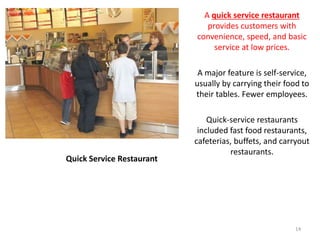
A quick service restaurant
provides customers with
convenience, speed, and basic
service at low prices.
A major feature is self-service,
usually by carrying their food to
their tables. Fewer employees.
Quick-service restaurants
included fast food restaurants,
cafeterias, buffets, and carryout
restaurants.
14
Fast-Food Restaurant
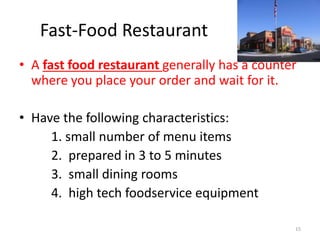
• A fast food restaurant generally has a counter
where you place your order and wait for it.
• Have the following characteristics:
1. small number of menu items
2. prepared in 3 to 5 minutes
3. small dining rooms
4. high tech foodservice equipment
15
Cafeterias
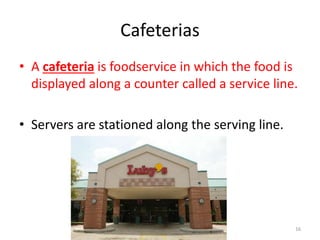
• A cafeteria is foodservice in which the food is
displayed along a counter called a service line.
• Servers are stationed along the serving line.
16
Buffets
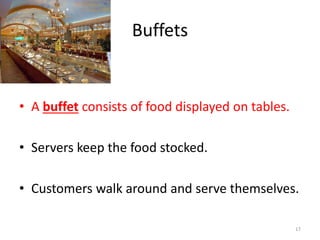
• A buffet consists of food displayed on tables.
• Servers keep the food stocked.
• Customers walk around and serve themselves.
17
Carryout Restaurant
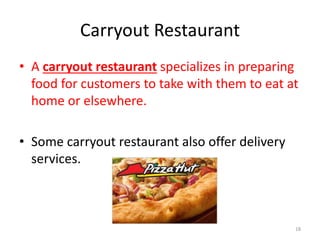
• A carryout restaurant specializes in preparing
food for customers to take with them to eat at
home or elsewhere.
• Some carryout restaurant also offer delivery
services.
18
Full-Service Restaurants
19
Full-Service Restaurant
• A full-service restaurant is a restaurant in
which customers are seated at a table, give
their orders to a server, and are served their
foods at the table.
• Two major categories are:
1. Fine dining
2. Casual
20
Fine Dining Restaurant
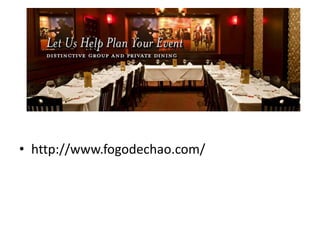
• A fine-dining restaurant emphasizes the
highest quality in service, ingredients, and
atmosphere.
• Prices are high, usually small, seating for fewer
than 100 and have chefs.
21
• http://www.fogodechao.com/
Casual Dining Restaurant
• Casual dining restaurant include all full-
service restaurants that are not in the fine-
dining category.
• These restaurants range from budget to
expensive, and from more casual to more
formal. Include single-item restaurant, ethnic
restaurants, and family restaurants.
23
• http://www.59diner.com/
• Family restaurants cater to the need of
families and emphasize variety and comfort.
• Family restaurants usually serve breakfast,
lunch, and dinner with an extensive menu.
• Home cooking is popular in family restaurants.
This refer to comfort foods & American dishes
(meatloaf, mashed potatoes & apple pie).
25
Discussion
• Have you ever been to a catered event?
• Describe the event and the foodservice.
26
Catering
• Catering is the provision of food and service
for special events.
• Two categories of special events:
1. Business (conventions, meetings, receptions award
dinners, and company parties)
2. Social (b-day parties, weddings, proms, anniversaries,
holiday celebration, graduation, reunions & charity events.
27
Discussion
• What is the difference between a quick
service and full service restaurants?
28
INSTITUTIONAL
FOODSERVICE
29
Discussion
• What experiences have you had with
institutional foodservice? Make sure students
realize that their school cafeteria is an
institutional foodservice.
30
• Institutional foodservice consists of food-
service provided to customers in an
institution.
• An institution is a place such as a school,
hospital, the military, or prison. Institutional
food-service mainly serve customers who are
not able or don’t have time to seek a
commercial food and beverage business.
• Example: school, hospital, factory
31
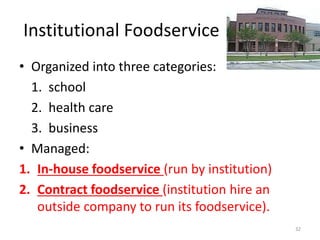
Institutional Foodservice
• Organized into three categories:
1. school
2. health care
3. business
• Managed:
1. In-house foodservice (run by institution)
2. Contract foodservice (institution hire an
outside company to run its foodservice).
32
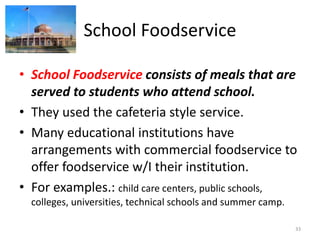
School Foodservice
• School Foodservice consists of meals that are
served to students who attend school.
• They used the cafeteria style service.
• Many educational institutions have
arrangements with commercial foodservice to
offer foodservice w/I their institution.
• For examples.: child care centers, public schools,
colleges, universities, technical schools and summer camp.
33
Field Trip & Tour
• Tour the AHS cafeteria.
34
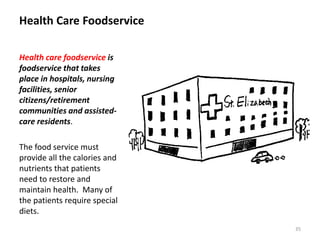
Health Care Foodservice
Health care foodservice is
foodservice that takes
place in hospitals, nursing
facilities, senior
citizens/retirement
communities and assisted-
care residents.
The food service must
provide all the calories and
nutrients that patients
need to restore and
maintain health. Many of
the patients require special
diets.
35
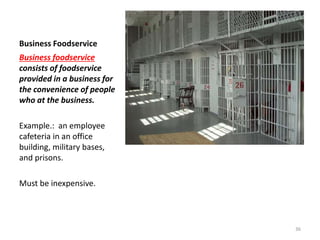
Business Foodservice
Business foodservice
consists of foodservice
provided in a business for
the convenience of people
who at the business.
Example.: an employee
cafeteria in an office
building, military bases,
and prisons.
Must be inexpensive.
36
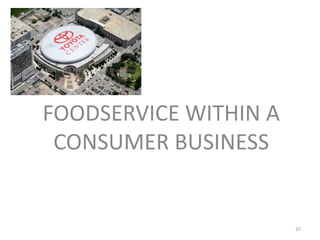
FOODSERVICE WITHIN A
CONSUMER BUSINESS
37
Reflection
Write about the last time you ate a
snack or meal in a mall or in a recreational
facility. What characteristics of commercial and
institutional foodservice businesses did you
observe?
38
• Foodservice within a consumer business is a
food and beverage business located in a
consumer business, such as a movie theater,
sports arena, or museum.
• A food and beverage business located in
another business is often called a food and
beverage operation or a food and beverage
outlet.
39
The foodservice within a
consumer business help
the consumer business
provide better customer
service.
A hungry family visiting the
zoo does not have to leave
the zoo to find food.
Food service within
consumer businesses can
be grouped into 3
categories (recreation,
retail, and transportation).
40
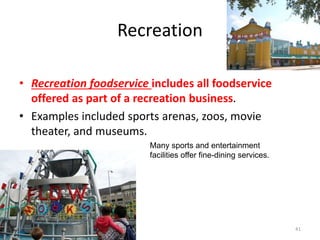
Recreation
• Recreation foodservice includes all foodservice
offered as part of a recreation business.
• Examples included sports arenas, zoos, movie
theater, and museums.
41
Many sports and entertainment
facilities offer fine-dining services.
Retail
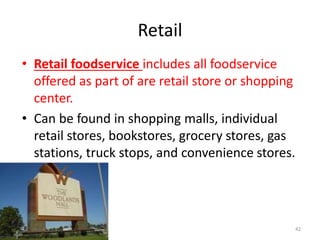
• Retail foodservice includes all foodservice
offered as part of are retail store or shopping
center.
• Can be found in shopping malls, individual
retail stores, bookstores, grocery stores, gas
stations, truck stops, and convenience stores.
42
Transportation
Foodservice on the Transportation
Airplane food, dining cars on trains, cruise ships.
Foodservice in the Station
Restaurants in airports, and railroad stations.
Food service in stations are designed for
travelers.
43
Organize the class into pairs. Have one half of the
groups list their expectations of recreational
foodservice businesses. Have the other half of the
groups list their expectations of retail foodservice.
Then, pair each recreational group with a retail group
and have them compare and contrast their
expectations. Then have the paired groups present
common expectations for all foodservices within a
consumer business.
44
Assignment: Workbook Activity C: Categorizing
Foodservice.
This is an individual assignment.
NO TALKING
45
Functionsin Foodservice
46
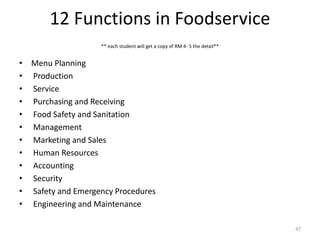
12 Functions in Foodservice
** each student will get a copy of RM 4- 5 the detail**
• Menu Planning
• Production
• Service
• Purchasing and Receiving
• Food Safety and Sanitation
• Management
• Marketing and Sales
• Human Resources
• Accounting
• Security
• Safety and Emergency Procedures
• Engineering and Maintenance
47
Activity: Function in
Foodservice
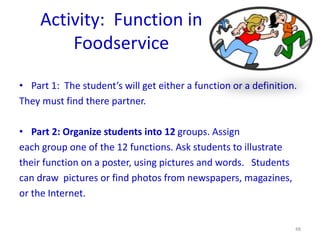
• Part 1: The student’s will get either a function or a definition.
They must find there partner.
• Part 2: Organize students into 12 groups. Assign
each group one of the 12 functions. Ask students to illustrate
their function on a poster, using pictures and words. Students
can draw pictures or find photos from newspapers, magazines,
or the Internet.
48
RestaurantConcepts
49
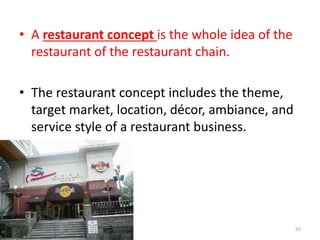
• A restaurant concept is the whole idea of the
restaurant of the restaurant chain.
• The restaurant concept includes the theme,
target market, location, décor, ambiance, and
service style of a restaurant business.
50
• A theme is a specific idea around which
something is organized.
• The theme organizes everything the
restaurant does.
• The theme is carried out in the décor of the
restaurant, the uniforms that the serves wear,
the type of food it serves and the look of the
menu.
51
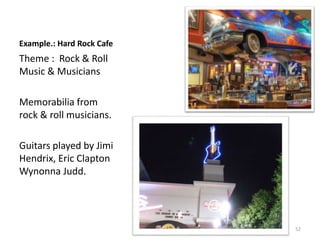
Example.: Hard Rock Cafe
Theme : Rock & Roll
Music & Musicians
Memorabilia from
rock & roll musicians.
Guitars played by Jimi
Hendrix, Eric Clapton
Wynonna Judd.
52
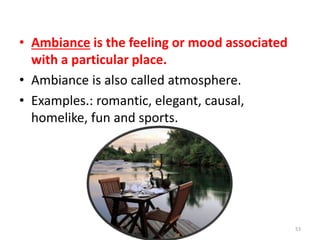
• Ambiance is the feeling or mood associated
with a particular place.
• Ambiance is also called atmosphere.
• Examples.: romantic, elegant, causal,
homelike, fun and sports.
53
• The restaurant concept also includes the types
of customers that the restaurant wants to
attract.
• A market consists of all the people who could
potentially buy what you are selling.
• The goal of every business is to meet the
needs of the market.
• It is useful to divide the market into subgroups
with similar needs.
54
• These subgroups are called market segments.
• A market segment is a subgroup of a larger
market; a market segment has similar needs
and wants for the product you are selling.
• Your target market is the market segment that
you choose to target. The target market is the
one whose needs you strive to meet.
55
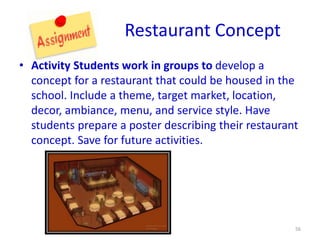
Restaurant Concept
• Activity Students work in groups to develop a
concept for a restaurant that could be housed in the
school. Include a theme, target market, location,
decor, ambiance, menu, and service style. Have
students prepare a poster describing their restaurant
concept. Save for future activities.
56
Interview about Restaurant Concepts
57
CUSTOMER FEEDBACK
58
• It is extremely important to know how
customers feel about your food and beverage.
• Managers need to know if their customers are
satisfied.
• If customers are not satisfied, the manager
need to know why.
• Once the manager knows why, the business
can work to improve customer satisfaction.
• Examples (comment cards, mystery shoppers)
59
Discussion: Feedback
• Why is customer feedback important?
• Why is it a good idea for managers to walk around
and talk with guests in their foodservice businesses?
60
Assignment: Revisiting Chapter 4
The World of Food & Beverage
61

Notes 4 .ppt

  • 1.
    Chapter 4 The Worldof Food & Beverage Hospitality Service By Johnny Sue Reynolds 1
  • 2.
    Chapter Objectives • describethe four types of commercial foodservice. • describe the three types of institutional foodservice. • distinguish between commercial and institutional foodservice. • describe foodservice within a consumer business. • list the functions that all foodservices must perform. • describe how a restaurant concept distinguishes one restaurant from another. • explain the importance of customer feedback. 2
  • 3.
    Group: Brainstorm • Havestudents generate a list of all the foodservice businesses that they have used in the past week. (i.e..: vending machine, cafeteria) • Put the businesses in categories. 3
  • 4.
  • 5.
    Discussion • Write alist of as many different types of foodservice businesses that you can think of? 5
  • 6.
    • According tothe National Restaurant Association, there are925,000 food & beverage businesses in the USA. • A food & beverage business prepares, packages, serves, sells, or provides food for people to eat. • Food & Beverage businesses are also referred to as food service. • Food & beverage businesses are also found in hotels, cruise ships, schools, hospitals, airlines, train and employees cafeterias and grocery stores (salad and soup bars). 6
  • 7.
  • 8.
    • The food& beverage industry categorizes foodservice businesses into three main groups: 1. Commercial 2. Institutional 3. Foodservice within consumer business 8
  • 9.
    Discussion • Have studentsconsult the lists they came up with and put the list of businesses into the following categories. Give each group a copy of RM 4.2 • Commercial • Intuitional • Consumer Business 9
  • 10.
  • 11.
    • Commercial foodserviceconsists of food and beverage businesses that compete for customers. These businesses are designed to make a profit. • Restaurant is a business establishment where meals or refreshments can be purchased. • Commercial food & beverage businesses can be organized into four categories: 1. quick service restaurants 2. full-service restaurants 3. hotel 4. club food services 11
  • 12.
  • 13.
    • Have studentsbring in ads for various restaurants and other commercial foodservice businesses. • Discuss which type of restaurant each is. • Use ads to create a bulletin board or posters that shows the different types of commercial foodservices. 13
  • 14.
    Quick Service Restaurant Aquick service restaurant provides customers with convenience, speed, and basic service at low prices. A major feature is self-service, usually by carrying their food to their tables. Fewer employees. Quick-service restaurants included fast food restaurants, cafeterias, buffets, and carryout restaurants. 14
  • 15.
    Fast-Food Restaurant • Afast food restaurant generally has a counter where you place your order and wait for it. • Have the following characteristics: 1. small number of menu items 2. prepared in 3 to 5 minutes 3. small dining rooms 4. high tech foodservice equipment 15
  • 16.
    Cafeterias • A cafeteriais foodservice in which the food is displayed along a counter called a service line. • Servers are stationed along the serving line. 16
  • 17.
    Buffets • A buffetconsists of food displayed on tables. • Servers keep the food stocked. • Customers walk around and serve themselves. 17
  • 18.
    Carryout Restaurant • Acarryout restaurant specializes in preparing food for customers to take with them to eat at home or elsewhere. • Some carryout restaurant also offer delivery services. 18
  • 19.
  • 20.
    Full-Service Restaurant • Afull-service restaurant is a restaurant in which customers are seated at a table, give their orders to a server, and are served their foods at the table. • Two major categories are: 1. Fine dining 2. Casual 20
  • 21.
    Fine Dining Restaurant •A fine-dining restaurant emphasizes the highest quality in service, ingredients, and atmosphere. • Prices are high, usually small, seating for fewer than 100 and have chefs. 21
  • 22.
  • 23.
    Casual Dining Restaurant •Casual dining restaurant include all full- service restaurants that are not in the fine- dining category. • These restaurants range from budget to expensive, and from more casual to more formal. Include single-item restaurant, ethnic restaurants, and family restaurants. 23
  • 24.
  • 25.
    • Family restaurantscater to the need of families and emphasize variety and comfort. • Family restaurants usually serve breakfast, lunch, and dinner with an extensive menu. • Home cooking is popular in family restaurants. This refer to comfort foods & American dishes (meatloaf, mashed potatoes & apple pie). 25
  • 26.
    Discussion • Have youever been to a catered event? • Describe the event and the foodservice. 26
  • 27.
    Catering • Catering isthe provision of food and service for special events. • Two categories of special events: 1. Business (conventions, meetings, receptions award dinners, and company parties) 2. Social (b-day parties, weddings, proms, anniversaries, holiday celebration, graduation, reunions & charity events. 27
  • 28.
    Discussion • What isthe difference between a quick service and full service restaurants? 28
  • 29.
  • 30.
    Discussion • What experienceshave you had with institutional foodservice? Make sure students realize that their school cafeteria is an institutional foodservice. 30
  • 31.
    • Institutional foodserviceconsists of food- service provided to customers in an institution. • An institution is a place such as a school, hospital, the military, or prison. Institutional food-service mainly serve customers who are not able or don’t have time to seek a commercial food and beverage business. • Example: school, hospital, factory 31
  • 32.
    Institutional Foodservice • Organizedinto three categories: 1. school 2. health care 3. business • Managed: 1. In-house foodservice (run by institution) 2. Contract foodservice (institution hire an outside company to run its foodservice). 32
  • 33.
    School Foodservice • SchoolFoodservice consists of meals that are served to students who attend school. • They used the cafeteria style service. • Many educational institutions have arrangements with commercial foodservice to offer foodservice w/I their institution. • For examples.: child care centers, public schools, colleges, universities, technical schools and summer camp. 33
  • 34.
    Field Trip &Tour • Tour the AHS cafeteria. 34
  • 35.
    Health Care Foodservice Healthcare foodservice is foodservice that takes place in hospitals, nursing facilities, senior citizens/retirement communities and assisted- care residents. The food service must provide all the calories and nutrients that patients need to restore and maintain health. Many of the patients require special diets. 35
  • 36.
    Business Foodservice Business foodservice consistsof foodservice provided in a business for the convenience of people who at the business. Example.: an employee cafeteria in an office building, military bases, and prisons. Must be inexpensive. 36
  • 37.
  • 38.
    Reflection Write about thelast time you ate a snack or meal in a mall or in a recreational facility. What characteristics of commercial and institutional foodservice businesses did you observe? 38
  • 39.
    • Foodservice withina consumer business is a food and beverage business located in a consumer business, such as a movie theater, sports arena, or museum. • A food and beverage business located in another business is often called a food and beverage operation or a food and beverage outlet. 39
  • 40.
    The foodservice withina consumer business help the consumer business provide better customer service. A hungry family visiting the zoo does not have to leave the zoo to find food. Food service within consumer businesses can be grouped into 3 categories (recreation, retail, and transportation). 40
  • 41.
    Recreation • Recreation foodserviceincludes all foodservice offered as part of a recreation business. • Examples included sports arenas, zoos, movie theater, and museums. 41 Many sports and entertainment facilities offer fine-dining services.
  • 42.
    Retail • Retail foodserviceincludes all foodservice offered as part of are retail store or shopping center. • Can be found in shopping malls, individual retail stores, bookstores, grocery stores, gas stations, truck stops, and convenience stores. 42
  • 43.
    Transportation Foodservice on theTransportation Airplane food, dining cars on trains, cruise ships. Foodservice in the Station Restaurants in airports, and railroad stations. Food service in stations are designed for travelers. 43
  • 44.
    Organize the classinto pairs. Have one half of the groups list their expectations of recreational foodservice businesses. Have the other half of the groups list their expectations of retail foodservice. Then, pair each recreational group with a retail group and have them compare and contrast their expectations. Then have the paired groups present common expectations for all foodservices within a consumer business. 44
  • 45.
    Assignment: Workbook ActivityC: Categorizing Foodservice. This is an individual assignment. NO TALKING 45
  • 46.
  • 47.
    12 Functions inFoodservice ** each student will get a copy of RM 4- 5 the detail** • Menu Planning • Production • Service • Purchasing and Receiving • Food Safety and Sanitation • Management • Marketing and Sales • Human Resources • Accounting • Security • Safety and Emergency Procedures • Engineering and Maintenance 47
  • 48.
    Activity: Function in Foodservice •Part 1: The student’s will get either a function or a definition. They must find there partner. • Part 2: Organize students into 12 groups. Assign each group one of the 12 functions. Ask students to illustrate their function on a poster, using pictures and words. Students can draw pictures or find photos from newspapers, magazines, or the Internet. 48
  • 49.
  • 50.
    • A restaurantconcept is the whole idea of the restaurant of the restaurant chain. • The restaurant concept includes the theme, target market, location, décor, ambiance, and service style of a restaurant business. 50
  • 51.
    • A themeis a specific idea around which something is organized. • The theme organizes everything the restaurant does. • The theme is carried out in the décor of the restaurant, the uniforms that the serves wear, the type of food it serves and the look of the menu. 51
  • 52.
    Example.: Hard RockCafe Theme : Rock & Roll Music & Musicians Memorabilia from rock & roll musicians. Guitars played by Jimi Hendrix, Eric Clapton Wynonna Judd. 52
  • 53.
    • Ambiance isthe feeling or mood associated with a particular place. • Ambiance is also called atmosphere. • Examples.: romantic, elegant, causal, homelike, fun and sports. 53
  • 54.
    • The restaurantconcept also includes the types of customers that the restaurant wants to attract. • A market consists of all the people who could potentially buy what you are selling. • The goal of every business is to meet the needs of the market. • It is useful to divide the market into subgroups with similar needs. 54
  • 55.
    • These subgroupsare called market segments. • A market segment is a subgroup of a larger market; a market segment has similar needs and wants for the product you are selling. • Your target market is the market segment that you choose to target. The target market is the one whose needs you strive to meet. 55
  • 56.
    Restaurant Concept • ActivityStudents work in groups to develop a concept for a restaurant that could be housed in the school. Include a theme, target market, location, decor, ambiance, menu, and service style. Have students prepare a poster describing their restaurant concept. Save for future activities. 56
  • 57.
  • 58.
  • 59.
    • It isextremely important to know how customers feel about your food and beverage. • Managers need to know if their customers are satisfied. • If customers are not satisfied, the manager need to know why. • Once the manager knows why, the business can work to improve customer satisfaction. • Examples (comment cards, mystery shoppers) 59
  • 60.
    Discussion: Feedback • Whyis customer feedback important? • Why is it a good idea for managers to walk around and talk with guests in their foodservice businesses? 60
  • 61.
    Assignment: Revisiting Chapter4 The World of Food & Beverage 61