Study Group: AWS SAA Guide
Chapter 10 -
Matching Supply and Demand
Sean
2020.Jun
AWS Certified Solutions
Architect Associate Guide
Chapter 10 Matching Supply and Demand
Topics
● System Reliability
● Elastic Load Balancing and Types
● ELB Attributes
● AWS Auto Scaling
System Reliability
Reliability is the characteristic of a
system to acquire compute
resources when patterns in traffic
change and the ability to acquire
resources dynamically to match the
demand.
AWS ELB (Elastic Load Balancing)
1. A Reserver Proxy Service
2. Decoupling Applications
3. Scaling Horizontally (Scale-up) with High
availability
4. Health Checks
Benefits
1. Highly Available (高可用性)
2. Secure (安全)
3. Elastic (彈性)
4. Flexible (靈活)
5. Robust Monitoring & Auditing (監控及稽核功能)
6. Hybrid Load Balancing (混合負載平衡)
The Elastic Load Balancing service provides with three different
load balancers for the general and specific purpose:
● Classic Load Balancer
● Application Load Balancer
● Network Load Balancer
ELB Types
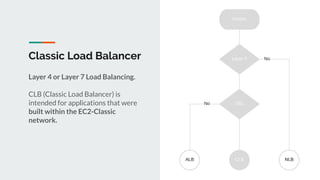
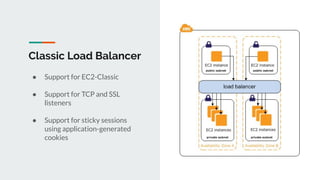
Classic Load Balancer
Layer 4 or Layer 7 Load Balancing.
CLB (Classic Load Balancer) is
intended for applications that were
built within the EC2-Classic
network.
Classic Load Balancer
● Support for EC2-Classic
● Support for TCP and SSL
listeners
● Support for sticky sessions
using application-generated
cookies
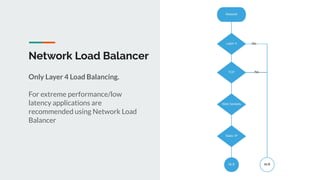
Network Load Balancer
Only Layer 4 Load Balancing.
For extreme performance/low
latency applications are
recommended using Network Load
Balancer
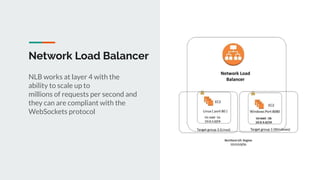
Network Load Balancer
NLB works at layer 4 with the
ability to scale up to
millions of requests per second and
they can are compliant with the
WebSockets protocol
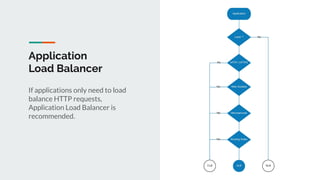
Application
Load Balancer
If applications only need to load
balance HTTP requests,
Application Load Balancer is
recommended.
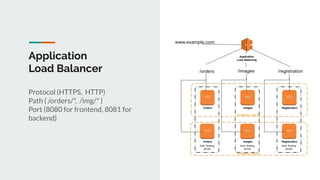
Application
Load Balancer
Protocol (HTTPS, HTTP)
Path ( /orders/*, /img/* )
Port (8080 for frontend, 8081 for
backend)
● Stateless versus Stateful
● Internet-facing versus internal-facing
● TCP Passthrough
● Cross-zone load balancing
● Connection draining
ELB Attributes
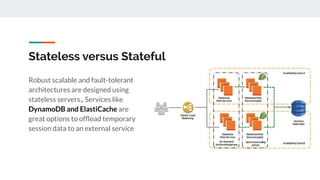
Stateless versus Stateful
Robust scalable and fault-tolerant
architectures are designed using
stateless servers。Services like
DynamoDB and ElastiCache are
great options to offload temporary
session data to an external service
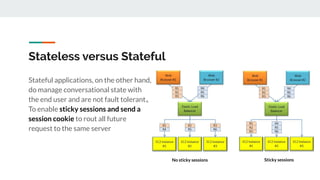
Stateless versus Stateful
Stateful applications, on the other hand,
do manage conversational state with
the end user and are not fault tolerant。
To enable sticky sessions and send a
session cookie to rout all future
request to the same server
No sticky sessions Sticky sessions
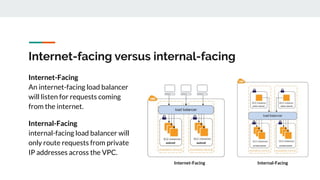
Internet-facing versus internal-facing
Internet-Facing
An internet-facing load balancer
will listen for requests coming
from the internet.
Internal-Facing
internal-facing load balancer will
only route requests from private
IP addresses across the VPC.
Internet-Facing Internal-Facing
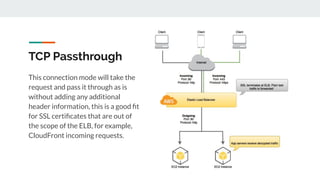
TCP Passthrough
This connection mode will take the
request and pass it through as is
without adding any additional
header information, this is a good fit
for SSL certificates that are out of
the scope of the ELB, for example,
CloudFront incoming requests.
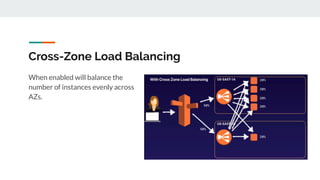
Cross-Zone Load Balancing
When enabled will balance the
number of instances evenly across
AZs.
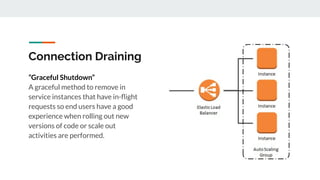
Connection Draining
“Graceful Shutdown”
A graceful method to remove in
service instances that have in-flight
requests so end users have a good
experience when rolling out new
versions of code or scale out
activities are performed.
Auto Scaling Lab
● Create AMI Image
● Create ALB
● Create Launch Configuration
● Create Auto Scaling Group

AWS Study Group - Chapter 10 - Matching Supply and Demand [Solution Architect Associate Guide]

  • 1.
    Study Group: AWSSAA Guide Chapter 10 - Matching Supply and Demand Sean 2020.Jun
  • 2.
    AWS Certified Solutions ArchitectAssociate Guide Chapter 10 Matching Supply and Demand
  • 3.
    Topics ● System Reliability ●Elastic Load Balancing and Types ● ELB Attributes ● AWS Auto Scaling
  • 4.
    System Reliability Reliability isthe characteristic of a system to acquire compute resources when patterns in traffic change and the ability to acquire resources dynamically to match the demand.
  • 5.
    AWS ELB (ElasticLoad Balancing) 1. A Reserver Proxy Service 2. Decoupling Applications 3. Scaling Horizontally (Scale-up) with High availability 4. Health Checks
  • 6.
    Benefits 1. Highly Available(高可用性) 2. Secure (安全) 3. Elastic (彈性) 4. Flexible (靈活) 5. Robust Monitoring & Auditing (監控及稽核功能) 6. Hybrid Load Balancing (混合負載平衡)
  • 7.
    The Elastic LoadBalancing service provides with three different load balancers for the general and specific purpose: ● Classic Load Balancer ● Application Load Balancer ● Network Load Balancer ELB Types
  • 8.
    Classic Load Balancer Layer4 or Layer 7 Load Balancing. CLB (Classic Load Balancer) is intended for applications that were built within the EC2-Classic network.
  • 9.
    Classic Load Balancer ●Support for EC2-Classic ● Support for TCP and SSL listeners ● Support for sticky sessions using application-generated cookies
  • 10.
    Network Load Balancer OnlyLayer 4 Load Balancing. For extreme performance/low latency applications are recommended using Network Load Balancer
  • 11.
    Network Load Balancer NLBworks at layer 4 with the ability to scale up to millions of requests per second and they can are compliant with the WebSockets protocol
  • 12.
    Application Load Balancer If applicationsonly need to load balance HTTP requests, Application Load Balancer is recommended.
  • 13.
    Application Load Balancer Protocol (HTTPS,HTTP) Path ( /orders/*, /img/* ) Port (8080 for frontend, 8081 for backend)
  • 14.
    ● Stateless versusStateful ● Internet-facing versus internal-facing ● TCP Passthrough ● Cross-zone load balancing ● Connection draining ELB Attributes
  • 15.
    Stateless versus Stateful Robustscalable and fault-tolerant architectures are designed using stateless servers。Services like DynamoDB and ElastiCache are great options to offload temporary session data to an external service
  • 16.
    Stateless versus Stateful Statefulapplications, on the other hand, do manage conversational state with the end user and are not fault tolerant。 To enable sticky sessions and send a session cookie to rout all future request to the same server No sticky sessions Sticky sessions
  • 17.
    Internet-facing versus internal-facing Internet-Facing Aninternet-facing load balancer will listen for requests coming from the internet. Internal-Facing internal-facing load balancer will only route requests from private IP addresses across the VPC. Internet-Facing Internal-Facing
  • 18.
    TCP Passthrough This connectionmode will take the request and pass it through as is without adding any additional header information, this is a good fit for SSL certificates that are out of the scope of the ELB, for example, CloudFront incoming requests.
  • 19.
    Cross-Zone Load Balancing Whenenabled will balance the number of instances evenly across AZs.
  • 20.
    Connection Draining “Graceful Shutdown” Agraceful method to remove in service instances that have in-flight requests so end users have a good experience when rolling out new versions of code or scale out activities are performed.
  • 21.
    Auto Scaling Lab ●Create AMI Image ● Create ALB ● Create Launch Configuration ● Create Auto Scaling Group