Mahesh TRMahesh TR
Cloud Front and Cloud Formation
Mahesh TR
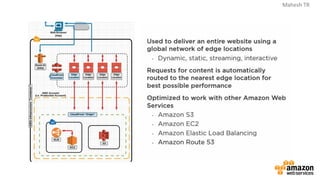
Amazon CloudFront is a web service that speeds up distribution of your static and dynamic web content, such as
.html, .css, .php, and image files, to your users.
CloudFront delivers your content through a worldwide network of data centers called edge locations. When a user
requests content that you're serving with CloudFront, the user is routed to the edge location that provides the lowest
latency (time delay), so that content is delivered with the best possible performance.
a) If the content is already in the edge location with the lowest latency, CloudFront delivers it immediately.
b) If the content is not in that edge location, CloudFront retrieves it from an Amazon S3 bucket or an HTTP server
(for example, a web server) that you have identified as the source for the definitive version of your content.
CloudFront? CDN
Mahesh TRMahesh TR
Mahesh TRMahesh TR
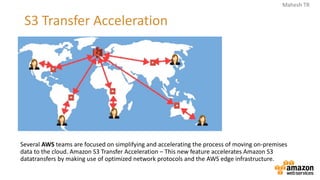
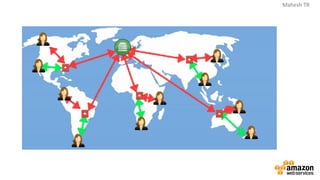
S3 Transfer Acceleration
Several AWS teams are focused on simplifying and accelerating the process of moving on-premises
data to the cloud. Amazon S3 Transfer Acceleration – This new feature accelerates Amazon S3
datatransfers by making use of optimized network protocols and the AWS edge infrastructure.
Mahesh TRMahesh TR
Mahesh TRMahesh TR
Mahesh TRMahesh TR
Mahesh TRMahesh TR
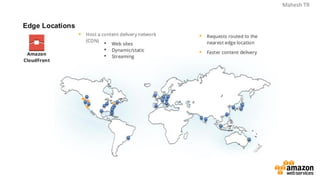
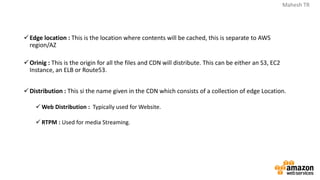
✓Edge location : This is the location where contents will be cached, this is separate to AWS
region/AZ
✓Orinig : This is the origin for all the files and CDN will distribute. This can be either an S3, EC2
Instance, an ELB or Route53.
✓Distribution : This si the name given in the CDN which consists of a collection of edge Location.
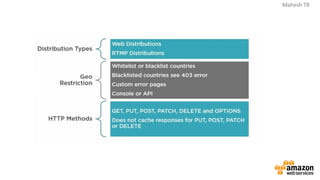
✓ Web Distribution : Typically used for Website.
✓ RTPM : Used for media Streaming.
Mahesh TRMahesh TR
Mahesh TRMahesh TR
Mahesh TRMahesh TR
CloudFormation
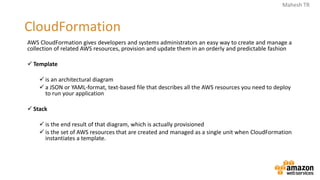
AWS CloudFormation gives developers and systems administrators an easy way to create and manage a
collection of related AWS resources, provision and update them in an orderly and predictable fashion
✓ Template
✓ is an architectural diagram
✓ a JSON or YAML-format, text-based file that describes all the AWS resources you need to deploy
to run your application
✓ Stack
✓ is the end result of that diagram, which is actually provisioned
✓ is the set of AWS resources that are created and managed as a single unit when CloudFormation
instantiates a template.
Mahesh TRMahesh TR
✓CloudFormation template can be used to set up the resources consistently and repeatedly over
and over across multiple regions
✓Resources can be updated, deleted and modified in a controlled and predictable way, in effect
applying version control to the infrastructure as done for software code
✓CloudFormation supports Chef & Puppet Integration, meaning that you can deploy and configure
right down the application layer
✓By default, automatic rollback on error feature is enabled, which will cause all the AWS resources
thatCloudFormation created successfully for a stack up to the point where an error occurred to be
deleted. However, charges would be applied for the resources the time they are up and running

AWS Cloud Front and Cloud Formation

  • 1.
    Mahesh TRMahesh TR CloudFront and Cloud Formation
  • 2.
    Mahesh TR Amazon CloudFrontis a web service that speeds up distribution of your static and dynamic web content, such as .html, .css, .php, and image files, to your users. CloudFront delivers your content through a worldwide network of data centers called edge locations. When a user requests content that you're serving with CloudFront, the user is routed to the edge location that provides the lowest latency (time delay), so that content is delivered with the best possible performance. a) If the content is already in the edge location with the lowest latency, CloudFront delivers it immediately. b) If the content is not in that edge location, CloudFront retrieves it from an Amazon S3 bucket or an HTTP server (for example, a web server) that you have identified as the source for the definitive version of your content. CloudFront? CDN
  • 3.
  • 4.
    Mahesh TRMahesh TR S3Transfer Acceleration Several AWS teams are focused on simplifying and accelerating the process of moving on-premises data to the cloud. Amazon S3 Transfer Acceleration – This new feature accelerates Amazon S3 datatransfers by making use of optimized network protocols and the AWS edge infrastructure.
  • 5.
  • 6.
  • 7.
  • 8.
    Mahesh TRMahesh TR ✓Edgelocation : This is the location where contents will be cached, this is separate to AWS region/AZ ✓Orinig : This is the origin for all the files and CDN will distribute. This can be either an S3, EC2 Instance, an ELB or Route53. ✓Distribution : This si the name given in the CDN which consists of a collection of edge Location. ✓ Web Distribution : Typically used for Website. ✓ RTPM : Used for media Streaming.
  • 9.
  • 10.
  • 11.
    Mahesh TRMahesh TR CloudFormation AWSCloudFormation gives developers and systems administrators an easy way to create and manage a collection of related AWS resources, provision and update them in an orderly and predictable fashion ✓ Template ✓ is an architectural diagram ✓ a JSON or YAML-format, text-based file that describes all the AWS resources you need to deploy to run your application ✓ Stack ✓ is the end result of that diagram, which is actually provisioned ✓ is the set of AWS resources that are created and managed as a single unit when CloudFormation instantiates a template.
  • 12.
    Mahesh TRMahesh TR ✓CloudFormationtemplate can be used to set up the resources consistently and repeatedly over and over across multiple regions ✓Resources can be updated, deleted and modified in a controlled and predictable way, in effect applying version control to the infrastructure as done for software code ✓CloudFormation supports Chef & Puppet Integration, meaning that you can deploy and configure right down the application layer ✓By default, automatic rollback on error feature is enabled, which will cause all the AWS resources thatCloudFormation created successfully for a stack up to the point where an error occurred to be deleted. However, charges would be applied for the resources the time they are up and running