
Securing AWS with HIDS
Gaurav Harsola
Mayank Gaikwad
»
IDS

What ?

Why ?

How ?
Intrusion Detection System
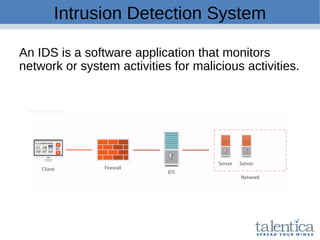
An IDS is a software application that monitors
network or system activities for malicious activities.
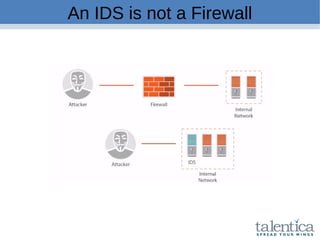
An IDS is not a Firewall
NIDS and HIDS
HIDS

A host-based intrusion detection system (HIDS) is a system that run on individual hosts
and monitors a computer system

Detect an intrusion and/or misuse, and responds by logging the activity

It is an agent that monitors and analyzes whether anything or anyone, whether internal
or external, has bypass the system’s security policy.

Tools like : Samhain, Ossec
NIDS

NIDS is placed within the network to monitor traffic to and from all devices on network

NIDS scan all inbound and outbound traffic

NIDS tools operate by inspecting traffic that occurs between hosts. Various Tools like
Snort, Suricata, Bro, Kismet
Available HIDS
OSSEC: OpenSource
Wazuh : OpenSource, Wrapper Over OSSEC with API, ELK, And Signature DB
AlianVault: Licenced, USM (Unified Security Management) is based OSSEC
MicroTrend: Licenced
AlertLogic: Licenced,
OSSEC ?
OSSEC is an Open Source Host-based Intrusion Detection System.
Key Features:

Log analysis

File Integrity checking (Unix and Windows)

Registry Integrity checking (Windows)

Host-based anomaly detection (for Unix – rootkit detection)

Active response
Ossec is mainly used for three things:
See what is going on
Stop brute-force attacks ( ftp, ssh, web )
Ossec Benefits

Open-Source

Log Analysis

Easy to install

Easy to customize (rules and config in XML format)

Scalable (client/server architecture)

High Availability (Can have multiple OSSEC Server)

Multi-Platform

Ossec comes with existing standard decoders /rules which analyse our logs
like telnetd, Sudo, SSH, FTP etc

PCI DSS Compliance at some extent.
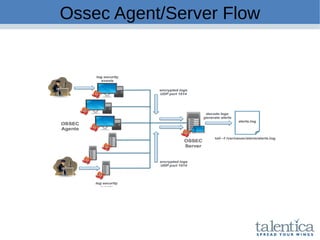
Ossec Agent/Server Flow
Ossec Internal Components
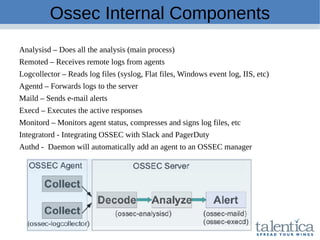
Analysisd – Does all the analysis (main process)
Remoted – Receives remote logs from agents
Logcollector – Reads log files (syslog, Flat files, Windows event log, IIS, etc)
Agentd – Forwards logs to the server
Maild – Sends e-mail alerts
Execd – Executes the active responses
Monitord – Monitors agent status, compresses and signs log files, etc
Integratord - Integrating OSSEC with Slack and PagerDuty
Authd - Daemon will automatically add an agent to an OSSEC manager
Wazuh
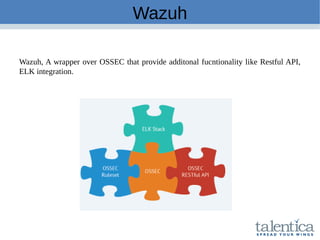
Wazuh, A wrapper over OSSEC that provide additonal fucntionality like Restful API,
ELK integration.
Ossec Server/Client Installtion
Firstly, Install necessary package required

sudo apt-get install gcc make git

sudo apt-get install libssl-dev
After this clone our Github repository

mkdir ossec_tmp && cd ossec_tmp

git clone -b stable https://github.com/wazuh/ossec-wazuh.git

cd ossec-wazuh

sudo ./install.sh
Choose server for server installation and agent for client installation when being asked
about the installation type and answer the rest of questions as desired.
Once installed, you can start your OSSEC manager running:
sudo /var/ossec/bin/ossec-control start
Check the service : ps aux |grep ossec
Connect Client with Server
After Setting up agent we need to Connect it with OSSEC-Server .
To make life easier, OSSEC added a new daemon on the server, called ossec-authd.

it is a daemon you run on the server when you deploy your agent;

it will populate your agents key;

when you have finished to deploy, you stop it.
Once the keys are created, you can start the ossec-authd:
/var/ossec/bin/ossec-authd -p 1515
Setting up the agents
On the agents, the work is minimal. All you have to do is to run the following command:
/var/ossec/bin/agent-auth -m <ServerIP> -p 1515 -A <agent-name>
That’s it. The keys are now exchanged and you can start your agent.
sudo /var/ossec/bin/ossec-control start
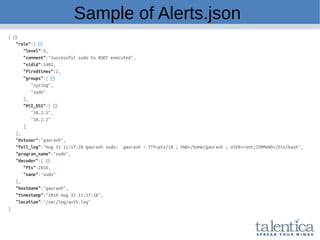
Sample of Alerts.json
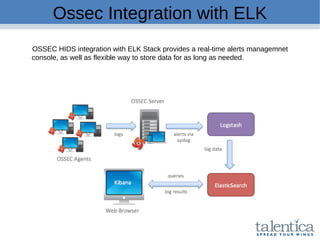
Ossec Integration with ELK
OSSEC HIDS integration with ELK Stack provides a real-time alerts managemnet
console, as well as flexible way to store data for as long as needed.
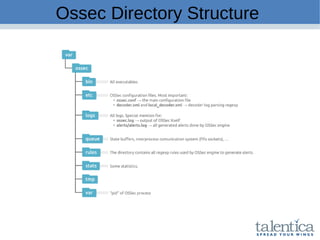
Ossec Directory Structure
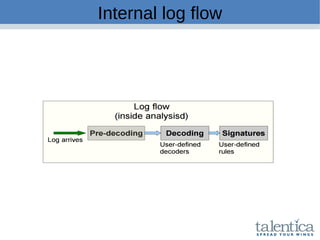
Internal log flow
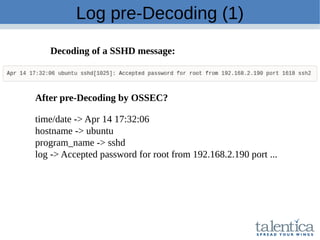
Log pre-Decoding (1)
Decoding of a SSHD message:
After pre-Decoding by OSSEC?
time/date -> Apr 14 17:32:06
hostname -> ubuntu
program_name -> sshd
log -> Accepted password for root from 192.168.2.190 port ...
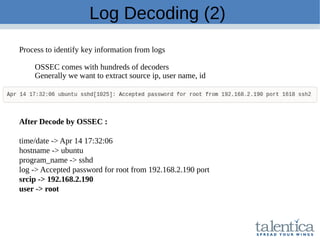
Log Decoding (2)
Process to identify key information from logs
OSSEC comes with hundreds of decoders
Generally we want to extract source ip, user name, id
After Decode by OSSEC :
time/date -> Apr 14 17:32:06
hostname -> ubuntu
program_name -> sshd
log -> Accepted password for root from 192.168.2.190 port
srcip -> 192.168.2.190
user -> root
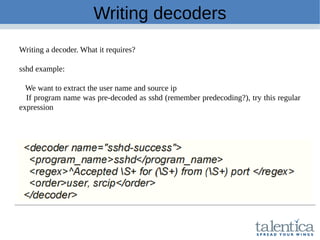
Writing decoders
Writing a decoder. What it requires?
sshd example:
We want to extract the user name and source ip
If program name was pre-decoded as sshd (remember predecoding?), try this regular
expression
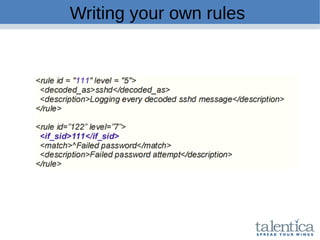
Log Rules
Next step after decoding is to check the rules
User-defined XML
Very easy to write!
Allows to match based on decoded information
OSSEC comes with more than 400 rules by default!
What it requires?
A Rule id (any integer)
A Level - from 0 (lowest) to 15 (highest)
Level 0 is ignored, not alerted at all
Pattern - anything from “regex” , to “srcip” , “id” , “user” , etc
Writing your own rules
PCI DSS

Payment Card industry Data Security Standard .

Visa, MasterCard and other card brands create common industry
security requirements

Intended to protect cardholders data – wherever it resides

compliance is mandated for all organization handling credit card data

12 Steps that we need to take to achieve PCI DSS compliance are
Firewall, password, storage, Encrypt, anti-virus, uniquid, track and
monitor etc

OSSEC helps to implement PCI DSS by performing log analysis, file
integrity checking, policy monitoring, intrusion detection, real-time
alerting and active response.
Monitor AWS logs
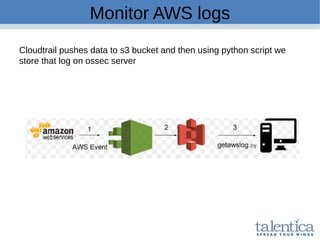
Cloudtrail pushes data to s3 bucket and then using python script we
store that log on ossec server
Alerting and Notification
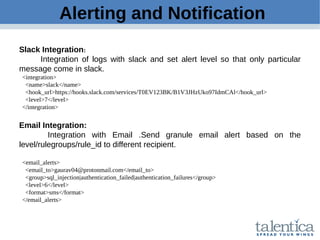
Slack Integration:
Integration of logs with slack and set alert level so that only particular
message come in slack.
<integration>
<name>slack</name>
<hook_url>https://hooks.slack.com/services/T0EV123BK/B1V3JHzUko97IdmCAl</hook_url>
<level>7</level>
</integration>
Email Integration:
Integration with Email .Send granule email alert based on the
level/rulegroups/rule_id to different recipient.
<email_alerts>
<email_to>gaurav04@protonmail.com</email_to>
<group>sql_injection|authentication_failed|authentication_failures</group>
<level>6</level>
<format>sms</format>
</email_alerts>
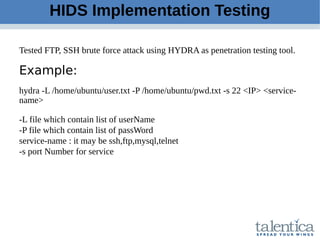
HIDS Implementation Testing
Tested FTP, SSH brute force attack using HYDRA as penetration testing tool.
Example:
hydra -L /home/ubuntu/user.txt -P /home/ubuntu/pwd.txt -s 22 <IP> <service-
name>
-L file which contain list of userName
-P file which contain list of passWord
service-name : it may be ssh,ftp,mysql,telnet
-s port Number for service
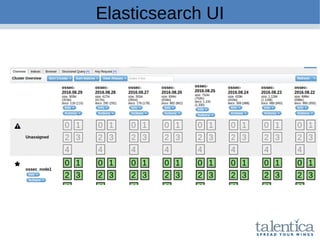
Elasticsearch UI
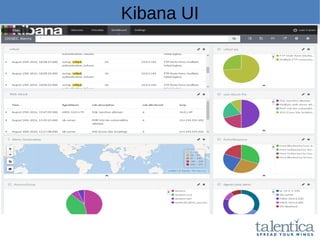
Kibana UI
Thanks & Questions ?

Aws security with HIDS using Ossec

  • 1.
    Securing AWS withHIDS Gaurav Harsola Mayank Gaikwad »
  • 2.
  • 3.
    Intrusion Detection System AnIDS is a software application that monitors network or system activities for malicious activities.
  • 4.
    An IDS isnot a Firewall
  • 5.
    NIDS and HIDS HIDS  Ahost-based intrusion detection system (HIDS) is a system that run on individual hosts and monitors a computer system  Detect an intrusion and/or misuse, and responds by logging the activity  It is an agent that monitors and analyzes whether anything or anyone, whether internal or external, has bypass the system’s security policy.  Tools like : Samhain, Ossec NIDS  NIDS is placed within the network to monitor traffic to and from all devices on network  NIDS scan all inbound and outbound traffic  NIDS tools operate by inspecting traffic that occurs between hosts. Various Tools like Snort, Suricata, Bro, Kismet
  • 6.
    Available HIDS OSSEC: OpenSource Wazuh: OpenSource, Wrapper Over OSSEC with API, ELK, And Signature DB AlianVault: Licenced, USM (Unified Security Management) is based OSSEC MicroTrend: Licenced AlertLogic: Licenced,
  • 7.
    OSSEC ? OSSEC isan Open Source Host-based Intrusion Detection System. Key Features:  Log analysis  File Integrity checking (Unix and Windows)  Registry Integrity checking (Windows)  Host-based anomaly detection (for Unix – rootkit detection)  Active response Ossec is mainly used for three things: See what is going on Stop brute-force attacks ( ftp, ssh, web )
  • 8.
    Ossec Benefits  Open-Source  Log Analysis  Easyto install  Easy to customize (rules and config in XML format)  Scalable (client/server architecture)  High Availability (Can have multiple OSSEC Server)  Multi-Platform  Ossec comes with existing standard decoders /rules which analyse our logs like telnetd, Sudo, SSH, FTP etc  PCI DSS Compliance at some extent.
  • 9.
  • 10.
    Ossec Internal Components Analysisd– Does all the analysis (main process) Remoted – Receives remote logs from agents Logcollector – Reads log files (syslog, Flat files, Windows event log, IIS, etc) Agentd – Forwards logs to the server Maild – Sends e-mail alerts Execd – Executes the active responses Monitord – Monitors agent status, compresses and signs log files, etc Integratord - Integrating OSSEC with Slack and PagerDuty Authd - Daemon will automatically add an agent to an OSSEC manager
  • 11.
    Wazuh Wazuh, A wrapperover OSSEC that provide additonal fucntionality like Restful API, ELK integration.
  • 12.
    Ossec Server/Client Installtion Firstly,Install necessary package required  sudo apt-get install gcc make git  sudo apt-get install libssl-dev After this clone our Github repository  mkdir ossec_tmp && cd ossec_tmp  git clone -b stable https://github.com/wazuh/ossec-wazuh.git  cd ossec-wazuh  sudo ./install.sh Choose server for server installation and agent for client installation when being asked about the installation type and answer the rest of questions as desired. Once installed, you can start your OSSEC manager running: sudo /var/ossec/bin/ossec-control start Check the service : ps aux |grep ossec
  • 13.
    Connect Client withServer After Setting up agent we need to Connect it with OSSEC-Server . To make life easier, OSSEC added a new daemon on the server, called ossec-authd.  it is a daemon you run on the server when you deploy your agent;  it will populate your agents key;  when you have finished to deploy, you stop it. Once the keys are created, you can start the ossec-authd: /var/ossec/bin/ossec-authd -p 1515 Setting up the agents On the agents, the work is minimal. All you have to do is to run the following command: /var/ossec/bin/agent-auth -m <ServerIP> -p 1515 -A <agent-name> That’s it. The keys are now exchanged and you can start your agent. sudo /var/ossec/bin/ossec-control start
  • 14.
  • 15.
    Ossec Integration withELK OSSEC HIDS integration with ELK Stack provides a real-time alerts managemnet console, as well as flexible way to store data for as long as needed.
  • 16.
  • 17.
  • 18.
    Log pre-Decoding (1) Decodingof a SSHD message: After pre-Decoding by OSSEC? time/date -> Apr 14 17:32:06 hostname -> ubuntu program_name -> sshd log -> Accepted password for root from 192.168.2.190 port ...
  • 19.
    Log Decoding (2) Processto identify key information from logs OSSEC comes with hundreds of decoders Generally we want to extract source ip, user name, id After Decode by OSSEC : time/date -> Apr 14 17:32:06 hostname -> ubuntu program_name -> sshd log -> Accepted password for root from 192.168.2.190 port srcip -> 192.168.2.190 user -> root
  • 20.
    Writing decoders Writing adecoder. What it requires? sshd example: We want to extract the user name and source ip If program name was pre-decoded as sshd (remember predecoding?), try this regular expression
  • 21.
    Log Rules Next stepafter decoding is to check the rules User-defined XML Very easy to write! Allows to match based on decoded information OSSEC comes with more than 400 rules by default! What it requires? A Rule id (any integer) A Level - from 0 (lowest) to 15 (highest) Level 0 is ignored, not alerted at all Pattern - anything from “regex” , to “srcip” , “id” , “user” , etc
  • 22.
  • 23.
    PCI DSS  Payment Cardindustry Data Security Standard .  Visa, MasterCard and other card brands create common industry security requirements  Intended to protect cardholders data – wherever it resides  compliance is mandated for all organization handling credit card data  12 Steps that we need to take to achieve PCI DSS compliance are Firewall, password, storage, Encrypt, anti-virus, uniquid, track and monitor etc  OSSEC helps to implement PCI DSS by performing log analysis, file integrity checking, policy monitoring, intrusion detection, real-time alerting and active response.
  • 24.
    Monitor AWS logs Cloudtrailpushes data to s3 bucket and then using python script we store that log on ossec server
  • 25.
    Alerting and Notification SlackIntegration: Integration of logs with slack and set alert level so that only particular message come in slack. <integration> <name>slack</name> <hook_url>https://hooks.slack.com/services/T0EV123BK/B1V3JHzUko97IdmCAl</hook_url> <level>7</level> </integration> Email Integration: Integration with Email .Send granule email alert based on the level/rulegroups/rule_id to different recipient. <email_alerts> <email_to>gaurav04@protonmail.com</email_to> <group>sql_injection|authentication_failed|authentication_failures</group> <level>6</level> <format>sms</format> </email_alerts>
  • 26.
    HIDS Implementation Testing TestedFTP, SSH brute force attack using HYDRA as penetration testing tool. Example: hydra -L /home/ubuntu/user.txt -P /home/ubuntu/pwd.txt -s 22 <IP> <service- name> -L file which contain list of userName -P file which contain list of passWord service-name : it may be ssh,ftp,mysql,telnet -s port Number for service
  • 27.
  • 28.
  • 29.