● Background
● Introduction
● Artificial Intelligence
● Drones
● Conclusion
Outline
● Bsc in Computer Science.
● Software Developer at Andela who has a keen interest in Artificial
Intelligence.
● Blog at techinpink.com
● Love to see myself as a Tech freak.
● Artificial Intelligence Research scientist to be - Currently enrolled in
online courses.
Background
Artificial Intelligence is a branch of computer
science dealing with the simulation of intelligent
behavior in computers.
“Artificial Intelligence is not a Man versus Machine saga; it’s in fact,
Man with Machine synergy.” - Sudipto Ghosh
Artificial Intelligence
The global population is expected to reach 10 billion people by 2050, which
means double agricultural production in order to meet food demands which
is about 70% increase in food production.
Farm enterprises require new and innovative technologies to face and
overcome these challenges.
Green Revolution
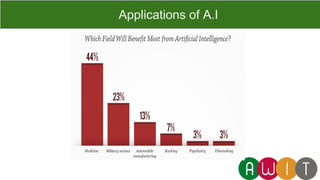
Applications of A.I
Revenue Generation from A.I
Can Artificial
Intelligence feed
the nation?
Green Revolution
● Automating farm activities
● Identification of pest and disease outbreaks before occurrence and
managing possible risk
● Managing crop quality
● Monitoring crop conditions like water stress, nutrient condition, plant
population, soil moisture content etc.
● Ongoing research work on machine vision systems, using the shape of
the leaves to distinguish the different types.
How A.I is used in Agriculture
A farmer milking a cow
Before use of A.I
Before use of A.I
Robotic Milkers Lettuce-thinning robot (treat 5,000 plants a
minute.)
A.I technologies in Agriculture
Driverless Tractor Weeding robot
A.I technologies in Agriculture
Potatoes sorting system Glaucus for fishing industry
A.I technologies in Agriculture
Strawberry harvesting robot Looking forward to yours
A.I technologies in Agriculture
● Ignorance - the Biggest Problem of Agriculture in Africa
● Low use of technology and machinery
Problems of Agriculture in Africa
● In spite of Africa natural resources, including a huge expanse of arable land,
Africa has the highest level of undernourishment worldwide.
● Increasing the total production by 70% in order to suit the world’s demand in
the next 50 years is an objective endangered by limited resources, climatic
changes and other short term and regional threats. Despite its relatively short
life, Artificial Intelligence is seen more and more as a solution to these
challenges.
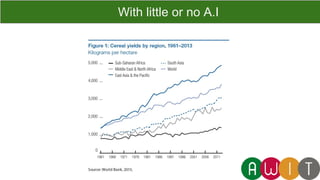
With little or no A.I
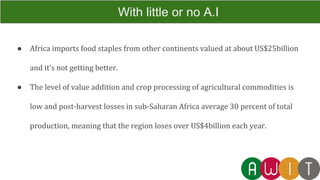
● Africa imports food staples from other continents valued at about US$25billion
and it’s not getting better.
● The level of value addition and crop processing of agricultural commodities is
low and post-harvest losses in sub-Saharan Africa average 30 percent of total
production, meaning that the region loses over US$4billion each year.
With little or no A.I
World Population
A drone is an unmanned aircraft
that can fly autonomously—that is,
without a human in control.
“Drones overall will be more impactful than I think people
recognize, in positive ways to help society” - Bill Gates
Drones
● Medicine
● Surveillance
● Traffic monitoring
● Combat
● Research
● Emergency
● eCommerce
Applications of Drones
Drones in Agriculture
Drones will see even more
liftoff in the agriculture
industry, predicting that
80% of the commercial
market for drones will
eventually be dedicated to
agriculture.
Drones in Agriculture
How drones are changing our Farming Processes
Planting
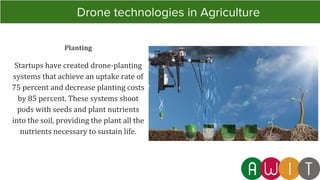
Startups have created drone-planting
systems that achieve an uptake rate of
75 percent and decrease planting costs
by 85 percent. These systems shoot
pods with seeds and plant nutrients
into the soil, providing the plant all the
nutrients necessary to sustain life.
Drone technologies in Agriculture
Soil and Field Analysis
Drones produce precise 3-D maps for early soil analysis,
useful in planning seed planting patterns.
After planting, drone-driven soil analysis provides data for
irrigation and nitrogen-level management.
Drone technologies in Agriculture
Crop monitoring
Vast fields and low efficiency in crop monitoring
together create farming’s largest obstacle.
Today, time-series animations with the use of drones,
can show the precise development of a crop and reveal
production inefficiencies, enabling better crop
management.
Irrigation
Drones with hyperspectral,
multispectral, or thermal
sensors can identify which parts
of a field are dry or need
improvements.
Drone technologies in Agriculture
Fertilization
Drones are capable of
delivering customized
fertilizers and pesticides
based on the requirement of
each plant.
Drone technologies in Agriculture
Health Assessment
By scanning a crop using both
visible and near-infrared light,
drone-carried devices can
identify which plants reflect
different amounts of green light
and NIR light. This information
can produce multispectral
images that track changes in
plants and indicate their health.
Drone technologies in Agriculture
● Optimization of treatments
● Reduction and prevention of waste
● Reduction of labor and material costs
● Reduction of infection and pollution
● Reduction of the risks
Benefits of Drones in Agriculture
● Increase yields
● Saves time
● Crop health imaging
Benefits of Drones in Agriculture
● Financial constraint
● National regulations
● Weather dependent(rain, wind)
● Need for expertise
Limitations of Drones in Agriculture
● Setting up more agricultural research centres
● Legislators need to be thinking of policies in the future and
it’s effects on farmers
● Developers need to make it cheap
● More empowerment and awareness of the use of technology
Way forward?
● According to the UN Food and Agricultural organization, Rwanda’s
farmers produced 792,000 tones of grain in 2014 - more than three
times in 2000.
● Production of maize, a vital crop in East Africa, jumped sevenfold.
● Cereal production tripled in Ethiopia between 2000 and 2014. The value
of crops grown in Cameroon, Ghana and Zambia has risen by at least
50% in the past decade.
Testament of Technology Application to Agriculture
● Data gathering and availability.
● Expertise: Usage of some of these technologies require expert hands.
● Poor electrification.
● Cost: Production and deployment of sensors is expensive.
Challenges involved in bringing ICT to Africa
“High tech companies that focus on research, development and production will
learn that they can be the perfect complement to our world-renowned
agriculture heritage.”- Alan Autry
Conclusion
A sweet quote
● http://ai.business/2016/05/03/artificial-intelligence-in-agriculture-part-1-how-farming-is-going-automa
ted-with-robots/
● https://www.technologyreview.com/s/601935/six-ways-drones-are-revolutionizing-agriculture/
● http://waypoint.sensefly.com/drone-surface-model-estimate-crop-yield-plant-health/
● http://ai.business/2016/05/06/artificial-intelligence-in-agriculture-part-2-how-farming-is-going-automa
ted-with-ai-technologies/
● http://www.mckinsey.com/industries/public-sector/our-insights/four-lessons-for-transforming-african-
agriculture
● http://www.cargill.com/learning-journey/africa/five-challenges-facing-africa/index.jsp
● http://www.aaopfund.com/?q=node/20
● http://www.africaw.com/the-african-farmer-problems-facing-agriculture
References
● http://aitopics.org/topic/agriculture-natural-resources
● http://www.mckinsey.com/industries/public-sector/our-insights/four-lessons-for-transforming-african-
agriculture
● http://www.slideshare.net/tseitlin/agritech-funder-investing-report-2015?next_slideshow=1
● http://www.slideshare.net/njoannah/the-way-ahead-how-drones-sensors-and-apps-are-rewriting-the-
rules-in-agriculture
● http://www.agweb.com/mobile/article/artificial-intelligence-will-arrive-on-the-farm-sooner-than-you-thi
nk-naa-ben-potter/
References
Questions???
Thank you!

Awit

  • 2.
    ● Background ● Introduction ●Artificial Intelligence ● Drones ● Conclusion Outline
  • 3.
    ● Bsc inComputer Science. ● Software Developer at Andela who has a keen interest in Artificial Intelligence. ● Blog at techinpink.com ● Love to see myself as a Tech freak. ● Artificial Intelligence Research scientist to be - Currently enrolled in online courses. Background
  • 4.
    Artificial Intelligence isa branch of computer science dealing with the simulation of intelligent behavior in computers. “Artificial Intelligence is not a Man versus Machine saga; it’s in fact, Man with Machine synergy.” - Sudipto Ghosh Artificial Intelligence
  • 5.
    The global populationis expected to reach 10 billion people by 2050, which means double agricultural production in order to meet food demands which is about 70% increase in food production. Farm enterprises require new and innovative technologies to face and overcome these challenges. Green Revolution
  • 6.
  • 7.
  • 8.
    Can Artificial Intelligence feed thenation? Green Revolution
  • 9.
    ● Automating farmactivities ● Identification of pest and disease outbreaks before occurrence and managing possible risk ● Managing crop quality ● Monitoring crop conditions like water stress, nutrient condition, plant population, soil moisture content etc. ● Ongoing research work on machine vision systems, using the shape of the leaves to distinguish the different types. How A.I is used in Agriculture
  • 10.
    A farmer milkinga cow Before use of A.I
  • 11.
  • 12.
    Robotic Milkers Lettuce-thinningrobot (treat 5,000 plants a minute.) A.I technologies in Agriculture
  • 13.
    Driverless Tractor Weedingrobot A.I technologies in Agriculture
  • 14.
    Potatoes sorting systemGlaucus for fishing industry A.I technologies in Agriculture
  • 15.
    Strawberry harvesting robotLooking forward to yours A.I technologies in Agriculture
  • 16.
    ● Ignorance -the Biggest Problem of Agriculture in Africa ● Low use of technology and machinery Problems of Agriculture in Africa
  • 17.
    ● In spiteof Africa natural resources, including a huge expanse of arable land, Africa has the highest level of undernourishment worldwide. ● Increasing the total production by 70% in order to suit the world’s demand in the next 50 years is an objective endangered by limited resources, climatic changes and other short term and regional threats. Despite its relatively short life, Artificial Intelligence is seen more and more as a solution to these challenges. With little or no A.I
  • 18.
    ● Africa importsfood staples from other continents valued at about US$25billion and it’s not getting better. ● The level of value addition and crop processing of agricultural commodities is low and post-harvest losses in sub-Saharan Africa average 30 percent of total production, meaning that the region loses over US$4billion each year. With little or no A.I
  • 19.
  • 20.
  • 21.
    A drone isan unmanned aircraft that can fly autonomously—that is, without a human in control. “Drones overall will be more impactful than I think people recognize, in positive ways to help society” - Bill Gates Drones
  • 22.
    ● Medicine ● Surveillance ●Traffic monitoring ● Combat ● Research ● Emergency ● eCommerce Applications of Drones
  • 23.
  • 24.
    Drones will seeeven more liftoff in the agriculture industry, predicting that 80% of the commercial market for drones will eventually be dedicated to agriculture. Drones in Agriculture
  • 25.
    How drones arechanging our Farming Processes
  • 26.
    Planting Startups have createddrone-planting systems that achieve an uptake rate of 75 percent and decrease planting costs by 85 percent. These systems shoot pods with seeds and plant nutrients into the soil, providing the plant all the nutrients necessary to sustain life. Drone technologies in Agriculture
  • 27.
    Soil and FieldAnalysis Drones produce precise 3-D maps for early soil analysis, useful in planning seed planting patterns. After planting, drone-driven soil analysis provides data for irrigation and nitrogen-level management. Drone technologies in Agriculture
  • 28.
    Drone technologies inAgriculture Crop monitoring Vast fields and low efficiency in crop monitoring together create farming’s largest obstacle. Today, time-series animations with the use of drones, can show the precise development of a crop and reveal production inefficiencies, enabling better crop management.
  • 29.
    Irrigation Drones with hyperspectral, multispectral,or thermal sensors can identify which parts of a field are dry or need improvements. Drone technologies in Agriculture
  • 30.
    Fertilization Drones are capableof delivering customized fertilizers and pesticides based on the requirement of each plant. Drone technologies in Agriculture
  • 31.
    Health Assessment By scanninga crop using both visible and near-infrared light, drone-carried devices can identify which plants reflect different amounts of green light and NIR light. This information can produce multispectral images that track changes in plants and indicate their health. Drone technologies in Agriculture
  • 32.
    ● Optimization oftreatments ● Reduction and prevention of waste ● Reduction of labor and material costs ● Reduction of infection and pollution ● Reduction of the risks Benefits of Drones in Agriculture
  • 33.
    ● Increase yields ●Saves time ● Crop health imaging Benefits of Drones in Agriculture
  • 34.
    ● Financial constraint ●National regulations ● Weather dependent(rain, wind) ● Need for expertise Limitations of Drones in Agriculture
  • 35.
    ● Setting upmore agricultural research centres ● Legislators need to be thinking of policies in the future and it’s effects on farmers ● Developers need to make it cheap ● More empowerment and awareness of the use of technology Way forward?
  • 36.
    ● According tothe UN Food and Agricultural organization, Rwanda’s farmers produced 792,000 tones of grain in 2014 - more than three times in 2000. ● Production of maize, a vital crop in East Africa, jumped sevenfold. ● Cereal production tripled in Ethiopia between 2000 and 2014. The value of crops grown in Cameroon, Ghana and Zambia has risen by at least 50% in the past decade. Testament of Technology Application to Agriculture
  • 37.
    ● Data gatheringand availability. ● Expertise: Usage of some of these technologies require expert hands. ● Poor electrification. ● Cost: Production and deployment of sensors is expensive. Challenges involved in bringing ICT to Africa
  • 38.
    “High tech companiesthat focus on research, development and production will learn that they can be the perfect complement to our world-renowned agriculture heritage.”- Alan Autry Conclusion
  • 39.
  • 40.
    ● http://ai.business/2016/05/03/artificial-intelligence-in-agriculture-part-1-how-farming-is-going-automa ted-with-robots/ ● https://www.technologyreview.com/s/601935/six-ways-drones-are-revolutionizing-agriculture/ ●http://waypoint.sensefly.com/drone-surface-model-estimate-crop-yield-plant-health/ ● http://ai.business/2016/05/06/artificial-intelligence-in-agriculture-part-2-how-farming-is-going-automa ted-with-ai-technologies/ ● http://www.mckinsey.com/industries/public-sector/our-insights/four-lessons-for-transforming-african- agriculture ● http://www.cargill.com/learning-journey/africa/five-challenges-facing-africa/index.jsp ● http://www.aaopfund.com/?q=node/20 ● http://www.africaw.com/the-african-farmer-problems-facing-agriculture References
  • 41.
    ● http://aitopics.org/topic/agriculture-natural-resources ● http://www.mckinsey.com/industries/public-sector/our-insights/four-lessons-for-transforming-african- agriculture ●http://www.slideshare.net/tseitlin/agritech-funder-investing-report-2015?next_slideshow=1 ● http://www.slideshare.net/njoannah/the-way-ahead-how-drones-sensors-and-apps-are-rewriting-the- rules-in-agriculture ● http://www.agweb.com/mobile/article/artificial-intelligence-will-arrive-on-the-farm-sooner-than-you-thi nk-naa-ben-potter/ References
  • 42.
  • 43.