IOT IN
AGRICULTURE
PRESENTED TO:
PROF. HELMUT WENISCH
GROUP MEMBERS
1. Syed M. Wasi Ul Hasan Naqvi
2. Abdul Ghaffar
IOT AND ITS ROLE IN AGRICULTURE
IoT is the abbreviated form of the Internet of Things.
IoT is a broad terminology given to every object that can relay information when connected to the
network.
Agriculture through precision farming implements IoT through the use of robots, drones, sensors,
and computer imaging integrated with analytical tools for getting insights and monitoring the farms.
Placement of physical equipment on farms monitors and records data, which is then used to get
valuable insights.
INFRASTRUCTURE REQUIREMENTS
FOR ADOPTING IOT IN AGRICULTURE
The high initial investments in sensors, drones, bots, and their setting up
Hiring well-trained field staff for operating and management
Connectivity to power to charge and operate the drones and robots
Hardware maintenance costs
Continuous connectivity to the internet
INTEGRATE IOT FOR MULTIPLE
FARMS
IoTs require physical devices, each farm will need to install its own set of sensors and bots which will
record the data related to that farm only.
Every farm will have its own separate dashboard for viewing the insights.
Integrating and scaling IoT for several farms in a single platform is not possible, unlike SaaS.
SaaS is the abbreviation for “Software as a service”
Benefits of Saas:
◦ No physical equipment required to be placed on farms
◦ Highly skilled labor not required
◦ No hardware maintenance costs
ROBOTS IN AGRICULTURE
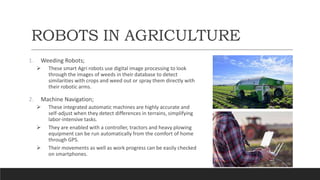
1. Weeding Robots;
 These smart Agri robots use digital image processing to look
through the images of weeds in their database to detect
similarities with crops and weed out or spray them directly with
their robotic arms.
2. Machine Navigation;
 These integrated automatic machines are highly accurate and
self-adjust when they detect differences in terrains, simplifying
labor-intensive tasks.
 They are enabled with a controller, tractors and heavy plowing
equipment can be run automatically from the comfort of home
through GPS.
 Their movements as well as work progress can be easily checked
on smartphones.
ROBOTS IN AGRICULTURE
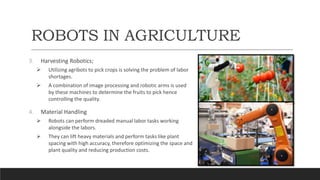
3. Harvesting Robotics;
 Utilizing agribots to pick crops is solving the problem of labor
shortages.
 A combination of image processing and robotic arms is used
by these machines to determine the fruits to pick hence
controlling the quality.
4. Material Handling
 Robots can perform dreaded manual labor tasks working
alongside the labors.
 They can lift heavy materials and perform tasks like plant
spacing with high accuracy, therefore optimizing the space and
plant quality and reducing production costs.
DRONES IN AGRICULTURE
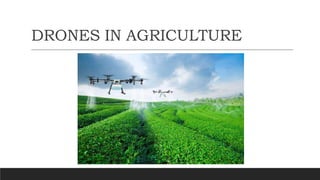
Drones equipped with sensors and cameras are used for imaging, mapping, and
surveying farms. There are ground-based drones and aerial drones.
Drones can be controlled remotely or they can fly automatically through software-
controlled flight plans in their embedded systems, working in coordination with
sensors and GPS.
From the drone data, insights can be drawn regarding crop health, irrigation,
spraying, planting, soil and field, plant counting, yield prediction, and much more.
Drones can either be scheduled for farm surveys (drone as a service) or can be
bought and stored near farms where they can be recharged and maintained.
After the surveys, the drones need to be taken to nearby labs to analyze the data
that has been collected, thereby helping leverage IoT in agriculture better.
DRONES IN AGRICULTURE
REMOTE SENSING IN AGRICULTURE
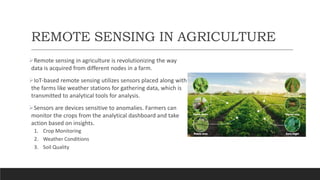
Remote sensing in agriculture is revolutionizing the way
data is acquired from different nodes in a farm.
IoT-based remote sensing utilizes sensors placed along with
the farms like weather stations for gathering data, which is
transmitted to analytical tools for analysis.
Sensors are devices sensitive to anomalies. Farmers can
monitor the crops from the analytical dashboard and take
action based on insights.
1. Crop Monitoring
2. Weather Conditions
3. Soil Quality
COMPUTER IMAGING IN AGRICULTURE
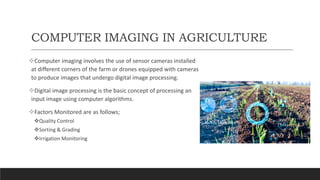
Computer imaging involves the use of sensor cameras installed
at different corners of the farm or drones equipped with cameras
to produce images that undergo digital image processing.
Digital image processing is the basic concept of processing an
input image using computer algorithms.
Factors Monitored are as follows;
Quality Control
Sorting & Grading
Irrigation Monitoring

IOT IN AGRICULTURE.pptx

  • 1.
  • 2.
    GROUP MEMBERS 1. SyedM. Wasi Ul Hasan Naqvi 2. Abdul Ghaffar
  • 3.
    IOT AND ITSROLE IN AGRICULTURE IoT is the abbreviated form of the Internet of Things. IoT is a broad terminology given to every object that can relay information when connected to the network. Agriculture through precision farming implements IoT through the use of robots, drones, sensors, and computer imaging integrated with analytical tools for getting insights and monitoring the farms. Placement of physical equipment on farms monitors and records data, which is then used to get valuable insights.
  • 4.
    INFRASTRUCTURE REQUIREMENTS FOR ADOPTINGIOT IN AGRICULTURE The high initial investments in sensors, drones, bots, and their setting up Hiring well-trained field staff for operating and management Connectivity to power to charge and operate the drones and robots Hardware maintenance costs Continuous connectivity to the internet
  • 5.
    INTEGRATE IOT FORMULTIPLE FARMS IoTs require physical devices, each farm will need to install its own set of sensors and bots which will record the data related to that farm only. Every farm will have its own separate dashboard for viewing the insights. Integrating and scaling IoT for several farms in a single platform is not possible, unlike SaaS. SaaS is the abbreviation for “Software as a service” Benefits of Saas: ◦ No physical equipment required to be placed on farms ◦ Highly skilled labor not required ◦ No hardware maintenance costs
  • 6.
    ROBOTS IN AGRICULTURE 1.Weeding Robots;  These smart Agri robots use digital image processing to look through the images of weeds in their database to detect similarities with crops and weed out or spray them directly with their robotic arms. 2. Machine Navigation;  These integrated automatic machines are highly accurate and self-adjust when they detect differences in terrains, simplifying labor-intensive tasks.  They are enabled with a controller, tractors and heavy plowing equipment can be run automatically from the comfort of home through GPS.  Their movements as well as work progress can be easily checked on smartphones.
  • 7.
    ROBOTS IN AGRICULTURE 3.Harvesting Robotics;  Utilizing agribots to pick crops is solving the problem of labor shortages.  A combination of image processing and robotic arms is used by these machines to determine the fruits to pick hence controlling the quality. 4. Material Handling  Robots can perform dreaded manual labor tasks working alongside the labors.  They can lift heavy materials and perform tasks like plant spacing with high accuracy, therefore optimizing the space and plant quality and reducing production costs.
  • 8.
    DRONES IN AGRICULTURE Dronesequipped with sensors and cameras are used for imaging, mapping, and surveying farms. There are ground-based drones and aerial drones. Drones can be controlled remotely or they can fly automatically through software- controlled flight plans in their embedded systems, working in coordination with sensors and GPS. From the drone data, insights can be drawn regarding crop health, irrigation, spraying, planting, soil and field, plant counting, yield prediction, and much more. Drones can either be scheduled for farm surveys (drone as a service) or can be bought and stored near farms where they can be recharged and maintained. After the surveys, the drones need to be taken to nearby labs to analyze the data that has been collected, thereby helping leverage IoT in agriculture better.
  • 9.
  • 10.
    REMOTE SENSING INAGRICULTURE Remote sensing in agriculture is revolutionizing the way data is acquired from different nodes in a farm. IoT-based remote sensing utilizes sensors placed along with the farms like weather stations for gathering data, which is transmitted to analytical tools for analysis. Sensors are devices sensitive to anomalies. Farmers can monitor the crops from the analytical dashboard and take action based on insights. 1. Crop Monitoring 2. Weather Conditions 3. Soil Quality
  • 11.
    COMPUTER IMAGING INAGRICULTURE Computer imaging involves the use of sensor cameras installed at different corners of the farm or drones equipped with cameras to produce images that undergo digital image processing. Digital image processing is the basic concept of processing an input image using computer algorithms. Factors Monitored are as follows; Quality Control Sorting & Grading Irrigation Monitoring