
Making Change Stick
Tze ChinTang
“The hard stuff is easy, the
soft stuff is hard.”
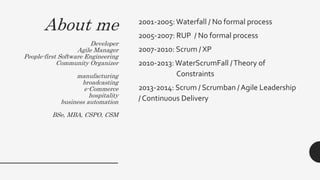
About me
Developer
Agile Manager
People-first Software Engineering
Community Organizer
manufacturing
broadcasting
e-Commerce
hospitality
business automation
BSe, MBA, CSPO, CSM
2001-2005:Waterfall / No formal process
2005-2007: RUP / No formal process
2007-2010: Scrum / XP
2010-2013:WaterScrumFall /Theory of
Constraints
2013-2014: Scrum / Scrumban / Agile Leadership
/ Continuous Delivery
My story at
Company X
• Company X was bought under duress from a SF-basedVC.
• It had five engineering centers, all in a high cost country
except for Kuala Lumpur, Malaysia.
• I joined as an Agile Guy to work on the flagship product,
Atlas, and mature the KL engineering center.
• Atlas had 3 sites working on it.
• Release cycles were between 8 to 14 months,
unpredictable. Highly rigid roadmaps and customer
commitments.
• A big part of engineering was in KL but product
management was in the US.
• KL had 20 developers and testers on site.
• KL was hiring, everywhere else firing.
• KL/German code to build took anywhere from 1 day to 1
week.
Caveat:
No two journeys are the
same.
This was my journey, yours
will be different.
Have a
shared
vision
• Executive support is important, if not explicit
then minimally tacit support.
• Use this opportunity to find an internal
mentor.
• Get an executive sponsor if you don’t have
one already, you’re just the hands the get it
done / change agent.
• Err on the side of over communication, much
gets lost.
• Ask your subordinates / peers / superiors
what that vision means to them, help them
understand and shape it to be personally
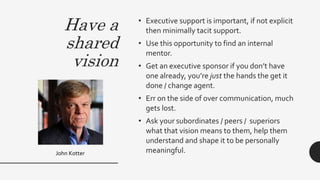
meaningful.John Kotter
Make
Progress
Meaningful
and Visible
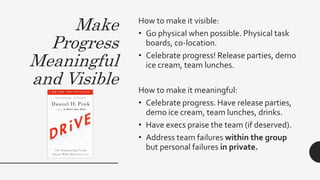
How to make it visible:
• Go physical when possible. Physical task
boards, co-location.
• Celebrate progress! Release parties, demo
ice cream, team lunches.
How to make it meaningful:
• Celebrate progress. Have release parties,
demo ice cream, team lunches, drinks.
• Have execs praise the team (if deserved).
• Address team failures within the group
but personal failures in private.
Don’t act
first, study
the
landscape
Be patient:
• Maximize learning and understanding in the
beginning.
• Minimize appearance of threat or disruption.
• Identify the promoters and detractors.
How to study the landscape:
• Have regular one-to-ones with subordinates,
superiors and peers.
• Lunches work too.
• Try lean coffee sessions.
Superiors
Subordinates
Peers
Warning:
Don't use the word "change"
or "Agile", unless they bring
it up first.
Identify the
promoters
and the
detractors
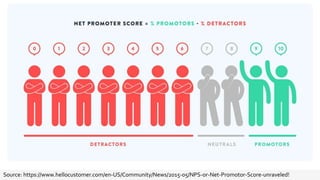
What to do with promoters:
– Nurture and educate.
– Strengthen buy in. Listen to them, include their ideas.
– Let them spread promote change on your behalf.
– Delegate.
What to do with detractors:
- Have open dialogs, hear them out.
- Find common ground. Get buy-in.
- Compromise, don’t have have to win every battle.
- When, all else fails: neutralize, reduce or remove but
never ignore!
Source: https://www.hellocustomer.com/en-US/Community/News/2015-05/NPS-or-Net-Promotor-Score-unraveled!
Warning:
Beware of and identify passive
aggressive behavior.
Warning:
Avoid ideological differences, focus
on common ground and objectives.
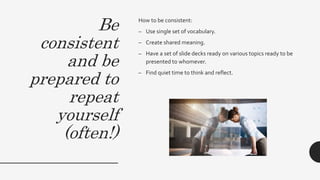
Be
consistent
and be
prepared to
repeat
yourself
(often!)
How to be consistent:
– Use single set of vocabulary.
– Create shared meaning.
– Have a set of slide decks ready on various topics ready to be
presented to whomever.
– Find quiet time to think and reflect.
Go as short
as possible,
maximize
learning
Iteration length:
• Start with what feels comfortable for the team with
buy in from management.
• Work to reduce iteration lengths.
• Example: Start with 4 week iterations, then reduce to
three OR have mini sprints within the sprint.
How to maximize learning:
• Don’t skip retrospectives.
• When they go stale, try different methods.
• Do something with retrospective findings.
Lots of
small wins
> one big
victory
• Sense of progress is a strong motivator, for the team
and yourself.
• Find what’s preventing you from moving forward –
bottlenecks.
• How to address bottlenecks:
– Identify constraint
– Exploit constraint
– Subordinate constraint
– Elevate constraint
– Prevent inertia
– Read The Goal
Tip for change agents:
Be flexible & open.
Tip for leaders:
Address problems as soon as they
appear.
Tip to managers:
Step out of the room
(once in a while).
My story at
Company X:
18 months
later
• KL grew from 20 to 50 devs + testers.
• US lost 1/3 of its engineers.
• Became a development manager of 14 devs + testers /
2 teams.
• Release cycle reduced to 4 months +- 2 weeks.
• Code to build reduced to 45 minutes.
• Flexible roadmaps.
• Transitioned from Scrum to Scrumban.
• Release candidate process.
What’s Next?
Developer
Agile Manager
People-first Software Engineering
Community Organizer
manufacturing
broadcasting
e-Commerce
hospitality
business automation
BSe, MBA, CSPO, CSM
ICF, LKU
2001-2005:Waterfall / No formal process
2005-2007: RUP / No formal process
2007-2010: Scrum / XP
2010-2013:WaterScrumFall /Theory of
Constraints
2013-2014: Scrum / Scrum-ban / Agile
Leadership / Continuous Delivery
2014-2015+: Kanban / Flow / Lean / Lean
Startup / DevOps

Avoiding Fragile Agile: Making Change Stick

  • 1.
  • 2.
    “The hard stuffis easy, the soft stuff is hard.”
  • 3.
    About me Developer Agile Manager People-firstSoftware Engineering Community Organizer manufacturing broadcasting e-Commerce hospitality business automation BSe, MBA, CSPO, CSM 2001-2005:Waterfall / No formal process 2005-2007: RUP / No formal process 2007-2010: Scrum / XP 2010-2013:WaterScrumFall /Theory of Constraints 2013-2014: Scrum / Scrumban / Agile Leadership / Continuous Delivery
  • 4.
    My story at CompanyX • Company X was bought under duress from a SF-basedVC. • It had five engineering centers, all in a high cost country except for Kuala Lumpur, Malaysia. • I joined as an Agile Guy to work on the flagship product, Atlas, and mature the KL engineering center. • Atlas had 3 sites working on it. • Release cycles were between 8 to 14 months, unpredictable. Highly rigid roadmaps and customer commitments. • A big part of engineering was in KL but product management was in the US. • KL had 20 developers and testers on site. • KL was hiring, everywhere else firing. • KL/German code to build took anywhere from 1 day to 1 week.
  • 5.
    Caveat: No two journeysare the same. This was my journey, yours will be different.
  • 6.
    Have a shared vision • Executivesupport is important, if not explicit then minimally tacit support. • Use this opportunity to find an internal mentor. • Get an executive sponsor if you don’t have one already, you’re just the hands the get it done / change agent. • Err on the side of over communication, much gets lost. • Ask your subordinates / peers / superiors what that vision means to them, help them understand and shape it to be personally meaningful.John Kotter
  • 7.
    Make Progress Meaningful and Visible How tomake it visible: • Go physical when possible. Physical task boards, co-location. • Celebrate progress! Release parties, demo ice cream, team lunches. How to make it meaningful: • Celebrate progress. Have release parties, demo ice cream, team lunches, drinks. • Have execs praise the team (if deserved). • Address team failures within the group but personal failures in private.
  • 8.
    Don’t act first, study the landscape Bepatient: • Maximize learning and understanding in the beginning. • Minimize appearance of threat or disruption. • Identify the promoters and detractors. How to study the landscape: • Have regular one-to-ones with subordinates, superiors and peers. • Lunches work too. • Try lean coffee sessions. Superiors Subordinates Peers
  • 9.
    Warning: Don't use theword "change" or "Agile", unless they bring it up first.
  • 10.
    Identify the promoters and the detractors Whatto do with promoters: – Nurture and educate. – Strengthen buy in. Listen to them, include their ideas. – Let them spread promote change on your behalf. – Delegate. What to do with detractors: - Have open dialogs, hear them out. - Find common ground. Get buy-in. - Compromise, don’t have have to win every battle. - When, all else fails: neutralize, reduce or remove but never ignore!
  • 11.
  • 13.
    Warning: Beware of andidentify passive aggressive behavior.
  • 14.
    Warning: Avoid ideological differences,focus on common ground and objectives.
  • 15.
    Be consistent and be prepared to repeat yourself (often!) Howto be consistent: – Use single set of vocabulary. – Create shared meaning. – Have a set of slide decks ready on various topics ready to be presented to whomever. – Find quiet time to think and reflect.
  • 16.
    Go as short aspossible, maximize learning Iteration length: • Start with what feels comfortable for the team with buy in from management. • Work to reduce iteration lengths. • Example: Start with 4 week iterations, then reduce to three OR have mini sprints within the sprint. How to maximize learning: • Don’t skip retrospectives. • When they go stale, try different methods. • Do something with retrospective findings.
  • 17.
    Lots of small wins >one big victory • Sense of progress is a strong motivator, for the team and yourself. • Find what’s preventing you from moving forward – bottlenecks. • How to address bottlenecks: – Identify constraint – Exploit constraint – Subordinate constraint – Elevate constraint – Prevent inertia – Read The Goal
  • 18.
    Tip for changeagents: Be flexible & open.
  • 19.
    Tip for leaders: Addressproblems as soon as they appear.
  • 20.
    Tip to managers: Stepout of the room (once in a while).
  • 21.
    My story at CompanyX: 18 months later • KL grew from 20 to 50 devs + testers. • US lost 1/3 of its engineers. • Became a development manager of 14 devs + testers / 2 teams. • Release cycle reduced to 4 months +- 2 weeks. • Code to build reduced to 45 minutes. • Flexible roadmaps. • Transitioned from Scrum to Scrumban. • Release candidate process.
  • 22.
    What’s Next? Developer Agile Manager People-firstSoftware Engineering Community Organizer manufacturing broadcasting e-Commerce hospitality business automation BSe, MBA, CSPO, CSM ICF, LKU 2001-2005:Waterfall / No formal process 2005-2007: RUP / No formal process 2007-2010: Scrum / XP 2010-2013:WaterScrumFall /Theory of Constraints 2013-2014: Scrum / Scrum-ban / Agile Leadership / Continuous Delivery 2014-2015+: Kanban / Flow / Lean / Lean Startup / DevOps

Editor's Notes

  • #2 10 SlidesMake change worthwhile to others Don't use the word "change" or "Agile", unless they bring it up first Identify the promoters and the detractors Align and collaborate with the promoters Win over (or nullify) the detractors <- understand their pain.  Be patient, study the landscape Be consistent and be prepared to repeat yourself (often!) Lots of small wins > one big victory Be flexible & open Have a shared vision (mocking jay) Make improvements visible Address problems as soon as they appear Go as short as possible, iterations / batch size and retrospect frequently. Promote empowerment but only when the vision is there. 1 Story GV - Stratus CI (reduction in build times) Build master no longer on critical path flexible roadmaps smaller, shorter release cycles Everyone owned the product and process]