[Document title]
[Document subtitle]
Michael
[Email address]
Abstract
[Draw your reader in with an engaging abstract. It is typically a short summary of the
document.
When you’re ready to add your content, just click here and start typing.]
Daniel Morrell
Michael Newell
Joe Potter
Cheuk Man Sin
Sonam Yaqub
Project
Supervisor:
Mr Chris Brier
20/01/2016
9237 words
(5)
AVIA1000 2015/16 Airbus A320 Design Project
1
1 Executive Summary, 134 words
This report contains a selection of experiments that employed the use of the merlin simulator
to change characteristics on an Airbus A320. Due to the access to this simulator, this report
contains a plethora of new research and findings, allowing us to draw original conclusions and
evaluate design concepts independent of previous findings. In keeping with this mantra and
hard work ethos that the authors of this report demonstrated, this study also contains a concise
analysis of the ethics that have to be considered in the design, maintenance and flying of an
A320. The overall design from the development of the A320 to the future of the A320 is
included within the report. Each team member's individual section explains the working of the
individual component along with the altered parameters and the associated measurements.
AVIA1000 2015/16 Airbus A320 Design Project
2
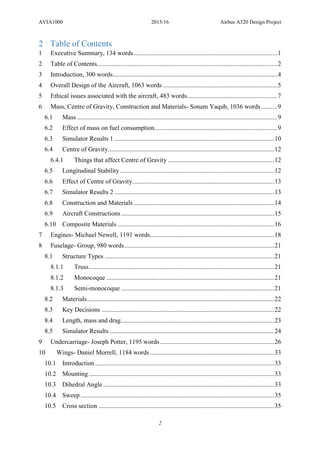
2 Table of Contents
1 Executive Summary, 134 words.........................................................................................1
2 Table of Contents................................................................................................................2
3 Introduction, 300 words......................................................................................................4
4 Overall Design of the Aircraft, 1063 words .......................................................................5
5 Ethical issues associated with the aircraft, 483 words........................................................7
6 Mass, Centre of Gravity, Construction and Materials- Sonam Yaqub, 1036 words ..........9
6.1 Mass ............................................................................................................................9
6.2 Effect of mass on fuel consumption............................................................................9
6.3 Simulator Results 1 ...................................................................................................10
6.4 Centre of Gravity.......................................................................................................12
6.4.1 Things that affect Centre of Gravity ..................................................................12
6.5 Longitudinal Stability................................................................................................12
6.6 Effect of Centre of Gravity........................................................................................13
6.7 Simulator Results 2 ...................................................................................................13
6.8 Construction and Materials .......................................................................................14
6.9 Aircraft Constructions...............................................................................................15
6.10 Composite Materials .................................................................................................16
7 Engines- Michael Newell, 1191 words.............................................................................18
8 Fuselage- Group, 980 words.............................................................................................21
8.1 Structure Types .........................................................................................................21
8.1.1 Truss...................................................................................................................21
8.1.2 Monocoque ........................................................................................................21
8.1.3 Semi-monocoque ...............................................................................................21
8.2 Materials....................................................................................................................22
8.3 Key Decisions ...........................................................................................................22
8.4 Length, mass and drag...............................................................................................23
8.5 Simulator Results ......................................................................................................24
9 Undercarriage- Joseph Potter, 1195 words.......................................................................26
10 Wings- Daniel Morrell, 1184 words.............................................................................33
10.1 Introduction...............................................................................................................33
10.2 Mounting...................................................................................................................33
10.3 Dihedral Angle ..........................................................................................................33
10.4 Sweep ........................................................................................................................35
10.5 Cross section .............................................................................................................35
AVIA1000 2015/16 Airbus A320 Design Project
3
10.6 Aspect Ratio..............................................................................................................35
10.7 Surface Area..............................................................................................................36
10.8 Fuel............................................................................................................................38
10.9 Spoilers......................................................................................................................38
10.10 High Lift Devices ..................................................................................................38
10.11 Sharklets ................................................................................................................39
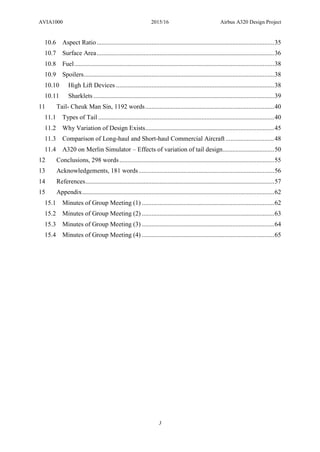
11 Tail- Cheuk Man Sin, 1192 words................................................................................40
11.1 Types of Tail .............................................................................................................40
11.2 Why Variation of Design Exists................................................................................45
11.3 Comparison of Long-haul and Short-haul Commercial Aircraft ..............................48
11.4 A320 on Merlin Simulator – Effects of variation of tail design................................50
12 Conclusions, 298 words................................................................................................55
13 Acknowledgements, 181 words....................................................................................56
14 References.....................................................................................................................57
15 Appendix.......................................................................................................................62
15.1 Minutes of Group Meeting (1) ..................................................................................62
15.2 Minutes of Group Meeting (2) ..................................................................................63
15.3 Minutes of Group Meeting (3) ..................................................................................64
15.4 Minutes of Group Meeting (4) ..................................................................................65
AVIA1000 2015/16 Airbus A320 Design Project
4
3 Introduction, 300 words
The aim of this research project is to study the fundamentals of aircraft design and the specific
design features of the A320 by researching and ‘flying’ the aircraft on Merlin Engineering
Flight Simulator with altered design aspects for performance and control input recordings.
By doing this project, students are able to develop a general understanding of aircraft design,
construction and Aviation Technology as a whole. It also develops the practical skills to collect
data from the simulator and working as a group.
The Airbus A320 is a single aisled short-medium haul aircraft. It is used all over the globe in
every continent. With a total number of orders at 8089 and with a current 3879 in operation.
The A320 has a max payload of 16.6 tonnes and a typical range of 3500 nm, to achieve this
range two CFM56 engines are mounted below the wings. The aircraft has a wingspan of 35.8
m and a height of 11.76. Within the A320 family there are several variants with the main
difference being the fuselage length (1).
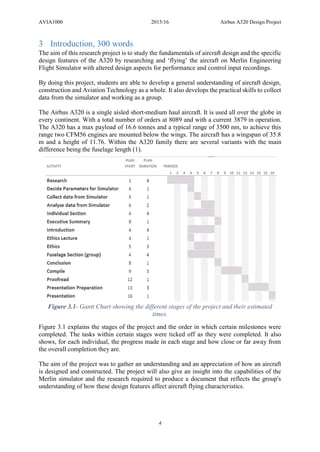
Figure 3.1 explains the stages of the project and the order in which certain milestones were
completed. The tasks within certain stages were ticked off as they were completed. It also
shows, for each individual, the progress made in each stage and how close or far away from
the overall completion they are.
The aim of the project was to gather an understanding and an appreciation of how an aircraft
is designed and constructed. The project will also give an insight into the capabilities of the
Merlin simulator and the research required to produce a document that reflects the group's
understanding of how these design features affect aircraft flying characteristics.
Figure 3.1- Gantt Chart showing the different stages of the project and their estimated
times.
AVIA1000 2015/16 Airbus A320 Design Project
5
4 Overall Design of the Aircraft, 1063 words
In the late 1960s, Airbus’ competitor, Boeing, successfully dominated the market through the
development of 737. In order to gain entry into the narrow body market, Airbus abandoned the
original plan to develop the A300 further, working with other European aircraft manufacturers
to develop the origin of A320 instead (2).
The Joint European Transport (JET) developed JET2, a former name of the A320, then sent it
off to Airbus for further development. Airbus then started the Single Aisle Study, which
developed various seating configurations: SA1, SA2 and SA3, later to become official variants
of the A320 (2).
Airbus hadn’t initially decided whether the A320 should be a twinjet or quad jet. However, one
of their largest customers, Lufthansa, mentioned that they were more interested in twinjet. As
a result, Airbus decided to fit the A320 with 2 engines (2).
Airbus then further developed SA2, they officially named the aircraft to A320 in 1981.
Coordinated with Delta Airlines, they developed the A320 with a maximum of 180 seats,
changing the length of fuselage as well. However, when deciding the cross-sectional area of
the fuselage, Airbus looked to its competitors such as the Boeing 737 for a similar size.
Although this reduced the fuel efficiency compared with Boeing 737, Airbus compensated by
using a thinner and longer wing, such that to increase the aspect ratio and better fuel efficiency
(2).
5 years into the service of the A320, Airbus rolled out the A321, a stretched version. It has all
the same dimensions as the A320, save a longer fuselage (7m longer). It has identical engines
and fuel capacity, so therefore has a shorter range than the A320 by about 1000nm (at 2600nm)
(3). It can hold up to 220 passengers (4). In 1995, just 2 years after the A321 entered service,
Airbus rolled out the A319, a similar concept to the A321 but with a fuselage 4m shorter than
the A320 (3), giving it a maximum capacity of 153 (4). Due to its [obvious] smaller mass, it
has a greater range than the A320 (4600 vs. 3600nm) (3), although is usually used for shorter
flights. Airbus further shrank the A319 fuselage by 2.39m in 2003 to create the final variant,
the A318 (3), this can haul to 132 passengers (4) 3100nm (3). The scale in sizing can be seen
below in Figure 4.1.
Figure 4.1- Image showing size differences in variants (5).
AVIA1000 2015/16 Airbus A320 Design Project
6
Since 2009, Airbus has further developed A320 with the A320 Enhanced family (A320E), in
order to maintain its position as the leading manufacturer of narrow bodied aircraft. The major
additional feature is blended sharklets which greatly reduce induced drag and wingtip vortices.
As a result, this enhances the fuel efficiency (see Section 10.11)
The most significant development of A320 family that made it a remarkable aircraft in aviation
historyis that it is the first commercial aircraft to use fly-by-wire system. Now, the pilot needn’t
use manual controls but instead uses the system to input data which sends digital signals to all
the aircraft systems. The computer also assists in flying the aircraft more than ever before. To
provide essential information to the pilot in a easy to read and direct fashion, primary function
and multifunction displays revolutionized cockpit design, eliminating the need for a flight
engineer. Featuring a side-stick control and full glass cockpit, the A320 has made design
breakthroughs leading to the improvement in commercial aircraft and system management (5).
In 2010, Airbus announced the new A320neo family, which features new engines option. The
choice of CFM International LEAP-1A and Pratt and Whitney PW1000G also enhanced fuel
efficiency as the engine will burn less fuel. The variants in this family includes A319neo,
A320neo, A321neo and A321LR for longer range journeys (5).
Airbus pioneered the use of one type rating for the entire A320 family, this is because the whole
familywas designed at a very similar time and each variant didn’t alter much (5). In comparison
to Boeing where the 737 was modified over several decades, a type rating is now only available
for the -700 and -800 (6), which isn’t particularly useful since there are still 1,033 ‘737
Classic’s (-200/300/400/500) in service (7). As an additional bonus, Airbus has designed all
their other aircraft too to enable a training course to be undertaken quicker (and therefore
cheaper) to that of a Type Rating, called a “Cross Crew Qualification” whereby a pilot can fly,
for example, both the A320 and the A380 at the same time, under one type rating (5).
The Airbus A320 family has proven to be one of the best-selling commercial aircraft in history.
With over 12,000 orders currently on the books (including the new A320neo family) and over
5000 left to deliver (8). The A320 itself accounts for over 8000 of these 12000 orders, so is by
far the best selling member of the family (5).
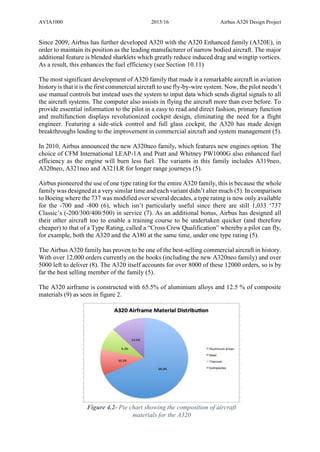
The A320 airframe is constructed with 65.5% of aluminium alloys and 12.5 % of composite
materials (9) as seen in figure 2.
Figure 4.2- Pie chart showing the composition of aircraft
materials for the A320
AVIA1000 2015/16 Airbus A320 Design Project
7
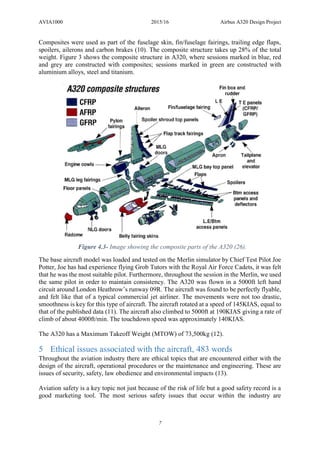
Composites were used as part of the fuselage skin, fin/fuselage fairings, trailing edge flaps,
spoilers, ailerons and carbon brakes (10). The composite structure takes up 28% of the total
weight. Figure 3 shows the composite structure in A320, where sessions marked in blue, red
and grey are constructed with composites; sessions marked in green are constructed with
aluminium alloys, steel and titanium.
The base aircraft model was loaded and tested on the Merlin simulator by Chief Test Pilot Joe
Potter, Joe has had experience flying Grob Tutors with the Royal Air Force Cadets, it was felt
that he was the most suitable pilot. Furthermore, throughout the session in the Merlin, we used
the same pilot in order to maintain consistency. The A320 was flown in a 5000ft left hand
circuit around London Heathrow’s runway 09R. The aircraft was found to be perfectly flyable,
and felt like that of a typical commercial jet airliner. The movements were not too drastic,
smoothness is key for this type of aircraft. The aircraft rotated at a speed of 145KIAS, equal to
that of the published data (11). The aircraft also climbed to 5000ft at 190KIAS giving a rate of
climb of about 4000ft/min. The touchdown speed was approximately 140KIAS.
The A320 has a Maximum Takeoff Weight (MTOW) of 73,500kg (12).
5 Ethical issues associated with the aircraft, 483 words
Throughout the aviation industry there are ethical topics that are encountered either with the
design of the aircraft, operational procedures or the maintenance and engineering. These are
issues of security, safety, law obedience and environmental impacts (13).
Aviation safety is a key topic not just because of the risk of life but a good safety record is a
good marketing tool. The most serious safety issues that occur within the industry are
Figure 4.3- Image showing the composite parts of the A320 (26).
AVIA1000 2015/16 Airbus A320 Design Project
8
commonly linked to the poor decisions, policies or procedures that have accumulated through
the management chain (13).
The A320 has a good safety record, it has had only 29 hull loss occurrences over the years,
with a hull loss rate of 0.26 per million passengers. Compared with the Boeing 737, which has
a rate of 0.57 per million passengers, the A320 has a better safety performance (14).
Although the majority of accidents in A320 are caused by technical failure, lack of detailed
maintenance, pilot errors or adverse weather, there are accidents partly caused by the aircraft
design, especially with complex computer systems in the A320. For example, Lufthansa Flight
2904 overran the runway in crosswind conditions because the pilot could not apply the spoilers
and thrust reversers. The computer would only apply these systems when there is a minimum
compressive load of 6.3 tonnes detected on each landing gear strut and wheels turning faster
than 72 knots. However, these conditions were not satisfied in this flight, causing this accident
to occur (15).
This proves engineers need to account for the different situations being input into the computer,
in order to ensure aircraft safety.
Similar to other aircraft, operating the A320 has an impact on the environment.
Noise pollution can be a problem mainly created by aircraft propulsion. Specifically to the
A320, the engines are turbofan engines, where the main sources of noise are from the
compressor and the fan. This is due to the intake of air into the engine. However, the newer
version of the A320, the A320neo, has included the new engine option where a newer
generation of turbofan engines are being used. The P1000G engine has a higher bypass ratio,
such that it reduces the noise generated (16).
In order to study the impact of air pollution and global warming by operating an aircraft, ICAO
has defined LTO (Landing and Take-off) cycles to calculate the aircraft emissions based on 4
operating modes: Take-off, climb-out to 3,000 ft, approach and taxi/ground idle (17).
According to ICAO Air Quality Manual published in 2011, the A320 produced 2,440 kg of
carbon dioxide per cycle, 9.01 kg of nitrogen dioxide per cycle (18). Carbon dioxide is the
main contributor to global warming, because it is one of the greenhouse gases which traps heat
within the earth’s atmosphere by forming a layer around the stratosphere. Nitrogen dioxide is
also one of the major air pollutants produced by fuel combustion in the engine (19).
AVIA1000 2015/16 Airbus A320 Design Project
9
6 Mass, Centre of Gravity, Construction and Materials- Sonam
Yaqub, 1036 words
6.1 Mass
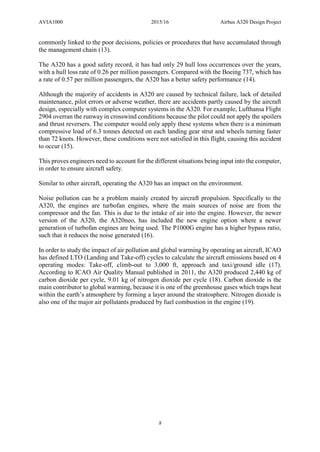
The mass of an object is the amount of matter that the object contains. The SI unit of mass is
the kilogram (kg). Gravity combines with mass to give a value for weight - one of the four
forces on an aircraft – which acts downwards towards the centre of the Earth (20).
Figure 6.1.1- Weight acting an airplane (21).
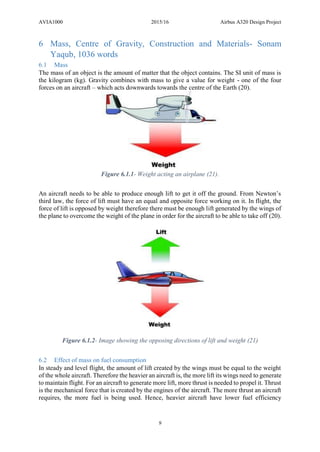
An aircraft needs to be able to produce enough lift to get it off the ground. From Newton’s
third law, the force of lift must have an equal and opposite force working on it. In flight, the
force of lift is opposed by weight therefore there must be enough lift generated by the wings of
the plane to overcome the weight of the plane in order for the aircraft to be able to take off (20).
Figure 6.1.2- Image showing the opposing directions of lift and weight (21)
6.2 Effect of mass on fuel consumption
In steady and level flight, the amount of lift created by the wings must be equal to the weight
of the whole aircraft. Therefore the heavier an aircraft is, the more lift its wings need to generate
to maintain flight. For an aircraft to generate more lift, more thrust is needed to propel it. Thrust
is the mechanical force that is created by the engines of the aircraft. The more thrust an aircraft
requires, the more fuel is being used. Hence, heavier aircraft have lower fuel efficiency
AVIA1000 2015/16 Airbus A320 Design Project
10
compared to lighter ones. From an economic perspective, it is important to minimise the fuel
consumption to increase profits (20).
6.3 Simulator Results 1
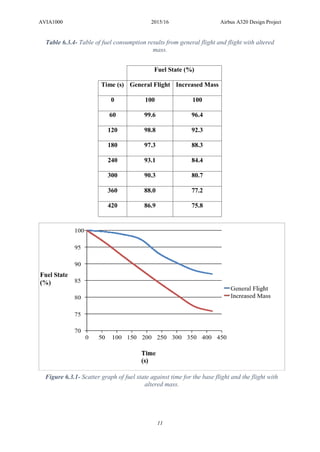
Table 6.3.1- Mass vairables available on the Simulator
Empty Mass
Fuel Capacity
Payload
By altering the parameters of the A320 on the Merlin Simulator, observations of the flight
performance can be made.
Table 6.3.2- Original mass values (kg)
Empty mass 40150
Fuel Capacity 3510
Payload 2340
Full Fuel Mass 46000
Table 6.3.3- New mass values (kg)
Empty Mass 40150
Fuel Capacity 3510
Payload 35340
Full Fuel Mass 79000
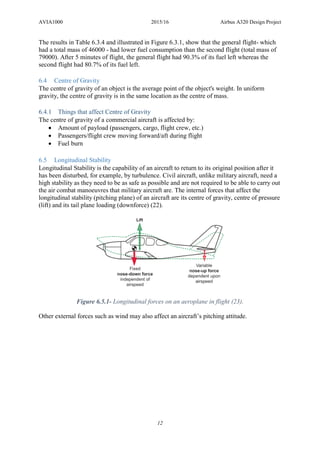
Two flights were carried out, first with the original mass values and then with the new mass
values. The results are shown in Table 6.3.4 and Figure 6.3.1.
AVIA1000 2015/16 Airbus A320 Design Project
11
Table 6.3.4- Table of fuel consumption results from general flight and flight with altered
mass.
Fuel State (%)
Time (s) General Flight Increased Mass
0 100 100
60 99.6 96.4
120 98.8 92.3
180 97.3 88.3
240 93.1 84.4
300 90.3 80.7
360 88.0 77.2
420 86.9 75.8
Figure 6.3.1- Scatter graph of fuel state against time for the base flight and the flight with
altered mass.
AVIA1000 2015/16 Airbus A320 Design Project
12
The results in Table 6.3.4 and illustrated in Figure 6.3.1, show that the general flight- which
had a total mass of 46000 - had lower fuel consumption than the second flight (total mass of
79000). After 5 minutes of flight, the general flight had 90.3% of its fuel left whereas the
second flight had 80.7% of its fuel left.
6.4 Centre of Gravity
The centre of gravity of an object is the average point of the object's weight. In uniform
gravity, the centre of gravity is in the same location as the centre of mass.
6.4.1 Things that affect Centre of Gravity
The centre of gravity of a commercial aircraft is affected by:
 Amount of payload (passengers, cargo, flight crew, etc.)
 Passengers/flight crew moving forward/aft during flight
 Fuel burn
6.5 Longitudinal Stability
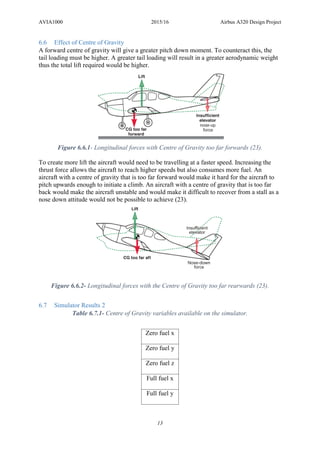
Longitudinal Stability is the capability of an aircraft to return to its original position after it
has been disturbed, for example, by turbulence. Civil aircraft, unlike military aircraft, need a
high stability as they need to be as safe as possible and are not required to be able to carry out
the air combat manoeuvres that military aircraft are. The internal forces that affect the
longitudinal stability (pitching plane) of an aircraft are its centre of gravity, centre of pressure
(lift) and its tail plane loading (downforce) (22).
Figure 6.5.1- Longitudinal forces on an aeroplane in flight (23).
Other external forces such as wind may also affect an aircraft’s pitching attitude.
AVIA1000 2015/16 Airbus A320 Design Project
13
6.6 Effect of Centre of Gravity
A forward centre of gravity will give a greater pitch down moment. To counteract this, the
tail loading must be higher. A greater tail loading will result in a greater aerodynamic weight
thus the total lift required would be higher.
Figure 6.6.1- Longitudinal forces with Centre of Gravity too far forwards (23).
To create more lift the aircraft would need to be travelling at a faster speed. Increasing the
thrust force allows the aircraft to reach higher speeds but also consumes more fuel. An
aircraft with a centre of gravity that is too far forward would make it hard for the aircraft to
pitch upwards enough to initiate a climb. An aircraft with a centre of gravity that is too far
back would make the aircraft unstable and would make it difficult to recover from a stall as a
nose down attitude would not be possible to achieve (23).
Figure 6.6.2- Longitudinal forces with the Centre of Gravity too far rearwards (23).
6.7 Simulator Results 2
Table 6.7.1- Centre of Gravity variables available on the simulator.
Zero fuel x
Zero fuel y
Zero fuel z
Full fuel x
Full fuel y
AVIA1000 2015/16 Airbus A320 Design Project
14
Full fuel z
In this experiment, the variables that were altered were the full fuel x values (moving the
centre of gravity forward/aft.)
Table 6.7.2- Centre of Gravity variables available on the simulator.
Original position Forward Aft
-0.15m 1m -1m
A stall test was carried out to observe the characteristics of the A320 with the different Centre
of Gravity positions. Results from the simulator show that when the Centre of Gravity was put
forward, it had stalled at with a true air speed of 280.19 knots whereas when the Centre of
Gravity had been placed backwards it had a
6.8 Construction and Materials
The main components of a fixed wing aircraft are:
● Fuselage
● Wings
● Landing gear
● Stabilisers
● Control surfaces (ailerons, elevator, rudder)
Each component in an aircraft has different requirements and therefore they are made up of
materials that are suitable to their requirement. Aircraft engineers are constantly looking for
new ways to make aircraft more efficient and new materials are continually being tested to
improve characteristics such as; fuel consumption, aerodynamic efficiency and noise
pollution. One way to improve these aspects is to look for alternative and more efficient
materials that are just as suitable for their requirement. As well as efficiency, materials are
picked based on other criteria such as their; cost, availability, durability and safety (24).
AVIA1000 2015/16 Airbus A320 Design Project
15
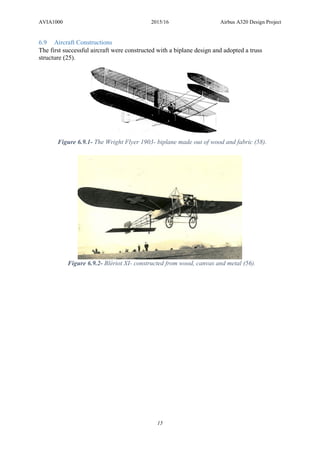
6.9 Aircraft Constructions
The first successful aircraft were constructed with a biplane design and adopted a truss
structure (25).
Figure 6.9.2- Blériot XI- constructed from wood, canvas and metal (56).
Figure 6.9.1- The Wright Flyer 1903- biplane made out of wood and fabric (58).
AVIA1000 2015/16 Airbus A320 Design Project
16
6.10 Composite Materials
Many modern day aircraft feature composite materials in their design.
The advantages of using composite materials are;
● Lighter weight – composite materials have a lower density than metals but are just as
strong. (Better strength to weight ratios.)
● Better specific stiffness – excellent stiffness to weight ratios (26)
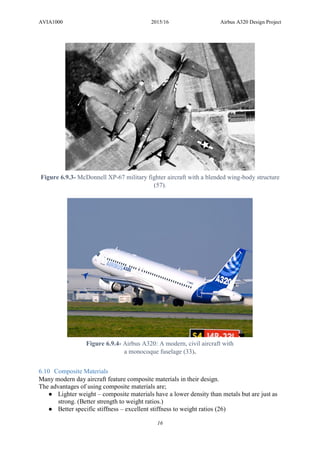
Figure 6.9.3- McDonnell XP-67 military fighter aircraft with a blended wing-body structure
(57).
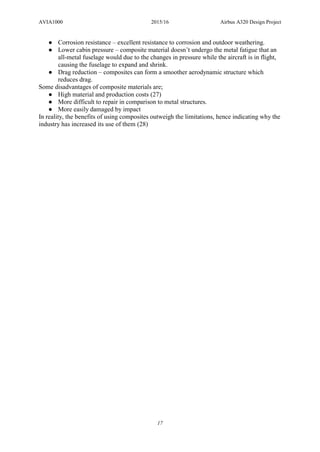
Figure 6.9.4- Airbus A320: A modern, civil aircraft with
a monocoque fuselage (33).
AVIA1000 2015/16 Airbus A320 Design Project
17
● Corrosion resistance – excellent resistance to corrosion and outdoor weathering.
● Lower cabin pressure – composite material doesn’t undergo the metal fatigue that an
all-metal fuselage would due to the changes in pressure while the aircraft is in flight,
causing the fuselage to expand and shrink.
● Drag reduction – composites can form a smoother aerodynamic structure which
reduces drag.
Some disadvantages of composite materials are;
● High material and production costs (27)
● More difficult to repair in comparison to metal structures.
● More easily damaged by impact
In reality, the benefits of using composites outweigh the limitations, hence indicating why the
industry has increased its use of them (28)
AVIA1000 2015/16 Airbus A320 Design Project
18
7 Engines- Michael Newell, 1191 words
Aircraft engines fall under four different categories:
The piston engine’s power ranges from 0.5bhp to 2000bhp. Aircraft that employ a propeller
prop system cannot exceed Mach 0.5 due to the shockwaves that will form on the tip of the
propeller. This engine is used on aircraft such as the Cessna 152 or the Piper Cub (29).
The turbojet is a gas turbine engine. This turbine compresses free air and then pushes it out of
a nozzle at a higher velocity. The thrust available from a turbo jet is from 10N to 100kN. These
engines can be applied across sub, trans and supersonic aircraft. The use of these engines is
now mainly within the military but originally on civilian aircraft e.g. DeHavilland Comet (29).
A turbofan engine works like a jet engine. However to improve the specific fuel consumption
and thrust, a large fan is placed before other compression stages. This fan has its own exit and
bypasses the air around the engine. These engines can produce between 1000N and 500kN.
They are applied in most civilian airliners such as the A320, B737 or Embraer 195 as some
examples (29).
The final type of engine is that of a turboprop engine. Essentially it is a gas turbine that is
connected to a propeller. For the propeller to spin the energy absorbed by the turbine is put into
the turning of a propeller. The nozzle therefore does not provide much in the way of thrust.
The thrust produced falls between that of the piston and turbo jet aircraft. They range in power
from 100bhp to 7000bhp. These are used on some aircraft such as the C-130 Hercules or the
Embraer EMB 129 Brasillia. The turboprop engines can be modified to become a turbo shaft.
A turbo shafts primary role is turn the energy absorbed in the turbine to power auxiliary
componentry. Hence why they are used in large airliners as an Auxiliary Power Unit (APU) or
on helicopters such as the Chinook (29).
The basic mechanics of all these engines are the same. From the piston engine to turbo fans
they all have the role of pushing air backwards. When looking at specifically jet engines they
apply Newton’s third law “for every force acting on a body there is an equal and opposite
reaction” (30).
To initialise the process on a gas turbine the compressors increase the pressure of the air mass.
Heat energy is then added via the combustion chamber before the force is converted to kinetic
energy in which is used to accelerate the aircraft through the jet pipe. The turbine plays a key
part absorbing the energy from the expansion of the hot gasses from the combustion chamber
and transforming it into mechanical energy to turn the compressor (30).
The installation of a gas turbine includes connecting it to the aircraft’s systems as well as all
the cowling panels being attached. The location of which it is installed is a design aspect and
depends on the desired uses of the aircraft. An engine may be installed on the underside of a
wing, like on Airbus A320 using pylons, on the fuselage using stub wings or maybe buried in
the wing roots or fuselage (30).
An engine position is not to effect the air intake or the expelling of exhaust gasses. Within the
design it must also be considered not to effect the control surfaces and must produce minimum
drag (30).
When looking at the selection of engines in the design process there are several aspects to
consider. These include performance, cost, engine weight, the number of engines the type of
engine and finally the position of the engines (29).
The specific engine that is associated with the A320 is the CFM56 (31), in which it has two of,
and is used for the A321 and A319 as well. This particular engine dominates nearly 60% of
this individual market (32). The maximum thrust that can be produced by the CFM56 is 120kN
AVIA1000 2015/16 Airbus A320 Design Project
19
(33). The CFM 56 is a high bypass gas turbine. This two spool engine consists of a 4 stage low
pressure turbine that is connected to the fan and has as 9 stage high pressure compressor
connected to a singular stage turbine (31).
Experiments on the merlin simulator were carried out on an A320 model comparing the change
in some certain characteristics. The first experiment required the take-off, climb and short
cruise using the A320 and CFM 56 parameters to gather a base line. This base run can be
compared against other tests. The first test included changing the maximum thrust output, this
was done if the A320 employed two different engines.
The two other engines include that of the Prat and Whitney PW6000 which has a maximum
thrust of 109kN (34) and is currently used on the A318. The other engine option is more drastic,
this engine produces 340kN of thrust and is employed on the A380 (35).
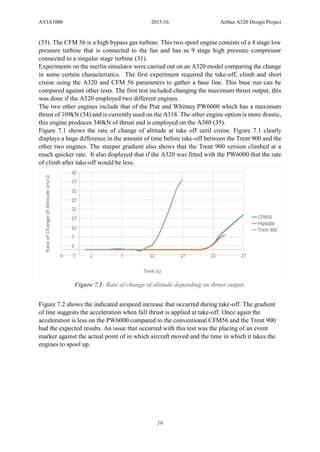
Figure 7.1 shows the rate of change of altitude at take off until cruise. Figure 7.1 clearly
displays a huge difference in the amount of time before take-off between the Trent 900 and the
other two engines. The steeper gradient also shows that the Trent 900 version climbed at a
much quicker rate. It also displayed that if the A320 was fitted with the PW6000 that the rate
of climb after take-off would be less.
Figure 7.1- Rate of change of altitude depending on thrust output.
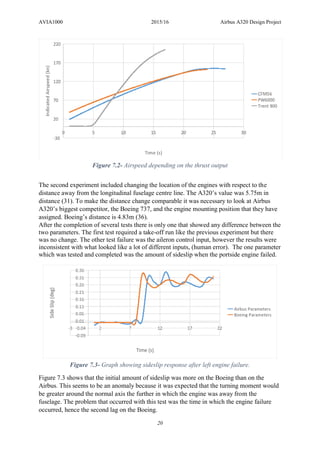
Figure 7.2 shows the indicated airspeed increase that occurred during take-off. The gradient
of line suggests the acceleration when full thrust is applied at take-off. Once again the
acceleration is less on the PW6000 compared to the conventional CFM56 and the Trent 900
had the expected results. An issue that occurred with this test was the placing of an event
marker against the actual point of in which aircraft moved and the time in which it takes the
engines to spool up.
AVIA1000 2015/16 Airbus A320 Design Project
20
Figure 7.2- Airspeed depending on the thrust output
The second experiment included changing the location of the engines with respect to the
distance away from the longitudinal fuselage centre line. The A320’s value was 5.75m in
distance (31). To make the distance change comparable it was necessary to look at Airbus
A320’s biggest competitor, the Boeing 737, and the engine mounting position that they have
assigned. Boeing’s distance is 4.83m (36).
After the completion of several tests there is only one that showed any difference between the
two parameters. The first test required a take-off run like the previous experiment but there
was no change. The other test failure was the aileron control input, however the results were
inconsistent with what looked like a lot of different inputs, (human error). The one parameter
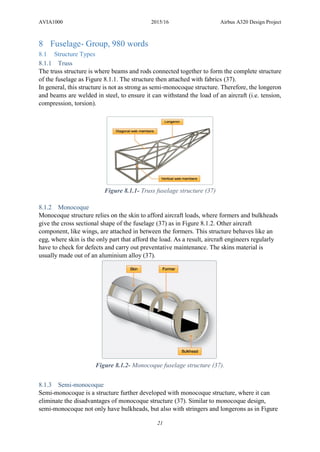
which was tested and completed was the amount of sideslip when the portside engine failed.
Figure 7.3 shows that the initial amount of sideslip was more on the Boeing than on the
Airbus. This seems to be an anomaly because it was expected that the turning moment would
be greater around the normal axis the further in which the engine was away from the
fuselage. The problem that occurred with this test was the time in which the engine failure
occurred, hence the second lag on the Boeing.
Figure 7.3- Graph showing sideslip response after left engine failure.
AVIA1000 2015/16 Airbus A320 Design Project
21
8 Fuselage- Group, 980 words
8.1 Structure Types
8.1.1 Truss
The truss structure is where beams and rods connected together to form the complete structure
of the fuselage as Figure 8.1.1. The structure then attached with fabrics (37).
In general, this structure is not as strong as semi-monocoque structure. Therefore, the longeron
and beams are welded in steel, to ensure it can withstand the load of an aircraft (i.e. tension,
compression, torsion).
Figure 8.1.1- Truss fuselage structure (37)
8.1.2 Monocoque
Monocoque structure relies on the skin to afford aircraft loads, where formers and bulkheads
give the cross sectional shape of the fuselage (37) as in Figure 8.1.2. Other aircraft
component, like wings, are attached in between the formers. This structure behaves like an
egg, where skin is the only part that afford the load. As a result, aircraft engineers regularly
have to check for defects and carry out preventative maintenance. The skins material is
usually made out of an aluminium alloy (37).
Figure 8.1.2- Monocoque fuselage structure (37).
8.1.3 Semi-monocoque
Semi-monocoque is a structure further developed with monocoque structure, where it can
eliminate the disadvantages of monocoque structure (37). Similar to monocoque design,
semi-monocoque not only have bulkheads, but also with stringers and longerons as in Figure
AVIA1000 2015/16 Airbus A320 Design Project
22
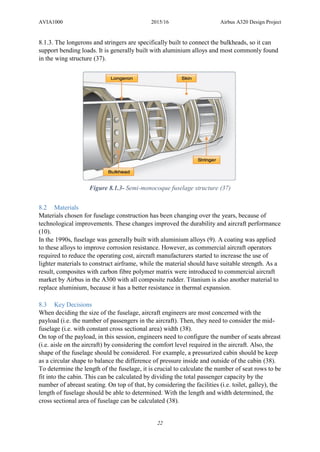
8.1.3. The longerons and stringers are specifically built to connect the bulkheads, so it can
support bending loads. It is generally built with aluminium alloys and most commonly found
in the wing structure (37).
Figure 8.1.3- Semi-monocoque fuselage structure (37)
8.2 Materials
Materials chosen for fuselage construction has been changing over the years, because of
technological improvements. These changes improved the durability and aircraft performance
(10).
In the 1990s, fuselage was generally built with aluminium alloys (9). A coating was applied
to these alloys to improve corrosion resistance. However, as commercial aircraft operators
required to reduce the operating cost, aircraft manufacturers started to increase the use of
lighter materials to construct airframe, while the material should have suitable strength. As a
result, composites with carbon fibre polymer matrix were introduced to commercial aircraft
market by Airbus in the A300 with all composite rudder. Titanium is also another material to
replace aluminium, because it has a better resistance in thermal expansion.
8.3 Key Decisions
When deciding the size of the fuselage, aircraft engineers are most concerned with the
payload (i.e. the number of passengers in the aircraft). Then, they need to consider the mid-
fuselage (i.e. with constant cross sectional area) width (38).
On top of the payload, in this session, engineers need to configure the number of seats abreast
(i.e. aisle on the aircraft) by considering the comfort level required in the aircraft. Also, the
shape of the fuselage should be considered. For example, a pressurized cabin should be keep
as a circular shape to balance the difference of pressure inside and outside of the cabin (38).
To determine the length of the fuselage, it is crucial to calculate the number of seat rows to be
fit into the cabin. This can be calculated by dividing the total passenger capacity by the
number of abreast seating. On top of that, by considering the facilities (i.e. toilet, galley), the
length of fuselage should be able to determined. With the length and width determined, the
cross sectional area of fuselage can be calculated (38).
AVIA1000 2015/16 Airbus A320 Design Project
23
Engineers then need to consider the front and aft closures, where the closures should be
smooth to reduce the impact of parasite drag on aircraft performance. They also need to
consider the shape of the windscreen, cockpit vision etc. (38).
After these 3 steps, there may be variants developed because of the variation of range (i.e.
long or short haul). There may be a change of fuselage size from the baseline model, due to
the number of facilities fit and the payload. For example, a high range model will have a
higher payload, therefore the size of the fuselage is larger though the seating comfort is less
(38).
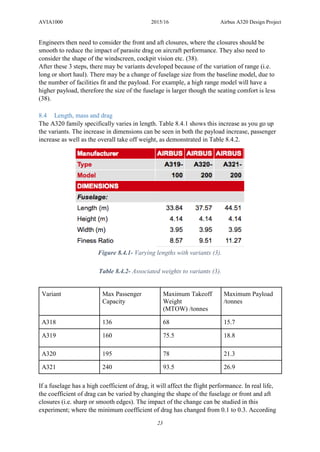
8.4 Length, mass and drag
The A320 family specifically varies in length. Table 8.4.1 shows this increase as you go up
the variants. The increase in dimensions can be seen in both the payload increase, passenger
increase as well as the overall take off weight, as demonstrated in Table 8.4.2.
Table 8.4.2- Associated weights to variants (3).
Variant Max Passenger
Capacity
Maximum Takeoff
Weight
(MTOW) /tonnes
Maximum Payload
/tonnes
A318 136 68 15.7
A319 160 75.5 18.8
A320 195 78 21.3
A321 240 93.5 26.9
If a fuselage has a high coefficient of drag, it will affect the flight performance. In real life,
the coefficient of drag can be varied by changing the shape of the fuselage or front and aft
closures (i.e. sharp or smooth edges). The impact of the change can be studied in this
experiment; where the minimum coefficient of drag has changed from 0.1 to 0.3. According
Figure 8.4.1- Varying lengths with variants (3).
AVIA1000 2015/16 Airbus A320 Design Project
24
to the ‘Excalibur Flight Model Parameter Definitions’, this is referenced to the fuselage
reference data.
8.5 Simulator Results
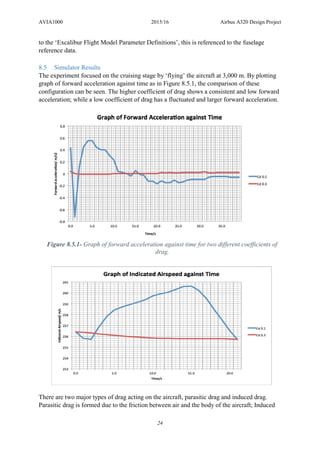
The experiment focused on the cruising stage by ‘flying’ the aircraft at 3,000 m. By plotting
graph of forward acceleration against time as in Figure 8.5.1, the comparison of these
configuration can be seen. The higher coefficient of drag shows a consistent and low forward
acceleration; while a low coefficient of drag has a fluctuated and larger forward acceleration.
There are two major types of drag acting on the aircraft, parasitic drag and induced drag.
Parasitic drag is formed due to the friction between air and the body of the aircraft; Induced
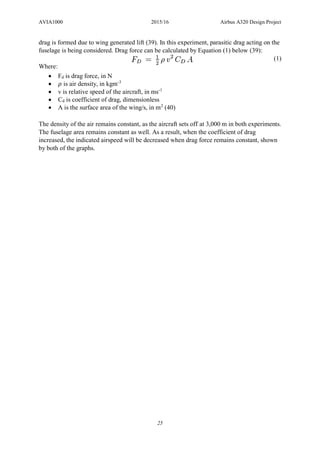
Figure 9.5.2- Graph of IAS against time for two different coefficients of
drag.
Figure 8.5.1- Graph of forward acceleration against time for two different coefficients of
drag.
AVIA1000 2015/16 Airbus A320 Design Project
25
drag is formed due to wing generated lift (39). In this experiment, parasitic drag acting on the
fuselage is being considered. Drag force can be calculated by Equation (1) below (39):
(1)
Where:
 Fd is drag force, in N
 𝜌 is air density, in kgm-3
 v is relative speed of the aircraft, in ms-1
 Cd is coefficient of drag, dimensionless
 A is the surface area of the wing/s, in m2
(40)
The density of the air remains constant, as the aircraft sets off at 3,000 m in both experiments.
The fuselage area remains constant as well. As a result, when the coefficient of drag
increased, the indicated airspeed will be decreased when drag force remains constant, shown
by both of the graphs.
AVIA1000 2015/16 Airbus A320 Design Project
26
9 Undercarriage- Joseph Potter, 1195 words
As A.Hebborn once aptly observed, an aircraft’s “undercarriage is its feet” (41) and in the same
way feet are required both to allow movement, absorb impacts and keep a body standing, so
this mantra can be applied to the undercarriage. In its most basic philosophy, the undercarriage
of the aircraft provides two main functions. Whilst on the ground it must provide structural
support and allows the aircraft to manoeuvre to its desired destination (42), and secondly it
must also must function in the air-ground transition phase as able to absorb the aircrafts
momentum, and dissipate its kinetic energy (42). In order to achieve this the landing gear
consists of three key component parts all of which will be examined for optimal parameters on
an Airbus A320; the Struts and supports, the wheels and tires and the braking system.
The main component of the landing gear is the struts and supports, which are designed to
support the load, provide stability and absorb compressive loading. During the early
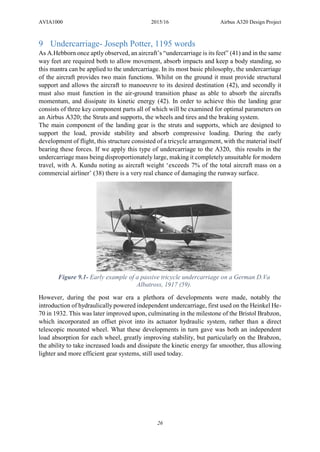
development of flight, this structure consisted of a tricycle arrangement, with the material itself
bearing these forces. If we apply this type of undercarriage to the A320, this results in the
undercarriage mass being disproportionately large, making it completely unsuitable for modern
travel, with A. Kundu noting as aircraft weight ‘exceeds 7% of the total aircraft mass on a
commercial airliner’ (38) there is a very real chance of damaging the runway surface.
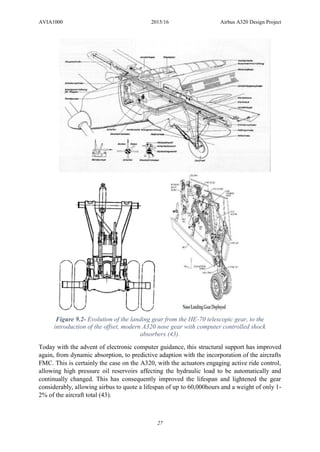
However, during the post war era a plethora of developments were made, notably the
introduction of hydraulically powered independent undercarriage, first used on the Heinkel He-
70 in 1932. This was later improved upon, culminating in the milestone of the Bristol Brabzon,
which incorporated an offset pivot into its actuator hydraulic system, rather than a direct
telescopic mounted wheel. What these developments in turn gave was both an independent
load absorption for each wheel, greatly improving stability, but particularly on the Brabzon,
the ability to take increased loads and dissipate the kinetic energy far smoother, thus allowing
lighter and more efficient gear systems, still used today.
Figure 9.1- Early example of a passive tricycle undercarriage on a German D.Va
Albatross, 1917 (59).
AVIA1000 2015/16 Airbus A320 Design Project
27
Today with the advent of electronic computer guidance, this structural support has improved
again, from dynamic absorption, to predictive adaption with the incorporation of the aircrafts
FMC. This is certainly the case on the A320, with the actuators engaging active ride control,
allowing high pressure oil reservoirs affecting the hydraulic load to be automatically and
continually changed. This has consequently improved the lifespan and lightened the gear
considerably, allowing airbus to quote a lifespan of up to 60,000hours and a weight of only 1-
2% of the aircraft total (43).
Figure 9.2- Evolution of the landing gear from the HE-70 telescopic gear, to the
introduction of the offset, modern A320 nose gear with computer controlled shock
absorbers (43).
AVIA1000 2015/16 Airbus A320 Design Project
28
In combination with this, the positioning of the struts affects how the stability and loading of
the aircraft changes.
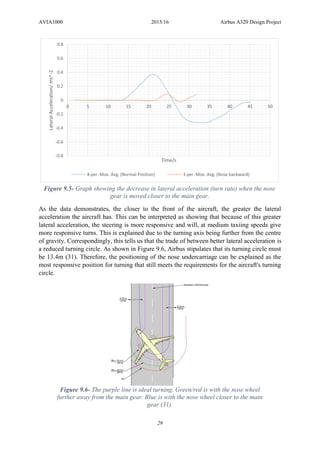
By altering the position of the nose wheel we can examine how the struts and shock absorbers
affect the aircraft, with the nose wheel further from the centre of gravity and then closer to the
centre of gravity.
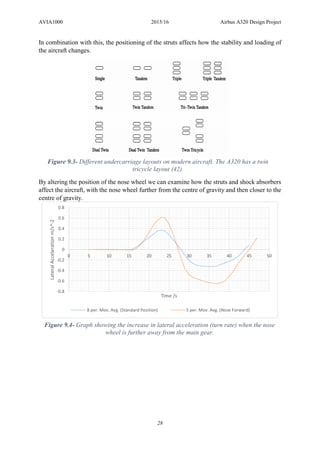
Figure 9.3- Different undercarriage layouts on modern aircraft. The A320 has a twin
tricycle layout (42).
-0.8
-0.6
-0.4
-0.2
0
0.2
0.4
0.6
0.8
0 5 10 15 20 25 30 35 40 45 50
LateralAccelerationm/s^-2
Time /s
8 per. Mov. Avg. (Standard Position) 5 per. Mov. Avg. (Nose Forward)
Figure 9.4- Graph showing the increase in lateral acceleration (turn rate) when the nose
wheel is further away from the main gear.
AVIA1000 2015/16 Airbus A320 Design Project
29
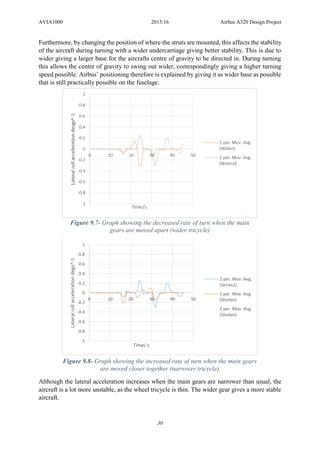
As the data demonstrates, the closer to the front of the aircraft, the greater the lateral
acceleration the aircraft has. This can be interpreted as showing that because of this greater
lateral acceleration, the steering is more responsive and will, at medium taxiing speeds give
more responsive turns. This is explained due to the turning axis being further from the centre
of gravity. Correspondingly, this tells us that the trade of between better lateral acceleration is
a reduced turning circle. As shown in Figure 9.6, Airbus stipulates that its turning circle must
be 13.4m (31). Therefore, the positioning of the nose undercarriage can be explained as the
most responsive position for turning that still meets the requirements for the aircraft's turning
circle.
-0.8
-0.6
-0.4
-0.2
0
0.2
0.4
0.6
0.8
0 5 10 15 20 25 30 35 40 45 50
LateralAcceleration/ms^-2
Time/s
8 per. Mov. Avg. (Normal Position) 3 per. Mov. Avg. (Nose backward)
Figure 9.6- The purple line is ideal turning. Green/red is with the nose wheel
further away from the main gear. Blue is with the nose wheel closer to the main
gear (31).
Figure 9.5- Graph showing the decrease in lateral acceleration (turn rate) when the nose
gear is moved closer to the main gear.
AVIA1000 2015/16 Airbus A320 Design Project
30
Furthermore, by changing the position of where the struts are mounted, this affects the stability
of the aircraft during turning with a wider undercarriage giving better stability. This is due to
wider giving a larger base for the aircrafts centre of gravity to be directed in. During turning
this allows the centre of gravity to swing out wider, correspondingly giving a higher turning
speed possible. Airbus’ positioning therefore is explained by giving it as wider base as possible
that is still practically possible on the fuselage.
Although the lateral acceleration increases when the main gears are narrower than usual, the
aircraft is a lot more unstable, as the wheel tricycle is thin. The wider gear gives a more stable
aircraft.
-1
-0.8
-0.6
-0.4
-0.2
0
0.2
0.4
0.6
0.8
1
0 10 20 30 40 50
Lateralrollaccelerationdegs^-1
Time/ s
2 per. Mov. Avg.
(Series1)
2 per. Mov. Avg.
(Shoten)
2 per. Mov. Avg.
(Shoten)
Figure 9.7- Graph showing the decreased rate of turn when the main
gears are moved apart (wider tricycle)
Figure 9.8- Graph showing the increased rate of turn when the main gears
are moved closer together (narrower tricycle)
AVIA1000 2015/16 Airbus A320 Design Project
31
The second key component to examine is the wheels and tires. Although the materials and
internal structures of aircraft wheels have witnessed an unprecedented, swift evolution, the
overall design of aircraft wheels has remained largely similar. Due to the large impact forces
relative to their size, almost all wheels have remained solid hub-ed, and pneumatic tires being
favoured throughout.
Therefore, in designing an experiment, by examining the impact on the wheel size and numbers
in mid-air a comparison of different tyres can be made on the aircrafts flight performance. By
altering the number of wheels this affects the drag coefficient of the aircraft during flight.
Contrastingly, the braking system has undergone a revolution in design, with market pull of
faster, heavier aircraft necessitating superior brakes to accommodate, evolving from simple
friction to carbon-ceramic automatic braking systems.
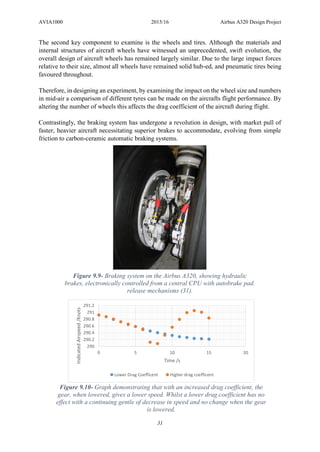
Figure 9.9- Braking system on the Airbus A320, showing hydraulic
brakes, electronically controlled from a central CPU with autobrake pad.
release mechanisms (31).
290
290.2
290.4
290.6
290.8
291
291.2
0 5 10 15 20
IndicatedAirspeed/Knots
Time /s
Lower Drag Coefficent Higher drag coefficent
Figure 9.10- Graph demonstrating that with an increased drag coefficient, the
gear, when lowered, gives a lower speed. Whilst a lower drag coefficient has no
effect with a continuing gentle of decrease in speed and no change when the gear
is lowered.
AVIA1000 2015/16 Airbus A320 Design Project
32
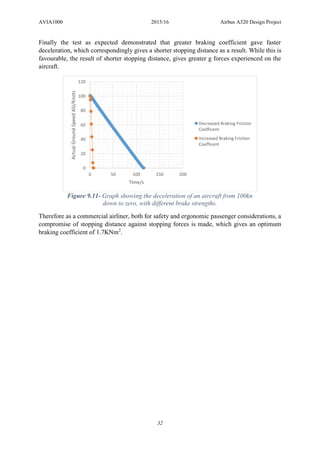
Finally the test as expected demonstrated that greater braking coefficient gave faster
deceleration, which correspondingly gives a shorter stopping distance as a result. While this is
favourable, the result of shorter stopping distance, gives greater g forces experienced on the
aircraft.
Therefore as a commercial airliner, both for safety and ergonomic passenger considerations, a
compromise of stopping distance against stopping forces is made, which gives an optimum
braking coefficient of 1.7KNm2
.
0
20
40
60
80
100
120
0 50 100 150 200
ActualGroundSpeedASI/Knots
Time/s
Decreased Braking Friction
Coefficent
Increased Braking Friction
Coefficent
Figure 9.11- Graph showing the deceleration of an aircraft from 100kn
down to zero, with different brake strengths.
AVIA1000 2015/16 Airbus A320 Design Project
33
10 Wings- Daniel Morrell, 1184 words
10.1 Introduction
The wing’s primary functions are for generating lift, and providing balance and control. A
commercial airliner has ailerons fitted to the wings to roll the aircraft around its longitudinal
axis. Wings are fitted with high lift devices on both the leading and trailing edge, as well as
spoilers on the top. The wing also helps the fuselage to stay steady by being able to flex and
take loads during turbulence, thus increasing comfort.
The conventional wing comprises of spars, which traverse the wing from root to tip. Ribs,
connected to and are perpendicular to, the spars. And the skin, which covers this entire
structure.
10.2 Mounting
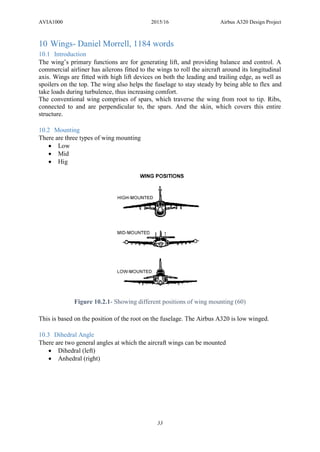
There are three types of wing mounting
 Low
 Mid
 Hig
This is based on the position of the root on the fuselage. The Airbus A320 is low winged.
10.3 Dihedral Angle
There are two general angles at which the aircraft wings can be mounted
 Dihedral (left)
 Anhedral (right)
Figure 10.2.1- Showing different positions of wing mounting (60)
AVIA1000 2015/16 Airbus A320 Design Project
34
This is based on the angle the wing makes with the horizontal (44). The dihedral induces a
rolling moment proportional to the angle. In commercial aviation, anhedral is associated with
high winged aircraft, as it has the same effect as low wing dihedral, but is also used in the
military for mid winged aircraft such as the Tornado (45). The A320 has a dihedral of 5.11o
(12). Excessive dihedral produces a phenomenon called “Dutch Roll” (44), wherebythe aircraft
oscillates about both the normal and longitudinal axes in opposite directions (eg. Yaw left and
roll right) which is difficult to overcome.
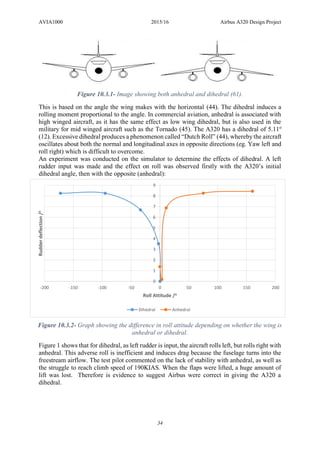
An experiment was conducted on the simulator to determine the effects of dihedral. A left
rudder input was made and the effect on roll was observed firstly with the A320’s initial
dihedral angle, then with the opposite (anhedral):
Figure 1 shows that for dihedral, as left rudder is input, the aircraft rolls left, but rolls right with
anhedral. This adverse roll is inefficient and induces drag because the fuselage turns into the
freestream airflow. The test pilot commented on the lack of stability with anhedral, as well as
the struggle to reach climb speed of 190KIAS. When the flaps were lifted, a huge amount of
lift was lost. Therefore is evidence to suggest Airbus were correct in giving the A320 a
dihedral.
0
1
2
3
4
5
6
7
8
9
-200 -150 -100 -50 0 50 100 150 200
Rudderdeflection/o
Roll Attitude /o
Dihedral Anhedral
Figure 10.3.2- Graph showing the difference in roll attitude depending on whether the wing is
anhedral or dihedral.
Figure 10.3.1- Image showing both anhedral and dihedral (61).
AVIA1000 2015/16 Airbus A320 Design Project
35
10.4 Sweep
The wing could also have:
 Forward sweep
 Sweepback
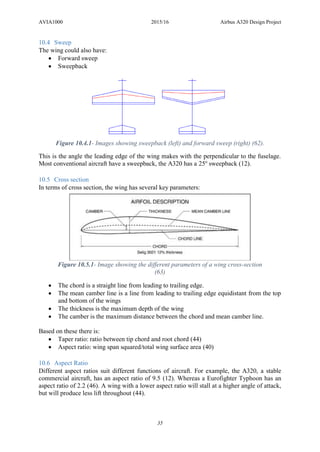
This is the angle the leading edge of the wing makes with the perpendicular to the fuselage.
Most conventional aircraft have a sweepback, the A320 has a 25o
sweepback (12).
10.5 Cross section
In terms of cross section, the wing has several key parameters:
 The chord is a straight line from leading to trailing edge.
 The mean camber line is a line from leading to trailing edge equidistant from the top
and bottom of the wings
 The thickness is the maximum depth of the wing
 The camber is the maximum distance between the chord and mean camber line.
Based on these there is:
 Taper ratio: ratio between tip chord and root chord (44)
 Aspect ratio: wing span squared/total wing surface area (40)
10.6 Aspect Ratio
Different aspect ratios suit different functions of aircraft. For example, the A320, a stable
commercial aircraft, has an aspect ratio of 9.5 (12). Whereas a Eurofighter Typhoon has an
aspect ratio of 2.2 (46). A wing with a lower aspect ratio will stall at a higher angle of attack,
but will produce less lift throughout (44).
Figure 10.4.1- Images showing sweepback (left) and forward sweep (right) (62).
Figure 10.5.1- Image showing the different parameters of a wing cross-section
(63)
AVIA1000 2015/16 Airbus A320 Design Project
36
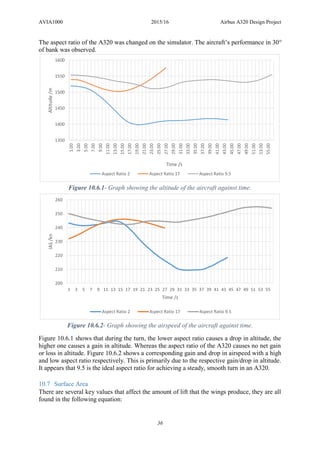
The aspect ratio of the A320 was changed on the simulator. The aircraft’s performance in 30o
of bank was observed.
Figure 10.6.1 shows that during the turn, the lower aspect ratio causes a drop in altitude, the
higher one causes a gain in altitude. Whereas the aspect ratio of the A320 causes no net gain
or loss in altitude. Figure 10.6.2 shows a corresponding gain and drop in airspeed with a high
and low aspect ratio respectively. This is primarily due to the respective gain/drop in altitude.
It appears that 9.5 is the ideal aspect ratio for achieving a steady, smooth turn in an A320.
10.7 Surface Area
There are several key values that affect the amount of lift that the wings produce, they are all
found in the following equation:
1350
1400
1450
1500
1550
1600
1.00
3.00
5.00
7.00
9.00
11.00
13.00
15.00
17.00
19.00
21.00
23.00
25.00
27.00
29.00
31.00
33.00
35.00
37.00
39.00
41.00
43.00
45.00
47.00
49.00
51.00
53.00
55.00
Altitude/m
Time /s
Aspect Ratio 2 Aspect Ratio 17 Aspect Ratio 9.5
200
210
220
230
240
250
260
1 3 5 7 9 11 13 15 17 19 21 23 25 27 29 31 33 35 37 39 41 43 45 47 49 51 53 55
IAS/kn
Time /s
Aspect Ratio 2 Aspect Ratio 17 Aspect Ratio 9.5
Figure 10.6.2- Graph showing the airspeed of the aircraft against time.
Figure 10.6.1- Graph showing the altitude of the aircraft against time.
AVIA1000 2015/16 Airbus A320 Design Project
37
𝐿 =
𝐶 𝐿 𝑆𝑉2 𝜌
2
(1)
Where:
 L is the total amount of lift produced, in N
 𝐶𝐿 is the coefficient of lift, dimensionless
 𝑆 is the surface area of the wings, in m2
 𝑉 is the velocity of the aircraft, in ms-1
 𝜌 is the air density, in kgm-3
(40)
Changing the surface area of the wings would therefore have an effect on the amount of lift
produced, assuming all other parameters remain constant.
A stall test was carried out to see the effect of a changing surface area. Theoretically, the
difference in the amount of lift can be calculated, but an experiment should be carried out to
see how this change of lift affects performance.
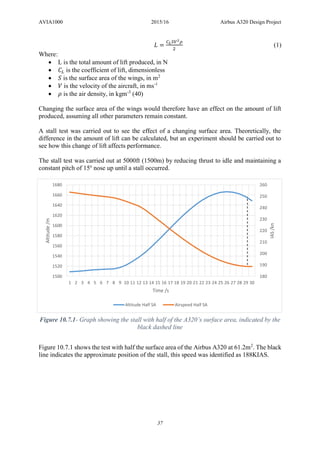
The stall test was carried out at 5000ft (1500m) by reducing thrust to idle and maintaining a
constant pitch of 15o
nose up until a stall occurred.
Figure 10.7.1 shows the test with half the surface area of the Airbus A320 at 61.2m2
. The black
line indicates the approximate position of the stall, this speed was identified as 188KIAS.
180
190
200
210
220
230
240
250
260
1500
1520
1540
1560
1580
1600
1620
1640
1660
1680
1 2 3 4 5 6 7 8 9 10 11 12 13 14 15 16 17 18 19 20 21 22 23 24 25 26 27 28 29 30
IAS/kn
Altitude/m
Time /s
Altitude Half SA Airspeed Half SA
Figure 10.7.1- Graph showing the stall with half of the A320’s surface area, indicated by the
black dashed line
AVIA1000 2015/16 Airbus A320 Design Project
38
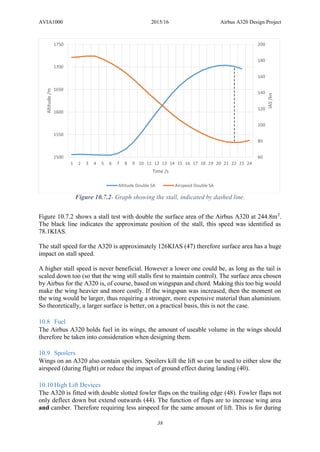
Figure 10.7.2- Graph showing the stall, indicated by dashed line.
Figure 10.7.2 shows a stall test with double the surface area of the Airbus A320 at 244.8m2
.
The black line indicates the approximate position of the stall, this speed was identified as
78.1KIAS.
The stall speed for the A320 is approximately 126KIAS (47) therefore surface area has a huge
impact on stall speed.
A higher stall speed is never beneficial. However a lower one could be, as long as the tail is
scaled down too (so that the wing still stalls first to maintain control). The surface area chosen
by Airbus for the A320 is, of course, based on wingspan and chord. Making this too big would
make the wing heavier and more costly. If the wingspan was increased, then the moment on
the wing would be larger, thus requiring a stronger, more expensive material than aluminium.
So theoretically, a larger surface is better, on a practical basis, this is not the case.
10.8 Fuel
The Airbus A320 holds fuel in its wings, the amount of useable volume in the wings should
therefore be taken into consideration when designing them.
10.9 Spoilers
Wings on an A320 also contain spoilers. Spoilers kill the lift so can be used to either slow the
airspeed (during flight) or reduce the impact of ground effect during landing (40).
10.10High Lift Devices
The A320 is fitted with double slotted fowler flaps on the trailing edge (48). Fowler flaps not
only deflect down but extend outwards (44). The function of flaps are to increase wing area
and camber. Therefore requiring less airspeed for the same amount of lift. This is for during
60
80
100
120
140
160
180
200
1500
1550
1600
1650
1700
1750
1 2 3 4 5 6 7 8 9 10 11 12 13 14 15 16 17 18 19 20 21 22 23 24
IAS/kn
Altitude/m
Time /s
Altitude Double SA Airspeed Double SA
AVIA1000 2015/16 Airbus A320 Design Project
39
takeoff and landing as the aircraft can approach and touchdown at lower speeds without
stalling. It must be noted, however, that the critical angle of attack is reduced.
10.11Sharklets
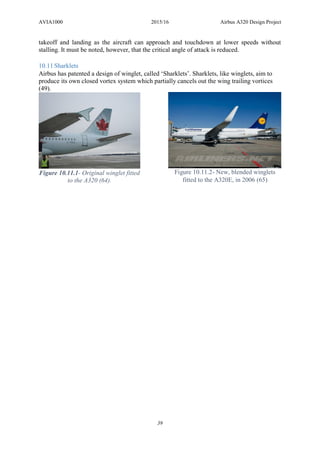
Airbus has patented a design of winglet, called ‘Sharklets’. Sharklets, like winglets, aim to
produce its own closed vortex system which partially cancels out the wing trailing vortices
(49).
Figure 10.11.1- Original winglet fitted
to the A320 (64).
Figure 10.11.2- New, blended winglets
fitted to the A320E, in 2006 (65)
AVIA1000 2015/16 Airbus A320 Design Project
40
11 Tail- Cheuk Man Sin, 1192 words
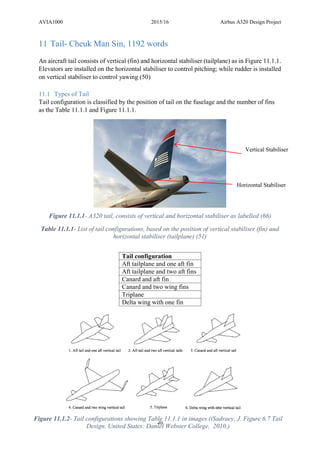
An aircraft tail consists of vertical (fin) and horizontal stabiliser (tailplane) as in Figure 11.1.1.
Elevators are installed on the horizontal stabiliser to control pitching; while rudder is installed
on vertical stabiliser to control yawing (50)
11.1 Types of Tail
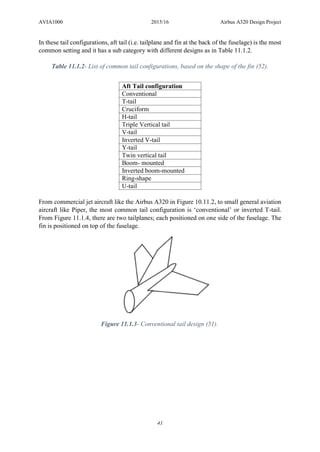
Tail configuration is classified by the position of tail on the fuselage and the number of fins
as the Table 11.1.1 and Figure 11.1.1.
Table 11.1.1- List of tail configurations, based on the position of vertical stabiliser (fin) and
horizontal stabiliser (tailplane) (51)
Tail configuration
Aft tailplane and one aft fin
Aft tailplane and two aft fins
Canard and aft fin
Canard and two wing fins
Triplane
Delta wing with one fin
Vertical Stabiliser
Horizontal Stabiliser
Figure 11.1.1- A320 tail, consists of vertical and horizontal stabiliser as labelled (66)
Figure 11.1.2- Tail configurations showing Table 11.1.1 in images ((Sadraey, J. Figure 6.7 Tail
Design. United States: Daniel Webster College, 2010.)
AVIA1000 2015/16 Airbus A320 Design Project
41
In these tail configurations, aft tail (i.e. tailplane and fin at the back of the fuselage) is the most
common setting and it has a sub category with different designs as in Table 11.1.2.
Table 11.1.2- List of common tail configurations, based on the shape of the fin (52).
Aft Tail configuration
Conventional
T-tail
Cruciform
H-tail
Triple Vertical tail
V-tail
Inverted V-tail
Y-tail
Twin vertical tail
Boom- mounted
Inverted boom-mounted
Ring-shape
U-tail
From commercial jet aircraft like the Airbus A320 in Figure 10.11.2, to small general aviation
aircraft like Piper, the most common tail configuration is ‘conventional’ or inverted T-tail.
From Figure 11.1.4, there are two tailplanes; each positioned on one side of the fuselage. The
fin is positioned on top of the fuselage.
Figure 11.1.3- Conventional tail design (51).
AVIA1000 2015/16 Airbus A320 Design Project
42
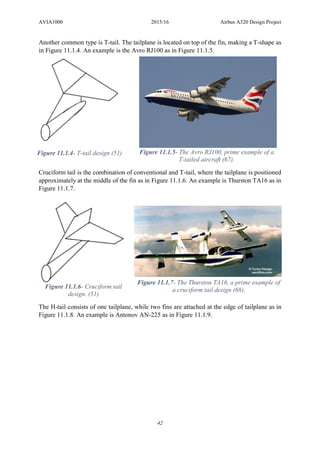
Another common type is T-tail. The tailplane is located on top of the fin, making a T-shape as
in Figure 11.1.4. An example is the Avro RJ100 as in Figure 11.1.5.
Cruciform tail is the combination of conventional and T-tail, where the tailplane is positioned
approximately at the middle of the fin as in Figure 11.1.6. An example is Thurston TA16 as in
Figure 11.1.7.
The H-tail consists of one tailplane, while two fins are attached at the edge of tailplane as in
Figure 11.1.8. An example is Antonov AN-225 as in Figure 11.1.9.
Figure 11.1.4- T-tail design (51) Figure 11.1.5- The Avro RJ100, prime example of a
T-tailed aircraft (67).
Figure 11.1.6- Cruciform tail
design. (51)
Figure 11.1.7- The Thurston TA16, a prime example of
a cruciform tail design (68).
AVIA1000 2015/16 Airbus A320 Design Project
43
V-tail has two taiplanes coming out of the fuselage in a dihedral V-shape. It does not have a
fin. The tailplanes (i.e. ‘ruddervator’) in this design controls both the elevator and rudder. An
example is Beechcraft Bonanza as in Figure 11.1.11.
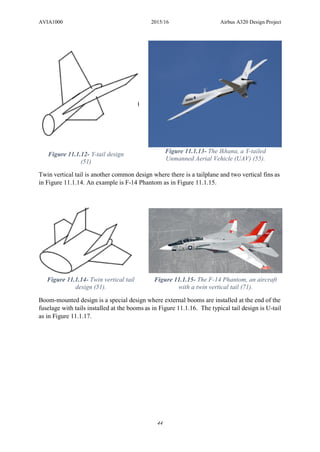
Y-tail is in Figure 11.1.12, similar to V-tail, has tailplanes attached as a V-shape, while a fin is
attached to the bottom of the fuselage. An example is Ikhana as Figure 11.1.13.
Figure 11.1.8- H-tail design (51) Figure 11.1.9- The Antonov AN-225, whilst
being the longest and heaviest aircraft in the
world, boasts a H-tail too (69).
Figure 11.1.10- V-tail design (51). Figure 11.1.11- The Beechcraft Bonanza, an
example of a V-tailed aircraft (Air Facts
Journal. Beechcraft Bonanza. [Online].
2015. [Accessed on: 17 Dec 2015] Available
from: http://airfactsjournal.com/
AVIA1000 2015/16 Airbus A320 Design Project
44
Twin vertical tail is another common design where there is a tailplane and two vertical fins as
in Figure 11.1.14. An example is F-14 Phantom as in Figure 11.1.15.
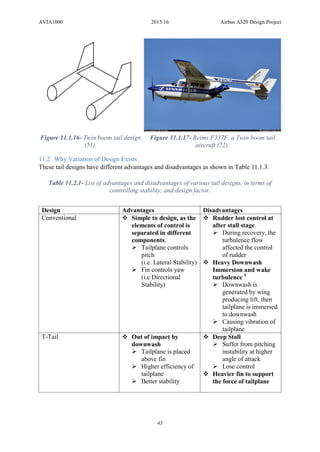
Boom-mounted design is a special design where external booms are installed at the end of the
fuselage with tails installed at the booms as in Figure 11.1.16. The typical tail design is U-tail
as in Figure 11.1.17.
Figure 11.1.12- Y-tail design
(51)
Figure 11.1.13- The Ikhana, a Y-tailed
Unmanned Aerial Vehicle (UAV) (55).
Figure 11.1.14- Twin vertical tail
design (51).
Figure 11.1.15- The F-14 Phantom, an aircraft
with a twin vertical tail (71).
AVIA1000 2015/16 Airbus A320 Design Project
45
11.2 Why Variation of Design Exists
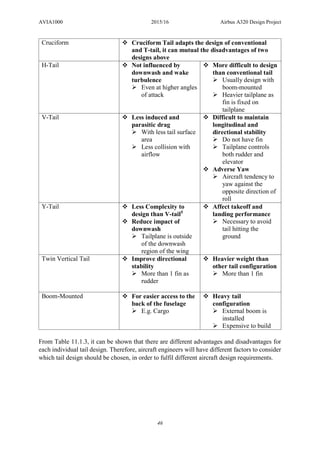
These tail designs have different advantages and disadvantages as shown in Table 11.1.3.
Table 11.2.1- List of advantages and disadvantages of various tail designs, in terms of
controlling stability, and design factor.
Design Advantages Disadvantages
Conventional  Simple to design, as the
elements of control is
separated in different
components.
 Tailplane controls
pitch
(i.e. Lateral Stability)
 Fin controls yaw
(i.e Directional
Stability)
 Rudder lost control at
after stall stage.
 During recovery, the
turbulence flow
affected the control
of rudder
 Heavy Downwash
Immersion and wake
turbulence 5
 Downwash is
generated by wing
producing lift, then
tailplane is immersed
to downwash
 Causing vibration of
tailplane
T-Tail  Out of impact by
downwash
 Tailplane is placed
above fin
 Higher efficiency of
tailplane
 Better stability
 Deep Stall
 Suffer from pitching
instability at higher
angle of attack
 Lose control
 Heavier fin to support
the force of tailplane
Figure 11.1.16- Twin boom tail design
(51).
Figure 11.1.17- Reims F337F, a Twin boom tail
aircraft (72).
AVIA1000 2015/16 Airbus A320 Design Project
46
Cruciform  Cruciform Tail adapts the design of conventional
and T-tail, it can mutual the disadvantages of two
designs above
H-Tail  Not influenced by
downwash and wake
turbulence
 Even at higher angles
of attack
 More difficult to design
than conventional tail
 Usually design with
boom-mounted
 Heavier tailplane as
fin is fixed on
tailplane
V-Tail  Less induced and
parasitic drag
 With less tail surface
area
 Less collision with
airflow
 Difficult to maintain
longitudinal and
directional stability
 Do not have fin
 Tailplane controls
both rudder and
elevator
 Adverse Yaw
 Aircraft tendency to
yaw against the
opposite direction of
roll
Y-Tail  Less Complexity to
design than V-tail5
 Reduce impact of
downwash
 Tailplane is outside
of the downwash
region of the wing
 Affect takeoff and
landing performance
 Necessary to avoid
tail hitting the
ground
Twin Vertical Tail  Improve directional
stability
 More than 1 fin as
rudder
 Heavier weight than
other tail configuration
 More than 1 fin
Boom-Mounted  For easier access to the
back of the fuselage
 E.g. Cargo
 Heavy tail
configuration
 External boom is
installed
 Expensive to build
From Table 11.1.3, it can be shown that there are different advantages and disadvantages for
each individual tail design. Therefore, aircraft engineers will have different factors to consider
which tail design should be chosen, in order to fulfil different aircraft design requirements.
AVIA1000 2015/16 Airbus A320 Design Project
47
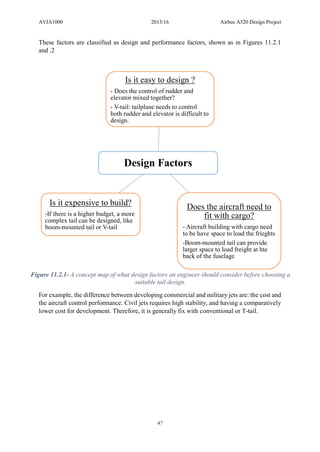
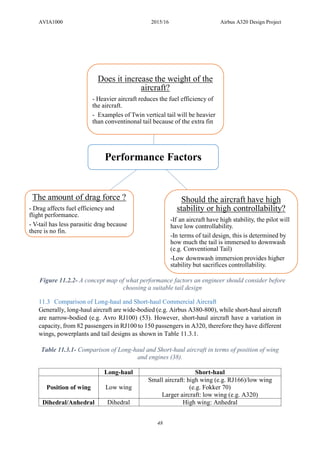
These factors are classified as design and performance factors, shown as in Figures 11.2.1
and .2
For example, the difference between developing commercial and military jets are: the cost and
the aircraft control performance. Civil jets requires high stability, and having a comparatively
lower cost for development. Therefore, it is generally fix with conventional or T-tail.
Design Factors
Is it easy to design ?
- Does the control of rudder and
elevator mixed together?
- V-tail: tailplane needs to control
both rudder and elevator is difficult to
design.
Does the aircraft need to
fit with cargo?
- Aircraft building with cargo need
to be have space to load the frieghts
-Boom-mounted tail can provide
larger space to load freight at hte
back of the fuselage
Is it expensive to build?
-If there is a higher budget, a more
complex tail can be designed, like
boom-mounted tail or V-tail
Figure 11.2.1- A concept map of what design factors an engineer should consider before choosing a
suitable tail design.
AVIA1000 2015/16 Airbus A320 Design Project
48
11.3 Comparison of Long-haul and Short-haul Commercial Aircraft
Generally, long-haul aircraft are wide-bodied (e.g. Airbus A380-800), while short-haul aircraft
are narrow-bodied (e.g. Avro RJ100) (53). However, short-haul aircraft have a variation in
capacity, from 82 passengers in RJ100 to 150 passengers in A320, therefore they have different
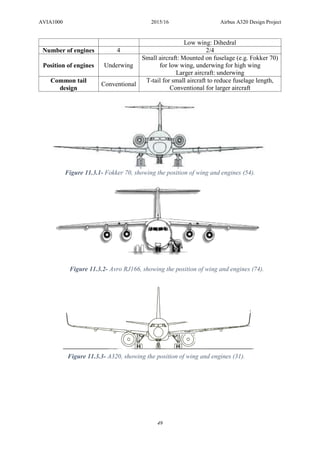
wings, powerplants and tail designs as shown in Table 11.3.1.
Table 11.3.1- Comparison of Long-haul and Short-haul aircraft in terms of position of wing
and engines (38).
Long-haul Short-haul
Position of wing Low wing
Small aircraft: high wing (e.g. RJ166)/low wing
(e.g. Fokker 70)
Larger aircraft: low wing (e.g. A320)
Dihedral/Anhedral Dihedral High wing: Anhedral
Performance Factors
Does it increase the weight of the
aircraft?
- Heavier aircraft reduces the fuel efficiency of
the aircraft.
- Examples of Twin vertical tail will be heavier
than conventinonal tail because of the extra fin
Should the aircraft have high
stability or high controllability?
-If an aircraft have high stability, the pilot will
have low controllability.
-In terms of tail design, this is determined by
how much the tail is immersed to downwash
(e.g. Conventional Tail)
-Low downwash immersion provides higher
stability but sacrifices controllability.
The amount of drag force ?
- Drag affects fuel efficiency and
flight performance.
- V-tail has less parasitic drag because
there is no fin.
Figure 11.2.2- A concept map of what performance factors an engineer should consider before
choosing a suitable tail design
AVIA1000 2015/16 Airbus A320 Design Project
49
Low wing: Dihedral
Number of engines 4 2/4
Position of engines Underwing
Small aircraft: Mounted on fuselage (e.g. Fokker 70)
for low wing, underwing for high wing
Larger aircraft: underwing
Common tail
design
Conventional
T-tail for small aircraft to reduce fuselage length,
Conventional for larger aircraft
Figure 11.3.1- Fokker 70, showing the position of wing and engines (54).
Figure 11.3.2- Avro RJ166, showing the position of wing and engines (74).
Figure 11.3.3- A320, showing the position of wing and engines (31).
AVIA1000 2015/16 Airbus A320 Design Project
50
11.4 A320 on Merlin Simulator – Effects of variation of tail design
Tail is the component to control the pitch and yaw of aircraft. Therefore, by changing some
of the parameters of A320 tail from Table 11.4.1, the impact on aircraft performance can be
studied.
Table 11.4.1- Available taiplane and fin parameters which can be changed to study the effect
on aircraft performance.
Tailplane parameters Fin parameters
Setting Angle Aero Centre X
Downwash immersion Aero Centre Z
Aero Centre X Lift Curve Slope
Aero Center Z Profile Drag Factor
Lift Curve Slope Induced Drag Factor
Profile Drag Factor Area
Induced Drag Factor
Area
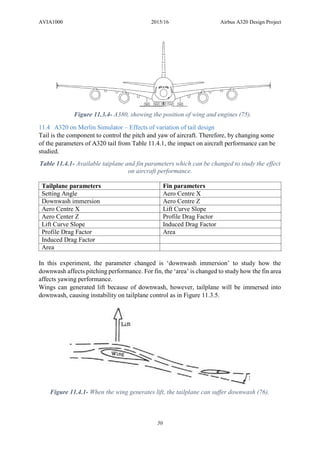
In this experiment, the parameter changed is ‘downwash immersion’ to study how the
downwash affects pitching performance. For fin, the ‘area’ is changed to study how the fin area
affects yawing performance.
Wings can generated lift because of downwash, however, tailplane will be immersed into
downwash, causing instability on tailplane control as in Figure 11.3.5.
Figure 11.3.4- A380, showing the position of wing and engines (75).
Figure 11.4.1- When the wing generates lift, the tailplane can suffer downwash (76).
AVIA1000 2015/16 Airbus A320 Design Project
51
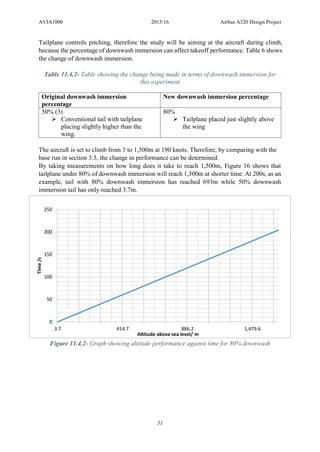
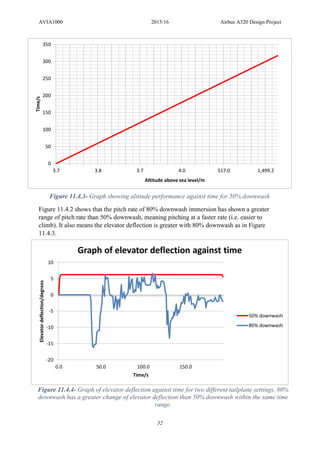
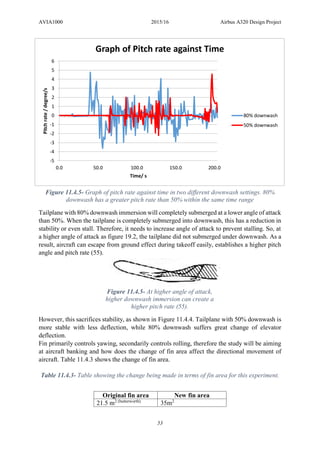
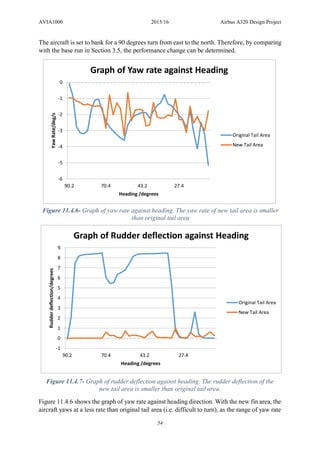
Tailplane controls pitching, therefore the study will be aiming at the aircraft during climb,
because the percentage of downwash immersion can affect takeoff performance. Table 6 shows
the change of downwash immersion.
Table 11.4.2- Table showing the change being made in terms of downwash immersion for
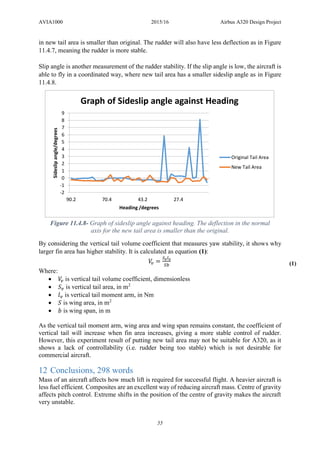
this experiment
Original downwash immersion
percentage
New downwash immersion percentage
50% (3)
 Conventional tail with tailplane
placing slightly higher than the
wing.
80%
 Tailplane placed just slightly above
the wing
The aircraft is set to climb from 3 to 1,500m at 190 knots. Therefore, by comparing with the
base run in section 3.5, the change in performance can be determined.
By taking measurements on how long does it take to reach 1,500m, Figure 16 shows that
tailplane under 80% of downwash immersion will reach 1,500m at shorter time. At 200s, as an
example, tail with 80% downwash immersion has reached 693m while 50% downwash
immersion tail has only reached 3.7m.
0
50
100
150
200
250
3.7 414.7 886.2 1,479.6
Time/s
Altitude above sea level/ m
Figure 11.4.2- Graph showing altitude performance against time for 80% downwash
AVIA1000 2015/16 Airbus A320 Design Project
52
Figure 11.4.2 shows that the pitch rate of 80% downwash immersion has shown a greater
range of pitch rate than 50% downwash, meaning pitching at a faster rate (i.e. easier to
climb). It also means the elevator deflection is greater with 80% downwash as in Figure
11.4.3.
-20
-15
-10
-5
0
5
10
0.0 50.0 100.0 150.0
Elevatordeflection/degrees
Time/s
Graph of elevator deflection against time
50% downwash
80% downwash
0
50
100
150
200
250
300
350
3.7 3.8 3.7 4.0 517.0 1,499.2
Time/s
Altitude above sea level/m
Figure 11.4.3- Graph showing altitude performance against time for 50% downwash
Figure 11.4.4- Graph of elevator deflection against time for two different tailplane settings. 80%
downwash has a greater change of elevator deflection than 50% downwash within the same time
range.
AVIA1000 2015/16 Airbus A320 Design Project
53
Tailplane with 80% downwash immersion will completely submerged at a lower angle of attack
than 50%. When the tailplane is completely submerged into downwash, this has a reduction in
stability or even stall. Therefore, it needs to increase angle of attack to prevent stalling. So, at
a higher angle of attack as figure 19.2, the tailplane did not submerged under downwash. As a
result, aircraft can escape from ground effect during takeoff easily, establishes a higher pitch
angle and pitch rate (55).
However, this sacrifices stability, as shown in Figure 11.4.4. Tailplane with 50% downwash is
more stable with less deflection, while 80% downwash suffers great change of elevator
deflection.
Fin primarily controls yawing, secondarily controls rolling, therefore the study will be aiming
at aircraft banking and how does the change of fin area affect the directional movement of
aircraft. Table 11.4.3 shows the change of fin area.
Table 11.4.3- Table showing the change being made in terms of fin area for this experiment.
Original fin area New fin area
21.5 m2 (butterworth)
35m2
-5
-4
-3
-2
-1
0
1
2
3
4
5
6
0.0 50.0 100.0 150.0 200.0
Pitchrate/degree/s
Time/ s
Graph of Pitch rate against Time
80% downwash
50% downwash
Figure 11.4.5- Graph of pitch rate against time in two different downwash settings. 80%
downwash has a greater pitch rate than 50% within the same time range
Figure 11.4.5- At higher angle of attack,
higher downwash immersion can create a
higher pitch rate (55).
AVIA1000 2015/16 Airbus A320 Design Project
54
The aircraft is set to bank for a 90 degrees turn from east to the north. Therefore, by comparing
with the base run in Section 3.5, the performance change can be determined.
Figure 11.4.6 shows the graph of yaw rate against heading direction. With the new fin area, the
aircraft yaws at a less rate than original tail area (i.e. difficult to turn), as the range of yaw rate
-6
-5
-4
-3
-2
-1
0
90.2 70.4 43.2 27.4
YawRate/deg/s
Heading /degrees
Graph of Yaw rate against Heading
Original Tail Area
New Tail Area
Figure 11.4.6- Graph of yaw rate against heading. The yaw rate of new tail area is smaller
than original tail area
-1
0
1
2
3
4
5
6
7
8
9
90.2 70.4 43.2 27.4
Rudderdeflection/degrees
Heading /degrees
Graph of Rudder deflection against Heading
Original Tail Area
New Tail Area
Figure 11.4.7- Graph of rudder deflection against heading. The rudder deflection of the
new tail area is smaller than original tail area.
AVIA1000 2015/16 Airbus A320 Design Project
55
in new tail area is smaller than original. The rudder will also have less deflection as in Figure
11.4.7, meaning the rudder is more stable.
Slip angle is another measurement of the rudder stability. If the slip angle is low, the aircraft is
able to fly in a coordinated way, where new tail area has a smaller sideslip angle as in Figure
11.4.8.
By considering the vertical tail volume coefficient that measures yaw stability, it shows why
larger fin area has higher stability. It is calculated as equation (1):
𝑉𝑣 =
𝑆 𝑣 𝑙 𝑣
𝑆𝑏
Where:
 𝑉𝑣 is vertical tail volume coefficient, dimensionless
 𝑆 𝑣 is vertical tail area, in m2
 𝑙 𝑣 is vertical tail moment arm, in Nm
 𝑆 is wing area, in m2
 𝑏 is wing span, in m
As the vertical tail moment arm, wing area and wing span remains constant, the coefficient of
vertical tail will increase when fin area increases, giving a more stable control of rudder.
However, this experiment result of putting new tail area may not be suitable for A320, as it
shows a lack of controllability (i.e. rudder being too stable) which is not desirable for
commercial aircraft.
12 Conclusions, 298 words
Mass of an aircraft affects how much lift is required for successful flight. A heavier aircraft is
less fuel efficient. Composites are an excellent way of reducing aircraft mass. Centre of gravity
affects pitch control. Extreme shifts in the position of the centre of gravity makes the aircraft
very unstable.
-2
-1
0
1
2
3
4
5
6
7
8
9
90.2 70.4 43.2 27.4
Sideslipangle/degrees
Heading /degrees
Graph of Sideslip angle against Heading
Original Tail Area
New Tail Area
(1)
Figure 11.4.8- Graph of sideslip angle against heading. The deflection in the normal
axis for the new tail area is smaller than the original.
AVIA1000 2015/16 Airbus A320 Design Project
56
It must be noted that the change in engine thrust, whether applying the PW6000 or the excessive
change with the trust of a Trent 900, changes the rate of change in altitude and acceleration.
The data suggests that there is another aspect of the aircraft effecting the sideslip during an
engine failure.
Fuselage fits in the aircraft payload. It is one of the factors that engineers need to consider for
the fuselage size. With the improvement of airframe and materials, this enhances the aircraft
performance by minimizing drag. It is important to minimize drag because drag reduces the
forward acceleration and airspeed.
From the undercarriage data, it was found that position is the most crucial aspect in landing
gear design, giving the largest variance in balance, stability and strength. Therefore by finding
the optimum positioning, the manufacturer can drastically improve the cost, weight and
efficiency of the aircraft without additonal systems.
Each feature of a wing affects its performance. Dihedral on a mid-low mount increases stability
and prevents Dutch Roll. A balance must also be struck between surface area and the additional
mass created by increasing it. Each aircraft has an ideal aspect ratio which makes it stable.
An aircraft tail controls pitching and yawing. There are several of tail designs between aircrafts,
because of design and performance factors. For example, changing the tailplane downwash
immersion and fin area affects the stability and controllability. Therefore, aircraft engineers
need to balance all the factors before choosing a suitable design.
13 Acknowledgements, 181 words
We would like to express our gratitude to Mr. Christopher P. Brier, Senior Experimental
Officer, University of Leeds for providing advice and assistance on collecting experimental
data throughout the simulation session. We would also like to express the deepest gratitude to
all those who help us directly and indirectly throughout the process, including our year tutor,
Clir. Clive Hudson, Senior Teaching Fellow, University of Leeds on providing the guidelines
of group project management. On top of that, all of our team members have made valuable
suggestions to improve the report as a whole. We thank all the people for their help.
Even with a challenging time frame and high workload the report and associated tasks were
completed as group in a professional and logical manner. The group’s cohesion meant that
communication was concise and informative and made the writing, formatting and the group
work a productive process. The essential construction, organization of all the work must be
contributed to the team leader's idea of the use of a cloud and the group's adaptation and
response to the requests of the leader.
AVIA1000 2015/16 Airbus A320 Design Project
57
14 References
1. Airbus S.A.S. A320 Range. [Online] 2015. [Cited: 16 January 2016.]
http://www.airbus.com/aircraftfamilies/passengeraircraft/a320family/a320/performance/.
2. Flight Global. Airbus A320 Aircraft Profile. [Online] 2015. [Cited: 19 January 2016.]
http://www.flightglobal.com.
3. Lloyd Jenkinson, Paul Simpkin, Darren Rhodes. Civil Jet Aircraft Design. Oxford :
Butterworth-Heinemann, 2001.
4. Airbus S.A.S. Airbus Family Figures. [Online] July 2015. [Cited: 16 January 2016.]
http://www.airbus.com/fileadmin/media_gallery/files/brochures_publications/aircraft_familie
s/Airbus-Family-figures-booklet-Jul15.pdf.
5. —. Airbus A320 Family. [Online] 2016. [Cited: 19 January 2016.]
http://www.airbus.com/aircraftfamilies/passengeraircraft/a320family/.
6. Boeing Commercial Airplanes. Flight Training Type Rating Course. [Online] 2015.
[Cited: 15 January 2016.]
http://www.boeing.com/resources/boeingdotcom/commercial/boeing-
edge/assets/brochure/edge-flight-services/fs-typerating.pdf.
7. Flightglobal Insight. World Airliner Census. [Online] 2015. [Cited: 16 January 2016.]
https://d1fmezig7cekam.cloudfront.net/VPP/Global/Flight/Airline%20Business/AB%20home
/Edit/WorldAirlinerCensus2015.pdf.
8. Airbus S.A.S. Orders & Deliveries. [Online] 2015. [Cited: 16 January 2016.]
http://www.airbus.com/company/market/orders-deliveries/ .
9. P Moreira, L Silva, P Castro. Structural Connections for Lightweight Metallic
Structures. Portugal : Springer Science & Business Media, 2012.
10. R Beo, J Starnes, R Holzwarth. Low-Cost Composite Materials and Structures for
Aircraft Applications. United States : Air Combat Systems, 2001.
11. Eurocontrol. Eurocontrol Aircraft Performance Database. [Online] 2008. [Cited: 11
January 2016.]
https://contentzone.eurocontrol.int/aircraftperformance/details.aspx?ICAO=A320&.
12. Aerospace Facts. Airbus A320 Facts. [Online] 2013. [Cited: 14 January 2016.]
http://www.aerospacefacts.com/plane/aircraft.php?plane_id=111.
13. Reese, NS. A measure of decision making ethics within aviation and aerospace industry.
Oklahoma State University : s.n., 2015.
14. Flight Safety Foundation. Airbus A320 Database. [Online] 2016. [Cited: 15 January
2016.] http://www.aviation-safety.net.
15. —. Lufthansa Flight 2904 Accident Description. [Online] 2016. [Cited: 15 January 2016.]
http://www.aviation-safety.net.
16. Pratt & Whitney. PurePower PW1000G Engine. [Online] 2016. [Cited: 15 January
2016.] http://www.purepowerengine.com.
AVIA1000 2015/16 Airbus A320 Design Project
58
17. Duchene, N. The impact of aircraft weight on aircraft take-off emissions. Paris :
Eurocontrol Experimental Centre, 2006.
18. International Civil Aviation Organisation. Airport Air Quality Manual. United States :
ICAO, 2006. 1st Edition.
19. IPCC. Aviation and the Global Atmosphere: A Special Report of the Intergovernmental
Panel on Climate Change. United Kingdom : Cambridge University Press, 1999.
20. NASA. Forces on an Airplane. [Online] 2016. [Cited: 19 January 2016.]
http://www.grc.nasa.gov/www/k-12/airplane/formces.html.
21. —. Virtual Skies Aeronautics. [Online] 2016. [Cited: 19 January 2016.]
http://virtualskies.arc.nasa.gov/aeronautics/2.html.
22. Federal Aviation Administration. Aircraft Weight and Balance Handbook. United
States : FAA, 2007.
23. West Wings Inc. Effect of GG. [Online] 2016. [Cited: 19 January 2016.]
http://www.westwingsinc.com/cgeffect.html.
24. Federal Aviation Administration. Aircraft Structures. [Online] [No date]. [Cited: 16
January 2016.]
25. Century of Flight. Development of Aviation Technology. The Monoplane. [Online]
2014. [Cited: 14 January 2016.] http://www.century-of-
flight.net/Aviation%20history/evolution%20of%20technology/The%20Monoplane.htm.
26. Campbell, F. C. Structural Composite Materials. Materials Park, Ohio : ASM
International, 2010.
27. K. B. Armstrong, R. T. Barrett. Care and repair of advanced composites. Warrendale,
PA : Society of Automotive Engineers, 1998.
28. Aboutflight.com. Types of Aircraft Construction. [Online] 2016. [Cited: 19 January
2016.] http://www.aboutflight.com/handbook-of-aeronautical-knowledge/ch-02-aircraft-
structure/types-of-aircraft-construction.
29. Sadraey, M. H. Aircraft Design- A Systems Engineering Approach. [Online] 2012.
[Cited: 14 January 2016.] https://books.google.co.uk/books?id=VT-
Tc3Tx5aEC&dq=The+application+of+engines+on+aircraft&source=gbs_navlinks.
30. The Jet Engine. Rolls Royce plc. United Kingdom : Rolls Royce plc, 1996, Vol. 5th
Edition.
31. Airbus S.A.S. A320 Aircraft Characteristics: Airport and Maintenance Planning.
[Online] 2005. [Cited: 16 January 2016.]
http://www.airbus.com/fileadmin/media_gallery/files/tech_data/AC/Airbus-AC-A320-
Jan16.pdf.
32. CFM International. CFM56-5B Turbofan Engine. [Online] 1996-2016. [Cited: 16
January 2016.] http://www.cfmaeroengines.com/engines/cfm56-5b.
AVIA1000 2015/16 Airbus A320 Design Project
59
33. Airbus S.A.S. A320 Dimensions and Key Data. [Online] 2015. [Cited: 16 January 2016.]
http://www.airbus.com/aircraftfamilies/passengeraircraft/a320family/a320/specifications/.
34. O. Turan, H. Aydin. Power Systems analysis of an Aero-engine. Journal of Power and
Energy Engineering. [Online] 2015. [Cited: 17 January 2016.]
file:///C:/Users/User/Downloads/JPEE_2015051916594102%20(3).pdf.
35. Melber-Wilkending, S. Aerodynamic Analysis of Jet-Blast using CFD considering as
example a Hangar and Airbus A380 Configurations. [Online] 2004. [Cited: 17 January 2016.]
http://link.springer.com/chapter/10.1007%2F978-3-540-33287-9_19?LI=true#page-1.
36. Boeing Commercial Airplanes. 737 Airplane Characteristics for Airport Planning.
[Online] 2013. [Cited: 17 January 2016.]
http://www.boeing.com/assets/pdf/commercial/airports/acaps/737.pdf..
37. Federal Aviation Administration. Aviation Maintenance Technician Handbook-
Airframe (Vol. 1). United States : FAA, 2012.
38. Kundu, A. Aircraft Design. Cambridge : Cambridge University Press, 2010.
39. SKYbrary Aviation Safety. Drag. [Online] 2015. [Cited: 19 January 2016.]
http://www.skybrary.aero.
40. Fielding, John P. Introduction to Aircraft Design. Cranfield University : Cambridge
University Press, 1999.
41. Hebborn, Andrew. DLGR Landing Gear and Systems. [Online] Hambury: Airbus
S.A.S., 2008. [Cited: 15 January 2016.]
42. Mason, F. Landing Gear System. [Online] 2011. [Cited: 16 January 2016.]
43. Roloff, Gerd. Landing Gear: The Evolution of a System. [Online] 2002. [Cited: 17
January 2016.]
44. Raymer, Daniel P. Aircraft Design: A Conceptual Approach. Virginia : AIAA, 2006.
45. Ministry of Defence. RAF Tornado. [Online] 2015. [Cited: 14 January 2016.]
http://www.raf.mod.uk/equipment/tornado.cfm.
46. Fighter Planes. Eurofighter. [Online] [Cited: 16 January 2016.] http://www.fighter-
planes.com/info/eurofighter_ef2000.htm .
47. SATA Virtual. A320 Limitations. [Online] [Cited: 14 January 2016.]
http://www.satavirtual.org/fleet/A320LIMITATIONS.PDF.
48. Answers. "What type of flat and slat A320 used?". [Online] [Cited: 17 January 2016.]
http://www.answers.com/Q/What_type_of_flap_and_slat_A320_used.
49. Wright, Stephen. Introduction to Aviation (AVIA1040)- Powerpoint. University of
Leeds : s.n., 2015-16.
50. Anderson, J. Introduction to Flight 5th Ed. New York : McGraw-Hill, 2004.
51. Sadraey, J. Tail Design. United States: Daniel Webster College : s.n., 2010.
AVIA1000 2015/16 Airbus A320 Design Project
60
52. Gudmundsson, S. General Aviation Aircraft Design: Applied Methods and Procedures.
United Kingdom : Butterworth-Heinemann, 2013.
53. Cole, S. Applied Transport Economics: Policy, Management and Decision-Making.
United Kingdom : Kogan-Page Publishers, 2005.
54. Fokker Aircraft. Fokker 70. [Online] 2015. [Cited: 17 December 2015.]
http://www.fokker-aircraft.info.
55. National Aeronautics and Space Agency. Quest for Performance: The evolution of
modern aircraft. [Online] 2015. [Cited: 17 December 2015.] http://www.history.nasa.gov.
56. Wikipedia. Blériot XI. [Online] 2015. [Cited: 19 January 2016.]
http://en.wikipedia.org/wiki/B1%C3%A9riot_XI.
57. Diseno-art. McDonnell XP-67 "Bat" or "Moonbat". [Online] 2012. [Cited: 19 January
2016.] http://www.diseno-art.com/news_content/2012/05/mcdonnell-xp-67-bat-or-moonbat/.
58. Mecca.org. How We Made The First Flight. [Online] 2016. [Cited: 29 January 2016.]
http://www.mecca.org/~tschieff/aviation/academy/firsflt.htm.
59. National Air and Space Museum Washington. Albatross D. Va. . [Online] Unknown,
1917. [Cited: 17 January 2016.]
60. Air Cav. Wings. [Online] 2000. [Cited: 13 January 2016.]
http://www.aircav.com/recog/chp03/ch03-003.gif .
61. Paper Aeroplanes. Lateral Stabulity 1. [Online] 2010. [Cited: 16 January 2016.]
http://paperaeroplanes.com/dihedraleffect1.jpg.
62. RC Groups Forum. [Online] [Cited: 17 January 2016.]
http://static.rcgroups.net/forums/attachments/1/6/0/9/2/a71942-100-example.gif.
63. Two Scenarios. [Online] [Cited: 13 January 2016.]
http://twoscenarios.typepad.com/.a/6a00d8341c1ad753ef011570169b50970b-450wi.
64. Innovations, Deicing. [Online] [Cited: 18 January 2016.]
http://training.deicinginnovations.com/wp-content/gallery/winglets_1/dsc03158.jpg .
65. Airliners.net. Airbus A320 Lufthansa. [Online] [Cited: 15 January 2016.] http://cdn-
www.airliners.net/aviation-photos/photos/8/0/1/2237108.jpg.
66. US Airways. A320 Empennage. [Online] 2009. [Cited: 17 December 2015.]
http://www.aeroweb-fr.net.
67. Airliner Gallery. Avro RJ100. [Online] 2015. [Cited: 17 December 2015.]
http://www.airlinergallery.nl.
68. Aerofiles. Thurston TA16. [Online] 2015. [Cited: 17 December 2015.]
http://www.aerofiles.com.
69. Rikoooo Simulation. Antonov An-225. [Online] 2015. [Cited: 17 December 2015.]
http://www.rikoooo.com.
AVIA1000 2015/16 Airbus A320 Design Project
61
70. National Aeronautics and Space Administration. Ikhana. [Online] 2015. [Cited: 17
December 2015.] http://www.dfrc.nasa.gov.
71. Air Power World. F-14 Phantom. [Online] 2015. [Cited: 17 December 2015.]
http://www.airpowerworld.info.
72. Planespotters.net. Reims F337F. [Online] 2015. [Cited: 17 December 2015.]
http://www.planespotters.net.
73. Fokker Aircraft. Fokker 70. [Online] 2015. [Cited: 17 December 2015.]
http://www.fokker-.
74. The-Blueprints.com. British Aerospace BAE146. [Online] 2015. [Cited: 17 December
2015.] http://www.the-blueprints.com.
75. Airbus S.A.S. Airbus A380 Aircraft Characteristics Airport and Maintenance Planning.
[Online] 2014. [Cited: 17 December 2015.] http://www.airbus.com.
76. NASA. Downwash effects on airplane tail. [Online] 2015. [Cited: 17 December 2015.]
http://www.history.nasa.gov.
AVIA1000 2015/16 Airbus A320 Design Project
62
15 Appendix
15.1 Minutes of Group Meeting (1)
Names of Students:
Name of Advisor(s):
Title of Project:
Date of Last Meeting: Date of Current Meeting:
Progress:
Aims for next meeting:
Daniel Morrell, Michael Newell, Joseph Potter, Cheuk Man Sin, Sonam
Yaqub
Christopher Brier
Airbus A320 Design Project
N/A 11th
Jan 2016
-Discussed the project flow as a group
-Group Sessions:
 3.5 Design of the Aircraft: Progress
- Started the introduction on A320
- Need more research on A320 ‘main design features’
- Used Excel to organize experiment data
 3.10 Fuselage
- Started on background research
- Time for next meeting:
12th Jan 2016, 12 pm
To discuss the experiment parameters for Merlin Simulator at
1pm
- Start doing research on individual part
- Start discussing ethnics session after tomorrow’s lecture
- Joe: In charge of designing the cover page
AVIA1000 2015/16 Airbus A320 Design Project
63
Name of Minute Secretary Cheuk Man Sin
Signature
Date 11th Jan 2016
Signature of Advisor
15.2 Minutes of Group Meeting (2)
Names of Students:
Name of Advisor(s):
Title of Project:
Date of Last Meeting: Date of Current Meeting:
Progress:
Daniel Morrell, Michael Newell, Joseph Potter, Cheuk Man Sin, Sonam
Yaqub
Christopher Brier
Airbus A320 Design Project
11th
Jan 2016 12th
Jan 2016
-Discussed what parameters changing for the Merlin Simulator Experiment
 Joe: Undercarriage (Ground Test & Cruising)
 Dan: Wings
 Michael: Engines
 Chermaine: Tail
 Sonam: Mass, Centre of gravity, material
 Group: Fuselage
-Collected all the data for general run (group session) and individual parts
AVIA1000 2015/16 Airbus A320 Design Project
64
Aims for next meeting:
Name of Minute Secretary: Cheuk Man Sin
Signature
Date 12th Jan 2016
Signature of Advisor
15.3 Minutes of Group Meeting (3)
Names of Students:
Name of Advisor(s):
Title of Project:
Date of Last Meeting: Date of Current Meeting:
- Time for next meeting:
14th Jan 2016
To follow up progress on analysing the data collected from Merlin
simulator
- Have suitable progress on individual parts
- Start to work on group sessions further (i.e. Design of the
aircraft, ethical issues)
Daniel Morrell, Michael Newell, Joseph Potter, Cheuk Man Sin, Sonam
Yaqub
Christopher Brier
Airbus A320 Design Project
12th
Jan 2016 15th
Jan 2016
AVIA1000 2015/16 Airbus A320 Design Project
65
Progress:
Aims for next meeting:
Name of Minute Secretary Cheuk Man Sin
Signature
Date 15th Jan 2016
Signature of Advisor
15.4 Minutes of Group Meeting (4)
Names of Students:
Name of Advisor(s):
Title of Project:
Date of Last Meeting: Date of Current Meeting:
- Finished ‘Introduction’ (Group Session)
- Half way through ‘Ethical issues’ (Group Session)
- ‘Design of the Aircraft’: finished sessions on ‘design concept’,
‘history of its design’, ‘market’, ‘variants’ , ‘material’,
‘performance’. Started on reporting Merlin Simulator session
- Individual sessions: Good progress where everyone has
started working on analysing the data
- Time for next meeting:
17th Jan 2016
To work on the remaining sessions (Design of the Aircraft, ethical
issues, fuselage)
Daniel Morrell, Michael Newell, Joseph Potter, Cheuk Man Sin, Sonam
Yaqub
Christopher Brier
Airbus A320 Design Project
15th
Jan 2016 20th
Jan 2016
AVIA1000 2015/16 Airbus A320 Design Project
66
Progress:
Aims for next meeting:
Name of Minute Secretary Cheuk Man Sin
Signature
Date 20th Jan 2016
Signature of Advisor
- Finished all the sessions
- Compile all the sessions together and put it as the full report
- Meeting with advisor, Mr Christopher Brier, to discuss and
get ready for the presentation
N/A, project completed

AVIA1000 Group Project

  • 1.
    [Document title] [Document subtitle] Michael [Emailaddress] Abstract [Draw your reader in with an engaging abstract. It is typically a short summary of the document. When you’re ready to add your content, just click here and start typing.] Daniel Morrell Michael Newell Joe Potter Cheuk Man Sin Sonam Yaqub Project Supervisor: Mr Chris Brier 20/01/2016 9237 words (5)
  • 2.
    AVIA1000 2015/16 AirbusA320 Design Project 1 1 Executive Summary, 134 words This report contains a selection of experiments that employed the use of the merlin simulator to change characteristics on an Airbus A320. Due to the access to this simulator, this report contains a plethora of new research and findings, allowing us to draw original conclusions and evaluate design concepts independent of previous findings. In keeping with this mantra and hard work ethos that the authors of this report demonstrated, this study also contains a concise analysis of the ethics that have to be considered in the design, maintenance and flying of an A320. The overall design from the development of the A320 to the future of the A320 is included within the report. Each team member's individual section explains the working of the individual component along with the altered parameters and the associated measurements.
  • 3.
    AVIA1000 2015/16 AirbusA320 Design Project 2 2 Table of Contents 1 Executive Summary, 134 words.........................................................................................1 2 Table of Contents................................................................................................................2 3 Introduction, 300 words......................................................................................................4 4 Overall Design of the Aircraft, 1063 words .......................................................................5 5 Ethical issues associated with the aircraft, 483 words........................................................7 6 Mass, Centre of Gravity, Construction and Materials- Sonam Yaqub, 1036 words ..........9 6.1 Mass ............................................................................................................................9 6.2 Effect of mass on fuel consumption............................................................................9 6.3 Simulator Results 1 ...................................................................................................10 6.4 Centre of Gravity.......................................................................................................12 6.4.1 Things that affect Centre of Gravity ..................................................................12 6.5 Longitudinal Stability................................................................................................12 6.6 Effect of Centre of Gravity........................................................................................13 6.7 Simulator Results 2 ...................................................................................................13 6.8 Construction and Materials .......................................................................................14 6.9 Aircraft Constructions...............................................................................................15 6.10 Composite Materials .................................................................................................16 7 Engines- Michael Newell, 1191 words.............................................................................18 8 Fuselage- Group, 980 words.............................................................................................21 8.1 Structure Types .........................................................................................................21 8.1.1 Truss...................................................................................................................21 8.1.2 Monocoque ........................................................................................................21 8.1.3 Semi-monocoque ...............................................................................................21 8.2 Materials....................................................................................................................22 8.3 Key Decisions ...........................................................................................................22 8.4 Length, mass and drag...............................................................................................23 8.5 Simulator Results ......................................................................................................24 9 Undercarriage- Joseph Potter, 1195 words.......................................................................26 10 Wings- Daniel Morrell, 1184 words.............................................................................33 10.1 Introduction...............................................................................................................33 10.2 Mounting...................................................................................................................33 10.3 Dihedral Angle ..........................................................................................................33 10.4 Sweep ........................................................................................................................35 10.5 Cross section .............................................................................................................35
  • 4.
    AVIA1000 2015/16 AirbusA320 Design Project 3 10.6 Aspect Ratio..............................................................................................................35 10.7 Surface Area..............................................................................................................36 10.8 Fuel............................................................................................................................38 10.9 Spoilers......................................................................................................................38 10.10 High Lift Devices ..................................................................................................38 10.11 Sharklets ................................................................................................................39 11 Tail- Cheuk Man Sin, 1192 words................................................................................40 11.1 Types of Tail .............................................................................................................40 11.2 Why Variation of Design Exists................................................................................45 11.3 Comparison of Long-haul and Short-haul Commercial Aircraft ..............................48 11.4 A320 on Merlin Simulator – Effects of variation of tail design................................50 12 Conclusions, 298 words................................................................................................55 13 Acknowledgements, 181 words....................................................................................56 14 References.....................................................................................................................57 15 Appendix.......................................................................................................................62 15.1 Minutes of Group Meeting (1) ..................................................................................62 15.2 Minutes of Group Meeting (2) ..................................................................................63 15.3 Minutes of Group Meeting (3) ..................................................................................64 15.4 Minutes of Group Meeting (4) ..................................................................................65
  • 5.
    AVIA1000 2015/16 AirbusA320 Design Project 4 3 Introduction, 300 words The aim of this research project is to study the fundamentals of aircraft design and the specific design features of the A320 by researching and ‘flying’ the aircraft on Merlin Engineering Flight Simulator with altered design aspects for performance and control input recordings. By doing this project, students are able to develop a general understanding of aircraft design, construction and Aviation Technology as a whole. It also develops the practical skills to collect data from the simulator and working as a group. The Airbus A320 is a single aisled short-medium haul aircraft. It is used all over the globe in every continent. With a total number of orders at 8089 and with a current 3879 in operation. The A320 has a max payload of 16.6 tonnes and a typical range of 3500 nm, to achieve this range two CFM56 engines are mounted below the wings. The aircraft has a wingspan of 35.8 m and a height of 11.76. Within the A320 family there are several variants with the main difference being the fuselage length (1). Figure 3.1 explains the stages of the project and the order in which certain milestones were completed. The tasks within certain stages were ticked off as they were completed. It also shows, for each individual, the progress made in each stage and how close or far away from the overall completion they are. The aim of the project was to gather an understanding and an appreciation of how an aircraft is designed and constructed. The project will also give an insight into the capabilities of the Merlin simulator and the research required to produce a document that reflects the group's understanding of how these design features affect aircraft flying characteristics. Figure 3.1- Gantt Chart showing the different stages of the project and their estimated times.
  • 6.
    AVIA1000 2015/16 AirbusA320 Design Project 5 4 Overall Design of the Aircraft, 1063 words In the late 1960s, Airbus’ competitor, Boeing, successfully dominated the market through the development of 737. In order to gain entry into the narrow body market, Airbus abandoned the original plan to develop the A300 further, working with other European aircraft manufacturers to develop the origin of A320 instead (2). The Joint European Transport (JET) developed JET2, a former name of the A320, then sent it off to Airbus for further development. Airbus then started the Single Aisle Study, which developed various seating configurations: SA1, SA2 and SA3, later to become official variants of the A320 (2). Airbus hadn’t initially decided whether the A320 should be a twinjet or quad jet. However, one of their largest customers, Lufthansa, mentioned that they were more interested in twinjet. As a result, Airbus decided to fit the A320 with 2 engines (2). Airbus then further developed SA2, they officially named the aircraft to A320 in 1981. Coordinated with Delta Airlines, they developed the A320 with a maximum of 180 seats, changing the length of fuselage as well. However, when deciding the cross-sectional area of the fuselage, Airbus looked to its competitors such as the Boeing 737 for a similar size. Although this reduced the fuel efficiency compared with Boeing 737, Airbus compensated by using a thinner and longer wing, such that to increase the aspect ratio and better fuel efficiency (2). 5 years into the service of the A320, Airbus rolled out the A321, a stretched version. It has all the same dimensions as the A320, save a longer fuselage (7m longer). It has identical engines and fuel capacity, so therefore has a shorter range than the A320 by about 1000nm (at 2600nm) (3). It can hold up to 220 passengers (4). In 1995, just 2 years after the A321 entered service, Airbus rolled out the A319, a similar concept to the A321 but with a fuselage 4m shorter than the A320 (3), giving it a maximum capacity of 153 (4). Due to its [obvious] smaller mass, it has a greater range than the A320 (4600 vs. 3600nm) (3), although is usually used for shorter flights. Airbus further shrank the A319 fuselage by 2.39m in 2003 to create the final variant, the A318 (3), this can haul to 132 passengers (4) 3100nm (3). The scale in sizing can be seen below in Figure 4.1. Figure 4.1- Image showing size differences in variants (5).
  • 7.
    AVIA1000 2015/16 AirbusA320 Design Project 6 Since 2009, Airbus has further developed A320 with the A320 Enhanced family (A320E), in order to maintain its position as the leading manufacturer of narrow bodied aircraft. The major additional feature is blended sharklets which greatly reduce induced drag and wingtip vortices. As a result, this enhances the fuel efficiency (see Section 10.11) The most significant development of A320 family that made it a remarkable aircraft in aviation historyis that it is the first commercial aircraft to use fly-by-wire system. Now, the pilot needn’t use manual controls but instead uses the system to input data which sends digital signals to all the aircraft systems. The computer also assists in flying the aircraft more than ever before. To provide essential information to the pilot in a easy to read and direct fashion, primary function and multifunction displays revolutionized cockpit design, eliminating the need for a flight engineer. Featuring a side-stick control and full glass cockpit, the A320 has made design breakthroughs leading to the improvement in commercial aircraft and system management (5). In 2010, Airbus announced the new A320neo family, which features new engines option. The choice of CFM International LEAP-1A and Pratt and Whitney PW1000G also enhanced fuel efficiency as the engine will burn less fuel. The variants in this family includes A319neo, A320neo, A321neo and A321LR for longer range journeys (5). Airbus pioneered the use of one type rating for the entire A320 family, this is because the whole familywas designed at a very similar time and each variant didn’t alter much (5). In comparison to Boeing where the 737 was modified over several decades, a type rating is now only available for the -700 and -800 (6), which isn’t particularly useful since there are still 1,033 ‘737 Classic’s (-200/300/400/500) in service (7). As an additional bonus, Airbus has designed all their other aircraft too to enable a training course to be undertaken quicker (and therefore cheaper) to that of a Type Rating, called a “Cross Crew Qualification” whereby a pilot can fly, for example, both the A320 and the A380 at the same time, under one type rating (5). The Airbus A320 family has proven to be one of the best-selling commercial aircraft in history. With over 12,000 orders currently on the books (including the new A320neo family) and over 5000 left to deliver (8). The A320 itself accounts for over 8000 of these 12000 orders, so is by far the best selling member of the family (5). The A320 airframe is constructed with 65.5% of aluminium alloys and 12.5 % of composite materials (9) as seen in figure 2. Figure 4.2- Pie chart showing the composition of aircraft materials for the A320
  • 8.
    AVIA1000 2015/16 AirbusA320 Design Project 7 Composites were used as part of the fuselage skin, fin/fuselage fairings, trailing edge flaps, spoilers, ailerons and carbon brakes (10). The composite structure takes up 28% of the total weight. Figure 3 shows the composite structure in A320, where sessions marked in blue, red and grey are constructed with composites; sessions marked in green are constructed with aluminium alloys, steel and titanium. The base aircraft model was loaded and tested on the Merlin simulator by Chief Test Pilot Joe Potter, Joe has had experience flying Grob Tutors with the Royal Air Force Cadets, it was felt that he was the most suitable pilot. Furthermore, throughout the session in the Merlin, we used the same pilot in order to maintain consistency. The A320 was flown in a 5000ft left hand circuit around London Heathrow’s runway 09R. The aircraft was found to be perfectly flyable, and felt like that of a typical commercial jet airliner. The movements were not too drastic, smoothness is key for this type of aircraft. The aircraft rotated at a speed of 145KIAS, equal to that of the published data (11). The aircraft also climbed to 5000ft at 190KIAS giving a rate of climb of about 4000ft/min. The touchdown speed was approximately 140KIAS. The A320 has a Maximum Takeoff Weight (MTOW) of 73,500kg (12). 5 Ethical issues associated with the aircraft, 483 words Throughout the aviation industry there are ethical topics that are encountered either with the design of the aircraft, operational procedures or the maintenance and engineering. These are issues of security, safety, law obedience and environmental impacts (13). Aviation safety is a key topic not just because of the risk of life but a good safety record is a good marketing tool. The most serious safety issues that occur within the industry are Figure 4.3- Image showing the composite parts of the A320 (26).
  • 9.
    AVIA1000 2015/16 AirbusA320 Design Project 8 commonly linked to the poor decisions, policies or procedures that have accumulated through the management chain (13). The A320 has a good safety record, it has had only 29 hull loss occurrences over the years, with a hull loss rate of 0.26 per million passengers. Compared with the Boeing 737, which has a rate of 0.57 per million passengers, the A320 has a better safety performance (14). Although the majority of accidents in A320 are caused by technical failure, lack of detailed maintenance, pilot errors or adverse weather, there are accidents partly caused by the aircraft design, especially with complex computer systems in the A320. For example, Lufthansa Flight 2904 overran the runway in crosswind conditions because the pilot could not apply the spoilers and thrust reversers. The computer would only apply these systems when there is a minimum compressive load of 6.3 tonnes detected on each landing gear strut and wheels turning faster than 72 knots. However, these conditions were not satisfied in this flight, causing this accident to occur (15). This proves engineers need to account for the different situations being input into the computer, in order to ensure aircraft safety. Similar to other aircraft, operating the A320 has an impact on the environment. Noise pollution can be a problem mainly created by aircraft propulsion. Specifically to the A320, the engines are turbofan engines, where the main sources of noise are from the compressor and the fan. This is due to the intake of air into the engine. However, the newer version of the A320, the A320neo, has included the new engine option where a newer generation of turbofan engines are being used. The P1000G engine has a higher bypass ratio, such that it reduces the noise generated (16). In order to study the impact of air pollution and global warming by operating an aircraft, ICAO has defined LTO (Landing and Take-off) cycles to calculate the aircraft emissions based on 4 operating modes: Take-off, climb-out to 3,000 ft, approach and taxi/ground idle (17). According to ICAO Air Quality Manual published in 2011, the A320 produced 2,440 kg of carbon dioxide per cycle, 9.01 kg of nitrogen dioxide per cycle (18). Carbon dioxide is the main contributor to global warming, because it is one of the greenhouse gases which traps heat within the earth’s atmosphere by forming a layer around the stratosphere. Nitrogen dioxide is also one of the major air pollutants produced by fuel combustion in the engine (19).
  • 10.
    AVIA1000 2015/16 AirbusA320 Design Project 9 6 Mass, Centre of Gravity, Construction and Materials- Sonam Yaqub, 1036 words 6.1 Mass The mass of an object is the amount of matter that the object contains. The SI unit of mass is the kilogram (kg). Gravity combines with mass to give a value for weight - one of the four forces on an aircraft – which acts downwards towards the centre of the Earth (20). Figure 6.1.1- Weight acting an airplane (21). An aircraft needs to be able to produce enough lift to get it off the ground. From Newton’s third law, the force of lift must have an equal and opposite force working on it. In flight, the force of lift is opposed by weight therefore there must be enough lift generated by the wings of the plane to overcome the weight of the plane in order for the aircraft to be able to take off (20). Figure 6.1.2- Image showing the opposing directions of lift and weight (21) 6.2 Effect of mass on fuel consumption In steady and level flight, the amount of lift created by the wings must be equal to the weight of the whole aircraft. Therefore the heavier an aircraft is, the more lift its wings need to generate to maintain flight. For an aircraft to generate more lift, more thrust is needed to propel it. Thrust is the mechanical force that is created by the engines of the aircraft. The more thrust an aircraft requires, the more fuel is being used. Hence, heavier aircraft have lower fuel efficiency
  • 11.
    AVIA1000 2015/16 AirbusA320 Design Project 10 compared to lighter ones. From an economic perspective, it is important to minimise the fuel consumption to increase profits (20). 6.3 Simulator Results 1 Table 6.3.1- Mass vairables available on the Simulator Empty Mass Fuel Capacity Payload By altering the parameters of the A320 on the Merlin Simulator, observations of the flight performance can be made. Table 6.3.2- Original mass values (kg) Empty mass 40150 Fuel Capacity 3510 Payload 2340 Full Fuel Mass 46000 Table 6.3.3- New mass values (kg) Empty Mass 40150 Fuel Capacity 3510 Payload 35340 Full Fuel Mass 79000 Two flights were carried out, first with the original mass values and then with the new mass values. The results are shown in Table 6.3.4 and Figure 6.3.1.
  • 12.
    AVIA1000 2015/16 AirbusA320 Design Project 11 Table 6.3.4- Table of fuel consumption results from general flight and flight with altered mass. Fuel State (%) Time (s) General Flight Increased Mass 0 100 100 60 99.6 96.4 120 98.8 92.3 180 97.3 88.3 240 93.1 84.4 300 90.3 80.7 360 88.0 77.2 420 86.9 75.8 Figure 6.3.1- Scatter graph of fuel state against time for the base flight and the flight with altered mass.
  • 13.
    AVIA1000 2015/16 AirbusA320 Design Project 12 The results in Table 6.3.4 and illustrated in Figure 6.3.1, show that the general flight- which had a total mass of 46000 - had lower fuel consumption than the second flight (total mass of 79000). After 5 minutes of flight, the general flight had 90.3% of its fuel left whereas the second flight had 80.7% of its fuel left. 6.4 Centre of Gravity The centre of gravity of an object is the average point of the object's weight. In uniform gravity, the centre of gravity is in the same location as the centre of mass. 6.4.1 Things that affect Centre of Gravity The centre of gravity of a commercial aircraft is affected by:  Amount of payload (passengers, cargo, flight crew, etc.)  Passengers/flight crew moving forward/aft during flight  Fuel burn 6.5 Longitudinal Stability Longitudinal Stability is the capability of an aircraft to return to its original position after it has been disturbed, for example, by turbulence. Civil aircraft, unlike military aircraft, need a high stability as they need to be as safe as possible and are not required to be able to carry out the air combat manoeuvres that military aircraft are. The internal forces that affect the longitudinal stability (pitching plane) of an aircraft are its centre of gravity, centre of pressure (lift) and its tail plane loading (downforce) (22). Figure 6.5.1- Longitudinal forces on an aeroplane in flight (23). Other external forces such as wind may also affect an aircraft’s pitching attitude.
  • 14.
    AVIA1000 2015/16 AirbusA320 Design Project 13 6.6 Effect of Centre of Gravity A forward centre of gravity will give a greater pitch down moment. To counteract this, the tail loading must be higher. A greater tail loading will result in a greater aerodynamic weight thus the total lift required would be higher. Figure 6.6.1- Longitudinal forces with Centre of Gravity too far forwards (23). To create more lift the aircraft would need to be travelling at a faster speed. Increasing the thrust force allows the aircraft to reach higher speeds but also consumes more fuel. An aircraft with a centre of gravity that is too far forward would make it hard for the aircraft to pitch upwards enough to initiate a climb. An aircraft with a centre of gravity that is too far back would make the aircraft unstable and would make it difficult to recover from a stall as a nose down attitude would not be possible to achieve (23). Figure 6.6.2- Longitudinal forces with the Centre of Gravity too far rearwards (23). 6.7 Simulator Results 2 Table 6.7.1- Centre of Gravity variables available on the simulator. Zero fuel x Zero fuel y Zero fuel z Full fuel x Full fuel y
  • 15.
    AVIA1000 2015/16 AirbusA320 Design Project 14 Full fuel z In this experiment, the variables that were altered were the full fuel x values (moving the centre of gravity forward/aft.) Table 6.7.2- Centre of Gravity variables available on the simulator. Original position Forward Aft -0.15m 1m -1m A stall test was carried out to observe the characteristics of the A320 with the different Centre of Gravity positions. Results from the simulator show that when the Centre of Gravity was put forward, it had stalled at with a true air speed of 280.19 knots whereas when the Centre of Gravity had been placed backwards it had a 6.8 Construction and Materials The main components of a fixed wing aircraft are: ● Fuselage ● Wings ● Landing gear ● Stabilisers ● Control surfaces (ailerons, elevator, rudder) Each component in an aircraft has different requirements and therefore they are made up of materials that are suitable to their requirement. Aircraft engineers are constantly looking for new ways to make aircraft more efficient and new materials are continually being tested to improve characteristics such as; fuel consumption, aerodynamic efficiency and noise pollution. One way to improve these aspects is to look for alternative and more efficient materials that are just as suitable for their requirement. As well as efficiency, materials are picked based on other criteria such as their; cost, availability, durability and safety (24).
  • 16.
    AVIA1000 2015/16 AirbusA320 Design Project 15 6.9 Aircraft Constructions The first successful aircraft were constructed with a biplane design and adopted a truss structure (25). Figure 6.9.2- Blériot XI- constructed from wood, canvas and metal (56). Figure 6.9.1- The Wright Flyer 1903- biplane made out of wood and fabric (58).
  • 17.
    AVIA1000 2015/16 AirbusA320 Design Project 16 6.10 Composite Materials Many modern day aircraft feature composite materials in their design. The advantages of using composite materials are; ● Lighter weight – composite materials have a lower density than metals but are just as strong. (Better strength to weight ratios.) ● Better specific stiffness – excellent stiffness to weight ratios (26) Figure 6.9.3- McDonnell XP-67 military fighter aircraft with a blended wing-body structure (57). Figure 6.9.4- Airbus A320: A modern, civil aircraft with a monocoque fuselage (33).
  • 18.
    AVIA1000 2015/16 AirbusA320 Design Project 17 ● Corrosion resistance – excellent resistance to corrosion and outdoor weathering. ● Lower cabin pressure – composite material doesn’t undergo the metal fatigue that an all-metal fuselage would due to the changes in pressure while the aircraft is in flight, causing the fuselage to expand and shrink. ● Drag reduction – composites can form a smoother aerodynamic structure which reduces drag. Some disadvantages of composite materials are; ● High material and production costs (27) ● More difficult to repair in comparison to metal structures. ● More easily damaged by impact In reality, the benefits of using composites outweigh the limitations, hence indicating why the industry has increased its use of them (28)
  • 19.
    AVIA1000 2015/16 AirbusA320 Design Project 18 7 Engines- Michael Newell, 1191 words Aircraft engines fall under four different categories: The piston engine’s power ranges from 0.5bhp to 2000bhp. Aircraft that employ a propeller prop system cannot exceed Mach 0.5 due to the shockwaves that will form on the tip of the propeller. This engine is used on aircraft such as the Cessna 152 or the Piper Cub (29). The turbojet is a gas turbine engine. This turbine compresses free air and then pushes it out of a nozzle at a higher velocity. The thrust available from a turbo jet is from 10N to 100kN. These engines can be applied across sub, trans and supersonic aircraft. The use of these engines is now mainly within the military but originally on civilian aircraft e.g. DeHavilland Comet (29). A turbofan engine works like a jet engine. However to improve the specific fuel consumption and thrust, a large fan is placed before other compression stages. This fan has its own exit and bypasses the air around the engine. These engines can produce between 1000N and 500kN. They are applied in most civilian airliners such as the A320, B737 or Embraer 195 as some examples (29). The final type of engine is that of a turboprop engine. Essentially it is a gas turbine that is connected to a propeller. For the propeller to spin the energy absorbed by the turbine is put into the turning of a propeller. The nozzle therefore does not provide much in the way of thrust. The thrust produced falls between that of the piston and turbo jet aircraft. They range in power from 100bhp to 7000bhp. These are used on some aircraft such as the C-130 Hercules or the Embraer EMB 129 Brasillia. The turboprop engines can be modified to become a turbo shaft. A turbo shafts primary role is turn the energy absorbed in the turbine to power auxiliary componentry. Hence why they are used in large airliners as an Auxiliary Power Unit (APU) or on helicopters such as the Chinook (29). The basic mechanics of all these engines are the same. From the piston engine to turbo fans they all have the role of pushing air backwards. When looking at specifically jet engines they apply Newton’s third law “for every force acting on a body there is an equal and opposite reaction” (30). To initialise the process on a gas turbine the compressors increase the pressure of the air mass. Heat energy is then added via the combustion chamber before the force is converted to kinetic energy in which is used to accelerate the aircraft through the jet pipe. The turbine plays a key part absorbing the energy from the expansion of the hot gasses from the combustion chamber and transforming it into mechanical energy to turn the compressor (30). The installation of a gas turbine includes connecting it to the aircraft’s systems as well as all the cowling panels being attached. The location of which it is installed is a design aspect and depends on the desired uses of the aircraft. An engine may be installed on the underside of a wing, like on Airbus A320 using pylons, on the fuselage using stub wings or maybe buried in the wing roots or fuselage (30). An engine position is not to effect the air intake or the expelling of exhaust gasses. Within the design it must also be considered not to effect the control surfaces and must produce minimum drag (30). When looking at the selection of engines in the design process there are several aspects to consider. These include performance, cost, engine weight, the number of engines the type of engine and finally the position of the engines (29). The specific engine that is associated with the A320 is the CFM56 (31), in which it has two of, and is used for the A321 and A319 as well. This particular engine dominates nearly 60% of this individual market (32). The maximum thrust that can be produced by the CFM56 is 120kN
  • 20.
    AVIA1000 2015/16 AirbusA320 Design Project 19 (33). The CFM 56 is a high bypass gas turbine. This two spool engine consists of a 4 stage low pressure turbine that is connected to the fan and has as 9 stage high pressure compressor connected to a singular stage turbine (31). Experiments on the merlin simulator were carried out on an A320 model comparing the change in some certain characteristics. The first experiment required the take-off, climb and short cruise using the A320 and CFM 56 parameters to gather a base line. This base run can be compared against other tests. The first test included changing the maximum thrust output, this was done if the A320 employed two different engines. The two other engines include that of the Prat and Whitney PW6000 which has a maximum thrust of 109kN (34) and is currently used on the A318. The other engine option is more drastic, this engine produces 340kN of thrust and is employed on the A380 (35). Figure 7.1 shows the rate of change of altitude at take off until cruise. Figure 7.1 clearly displays a huge difference in the amount of time before take-off between the Trent 900 and the other two engines. The steeper gradient also shows that the Trent 900 version climbed at a much quicker rate. It also displayed that if the A320 was fitted with the PW6000 that the rate of climb after take-off would be less. Figure 7.1- Rate of change of altitude depending on thrust output. Figure 7.2 shows the indicated airspeed increase that occurred during take-off. The gradient of line suggests the acceleration when full thrust is applied at take-off. Once again the acceleration is less on the PW6000 compared to the conventional CFM56 and the Trent 900 had the expected results. An issue that occurred with this test was the placing of an event marker against the actual point of in which aircraft moved and the time in which it takes the engines to spool up.
  • 21.
    AVIA1000 2015/16 AirbusA320 Design Project 20 Figure 7.2- Airspeed depending on the thrust output The second experiment included changing the location of the engines with respect to the distance away from the longitudinal fuselage centre line. The A320’s value was 5.75m in distance (31). To make the distance change comparable it was necessary to look at Airbus A320’s biggest competitor, the Boeing 737, and the engine mounting position that they have assigned. Boeing’s distance is 4.83m (36). After the completion of several tests there is only one that showed any difference between the two parameters. The first test required a take-off run like the previous experiment but there was no change. The other test failure was the aileron control input, however the results were inconsistent with what looked like a lot of different inputs, (human error). The one parameter which was tested and completed was the amount of sideslip when the portside engine failed. Figure 7.3 shows that the initial amount of sideslip was more on the Boeing than on the Airbus. This seems to be an anomaly because it was expected that the turning moment would be greater around the normal axis the further in which the engine was away from the fuselage. The problem that occurred with this test was the time in which the engine failure occurred, hence the second lag on the Boeing. Figure 7.3- Graph showing sideslip response after left engine failure.
  • 22.
    AVIA1000 2015/16 AirbusA320 Design Project 21 8 Fuselage- Group, 980 words 8.1 Structure Types 8.1.1 Truss The truss structure is where beams and rods connected together to form the complete structure of the fuselage as Figure 8.1.1. The structure then attached with fabrics (37). In general, this structure is not as strong as semi-monocoque structure. Therefore, the longeron and beams are welded in steel, to ensure it can withstand the load of an aircraft (i.e. tension, compression, torsion). Figure 8.1.1- Truss fuselage structure (37) 8.1.2 Monocoque Monocoque structure relies on the skin to afford aircraft loads, where formers and bulkheads give the cross sectional shape of the fuselage (37) as in Figure 8.1.2. Other aircraft component, like wings, are attached in between the formers. This structure behaves like an egg, where skin is the only part that afford the load. As a result, aircraft engineers regularly have to check for defects and carry out preventative maintenance. The skins material is usually made out of an aluminium alloy (37). Figure 8.1.2- Monocoque fuselage structure (37). 8.1.3 Semi-monocoque Semi-monocoque is a structure further developed with monocoque structure, where it can eliminate the disadvantages of monocoque structure (37). Similar to monocoque design, semi-monocoque not only have bulkheads, but also with stringers and longerons as in Figure
  • 23.
    AVIA1000 2015/16 AirbusA320 Design Project 22 8.1.3. The longerons and stringers are specifically built to connect the bulkheads, so it can support bending loads. It is generally built with aluminium alloys and most commonly found in the wing structure (37). Figure 8.1.3- Semi-monocoque fuselage structure (37) 8.2 Materials Materials chosen for fuselage construction has been changing over the years, because of technological improvements. These changes improved the durability and aircraft performance (10). In the 1990s, fuselage was generally built with aluminium alloys (9). A coating was applied to these alloys to improve corrosion resistance. However, as commercial aircraft operators required to reduce the operating cost, aircraft manufacturers started to increase the use of lighter materials to construct airframe, while the material should have suitable strength. As a result, composites with carbon fibre polymer matrix were introduced to commercial aircraft market by Airbus in the A300 with all composite rudder. Titanium is also another material to replace aluminium, because it has a better resistance in thermal expansion. 8.3 Key Decisions When deciding the size of the fuselage, aircraft engineers are most concerned with the payload (i.e. the number of passengers in the aircraft). Then, they need to consider the mid- fuselage (i.e. with constant cross sectional area) width (38). On top of the payload, in this session, engineers need to configure the number of seats abreast (i.e. aisle on the aircraft) by considering the comfort level required in the aircraft. Also, the shape of the fuselage should be considered. For example, a pressurized cabin should be keep as a circular shape to balance the difference of pressure inside and outside of the cabin (38). To determine the length of the fuselage, it is crucial to calculate the number of seat rows to be fit into the cabin. This can be calculated by dividing the total passenger capacity by the number of abreast seating. On top of that, by considering the facilities (i.e. toilet, galley), the length of fuselage should be able to determined. With the length and width determined, the cross sectional area of fuselage can be calculated (38).
  • 24.
    AVIA1000 2015/16 AirbusA320 Design Project 23 Engineers then need to consider the front and aft closures, where the closures should be smooth to reduce the impact of parasite drag on aircraft performance. They also need to consider the shape of the windscreen, cockpit vision etc. (38). After these 3 steps, there may be variants developed because of the variation of range (i.e. long or short haul). There may be a change of fuselage size from the baseline model, due to the number of facilities fit and the payload. For example, a high range model will have a higher payload, therefore the size of the fuselage is larger though the seating comfort is less (38). 8.4 Length, mass and drag The A320 family specifically varies in length. Table 8.4.1 shows this increase as you go up the variants. The increase in dimensions can be seen in both the payload increase, passenger increase as well as the overall take off weight, as demonstrated in Table 8.4.2. Table 8.4.2- Associated weights to variants (3). Variant Max Passenger Capacity Maximum Takeoff Weight (MTOW) /tonnes Maximum Payload /tonnes A318 136 68 15.7 A319 160 75.5 18.8 A320 195 78 21.3 A321 240 93.5 26.9 If a fuselage has a high coefficient of drag, it will affect the flight performance. In real life, the coefficient of drag can be varied by changing the shape of the fuselage or front and aft closures (i.e. sharp or smooth edges). The impact of the change can be studied in this experiment; where the minimum coefficient of drag has changed from 0.1 to 0.3. According Figure 8.4.1- Varying lengths with variants (3).
  • 25.
    AVIA1000 2015/16 AirbusA320 Design Project 24 to the ‘Excalibur Flight Model Parameter Definitions’, this is referenced to the fuselage reference data. 8.5 Simulator Results The experiment focused on the cruising stage by ‘flying’ the aircraft at 3,000 m. By plotting graph of forward acceleration against time as in Figure 8.5.1, the comparison of these configuration can be seen. The higher coefficient of drag shows a consistent and low forward acceleration; while a low coefficient of drag has a fluctuated and larger forward acceleration. There are two major types of drag acting on the aircraft, parasitic drag and induced drag. Parasitic drag is formed due to the friction between air and the body of the aircraft; Induced Figure 9.5.2- Graph of IAS against time for two different coefficients of drag. Figure 8.5.1- Graph of forward acceleration against time for two different coefficients of drag.
  • 26.
    AVIA1000 2015/16 AirbusA320 Design Project 25 drag is formed due to wing generated lift (39). In this experiment, parasitic drag acting on the fuselage is being considered. Drag force can be calculated by Equation (1) below (39): (1) Where:  Fd is drag force, in N  𝜌 is air density, in kgm-3  v is relative speed of the aircraft, in ms-1  Cd is coefficient of drag, dimensionless  A is the surface area of the wing/s, in m2 (40) The density of the air remains constant, as the aircraft sets off at 3,000 m in both experiments. The fuselage area remains constant as well. As a result, when the coefficient of drag increased, the indicated airspeed will be decreased when drag force remains constant, shown by both of the graphs.
  • 27.
    AVIA1000 2015/16 AirbusA320 Design Project 26 9 Undercarriage- Joseph Potter, 1195 words As A.Hebborn once aptly observed, an aircraft’s “undercarriage is its feet” (41) and in the same way feet are required both to allow movement, absorb impacts and keep a body standing, so this mantra can be applied to the undercarriage. In its most basic philosophy, the undercarriage of the aircraft provides two main functions. Whilst on the ground it must provide structural support and allows the aircraft to manoeuvre to its desired destination (42), and secondly it must also must function in the air-ground transition phase as able to absorb the aircrafts momentum, and dissipate its kinetic energy (42). In order to achieve this the landing gear consists of three key component parts all of which will be examined for optimal parameters on an Airbus A320; the Struts and supports, the wheels and tires and the braking system. The main component of the landing gear is the struts and supports, which are designed to support the load, provide stability and absorb compressive loading. During the early development of flight, this structure consisted of a tricycle arrangement, with the material itself bearing these forces. If we apply this type of undercarriage to the A320, this results in the undercarriage mass being disproportionately large, making it completely unsuitable for modern travel, with A. Kundu noting as aircraft weight ‘exceeds 7% of the total aircraft mass on a commercial airliner’ (38) there is a very real chance of damaging the runway surface. However, during the post war era a plethora of developments were made, notably the introduction of hydraulically powered independent undercarriage, first used on the Heinkel He- 70 in 1932. This was later improved upon, culminating in the milestone of the Bristol Brabzon, which incorporated an offset pivot into its actuator hydraulic system, rather than a direct telescopic mounted wheel. What these developments in turn gave was both an independent load absorption for each wheel, greatly improving stability, but particularly on the Brabzon, the ability to take increased loads and dissipate the kinetic energy far smoother, thus allowing lighter and more efficient gear systems, still used today. Figure 9.1- Early example of a passive tricycle undercarriage on a German D.Va Albatross, 1917 (59).
  • 28.
    AVIA1000 2015/16 AirbusA320 Design Project 27 Today with the advent of electronic computer guidance, this structural support has improved again, from dynamic absorption, to predictive adaption with the incorporation of the aircrafts FMC. This is certainly the case on the A320, with the actuators engaging active ride control, allowing high pressure oil reservoirs affecting the hydraulic load to be automatically and continually changed. This has consequently improved the lifespan and lightened the gear considerably, allowing airbus to quote a lifespan of up to 60,000hours and a weight of only 1- 2% of the aircraft total (43). Figure 9.2- Evolution of the landing gear from the HE-70 telescopic gear, to the introduction of the offset, modern A320 nose gear with computer controlled shock absorbers (43).
  • 29.
    AVIA1000 2015/16 AirbusA320 Design Project 28 In combination with this, the positioning of the struts affects how the stability and loading of the aircraft changes. By altering the position of the nose wheel we can examine how the struts and shock absorbers affect the aircraft, with the nose wheel further from the centre of gravity and then closer to the centre of gravity. Figure 9.3- Different undercarriage layouts on modern aircraft. The A320 has a twin tricycle layout (42). -0.8 -0.6 -0.4 -0.2 0 0.2 0.4 0.6 0.8 0 5 10 15 20 25 30 35 40 45 50 LateralAccelerationm/s^-2 Time /s 8 per. Mov. Avg. (Standard Position) 5 per. Mov. Avg. (Nose Forward) Figure 9.4- Graph showing the increase in lateral acceleration (turn rate) when the nose wheel is further away from the main gear.
  • 30.
    AVIA1000 2015/16 AirbusA320 Design Project 29 As the data demonstrates, the closer to the front of the aircraft, the greater the lateral acceleration the aircraft has. This can be interpreted as showing that because of this greater lateral acceleration, the steering is more responsive and will, at medium taxiing speeds give more responsive turns. This is explained due to the turning axis being further from the centre of gravity. Correspondingly, this tells us that the trade of between better lateral acceleration is a reduced turning circle. As shown in Figure 9.6, Airbus stipulates that its turning circle must be 13.4m (31). Therefore, the positioning of the nose undercarriage can be explained as the most responsive position for turning that still meets the requirements for the aircraft's turning circle. -0.8 -0.6 -0.4 -0.2 0 0.2 0.4 0.6 0.8 0 5 10 15 20 25 30 35 40 45 50 LateralAcceleration/ms^-2 Time/s 8 per. Mov. Avg. (Normal Position) 3 per. Mov. Avg. (Nose backward) Figure 9.6- The purple line is ideal turning. Green/red is with the nose wheel further away from the main gear. Blue is with the nose wheel closer to the main gear (31). Figure 9.5- Graph showing the decrease in lateral acceleration (turn rate) when the nose gear is moved closer to the main gear.
  • 31.
    AVIA1000 2015/16 AirbusA320 Design Project 30 Furthermore, by changing the position of where the struts are mounted, this affects the stability of the aircraft during turning with a wider undercarriage giving better stability. This is due to wider giving a larger base for the aircrafts centre of gravity to be directed in. During turning this allows the centre of gravity to swing out wider, correspondingly giving a higher turning speed possible. Airbus’ positioning therefore is explained by giving it as wider base as possible that is still practically possible on the fuselage. Although the lateral acceleration increases when the main gears are narrower than usual, the aircraft is a lot more unstable, as the wheel tricycle is thin. The wider gear gives a more stable aircraft. -1 -0.8 -0.6 -0.4 -0.2 0 0.2 0.4 0.6 0.8 1 0 10 20 30 40 50 Lateralrollaccelerationdegs^-1 Time/ s 2 per. Mov. Avg. (Series1) 2 per. Mov. Avg. (Shoten) 2 per. Mov. Avg. (Shoten) Figure 9.7- Graph showing the decreased rate of turn when the main gears are moved apart (wider tricycle) Figure 9.8- Graph showing the increased rate of turn when the main gears are moved closer together (narrower tricycle)
  • 32.
    AVIA1000 2015/16 AirbusA320 Design Project 31 The second key component to examine is the wheels and tires. Although the materials and internal structures of aircraft wheels have witnessed an unprecedented, swift evolution, the overall design of aircraft wheels has remained largely similar. Due to the large impact forces relative to their size, almost all wheels have remained solid hub-ed, and pneumatic tires being favoured throughout. Therefore, in designing an experiment, by examining the impact on the wheel size and numbers in mid-air a comparison of different tyres can be made on the aircrafts flight performance. By altering the number of wheels this affects the drag coefficient of the aircraft during flight. Contrastingly, the braking system has undergone a revolution in design, with market pull of faster, heavier aircraft necessitating superior brakes to accommodate, evolving from simple friction to carbon-ceramic automatic braking systems. Figure 9.9- Braking system on the Airbus A320, showing hydraulic brakes, electronically controlled from a central CPU with autobrake pad. release mechanisms (31). 290 290.2 290.4 290.6 290.8 291 291.2 0 5 10 15 20 IndicatedAirspeed/Knots Time /s Lower Drag Coefficent Higher drag coefficent Figure 9.10- Graph demonstrating that with an increased drag coefficient, the gear, when lowered, gives a lower speed. Whilst a lower drag coefficient has no effect with a continuing gentle of decrease in speed and no change when the gear is lowered.
  • 33.
    AVIA1000 2015/16 AirbusA320 Design Project 32 Finally the test as expected demonstrated that greater braking coefficient gave faster deceleration, which correspondingly gives a shorter stopping distance as a result. While this is favourable, the result of shorter stopping distance, gives greater g forces experienced on the aircraft. Therefore as a commercial airliner, both for safety and ergonomic passenger considerations, a compromise of stopping distance against stopping forces is made, which gives an optimum braking coefficient of 1.7KNm2 . 0 20 40 60 80 100 120 0 50 100 150 200 ActualGroundSpeedASI/Knots Time/s Decreased Braking Friction Coefficent Increased Braking Friction Coefficent Figure 9.11- Graph showing the deceleration of an aircraft from 100kn down to zero, with different brake strengths.
  • 34.
    AVIA1000 2015/16 AirbusA320 Design Project 33 10 Wings- Daniel Morrell, 1184 words 10.1 Introduction The wing’s primary functions are for generating lift, and providing balance and control. A commercial airliner has ailerons fitted to the wings to roll the aircraft around its longitudinal axis. Wings are fitted with high lift devices on both the leading and trailing edge, as well as spoilers on the top. The wing also helps the fuselage to stay steady by being able to flex and take loads during turbulence, thus increasing comfort. The conventional wing comprises of spars, which traverse the wing from root to tip. Ribs, connected to and are perpendicular to, the spars. And the skin, which covers this entire structure. 10.2 Mounting There are three types of wing mounting  Low  Mid  Hig This is based on the position of the root on the fuselage. The Airbus A320 is low winged. 10.3 Dihedral Angle There are two general angles at which the aircraft wings can be mounted  Dihedral (left)  Anhedral (right) Figure 10.2.1- Showing different positions of wing mounting (60)
  • 35.
    AVIA1000 2015/16 AirbusA320 Design Project 34 This is based on the angle the wing makes with the horizontal (44). The dihedral induces a rolling moment proportional to the angle. In commercial aviation, anhedral is associated with high winged aircraft, as it has the same effect as low wing dihedral, but is also used in the military for mid winged aircraft such as the Tornado (45). The A320 has a dihedral of 5.11o (12). Excessive dihedral produces a phenomenon called “Dutch Roll” (44), wherebythe aircraft oscillates about both the normal and longitudinal axes in opposite directions (eg. Yaw left and roll right) which is difficult to overcome. An experiment was conducted on the simulator to determine the effects of dihedral. A left rudder input was made and the effect on roll was observed firstly with the A320’s initial dihedral angle, then with the opposite (anhedral): Figure 1 shows that for dihedral, as left rudder is input, the aircraft rolls left, but rolls right with anhedral. This adverse roll is inefficient and induces drag because the fuselage turns into the freestream airflow. The test pilot commented on the lack of stability with anhedral, as well as the struggle to reach climb speed of 190KIAS. When the flaps were lifted, a huge amount of lift was lost. Therefore is evidence to suggest Airbus were correct in giving the A320 a dihedral. 0 1 2 3 4 5 6 7 8 9 -200 -150 -100 -50 0 50 100 150 200 Rudderdeflection/o Roll Attitude /o Dihedral Anhedral Figure 10.3.2- Graph showing the difference in roll attitude depending on whether the wing is anhedral or dihedral. Figure 10.3.1- Image showing both anhedral and dihedral (61).
  • 36.
    AVIA1000 2015/16 AirbusA320 Design Project 35 10.4 Sweep The wing could also have:  Forward sweep  Sweepback This is the angle the leading edge of the wing makes with the perpendicular to the fuselage. Most conventional aircraft have a sweepback, the A320 has a 25o sweepback (12). 10.5 Cross section In terms of cross section, the wing has several key parameters:  The chord is a straight line from leading to trailing edge.  The mean camber line is a line from leading to trailing edge equidistant from the top and bottom of the wings  The thickness is the maximum depth of the wing  The camber is the maximum distance between the chord and mean camber line. Based on these there is:  Taper ratio: ratio between tip chord and root chord (44)  Aspect ratio: wing span squared/total wing surface area (40) 10.6 Aspect Ratio Different aspect ratios suit different functions of aircraft. For example, the A320, a stable commercial aircraft, has an aspect ratio of 9.5 (12). Whereas a Eurofighter Typhoon has an aspect ratio of 2.2 (46). A wing with a lower aspect ratio will stall at a higher angle of attack, but will produce less lift throughout (44). Figure 10.4.1- Images showing sweepback (left) and forward sweep (right) (62). Figure 10.5.1- Image showing the different parameters of a wing cross-section (63)
  • 37.
    AVIA1000 2015/16 AirbusA320 Design Project 36 The aspect ratio of the A320 was changed on the simulator. The aircraft’s performance in 30o of bank was observed. Figure 10.6.1 shows that during the turn, the lower aspect ratio causes a drop in altitude, the higher one causes a gain in altitude. Whereas the aspect ratio of the A320 causes no net gain or loss in altitude. Figure 10.6.2 shows a corresponding gain and drop in airspeed with a high and low aspect ratio respectively. This is primarily due to the respective gain/drop in altitude. It appears that 9.5 is the ideal aspect ratio for achieving a steady, smooth turn in an A320. 10.7 Surface Area There are several key values that affect the amount of lift that the wings produce, they are all found in the following equation: 1350 1400 1450 1500 1550 1600 1.00 3.00 5.00 7.00 9.00 11.00 13.00 15.00 17.00 19.00 21.00 23.00 25.00 27.00 29.00 31.00 33.00 35.00 37.00 39.00 41.00 43.00 45.00 47.00 49.00 51.00 53.00 55.00 Altitude/m Time /s Aspect Ratio 2 Aspect Ratio 17 Aspect Ratio 9.5 200 210 220 230 240 250 260 1 3 5 7 9 11 13 15 17 19 21 23 25 27 29 31 33 35 37 39 41 43 45 47 49 51 53 55 IAS/kn Time /s Aspect Ratio 2 Aspect Ratio 17 Aspect Ratio 9.5 Figure 10.6.2- Graph showing the airspeed of the aircraft against time. Figure 10.6.1- Graph showing the altitude of the aircraft against time.
  • 38.
    AVIA1000 2015/16 AirbusA320 Design Project 37 𝐿 = 𝐶 𝐿 𝑆𝑉2 𝜌 2 (1) Where:  L is the total amount of lift produced, in N  𝐶𝐿 is the coefficient of lift, dimensionless  𝑆 is the surface area of the wings, in m2  𝑉 is the velocity of the aircraft, in ms-1  𝜌 is the air density, in kgm-3 (40) Changing the surface area of the wings would therefore have an effect on the amount of lift produced, assuming all other parameters remain constant. A stall test was carried out to see the effect of a changing surface area. Theoretically, the difference in the amount of lift can be calculated, but an experiment should be carried out to see how this change of lift affects performance. The stall test was carried out at 5000ft (1500m) by reducing thrust to idle and maintaining a constant pitch of 15o nose up until a stall occurred. Figure 10.7.1 shows the test with half the surface area of the Airbus A320 at 61.2m2 . The black line indicates the approximate position of the stall, this speed was identified as 188KIAS. 180 190 200 210 220 230 240 250 260 1500 1520 1540 1560 1580 1600 1620 1640 1660 1680 1 2 3 4 5 6 7 8 9 10 11 12 13 14 15 16 17 18 19 20 21 22 23 24 25 26 27 28 29 30 IAS/kn Altitude/m Time /s Altitude Half SA Airspeed Half SA Figure 10.7.1- Graph showing the stall with half of the A320’s surface area, indicated by the black dashed line
  • 39.
    AVIA1000 2015/16 AirbusA320 Design Project 38 Figure 10.7.2- Graph showing the stall, indicated by dashed line. Figure 10.7.2 shows a stall test with double the surface area of the Airbus A320 at 244.8m2 . The black line indicates the approximate position of the stall, this speed was identified as 78.1KIAS. The stall speed for the A320 is approximately 126KIAS (47) therefore surface area has a huge impact on stall speed. A higher stall speed is never beneficial. However a lower one could be, as long as the tail is scaled down too (so that the wing still stalls first to maintain control). The surface area chosen by Airbus for the A320 is, of course, based on wingspan and chord. Making this too big would make the wing heavier and more costly. If the wingspan was increased, then the moment on the wing would be larger, thus requiring a stronger, more expensive material than aluminium. So theoretically, a larger surface is better, on a practical basis, this is not the case. 10.8 Fuel The Airbus A320 holds fuel in its wings, the amount of useable volume in the wings should therefore be taken into consideration when designing them. 10.9 Spoilers Wings on an A320 also contain spoilers. Spoilers kill the lift so can be used to either slow the airspeed (during flight) or reduce the impact of ground effect during landing (40). 10.10High Lift Devices The A320 is fitted with double slotted fowler flaps on the trailing edge (48). Fowler flaps not only deflect down but extend outwards (44). The function of flaps are to increase wing area and camber. Therefore requiring less airspeed for the same amount of lift. This is for during 60 80 100 120 140 160 180 200 1500 1550 1600 1650 1700 1750 1 2 3 4 5 6 7 8 9 10 11 12 13 14 15 16 17 18 19 20 21 22 23 24 IAS/kn Altitude/m Time /s Altitude Double SA Airspeed Double SA
  • 40.
    AVIA1000 2015/16 AirbusA320 Design Project 39 takeoff and landing as the aircraft can approach and touchdown at lower speeds without stalling. It must be noted, however, that the critical angle of attack is reduced. 10.11Sharklets Airbus has patented a design of winglet, called ‘Sharklets’. Sharklets, like winglets, aim to produce its own closed vortex system which partially cancels out the wing trailing vortices (49). Figure 10.11.1- Original winglet fitted to the A320 (64). Figure 10.11.2- New, blended winglets fitted to the A320E, in 2006 (65)
  • 41.
    AVIA1000 2015/16 AirbusA320 Design Project 40 11 Tail- Cheuk Man Sin, 1192 words An aircraft tail consists of vertical (fin) and horizontal stabiliser (tailplane) as in Figure 11.1.1. Elevators are installed on the horizontal stabiliser to control pitching; while rudder is installed on vertical stabiliser to control yawing (50) 11.1 Types of Tail Tail configuration is classified by the position of tail on the fuselage and the number of fins as the Table 11.1.1 and Figure 11.1.1. Table 11.1.1- List of tail configurations, based on the position of vertical stabiliser (fin) and horizontal stabiliser (tailplane) (51) Tail configuration Aft tailplane and one aft fin Aft tailplane and two aft fins Canard and aft fin Canard and two wing fins Triplane Delta wing with one fin Vertical Stabiliser Horizontal Stabiliser Figure 11.1.1- A320 tail, consists of vertical and horizontal stabiliser as labelled (66) Figure 11.1.2- Tail configurations showing Table 11.1.1 in images ((Sadraey, J. Figure 6.7 Tail Design. United States: Daniel Webster College, 2010.)
  • 42.
    AVIA1000 2015/16 AirbusA320 Design Project 41 In these tail configurations, aft tail (i.e. tailplane and fin at the back of the fuselage) is the most common setting and it has a sub category with different designs as in Table 11.1.2. Table 11.1.2- List of common tail configurations, based on the shape of the fin (52). Aft Tail configuration Conventional T-tail Cruciform H-tail Triple Vertical tail V-tail Inverted V-tail Y-tail Twin vertical tail Boom- mounted Inverted boom-mounted Ring-shape U-tail From commercial jet aircraft like the Airbus A320 in Figure 10.11.2, to small general aviation aircraft like Piper, the most common tail configuration is ‘conventional’ or inverted T-tail. From Figure 11.1.4, there are two tailplanes; each positioned on one side of the fuselage. The fin is positioned on top of the fuselage. Figure 11.1.3- Conventional tail design (51).
  • 43.
    AVIA1000 2015/16 AirbusA320 Design Project 42 Another common type is T-tail. The tailplane is located on top of the fin, making a T-shape as in Figure 11.1.4. An example is the Avro RJ100 as in Figure 11.1.5. Cruciform tail is the combination of conventional and T-tail, where the tailplane is positioned approximately at the middle of the fin as in Figure 11.1.6. An example is Thurston TA16 as in Figure 11.1.7. The H-tail consists of one tailplane, while two fins are attached at the edge of tailplane as in Figure 11.1.8. An example is Antonov AN-225 as in Figure 11.1.9. Figure 11.1.4- T-tail design (51) Figure 11.1.5- The Avro RJ100, prime example of a T-tailed aircraft (67). Figure 11.1.6- Cruciform tail design. (51) Figure 11.1.7- The Thurston TA16, a prime example of a cruciform tail design (68).
  • 44.
    AVIA1000 2015/16 AirbusA320 Design Project 43 V-tail has two taiplanes coming out of the fuselage in a dihedral V-shape. It does not have a fin. The tailplanes (i.e. ‘ruddervator’) in this design controls both the elevator and rudder. An example is Beechcraft Bonanza as in Figure 11.1.11. Y-tail is in Figure 11.1.12, similar to V-tail, has tailplanes attached as a V-shape, while a fin is attached to the bottom of the fuselage. An example is Ikhana as Figure 11.1.13. Figure 11.1.8- H-tail design (51) Figure 11.1.9- The Antonov AN-225, whilst being the longest and heaviest aircraft in the world, boasts a H-tail too (69). Figure 11.1.10- V-tail design (51). Figure 11.1.11- The Beechcraft Bonanza, an example of a V-tailed aircraft (Air Facts Journal. Beechcraft Bonanza. [Online]. 2015. [Accessed on: 17 Dec 2015] Available from: http://airfactsjournal.com/
  • 45.
    AVIA1000 2015/16 AirbusA320 Design Project 44 Twin vertical tail is another common design where there is a tailplane and two vertical fins as in Figure 11.1.14. An example is F-14 Phantom as in Figure 11.1.15. Boom-mounted design is a special design where external booms are installed at the end of the fuselage with tails installed at the booms as in Figure 11.1.16. The typical tail design is U-tail as in Figure 11.1.17. Figure 11.1.12- Y-tail design (51) Figure 11.1.13- The Ikhana, a Y-tailed Unmanned Aerial Vehicle (UAV) (55). Figure 11.1.14- Twin vertical tail design (51). Figure 11.1.15- The F-14 Phantom, an aircraft with a twin vertical tail (71).
  • 46.
    AVIA1000 2015/16 AirbusA320 Design Project 45 11.2 Why Variation of Design Exists These tail designs have different advantages and disadvantages as shown in Table 11.1.3. Table 11.2.1- List of advantages and disadvantages of various tail designs, in terms of controlling stability, and design factor. Design Advantages Disadvantages Conventional  Simple to design, as the elements of control is separated in different components.  Tailplane controls pitch (i.e. Lateral Stability)  Fin controls yaw (i.e Directional Stability)  Rudder lost control at after stall stage.  During recovery, the turbulence flow affected the control of rudder  Heavy Downwash Immersion and wake turbulence 5  Downwash is generated by wing producing lift, then tailplane is immersed to downwash  Causing vibration of tailplane T-Tail  Out of impact by downwash  Tailplane is placed above fin  Higher efficiency of tailplane  Better stability  Deep Stall  Suffer from pitching instability at higher angle of attack  Lose control  Heavier fin to support the force of tailplane Figure 11.1.16- Twin boom tail design (51). Figure 11.1.17- Reims F337F, a Twin boom tail aircraft (72).
  • 47.
    AVIA1000 2015/16 AirbusA320 Design Project 46 Cruciform  Cruciform Tail adapts the design of conventional and T-tail, it can mutual the disadvantages of two designs above H-Tail  Not influenced by downwash and wake turbulence  Even at higher angles of attack  More difficult to design than conventional tail  Usually design with boom-mounted  Heavier tailplane as fin is fixed on tailplane V-Tail  Less induced and parasitic drag  With less tail surface area  Less collision with airflow  Difficult to maintain longitudinal and directional stability  Do not have fin  Tailplane controls both rudder and elevator  Adverse Yaw  Aircraft tendency to yaw against the opposite direction of roll Y-Tail  Less Complexity to design than V-tail5  Reduce impact of downwash  Tailplane is outside of the downwash region of the wing  Affect takeoff and landing performance  Necessary to avoid tail hitting the ground Twin Vertical Tail  Improve directional stability  More than 1 fin as rudder  Heavier weight than other tail configuration  More than 1 fin Boom-Mounted  For easier access to the back of the fuselage  E.g. Cargo  Heavy tail configuration  External boom is installed  Expensive to build From Table 11.1.3, it can be shown that there are different advantages and disadvantages for each individual tail design. Therefore, aircraft engineers will have different factors to consider which tail design should be chosen, in order to fulfil different aircraft design requirements.
  • 48.
    AVIA1000 2015/16 AirbusA320 Design Project 47 These factors are classified as design and performance factors, shown as in Figures 11.2.1 and .2 For example, the difference between developing commercial and military jets are: the cost and the aircraft control performance. Civil jets requires high stability, and having a comparatively lower cost for development. Therefore, it is generally fix with conventional or T-tail. Design Factors Is it easy to design ? - Does the control of rudder and elevator mixed together? - V-tail: tailplane needs to control both rudder and elevator is difficult to design. Does the aircraft need to fit with cargo? - Aircraft building with cargo need to be have space to load the frieghts -Boom-mounted tail can provide larger space to load freight at hte back of the fuselage Is it expensive to build? -If there is a higher budget, a more complex tail can be designed, like boom-mounted tail or V-tail Figure 11.2.1- A concept map of what design factors an engineer should consider before choosing a suitable tail design.
  • 49.
    AVIA1000 2015/16 AirbusA320 Design Project 48 11.3 Comparison of Long-haul and Short-haul Commercial Aircraft Generally, long-haul aircraft are wide-bodied (e.g. Airbus A380-800), while short-haul aircraft are narrow-bodied (e.g. Avro RJ100) (53). However, short-haul aircraft have a variation in capacity, from 82 passengers in RJ100 to 150 passengers in A320, therefore they have different wings, powerplants and tail designs as shown in Table 11.3.1. Table 11.3.1- Comparison of Long-haul and Short-haul aircraft in terms of position of wing and engines (38). Long-haul Short-haul Position of wing Low wing Small aircraft: high wing (e.g. RJ166)/low wing (e.g. Fokker 70) Larger aircraft: low wing (e.g. A320) Dihedral/Anhedral Dihedral High wing: Anhedral Performance Factors Does it increase the weight of the aircraft? - Heavier aircraft reduces the fuel efficiency of the aircraft. - Examples of Twin vertical tail will be heavier than conventinonal tail because of the extra fin Should the aircraft have high stability or high controllability? -If an aircraft have high stability, the pilot will have low controllability. -In terms of tail design, this is determined by how much the tail is immersed to downwash (e.g. Conventional Tail) -Low downwash immersion provides higher stability but sacrifices controllability. The amount of drag force ? - Drag affects fuel efficiency and flight performance. - V-tail has less parasitic drag because there is no fin. Figure 11.2.2- A concept map of what performance factors an engineer should consider before choosing a suitable tail design
  • 50.
    AVIA1000 2015/16 AirbusA320 Design Project 49 Low wing: Dihedral Number of engines 4 2/4 Position of engines Underwing Small aircraft: Mounted on fuselage (e.g. Fokker 70) for low wing, underwing for high wing Larger aircraft: underwing Common tail design Conventional T-tail for small aircraft to reduce fuselage length, Conventional for larger aircraft Figure 11.3.1- Fokker 70, showing the position of wing and engines (54). Figure 11.3.2- Avro RJ166, showing the position of wing and engines (74). Figure 11.3.3- A320, showing the position of wing and engines (31).
  • 51.
    AVIA1000 2015/16 AirbusA320 Design Project 50 11.4 A320 on Merlin Simulator – Effects of variation of tail design Tail is the component to control the pitch and yaw of aircraft. Therefore, by changing some of the parameters of A320 tail from Table 11.4.1, the impact on aircraft performance can be studied. Table 11.4.1- Available taiplane and fin parameters which can be changed to study the effect on aircraft performance. Tailplane parameters Fin parameters Setting Angle Aero Centre X Downwash immersion Aero Centre Z Aero Centre X Lift Curve Slope Aero Center Z Profile Drag Factor Lift Curve Slope Induced Drag Factor Profile Drag Factor Area Induced Drag Factor Area In this experiment, the parameter changed is ‘downwash immersion’ to study how the downwash affects pitching performance. For fin, the ‘area’ is changed to study how the fin area affects yawing performance. Wings can generated lift because of downwash, however, tailplane will be immersed into downwash, causing instability on tailplane control as in Figure 11.3.5. Figure 11.3.4- A380, showing the position of wing and engines (75). Figure 11.4.1- When the wing generates lift, the tailplane can suffer downwash (76).
  • 52.
    AVIA1000 2015/16 AirbusA320 Design Project 51 Tailplane controls pitching, therefore the study will be aiming at the aircraft during climb, because the percentage of downwash immersion can affect takeoff performance. Table 6 shows the change of downwash immersion. Table 11.4.2- Table showing the change being made in terms of downwash immersion for this experiment Original downwash immersion percentage New downwash immersion percentage 50% (3)  Conventional tail with tailplane placing slightly higher than the wing. 80%  Tailplane placed just slightly above the wing The aircraft is set to climb from 3 to 1,500m at 190 knots. Therefore, by comparing with the base run in section 3.5, the change in performance can be determined. By taking measurements on how long does it take to reach 1,500m, Figure 16 shows that tailplane under 80% of downwash immersion will reach 1,500m at shorter time. At 200s, as an example, tail with 80% downwash immersion has reached 693m while 50% downwash immersion tail has only reached 3.7m. 0 50 100 150 200 250 3.7 414.7 886.2 1,479.6 Time/s Altitude above sea level/ m Figure 11.4.2- Graph showing altitude performance against time for 80% downwash
  • 53.
    AVIA1000 2015/16 AirbusA320 Design Project 52 Figure 11.4.2 shows that the pitch rate of 80% downwash immersion has shown a greater range of pitch rate than 50% downwash, meaning pitching at a faster rate (i.e. easier to climb). It also means the elevator deflection is greater with 80% downwash as in Figure 11.4.3. -20 -15 -10 -5 0 5 10 0.0 50.0 100.0 150.0 Elevatordeflection/degrees Time/s Graph of elevator deflection against time 50% downwash 80% downwash 0 50 100 150 200 250 300 350 3.7 3.8 3.7 4.0 517.0 1,499.2 Time/s Altitude above sea level/m Figure 11.4.3- Graph showing altitude performance against time for 50% downwash Figure 11.4.4- Graph of elevator deflection against time for two different tailplane settings. 80% downwash has a greater change of elevator deflection than 50% downwash within the same time range.
  • 54.
    AVIA1000 2015/16 AirbusA320 Design Project 53 Tailplane with 80% downwash immersion will completely submerged at a lower angle of attack than 50%. When the tailplane is completely submerged into downwash, this has a reduction in stability or even stall. Therefore, it needs to increase angle of attack to prevent stalling. So, at a higher angle of attack as figure 19.2, the tailplane did not submerged under downwash. As a result, aircraft can escape from ground effect during takeoff easily, establishes a higher pitch angle and pitch rate (55). However, this sacrifices stability, as shown in Figure 11.4.4. Tailplane with 50% downwash is more stable with less deflection, while 80% downwash suffers great change of elevator deflection. Fin primarily controls yawing, secondarily controls rolling, therefore the study will be aiming at aircraft banking and how does the change of fin area affect the directional movement of aircraft. Table 11.4.3 shows the change of fin area. Table 11.4.3- Table showing the change being made in terms of fin area for this experiment. Original fin area New fin area 21.5 m2 (butterworth) 35m2 -5 -4 -3 -2 -1 0 1 2 3 4 5 6 0.0 50.0 100.0 150.0 200.0 Pitchrate/degree/s Time/ s Graph of Pitch rate against Time 80% downwash 50% downwash Figure 11.4.5- Graph of pitch rate against time in two different downwash settings. 80% downwash has a greater pitch rate than 50% within the same time range Figure 11.4.5- At higher angle of attack, higher downwash immersion can create a higher pitch rate (55).
  • 55.
    AVIA1000 2015/16 AirbusA320 Design Project 54 The aircraft is set to bank for a 90 degrees turn from east to the north. Therefore, by comparing with the base run in Section 3.5, the performance change can be determined. Figure 11.4.6 shows the graph of yaw rate against heading direction. With the new fin area, the aircraft yaws at a less rate than original tail area (i.e. difficult to turn), as the range of yaw rate -6 -5 -4 -3 -2 -1 0 90.2 70.4 43.2 27.4 YawRate/deg/s Heading /degrees Graph of Yaw rate against Heading Original Tail Area New Tail Area Figure 11.4.6- Graph of yaw rate against heading. The yaw rate of new tail area is smaller than original tail area -1 0 1 2 3 4 5 6 7 8 9 90.2 70.4 43.2 27.4 Rudderdeflection/degrees Heading /degrees Graph of Rudder deflection against Heading Original Tail Area New Tail Area Figure 11.4.7- Graph of rudder deflection against heading. The rudder deflection of the new tail area is smaller than original tail area.
  • 56.
    AVIA1000 2015/16 AirbusA320 Design Project 55 in new tail area is smaller than original. The rudder will also have less deflection as in Figure 11.4.7, meaning the rudder is more stable. Slip angle is another measurement of the rudder stability. If the slip angle is low, the aircraft is able to fly in a coordinated way, where new tail area has a smaller sideslip angle as in Figure 11.4.8. By considering the vertical tail volume coefficient that measures yaw stability, it shows why larger fin area has higher stability. It is calculated as equation (1): 𝑉𝑣 = 𝑆 𝑣 𝑙 𝑣 𝑆𝑏 Where:  𝑉𝑣 is vertical tail volume coefficient, dimensionless  𝑆 𝑣 is vertical tail area, in m2  𝑙 𝑣 is vertical tail moment arm, in Nm  𝑆 is wing area, in m2  𝑏 is wing span, in m As the vertical tail moment arm, wing area and wing span remains constant, the coefficient of vertical tail will increase when fin area increases, giving a more stable control of rudder. However, this experiment result of putting new tail area may not be suitable for A320, as it shows a lack of controllability (i.e. rudder being too stable) which is not desirable for commercial aircraft. 12 Conclusions, 298 words Mass of an aircraft affects how much lift is required for successful flight. A heavier aircraft is less fuel efficient. Composites are an excellent way of reducing aircraft mass. Centre of gravity affects pitch control. Extreme shifts in the position of the centre of gravity makes the aircraft very unstable. -2 -1 0 1 2 3 4 5 6 7 8 9 90.2 70.4 43.2 27.4 Sideslipangle/degrees Heading /degrees Graph of Sideslip angle against Heading Original Tail Area New Tail Area (1) Figure 11.4.8- Graph of sideslip angle against heading. The deflection in the normal axis for the new tail area is smaller than the original.
  • 57.
    AVIA1000 2015/16 AirbusA320 Design Project 56 It must be noted that the change in engine thrust, whether applying the PW6000 or the excessive change with the trust of a Trent 900, changes the rate of change in altitude and acceleration. The data suggests that there is another aspect of the aircraft effecting the sideslip during an engine failure. Fuselage fits in the aircraft payload. It is one of the factors that engineers need to consider for the fuselage size. With the improvement of airframe and materials, this enhances the aircraft performance by minimizing drag. It is important to minimize drag because drag reduces the forward acceleration and airspeed. From the undercarriage data, it was found that position is the most crucial aspect in landing gear design, giving the largest variance in balance, stability and strength. Therefore by finding the optimum positioning, the manufacturer can drastically improve the cost, weight and efficiency of the aircraft without additonal systems. Each feature of a wing affects its performance. Dihedral on a mid-low mount increases stability and prevents Dutch Roll. A balance must also be struck between surface area and the additional mass created by increasing it. Each aircraft has an ideal aspect ratio which makes it stable. An aircraft tail controls pitching and yawing. There are several of tail designs between aircrafts, because of design and performance factors. For example, changing the tailplane downwash immersion and fin area affects the stability and controllability. Therefore, aircraft engineers need to balance all the factors before choosing a suitable design. 13 Acknowledgements, 181 words We would like to express our gratitude to Mr. Christopher P. Brier, Senior Experimental Officer, University of Leeds for providing advice and assistance on collecting experimental data throughout the simulation session. We would also like to express the deepest gratitude to all those who help us directly and indirectly throughout the process, including our year tutor, Clir. Clive Hudson, Senior Teaching Fellow, University of Leeds on providing the guidelines of group project management. On top of that, all of our team members have made valuable suggestions to improve the report as a whole. We thank all the people for their help. Even with a challenging time frame and high workload the report and associated tasks were completed as group in a professional and logical manner. The group’s cohesion meant that communication was concise and informative and made the writing, formatting and the group work a productive process. The essential construction, organization of all the work must be contributed to the team leader's idea of the use of a cloud and the group's adaptation and response to the requests of the leader.
  • 58.
    AVIA1000 2015/16 AirbusA320 Design Project 57 14 References 1. Airbus S.A.S. A320 Range. [Online] 2015. [Cited: 16 January 2016.] http://www.airbus.com/aircraftfamilies/passengeraircraft/a320family/a320/performance/. 2. Flight Global. Airbus A320 Aircraft Profile. [Online] 2015. [Cited: 19 January 2016.] http://www.flightglobal.com. 3. Lloyd Jenkinson, Paul Simpkin, Darren Rhodes. Civil Jet Aircraft Design. Oxford : Butterworth-Heinemann, 2001. 4. Airbus S.A.S. Airbus Family Figures. [Online] July 2015. [Cited: 16 January 2016.] http://www.airbus.com/fileadmin/media_gallery/files/brochures_publications/aircraft_familie s/Airbus-Family-figures-booklet-Jul15.pdf. 5. —. Airbus A320 Family. [Online] 2016. [Cited: 19 January 2016.] http://www.airbus.com/aircraftfamilies/passengeraircraft/a320family/. 6. Boeing Commercial Airplanes. Flight Training Type Rating Course. [Online] 2015. [Cited: 15 January 2016.] http://www.boeing.com/resources/boeingdotcom/commercial/boeing- edge/assets/brochure/edge-flight-services/fs-typerating.pdf. 7. Flightglobal Insight. World Airliner Census. [Online] 2015. [Cited: 16 January 2016.] https://d1fmezig7cekam.cloudfront.net/VPP/Global/Flight/Airline%20Business/AB%20home /Edit/WorldAirlinerCensus2015.pdf. 8. Airbus S.A.S. Orders & Deliveries. [Online] 2015. [Cited: 16 January 2016.] http://www.airbus.com/company/market/orders-deliveries/ . 9. P Moreira, L Silva, P Castro. Structural Connections for Lightweight Metallic Structures. Portugal : Springer Science & Business Media, 2012. 10. R Beo, J Starnes, R Holzwarth. Low-Cost Composite Materials and Structures for Aircraft Applications. United States : Air Combat Systems, 2001. 11. Eurocontrol. Eurocontrol Aircraft Performance Database. [Online] 2008. [Cited: 11 January 2016.] https://contentzone.eurocontrol.int/aircraftperformance/details.aspx?ICAO=A320&. 12. Aerospace Facts. Airbus A320 Facts. [Online] 2013. [Cited: 14 January 2016.] http://www.aerospacefacts.com/plane/aircraft.php?plane_id=111. 13. Reese, NS. A measure of decision making ethics within aviation and aerospace industry. Oklahoma State University : s.n., 2015. 14. Flight Safety Foundation. Airbus A320 Database. [Online] 2016. [Cited: 15 January 2016.] http://www.aviation-safety.net. 15. —. Lufthansa Flight 2904 Accident Description. [Online] 2016. [Cited: 15 January 2016.] http://www.aviation-safety.net. 16. Pratt & Whitney. PurePower PW1000G Engine. [Online] 2016. [Cited: 15 January 2016.] http://www.purepowerengine.com.
  • 59.
    AVIA1000 2015/16 AirbusA320 Design Project 58 17. Duchene, N. The impact of aircraft weight on aircraft take-off emissions. Paris : Eurocontrol Experimental Centre, 2006. 18. International Civil Aviation Organisation. Airport Air Quality Manual. United States : ICAO, 2006. 1st Edition. 19. IPCC. Aviation and the Global Atmosphere: A Special Report of the Intergovernmental Panel on Climate Change. United Kingdom : Cambridge University Press, 1999. 20. NASA. Forces on an Airplane. [Online] 2016. [Cited: 19 January 2016.] http://www.grc.nasa.gov/www/k-12/airplane/formces.html. 21. —. Virtual Skies Aeronautics. [Online] 2016. [Cited: 19 January 2016.] http://virtualskies.arc.nasa.gov/aeronautics/2.html. 22. Federal Aviation Administration. Aircraft Weight and Balance Handbook. United States : FAA, 2007. 23. West Wings Inc. Effect of GG. [Online] 2016. [Cited: 19 January 2016.] http://www.westwingsinc.com/cgeffect.html. 24. Federal Aviation Administration. Aircraft Structures. [Online] [No date]. [Cited: 16 January 2016.] 25. Century of Flight. Development of Aviation Technology. The Monoplane. [Online] 2014. [Cited: 14 January 2016.] http://www.century-of- flight.net/Aviation%20history/evolution%20of%20technology/The%20Monoplane.htm. 26. Campbell, F. C. Structural Composite Materials. Materials Park, Ohio : ASM International, 2010. 27. K. B. Armstrong, R. T. Barrett. Care and repair of advanced composites. Warrendale, PA : Society of Automotive Engineers, 1998. 28. Aboutflight.com. Types of Aircraft Construction. [Online] 2016. [Cited: 19 January 2016.] http://www.aboutflight.com/handbook-of-aeronautical-knowledge/ch-02-aircraft- structure/types-of-aircraft-construction. 29. Sadraey, M. H. Aircraft Design- A Systems Engineering Approach. [Online] 2012. [Cited: 14 January 2016.] https://books.google.co.uk/books?id=VT- Tc3Tx5aEC&dq=The+application+of+engines+on+aircraft&source=gbs_navlinks. 30. The Jet Engine. Rolls Royce plc. United Kingdom : Rolls Royce plc, 1996, Vol. 5th Edition. 31. Airbus S.A.S. A320 Aircraft Characteristics: Airport and Maintenance Planning. [Online] 2005. [Cited: 16 January 2016.] http://www.airbus.com/fileadmin/media_gallery/files/tech_data/AC/Airbus-AC-A320- Jan16.pdf. 32. CFM International. CFM56-5B Turbofan Engine. [Online] 1996-2016. [Cited: 16 January 2016.] http://www.cfmaeroengines.com/engines/cfm56-5b.
  • 60.
    AVIA1000 2015/16 AirbusA320 Design Project 59 33. Airbus S.A.S. A320 Dimensions and Key Data. [Online] 2015. [Cited: 16 January 2016.] http://www.airbus.com/aircraftfamilies/passengeraircraft/a320family/a320/specifications/. 34. O. Turan, H. Aydin. Power Systems analysis of an Aero-engine. Journal of Power and Energy Engineering. [Online] 2015. [Cited: 17 January 2016.] file:///C:/Users/User/Downloads/JPEE_2015051916594102%20(3).pdf. 35. Melber-Wilkending, S. Aerodynamic Analysis of Jet-Blast using CFD considering as example a Hangar and Airbus A380 Configurations. [Online] 2004. [Cited: 17 January 2016.] http://link.springer.com/chapter/10.1007%2F978-3-540-33287-9_19?LI=true#page-1. 36. Boeing Commercial Airplanes. 737 Airplane Characteristics for Airport Planning. [Online] 2013. [Cited: 17 January 2016.] http://www.boeing.com/assets/pdf/commercial/airports/acaps/737.pdf.. 37. Federal Aviation Administration. Aviation Maintenance Technician Handbook- Airframe (Vol. 1). United States : FAA, 2012. 38. Kundu, A. Aircraft Design. Cambridge : Cambridge University Press, 2010. 39. SKYbrary Aviation Safety. Drag. [Online] 2015. [Cited: 19 January 2016.] http://www.skybrary.aero. 40. Fielding, John P. Introduction to Aircraft Design. Cranfield University : Cambridge University Press, 1999. 41. Hebborn, Andrew. DLGR Landing Gear and Systems. [Online] Hambury: Airbus S.A.S., 2008. [Cited: 15 January 2016.] 42. Mason, F. Landing Gear System. [Online] 2011. [Cited: 16 January 2016.] 43. Roloff, Gerd. Landing Gear: The Evolution of a System. [Online] 2002. [Cited: 17 January 2016.] 44. Raymer, Daniel P. Aircraft Design: A Conceptual Approach. Virginia : AIAA, 2006. 45. Ministry of Defence. RAF Tornado. [Online] 2015. [Cited: 14 January 2016.] http://www.raf.mod.uk/equipment/tornado.cfm. 46. Fighter Planes. Eurofighter. [Online] [Cited: 16 January 2016.] http://www.fighter- planes.com/info/eurofighter_ef2000.htm . 47. SATA Virtual. A320 Limitations. [Online] [Cited: 14 January 2016.] http://www.satavirtual.org/fleet/A320LIMITATIONS.PDF. 48. Answers. "What type of flat and slat A320 used?". [Online] [Cited: 17 January 2016.] http://www.answers.com/Q/What_type_of_flap_and_slat_A320_used. 49. Wright, Stephen. Introduction to Aviation (AVIA1040)- Powerpoint. University of Leeds : s.n., 2015-16. 50. Anderson, J. Introduction to Flight 5th Ed. New York : McGraw-Hill, 2004. 51. Sadraey, J. Tail Design. United States: Daniel Webster College : s.n., 2010.
  • 61.
    AVIA1000 2015/16 AirbusA320 Design Project 60 52. Gudmundsson, S. General Aviation Aircraft Design: Applied Methods and Procedures. United Kingdom : Butterworth-Heinemann, 2013. 53. Cole, S. Applied Transport Economics: Policy, Management and Decision-Making. United Kingdom : Kogan-Page Publishers, 2005. 54. Fokker Aircraft. Fokker 70. [Online] 2015. [Cited: 17 December 2015.] http://www.fokker-aircraft.info. 55. National Aeronautics and Space Agency. Quest for Performance: The evolution of modern aircraft. [Online] 2015. [Cited: 17 December 2015.] http://www.history.nasa.gov. 56. Wikipedia. Blériot XI. [Online] 2015. [Cited: 19 January 2016.] http://en.wikipedia.org/wiki/B1%C3%A9riot_XI. 57. Diseno-art. McDonnell XP-67 "Bat" or "Moonbat". [Online] 2012. [Cited: 19 January 2016.] http://www.diseno-art.com/news_content/2012/05/mcdonnell-xp-67-bat-or-moonbat/. 58. Mecca.org. How We Made The First Flight. [Online] 2016. [Cited: 29 January 2016.] http://www.mecca.org/~tschieff/aviation/academy/firsflt.htm. 59. National Air and Space Museum Washington. Albatross D. Va. . [Online] Unknown, 1917. [Cited: 17 January 2016.] 60. Air Cav. Wings. [Online] 2000. [Cited: 13 January 2016.] http://www.aircav.com/recog/chp03/ch03-003.gif . 61. Paper Aeroplanes. Lateral Stabulity 1. [Online] 2010. [Cited: 16 January 2016.] http://paperaeroplanes.com/dihedraleffect1.jpg. 62. RC Groups Forum. [Online] [Cited: 17 January 2016.] http://static.rcgroups.net/forums/attachments/1/6/0/9/2/a71942-100-example.gif. 63. Two Scenarios. [Online] [Cited: 13 January 2016.] http://twoscenarios.typepad.com/.a/6a00d8341c1ad753ef011570169b50970b-450wi. 64. Innovations, Deicing. [Online] [Cited: 18 January 2016.] http://training.deicinginnovations.com/wp-content/gallery/winglets_1/dsc03158.jpg . 65. Airliners.net. Airbus A320 Lufthansa. [Online] [Cited: 15 January 2016.] http://cdn- www.airliners.net/aviation-photos/photos/8/0/1/2237108.jpg. 66. US Airways. A320 Empennage. [Online] 2009. [Cited: 17 December 2015.] http://www.aeroweb-fr.net. 67. Airliner Gallery. Avro RJ100. [Online] 2015. [Cited: 17 December 2015.] http://www.airlinergallery.nl. 68. Aerofiles. Thurston TA16. [Online] 2015. [Cited: 17 December 2015.] http://www.aerofiles.com. 69. Rikoooo Simulation. Antonov An-225. [Online] 2015. [Cited: 17 December 2015.] http://www.rikoooo.com.
  • 62.
    AVIA1000 2015/16 AirbusA320 Design Project 61 70. National Aeronautics and Space Administration. Ikhana. [Online] 2015. [Cited: 17 December 2015.] http://www.dfrc.nasa.gov. 71. Air Power World. F-14 Phantom. [Online] 2015. [Cited: 17 December 2015.] http://www.airpowerworld.info. 72. Planespotters.net. Reims F337F. [Online] 2015. [Cited: 17 December 2015.] http://www.planespotters.net. 73. Fokker Aircraft. Fokker 70. [Online] 2015. [Cited: 17 December 2015.] http://www.fokker-. 74. The-Blueprints.com. British Aerospace BAE146. [Online] 2015. [Cited: 17 December 2015.] http://www.the-blueprints.com. 75. Airbus S.A.S. Airbus A380 Aircraft Characteristics Airport and Maintenance Planning. [Online] 2014. [Cited: 17 December 2015.] http://www.airbus.com. 76. NASA. Downwash effects on airplane tail. [Online] 2015. [Cited: 17 December 2015.] http://www.history.nasa.gov.
  • 63.
    AVIA1000 2015/16 AirbusA320 Design Project 62 15 Appendix 15.1 Minutes of Group Meeting (1) Names of Students: Name of Advisor(s): Title of Project: Date of Last Meeting: Date of Current Meeting: Progress: Aims for next meeting: Daniel Morrell, Michael Newell, Joseph Potter, Cheuk Man Sin, Sonam Yaqub Christopher Brier Airbus A320 Design Project N/A 11th Jan 2016 -Discussed the project flow as a group -Group Sessions:  3.5 Design of the Aircraft: Progress - Started the introduction on A320 - Need more research on A320 ‘main design features’ - Used Excel to organize experiment data  3.10 Fuselage - Started on background research - Time for next meeting: 12th Jan 2016, 12 pm To discuss the experiment parameters for Merlin Simulator at 1pm - Start doing research on individual part - Start discussing ethnics session after tomorrow’s lecture - Joe: In charge of designing the cover page
  • 64.
    AVIA1000 2015/16 AirbusA320 Design Project 63 Name of Minute Secretary Cheuk Man Sin Signature Date 11th Jan 2016 Signature of Advisor 15.2 Minutes of Group Meeting (2) Names of Students: Name of Advisor(s): Title of Project: Date of Last Meeting: Date of Current Meeting: Progress: Daniel Morrell, Michael Newell, Joseph Potter, Cheuk Man Sin, Sonam Yaqub Christopher Brier Airbus A320 Design Project 11th Jan 2016 12th Jan 2016 -Discussed what parameters changing for the Merlin Simulator Experiment  Joe: Undercarriage (Ground Test & Cruising)  Dan: Wings  Michael: Engines  Chermaine: Tail  Sonam: Mass, Centre of gravity, material  Group: Fuselage -Collected all the data for general run (group session) and individual parts
  • 65.
    AVIA1000 2015/16 AirbusA320 Design Project 64 Aims for next meeting: Name of Minute Secretary: Cheuk Man Sin Signature Date 12th Jan 2016 Signature of Advisor 15.3 Minutes of Group Meeting (3) Names of Students: Name of Advisor(s): Title of Project: Date of Last Meeting: Date of Current Meeting: - Time for next meeting: 14th Jan 2016 To follow up progress on analysing the data collected from Merlin simulator - Have suitable progress on individual parts - Start to work on group sessions further (i.e. Design of the aircraft, ethical issues) Daniel Morrell, Michael Newell, Joseph Potter, Cheuk Man Sin, Sonam Yaqub Christopher Brier Airbus A320 Design Project 12th Jan 2016 15th Jan 2016
  • 66.
    AVIA1000 2015/16 AirbusA320 Design Project 65 Progress: Aims for next meeting: Name of Minute Secretary Cheuk Man Sin Signature Date 15th Jan 2016 Signature of Advisor 15.4 Minutes of Group Meeting (4) Names of Students: Name of Advisor(s): Title of Project: Date of Last Meeting: Date of Current Meeting: - Finished ‘Introduction’ (Group Session) - Half way through ‘Ethical issues’ (Group Session) - ‘Design of the Aircraft’: finished sessions on ‘design concept’, ‘history of its design’, ‘market’, ‘variants’ , ‘material’, ‘performance’. Started on reporting Merlin Simulator session - Individual sessions: Good progress where everyone has started working on analysing the data - Time for next meeting: 17th Jan 2016 To work on the remaining sessions (Design of the Aircraft, ethical issues, fuselage) Daniel Morrell, Michael Newell, Joseph Potter, Cheuk Man Sin, Sonam Yaqub Christopher Brier Airbus A320 Design Project 15th Jan 2016 20th Jan 2016
  • 67.
    AVIA1000 2015/16 AirbusA320 Design Project 66 Progress: Aims for next meeting: Name of Minute Secretary Cheuk Man Sin Signature Date 20th Jan 2016 Signature of Advisor - Finished all the sessions - Compile all the sessions together and put it as the full report - Meeting with advisor, Mr Christopher Brier, to discuss and get ready for the presentation N/A, project completed