STL 472.755/92 Issue 4
AIRBUS
A330
Flight deck and systems
briefing for pilots
THIS BROCHURE IS PROVIDED
FOR INFORMATION PURPOSES ONLY
AND ITS CONTENTS
WILL NOT BE UPDATED.
IT MUST NOT BE USED AS AN OFFICIAL REFERENCE.
FOR TECHNICAL DATA OR OPERATIONAL PROCEDURES,
PLEASE REFER TO THE
RELEVANT AIRBUS DOCUMENTATION
March 1999
STL 472.755/92 issue 4
STL 472.755/92 Issue 4
Contents
1. General
2. Flight deck layout
3. Electrical system
4. Hydraulic system
5. Flight controls
6. Landing gear
7. Fuel system
8. Engine controls
9. Auxiliary power unit
10. Automatic flight system
11. Environmental control system
12. Electronic instrument system
13. Radio management and communication
14. Central Maintenance System.
STL 472.755/92 Issue 4
1. General
1.1
STL 472.755/92 Issue 4
A330 General
6.67m
21ft 11in
22.18m
72ft 9in
10.7m
35ft 1.3in 60.304m
198ft
9.37m
30ft 9in
58.37 m
191ft 3in
17.8m
58ft
5in
6.67m
21ft 11in
25.58 m
83ft 11in
10.7m
35ft 1.3in 60.304m
198ft
9.37m
30ft 9in
63.66 m
208ft 10in
16.828m
55ft
2.5in
Passenger cabin
zTrue widebody
spaciousness and
adaptability
Lower cargo holds
z Large, efficient, fully
compatible with existing
worldwide air cargo
system
65.7in
1.67m
91.7in
2.33m
208.2in
5.287m
125in
3.18m
LD-3s
222in
5.64m
67in
1.702m
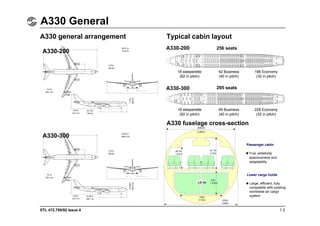
A330 general arrangement
A330-300
A330-200
1.2
Typical cabin layout
256 seats
A330-200
18 sleeperette
(62 in pitch)
42 Business
(40 in pitch)
196 Economy
(32 in pitch)
295 seats
A330-300
18 sleeperette
(62 in pitch)
49 Business
(40 in pitch)
228 Economy
(32 in pitch)
A330 fuselage cross-section
STL 472.755/92 Issue 4
A330 General
• The medium to long-range A330 is an all-new, wide-
body, twin-engine, twin-aisle aircraft.
• The design combines high technology developed for
the A320 and A340 with the wide experience gained
from the A300 and A310 aircraft currently in world-
wide service.
- two-man crew operation with CRT displays
- electrically signalled flight controls
- sidestick controllers
- full authority digital engine control (FADEC)
- centralized maintenance system.
• Since it’s introduction in December 1993 the aircraft is
the most advanced medium to long-range airliner
offering a major stride forward in airline profitability.
• Certification basis includes :
- JAR 25 at change 13
- JAR AWO at change 1 for CAT II and CAT III and
autoland.
- ICAO annex 16 chapter 3 for noise.
MTOW*
MLW
MZFW
Max fuel capacity
Max operating
altitude
Powerplants
Design speeds
Vmo/Mmo
Underfloor cargo
230 000 kg
180 000 kg
168 000 kg
139 090 lit
41 100 ft
GE CF6-80E1A4
70 000 lb
RR Trent 772
71 100 lb
PW 4168
68 000 lb
330 kt CAS/0.86
From 27LD3 to
3LD3 + 8 pallets
+ bulk 19.7 m3
217 000 kg
179 000 kg
169 000 kg
97 170lit
41 100 ft
GE CF6-80E1A2
67 500 lb
RR Trent 768 / 772
67 500 lb / 71 100 lb
PW 4164 / 4168
64 000 lb / 68 000 lb
330 kt CAS/0.86
32/33LD3/11 pallets
+ bulk 19.7 m3
A330-300
A330-200
* Max ramp weight 900 kg higher than MTOW
Basic data
1.3
Introduction
As with the A319, A320, A321 and A340, it will
incorporate all of the following features :
STL 472.755/92 Issue 4
A330 General
1.4
Aircraft design specifications
1. Design weights (see page 1.3)
2. Design speeds
VMO = 330 kt CAS
MMO = 0.86
VD = 365 kt CAS
MD = 0.93
VB = 260 kt CAS
MB = 0.78
VLO (landing gear) extension
retraction
VLE (Landing gear extended)
3. Slat and flap design speeds
250 kt CAS
0
1
1
2
3
Full
Climb/cruise/holding
Holding
Take-off
Approach
Take-off
Take-off/approach
Landing
0
1
1 + F
1*
2
3
Full
-
240
215
205
196
186
180
Lever
position
Function Config.
No.
Design speed
VFE kt (CAS)
4. Structural life (design aims)
The objectives for primary structure fatigue life are as
follows based on average block time of 4 hours :
- design life goal …………………………. 20000 flights
- threshold for initial inspection ………… 8 750 flights
5. Landing gear
The design aim is 25000 cycles safe life operation in
accordance with FAR and JAR.
6. Cabin pressure
Max nominal operational
differential pressure
Actuating cabin pressure
of discharge valve
Max relief valve overpressure
Max negative differential
pressure
574 mb ±7 mb
610 mb ± 7 mb
638 mb
- 70 mb
8.33 psi ± 0.1 psi
8.85 psi ± 0.1 psi
9.25 psi
1.00 psi
STL 472.755/92 Issue 4
A330 General
Aircraft design specifications
11 095
11 095
964
964
1 646
10 980
36 745
8. Pavement strength
Max ramp weight and max aft CG.
A330-200
A330-300
Cat A
61
56
Cat B
66
61
Cat C
77
71
Cat D
105
95
Cat A
52
48
Cat B
61
55
Cat C
73
65
Cat D
85
76
Rigid pavement
Flexible pavement
ACN
Tyres radial - main gear 1400 mm x 530 mm x R23
- nose gear 1050 mm x 395 mm x R16
1.5
Inner tank LH
Inner tank RH
Outer tank LH
Outer tank RH
Center tank
Trim tank
Total
42 000
42 000
3 650
3 650
6 230
41 560
139 090
Litres US gallons Litres US gallons
7. Fuel capacity
A330-300
A330-200
41 904
41 904
3 624
3 624
6 230
-
97 286
11 070
11 070
957
957
1 646
-
25 700
STL 472.755/92 Issue 4
A330 General
Weight and balance
A330-200 CG limits A330-300 CG limits
1.6
STL 472.755/92 Issue 4
A330 General
1.7
Minimum turning radius
Towing
The A330 can be towed or pushed up to a nosewheel
angle of 78° from the aircraft centre line at all weights up
to maximum ramp weight without disconnecting the
steering.
Taxiing
Minimum turning radii (with tyre slip) and minimum
pavement width for 180° turn are as shown.
Y
A
R3
R4
R5
R6
Meter
4.72
34.27
23.24
36.29
29.26
32.89
(Feet)
15.478
112.4
76.26
119.04
96.07
107.91
Meter
11.65
43.58
25.62
42.99
31.20
36.45
(Feet)
38.23
143.0
84.06
141.06
102.37
119.6
Type of turn 2
Effective turn angle
62.3°
Type of turn 1
Effective turn angle
78°
X = 22.19 m / 72.8 ft
Type of turn 1 : Asymmetric thrust differential braking (pivoting on one main gear)
Type of turn 2 : Symmetric thrust no braking
A330-200
X = 27.50 m / 90.23 ft
Y
A
R3
R4
R5
R6
(Feet)
15.53
125.1
86.9
120.9
106.2
113.5
Meter
12.10
47.16
26.78
43.36
34.26
38.01
(Feet)
39.7
154.7
94.3
142.3
112.4
124.7
Type of turn 2
Effective turn angle
64.5°
Type of turn 1
Effective turn angle
77.95°
A330-300
Meter
5.342
38.13
26.49
36.96
32.37
34.60
Ground maneuvre capability
R6
Outside
face of tire
Min. turning width
for 180° turn
Effective
turn angle
10,684m
A
Y
R4
R5
R3
STL 472.755/92 Issue 4
2. Flight deck layout
2.1
STL 472.755/92 Issue 4
A330 flight deck layout
2.2
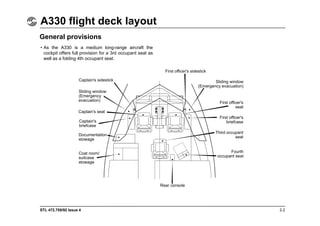
• As the A330 is a medium long-range aircraft the
cockpit offers full provision for a 3rd occupant seat as
well as a folding 4th occupant seat.
General provisions
Captain's sidestick
Sliding window
(Emergency
evacuation)
Captain's seat
Captain's
briefcase
Documentation
stowage
Coat room/
suitcase
stowage
Rear console
Fourth
occupant seat
Third occupant
seat
First officer's
briefcase
First officer's
seat
Sliding window
(Emergency evacuation)
First officer's sidestick
STL 472.755/92 Issue 4
A330 flight deck layout
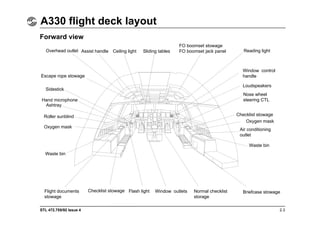
Forward view
2.3
Overhead outlet Assist handle Ceiling light Sliding tables
FO boomset stowage
FO boomset jack panel Reading light
Window control
handle
Loudspeakers
Nose wheel
steering CTL
Checklist stowage
Oxygen mask
Air conditioning
outlet
Waste bin
Normal checklist
storage
Briefcase stowage
Window outlets
Flash light
Checklist stowage
Flight documents
stowage
Waste bin
Oxygen mask
Roller sunblind
Ashtray
Hand microphone
Sidestick
Escape rope stowage
STL 472.755/92 Issue 4
A330 flight deck layout
2.4
Rear view : right aft corner
Rear view : left aft corner
RAIN REPELLENT BOTTLE
(OPTION)
OXY MASK
LIFE VEST
3rd
OCCUPANT
CONSOLE
OXY MASK
LIFE VEST
JACK PANEL
HEADSET
BOOMSET
4th OCCUPANT
CONSOLE
AXE
STL 472.755/92 Issue 4
A330 flight deck layout
Visibility
• Windows are designed to meet or exceed the
Aerospace standard.
• Geometry :
- windshield panels : flat glass
- lateral windows : curved acrylic.
Pilots’ vision envelope
2.5
140 130 120 110 100 90 80 70 60 50 40 30 20 10 0 10 20 30 40 50°
50°
40
30
20
10
0
10
20
30
Wingtip
visible
Pilot’s axis
Downward visibility in
the pilot axis : 20°
Aerospace standard 580 B
Binocular vision
Pilots’ field of vision
STL 472.755/92 Issue 4
A330 flight deck layout
2.6
Pilots’ field of vision
Pilot’s eye position
25°
19°20’
7ft 10.7in
2.40m
45ft 1.3in
13.75m
21ft 10.6in
6.67m
Max. aft vision
with head rotated
about spinal column
111°
135°
115°
135°
Pilot’s eye position
62°
42°
30°
36°
42°
62°
30°
36°
1ft 9in
0.53m
With head
moved 5 inches
outboard
STL 472.755/92 Issue 4
A330 flight deck layout
2.7
Pilots’ field of vision - landing
configuration CAT II DH = 100 ft
• This geometry improves external aircraft monitoring,
thereby increasing safety standards.
- Downward visibility in the pilot axis is 20°.
- Wing tips are visible from respective pilot stations.
Aircraft
A330-200
m (ft)
A330-300
m (ft)
θ
5°
2.1°
A
39.7
(132)
38.2
(127)
V
120
(394)
120
(394)
0
150
(493)
120
(394)
RVR
270
(887)
240
(788)
SVR
273
(897)
243
(798)
20° cockpit
cut-off angle
2.1°pitch Pilot’s eyes
C
B
V (Visual segment) O (Obscured)
θ
100ft
30m
A
SVR
RVR
STL 472.755/92 Issue 4
A330 flight deck layout
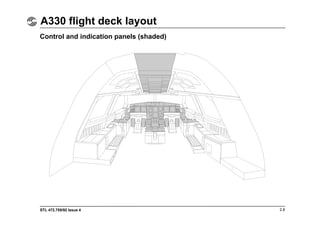
Control and indication panels (shaded)
2.8
STL 472.755/92 Issue 4
A330 flight deck layout
2.9
• The main features are common with those developed for
the A320 and A340 families :
• The other features evolve directly from the concepts
introduced with the A300/A310 family :
- sidestick controllers which leave the main instrument
panel unobstructed
- six display units (DU) interchangeable, switchable and
integrated into the same system architecture
(EFIS/ECAM).
- ergonomic layout of panels, synoptically arranged
according to frequency of use (normal, abnormal,
emergency) within easy reach and visibility for both crew
members
- philosophy of panels (e.g., “lights out” philosophy for
overhead panel)
- principles of presentation of information (“need to know”
concept)
- monitoring of systems through an Electronic Centralized
Aircraft Monitor (ECAM)
- coherent system of colour coding for EFIS, ECAM and
panel lights.
Main features
STL 472.755/92 Issue 4
A330 flight deck layout
2.10
Sidestick arrangement
• Sidesicks are installed on the Captain’s and First
Officer’s forward lateral consoles.
• A dual pivot adjustable armrest behind each sidestick to
facilitate control is fitted on each seat, with position
indicators.
The handgrip includes two switches :
- A/P disconnect/sidestick priority push-button
- Push-to-talk button
Pitch adjustment
Position indicator
Neutral
Radio
Take-over PB
(A/P disconnection or take-over
from opposite sidestick)
STL 472.755/92 Issue 4
A330 flight deck layout
• Moving the sidestick results in “setting the aircraft
trajectory” with a certain level of “g” for the requested
manoeuvre depending on the amount of sidestick
movement.
• Accuracy of movements is very precise since
backlash and friction are negligible.
2.11
• Control of the flight path is performed by the Electronic
Flight Control System (EFCS) which links the
trajectory order with aerodynamic data to stabilize the
aircraft and protect it from prohibited attitudes.
Sidestick released :
return to neutral
Sidestick released :
return to neutral
10 10
10 10
10 10
10 10
10 10
10 10
10 10
10 10
Sidestick operation
STL 472.755/92 Issue 4
A330 flight deck layout
2.12
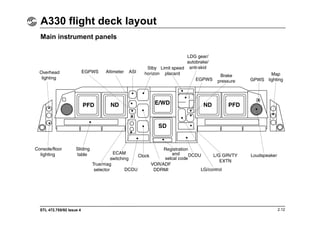
Main instrument panels
STL 472.755/92 Issue 4
A330 flight deck layout
2.13
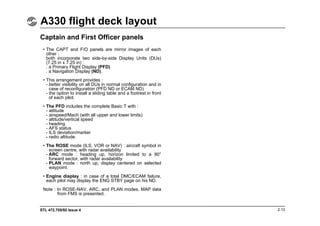
Captain and First Officer panels
• The CAPT and F/O panels are mirror images of each
other :
both incorporate two side-by-side Display Units (DUs)
(7.25 in x 7.25 in) :
. a Primary Flight Display (PFD)
. a Navigation Display (ND).
• This arrangement provides :
- better visibility on all DUs in normal configuration and in
case of reconfiguration (PFD ND or ECAM ND)
- the option to install a sliding table and a footrest in front
of each pilot.
• The PFD includes the complete Basic T with :
- attitude
- airspeed/Mach (with all upper and lower limits)
- altitude/vertical speed
- heading
- AFS status
- ILS deviation/marker
- radio altitude.
• The ROSE mode (ILS, VOR or NAV) : aircraft symbol in
screen centre, with radar availability
- ARC mode : heading up, horizon limited to a 90°
forward sector, with radar availability
- PLAN mode : north up, display centered on selected
waypoint.
• Engine display : in case of a total DMC/ECAM failure,
each pilot may display the ENG STBY page on his ND.
Note : In ROSE-NAV, ARC, and PLAN modes, MAP data
from FMS is presented.
STL 472.755/92 Issue 4
A330 flight deck layout
2.14
STL 472.755/92 Issue 4
A330 flight deck layout
2.15
Main centre panel
The centre panel groups :
- two DUs, one above the other, which are
interchangeable with the CAPT and F/O DUs :
• Engine Display (DU 1), showing :
- the main engine parameters (N1, EGT, N2 for GE
engines ;
EPR, EGT, N1, N2 for PW engines ; (EPR, TGT, N1,
N3 for RR engines)
- N1 (EPR) limit, N1 (EPR) command
- total fuel
- the flaps and slats position
- memo and warning
• System Display (DU 2) showing :
- an aircraft system synoptic diagrams page
- or the aircraft status (list of all operationally significant
items)
- standby instruments
- landing gear control and indications (including brakes)
- clock.
STL 472.755/92 Issue 4
A330 flight deck layout
2.16
Glareshield
• The Flight Control Unit (FCU) provides short-term
interface between the Flight Management and
Guidance Computer (FMGC) and crew for :
- engagement of A/P, A/THR
- selection of required guidance modes
- manual selection of flight parameters SPD, MACH,
ALT, V/SPD, HDG or track.
• The EFIS control panels for :
- selection of desired ND modes (ROSE-ILS, -VOR, -
NAV, ARC, PLAN, ENG) and ranges
- selection of baro settings.
• The master warning, master caution, autoland and
sidestick priority lights.
STL 472.755/92 Issue 4
A330 flight deck layout
2.17
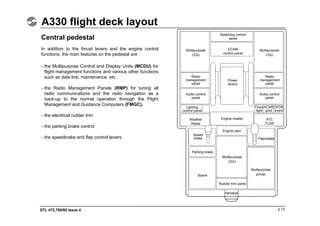
- the Multipurpose Control and Display Units (MCDU) for
flight management functions and various other functions
such as data link, maintenance, etc.
- the Radio Management Panels (RMP) for tuning all
radio communications and the radio navigation as a
back-up to the normal operation through the Flight
Management and Guidance Computers (FMGC).
- the electrical rudder trim
- the parking brake control
- the speedbrake and flap control levers.
Engine start
Rudder trim panel
Space
Multipurpose
printer
Handset
Flaps/slats
Multipurpose
CDU
Multipurpose
CDU
Multipurpose
CDU
Radio
management
panel
Radio
management
panel
Audio control
panel
Audio control
panel
Lighting
control panel
Flood
light
ACMS
print
DFDR
event
Parking brake
ATC
TCAS
Engine master
Speed
brake
Weather
Radar
Switching control
panel
ECAM
control panel
Power
levers
In addition to the thrust levers and the engine control
functions, the main features on the pedestal are :
Central pedestal
STL 472.755/92 Issue 4
A330 flight deck layout
2.18
Overhead panel
• The overhead panel has a “single slope”.
• All controls on the overhead panel can be reached by either
pilot.
• Two main zones are separated by protective padding.
• The push-button philosophy is identical to that already
applied on existing Airbus aircraft.
- Forward zone :
- for most frequently used functions
- for system controls : arranged in three main rows :
- centre row for engine-related systems arranged in a
logical way
- lateral rows for other systems.
- Aft zone, not used in flight, mainly for a small
maintenance panel corresponding to some maintenance
controls.
RCDR Oxygen
Space
Reset
panel
Reading
light
Space
ADIRS
APU Fire
Flight control
Fuel
EVAC
Emer elec
GPWS
Calls
Rain Wiper
RPLNT
EXT
lighting
Interior
lighting
Signs
Anti ice Cabin press
A
P
U
Wiper Rain
RPLNT
Engine start
Ventilation
Cargo smoke
Cargo
air cond.
Audio control
panel
Radio managt
panel
CVR panel
Space
Reset
panel
Reading
light
Space
Space
Space
Maintenance panel
Light
Engine Fire
Hydraulic power
Fuel
Electrics
Air conditioning
Flight control
STL 472.755/92 Issue 4
3. Electrical system
3.1
STL 472.755/92 Issue 4
A330 electrical system
3.2
Electrical power generation
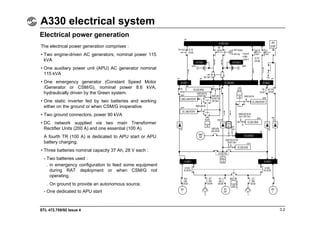
The electrical power generation comprises :
• Two engine-driven AC generators, nominal power 115
kVA
• One auxiliary power unit (APU) AC generator nominal
115 kVA
• One emergency generator (Constant Speed Motor
/Generator or CSM/G), nominal power 8.6 kVA,
hydraulically driven by the Green system.
• One static inverter fed by two batteries and working
either on the ground or when CSM/G inoperative.
• Two ground connectors, power 90 kVA
• DC network supplied via two main Transformer
Rectifier Units (200 A) and one essential (100 A).
A fourth TR (100 A) is dedicated to APU start or APU
battery charging.
• Three batteries nominal capacity 37 Ah, 28 V each :
- Two batteries used :
- One dedicated to APU start
. in emergency configuration to feed some equipment
during RAT deployment or when CSM/G not
operating.
. On ground to provide an autonomous source.
STL 472.755/92 Issue 4
A330 electrical system
3.3
Distribution - normal configuration
TR 1
28 V
50 A
DC 1
STAT
INV
ELEC
DC
AC1
ESS TR
28 V
50 A
DC ESS
AC1
TR 2
28 V
50 A
DC 2
AC2
APU TR
25 V
100 A
AC2
DC APU
DC BAT
BAT 1
25 V
5 A
BAT 2
26 V
0 A
APU BAT
25 V
5 A
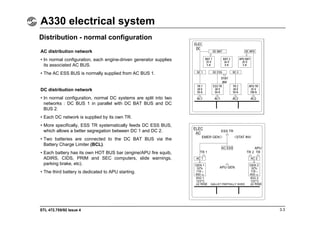
AC distribution network
• In normal configuration, each engine-driven generator supplies
its associated AC BUS.
• The AC ESS BUS is normally supplied from AC BUS 1.
DC distribution network
• In normal configuration, normal DC systems are split into two
networks : DC BUS 1 in parallel with DC BAT BUS and DC
BUS 2.
• Each DC network is supplied by its own TR.
• More specifically, ESS TR systematically feeds DC ESS BUS,
which allows a better segregation between DC 1 and DC 2.
• Two batteries are connected to the DC BAT BUS via the
Battery Charge Limiter (BCL).
• Each battery has its own HOT BUS bar (engine/APU fire squib,
ADIRS, CIDS, PRIM and SEC computers, slide warnings,
parking brake, etc).
• The third battery is dedicated to APU starting.
STL 472.755/92 Issue 4
TOTAL
LOSS OF
ALL MAIN
GEN
A330 electrical system
3.4
Distribution - abnormal configurations
Generator failure
- if one generator fails, another will automatically take over :
• if APU operative, APU generator will take over
• if APU generator not available, the other engine generator
will take over.
- In case of total loss of all main generators :
• the EMER GEN will deliver 8.6 kVA since the Green
hydraulic system is still powered by engine-driven pumps
or
- In case of loss of all engines :
• the EMER GEN will deliver 3.5 kVA since the Green
hydraulic system is then powered by the RAT ; in this
case the batteries take over when slats are extended.
TR failure
- if one TR fails, the other will automatically take over its
corresponding DC network via DC BAT BUS,
- In case of double TR failure :
• TR 1 and 2 : DC BUS 1 and DC BUS 2 are lost
• TR 1 (or 2) and ESS TR : The remaining TR supplies
DC BUS 1 + 2 and DC BAT BUS ; the DC ESS BUS is
lost.
TR 1
0 V
0 A
DC 1
SHED
LND RCVRY
ELEC
DC
AC1
ESS TR
0 V
100 A
DC ESS
EMER GEN
TR 2
0 V
0 A
DC 2
AC2
APU TR
0 V
0 A
AC2
DC APU
DC BAT
BAT 1
25 V
0 A
BAT 2
26 V
0 A
APU BAT
25 V
0 A
STL 472.755/92 Issue 4
A330 electrical system
3.5
Control and display
Overhead panel
ECAM
FAULT
OFF/R
BAT1
FAULT
OFF/R
BAT2
FAULT
OFF/R
APU BAT
FAULT
OFF
GALLEY
A
U
T
O
OFF
COMMERCIAL
26.8
BAT
1
2
APU
FAULT
OFF
FAULT
OFF/R
IDG
GEN
1
FAULT
ALTN
AC ESS FEED
E
L
E
C
AC ESS BUS
AC BUS 1
FAULT
OFF
FAULT
OFF/R
IDG 2
GEN
AC BUS 2 E
L
E
C
AVAIL
ON
EXT A
FAULT
OFF
APU GEN
AVAIL
AUTO
EXT B
OFF
BUS TIE
A
U
T
O
v
EMER GEN TEST MAN ON
EMER GEN
FAULT
LAND
RECOVERY
ON
A
U
T
O
EMER ELEC PWR
TR 1
28 V
50 A
DC 1
STAT
INV
ELEC
DC
AC1
ESS TR
28 V
50 A
DC ESS
AC1
TR 2
28 V
50 A
DC 2
AC2
APU TR
25 V
100 A
AC2
DC APU
DC BAT
BAT 1
25 V
5 A
BAT 2
26 V
0 A
APU BAT
25 V
5 A
STL 472.755/92 Issue 4
A330 electrical system
3.6
Circuit - breaker monitoring
• Circuit-breakers are installed in the avionics bay area
below the cockpit.
• Circuit-breakers are monitored by the CBMU (Circuit-
Breaker Monitoring Units) which output the identification
and status of each circuit-breaker.
• A specific C/B page is provided on the ECAM.
• Computer resets can be performed via system controls.
C/B
ECMU1 VOLT SNSG ………………….
SFCC1 NORM DCBUS AVAI ………...
HYD PUMP G ENG2 ………………….
ANTI ICE ENG2 ………………………..
DU SWTG CAPT ND ………………….
HYD PUMP B ENG1 …………………..
ADIRU1 155VAC ………………………
ANTI ICE PITOT 1 OR 3 ……………..
303PP …………………………………..
BUS 1/3 TIE CNTOR ………………….
ANTI ICE 1 OR 3 PHC ………………..
EXTRACT FAN AVNCS ……………….
ADIRU1 AOA1 26VAC ………………..
APU TR ………………………………….
SWTG FUEL BUS ……………………..
AUDIO ACP CAPT ……………………..
AIR BLEED VLV ENG2 ………………..
XFEED VLV ENG1 MOT1-2 …………..
X1
X3
X44
W2
S2
U15
C8
D10
715VU
X12
N21
J21
M80
5000VU
W15
A50
D12
C15
4XM
10CW
4JG2
2DN2
9WK1
1JB
4FP1
4DA1
9PB
10PC1
2DA3
1HQ
5FP1
3PU3
8PR
4RN1
3HA2
40E1
STL 472.755/92 Issue 4
4. Hydraulic system
4.1
STL 472.755/92 Issue 4
A330 hydraulic system
4.2
Architecture
*
STL 472.755/92 Issue 4
A330 hydraulic system
4.3
General
• Three fully independent systems : Green, Blue, Yellow
(nominal pressure at 3000 psi).
• Normal operation :
They are managed by the HSMU (Hydraulic System
Monitoring Unit) which ensures all autofunctions (electrical
pumps, RAT, monitoring, etc) ; manual override is
available on the overhead panel.
- one handpump on the Yellow system for cargo doors
operation when no electrical power is available.
• Abnormal operation :
ELEC
OVHT
GREEN
3000
LO AIR
PRESS
OVHT
1
ELEC
BLUE
3000
1
ELEC
YELLOW
3000
2
PTU
GREEN
2
PSI
RAT
5600
RPM
HYD
- four engine-driven pumps, two of which are for the
Green system
- three electrical pumps that can act automatically as back-
up
- in the event of one engine failure, the Green
electrical pump runs automatically for 25 seconds
when landing gear lever is selected up.
- in the event of engine 2 failure, the Yellow electrical
pump runs automatically when flaps are not
retracted.
- In the event of both engine failure, RAT deployment
will be automatically controlled by the HSMU to
pressurize the Green system.
STL 472.755/92 Issue 4
5. Flight controls
5.1
STL 472.755/92 Issue 4
A330 flight controls - EFCS
5.2
Electronic Flight Control System (EFCS)
Surfaces :
• all hydraulically activated
• all electrically controlled
• mechanical back-up control :
- rudder
- Trimmable Horizontal Stabilizer
Slats Spoilers
Ailerons
Flaps
Trimmable
Horizontal
Stabiliser (THS)
Elevators
Rudder
STL 472.755/92 Issue 4
A330 flight controls - EFCS
5.3
General
The A330 fly-by-wire system is being designed to make
this new aircraft more cost effective, safer and more
pleasant to fly, and more comfortable to travel in than
conventional aircraft.
Basic principles
• A330 flight control surfaces are all :
- electrically controlled
- hydraulically activated
• Stabilizer and rudder can be mechanically controlled.
• Sidesticks are used to fly the aircraft in pitch and roll
(and indirectly through turn coordination, in yaw).
• Pilot inputs are interpreted by the EFCS computers for
moving the flying controls as necessary to achieve the
desired pilot commands.
• Regardless of pilot inputs, the computers will prevent :
- excessive maneuvres
- exceedance of the safe flight envelope.
STL 472.755/92 Issue 4
A330 flight controls - EFCS
5.4
Computers
• three flight control primary computers (PRIM) which can
process all three types of control laws (Normal,
Alternate, Direct)
• two flight control secondary computers (SEC) which can
process the Direct Control Law.
These computers perform additional functions including :
• speebrakes and ground spoiler command
• characteristic speed computation (PRIM only).
High-lift devices are commanded by two Slat/Flap Control
Computers (SFCC).
The SFCCs also command the aileron droop via the
primary or secondary computers.
In order to provide all required monitoring information to
the crew and to the Central Maintenance System (CMS),
two Flight Control Data Concentrators (FCDC) acquire the
outputs from the various computers to be sent to the
ECAM and Flight Data Interface Unit (FDIU). These two
FCDCs ensure the electrical isolation of the flight control
computers from the other systems.
Electrical control of the main surfaces is achieved by two
types of computers :
STL 472.755/92 Issue 4
A330 flight controls - EFCS
5.5
Power sources
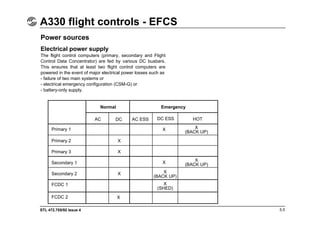
Electrical power supply
The flight control computers (primary, secondary and Flight
Control Data Concentrator) are fed by various DC busbars.
This ensures that at least two flight control computers are
powered in the event of major electrical power losses such as
- failure of two main systems or
- electrical emergency configuration (CSM-G) or
- battery-only supply.
Primary 1
Primary 2
Primary 3
Secondary 1
Secondary 2
FCDC 1
FCDC 2
AC
X
X
X
AC ESS
X
HOT
X
(BACK UP)
X
(BACK UP)
DC ESS
DC
X
X
X
(BACK UP)
X
(SHED)
Normal Emergency
STL 472.755/92 Issue 4
A330 flight controls - EFCS
5.6
Power sources
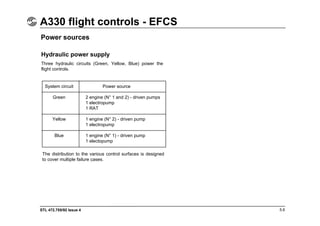
Hydraulic power supply
Three hydraulic circuits (Green, Yellow, Blue) power the
flight controls.
The distribution to the various control surfaces is designed
to cover multiple failure cases.
System circuit
Green
Yellow
Blue
Power source
2 engine (N° 1 and 2) - driven pumps
1 electropump
1 RAT
1 engine (N° 2) - driven pump
1 electropump
1 engine (N° 1) - driven pump
1 electopump
STL 472.755/92 Issue 4
A330 flight controls - EFCS
5.7
Safety objectives
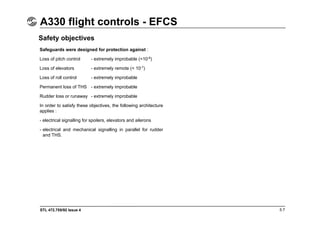
Safeguards were designed for protection against :
Loss of pitch control - extremely improbable (<10-9
)
Loss of elevators - extremely remote (< 10-7
)
Loss of roll control - extremely improbable
Permanent loss of THS - extremely improbable
Rudder loss or runaway - extremely improbable
In order to satisfy these objectives, the following architecture
applies :
- electrical signalling for spoilers, elevators and ailerons
- electrical and mechanical signalling in parallel for rudder
and THS.
STL 472.755/92 Issue 4
A330 flight controls - EFCS
5.8
Dispatch objectives
The basic objective is to allow dispatch of the aircraft with at
least one peripheral or computer failed in order to increase
the dispatch reliability without impairing flight safety.
Systems
3 IRS
2 yaw rate gyros
3 PRIM
2 SEC
3 ADR
3 IR - 2 Nz accelerometers
2 FCDC
3 PRIM/2 SEC
Electro hydraulic and electro actuators
Dispatch situation
Maximum 1 inoperative or “off”
Maximum 1 inoperative if it is not connected to 2 computers
No-go items are inboard aileron, elevator and yaw damper
actuators.
STL 472.755/92 Issue 4
A330 flight controls - EFCS
5.9
Design principles
Two types of flight control computers :
• PRIM (two channels with different software for
control/monitoring).
SEC (two channels with different software for
control/monitoring).
• Each one of these computers can perform two tasks :
- process orders to be sent to other computers as a
function of various inputs (sidestick, autopilot…)
- execute orders received from other computers so as
to control their own servo-loop.
The three primary or main computers (PRIM) :
• process all control laws (Normal, Alternate, Direct) as
the flight control orders.
• One of the three PRIM is selected to be the master ;
it processes the orders and outputs them to the other
computers PRIM 1, 2 and 3, SEC 1 and 2) which will
then execute them on their related servo-loop.
• The master checks that its orders are fulfilled by
comparing them with feedback received ; this allows
self-monitoring of the master which can detect a
malfunction and cascade control to the next
computer.
• Each PRIM is able to control up to eight servo-loops
simultaneously ; each can provide complete aircraft
control under normal laws.
The two secondary computers (SEC) :
• are able to process direct laws only
• either SEC can be the master in case of loss of all
primary computers
• each SEC can control up to 10 servo-loops
simultaneously ; each can provide complete aircraft
control.
Electrically controlled hydraulic servo-jacks can
operate in one of three control modes depending
upon computer status and type of control surface :
• Active : the servo-jack position is electrically
controlled
• Damping : the servo-jack position follows the
surface movement
• Centering : the servo-jack position is maintained
neutral.
STL 472.755/92 Issue 4
A330 flight controls - EFCS
5.10
Schematic diagram
STL 472.755/92 Issue 4
A330 flight controls - EFCS
5.11
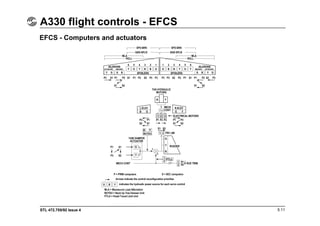
EFCS - Computers and actuators
STL 472.755/92 Issue 4
A330 flight controls - EFCS
5.12
Pitch control
STL 472.755/92 Issue 4
A330 flight controls - EFCS
5.13
Pitch control
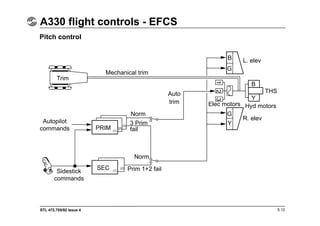
Pitch control is provided by two elevators and the THS :
- elevator deflections 30° nose up - 15° nose down
- THS deflections 14° nose up - 2° nose down.
Each elevator is actuated by two independent hydraulic
servo control units ;
L ELEV is driven by Green and Blue hydraulic jacks
R ELEV is driven by Green and Yellow hydraulic jacks
one servo control is in active mode while the other is in
damping mode.
In case of a failure on the active servo-jack, it reverts to
damping mode while the other becomes active.
In case of electrical supply failure to both servo-jacks of one
elevator, these revert to centering mode which commands a
0° position of the related elevator.
Autoflight orders are processed by one of the primary
computers.
Sidestick signals, in manual flight, are processed by either
one of PRIM 1 and 2 or SEC 1 and 2
The THS is driven by two hydraulic motors supplied by Blue
and Yellow systems ; these motors are controlled :
- either of the three electrical motors with their associated
electronics controlled by one primary computer each
- or by mechanical command from control wheels located
on the central pedestal.
The control wheels are used in case of major failure (Direct
Law or mechanical back-up) and have priority over any
other command.
STL 472.755/92 Issue 4
A330 flight controls - EFCS
5.14
Roll control
Autopilot
commands
Sidestick
commands
PRIM
(1) (2) (3)
S
EC
(1) (2)
NORM
SPLRS 2, 4 ,5
3 PRIM
FAIL
SPLRS 3, 6
G
Y
G
B
G
Y
G
B
1
2
3
4
5
6
1
2
3
4
5
6
Ailerons
hyd jacks
Spoilers
STL 472.755/92 Issue 4
A330 flight controls - EFCS
5.15
Roll control
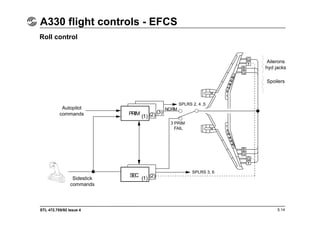
Roll control is provided two ailerons and five spoilers (2 to 6) per
wing :
- aileron deflection is ± 25°
- spoiler max deflection is -35°. Deflection is reduced in CONF 2
and 3.
Each aileron is driven by two electrically signalled servo-controls
which are connected to :
- two computers for the inboard ailerons (PRIM 1 or 2 and SEC
1 or 2)
- one computer for the outboard ailerons (PRIM 3, SEC 1 or 2)
- one servo-control is in active mode while the other is in
damping mode.
In manual mode, above 190 kt the outboard ailerons are
centered to prevent any twisting moment.
In AP mode or in certain failure cases the outboard ailerons are
used up to 300 Kt. Each spoiler is driven by one electro-
hydraulic servo-control which is connected to one specific
computer.
In the event of a failure being detected on one spoiler, the
opposite spoiler is retracted and maintained in a retracted
position.
Autopilot orders are processed by one of the primary computers.
Sidestick signals, in manual flight, are processed by either one
of the primary or secondary computers.
Note : If the RAT is deployed to provide Green hydraulic power,
the outboard ailerons servo-controls revert to damping
mode in order to minimize hydraulic demands.
STL 472.755/92 Issue 4
A330 flight controls - EFCS
5.16
Yaw control
STL 472.755/92 Issue 4
A330 flight controls - EFCS
5.17
Yaw control
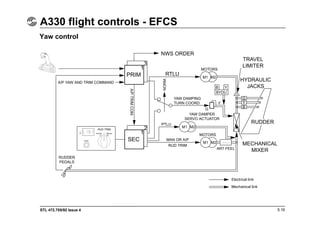
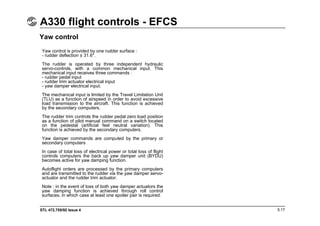
Yaw control is provided by one rudder surface :
- rudder deflection ± 31.6°.
The rudder is operated by three independent hydraulic
servo-controls, with a common mechanical input. This
mechanical input receives three commands :
- rudder pedal input
- rudder trim actuator electrical input
- yaw damper electrical input.
The mechanical input is limited by the Travel Limitation Unit
(TLU) as a function of airspeed in order to avoid excessive
load transmission to the aircraft. This function is achieved
by the secondary computers.
The rudder trim controls the rudder pedal zero load position
as a function of pilot manual command on a switch located
on the pedestal (artificial feel neutral variation). This
function is achieved by the secondary computers.
Yaw damper commands are computed by the primary or
secondary computers
In case of total loss of electrical power or total loss of flight
controls computers the back up yaw damper unit (BYDU)
becomes active for yaw damping function.
Autoflight orders are processed by the primary computers
and are transmitted to the rudder via the yaw damper servo-
actuator and the rudder trim actuator.
Note : in the event of loss of both yaw damper actuators the
yaw damping function is achieved through roll control
surfaces, in which case at least one spoiler pair is required.
STL 472.755/92 Issue 4
A330 flight controls - EFCS
5.18
Left intentionally blank
STL 472.755/92 Issue 4
A330 flight controls - EFCS
5.19
Additional functions devoted to
aileron and spoilers
Ailerons
• manoeuvre load alleviation : two pairs of ailerons
are deflected upwards - 11° max to reduce wing loads
in case of high “g” manoeuvre
• lift augmentation (aileron droop) : two pairs of
ailerons are deflected downwards to increase lift when
flaps are extended.
Spoilers
• manoeuvre load alleviation : spoilers 4, 5 and 6
• Ground spoiler functions : spoilers 1 to 6
• - 35° max for spoiler 1,
• - 50° max for spoilers 2 to 6
• Speedbrake functions : spoilers 1 to 6
• - 25° max for spoiler 1
• - 30° max for spoilers 2 to 6
• the roll demand has priority over the speedbrake
function
• the lift augmenting function has priority over the
speedbrake function
• if one spoiler surface fails to extend, the symmetrical
surface on the other wing is inhibited.
Ailerons receive commands for the following additional
functions :
Spoilers receive commands for the following additional
functions :
Six spoilers and two pairs of ailerons perform these
functions in following priority order :
STL 472.755/92 Issue 4
A330 flight controls - EFCS
5.20
Slats/flaps controls
STL 472.755/92 Issue 4
A330 flight controls - EFCS
5.21
Slats/flaps
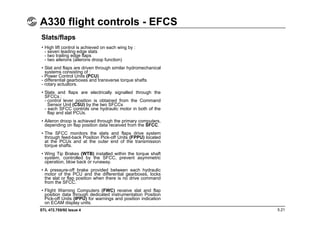
• High lift control is achieved on each wing by :
- seven leading edge slats
- two trailing edge flaps
- two ailerons (ailerons droop function)
• Slat and flaps are driven through similar hydromechanical
systems consisting of :
- Power Control Units (PCU)
- differential gearboxes and transverse torque shafts
- rotary actuators.
• Slats and flaps are electrically signalled through the
SFCCs :
- control lever position is obtained from the Command
Sensor Unit (CSU) by the two SFCCs
- each SFCC controls one hydraulic motor in both of the
flap and slat PCUs.
• Aileron droop is achieved through the primary computers,
depending on flap position data received from the SFCC.
• The SFCC monitors the slats and flaps drive system
through feed-back Position Pick-off Units (FPPU) located
at the PCUs and at the outer end of the transmission
torque shafts.
• Wing Tip Brakes (WTB) installed within the torque shaft
system, controlled by the SFCC, prevent asymmetric
operation, blow back or runaway.
• A pressure-off brake provided between each hydraulic
motor of the PCU and the differential gearboxes, locks
the slat or flap position when there is no drive command
from the SFCC.
• Flight Warning Computers (FWC) receive slat and flap
position data through dedicated instrumentation Position
Pick-off Units (IPPU) for warnings and position indication
on ECAM display units.
STL 472.755/92 Issue 4
A330 flight controls - EFCS
5.22
Controls and displays
PFD
F/O
ECAM
ENGINE-
WARNING
ECAM
SYSTEM -
WARNING
SIDE STICK PRIORITY
OFF OFF OFF
FAULT FAULT FAULT
PRIM 2 SEC 2
FLT CTL
PRIM 3
F/O
RUD TRIM
NOSE
L
NOSE
R
RESET
L 19.7
FLAPS
0 0
1 1
2 2
3 3
FULL FULL
STL 472.755/92 Issue 4
A330 flight controls - EFCS
5.23
Controls and displays
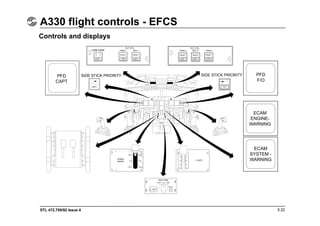
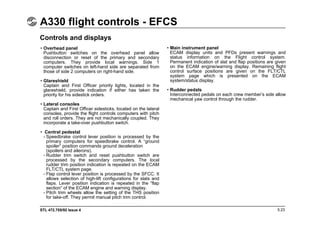
• Overhead panel
Pushbutton switches on the overhead panel allow
disconnection or reset of the primary and secondary
computers. They provide local warnings. Side 1
computer switches on left-hand side are separated from
those of side 2 computers on right-hand side.
• Glareshield
Captain and First Officer priority lights, located in the
glareshield, provide indication if either has taken the
priority for his sidestick orders.
• Lateral consoles
Captain and First Officer sidesticks, located on the lateral
consoles, provide the flight controls computers with pitch
and roll orders. They are not mechanically coupled. They
incorporate a take-over pushbutton switch.
• Central pedestal
- Speedbrake control lever position is processed by the
primary computers for speedbrake control. A “ground
spoiler” position commands ground deceleration
(spoilers and ailerons).
- Rudder trim switch and reset pushbutton switch are
processed by the secondary computers. The local
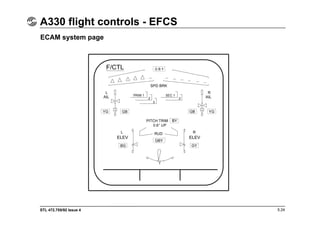
rudder trim position indication is repeated on the ECAM
FLT/CTL system page.
- Flap control lever position is processed by the SFCC. It
allows selection of high-lift configurations for slats and
flaps. Lever position indication is repeated in the “flap
section” of the ECAM engine and warning display.
- Pitch trim wheels allow the setting of the THS position
for take-off. They permit manual pitch trim control.
• Main instrument panel
ECAM display units and PFDs present warnings and
status information on the Flight control system.
Permanent indication of slat and flap positions are given
on the ECAM engine/warning display. Remaining flight
control surface positions are given on the FLT/CTL
system page which is presented on the ECAM
system/status display.
• Rudder pedals
Interconnected pedals on each crew member’s side allow
mechanical yaw control through the rudder.
STL 472.755/92 Issue 4
A330 flight controls - EFCS
5.24
ECAM system page
STL 472.755/92 Issue 4
A330 flight controls - EFCS
5.25
Control law introduction
• Flight through computers
Depending upon the EFCS status, the control law is :
According to number and nature of subsequent
failures, it automatically reverts to :
- Alternate Law, or
- Direct Law.
• Mechanical back-up
During a complete loss of electrical power the aircraft
is controlled by :
- longitudinal control through trim wheel
- lateral control from pedals.
Overall Normal LAW schematic
- Normal Law (normal conditions even after single
failure of sensors, electrical system, hydraulic
system or flight control computer).
STL 472.755/92 Issue 4
A330 flight controls - EFCS
5.26
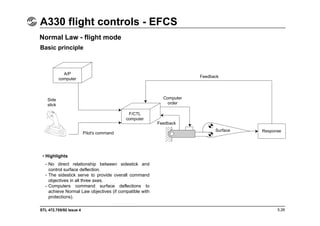
Normal Law - flight mode
Basic principle
- No direct relationship between sidestick and
control surface deflection.
- The sidestick serve to provide overall command
objectives in all three axes.
- Computers command surface deflections to
achieve Normal Law objectives (if compatible with
protections).
• Highlights
STL 472.755/92 Issue 4
A330 flight controls - EFCS
5.27
Normal Law - flight mode
Objectives
• Pitch axis :
Sidestick deflection results in a change of vertical
load factor.
The normal law elaborates elevator and THS orders so
that :
- a stick movement leads to a flight path variation
- when stick is released, flight path is maintained without
any pilot action, the aircraft being automatically
trimmed.
• Lateral axis : Sidestick deflection results in initiating
roll rate.
Roll rate demand is converted into a bank angle demand.
The Normal Law signals roll and yaw surfaces to achieve
bank angle demand and maintain it - if less than 33° -
when the stick is released.
Pedal deflection results in sideslip and bank angle (with a
given relationship).
Pedal input - stick free - results in stabilized sideslip
and bank angle (facilitates de-crabbing in crosswind).
• Adaptation of objectives to :
- Ground phase : ground mode
. Direct relationship between stick and elevator available
before lift-off and after touch-down.
. Direct relationship between stick and roll control
surfaces.
. Rudder : mechanical from pedals + yaw damper
function.
. For smooth transition, blend of ground phase law and
load factor (Nz) command law at take off.
- Flight phase : flight mode
The pitch normal law flight mode is a load factor demand
law with auto trim and full flight envelope protection. The
roll normal law provides combined control of the
ailerons, spoilers 2 to 6 and rudder.
- Landing phase : flare mode
. To allow conventional flare.
. Stick input commands a pitch attitude increment to a
reference pitch attitude adjusted as a function of radio
altitude to provide artificial ground effect.
STL 472.755/92 Issue 4
A330 flight controls - EFCS
5.28
Normal Law - flight mode
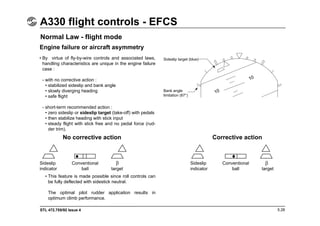
Engine failure or aircraft asymmetry
• By virtue of fly-by-wire controls and associated laws,
handling characteristics are unique in the engine failure
case :
- with no corrective action :
• stabilized sideslip and bank angle
• slowly diverging heading
• safe flight
- short-term recommended action :
• zero sideslip or sideslip target (take-off) with pedals
• then stabilize heading with stick input
• steady flight with stick free and no pedal force (rud-
der trim).
• This feature is made possible since roll controls can
be fully deflected with sidestick neutral.
The optimal pilot rudder application results in
optimum climb performance.
No corrective action Corrective action
β
β
STL 472.755/92 Issue 4
A330 flight controls - EFCS
5.29
Normal Law - flight mode
Main operational aspects and benefits
• Automatic pitch trim
• Automatic elevator to compensate turns up to 33° bank
• Aircraft response almost unaffected by speed, weight
or center of gravity location
• Bank angle resistance to disturbance stick free
• Precise piloting
• Turn coordination
• Dutch roll damping
• Sideslip minimization
• Passenger comfort
• Reduced pilot, workload
• Increased safety
• Protection does not mean limitation of pilot authority.
Full pilot authority prevails within the normal flight
envelope.
• Whatever the sidestick deflection is, computers have
scheduled protections which overcome pilot inputs to
prevent :
- excessive load factors (no structural overstressing)
- significant flight envelope exceedances :
• speed overshoot above operational limits
• stall
• extreme pitch attitude
• extreme bank angle.
Normal Law - protections
Load factor protection
• Design aim
To minimize the probability of hazardous events when
high manoeuvrability is needed.
• Load factor limitation at :
+ 2.5 g, -1 g for clean configuration
+ 2 g, 0 g when slats are extended.
Rapid pull-up to 2.5 g is immediately possible.
STL 472.755/92 Issue 4
A330 flight controls - EFCS
5.30
High speed protection
• Design aims
To protect the aircraft against speed overshoot
above VMO/MMO.
Non-interference with flight at VMO/MMO.
• Principle
When speed or Mach number is exceeded (VMO +
6 kt/MMO + 0.01) :
- automatic, progressive, up elevator is applied
(.1 g max)
- pilot nose-down authority is reduced.
• Results
Maximum stabilized speed, nosed-down stick :
VMO + 15 kt
MMO + 0.04
High angle-of-attack protection
• Design aims
- Protection against stall
- Ability to reach and hold a high CL (sidestick fully
back), without exceeding stall angle (typically 3°/5°
below stall angle) : good roll manoeuvrability and
innocuous flight characteristics.
- Elimination of risk of stall in high dynamic manoeuvres
or gusts.
- Non-interference with normal operating speeds and
manoeuvres.
- Load factor limitation maintained.
- Bank angle limited.
- Available from lift-off to landing.
• Windshear protection
Windshear protection is ensured by
- SRS mode
- speed trend indication
- wind indication (speed and direction)
- flight path vector
- Windshear warning
- predictive windshear function of weather radar
(optional).
STL 472.755/92 Issue 4
Pitch attitude protection
• Design aim
To enhance the effectiveness of AOA and high-speed
protection in extreme conditions and in windshear
encounter.
• Principle
Pilot authority is reduced at extreme attitude.
• Result
Pitch attitude limited :
- nose-down 15°
- nose-up 30°, to 25° at low speed
Bank angle protection
- When stick is released above 33° the aircraft
automatically rolls back to 33°.
- If stick is maintained, bank angle greater than 33° will be
maintained but limited to 67°.
- When overspeed protection is triggered :
. Spiral stability is introduced regardless of bank angle
. Max bank angle is limited to 45°.
- When angle-of-attack protection is triggered, max bank
angle is limited to 45°.
Low energy warning
A low energy aural warning “SPEED SPEED SPEED” is
triggered to inform the pilot that the aircraft energy
becomes lower than a threshold under which, to recover
a positive flight path angle through pitch control, the
thrust must be increased.
A330 flight controls - EFCS
5.31
High angle-of-attack protection
• Principle
When the AOA*) is greater than AOA prot, the basic
objective defined by sidestick input reverts from
vertical load factor to AOA demand.
• Result
- AOA protection is maintained if sidestick is left
neutral.
- AOA floor results in GA power with an ensuing
reduction of AOA.
- AOA max is maintained if sidestick is deflected
fully aft.
Return to normal basic objective is achieved if the
sidestick is pushed forward.
α
α
α
α
α
α
α
*) AOA = α
STL 472.755/92 Issue 4
A330 flight controls - EFCS
5.32
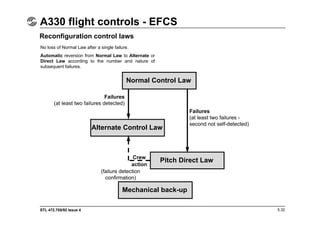
Reconfiguration control laws
No loss of Normal Law after a single failure.
Automatic reversion from Normal Law to Alternate or
Direct Law according to the number and nature of
subsequent failures.
Normal Control Law
Pitch Direct Law
Alternate Control Law
Mechanical back-up
Failures
(at least two failures -
second not self-detected)
(failure detection
confirmation)
Crew
action
Failures
(at least two failures detected)
STL 472.755/92 Issue 4
A330 flight controls - EFCS
Alternate Law
• Probability objective : 10-5
/flight hour (10-3
under
MMEL).
• No change for ground, take-off and flare mode
compared to Normal Law.
• Flight mode :
• Protections :
- pitch attitude : lost
- high speed : replaced by static stability
- high angle of attack : replaced by static stability
(Vc prot. Law)
+ aural stall warning when
α > α sw*
- low energy : lost
Direct Law
• Probability objective : 10-7
/flight hour (10-5
under
MMEL).
• No change for ground mode and take-off mode
compared to Normal Law.
• Flight mode : Maintained down to the ground
• All protections are lost
Conventional aural stall and overspeed warnings are
provided as for Alternate Law.
• Main operational aspect :
- manual trimming through trim wheel.
5.33
- Pitch axis : as per Normal Law with limited pitch rate
and gains depending on speed and CONF.
- Roll/yaw axes : Depending on failure :
1. The lateral control is similar to normal law (no
positive spiral stability is introduced).
2. Characterized by a direct stick-to-roll surface
relationship which is configuration dependent.
- in all three axes, direct relationship between stick
and elevator/roll control surfaces which is center of
gravity and configuration dependent.
STL 472.755/92 Issue 4
A330 flight controls - EFCS
5.34
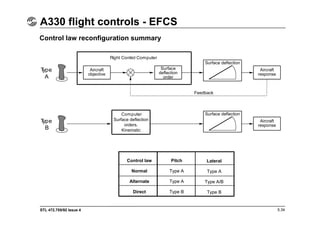
Control law reconfiguration summary
T
ype
A
Surface deflection
Aircraft
response
Surface
deflection
order
Feedback
Aircraft
objective
Flight Control Computer
T
ype
B
Surface deflection
Aircraft
response
Surface deflection
orders.
Kinematic
Computer
Control law
Normal
Alternate
Direct
Pitch
Type A
Type A
Type B
Lateral
Type A
Type A/B
Type B
STL 472.755/92 Issue 4
A330 flight controls - EFCS
5.35
Mechanical back-up
• To sustain the aircraft during a temporary complete loss of
electrical power.
• Longitudinal control of the aircraft through trim wheel.
Elevators kept at zero deflection.
• Lateral control from pedals. Roll damping is provided by the
Back up Yaw Dumper Unit (BYDU).
• Message on PFD MAN PITCH TRIM ONLY (red).
STL 472.755/92 Issue 4
A330 flight controls - EFCS
5.36
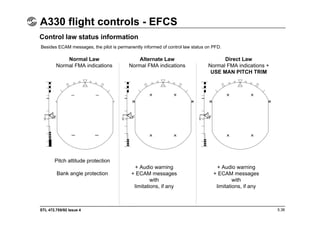
Control law status information
Besides ECAM messages, the pilot is permanently informed of control law status on PFD.
Normal Law
Normal FMA indications
Alternate Law
Normal FMA indications
Direct Law
Normal FMA indications +
USE MAN PITCH TRIM
Pitch attitude protection
Bank angle protection
+ Audio warning
+ ECAM messages
with
limitations, if any
+ Audio warning
+ ECAM messages
with
limitations, if any
STL 472.755/92 Issue 4
A330 flight controls - EFCS
5.37
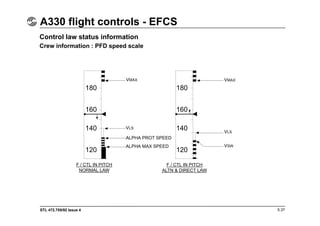
Control law status information
Crew information : PFD speed scale
STL 472.755/92 Issue 4
A330 flight controls - EFCS
5.38
Priority display logic
Captain's side First Officer'side
Annunciation
Sidestick Annunciation Sidestick
CPT
F/O
Green
“Light off”
Red
Red “Light off”
Green
Red
Red
Sidestick
deflected
Sidestick
in neutral
Take-over button
depressed
Take-over button
depressed
Take-over button
depressed
Take-over button
depressed
Sidestick
deflected
Sidestick
in neutral
STL 472.755/92 Issue 4
A330 flight controls - EFCS
5.39
Priority logic
• Normal operation : Captain and First Officer inputs are
algebrically summed.
• Autopilot disconnect pushbutton is used at take-over
button.
• Last pilot who depressed and holds take-over button has
priority ; other pilot’s inputs ignored.
• Priority annunciation :
- in front of each pilot on glareshield
- ECAM message
- audio warning.
• Normal control restored when both buttons are released.
• Jammed sidestick :
- priority automatically latched after 30 seconds
- priority reset by depressing take-over button on
previously jammed sidestick.
CHRONO
SIDE STICK PRIORITY
CAPT
CHRONO
SIDE STICK PRIORITY
F/O
STL 472.755/92 Issue 4
6. Landing gear
6.1
STL 472.755/92 Issue 4
A330 landing gear
6.2
Left intentionally blank
STL 472.755/92 Issue 4
A330 landing gear
6.3
Main features
• Conventional landing gear with single bogie nose gear
and double bogie main landing gear with direct-action
shock absorbers.
• The main landing gear is also provided with a shock
absorber extension/retraction system.
• The main gears retract laterally ; nose gear retracts
forward into the fuselage.
• Electrically controlled by two Landing Gear
Control/Interface Units (LGCIU).
• Hydraulically actuated (Green system) with alternative
free-fall/spring downlock mode.
• Alternating use of both LGCIUs for each
retraction/extension cycle. Resetting the landing gear
control lever results in transition to the other LGCIU.
• Elimitation of gear lever neutral position through
automatic depressurization of landing gear hydraulic
supply at speeds above 280 kt.
• Elimitation of microswitches by use trouble-free proximity
detectors for position sensing.
STL 472.755/92 Issue 4
A330 landing gear
6.4
AUTO/BRK
LO MED MAX
DECEL DECEL DECEL
ON ON ON
BLUE LO PR DISTRIBUTION LINE
PEDALS
TO OTHER
DUAL VALVE
GREEN
HP
ACCUMULATORS
BLUE
HP
NORMAL SELECTOR
VALVE
AUTOMATIC
SELECTOR
CONTROL VALVE
PARKING BRAKE
TO OTHER GEAR
PULL & TURN
OFF
ON
B S C U
NORMAL SERVO
VALVE
DUAL SHUTTLE
VALVE
TO OTHER
WHEELS
DUAL
VALVE
ALTERNATE
SERVO VALVE
TO ECAM
TO
OPPOSITE
WHEEL
T
A
C
H
TO OTHER
WHEELS
A/SKID &
N/W STRG
ON
OFF
312VU
ACCU PRESS
PSIX1000
BRAKES
0 4
3 3
1 1
0
STL 472.755/92 Issue 4
A330 landing gear
6.5
Braking system
• Carbon disc brakes are standard.
• Normal system (Green hydraulic system supply) :
- electrically signalled through antiskid valves
- individual wheel antiskid control
- autobrake function
- automatic switchover to alternate system in event of
Green hydraulic supply failure.
• Alternate braking system with antiskid (Blue hydraulic
system supply) :
- electrically signalled through alternate servovalves
- hydraulically controlled through dual valve
- individual wheel antiskid control
- no autobrake function.
• Alternate braking system without anti-skid (Blue
hydraulic system supply or Blue brake power
accumulator) :
- hydraulically controlled by pedals through dual valve
- brake pressure has to be limited by the pilot referring
to the gauges.
- no autobrake function
- no antiskid system
• Parking brake (Blue hydraulic system supply or Blue
brake power accumulator :
- electrically signalled
- hydraulically controlled with brake pressure indication
on gauges.
• The Braking and Steering Control Unit (BSCU) is digital
dual-channel double system (control and monitoring)
computer controlling the following functions :
- normal braking system control
- anti-skid control (normal and alternate)
- autobrake function with LO, MED, MAX.
- nosewheel steering command processing
- brake temperature signal processing
- monitoring of all these functions.
STL 472.755/92 Issue 4
A330 landing gear
Antiskid system schematic
6.6
DECEL DECEL DECEL
ON ON ON
LO MED MAX
AUTO/BRK
A/C LONGITUDINAL
DECELERATION
(ADIRU)
A/C SPEED
AFTER IMPACT
(WHEEL SPEED)
γ ir Vo γ prog
Vo - ir .t
γ Vo - prog .t
γ
HIGHEST VALUE
OFF ON
AUTO BRAKE
V ref
+
- + -
RELEASE
ORDER
RELEASE
ORDER
IF WHEEL SPD
<0.88 V ref
OR
BLUE
HYD
GREEN
AUTOMATIC
SELECTOR
NORMAL
SERVO
VALVE
ALTERNATE
SERVO
VALVE
NORMAL
SERVO
VALVE
WHEEL
SPEED
WHEEL
SPEED
BSCU
STL 472.755/92 Issue 4
A330 landing gear
6.7
Antiskid system
• From touchdown, aircraft speed is computed based on
touchdown speed (wheels) and integrated deceleration
(ADIRS). This reference speed is compared with each
wheel speed to generate a release order for closing
the normal servovalve in case of skid exceeding 16%.
• Brake pedal orders open this servovalve which is also
modulated by anti-skid closing signals.
Autobrake system
• From touchdown, a specific speed is computed based
on touchdown speed (wheels) and programmed
deceleration (low, medium, max). This programmed
speed is compared with each wheel speed to generate
a release order for closing the normal servovalve to
meet selected deceleration.
• If the reference speed exceeds programmed speed
(contaminated or iced runways), the former will take
over for the antiskid to modulate the normal servovalve.
Braking principle
STL 472.755/92 Issue 4
A330 landing gear
6.8
Nose gear steering principle
D
I
SC
DIS
C
P
E
DALS PED
A
L
S
70
50 30 10
10
3
0
50
70
70
50
3
0
10
10
30 50
70
P
R
I
M AUTO PILOT
NOSE
GEAR
STEERING SERVO
VALVE
STEERING
SELECTOR
VALVE
NWS ANGLE
GEEN POWER
FROM NOSE GEAR
DOORS CLOSING
CIRCUIT (WHEN
DOORS ARE CLOSED)
CHANNEL 1
LGCIU 1/2
2
AND
OPEN
BSCU
A/SKID &
N/W STRG
ON
NON TOWING POSITION
OFF
ON
OFF
NLG DOWNLOCKED AND
COMPRESSED
NLG DOWNLOCKED AND
BOOGIES IN GROUND POS
ENG
STL 472.755/92 Issue 4
A330 landing gear
6.9
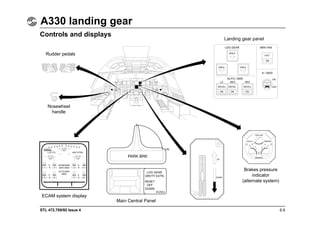
Controls and displays
Rudder pedals
Nosewheel
handle
STL 472.755/92 Issue 4
A330 landing gear
6.10
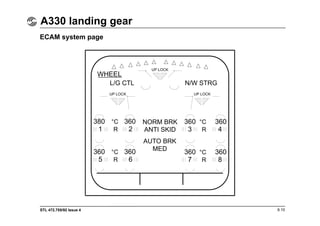
ECAM system page
STL 472.755/92 Issue 4
7. Fuel system
7.1
STL 472.755/92 Issue 4
A330 fuel system
7.2
Basic layout
• Total fuel capacity
A330-200
A330-300
Outer tanks
7300 litres
(5730 kg)
7248 litres
(5690 kg)
Inner tanks
84 000 litres
(65940 kg)
83808 litres
(65790 kg)
Center tank
41650 litres
(32625 kg)
Trim tank
6230 litres
(4890 kg)
6230 litres
(4890 kg)
Total
139090 litres
(109185 kg)
97 286 litres
(76 370 kg)
• Ventilation
- Each wing tank and the tail tank is separately vented
though its associated vent tank.
- These vent tanks are open to the atmosphere via flame
arrestors and NACA inlets.
- Location of ducts and float valves is designed to ensure
free venting over appropriate attitude ranges during
refueling and normal ground and flight manoeuvres.
- Pressure relief outlets protext the inner tank from over-
or under-pressure in case of failure or blockage of the
vent system or pressure refueling gallery.
Tank arrangement
INNER TANK INNER TANK
CTR TANK
(for A330-200 only)
OUTER TANK OUTER TANK
INNER TANK DIVISION
VENT TANK VENT TANK
TRIM TANK
FUEL CELL
NORMAL PUMPS
STBY PUMP
EMER SPLIT VALVE
STL 472.755/92 Issue 4
A330 fuel system
7.3
The Fuel Control and Monitoring System (FCMS)
controls the fuel system automatically
Two identical Fuel Control and Monitoring Computers
(FCMC) provide :
- fuel transfer control
- aircraft gross weight and center of gravity calculation
based on zero fuel weight and zero fuel center of
gravity entered by the crew.
- center of gravity control
- refuel control
- fuel quantity measurement and indication
- level sensing
- fuel temperature indication
- signals to FADEC for IDG cooling control.
Control and monitoring
STL 472.755/92 Issue 4
A330 fuel system
7.4
Engine feed
• In normal operation, each engine is independently
supplied by two continuously operating booster pumps
located in a dedicated collector box.
In the event of a pump failure, a standby pump
automatically comes on line.
Collector boxes are maintained full by a jet pump
transfer action using booster pump pressure.
In cruise conditions, a single booster pump is able to
supply flow to both engines.
• A cross-feed valve allows the engine on either wing to
be supplied from the opposite one.
• Supply of fuel to each engine may be shut off by an
engine LP valve driven by a double motor actuator. It
is controlled by either the ENG FIRE pushbutton or
the ENG master lever.
• Automatic transfer of fuel from the outer tanks is
performed by gravity. This occurs when trim tanks
have been emptied and when either inner tank
reaches 3500 kg.
Outer tank fuel transfer valves are used to cycle the
inner tanks contents between 3500 and 4000 kg.
These valves are closed when outer tanks are empty
for 5 minutes.
• Transfer to inner tanks can be manually selected
through the OUTR TK XFR pushbutton.
When selected ON, the outer tanks fuel transfer
valves, outer and inner inlet valves are controlled
OPEN.
• For A330-200 only :
With fuel in the center tank, both CTR TK pumps are
running and the inner inlet valves are used
independently to cycle their respective inner tank
contents between underfull and high level (Underfull
is set at approximately 2000 kg below high level).
When the center tank is empty, the pumps are
automatically shut off, and both inner inlet valves
close.
STL 472.755/92 Issue 4
A330 fuel system
7.5
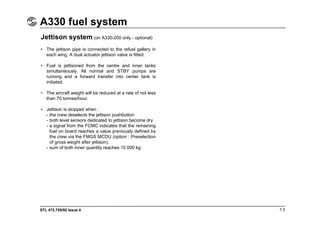
Jettison system (on A330-200 only - optional)
• The jettison pipe is connected to the refuel gallery in
each wing. A dual actuator jettison valve is fitted.
• Fuel is jettisoned from the centre and inner tanks
simultaneously. All normal and STBY pumps are
running and a forward transfer into center tank is
initiated.
• The aircraft weight will be reduced at a rate of not less
than 70 tonnes/hour.
• Jettison is stopped when :
- the crew deselects the jettison pushbutton
- both level sensors dedicated to jettison become dry
- a signal from the FCMC indicates that the remaining
fuel on board reaches a value previously defined by
the crew via the FMGS MCDU (option : Preselection
of gross weight after jettison).
- sum of both inner quantity reaches 10 000 kg.
STL 472.755/92 Issue 4
A330 fuel system
7.6
Centre of Gravity control band relative to operational flight envelope
STL 472.755/92 Issue 4
A330 fuel system
7.7
CG control
• Automatic CG control begins in climb at FL 255 and
stops in descent at FL 245 or when FMGS time to
destination is below 35 minutes (or 75 minutes if the
trim tank transfer pump fails).
• Aft transfer
Aft transfer is terminated for example when computed
CG = target CG - 0.5%, or when an inner tank reaches
the low level.
• Forward transfer
- Forward transfer is required for example when
computed CG = target CG.
- Fuel transfer from the trim tank to the inner tanks is
performed by the trim tank forward transfer pump
through the trim pipe isolation valve.
- On the A330-200, forward transfer is directed to the
center tank when it is not empty.
- Forward transfer is terminated when computed CG =
target CG - 0.5%.
* A330-200
Fuel for trim tank aft transfer is provided by the center
tank when it contains fuel or by the inner tanks when
the center tank is empty.
* A330-300
The inner tanks provide fuel for trim tank aft transfer
through the engines feed pumps.
STL 472.755/92 Issue 4
A330 fuel system
7.8
Controls and displays
A330-200
SHUT SHUT
OFF
OFF
L R
INR TK
SPLIT
OPEN
ON
ON
ARM ACTIVE
JETTISON
If JETTISON installed
FUEL 211 VU
ENG 1
X FEED
FAULT
OFF
FAULT
OFF
FAULT
OFF
FAULT
OFF
FAULT
OFF
FAULT
OFF
FAULT
ON
ENG 2
OPEN
ON
R1 R2
T TANK
MODE FEED
FAULT
FWD
FAULT
L
CTR TANK
XFR L
OFF
FAULT
FWD
FAULT
OFF
A
U
T
O
ISOL
AUTO
OPEN
A
U
T
O
OUTER TK
XFR
R STBY
L STBY
L2
L1
F
U
E
L
F
U
E
L
A. FLOOR
CLB
102.6%
35°C
FOB : 76470KG
IDLE
N1
%
CHECK
EWD
EGT
°C
N2
%
F.F
KG/H 2250
2250
102 102
690 690
FUEL
1
7300
2
7300
KG
F. USED
14600
2845
31715
1150 1054
31715
2550
2845
FOB : 76470 KG
APU
GW 216000 KG
CG 28%
11 °C 10
10°C
10°C
4800
STL 472.755/92 Issue 4
A330 fuel system
7.9
Controls and displays
A330-300
SHUT SHUT
OFF
OFF
L R
INR TK
SPLIT
FUEL 211 VU
ENG 1
X FEED
FAULT
OFF
FAULT
OFF
FAULT
OFF
FAULT
OFF
FAULT
OFF
FAULT
OFF
FAULT
ON
ENG 2
OPEN
ON
R1 R2
T TANK
MODE FEED
FAULT
FWD
A
U
T
O
ISOL
AUTO
OPEN
A
U
T
O
OUTER TK
XFR
R STBY
L STBY
L2
L1
F
U
E
L
F
U
E
L
A. FLOOR
CLB
102.6%
35°C
FOB : 73420KG
IDLE
N1
%
CHECK
EWD
EGT
°C
N2
%
F.F
KG/H 2250
2250
102 102
690 690
FUEL
1
7300
2
7300
KG
F. USED
14600
2845
31715
1650 1650
31715
2845
FOB : 73420 KG
GW 185000 KG
CG 28%
- 15 °C - 21
- 20°C
- 20°C
4300
STL 472.755/92 Issue 4
A330 fuel system
7.10
Left intentionally blank
STL 472.755/92 Issue 4
A330 fuel system
7.11
Control and indication
• No crew action is required for normal operation except
initiation and termination.
• Indications :
- fuel data (quantity, temperature) are available from a
Fuel Quantity Indication (FQI) system
- Fuel quantity is permanently displayed on upper ECAM
DU
- Fuel system synoptic on lower ECAM DU is displayed
according to ECAM logic
- low level warning is totally independent from FQI.
• Abnormal operations :
- Fuel feed sequence may be operated manually
- cross-feed valve may be operated manually
- forward and (some) inter tank transfers may be initiated
manually
- gravity feed is possible.
STL 472.755/92 Issue 4
A330 fuel system
7.12
Refueling system
A330-200 A330-300
OUTR TK
INR TK
INLET
VALVE
REFUEL
ISOL
VALVE
INLET
VALVE
TRIM
PIPE
ISOL
VALVE
INLET
VALVE TRIM TK
OUTR TK
INR TK
REFUEL
ISOL
VALVE
INLET
VALVE
INLET
VALVE
*
OUTR TK
INR TK
CTR TK
INLET
VALVE
REFUEL
ISOL
VALVE
INLET
VALVE
TRIM
PIPE
ISOL
VALVE
INLET
VALVE TRIM TK
OUTR TK
INR TK
REFUEL
ISOL
VALVE
INLET
VALVE
INLET
VALVE
INLET
VALVE
STL 472.755/92 Issue 4
A330 fuel system
7.13
Refueling
• Two 2.5 inch couplings are installed in the leading edge
of the right wing and of the left wing (optional on the
A330-300), enabling all tanks to be filled from empty in
some :
• An isolation valve is provided between couplings and
the refueling gallery.
• A refueling inlet valve is provided for each tank,
allowing distribution to a diffuser to reduce turbulence
and avoid electrostatic build-up.
• An automatic refueling system controls the refuel
valves to give preselected fuel load and correct
distribution.
• Refueling/defueling is controlled from an external panel,
located in the fuselage fairing under the RH belly fairing,
and can be carried out with battery power only.
Optional : Refueling can be controlled from the cockpit
• Gravity refueling can be achieved by overwing refueling
points
• Defueling is accomplished by means of fuel pumps and
for the outer and trim tanks, via transfer valves.
- 33 minutes on the A330-200
- 25 minutes on the A330-300 or 35 minutes if the left
wing refueling point is not installed.
STL 472.755/92 Issue 4
8. Engine controls
8.1
STL 472.755/92 Issue 4
A330 engine controls
8.2
FADEC
• Thrust control is operated through Full Authority Digital
Engine Control (FADEC) computers which :
• either in manual (thrust lever)
• or in automatic (authothrust) with a fixed thrust lever.
• Engine performance and safety improvement over
current hydromechanical control system.
Simplification of engine/aircraft communication
architecture.
Reduction of crew workload by means of automatic
functions (starting, power management).
Ease of on-wing maintenance.
• The system design is fault-tolerant and fully duplicated,
with ‘graceful degradation’ for minor failures (i.e. sensor
failures may lose functions but not the total system).
The engine shut-down rate resulting from FADEC
failures will be at least as good as today’s latest
hydromechanical systems with supervisory override.
• FADEC also called Engine Control Unit (ECU for GE
engines) or Engine Electronic Controller (EEC for PW
and RR engines) is a fully redundant digital control
system which provides complete engine management.
Aircraft data used for engine management is transmitted
to the FADEC by the Engine Interface Unit (EIU).
Each engine is equipped with a fan-case-mounted
FADEC supporting the following functions :
- gas generator control
- engine limit protection
- engine automatic starting
- engine manual starting
- power management
- engine data for cockpit indication
- engine condition parameters
- reverser control and feedback
- fuel used computation
- fuel recirculation control (RR engines)
- FADEC cooling (RR engines)
- command the engines to provide the power best
suited to each flight phase
- automatically provide all the associated protection
required :
STL 472.755/92 Issue 4
A330 engine controls - GE CF6-80E1A
8.3
FADEC architecture
STL 472.755/92 Issue 4
A330 engine controls - PW4164
8.4
FADEC architecture
STL 472.755/92 Issue 4
A330 engine controls - RR Trent
8.5
FADEC architecture
STL 472.755/92 Issue 4
A330 engine controls
8.6
FADEC and EIU
One FADEC located on the engine with dual redundant
channels (active and standby) each having separate 115
VAC aircraft power sources to provide engine starting on
ground and in flight.
Additional features
Dedicated FADEC alternator provides self power above :
12% N2 for GE engines
5% N2 for PW engines
8% N3 for RR engines
- Dual redundancy for electrical input devices (ADIRS 1 + 2,
TLAs, engine parameters).
- Dual redundancy for electrical part of control actuator.
- Simplex system for hydromechanical parts of the control.
- Fault tolerance and fail-operational capability.
- High level of protection against electromagnetic
disturbance.
- Interface between the FADEC system and the other aircraft
systems mainly performed by the EIU through digital data
buses.
- One EIU per engine located in the avionics bay.
- Care taken to preserve system segregation for safety and
integrity.
STL 472.755/92 Issue 4
A330 engine controls
8.7
Thrust control system
• Engine thrust control is provided by the FADEC 1 and 2
controlling engines 1 and 2 respectively.
• Thrust selection is performed by means of :
- thrust levers when in manual mode,
- A/THR function of the FMGS when in automatic mode,
but limited to the value corresponding to the thrust
levers position.
• Limit thrust parameters are computed by the FADEC.
• Since there is no mechanization of the thrust levers (no
servomotor) any thrust lever displacement must be
performed manually.
• According to the thrust lever position the FADEC
computes :
- thrust rating limit
- N1* (EPR)** when in manual mode
- N1* (EPR)** which can be achieved in automatic mode
(A/THR).
* for GE engines
** for PW, RR engines
STL 472.755/92 Issue 4
A330 engine controls
8.8
Thrust control operations
STL 472.755/92 Issue 4
A330 engine controls
8.9
Indications on ECAM upper DU
GE engines PWE engines RR engines
STL 472.755/92 Issue 4
A330 engine controls
8.10
Indications on PFD : FMA
• Following indications may appear on the PFD flight mode
annunciator, in the upper left corner : (examples only)
• ASYM : One thrust lever not in CL detent.
• CLB : Flashing when aircraft is above thrust
reduction altitude and thrust levers are not
retarded to CL.
• MCT : Flashing in case of engine failure if the
non-affected thrust levers are not set at
MCT.
• A-FLOOR : When thrust is at MTO and an alpha-floor
condition is encountered.
V / S HDG
ASYM
180
160
120
140
20
10
10
V / S HDG
ASYM
180
160
120
140
20
10
10
STL 472.755/92 Issue 4
A330 engine controls
8.11
Thrust reverser
• Reverser deployment selection is performed through
conventional reverser controls.
• Automatic maximum reverse power limitation versus
ambient conditions with full aft throttle position.
• Display of reverser status on ECAM upper DU.
STL 472.755/92 Issue 4
9. Auxiliary power unit
9.1
STL 472.755/92 Issue 4
A330 auxiliary power unit
9.2
General principles System display
• On ground, the APU makes the aircraft self-contained
by :
- providing bleed air for starting engines and for the air
conditioning system
- providing electrical power to supply the electrical
system.
• In flight, provision of back-up power for the electrical
system, the air conditioning system and engine start.
• The APU can be started using either dedicated battery,
external power or normal aircraft supply.
The normal flight envelope does not impose any
limitations for starting except when batteries are
supplying starting power.
• The APU is automatically controlled by the Electronic
Control Box (ECB) which acts as a FADEC for
monitoring start and shut-down sequences, bleed air and
speed/temperature regulation.
• Control and displays are located :
- on the overhead panel for APU normal operation and
fire protection
- on the ECAM for APU parameter display
- on the external power control panel next to the nose
landing gear
- on the REFUEL/DEFUEL panel for APU shut-down.
STL 472.755/92 Issue 4
A330 auxiliary power unit
9.3
Controls and display
APU
MASTER SW
FAULT
ON/R
AVAIL
ON
START
FIRE
ECB
APU
PUSH
TEST
AGENT
SQUIB
DISCH
APU
FIRE
APU
SHUT OFF
925VU
(EXTERNAL CONTROL PANEL)
2 STAGES COMPRESSOR
3 STAGES TURBINE
APU BLEED VALVE
APU
GEN
OIL
PUMP
STARTER
FLAP
MOTOR
FUEL SUPPLY
COMBUSTION CHAMBER
GEAR
BOX
STL 472.755/92 Issue 4
10. Automatic flight system
10.1
STL 472.755/92 Issue 4
A330 automatic flight system
10.2
Architecture block diagram
ADR / IR
ILS (MLS)
ADF
RA
VOR
DME
CLOCK
FCMC
DATA
BASE
LOADER
LGCIU
SFCC
FCU
Primary Secondary
Flight controls
ECAM
Maintenance
EFIS
CPC
ATSU option
ACARS option
Thrust levers
FADECs
FMGC
Back-up
Nav
Flight controls
STL 472.755/92 Issue 4
A330 automatic flight system
10.3
Architecture components
FMGC
FCU
MCDU
A/THR instinctive
disconnect switches
AP take-over switches
North reference switches
FM source switch
2
1
3
2
2
1
1
FMGEC 1 includes AFS/FIDS*
Includes three independent channels
Colour display
One for CM 1 and one for CM 2
For EIS and MCDU display
For EIS display
Unit Number per aircraft Comments
* Fault isolation and Detection System
OBRM (On-board Replaceable Modules)
- Solid-state memory modules plugged into the front face
of the computer.
- Cost and logistic improvement for software changes.
- Software change can be achieved in situ using a
common replaceable module reprogrammer.
STL 472.755/92 Issue 4
A330 automatic flight system
10.4
Flight Management Guidance and Envelope System (FMGS) crew interface
S
PEED G/S L
OC CAT2
DH100
AP1
1FD2
A/T
HR
3000
180
160
140
120
20 20
10 10
10 10
015
010
13
20
80
790
31 32 33 34 3
7
T
BN
109.30
4.7 NM
OM
1020
QNH
00
S
PEED G/S L
OC CAT2
DH100
AP1
1FD2
A/T
HR
3000
180
160
140
120
20 20
10 10
10 10
015
010
13
20
80
790
31 32 33 34 3
7
T
BN
109.30
4.7 NM
OM
1020
QNH
00
33
34
35
0 1
2
3
4
OL
CON
AVD
LWG TILT
-3,00
2R
GAI
VOR1
CGCM
103 NM
CGC
AVD
VOR2
AVD
6
0
4
0
1
6
0
NAV ACCY UPGRADED
LWG/004
GS TAS
394 388
249/16 93MM
18:35
33
34
35
0 1
2
3
4
OL
CON
AVD
LWG TILT
-3,00
2R
GAI
VOR1
CGCM
103 NM
CGC
AVD
VOR2
AVD
6
0
4
0
1
6
0
NAV ACCY UPGRADED
LWG/004
GS TAS
394 388
249/16 93MM
18:35
SPD
MACH
SPD MACH HDG TRK
LOC A/THR
AP 1 AP 2
ALT APPR
ALT V/S FPA
100 1000
HDG
TRK
V/S
FPA
LWL/CH
METRIC
ALT
UP
DN
PUSH
TO
LEVEL
OFF
HDG V/S
TRK FPA
LAT
DIR PROG PERF INIT DATA
F-PLN
RAD
NAV
FUEL
PRED
SEC
F-PNL
MCDU
MENU
AIR
PORT
ä
A B C D
F G H I J
K L M N O
P Q R S T
U V W X Y
Z - +
DWFY
Δ CLR
E
M
C
D
U
M
E
N
U
F
A
I
L
F
M
1 2 3
4 5 6
7 8 9
. ∅ +
BRT
FM1 FM2
IND RDY SPARE
ä
ä
ä
DIR PROG PERF INIT DATA
F-PLN
RAD
NAV
FUEL
PRED
SEC
F-PNL
MCDU
MENU
AIR
PORT
ä
A B C D
F G H I J
K L M N O
P Q R S T
U V W X Y
Z - +
DWFY
Δ CLR
E
M
C
D
U
M
E
N
U
F
A
I
L
F
M
1 2 3
4 5 6
7 8 9
. ∅ +
BRT
FM1 FM2
IND RDY SPARE
ä
ä
ä
PFD1 PFD2
ND2
FMGC 1
ND1
FMGC 2
MCDU Thrust levers MCDU
FCU
STL 472.755/92 Issue 4
A330 automatic flight system
10.5
FMGS - AFS/FMS integration
• Composed of two computers (FMGC) including a
management part (FM), a flight guidance (FG) and a
flight envelope part (FE), this pilot interactive system
provides :
• The FMGS offers two types of guidance achievable by
AP/FD :
- “managed” : guidance targets are automatically
provided by the FMGS as a function of
lateral and vertical flight plan data
entered in the Multipurpose Control and
Display Units (MCDU).
- “selected” : guidance targets are selected by the
pilot on the glareshield Fight Control
Unit (FCU).
Selected guidances mode always have priority over the
managed guidance modes.
- flight management for navigation, performance
prediction and optimization, navigation radio tuning and
information display management,
- flight guidance for autopilot commands (to EFCS), flight
director command bar inputs and thrust commands (to
FADECs)
- flight envelope and speed computation.
STL 472.755/92 Issue 4
A330 automatic flight system
10.6
FMGS Crew interface
• Three MCDUs (only two at a time) on the central
pedestal provide a long-term interface between the crew
and the FMGCs in terms of :
• One FCU on the central glareshield provides a short-
term interface between the crew and the FMGCs.
• Two thrust levers linked to the FMGCs and FADECs
provide autothrust or manual thrust control selection to
the crew.
• Two PFDs and two NDs provide visual interface with
flight management and guidance-related data such as :
on PFD :
- FMGS guidance targets
- armed and active modes
- system engagement status
on ND :
- flight plan presentation
- aircraft position and flight path
- navigation items (radio aids, wind).
PFD ND
SPEED ALT CRZ NAV AP1
1FD2
A/THR
320
300
280
260
780
33 34 35 0
315
310
20
00
80
305
STD
10 10
10 10
33
34
35
0 1
2
3
4
OL
CDN
ANG
AMB
AVD
CGC LMG TILT
-3,00
2R
GAI
2'30
VOR1
CGCM
103 NM
GS 394 TAS 388
249/16
LMG/004
93 NM
18:35
- flight plan definition and display
- data insertion (speeds, weights, cruise level, etc.)
- selection of specific functions (direct to, offset,
secondary flight plan).
STL 472.755/92 Issue 4
A330 automatic flight system
10.7
General functions
• Guidance function
Fail operational architecture*
Operation
Modes
• Autothrust
Operation
Modes
• Flight envelope
Envelope protection --------------- (windshear, aft CG detection)
Speed computation
• Flight management
Functional architecture
Navigation
Flight planning functions -------- (assembly , fuel management, lateral revision)
Optimisation performance ------ (speed/altitude, prediction)
Vertical profile
* Fail operational refers to a single failure of a system which does not modify the aircraft’s flight path.
AP/FD and A/THR mode relationship
STL 472.755/92 Issue 4
A330 automatic flight system - guidance function
10.8
Flight Control Unit (FCU)
STL 472.755/92 Issue 4
A330 automatic flight system - guidance function
10.9
AP/FD modes
Lateral
Vertical
Speed
NAV
B/C*, B/C, LOC*, LOC
RWY
RWY TRK
GA TRK
ROLL OUT
SRS (TO and GA)
CLB, DES
ALT
G/S*, G/S
FINAL DES
FLARE
FMGC reference
ECON, Auto SPD, SPD LIM
HDG - TRK
OP CLB, OP DES
V/S - FPA
ALT*, ALT
FCU reference
Guidance Managed mode Selected mode
Available modes
- By pushbutton action (located on the FCU) LOC -
APPR - ALT, AP1 - AP2 - A/THR.
- By action on the thrust levers. On the ground, setting
the thrust levers to the TO/GA or FLEX/TO detents
leads to AP/FD mode engagement (SRS/RWY).
During approach, setting the thrust levers to TO/GA
engages go-around mode.
- By action on the FCU selection knobs (speed
selection knob, HDG/TRK selection knob, altitude
selection knob, V/S-FPA selection knob).
• Push action engages managed mode
• Pull action engages selected mode -
e.g speed or Mach selected mode pushed in flight
engages managed speed profile (usually ECON).
Mode engagement (or arming as long as engagement
conditions are not met).
STL 472.755/92 Issue 4
A330 automatic flight system - guidance function
10.10
AP/FD operation Lateral modes
• The aircraft can be operated in ‘selected guidance’ with
flight references selected by the crew, or in ‘managed
guidance’ with references computed by the system.
• If the AP/FD controls a vertical trajectory the A/THR
controls the target SPEED/MACH.
If the AP/FD controls a target speed, the A/THR controls
the thrust.
• Selected guidance always has priority over managed
guidance, which means that the PF may select a speed,
lateral or vertical path at any time ; actions are
acknowledged on the FCU itself and on the FMA (Flight
Mode Annunciator).
• Selected guidance or managed guidance is available for
SPEED/MACH control, LATERAL guidance and LEVEL
CHANGE execution.
NAV : lateral navigation
• Lateral track is defined by the FMGC according to the
flight plan introduced in the system.
LOC : LOC axis capture and track
• LOC is armed if LOC pushbutton is pressed ; LOC
capture replaces NAV.
HDG/TRK
• Selection of HDG/TRK references is obtained by turning
the dedicated switch located on the FCU.
• HDG/TRK is engaged by pulling on lateral selector ;
HDG/TRK value can be selected before or after pull
action.
• Heading track preselection is possible on ground before
take-off, in flight as from 30 ft height.
STL 472.755/92 Issue 4
A330 automatic flight system - guidance function
10.11
Vertical modes Common modes
• In CLB/DES modes vertical path is maintained as
defined by the FMGC, taking into account the flight plan
constraints inserted in the system at the clearance
altitude selected on the FCU.
• OP CLB (OP DES) mode allows the aircraft to climb or
descend uninterrupted toward FCU selected altitude,
maintaining a TARGET SPEED (managed or selected)
with a fixed given thrust. ALT constraints are ignored.
Altitude hold
• It is active if aircraft reaches FCU altitude, intermediate
flight plan altitude constraints when ALT pushbutton is
depressed on FCU or when V/S is set to zero.
V/S/FPA
• V/S/FPA is engaged by pulling on V/S/FPA selector.
V/S or FPA value can be selected before or after a pull
action.
Approach • ILS available
- GLIDE capture and track
- FLARE
- LAND
- ROLL OUT
• ILS not available, RNAV approach
selected on MCDU :
- LATERAL guidance on the F-PLN
- VERTICAL guidance and descent
allowed down to MDA.
Take-off • SRS
- with engines running V2 + 10 holding
- with one engine out VA (1) holding if VA>V2
V2 holding if VA<V2.
(1) VA = aircraft speed when the engine
failure occurs.
• RWY :
- Track hold or LOC centerline hold.
Go-around • SRS (as take-off).
• GA TRK hold.
Level changes [managed guidance (CLB, DES), selected
guidance (OP CLB OP DES)].
STL 472.755/92 Issue 4
A330 automatic flight system - autothrust function
10.12
1st case
AP/FD pitch mode controls a vertical fligh path (V/S
or G/S or FINAL) then A/THR mode will control the
target speed/Mach.
e.g. if AP/FD V/S mode is selected
A/THR is in SPEED mode
2nd
AP/FD pitch mode controls the target speed/Mach
then A/THR mode will control the thrust
e.g. if AP/FD open CLB mode is selected
A//THR is in THR CLB mode
AP/FD and A/THR mode relationship
S
PEED G/S LOC CATII
DH= 200
AP1
1 FD2
A/T
HR
T
HRCLB OPCLB NAV AP1
1 FD2
A/T
HR
STL 472.755/92 Issue 4
A330 automatic flight system - autothrust function
10.13
AP/FD and A/THR SPD/MACH modes
In SPD/MACH managed mode
• Is engaged by pushing the FCU SPD selector knob.
• AP/FD or A/THR holds the SPEED/MACH as provided
by the FMS.
• Speed preset for next flight phase is available by
entering preset value on the MCDU ; speed preset
becomes active at flight phase change.
• Crossover altitude is automatically provided.
SPD/MACH selected mode
• Is engaged by pulling the FCU SPD selector knob.
• Crossover altitude is automatically provided.
• Manual SPD/MACH selection is available to the pilot via
the SPD/MACH conversion push-button.
AP/FD and A/THR SPD/MACH modes
• An AP/FD pitch mode may control a flight or an
indicated airspeed - but not both at the same time.
• Thus, if the pitch mode (elevator) controls a flight
path, (G/S of V/S) the A/THR controls the IAS, but if
the pitch mode controls a speed (OPEN CLB/OPEN
DES) then the A/THR will control a thrust.
Consequently, AP/FD pitch mode and A/THR are
linked so that, if no AP/FD engaged, A/THR can be
active in SPD/MACH mode.
SPEED/MACH managed or selected may either be
controlled by AP/FD pitch mode or A/THR mode.
The reasons for this are as follows.
STL 472.755/92 Issue 4
A330 automatic flight system - autothrust function
10.14
A/THR operation - A/THR can be armed, active or de-activated
STL 472.755/92 Issue 4
A330 automatic flight system - autothrust function
10.15
A/THR main features
Each engine thrust is electrically controlled by the
associated FADEC (FULL Authority Digital Engine
Control) which is fully integrated in the autothrust system.
The A/THR function is computed in the FMGC.
The FADECs receive A/THR commands directly from the
AFS via an ARINC 429 bus.
Selection of thrust limit mode is obtained from the Thrust
Lever Angle (TLA). A / THR ACTIVE RANGE
inop engine
both engines
TO/GA
FLX T.O
MCT CLB
CLB
IDLE
STL 472.755/92 Issue 4
A330 automatic flight system - autothrust function
10.16
A/THR mechanisation
The thrust levers can only be moved manually by the
pilot.
Take-off
Thrust mode selection
- On ground TO limit mode is automatically selected at
power up.
- FLX/TO limit mode is selected by setting a FLX/TO
temperature on the MCDU (TO page).
Take-off is performed :
- in limit mode, by manually setting the thrust lever to
TO/GA detent.
- in FLX/TO limit mode, by manually setting to
FLX/TO/MCT detent.
Notes :
- In both cases, this manoeuvre also engages FD TO
mode (SRS RWY if ILS selected).
- The lowest FLX/TO thrust is limited to CL thrust.
Cruise
Thrust levers must be set :
- to be CLB detent
- to the MCT detent (engine failure case).
- The A/THR modes become active according to AP/FD
mode selection.
Approach
Thrust levers must be set to CLB (or MCT engine failure
case) detent :
- ATS SPD mode is active
Go Around
GA mode engagement is achieved by setting the thrust
levers to TO/GA detent ;
(A/THR armed ; GA thrust is applied via the FADEC).
This maneuvre also engages AP/FD GA mode.
Alpha floor
If the alpha floor function is activated, A/THR increases
the thrust to the GA thrust limit.
STL 472.755/92 Issue 4
A330 automatic flight system - autothrust function
10.17
Flight envelope protection
Flight envelope protection is achieved by generating
maximum and minimum selectable speeds, windshear
warning and stall warning. Also computed as part of this
protection are the maneuvering speed and the flap and
slat retraction speeds.
The alpha-floor signal is computed by the flight control
computers.
Speed computation (PFD scale)
STL 472.755/92 Issue 4
A330 automatic flight system - flight management
10.18
General architecture
MCDU 3 switchable for FM function in case of MCDU 1 or 2 failure
FIDS
FM
BACK UP NAV
FE
Com
Mon
EFIS CP 1
EFIS CP 2
AP CONTROLS
FMGC 1
FCU
FM
FMGC 2
MCDU 1
BACK UP NAV
MCDU 2
MCDU 3
FG
Com
Mon
FG
Com
Mon
FE
Com
Mon
STL 472.755/92 Issue 4
A330 automatic flight system - flight management
10.19
Functional architecture - Normal configuration
FMGC1
MCDU 1
MCDU 3
MCDU 2
FMGC 2
DMC 1 DMC 3 DMC 2
FM
NORM
BOTH
ON 2
BOTH
ON 1
STL 472.755/92 Issue 4
A330 automatic flight system - flight management
10.20
Functional architecture - One FMGC failed Functional architecture - Normal configuration
DMC1 DMC3 DMC2
FMGC1 FMGC2
MCDU1 MCDU2
MCDU3
DMC1 DMC3 DMC2
FMGC1
MCDU1 MCDU2
MCDU3
DMC1 DMC3 DMC2
FMGC1 FMGC2
MCDU1 MCDU2
OFF
MCDU3
FMGC2
MCDU 2 brightness knob
on "OFF"
FM
NORM
BOTH
ON 1
BOTH
ON 2
FM
NORM
BOTH
ON 1
BOTH
ON 2
FM
NORM
BOTH
ON 1
BOTH
ON 2
STL 472.755/92 Issue 4
A330 automatic flight system - flight management
10.21
• Normal mode operation : dual mode
- Each FMGC makes its own computation.
- One FMGC is master - the other one is slave.
- Both FMGCs are synchronized.
- Both MCDUs act independently (entries are auto-
matically transmitted on the other MCDU and
applied to both FMGCs).
• Independent mode
Single mode
- One FMGC fails.
- Either MCDU can be used to enter or display data
related to the remaining FMGC.
Two FMGCs associated to two MCDUs provide a
redundant configuration
FMGC 1 FMGC 2
FMGC 1 FMGC 2
FMGC 1
MCDU MCDU
MCDU MCDU
MCDU MCDU
crosstalk
buses
- Automatically operative if mismatch occurs between
FMGCs.
- Independent operation of FMGC with associated
MCDUs.
(Data insertion and display related to the side
concerned.
- One FMGC remains master.
STL 472.755/92 Issue 4
A330 automatic flight system - flight management
10.22
Left intentionally blank
STL 472.755/92 Issue 4
A330 automatic flight system - flight management
10.23
Position indication
STL 472.755/92 Issue 4
A330 automatic flight system - flight management
10.24
MCDU
ND
33
34
35
0 1
2
3
4
OL
CDN
AVD
LWG TILT
-3,00
2R
GAI
VOR1
CGCM
103 NM
CGC
AVD
VOR2
AVD
6
0
4
0
1
6
0
NAV ACCY UPGRADED
LWG/004
GS TAS
394 388
249/16 93MM
18:35
ECON
1 5 10 15 20 25
DES AI101
1L
2L
3L
4L
5L
6L
1R
2R
3R
4R
5R
6R
OPT REC MAX
FL390
CRZ
REQD DIST TO LAND = 70NM
DIR DIST TO DEST = 89NM
< REPORT
BRG / DIST
/ TO
UPDATE AT
*
VOR 1 / FREQ ACY FREQ / VORZ
ATH / 114.4 HIGH117.2 / DDM
STL 472.755/92 Issue 4
A330 automatic flight system - flight management
10.25
Lateral navigation
• Position computation
- Before flight, the three IRSs are aligned on airfield or
gate position (manually or via database).
- At take-off, the position is automatically updated to
the runway threshold.
- In flight, position updating is computed using radio
navaids (DME, VOR, ILS and GPS when available).
The FMGC position is a blend of IRS and radio
position. On a medium-term basis the FM position will
tend towards the radio position, if any drift occurs.
• Navigation mode selection
- If the aircraft is equipped with GPS primary, the
FMGC uses the GPIRS position in priority (IRS-GPS
mode).
- if the GPIRS position is not available or if the aircraft
is not equipped with GPS primary, depending upon
availability of navaids and sensors, FMGC
automatically uses the best navigation means to
compute the most accurate position :
IRS - DME/DME
IRS - VOR/DME
IRS - ILS/DME
IRS only.
• The FMGC position is associated with a high or low
criterion which is based on an Estimated Position Error
(EPE).
This EPE depends upon the flying area (en route,
terminal, approach) and is permanently compared to
Airworthiness Authorities Accuracy Requirements
(AAAR).
If EPE > AAAR, then LOW is displayed on MCDU
and the position must be cross-checked with raw
data (ADF/VOR needles, DME reading).
Each time HIGH (or LOW) reverts to LOW (or HIGH)
the message NAV ACCUR DOWNGRAD (or
UPGRAD) is displayed on NDs and MCDUs.
STL 472.755/92 Issue 4
A330 automatic flight system - flight management
10.26
Radio navigation
Each FMGC tunes its own side radio navaids except
when in single operation :
- one VOR, one ILS, one ADF (if belonging to the F-PLN)
and five DMEs may be auto tuned at the same time.
- manual tuning always has priority over autotuning.
- autotune priority rules are done according to FMGS
logics ;
for example :
• VOR autotune (frequency course) priority is :
- manual tune
- specified navaid for approach
- radio position computation
- display purpose logic.
• Five DMEs can be scanned simultaneously
- one DMEs for display purpose
- two DMEs for radio position computation when in
DME/DME mode
- one DMEs for VOR/DME position computation
when in VOR/DME mode
- one DME is linked to ILS/DME.
Radio navigation architecture
FMGC 2 FMGC 1
FMGC 1 FMGC 2
RMP 1 RMP 2
VOR 1
DME 1
ILS 1
ADF 1
VOR 2
DME 2
ILS 2
ADF 2
RADIO NAV
VOR 1 FREQ
SIU / 128.50
CRS
075
ILS / FREQ
( ) / ( )
ADFI / FREQ
10E / 415.00 415.00 / 10E
FREQ/ ADF 2
FREQ/ VOR 2
CRS
( )
115.70 /TGO
CRS
( )
STL 472.755/92 Issue 4
A330 automatic flight system - flight management
10.27
Navigation and flight planning
Navigation
• Aircraft position determination.
• Aircraft position referenced to the flight plan.
• Automatic VOR/DME/ILS/ADF selection.
• Automatic guidance along flight plan from take-off to
approach.
• IRS alignment.
• Ground speed and wind computation.
• Polar navigation.
• Optimum radio and inertial sensor mixing.
• Provision for GPS and MLS.
Flight plan stringing
• Flight plan definition by company route or city pair.
• Departure and arrival procedures including associated
speed/altitude/time constraints.
• Standard flight plan revision (offset, DIR TO, holding
pattern, alternate flight plan activation, etc.).
• Additional flight plan revisions linked to long-range flights
(DIR TO mechanization, AWY stringing).
• Secondary flight plan creation similar to primary flight
plan.
• Definition of five cruising levels on the flight plan.
• Extension of the data base capacity.
STL 472.755/92 Issue 4
A330 automatic flight system - flight management
10.28
Left intentionally blank
STL 472.755/92 Issue 4
A330 automatic flight system - flight management
10.29
Back-up NAV function
• A back-up source of navigation is available in the MCDU 1
and the MCDU 2, to cover failure cases.
• No data base is available in the MCDUs. The FM F-PLN is
permanently downloaded in the MCDUs (from the FMS to
which the MCDU is linked) and the back-up NAV is
selectable on MCDU menu page if FM source is on ’normal’
position.
• The following features are provided.
- Lateral revision using :
. ‘direct to’ (DIR TO) modification
. clearing of discontinuity
. waypoint deletion
. waypoint lat/long definition and insertion.
- F-PLN automatic sequencing.
- Track and distance computation between waypoints.
- IRS position using one ADIRS (onside or ADIRS 3,
according to pilot selection).
- F-PLN display on ND with crosstrack error.
STL 472.755/92 Issue 4
A330 automatic flight system - flight management
10.30
Flight plan aspects
• Flight plan optimisation through the performance
database :
- optimum speeds.
- optimum and maximum recommended altitudes.
- optimum step climb.
The computation are based on :
- flight conditions (multiple cruise levels, weights, center of
gravity, meteorological data).
- cost index given by the airline.
- speed entered on the FCU or given in the flight plan.
• Performance predictions :
- time, altitude, speed at all waypoints.
- estimated time of arrival, distance to destination.
estimated fuel on board at destination.
- energy circle.
• Advisory functions :
- fuel planning.
- optimum altitude and step climb.
- time/distance/EFOB to en route diversion airfields.
• Fuel vertical guidance related to flight plan predictions,
from initial climb to approach.
STL 472.755/92 Issue 4
A330 automatic flight system - flight management
10.31
Vertical profile
• Take-off
SRS control law maintains V2 + 10 up to thrust reduction
altitude where max climb thrust is applied. V2 + 10 is
held up to acceleration altitude (ACC ALT).
• Climb
Energy sharing is applied for acceleration (70% thrust)
and for altitude (30% thrust) from ACC ALT up to first
climb speed. Max climb thrust is kept - altitude and
speed constraints are taken into account.
• CRZ
Steps may exist and/or may be inserted.
• Descent
Top of Descent (T/D) is provided on ND.
From T/D down to the highest altitude constraint, ECON
descent speed is held by the elevator and IDLE thrust by
the A/THR. If this status can no longer be held or
maintained, geometric segments will be followed
between the constraints.
• Approach
From DECEL point, a deceleration allows configuration
changes in level flight.
Approach phase is planned to reach approach speed at
1000 ft above ground level.
STEP CLIMB
T/C
SPD/MACH
ALT.TRANSITION
SPD LIM
ALT
SPD
CONSTRAINTS
ACCEL
THR RED
ORIGIN
MULTIPLE FL CRUISE
T/D
SPD/MACH
ALT.TRANSITION
SPD LIM
ALT
SPD
CONSTRAINTS
ACCEL
DECELERATE
FINAL
THR RED
TAKE OFF CLIMB CRUISE DESCENT APPROACH GO AROUND
Flight plan - vertical definition
STL 472.755/92 Issue 4
11. Environmental control system
11.1
STL 472.755/92 Issue 4
A330 environmental control system
11.2
STL 472.755/92 Issue 4
A330 environmental control system
11.3
Air conditioning
The hot compressed air is cooled, conditioned and
delivered to the fuselage compartments and then
discharged overboard through two outflow valves.
Fresh air can also be supplied to the distribution system
through two low-pressure ground connections. A ram air
inlet supplies emergency air to fuselage if there is a
complete failure of the air generation system during flight.
A mixing manifold, mixes fresh air with cabin air.
The cabin air that enters the underfloor area, is drawn
through recirculation filters by fans. The recirculation fans
then blow the air through check valves to the mixing
manifold. The flight deck is supplied by fresh air only.
Hot bleed air is tapped downstream of the pack valves.
The air flows through two hot air valves which control the
pressure of the hot trim air going into two hot air
manifolds.
To control the temperature in the different upper deck
zones, the quantity of trim air added is controlled through
the cockpit and cabin temperature control system. Hot air
is delivered to the air supply ducts through the related
zone trim air valves. The trim air valves are controlled
through the temperature requirements of each zone and
duplicated for cabin zone flexibility.
The trim air system has several features to ensure that no
substantial comfort degradation occurs in case of trim air
valve or hot air valve failure ; a hot cross-bleed valve is
installed between the two hot air manifolds and will open
to maintain trim air supply to all riser ducts in the event of
hot air failure (blocked closed). Moreover, in the event of
trim air valve failure (blocked open) and/or duct overheat,
as the shut-off valve is normally closed and there are two
riser ducts per cabin zone, only half of each zone will lose
its trim air supply. The flight deck is permanently supplied
by a constant restricted trim air flow in addition to the
normal controlled trim air supply.
STL 472.755/92 Issue 4
A330 environmental control system
11.4
Air conditioning - Air bleed
STL 472.755/92 Issue 4
A330 environmental control system
11.5
Pneumatic
• Pressurized air is supplied for air conditioning, air
starting, wing anti-ice, water pressurization and hydraulic
reservoir pressurization.
• System operation is electrically by Bleed Monitoring
Computers (BMC), and is pneumatically controlled.
• A leak detection system is provided to detect any
overheating in the vicinity of the hot air ducts.
(*) For engine 2 the bleed valve closure due to APU
bleed valve open will occur only if the x bleed valve is
not selected close.
(**) For GE engnes only
* if installed
STL 472.755/92 Issue 4
A330 environmental control system
11.6
Avionics ventilation
STL 472.755/92 Issue 4
A330 environmental control system
11.7
Ventilation
• Avionics ventilation
Provides ventilation and cooling of avionics and
electronic equipment under digital control (AEVC) and
without any crew intervention.
• Cabin fans provide air blown to the avionics
compartment.
• Extract fan (continuously on) blows air through the
overboard valve (on ground), or the under-floor valve
(in flight).
• Manual control opens the overboard valve (fan failure
or smoke removal).
• Pack bay ventilation
Provided to maintain a mean temperature compatible
with the structure constraints. In flight, air is fed from
outside through a NACA air inlet. On ground, air is blown
by a turbofan which is carried out by the air bleed
system.
• Battery ventilation
Provided by ambient air being drawn around the
batteries and then vented directly outboard via a venturi.
• Lavatory and galley ventilation
Provided by ambient cabin air extracted by a fan and
exhausted near the outflow valves.
STL 472.755/92 Issue 4
A330 environmental control system
11.8
Cabin pressure control
STL 472.755/92 Issue 4
A330 environmental control system
11.9
Pressurization
• The pressurization control system operates fully
automatically.
• Dual system with automatic switchover after failure.
Alternative use for each flight. Two outflow valves are
operated by one of three independent electric motors.
Two of these are associated with automatic controllers.
• In normal operation, cabin altitude and rate of change
are automatically controlled from FMGC flight plan data :
- cruise flight level, landing field elevation, QNH
- time to top of climb, time to landing.
• In case of dual FMGC failure, the crew has to manually
select the landing field elevation. The cabin altitude
varies according to a preprogrammed law.
• In case of failure of both pressurization system auto-
controllers, the manual back-up mode is provided
through the third outflow valve motor.
STL 472.755/92 Issue 4
12. Electronic instrument system
12.1
STL 472.755/92 Issue 4
A330 electronic instrument system
12.2
Cockpit arrangement
Captain :
EFIS control panel
Navigation display
Master warning
and caution lights
Primary flight display
EFIS switching Loudspeaker
ECAM switching
ECAM control panel
EFIS control panel
Navigation display
Master warning
and caution lights
Primary flight display
PFD
1
ND
1
E/WD
SD
ND
2
PFD
2
Loudspeaker EFIS switching
Engine/warning
display
System display
First Officer :
STL 472.755/92 Issue 4
A330 electronic instrument system
12.3
General
The Electronic Instrument System (EIS) performs a
display function for :
• flight operation. EFIS (Electronic Flight Instrument
System) on each crew member instrument panel :
- 1PFD (Primary Flight Display)
- 1 ND (Navigation Display)
• system operation. ECAM (Electronic Centralized Aircraft
Monitor)
On the centre instrument panel for both crew members :
- 1 E/WD (Engine/Warning Display)
- 1 SD (System Display)
The crew remains in the INFORMATION/ACTION loop
at all times and is able to CHECK and OVERRIDE the
automation (if necessary).
STL 472.755/92 Issue 4
A330 electronic instrument system
12.4
EFIS / ECAM architecture
STL 472.755/92 Issue 4
A330 electronic instrument system
12.5
Components
• DU (Display Unit)
- Six identical full-colour DUs
- 7.25in x 7.25in case size
- Symbol generator resident in DU
• DMC (Display Management Computer)
- Three identical DMCs
- Each DMC has two independent channels :
EFIS/ECAM
- Each DMC is able to drive all six DUs with four
independent formats (PFD ; ND ; E/WD ; SD).
• SDAC (System Data Acquisition Concentrator)
- Two identical SDACs
- The SDCAs are connected to the DMCs and FWCs
• FWC (Flight Warning Computer)
- Two identical FWCs
- Each FWC is connected to all DMCs.
Display function
Acquisition and
processing functions
Acquisition and
processing of : Alert messages
Memos
Aural alerts
Flight phases
Auto callout
Acquisition of system data for
transmission to FWC and DMC
STL 472.755/92 Issue 4
A330 electronic instrument system
12.6
Architecture
• Fully redundant EIS architecture
Partitioned DMCs (three EFIS functions/three ECAM
functions) to drive the six DUs.
- Full reconfiguration capability.
- Independence between EFIS and ECAM switching.
• Benefits
- Dispatchability.
- No operational degradation when a DMC fails or some
external computers fail (ADIRS, FWC, SDAC, etc.)
Availability objectives
• Departure with one DMC and one DU failed all functions
remain available :
- EFIS 1
- ECAM
- EFIS 2
• After two failures (normal operation) or one failure (MEL
operation) the following functions remain available :
- EFIS 1 or 2
- ECAM
- Copy of remaining EFIS on the opposite side.
STL 472.755/92 Issue 4
A330 electronic instrument system
12.7
Reconfiguration possibilities - Architecture
STL 472.755/92 Issue 4
A330 electronic instrument system
12.8
Reconfiguration - F/O on EFIS DMC3
STL 472.755/92 Issue 4
A330 electronic instrument system
12.9
Reconfiguration - ECAM on DMC1 + F/O on EFIS DMC1
STL 472.755/92 Issue 4
A330 electronic instrument system
12.10
DU reconfiguration
PFDU
1
PFDU1 FAILED
NDU
1
E/WDU
SDU
PFD/ND
E/W
DU
FAILED
E/W
DU
NOT
FAILED
E/W
DU
NOT
FAILED
E/W
DU
FAILED
E/W DU FAILED
PFDU2 FAILED
NDU
2
PFDU
2
PFD/ND
SWITCHING
ECAM/ WD XFR
NORM
CAP F/O
AUTO XFR
MANUAL XFR
STL 472.755/92 Issue 4
A330 electronic instrument system - EFIS
12.11
The EFIS (Electronic Flight Instrument System) is used
for flight operation.
The two PFDs (Primary Flight Displays) provide short-
term flight information :
- aircraft attitude
- air speed
- altitude and vertical speed
- heading and track
- autoflight information
- vertical and lateral deviations
- radio NAV information.
The two NDs (Navigation Displays) provide medium-term
flight information :
- location of the aircraft with respect to navigation aids :
FMS flight plan and map data
- weather radar information.
PFD
1
ND
1
E/WD ND
2
PFD
2
CAPT EFIS
SD
ECAM
F/O EFIS
STL 472.755/92 Issue 4 12.12
A330 electronic instrument system - EFIS
Control panels
QFE QNH
In Hg hPa
PULL
STD
FD LS
ADF VOR
OFF
ADF VOR
OFF
2
LS
ROSE
VOR
NAV
ARC
PLAN
ENG
10
20
40
80
160
320
CSTR WPT VOR.D NDB ARPT
Capt. EFIS control panel F/O EFIS control panel
Options keys
ND mode
ND range
VOR/ADF selector
(ADF 2 optional on A330)
Control the display
of G/S and LOC
scales of the PFD
Control the display
of the flight director
of the PFD
PFD Controls ND Controls
1
QFE QNH
In Hg hPa
FD LS
CSTR WPT VOR.D NDB ARPT
LS
ROSE
VOR
NAV
ARC
PLAN
ENG
ADF VOR
OFF
1
ADF VOR
OFF
2
10
20
40
80
160
320
ARPT NDB VOR.D WPT CSTR
10
20
40
80
160
320
LS
ROSE
VOR
NAV
ARC
PLAN
ENG
ADF VOR
OFF
1
ADF VOR
OFF
2
QFE QNH
In Hg hPa
FD
LS
PULL
STD
PULL
STD
The capt and F/O control panels are part of the FCU ( Flight Control Unit)
SPD
MACH
SPD MACH HDG TRK
LOC A/THR
AP 1 AP 2
ALT APPR
ALT V/S FPA
100 1000
HDG
TRK
V/S
FPA
LWL/CH
METRIC
ALT
UP
DN
PUSH
TO
LEVEL
OFF
HDG V/S
TRK FPA
LAT
STL 472.755/92 Issue 4 12.13
A330 electronic instrument system - EFIS
PFD - Approach
AP/FD and A/THR
engagement status
Selected altitude
Altitude indication
G/S and LOC scales
and DEV indexes.
Altimeter baro
setting display
Approach capability
and decision height
VFE or actual configuration
Speed trend
Alpha max speed
Radio altitude
ILS ident + freq
ILS - DME distance
Outer market “light”
Target airspeed
Minimum selectable speed
ILS course
Alpha protection speed
STL 472.755/92 Issue 4 12.14
A330 electronic instrument system - EFIS
ND - ARC mode
33
34
35
0 1
2
3
4
OL
CDN
ANG
AMB
AVD
CGC LMG TILT
-3,00
.2R
GAI
VOR1
CGCM
103 NM
240
160
240
160
GS 394 TAS 388
249/16
LMG 004°
93 NM
18:35
STL 472.755/92 Issue 4 12.15
A330 electronic instrument system - EFIS
ND - ROSE/NAV mode
GS200 T
AS210
210 / 20
T
OE/ 163°
10.5 NM
18 : 35 ET
A
Waypoint
Airport
ADF 2
M T
S
ADF2
M= manually tuned
Distance scale
T
OE
T
OE07
QM33L
LFBO
33L
15 18
2
1
24
2
7
3
0
3
3
0
3
6
9
12
T
OU
T
S
5
10
STL 472.755/92 Issue 4 12.16
A330 electronic instrument system - EFIS
ND - PLAN mode
GS 394 388
249/16
BRACO / 097°
33 NM
18:35
N
GEN BRACO
FRZ
RNC E
S
160
W
80
TAS
STL 472.755/92 Issue 4 12.17
A330 electronic instrument system - EFIS
ND - ROSE/ILS mode
24
Wind direction
Localizer deviation
bar
VOR 1
M = manually tuned
GS 165 TAS 150
095/20
ILS APP ILS2 109.3
CRS 327°
TBN
Glide deviation
Glide scale
M
VOR 1
TOU
15.3 NM
27
3
0
33
0
3
6
9
1
2
1
5
1
8
21
Wind force
STL 472.755/92 Issue 4 12.18
A330 electronic instrument system - EFIS
ND - TCAS (optional)
Resolution Advisory :
RED
Traffic Advisory :
AMBER
Proximate intruder :
WHITE
Relative altitude/
vertical speed
2.5 nm range ring
Other intruders :
WHITE EMPTY
No bearing
intruders
GS T
AS
195 200
280/20 8 NM
5.
18:35
5 NM
12. 5.2NM + 10 12.4NM
VOR APP
R
D130M
VOR1
DDM
D-LG 065°
AT
H
FF33M
-01
+ 09
-11
-03
D-LG
LGAT
33R
6
3
0
9
1
2
15
2
1
24
2
7
3
0
3
3
1
8
STL 472.755/92 Issue 4 12.21
A330 electronic instrument system - ECAM
Arrangement
• ECAM (EFIS) colour symbology
- Warnings : RED for configuration or failure requiring
immediate action.
- Cautions : AMBER for configuration or failure
requiring awareness but not immediate
action.
- Indications : GREEN for normal long-term operations.
WHITE for titling and guiding remarks.
BLUE for actions to be carried out or
limitations.
MAGENTA for particular messages, e.g.
inhibitions.
• ECAM displays arrangement
Upper DU Lower DU
- Engine primary indication - Aircraft system synoptic
- Fuel quantity information diagram or status messages.
- Slats/flaps position
- Warning/Caution
or Memo messages.
STL 472.755/92 Issue 4
CONTINUOUS
REPETITIVE CHIMIE
SINGLE CHIME
CAVALRY CHARGE
CLICK
CRICKET
+
“STALL” message
(synthetic voice)
INTERMITTENT
BUZZER
BUZZER
C CHORD
AUTO CALL OUT
(synthetic voice)
GROUND PROXIMITY
WARNING
(synthetic voice)
“WINDSHEAR”
(synthetic voice)
“PRIORITY LEFT”
“PRIORITY RIGHT”
(synthetic voice)
“RETARD” (synthetic voice)
TCAS
(synthetic voice)
12.22
A330 electronic instrument system - ECAM
Audible warning definition
RED WARNINGS
AMBER CAUTION
A/P DISCONNECTION
BY TAKE OVER pb
A/P DISCONNECTION
DUE TO FAILURE
LANDING CAPABILITY
CHANGE
STALL
SELCAL CALL
CABIN CALL
EMER CABIN CALL
MECH CALL
ACARS
CALL or ALERT
ALTITUDE ALERT
HEIGHT
ANNOUNCEMENT
BELOW 400 FT
UNSAFE TERRAIN IN
CLEARANCE
FORESEEN
WINDSHEAR
A/PTAKE OVER pb
THRUST LEVER NOT
IN IDLE POSITION
FOR LANDING
TRAFFIC OR
POTENTIAL COLLISION
PERMANENT
1/2 sec.
1.5 sec
PERMANENT
1/2 sec (3 pulses)
PERMANENT
PERMANENT
3s
3s REPEATED
3 TIMES
As long as outside
pb pressed
PERMANENT
1.5 sec
or
PERMANENT
PERMANENT
PERMANENT
REPEATED 3 TIMES
1 sec
PERMANENT
PERMANENT
Depress*
MASTER WARN lt
Second push on
TAKE OVER pb
Depress
MASTER WARN lt
or TAKE OVER pb
NIL
Depress
RESET key on ACP
NIL
NIL
NIL
Message reading on MCDU
or Depress MASTER CAUT
new ALTITUDE
selection or depress
MASTER WARN pb
NIL
NIL
NIL
NIL
THRUST LEVER
NIL
WARNING SIGNAL CONDITION DURATION SILENCING
* All aural warnings may be cancelled by depressing
the EMER CANC pb on ECAM control panel or the
MASTER WARN lt except for some warnings like
overspeed or L/G not down.
* If option is installed *
*
STL 472.755/92 Issue 4 12.23
A330 electronic instrument system - ECAM
Display unit
SYSTEM synoptics
corresponding to :
- Warning / caution situation
- Advisory situation
- Crew manual selection
- Current flight phase
SYSTEM synoptics
or
STATUS
System display
STATUS
Operational status of the
aircraft after failure
including recovery
procedures
Permanent data :
- TAT
- SAT
- UTC
- GW
- CG
TAT = 19°C
SAT = 18°C 17 H 03
G.W. 170300 KG
C.G. 28.1 %
MEMO
- Reminder of functions
temporarily used under
normal operation
- TO or LDG MEMO
(key items for TO or LDG)
Engine / warning display
ENGINES control indication
Total FUEL
FLAPS / SLATS position
Overflow symbol
WARNING/CAUTION messages
- Title of the failure
- Corresponding procedures
(actions to be performed)
MEMO
or
WARNING / CAUTION messages
STL 472.755/92 Issue 4 12.24
A330 electronic instrument system - ECAM
E/WD - engines Typical
- ENGINE CONTROL PARAMETERS
- FUEL QUANTITY INDICATION
- FLAPS/SLATS POSITION
ECAM UPPER DISPLAY (E/WD)
- MEMO INFORMATION
6
10
120
6
1222 1222
102 102
12250 12250
N2
%
F.F
KG/H
FOB : 55200 KG
F
SEAT BELTS WING A.ICE
10
120
N1
%
EGT
°C
STL 472.755/92 Issue 4 12.25
A330 electronic instrument system - ECAM
S/D - A330 cruise page
System pages
14 system pages can be displayed :
- BLEED (Air bleed)
- COND (Air conditioning)
- PRESS (Cabin pressurization)
- ELEC AC (AC electrical power)
- ELEC DC (DC electrical power)
- C / B (Circuit breakers)
- F / CTL (Flight controls)
- FUEL (Fuel)
- HYD (Hydraulic)
- APU (Auxiliary power unit)
- ENGINE (Secondary engine parameters)
- DOOR / OXY (Doors / oxygen)
- WHEEL (Landing gear, braking, ground spoilers, etc.)
- CRUISE (Cruise)
STL 472.755/92 Issue 4 12.26
A330 electronic instrument system - ECAM
Control panel
Note : In the event of complete failure of the ECAM control panel electronics,
the CLR, RCL, STS, EMER CANC and ALL remain operative since the
contacts are directly wired to the FWCs/DMCs.
STL 472.755/92 Issue 4 12.27
A330 electronic instrument system - ECAM
• Four modes of ECAM system pages presentation :
NORMAL mode : automatic flight phase related mode :
- MEMO on E/WD
- most suitable system page on SD.
MANUAL mode : use of the ECAM control panel
ADVISORY mode : parameter trend monitoring
FAILURE RELATED mode :
- any of the system pages may be called-up on SD by
pressing the corresponding selector keys of the
ECAM control panel.
- corresponding system page on SD with affected
parameter pulsing.
- Failure indication and abnormal/emergency proce-
dures on E/WD
- affected system synoptic on SD.
Operating modes
STL 472.755/92 Issue 4 12.28
A330 electronic instrument system - ECAM
Automatic flight phase
Engine**
DOOR WHEEL ENGINE CRUISE WHEEL DOOR
PHASE 6
APU**
*FLT
CTL
NO TO PWR
L/G EXTENDED
AND ALT < 15000ft
OR
EIS
associated
system pages
FWS
flight phases
ELEC
PWR
1st
ENG
STARTED
2nd
ENG
T.O.
PWR
80
KTS
LIFT
OFF
start
1500
FT
800
FT
TOUCH
DOWN
80
KTS
2nd
ENG
SHUT
DOWN
5MN
AFTER
1 2 3 4 5 6 7 8 9 10
FLT CTL page replaces wheel page for 20 seconds when either sidestick is moved or when rudder
deflection is above 22°.
APU page or ENG START page automatically displayed during start sequence.
*
**
STL 472.755/92 Issue 4 12.29
A330 electronic instrument system - ECAM
Failure-related mode
Engine / warning display
ENGINE control indication
Total FUEL
FLAPS / SLATS position
Failure indication
corrective action
MASTER
CAUTION
CLR
Corresponding system synoptic
with failure indication
System display
TAT + 19°C
SAT + 18°C 17 H 03
G.W. 170300 KG
C.G. 28.1 %
MASTER
CAUTION
STL 472.755/92 Issue 4 12.30
A330 electronic instrument system
Architecture - Flight Warning System (FWS)
STL 472.755/92 Issue 4 12.31
A330 electronic instrument system
• The FWS performs (in real time) the computation and
management of central warnings and cautions
- Warning/caution hierarchical classification (level 3 :
red warning, level 2 : amber caution, level 1 : simple
caution) and priority rules.
- Warning/caution inhibitions.
- Operational failure categorization : independent
failure, primary failure, secondary failure.
• The FWS directly activates the crew attention getters
(aural and visual) and uses the EIS (ECAM : E/WD and
SD) to display the warning/caution messages.
• The FWS also computes the MEMO information
(presented on the E/WD) and performs an automatic radio
height call-out function.
STL 472.755/92 Issue 4
13. Radio management and
communication
13.1
STL 472.755/92 Issue 4
A330 radio management and communication
13.2
Radio Management Panel (RMP)
STL 472.755/92 Issue 4
A330 radio management and communication
13.3
Concept
• Radio Management Panel (RMP) system provides :
- crew control of all radio communication systems.
- back-up to the two FMGCs for controlling all radio
navigation systems.
• Basic installation includes :
- two RMPs on pedestal
- a third RMP on overhead panel (not available for
NAV back up).
• The ATC transponder is tuned by a separate
conventional control panel.
STL 472.755/92 Issue 4
A330 radio management and communication
13.4
RMP architecture
STL 472.755/92 Issue 4
A330 radio management and communication
13.5
Concept architecture
Communications tuning
Navigation tuning
Three different operating modes exist :
• Automatic tuning : VOR/DME, ILS and ADF are
automatically controlled by the
FMGC.
• Manual tuning : for selection of a specific
frequency through the FMGC
MCDU which overrides the
automatic function of the FMGC.
• Back-up tuning : when both FMGCs are
inoperative, any NAV receiver
may be tuned by the crew from
RMP 1 or 2.
When one FMGC is inoperative, the remaining one
controls all receivers.
Any communication receiver can be tuned from either of
the three RMPs. Either RMP can take over from the
other in the event of failure.
STL 472.755/92 Issue 4
A330 radio management and communication
13.6
COMM - Audio Control Panel (ACP)
STL 472.755/92 Issue 4
A330 radio management and communication
13.7
• Basic installation includes :
- three Audio Control Panels (ACP) - two on pedestal,
one on overhead panel.
- one Audio Management Unit (AMU) in avionics bay.
- one SELCAL code selector in avionics bay.
• Provision exists for supplementary ACPs.
• All selections and volume adjustments are carried out by
the crew through ACPs.
• All ACPs are fitted for maximum capacity (three VHF, two
HF, public address, calls, two VOR, two ADF, ILS and
provision for MLS).
• Each ACP and associated AMU electronic card are fully
independent and microprocessor controlled.
• Optional : The Satellite Communication (SATCOM)
system allows the exchange of information between the
ground station and the aircraft (technical information,
voice transmission) via satellites.
COMM - Audio system
The audio integrating system provides the management of
all audio signals produced by feeding the radio
communications, radio navigation and interphone systems :
STL 472.755/92 Issue 4
A330 Central Maintenance System
14.1
STL 472.755/92 Issue 4
A330 Central Maintenance System
14.2
Left intentionally blank
STL 472.755/92 Issue 4
A330 Central Maintenance System (CMS)
14.3
Line maintenance of the electronic systems is based on
the use of a Central Maintenance System (CMS).
The purpose of the CMS is to give maintenance
technicians a central maintenance aid to intervene at
system or subsystem level from multipurpose CDUs
located in the cockpit :
- to read the maintenance information.
- to initiate various tests.
Two levels of maintenance should be possible using the
CFDS :
- maintenance at an out-station (LRU change).
- maintenance in the hangar or at the main base
(troubleshooting).
General
STL 472.755/92 Issue 4
A330 Central Maintenance System
14.4
Architecture
CMC : Central Maintenance Computer
ACARS : Aircraft Communication And
Reporting System
CMC 1
ACARSMU
PRINT
ER
(A4 FORMAT
) DAT
A LOADER
1
MCDU
if installed
2
3
CMC 2
BIT
E
Aircraft S
ystems
* *
*
VHF3
STL 472.755/92 Issue 4
A330 Central Maintenance System
14.5
Advantage of the CMS
A revised maintenance concept provides a :
- reduction of the duration of operations
- reduction of the maintenance crew training time
- simplification of technical documentation
- standardization of the equipment
- simplification of the computers which no longer display
any BITE
Integration of the CMS
The CMS includes :
• Basic equipment
- the BITE (Built-In Test Equipment) for each electronic
system.
- two fully redundant Central Maintenance Computers
(CMCs).
- three MCDUs (Multipurpose Control Display Units)
- one printer.
• Optional equipment
- ACARS (Aircraft Communication And Reporting
System) which dialogue with the CMC for display of
information or initiation of tests.
- Data Loader which allows to upload data bases and
operational software or to download system reports
from various onboard computers.
STL 472.755/92 Issue 4
A330 Central Maintenance System
14.6
Example of use
STL 472.755/92 Issue 4
A330 Central Maintenance System
14.7
Example of use (cont’d)
MAINTENANCE CURRENT FLIGHT REPORT
AIRCRAFT IDENTIFICATION / F-GGEA
DATE / MAR31
FLIGHT NUMBER : AIB 1027
ENGINE ON/ENGINE OFF / 1015/1720
FROM/TO : LFBO/LFBT
PRINTING
DATE : APR02
TYC : 1406
COCKPIT EFFECTS FAULTS
ATA 36-11
MESSAGE DISPLAYED
ENG 2 BLEED FAULT
UTC : 1032
FLIGHT PHASE :
TAKEOFF ROLL
ATA 36-11-42
SOURCE : BMC3
MESSAGE :
THRM (5HA3)/FAN AIR-V
(12HA3)/SENSE LINE
INERMITTENT CLASS 1
IDENTIFIERS :
CP1C CPC2
ATA 30-11
MESSAGE DISPLAYED
ANTI-ICE F/O PROBE
UTC : 1033
FLIGHT PHASE :
CLIMB
ATA 36-11-16
SOURCE : PHC2
MESSAGE :
R STATIC PROBE (8DA2)/
PHC2 (6DA2)
HARD CLASS 1
IDENTIFIERS :
ADIRU1 ADIRU2
ADIRU3
ATA 24-53
MESSAGE DISPLAYED
ELEC AC 1.1 BUS FAULT
UTC : 1822
FLIGHT PHASE :
CRUISE
ATA 24-53-00
SOURCE : SDAC
MESSAGES :
POWER SUPPLY INTERRUPT
HARD CLASS 1
IDENTIFIERS :
CBMU
LEG-00
STL 472.755/92 Issue 4
AIRBUS
31707 Blagnac Cedex
France
Telephone 05 61 93 33 33
©Airbus Industrie 1999
All right reserved.
The statements made herein do not constitute an offer.
They are based on the assumptions shown and are
expressed in good faith. Where the supporting grounds for
these statements are not shown, the Company will be
pleased to explain the basis thereof.
This document is the property of Airbus Industrie and is
supplied on the express condition that it is to be treated as
confidential. No use or reproduction may be made thereof
other than that expressly authorised.
Printed in France
STL 472.755/92 Issue 4

A330_Flight_Deck_and_Systems_Briefing_For_Pilots.pdf

  • 1.
    STL 472.755/92 Issue4 AIRBUS A330 Flight deck and systems briefing for pilots THIS BROCHURE IS PROVIDED FOR INFORMATION PURPOSES ONLY AND ITS CONTENTS WILL NOT BE UPDATED. IT MUST NOT BE USED AS AN OFFICIAL REFERENCE. FOR TECHNICAL DATA OR OPERATIONAL PROCEDURES, PLEASE REFER TO THE RELEVANT AIRBUS DOCUMENTATION March 1999 STL 472.755/92 issue 4
  • 2.
  • 3.
    STL 472.755/92 Issue4 Contents 1. General 2. Flight deck layout 3. Electrical system 4. Hydraulic system 5. Flight controls 6. Landing gear 7. Fuel system 8. Engine controls 9. Auxiliary power unit 10. Automatic flight system 11. Environmental control system 12. Electronic instrument system 13. Radio management and communication 14. Central Maintenance System.
  • 4.
  • 5.
    STL 472.755/92 Issue4 1. General 1.1
  • 6.
    STL 472.755/92 Issue4 A330 General 6.67m 21ft 11in 22.18m 72ft 9in 10.7m 35ft 1.3in 60.304m 198ft 9.37m 30ft 9in 58.37 m 191ft 3in 17.8m 58ft 5in 6.67m 21ft 11in 25.58 m 83ft 11in 10.7m 35ft 1.3in 60.304m 198ft 9.37m 30ft 9in 63.66 m 208ft 10in 16.828m 55ft 2.5in Passenger cabin zTrue widebody spaciousness and adaptability Lower cargo holds z Large, efficient, fully compatible with existing worldwide air cargo system 65.7in 1.67m 91.7in 2.33m 208.2in 5.287m 125in 3.18m LD-3s 222in 5.64m 67in 1.702m A330 general arrangement A330-300 A330-200 1.2 Typical cabin layout 256 seats A330-200 18 sleeperette (62 in pitch) 42 Business (40 in pitch) 196 Economy (32 in pitch) 295 seats A330-300 18 sleeperette (62 in pitch) 49 Business (40 in pitch) 228 Economy (32 in pitch) A330 fuselage cross-section
  • 7.
    STL 472.755/92 Issue4 A330 General • The medium to long-range A330 is an all-new, wide- body, twin-engine, twin-aisle aircraft. • The design combines high technology developed for the A320 and A340 with the wide experience gained from the A300 and A310 aircraft currently in world- wide service. - two-man crew operation with CRT displays - electrically signalled flight controls - sidestick controllers - full authority digital engine control (FADEC) - centralized maintenance system. • Since it’s introduction in December 1993 the aircraft is the most advanced medium to long-range airliner offering a major stride forward in airline profitability. • Certification basis includes : - JAR 25 at change 13 - JAR AWO at change 1 for CAT II and CAT III and autoland. - ICAO annex 16 chapter 3 for noise. MTOW* MLW MZFW Max fuel capacity Max operating altitude Powerplants Design speeds Vmo/Mmo Underfloor cargo 230 000 kg 180 000 kg 168 000 kg 139 090 lit 41 100 ft GE CF6-80E1A4 70 000 lb RR Trent 772 71 100 lb PW 4168 68 000 lb 330 kt CAS/0.86 From 27LD3 to 3LD3 + 8 pallets + bulk 19.7 m3 217 000 kg 179 000 kg 169 000 kg 97 170lit 41 100 ft GE CF6-80E1A2 67 500 lb RR Trent 768 / 772 67 500 lb / 71 100 lb PW 4164 / 4168 64 000 lb / 68 000 lb 330 kt CAS/0.86 32/33LD3/11 pallets + bulk 19.7 m3 A330-300 A330-200 * Max ramp weight 900 kg higher than MTOW Basic data 1.3 Introduction As with the A319, A320, A321 and A340, it will incorporate all of the following features :
  • 8.
    STL 472.755/92 Issue4 A330 General 1.4 Aircraft design specifications 1. Design weights (see page 1.3) 2. Design speeds VMO = 330 kt CAS MMO = 0.86 VD = 365 kt CAS MD = 0.93 VB = 260 kt CAS MB = 0.78 VLO (landing gear) extension retraction VLE (Landing gear extended) 3. Slat and flap design speeds 250 kt CAS 0 1 1 2 3 Full Climb/cruise/holding Holding Take-off Approach Take-off Take-off/approach Landing 0 1 1 + F 1* 2 3 Full - 240 215 205 196 186 180 Lever position Function Config. No. Design speed VFE kt (CAS) 4. Structural life (design aims) The objectives for primary structure fatigue life are as follows based on average block time of 4 hours : - design life goal …………………………. 20000 flights - threshold for initial inspection ………… 8 750 flights 5. Landing gear The design aim is 25000 cycles safe life operation in accordance with FAR and JAR. 6. Cabin pressure Max nominal operational differential pressure Actuating cabin pressure of discharge valve Max relief valve overpressure Max negative differential pressure 574 mb ±7 mb 610 mb ± 7 mb 638 mb - 70 mb 8.33 psi ± 0.1 psi 8.85 psi ± 0.1 psi 9.25 psi 1.00 psi
  • 9.
    STL 472.755/92 Issue4 A330 General Aircraft design specifications 11 095 11 095 964 964 1 646 10 980 36 745 8. Pavement strength Max ramp weight and max aft CG. A330-200 A330-300 Cat A 61 56 Cat B 66 61 Cat C 77 71 Cat D 105 95 Cat A 52 48 Cat B 61 55 Cat C 73 65 Cat D 85 76 Rigid pavement Flexible pavement ACN Tyres radial - main gear 1400 mm x 530 mm x R23 - nose gear 1050 mm x 395 mm x R16 1.5 Inner tank LH Inner tank RH Outer tank LH Outer tank RH Center tank Trim tank Total 42 000 42 000 3 650 3 650 6 230 41 560 139 090 Litres US gallons Litres US gallons 7. Fuel capacity A330-300 A330-200 41 904 41 904 3 624 3 624 6 230 - 97 286 11 070 11 070 957 957 1 646 - 25 700
  • 10.
    STL 472.755/92 Issue4 A330 General Weight and balance A330-200 CG limits A330-300 CG limits 1.6
  • 11.
    STL 472.755/92 Issue4 A330 General 1.7 Minimum turning radius Towing The A330 can be towed or pushed up to a nosewheel angle of 78° from the aircraft centre line at all weights up to maximum ramp weight without disconnecting the steering. Taxiing Minimum turning radii (with tyre slip) and minimum pavement width for 180° turn are as shown. Y A R3 R4 R5 R6 Meter 4.72 34.27 23.24 36.29 29.26 32.89 (Feet) 15.478 112.4 76.26 119.04 96.07 107.91 Meter 11.65 43.58 25.62 42.99 31.20 36.45 (Feet) 38.23 143.0 84.06 141.06 102.37 119.6 Type of turn 2 Effective turn angle 62.3° Type of turn 1 Effective turn angle 78° X = 22.19 m / 72.8 ft Type of turn 1 : Asymmetric thrust differential braking (pivoting on one main gear) Type of turn 2 : Symmetric thrust no braking A330-200 X = 27.50 m / 90.23 ft Y A R3 R4 R5 R6 (Feet) 15.53 125.1 86.9 120.9 106.2 113.5 Meter 12.10 47.16 26.78 43.36 34.26 38.01 (Feet) 39.7 154.7 94.3 142.3 112.4 124.7 Type of turn 2 Effective turn angle 64.5° Type of turn 1 Effective turn angle 77.95° A330-300 Meter 5.342 38.13 26.49 36.96 32.37 34.60 Ground maneuvre capability R6 Outside face of tire Min. turning width for 180° turn Effective turn angle 10,684m A Y R4 R5 R3
  • 12.
  • 13.
    STL 472.755/92 Issue4 2. Flight deck layout 2.1
  • 14.
    STL 472.755/92 Issue4 A330 flight deck layout 2.2 • As the A330 is a medium long-range aircraft the cockpit offers full provision for a 3rd occupant seat as well as a folding 4th occupant seat. General provisions Captain's sidestick Sliding window (Emergency evacuation) Captain's seat Captain's briefcase Documentation stowage Coat room/ suitcase stowage Rear console Fourth occupant seat Third occupant seat First officer's briefcase First officer's seat Sliding window (Emergency evacuation) First officer's sidestick
  • 15.
    STL 472.755/92 Issue4 A330 flight deck layout Forward view 2.3 Overhead outlet Assist handle Ceiling light Sliding tables FO boomset stowage FO boomset jack panel Reading light Window control handle Loudspeakers Nose wheel steering CTL Checklist stowage Oxygen mask Air conditioning outlet Waste bin Normal checklist storage Briefcase stowage Window outlets Flash light Checklist stowage Flight documents stowage Waste bin Oxygen mask Roller sunblind Ashtray Hand microphone Sidestick Escape rope stowage
  • 16.
    STL 472.755/92 Issue4 A330 flight deck layout 2.4 Rear view : right aft corner Rear view : left aft corner RAIN REPELLENT BOTTLE (OPTION) OXY MASK LIFE VEST 3rd OCCUPANT CONSOLE OXY MASK LIFE VEST JACK PANEL HEADSET BOOMSET 4th OCCUPANT CONSOLE AXE
  • 17.
    STL 472.755/92 Issue4 A330 flight deck layout Visibility • Windows are designed to meet or exceed the Aerospace standard. • Geometry : - windshield panels : flat glass - lateral windows : curved acrylic. Pilots’ vision envelope 2.5 140 130 120 110 100 90 80 70 60 50 40 30 20 10 0 10 20 30 40 50° 50° 40 30 20 10 0 10 20 30 Wingtip visible Pilot’s axis Downward visibility in the pilot axis : 20° Aerospace standard 580 B Binocular vision Pilots’ field of vision
  • 18.
    STL 472.755/92 Issue4 A330 flight deck layout 2.6 Pilots’ field of vision Pilot’s eye position 25° 19°20’ 7ft 10.7in 2.40m 45ft 1.3in 13.75m 21ft 10.6in 6.67m Max. aft vision with head rotated about spinal column 111° 135° 115° 135° Pilot’s eye position 62° 42° 30° 36° 42° 62° 30° 36° 1ft 9in 0.53m With head moved 5 inches outboard
  • 19.
    STL 472.755/92 Issue4 A330 flight deck layout 2.7 Pilots’ field of vision - landing configuration CAT II DH = 100 ft • This geometry improves external aircraft monitoring, thereby increasing safety standards. - Downward visibility in the pilot axis is 20°. - Wing tips are visible from respective pilot stations. Aircraft A330-200 m (ft) A330-300 m (ft) θ 5° 2.1° A 39.7 (132) 38.2 (127) V 120 (394) 120 (394) 0 150 (493) 120 (394) RVR 270 (887) 240 (788) SVR 273 (897) 243 (798) 20° cockpit cut-off angle 2.1°pitch Pilot’s eyes C B V (Visual segment) O (Obscured) θ 100ft 30m A SVR RVR
  • 20.
    STL 472.755/92 Issue4 A330 flight deck layout Control and indication panels (shaded) 2.8
  • 21.
    STL 472.755/92 Issue4 A330 flight deck layout 2.9 • The main features are common with those developed for the A320 and A340 families : • The other features evolve directly from the concepts introduced with the A300/A310 family : - sidestick controllers which leave the main instrument panel unobstructed - six display units (DU) interchangeable, switchable and integrated into the same system architecture (EFIS/ECAM). - ergonomic layout of panels, synoptically arranged according to frequency of use (normal, abnormal, emergency) within easy reach and visibility for both crew members - philosophy of panels (e.g., “lights out” philosophy for overhead panel) - principles of presentation of information (“need to know” concept) - monitoring of systems through an Electronic Centralized Aircraft Monitor (ECAM) - coherent system of colour coding for EFIS, ECAM and panel lights. Main features
  • 22.
    STL 472.755/92 Issue4 A330 flight deck layout 2.10 Sidestick arrangement • Sidesicks are installed on the Captain’s and First Officer’s forward lateral consoles. • A dual pivot adjustable armrest behind each sidestick to facilitate control is fitted on each seat, with position indicators. The handgrip includes two switches : - A/P disconnect/sidestick priority push-button - Push-to-talk button Pitch adjustment Position indicator Neutral Radio Take-over PB (A/P disconnection or take-over from opposite sidestick)
  • 23.
    STL 472.755/92 Issue4 A330 flight deck layout • Moving the sidestick results in “setting the aircraft trajectory” with a certain level of “g” for the requested manoeuvre depending on the amount of sidestick movement. • Accuracy of movements is very precise since backlash and friction are negligible. 2.11 • Control of the flight path is performed by the Electronic Flight Control System (EFCS) which links the trajectory order with aerodynamic data to stabilize the aircraft and protect it from prohibited attitudes. Sidestick released : return to neutral Sidestick released : return to neutral 10 10 10 10 10 10 10 10 10 10 10 10 10 10 10 10 Sidestick operation
  • 24.
    STL 472.755/92 Issue4 A330 flight deck layout 2.12 Main instrument panels
  • 25.
    STL 472.755/92 Issue4 A330 flight deck layout 2.13 Captain and First Officer panels • The CAPT and F/O panels are mirror images of each other : both incorporate two side-by-side Display Units (DUs) (7.25 in x 7.25 in) : . a Primary Flight Display (PFD) . a Navigation Display (ND). • This arrangement provides : - better visibility on all DUs in normal configuration and in case of reconfiguration (PFD ND or ECAM ND) - the option to install a sliding table and a footrest in front of each pilot. • The PFD includes the complete Basic T with : - attitude - airspeed/Mach (with all upper and lower limits) - altitude/vertical speed - heading - AFS status - ILS deviation/marker - radio altitude. • The ROSE mode (ILS, VOR or NAV) : aircraft symbol in screen centre, with radar availability - ARC mode : heading up, horizon limited to a 90° forward sector, with radar availability - PLAN mode : north up, display centered on selected waypoint. • Engine display : in case of a total DMC/ECAM failure, each pilot may display the ENG STBY page on his ND. Note : In ROSE-NAV, ARC, and PLAN modes, MAP data from FMS is presented.
  • 26.
    STL 472.755/92 Issue4 A330 flight deck layout 2.14
  • 27.
    STL 472.755/92 Issue4 A330 flight deck layout 2.15 Main centre panel The centre panel groups : - two DUs, one above the other, which are interchangeable with the CAPT and F/O DUs : • Engine Display (DU 1), showing : - the main engine parameters (N1, EGT, N2 for GE engines ; EPR, EGT, N1, N2 for PW engines ; (EPR, TGT, N1, N3 for RR engines) - N1 (EPR) limit, N1 (EPR) command - total fuel - the flaps and slats position - memo and warning • System Display (DU 2) showing : - an aircraft system synoptic diagrams page - or the aircraft status (list of all operationally significant items) - standby instruments - landing gear control and indications (including brakes) - clock.
  • 28.
    STL 472.755/92 Issue4 A330 flight deck layout 2.16 Glareshield • The Flight Control Unit (FCU) provides short-term interface between the Flight Management and Guidance Computer (FMGC) and crew for : - engagement of A/P, A/THR - selection of required guidance modes - manual selection of flight parameters SPD, MACH, ALT, V/SPD, HDG or track. • The EFIS control panels for : - selection of desired ND modes (ROSE-ILS, -VOR, - NAV, ARC, PLAN, ENG) and ranges - selection of baro settings. • The master warning, master caution, autoland and sidestick priority lights.
  • 29.
    STL 472.755/92 Issue4 A330 flight deck layout 2.17 - the Multipurpose Control and Display Units (MCDU) for flight management functions and various other functions such as data link, maintenance, etc. - the Radio Management Panels (RMP) for tuning all radio communications and the radio navigation as a back-up to the normal operation through the Flight Management and Guidance Computers (FMGC). - the electrical rudder trim - the parking brake control - the speedbrake and flap control levers. Engine start Rudder trim panel Space Multipurpose printer Handset Flaps/slats Multipurpose CDU Multipurpose CDU Multipurpose CDU Radio management panel Radio management panel Audio control panel Audio control panel Lighting control panel Flood light ACMS print DFDR event Parking brake ATC TCAS Engine master Speed brake Weather Radar Switching control panel ECAM control panel Power levers In addition to the thrust levers and the engine control functions, the main features on the pedestal are : Central pedestal
  • 30.
    STL 472.755/92 Issue4 A330 flight deck layout 2.18 Overhead panel • The overhead panel has a “single slope”. • All controls on the overhead panel can be reached by either pilot. • Two main zones are separated by protective padding. • The push-button philosophy is identical to that already applied on existing Airbus aircraft. - Forward zone : - for most frequently used functions - for system controls : arranged in three main rows : - centre row for engine-related systems arranged in a logical way - lateral rows for other systems. - Aft zone, not used in flight, mainly for a small maintenance panel corresponding to some maintenance controls. RCDR Oxygen Space Reset panel Reading light Space ADIRS APU Fire Flight control Fuel EVAC Emer elec GPWS Calls Rain Wiper RPLNT EXT lighting Interior lighting Signs Anti ice Cabin press A P U Wiper Rain RPLNT Engine start Ventilation Cargo smoke Cargo air cond. Audio control panel Radio managt panel CVR panel Space Reset panel Reading light Space Space Space Maintenance panel Light Engine Fire Hydraulic power Fuel Electrics Air conditioning Flight control
  • 31.
    STL 472.755/92 Issue4 3. Electrical system 3.1
  • 32.
    STL 472.755/92 Issue4 A330 electrical system 3.2 Electrical power generation The electrical power generation comprises : • Two engine-driven AC generators, nominal power 115 kVA • One auxiliary power unit (APU) AC generator nominal 115 kVA • One emergency generator (Constant Speed Motor /Generator or CSM/G), nominal power 8.6 kVA, hydraulically driven by the Green system. • One static inverter fed by two batteries and working either on the ground or when CSM/G inoperative. • Two ground connectors, power 90 kVA • DC network supplied via two main Transformer Rectifier Units (200 A) and one essential (100 A). A fourth TR (100 A) is dedicated to APU start or APU battery charging. • Three batteries nominal capacity 37 Ah, 28 V each : - Two batteries used : - One dedicated to APU start . in emergency configuration to feed some equipment during RAT deployment or when CSM/G not operating. . On ground to provide an autonomous source.
  • 33.
    STL 472.755/92 Issue4 A330 electrical system 3.3 Distribution - normal configuration TR 1 28 V 50 A DC 1 STAT INV ELEC DC AC1 ESS TR 28 V 50 A DC ESS AC1 TR 2 28 V 50 A DC 2 AC2 APU TR 25 V 100 A AC2 DC APU DC BAT BAT 1 25 V 5 A BAT 2 26 V 0 A APU BAT 25 V 5 A AC distribution network • In normal configuration, each engine-driven generator supplies its associated AC BUS. • The AC ESS BUS is normally supplied from AC BUS 1. DC distribution network • In normal configuration, normal DC systems are split into two networks : DC BUS 1 in parallel with DC BAT BUS and DC BUS 2. • Each DC network is supplied by its own TR. • More specifically, ESS TR systematically feeds DC ESS BUS, which allows a better segregation between DC 1 and DC 2. • Two batteries are connected to the DC BAT BUS via the Battery Charge Limiter (BCL). • Each battery has its own HOT BUS bar (engine/APU fire squib, ADIRS, CIDS, PRIM and SEC computers, slide warnings, parking brake, etc). • The third battery is dedicated to APU starting.
  • 34.
    STL 472.755/92 Issue4 TOTAL LOSS OF ALL MAIN GEN A330 electrical system 3.4 Distribution - abnormal configurations Generator failure - if one generator fails, another will automatically take over : • if APU operative, APU generator will take over • if APU generator not available, the other engine generator will take over. - In case of total loss of all main generators : • the EMER GEN will deliver 8.6 kVA since the Green hydraulic system is still powered by engine-driven pumps or - In case of loss of all engines : • the EMER GEN will deliver 3.5 kVA since the Green hydraulic system is then powered by the RAT ; in this case the batteries take over when slats are extended. TR failure - if one TR fails, the other will automatically take over its corresponding DC network via DC BAT BUS, - In case of double TR failure : • TR 1 and 2 : DC BUS 1 and DC BUS 2 are lost • TR 1 (or 2) and ESS TR : The remaining TR supplies DC BUS 1 + 2 and DC BAT BUS ; the DC ESS BUS is lost. TR 1 0 V 0 A DC 1 SHED LND RCVRY ELEC DC AC1 ESS TR 0 V 100 A DC ESS EMER GEN TR 2 0 V 0 A DC 2 AC2 APU TR 0 V 0 A AC2 DC APU DC BAT BAT 1 25 V 0 A BAT 2 26 V 0 A APU BAT 25 V 0 A
  • 35.
    STL 472.755/92 Issue4 A330 electrical system 3.5 Control and display Overhead panel ECAM FAULT OFF/R BAT1 FAULT OFF/R BAT2 FAULT OFF/R APU BAT FAULT OFF GALLEY A U T O OFF COMMERCIAL 26.8 BAT 1 2 APU FAULT OFF FAULT OFF/R IDG GEN 1 FAULT ALTN AC ESS FEED E L E C AC ESS BUS AC BUS 1 FAULT OFF FAULT OFF/R IDG 2 GEN AC BUS 2 E L E C AVAIL ON EXT A FAULT OFF APU GEN AVAIL AUTO EXT B OFF BUS TIE A U T O v EMER GEN TEST MAN ON EMER GEN FAULT LAND RECOVERY ON A U T O EMER ELEC PWR TR 1 28 V 50 A DC 1 STAT INV ELEC DC AC1 ESS TR 28 V 50 A DC ESS AC1 TR 2 28 V 50 A DC 2 AC2 APU TR 25 V 100 A AC2 DC APU DC BAT BAT 1 25 V 5 A BAT 2 26 V 0 A APU BAT 25 V 5 A
  • 36.
    STL 472.755/92 Issue4 A330 electrical system 3.6 Circuit - breaker monitoring • Circuit-breakers are installed in the avionics bay area below the cockpit. • Circuit-breakers are monitored by the CBMU (Circuit- Breaker Monitoring Units) which output the identification and status of each circuit-breaker. • A specific C/B page is provided on the ECAM. • Computer resets can be performed via system controls. C/B ECMU1 VOLT SNSG …………………. SFCC1 NORM DCBUS AVAI ………... HYD PUMP G ENG2 …………………. ANTI ICE ENG2 ……………………….. DU SWTG CAPT ND …………………. HYD PUMP B ENG1 ………………….. ADIRU1 155VAC ……………………… ANTI ICE PITOT 1 OR 3 …………….. 303PP ………………………………….. BUS 1/3 TIE CNTOR …………………. ANTI ICE 1 OR 3 PHC ……………….. EXTRACT FAN AVNCS ………………. ADIRU1 AOA1 26VAC ……………….. APU TR …………………………………. SWTG FUEL BUS …………………….. AUDIO ACP CAPT …………………….. AIR BLEED VLV ENG2 ……………….. XFEED VLV ENG1 MOT1-2 ………….. X1 X3 X44 W2 S2 U15 C8 D10 715VU X12 N21 J21 M80 5000VU W15 A50 D12 C15 4XM 10CW 4JG2 2DN2 9WK1 1JB 4FP1 4DA1 9PB 10PC1 2DA3 1HQ 5FP1 3PU3 8PR 4RN1 3HA2 40E1
  • 37.
    STL 472.755/92 Issue4 4. Hydraulic system 4.1
  • 38.
    STL 472.755/92 Issue4 A330 hydraulic system 4.2 Architecture *
  • 39.
    STL 472.755/92 Issue4 A330 hydraulic system 4.3 General • Three fully independent systems : Green, Blue, Yellow (nominal pressure at 3000 psi). • Normal operation : They are managed by the HSMU (Hydraulic System Monitoring Unit) which ensures all autofunctions (electrical pumps, RAT, monitoring, etc) ; manual override is available on the overhead panel. - one handpump on the Yellow system for cargo doors operation when no electrical power is available. • Abnormal operation : ELEC OVHT GREEN 3000 LO AIR PRESS OVHT 1 ELEC BLUE 3000 1 ELEC YELLOW 3000 2 PTU GREEN 2 PSI RAT 5600 RPM HYD - four engine-driven pumps, two of which are for the Green system - three electrical pumps that can act automatically as back- up - in the event of one engine failure, the Green electrical pump runs automatically for 25 seconds when landing gear lever is selected up. - in the event of engine 2 failure, the Yellow electrical pump runs automatically when flaps are not retracted. - In the event of both engine failure, RAT deployment will be automatically controlled by the HSMU to pressurize the Green system.
  • 40.
  • 41.
    STL 472.755/92 Issue4 5. Flight controls 5.1
  • 42.
    STL 472.755/92 Issue4 A330 flight controls - EFCS 5.2 Electronic Flight Control System (EFCS) Surfaces : • all hydraulically activated • all electrically controlled • mechanical back-up control : - rudder - Trimmable Horizontal Stabilizer Slats Spoilers Ailerons Flaps Trimmable Horizontal Stabiliser (THS) Elevators Rudder
  • 43.
    STL 472.755/92 Issue4 A330 flight controls - EFCS 5.3 General The A330 fly-by-wire system is being designed to make this new aircraft more cost effective, safer and more pleasant to fly, and more comfortable to travel in than conventional aircraft. Basic principles • A330 flight control surfaces are all : - electrically controlled - hydraulically activated • Stabilizer and rudder can be mechanically controlled. • Sidesticks are used to fly the aircraft in pitch and roll (and indirectly through turn coordination, in yaw). • Pilot inputs are interpreted by the EFCS computers for moving the flying controls as necessary to achieve the desired pilot commands. • Regardless of pilot inputs, the computers will prevent : - excessive maneuvres - exceedance of the safe flight envelope.
  • 44.
    STL 472.755/92 Issue4 A330 flight controls - EFCS 5.4 Computers • three flight control primary computers (PRIM) which can process all three types of control laws (Normal, Alternate, Direct) • two flight control secondary computers (SEC) which can process the Direct Control Law. These computers perform additional functions including : • speebrakes and ground spoiler command • characteristic speed computation (PRIM only). High-lift devices are commanded by two Slat/Flap Control Computers (SFCC). The SFCCs also command the aileron droop via the primary or secondary computers. In order to provide all required monitoring information to the crew and to the Central Maintenance System (CMS), two Flight Control Data Concentrators (FCDC) acquire the outputs from the various computers to be sent to the ECAM and Flight Data Interface Unit (FDIU). These two FCDCs ensure the electrical isolation of the flight control computers from the other systems. Electrical control of the main surfaces is achieved by two types of computers :
  • 45.
    STL 472.755/92 Issue4 A330 flight controls - EFCS 5.5 Power sources Electrical power supply The flight control computers (primary, secondary and Flight Control Data Concentrator) are fed by various DC busbars. This ensures that at least two flight control computers are powered in the event of major electrical power losses such as - failure of two main systems or - electrical emergency configuration (CSM-G) or - battery-only supply. Primary 1 Primary 2 Primary 3 Secondary 1 Secondary 2 FCDC 1 FCDC 2 AC X X X AC ESS X HOT X (BACK UP) X (BACK UP) DC ESS DC X X X (BACK UP) X (SHED) Normal Emergency
  • 46.
    STL 472.755/92 Issue4 A330 flight controls - EFCS 5.6 Power sources Hydraulic power supply Three hydraulic circuits (Green, Yellow, Blue) power the flight controls. The distribution to the various control surfaces is designed to cover multiple failure cases. System circuit Green Yellow Blue Power source 2 engine (N° 1 and 2) - driven pumps 1 electropump 1 RAT 1 engine (N° 2) - driven pump 1 electropump 1 engine (N° 1) - driven pump 1 electopump
  • 47.
    STL 472.755/92 Issue4 A330 flight controls - EFCS 5.7 Safety objectives Safeguards were designed for protection against : Loss of pitch control - extremely improbable (<10-9 ) Loss of elevators - extremely remote (< 10-7 ) Loss of roll control - extremely improbable Permanent loss of THS - extremely improbable Rudder loss or runaway - extremely improbable In order to satisfy these objectives, the following architecture applies : - electrical signalling for spoilers, elevators and ailerons - electrical and mechanical signalling in parallel for rudder and THS.
  • 48.
    STL 472.755/92 Issue4 A330 flight controls - EFCS 5.8 Dispatch objectives The basic objective is to allow dispatch of the aircraft with at least one peripheral or computer failed in order to increase the dispatch reliability without impairing flight safety. Systems 3 IRS 2 yaw rate gyros 3 PRIM 2 SEC 3 ADR 3 IR - 2 Nz accelerometers 2 FCDC 3 PRIM/2 SEC Electro hydraulic and electro actuators Dispatch situation Maximum 1 inoperative or “off” Maximum 1 inoperative or “off” Maximum 1 inoperative or “off” Maximum 1 inoperative or “off” Maximum 1 inoperative or “off” Maximum 1 inoperative if it is not connected to 2 computers No-go items are inboard aileron, elevator and yaw damper actuators.
  • 49.
    STL 472.755/92 Issue4 A330 flight controls - EFCS 5.9 Design principles Two types of flight control computers : • PRIM (two channels with different software for control/monitoring). SEC (two channels with different software for control/monitoring). • Each one of these computers can perform two tasks : - process orders to be sent to other computers as a function of various inputs (sidestick, autopilot…) - execute orders received from other computers so as to control their own servo-loop. The three primary or main computers (PRIM) : • process all control laws (Normal, Alternate, Direct) as the flight control orders. • One of the three PRIM is selected to be the master ; it processes the orders and outputs them to the other computers PRIM 1, 2 and 3, SEC 1 and 2) which will then execute them on their related servo-loop. • The master checks that its orders are fulfilled by comparing them with feedback received ; this allows self-monitoring of the master which can detect a malfunction and cascade control to the next computer. • Each PRIM is able to control up to eight servo-loops simultaneously ; each can provide complete aircraft control under normal laws. The two secondary computers (SEC) : • are able to process direct laws only • either SEC can be the master in case of loss of all primary computers • each SEC can control up to 10 servo-loops simultaneously ; each can provide complete aircraft control. Electrically controlled hydraulic servo-jacks can operate in one of three control modes depending upon computer status and type of control surface : • Active : the servo-jack position is electrically controlled • Damping : the servo-jack position follows the surface movement • Centering : the servo-jack position is maintained neutral.
  • 50.
    STL 472.755/92 Issue4 A330 flight controls - EFCS 5.10 Schematic diagram
  • 51.
    STL 472.755/92 Issue4 A330 flight controls - EFCS 5.11 EFCS - Computers and actuators
  • 52.
    STL 472.755/92 Issue4 A330 flight controls - EFCS 5.12 Pitch control
  • 53.
    STL 472.755/92 Issue4 A330 flight controls - EFCS 5.13 Pitch control Pitch control is provided by two elevators and the THS : - elevator deflections 30° nose up - 15° nose down - THS deflections 14° nose up - 2° nose down. Each elevator is actuated by two independent hydraulic servo control units ; L ELEV is driven by Green and Blue hydraulic jacks R ELEV is driven by Green and Yellow hydraulic jacks one servo control is in active mode while the other is in damping mode. In case of a failure on the active servo-jack, it reverts to damping mode while the other becomes active. In case of electrical supply failure to both servo-jacks of one elevator, these revert to centering mode which commands a 0° position of the related elevator. Autoflight orders are processed by one of the primary computers. Sidestick signals, in manual flight, are processed by either one of PRIM 1 and 2 or SEC 1 and 2 The THS is driven by two hydraulic motors supplied by Blue and Yellow systems ; these motors are controlled : - either of the three electrical motors with their associated electronics controlled by one primary computer each - or by mechanical command from control wheels located on the central pedestal. The control wheels are used in case of major failure (Direct Law or mechanical back-up) and have priority over any other command.
  • 54.
    STL 472.755/92 Issue4 A330 flight controls - EFCS 5.14 Roll control Autopilot commands Sidestick commands PRIM (1) (2) (3) S EC (1) (2) NORM SPLRS 2, 4 ,5 3 PRIM FAIL SPLRS 3, 6 G Y G B G Y G B 1 2 3 4 5 6 1 2 3 4 5 6 Ailerons hyd jacks Spoilers
  • 55.
    STL 472.755/92 Issue4 A330 flight controls - EFCS 5.15 Roll control Roll control is provided two ailerons and five spoilers (2 to 6) per wing : - aileron deflection is ± 25° - spoiler max deflection is -35°. Deflection is reduced in CONF 2 and 3. Each aileron is driven by two electrically signalled servo-controls which are connected to : - two computers for the inboard ailerons (PRIM 1 or 2 and SEC 1 or 2) - one computer for the outboard ailerons (PRIM 3, SEC 1 or 2) - one servo-control is in active mode while the other is in damping mode. In manual mode, above 190 kt the outboard ailerons are centered to prevent any twisting moment. In AP mode or in certain failure cases the outboard ailerons are used up to 300 Kt. Each spoiler is driven by one electro- hydraulic servo-control which is connected to one specific computer. In the event of a failure being detected on one spoiler, the opposite spoiler is retracted and maintained in a retracted position. Autopilot orders are processed by one of the primary computers. Sidestick signals, in manual flight, are processed by either one of the primary or secondary computers. Note : If the RAT is deployed to provide Green hydraulic power, the outboard ailerons servo-controls revert to damping mode in order to minimize hydraulic demands.
  • 56.
    STL 472.755/92 Issue4 A330 flight controls - EFCS 5.16 Yaw control
  • 57.
    STL 472.755/92 Issue4 A330 flight controls - EFCS 5.17 Yaw control Yaw control is provided by one rudder surface : - rudder deflection ± 31.6°. The rudder is operated by three independent hydraulic servo-controls, with a common mechanical input. This mechanical input receives three commands : - rudder pedal input - rudder trim actuator electrical input - yaw damper electrical input. The mechanical input is limited by the Travel Limitation Unit (TLU) as a function of airspeed in order to avoid excessive load transmission to the aircraft. This function is achieved by the secondary computers. The rudder trim controls the rudder pedal zero load position as a function of pilot manual command on a switch located on the pedestal (artificial feel neutral variation). This function is achieved by the secondary computers. Yaw damper commands are computed by the primary or secondary computers In case of total loss of electrical power or total loss of flight controls computers the back up yaw damper unit (BYDU) becomes active for yaw damping function. Autoflight orders are processed by the primary computers and are transmitted to the rudder via the yaw damper servo- actuator and the rudder trim actuator. Note : in the event of loss of both yaw damper actuators the yaw damping function is achieved through roll control surfaces, in which case at least one spoiler pair is required.
  • 58.
    STL 472.755/92 Issue4 A330 flight controls - EFCS 5.18 Left intentionally blank
  • 59.
    STL 472.755/92 Issue4 A330 flight controls - EFCS 5.19 Additional functions devoted to aileron and spoilers Ailerons • manoeuvre load alleviation : two pairs of ailerons are deflected upwards - 11° max to reduce wing loads in case of high “g” manoeuvre • lift augmentation (aileron droop) : two pairs of ailerons are deflected downwards to increase lift when flaps are extended. Spoilers • manoeuvre load alleviation : spoilers 4, 5 and 6 • Ground spoiler functions : spoilers 1 to 6 • - 35° max for spoiler 1, • - 50° max for spoilers 2 to 6 • Speedbrake functions : spoilers 1 to 6 • - 25° max for spoiler 1 • - 30° max for spoilers 2 to 6 • the roll demand has priority over the speedbrake function • the lift augmenting function has priority over the speedbrake function • if one spoiler surface fails to extend, the symmetrical surface on the other wing is inhibited. Ailerons receive commands for the following additional functions : Spoilers receive commands for the following additional functions : Six spoilers and two pairs of ailerons perform these functions in following priority order :
  • 60.
    STL 472.755/92 Issue4 A330 flight controls - EFCS 5.20 Slats/flaps controls
  • 61.
    STL 472.755/92 Issue4 A330 flight controls - EFCS 5.21 Slats/flaps • High lift control is achieved on each wing by : - seven leading edge slats - two trailing edge flaps - two ailerons (ailerons droop function) • Slat and flaps are driven through similar hydromechanical systems consisting of : - Power Control Units (PCU) - differential gearboxes and transverse torque shafts - rotary actuators. • Slats and flaps are electrically signalled through the SFCCs : - control lever position is obtained from the Command Sensor Unit (CSU) by the two SFCCs - each SFCC controls one hydraulic motor in both of the flap and slat PCUs. • Aileron droop is achieved through the primary computers, depending on flap position data received from the SFCC. • The SFCC monitors the slats and flaps drive system through feed-back Position Pick-off Units (FPPU) located at the PCUs and at the outer end of the transmission torque shafts. • Wing Tip Brakes (WTB) installed within the torque shaft system, controlled by the SFCC, prevent asymmetric operation, blow back or runaway. • A pressure-off brake provided between each hydraulic motor of the PCU and the differential gearboxes, locks the slat or flap position when there is no drive command from the SFCC. • Flight Warning Computers (FWC) receive slat and flap position data through dedicated instrumentation Position Pick-off Units (IPPU) for warnings and position indication on ECAM display units.
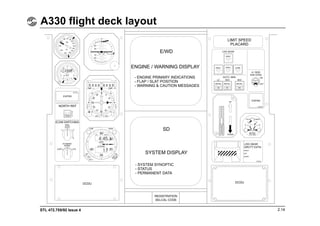
  • 62.
    STL 472.755/92 Issue4 A330 flight controls - EFCS 5.22 Controls and displays PFD F/O ECAM ENGINE- WARNING ECAM SYSTEM - WARNING SIDE STICK PRIORITY OFF OFF OFF FAULT FAULT FAULT PRIM 2 SEC 2 FLT CTL PRIM 3 F/O RUD TRIM NOSE L NOSE R RESET L 19.7 FLAPS 0 0 1 1 2 2 3 3 FULL FULL
  • 63.
    STL 472.755/92 Issue4 A330 flight controls - EFCS 5.23 Controls and displays • Overhead panel Pushbutton switches on the overhead panel allow disconnection or reset of the primary and secondary computers. They provide local warnings. Side 1 computer switches on left-hand side are separated from those of side 2 computers on right-hand side. • Glareshield Captain and First Officer priority lights, located in the glareshield, provide indication if either has taken the priority for his sidestick orders. • Lateral consoles Captain and First Officer sidesticks, located on the lateral consoles, provide the flight controls computers with pitch and roll orders. They are not mechanically coupled. They incorporate a take-over pushbutton switch. • Central pedestal - Speedbrake control lever position is processed by the primary computers for speedbrake control. A “ground spoiler” position commands ground deceleration (spoilers and ailerons). - Rudder trim switch and reset pushbutton switch are processed by the secondary computers. The local rudder trim position indication is repeated on the ECAM FLT/CTL system page. - Flap control lever position is processed by the SFCC. It allows selection of high-lift configurations for slats and flaps. Lever position indication is repeated in the “flap section” of the ECAM engine and warning display. - Pitch trim wheels allow the setting of the THS position for take-off. They permit manual pitch trim control. • Main instrument panel ECAM display units and PFDs present warnings and status information on the Flight control system. Permanent indication of slat and flap positions are given on the ECAM engine/warning display. Remaining flight control surface positions are given on the FLT/CTL system page which is presented on the ECAM system/status display. • Rudder pedals Interconnected pedals on each crew member’s side allow mechanical yaw control through the rudder.
  • 64.
    STL 472.755/92 Issue4 A330 flight controls - EFCS 5.24 ECAM system page
  • 65.
    STL 472.755/92 Issue4 A330 flight controls - EFCS 5.25 Control law introduction • Flight through computers Depending upon the EFCS status, the control law is : According to number and nature of subsequent failures, it automatically reverts to : - Alternate Law, or - Direct Law. • Mechanical back-up During a complete loss of electrical power the aircraft is controlled by : - longitudinal control through trim wheel - lateral control from pedals. Overall Normal LAW schematic - Normal Law (normal conditions even after single failure of sensors, electrical system, hydraulic system or flight control computer).
  • 66.
    STL 472.755/92 Issue4 A330 flight controls - EFCS 5.26 Normal Law - flight mode Basic principle - No direct relationship between sidestick and control surface deflection. - The sidestick serve to provide overall command objectives in all three axes. - Computers command surface deflections to achieve Normal Law objectives (if compatible with protections). • Highlights
  • 67.
    STL 472.755/92 Issue4 A330 flight controls - EFCS 5.27 Normal Law - flight mode Objectives • Pitch axis : Sidestick deflection results in a change of vertical load factor. The normal law elaborates elevator and THS orders so that : - a stick movement leads to a flight path variation - when stick is released, flight path is maintained without any pilot action, the aircraft being automatically trimmed. • Lateral axis : Sidestick deflection results in initiating roll rate. Roll rate demand is converted into a bank angle demand. The Normal Law signals roll and yaw surfaces to achieve bank angle demand and maintain it - if less than 33° - when the stick is released. Pedal deflection results in sideslip and bank angle (with a given relationship). Pedal input - stick free - results in stabilized sideslip and bank angle (facilitates de-crabbing in crosswind). • Adaptation of objectives to : - Ground phase : ground mode . Direct relationship between stick and elevator available before lift-off and after touch-down. . Direct relationship between stick and roll control surfaces. . Rudder : mechanical from pedals + yaw damper function. . For smooth transition, blend of ground phase law and load factor (Nz) command law at take off. - Flight phase : flight mode The pitch normal law flight mode is a load factor demand law with auto trim and full flight envelope protection. The roll normal law provides combined control of the ailerons, spoilers 2 to 6 and rudder. - Landing phase : flare mode . To allow conventional flare. . Stick input commands a pitch attitude increment to a reference pitch attitude adjusted as a function of radio altitude to provide artificial ground effect.
  • 68.
    STL 472.755/92 Issue4 A330 flight controls - EFCS 5.28 Normal Law - flight mode Engine failure or aircraft asymmetry • By virtue of fly-by-wire controls and associated laws, handling characteristics are unique in the engine failure case : - with no corrective action : • stabilized sideslip and bank angle • slowly diverging heading • safe flight - short-term recommended action : • zero sideslip or sideslip target (take-off) with pedals • then stabilize heading with stick input • steady flight with stick free and no pedal force (rud- der trim). • This feature is made possible since roll controls can be fully deflected with sidestick neutral. The optimal pilot rudder application results in optimum climb performance. No corrective action Corrective action β β
  • 69.
    STL 472.755/92 Issue4 A330 flight controls - EFCS 5.29 Normal Law - flight mode Main operational aspects and benefits • Automatic pitch trim • Automatic elevator to compensate turns up to 33° bank • Aircraft response almost unaffected by speed, weight or center of gravity location • Bank angle resistance to disturbance stick free • Precise piloting • Turn coordination • Dutch roll damping • Sideslip minimization • Passenger comfort • Reduced pilot, workload • Increased safety • Protection does not mean limitation of pilot authority. Full pilot authority prevails within the normal flight envelope. • Whatever the sidestick deflection is, computers have scheduled protections which overcome pilot inputs to prevent : - excessive load factors (no structural overstressing) - significant flight envelope exceedances : • speed overshoot above operational limits • stall • extreme pitch attitude • extreme bank angle. Normal Law - protections Load factor protection • Design aim To minimize the probability of hazardous events when high manoeuvrability is needed. • Load factor limitation at : + 2.5 g, -1 g for clean configuration + 2 g, 0 g when slats are extended. Rapid pull-up to 2.5 g is immediately possible.
  • 70.
    STL 472.755/92 Issue4 A330 flight controls - EFCS 5.30 High speed protection • Design aims To protect the aircraft against speed overshoot above VMO/MMO. Non-interference with flight at VMO/MMO. • Principle When speed or Mach number is exceeded (VMO + 6 kt/MMO + 0.01) : - automatic, progressive, up elevator is applied (.1 g max) - pilot nose-down authority is reduced. • Results Maximum stabilized speed, nosed-down stick : VMO + 15 kt MMO + 0.04 High angle-of-attack protection • Design aims - Protection against stall - Ability to reach and hold a high CL (sidestick fully back), without exceeding stall angle (typically 3°/5° below stall angle) : good roll manoeuvrability and innocuous flight characteristics. - Elimination of risk of stall in high dynamic manoeuvres or gusts. - Non-interference with normal operating speeds and manoeuvres. - Load factor limitation maintained. - Bank angle limited. - Available from lift-off to landing. • Windshear protection Windshear protection is ensured by - SRS mode - speed trend indication - wind indication (speed and direction) - flight path vector - Windshear warning - predictive windshear function of weather radar (optional).
  • 71.
    STL 472.755/92 Issue4 Pitch attitude protection • Design aim To enhance the effectiveness of AOA and high-speed protection in extreme conditions and in windshear encounter. • Principle Pilot authority is reduced at extreme attitude. • Result Pitch attitude limited : - nose-down 15° - nose-up 30°, to 25° at low speed Bank angle protection - When stick is released above 33° the aircraft automatically rolls back to 33°. - If stick is maintained, bank angle greater than 33° will be maintained but limited to 67°. - When overspeed protection is triggered : . Spiral stability is introduced regardless of bank angle . Max bank angle is limited to 45°. - When angle-of-attack protection is triggered, max bank angle is limited to 45°. Low energy warning A low energy aural warning “SPEED SPEED SPEED” is triggered to inform the pilot that the aircraft energy becomes lower than a threshold under which, to recover a positive flight path angle through pitch control, the thrust must be increased. A330 flight controls - EFCS 5.31 High angle-of-attack protection • Principle When the AOA*) is greater than AOA prot, the basic objective defined by sidestick input reverts from vertical load factor to AOA demand. • Result - AOA protection is maintained if sidestick is left neutral. - AOA floor results in GA power with an ensuing reduction of AOA. - AOA max is maintained if sidestick is deflected fully aft. Return to normal basic objective is achieved if the sidestick is pushed forward. α α α α α α α *) AOA = α
  • 72.
    STL 472.755/92 Issue4 A330 flight controls - EFCS 5.32 Reconfiguration control laws No loss of Normal Law after a single failure. Automatic reversion from Normal Law to Alternate or Direct Law according to the number and nature of subsequent failures. Normal Control Law Pitch Direct Law Alternate Control Law Mechanical back-up Failures (at least two failures - second not self-detected) (failure detection confirmation) Crew action Failures (at least two failures detected)
  • 73.
    STL 472.755/92 Issue4 A330 flight controls - EFCS Alternate Law • Probability objective : 10-5 /flight hour (10-3 under MMEL). • No change for ground, take-off and flare mode compared to Normal Law. • Flight mode : • Protections : - pitch attitude : lost - high speed : replaced by static stability - high angle of attack : replaced by static stability (Vc prot. Law) + aural stall warning when α > α sw* - low energy : lost Direct Law • Probability objective : 10-7 /flight hour (10-5 under MMEL). • No change for ground mode and take-off mode compared to Normal Law. • Flight mode : Maintained down to the ground • All protections are lost Conventional aural stall and overspeed warnings are provided as for Alternate Law. • Main operational aspect : - manual trimming through trim wheel. 5.33 - Pitch axis : as per Normal Law with limited pitch rate and gains depending on speed and CONF. - Roll/yaw axes : Depending on failure : 1. The lateral control is similar to normal law (no positive spiral stability is introduced). 2. Characterized by a direct stick-to-roll surface relationship which is configuration dependent. - in all three axes, direct relationship between stick and elevator/roll control surfaces which is center of gravity and configuration dependent.
  • 74.
    STL 472.755/92 Issue4 A330 flight controls - EFCS 5.34 Control law reconfiguration summary T ype A Surface deflection Aircraft response Surface deflection order Feedback Aircraft objective Flight Control Computer T ype B Surface deflection Aircraft response Surface deflection orders. Kinematic Computer Control law Normal Alternate Direct Pitch Type A Type A Type B Lateral Type A Type A/B Type B
  • 75.
    STL 472.755/92 Issue4 A330 flight controls - EFCS 5.35 Mechanical back-up • To sustain the aircraft during a temporary complete loss of electrical power. • Longitudinal control of the aircraft through trim wheel. Elevators kept at zero deflection. • Lateral control from pedals. Roll damping is provided by the Back up Yaw Dumper Unit (BYDU). • Message on PFD MAN PITCH TRIM ONLY (red).
  • 76.
    STL 472.755/92 Issue4 A330 flight controls - EFCS 5.36 Control law status information Besides ECAM messages, the pilot is permanently informed of control law status on PFD. Normal Law Normal FMA indications Alternate Law Normal FMA indications Direct Law Normal FMA indications + USE MAN PITCH TRIM Pitch attitude protection Bank angle protection + Audio warning + ECAM messages with limitations, if any + Audio warning + ECAM messages with limitations, if any
  • 77.
    STL 472.755/92 Issue4 A330 flight controls - EFCS 5.37 Control law status information Crew information : PFD speed scale
  • 78.
    STL 472.755/92 Issue4 A330 flight controls - EFCS 5.38 Priority display logic Captain's side First Officer'side Annunciation Sidestick Annunciation Sidestick CPT F/O Green “Light off” Red Red “Light off” Green Red Red Sidestick deflected Sidestick in neutral Take-over button depressed Take-over button depressed Take-over button depressed Take-over button depressed Sidestick deflected Sidestick in neutral
  • 79.
    STL 472.755/92 Issue4 A330 flight controls - EFCS 5.39 Priority logic • Normal operation : Captain and First Officer inputs are algebrically summed. • Autopilot disconnect pushbutton is used at take-over button. • Last pilot who depressed and holds take-over button has priority ; other pilot’s inputs ignored. • Priority annunciation : - in front of each pilot on glareshield - ECAM message - audio warning. • Normal control restored when both buttons are released. • Jammed sidestick : - priority automatically latched after 30 seconds - priority reset by depressing take-over button on previously jammed sidestick. CHRONO SIDE STICK PRIORITY CAPT CHRONO SIDE STICK PRIORITY F/O
  • 80.
  • 81.
    STL 472.755/92 Issue4 6. Landing gear 6.1
  • 82.
    STL 472.755/92 Issue4 A330 landing gear 6.2 Left intentionally blank
  • 83.
    STL 472.755/92 Issue4 A330 landing gear 6.3 Main features • Conventional landing gear with single bogie nose gear and double bogie main landing gear with direct-action shock absorbers. • The main landing gear is also provided with a shock absorber extension/retraction system. • The main gears retract laterally ; nose gear retracts forward into the fuselage. • Electrically controlled by two Landing Gear Control/Interface Units (LGCIU). • Hydraulically actuated (Green system) with alternative free-fall/spring downlock mode. • Alternating use of both LGCIUs for each retraction/extension cycle. Resetting the landing gear control lever results in transition to the other LGCIU. • Elimitation of gear lever neutral position through automatic depressurization of landing gear hydraulic supply at speeds above 280 kt. • Elimitation of microswitches by use trouble-free proximity detectors for position sensing.
  • 84.
    STL 472.755/92 Issue4 A330 landing gear 6.4 AUTO/BRK LO MED MAX DECEL DECEL DECEL ON ON ON BLUE LO PR DISTRIBUTION LINE PEDALS TO OTHER DUAL VALVE GREEN HP ACCUMULATORS BLUE HP NORMAL SELECTOR VALVE AUTOMATIC SELECTOR CONTROL VALVE PARKING BRAKE TO OTHER GEAR PULL & TURN OFF ON B S C U NORMAL SERVO VALVE DUAL SHUTTLE VALVE TO OTHER WHEELS DUAL VALVE ALTERNATE SERVO VALVE TO ECAM TO OPPOSITE WHEEL T A C H TO OTHER WHEELS A/SKID & N/W STRG ON OFF 312VU ACCU PRESS PSIX1000 BRAKES 0 4 3 3 1 1 0
  • 85.
    STL 472.755/92 Issue4 A330 landing gear 6.5 Braking system • Carbon disc brakes are standard. • Normal system (Green hydraulic system supply) : - electrically signalled through antiskid valves - individual wheel antiskid control - autobrake function - automatic switchover to alternate system in event of Green hydraulic supply failure. • Alternate braking system with antiskid (Blue hydraulic system supply) : - electrically signalled through alternate servovalves - hydraulically controlled through dual valve - individual wheel antiskid control - no autobrake function. • Alternate braking system without anti-skid (Blue hydraulic system supply or Blue brake power accumulator) : - hydraulically controlled by pedals through dual valve - brake pressure has to be limited by the pilot referring to the gauges. - no autobrake function - no antiskid system • Parking brake (Blue hydraulic system supply or Blue brake power accumulator : - electrically signalled - hydraulically controlled with brake pressure indication on gauges. • The Braking and Steering Control Unit (BSCU) is digital dual-channel double system (control and monitoring) computer controlling the following functions : - normal braking system control - anti-skid control (normal and alternate) - autobrake function with LO, MED, MAX. - nosewheel steering command processing - brake temperature signal processing - monitoring of all these functions.
  • 86.
    STL 472.755/92 Issue4 A330 landing gear Antiskid system schematic 6.6 DECEL DECEL DECEL ON ON ON LO MED MAX AUTO/BRK A/C LONGITUDINAL DECELERATION (ADIRU) A/C SPEED AFTER IMPACT (WHEEL SPEED) γ ir Vo γ prog Vo - ir .t γ Vo - prog .t γ HIGHEST VALUE OFF ON AUTO BRAKE V ref + - + - RELEASE ORDER RELEASE ORDER IF WHEEL SPD <0.88 V ref OR BLUE HYD GREEN AUTOMATIC SELECTOR NORMAL SERVO VALVE ALTERNATE SERVO VALVE NORMAL SERVO VALVE WHEEL SPEED WHEEL SPEED BSCU
  • 87.
    STL 472.755/92 Issue4 A330 landing gear 6.7 Antiskid system • From touchdown, aircraft speed is computed based on touchdown speed (wheels) and integrated deceleration (ADIRS). This reference speed is compared with each wheel speed to generate a release order for closing the normal servovalve in case of skid exceeding 16%. • Brake pedal orders open this servovalve which is also modulated by anti-skid closing signals. Autobrake system • From touchdown, a specific speed is computed based on touchdown speed (wheels) and programmed deceleration (low, medium, max). This programmed speed is compared with each wheel speed to generate a release order for closing the normal servovalve to meet selected deceleration. • If the reference speed exceeds programmed speed (contaminated or iced runways), the former will take over for the antiskid to modulate the normal servovalve. Braking principle
  • 88.
    STL 472.755/92 Issue4 A330 landing gear 6.8 Nose gear steering principle D I SC DIS C P E DALS PED A L S 70 50 30 10 10 3 0 50 70 70 50 3 0 10 10 30 50 70 P R I M AUTO PILOT NOSE GEAR STEERING SERVO VALVE STEERING SELECTOR VALVE NWS ANGLE GEEN POWER FROM NOSE GEAR DOORS CLOSING CIRCUIT (WHEN DOORS ARE CLOSED) CHANNEL 1 LGCIU 1/2 2 AND OPEN BSCU A/SKID & N/W STRG ON NON TOWING POSITION OFF ON OFF NLG DOWNLOCKED AND COMPRESSED NLG DOWNLOCKED AND BOOGIES IN GROUND POS ENG
  • 89.
    STL 472.755/92 Issue4 A330 landing gear 6.9 Controls and displays Rudder pedals Nosewheel handle
  • 90.
    STL 472.755/92 Issue4 A330 landing gear 6.10 ECAM system page
  • 91.
    STL 472.755/92 Issue4 7. Fuel system 7.1
  • 92.
    STL 472.755/92 Issue4 A330 fuel system 7.2 Basic layout • Total fuel capacity A330-200 A330-300 Outer tanks 7300 litres (5730 kg) 7248 litres (5690 kg) Inner tanks 84 000 litres (65940 kg) 83808 litres (65790 kg) Center tank 41650 litres (32625 kg) Trim tank 6230 litres (4890 kg) 6230 litres (4890 kg) Total 139090 litres (109185 kg) 97 286 litres (76 370 kg) • Ventilation - Each wing tank and the tail tank is separately vented though its associated vent tank. - These vent tanks are open to the atmosphere via flame arrestors and NACA inlets. - Location of ducts and float valves is designed to ensure free venting over appropriate attitude ranges during refueling and normal ground and flight manoeuvres. - Pressure relief outlets protext the inner tank from over- or under-pressure in case of failure or blockage of the vent system or pressure refueling gallery. Tank arrangement INNER TANK INNER TANK CTR TANK (for A330-200 only) OUTER TANK OUTER TANK INNER TANK DIVISION VENT TANK VENT TANK TRIM TANK FUEL CELL NORMAL PUMPS STBY PUMP EMER SPLIT VALVE
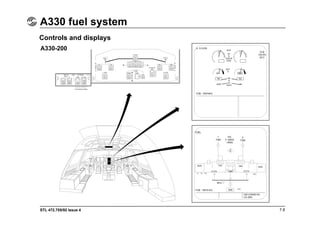
  • 93.
    STL 472.755/92 Issue4 A330 fuel system 7.3 The Fuel Control and Monitoring System (FCMS) controls the fuel system automatically Two identical Fuel Control and Monitoring Computers (FCMC) provide : - fuel transfer control - aircraft gross weight and center of gravity calculation based on zero fuel weight and zero fuel center of gravity entered by the crew. - center of gravity control - refuel control - fuel quantity measurement and indication - level sensing - fuel temperature indication - signals to FADEC for IDG cooling control. Control and monitoring
  • 94.
    STL 472.755/92 Issue4 A330 fuel system 7.4 Engine feed • In normal operation, each engine is independently supplied by two continuously operating booster pumps located in a dedicated collector box. In the event of a pump failure, a standby pump automatically comes on line. Collector boxes are maintained full by a jet pump transfer action using booster pump pressure. In cruise conditions, a single booster pump is able to supply flow to both engines. • A cross-feed valve allows the engine on either wing to be supplied from the opposite one. • Supply of fuel to each engine may be shut off by an engine LP valve driven by a double motor actuator. It is controlled by either the ENG FIRE pushbutton or the ENG master lever. • Automatic transfer of fuel from the outer tanks is performed by gravity. This occurs when trim tanks have been emptied and when either inner tank reaches 3500 kg. Outer tank fuel transfer valves are used to cycle the inner tanks contents between 3500 and 4000 kg. These valves are closed when outer tanks are empty for 5 minutes. • Transfer to inner tanks can be manually selected through the OUTR TK XFR pushbutton. When selected ON, the outer tanks fuel transfer valves, outer and inner inlet valves are controlled OPEN. • For A330-200 only : With fuel in the center tank, both CTR TK pumps are running and the inner inlet valves are used independently to cycle their respective inner tank contents between underfull and high level (Underfull is set at approximately 2000 kg below high level). When the center tank is empty, the pumps are automatically shut off, and both inner inlet valves close.
  • 95.
    STL 472.755/92 Issue4 A330 fuel system 7.5 Jettison system (on A330-200 only - optional) • The jettison pipe is connected to the refuel gallery in each wing. A dual actuator jettison valve is fitted. • Fuel is jettisoned from the centre and inner tanks simultaneously. All normal and STBY pumps are running and a forward transfer into center tank is initiated. • The aircraft weight will be reduced at a rate of not less than 70 tonnes/hour. • Jettison is stopped when : - the crew deselects the jettison pushbutton - both level sensors dedicated to jettison become dry - a signal from the FCMC indicates that the remaining fuel on board reaches a value previously defined by the crew via the FMGS MCDU (option : Preselection of gross weight after jettison). - sum of both inner quantity reaches 10 000 kg.
  • 96.
    STL 472.755/92 Issue4 A330 fuel system 7.6 Centre of Gravity control band relative to operational flight envelope
  • 97.
    STL 472.755/92 Issue4 A330 fuel system 7.7 CG control • Automatic CG control begins in climb at FL 255 and stops in descent at FL 245 or when FMGS time to destination is below 35 minutes (or 75 minutes if the trim tank transfer pump fails). • Aft transfer Aft transfer is terminated for example when computed CG = target CG - 0.5%, or when an inner tank reaches the low level. • Forward transfer - Forward transfer is required for example when computed CG = target CG. - Fuel transfer from the trim tank to the inner tanks is performed by the trim tank forward transfer pump through the trim pipe isolation valve. - On the A330-200, forward transfer is directed to the center tank when it is not empty. - Forward transfer is terminated when computed CG = target CG - 0.5%. * A330-200 Fuel for trim tank aft transfer is provided by the center tank when it contains fuel or by the inner tanks when the center tank is empty. * A330-300 The inner tanks provide fuel for trim tank aft transfer through the engines feed pumps.
  • 98.
    STL 472.755/92 Issue4 A330 fuel system 7.8 Controls and displays A330-200 SHUT SHUT OFF OFF L R INR TK SPLIT OPEN ON ON ARM ACTIVE JETTISON If JETTISON installed FUEL 211 VU ENG 1 X FEED FAULT OFF FAULT OFF FAULT OFF FAULT OFF FAULT OFF FAULT OFF FAULT ON ENG 2 OPEN ON R1 R2 T TANK MODE FEED FAULT FWD FAULT L CTR TANK XFR L OFF FAULT FWD FAULT OFF A U T O ISOL AUTO OPEN A U T O OUTER TK XFR R STBY L STBY L2 L1 F U E L F U E L A. FLOOR CLB 102.6% 35°C FOB : 76470KG IDLE N1 % CHECK EWD EGT °C N2 % F.F KG/H 2250 2250 102 102 690 690 FUEL 1 7300 2 7300 KG F. USED 14600 2845 31715 1150 1054 31715 2550 2845 FOB : 76470 KG APU GW 216000 KG CG 28% 11 °C 10 10°C 10°C 4800
  • 99.
    STL 472.755/92 Issue4 A330 fuel system 7.9 Controls and displays A330-300 SHUT SHUT OFF OFF L R INR TK SPLIT FUEL 211 VU ENG 1 X FEED FAULT OFF FAULT OFF FAULT OFF FAULT OFF FAULT OFF FAULT OFF FAULT ON ENG 2 OPEN ON R1 R2 T TANK MODE FEED FAULT FWD A U T O ISOL AUTO OPEN A U T O OUTER TK XFR R STBY L STBY L2 L1 F U E L F U E L A. FLOOR CLB 102.6% 35°C FOB : 73420KG IDLE N1 % CHECK EWD EGT °C N2 % F.F KG/H 2250 2250 102 102 690 690 FUEL 1 7300 2 7300 KG F. USED 14600 2845 31715 1650 1650 31715 2845 FOB : 73420 KG GW 185000 KG CG 28% - 15 °C - 21 - 20°C - 20°C 4300
  • 100.
    STL 472.755/92 Issue4 A330 fuel system 7.10 Left intentionally blank
  • 101.
    STL 472.755/92 Issue4 A330 fuel system 7.11 Control and indication • No crew action is required for normal operation except initiation and termination. • Indications : - fuel data (quantity, temperature) are available from a Fuel Quantity Indication (FQI) system - Fuel quantity is permanently displayed on upper ECAM DU - Fuel system synoptic on lower ECAM DU is displayed according to ECAM logic - low level warning is totally independent from FQI. • Abnormal operations : - Fuel feed sequence may be operated manually - cross-feed valve may be operated manually - forward and (some) inter tank transfers may be initiated manually - gravity feed is possible.
  • 102.
    STL 472.755/92 Issue4 A330 fuel system 7.12 Refueling system A330-200 A330-300 OUTR TK INR TK INLET VALVE REFUEL ISOL VALVE INLET VALVE TRIM PIPE ISOL VALVE INLET VALVE TRIM TK OUTR TK INR TK REFUEL ISOL VALVE INLET VALVE INLET VALVE * OUTR TK INR TK CTR TK INLET VALVE REFUEL ISOL VALVE INLET VALVE TRIM PIPE ISOL VALVE INLET VALVE TRIM TK OUTR TK INR TK REFUEL ISOL VALVE INLET VALVE INLET VALVE INLET VALVE
  • 103.
    STL 472.755/92 Issue4 A330 fuel system 7.13 Refueling • Two 2.5 inch couplings are installed in the leading edge of the right wing and of the left wing (optional on the A330-300), enabling all tanks to be filled from empty in some : • An isolation valve is provided between couplings and the refueling gallery. • A refueling inlet valve is provided for each tank, allowing distribution to a diffuser to reduce turbulence and avoid electrostatic build-up. • An automatic refueling system controls the refuel valves to give preselected fuel load and correct distribution. • Refueling/defueling is controlled from an external panel, located in the fuselage fairing under the RH belly fairing, and can be carried out with battery power only. Optional : Refueling can be controlled from the cockpit • Gravity refueling can be achieved by overwing refueling points • Defueling is accomplished by means of fuel pumps and for the outer and trim tanks, via transfer valves. - 33 minutes on the A330-200 - 25 minutes on the A330-300 or 35 minutes if the left wing refueling point is not installed.
  • 104.
  • 105.
    STL 472.755/92 Issue4 8. Engine controls 8.1
  • 106.
    STL 472.755/92 Issue4 A330 engine controls 8.2 FADEC • Thrust control is operated through Full Authority Digital Engine Control (FADEC) computers which : • either in manual (thrust lever) • or in automatic (authothrust) with a fixed thrust lever. • Engine performance and safety improvement over current hydromechanical control system. Simplification of engine/aircraft communication architecture. Reduction of crew workload by means of automatic functions (starting, power management). Ease of on-wing maintenance. • The system design is fault-tolerant and fully duplicated, with ‘graceful degradation’ for minor failures (i.e. sensor failures may lose functions but not the total system). The engine shut-down rate resulting from FADEC failures will be at least as good as today’s latest hydromechanical systems with supervisory override. • FADEC also called Engine Control Unit (ECU for GE engines) or Engine Electronic Controller (EEC for PW and RR engines) is a fully redundant digital control system which provides complete engine management. Aircraft data used for engine management is transmitted to the FADEC by the Engine Interface Unit (EIU). Each engine is equipped with a fan-case-mounted FADEC supporting the following functions : - gas generator control - engine limit protection - engine automatic starting - engine manual starting - power management - engine data for cockpit indication - engine condition parameters - reverser control and feedback - fuel used computation - fuel recirculation control (RR engines) - FADEC cooling (RR engines) - command the engines to provide the power best suited to each flight phase - automatically provide all the associated protection required :
  • 107.
    STL 472.755/92 Issue4 A330 engine controls - GE CF6-80E1A 8.3 FADEC architecture
  • 108.
    STL 472.755/92 Issue4 A330 engine controls - PW4164 8.4 FADEC architecture
  • 109.
    STL 472.755/92 Issue4 A330 engine controls - RR Trent 8.5 FADEC architecture
  • 110.
    STL 472.755/92 Issue4 A330 engine controls 8.6 FADEC and EIU One FADEC located on the engine with dual redundant channels (active and standby) each having separate 115 VAC aircraft power sources to provide engine starting on ground and in flight. Additional features Dedicated FADEC alternator provides self power above : 12% N2 for GE engines 5% N2 for PW engines 8% N3 for RR engines - Dual redundancy for electrical input devices (ADIRS 1 + 2, TLAs, engine parameters). - Dual redundancy for electrical part of control actuator. - Simplex system for hydromechanical parts of the control. - Fault tolerance and fail-operational capability. - High level of protection against electromagnetic disturbance. - Interface between the FADEC system and the other aircraft systems mainly performed by the EIU through digital data buses. - One EIU per engine located in the avionics bay. - Care taken to preserve system segregation for safety and integrity.
  • 111.
    STL 472.755/92 Issue4 A330 engine controls 8.7 Thrust control system • Engine thrust control is provided by the FADEC 1 and 2 controlling engines 1 and 2 respectively. • Thrust selection is performed by means of : - thrust levers when in manual mode, - A/THR function of the FMGS when in automatic mode, but limited to the value corresponding to the thrust levers position. • Limit thrust parameters are computed by the FADEC. • Since there is no mechanization of the thrust levers (no servomotor) any thrust lever displacement must be performed manually. • According to the thrust lever position the FADEC computes : - thrust rating limit - N1* (EPR)** when in manual mode - N1* (EPR)** which can be achieved in automatic mode (A/THR). * for GE engines ** for PW, RR engines
  • 112.
    STL 472.755/92 Issue4 A330 engine controls 8.8 Thrust control operations
  • 113.
    STL 472.755/92 Issue4 A330 engine controls 8.9 Indications on ECAM upper DU GE engines PWE engines RR engines
  • 114.
    STL 472.755/92 Issue4 A330 engine controls 8.10 Indications on PFD : FMA • Following indications may appear on the PFD flight mode annunciator, in the upper left corner : (examples only) • ASYM : One thrust lever not in CL detent. • CLB : Flashing when aircraft is above thrust reduction altitude and thrust levers are not retarded to CL. • MCT : Flashing in case of engine failure if the non-affected thrust levers are not set at MCT. • A-FLOOR : When thrust is at MTO and an alpha-floor condition is encountered. V / S HDG ASYM 180 160 120 140 20 10 10 V / S HDG ASYM 180 160 120 140 20 10 10
  • 115.
    STL 472.755/92 Issue4 A330 engine controls 8.11 Thrust reverser • Reverser deployment selection is performed through conventional reverser controls. • Automatic maximum reverse power limitation versus ambient conditions with full aft throttle position. • Display of reverser status on ECAM upper DU.
  • 116.
  • 117.
    STL 472.755/92 Issue4 9. Auxiliary power unit 9.1
  • 118.
    STL 472.755/92 Issue4 A330 auxiliary power unit 9.2 General principles System display • On ground, the APU makes the aircraft self-contained by : - providing bleed air for starting engines and for the air conditioning system - providing electrical power to supply the electrical system. • In flight, provision of back-up power for the electrical system, the air conditioning system and engine start. • The APU can be started using either dedicated battery, external power or normal aircraft supply. The normal flight envelope does not impose any limitations for starting except when batteries are supplying starting power. • The APU is automatically controlled by the Electronic Control Box (ECB) which acts as a FADEC for monitoring start and shut-down sequences, bleed air and speed/temperature regulation. • Control and displays are located : - on the overhead panel for APU normal operation and fire protection - on the ECAM for APU parameter display - on the external power control panel next to the nose landing gear - on the REFUEL/DEFUEL panel for APU shut-down.
  • 119.
    STL 472.755/92 Issue4 A330 auxiliary power unit 9.3 Controls and display APU MASTER SW FAULT ON/R AVAIL ON START FIRE ECB APU PUSH TEST AGENT SQUIB DISCH APU FIRE APU SHUT OFF 925VU (EXTERNAL CONTROL PANEL) 2 STAGES COMPRESSOR 3 STAGES TURBINE APU BLEED VALVE APU GEN OIL PUMP STARTER FLAP MOTOR FUEL SUPPLY COMBUSTION CHAMBER GEAR BOX
  • 120.
  • 121.
    STL 472.755/92 Issue4 10. Automatic flight system 10.1
  • 122.
    STL 472.755/92 Issue4 A330 automatic flight system 10.2 Architecture block diagram ADR / IR ILS (MLS) ADF RA VOR DME CLOCK FCMC DATA BASE LOADER LGCIU SFCC FCU Primary Secondary Flight controls ECAM Maintenance EFIS CPC ATSU option ACARS option Thrust levers FADECs FMGC Back-up Nav Flight controls
  • 123.
    STL 472.755/92 Issue4 A330 automatic flight system 10.3 Architecture components FMGC FCU MCDU A/THR instinctive disconnect switches AP take-over switches North reference switches FM source switch 2 1 3 2 2 1 1 FMGEC 1 includes AFS/FIDS* Includes three independent channels Colour display One for CM 1 and one for CM 2 One for CM 1 and one for CM 2 For EIS and MCDU display For EIS display Unit Number per aircraft Comments * Fault isolation and Detection System OBRM (On-board Replaceable Modules) - Solid-state memory modules plugged into the front face of the computer. - Cost and logistic improvement for software changes. - Software change can be achieved in situ using a common replaceable module reprogrammer.
  • 124.
    STL 472.755/92 Issue4 A330 automatic flight system 10.4 Flight Management Guidance and Envelope System (FMGS) crew interface S PEED G/S L OC CAT2 DH100 AP1 1FD2 A/T HR 3000 180 160 140 120 20 20 10 10 10 10 015 010 13 20 80 790 31 32 33 34 3 7 T BN 109.30 4.7 NM OM 1020 QNH 00 S PEED G/S L OC CAT2 DH100 AP1 1FD2 A/T HR 3000 180 160 140 120 20 20 10 10 10 10 015 010 13 20 80 790 31 32 33 34 3 7 T BN 109.30 4.7 NM OM 1020 QNH 00 33 34 35 0 1 2 3 4 OL CON AVD LWG TILT -3,00 2R GAI VOR1 CGCM 103 NM CGC AVD VOR2 AVD 6 0 4 0 1 6 0 NAV ACCY UPGRADED LWG/004 GS TAS 394 388 249/16 93MM 18:35 33 34 35 0 1 2 3 4 OL CON AVD LWG TILT -3,00 2R GAI VOR1 CGCM 103 NM CGC AVD VOR2 AVD 6 0 4 0 1 6 0 NAV ACCY UPGRADED LWG/004 GS TAS 394 388 249/16 93MM 18:35 SPD MACH SPD MACH HDG TRK LOC A/THR AP 1 AP 2 ALT APPR ALT V/S FPA 100 1000 HDG TRK V/S FPA LWL/CH METRIC ALT UP DN PUSH TO LEVEL OFF HDG V/S TRK FPA LAT DIR PROG PERF INIT DATA F-PLN RAD NAV FUEL PRED SEC F-PNL MCDU MENU AIR PORT ä A B C D F G H I J K L M N O P Q R S T U V W X Y Z - + DWFY Δ CLR E M C D U M E N U F A I L F M 1 2 3 4 5 6 7 8 9 . ∅ + BRT FM1 FM2 IND RDY SPARE ä ä ä DIR PROG PERF INIT DATA F-PLN RAD NAV FUEL PRED SEC F-PNL MCDU MENU AIR PORT ä A B C D F G H I J K L M N O P Q R S T U V W X Y Z - + DWFY Δ CLR E M C D U M E N U F A I L F M 1 2 3 4 5 6 7 8 9 . ∅ + BRT FM1 FM2 IND RDY SPARE ä ä ä PFD1 PFD2 ND2 FMGC 1 ND1 FMGC 2 MCDU Thrust levers MCDU FCU
  • 125.
    STL 472.755/92 Issue4 A330 automatic flight system 10.5 FMGS - AFS/FMS integration • Composed of two computers (FMGC) including a management part (FM), a flight guidance (FG) and a flight envelope part (FE), this pilot interactive system provides : • The FMGS offers two types of guidance achievable by AP/FD : - “managed” : guidance targets are automatically provided by the FMGS as a function of lateral and vertical flight plan data entered in the Multipurpose Control and Display Units (MCDU). - “selected” : guidance targets are selected by the pilot on the glareshield Fight Control Unit (FCU). Selected guidances mode always have priority over the managed guidance modes. - flight management for navigation, performance prediction and optimization, navigation radio tuning and information display management, - flight guidance for autopilot commands (to EFCS), flight director command bar inputs and thrust commands (to FADECs) - flight envelope and speed computation.
  • 126.
    STL 472.755/92 Issue4 A330 automatic flight system 10.6 FMGS Crew interface • Three MCDUs (only two at a time) on the central pedestal provide a long-term interface between the crew and the FMGCs in terms of : • One FCU on the central glareshield provides a short- term interface between the crew and the FMGCs. • Two thrust levers linked to the FMGCs and FADECs provide autothrust or manual thrust control selection to the crew. • Two PFDs and two NDs provide visual interface with flight management and guidance-related data such as : on PFD : - FMGS guidance targets - armed and active modes - system engagement status on ND : - flight plan presentation - aircraft position and flight path - navigation items (radio aids, wind). PFD ND SPEED ALT CRZ NAV AP1 1FD2 A/THR 320 300 280 260 780 33 34 35 0 315 310 20 00 80 305 STD 10 10 10 10 33 34 35 0 1 2 3 4 OL CDN ANG AMB AVD CGC LMG TILT -3,00 2R GAI 2'30 VOR1 CGCM 103 NM GS 394 TAS 388 249/16 LMG/004 93 NM 18:35 - flight plan definition and display - data insertion (speeds, weights, cruise level, etc.) - selection of specific functions (direct to, offset, secondary flight plan).
  • 127.
    STL 472.755/92 Issue4 A330 automatic flight system 10.7 General functions • Guidance function Fail operational architecture* Operation Modes • Autothrust Operation Modes • Flight envelope Envelope protection --------------- (windshear, aft CG detection) Speed computation • Flight management Functional architecture Navigation Flight planning functions -------- (assembly , fuel management, lateral revision) Optimisation performance ------ (speed/altitude, prediction) Vertical profile * Fail operational refers to a single failure of a system which does not modify the aircraft’s flight path. AP/FD and A/THR mode relationship
  • 128.
    STL 472.755/92 Issue4 A330 automatic flight system - guidance function 10.8 Flight Control Unit (FCU)
  • 129.
    STL 472.755/92 Issue4 A330 automatic flight system - guidance function 10.9 AP/FD modes Lateral Vertical Speed NAV B/C*, B/C, LOC*, LOC RWY RWY TRK GA TRK ROLL OUT SRS (TO and GA) CLB, DES ALT G/S*, G/S FINAL DES FLARE FMGC reference ECON, Auto SPD, SPD LIM HDG - TRK OP CLB, OP DES V/S - FPA ALT*, ALT FCU reference Guidance Managed mode Selected mode Available modes - By pushbutton action (located on the FCU) LOC - APPR - ALT, AP1 - AP2 - A/THR. - By action on the thrust levers. On the ground, setting the thrust levers to the TO/GA or FLEX/TO detents leads to AP/FD mode engagement (SRS/RWY). During approach, setting the thrust levers to TO/GA engages go-around mode. - By action on the FCU selection knobs (speed selection knob, HDG/TRK selection knob, altitude selection knob, V/S-FPA selection knob). • Push action engages managed mode • Pull action engages selected mode - e.g speed or Mach selected mode pushed in flight engages managed speed profile (usually ECON). Mode engagement (or arming as long as engagement conditions are not met).
  • 130.
    STL 472.755/92 Issue4 A330 automatic flight system - guidance function 10.10 AP/FD operation Lateral modes • The aircraft can be operated in ‘selected guidance’ with flight references selected by the crew, or in ‘managed guidance’ with references computed by the system. • If the AP/FD controls a vertical trajectory the A/THR controls the target SPEED/MACH. If the AP/FD controls a target speed, the A/THR controls the thrust. • Selected guidance always has priority over managed guidance, which means that the PF may select a speed, lateral or vertical path at any time ; actions are acknowledged on the FCU itself and on the FMA (Flight Mode Annunciator). • Selected guidance or managed guidance is available for SPEED/MACH control, LATERAL guidance and LEVEL CHANGE execution. NAV : lateral navigation • Lateral track is defined by the FMGC according to the flight plan introduced in the system. LOC : LOC axis capture and track • LOC is armed if LOC pushbutton is pressed ; LOC capture replaces NAV. HDG/TRK • Selection of HDG/TRK references is obtained by turning the dedicated switch located on the FCU. • HDG/TRK is engaged by pulling on lateral selector ; HDG/TRK value can be selected before or after pull action. • Heading track preselection is possible on ground before take-off, in flight as from 30 ft height.
  • 131.
    STL 472.755/92 Issue4 A330 automatic flight system - guidance function 10.11 Vertical modes Common modes • In CLB/DES modes vertical path is maintained as defined by the FMGC, taking into account the flight plan constraints inserted in the system at the clearance altitude selected on the FCU. • OP CLB (OP DES) mode allows the aircraft to climb or descend uninterrupted toward FCU selected altitude, maintaining a TARGET SPEED (managed or selected) with a fixed given thrust. ALT constraints are ignored. Altitude hold • It is active if aircraft reaches FCU altitude, intermediate flight plan altitude constraints when ALT pushbutton is depressed on FCU or when V/S is set to zero. V/S/FPA • V/S/FPA is engaged by pulling on V/S/FPA selector. V/S or FPA value can be selected before or after a pull action. Approach • ILS available - GLIDE capture and track - FLARE - LAND - ROLL OUT • ILS not available, RNAV approach selected on MCDU : - LATERAL guidance on the F-PLN - VERTICAL guidance and descent allowed down to MDA. Take-off • SRS - with engines running V2 + 10 holding - with one engine out VA (1) holding if VA>V2 V2 holding if VA<V2. (1) VA = aircraft speed when the engine failure occurs. • RWY : - Track hold or LOC centerline hold. Go-around • SRS (as take-off). • GA TRK hold. Level changes [managed guidance (CLB, DES), selected guidance (OP CLB OP DES)].
  • 132.
    STL 472.755/92 Issue4 A330 automatic flight system - autothrust function 10.12 1st case AP/FD pitch mode controls a vertical fligh path (V/S or G/S or FINAL) then A/THR mode will control the target speed/Mach. e.g. if AP/FD V/S mode is selected A/THR is in SPEED mode 2nd AP/FD pitch mode controls the target speed/Mach then A/THR mode will control the thrust e.g. if AP/FD open CLB mode is selected A//THR is in THR CLB mode AP/FD and A/THR mode relationship S PEED G/S LOC CATII DH= 200 AP1 1 FD2 A/T HR T HRCLB OPCLB NAV AP1 1 FD2 A/T HR
  • 133.
    STL 472.755/92 Issue4 A330 automatic flight system - autothrust function 10.13 AP/FD and A/THR SPD/MACH modes In SPD/MACH managed mode • Is engaged by pushing the FCU SPD selector knob. • AP/FD or A/THR holds the SPEED/MACH as provided by the FMS. • Speed preset for next flight phase is available by entering preset value on the MCDU ; speed preset becomes active at flight phase change. • Crossover altitude is automatically provided. SPD/MACH selected mode • Is engaged by pulling the FCU SPD selector knob. • Crossover altitude is automatically provided. • Manual SPD/MACH selection is available to the pilot via the SPD/MACH conversion push-button. AP/FD and A/THR SPD/MACH modes • An AP/FD pitch mode may control a flight or an indicated airspeed - but not both at the same time. • Thus, if the pitch mode (elevator) controls a flight path, (G/S of V/S) the A/THR controls the IAS, but if the pitch mode controls a speed (OPEN CLB/OPEN DES) then the A/THR will control a thrust. Consequently, AP/FD pitch mode and A/THR are linked so that, if no AP/FD engaged, A/THR can be active in SPD/MACH mode. SPEED/MACH managed or selected may either be controlled by AP/FD pitch mode or A/THR mode. The reasons for this are as follows.
  • 134.
    STL 472.755/92 Issue4 A330 automatic flight system - autothrust function 10.14 A/THR operation - A/THR can be armed, active or de-activated
  • 135.
    STL 472.755/92 Issue4 A330 automatic flight system - autothrust function 10.15 A/THR main features Each engine thrust is electrically controlled by the associated FADEC (FULL Authority Digital Engine Control) which is fully integrated in the autothrust system. The A/THR function is computed in the FMGC. The FADECs receive A/THR commands directly from the AFS via an ARINC 429 bus. Selection of thrust limit mode is obtained from the Thrust Lever Angle (TLA). A / THR ACTIVE RANGE inop engine both engines TO/GA FLX T.O MCT CLB CLB IDLE
  • 136.
    STL 472.755/92 Issue4 A330 automatic flight system - autothrust function 10.16 A/THR mechanisation The thrust levers can only be moved manually by the pilot. Take-off Thrust mode selection - On ground TO limit mode is automatically selected at power up. - FLX/TO limit mode is selected by setting a FLX/TO temperature on the MCDU (TO page). Take-off is performed : - in limit mode, by manually setting the thrust lever to TO/GA detent. - in FLX/TO limit mode, by manually setting to FLX/TO/MCT detent. Notes : - In both cases, this manoeuvre also engages FD TO mode (SRS RWY if ILS selected). - The lowest FLX/TO thrust is limited to CL thrust. Cruise Thrust levers must be set : - to be CLB detent - to the MCT detent (engine failure case). - The A/THR modes become active according to AP/FD mode selection. Approach Thrust levers must be set to CLB (or MCT engine failure case) detent : - ATS SPD mode is active Go Around GA mode engagement is achieved by setting the thrust levers to TO/GA detent ; (A/THR armed ; GA thrust is applied via the FADEC). This maneuvre also engages AP/FD GA mode. Alpha floor If the alpha floor function is activated, A/THR increases the thrust to the GA thrust limit.
  • 137.
    STL 472.755/92 Issue4 A330 automatic flight system - autothrust function 10.17 Flight envelope protection Flight envelope protection is achieved by generating maximum and minimum selectable speeds, windshear warning and stall warning. Also computed as part of this protection are the maneuvering speed and the flap and slat retraction speeds. The alpha-floor signal is computed by the flight control computers. Speed computation (PFD scale)
  • 138.
    STL 472.755/92 Issue4 A330 automatic flight system - flight management 10.18 General architecture MCDU 3 switchable for FM function in case of MCDU 1 or 2 failure FIDS FM BACK UP NAV FE Com Mon EFIS CP 1 EFIS CP 2 AP CONTROLS FMGC 1 FCU FM FMGC 2 MCDU 1 BACK UP NAV MCDU 2 MCDU 3 FG Com Mon FG Com Mon FE Com Mon
  • 139.
    STL 472.755/92 Issue4 A330 automatic flight system - flight management 10.19 Functional architecture - Normal configuration FMGC1 MCDU 1 MCDU 3 MCDU 2 FMGC 2 DMC 1 DMC 3 DMC 2 FM NORM BOTH ON 2 BOTH ON 1
  • 140.
    STL 472.755/92 Issue4 A330 automatic flight system - flight management 10.20 Functional architecture - One FMGC failed Functional architecture - Normal configuration DMC1 DMC3 DMC2 FMGC1 FMGC2 MCDU1 MCDU2 MCDU3 DMC1 DMC3 DMC2 FMGC1 MCDU1 MCDU2 MCDU3 DMC1 DMC3 DMC2 FMGC1 FMGC2 MCDU1 MCDU2 OFF MCDU3 FMGC2 MCDU 2 brightness knob on "OFF" FM NORM BOTH ON 1 BOTH ON 2 FM NORM BOTH ON 1 BOTH ON 2 FM NORM BOTH ON 1 BOTH ON 2
  • 141.
    STL 472.755/92 Issue4 A330 automatic flight system - flight management 10.21 • Normal mode operation : dual mode - Each FMGC makes its own computation. - One FMGC is master - the other one is slave. - Both FMGCs are synchronized. - Both MCDUs act independently (entries are auto- matically transmitted on the other MCDU and applied to both FMGCs). • Independent mode Single mode - One FMGC fails. - Either MCDU can be used to enter or display data related to the remaining FMGC. Two FMGCs associated to two MCDUs provide a redundant configuration FMGC 1 FMGC 2 FMGC 1 FMGC 2 FMGC 1 MCDU MCDU MCDU MCDU MCDU MCDU crosstalk buses - Automatically operative if mismatch occurs between FMGCs. - Independent operation of FMGC with associated MCDUs. (Data insertion and display related to the side concerned. - One FMGC remains master.
  • 142.
    STL 472.755/92 Issue4 A330 automatic flight system - flight management 10.22 Left intentionally blank
  • 143.
    STL 472.755/92 Issue4 A330 automatic flight system - flight management 10.23 Position indication
  • 144.
    STL 472.755/92 Issue4 A330 automatic flight system - flight management 10.24 MCDU ND 33 34 35 0 1 2 3 4 OL CDN AVD LWG TILT -3,00 2R GAI VOR1 CGCM 103 NM CGC AVD VOR2 AVD 6 0 4 0 1 6 0 NAV ACCY UPGRADED LWG/004 GS TAS 394 388 249/16 93MM 18:35 ECON 1 5 10 15 20 25 DES AI101 1L 2L 3L 4L 5L 6L 1R 2R 3R 4R 5R 6R OPT REC MAX FL390 CRZ REQD DIST TO LAND = 70NM DIR DIST TO DEST = 89NM < REPORT BRG / DIST / TO UPDATE AT * VOR 1 / FREQ ACY FREQ / VORZ ATH / 114.4 HIGH117.2 / DDM
  • 145.
    STL 472.755/92 Issue4 A330 automatic flight system - flight management 10.25 Lateral navigation • Position computation - Before flight, the three IRSs are aligned on airfield or gate position (manually or via database). - At take-off, the position is automatically updated to the runway threshold. - In flight, position updating is computed using radio navaids (DME, VOR, ILS and GPS when available). The FMGC position is a blend of IRS and radio position. On a medium-term basis the FM position will tend towards the radio position, if any drift occurs. • Navigation mode selection - If the aircraft is equipped with GPS primary, the FMGC uses the GPIRS position in priority (IRS-GPS mode). - if the GPIRS position is not available or if the aircraft is not equipped with GPS primary, depending upon availability of navaids and sensors, FMGC automatically uses the best navigation means to compute the most accurate position : IRS - DME/DME IRS - VOR/DME IRS - ILS/DME IRS only. • The FMGC position is associated with a high or low criterion which is based on an Estimated Position Error (EPE). This EPE depends upon the flying area (en route, terminal, approach) and is permanently compared to Airworthiness Authorities Accuracy Requirements (AAAR). If EPE > AAAR, then LOW is displayed on MCDU and the position must be cross-checked with raw data (ADF/VOR needles, DME reading). Each time HIGH (or LOW) reverts to LOW (or HIGH) the message NAV ACCUR DOWNGRAD (or UPGRAD) is displayed on NDs and MCDUs.
  • 146.
    STL 472.755/92 Issue4 A330 automatic flight system - flight management 10.26 Radio navigation Each FMGC tunes its own side radio navaids except when in single operation : - one VOR, one ILS, one ADF (if belonging to the F-PLN) and five DMEs may be auto tuned at the same time. - manual tuning always has priority over autotuning. - autotune priority rules are done according to FMGS logics ; for example : • VOR autotune (frequency course) priority is : - manual tune - specified navaid for approach - radio position computation - display purpose logic. • Five DMEs can be scanned simultaneously - one DMEs for display purpose - two DMEs for radio position computation when in DME/DME mode - one DMEs for VOR/DME position computation when in VOR/DME mode - one DME is linked to ILS/DME. Radio navigation architecture FMGC 2 FMGC 1 FMGC 1 FMGC 2 RMP 1 RMP 2 VOR 1 DME 1 ILS 1 ADF 1 VOR 2 DME 2 ILS 2 ADF 2 RADIO NAV VOR 1 FREQ SIU / 128.50 CRS 075 ILS / FREQ ( ) / ( ) ADFI / FREQ 10E / 415.00 415.00 / 10E FREQ/ ADF 2 FREQ/ VOR 2 CRS ( ) 115.70 /TGO CRS ( )
  • 147.
    STL 472.755/92 Issue4 A330 automatic flight system - flight management 10.27 Navigation and flight planning Navigation • Aircraft position determination. • Aircraft position referenced to the flight plan. • Automatic VOR/DME/ILS/ADF selection. • Automatic guidance along flight plan from take-off to approach. • IRS alignment. • Ground speed and wind computation. • Polar navigation. • Optimum radio and inertial sensor mixing. • Provision for GPS and MLS. Flight plan stringing • Flight plan definition by company route or city pair. • Departure and arrival procedures including associated speed/altitude/time constraints. • Standard flight plan revision (offset, DIR TO, holding pattern, alternate flight plan activation, etc.). • Additional flight plan revisions linked to long-range flights (DIR TO mechanization, AWY stringing). • Secondary flight plan creation similar to primary flight plan. • Definition of five cruising levels on the flight plan. • Extension of the data base capacity.
  • 148.
    STL 472.755/92 Issue4 A330 automatic flight system - flight management 10.28 Left intentionally blank
  • 149.
    STL 472.755/92 Issue4 A330 automatic flight system - flight management 10.29 Back-up NAV function • A back-up source of navigation is available in the MCDU 1 and the MCDU 2, to cover failure cases. • No data base is available in the MCDUs. The FM F-PLN is permanently downloaded in the MCDUs (from the FMS to which the MCDU is linked) and the back-up NAV is selectable on MCDU menu page if FM source is on ’normal’ position. • The following features are provided. - Lateral revision using : . ‘direct to’ (DIR TO) modification . clearing of discontinuity . waypoint deletion . waypoint lat/long definition and insertion. - F-PLN automatic sequencing. - Track and distance computation between waypoints. - IRS position using one ADIRS (onside or ADIRS 3, according to pilot selection). - F-PLN display on ND with crosstrack error.
  • 150.
    STL 472.755/92 Issue4 A330 automatic flight system - flight management 10.30 Flight plan aspects • Flight plan optimisation through the performance database : - optimum speeds. - optimum and maximum recommended altitudes. - optimum step climb. The computation are based on : - flight conditions (multiple cruise levels, weights, center of gravity, meteorological data). - cost index given by the airline. - speed entered on the FCU or given in the flight plan. • Performance predictions : - time, altitude, speed at all waypoints. - estimated time of arrival, distance to destination. estimated fuel on board at destination. - energy circle. • Advisory functions : - fuel planning. - optimum altitude and step climb. - time/distance/EFOB to en route diversion airfields. • Fuel vertical guidance related to flight plan predictions, from initial climb to approach.
  • 151.
    STL 472.755/92 Issue4 A330 automatic flight system - flight management 10.31 Vertical profile • Take-off SRS control law maintains V2 + 10 up to thrust reduction altitude where max climb thrust is applied. V2 + 10 is held up to acceleration altitude (ACC ALT). • Climb Energy sharing is applied for acceleration (70% thrust) and for altitude (30% thrust) from ACC ALT up to first climb speed. Max climb thrust is kept - altitude and speed constraints are taken into account. • CRZ Steps may exist and/or may be inserted. • Descent Top of Descent (T/D) is provided on ND. From T/D down to the highest altitude constraint, ECON descent speed is held by the elevator and IDLE thrust by the A/THR. If this status can no longer be held or maintained, geometric segments will be followed between the constraints. • Approach From DECEL point, a deceleration allows configuration changes in level flight. Approach phase is planned to reach approach speed at 1000 ft above ground level. STEP CLIMB T/C SPD/MACH ALT.TRANSITION SPD LIM ALT SPD CONSTRAINTS ACCEL THR RED ORIGIN MULTIPLE FL CRUISE T/D SPD/MACH ALT.TRANSITION SPD LIM ALT SPD CONSTRAINTS ACCEL DECELERATE FINAL THR RED TAKE OFF CLIMB CRUISE DESCENT APPROACH GO AROUND Flight plan - vertical definition
  • 152.
  • 153.
    STL 472.755/92 Issue4 11. Environmental control system 11.1
  • 154.
    STL 472.755/92 Issue4 A330 environmental control system 11.2
  • 155.
    STL 472.755/92 Issue4 A330 environmental control system 11.3 Air conditioning The hot compressed air is cooled, conditioned and delivered to the fuselage compartments and then discharged overboard through two outflow valves. Fresh air can also be supplied to the distribution system through two low-pressure ground connections. A ram air inlet supplies emergency air to fuselage if there is a complete failure of the air generation system during flight. A mixing manifold, mixes fresh air with cabin air. The cabin air that enters the underfloor area, is drawn through recirculation filters by fans. The recirculation fans then blow the air through check valves to the mixing manifold. The flight deck is supplied by fresh air only. Hot bleed air is tapped downstream of the pack valves. The air flows through two hot air valves which control the pressure of the hot trim air going into two hot air manifolds. To control the temperature in the different upper deck zones, the quantity of trim air added is controlled through the cockpit and cabin temperature control system. Hot air is delivered to the air supply ducts through the related zone trim air valves. The trim air valves are controlled through the temperature requirements of each zone and duplicated for cabin zone flexibility. The trim air system has several features to ensure that no substantial comfort degradation occurs in case of trim air valve or hot air valve failure ; a hot cross-bleed valve is installed between the two hot air manifolds and will open to maintain trim air supply to all riser ducts in the event of hot air failure (blocked closed). Moreover, in the event of trim air valve failure (blocked open) and/or duct overheat, as the shut-off valve is normally closed and there are two riser ducts per cabin zone, only half of each zone will lose its trim air supply. The flight deck is permanently supplied by a constant restricted trim air flow in addition to the normal controlled trim air supply.
  • 156.
    STL 472.755/92 Issue4 A330 environmental control system 11.4 Air conditioning - Air bleed
  • 157.
    STL 472.755/92 Issue4 A330 environmental control system 11.5 Pneumatic • Pressurized air is supplied for air conditioning, air starting, wing anti-ice, water pressurization and hydraulic reservoir pressurization. • System operation is electrically by Bleed Monitoring Computers (BMC), and is pneumatically controlled. • A leak detection system is provided to detect any overheating in the vicinity of the hot air ducts. (*) For engine 2 the bleed valve closure due to APU bleed valve open will occur only if the x bleed valve is not selected close. (**) For GE engnes only * if installed
  • 158.
    STL 472.755/92 Issue4 A330 environmental control system 11.6 Avionics ventilation
  • 159.
    STL 472.755/92 Issue4 A330 environmental control system 11.7 Ventilation • Avionics ventilation Provides ventilation and cooling of avionics and electronic equipment under digital control (AEVC) and without any crew intervention. • Cabin fans provide air blown to the avionics compartment. • Extract fan (continuously on) blows air through the overboard valve (on ground), or the under-floor valve (in flight). • Manual control opens the overboard valve (fan failure or smoke removal). • Pack bay ventilation Provided to maintain a mean temperature compatible with the structure constraints. In flight, air is fed from outside through a NACA air inlet. On ground, air is blown by a turbofan which is carried out by the air bleed system. • Battery ventilation Provided by ambient air being drawn around the batteries and then vented directly outboard via a venturi. • Lavatory and galley ventilation Provided by ambient cabin air extracted by a fan and exhausted near the outflow valves.
  • 160.
    STL 472.755/92 Issue4 A330 environmental control system 11.8 Cabin pressure control
  • 161.
    STL 472.755/92 Issue4 A330 environmental control system 11.9 Pressurization • The pressurization control system operates fully automatically. • Dual system with automatic switchover after failure. Alternative use for each flight. Two outflow valves are operated by one of three independent electric motors. Two of these are associated with automatic controllers. • In normal operation, cabin altitude and rate of change are automatically controlled from FMGC flight plan data : - cruise flight level, landing field elevation, QNH - time to top of climb, time to landing. • In case of dual FMGC failure, the crew has to manually select the landing field elevation. The cabin altitude varies according to a preprogrammed law. • In case of failure of both pressurization system auto- controllers, the manual back-up mode is provided through the third outflow valve motor.
  • 162.
  • 163.
    STL 472.755/92 Issue4 12. Electronic instrument system 12.1
  • 164.
    STL 472.755/92 Issue4 A330 electronic instrument system 12.2 Cockpit arrangement Captain : EFIS control panel Navigation display Master warning and caution lights Primary flight display EFIS switching Loudspeaker ECAM switching ECAM control panel EFIS control panel Navigation display Master warning and caution lights Primary flight display PFD 1 ND 1 E/WD SD ND 2 PFD 2 Loudspeaker EFIS switching Engine/warning display System display First Officer :
  • 165.
    STL 472.755/92 Issue4 A330 electronic instrument system 12.3 General The Electronic Instrument System (EIS) performs a display function for : • flight operation. EFIS (Electronic Flight Instrument System) on each crew member instrument panel : - 1PFD (Primary Flight Display) - 1 ND (Navigation Display) • system operation. ECAM (Electronic Centralized Aircraft Monitor) On the centre instrument panel for both crew members : - 1 E/WD (Engine/Warning Display) - 1 SD (System Display) The crew remains in the INFORMATION/ACTION loop at all times and is able to CHECK and OVERRIDE the automation (if necessary).
  • 166.
    STL 472.755/92 Issue4 A330 electronic instrument system 12.4 EFIS / ECAM architecture
  • 167.
    STL 472.755/92 Issue4 A330 electronic instrument system 12.5 Components • DU (Display Unit) - Six identical full-colour DUs - 7.25in x 7.25in case size - Symbol generator resident in DU • DMC (Display Management Computer) - Three identical DMCs - Each DMC has two independent channels : EFIS/ECAM - Each DMC is able to drive all six DUs with four independent formats (PFD ; ND ; E/WD ; SD). • SDAC (System Data Acquisition Concentrator) - Two identical SDACs - The SDCAs are connected to the DMCs and FWCs • FWC (Flight Warning Computer) - Two identical FWCs - Each FWC is connected to all DMCs. Display function Acquisition and processing functions Acquisition and processing of : Alert messages Memos Aural alerts Flight phases Auto callout Acquisition of system data for transmission to FWC and DMC
  • 168.
    STL 472.755/92 Issue4 A330 electronic instrument system 12.6 Architecture • Fully redundant EIS architecture Partitioned DMCs (three EFIS functions/three ECAM functions) to drive the six DUs. - Full reconfiguration capability. - Independence between EFIS and ECAM switching. • Benefits - Dispatchability. - No operational degradation when a DMC fails or some external computers fail (ADIRS, FWC, SDAC, etc.) Availability objectives • Departure with one DMC and one DU failed all functions remain available : - EFIS 1 - ECAM - EFIS 2 • After two failures (normal operation) or one failure (MEL operation) the following functions remain available : - EFIS 1 or 2 - ECAM - Copy of remaining EFIS on the opposite side.
  • 169.
    STL 472.755/92 Issue4 A330 electronic instrument system 12.7 Reconfiguration possibilities - Architecture
  • 170.
    STL 472.755/92 Issue4 A330 electronic instrument system 12.8 Reconfiguration - F/O on EFIS DMC3
  • 171.
    STL 472.755/92 Issue4 A330 electronic instrument system 12.9 Reconfiguration - ECAM on DMC1 + F/O on EFIS DMC1
  • 172.
    STL 472.755/92 Issue4 A330 electronic instrument system 12.10 DU reconfiguration PFDU 1 PFDU1 FAILED NDU 1 E/WDU SDU PFD/ND E/W DU FAILED E/W DU NOT FAILED E/W DU NOT FAILED E/W DU FAILED E/W DU FAILED PFDU2 FAILED NDU 2 PFDU 2 PFD/ND SWITCHING ECAM/ WD XFR NORM CAP F/O AUTO XFR MANUAL XFR
  • 173.
    STL 472.755/92 Issue4 A330 electronic instrument system - EFIS 12.11 The EFIS (Electronic Flight Instrument System) is used for flight operation. The two PFDs (Primary Flight Displays) provide short- term flight information : - aircraft attitude - air speed - altitude and vertical speed - heading and track - autoflight information - vertical and lateral deviations - radio NAV information. The two NDs (Navigation Displays) provide medium-term flight information : - location of the aircraft with respect to navigation aids : FMS flight plan and map data - weather radar information. PFD 1 ND 1 E/WD ND 2 PFD 2 CAPT EFIS SD ECAM F/O EFIS
  • 174.
    STL 472.755/92 Issue4 12.12 A330 electronic instrument system - EFIS Control panels QFE QNH In Hg hPa PULL STD FD LS ADF VOR OFF ADF VOR OFF 2 LS ROSE VOR NAV ARC PLAN ENG 10 20 40 80 160 320 CSTR WPT VOR.D NDB ARPT Capt. EFIS control panel F/O EFIS control panel Options keys ND mode ND range VOR/ADF selector (ADF 2 optional on A330) Control the display of G/S and LOC scales of the PFD Control the display of the flight director of the PFD PFD Controls ND Controls 1 QFE QNH In Hg hPa FD LS CSTR WPT VOR.D NDB ARPT LS ROSE VOR NAV ARC PLAN ENG ADF VOR OFF 1 ADF VOR OFF 2 10 20 40 80 160 320 ARPT NDB VOR.D WPT CSTR 10 20 40 80 160 320 LS ROSE VOR NAV ARC PLAN ENG ADF VOR OFF 1 ADF VOR OFF 2 QFE QNH In Hg hPa FD LS PULL STD PULL STD The capt and F/O control panels are part of the FCU ( Flight Control Unit) SPD MACH SPD MACH HDG TRK LOC A/THR AP 1 AP 2 ALT APPR ALT V/S FPA 100 1000 HDG TRK V/S FPA LWL/CH METRIC ALT UP DN PUSH TO LEVEL OFF HDG V/S TRK FPA LAT
  • 175.
    STL 472.755/92 Issue4 12.13 A330 electronic instrument system - EFIS PFD - Approach AP/FD and A/THR engagement status Selected altitude Altitude indication G/S and LOC scales and DEV indexes. Altimeter baro setting display Approach capability and decision height VFE or actual configuration Speed trend Alpha max speed Radio altitude ILS ident + freq ILS - DME distance Outer market “light” Target airspeed Minimum selectable speed ILS course Alpha protection speed
  • 176.
    STL 472.755/92 Issue4 12.14 A330 electronic instrument system - EFIS ND - ARC mode 33 34 35 0 1 2 3 4 OL CDN ANG AMB AVD CGC LMG TILT -3,00 .2R GAI VOR1 CGCM 103 NM 240 160 240 160 GS 394 TAS 388 249/16 LMG 004° 93 NM 18:35
  • 177.
    STL 472.755/92 Issue4 12.15 A330 electronic instrument system - EFIS ND - ROSE/NAV mode GS200 T AS210 210 / 20 T OE/ 163° 10.5 NM 18 : 35 ET A Waypoint Airport ADF 2 M T S ADF2 M= manually tuned Distance scale T OE T OE07 QM33L LFBO 33L 15 18 2 1 24 2 7 3 0 3 3 0 3 6 9 12 T OU T S 5 10
  • 178.
    STL 472.755/92 Issue4 12.16 A330 electronic instrument system - EFIS ND - PLAN mode GS 394 388 249/16 BRACO / 097° 33 NM 18:35 N GEN BRACO FRZ RNC E S 160 W 80 TAS
  • 179.
    STL 472.755/92 Issue4 12.17 A330 electronic instrument system - EFIS ND - ROSE/ILS mode 24 Wind direction Localizer deviation bar VOR 1 M = manually tuned GS 165 TAS 150 095/20 ILS APP ILS2 109.3 CRS 327° TBN Glide deviation Glide scale M VOR 1 TOU 15.3 NM 27 3 0 33 0 3 6 9 1 2 1 5 1 8 21 Wind force
  • 180.
    STL 472.755/92 Issue4 12.18 A330 electronic instrument system - EFIS ND - TCAS (optional) Resolution Advisory : RED Traffic Advisory : AMBER Proximate intruder : WHITE Relative altitude/ vertical speed 2.5 nm range ring Other intruders : WHITE EMPTY No bearing intruders GS T AS 195 200 280/20 8 NM 5. 18:35 5 NM 12. 5.2NM + 10 12.4NM VOR APP R D130M VOR1 DDM D-LG 065° AT H FF33M -01 + 09 -11 -03 D-LG LGAT 33R 6 3 0 9 1 2 15 2 1 24 2 7 3 0 3 3 1 8
  • 181.
    STL 472.755/92 Issue4 12.21 A330 electronic instrument system - ECAM Arrangement • ECAM (EFIS) colour symbology - Warnings : RED for configuration or failure requiring immediate action. - Cautions : AMBER for configuration or failure requiring awareness but not immediate action. - Indications : GREEN for normal long-term operations. WHITE for titling and guiding remarks. BLUE for actions to be carried out or limitations. MAGENTA for particular messages, e.g. inhibitions. • ECAM displays arrangement Upper DU Lower DU - Engine primary indication - Aircraft system synoptic - Fuel quantity information diagram or status messages. - Slats/flaps position - Warning/Caution or Memo messages.
  • 182.
    STL 472.755/92 Issue4 CONTINUOUS REPETITIVE CHIMIE SINGLE CHIME CAVALRY CHARGE CLICK CRICKET + “STALL” message (synthetic voice) INTERMITTENT BUZZER BUZZER C CHORD AUTO CALL OUT (synthetic voice) GROUND PROXIMITY WARNING (synthetic voice) “WINDSHEAR” (synthetic voice) “PRIORITY LEFT” “PRIORITY RIGHT” (synthetic voice) “RETARD” (synthetic voice) TCAS (synthetic voice) 12.22 A330 electronic instrument system - ECAM Audible warning definition RED WARNINGS AMBER CAUTION A/P DISCONNECTION BY TAKE OVER pb A/P DISCONNECTION DUE TO FAILURE LANDING CAPABILITY CHANGE STALL SELCAL CALL CABIN CALL EMER CABIN CALL MECH CALL ACARS CALL or ALERT ALTITUDE ALERT HEIGHT ANNOUNCEMENT BELOW 400 FT UNSAFE TERRAIN IN CLEARANCE FORESEEN WINDSHEAR A/PTAKE OVER pb THRUST LEVER NOT IN IDLE POSITION FOR LANDING TRAFFIC OR POTENTIAL COLLISION PERMANENT 1/2 sec. 1.5 sec PERMANENT 1/2 sec (3 pulses) PERMANENT PERMANENT 3s 3s REPEATED 3 TIMES As long as outside pb pressed PERMANENT 1.5 sec or PERMANENT PERMANENT PERMANENT REPEATED 3 TIMES 1 sec PERMANENT PERMANENT Depress* MASTER WARN lt Second push on TAKE OVER pb Depress MASTER WARN lt or TAKE OVER pb NIL Depress RESET key on ACP NIL NIL NIL Message reading on MCDU or Depress MASTER CAUT new ALTITUDE selection or depress MASTER WARN pb NIL NIL NIL NIL THRUST LEVER NIL WARNING SIGNAL CONDITION DURATION SILENCING * All aural warnings may be cancelled by depressing the EMER CANC pb on ECAM control panel or the MASTER WARN lt except for some warnings like overspeed or L/G not down. * If option is installed * *
  • 183.
    STL 472.755/92 Issue4 12.23 A330 electronic instrument system - ECAM Display unit SYSTEM synoptics corresponding to : - Warning / caution situation - Advisory situation - Crew manual selection - Current flight phase SYSTEM synoptics or STATUS System display STATUS Operational status of the aircraft after failure including recovery procedures Permanent data : - TAT - SAT - UTC - GW - CG TAT = 19°C SAT = 18°C 17 H 03 G.W. 170300 KG C.G. 28.1 % MEMO - Reminder of functions temporarily used under normal operation - TO or LDG MEMO (key items for TO or LDG) Engine / warning display ENGINES control indication Total FUEL FLAPS / SLATS position Overflow symbol WARNING/CAUTION messages - Title of the failure - Corresponding procedures (actions to be performed) MEMO or WARNING / CAUTION messages
  • 184.
    STL 472.755/92 Issue4 12.24 A330 electronic instrument system - ECAM E/WD - engines Typical - ENGINE CONTROL PARAMETERS - FUEL QUANTITY INDICATION - FLAPS/SLATS POSITION ECAM UPPER DISPLAY (E/WD) - MEMO INFORMATION 6 10 120 6 1222 1222 102 102 12250 12250 N2 % F.F KG/H FOB : 55200 KG F SEAT BELTS WING A.ICE 10 120 N1 % EGT °C
  • 185.
    STL 472.755/92 Issue4 12.25 A330 electronic instrument system - ECAM S/D - A330 cruise page System pages 14 system pages can be displayed : - BLEED (Air bleed) - COND (Air conditioning) - PRESS (Cabin pressurization) - ELEC AC (AC electrical power) - ELEC DC (DC electrical power) - C / B (Circuit breakers) - F / CTL (Flight controls) - FUEL (Fuel) - HYD (Hydraulic) - APU (Auxiliary power unit) - ENGINE (Secondary engine parameters) - DOOR / OXY (Doors / oxygen) - WHEEL (Landing gear, braking, ground spoilers, etc.) - CRUISE (Cruise)
  • 186.
    STL 472.755/92 Issue4 12.26 A330 electronic instrument system - ECAM Control panel Note : In the event of complete failure of the ECAM control panel electronics, the CLR, RCL, STS, EMER CANC and ALL remain operative since the contacts are directly wired to the FWCs/DMCs.
  • 187.
    STL 472.755/92 Issue4 12.27 A330 electronic instrument system - ECAM • Four modes of ECAM system pages presentation : NORMAL mode : automatic flight phase related mode : - MEMO on E/WD - most suitable system page on SD. MANUAL mode : use of the ECAM control panel ADVISORY mode : parameter trend monitoring FAILURE RELATED mode : - any of the system pages may be called-up on SD by pressing the corresponding selector keys of the ECAM control panel. - corresponding system page on SD with affected parameter pulsing. - Failure indication and abnormal/emergency proce- dures on E/WD - affected system synoptic on SD. Operating modes
  • 188.
    STL 472.755/92 Issue4 12.28 A330 electronic instrument system - ECAM Automatic flight phase Engine** DOOR WHEEL ENGINE CRUISE WHEEL DOOR PHASE 6 APU** *FLT CTL NO TO PWR L/G EXTENDED AND ALT < 15000ft OR EIS associated system pages FWS flight phases ELEC PWR 1st ENG STARTED 2nd ENG T.O. PWR 80 KTS LIFT OFF start 1500 FT 800 FT TOUCH DOWN 80 KTS 2nd ENG SHUT DOWN 5MN AFTER 1 2 3 4 5 6 7 8 9 10 FLT CTL page replaces wheel page for 20 seconds when either sidestick is moved or when rudder deflection is above 22°. APU page or ENG START page automatically displayed during start sequence. * **
  • 189.
    STL 472.755/92 Issue4 12.29 A330 electronic instrument system - ECAM Failure-related mode Engine / warning display ENGINE control indication Total FUEL FLAPS / SLATS position Failure indication corrective action MASTER CAUTION CLR Corresponding system synoptic with failure indication System display TAT + 19°C SAT + 18°C 17 H 03 G.W. 170300 KG C.G. 28.1 % MASTER CAUTION
  • 190.
    STL 472.755/92 Issue4 12.30 A330 electronic instrument system Architecture - Flight Warning System (FWS)
  • 191.
    STL 472.755/92 Issue4 12.31 A330 electronic instrument system • The FWS performs (in real time) the computation and management of central warnings and cautions - Warning/caution hierarchical classification (level 3 : red warning, level 2 : amber caution, level 1 : simple caution) and priority rules. - Warning/caution inhibitions. - Operational failure categorization : independent failure, primary failure, secondary failure. • The FWS directly activates the crew attention getters (aural and visual) and uses the EIS (ECAM : E/WD and SD) to display the warning/caution messages. • The FWS also computes the MEMO information (presented on the E/WD) and performs an automatic radio height call-out function.
  • 192.
  • 193.
    STL 472.755/92 Issue4 13. Radio management and communication 13.1
  • 194.
    STL 472.755/92 Issue4 A330 radio management and communication 13.2 Radio Management Panel (RMP)
  • 195.
    STL 472.755/92 Issue4 A330 radio management and communication 13.3 Concept • Radio Management Panel (RMP) system provides : - crew control of all radio communication systems. - back-up to the two FMGCs for controlling all radio navigation systems. • Basic installation includes : - two RMPs on pedestal - a third RMP on overhead panel (not available for NAV back up). • The ATC transponder is tuned by a separate conventional control panel.
  • 196.
    STL 472.755/92 Issue4 A330 radio management and communication 13.4 RMP architecture
  • 197.
    STL 472.755/92 Issue4 A330 radio management and communication 13.5 Concept architecture Communications tuning Navigation tuning Three different operating modes exist : • Automatic tuning : VOR/DME, ILS and ADF are automatically controlled by the FMGC. • Manual tuning : for selection of a specific frequency through the FMGC MCDU which overrides the automatic function of the FMGC. • Back-up tuning : when both FMGCs are inoperative, any NAV receiver may be tuned by the crew from RMP 1 or 2. When one FMGC is inoperative, the remaining one controls all receivers. Any communication receiver can be tuned from either of the three RMPs. Either RMP can take over from the other in the event of failure.
  • 198.
    STL 472.755/92 Issue4 A330 radio management and communication 13.6 COMM - Audio Control Panel (ACP)
  • 199.
    STL 472.755/92 Issue4 A330 radio management and communication 13.7 • Basic installation includes : - three Audio Control Panels (ACP) - two on pedestal, one on overhead panel. - one Audio Management Unit (AMU) in avionics bay. - one SELCAL code selector in avionics bay. • Provision exists for supplementary ACPs. • All selections and volume adjustments are carried out by the crew through ACPs. • All ACPs are fitted for maximum capacity (three VHF, two HF, public address, calls, two VOR, two ADF, ILS and provision for MLS). • Each ACP and associated AMU electronic card are fully independent and microprocessor controlled. • Optional : The Satellite Communication (SATCOM) system allows the exchange of information between the ground station and the aircraft (technical information, voice transmission) via satellites. COMM - Audio system The audio integrating system provides the management of all audio signals produced by feeding the radio communications, radio navigation and interphone systems :
  • 200.
  • 201.
    STL 472.755/92 Issue4 A330 Central Maintenance System 14.1
  • 202.
    STL 472.755/92 Issue4 A330 Central Maintenance System 14.2 Left intentionally blank
  • 203.
    STL 472.755/92 Issue4 A330 Central Maintenance System (CMS) 14.3 Line maintenance of the electronic systems is based on the use of a Central Maintenance System (CMS). The purpose of the CMS is to give maintenance technicians a central maintenance aid to intervene at system or subsystem level from multipurpose CDUs located in the cockpit : - to read the maintenance information. - to initiate various tests. Two levels of maintenance should be possible using the CFDS : - maintenance at an out-station (LRU change). - maintenance in the hangar or at the main base (troubleshooting). General
  • 204.
    STL 472.755/92 Issue4 A330 Central Maintenance System 14.4 Architecture CMC : Central Maintenance Computer ACARS : Aircraft Communication And Reporting System CMC 1 ACARSMU PRINT ER (A4 FORMAT ) DAT A LOADER 1 MCDU if installed 2 3 CMC 2 BIT E Aircraft S ystems * * * VHF3
  • 205.
    STL 472.755/92 Issue4 A330 Central Maintenance System 14.5 Advantage of the CMS A revised maintenance concept provides a : - reduction of the duration of operations - reduction of the maintenance crew training time - simplification of technical documentation - standardization of the equipment - simplification of the computers which no longer display any BITE Integration of the CMS The CMS includes : • Basic equipment - the BITE (Built-In Test Equipment) for each electronic system. - two fully redundant Central Maintenance Computers (CMCs). - three MCDUs (Multipurpose Control Display Units) - one printer. • Optional equipment - ACARS (Aircraft Communication And Reporting System) which dialogue with the CMC for display of information or initiation of tests. - Data Loader which allows to upload data bases and operational software or to download system reports from various onboard computers.
  • 206.
    STL 472.755/92 Issue4 A330 Central Maintenance System 14.6 Example of use
  • 207.
    STL 472.755/92 Issue4 A330 Central Maintenance System 14.7 Example of use (cont’d) MAINTENANCE CURRENT FLIGHT REPORT AIRCRAFT IDENTIFICATION / F-GGEA DATE / MAR31 FLIGHT NUMBER : AIB 1027 ENGINE ON/ENGINE OFF / 1015/1720 FROM/TO : LFBO/LFBT PRINTING DATE : APR02 TYC : 1406 COCKPIT EFFECTS FAULTS ATA 36-11 MESSAGE DISPLAYED ENG 2 BLEED FAULT UTC : 1032 FLIGHT PHASE : TAKEOFF ROLL ATA 36-11-42 SOURCE : BMC3 MESSAGE : THRM (5HA3)/FAN AIR-V (12HA3)/SENSE LINE INERMITTENT CLASS 1 IDENTIFIERS : CP1C CPC2 ATA 30-11 MESSAGE DISPLAYED ANTI-ICE F/O PROBE UTC : 1033 FLIGHT PHASE : CLIMB ATA 36-11-16 SOURCE : PHC2 MESSAGE : R STATIC PROBE (8DA2)/ PHC2 (6DA2) HARD CLASS 1 IDENTIFIERS : ADIRU1 ADIRU2 ADIRU3 ATA 24-53 MESSAGE DISPLAYED ELEC AC 1.1 BUS FAULT UTC : 1822 FLIGHT PHASE : CRUISE ATA 24-53-00 SOURCE : SDAC MESSAGES : POWER SUPPLY INTERRUPT HARD CLASS 1 IDENTIFIERS : CBMU LEG-00
  • 208.
  • 209.
    AIRBUS 31707 Blagnac Cedex France Telephone05 61 93 33 33 ©Airbus Industrie 1999 All right reserved. The statements made herein do not constitute an offer. They are based on the assumptions shown and are expressed in good faith. Where the supporting grounds for these statements are not shown, the Company will be pleased to explain the basis thereof. This document is the property of Airbus Industrie and is supplied on the express condition that it is to be treated as confidential. No use or reproduction may be made thereof other than that expressly authorised. Printed in France
  • 210.