Subject:- Data Communication and
Computer Networks
GROUP MATES :-
Chetan.S.Harihar
Dileep.S
Madhan Kumar. N
Topic :- Hierarchy of Industrial Automation
System
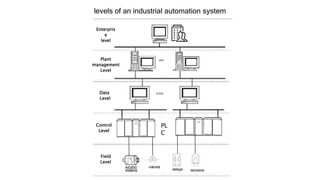
What is Communication Hierarchy model for Industrial Automation?
Industries require flow of information between different levels right from field
devices level up to enterprise level for optimum management of overall business of
the industry.
Advantages
Field
Level
Enterpris
e
level
Plant
management
Level
Data
Level
Control
Level
MES
SCADA
levels of an industrial automation system
PL
C
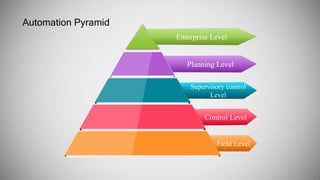
Field Level
Control Level
Supervisory control
Level
Planning Level
Enterprise Level
Automation Pyramid
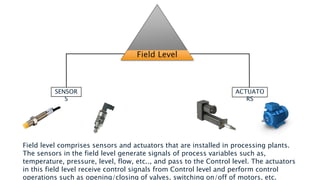
Field Level
SENSOR
S
ACTUATO
RS
Field level comprises sensors and actuators that are installed in processing plants.
The sensors in the field level generate signals of process variables such as,
temperature, pressure, level, flow, etc.., and pass to the Control level. The actuators
in this field level receive control signals from Control level and perform control
operations such as opening/closing of valves, switching on/off of motors, etc.
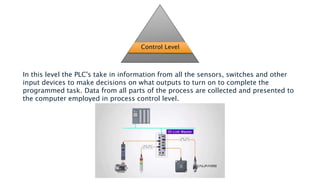
Control Level
In this level the PLC's take in information from all the sensors, switches and other
input devices to make decisions on what outputs to turn on to complete the
programmed task. Data from all parts of the process are collected and presented to
the computer employed in process control level.
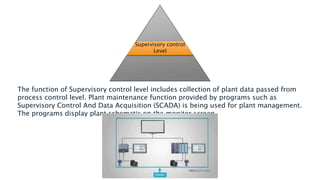
Supervisory control
Level
The function of Supervisory control level includes collection of plant data passed from
process control level. Plant maintenance function provided by programs such as
Supervisory Control And Data Acquisition (SCADA) is being used for plant management.
The programs display plant schematic on the monitor screen.
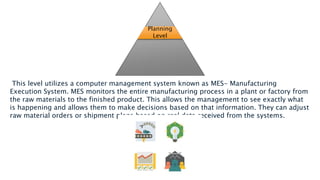
Planning
Level
This level utilizes a computer management system known as MES- Manufacturing
Execution System. MES monitors the entire manufacturing process in a plant or factory from
the raw materials to the finished product. This allows the management to see exactly what
is happening and allows them to make decisions based on that information. They can adjust
raw material orders or shipment plans based on real data received from the systems.
Enterpri
se Level
The enterprise level is where a company's top management can see and control their
operations, for example to accounts, manufacturing, purchasing, sales department, finance
and pay role etc,. The computers in enterprise level generally use office programs such as,
text editor, spreadsheets, database and e-mail.
SUMMARY
THE INDUSTRIAL AUTOMATION HIERARCHY TAKES ON A PYRAMID FORM OF COMMUNICATIONS WHERE
INFORMATION GETS AGGREGATED AS IT MOVES FROM A LOW LEVEL (SENSOR LEVEL) TO HIGH LEVEL
(SERVER OR ENTERPRISE LEVEL) AND THERE IS A DIRECT CORRELATION BETWEEN THE LEVELS OF THE
HIERARCHY IN THAT IMPROVED COMMUNICATIONS BETWEEN LEVELS OF THE HIERARCH LEAD TO DIRECT
EFFICIENCY INCREASES OF THE OVERALL MANUFACTURING SYSTEMS.
Automation pyramid.pptx

Automation pyramid.pptx

  • 1.
    Subject:- Data Communicationand Computer Networks GROUP MATES :- Chetan.S.Harihar Dileep.S Madhan Kumar. N Topic :- Hierarchy of Industrial Automation System
  • 2.
    What is CommunicationHierarchy model for Industrial Automation? Industries require flow of information between different levels right from field devices level up to enterprise level for optimum management of overall business of the industry.
  • 3.
  • 4.
  • 5.
    Field Level Control Level Supervisorycontrol Level Planning Level Enterprise Level Automation Pyramid
  • 6.
    Field Level SENSOR S ACTUATO RS Field levelcomprises sensors and actuators that are installed in processing plants. The sensors in the field level generate signals of process variables such as, temperature, pressure, level, flow, etc.., and pass to the Control level. The actuators in this field level receive control signals from Control level and perform control operations such as opening/closing of valves, switching on/off of motors, etc.
  • 7.
    Control Level In thislevel the PLC's take in information from all the sensors, switches and other input devices to make decisions on what outputs to turn on to complete the programmed task. Data from all parts of the process are collected and presented to the computer employed in process control level.
  • 8.
    Supervisory control Level The functionof Supervisory control level includes collection of plant data passed from process control level. Plant maintenance function provided by programs such as Supervisory Control And Data Acquisition (SCADA) is being used for plant management. The programs display plant schematic on the monitor screen.
  • 9.
    Planning Level This level utilizesa computer management system known as MES- Manufacturing Execution System. MES monitors the entire manufacturing process in a plant or factory from the raw materials to the finished product. This allows the management to see exactly what is happening and allows them to make decisions based on that information. They can adjust raw material orders or shipment plans based on real data received from the systems.
  • 10.
    Enterpri se Level The enterpriselevel is where a company's top management can see and control their operations, for example to accounts, manufacturing, purchasing, sales department, finance and pay role etc,. The computers in enterprise level generally use office programs such as, text editor, spreadsheets, database and e-mail.
  • 11.
    SUMMARY THE INDUSTRIAL AUTOMATIONHIERARCHY TAKES ON A PYRAMID FORM OF COMMUNICATIONS WHERE INFORMATION GETS AGGREGATED AS IT MOVES FROM A LOW LEVEL (SENSOR LEVEL) TO HIGH LEVEL (SERVER OR ENTERPRISE LEVEL) AND THERE IS A DIRECT CORRELATION BETWEEN THE LEVELS OF THE HIERARCHY IN THAT IMPROVED COMMUNICATIONS BETWEEN LEVELS OF THE HIERARCH LEAD TO DIRECT EFFICIENCY INCREASES OF THE OVERALL MANUFACTURING SYSTEMS.