AUTOMATIC ROAD CRACK DETECTION AND
CHARACTERIZATION
ABSTRACT:
A fully integrated system for the automatic detection and characterization of cracks in
road flexible pavement surfaces, which does not require manually labeled samples, is
proposed to minimize the human subjectivity resulting from traditional visual surveys. The
first task addressed, i.e., crack detection, is based on a learning from samples paradigm,
where a subset of the available image database is automatically selected and used for
unsupervised training of the system. The system classifies non-overlapping image blocks as
either containing crack pixels or not.
The second task deals with crack type characterization, for which another
classification system is constructed, to characterize the detected cracks' connect components.
Cracks are labeled according to the types defined in the Portuguese Distress Catalog, with
each different crack present in a given image receiving the appropriate label. Moreover, a
novel methodology for the assignment of crack severity levels is introduced, computing an
estimate for the width of each detected crack. Experimental crack detection and
characterization results are presented based on images captured during a visual road
pavement surface survey over Portuguese roads, with promising results. This is shown by the
quantitative evaluation methodology introduced for the evaluation of this type of system,
including a comparison with human experts' manual labeling results.

EXISTING SYSTEM:
The Crack and Pothole in the roads is one of the major problems nowadays. People
are struggling to travel from one place to another. People feel lazy to complain to the
government about the issue. So for this purpose, we propose the automatic crack and Pothole
detection using the sensor and monitor on the Google map.

PROPOSED SYSTEM:
In this paper we propose the automatic road crack and pothole detection using the
sensor and the information will be updated on the PC. The place where the crack will be
detected is monitored by using the Google map. If the crack has presented in the road by
using the sensor the information regarding the crack or pothole is updated on the PC and also
the information send the officials for the future recovery. By using this project, we reduce the
human effect to report about the problem.

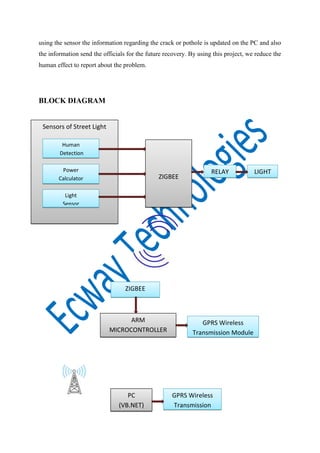
BLOCK DIAGRAM

Sensors of Street Light
Human
Detection
Power
Calculator

ZIGBEE

RELAY

Light
Sensor

ZIGBEE

ARM
MICROCONTROLLER

PC
(VB.NET)

GPRS Wireless
Transmission Module

GPRS Wireless
Transmission
Module

LIGHT
SOFTWAREREQUIRMENT:
Kiel ide
Flash magic
Embedded-c

HARDWARE REQUIRMENT:
8051(or)PIC - microcontroller project board
IR - Sensor
PC

Automatic road crack detection and characterization

  • 1.
    AUTOMATIC ROAD CRACKDETECTION AND CHARACTERIZATION ABSTRACT: A fully integrated system for the automatic detection and characterization of cracks in road flexible pavement surfaces, which does not require manually labeled samples, is proposed to minimize the human subjectivity resulting from traditional visual surveys. The first task addressed, i.e., crack detection, is based on a learning from samples paradigm, where a subset of the available image database is automatically selected and used for unsupervised training of the system. The system classifies non-overlapping image blocks as either containing crack pixels or not. The second task deals with crack type characterization, for which another classification system is constructed, to characterize the detected cracks' connect components. Cracks are labeled according to the types defined in the Portuguese Distress Catalog, with each different crack present in a given image receiving the appropriate label. Moreover, a novel methodology for the assignment of crack severity levels is introduced, computing an estimate for the width of each detected crack. Experimental crack detection and characterization results are presented based on images captured during a visual road pavement surface survey over Portuguese roads, with promising results. This is shown by the quantitative evaluation methodology introduced for the evaluation of this type of system, including a comparison with human experts' manual labeling results. EXISTING SYSTEM: The Crack and Pothole in the roads is one of the major problems nowadays. People are struggling to travel from one place to another. People feel lazy to complain to the government about the issue. So for this purpose, we propose the automatic crack and Pothole detection using the sensor and monitor on the Google map. PROPOSED SYSTEM: In this paper we propose the automatic road crack and pothole detection using the sensor and the information will be updated on the PC. The place where the crack will be detected is monitored by using the Google map. If the crack has presented in the road by
  • 2.
    using the sensorthe information regarding the crack or pothole is updated on the PC and also the information send the officials for the future recovery. By using this project, we reduce the human effect to report about the problem. BLOCK DIAGRAM Sensors of Street Light Human Detection Power Calculator ZIGBEE RELAY Light Sensor ZIGBEE ARM MICROCONTROLLER PC (VB.NET) GPRS Wireless Transmission Module GPRS Wireless Transmission Module LIGHT
  • 3.
    SOFTWAREREQUIRMENT: Kiel ide Flash magic Embedded-c HARDWAREREQUIRMENT: 8051(or)PIC - microcontroller project board IR - Sensor PC