A ROBOT THAT APPROACHES PEDESTRIANS
ABSTRACT
When robots serve in urban areas such as shopping malls, they will often be required to
approach people in order to initiate service. This paper presents a technique for human–robot
interaction that enables a robot to approach people who are passing through an environment. For
successful approach, our proposed planner first searches for a target person at public distance
zones anticipating his/her future position and behavior. It chooses a person who does not seem
busy and can be reached from a frontal direction. Once the robot successfully approaches the
person within the social distance zone, it identifies the person’s reaction and provides a timely
response by coordinating its body orientation. The system was tested in a shopping mall and
compared with a simple approaching method. The result demonstrates a significant improvement
in approaching performance; the simple method was only 35.1% successful, whereas the
proposed technique showed a success rate of 55.9%.

EXISTING SYSTEM
Robots have started to move from laboratories to real environments, where they
interact with ordinary people who spontaneously interact with them. Robots have been tested in
guiding roles in museums and supermarkets. Social robots, such as receptionists and tutors, have
been developed to interact like humans, communicating socially with people.
The “initiating interaction” is one of the fundamental capabilities of human–robot
interaction for such robots. That is, the initiating interaction would be commonly useful among
these robots, while each of them would engage in task-specific interaction for each individual
application after initiation. Although many robots are equipped with the capability to invite
people into an interaction, these robots only passively wait for people to approach them.
PROPOSED SYSTEM
In our proposed system, a “mobile” robot can approach people to initiate
interaction. This way of providing services is more proactive than waiting, since it enables robots
to find and assist people who have potential needs. For instance, imagine a senior citizen who is
lost in a mall. If a robot were placed in the mall to provide route directions, it could wait to be
approached for help; however, people might not know what the robot can do, or they might
hesitate to ask for help. It would be more appropriate for the robot to approach and offer help.
Our study presents a method to deal with this novel way of initiating interaction.
A robot’s capability to approach people is important for a number of applications. We
believe that one promising application is an invitation service; a robot offers shopping
information and invites people to visit shops, while giving people the opportunity to interact with
it, since robots remain very novel.

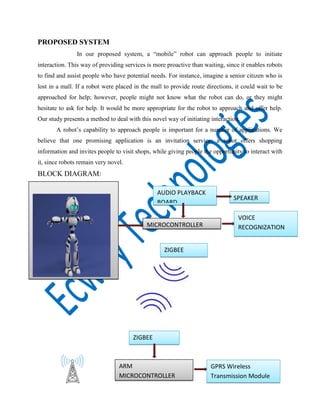
BLOCK DIAGRAM:
AUDIO PLAYBACK
BOARD
MICROCONTROLLER

SPEAKER
VOICE
RECOGNIZATION
(PC)

ZIGBEE

ZIGBEE

ARM
MICROCONTROLLER

GPRS Wireless
Transmission Module
HARDWARE REQURIMENT:
1. Arm-microcontroller
2. Audio playback board
3. Voice reorganization
4. ZIGBEE
5. GPRS wireless transmission module
6. Speaker
7. Power supply

SOFTWARE REQURIMENT:
1. Kiel IDE
2. Flash magic

3. Embedded-c

A robot that approaches pedestrians

  • 1.
    A ROBOT THATAPPROACHES PEDESTRIANS ABSTRACT When robots serve in urban areas such as shopping malls, they will often be required to approach people in order to initiate service. This paper presents a technique for human–robot interaction that enables a robot to approach people who are passing through an environment. For successful approach, our proposed planner first searches for a target person at public distance zones anticipating his/her future position and behavior. It chooses a person who does not seem busy and can be reached from a frontal direction. Once the robot successfully approaches the person within the social distance zone, it identifies the person’s reaction and provides a timely response by coordinating its body orientation. The system was tested in a shopping mall and compared with a simple approaching method. The result demonstrates a significant improvement in approaching performance; the simple method was only 35.1% successful, whereas the proposed technique showed a success rate of 55.9%. EXISTING SYSTEM Robots have started to move from laboratories to real environments, where they interact with ordinary people who spontaneously interact with them. Robots have been tested in guiding roles in museums and supermarkets. Social robots, such as receptionists and tutors, have been developed to interact like humans, communicating socially with people. The “initiating interaction” is one of the fundamental capabilities of human–robot interaction for such robots. That is, the initiating interaction would be commonly useful among these robots, while each of them would engage in task-specific interaction for each individual application after initiation. Although many robots are equipped with the capability to invite people into an interaction, these robots only passively wait for people to approach them.
  • 2.
    PROPOSED SYSTEM In ourproposed system, a “mobile” robot can approach people to initiate interaction. This way of providing services is more proactive than waiting, since it enables robots to find and assist people who have potential needs. For instance, imagine a senior citizen who is lost in a mall. If a robot were placed in the mall to provide route directions, it could wait to be approached for help; however, people might not know what the robot can do, or they might hesitate to ask for help. It would be more appropriate for the robot to approach and offer help. Our study presents a method to deal with this novel way of initiating interaction. A robot’s capability to approach people is important for a number of applications. We believe that one promising application is an invitation service; a robot offers shopping information and invites people to visit shops, while giving people the opportunity to interact with it, since robots remain very novel. BLOCK DIAGRAM: AUDIO PLAYBACK BOARD MICROCONTROLLER SPEAKER VOICE RECOGNIZATION (PC) ZIGBEE ZIGBEE ARM MICROCONTROLLER GPRS Wireless Transmission Module
  • 3.
    HARDWARE REQURIMENT: 1. Arm-microcontroller 2.Audio playback board 3. Voice reorganization 4. ZIGBEE 5. GPRS wireless transmission module 6. Speaker 7. Power supply SOFTWARE REQURIMENT: 1. Kiel IDE 2. Flash magic 3. Embedded-c