Automated testing of EPiServer CMS sitesAn overview of testing in general and specifically EPiServer sites
About meJoel AbrahamssonLiving in StockholmWorks at ValtechDevelops websites with ASP.NET and EPiServerBlogs about web developmentFounder of the open source projects Page Type Builder, EPiAbstractions and co-founder of EPiMVP
AgendaThe importance of automationTypes of testingxUnit testingIsolating codeChallenges when testing EPiServer sites
The importance of automationQuick feedback loopsLess debuggingLimits the human factorDocumentation
Automation goalsWe want our tests to be run. Often. By everyone.Tests should be self-checkingTests should be repeatableTests should be independent of environmentTests should run fastThere should be no hassle running our tests.
Types of automated testsUI TestsIntegration testsUnit tests
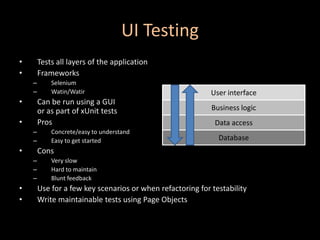
UI TestingTests all layers of the applicationFrameworksSeleniumWatin/WatirCan be run using a GUIor as part of xUnit testsProsConcrete/easy to understandEasy to get startedConsVery slowHard to maintainBlunt feedbackUse for a few key scenarios or when refactoring for testabilityWrite maintainable tests using Page ObjectsUser interfaceBusiness logicData accessDatabase
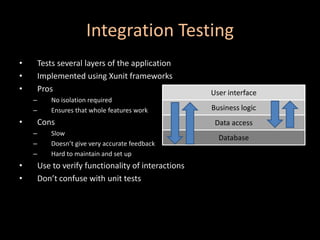
Tests several layers of the applicationImplemented using Xunit frameworksProsNo isolation requiredEnsures that whole features workConsSlowDoesn’t give very accurate feedbackHard to maintain and set upUse to verify functionality of interactionsDon’t confuse with unit testsIntegration TestingUser interfaceBusiness logicData accessDatabase
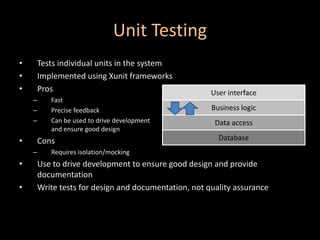
Tests individual units in the systemImplemented using Xunit frameworksProsFastPrecise feedbackCan be used to drive developmentand ensure good designConsRequires isolation/mockingUse to drive development to ensure good design and provide documentationWrite tests for design and documentation, not quality assuranceUnit TestingUser interfaceBusiness logicData accessDatabase
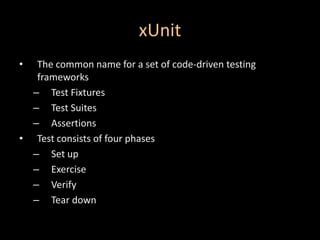
The common name for a set of code-driven testing frameworksTest FixturesTest SuitesAssertionsTest consists of four phasesSet upExerciseVerifyTear downxUnit
The verification phase consists of one or several assertionsTests either test state or interactionsVerifying state means checking a returned value or ensuring that an object is in a specific stateVerifying interactions usually means verifying that the component being tested has performed an interaction with another component. xUnit - Asserts
FrameworksNUnitMBUnitxUnit.netVisual Studio Unit Testing Framework / MSTestExecuted using test runners on clients and by build serversMany frameworks comes with built in runnersResharperTestDriven.NETxUnit Frameworks
Replace a depency with a different component with the same interface to enable and verify interactionsAlso known as mockingAccomplished using Inversion of ControlReplacing interface methods or virtual methodsFrameworksRhino MocksMoqIsolatorNUnit.MocksCode Isolation
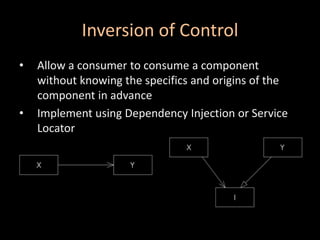
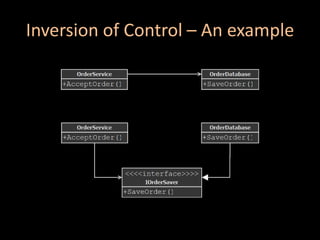
Allow a consumer to consume a component without knowing the specifics and origins of the component in advanceImplement using Dependency Injection or Service LocatorInversion of Control
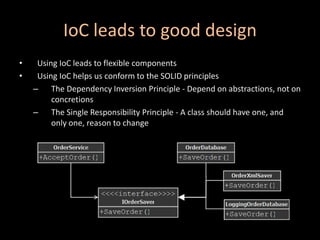
Inversion of Control – An example
Using IoC leads to flexible componentsUsing IoC helps us conform to the SOLID principles The Dependency Inversion Principle - Depend on abstractions, not on concretionsThe Single Responsibility Principle - A class should have one, and only one, reason to changeIoC leads to good design
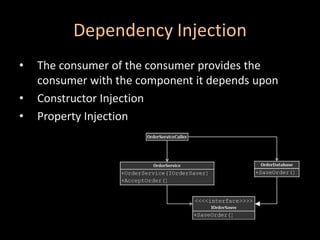
The consumer of the consumer provides the consumer with the component it depends uponConstructor InjectionProperty InjectionDependency Injection
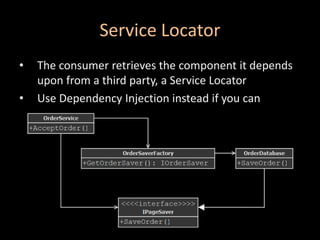
The consumer retrieves the component it depends upon from a third party, a Service LocatorUse Dependency Injection instead if you canService Locator
Frameworks for managing dependenciesEnable life cycle aware applicationsA wide range of open source frameworksStructureMapNinjectUnityCastle WindsorAutofacIoC Containers
Test DoublesDummies – objects that are passed around but never used.Fakes – Working implementationsStubs – Provides implementations for certain methods with responses defined in the testMocks – Same as stubs but with expectations that can be verifiedPartial mocksIsolation/Mocking terminology
Static or non-virtual methodsExample: all methods in DataFactory are non-virtualMakes Inversion of Control hardDependent on it’s configurationMakes it hard to test single units of codeTightly integrated with Web FormsMakes it hard to test without a HTTP ContextComplicates Depency InjectionEPiServer CMS challenges
Create wrappersEPiAbstractionsepiabstractions.codeplex.comBeware of security concernsOvercoming static and non-virtual methods
Create wrappersUse Page Type Builder to decouple from PageData.PropertyPartial mockingOvercoming dependencies on the configuration
Extract business logic from pages and controlsUse Page Type Builder to decouple from PageData.Propertypagetypebuilder.codeplex.comThe Model View Presenter patternWeb Forms MVPwebformsmvp.comEPiMVPgithub.com/joelabrahamsson/EPiServer-MVPOvercoming tight Web Forms integration
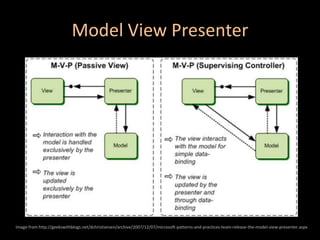
Model View PresenterImage from http://geekswithblogs.net/dchristiansen/archive/2007/12/07/microsoft-patterns-and-practices-team-release-the-model-view-presenter.aspx
Two base classes for pages and controls, EPiMvpPage and EPiMvpUserControlA base class for presenters, EPiPresenterA presenterfactory that instantiates presenters for views with the view and PageData objectAlso comes with two presenterfactories that utilizes IoC containers, StructureMap and NinjectEPiMVP - Components
A request comes in to the viewWeb Forms MVP inspects the views PresenterBinding attribute to find the presenter typeWeb Forms MVP uses a configured (in global.asax) PresenterFactory to instantiate a presenter with a modelobjectThe presenter, which receives the view and PageData object in the constructor attaches it’s methods to the view’s eventsEPiMVP – How it works
Good candidates for testing includeIntegrations with external servicesUtilities (AddQuerystringParameter etc)Custom cachingComponents that easily get to be complex (example: paging)Bad candidates includeComponents with extremely little logicComponents where the logic is handled by EPiServer (menus etc)Components that deal with, or are closely coupled to, markup Keep in mind that the point of the test isn’t only what it tests but that it drives good designWhat to (not) test using unit tests
Give your tests descriptive namesCare about the code in your testArrange your tests using AAA (Arrange, Act, Assert)Also known as Given-When-ThenBe carefull with using code coverage as a measurementSome principles such as the DRY principle isn’t always valid for testsDo not use tools to generate tests. Period.Words of advice
Questions?http://joelabrahamsson.com@joelabrahamssonmail@joelabrahamsson.com

Automated Testing Of EPiServer CMS Sites

  • 1.
    Automated testing ofEPiServer CMS sitesAn overview of testing in general and specifically EPiServer sites
  • 2.
    About meJoel AbrahamssonLivingin StockholmWorks at ValtechDevelops websites with ASP.NET and EPiServerBlogs about web developmentFounder of the open source projects Page Type Builder, EPiAbstractions and co-founder of EPiMVP
  • 3.
    AgendaThe importance ofautomationTypes of testingxUnit testingIsolating codeChallenges when testing EPiServer sites
  • 4.
    The importance ofautomationQuick feedback loopsLess debuggingLimits the human factorDocumentation
  • 5.
    Automation goalsWe wantour tests to be run. Often. By everyone.Tests should be self-checkingTests should be repeatableTests should be independent of environmentTests should run fastThere should be no hassle running our tests.
  • 6.
    Types of automatedtestsUI TestsIntegration testsUnit tests
  • 7.
    UI TestingTests alllayers of the applicationFrameworksSeleniumWatin/WatirCan be run using a GUIor as part of xUnit testsProsConcrete/easy to understandEasy to get startedConsVery slowHard to maintainBlunt feedbackUse for a few key scenarios or when refactoring for testabilityWrite maintainable tests using Page ObjectsUser interfaceBusiness logicData accessDatabase
  • 8.
    Tests several layersof the applicationImplemented using Xunit frameworksProsNo isolation requiredEnsures that whole features workConsSlowDoesn’t give very accurate feedbackHard to maintain and set upUse to verify functionality of interactionsDon’t confuse with unit testsIntegration TestingUser interfaceBusiness logicData accessDatabase
  • 9.
    Tests individual unitsin the systemImplemented using Xunit frameworksProsFastPrecise feedbackCan be used to drive developmentand ensure good designConsRequires isolation/mockingUse to drive development to ensure good design and provide documentationWrite tests for design and documentation, not quality assuranceUnit TestingUser interfaceBusiness logicData accessDatabase
  • 10.
    The common namefor a set of code-driven testing frameworksTest FixturesTest SuitesAssertionsTest consists of four phasesSet upExerciseVerifyTear downxUnit
  • 11.
    The verification phaseconsists of one or several assertionsTests either test state or interactionsVerifying state means checking a returned value or ensuring that an object is in a specific stateVerifying interactions usually means verifying that the component being tested has performed an interaction with another component. xUnit - Asserts
  • 12.
    FrameworksNUnitMBUnitxUnit.netVisual Studio UnitTesting Framework / MSTestExecuted using test runners on clients and by build serversMany frameworks comes with built in runnersResharperTestDriven.NETxUnit Frameworks
  • 13.
    Replace a depencywith a different component with the same interface to enable and verify interactionsAlso known as mockingAccomplished using Inversion of ControlReplacing interface methods or virtual methodsFrameworksRhino MocksMoqIsolatorNUnit.MocksCode Isolation
  • 14.
    Allow a consumerto consume a component without knowing the specifics and origins of the component in advanceImplement using Dependency Injection or Service LocatorInversion of Control
  • 15.
    Inversion of Control– An example
  • 16.
    Using IoC leadsto flexible componentsUsing IoC helps us conform to the SOLID principles The Dependency Inversion Principle - Depend on abstractions, not on concretionsThe Single Responsibility Principle - A class should have one, and only one, reason to changeIoC leads to good design
  • 17.
    The consumer ofthe consumer provides the consumer with the component it depends uponConstructor InjectionProperty InjectionDependency Injection
  • 18.
    The consumer retrievesthe component it depends upon from a third party, a Service LocatorUse Dependency Injection instead if you canService Locator
  • 19.
    Frameworks for managingdependenciesEnable life cycle aware applicationsA wide range of open source frameworksStructureMapNinjectUnityCastle WindsorAutofacIoC Containers
  • 20.
    Test DoublesDummies –objects that are passed around but never used.Fakes – Working implementationsStubs – Provides implementations for certain methods with responses defined in the testMocks – Same as stubs but with expectations that can be verifiedPartial mocksIsolation/Mocking terminology
  • 21.
    Static or non-virtualmethodsExample: all methods in DataFactory are non-virtualMakes Inversion of Control hardDependent on it’s configurationMakes it hard to test single units of codeTightly integrated with Web FormsMakes it hard to test without a HTTP ContextComplicates Depency InjectionEPiServer CMS challenges
  • 22.
    Create wrappersEPiAbstractionsepiabstractions.codeplex.comBeware ofsecurity concernsOvercoming static and non-virtual methods
  • 23.
    Create wrappersUse PageType Builder to decouple from PageData.PropertyPartial mockingOvercoming dependencies on the configuration
  • 24.
    Extract business logicfrom pages and controlsUse Page Type Builder to decouple from PageData.Propertypagetypebuilder.codeplex.comThe Model View Presenter patternWeb Forms MVPwebformsmvp.comEPiMVPgithub.com/joelabrahamsson/EPiServer-MVPOvercoming tight Web Forms integration
  • 25.
    Model View PresenterImagefrom http://geekswithblogs.net/dchristiansen/archive/2007/12/07/microsoft-patterns-and-practices-team-release-the-model-view-presenter.aspx
  • 26.
    Two base classesfor pages and controls, EPiMvpPage and EPiMvpUserControlA base class for presenters, EPiPresenterA presenterfactory that instantiates presenters for views with the view and PageData objectAlso comes with two presenterfactories that utilizes IoC containers, StructureMap and NinjectEPiMVP - Components
  • 27.
    A request comesin to the viewWeb Forms MVP inspects the views PresenterBinding attribute to find the presenter typeWeb Forms MVP uses a configured (in global.asax) PresenterFactory to instantiate a presenter with a modelobjectThe presenter, which receives the view and PageData object in the constructor attaches it’s methods to the view’s eventsEPiMVP – How it works
  • 28.
    Good candidates fortesting includeIntegrations with external servicesUtilities (AddQuerystringParameter etc)Custom cachingComponents that easily get to be complex (example: paging)Bad candidates includeComponents with extremely little logicComponents where the logic is handled by EPiServer (menus etc)Components that deal with, or are closely coupled to, markup Keep in mind that the point of the test isn’t only what it tests but that it drives good designWhat to (not) test using unit tests
  • 29.
    Give your testsdescriptive namesCare about the code in your testArrange your tests using AAA (Arrange, Act, Assert)Also known as Given-When-ThenBe carefull with using code coverage as a measurementSome principles such as the DRY principle isn’t always valid for testsDo not use tools to generate tests. Period.Words of advice
  • 30.