A Study on
Artificial Intelligence
in Apparel Industry:
Future of Technical
World
Paper Presentation done by
: Nandhinikutty
INTRODUCTI
ON
PRESENT
SCENARIO
FUTURE CONCLUSION
TABLE OF CONTENTS
01 03
02 04
INTRODUCTION
01
WHAT IS AI?
Artificial Intelligence (AI) is the
branch of computer sciences
that emphasizes the
development of intelligence
machines, thinking and working
like humans. For
example, speech recognition,
problem-solving, learning
and planning.
INTRODUCTION
Using a powerful algorithm that analyses past
designs and future trends, AI makes new apparel
designs complete with sewing patterns. Retailers
can choose to send AI-designed apparel straight to
manufacturing or incorporate this as an additional
step to automate the pattern making and fit
process.
Applications help both customers and
manufacturers sort out the fit situation, which
will make shoppers happier and reduce the
industry's environmental impact. Designers use
AI to create fabrics and garments; consulting firms
One example: Almossawi used AI to create a line of garments
based on the Japanese kimono. “I thought it would be cool to
look at designing different silhouettes with different kinds of
textures and details,” he said.
Eg: Designer Hussain Almossawi used AI to create a line of garments
AI HELPS WITH DESIGN
Almossawi taps AI for inspiration and idea
generation; it’s helped him generate more
ideas than he could without it. “As part of
every designer’s process, the early phase
involves a lot of explorations and ideation
sessions” ranging from bouncing around blue-
sky ideas to brainstorming with colleagues. AI,
he said, aids collaboration by expanding
person-to-person collaboration to human-to-
machine collaboration. “As crazy and
interesting as AI is, it’s probably just in its
infancy, and I can only see it getting better and
doing much more than outputting images,” he
said.
AI IN THE TEXTILE INDUSTRY
1. YARN MANUFACTURING
AI IN
THE
TEXTILE
INDUST
RY
2. FABRIC PATTERN INSPECTION
3. COLOR MANAGEMENT
4.FABRIC GRADING
5. AI IN PATTERN MAKING
6. SUPPLY CHAIN AND
MERCHANDISING
PRESENT
SCENARIO
02
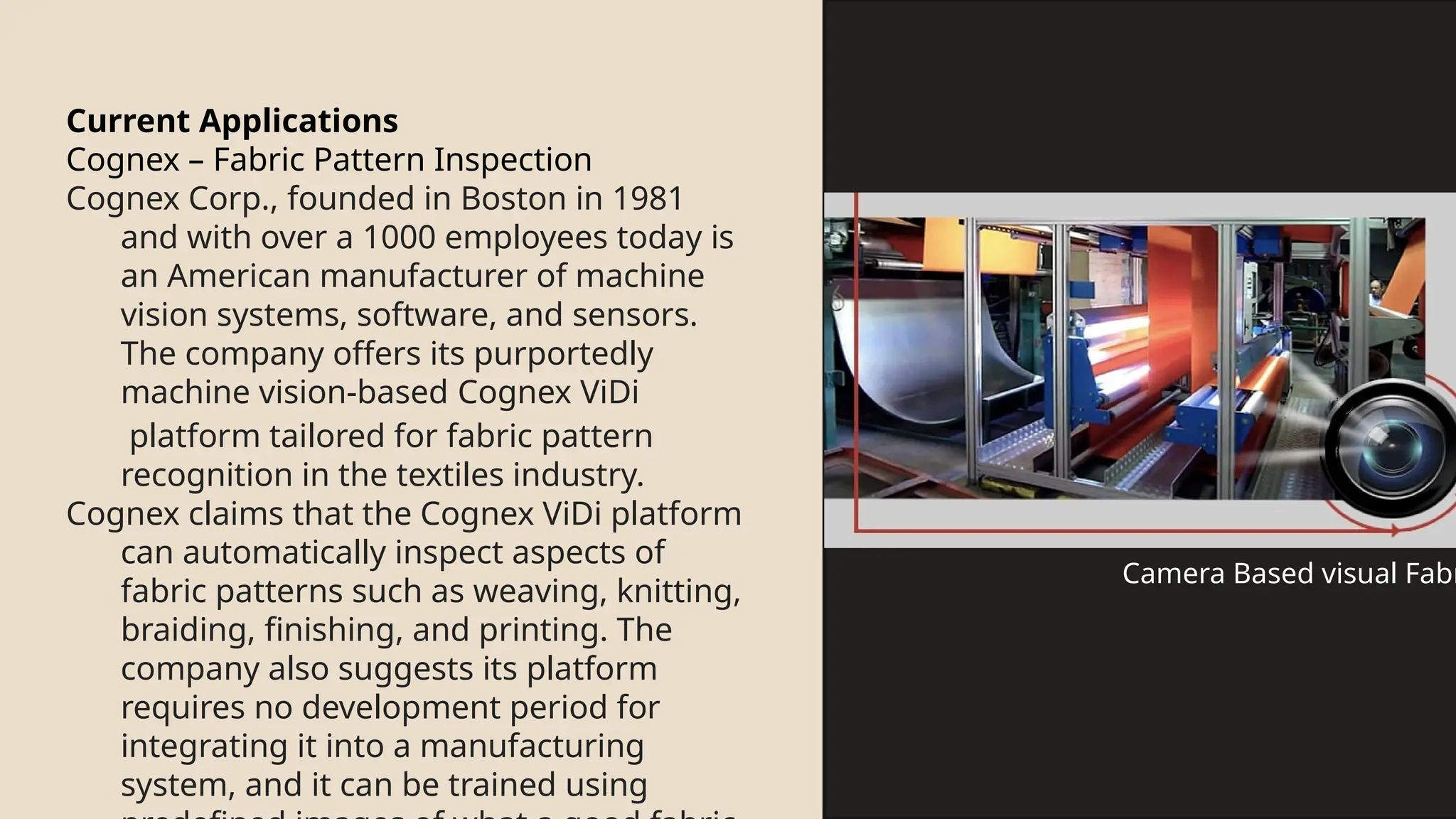
Current Applications
Cognex – Fabric Pattern Inspection
Cognex Corp., founded in Boston in 1981
and with over a 1000 employees today is
an American manufacturer of machine
vision systems, software, and sensors.
The company offers its purportedly
machine vision-based Cognex ViDi
platform tailored for fabric pattern
recognition in the textiles industry.
Cognex claims that the Cognex ViDi platform
can automatically inspect aspects of
fabric patterns such as weaving, knitting,
braiding, finishing, and printing. The
company also suggests its platform
requires no development period for
integrating it into a manufacturing
system, and it can be trained using
Camera Based visual Fabr
Yarn Dye Plaid:-For this first woven fabric, we
provided our VIDI red tool with a representative set
of good samples for the system to learn by itself,
completely unsupervised, the weaving pattern, yarn
properties, colors and tolerable imperfections.
EXPERIMENT 2
Yarn Dye Stripes :-On this second set of
fabric, just as for the previous set, ViDi's red
tool learns, by itself, a model of the complex
knitting pattern from a collection of
randomly selected good samples.
CATEGORY 01
EXPERIMENT
1
Cognex ViDi distinguishes unacceptable defects on
seat belt and tire fabric while tolerating naturally
occurring variations.
EXPERIMENT 4 -
PRINTING
Cognex VIDI allows the inspection of printed
webs. It is able to identify problems in
printing quality such as misalignment of
different color channels (black outline versus
filling) while the motifs can be highly
complex.
CATEGORY 02
EXPERIMENT 3 -
WEAVING
Cognex ViDi can detect anomalies like soil or ink
spots on garments as well as defects in highly
critical stitching such as on airbags. It also excels at
verifying embossed characters on medical fabrics.
CATEGORY 03
EXPERIMENT 5 -
FINISHING
FUTURE
IN TEXTILE INDUSTRY
03
AI
IN
THE
NEAR
FUTUR
E
• In Mendelson’s view, some of the most
intriguing AI research and
experimentation that will have near-
future ramifications is happening in two
areas: “reinforcement” learning, which
deals in rewards and punishment rather
than labeled data; and generative
adversarial networks (GAN for short) that
allow computer algorithms to create
rather than merely assess by pitting two
nets against each other.
• The former is exemplified by the Go-
playing prowess of Google DeepMinds
Alpha Go Zero, the latter by original
image or audio generation that’s based
on learning about a certain subject like
celebrities or a particular type of music.
• On a far grander scale, AI is poised to
have a major effect on sustainability,
• There’s virtually no major industry modern AI — more
specifically, “narrow AI,” which performs objective
functions using data-trained models and often falls
into the categories of deep learning or machine
learning — hasn’t already affected. That’s especially
true in the past few years, as data collection and
analysis has ramped up considerably thanks to
robust IoT connectivity, the proliferation of connected
devices and ever-speedier computer processing.
• Some sectors are at the start of their AI journey,
others are veteran travelers. Both have a long way to
go. Regardless, the impact AI is having on our present
day lives is hard to ignore.
• With companies spending billions of dollars on AI
products and services annually, tech giants
like Google, Apple, Microsoft and Amazon spending
billions to create those products and services,
universities making AI a more prominent part of
their curricula, and the U.S. Department of Defense
upping its AI game, big things are bound to happen.
Some of those developments are well on their way to
being fully realized; some are merely theoretical and
Teslas Humanoid
Robot
CONCLUSION
04
In the last five years, academic research papers have been
published on using image-recognition technology in
the textile industry in a number of applications, such
as grading yarn appearance from the Textile
Department, Amirkabir University of Technology,
Iran or fabric-defect inspection using sensors. As
machine vision continues to make its way
into manufacturing and industrial applications, we can
expect to see more textile examination use cases in the
future.
Yet, commercial use of AI in pre-production textile
processing seems limited to only a few applications
today, particularly in identifying and grading textile
fibers and yarn. Fiber identification and grading in
terms of color, length, uniformity ratio, tenacity, etc.,
may see AI use cases develop in the years ahead.
We suspect that only larger and more tech-savvy textile
manufacturers are likely to adopt this technology in
the near-term, given the setup, integration, and the
potential need for data science talent that would be
required to successfully scale such an application
CREDITS: This presentation template was created
by Slidesgo, and includes icons by Flaticon, and
infographics & images by Freepik
THANK
YOU

ARTIFICIAL INTELLIGENCE IN APPAREL INDUSTRY.pptx

  • 1.
    A Study on ArtificialIntelligence in Apparel Industry: Future of Technical World Paper Presentation done by : Nandhinikutty
  • 2.
  • 3.
  • 4.
    WHAT IS AI? ArtificialIntelligence (AI) is the branch of computer sciences that emphasizes the development of intelligence machines, thinking and working like humans. For example, speech recognition, problem-solving, learning and planning. INTRODUCTION Using a powerful algorithm that analyses past designs and future trends, AI makes new apparel designs complete with sewing patterns. Retailers can choose to send AI-designed apparel straight to manufacturing or incorporate this as an additional step to automate the pattern making and fit process. Applications help both customers and manufacturers sort out the fit situation, which will make shoppers happier and reduce the industry's environmental impact. Designers use AI to create fabrics and garments; consulting firms
  • 5.
    One example: Almossawiused AI to create a line of garments based on the Japanese kimono. “I thought it would be cool to look at designing different silhouettes with different kinds of textures and details,” he said. Eg: Designer Hussain Almossawi used AI to create a line of garments AI HELPS WITH DESIGN Almossawi taps AI for inspiration and idea generation; it’s helped him generate more ideas than he could without it. “As part of every designer’s process, the early phase involves a lot of explorations and ideation sessions” ranging from bouncing around blue- sky ideas to brainstorming with colleagues. AI, he said, aids collaboration by expanding person-to-person collaboration to human-to- machine collaboration. “As crazy and interesting as AI is, it’s probably just in its infancy, and I can only see it getting better and doing much more than outputting images,” he said.
  • 6.
    AI IN THETEXTILE INDUSTRY 1. YARN MANUFACTURING AI IN THE TEXTILE INDUST RY 2. FABRIC PATTERN INSPECTION 3. COLOR MANAGEMENT 4.FABRIC GRADING 5. AI IN PATTERN MAKING 6. SUPPLY CHAIN AND MERCHANDISING
  • 7.
  • 8.
    Current Applications Cognex –Fabric Pattern Inspection Cognex Corp., founded in Boston in 1981 and with over a 1000 employees today is an American manufacturer of machine vision systems, software, and sensors. The company offers its purportedly machine vision-based Cognex ViDi platform tailored for fabric pattern recognition in the textiles industry. Cognex claims that the Cognex ViDi platform can automatically inspect aspects of fabric patterns such as weaving, knitting, braiding, finishing, and printing. The company also suggests its platform requires no development period for integrating it into a manufacturing system, and it can be trained using Camera Based visual Fabr
  • 9.
    Yarn Dye Plaid:-Forthis first woven fabric, we provided our VIDI red tool with a representative set of good samples for the system to learn by itself, completely unsupervised, the weaving pattern, yarn properties, colors and tolerable imperfections. EXPERIMENT 2 Yarn Dye Stripes :-On this second set of fabric, just as for the previous set, ViDi's red tool learns, by itself, a model of the complex knitting pattern from a collection of randomly selected good samples. CATEGORY 01 EXPERIMENT 1
  • 10.
    Cognex ViDi distinguishesunacceptable defects on seat belt and tire fabric while tolerating naturally occurring variations. EXPERIMENT 4 - PRINTING Cognex VIDI allows the inspection of printed webs. It is able to identify problems in printing quality such as misalignment of different color channels (black outline versus filling) while the motifs can be highly complex. CATEGORY 02 EXPERIMENT 3 - WEAVING
  • 11.
    Cognex ViDi candetect anomalies like soil or ink spots on garments as well as defects in highly critical stitching such as on airbags. It also excels at verifying embossed characters on medical fabrics. CATEGORY 03 EXPERIMENT 5 - FINISHING
  • 12.
  • 13.
    AI IN THE NEAR FUTUR E • In Mendelson’sview, some of the most intriguing AI research and experimentation that will have near- future ramifications is happening in two areas: “reinforcement” learning, which deals in rewards and punishment rather than labeled data; and generative adversarial networks (GAN for short) that allow computer algorithms to create rather than merely assess by pitting two nets against each other. • The former is exemplified by the Go- playing prowess of Google DeepMinds Alpha Go Zero, the latter by original image or audio generation that’s based on learning about a certain subject like celebrities or a particular type of music. • On a far grander scale, AI is poised to have a major effect on sustainability,
  • 14.
    • There’s virtuallyno major industry modern AI — more specifically, “narrow AI,” which performs objective functions using data-trained models and often falls into the categories of deep learning or machine learning — hasn’t already affected. That’s especially true in the past few years, as data collection and analysis has ramped up considerably thanks to robust IoT connectivity, the proliferation of connected devices and ever-speedier computer processing. • Some sectors are at the start of their AI journey, others are veteran travelers. Both have a long way to go. Regardless, the impact AI is having on our present day lives is hard to ignore. • With companies spending billions of dollars on AI products and services annually, tech giants like Google, Apple, Microsoft and Amazon spending billions to create those products and services, universities making AI a more prominent part of their curricula, and the U.S. Department of Defense upping its AI game, big things are bound to happen. Some of those developments are well on their way to being fully realized; some are merely theoretical and Teslas Humanoid Robot
  • 15.
  • 16.
    In the lastfive years, academic research papers have been published on using image-recognition technology in the textile industry in a number of applications, such as grading yarn appearance from the Textile Department, Amirkabir University of Technology, Iran or fabric-defect inspection using sensors. As machine vision continues to make its way into manufacturing and industrial applications, we can expect to see more textile examination use cases in the future. Yet, commercial use of AI in pre-production textile processing seems limited to only a few applications today, particularly in identifying and grading textile fibers and yarn. Fiber identification and grading in terms of color, length, uniformity ratio, tenacity, etc., may see AI use cases develop in the years ahead. We suspect that only larger and more tech-savvy textile manufacturers are likely to adopt this technology in the near-term, given the setup, integration, and the potential need for data science talent that would be required to successfully scale such an application
  • 17.
    CREDITS: This presentationtemplate was created by Slidesgo, and includes icons by Flaticon, and infographics & images by Freepik THANK YOU