홍은기
AUTOMATA
1. What is an Automaton?
2. Fundamental Concepts
3. Finite-state Automaton
4. References
CONTENTS
1. The automaton (pl. automata) is an abstract
computing machine, which is a conceptual
model of the fundamentals of computation.
2. Automaton, originally from a Greek word
αὐτόματον, means "self-acting".
3. The automaton arose in the 1950s out of
Turing's (1936) model of algorithmic
computation, considered by many to be the
foundation of modern computer science.
WHAT IS AN AUTOMATON?
*Applications of automata
1. Text processing
2. Web browsing
3. Compiler
4. Operating system
5. Hardware design
6. Sequential logic circuits
7. etc.
WHAT IS AN AUTOMATON?
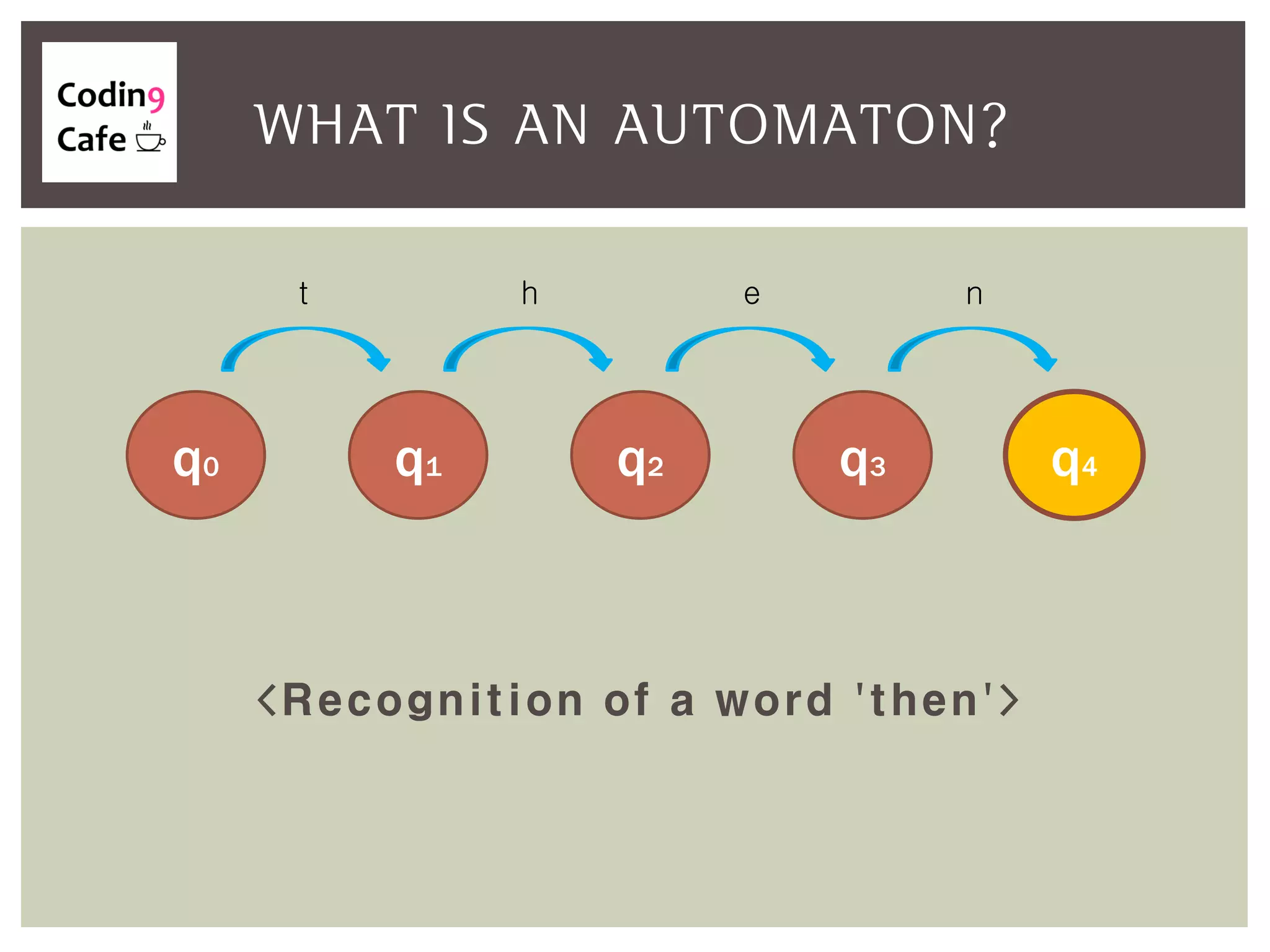
<Recognition of a word 'then'>
WHAT IS AN AUTOMATON?
q0 q1 q2 q3
t h e
q4
n
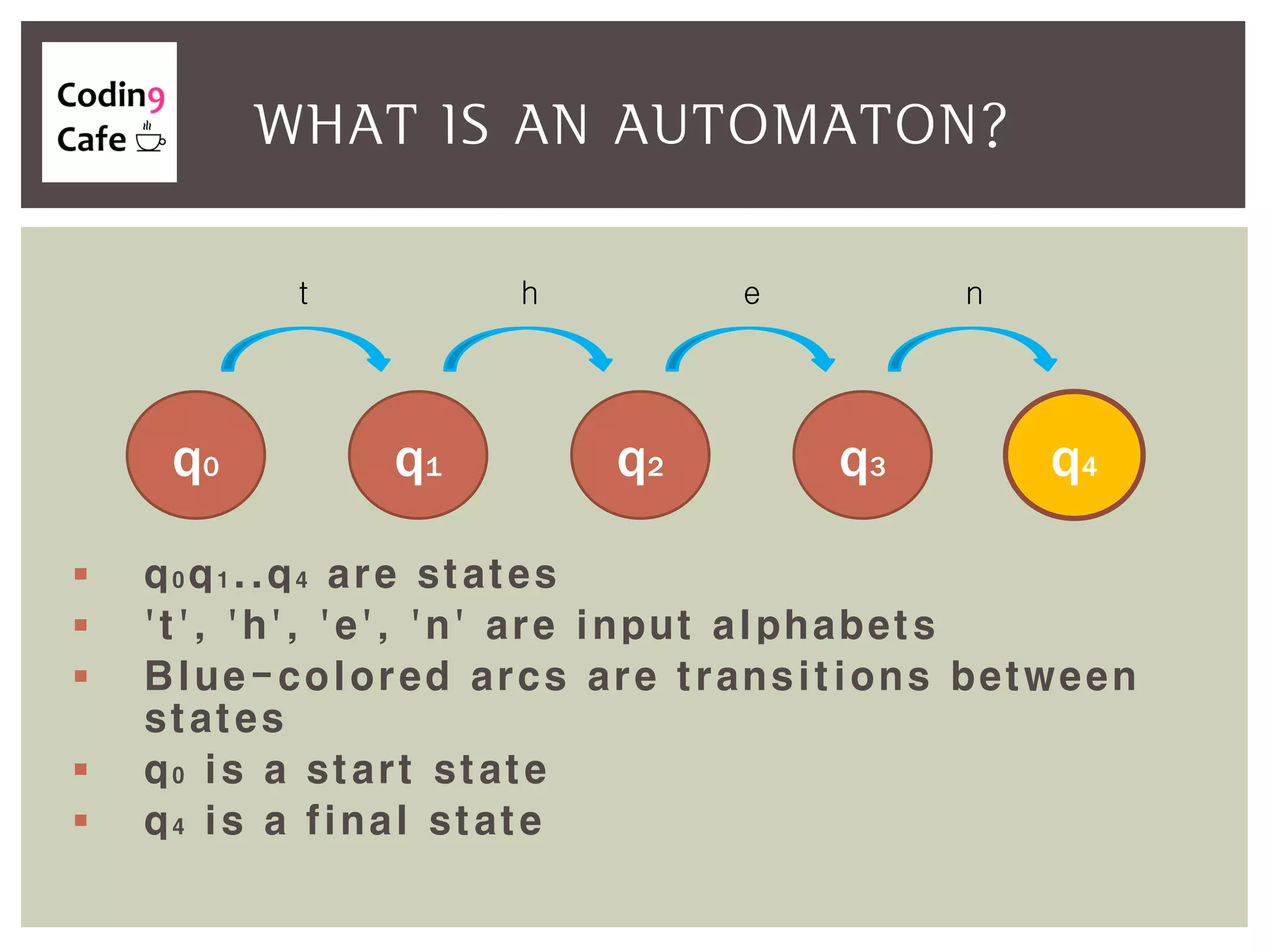
 q0q1..q4 are states
 't', 'h', 'e', 'n' are input alphabets
 Blue-colored arcs are transitions between
states
 q0 is a start state
 q4 is a final state
WHAT IS AN AUTOMATON?
q0 q1 q2 q3
t h e
q4
n
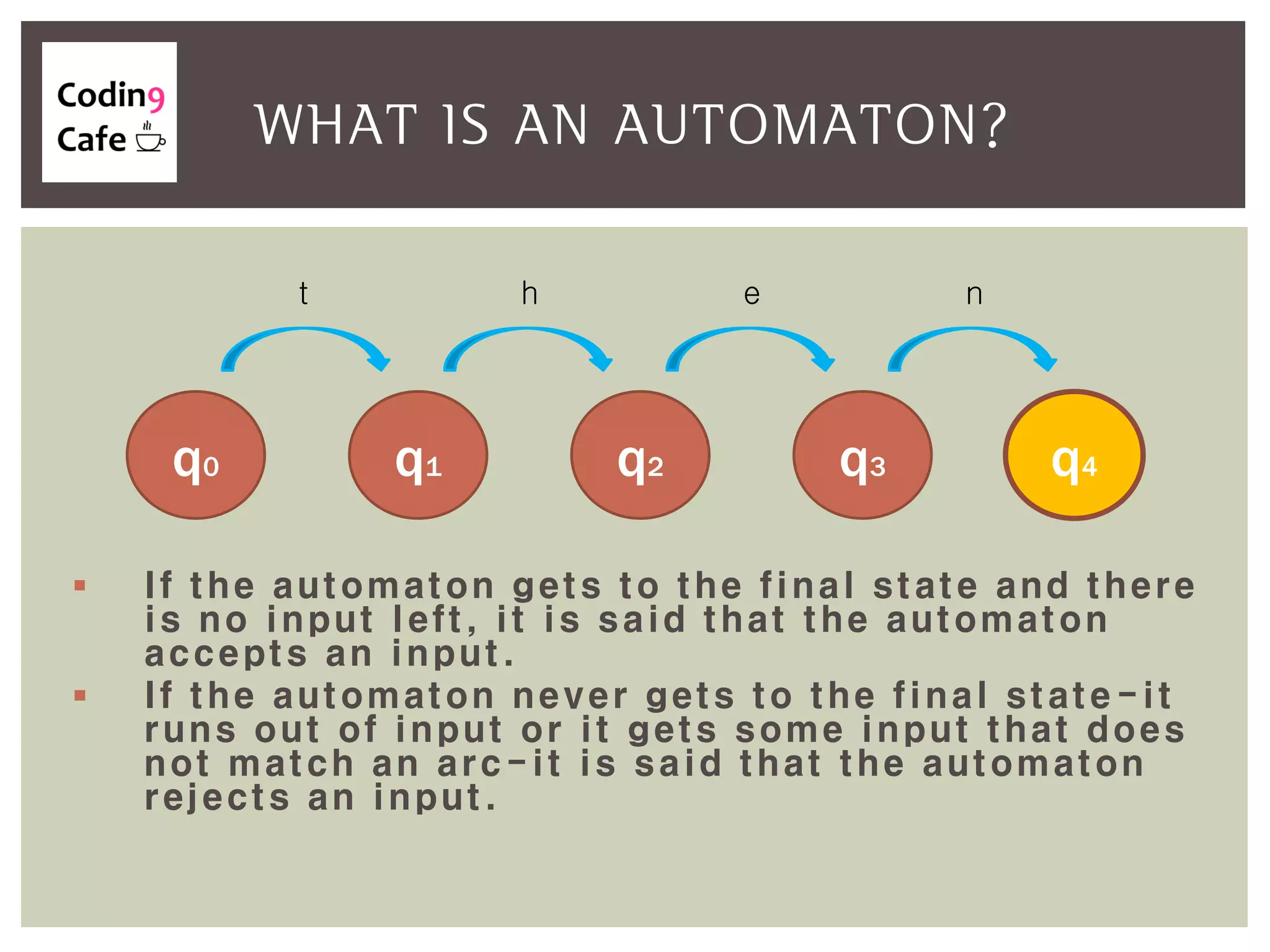
 If the automaton gets to the final state and there
is no input left, it is said that the automaton
accepts an input.
 If the automaton never gets to the final state-it
runs out of input or it gets some input that does
not match an arc-it is said that the automaton
rejects an input.
WHAT IS AN AUTOMATON?
q0 q1 q2 q3
t h e
q4
n
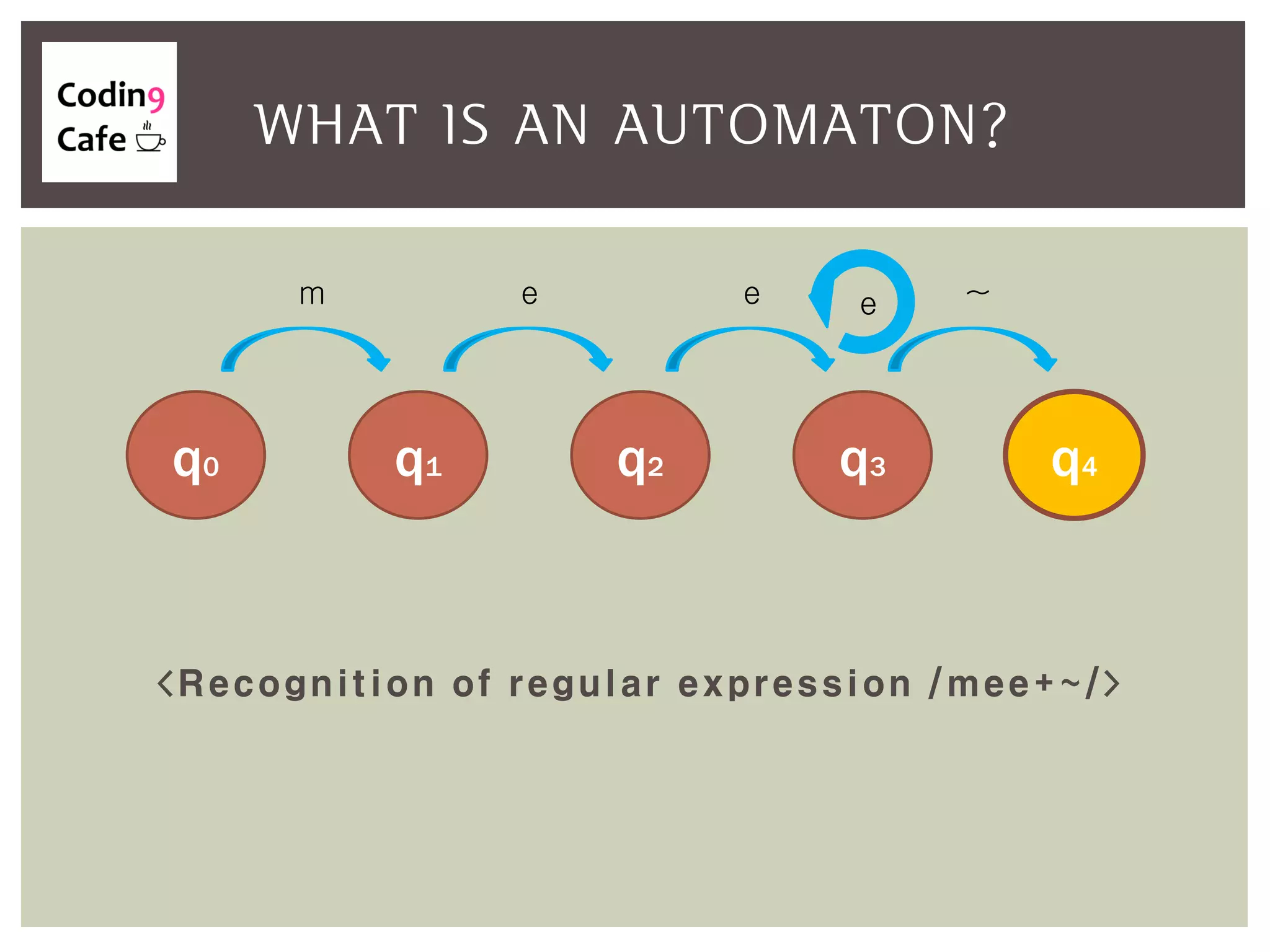
<Recognition of regular expression /mee+~/>
WHAT IS AN AUTOMATON?
q0 q1 q2 q3
m e e
q4
~e
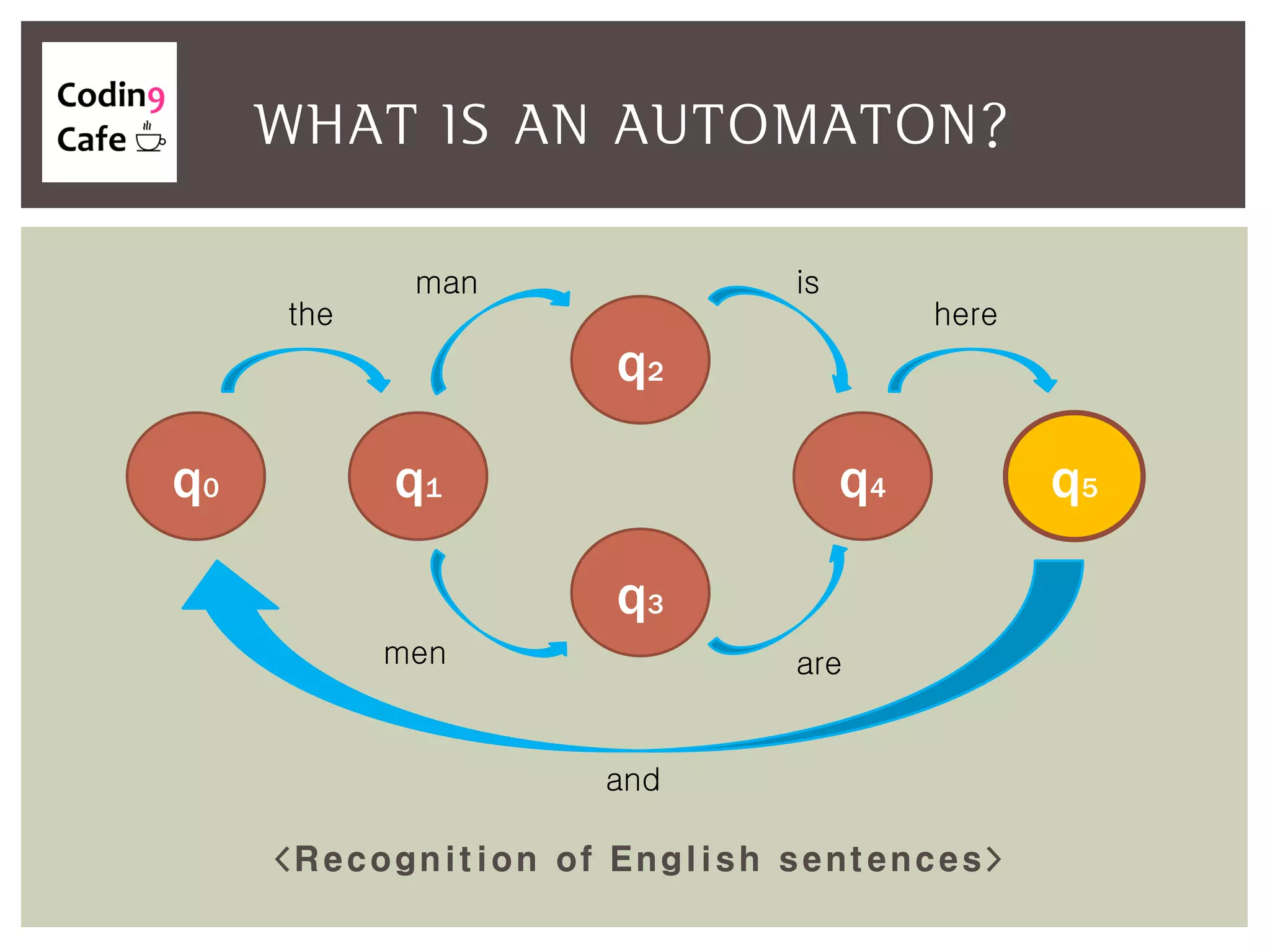
<Recognition of English sentences>
WHAT IS AN AUTOMATON?
and
q0 q1
q2
q4
the
man is
q5
here
q3
men are
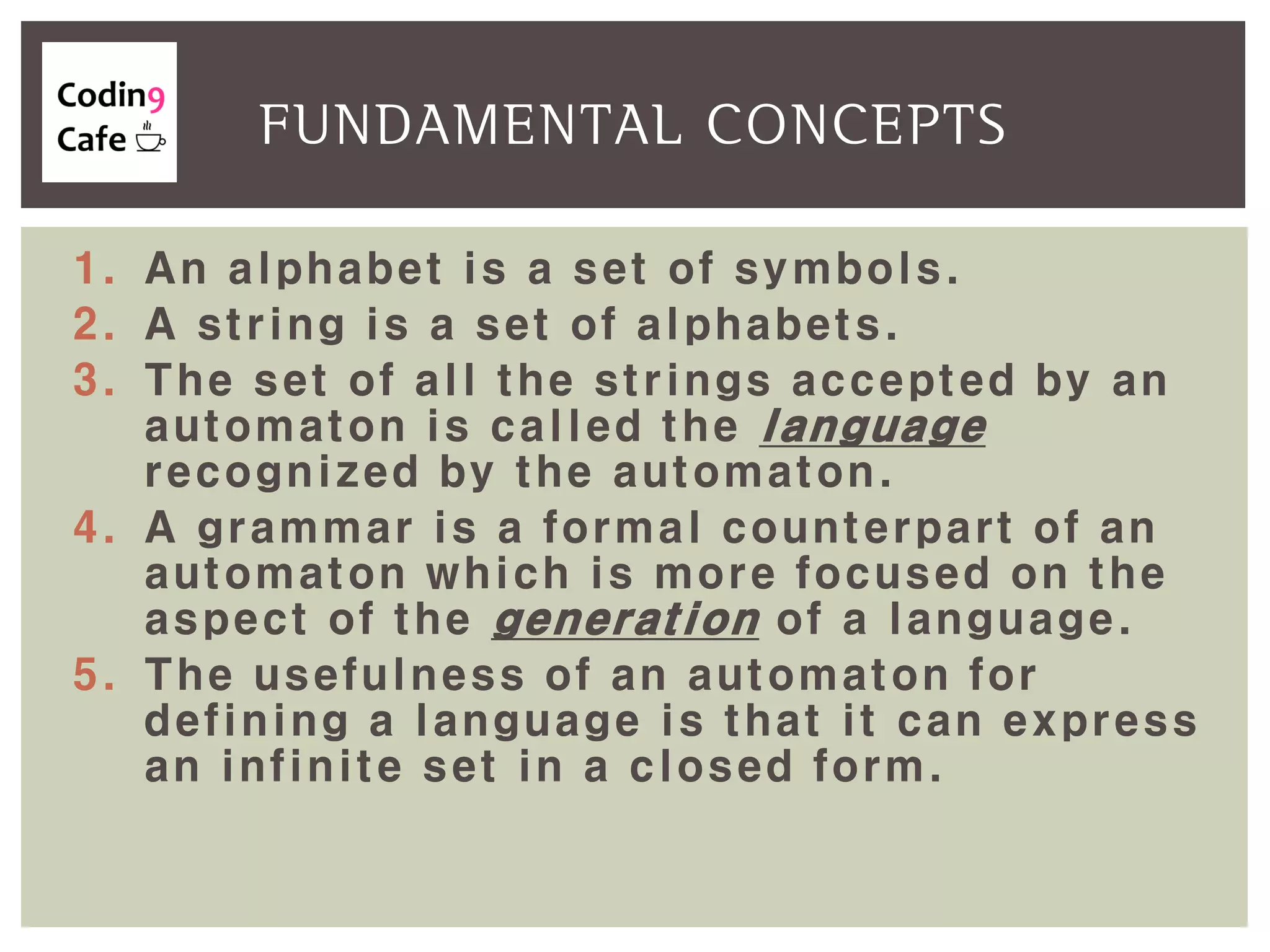
1. An alphabet is a set of symbols.
2. A string is a set of alphabets.
3. The set of all the strings accepted by an
automaton is called the language
recognized by the automaton.
4. A grammar is a formal counterpart of an
automaton which is more focused on the
aspect of the generation of a language.
5. The usefulness of an automaton for
defining a language is that it can express
an infinite set in a closed form.
FUNDAMENTAL CONCEPTS
1. An alphabet is a set of symbols.
2. A string is a set of alphabets.
3. The set of all the strings accepted by an
automaton is called the language
recognized by the automaton.
4. A grammar is a formal counterpart of an
automaton which is more focused on the
aspect of the generation of a language.
5. The usefulness of an automaton for
defining a language is that it can express
an infinite set in a closed form.
FUNDAMENTAL CONCEPTS
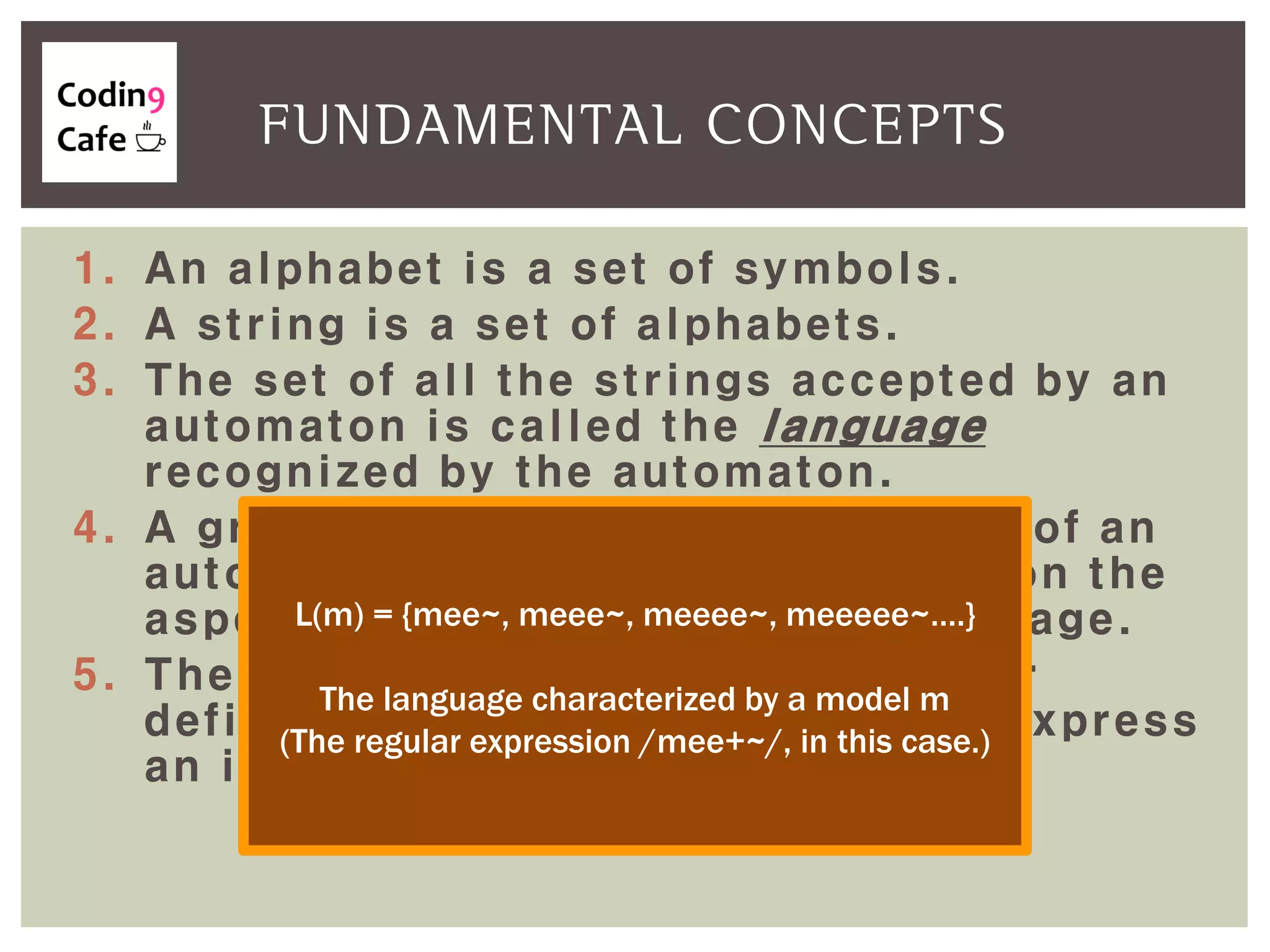
L(m) = {mee~, meee~, meeee~, meeeee~….}
The language characterized by a model m
(The regular expression /mee+~/, in this case.)
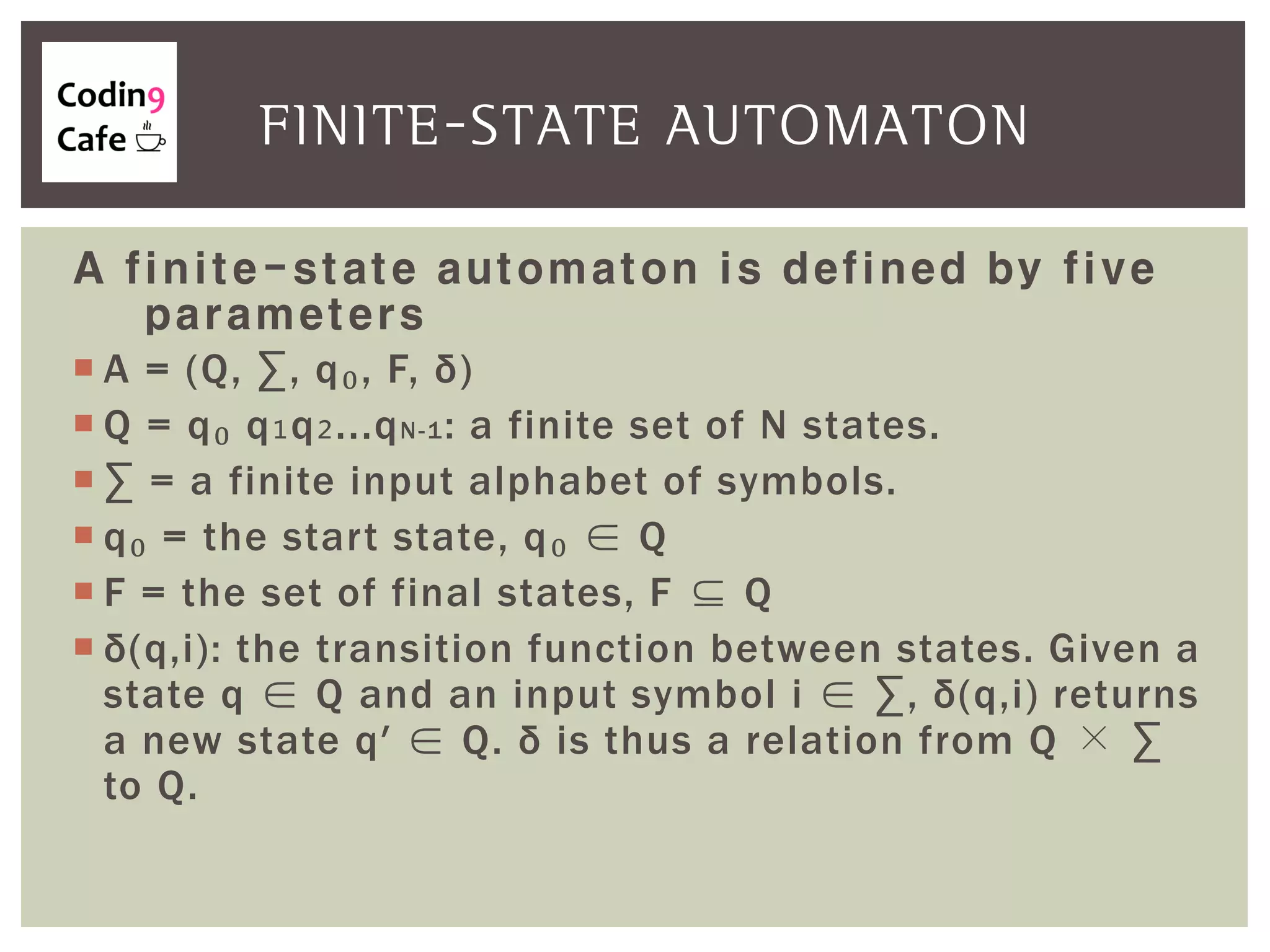
A finite-state automaton is defined by five
parameters
 A = (Q, ∑, q₀, F, δ)
 Q = q₀ q₁q₂...qN-1: a finite set of N states.
 ∑ = a finite input alphabet of symbols.
 q₀ = the start state, q₀ ∈ Q
 F = the set of final states, F ⊆ Q
 δ(q,i): the transition function between states. Given a
state q ∈ Q and an input symbol i ∈ ∑, δ(q,i) returns
a new state q′ ∈ Q. δ is thus a relation from Q × ∑
to Q.
FINITE-STATE AUTOMATON
김삼묘, 유기영. (2004). 계산모델: 오토마타 및 형식
언어. 이한출판사
Jurafsky, D. and Martin, J. H. (2009).
Speech and language processing 2nd
Edition. Pearson Education, Inc.
Partee et al. (1993). Mathematical methods
in linguistics. Kluwer Academic
Publishers
REFERENCES

Automata

  • 1.
  • 2.
    1. What isan Automaton? 2. Fundamental Concepts 3. Finite-state Automaton 4. References CONTENTS
  • 3.
    1. The automaton(pl. automata) is an abstract computing machine, which is a conceptual model of the fundamentals of computation. 2. Automaton, originally from a Greek word αὐτόματον, means "self-acting". 3. The automaton arose in the 1950s out of Turing's (1936) model of algorithmic computation, considered by many to be the foundation of modern computer science. WHAT IS AN AUTOMATON?
  • 4.
    *Applications of automata 1.Text processing 2. Web browsing 3. Compiler 4. Operating system 5. Hardware design 6. Sequential logic circuits 7. etc. WHAT IS AN AUTOMATON?
  • 5.
    <Recognition of aword 'then'> WHAT IS AN AUTOMATON? q0 q1 q2 q3 t h e q4 n
  • 6.
     q0q1..q4 arestates  't', 'h', 'e', 'n' are input alphabets  Blue-colored arcs are transitions between states  q0 is a start state  q4 is a final state WHAT IS AN AUTOMATON? q0 q1 q2 q3 t h e q4 n
  • 7.
     If theautomaton gets to the final state and there is no input left, it is said that the automaton accepts an input.  If the automaton never gets to the final state-it runs out of input or it gets some input that does not match an arc-it is said that the automaton rejects an input. WHAT IS AN AUTOMATON? q0 q1 q2 q3 t h e q4 n
  • 8.
    <Recognition of regularexpression /mee+~/> WHAT IS AN AUTOMATON? q0 q1 q2 q3 m e e q4 ~e
  • 9.
    <Recognition of Englishsentences> WHAT IS AN AUTOMATON? and q0 q1 q2 q4 the man is q5 here q3 men are
  • 10.
    1. An alphabetis a set of symbols. 2. A string is a set of alphabets. 3. The set of all the strings accepted by an automaton is called the language recognized by the automaton. 4. A grammar is a formal counterpart of an automaton which is more focused on the aspect of the generation of a language. 5. The usefulness of an automaton for defining a language is that it can express an infinite set in a closed form. FUNDAMENTAL CONCEPTS
  • 11.
    1. An alphabetis a set of symbols. 2. A string is a set of alphabets. 3. The set of all the strings accepted by an automaton is called the language recognized by the automaton. 4. A grammar is a formal counterpart of an automaton which is more focused on the aspect of the generation of a language. 5. The usefulness of an automaton for defining a language is that it can express an infinite set in a closed form. FUNDAMENTAL CONCEPTS L(m) = {mee~, meee~, meeee~, meeeee~….} The language characterized by a model m (The regular expression /mee+~/, in this case.)
  • 12.
    A finite-state automatonis defined by five parameters  A = (Q, ∑, q₀, F, δ)  Q = q₀ q₁q₂...qN-1: a finite set of N states.  ∑ = a finite input alphabet of symbols.  q₀ = the start state, q₀ ∈ Q  F = the set of final states, F ⊆ Q  δ(q,i): the transition function between states. Given a state q ∈ Q and an input symbol i ∈ ∑, δ(q,i) returns a new state q′ ∈ Q. δ is thus a relation from Q × ∑ to Q. FINITE-STATE AUTOMATON
  • 13.
    김삼묘, 유기영. (2004).계산모델: 오토마타 및 형식 언어. 이한출판사 Jurafsky, D. and Martin, J. H. (2009). Speech and language processing 2nd Edition. Pearson Education, Inc. Partee et al. (1993). Mathematical methods in linguistics. Kluwer Academic Publishers REFERENCES