1
Introduction to Automata
Theory
Reading: Chapter 1
Source: https://eecs.wsu.edu/~ananth/CptS317/Lectures/index.htm
2
What is Automata Theory?
 Study of abstract computing devices, or
“machines”
 Automaton = an abstract computing device
 Note: A “device” need not even be a physical
hardware!
 A fundamental question in computer science:
 Find out what different models of machines can do
and cannot do
 The theory of computation
 Computability vs. Complexity
3
What is Automata Theory?
Automata Theory is also a branch of computer
science that deals with the design and analysis
of algorithms and mathematical models of
computation. It focuses on the study of abstract
machines (automata) and the problems they
can solve.
4
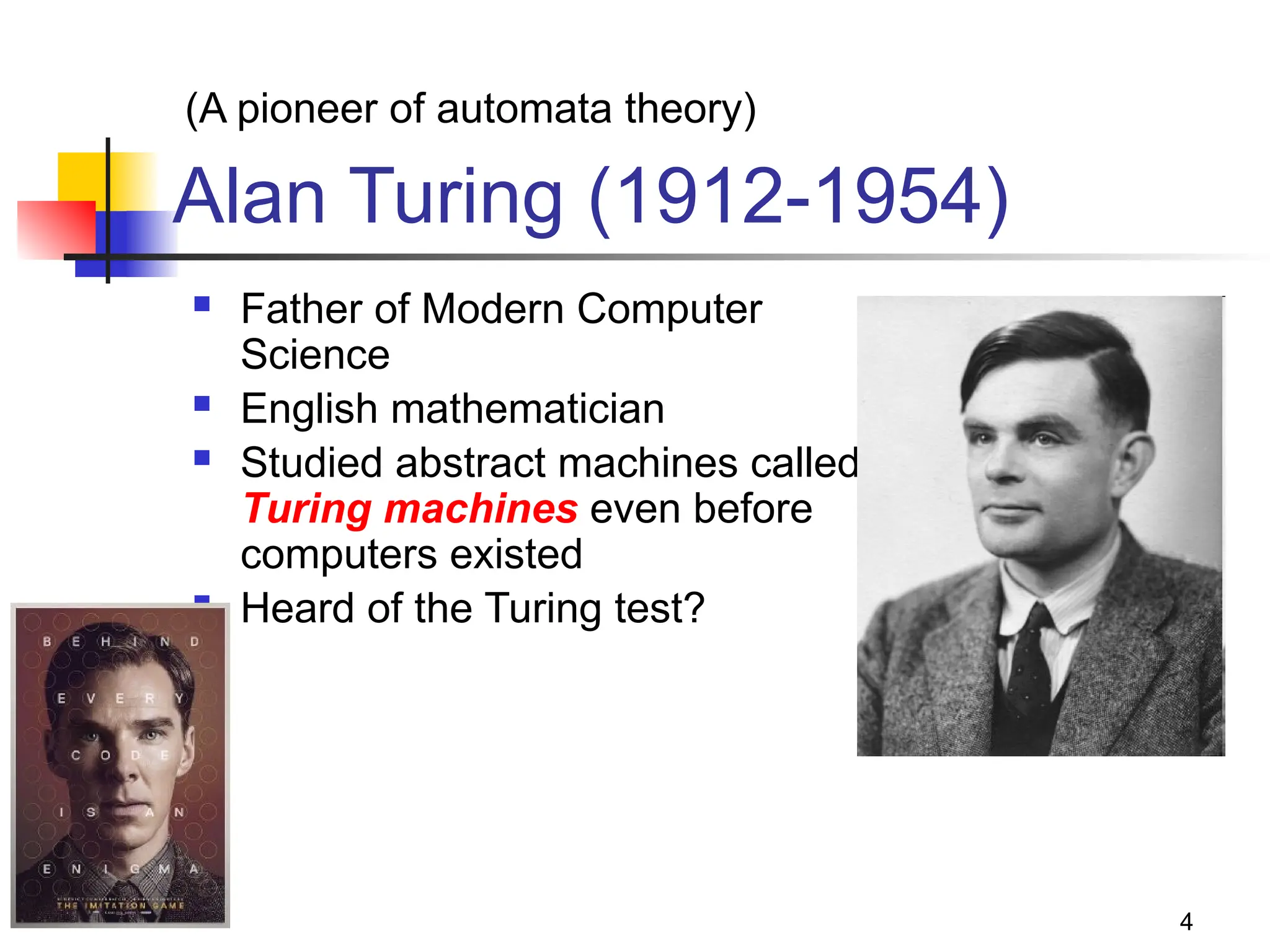
Alan Turing (1912-1954)
 Father of Modern Computer
Science
 English mathematician
 Studied abstract machines called
Turing machines even before
computers existed
 Heard of the Turing test?
(A pioneer of automata theory)
5
Alan Turing (1912-1954)
Alan Turing made seminal contributions to
the fields of automata theory and formal
languages, which are foundational areas in
theoretical computer science. His work laid
the groundwork for many concepts and
theories that underpin these fields.
(A pioneer of automata theory)
6
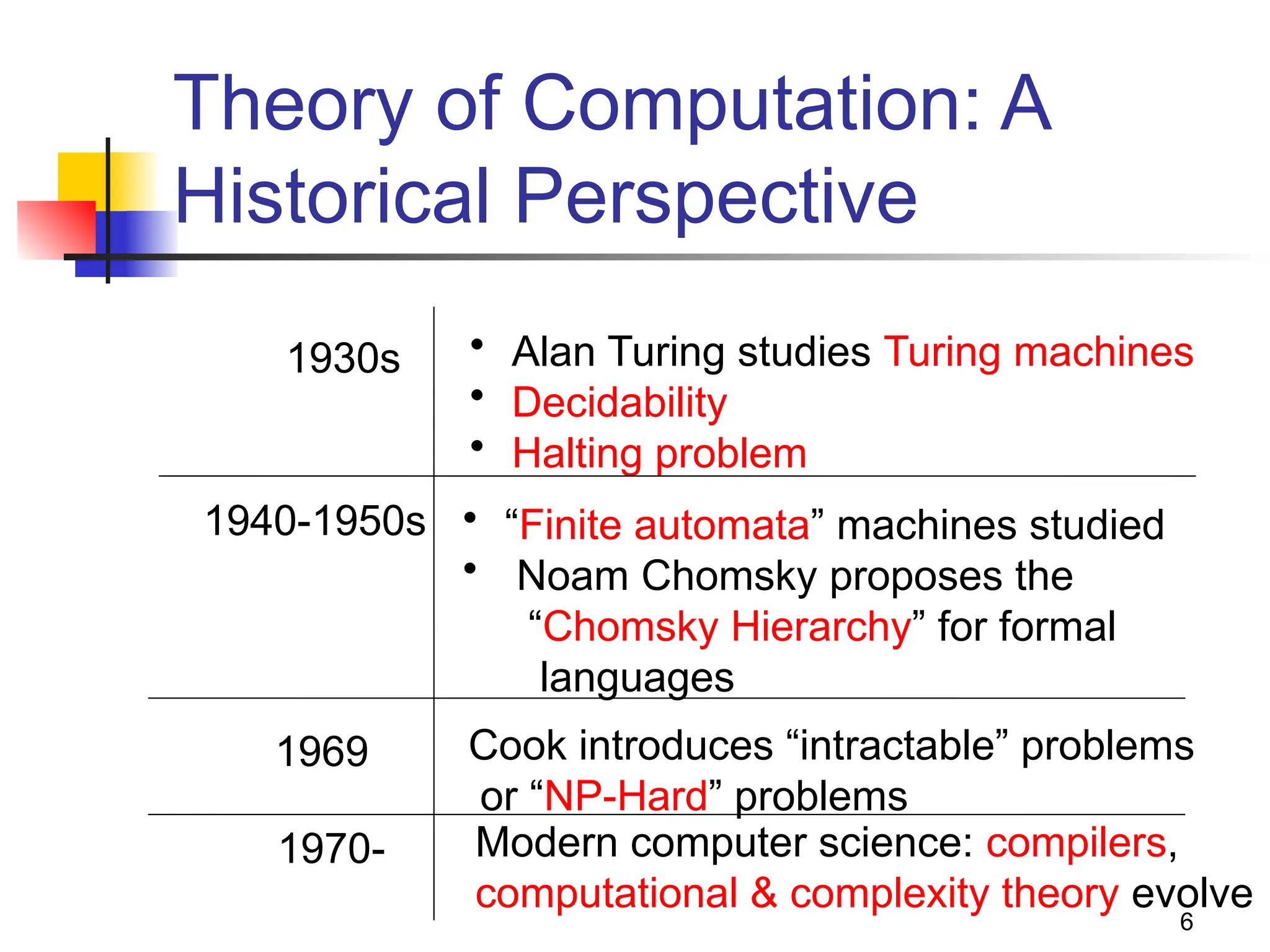
Theory of Computation: A
Historical Perspective
1930s • Alan Turing studies Turing machines
• Decidability
• Halting problem
1940-1950s • “Finite automata” machines studied
• Noam Chomsky proposes the
“Chomsky Hierarchy” for formal
languages
1969 Cook introduces “intractable” problems
or “NP-Hard” problems
1970- Modern computer science: compilers,
computational & complexity theory evolve
7
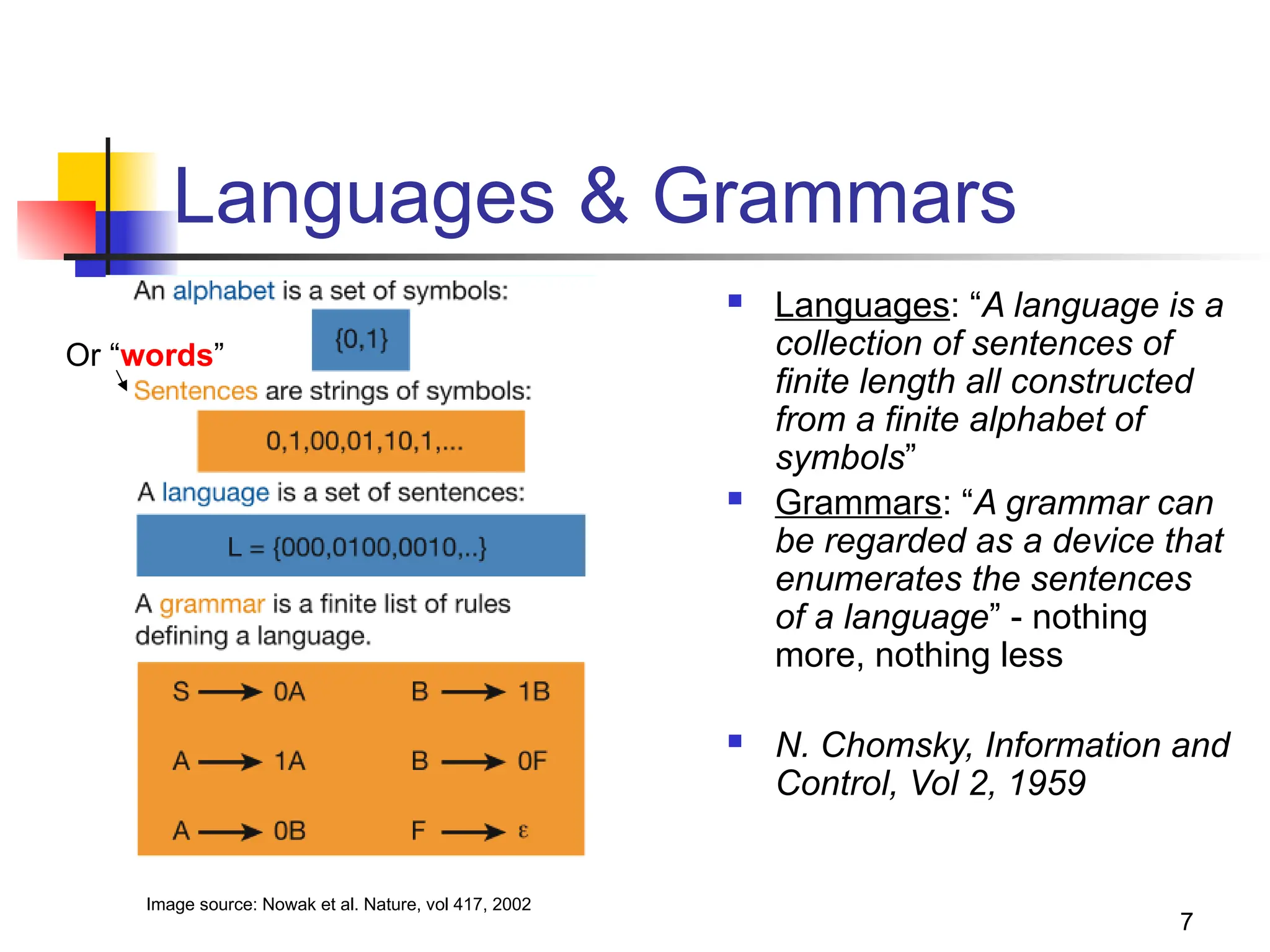
Languages & Grammars
Or “words”
Image source: Nowak et al. Nature, vol 417, 2002
 Languages: “A language is a
collection of sentences of
finite length all constructed
from a finite alphabet of
symbols”
 Grammars: “A grammar can
be regarded as a device that
enumerates the sentences
of a language” - nothing
more, nothing less
 N. Chomsky, Information and
Control, Vol 2, 1959
8
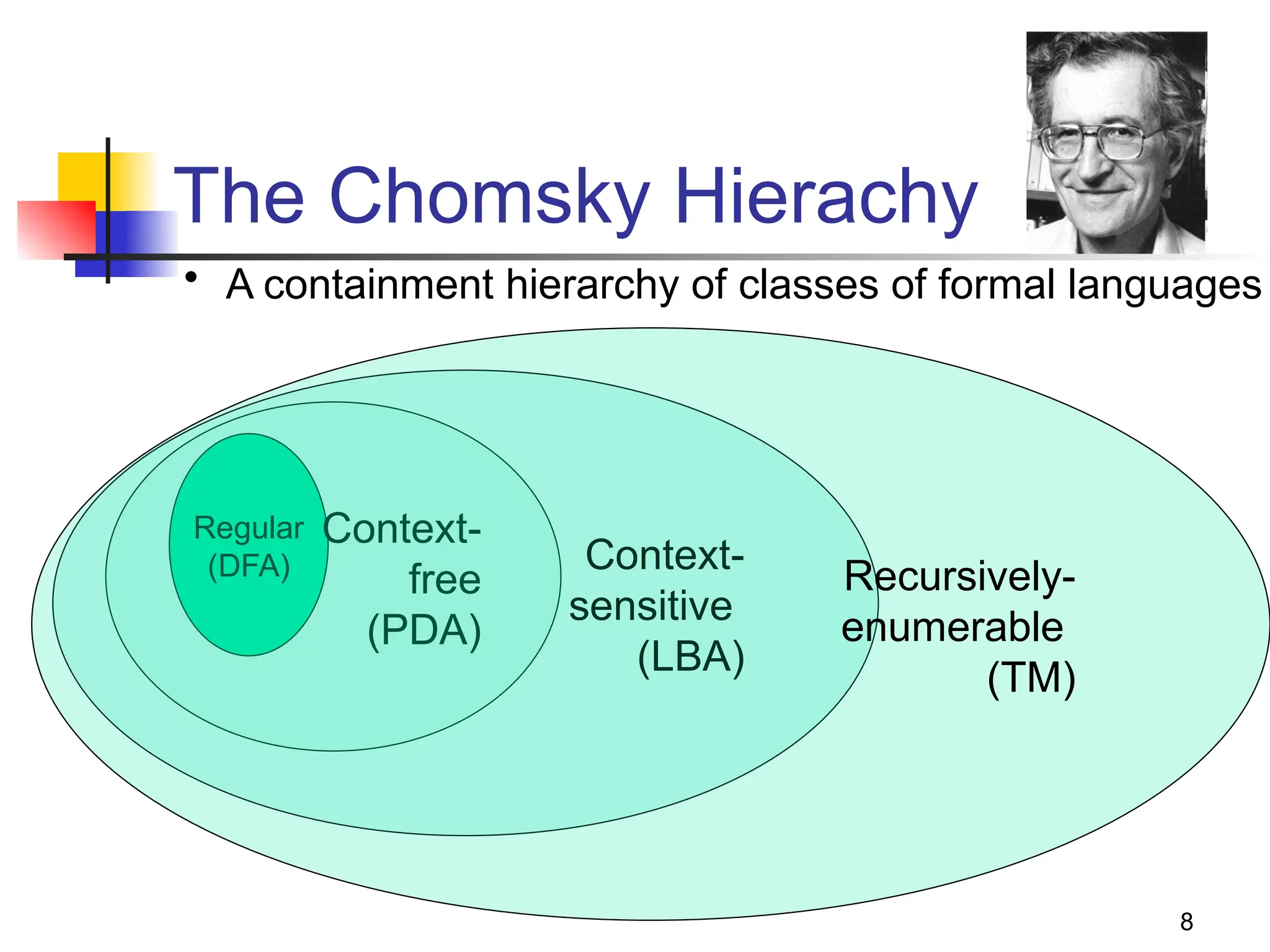
The Chomsky Hierachy
Regular
(DFA)
Context-
free
(PDA)
Context-
sensitive
(LBA)
Recursively-
enumerable
(TM)
• A containment hierarchy of classes of formal languages
9
The Chomsky Hierachy
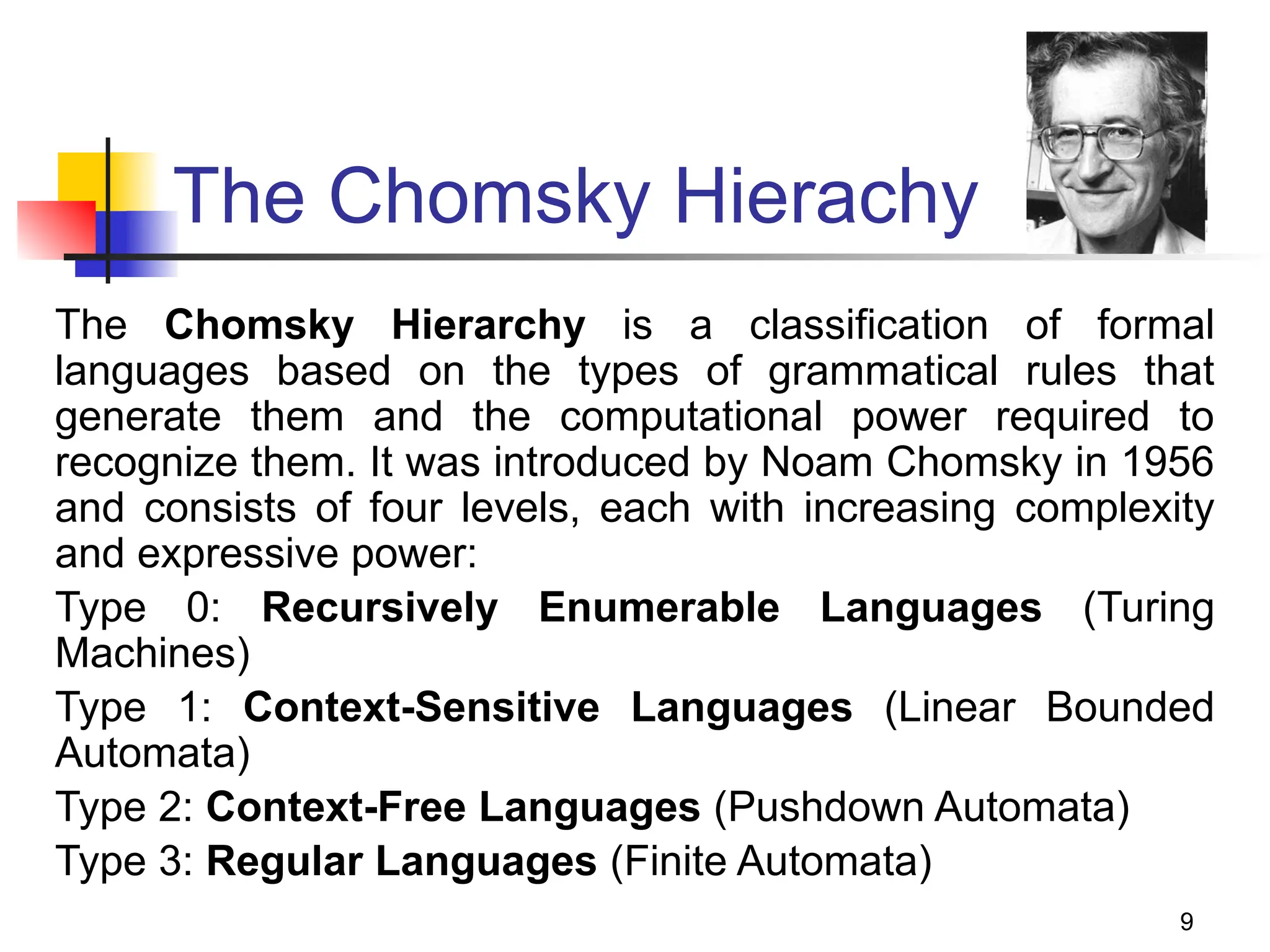
The Chomsky Hierarchy is a classification of formal
languages based on the types of grammatical rules that
generate them and the computational power required to
recognize them. It was introduced by Noam Chomsky in 1956
and consists of four levels, each with increasing complexity
and expressive power:
Type 0: Recursively Enumerable Languages (Turing
Machines)
Type 1: Context-Sensitive Languages (Linear Bounded
Automata)
Type 2: Context-Free Languages (Pushdown Automata)
Type 3: Regular Languages (Finite Automata)
10
The Central Concepts of
Automata Theory
11
Alphabet
An alphabet is a finite, non-empty set of
symbols
 We use the symbol ∑ (sigma) to denote an
alphabet
 Examples:
 Binary: ∑ = {0,1}
 All lower case letters: ∑ = {a,b,c,..z}
 Alphanumeric: ∑ = {a-z, A-Z, 0-9}
 DNA molecule letters: ∑ = {a,c,g,t}
 …
12
Strings
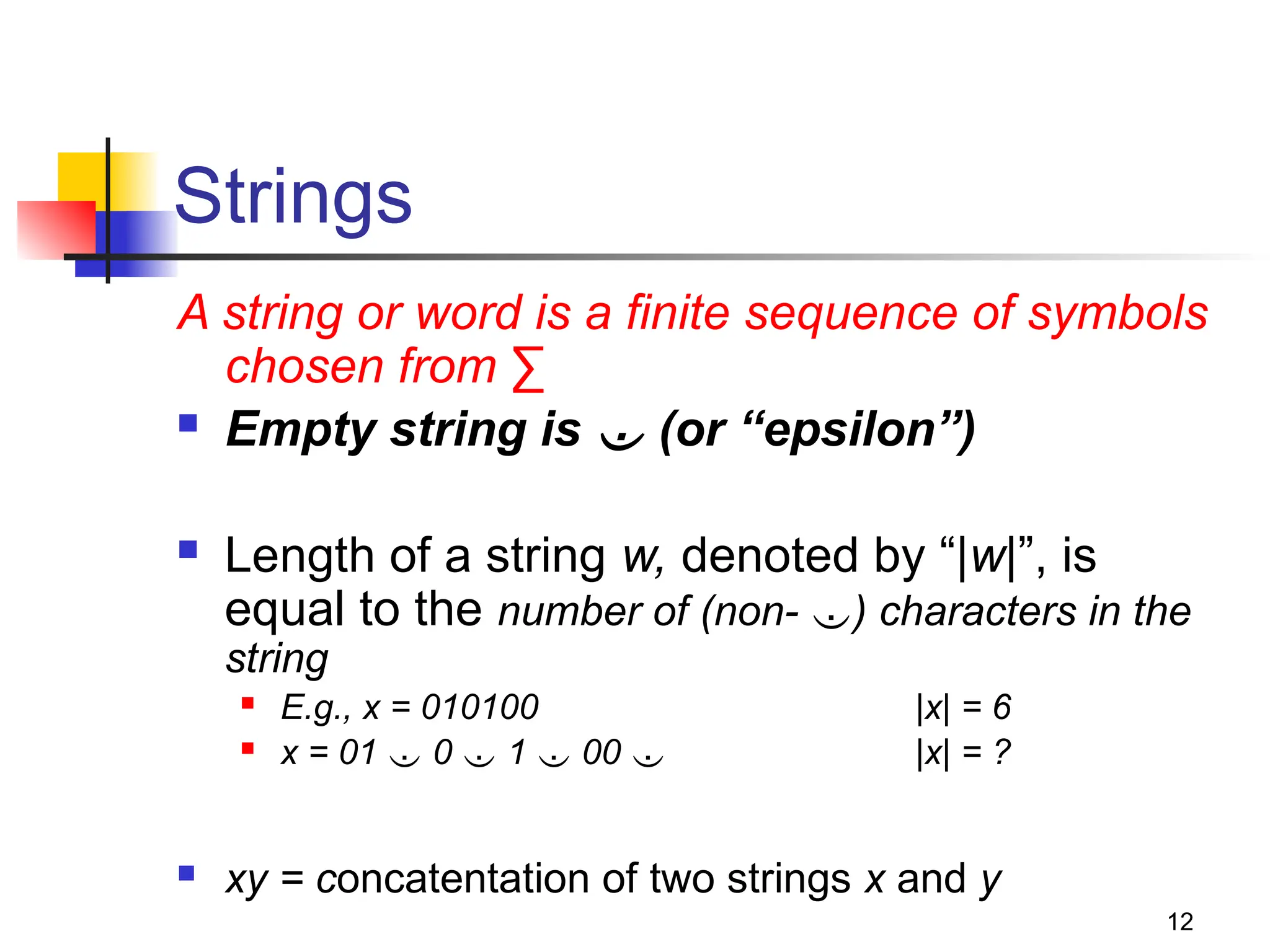
A string or word is a finite sequence of symbols
chosen from ∑
 Empty string is  (or “epsilon”)
 Length of a string w, denoted by “|w|”, is
equal to the number of (non- ) characters in the
string
 E.g., x = 010100 |x| = 6
 x = 01  0  1  00  |x| = ?
 xy = concatentation of two strings x and y
13
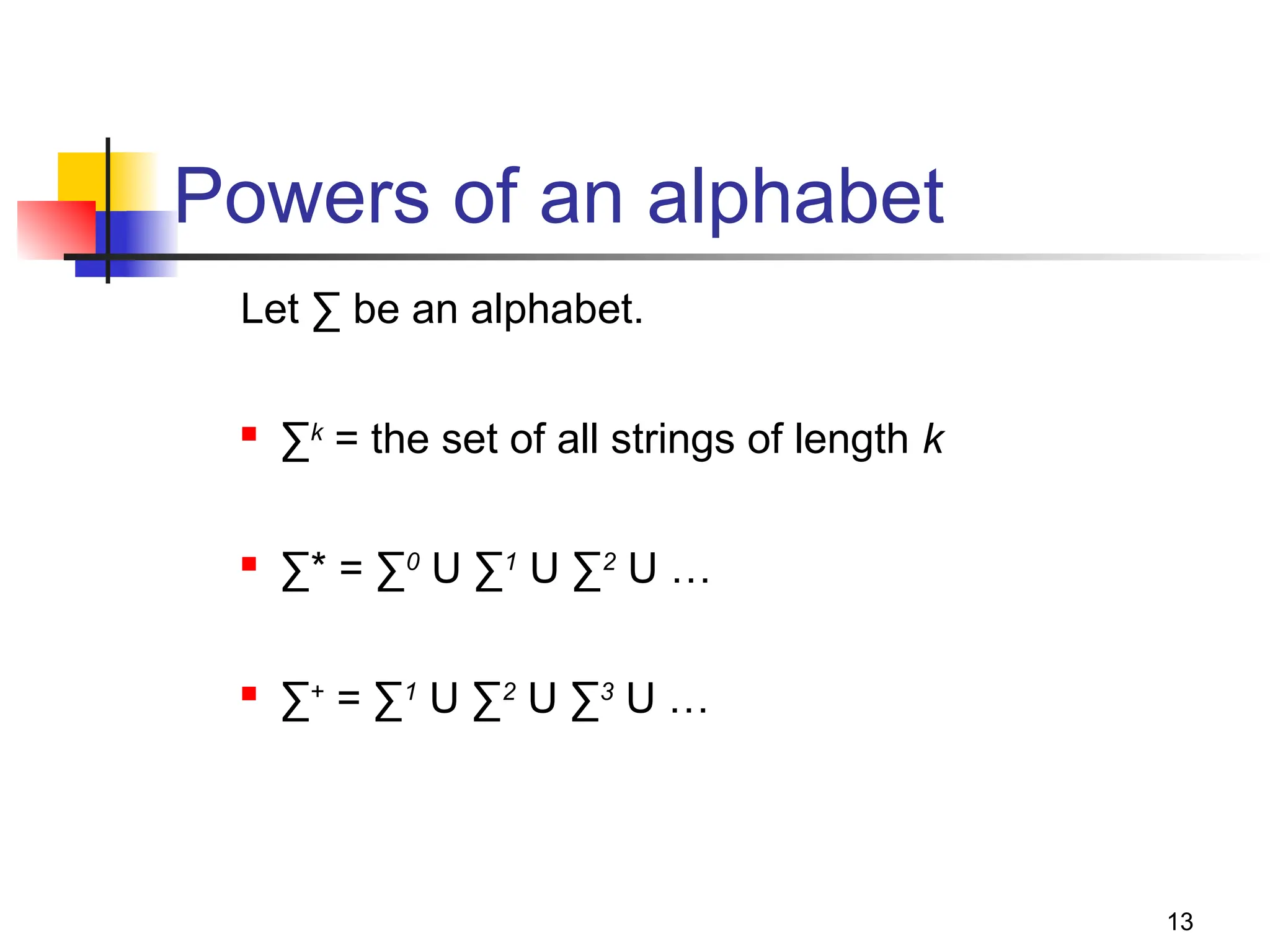
Powers of an alphabet
Let ∑ be an alphabet.
 ∑k
= the set of all strings of length k
 ∑* = ∑0
U ∑1
U ∑2
U …
 ∑+
= ∑1
U ∑2
U ∑3
U …
14
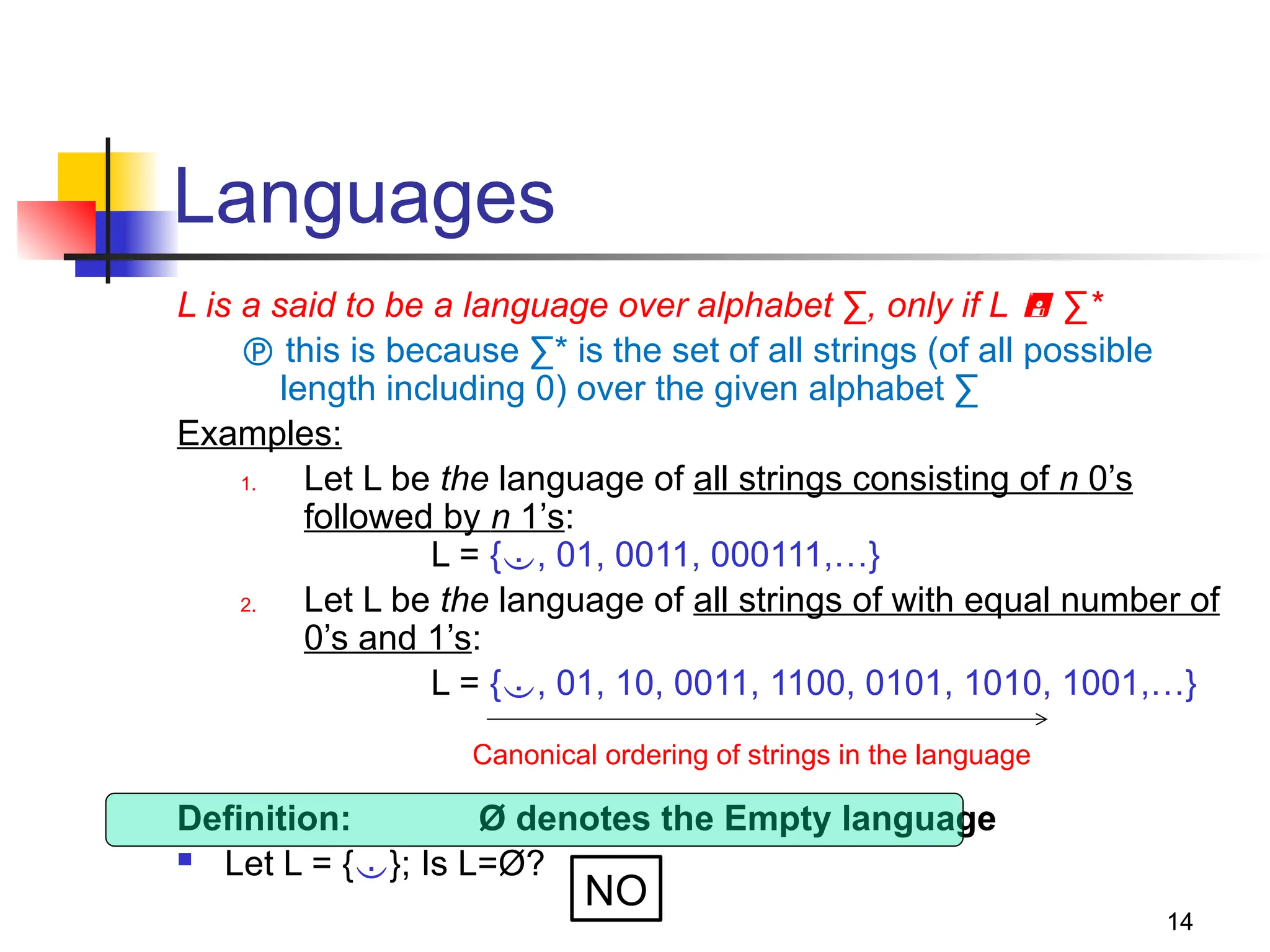
Languages
L is a said to be a language over alphabet ∑, only if L  ∑*
 this is because ∑* is the set of all strings (of all possible
length including 0) over the given alphabet ∑
Examples:
1. Let L be the language of all strings consisting of n 0’s
followed by n 1’s:
L = {, 01, 0011, 000111,…}
2. Let L be the language of all strings of with equal number of
0’s and 1’s:
L = {, 01, 10, 0011, 1100, 0101, 1010, 1001,…}
Definition: Ø denotes the Empty language
 Let L = {}; Is L=Ø?
NO
Canonical ordering of strings in the language
15
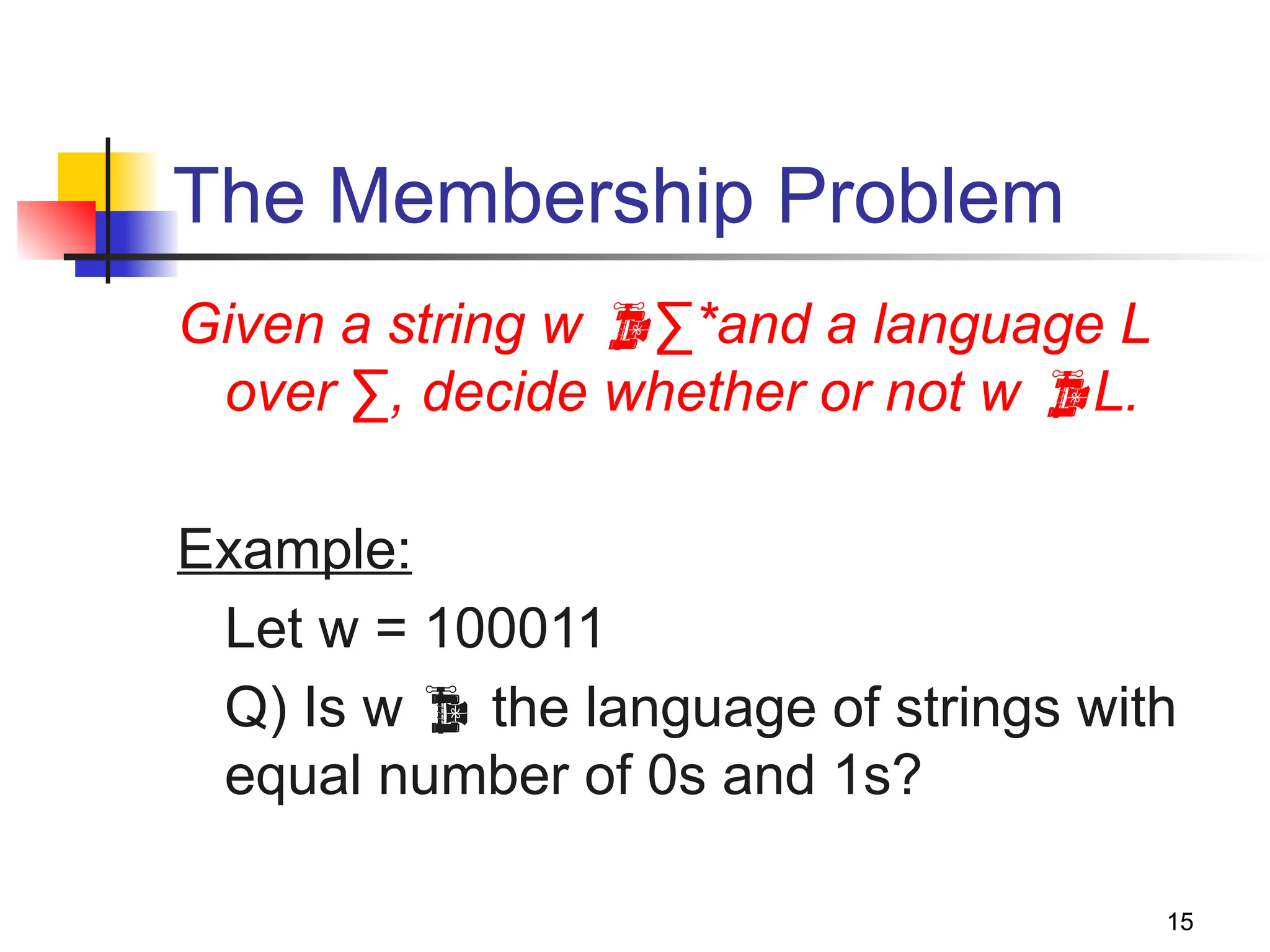
The Membership Problem
Given a string w ∑*and a language L
over ∑, decide whether or not w L.
Example:
Let w = 100011
Q) Is w  the language of strings with
equal number of 0s and 1s?
16
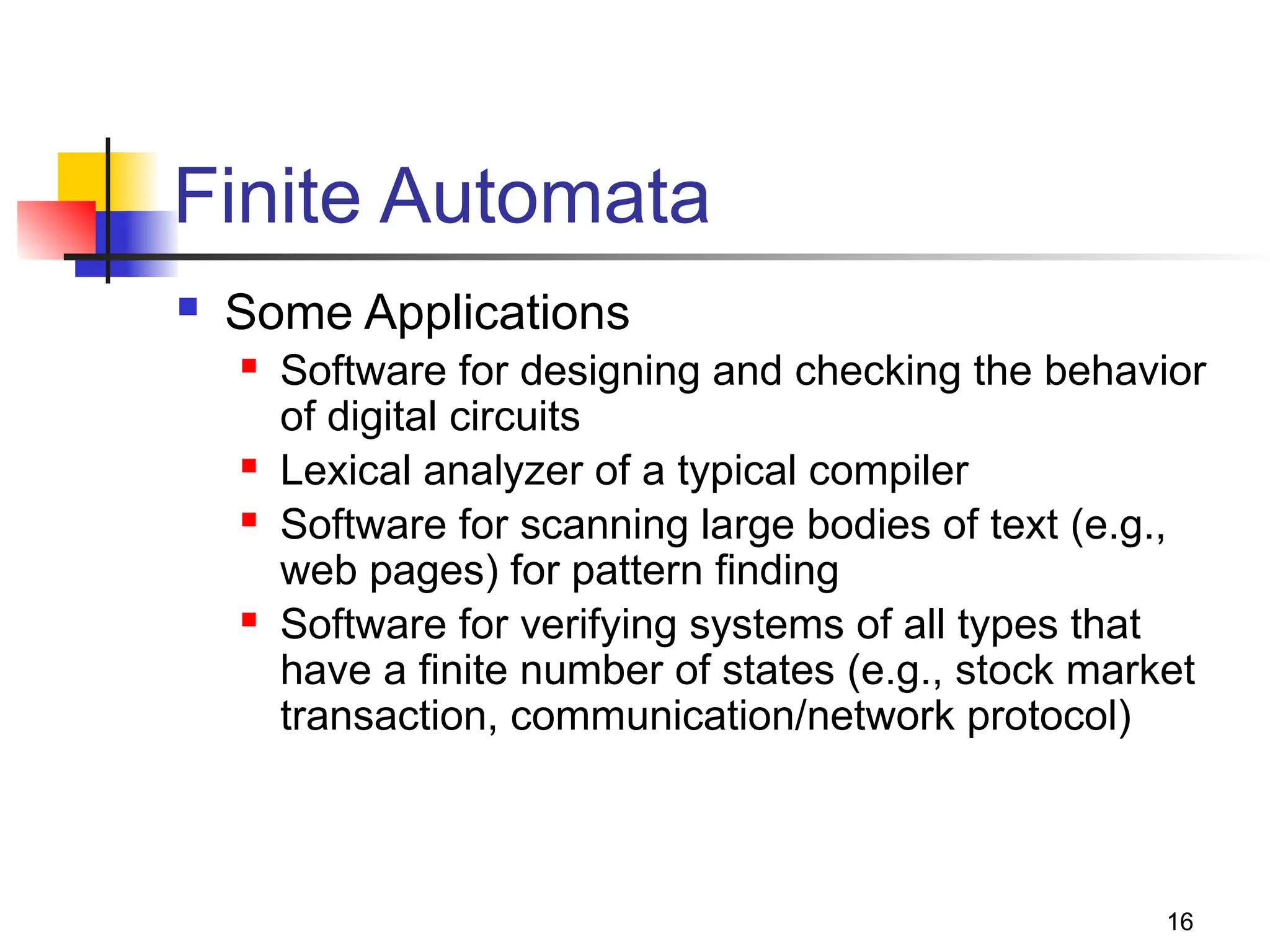
Finite Automata
 Some Applications
 Software for designing and checking the behavior
of digital circuits
 Lexical analyzer of a typical compiler
 Software for scanning large bodies of text (e.g.,
web pages) for pattern finding
 Software for verifying systems of all types that
have a finite number of states (e.g., stock market
transaction, communication/network protocol)
17
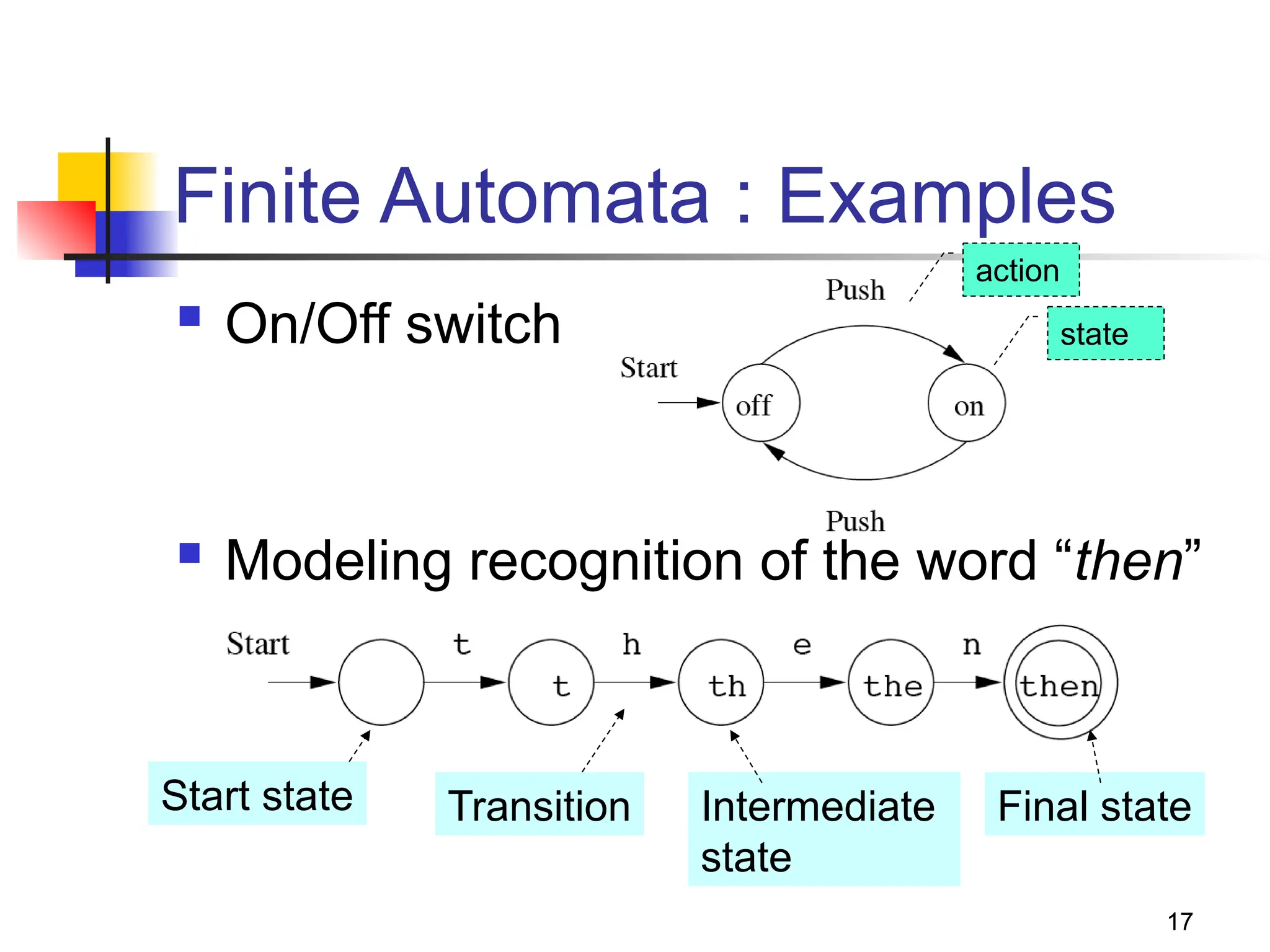
Finite Automata : Examples
 On/Off switch
 Modeling recognition of the word “then”
Start state Final state
Transition Intermediate
state
action
state
18
Structural expressions
 Grammars
 Regular expressions
 E.g., unix style to capture city names such
as “Palo Alto CA”:

[A-Z][a-z]*([ ][A-Z][a-z]*)*[ ][A-Z][A-Z]
Start with a letter
A string of other
letters (possibly
empty)
Other space delimited words
(part of city name)
Should end w/ 2-letter state code
19
Formal Proofs
20
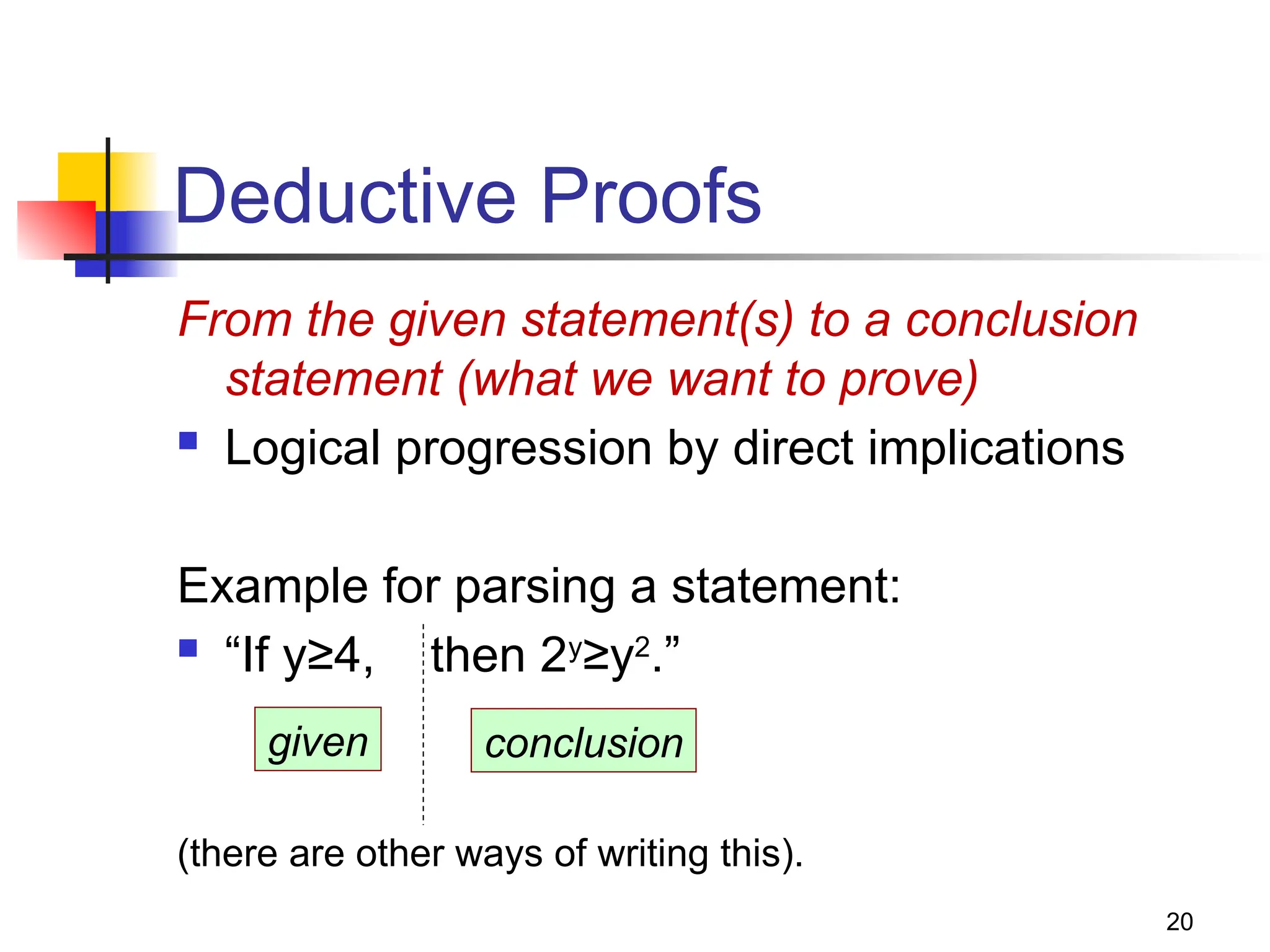
Deductive Proofs
From the given statement(s) to a conclusion
statement (what we want to prove)
 Logical progression by direct implications
Example for parsing a statement:
 “If y≥4, then 2y
≥y2
.”
(there are other ways of writing this).
given conclusion
21
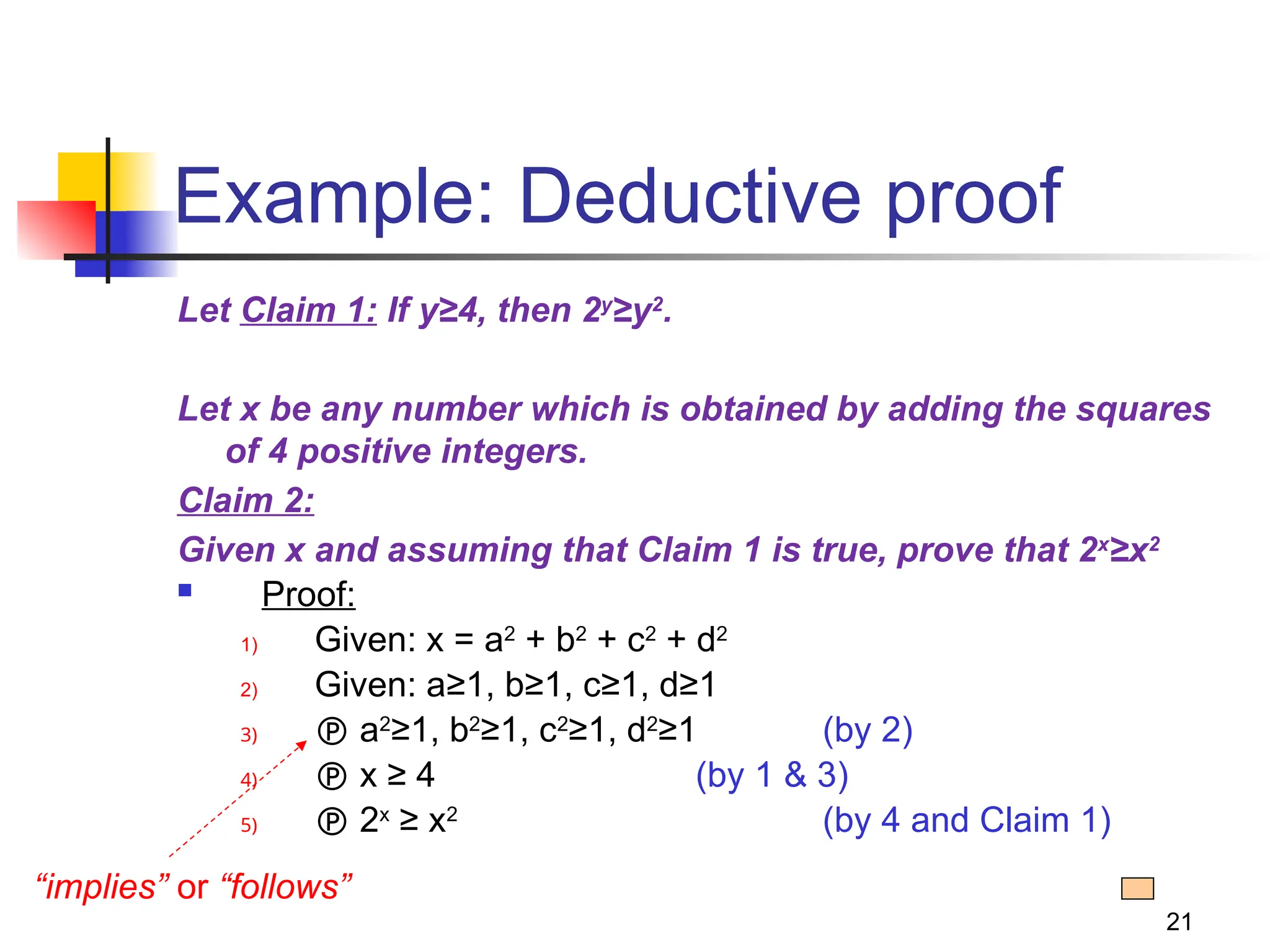
Example: Deductive proof
Let Claim 1: If y≥4, then 2y
≥y2
.
Let x be any number which is obtained by adding the squares
of 4 positive integers.
Claim 2:
Given x and assuming that Claim 1 is true, prove that 2x
≥x2
 Proof:
1) Given: x = a2
+ b2
+ c2
+ d2
2) Given: a≥1, b≥1, c≥1, d≥1
3)  a2
≥1, b2
≥1, c2
≥1, d2
≥1 (by 2)
4)  x ≥ 4 (by 1 & 3)
5)  2x
≥ x2
(by 4 and Claim 1)
“implies” or “follows”
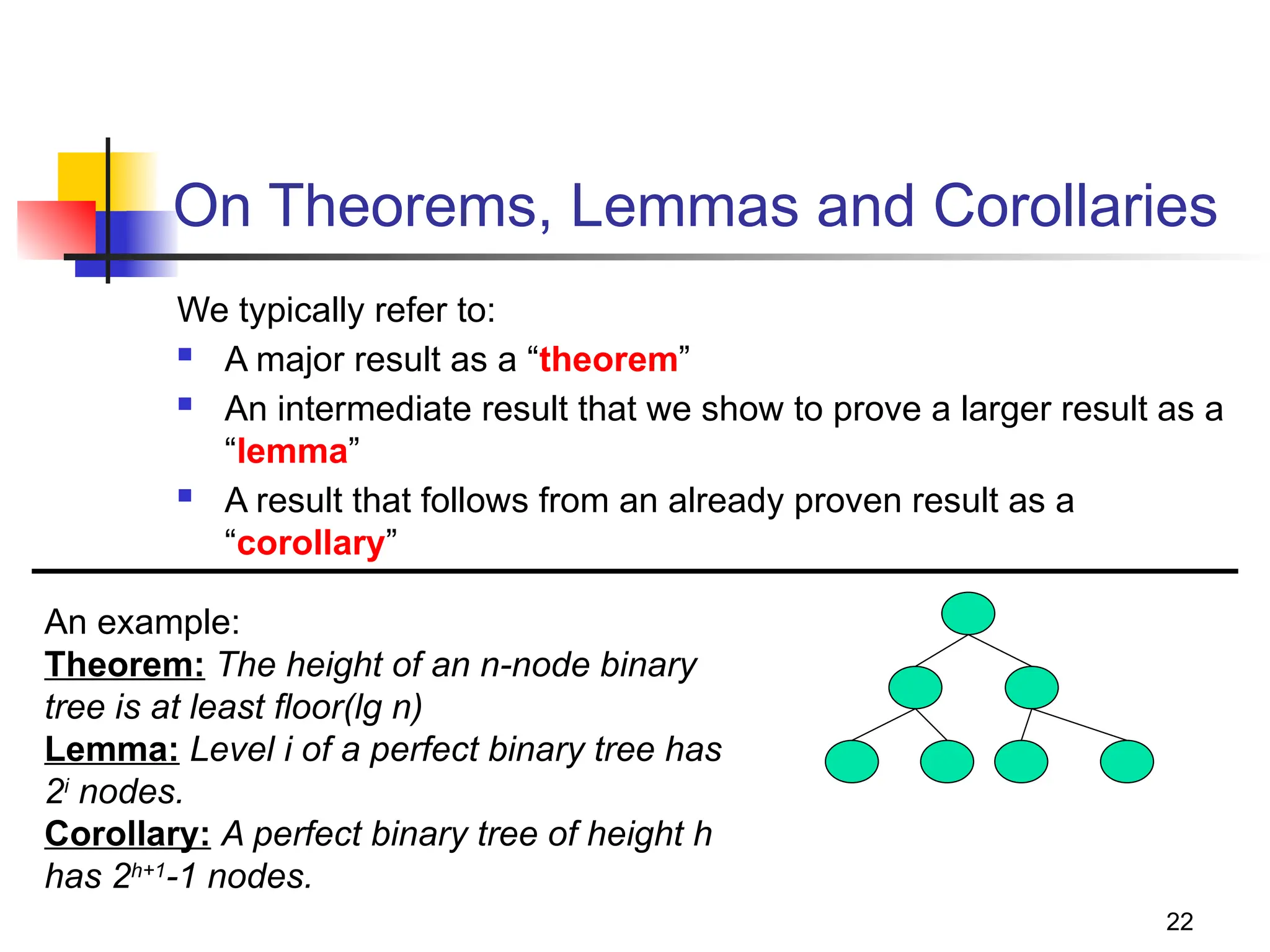
On Theorems, Lemmas and Corollaries
We typically refer to:
 A major result as a “theorem”
 An intermediate result that we show to prove a larger result as a
“lemma”
 A result that follows from an already proven result as a
“corollary”
22
An example:
Theorem: The height of an n-node binary
tree is at least floor(lg n)
Lemma: Level i of a perfect binary tree has
2i
nodes.
Corollary: A perfect binary tree of height h
has 2h+1
-1 nodes.
23
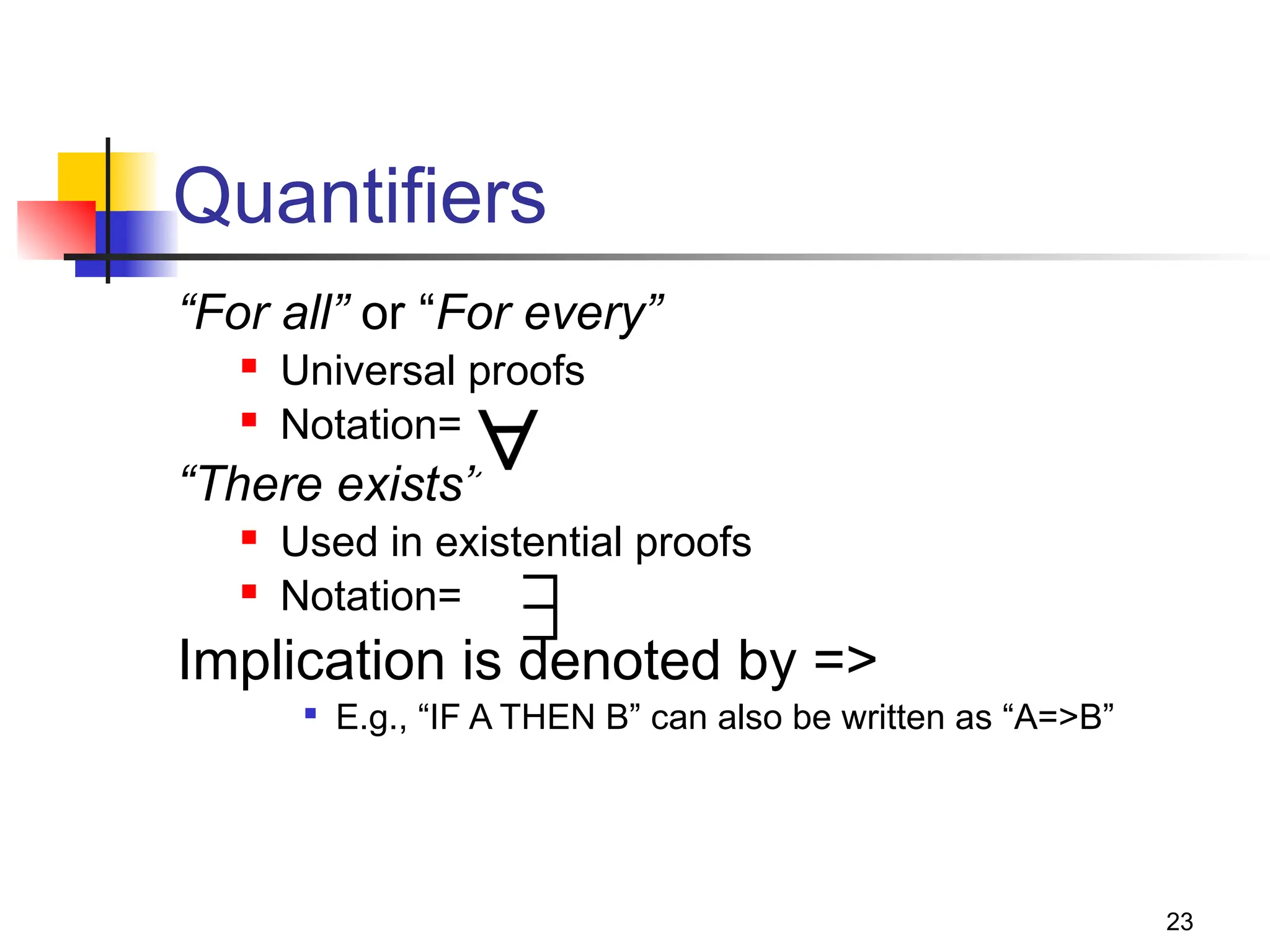
Quantifiers
“For all” or “For every”
 Universal proofs
 Notation=
“There exists”
 Used in existential proofs
 Notation=
Implication is denoted by =>

E.g., “IF A THEN B” can also be written as “A=>B”
24
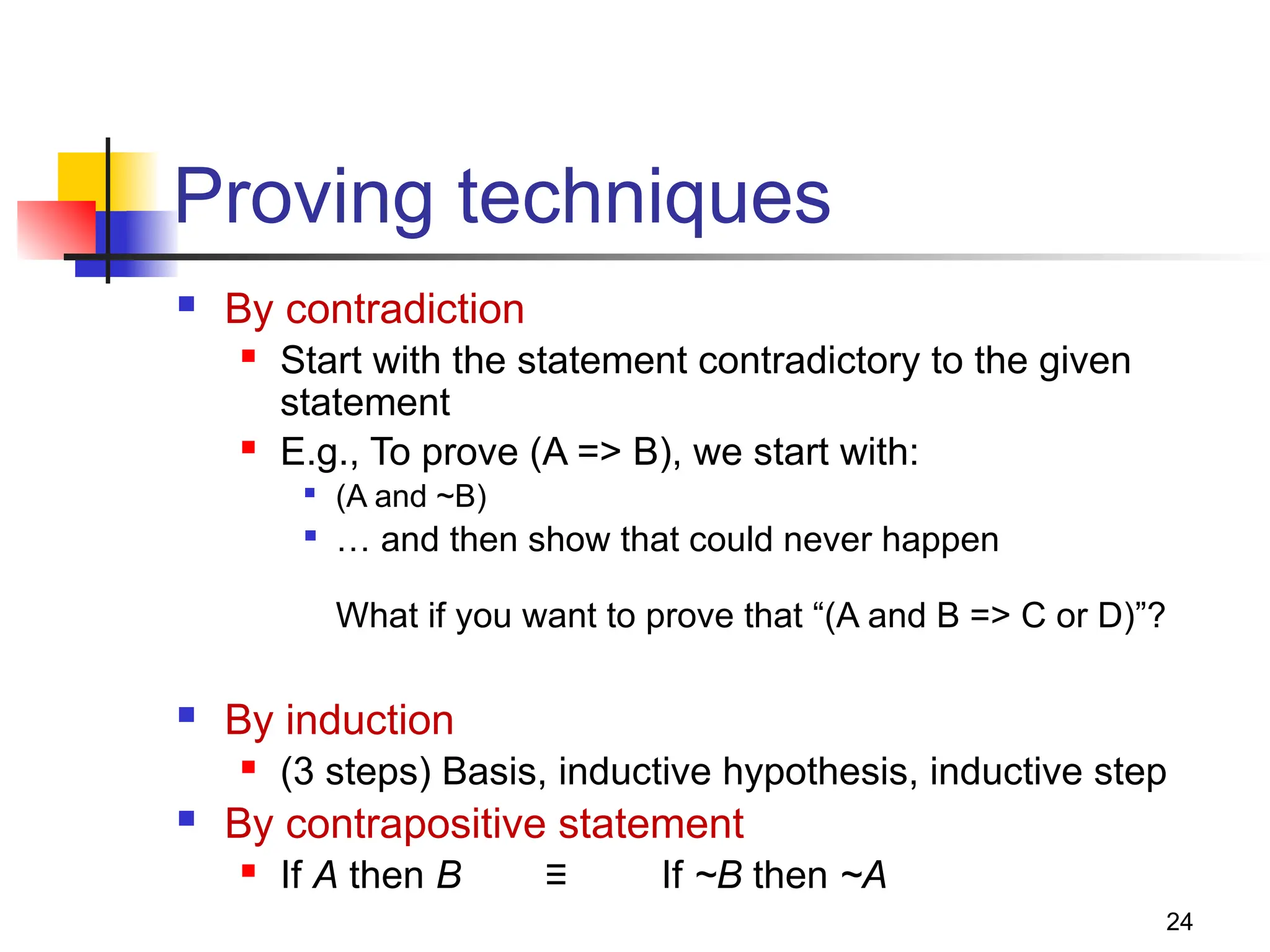
Proving techniques
 By contradiction
 Start with the statement contradictory to the given
statement
 E.g., To prove (A => B), we start with:

(A and ~B)

… and then show that could never happen
What if you want to prove that “(A and B => C or D)”?
 By induction
 (3 steps) Basis, inductive hypothesis, inductive step
 By contrapositive statement
 If A then B ≡ If ~B then ~A
25
Proving techniques…
 By counter-example
 Show an example that disproves the claim
 Note: There is no such thing called a
“proof by example”!
 So when asked to prove a claim, an example that
satisfied that claim is not a proof
26
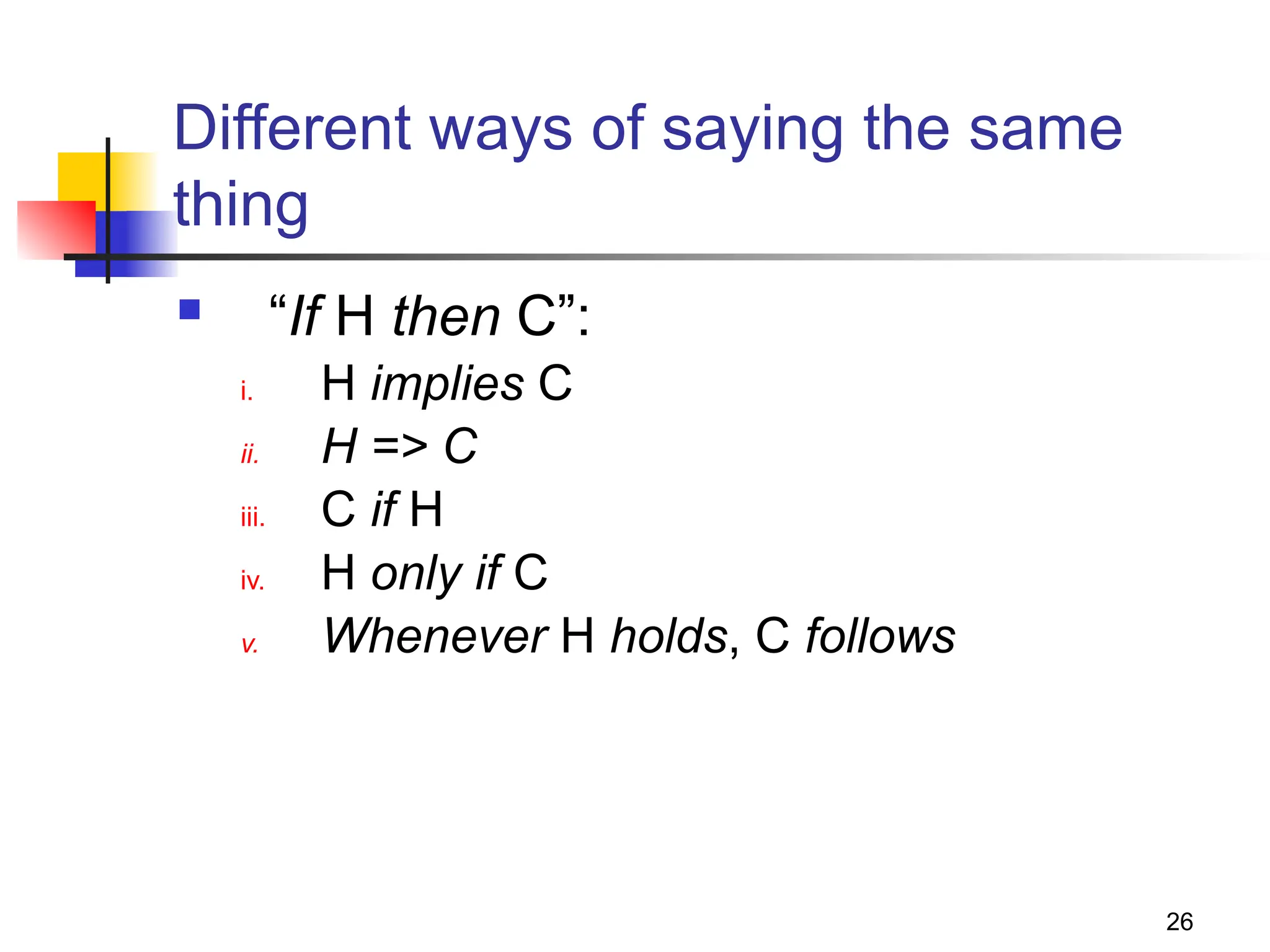
Different ways of saying the same
thing
 “If H then C”:
i. H implies C
ii. H => C
iii. C if H
iv. H only if C
v. Whenever H holds, C follows
27
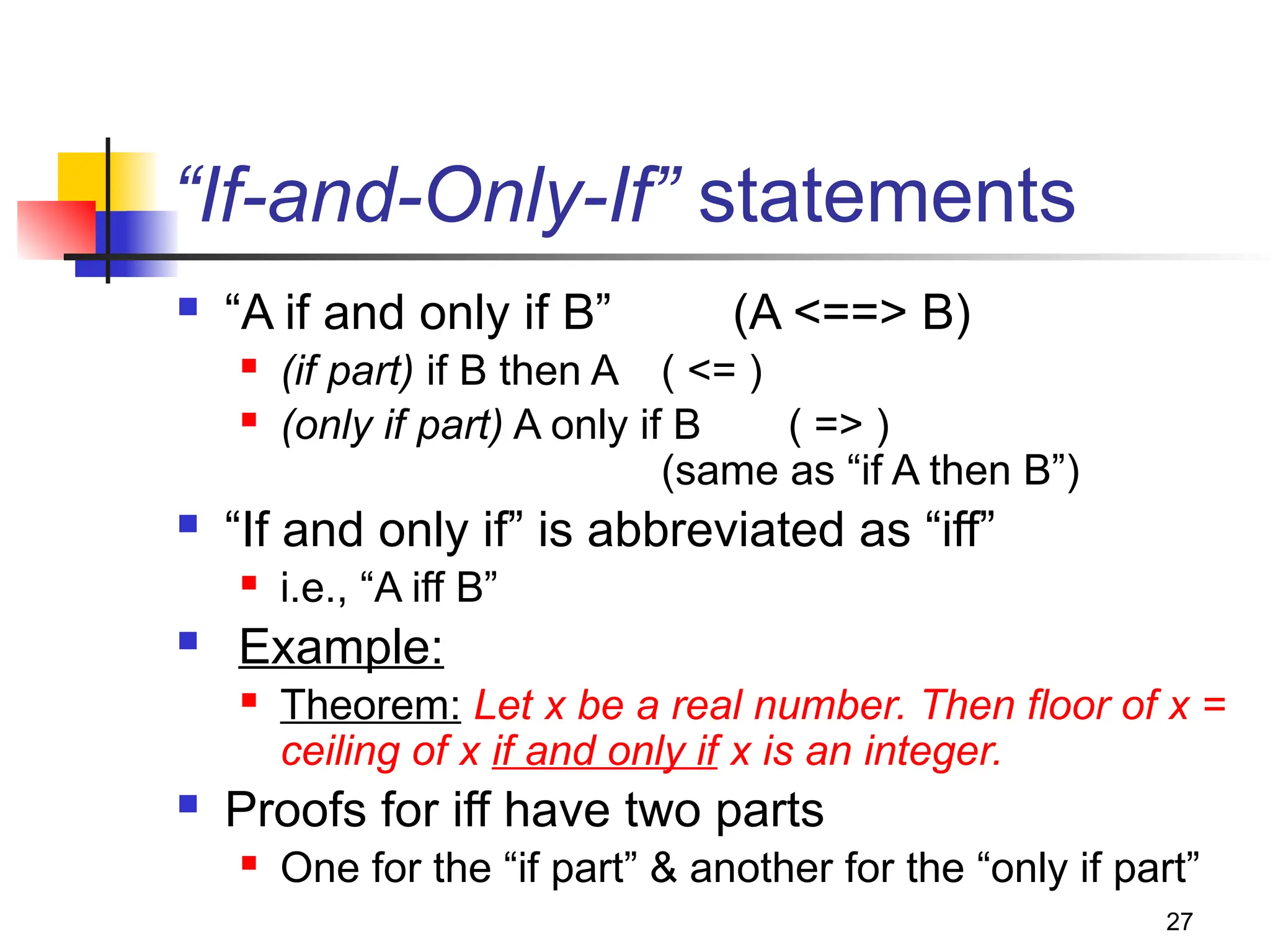
“If-and-Only-If” statements
 “A if and only if B” (A <==> B)
 (if part) if B then A ( <= )
 (only if part) A only if B ( => )
(same as “if A then B”)
 “If and only if” is abbreviated as “iff”
 i.e., “A iff B”
 Example:
 Theorem: Let x be a real number. Then floor of x =
ceiling of x if and only if x is an integer.
 Proofs for iff have two parts
 One for the “if part” & another for the “only if part”
28
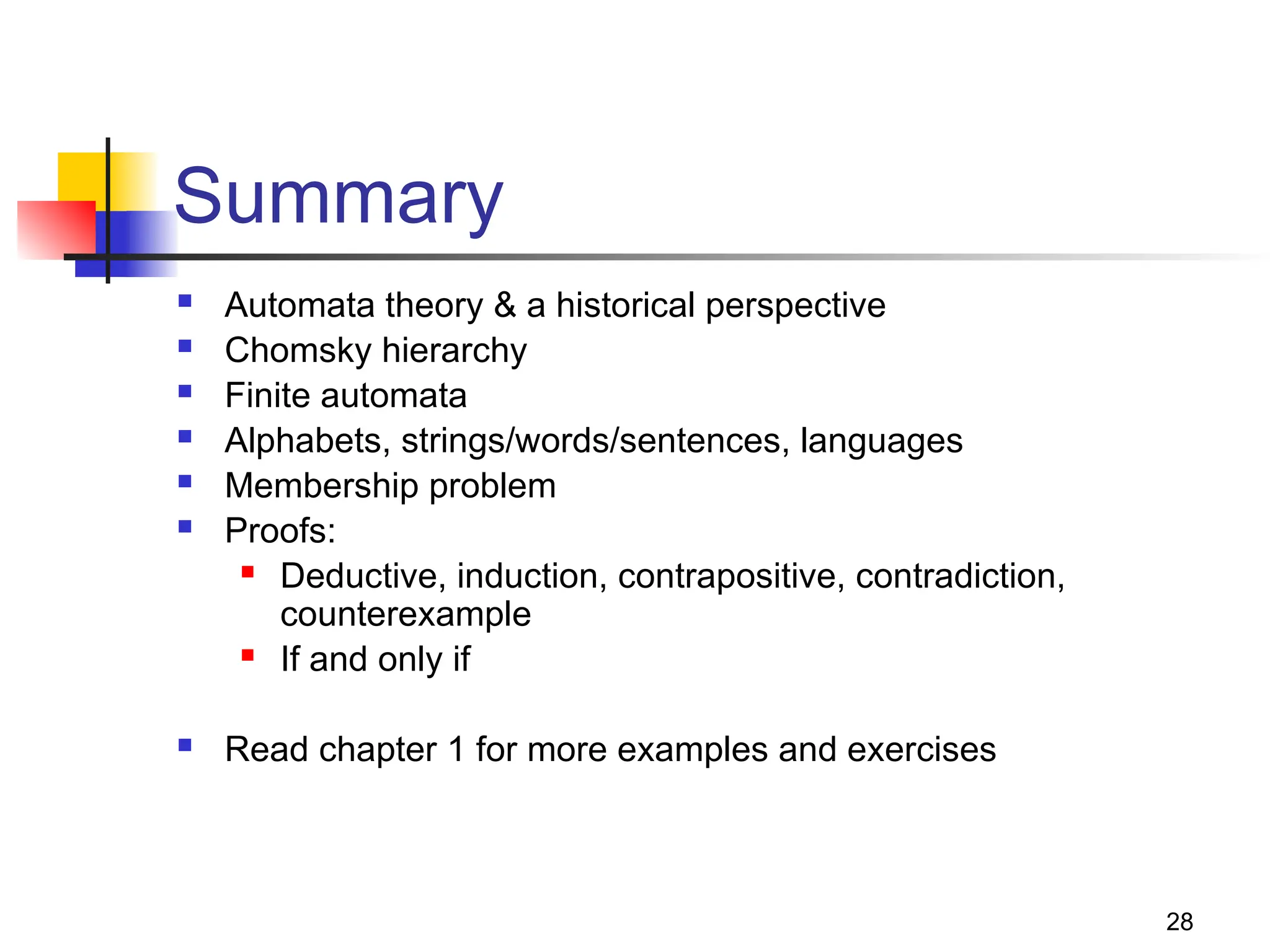
Summary
 Automata theory & a historical perspective
 Chomsky hierarchy
 Finite automata
 Alphabets, strings/words/sentences, languages
 Membership problem
 Proofs:
 Deductive, induction, contrapositive, contradiction,
counterexample
 If and only if
 Read chapter 1 for more examples and exercises

automata theory and formal languages Automata2Chapter1.pptx

  • 1.
    1 Introduction to Automata Theory Reading:Chapter 1 Source: https://eecs.wsu.edu/~ananth/CptS317/Lectures/index.htm
  • 2.
    2 What is AutomataTheory?  Study of abstract computing devices, or “machines”  Automaton = an abstract computing device  Note: A “device” need not even be a physical hardware!  A fundamental question in computer science:  Find out what different models of machines can do and cannot do  The theory of computation  Computability vs. Complexity
  • 3.
    3 What is AutomataTheory? Automata Theory is also a branch of computer science that deals with the design and analysis of algorithms and mathematical models of computation. It focuses on the study of abstract machines (automata) and the problems they can solve.
  • 4.
    4 Alan Turing (1912-1954) Father of Modern Computer Science  English mathematician  Studied abstract machines called Turing machines even before computers existed  Heard of the Turing test? (A pioneer of automata theory)
  • 5.
    5 Alan Turing (1912-1954) AlanTuring made seminal contributions to the fields of automata theory and formal languages, which are foundational areas in theoretical computer science. His work laid the groundwork for many concepts and theories that underpin these fields. (A pioneer of automata theory)
  • 6.
    6 Theory of Computation:A Historical Perspective 1930s • Alan Turing studies Turing machines • Decidability • Halting problem 1940-1950s • “Finite automata” machines studied • Noam Chomsky proposes the “Chomsky Hierarchy” for formal languages 1969 Cook introduces “intractable” problems or “NP-Hard” problems 1970- Modern computer science: compilers, computational & complexity theory evolve
  • 7.
    7 Languages & Grammars Or“words” Image source: Nowak et al. Nature, vol 417, 2002  Languages: “A language is a collection of sentences of finite length all constructed from a finite alphabet of symbols”  Grammars: “A grammar can be regarded as a device that enumerates the sentences of a language” - nothing more, nothing less  N. Chomsky, Information and Control, Vol 2, 1959
  • 8.
  • 9.
    9 The Chomsky Hierachy TheChomsky Hierarchy is a classification of formal languages based on the types of grammatical rules that generate them and the computational power required to recognize them. It was introduced by Noam Chomsky in 1956 and consists of four levels, each with increasing complexity and expressive power: Type 0: Recursively Enumerable Languages (Turing Machines) Type 1: Context-Sensitive Languages (Linear Bounded Automata) Type 2: Context-Free Languages (Pushdown Automata) Type 3: Regular Languages (Finite Automata)
  • 10.
    10 The Central Conceptsof Automata Theory
  • 11.
    11 Alphabet An alphabet isa finite, non-empty set of symbols  We use the symbol ∑ (sigma) to denote an alphabet  Examples:  Binary: ∑ = {0,1}  All lower case letters: ∑ = {a,b,c,..z}  Alphanumeric: ∑ = {a-z, A-Z, 0-9}  DNA molecule letters: ∑ = {a,c,g,t}  …
  • 12.
    12 Strings A string orword is a finite sequence of symbols chosen from ∑  Empty string is  (or “epsilon”)  Length of a string w, denoted by “|w|”, is equal to the number of (non- ) characters in the string  E.g., x = 010100 |x| = 6  x = 01  0  1  00  |x| = ?  xy = concatentation of two strings x and y
  • 13.
    13 Powers of analphabet Let ∑ be an alphabet.  ∑k = the set of all strings of length k  ∑* = ∑0 U ∑1 U ∑2 U …  ∑+ = ∑1 U ∑2 U ∑3 U …
  • 14.
    14 Languages L is asaid to be a language over alphabet ∑, only if L  ∑*  this is because ∑* is the set of all strings (of all possible length including 0) over the given alphabet ∑ Examples: 1. Let L be the language of all strings consisting of n 0’s followed by n 1’s: L = {, 01, 0011, 000111,…} 2. Let L be the language of all strings of with equal number of 0’s and 1’s: L = {, 01, 10, 0011, 1100, 0101, 1010, 1001,…} Definition: Ø denotes the Empty language  Let L = {}; Is L=Ø? NO Canonical ordering of strings in the language
  • 15.
    15 The Membership Problem Givena string w ∑*and a language L over ∑, decide whether or not w L. Example: Let w = 100011 Q) Is w  the language of strings with equal number of 0s and 1s?
  • 16.
    16 Finite Automata  SomeApplications  Software for designing and checking the behavior of digital circuits  Lexical analyzer of a typical compiler  Software for scanning large bodies of text (e.g., web pages) for pattern finding  Software for verifying systems of all types that have a finite number of states (e.g., stock market transaction, communication/network protocol)
  • 17.
    17 Finite Automata :Examples  On/Off switch  Modeling recognition of the word “then” Start state Final state Transition Intermediate state action state
  • 18.
    18 Structural expressions  Grammars Regular expressions  E.g., unix style to capture city names such as “Palo Alto CA”:  [A-Z][a-z]*([ ][A-Z][a-z]*)*[ ][A-Z][A-Z] Start with a letter A string of other letters (possibly empty) Other space delimited words (part of city name) Should end w/ 2-letter state code
  • 19.
  • 20.
    20 Deductive Proofs From thegiven statement(s) to a conclusion statement (what we want to prove)  Logical progression by direct implications Example for parsing a statement:  “If y≥4, then 2y ≥y2 .” (there are other ways of writing this). given conclusion
  • 21.
    21 Example: Deductive proof LetClaim 1: If y≥4, then 2y ≥y2 . Let x be any number which is obtained by adding the squares of 4 positive integers. Claim 2: Given x and assuming that Claim 1 is true, prove that 2x ≥x2  Proof: 1) Given: x = a2 + b2 + c2 + d2 2) Given: a≥1, b≥1, c≥1, d≥1 3)  a2 ≥1, b2 ≥1, c2 ≥1, d2 ≥1 (by 2) 4)  x ≥ 4 (by 1 & 3) 5)  2x ≥ x2 (by 4 and Claim 1) “implies” or “follows”
  • 22.
    On Theorems, Lemmasand Corollaries We typically refer to:  A major result as a “theorem”  An intermediate result that we show to prove a larger result as a “lemma”  A result that follows from an already proven result as a “corollary” 22 An example: Theorem: The height of an n-node binary tree is at least floor(lg n) Lemma: Level i of a perfect binary tree has 2i nodes. Corollary: A perfect binary tree of height h has 2h+1 -1 nodes.
  • 23.
    23 Quantifiers “For all” or“For every”  Universal proofs  Notation= “There exists”  Used in existential proofs  Notation= Implication is denoted by =>  E.g., “IF A THEN B” can also be written as “A=>B”
  • 24.
    24 Proving techniques  Bycontradiction  Start with the statement contradictory to the given statement  E.g., To prove (A => B), we start with:  (A and ~B)  … and then show that could never happen What if you want to prove that “(A and B => C or D)”?  By induction  (3 steps) Basis, inductive hypothesis, inductive step  By contrapositive statement  If A then B ≡ If ~B then ~A
  • 25.
    25 Proving techniques…  Bycounter-example  Show an example that disproves the claim  Note: There is no such thing called a “proof by example”!  So when asked to prove a claim, an example that satisfied that claim is not a proof
  • 26.
    26 Different ways ofsaying the same thing  “If H then C”: i. H implies C ii. H => C iii. C if H iv. H only if C v. Whenever H holds, C follows
  • 27.
    27 “If-and-Only-If” statements  “Aif and only if B” (A <==> B)  (if part) if B then A ( <= )  (only if part) A only if B ( => ) (same as “if A then B”)  “If and only if” is abbreviated as “iff”  i.e., “A iff B”  Example:  Theorem: Let x be a real number. Then floor of x = ceiling of x if and only if x is an integer.  Proofs for iff have two parts  One for the “if part” & another for the “only if part”
  • 28.
    28 Summary  Automata theory& a historical perspective  Chomsky hierarchy  Finite automata  Alphabets, strings/words/sentences, languages  Membership problem  Proofs:  Deductive, induction, contrapositive, contradiction, counterexample  If and only if  Read chapter 1 for more examples and exercises