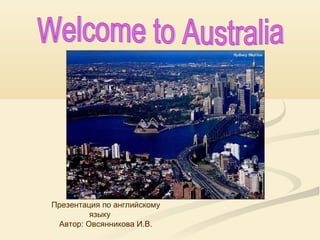
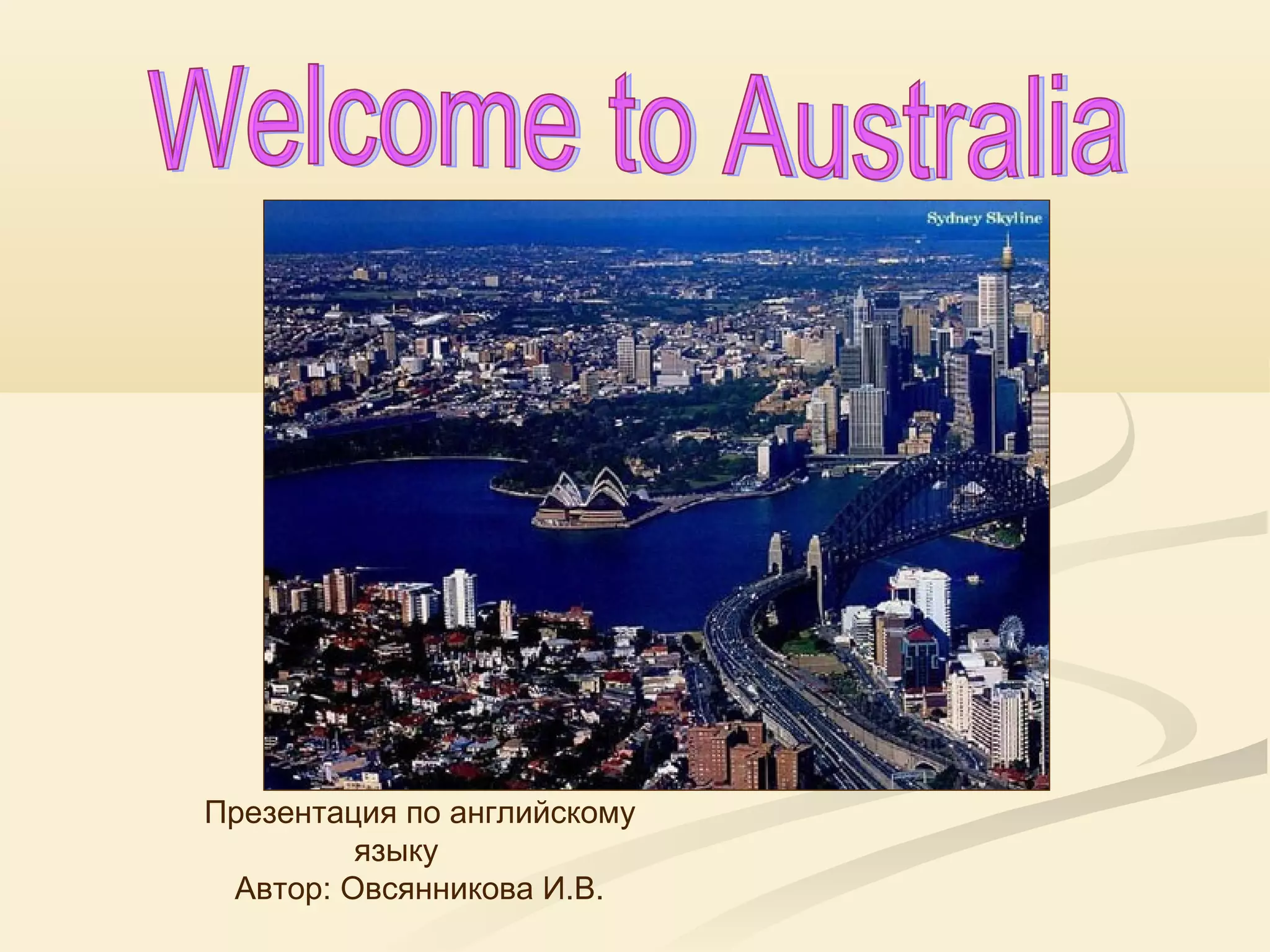
Презентация по английскому
языку
Автор: Овсянникова И.В.
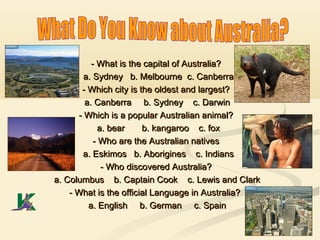
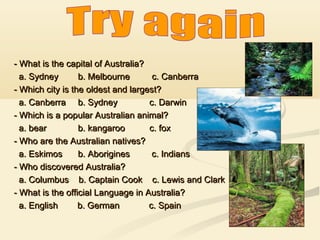
- What is the capital of Australia?
a. Sydney b. Melbourne c. Canberra
- Which city is the oldest and largest?
a. Canberra b. Sydney c. Darwin
- Which is a popular Australian animal?
a. bear
b. kangaroo c. fox
- Who are the Australian natives
a. Eskimos b. Aborigines c. Indians
- Who discovered Australia?
a. Columbus b. Captain Cook c. Lewis and Clark
- What is the official Language in Australia?
a. English b. German c. Spain
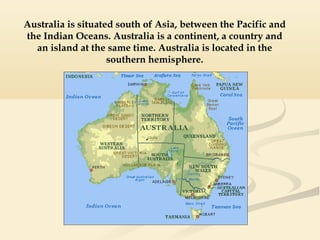
Australia is situated south of Asia, between the Pacific and
the Indian Oceans. Australia is a continent, a country and
an island at the same time. Australia is located in the
southern hemisphere.















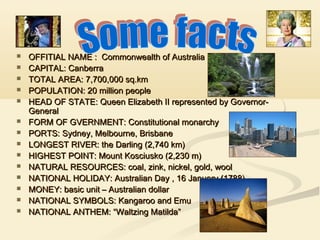
OFFITIAL NAME : Commonwealth of Australia
CAPITAL: Canberra
TOTAL AREA: 7,700,000 sq.km
POPULATION: 20 million people
HEAD OF STATE: Queen Elizabeth II represented by GovernorGeneral
FORM OF GVERNMENT: Constitutional monarchy
PORTS: Sydney, Melbourne, Brisbane
LONGEST RIVER: the Darling (2,740 km)
HIGHEST POINT: Mount Kosciusko (2,230 m)
NATURAL RESOURCES: coal, zink, nickel, gold, wool
NATIONAL HOLIDAY: Australian Day , 16 January (1788)
MONEY: basic unit – Australian dollar
NATIONAL SYMBOLS: Kangaroo and Emu
NATIONAL ANTHEM: “Waltzing Matilda”
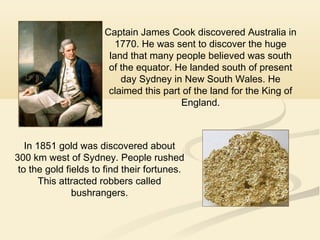
Captain James Cook discovered Australia in
1770. He was sent to discover the huge
land that many people believed was south
of the equator. He landed south of present
day Sydney in New South Wales. He
claimed this part of the land for the King of
England.

In 1851 gold was discovered about
300 km west of Sydney. People rushed
to the gold fields to find their fortunes.
This attracted robbers called
bushrangers.
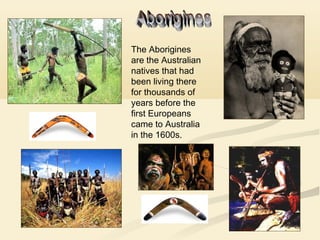
The Aborigines
are the Australian
natives that had
been living there
for thousands of
years before the
first Europeans
came to Australia
in the 1600s.
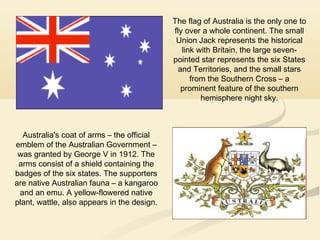
The flag of Australia is the only one to
fly over a whole continent. The small
Union Jack represents the historical
link with Britain, the large sevenpointed star represents the six States
and Territories, and the small stars
from the Southern Cross – a
prominent feature of the southern
hemisphere night sky.

Australia's coat of arms – the official
emblem of the Australian Government –
was granted by George V in 1912. The
arms consist of a shield containing the
badges of the six states. The supporters
are native Australian fauna – a kangaroo
and an emu. A yellow-flowered native
plant, wattle, also appears in the design.
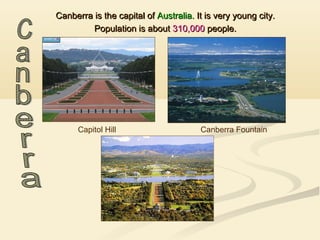
Canberra is the capital of Australia. It is very young city.
Population is about 310,000 people.

Capitol Hill

Canberra Fountain
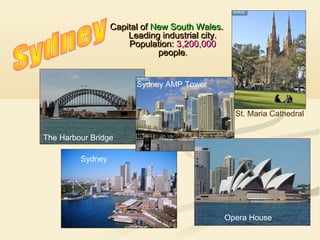
Capital of New South Wales.
Leading industrial city.
Population: 3,200,000
people.
Sydney AMP Tower

St. Maria Cathedral
The Harbour Bridge
Sydney

Opera House
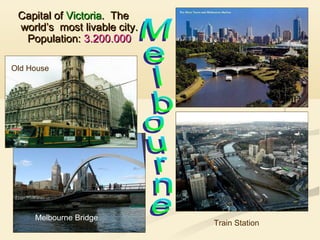
Capital of Victoria. The
world’s most livable city.
Population: 3.200.000
Old House

Melbourne Bridge

Train Station
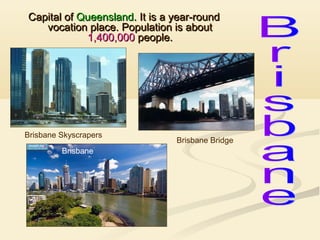
Capital of Queensland. It is a year-round
vocation place. Population is about
1,400,000 people.

Brisbane Skyscrapers
Brisbane

Brisbane Bridge
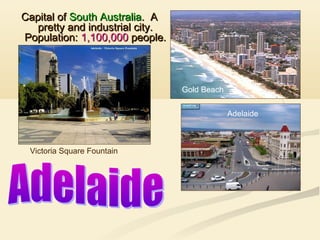
Capital of South Australia. A
pretty and industrial city.
Population: 1,100,000 people.

Gold Beach
Adelaide

Victoria Square Fountain
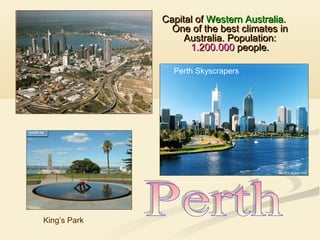
Capital of Western Australia.
One of the best climates in
Australia. Population:
1.200.000 people.
Perth Skyscrapers

King’s Park
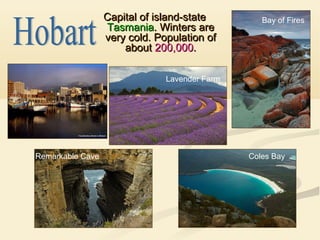
Capital of island-state
Tasmania. Winters are
very cold. Population of
about 200,000.

Bay of Fires

Lavender Farm

Remarkable Cave

Coles Bay
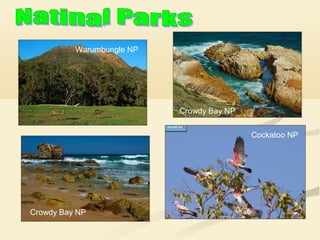
Warumbungle NP

Crowdy Bay NP
Cockatoo NP

Crowdy Bay NP
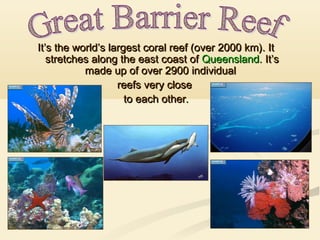
It’s the world’s largest coral reef (over 2000 km). It
stretches along the east coast of Queensland. It’s
made up of over 2900 individual
reefs very close
to each other.
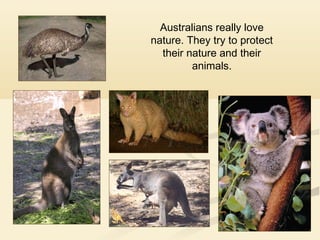
Australians really love
nature. They try to protect
their nature and their
animals.
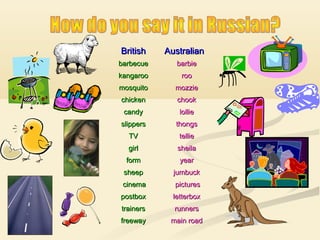
British

Australian

barbecue

barbie

kangaroo

roo

mosquito

mozzie

chicken

chook

candy

lollie

slippers

thongs

TV

tellie

girl

sheila

form

year

sheep

jumbuck

cinema

pictures

postbox

letterbox

trainers

runners

freeway

main road
The First people in Australia were Aborigines. They arrived there
about 12,000 years before from southern Asia. They had very rich
forms of art, painting, song, poetry and mythology. The lives of
aborigines stayed almost the same for thousands of years until the
Europeans came to live in Australia in 1778.
In 1770 J. Cook landed in eastern Australia and declared that it
belonged to Britain. In 1778, the British government began sending
the first prisoners to Australia. Overtime many people arrived from
Britain and Europe. Life was difficult. There was very little water
and the climate was very hard.
The Europeans suffered a lot in Australia but the Aborigines suffered
a lot more. Europeans stole their land and killed thousand of
Aborigines. They also brought new diseases with them. In parts of
Australia, not one Aborigine survived. Today aborigines continue to
live in Australia but there culture in under threat. In 1770, there
were about 300,000 Aborigines. Now, there are 120,000. It is
becoming harder and harder for them to continue their traditional
way to live.
Today Australia is a modern, industrial country, independent from
Britain since 1931. The Commonwealth of Australia consists of 6
states and two provinces. It is the world’s biggest producer of
wool, bauxite and important producer of wheat, meat, sugar and
fruit.
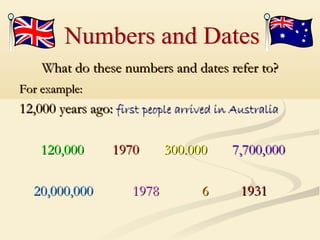
What do these numbers and dates refer to?
For example:

12,000 years ago: first people arrived in Australia
120,000
20,000,000

1970
1978

300.000
6

7,700,000
1931
- What is the capital of Australia?
a. Sydney
b. Melbourne
c. Canberra
- Which city is the oldest and largest?
a. Canberra b. Sydney
c. Darwin
- Which is a popular Australian animal?
a. bear
b. kangaroo
c. fox
- Who are the Australian natives?
a. Eskimos
b. Aborigines
c. Indians
- Who discovered Australia?
a. Columbus b. Captain Cook c. Lewis and Clark
- What is the official Language in Australia?
a. English
b. German
c. Spain
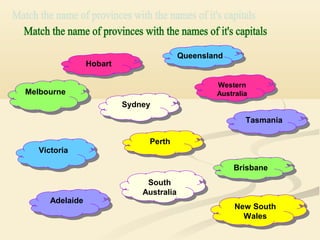
Queensland
Queensland

Hobart
Hobart
Melbourne
Melbourne
Sydney
Sydney

Western
Western
Australia
Australia

Tasmania
Tasmania
Victoria
Victoria

Perth
Perth
Brisbane
Brisbane

Adelaide
Adelaide

South
South
Australia
Australia
New South
New South
Wales
Wales
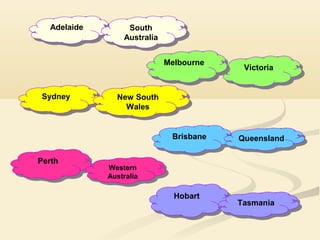
Adelaide
Adelaide

South
South
Australia
Australia
Melbourne
Melbourne

Sydney
Sydney

New South
New South
Wales
Wales
Brisbane
Brisbane

Perth
Perth

Victoria
Victoria

Queensland
Queensland

Western
Western
Australia
Australia

Hobart
Hobart

Tasmania
Tasmania
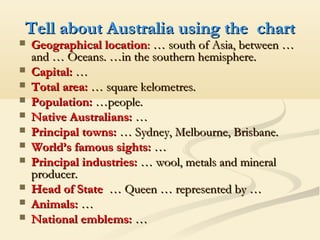
Tell about Australia using the chart












Geographical location: … south of Asia, between …
and … Oceans. …in the southern hemisphere.
Capital: …
Total area: … square kelometres.
Population: …people.
Native Australians: …
Principal towns: … Sydney, Melbourne, Brisbane.
World’s famous sights: …
Principal industries: … wool, metals and mineral
producer.
Head of State … Queen … represented by …
Animals: …
National emblems: …
Welcome to Australia

Welcome to Australia

  • 1.
  • 2.
    - What isthe capital of Australia? a. Sydney b. Melbourne c. Canberra - Which city is the oldest and largest? a. Canberra b. Sydney c. Darwin - Which is a popular Australian animal? a. bear b. kangaroo c. fox - Who are the Australian natives a. Eskimos b. Aborigines c. Indians - Who discovered Australia? a. Columbus b. Captain Cook c. Lewis and Clark - What is the official Language in Australia? a. English b. German c. Spain
  • 3.
    Australia is situatedsouth of Asia, between the Pacific and the Indian Oceans. Australia is a continent, a country and an island at the same time. Australia is located in the southern hemisphere.
  • 4.
                  OFFITIAL NAME :Commonwealth of Australia CAPITAL: Canberra TOTAL AREA: 7,700,000 sq.km POPULATION: 20 million people HEAD OF STATE: Queen Elizabeth II represented by GovernorGeneral FORM OF GVERNMENT: Constitutional monarchy PORTS: Sydney, Melbourne, Brisbane LONGEST RIVER: the Darling (2,740 km) HIGHEST POINT: Mount Kosciusko (2,230 m) NATURAL RESOURCES: coal, zink, nickel, gold, wool NATIONAL HOLIDAY: Australian Day , 16 January (1788) MONEY: basic unit – Australian dollar NATIONAL SYMBOLS: Kangaroo and Emu NATIONAL ANTHEM: “Waltzing Matilda”
  • 5.
    Captain James Cookdiscovered Australia in 1770. He was sent to discover the huge land that many people believed was south of the equator. He landed south of present day Sydney in New South Wales. He claimed this part of the land for the King of England. In 1851 gold was discovered about 300 km west of Sydney. People rushed to the gold fields to find their fortunes. This attracted robbers called bushrangers.
  • 6.
    The Aborigines are theAustralian natives that had been living there for thousands of years before the first Europeans came to Australia in the 1600s.
  • 7.
    The flag ofAustralia is the only one to fly over a whole continent. The small Union Jack represents the historical link with Britain, the large sevenpointed star represents the six States and Territories, and the small stars from the Southern Cross – a prominent feature of the southern hemisphere night sky. Australia's coat of arms – the official emblem of the Australian Government – was granted by George V in 1912. The arms consist of a shield containing the badges of the six states. The supporters are native Australian fauna – a kangaroo and an emu. A yellow-flowered native plant, wattle, also appears in the design.
  • 8.
    Canberra is thecapital of Australia. It is very young city. Population is about 310,000 people. Capitol Hill Canberra Fountain
  • 9.
    Capital of NewSouth Wales. Leading industrial city. Population: 3,200,000 people. Sydney AMP Tower St. Maria Cathedral The Harbour Bridge Sydney Opera House
  • 10.
    Capital of Victoria.The world’s most livable city. Population: 3.200.000 Old House Melbourne Bridge Train Station
  • 11.
    Capital of Queensland.It is a year-round vocation place. Population is about 1,400,000 people. Brisbane Skyscrapers Brisbane Brisbane Bridge
  • 12.
    Capital of SouthAustralia. A pretty and industrial city. Population: 1,100,000 people. Gold Beach Adelaide Victoria Square Fountain
  • 13.
    Capital of WesternAustralia. One of the best climates in Australia. Population: 1.200.000 people. Perth Skyscrapers King’s Park
  • 14.
    Capital of island-state Tasmania.Winters are very cold. Population of about 200,000. Bay of Fires Lavender Farm Remarkable Cave Coles Bay
  • 15.
    Warumbungle NP Crowdy BayNP Cockatoo NP Crowdy Bay NP
  • 16.
    It’s the world’slargest coral reef (over 2000 km). It stretches along the east coast of Queensland. It’s made up of over 2900 individual reefs very close to each other.
  • 17.
    Australians really love nature.They try to protect their nature and their animals.
  • 18.
  • 19.
    The First peoplein Australia were Aborigines. They arrived there about 12,000 years before from southern Asia. They had very rich forms of art, painting, song, poetry and mythology. The lives of aborigines stayed almost the same for thousands of years until the Europeans came to live in Australia in 1778. In 1770 J. Cook landed in eastern Australia and declared that it belonged to Britain. In 1778, the British government began sending the first prisoners to Australia. Overtime many people arrived from Britain and Europe. Life was difficult. There was very little water and the climate was very hard. The Europeans suffered a lot in Australia but the Aborigines suffered a lot more. Europeans stole their land and killed thousand of Aborigines. They also brought new diseases with them. In parts of Australia, not one Aborigine survived. Today aborigines continue to live in Australia but there culture in under threat. In 1770, there were about 300,000 Aborigines. Now, there are 120,000. It is becoming harder and harder for them to continue their traditional way to live. Today Australia is a modern, industrial country, independent from Britain since 1931. The Commonwealth of Australia consists of 6 states and two provinces. It is the world’s biggest producer of wool, bauxite and important producer of wheat, meat, sugar and fruit.
  • 20.
    What do thesenumbers and dates refer to? For example: 12,000 years ago: first people arrived in Australia 120,000 20,000,000 1970 1978 300.000 6 7,700,000 1931
  • 21.
    - What isthe capital of Australia? a. Sydney b. Melbourne c. Canberra - Which city is the oldest and largest? a. Canberra b. Sydney c. Darwin - Which is a popular Australian animal? a. bear b. kangaroo c. fox - Who are the Australian natives? a. Eskimos b. Aborigines c. Indians - Who discovered Australia? a. Columbus b. Captain Cook c. Lewis and Clark - What is the official Language in Australia? a. English b. German c. Spain
  • 22.
  • 23.
  • 24.
    Tell about Australiausing the chart            Geographical location: … south of Asia, between … and … Oceans. …in the southern hemisphere. Capital: … Total area: … square kelometres. Population: …people. Native Australians: … Principal towns: … Sydney, Melbourne, Brisbane. World’s famous sights: … Principal industries: … wool, metals and mineral producer. Head of State … Queen … represented by … Animals: … National emblems: …