AUSTRALIA
Australia is in the
Southern Hemisphere.
Because it is south of the equator, the seasons
in Australia are the opposite of those in
Europe: it’s winter in Australia when it’s
summer in Europe.
LOCATION
- It’s the 6th biggest country in the world.
- It’s an island, surrounded by water.
- It’s the smallest continent in the world.
Australia is composed of 7 territories:
Western Australia, Northern Territory,
Queensland, South Australia, New South Wales,
Victoria + Tasmania, and Papua New Guinea.
James Cook discovered Australia in 1770.
Britain sent prisoners
and criminals to Australia.
Europeans sold the land
of Aborigines and killed
thousands of them.
HISTORY
Native Australians. The Aborigines have lived in Australia
for over 40,000 years. Now they only represent 1% of the
population. The total population of Australia is 22 million.
The capital city is
Canberra.
CITIES
The biggest city is Sydney,
where there is the famous
Sydney Opera House.
OTHER IMPORTANT CITIES
Melbourne
Perth
Brisbane
Where are the majority of important cities in
Australia?
CANBERRA
 Canberra is the capital city of Australia. There are 340 800 people 
who live there. It doesn’t belong to a state but it is in theAustralian 
Capital Territory (ACT).
 Canberra was started in 1913 and in the middle of the city is Lake 
Burley-Griffin.
 Tourists who visit Canberra come to see the many 
national monuments and other famous sights. Some places to visit 
are the Government House, Parliament House, the High Court of 
Australia, the Australian War Memorial, the National Gallery of 
Australia, the Royal Australian Mint, Telstra Tower, the National 
Library of Australia, and the National Museum of Australia.
SYDNEY
 Sydney is a city on the east coast of Australia. Sydney is the capital 
cityof New South Wales. About four million people live in Sydney which 
makes it the biggest city in Oceania.
 In Sydney, there are many famous buildings: the Sydney Opera House, 
the Queen Victoria Building and the Sydney Harbour Bridge. Sydney has a 
large harbour and many beaches. The most famous beach is Bondi Beach, 
some other famous beaches are Coogee Beach and Manly Beach. Famous 
parts of the harbour are Darling Harbour and Circular Quay.
 The most famous sports ground in Sydney is ANZ Stadium (which used to 
be called "Stadium Australia") because it was built for the 2000 Summer 
Olympics. Another stadium in Sydney is the Sydney Cricket Ground (SCG).
 Sydney has many things to see and do. These include visiting Taronga 
Zoo (a park for animals) on the northern side of the harbour, eating food, 
looking at art or watching sports (like cricket or rugby) or walking down 
George Street which has many nice shops. Sydney has some of Australia's 
best shopping, and the Blue Mountains are about two hours' drive away to 
the west. Many people go to Sydney City to watch the 
great fireworks display over the harbour on New Year's Eve.
MELBOURNE
 Melbourne is the second largest city in Australia. It is 
the capital of Victoria, which is a state in the south-east of Australia. The 
population of Melbourne is 3,806,092.
 Melbourne is a multicultural city (it welcomes people and cultures from 
all over the world). It is famous for its trams (small short trains). The 
centre of Melbourne is around a river called the Yarra River. Melbourne 
also has many big parks and gardens and some beaches.
 There are many things to do in Melbourne. Visitors in Melbourne can go 
to museums, look at art, eat food at restaurants, go to shops, and go to 
many large sport events.
 There is a lot of industry (factories) and commerce (buying and selling) 
in Melbourne. Many of Australia's largest companies and many large 
companies from other countries work there. It is home to Australia's 
largest seaport. There are a number of universities (the University of 
Melbourne, Monash University, Deakin University, Victoria University, 
La Trobe University, RMIT University, Swinburne University and the 
Australian Catholic University). Much of Australia's automotive (car) 
industry is there, for example the engine maker "Holden", and "Ford" 
and "Toyota" car builders.
BRISBANE
 Brisbane (local nickname Brissie) is the capital city and biggest city 
of Queensland.
 It has a population of 2.2 million people and is the third biggest city 
in Australia, after Sydney and Melbourne.
 The first free settlers moved to Brisbane in 1842. Brisbane became 
the capital city when Queensland became a separate colony 
from New South Wales in 1859.
 Brisbane has more than 50 skyscrapers more than 100 metres 
(330 ft) tall.
 If you go to Brisbane, you have to go to Southbank Parklands, that 
 is a  family-friendly parklands and provides the perfect setting for a 
great day out. With riverside cycling and walking paths, lush 
gardens, a beautiful inner city beach, a great range of dining options 
and vibrant shopping, there is something for everyone to enjoy!
PERTH
 Perth is the capital city of the state of Western Australia. 
It is built on the banks of the Swan River. Almost 
1.7 million people live in the city. It is the fourth biggest 
city in Australia, 
behind Sydney, Melbourne and Brisbane. Perth was 
founded in 1829 by CaptainJames Stirling. Perth is 
famous for its beautiful white, sandy beaches. Popular 
local beaches include Cottesloe and Scarborough. 
These beaches are ideal for swimming and bodysurfing. 
A popular local tourist attraction is Rottnest Island, which 
is populated by small native mammals called Quokkas.
GEOGRAPHY
Uluru (Ayers Rock) is the world’s largest monolith. It is 
sacred for Aborigines. 
It is very popular with tourists because of its beautiful 
colours.
THE AUSTRALIAN FLAG
Union Flag
6th British 
colony.
The Commonwealth 7 pointed star 
represents the 7 territories.
Southern cross symbolizes the constellation.
Other names for Australia
• Oz
• Down Under
The currency is the Australian dollar.
In Australia it is usually very warm, so Australians love
sport and other outdoor activities. The most popular
are:
surfing
swimming
scuba-diving cricket
TYPICAL ANIMALS
Koala Kangaroo
Dingo
Platypus
Sugar glider
Tasmanian devil
Wombat
Possum
Australia has also some very poisonous snakes and
spiders. At school children have to learn first aid for snake
and spider bites.
SOME AUSTRALIAN SYMBOLS
An Aborigine
Sydney Opera House
built by Danish architect Jørn Utzon
Bondi Beach, Sydney
Ayers Rock or Uluru
A didgeridoo
A boomerang
Kangaroos in the Outback
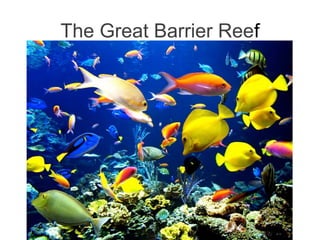
The Great Barrier Reef

Powerpoint Australia