The Australian
 Geography
 Curriculum
 and Global Education


          Rebecca Nicholas
     Brisbane State High School
        rnich101@eq.edu.au
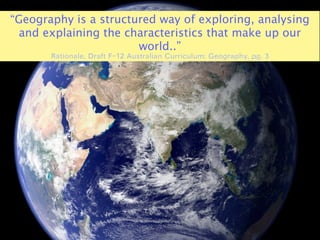
“Geography is a structured way of exploring, analysing
  and explaining the characteristics that make up our
                       world..”
       Rationale, Draft F-12 Australian Curriculum: Geography, pg. 3
Aims
Aims


A sense of wonder and curiosity about places,
people, cultures and environments throughout
                  the world.
Aims
Aims


A deep geographical knowledge of their own
 place, Australia, our region and the world.
Aims
Aims


 The ability to think geographically, based on an
   understanding of place, space, environment,
interconnection, sustainability, scale and change.
Aims
Aims


   The capacity to be competent, critical and
creative users of geographical inquiry, methods
                   and skills.
Aims
Aims


As informed, responsible and active citizens
who can contribute to the development of a
            sustainable world.
Aims
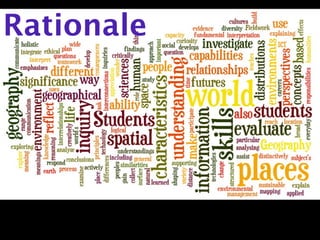
Rationale
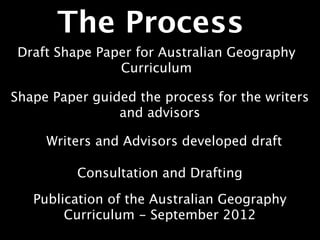
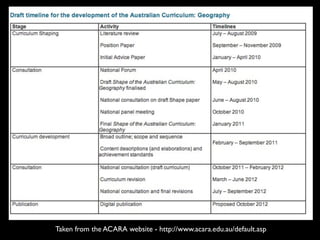
The Process
 Draft Shape Paper for Australian Geography
                Curriculum

Shape Paper guided the process for the writers
                and advisors

     Writers and Advisors developed draft

          Consultation and Drafting

   Publication of the Australian Geography
        Curriculum - September 2012
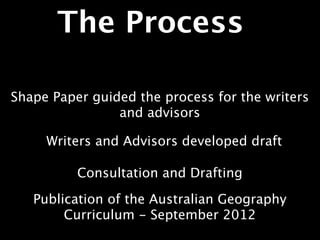
The Process

Shape Paper guided the process for the writers
                and advisors

     Writers and Advisors developed draft

          Consultation and Drafting

   Publication of the Australian Geography
        Curriculum - September 2012
The Process


  Writers and Advisors developed draft

      Consultation and Drafting

Publication of the Australian Geography
     Curriculum - September 2012
The Process


      Consultation and Drafting

Publication of the Australian Geography
     Curriculum - September 2012
The Process


Publication of the Australian Geography
     Curriculum - September 2012
The Process
Taken from the ACARA website - http://www.acara.edu.au/default.asp
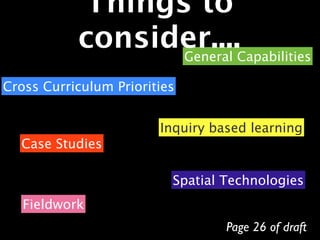
Things to
consider....


          Page 26 of draft
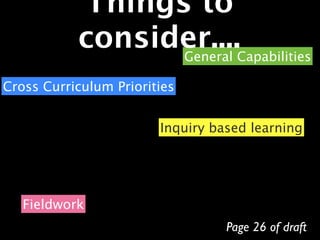
Things to
           consider....
Cross Curriculum Priorities


                              Page 26 of draft
Things to
           consider....Capabilities
                 General

Cross Curriculum Priorities


                              Page 26 of draft
Things to
           consider....Capabilities
                 General

Cross Curriculum Priorities


   Fieldwork
                              Page 26 of draft
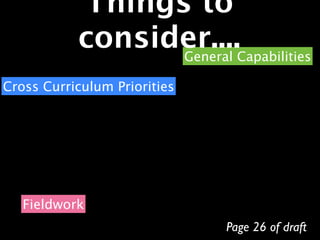
Things to
           consider....Capabilities
                 General

Cross Curriculum Priorities


                        Inquiry based learning


   Fieldwork
                                  Page 26 of draft
Things to
           consider....Capabilities
                 General

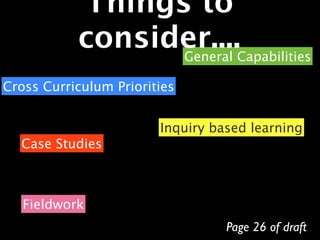
Cross Curriculum Priorities


                        Inquiry based learning
  Case Studies


   Fieldwork
                                  Page 26 of draft
Things to
           consider....Capabilities
                 General

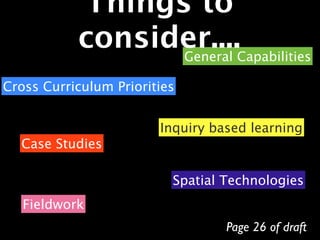
Cross Curriculum Priorities


                        Inquiry based learning
  Case Studies

                          Spatial Technologies
   Fieldwork
                                  Page 26 of draft
Things to
           consider....Capabilities
                 General

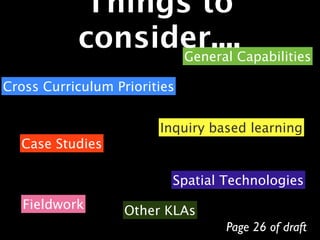
Cross Curriculum Priorities


                        Inquiry based learning
  Case Studies

                          Spatial Technologies
   Fieldwork       Other KLAs
                                  Page 26 of draft
Things to
           consider....Capabilities
                 General

Cross Curriculum Priorities


                        Inquiry based learning
  Case Studies

                          Spatial Technologies
   Fieldwork
                                  Page 26 of draft
Strands
Strands
Geographical Knowledge and
      Understanding
Strands
Geographical Knowledge and
      Understanding


        Geographical Inquiry and Skills
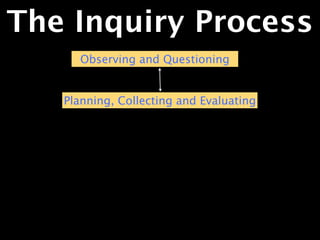
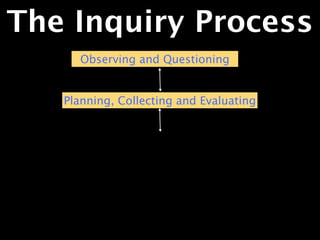
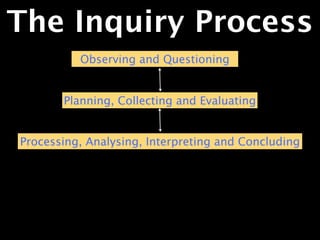
The Inquiry Process
The Inquiry Process
    Observing and Questioning
The Inquiry Process
    Observing and Questioning
The Inquiry Process
      Observing and Questioning


   Planning, Collecting and Evaluating
The Inquiry Process
      Observing and Questioning


   Planning, Collecting and Evaluating
The Inquiry Process
          Observing and Questioning


       Planning, Collecting and Evaluating


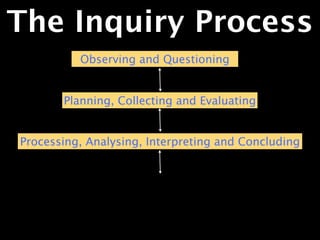
Processing, Analysing, Interpreting and Concluding
The Inquiry Process
          Observing and Questioning


       Planning, Collecting and Evaluating


Processing, Analysing, Interpreting and Concluding
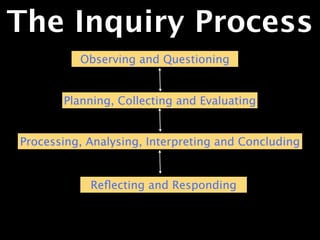
The Inquiry Process
          Observing and Questioning


       Planning, Collecting and Evaluating


Processing, Analysing, Interpreting and Concluding


            Reflecting and Responding
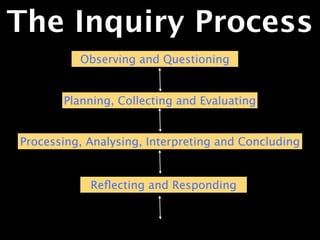
The Inquiry Process
          Observing and Questioning


       Planning, Collecting and Evaluating


Processing, Analysing, Interpreting and Concluding


            Reflecting and Responding
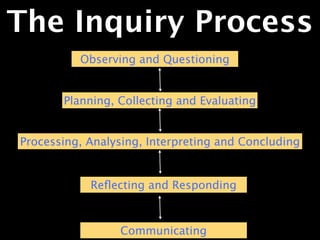
The Inquiry Process
          Observing and Questioning


       Planning, Collecting and Evaluating


Processing, Analysing, Interpreting and Concluding


            Reflecting and Responding


                 Communicating
Concepts
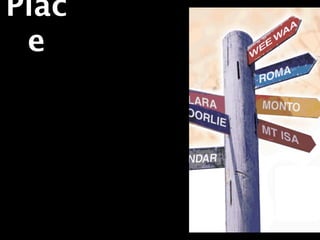
Plac
 e
Plac
  e
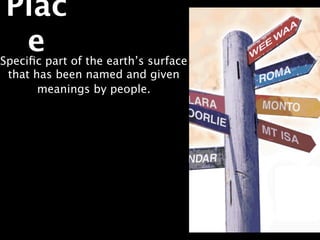
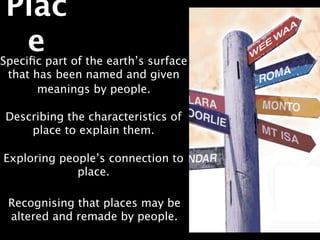
Specific part of the earth’s surface
 that has been named and given
       meanings by people.
Plac
  e
Specific part of the earth’s surface
 that has been named and given
       meanings by people.

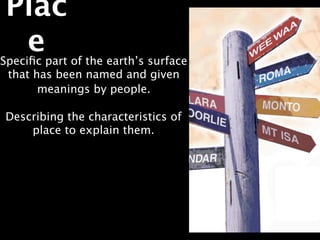
Describing the characteristics of
    place to explain them.
Plac
  e
Specific part of the earth’s surface
 that has been named and given
       meanings by people.

Describing the characteristics of
    place to explain them.

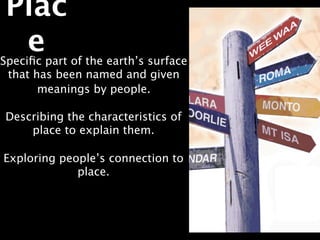
Exploring people’s connection to
             place.
Plac
  e
Specific part of the earth’s surface
 that has been named and given
       meanings by people.

Describing the characteristics of
    place to explain them.

Exploring people’s connection to
             place.

 Recognising that places may be
 altered and remade by people.
Spa
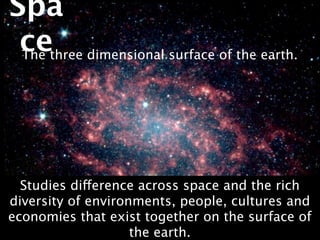
 cethree dimensional surface of the earth.
 The


  Studies difference across space and the rich
diversity of environments, people, cultures and
economies that exist together on the surface of
                    the earth.
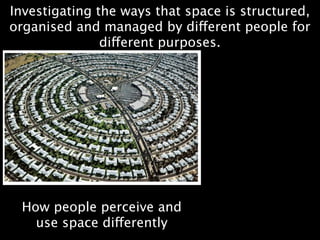
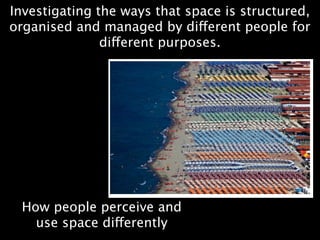
Investigating the ways that space is structured,
organised and managed by different people for
               different purposes.


 How people perceive and
   use space differently
Investigating the ways that space is structured,
organised and managed by different people for
               different purposes.


 How people perceive and
   use space differently
Investigating the ways that space is structured,
organised and managed by different people for
               different purposes.


 How people perceive and
   use space differently
Investigating the ways that space is structured,
organised and managed by different people for
               different purposes.


 How people perceive and
   use space differently
Investigating the ways that space is structured,
organised and managed by different people for
               different purposes.


 How people perceive and
   use space differently
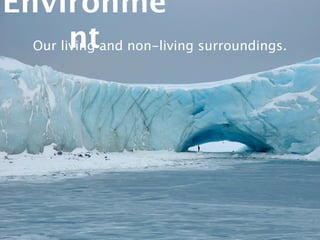
Environme
        nt
  Our living and non-living surroundings.
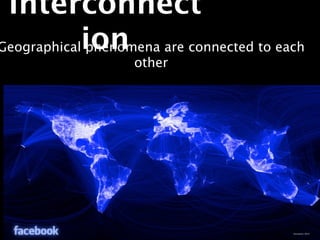
Interconnect
Geographicalion
            phenomena are connected to each
                   other
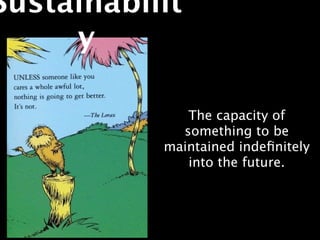
Sustainabilit
     y

              The capacity of
             something to be
           maintained indefinitely
              into the future.
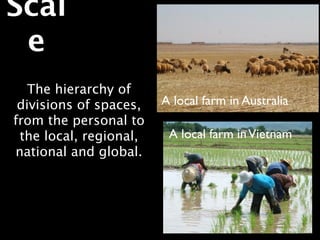
Scal
 e
   The hierarchy of
 divisions of spaces,   A local farm in Australia
from the personal to
 the local, regional,    A local farm in Vietnam
national and global.
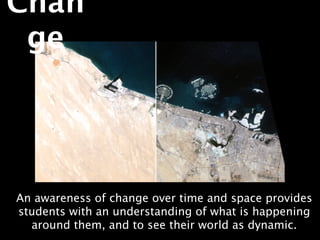
Chan
 ge


An awareness of change over time and space provides
students with an understanding of what is happening
  around them, and to see their world as dynamic.
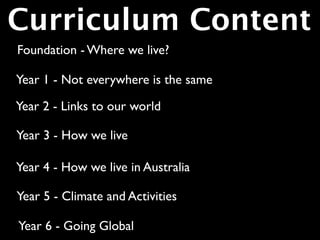
Curriculum Content
Foundation - Where we live?

Year 1 - Not everywhere is the same

Year 2 - Links to our world

Year 3 - How we live

Year 4 - How we live in Australia

Year 5 - Climate and Activities

Year 6 - Going Global
Any Questions?

Australian Geography Curriculum

  • 1.
    The Australian Geography Curriculum and Global Education Rebecca Nicholas Brisbane State High School rnich101@eq.edu.au
  • 2.
    “Geography is astructured way of exploring, analysing and explaining the characteristics that make up our world..” Rationale, Draft F-12 Australian Curriculum: Geography, pg. 3
  • 3.
  • 4.
    Aims A sense ofwonder and curiosity about places, people, cultures and environments throughout the world.
  • 5.
  • 6.
    Aims A deep geographicalknowledge of their own place, Australia, our region and the world.
  • 7.
  • 8.
    Aims The abilityto think geographically, based on an understanding of place, space, environment, interconnection, sustainability, scale and change.
  • 9.
  • 10.
    Aims The capacity to be competent, critical and creative users of geographical inquiry, methods and skills.
  • 11.
  • 12.
    Aims As informed, responsibleand active citizens who can contribute to the development of a sustainable world.
  • 13.
  • 14.
  • 15.
    The Process DraftShape Paper for Australian Geography Curriculum Shape Paper guided the process for the writers and advisors Writers and Advisors developed draft Consultation and Drafting Publication of the Australian Geography Curriculum - September 2012
  • 16.
    The Process Shape Paperguided the process for the writers and advisors Writers and Advisors developed draft Consultation and Drafting Publication of the Australian Geography Curriculum - September 2012
  • 17.
    The Process Writers and Advisors developed draft Consultation and Drafting Publication of the Australian Geography Curriculum - September 2012
  • 18.
    The Process Consultation and Drafting Publication of the Australian Geography Curriculum - September 2012
  • 19.
    The Process Publication ofthe Australian Geography Curriculum - September 2012
  • 20.
  • 21.
    Taken from theACARA website - http://www.acara.edu.au/default.asp
  • 22.
    Things to consider.... Page 26 of draft
  • 23.
    Things to consider.... Cross Curriculum Priorities Page 26 of draft
  • 24.
    Things to consider....Capabilities General Cross Curriculum Priorities Page 26 of draft
  • 25.
    Things to consider....Capabilities General Cross Curriculum Priorities Fieldwork Page 26 of draft
  • 26.
    Things to consider....Capabilities General Cross Curriculum Priorities Inquiry based learning Fieldwork Page 26 of draft
  • 27.
    Things to consider....Capabilities General Cross Curriculum Priorities Inquiry based learning Case Studies Fieldwork Page 26 of draft
  • 28.
    Things to consider....Capabilities General Cross Curriculum Priorities Inquiry based learning Case Studies Spatial Technologies Fieldwork Page 26 of draft
  • 29.
    Things to consider....Capabilities General Cross Curriculum Priorities Inquiry based learning Case Studies Spatial Technologies Fieldwork Other KLAs Page 26 of draft
  • 30.
    Things to consider....Capabilities General Cross Curriculum Priorities Inquiry based learning Case Studies Spatial Technologies Fieldwork Page 26 of draft
  • 31.
  • 32.
  • 33.
    Strands Geographical Knowledge and Understanding Geographical Inquiry and Skills
  • 34.
  • 35.
    The Inquiry Process Observing and Questioning
  • 36.
    The Inquiry Process Observing and Questioning
  • 37.
    The Inquiry Process Observing and Questioning Planning, Collecting and Evaluating
  • 38.
    The Inquiry Process Observing and Questioning Planning, Collecting and Evaluating
  • 39.
    The Inquiry Process Observing and Questioning Planning, Collecting and Evaluating Processing, Analysing, Interpreting and Concluding
  • 40.
    The Inquiry Process Observing and Questioning Planning, Collecting and Evaluating Processing, Analysing, Interpreting and Concluding
  • 41.
    The Inquiry Process Observing and Questioning Planning, Collecting and Evaluating Processing, Analysing, Interpreting and Concluding Reflecting and Responding
  • 42.
    The Inquiry Process Observing and Questioning Planning, Collecting and Evaluating Processing, Analysing, Interpreting and Concluding Reflecting and Responding
  • 43.
    The Inquiry Process Observing and Questioning Planning, Collecting and Evaluating Processing, Analysing, Interpreting and Concluding Reflecting and Responding Communicating
  • 44.
  • 45.
  • 46.
    Plac e Specificpart of the earth’s surface that has been named and given meanings by people.
  • 47.
    Plac e Specificpart of the earth’s surface that has been named and given meanings by people. Describing the characteristics of place to explain them.
  • 48.
    Plac e Specificpart of the earth’s surface that has been named and given meanings by people. Describing the characteristics of place to explain them. Exploring people’s connection to place.
  • 49.
    Plac e Specificpart of the earth’s surface that has been named and given meanings by people. Describing the characteristics of place to explain them. Exploring people’s connection to place. Recognising that places may be altered and remade by people.
  • 50.
    Spa cethree dimensionalsurface of the earth. The Studies difference across space and the rich diversity of environments, people, cultures and economies that exist together on the surface of the earth.
  • 51.
    Investigating the waysthat space is structured, organised and managed by different people for different purposes. How people perceive and use space differently
  • 52.
    Investigating the waysthat space is structured, organised and managed by different people for different purposes. How people perceive and use space differently
  • 53.
    Investigating the waysthat space is structured, organised and managed by different people for different purposes. How people perceive and use space differently
  • 54.
    Investigating the waysthat space is structured, organised and managed by different people for different purposes. How people perceive and use space differently
  • 55.
    Investigating the waysthat space is structured, organised and managed by different people for different purposes. How people perceive and use space differently
  • 56.
    Environme nt Our living and non-living surroundings.
  • 57.
    Interconnect Geographicalion phenomena are connected to each other
  • 58.
    Sustainabilit y The capacity of something to be maintained indefinitely into the future.
  • 59.
    Scal e The hierarchy of divisions of spaces, A local farm in Australia from the personal to the local, regional, A local farm in Vietnam national and global.
  • 60.
    Chan ge An awarenessof change over time and space provides students with an understanding of what is happening around them, and to see their world as dynamic.
  • 61.
    Curriculum Content Foundation -Where we live? Year 1 - Not everywhere is the same Year 2 - Links to our world Year 3 - How we live Year 4 - How we live in Australia Year 5 - Climate and Activities Year 6 - Going Global
  • 62.