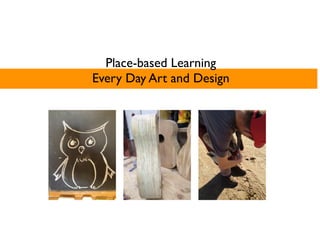
Place-based Design:
Ethnographic fieldwork and exhibit design

                   Jim Mathews
                   Robyn Acker
                    Molly Ward

       Middleton Alternative Senior High (MASH)
        Clark Street Community School (CSCS)

                  WCSS Conference
                   March 19, 2012
Anchor 1: Theme + Inquiry

            What is everyday art and design?


              Anchor 2: Design Challenge

Design an exhibit to teach young kids about every day art
Open-ended Exploration


What is every day art and design?
Open-ended Design Challenge
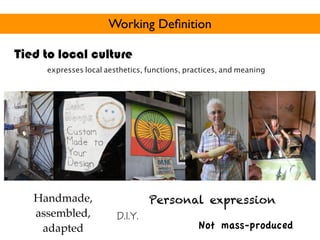
Working Definition

Tied to local culture
     expresses local aesthetics, functions, practices, and meaning


   Handmade,                     Personal expression
   assembled,           D.I.Y.
    adapted                                    Not mass-produced
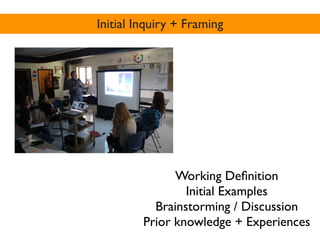
Initial Inquiry + Framing


               Working Definition
                 Initial Examples
           Brainstorming / Discussion
         Prior knowledge + Experiences
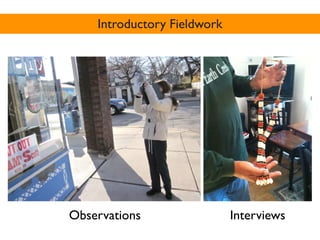
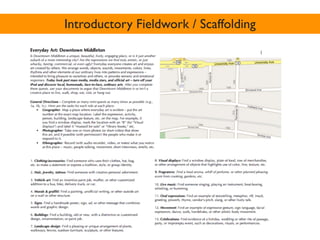
Introductory Fieldwork


Observations                 Interviews
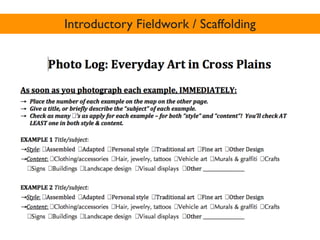
Introductory Fieldwork / Scaffolding
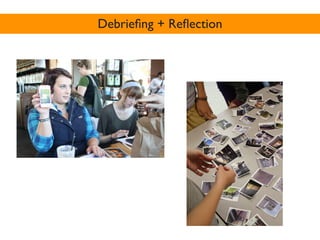
Debriefing + Reflection
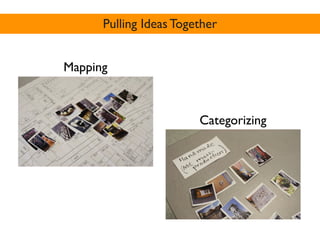
Pulling Ideas Together


Mapping


                        Categorizing
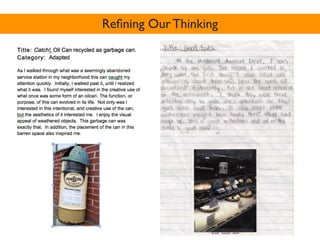
Refining Our Thinking
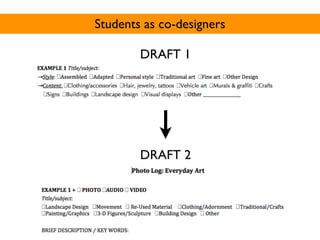
Students as co-designers

        DRAFT 1


        DRAFT 2
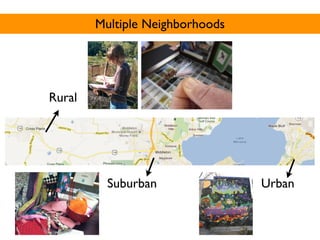
Multiple Neighborhoods


Rural


          Suburban               Urban
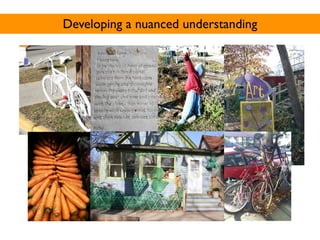
Developing a nuanced understanding
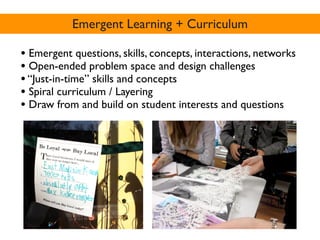
Emergent Learning + Curriculum

• Emergent questions, skills, concepts, interactions, networks
• Open-ended problem space and design challenges
• “Just-in-time” skills and concepts
• Spiral curriculum / Layering
• Draw from and build on student interests and questions
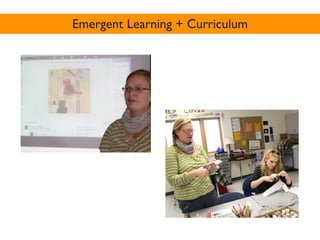
Emergent Learning + Curriculum
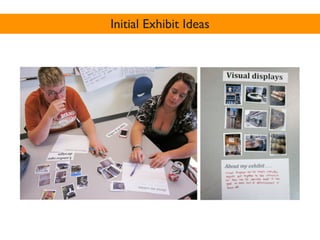
Initial Exhibit Ideas
Any questions before we move on?
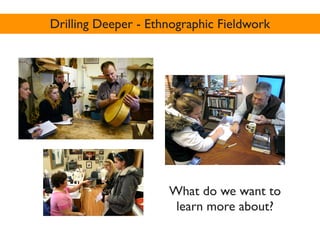
Drilling Deeper - Ethnographic Fieldwork


                     What do we want to
                      learn more about?
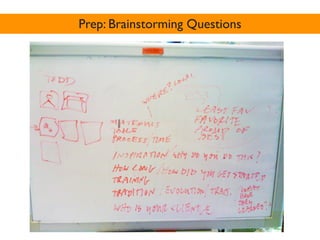
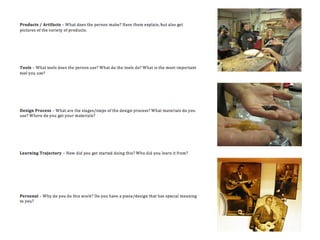
Prep: Brainstorming Questions
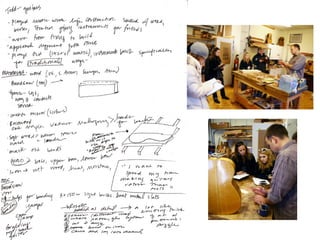
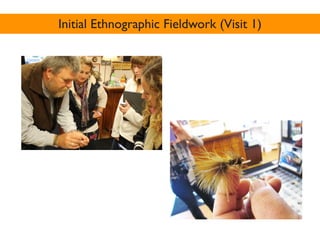
Initial Ethnographic Fieldwork (Visit 1)
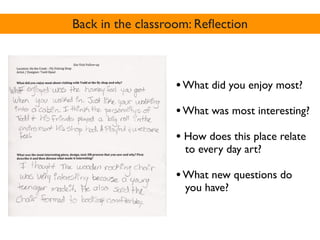
Back in the classroom: Reflection


                  • What did you enjoy most?
                  • What was most interesting?
                  • How does this place relate
                    to every day art?

                  • What new questions do
                    you have?
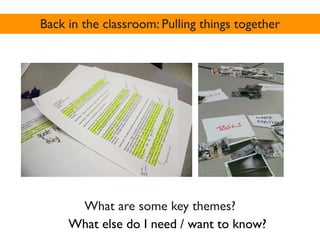
Back in the classroom: Pulling things together


      What are some key themes?
     What else do I need / want to know?
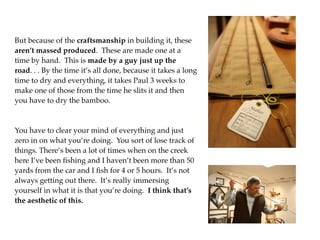
But because of the craftsmanship in building it, these
aren’t massed produced. These are made one at a
time by hand. This is made by a guy just up the
road. . . By the time it’s all done, because it takes a long
time to dry and everything, it takes Paul 3 weeks to
make one of those from the time he slits it and then
you have to dry the bamboo.


You have to clear your mind of everything and just
zero in on what you’re doing. You sort of lose track of
things. There’s been a lot of times when on the creek
here I’ve been fishing and I haven’t been more than 50
yards from the car and I fish for 4 or 5 hours. It’s not
always getting out there. It’s really immersing
yourself in what it is that you’re doing. I think that’s
the aesthetic of this.
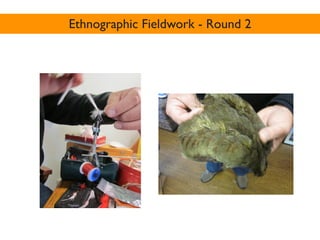
Ethnographic Fieldwork - Round 2
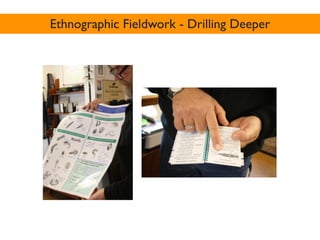
Ethnographic Fieldwork - Drilling Deeper
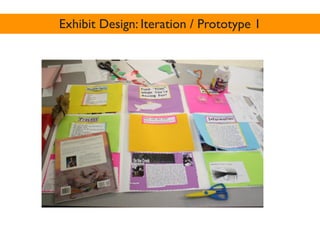
Exhibit Design: Iteration / Prototype 1
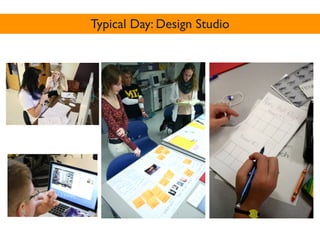
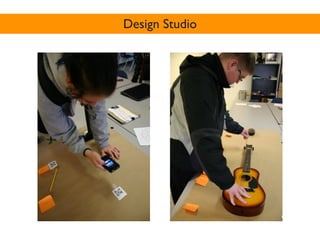
Typical Day: Design Studio
Design Studio
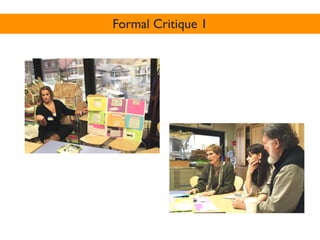
Formal Critique 1
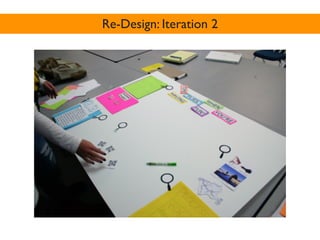
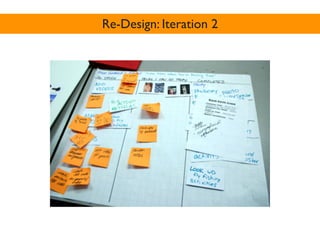
Re-Design: Iteration 2
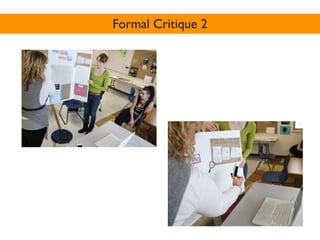
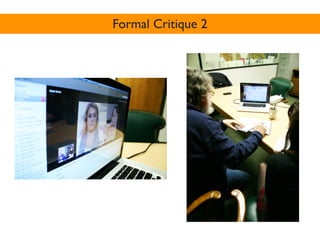
Formal Critique 2
Formal Critique 2
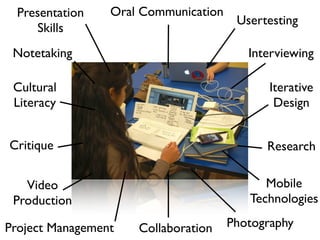
Presentation   Oral Communication
                                       Usertesting
     Skills
 Notetaking                              Interviewing

 Cultural                                    Iterative
 Literacy                                     Design


Critique                                    Research

   Video                                    Mobile
 Production                              Technologies

Project Management   Collaboration    Photography
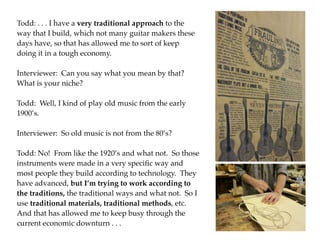
Todd: . . . I have a very traditional approach to the
way that I build, which not many guitar makers these
days have, so that has allowed me to sort of keep
doing it in a tough economy.
Interviewer: Can you say what you mean by that?
What is your niche?

Todd: Well, I kind of play old music from the early
1900’s.
Interviewer: So old music is not from the 80’s?

Todd: No! From like the 1920’s and what not. So those
instruments were made in a very specific way and
most people they build according to technology. They
have advanced, but I’m trying to work according to
the traditions, the traditional ways and what not. So I
use traditional materials, traditional methods, etc.
And that has allowed me to keep busy through the
current economic downturn . . .
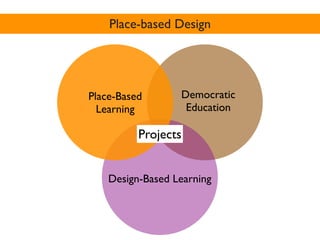
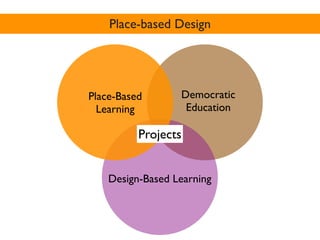
Place-based Design


Place-Based       Democratic
  Learning         Education

          Projects


    Design-Based Learning
How did this differ from other classes?
What did you enjoy most about this project?
How could this class or project be improved?
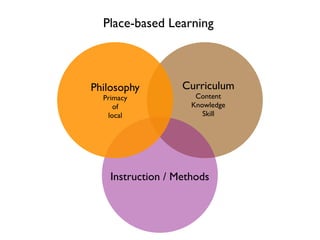
Place-based Learning


Philosophy         Curriculum
  Primacy             Content
     of              Knowledge
   local                Skill


    Instruction / Methods
Place-based Design


Place-Based       Democratic
  Learning         Education

          Projects


    Design-Based Learning
Place-based Learning

● Experiential - e.g., Field experiences, design
● Local/global - abstraction of concepts,
 interdependence
● Democratic participation - student centered, civic
 action, community partnerships
● Classroom-based experiences directly link to field
 experiences and vice versa
● Inquiry-based, project-based, problem-based
● Design Oriented / Applied (process & product)
● Interdisciplinary
● Layering (e.g., content, disciplines, perspectives),
 “spiral” curriculum
● Emergent questions, skills, concepts, interactions
Place-based Learning: Key Components


Students engaged in applying their knowledge
to solve “real problems” and answer authentic
inquiry questions
Place-based Learning: Key Components


Students collaborate with local citizens,
organizations, agencies, businesses, and
government to help make plans that shape the
future of their cultural and ecological systems
Place-based Learning: Key Components


Students play an active role in defining
and shaping projects
Place-based Learning: Key Components


* Interdisciplinary

* Students as producers of new knowledge vs.
  consumers of knowledge

* Direct instruction situated within an
  authentic context

* Emergent skills, concepts, and interactions
Place-based Learning: Key Components

• Experiential - e.g., Field Experiences, Applied

• Design/Action Oriented

• Local/global - abstraction of concepts, interdependence

• Democratic participation - student centered, civic action,
  community partnerships

• Inquiry-based, project-based, problem-based

• Interdisciplinary

• Layering (e.g., content, disciplines, perspectives), “spiral”
  curriculum

• Emergent questions, skills, concepts, interactions
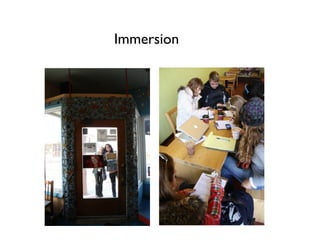
Immersion
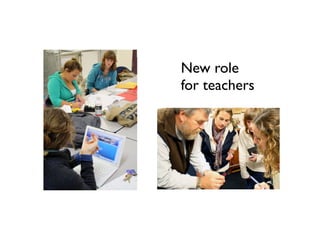
New role
for teachers
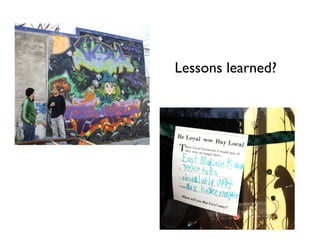
Lessons learned?
Neighborhood Game Design Project: Overview


* Investigate contested issues and places in
   our community

* Students design their own media as a way
  to teach others about these issues and
  share their own perspectives

* Studio-based design pedagogy
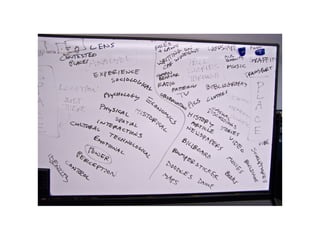
Contested Places / Contested Spaces

“The identities of place are always unfixed, contested and multiple. And the
particularity of any place is, in these terms, constructed not by placing boundaries
around it and defining its identity through counter-position to the other which lies
beyond, but precisely (in part) through the specificity of the mix of links and
interconnections to that "beyond". Places viewed in this way are open and
porous. . . . All attempts to institute horizons, to establish boundaries, to secure the
identity of places, can in this sense therefore be seen to be attempts to stabilize the
meaning of particular envelopes of space-time. . . . such attempts . . . are constantly
the site of social contest, battles over the power to label space-time, to impose
the meaning to be attributed to a space, for however long or short a span of
time.” -- Massey 1994, 5

Massey, Doreen. (1994). Space, Place, and Gender. Minneapolis: University of
Minnesota Press.
Contested Places: “Meaning Sticks to Place”

Contested place suggests primary narrative elements: the events that flow from
people who have problems in a place; or in scientific contexts, the story of the give
and take of diverse natural elements in a place. Such a place has a history, limits,
potential, and multiple opportunities for exploration and meaning making.

The emotional dramas of contests hook students, as do nearby, hands-on, and context-
rich local places. Combined in a local game, a contested place is a natural focus for
instruction and learning. It at once provides coherent and rich subject matter,
intrinsic motivation, multiple entry points for inquiry, opportunities to develop
many fluencies, and structures for developing deep understanding of the world.
Meaning sticks to place, making it possible for students to easily comprehend what is
otherwise difficult.

The Local Games Lab - http://lgl.gameslearningsociety.org/
Neighborhood Game Design Project: Part One

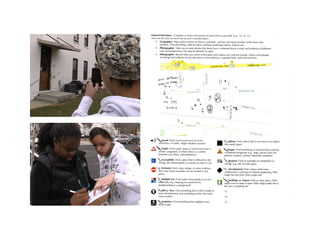
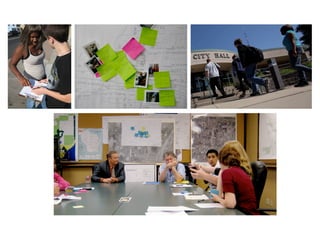
    Initial Simulation + Investigations


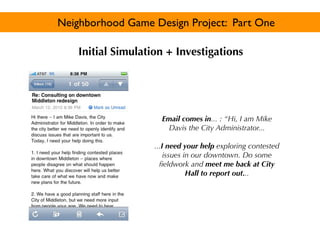
                      Email comes in... : “Hi, I am Mike
                        Davis the City Administrator...

                    ...I need your help exploring contested
                        issues in our downtown. Do some
                      fieldwork and meet me back at City
                                Hall to report out...
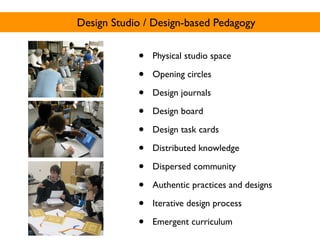
Design Studio / Design-based Pedagogy


            •   Physical studio space

            •   Opening circles

            •   Design journals

            •   Design board

            •   Design task cards

            •   Distributed knowledge

            •   Dispersed community

            •   Authentic practices and designs

            •   Iterative design process

            •   Emergent curriculum
Place-based Learning
Every Day Art and Design

Everyday Art WCSS-2012

  • 1.
    Place-based Design: Ethnographic fieldworkand exhibit design Jim Mathews Robyn Acker Molly Ward Middleton Alternative Senior High (MASH) Clark Street Community School (CSCS) WCSS Conference March 19, 2012
  • 2.
    Anchor 1: Theme+ Inquiry What is everyday art and design? Anchor 2: Design Challenge Design an exhibit to teach young kids about every day art
  • 3.
    Open-ended Exploration What isevery day art and design?
  • 4.
  • 5.
    Working Definition Tied tolocal culture expresses local aesthetics, functions, practices, and meaning Handmade, Personal expression assembled, D.I.Y. adapted Not mass-produced
  • 6.
    Initial Inquiry +Framing Working Definition Initial Examples Brainstorming / Discussion Prior knowledge + Experiences
  • 7.
  • 8.
  • 9.
  • 10.
  • 11.
  • 12.
  • 13.
  • 14.
  • 15.
    Developing a nuancedunderstanding
  • 16.
    Emergent Learning +Curriculum • Emergent questions, skills, concepts, interactions, networks • Open-ended problem space and design challenges • “Just-in-time” skills and concepts • Spiral curriculum / Layering • Draw from and build on student interests and questions
  • 17.
  • 18.
  • 19.
  • 20.
    Drilling Deeper -Ethnographic Fieldwork What do we want to learn more about?
  • 21.
  • 24.
  • 25.
    Back in theclassroom: Reflection • What did you enjoy most? • What was most interesting? • How does this place relate to every day art? • What new questions do you have?
  • 26.
    Back in theclassroom: Pulling things together What are some key themes? What else do I need / want to know?
  • 27.
    But because ofthe craftsmanship in building it, these aren’t massed produced. These are made one at a time by hand. This is made by a guy just up the road. . . By the time it’s all done, because it takes a long time to dry and everything, it takes Paul 3 weeks to make one of those from the time he slits it and then you have to dry the bamboo. You have to clear your mind of everything and just zero in on what you’re doing. You sort of lose track of things. There’s been a lot of times when on the creek here I’ve been fishing and I haven’t been more than 50 yards from the car and I fish for 4 or 5 hours. It’s not always getting out there. It’s really immersing yourself in what it is that you’re doing. I think that’s the aesthetic of this.
  • 28.
  • 29.
    Ethnographic Fieldwork -Drilling Deeper
  • 30.
  • 31.
  • 32.
  • 33.
  • 34.
  • 35.
  • 36.
  • 37.
  • 38.
    Presentation Oral Communication Usertesting Skills Notetaking Interviewing Cultural Iterative Literacy Design Critique Research Video Mobile Production Technologies Project Management Collaboration Photography
  • 39.
    Todd: . .. I have a very traditional approach to the way that I build, which not many guitar makers these days have, so that has allowed me to sort of keep doing it in a tough economy. Interviewer: Can you say what you mean by that? What is your niche? Todd: Well, I kind of play old music from the early 1900’s. Interviewer: So old music is not from the 80’s? Todd: No! From like the 1920’s and what not. So those instruments were made in a very specific way and most people they build according to technology. They have advanced, but I’m trying to work according to the traditions, the traditional ways and what not. So I use traditional materials, traditional methods, etc. And that has allowed me to keep busy through the current economic downturn . . .
  • 40.
    Place-based Design Place-Based Democratic Learning Education Projects Design-Based Learning
  • 41.
    How did thisdiffer from other classes?
  • 42.
    What did youenjoy most about this project?
  • 43.
    How could thisclass or project be improved?
  • 45.
    Place-based Learning Philosophy Curriculum Primacy Content of Knowledge local Skill Instruction / Methods
  • 46.
    Place-based Design Place-Based Democratic Learning Education Projects Design-Based Learning
  • 47.
    Place-based Learning ● Experiential- e.g., Field experiences, design ● Local/global - abstraction of concepts, interdependence ● Democratic participation - student centered, civic action, community partnerships ● Classroom-based experiences directly link to field experiences and vice versa ● Inquiry-based, project-based, problem-based ● Design Oriented / Applied (process & product) ● Interdisciplinary ● Layering (e.g., content, disciplines, perspectives), “spiral” curriculum ● Emergent questions, skills, concepts, interactions
  • 48.
    Place-based Learning: KeyComponents Students engaged in applying their knowledge to solve “real problems” and answer authentic inquiry questions
  • 49.
    Place-based Learning: KeyComponents Students collaborate with local citizens, organizations, agencies, businesses, and government to help make plans that shape the future of their cultural and ecological systems
  • 50.
    Place-based Learning: KeyComponents Students play an active role in defining and shaping projects
  • 51.
    Place-based Learning: KeyComponents * Interdisciplinary * Students as producers of new knowledge vs. consumers of knowledge * Direct instruction situated within an authentic context * Emergent skills, concepts, and interactions
  • 52.
    Place-based Learning: KeyComponents • Experiential - e.g., Field Experiences, Applied • Design/Action Oriented • Local/global - abstraction of concepts, interdependence • Democratic participation - student centered, civic action, community partnerships • Inquiry-based, project-based, problem-based • Interdisciplinary • Layering (e.g., content, disciplines, perspectives), “spiral” curriculum • Emergent questions, skills, concepts, interactions
  • 53.
  • 54.
  • 56.
  • 58.
    Neighborhood Game DesignProject: Overview * Investigate contested issues and places in our community * Students design their own media as a way to teach others about these issues and share their own perspectives * Studio-based design pedagogy
  • 60.
    Contested Places /Contested Spaces “The identities of place are always unfixed, contested and multiple. And the particularity of any place is, in these terms, constructed not by placing boundaries around it and defining its identity through counter-position to the other which lies beyond, but precisely (in part) through the specificity of the mix of links and interconnections to that "beyond". Places viewed in this way are open and porous. . . . All attempts to institute horizons, to establish boundaries, to secure the identity of places, can in this sense therefore be seen to be attempts to stabilize the meaning of particular envelopes of space-time. . . . such attempts . . . are constantly the site of social contest, battles over the power to label space-time, to impose the meaning to be attributed to a space, for however long or short a span of time.” -- Massey 1994, 5 Massey, Doreen. (1994). Space, Place, and Gender. Minneapolis: University of Minnesota Press.
  • 61.
    Contested Places: “MeaningSticks to Place” Contested place suggests primary narrative elements: the events that flow from people who have problems in a place; or in scientific contexts, the story of the give and take of diverse natural elements in a place. Such a place has a history, limits, potential, and multiple opportunities for exploration and meaning making. The emotional dramas of contests hook students, as do nearby, hands-on, and context- rich local places. Combined in a local game, a contested place is a natural focus for instruction and learning. It at once provides coherent and rich subject matter, intrinsic motivation, multiple entry points for inquiry, opportunities to develop many fluencies, and structures for developing deep understanding of the world. Meaning sticks to place, making it possible for students to easily comprehend what is otherwise difficult. The Local Games Lab - http://lgl.gameslearningsociety.org/
  • 62.
    Neighborhood Game DesignProject: Part One Initial Simulation + Investigations Email comes in... : “Hi, I am Mike Davis the City Administrator... ...I need your help exploring contested issues in our downtown. Do some fieldwork and meet me back at City Hall to report out...
  • 65.
    Design Studio /Design-based Pedagogy • Physical studio space • Opening circles • Design journals • Design board • Design task cards • Distributed knowledge • Dispersed community • Authentic practices and designs • Iterative design process • Emergent curriculum
  • 66.