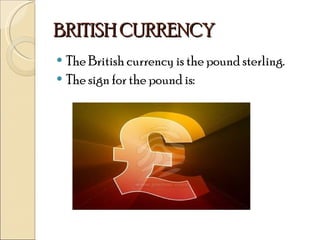
BRITISH CURRENCY The British currency is the pound sterling.  The sign for the pound is:
BRITISH CURRENCY They don´t use the Euro. However, some stores accept it.
BRITISH CURRENCY Since decimalisation in 1971, the pound has been divided into  100 pence . The singular of pence is  “penny”,  and its symbol is  “p”.  So, an amount such as 50p is often pronounced “fifty pee” instead of “fifty pence”. The pound is made up of 100 pence (p), like the dollar is split into 100 cents.
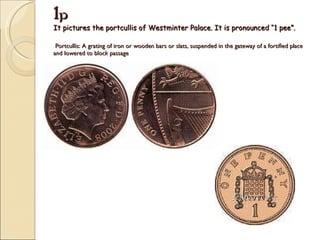
1p It pictures the portcullis of Westminter Palace. It is pronounced “1 pee”.   Portcullis: A grating of iron or wooden bars or slats, suspended in the gateway of a fortified place and lowered to block passage
2p It pictures the Prince of Wales feathers. It is pronounced “2 pees”.
5p This coin shows the symbol of Scotland, the thistle. On top of it, you can see the British crown .  It is called “five pee”.
10p It shows a lion. For centuries it was a proud symbol of British strenght. It wears the crown of the British Monarch. It is pronounced “10 pee”.
20p This coin shows the Tudor Rose. A rose is the national flower of England. And, on top you can see the British crown. It is pronounced “20 pee”.
50p The 50 pence coin shows the picture of Britannia and a lion. Both are symbols of Britain. It´s pronounced “50 pee”.
£1 (1 pound) There are many different pictures on the £1 coin to reflect the different countries of Britain: lions for England, a thistle for Scotland and a leek for Wales. This picture shows the three lions of England.
£2 (2 pounds) The design of the 2 pound coin represents technological development. The edge lettering features the quote “Standing on the Shoulders of Giants” by Sir Isaac Newton.
BANKNOTES All the bank notes bear HM The Queen´s head on one side and a famous historical person on the other side. Queen Elizabeth II is the first monarch to have her portrait on a bank note. It was first done in 1960 as a way of helping to prevent folgeries.
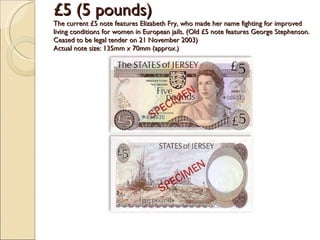
£5 (5 pounds) The current  £5 note features Elizabeth Fry, who made her name fighting for improved living conditions for women in European jails. (Old £5 note features George Stephenson. Ceased to be legal tender on 21 November 2003) Actual note size: 135mm x 70mm (approx.)
£10 (10 pounds) The current £10 note features Charles Darwin, the Victorian naturalist who developed the theory of evolution. Also pictured is an illustration of Darwin 's own magnifying lens and the flora and fauna that he may have come across on his travels. Actual note size: 142mm x 75mm (approx.)
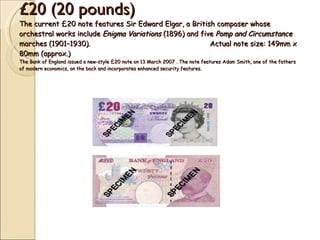
£20 (20 pounds) The current £20 note features Sir Edward Elgar, a British composer whose orchestral works include  Enigma Variations  (1896) and five  Pomp and Circumstance  marches (1901–1930).  Actual note size: 149mm x 80mm (approx.) The Bank of England issued a new-style £20 note on 13 March 2007 . The note features Adam Smith, one of the fathers of modern economics, on the back and incorporates enhanced security features.

British currency

  • 1.
    BRITISH CURRENCY TheBritish currency is the pound sterling. The sign for the pound is:
  • 2.
    BRITISH CURRENCY Theydon´t use the Euro. However, some stores accept it.
  • 3.
    BRITISH CURRENCY Sincedecimalisation in 1971, the pound has been divided into 100 pence . The singular of pence is “penny”, and its symbol is “p”. So, an amount such as 50p is often pronounced “fifty pee” instead of “fifty pence”. The pound is made up of 100 pence (p), like the dollar is split into 100 cents.
  • 4.
    1p It picturesthe portcullis of Westminter Palace. It is pronounced “1 pee”. Portcullis: A grating of iron or wooden bars or slats, suspended in the gateway of a fortified place and lowered to block passage
  • 5.
    2p It picturesthe Prince of Wales feathers. It is pronounced “2 pees”.
  • 6.
    5p This coinshows the symbol of Scotland, the thistle. On top of it, you can see the British crown . It is called “five pee”.
  • 7.
    10p It showsa lion. For centuries it was a proud symbol of British strenght. It wears the crown of the British Monarch. It is pronounced “10 pee”.
  • 8.
    20p This coinshows the Tudor Rose. A rose is the national flower of England. And, on top you can see the British crown. It is pronounced “20 pee”.
  • 9.
    50p The 50pence coin shows the picture of Britannia and a lion. Both are symbols of Britain. It´s pronounced “50 pee”.
  • 10.
    £1 (1 pound)There are many different pictures on the £1 coin to reflect the different countries of Britain: lions for England, a thistle for Scotland and a leek for Wales. This picture shows the three lions of England.
  • 11.
    £2 (2 pounds)The design of the 2 pound coin represents technological development. The edge lettering features the quote “Standing on the Shoulders of Giants” by Sir Isaac Newton.
  • 12.
    BANKNOTES All thebank notes bear HM The Queen´s head on one side and a famous historical person on the other side. Queen Elizabeth II is the first monarch to have her portrait on a bank note. It was first done in 1960 as a way of helping to prevent folgeries.
  • 13.
    £5 (5 pounds)The current £5 note features Elizabeth Fry, who made her name fighting for improved living conditions for women in European jails. (Old £5 note features George Stephenson. Ceased to be legal tender on 21 November 2003) Actual note size: 135mm x 70mm (approx.)
  • 14.
    £10 (10 pounds)The current £10 note features Charles Darwin, the Victorian naturalist who developed the theory of evolution. Also pictured is an illustration of Darwin 's own magnifying lens and the flora and fauna that he may have come across on his travels. Actual note size: 142mm x 75mm (approx.)
  • 15.
    £20 (20 pounds)The current £20 note features Sir Edward Elgar, a British composer whose orchestral works include Enigma Variations (1896) and five Pomp and Circumstance marches (1901–1930). Actual note size: 149mm x 80mm (approx.) The Bank of England issued a new-style £20 note on 13 March 2007 . The note features Adam Smith, one of the fathers of modern economics, on the back and incorporates enhanced security features.