Project Work
Polina Boyko
Form 11
School №1
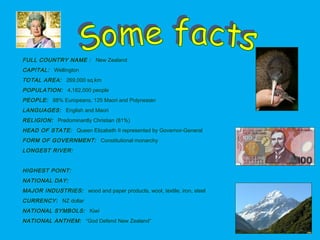
FULL COUNTRY NAME : New Zealand
CAPITAL: Wellington
TOTAL AREA: 269,000 sq.km
POPULATION: 4,182,000 people
PEOPLE: 88% Europeans, 125 Maori and Polynesian
LANGUAGES: English and Maori
RELIGION: Predominantly Christian (81%)
HEAD OF STATE: Queen Elizabeth II represented by Governor-General
FORM OF GOVERNMENT: Constitutional monarchy
LONGEST RIVER: Waikato (425 km)
LARGEST LAKE: Taupo (606 km)
HIGHEST POINT: Mount Cook (3,754 m)
NATIONAL DAY: Waitangi Day , 6 February ( since 1840)
MAJOR INDUSTRIES: wood and paper products, wool, textile, iron, steel
CURRENCY: NZ dollar
NATIONAL SYMBOLS: Kiwi
NATIONAL ANTHEM: “God Defend New Zealand”
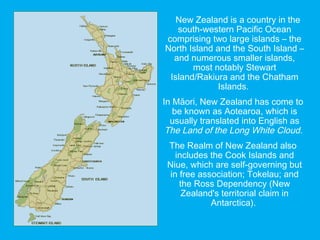
New Zealand is a country in the
south-western Pacific Ocean
comprising two large islands – the
North Island and the South Island –
and numerous smaller islands,
most notably Stewart
Island/Rakiura and the Chatham
Islands.
In Māori, New Zealand has come to
be known as Aotearoa, which is
usually translated into English as
The Land of the Long White Cloud.
The Realm of New Zealand also
includes the Cook Islands and
Niue, which are self-governing but
in free association; Tokelau; and
the Ross Dependency (New
Zealand's territorial claim in
Antarctica).
The Flag of New Zealand is a
defaced blue ensign with the Union
Flag in the canton, and four red
stars with white borders to the right.
The stars represent the
constellation of Crux, the Southern
Cross, as seen from New Zealand.
The flag proportion is 1:2 and the
colours are Red, Blue and White.
Proportion and colours are identical
to the Union Flag.
Since 1990, some Māori have been
using the red ensign less in favour of a
new flag which lacks colonial
connotations. Chosen through a
competition, the Māori flag uses black
to represent Te Korekore or potential
being, white to represent Te Ao
Marama or the physical world, red to
represent Te Whei Ao, the realm of
coming into being and the Koru, a curl
representing the unfolding of new life.
Until 1911, New Zealand used the
same national coat of arms as the
United Kingdom. When New Zealand
became a Dominion in 1907, it was
decided that a new Coat of Arms was
required, and a design competition
was held.
Since being granted its own arms in
1911, New Zealand's arms have
remained similar to the current
design, with minor changes in 1956.
The shield is now supported by two
figures, a blonde Pākehā (European)
woman holding the New Zealand flag,
and a Māori warrior holding a taiaha
(Māori staff).
The shield is topped with the St
Edward's Crown, and beneath the
shield are two silver fern leaves and a
scroll bearing the words "New
Zealand".The old-style Coat of Arm
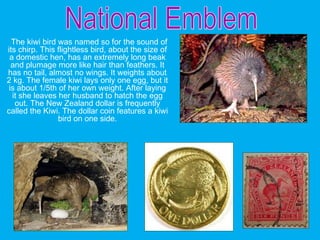
The kiwi bird was named so for the sound of
its chirp. This flightless bird, about the size of
a domestic hen, has an extremely long beak
and plumage more like hair than feathers. It
has no tail, almost no wings. It weights about
2 kg. The female kiwi lays only one egg, but it
is about 1/5th of her own weight. After laying
it she leaves her husband to hatch the egg
out. The New Zealand dollar is frequently
called the Kiwi. The dollar coin features a kiwi
bird on one side.
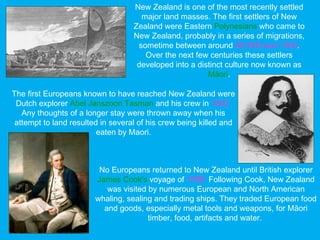
The first Europeans known to have reached New Zealand were
Dutch explorer Abel Janszoon Tasman and his crew in 1642.
Any thoughts of a longer stay were thrown away when his
attempt to land resulted in several of his crew being killed and
eaten by Maori.
New Zealand is one of the most recently settled
major land masses. The first settlers of New
Zealand were Eastern Polynesians who came to
New Zealand, probably in a series of migrations,
sometime between around AD 800 and 1300.
Over the next few centuries these settlers
developed into a distinct culture now known as
Māori.
No Europeans returned to New Zealand until British explorer
James Cook's voyage of 1768. Following Cook, New Zealand
was visited by numerous European and North American
whaling, sealing and trading ships. They traded European food
and goods, especially metal tools and weapons, for Māori
timber, food, artifacts and water.
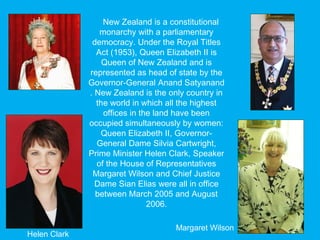
New Zealand is a constitutional
monarchy with a parliamentary
democracy. Under the Royal Titles
Act (1953), Queen Elizabeth II is
Queen of New Zealand and is
represented as head of state by the
Governor-General Anand Satyanand
. New Zealand is the only country in
the world in which all the highest
offices in the land have been
occupied simultaneously by women:
Queen Elizabeth II, Governor-
General Dame Silvia Cartwright,
Prime Minister Helen Clark, Speaker
of the House of Representatives
Margaret Wilson and Chief Justice
Dame Sian Elias were all in office
between March 2005 and August
2006.
Helen Clark
Margaret Wilson
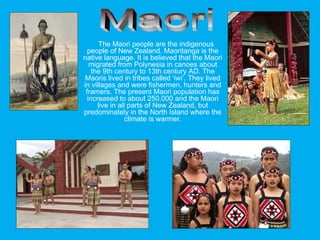
The Maori people are the indigenous
people of New Zealand. Maoritanga is the
native language. It is believed that the Maori
migrated from Polynesia in canoes about
the 9th century to 13th century AD. The
Maoris lived in tribes called ‘iwi’. They lived
in villages and were fishermen, hunters and
framers. The present Maori population has
increased to about 250,000 and the Maori
live in all parts of New Zealand, but
predominately in the North Island where the
climate is warmer.
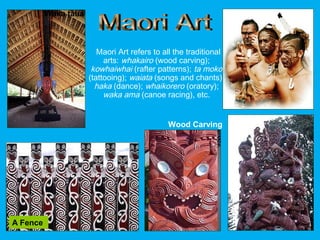
Maori Art refers to all the traditional
arts: whakairo (wood carving);
kowhaiwhai (rafter patterns); ta moko
(tattooing); waiata (songs and chants);
haka (dance); whaikorero (oratory);
waka ama (canoe racing), etc.
Wood Carving
A Fence
TattoosWaka taua
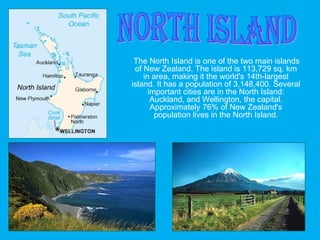
The North Island is one of the two main islands
of New Zealand. The island is 113,729 sq. km
in area, making it the world's 14th-largest
island. It has a population of 3,148,400. Several
important cities are in the North Island:
Auckland, and Wellington, the capital.
Approximately 76% of New Zealand's
population lives in the North Island.
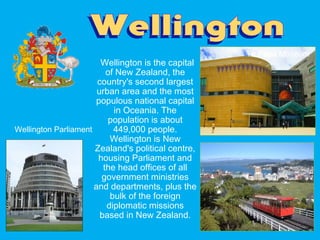
Wellington is the capital
of New Zealand, the
country's second largest
urban area and the most
populous national capital
in Oceania. The
population is about
449,000 people.
Wellington is New
Zealand's political centre,
housing Parliament and
the head offices of all
government ministries
and departments, plus the
bulk of the foreign
diplomatic missions
based in New Zealand.
Te Papa Museum
Wellington Parliament
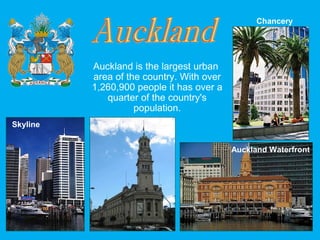
Auckland is the largest urban
area of the country. With over
1,260,900 people it has over a
quarter of the country's
population.
Skyline Town Hall
Auckland Waterfront
Chancery
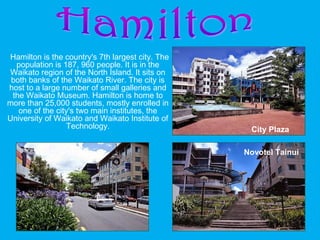
Hamilton is the country's 7th largest city. The
population is 187, 960 people. It is in the
Waikato region of the North Island. It sits on
both banks of the Waikato River. The city is
host to a large number of small galleries and
the Waikato Museum. Hamilton is home to
more than 25,000 students, mostly enrolled in
one of the city's two main institutes, the
University of Waikato and Waikato Institute of
Technology. City Plaza
Victoria Street Novotel Tainui
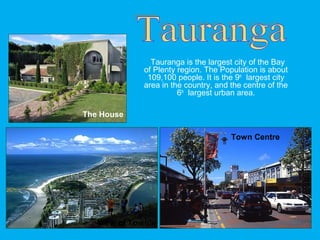
Tauranga is the largest city of the Bay
of Plenty region. The Population is about
109,100 people. It is the 9th
largest city
area in the country, and the centre of the
6th
largest urban area.
View of Town
Town Centre
The House
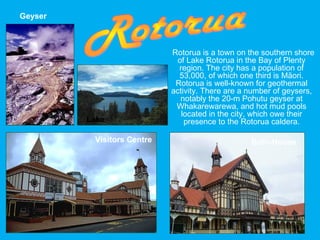
Rotorua is a town on the southern shore
of Lake Rotorua in the Bay of Plenty
region. The city has a population of
53,000, of which one third is Māori.
Rotorua is well-known for geothermal
activity. There are a number of geysers,
notably the 20-m Pohutu geyser at
Whakarewarewa, and hot mud pools
located in the city, which owe their
presence to the Rotorua caldera.
Geyser
Visitors Centre Bath-House
Lake
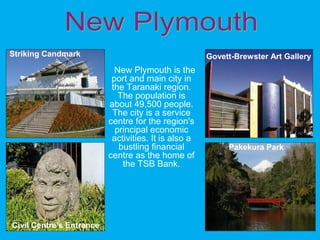
New Plymouth is the
port and main city in
the Taranaki region.
The population is
about 49,500 people.
The city is a service
centre for the region's
principal economic
activities. It is also a
bustling financial
centre as the home of
the TSB Bank.
Govett-Brewster Art Gallery
Civil Centre’s Entrance
Pakekura Park
Striking Candmark
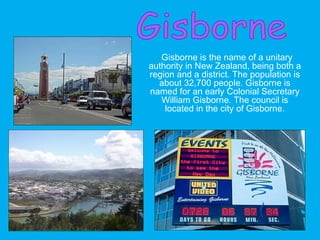
Gisborne is the name of a unitary
authority in New Zealand, being both a
region and a district. The population is
about 32,700 people. Gisborne is
named for an early Colonial Secretary
William Gisborne. The council is
located in the city of Gisborne.
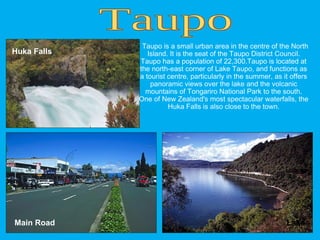
Taupo is a small urban area in the centre of the North
Island. It is the seat of the Taupo District Council.
Taupo has a population of 22,300.Taupo is located at
the north-east corner of Lake Taupo, and functions as
a tourist centre, particularly in the summer, as it offers
panoramic views over the lake and the volcanic
mountains of Tongariro National Park to the south.
One of New Zealand's most spectacular waterfalls, the
Huka Falls is also close to the town.
Main Road Lake
Huka Falls
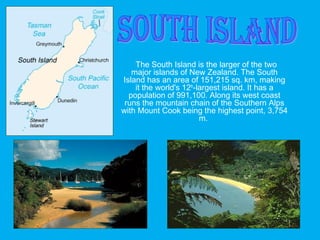
The South Island is the larger of the two
major islands of New Zealand. The South
Island has an area of 151,215 sq. km, making
it the world's 12th
-largest island. It has a
population of 991,100. Along its west coast
runs the mountain chain of the Southern Alps
with Mount Cook being the highest point, 3,754
m.
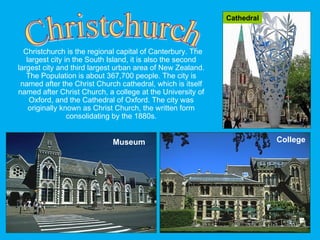
Christchurch is the regional capital of Canterbury. The
largest city in the South Island, it is also the second
largest city and third largest urban area of New Zealand.
The Population is about 367,700 people. The city is
named after the Christ Church cathedral, which is itself
named after Christ Church, a college at the University of
Oxford, and the Cathedral of Oxford. The city was
originally known as Christ Church, the written form
consolidating by the 1880s.
CollegeMuseum
Cathedral
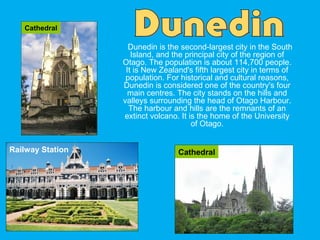
Dunedin is the second-largest city in the South
Island, and the principal city of the region of
Otago. The population is about 114,700 people.
It is New Zealand's fifth largest city in terms of
population. For historical and cultural reasons,
Dunedin is considered one of the country's four
main centres. The city stands on the hills and
valleys surrounding the head of Otago Harbour.
The harbour and hills are the remnants of an
extinct volcano. It is the home of the University
of Otago.
Railway Station
Cathedral
Cathedral
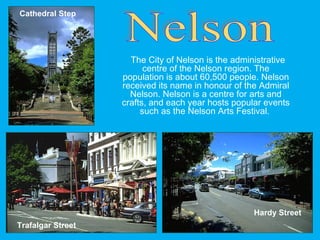
The City of Nelson is the administrative
centre of the Nelson region. The
population is about 60,500 people. Nelson
received its name in honour of the Admiral
Nelson. Nelson is a centre for arts and
crafts, and each year hosts popular events
such as the Nelson Arts Festival.
Cathedral Step
Hardy Street
Trafalgar Street
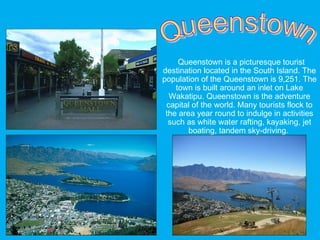
Queenstown is a picturesque tourist
destination located in the South Island. The
population of the Queenstown is 9,251. The
town is built around an inlet on Lake
Wakatipu. Queenstown is the adventure
capital of the world. Many tourists flock to
the area year round to indulge in activities
such as white water rafting, kayaking, jet
boating, tandem sky-driving.
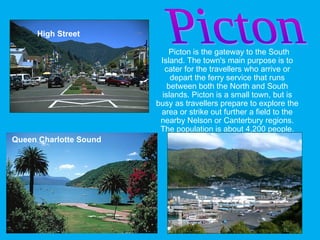
Picton is the gateway to the South
Island. The town's main purpose is to
cater for the travellers who arrive or
depart the ferry service that runs
between both the North and South
islands. Picton is a small town, but is
busy as travellers prepare to explore the
area or strike out further a field to the
nearby Nelson or Canterbury regions.
The population is about 4,200 people.
Queen Charlotte Sound
High Street
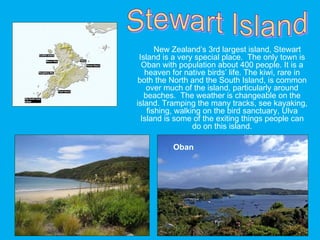
New Zealand’s 3rd largest island, Stewart
Island is a very special place. The only town is
Oban with population about 400 people. It is a
heaven for native birds’ life. The kiwi, rare in
both the North and the South Island, is common
over much of the island, particularly around
beaches. The weather is changeable on the
island. Tramping the many tracks, see kayaking,
fishing, walking on the bird sanctuary, Ulva
Island is some of the exiting things people can
do on this island.
Oban
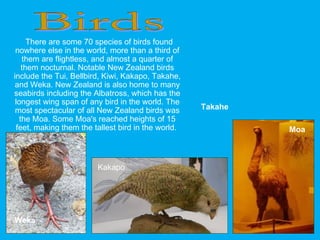
There are some 70 species of birds found
nowhere else in the world, more than a third of
them are flightless, and almost a quarter of
them nocturnal. Notable New Zealand birds
include the Tui, Bellbird, Kiwi, Kakapo, Takahe,
and Weka. New Zealand is also home to many
seabirds including the Albatross, which has the
longest wing span of any bird in the world. The
most spectacular of all New Zealand birds was
the Moa. Some Moa's reached heights of 15
feet, making them the tallest bird in the world.
Weka
Moa
Kakapo
Takahe
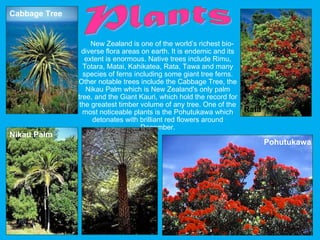
New Zealand is one of the world’s richest bio-
diverse flora areas on earth. It is endemic and its
extent is enormous. Native trees include Rimu,
Totara, Matai, Kahikatea, Rata, Tawa and many
species of ferns including some giant tree ferns.
Other notable trees include the Cabbage Tree, the
Nikau Palm which is New Zealand's only palm
tree, and the Giant Kauri, which hold the record for
the greatest timber volume of any tree. One of the
most noticeable plants is the Pohutukawa which
detonates with brilliant red flowers around
December.
Cabbage Tree
Nikau Palm
Pohutukawa
Fern
Rata
With the exception of two species of bat, no
indigenous mammals are native to New Zealand.
Wild mammals include deer, goats, pigs, rabbits,
weasels, ferrets. Marine mammals are dolphins,
seals and whales. New Zealand contains no
snakes and has only one poisonous spider called
the Katipo. Other insects include the Weta one
species of which may grow as large as a house
mouse and is the heaviest insect in the world. New
Zealand's most unigue animal is the Tuatara, which
is a lizard-like reptile that predates the Dinosaur
and is considered a living fossil.
Katipo
Tuatara
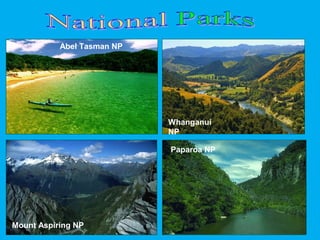
Abel Tasman NP
Mount Aspiring NP
Whanganui
NP
Paparoa NP
New Zealand

New Zealand

  • 1.
  • 3.
    FULL COUNTRY NAME: New Zealand CAPITAL: Wellington TOTAL AREA: 269,000 sq.km POPULATION: 4,182,000 people PEOPLE: 88% Europeans, 125 Maori and Polynesian LANGUAGES: English and Maori RELIGION: Predominantly Christian (81%) HEAD OF STATE: Queen Elizabeth II represented by Governor-General FORM OF GOVERNMENT: Constitutional monarchy LONGEST RIVER: Waikato (425 km) LARGEST LAKE: Taupo (606 km) HIGHEST POINT: Mount Cook (3,754 m) NATIONAL DAY: Waitangi Day , 6 February ( since 1840) MAJOR INDUSTRIES: wood and paper products, wool, textile, iron, steel CURRENCY: NZ dollar NATIONAL SYMBOLS: Kiwi NATIONAL ANTHEM: “God Defend New Zealand”
  • 4.
    New Zealand isa country in the south-western Pacific Ocean comprising two large islands – the North Island and the South Island – and numerous smaller islands, most notably Stewart Island/Rakiura and the Chatham Islands. In Māori, New Zealand has come to be known as Aotearoa, which is usually translated into English as The Land of the Long White Cloud. The Realm of New Zealand also includes the Cook Islands and Niue, which are self-governing but in free association; Tokelau; and the Ross Dependency (New Zealand's territorial claim in Antarctica).
  • 5.
    The Flag ofNew Zealand is a defaced blue ensign with the Union Flag in the canton, and four red stars with white borders to the right. The stars represent the constellation of Crux, the Southern Cross, as seen from New Zealand. The flag proportion is 1:2 and the colours are Red, Blue and White. Proportion and colours are identical to the Union Flag. Since 1990, some Māori have been using the red ensign less in favour of a new flag which lacks colonial connotations. Chosen through a competition, the Māori flag uses black to represent Te Korekore or potential being, white to represent Te Ao Marama or the physical world, red to represent Te Whei Ao, the realm of coming into being and the Koru, a curl representing the unfolding of new life.
  • 6.
    Until 1911, NewZealand used the same national coat of arms as the United Kingdom. When New Zealand became a Dominion in 1907, it was decided that a new Coat of Arms was required, and a design competition was held. Since being granted its own arms in 1911, New Zealand's arms have remained similar to the current design, with minor changes in 1956. The shield is now supported by two figures, a blonde Pākehā (European) woman holding the New Zealand flag, and a Māori warrior holding a taiaha (Māori staff). The shield is topped with the St Edward's Crown, and beneath the shield are two silver fern leaves and a scroll bearing the words "New Zealand".The old-style Coat of Arm
  • 7.
    The kiwi birdwas named so for the sound of its chirp. This flightless bird, about the size of a domestic hen, has an extremely long beak and plumage more like hair than feathers. It has no tail, almost no wings. It weights about 2 kg. The female kiwi lays only one egg, but it is about 1/5th of her own weight. After laying it she leaves her husband to hatch the egg out. The New Zealand dollar is frequently called the Kiwi. The dollar coin features a kiwi bird on one side.
  • 8.
    The first Europeansknown to have reached New Zealand were Dutch explorer Abel Janszoon Tasman and his crew in 1642. Any thoughts of a longer stay were thrown away when his attempt to land resulted in several of his crew being killed and eaten by Maori. New Zealand is one of the most recently settled major land masses. The first settlers of New Zealand were Eastern Polynesians who came to New Zealand, probably in a series of migrations, sometime between around AD 800 and 1300. Over the next few centuries these settlers developed into a distinct culture now known as Māori. No Europeans returned to New Zealand until British explorer James Cook's voyage of 1768. Following Cook, New Zealand was visited by numerous European and North American whaling, sealing and trading ships. They traded European food and goods, especially metal tools and weapons, for Māori timber, food, artifacts and water.
  • 9.
    New Zealand isa constitutional monarchy with a parliamentary democracy. Under the Royal Titles Act (1953), Queen Elizabeth II is Queen of New Zealand and is represented as head of state by the Governor-General Anand Satyanand . New Zealand is the only country in the world in which all the highest offices in the land have been occupied simultaneously by women: Queen Elizabeth II, Governor- General Dame Silvia Cartwright, Prime Minister Helen Clark, Speaker of the House of Representatives Margaret Wilson and Chief Justice Dame Sian Elias were all in office between March 2005 and August 2006. Helen Clark Margaret Wilson
  • 10.
    The Maori peopleare the indigenous people of New Zealand. Maoritanga is the native language. It is believed that the Maori migrated from Polynesia in canoes about the 9th century to 13th century AD. The Maoris lived in tribes called ‘iwi’. They lived in villages and were fishermen, hunters and framers. The present Maori population has increased to about 250,000 and the Maori live in all parts of New Zealand, but predominately in the North Island where the climate is warmer.
  • 11.
    Maori Art refersto all the traditional arts: whakairo (wood carving); kowhaiwhai (rafter patterns); ta moko (tattooing); waiata (songs and chants); haka (dance); whaikorero (oratory); waka ama (canoe racing), etc. Wood Carving A Fence TattoosWaka taua
  • 12.
    The North Islandis one of the two main islands of New Zealand. The island is 113,729 sq. km in area, making it the world's 14th-largest island. It has a population of 3,148,400. Several important cities are in the North Island: Auckland, and Wellington, the capital. Approximately 76% of New Zealand's population lives in the North Island.
  • 13.
    Wellington is thecapital of New Zealand, the country's second largest urban area and the most populous national capital in Oceania. The population is about 449,000 people. Wellington is New Zealand's political centre, housing Parliament and the head offices of all government ministries and departments, plus the bulk of the foreign diplomatic missions based in New Zealand. Te Papa Museum Wellington Parliament
  • 14.
    Auckland is thelargest urban area of the country. With over 1,260,900 people it has over a quarter of the country's population. Skyline Town Hall Auckland Waterfront Chancery
  • 15.
    Hamilton is thecountry's 7th largest city. The population is 187, 960 people. It is in the Waikato region of the North Island. It sits on both banks of the Waikato River. The city is host to a large number of small galleries and the Waikato Museum. Hamilton is home to more than 25,000 students, mostly enrolled in one of the city's two main institutes, the University of Waikato and Waikato Institute of Technology. City Plaza Victoria Street Novotel Tainui
  • 16.
    Tauranga is thelargest city of the Bay of Plenty region. The Population is about 109,100 people. It is the 9th largest city area in the country, and the centre of the 6th largest urban area. View of Town Town Centre The House
  • 17.
    Rotorua is atown on the southern shore of Lake Rotorua in the Bay of Plenty region. The city has a population of 53,000, of which one third is Māori. Rotorua is well-known for geothermal activity. There are a number of geysers, notably the 20-m Pohutu geyser at Whakarewarewa, and hot mud pools located in the city, which owe their presence to the Rotorua caldera. Geyser Visitors Centre Bath-House Lake
  • 18.
    New Plymouth isthe port and main city in the Taranaki region. The population is about 49,500 people. The city is a service centre for the region's principal economic activities. It is also a bustling financial centre as the home of the TSB Bank. Govett-Brewster Art Gallery Civil Centre’s Entrance Pakekura Park Striking Candmark
  • 19.
    Gisborne is thename of a unitary authority in New Zealand, being both a region and a district. The population is about 32,700 people. Gisborne is named for an early Colonial Secretary William Gisborne. The council is located in the city of Gisborne.
  • 20.
    Taupo is asmall urban area in the centre of the North Island. It is the seat of the Taupo District Council. Taupo has a population of 22,300.Taupo is located at the north-east corner of Lake Taupo, and functions as a tourist centre, particularly in the summer, as it offers panoramic views over the lake and the volcanic mountains of Tongariro National Park to the south. One of New Zealand's most spectacular waterfalls, the Huka Falls is also close to the town. Main Road Lake Huka Falls
  • 21.
    The South Islandis the larger of the two major islands of New Zealand. The South Island has an area of 151,215 sq. km, making it the world's 12th -largest island. It has a population of 991,100. Along its west coast runs the mountain chain of the Southern Alps with Mount Cook being the highest point, 3,754 m.
  • 22.
    Christchurch is theregional capital of Canterbury. The largest city in the South Island, it is also the second largest city and third largest urban area of New Zealand. The Population is about 367,700 people. The city is named after the Christ Church cathedral, which is itself named after Christ Church, a college at the University of Oxford, and the Cathedral of Oxford. The city was originally known as Christ Church, the written form consolidating by the 1880s. CollegeMuseum Cathedral
  • 23.
    Dunedin is thesecond-largest city in the South Island, and the principal city of the region of Otago. The population is about 114,700 people. It is New Zealand's fifth largest city in terms of population. For historical and cultural reasons, Dunedin is considered one of the country's four main centres. The city stands on the hills and valleys surrounding the head of Otago Harbour. The harbour and hills are the remnants of an extinct volcano. It is the home of the University of Otago. Railway Station Cathedral Cathedral
  • 24.
    The City ofNelson is the administrative centre of the Nelson region. The population is about 60,500 people. Nelson received its name in honour of the Admiral Nelson. Nelson is a centre for arts and crafts, and each year hosts popular events such as the Nelson Arts Festival. Cathedral Step Hardy Street Trafalgar Street
  • 25.
    Queenstown is apicturesque tourist destination located in the South Island. The population of the Queenstown is 9,251. The town is built around an inlet on Lake Wakatipu. Queenstown is the adventure capital of the world. Many tourists flock to the area year round to indulge in activities such as white water rafting, kayaking, jet boating, tandem sky-driving.
  • 26.
    Picton is thegateway to the South Island. The town's main purpose is to cater for the travellers who arrive or depart the ferry service that runs between both the North and South islands. Picton is a small town, but is busy as travellers prepare to explore the area or strike out further a field to the nearby Nelson or Canterbury regions. The population is about 4,200 people. Queen Charlotte Sound High Street
  • 27.
    New Zealand’s 3rdlargest island, Stewart Island is a very special place. The only town is Oban with population about 400 people. It is a heaven for native birds’ life. The kiwi, rare in both the North and the South Island, is common over much of the island, particularly around beaches. The weather is changeable on the island. Tramping the many tracks, see kayaking, fishing, walking on the bird sanctuary, Ulva Island is some of the exiting things people can do on this island. Oban
  • 28.
    There are some70 species of birds found nowhere else in the world, more than a third of them are flightless, and almost a quarter of them nocturnal. Notable New Zealand birds include the Tui, Bellbird, Kiwi, Kakapo, Takahe, and Weka. New Zealand is also home to many seabirds including the Albatross, which has the longest wing span of any bird in the world. The most spectacular of all New Zealand birds was the Moa. Some Moa's reached heights of 15 feet, making them the tallest bird in the world. Weka Moa Kakapo Takahe
  • 29.
    New Zealand isone of the world’s richest bio- diverse flora areas on earth. It is endemic and its extent is enormous. Native trees include Rimu, Totara, Matai, Kahikatea, Rata, Tawa and many species of ferns including some giant tree ferns. Other notable trees include the Cabbage Tree, the Nikau Palm which is New Zealand's only palm tree, and the Giant Kauri, which hold the record for the greatest timber volume of any tree. One of the most noticeable plants is the Pohutukawa which detonates with brilliant red flowers around December. Cabbage Tree Nikau Palm Pohutukawa Fern Rata
  • 30.
    With the exceptionof two species of bat, no indigenous mammals are native to New Zealand. Wild mammals include deer, goats, pigs, rabbits, weasels, ferrets. Marine mammals are dolphins, seals and whales. New Zealand contains no snakes and has only one poisonous spider called the Katipo. Other insects include the Weta one species of which may grow as large as a house mouse and is the heaviest insect in the world. New Zealand's most unigue animal is the Tuatara, which is a lizard-like reptile that predates the Dinosaur and is considered a living fossil. Katipo Tuatara
  • 31.
    Abel Tasman NP MountAspiring NP Whanganui NP Paparoa NP