Citation: Lai H-Y, Cheng B-C, Chang Y and Chien T-W. Robotic Surgery for Mastitis Complicated With Tricuspid
Valve Infective Endocarditis: Case Report. Austin Cardio & Cardiovasc Case Rep. 2018; 3(3): 1026.
Austin Cardio & Cardiovasc Case Rep - Volume 3 Issue 3 - 2018
ISSN: 2578-952X | www.austinpublishinggroup.com
Lai et al. © All rights are reserved
Austin Cardio & Cardiovascular Case
Reports
Open Access
Abstract
Tricuspid Valve Infective Endocarditis (TVIE) is less common than left-sided
infective endocarditis. Nevertheless, mastitis may be complicated with TVIE.
Valve repair should be considered in this situation due to high probability of
Methicillin resistant Staphylococcus aureus vegetation. By robotic surgery,
postoperative recovery is expected to be rapid owing to the small surgical
wound.
Keywords: Infective Endocarditis; Tricuspid Valve; Da Vinci Robotic-
Assisted Surgery
Introduction
Tricuspid Valve Infective Endocarditis (TVIE) accounted for
5% to 10% of infective endocarditis [1]. The researches of TVIE are
increasing due to intravenous drug abusers are more often seen in
healthcare settings. However, TVIE caused by mastitis is extremely
rare.
According to the definition by the World Health Organization
(WHO), mastitis refers to as an inflammatory condition of the
breast, possibly accompanied by infection and usually associated
with lactation [2]. Mastitis often occurs in postpartum women. Once
abscesses form in mastitis, generally surgical incision and drainage
are required.
In a joint study conducted by National Yang Ming University
Hospital and Heping Fuyou Branch of Taipei City Hospital, it was
found that 88% of mastitis in Taiwan was caused by Staphylococcus
aureus. In which, more than half of them are Methicillin Resistant
Staphylococcus Aureus (MRSA). According to a study, 77% of
patients can be cured from ultrasound-guided drainage without
surgery.
It is important to conduct health education to prevent patients
from mastitis-associated complications. Once mastitis is complicated
with TVIE, profound bacteremia and cardiac valve damage will be
frequently accompanied. Early surgical valve repair is necessary to
be considered due to Methicillin resistant Staphylococcus aureus
are often seen. By robotic surgery, rapid postoperative recovery is
expected due to the small surgical wound.
Case
A 35-year-old woman who breastfeeded complained of fever and
chills for 2 weeks. Meanwhile, right breast pain with erythematous
change over 11 to 3 o’clock was noted and mastitis was impressed.
While admission, vital signs showed that blood pressure was 94/63
mmHg and heart rate was 93/min. Physical examination showed no
Case Report
Robotic Surgery for Mastitis Complicated With Tricuspid
Valve Infective Endocarditis: Case Report
Hsiu-Yu Lai1
, Bor-Chih Cheng2
, Yu Chang3
and
Tsair-Wei Chien4
*
1
Department of Cardiology, Chi Mei Medical Center,
Tainan, Taiwan
2
Department of Cardiovascular Surgery, Chi Mei Medical
Center, Tainan, Taiwan
3
Department of Medicine, National Taiwan University,
Tainan, Taiwan
4
Department of Medical Research, Chi Mei Medical
Center, Tainan, Taiwan
*Corresponding author: Tsair-Wei Chien, Chi-Mei
Medical Center, 901 Chung Hwa Road, Yung Kung Dist,
Tainan 710, Taiwan
Received: August 09, 2018; Accepted: August 22,
2018; Published: August 29, 2018
evidence of cardiac murmur, or marble markings over bilateral legs.
Laboratory test revealed leukocytosis (white blood cell, WBC 17900/
μl) and elevated C-reactive protein (242.4 mg/L). Echocardiography
showed myxomatous mitral valve with mild centric mitral valve
regurgitation, mild Tricuspid Valve Regurgitation (TR), a 2.1*
0.9 cm
fluttering echogenic mass over posterior leaflet of tricuspid valve.
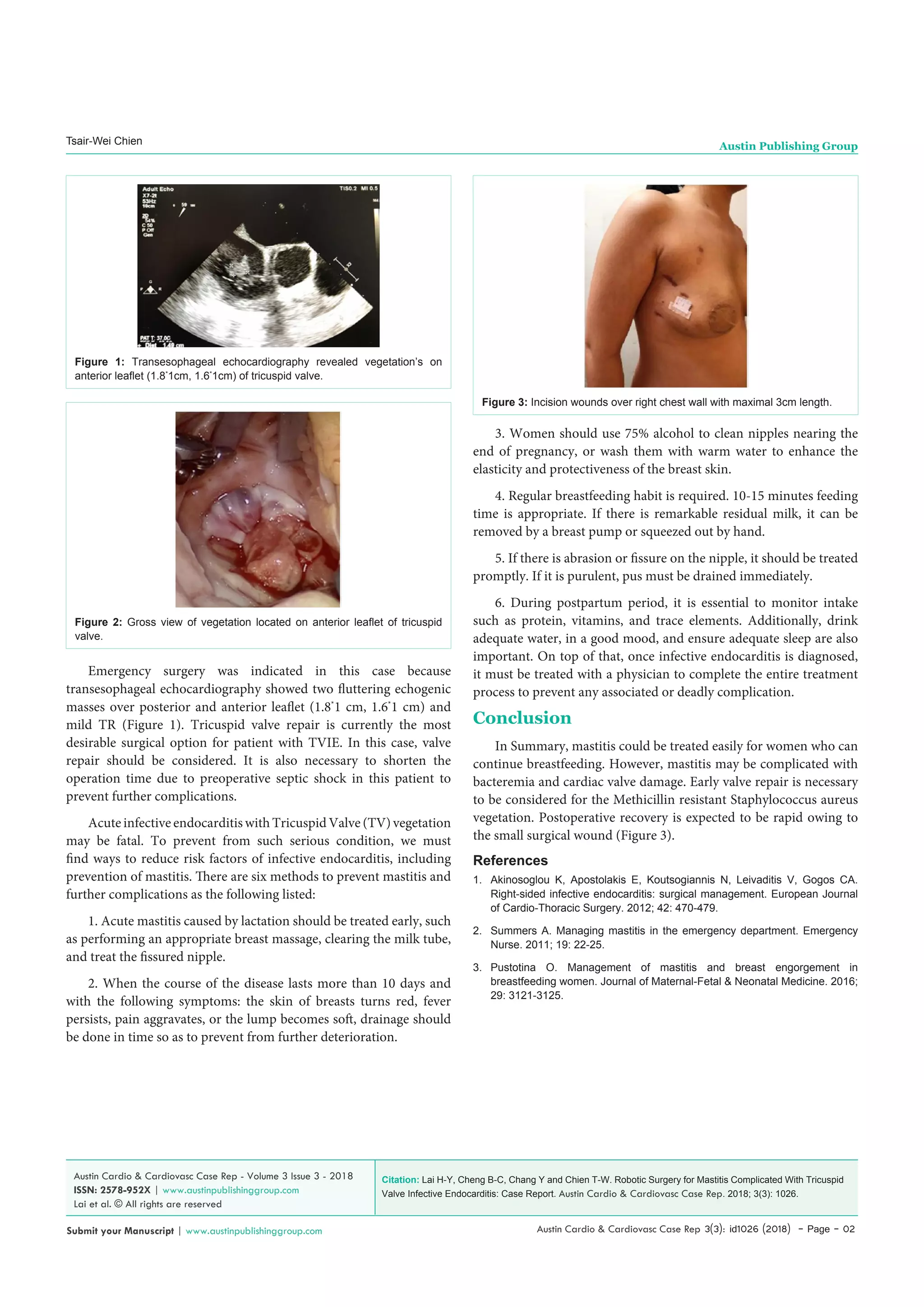
Transesophageal echocardiography showed two fluttering echogenic
masses over posterior and anterior leaflet (1.8*
1cm, 1.6*
1cm) and
mild TR (Figure 1). Blood culture yielded Methicillin resistant
Staphylococcus aureus. Thus, antibiotic with Vancomycin [3], was
prescribed. However, off-and-on fever and vomiting were still noted.
Due to acute infectious endocarditis with Tricuspid Valve (TV)
vegetation, da Vinci robotic surgery was arranged. Vegetectomy in
anterior and septal leaflet, TV annuloplasty with 27mm Tailor ring
were performed (Figure 2). There are five ports incision wounds
over right chest wall. Patient weaned off ventilator 3 hours after
operation and started walking training on the second postoperative
day. However, skin ecchymosis appeared under Vancomycin.
Hypersensitivity to Vancomycin was suspected. Antibiotic was shifted
to Daptomycin. Follow-up echocardiography revealed adequate heart
function, and trivial residual TR. Daptomycin maintained six weeks
for entire antibiotic course. She was discharged without any adverse
event.	
Discussion
After TVIE diagnosed, antibiotic treatment is indicated.
Furthermore, antibiotic should be continuously administered until
infection signs disappeared for 4 to 6 weeks. Blood culture yielded
Methicillin resistant Staphylococcus aureus. Thus, Vancomycin was
prescribed.Duetoallergynoted,antibioticwasshiftedtoDaptomycin.
Generally, operative indications for TVIE in the active stage included
uncontrolled right ventricular dysfunction due to massive TR, active
infection persisted and persistent fever despite antibiotic such as
Vancomycin administered over one week.
Austin Cardio & Cardiovasc Case Rep 3(3): id1026 (2018) - Page - 02
Tsair-Wei Chien Austin Publishing Group
Submit your Manuscript | www.austinpublishinggroup.com
Emergency surgery was indicated in this case because
transesophageal echocardiography showed two fluttering echogenic
masses over posterior and anterior leaflet (1.8*
1 cm, 1.6*
1 cm) and
mild TR (Figure 1). Tricuspid valve repair is currently the most
desirable surgical option for patient with TVIE. In this case, valve
repair should be considered. It is also necessary to shorten the
operation time due to preoperative septic shock in this patient to
prevent further complications.
Acute infective endocarditis with Tricuspid Valve (TV) vegetation
may be fatal. To prevent from such serious condition, we must
find ways to reduce risk factors of infective endocarditis, including
prevention of mastitis. There are six methods to prevent mastitis and
further complications as the following listed:
1. Acute mastitis caused by lactation should be treated early, such
as performing an appropriate breast massage, clearing the milk tube,
and treat the fissured nipple.
2. When the course of the disease lasts more than 10 days and
with the following symptoms: the skin of breasts turns red, fever
persists, pain aggravates, or the lump becomes soft, drainage should
be done in time so as to prevent from further deterioration.
Figure 1: Transesophageal echocardiography revealed vegetation’s on
anterior leaflet (1.8*
1cm, 1.6*
1cm) of tricuspid valve.
Figure 2: Gross view of vegetation located on anterior leaflet of tricuspid
valve.
Figure 3: Incision wounds over right chest wall with maximal 3cm length.
3. Women should use 75% alcohol to clean nipples nearing the
end of pregnancy, or wash them with warm water to enhance the
elasticity and protectiveness of the breast skin.
4. Regular breastfeeding habit is required. 10-15 minutes feeding
time is appropriate. If there is remarkable residual milk, it can be
removed by a breast pump or squeezed out by hand.
5. If there is abrasion or fissure on the nipple, it should be treated
promptly. If it is purulent, pus must be drained immediately.
6. During postpartum period, it is essential to monitor intake
such as protein, vitamins, and trace elements. Additionally, drink
adequate water, in a good mood, and ensure adequate sleep are also
important. On top of that, once infective endocarditis is diagnosed,
it must be treated with a physician to complete the entire treatment
process to prevent any associated or deadly complication.
Conclusion
In Summary, mastitis could be treated easily for women who can
continue breastfeeding. However, mastitis may be complicated with
bacteremia and cardiac valve damage. Early valve repair is necessary
to be considered for the Methicillin resistant Staphylococcus aureus
vegetation. Postoperative recovery is expected to be rapid owing to
the small surgical wound (Figure 3).
References
1.	 Akinosoglou K, Apostolakis E, Koutsogiannis N, Leivaditis V, Gogos CA.
Right-sided infective endocarditis: surgical management. European Journal
of Cardio-Thoracic Surgery. 2012; 42: 470-479.
2.	 Summers A. Managing mastitis in the emergency department. Emergency
Nurse. 2011; 19: 22-25.
3.	 Pustotina O. Management of mastitis and breast engorgement in
breastfeeding women. Journal of Maternal-Fetal & Neonatal Medicine. 2016;
29: 3121-3125.
Citation: Lai H-Y, Cheng B-C, Chang Y and Chien T-W. Robotic Surgery for Mastitis Complicated With Tricuspid
Valve Infective Endocarditis: Case Report. Austin Cardio & Cardiovasc Case Rep. 2018; 3(3): 1026.
Austin Cardio & Cardiovasc Case Rep - Volume 3 Issue 3 - 2018
ISSN: 2578-952X | www.austinpublishinggroup.com
Lai et al. © All rights are reserved

Austin Cardio & Cardiovascular Case Reports

  • 1.
    Citation: Lai H-Y,Cheng B-C, Chang Y and Chien T-W. Robotic Surgery for Mastitis Complicated With Tricuspid Valve Infective Endocarditis: Case Report. Austin Cardio & Cardiovasc Case Rep. 2018; 3(3): 1026. Austin Cardio & Cardiovasc Case Rep - Volume 3 Issue 3 - 2018 ISSN: 2578-952X | www.austinpublishinggroup.com Lai et al. © All rights are reserved Austin Cardio & Cardiovascular Case Reports Open Access Abstract Tricuspid Valve Infective Endocarditis (TVIE) is less common than left-sided infective endocarditis. Nevertheless, mastitis may be complicated with TVIE. Valve repair should be considered in this situation due to high probability of Methicillin resistant Staphylococcus aureus vegetation. By robotic surgery, postoperative recovery is expected to be rapid owing to the small surgical wound. Keywords: Infective Endocarditis; Tricuspid Valve; Da Vinci Robotic- Assisted Surgery Introduction Tricuspid Valve Infective Endocarditis (TVIE) accounted for 5% to 10% of infective endocarditis [1]. The researches of TVIE are increasing due to intravenous drug abusers are more often seen in healthcare settings. However, TVIE caused by mastitis is extremely rare. According to the definition by the World Health Organization (WHO), mastitis refers to as an inflammatory condition of the breast, possibly accompanied by infection and usually associated with lactation [2]. Mastitis often occurs in postpartum women. Once abscesses form in mastitis, generally surgical incision and drainage are required. In a joint study conducted by National Yang Ming University Hospital and Heping Fuyou Branch of Taipei City Hospital, it was found that 88% of mastitis in Taiwan was caused by Staphylococcus aureus. In which, more than half of them are Methicillin Resistant Staphylococcus Aureus (MRSA). According to a study, 77% of patients can be cured from ultrasound-guided drainage without surgery. It is important to conduct health education to prevent patients from mastitis-associated complications. Once mastitis is complicated with TVIE, profound bacteremia and cardiac valve damage will be frequently accompanied. Early surgical valve repair is necessary to be considered due to Methicillin resistant Staphylococcus aureus are often seen. By robotic surgery, rapid postoperative recovery is expected due to the small surgical wound. Case A 35-year-old woman who breastfeeded complained of fever and chills for 2 weeks. Meanwhile, right breast pain with erythematous change over 11 to 3 o’clock was noted and mastitis was impressed. While admission, vital signs showed that blood pressure was 94/63 mmHg and heart rate was 93/min. Physical examination showed no Case Report Robotic Surgery for Mastitis Complicated With Tricuspid Valve Infective Endocarditis: Case Report Hsiu-Yu Lai1 , Bor-Chih Cheng2 , Yu Chang3 and Tsair-Wei Chien4 * 1 Department of Cardiology, Chi Mei Medical Center, Tainan, Taiwan 2 Department of Cardiovascular Surgery, Chi Mei Medical Center, Tainan, Taiwan 3 Department of Medicine, National Taiwan University, Tainan, Taiwan 4 Department of Medical Research, Chi Mei Medical Center, Tainan, Taiwan *Corresponding author: Tsair-Wei Chien, Chi-Mei Medical Center, 901 Chung Hwa Road, Yung Kung Dist, Tainan 710, Taiwan Received: August 09, 2018; Accepted: August 22, 2018; Published: August 29, 2018 evidence of cardiac murmur, or marble markings over bilateral legs. Laboratory test revealed leukocytosis (white blood cell, WBC 17900/ μl) and elevated C-reactive protein (242.4 mg/L). Echocardiography showed myxomatous mitral valve with mild centric mitral valve regurgitation, mild Tricuspid Valve Regurgitation (TR), a 2.1* 0.9 cm fluttering echogenic mass over posterior leaflet of tricuspid valve. Transesophageal echocardiography showed two fluttering echogenic masses over posterior and anterior leaflet (1.8* 1cm, 1.6* 1cm) and mild TR (Figure 1). Blood culture yielded Methicillin resistant Staphylococcus aureus. Thus, antibiotic with Vancomycin [3], was prescribed. However, off-and-on fever and vomiting were still noted. Due to acute infectious endocarditis with Tricuspid Valve (TV) vegetation, da Vinci robotic surgery was arranged. Vegetectomy in anterior and septal leaflet, TV annuloplasty with 27mm Tailor ring were performed (Figure 2). There are five ports incision wounds over right chest wall. Patient weaned off ventilator 3 hours after operation and started walking training on the second postoperative day. However, skin ecchymosis appeared under Vancomycin. Hypersensitivity to Vancomycin was suspected. Antibiotic was shifted to Daptomycin. Follow-up echocardiography revealed adequate heart function, and trivial residual TR. Daptomycin maintained six weeks for entire antibiotic course. She was discharged without any adverse event. Discussion After TVIE diagnosed, antibiotic treatment is indicated. Furthermore, antibiotic should be continuously administered until infection signs disappeared for 4 to 6 weeks. Blood culture yielded Methicillin resistant Staphylococcus aureus. Thus, Vancomycin was prescribed.Duetoallergynoted,antibioticwasshiftedtoDaptomycin. Generally, operative indications for TVIE in the active stage included uncontrolled right ventricular dysfunction due to massive TR, active infection persisted and persistent fever despite antibiotic such as Vancomycin administered over one week.
  • 2.
    Austin Cardio &Cardiovasc Case Rep 3(3): id1026 (2018) - Page - 02 Tsair-Wei Chien Austin Publishing Group Submit your Manuscript | www.austinpublishinggroup.com Emergency surgery was indicated in this case because transesophageal echocardiography showed two fluttering echogenic masses over posterior and anterior leaflet (1.8* 1 cm, 1.6* 1 cm) and mild TR (Figure 1). Tricuspid valve repair is currently the most desirable surgical option for patient with TVIE. In this case, valve repair should be considered. It is also necessary to shorten the operation time due to preoperative septic shock in this patient to prevent further complications. Acute infective endocarditis with Tricuspid Valve (TV) vegetation may be fatal. To prevent from such serious condition, we must find ways to reduce risk factors of infective endocarditis, including prevention of mastitis. There are six methods to prevent mastitis and further complications as the following listed: 1. Acute mastitis caused by lactation should be treated early, such as performing an appropriate breast massage, clearing the milk tube, and treat the fissured nipple. 2. When the course of the disease lasts more than 10 days and with the following symptoms: the skin of breasts turns red, fever persists, pain aggravates, or the lump becomes soft, drainage should be done in time so as to prevent from further deterioration. Figure 1: Transesophageal echocardiography revealed vegetation’s on anterior leaflet (1.8* 1cm, 1.6* 1cm) of tricuspid valve. Figure 2: Gross view of vegetation located on anterior leaflet of tricuspid valve. Figure 3: Incision wounds over right chest wall with maximal 3cm length. 3. Women should use 75% alcohol to clean nipples nearing the end of pregnancy, or wash them with warm water to enhance the elasticity and protectiveness of the breast skin. 4. Regular breastfeeding habit is required. 10-15 minutes feeding time is appropriate. If there is remarkable residual milk, it can be removed by a breast pump or squeezed out by hand. 5. If there is abrasion or fissure on the nipple, it should be treated promptly. If it is purulent, pus must be drained immediately. 6. During postpartum period, it is essential to monitor intake such as protein, vitamins, and trace elements. Additionally, drink adequate water, in a good mood, and ensure adequate sleep are also important. On top of that, once infective endocarditis is diagnosed, it must be treated with a physician to complete the entire treatment process to prevent any associated or deadly complication. Conclusion In Summary, mastitis could be treated easily for women who can continue breastfeeding. However, mastitis may be complicated with bacteremia and cardiac valve damage. Early valve repair is necessary to be considered for the Methicillin resistant Staphylococcus aureus vegetation. Postoperative recovery is expected to be rapid owing to the small surgical wound (Figure 3). References 1. Akinosoglou K, Apostolakis E, Koutsogiannis N, Leivaditis V, Gogos CA. Right-sided infective endocarditis: surgical management. European Journal of Cardio-Thoracic Surgery. 2012; 42: 470-479. 2. Summers A. Managing mastitis in the emergency department. Emergency Nurse. 2011; 19: 22-25. 3. Pustotina O. Management of mastitis and breast engorgement in breastfeeding women. Journal of Maternal-Fetal & Neonatal Medicine. 2016; 29: 3121-3125. Citation: Lai H-Y, Cheng B-C, Chang Y and Chien T-W. Robotic Surgery for Mastitis Complicated With Tricuspid Valve Infective Endocarditis: Case Report. Austin Cardio & Cardiovasc Case Rep. 2018; 3(3): 1026. Austin Cardio & Cardiovasc Case Rep - Volume 3 Issue 3 - 2018 ISSN: 2578-952X | www.austinpublishinggroup.com Lai et al. © All rights are reserved