Australian
Goods and Services Tax (GST)
Raphael Cicchini, Manager, GST Policy Unit
26 October 2004
Overview
Why did Australia introduce a GST?
How does Australia’s GST work?
Types of GST treatment and GST in the
international context
Administration of the GST
Transition to the New Tax System
Why did we introduce a GST?
The wholesale sales tax was:
Out of date
– The tax base (goods) is a declining
proportion of economic activity.
Internationally uncompetitive
– WST cascaded through production – hidden
tax on exports & import competing firms.
Complex and distortionary
– The WST applied at at least 6 different rates.
Australia’s GST
GST introduced on 1 July 2000.
Broadly, it is a tax on private
consumption in Australia.
The GST replaced the WST and a range
of State indirect taxes.
Applies at a flat rate of 10% to a broad
base of goods and services and other
supplies (such as property and rights).
However, there are some exceptions.
All GST revenue goes to the States and
Territories.
How does the GST work?
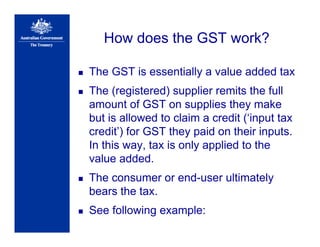
The GST is essentially a value added tax
The (registered) supplier remits the full
amount of GST on supplies they make
but is allowed to claim a credit (‘input tax
credit’) for GST they paid on their inputs.
In this way, tax is only applied to the
value added.
The consumer or end-user ultimately
bears the tax.
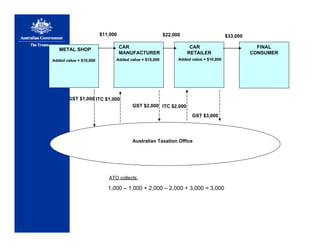
See following example:
ATO collects:
METAL SHOP
Added value = $10,000
CAR
MANUFACTURER
Added value = $10,000
CAR
RETAILER
Added value = $10,000
FINAL
CONSUMER
Australian Taxation Office
GST $1,000
GST $3,000
ITC $1,000
ITC $2,000GST $2,000
$22,000$11,000 $33,000
1,000 – 1,000 + 2,000 – 2,000 + 3,000 = 3,000
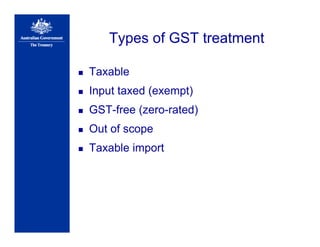
Types of GST treatment
Taxable
Input taxed (exempt)
GST-free (zero-rated)
Out of scope
Taxable import
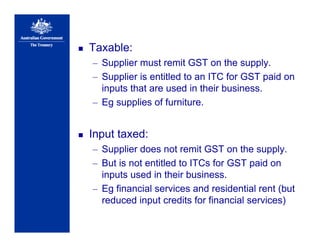
Taxable:
– Supplier must remit GST on the supply.
– Supplier is entitled to an ITC for GST paid on
inputs that are used in their business.
– Eg supplies of furniture.
Input taxed:
– Supplier does not remit GST on the supply.
– But is not entitled to ITCs for GST paid on
inputs used in their business.
– Eg financial services and residential rent (but
reduced input credits for financial services)
GST-free:
– Supplier does not need to remit GST on the
supply
– But is still entitled to an ITC for GST paid on
inputs used in their business
– Eg. basic food, health, education, exports
Out of scope:
– The supply is not taxable therefore the
supplier does not need to remit GST.
– Eg supplies made by unregistered
businesses.
Taxable import
– Goods are subject to GST if they are
imported into Australia and ‘entered for
home consumption’.
• Regardless of whether the importer is registered.
• Eg the import of presents is a taxable import.
– However, to reduce administrative costs, a
low value threshold applies in determining
whether GST is collected on taxable
importations.
Administration of the GST
Registration for GST is compulsory if
your annual turnover is:
– $50,000 or over for businesses; or
– $100,000 or over for non-profit entities.
Return (BAS) is lodged either monthly,
quarterly or annually
– concessional options for entities with a
turnover of less than $50,000 or $2 mill p.a.
– quarterly for entities with turnover less than
$20 million per annum
– monthly for larger businesses
– any business can opt to be monthly
Administration of the GST
If the tax collected on sales exceeds
total input tax credits, then the net
difference will be paid to the Tax Office.
If input tax credits exceed the tax
collected on sales, a refund can be
claimed.
Special rules, insurance, gambling,
vouchers, charities
Transition issues
Credits for stock on which you paid
wholesale sales tax
Motor vehicles – input tax credits and
operating leases
Long-term non-reviewable contracts
Other
Credits for stock on hand
As part of the introduction of the GST,
credits were provided for WST paid on
inventories held for sale.
However, it was not possible for revenue
reasons to provide credits for WST paid
on all capital assets.
Also, it would often be difficult for
businesses to substantiate the amount of
WST paid on an older asset.
Phase-in of input tax credits for
motor vehicles
Generally, input tax credits can not be
claimed for GST paid on new vehicles
purchased between 1 July 2000 and
22 May 2001.
– Addresses concerns about the deferral of
purchases in the lead up to the GST.
– However, there are some exceptions.
Operating leases
A special (notional) input tax credit is
available for certain vehicles purchased
prior to 2 December 1998 and sold after
1 July 2000
– In recognition that they would bear the
unanticipated cost of GST and would not be
able to pass this cost on in their other prices.
– Equal to the lesser of 1/11th of the amount
the lessor paid for the motor vehicle or the
amount of GST payable on the sale price.
Long-term contracts
Long-term non-reviewable contracts
continue to remain GST-free until
30 June 2005 unless there has been a
review opportunity.
At this time, suppliers under these
contracts will be able to adjust their
prices to take account of the GST.
Other transitional issues
Trading past midnight on 1 July 2000
Supplies of rights that were granted
before 1 July 2000 but exercisable at
later date
Construction agreements made before
1 July 2000
Compulsory third party schemes
Special credit for rental car businesses
Coin-operated machines
Other issues
Any changes to the GST base (10% rate
or things subject to tax) require State
and Territory approval.
Compliance costs for businesses.
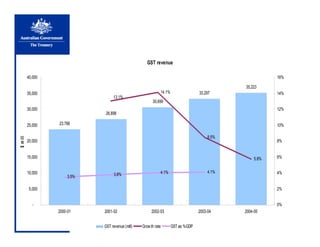
GST revenue
23,788
26,898
30,699
33,297
35,223
14.1%
8.5%
5.8%
3.5% 3.8% 4.1% 4.1%
13.1%
-
5,000
10,000
15,000
20,000
25,000
30,000
35,000
40,000
2000-01 2001-02 2002-03 2003-04 2004-05
$mill
0%
2%
4%
6%
8%
10%
12%
14%
16%
GST revenue (mill) Growth rate GST as %GDP

Aust treasury -gst

  • 1.
    Australian Goods and ServicesTax (GST) Raphael Cicchini, Manager, GST Policy Unit 26 October 2004
  • 2.
    Overview Why did Australiaintroduce a GST? How does Australia’s GST work? Types of GST treatment and GST in the international context Administration of the GST Transition to the New Tax System
  • 3.
    Why did weintroduce a GST? The wholesale sales tax was: Out of date – The tax base (goods) is a declining proportion of economic activity. Internationally uncompetitive – WST cascaded through production – hidden tax on exports & import competing firms. Complex and distortionary – The WST applied at at least 6 different rates.
  • 4.
    Australia’s GST GST introducedon 1 July 2000. Broadly, it is a tax on private consumption in Australia. The GST replaced the WST and a range of State indirect taxes. Applies at a flat rate of 10% to a broad base of goods and services and other supplies (such as property and rights). However, there are some exceptions. All GST revenue goes to the States and Territories.
  • 5.
    How does theGST work? The GST is essentially a value added tax The (registered) supplier remits the full amount of GST on supplies they make but is allowed to claim a credit (‘input tax credit’) for GST they paid on their inputs. In this way, tax is only applied to the value added. The consumer or end-user ultimately bears the tax. See following example:
  • 6.
    ATO collects: METAL SHOP Addedvalue = $10,000 CAR MANUFACTURER Added value = $10,000 CAR RETAILER Added value = $10,000 FINAL CONSUMER Australian Taxation Office GST $1,000 GST $3,000 ITC $1,000 ITC $2,000GST $2,000 $22,000$11,000 $33,000 1,000 – 1,000 + 2,000 – 2,000 + 3,000 = 3,000
  • 7.
    Types of GSTtreatment Taxable Input taxed (exempt) GST-free (zero-rated) Out of scope Taxable import
  • 8.
    Taxable: – Supplier mustremit GST on the supply. – Supplier is entitled to an ITC for GST paid on inputs that are used in their business. – Eg supplies of furniture. Input taxed: – Supplier does not remit GST on the supply. – But is not entitled to ITCs for GST paid on inputs used in their business. – Eg financial services and residential rent (but reduced input credits for financial services)
  • 9.
    GST-free: – Supplier doesnot need to remit GST on the supply – But is still entitled to an ITC for GST paid on inputs used in their business – Eg. basic food, health, education, exports Out of scope: – The supply is not taxable therefore the supplier does not need to remit GST. – Eg supplies made by unregistered businesses.
  • 10.
    Taxable import – Goodsare subject to GST if they are imported into Australia and ‘entered for home consumption’. • Regardless of whether the importer is registered. • Eg the import of presents is a taxable import. – However, to reduce administrative costs, a low value threshold applies in determining whether GST is collected on taxable importations.
  • 11.
    Administration of theGST Registration for GST is compulsory if your annual turnover is: – $50,000 or over for businesses; or – $100,000 or over for non-profit entities. Return (BAS) is lodged either monthly, quarterly or annually – concessional options for entities with a turnover of less than $50,000 or $2 mill p.a. – quarterly for entities with turnover less than $20 million per annum – monthly for larger businesses – any business can opt to be monthly
  • 12.
    Administration of theGST If the tax collected on sales exceeds total input tax credits, then the net difference will be paid to the Tax Office. If input tax credits exceed the tax collected on sales, a refund can be claimed. Special rules, insurance, gambling, vouchers, charities
  • 13.
    Transition issues Credits forstock on which you paid wholesale sales tax Motor vehicles – input tax credits and operating leases Long-term non-reviewable contracts Other
  • 14.
    Credits for stockon hand As part of the introduction of the GST, credits were provided for WST paid on inventories held for sale. However, it was not possible for revenue reasons to provide credits for WST paid on all capital assets. Also, it would often be difficult for businesses to substantiate the amount of WST paid on an older asset.
  • 15.
    Phase-in of inputtax credits for motor vehicles Generally, input tax credits can not be claimed for GST paid on new vehicles purchased between 1 July 2000 and 22 May 2001. – Addresses concerns about the deferral of purchases in the lead up to the GST. – However, there are some exceptions.
  • 16.
    Operating leases A special(notional) input tax credit is available for certain vehicles purchased prior to 2 December 1998 and sold after 1 July 2000 – In recognition that they would bear the unanticipated cost of GST and would not be able to pass this cost on in their other prices. – Equal to the lesser of 1/11th of the amount the lessor paid for the motor vehicle or the amount of GST payable on the sale price.
  • 17.
    Long-term contracts Long-term non-reviewablecontracts continue to remain GST-free until 30 June 2005 unless there has been a review opportunity. At this time, suppliers under these contracts will be able to adjust their prices to take account of the GST.
  • 18.
    Other transitional issues Tradingpast midnight on 1 July 2000 Supplies of rights that were granted before 1 July 2000 but exercisable at later date Construction agreements made before 1 July 2000 Compulsory third party schemes Special credit for rental car businesses Coin-operated machines
  • 19.
    Other issues Any changesto the GST base (10% rate or things subject to tax) require State and Territory approval. Compliance costs for businesses.
  • 20.
    GST revenue 23,788 26,898 30,699 33,297 35,223 14.1% 8.5% 5.8% 3.5% 3.8%4.1% 4.1% 13.1% - 5,000 10,000 15,000 20,000 25,000 30,000 35,000 40,000 2000-01 2001-02 2002-03 2003-04 2004-05 $mill 0% 2% 4% 6% 8% 10% 12% 14% 16% GST revenue (mill) Growth rate GST as %GDP