
GST & BAS

     By – Bhargav Kejkar
Introduction
• Introduced on 1st July 2000 and replaced sales
  tax.
• Under the current tax system in Australia
  specific good & services have a tax levied on
  them at 10%.
• One of the most important things to
  remember is that GST is not tax deductible.
GST Free Goods
•   Health and Medical care.
•   Educational supplies.
•   Fresh food and beverages.
•   Cars for disable people etc.
BAS

A Business Activity Statement is a form that is lodged
  with the Australian Taxation Office (ATO) that reports
  a client’s obligations and entitlements relating to:
• GST (similar to VAT)
• Wine equalization tax
• Luxury car tax
• Pay As You Go (PAYG) amounts withheld from payments (similar to
  TDS)
• PAYG installments
• Fringe benefits tax installments
LODGEMENT OF BUSINESS ACTIVITY
         STATEMENT
• If annual turnover < $ 20 million, entity can choose to lodge
  BAS either quarterly or monthly.

• Quarterly tax periods are
       July 1st - September 30th
       Oct 1st - Dec 31st
       Jan 1st - March 31st
       April 1st - June 30th
Accounting For GST
• On Cash Basis – on receipt basis , when
   – Annual turnover < = $1 Million
   – Accounting for Income tax on receipt basis
   – Charitable institution, a trustee of charitable fund or a gift
     deductible entity

• On Non - Cash Basis – on Accrual Basis, when
   – Any consideration is received or Paid
   – Any invoice (a document notifying an obligation for
     payment) is issued by supplier or issued to purchaser
Accounting for GST
• GST on income (Credit in Balance Sheet)
  (always PAYABLE)
   = GST on sales
   = GST payable control account
   = GST Collected
• GST on expenses (Debit in Balance Sheet)
   (always RECEIVABLE)
  = GST on sales
  = Input tax credit account
  = GST Paid
• Net GST = GST on income – GST on expense
• GST Payable / Refundable
   – GST on sales > GST on Purchases = GST Payable
     (Net credit)
   – GST on sales < GST on Purchases = GST refundable
     (Net debit)
   – Transferred to GST Clearing for Clearing Purpose
Accounting treatment for GST
• While dealing with GST a/cs, we usually have to
  face following a/cs
       (a) Input Tax Credit Control A/c
       (b) GST output control a/c
       (c) GST Clearing a/c
       (d) BAS payable
       (e) GST output tax credit adjustment a/c etc.
• GST Clearing a/c consist of all quarterly GST
  payments / receipts.
• BAS payable shows last year’s last quarter’s
  liability.
•   Firstly we transfer GST clearing a/c balance to
    suspense a/c.
•   Then, GST on sales and GST on purchase trf to
    GST clearing a/c. GST clearing a/c will show net
    GST.
•   We check detailed ledger for how these
    quarterly payments or receipts had been made.
•   After which we pass entries of those payments.
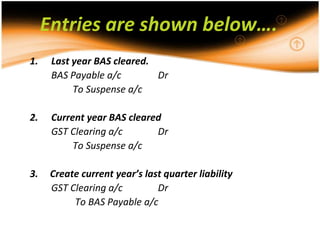
Entries are shown below….
1.    Last year BAS cleared.
      BAS Payable a/c        Dr
           To Suspense a/c

2.    Current year BAS cleared
      GST Clearing a/c       Dr
           To Suspense a/c

3.    Create current year’s last quarter liability
      GST Clearing a/c         Dr
           To BAS Payable a/c
Making ATO Payments/Refunds for C.Y.
• GST Clearing Account
   – All the ATO (GST) Payments or refunds relating to 3 quarters (Sep, Dec,
     March) are transferred to GST Clearing Account
• PAYG W/H Payable Account
   – All the ATO (PAYG W/H) payments are transferred to Debit of PAYG W/H
     Liability Account
• Net Wages Account
   – All the ATO (PAYG W/H) payments are transferred to Debit of Wages to make
     it Gross, as clients in Australia are allowed to Claim PAYG W/H as a direct
     deduction
• Fuel tax Credit Account
   – All the ATO (Fuel Tax credit) refunds are transferred to P & L credit as Diesel
     Fuel Rebate
• PAYG Installments
   – All the ATO(IAS) payments are transferred to Debit of Equity section of
     Balance Sheet as PAYG tax Installments
Example
• Practice Job 2
THANK YOU

19636819 goods-and-service-tax

  • 1.
    GST & BAS By – Bhargav Kejkar
  • 2.
    Introduction • Introduced on1st July 2000 and replaced sales tax. • Under the current tax system in Australia specific good & services have a tax levied on them at 10%. • One of the most important things to remember is that GST is not tax deductible.
  • 3.
    GST Free Goods • Health and Medical care. • Educational supplies. • Fresh food and beverages. • Cars for disable people etc.
  • 4.
    BAS A Business ActivityStatement is a form that is lodged with the Australian Taxation Office (ATO) that reports a client’s obligations and entitlements relating to: • GST (similar to VAT) • Wine equalization tax • Luxury car tax • Pay As You Go (PAYG) amounts withheld from payments (similar to TDS) • PAYG installments • Fringe benefits tax installments
  • 5.
    LODGEMENT OF BUSINESSACTIVITY STATEMENT • If annual turnover < $ 20 million, entity can choose to lodge BAS either quarterly or monthly. • Quarterly tax periods are July 1st - September 30th Oct 1st - Dec 31st Jan 1st - March 31st April 1st - June 30th
  • 6.
    Accounting For GST •On Cash Basis – on receipt basis , when – Annual turnover < = $1 Million – Accounting for Income tax on receipt basis – Charitable institution, a trustee of charitable fund or a gift deductible entity • On Non - Cash Basis – on Accrual Basis, when – Any consideration is received or Paid – Any invoice (a document notifying an obligation for payment) is issued by supplier or issued to purchaser
  • 7.
    Accounting for GST •GST on income (Credit in Balance Sheet) (always PAYABLE) = GST on sales = GST payable control account = GST Collected • GST on expenses (Debit in Balance Sheet) (always RECEIVABLE) = GST on sales = Input tax credit account = GST Paid • Net GST = GST on income – GST on expense
  • 8.
    • GST Payable/ Refundable – GST on sales > GST on Purchases = GST Payable (Net credit) – GST on sales < GST on Purchases = GST refundable (Net debit) – Transferred to GST Clearing for Clearing Purpose
  • 9.
    Accounting treatment forGST • While dealing with GST a/cs, we usually have to face following a/cs (a) Input Tax Credit Control A/c (b) GST output control a/c (c) GST Clearing a/c (d) BAS payable (e) GST output tax credit adjustment a/c etc. • GST Clearing a/c consist of all quarterly GST payments / receipts. • BAS payable shows last year’s last quarter’s liability.
  • 10.
    Firstly we transfer GST clearing a/c balance to suspense a/c. • Then, GST on sales and GST on purchase trf to GST clearing a/c. GST clearing a/c will show net GST. • We check detailed ledger for how these quarterly payments or receipts had been made. • After which we pass entries of those payments.
  • 11.
    Entries are shownbelow…. 1. Last year BAS cleared. BAS Payable a/c Dr To Suspense a/c 2. Current year BAS cleared GST Clearing a/c Dr To Suspense a/c 3. Create current year’s last quarter liability GST Clearing a/c Dr To BAS Payable a/c
  • 12.
    Making ATO Payments/Refundsfor C.Y. • GST Clearing Account – All the ATO (GST) Payments or refunds relating to 3 quarters (Sep, Dec, March) are transferred to GST Clearing Account • PAYG W/H Payable Account – All the ATO (PAYG W/H) payments are transferred to Debit of PAYG W/H Liability Account • Net Wages Account – All the ATO (PAYG W/H) payments are transferred to Debit of Wages to make it Gross, as clients in Australia are allowed to Claim PAYG W/H as a direct deduction • Fuel tax Credit Account – All the ATO (Fuel Tax credit) refunds are transferred to P & L credit as Diesel Fuel Rebate • PAYG Installments – All the ATO(IAS) payments are transferred to Debit of Equity section of Balance Sheet as PAYG tax Installments
  • 13.
  • 14.