DR. JITEN LAD – JUNIOR RESIDENT
• It is a subjective test
• It is a non invasive test
• It is a graphical recording of Hearing
Loss both quantitatively and
qualitatively.
• The audiometer is an electronic
device that generates pure tones.
The intensity of these tones and
increased/decreased in 5 dB steps.
PURE TONESOUND

 Whenanobjectvibratesinfixedsingle
frequency,the soundwaveswill presenta
sinusoidalwavepattern knownassine-
wave.
Thesoundsensationproducedbysuch
a sine-waveiscalledasapuretone
sound.
 Inpuretoneaudiometry,wetest the
hearingsensitivityofasubjectonlyfor
pure tonesounds.
AIMS OF PURETONEAUDIOMETRY
 Whetherthesubjecthasanydefinitehearing
loss.
 Whetherthe hearinglossis
conductive/sensorineural/mixed
type.
 Insensorineural
deafness,wheatherthe deafnessis
COCHLEARorRETROCOCHLEAR.
 Tonotethedegreeofhearingdysfunction.
PURETONEAUDIOMETER
 Itistheelectronicdeviceusedforcreating
puretoneaudiogram.
 Itconsistsofanaudio-oscillatorwhich
generatespuretonesoundsofdifferent
frequencies.
 Eachtonecanbeseparatelyamplifiedto a
maximumof100to110dBinmost
frequencies exceptverylow&veryhigh
frequencies.
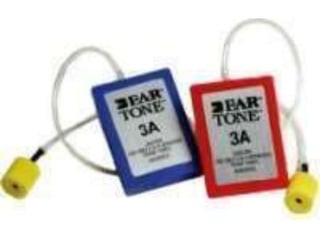
 Audiometer is connected to standard &
specified bone conduction vibrator or
earphones through which sound is
presentedtosubject’sear.
THRESHOLD
 TheInternationalStandards
Organisationhas definedhearing
thresholdas“thelowestsound
pressurelevel,at whichunder
specified conditions,a persongives
a predetermined percentageof
correctresponsesonrepeated
trails”.
THRESHOLD
 Forclinicalusage,this
predetermined percentage
is50%.
 Inpuretoneaudiometry,wetry to
obtain thresholdsthatcomparethe
hearingsensitivity ofasubjectin
decibelswithafixedidealor normal
hearinglevel(0dB).
 So,in clinicalaudiometry,it isthe
relative threshold&nottheabsolute
thresholdthatis measured.That
means,inaudiological measurements,
the intensity of soundis always
measured& expressedincomparison
to orin relationto anothersound
whichis idealnormalhearing
threshold.
DECIBEL & OTHER
RELATED TERMS
 TheDecibelisthe unit by whichthe intensity
of the sound(or pressure exerted by a sound
stimulus)ismeasured.
 Averageminimumwhichwillproducea
soundjustaudibletoanormalear:-
 Inunitsofpressure0.00024dynes/sq.cm.
 Inunitsofintensity1/100000000000000000
watts/sq.cm.
DECIBEL & OTHER
RELATED TERMS
 BEL- A ratio expressed in logarithm(with
base 10)whichtellsushowmanytimesthe
sound we are measuring is stronger or
weakerthan areferencesound.(0-14)

 BEL=logIO/IR
 IO=intensityofthesound
 IR=intensityofthereferencesound
 deciBEL-onetenth of
BEL.
[DECIBEL(dB)=10logIO/IR]
 SPL-signifiesthat apressurereference
has beenused(i.e.referencesoundhasa
pressurelevelof .00024dynes/sq.cm.)
Inactualpracticeitwasfoundthattheunitof
BEListoolargeandencompassesavery
hugeamountofsoundintensity.
DECIBEL & OTHER
RELATED TERMS
 HL-Indifferentfrequenciesthe intensityor
the pressureof justaudiblesoundisslightly
different.Henceforstandardisation,different
amountof pressure(orintensity)havebeen
separatelycalculatedfor eachfrequency,
suchthat the minimum soundaudiblebya
normalsubjectin different frequenciesmay
bedesignatedas0dBHL,for that particular
frequency.
 SL-Thisisinreferenceto the auditory
thresholdofaparticularsubject&
indicates howmuchsoundsensation
that particular subjectisactually
getting.
SL+handicap=HL.
DECIBEL & OTHER
RELATED TERMS
PROCEDURE OF P.T.A.
 AIRCONDUCTIONTESTS
 (conditions required):-
 1.CALIBRATIONOFTHEINSTRUMENT-
 ISO-1964specification.
 6monthlyelectroniccalibration.
 Airconductionheadphones-TDH39/TDH49.
 Insertear-phones-ER-3A.
 Earconductionheadphonecushions-MX41
AR.
PROCEDURE OF P.T.A.
 2.REASONABLYNOISELESSTEST
ENVIRONMENT-
 AmericanstandardsAssociation(ANSI-53.1-
1991)table.
 ISO/DIS8253table.
 3.POSITIONOFHEADPHONES.
 4.INSTRUCTIONTOTHEPATIENT.
 TECHNIQUEOFAIRCONDUCTIONTESTS:-
 1.CONVENTIONAL/HUGHSON-
WESTLAKE(5-up-10-down)technique.
 2.AmericanSpeech&Hearing
Association(ASHA)technique.
 3.BritishSocietyofAudiology/British
associationofOtolaryngologiststechnique.
 4.ISO/DIS8253technique.
PROCEDURE OF P.T.A.
 BONECONDUCTIONTESTS
 (conditionsrequired):-
 1.Calibrationoftheinstrument-
RadioearB71.
 2.Reasonablynoiselesstest
environment.
 3.Placementofboneconduction
vibrator-
PROCEDURE OF P.T.A.
 a)Mastoidplacement-
 Superiorinrespectofsensitivityby10-15
dB.
 Theboneconductionvibratorisplaced
overthe mastoidboneattachedto a
springmetal headband.Thepressureon
mastoidisgivenas500gm/sq.cm.
 Areaoverwhichthepersoncanhearthe
sound loudestisplaced.
 Thetestingeariskeptuncovered.The
otherear iskeptcoveredformasking.
PROCEDURE OF P.T.A.
 Theboneconductionvibratormustnot
touchthepinnaortheearphone.
 b)Frontalplacement-Superiorin respect
of consistencybecauseoflessvariation
ofamount of tissuebetweenbone
conductionvibrator& theearphone.
 TECHNIQUESOFBONECONDUCTION.
MASKING
 Inpuretoneaudiometry,the clinicianmust
ascertaintheexacthearingthresholdbyair&
boneconductionforthedifferentfrequencies
for eachof the two earsseparately&
individually.Thiscannot betakenlightly &
needsto beover-emphasised.
 Contralateralmaskingmeansintroducinga
noiseinnon-testear,suchthatthenon-test
earisacousticallyblocked& cannot
participateinthehearingtest.
MASKING
 Whentomask:-
 Interauralattenuation(40-45dBHLforair
conduction).
 Hazardofcrosshearingismuchmoreinbone
conductionthaninairconductiontest.
 Chanceofcross-hearingisAC(testear)-
BC(non-testear)>IA.
 Forboneconduction,theInteraural
attenuation maybe0dBHL.
MASKING
 Howmuchtomask-neither
undermask,nor overmask.
 Minimummaskinglevel:
 (AC)Airconductionthresholdinthe test ear-
45+(Airconductionthresholdinthe masked
ear-Boneconductionthresholdinthemasked
ear).
 Maximummaskinglevel:
 Boneconductionthresholdforthetest
ear+45.
MASKING
 Masking is doneby:
 1.Whitenoise-consistsof soundof all
frequenciesfrom high to low.
 2.Narrow bandnoise-moreeffectivefor
masking, consists of anarrow band of
noise 100-200 Hz above/below that
frequency.
 3.Complex noise-low frequency
fundamental+multiples offrequencies up
to 4000Hz.Leastefficient for masking.
 A)QUANTITATIVEINFORMATION-
 1.WhatistheACthreshold?
 2.WhatistheBCthreshold?
 3.WhatistheA-Bgap?
 4.Wheathermaskinghasbeendoneornot?
 5.Doesitmatchwithclinicalfindingsand
tuningforktests?
 B)QUALITATIVEINFORMATION.
INTERPRETETION OF P.T.A.
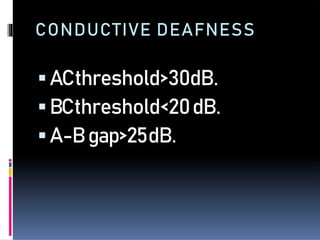
CONDUCTIVE DEAFNESS
ACthreshold>30dB.
BCthreshold<20dB.
A-Bgap>25dB.
PTA OF CONDUCTIVE
DEAFNESS
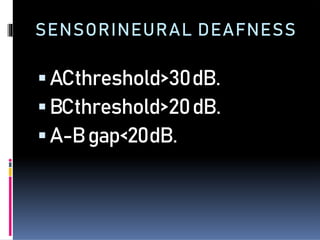
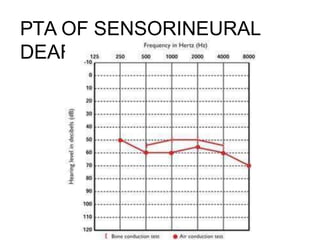
SENSORINEURAL DEAFNESS
ACthreshold>30dB.
BCthreshold>20dB.
A-Bgap<20dB.
PTA OF SENSORINEURAL
DEAFNESS
MIXED DEAFNESS
ACthreshold>45dB.
BCthreshold>20dB.
A-Bgap>20dB.
PTA OF MIXED
DEAFNESS
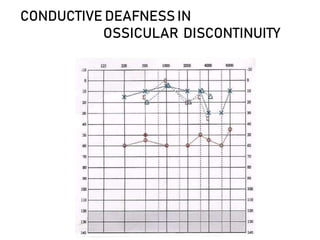
CONDUCTIVE DEAFNESS IN
OSSICULAR DISCONTINUITY
CARHART’S NOTCH(OTOSCLEROSIS)
STRIAL PRESBYACUSIS(S.N.D.)
S.N.D. D/T ACOUSTIC TRAUMA
LIMITATIONS OF P.T.A.
 1.AUDIOGRAMSARE
VERYOFTEN INACCURATE.
 a)Impropertechnique-masking,placement.
 b)Impropertestcondition-RNTE.
 c)Impropertest instrument-calibration.
 d)Improperexaminer.
 2.ASUBJECTIVE & TIME-
CONSUMINGTEST.
 3.IT DOES NOTASSESSALL
FEATURESOF HEARING.
LIMITATIONS OF P.T.A.
 4.IT DOES NOT IDENTIFYTHE NATUREOF
THE PATHOLOGY.
 5.BONE CONDUCTION TEST DOES NOT
ASSESS THE TRUE SENSORINEURAL
RESERVE.
 6.MANY SOURCES OF VARIANCES IN THE
TEST RESULTS THATARE NOT RELATED
TO HEARING.
RECRUITMENT
• It is a phenomenon of abnormal
appreciation of loud sounds, a loud
sound that is tolerable in normal
ear may grow to abnormal levels
of loudness in recruiting ear and
thus becomes intolerable.
• It is a feature of cochlear hearing
loss.
TESTS FOR RECRUITMENT
1) FOWLER’S ALTERNATE BINAURAL
LOUDNESS BALANCE TEST
• Done in case of unilateral hearing loss
• A tone of 1000 Hz is played alternatively to
the normal and affected ear.
• The intensity in the affected ear is
adjusted to match the loudness in normal
ear.
• The test begins at 20 dB above the
threshold and is repeated at every
10 dB rise until the loudness is
matched or limits of audiometer is
reached.
• The initial difference is maintained
throughout in normal hearing or
conductive hearing loss.
• Partial or complete or over
recruitment is seen in cochlear
lesions.
SHORT INCREMENT
SENSITIVITY INDEX TEST
• Due to the recruitment, patients of
cochlear lesions can distinguish
smaller changes in intensity of pure
tone better than patients of normal
hearing, conductive and nerve hearing
loss.
• Method:
A continuous tone is delivered 20 dB
above threshold and sustained for
about 2 minutes. At every 5 seconds,
the tone is increased by 1 dB.
Twenty such blips are delivered.
Patient is asked to indicate the blips
heard.
SISI score is presented in
percentage.
• Interpretations:
• Score less than 20% : Normal
hearing and conductive and
nerve hearing loss.
• Score more than 70%: Cochlear
hearing loss.
CARHART'S TONE DECAY TEST
This simple test is a measure of nerve
fatigue, which is a feature of retrocochlear
hearing loss.
Principle: A normal person can hear a tone
continuously for 60 seconds. In nerve fatigue,
patient stops hearing earlier.
• Method:
A tone of 4,000 Hz is delivered at 5 dB
above the patient's threshold for 60
seconds. When patient stops hearing,
intensity is increased each time by 5
dB.
• The procedure is continued till
patient hears the tone continuously
for 60 seconds or tone's upper limit
is reached.
Interpretation:
A tone decay of more than
25 dB is diagnostic of a
Retrocochlear hearing loss.
HAVE A GOOD DAY

puretoneaudiometry.pptx