
Atypical stemi patterns &
stemi equivalents
- Dr Varun Patel
Courtesy for References:
1. EM Docs website
2. Dr Stephen Smith’s Blog
3. ECG in Acute MI Book by Dr Stephen smith
4. Life in the Fast lane Website
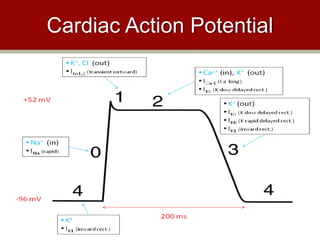
Cardiac Action Potential
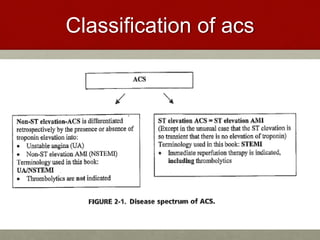
Classification of acs
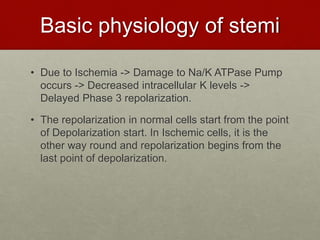
Basic physiology of stemi
• Due to Ischemia -> Damage to Na/K ATPase Pump
occurs -> Decreased intracellular K levels ->
Delayed Phase 3 repolarization.
• The repolarization in normal cells start from the point
of Depolarization start. In Ischemic cells, it is the
other way round and repolarization begins from the
last point of depolarization.
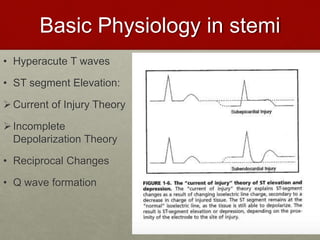
Basic Physiology in stemi
• Hyperacute T waves
• ST segment Elevation:
Current of Injury Theory
Incomplete
Depolarization Theory
• Reciprocal Changes
• Q wave formation
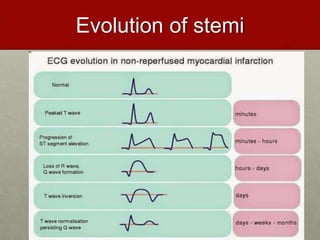
Evolution of stemi
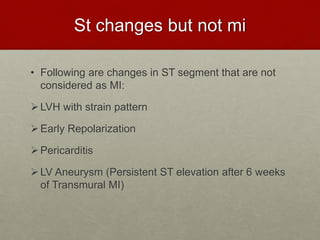
St changes but not mi
• Following are changes in ST segment that are not
considered as MI:
LVH with strain pattern
Early Repolarization
Pericarditis
LV Aneurysm (Persistent ST elevation after 6 weeks
of Transmural MI)
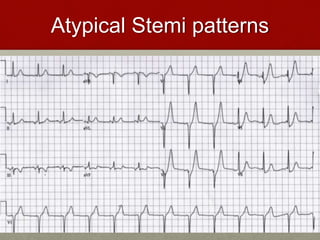
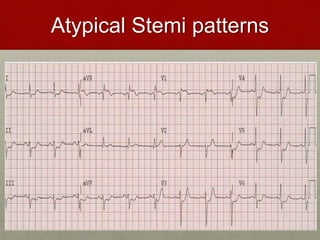
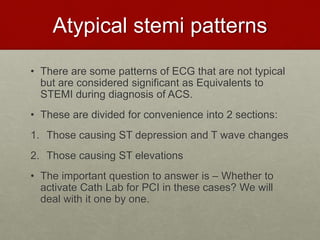
Atypical stemi patterns
• There are some patterns of ECG that are not typical
but are considered significant as Equivalents to
STEMI during diagnosis of ACS.
• These are divided for convenience into 2 sections:
1. Those causing ST depression and T wave changes
2. Those causing ST elevations
• The important question to answer is – Whether to
activate Cath Lab for PCI in these cases? We will
deal with it one by one.
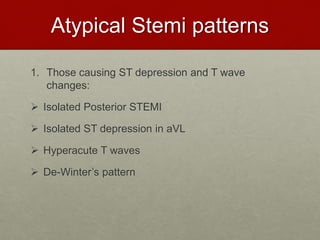
Atypical Stemi patterns
1. Those causing ST depression and T wave
changes:
 Isolated Posterior STEMI
 Isolated ST depression in aVL
 Hyperacute T waves
 De-Winter’s pattern
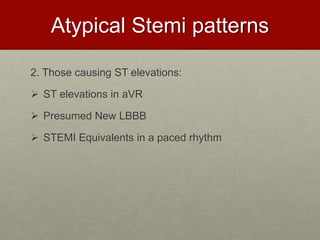
Atypical Stemi patterns
2. Those causing ST elevations:
 ST elevations in aVR
 Presumed New LBBB
 STEMI Equivalents in a paced rhythm
Atypical Stemi patterns
I] Isolated Posterior STEMI:
Posterior heart is involved in 20% cases, but
Isolated Posterior STEMI is seen in 5% patients
only.
When to suspect Posterior STEMI?
1. When there is presence of Inferior & Lateral
STEMI, always do a Posterior ECG to rule out
Posterior STEMI.
2. ECG shows: Isolated ST Depressions in V1-V3
Atypical Stemi patterns
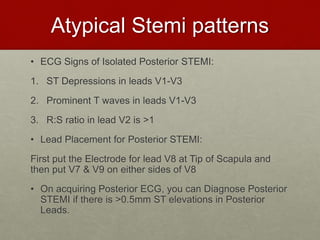
• ECG Signs of Isolated Posterior STEMI:
1. ST Depressions in leads V1-V3
2. Prominent T waves in leads V1-V3
3. R:S ratio in lead V2 is >1
• Lead Placement for Posterior STEMI:
First put the Electrode for lead V8 at Tip of Scapula and
then put V7 & V9 on either sides of V8
• On acquiring Posterior ECG, you can Diagnose Posterior
STEMI if there is >0.5mm ST elevations in Posterior
Leads.
Atypical Stemi patterns
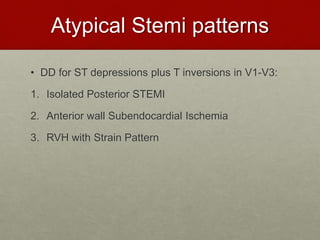
• DD for ST depressions plus T inversions in V1-V3:
1. Isolated Posterior STEMI
2. Anterior wall Subendocardial Ischemia
3. RVH with Strain Pattern
Atypical Stemi patterns
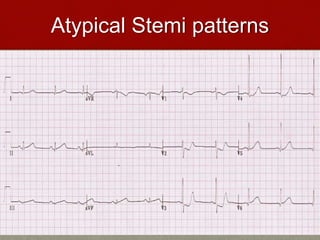
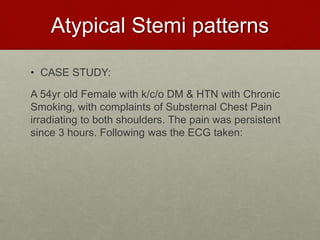
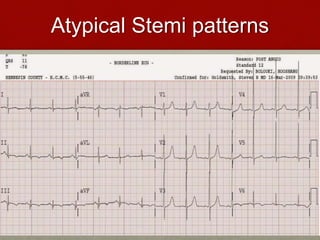
• CASE STUDY:
A 54yr old Female with k/c/o DM & HTN with Chronic
Smoking, with complaints of Substernal Chest Pain
irradiating to both shoulders. The pain was persistent
since 3 hours. Following was the ECG taken:
Atypical Stemi patterns
• The patient was diagnosed as NSTEMI and loaded
with Inj Enoxaparin, Dual Antiplatelets and admitted
to ICU. In ICU, a 2D ECHO was done which
revealed Regional wall motion Abnormality in
Posterior wall. At this point, the patient was sent to
Cath lab for PPCI.
• CAG revealed a complete 100% occlusion in Left
Circumflex Artery (LCX)
• How can such delay be avoided?
Atypical Stemi patterns
• How common is Posterior STEMI? What is the
Significance of Precordial ST Depressions in ACS?
 As per many studies conducted, the average occurrence
rate of an Isolated Posterior STEMI is 3-11%. This is not
a less number!
 In all these patients, a study revealed that an average
time for Door to PCI in these patients was 29.4 hours.
None of the patients had Door to PCI time of less than 6
hours.
 However, note that 3/4th of the patients coming with ST
depressions in Ant Chest leads did not have a completely
occluded Artery. Thus, it is Important to properly evaluate
this ECG and not assume that it is Posterior STEMI.
Atypical Stemi patterns
 Anterior Subendocardial Ischemia Vs Isolated Posterior
STEMI:
Following are few points that can be used to differentiate the two
on ECG:
• First, you should know that when there is precordial ST
depression due to subendocardial ischemia, it is not necessarily
due to anterior wall ischemia. Data from stress testing shows
that subendocardial ischemia DOES NOT LOCALIZE on the
ECG, and usually is in leads II, III, aVF and V4-V6. But, again,
this does not tell you which artery is involved.
• Second, ST depression in V1-V3, vs. V4-V6, is much more
likely to be posterior than subendocardial ischemia.
Atypical Stemi patterns
• Third, patients at higher risk of NSTEMI (older, more risk
factors, h/o angiogram with multivessel disease) are
much more likely to have subendocardial disease (vs.
younger smoker).
• Fourth, patients with reasons to have demand ischemia
(tachycardia, sepsis, GI Bleed, etc.) are much more likely
to have subendocardial ischemia (like in a stress test);
those with posterior MI are much more likely to present
with onset of chest pain and with normal vital signs.
• Fifth, look for tall R-waves in V1-V3 (the analog of Q-
waves in other locations).
Atypical Stemi patterns
• Sixth, placement of posterior leads. At least 0.5 mm of ST
elevation in just one lead appears to be the most sensitive
and specific single "criteria" for posterior MI.
• Seventh, an immediate echocardiogram can make the
distinction
• Eighth, Whether or not it is STEMI, the cath lab should be
activated if the ischemia cannot be controlled medically: aspirin,
nitro, beta blockers, clopidogrel, heparin/enoxaparin, GP IIb/IIIa
inhibitor.
Atypical Stemi patterns
II] Isolated ST depressions in aVL:
• ST depressions in aVL can be reciprocal to Inferior STEMI.
• Birbaum and Smith demonstrated in a study that Reciprocal ST
Depression in aVL can be apparent in absence of STEMI in
Inferior leads.
• In their study, they noted that 99% of patients with Inferior
STEMI have ST depressions in lead aVL as reciprocal
changes, 93% of which had prominent ST elevations in inferior
leads of >1mm. But 7% of patients had only Isolated ST
depressions in lead aVL, for which on further evaluation noted
that patient had Biomarker positive Inferior STEMI.
• As such, the evidence to prove this Hypothesis is still lacking
and Smith et al are still gathering enough evidence to prove it.
• As of now, this finding in ECG does not need immediate Cath
lab activation for PCI, but an Early Cardiologist consult is a
must.
Atypical Stemi patterns
III] Hyperacute T waves:
• Hyperacute T waves are a well defined ECG feature of Early
STEMI. They are noted anywhere between 5 min to 30 min of
onset of Chest Pain.
• They tend to be broad-based, taller than normal T-waves (>5-
10mm in precordial leads) and may be symmetric or asymmetric.
• Very often, reciprocal ST changes are seen in Inferior leads along
with Tall T waves.
• Possible common DD for Tall T waves:
1. Hyperkalemia
2. LVH
3. Benign Early Repolarization
4. Hyperacute Anterior STEMI
Atypical Stemi patterns
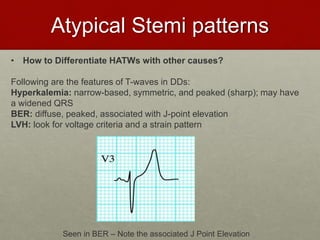
• How to Differentiate HATWs with other causes?
Following are the features of T-waves in DDs:
Hyperkalemia: narrow-based, symmetric, and peaked (sharp); may have
a widened QRS
BER: diffuse, peaked, associated with J-point elevation
LVH: look for voltage criteria and a strain pattern
Seen in BER – Note the associated J Point Elevation
Atypical Stemi patterns
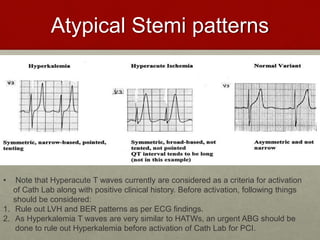
• Note that Hyperacute T waves currently are considered as a criteria for activation
of Cath Lab along with positive clinical history. Before activation, following things
should be considered:
1. Rule out LVH and BER patterns as per ECG findings.
2. As Hyperkalemia T waves are very similar to HATWs, an urgent ABG should be
done to rule out Hyperkalemia before activation of Cath Lab for PCI.
Atypical Stemi patterns
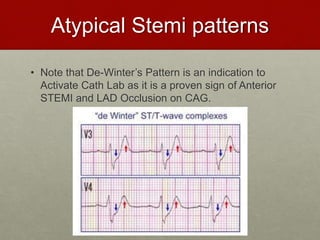
IV] De-Winter’s Pattern:
• In 2008, De-Winter in a Dutch Registry, described a
pattern seen in ECG consistent with Anterior STEMI
and further complete occlusion in LAD found in CAG
in 2% of patients.
• De-Winter’s Pattern: Upsloping ST elevations in
aVR (>1mm) with ST-Depressions and tall T
waves in Precordial leads.
Atypical Stemi patterns
• Note that De-Winter’s Pattern is an indication to
Activate Cath Lab as it is a proven sign of Anterior
STEMI and LAD Occlusion on CAG.
Atypical Stemi patterns
V] ST elevations in aVR:
• Diffused ST depressions with ST elevations in aVR are
indicative of Subendocardial Ischemia and it indicates
that patient may have one of the following:
1. LMCA occlusion
2. LMEQ Disease (Significant stenosis in LAD and LCX)
3. Triple Vessel Disease
• Although studies have suggested that ST Elevations in
aVR have shown complete LMCA occlusion on CAG, still
the contradictory studies hamper the activation of Cath
Lab for such patients
Atypical Stemi patterns
• Current Guidelines for ST elevations in aVR:
1. If the patient is Unstable and has Subendocardial
Pattern of Ischemia with ST Elevations in aVR –
Activate Cath Lab immediately.
2. If the patient with similar ECG is stable – Do an
Emergency 2D ECHO and a Cardiology Consult
before activating Cath Lab.
Atypical Stemi patterns
V] Presumed New LBBB:
• Historically, it is clear that a new onset LBBB is
considered as a STEMI Equivalent.
• But, Studies by Chang et al in 2009 and Neeland et al in
2012 indicated that only about 40% of patients with New
Presumed LBBB have been found to have culprit lesion
on CAG.
• STEMI guidelines from 2013 have now removed
Presumed New LBBB as being Diagnostic for MI “In
Isolation”
• Further, a Presumed New onset LBBB might not be a
New onset LBBB and paperwork drawback may cause
problems.
• Thus, Presumed New Onset LBBB is not an indication for
Cath Lab Activation.
Atypical Stemi patterns
• Which patients should we activate Cath Lab call in
Presumed New Onset LBBB?
1. Patients who are Unstable and have Presumed
new LBBB
2. Patients with Positive 2D ECHO findings of
Regional wall motion abnormality with low EF
3. LBBB meeting Sgarbossa’s Criteria
Atypical Stemi patterns
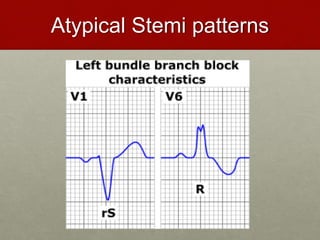
VI] STEMI Equivalents in Paced Rhythms & Old LBBB:
• Most of the Pacemakers are inserted in Right Ventricle
and the pattern thus formed bypasses the Bundle of His,
ultimately mimicking LBBB pattern.
• Largest study till date for this has been published by
Sgarbossa et al in 32 patients with Pacemaker and
Coronary Occlusion.
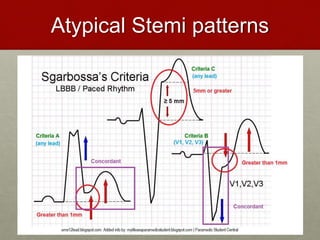
• Sgarbossa Criteria: It states that LBBB or Pacemaker
with following signs on ECG are indicative of Coronary
Occlusion-
1. Concordant ST Elevation >1mm
2. Concordant ST Depression >1mm in V1-V3
3. Discordant ST Elevation >5mm
Atypical Stemi patterns
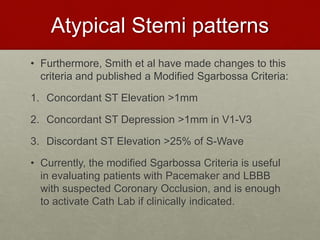
• Furthermore, Smith et al have made changes to this
criteria and published a Modified Sgarbossa Criteria:
1. Concordant ST Elevation >1mm
2. Concordant ST Depression >1mm in V1-V3
3. Discordant ST Elevation >25% of S-Wave
• Currently, the modified Sgarbossa Criteria is useful
in evaluating patients with Pacemaker and LBBB
with suspected Coronary Occlusion, and is enough
to activate Cath Lab if clinically indicated.
Atypical Stemi patterns
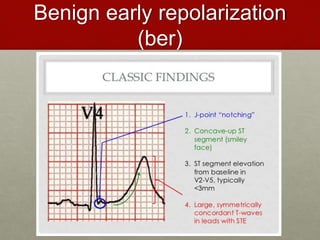
Benign early repolarization
(ber)
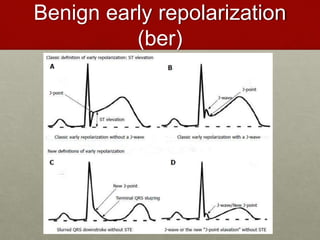
Benign early repolarization
(ber)
BER vs STEMI
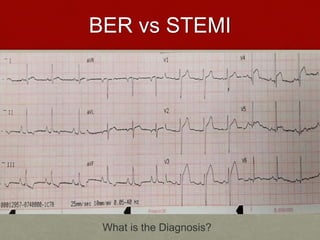
• Case Study:
A 36yr old Male with history of Seizure Disorder. He
had a seizure in the morning and rolled out of bed. In
ER, patient is stable and has no complaints of Chest
Pain. His prehospital ECG was taken in Ambulance:
BER vs STEMI
What is the Diagnosis?
BER vs STEMI
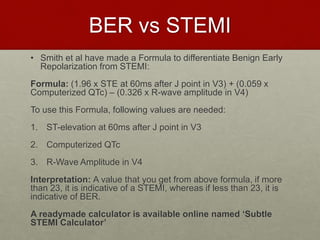
• Smith et al have made a Formula to differentiate Benign Early
Repolarization from STEMI:
Formula: (1.96 x STE at 60ms after J point in V3) + (0.059 x
Computerized QTc) – (0.326 x R-wave amplitude in V4)
To use this Formula, following values are needed:
1. ST-elevation at 60ms after J point in V3
2. Computerized QTc
3. R-Wave Amplitude in V4
Interpretation: A value that you get from above formula, if more
than 23, it is indicative of a STEMI, whereas if less than 23, it is
indicative of BER.
A readymade calculator is available online named ‘Subtle
STEMI Calculator’
BER vs STEMI
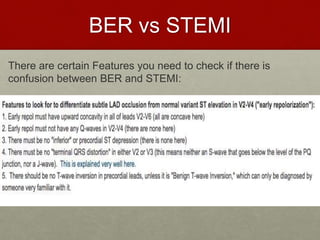
There are certain Features you need to check if there is
confusion between BER and STEMI:
BER vs STEMI
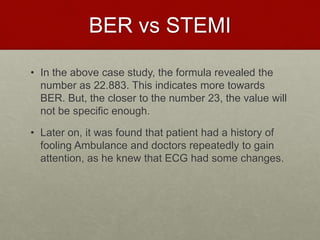
• In the above case study, the formula revealed the
number as 22.883. This indicates more towards
BER. But, the closer to the number 23, the value will
not be specific enough.
• Later on, it was found that patient had a history of
fooling Ambulance and doctors repeatedly to gain
attention, as he knew that ECG had some changes.
Terminal qrs distortion
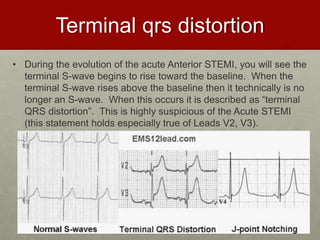
• During the evolution of the acute Anterior STEMI, you will see the
terminal S-wave begins to rise toward the baseline. When the
terminal S-wave rises above the baseline then it technically is no
longer an S-wave. When this occurs it is described as “terminal
QRS distortion”. This is highly suspicious of the Acute STEMI
(this statement holds especially true of Leads V2, V3).
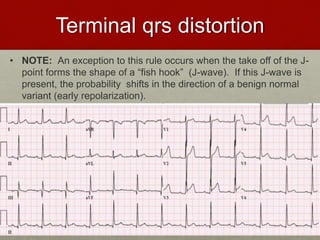
Terminal qrs distortion
• NOTE: An exception to this rule occurs when the take off of the J-
point forms the shape of a “fish hook” (J-wave). If this J-wave is
present, the probability shifts in the direction of a benign normal
variant (early repolarization).
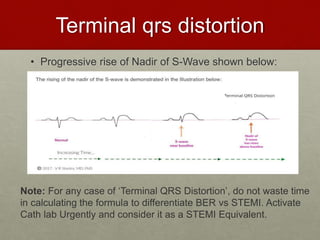
Terminal qrs distortion
• Progressive rise of Nadir of S-Wave shown below:
Note: For any case of ‘Terminal QRS Distortion’, do not waste time
in calculating the formula to differentiate BER vs STEMI. Activate
Cath lab Urgently and consider it as a STEMI Equivalent.
Conclusion
• Even though these Atypical STEMI Patterns are
relatively rare, an Emergency Physician should
know them correctly. This will allow to cut short the
delay in PPCI activation and can be useful in Early
Reperfusion of Occluded Coronary Artery.
THANK YOU

Atypical stemi patterns and stemi equivalents

  • 1.
    Atypical stemi patterns& stemi equivalents - Dr Varun Patel Courtesy for References: 1. EM Docs website 2. Dr Stephen Smith’s Blog 3. ECG in Acute MI Book by Dr Stephen smith 4. Life in the Fast lane Website
  • 2.
  • 3.
  • 4.
    Basic physiology ofstemi • Due to Ischemia -> Damage to Na/K ATPase Pump occurs -> Decreased intracellular K levels -> Delayed Phase 3 repolarization. • The repolarization in normal cells start from the point of Depolarization start. In Ischemic cells, it is the other way round and repolarization begins from the last point of depolarization.
  • 5.
    Basic Physiology instemi • Hyperacute T waves • ST segment Elevation: Current of Injury Theory Incomplete Depolarization Theory • Reciprocal Changes • Q wave formation
  • 6.
  • 7.
    St changes butnot mi • Following are changes in ST segment that are not considered as MI: LVH with strain pattern Early Repolarization Pericarditis LV Aneurysm (Persistent ST elevation after 6 weeks of Transmural MI)
  • 8.
    Atypical stemi patterns •There are some patterns of ECG that are not typical but are considered significant as Equivalents to STEMI during diagnosis of ACS. • These are divided for convenience into 2 sections: 1. Those causing ST depression and T wave changes 2. Those causing ST elevations • The important question to answer is – Whether to activate Cath Lab for PCI in these cases? We will deal with it one by one.
  • 9.
    Atypical Stemi patterns 1.Those causing ST depression and T wave changes:  Isolated Posterior STEMI  Isolated ST depression in aVL  Hyperacute T waves  De-Winter’s pattern
  • 10.
    Atypical Stemi patterns 2.Those causing ST elevations:  ST elevations in aVR  Presumed New LBBB  STEMI Equivalents in a paced rhythm
  • 11.
    Atypical Stemi patterns I]Isolated Posterior STEMI: Posterior heart is involved in 20% cases, but Isolated Posterior STEMI is seen in 5% patients only. When to suspect Posterior STEMI? 1. When there is presence of Inferior & Lateral STEMI, always do a Posterior ECG to rule out Posterior STEMI. 2. ECG shows: Isolated ST Depressions in V1-V3
  • 12.
    Atypical Stemi patterns •ECG Signs of Isolated Posterior STEMI: 1. ST Depressions in leads V1-V3 2. Prominent T waves in leads V1-V3 3. R:S ratio in lead V2 is >1 • Lead Placement for Posterior STEMI: First put the Electrode for lead V8 at Tip of Scapula and then put V7 & V9 on either sides of V8 • On acquiring Posterior ECG, you can Diagnose Posterior STEMI if there is >0.5mm ST elevations in Posterior Leads.
  • 13.
  • 14.
    Atypical Stemi patterns •DD for ST depressions plus T inversions in V1-V3: 1. Isolated Posterior STEMI 2. Anterior wall Subendocardial Ischemia 3. RVH with Strain Pattern
  • 15.
    Atypical Stemi patterns •CASE STUDY: A 54yr old Female with k/c/o DM & HTN with Chronic Smoking, with complaints of Substernal Chest Pain irradiating to both shoulders. The pain was persistent since 3 hours. Following was the ECG taken:
  • 16.
  • 17.
    Atypical Stemi patterns •The patient was diagnosed as NSTEMI and loaded with Inj Enoxaparin, Dual Antiplatelets and admitted to ICU. In ICU, a 2D ECHO was done which revealed Regional wall motion Abnormality in Posterior wall. At this point, the patient was sent to Cath lab for PPCI. • CAG revealed a complete 100% occlusion in Left Circumflex Artery (LCX) • How can such delay be avoided?
  • 18.
    Atypical Stemi patterns •How common is Posterior STEMI? What is the Significance of Precordial ST Depressions in ACS?  As per many studies conducted, the average occurrence rate of an Isolated Posterior STEMI is 3-11%. This is not a less number!  In all these patients, a study revealed that an average time for Door to PCI in these patients was 29.4 hours. None of the patients had Door to PCI time of less than 6 hours.  However, note that 3/4th of the patients coming with ST depressions in Ant Chest leads did not have a completely occluded Artery. Thus, it is Important to properly evaluate this ECG and not assume that it is Posterior STEMI.
  • 19.
    Atypical Stemi patterns Anterior Subendocardial Ischemia Vs Isolated Posterior STEMI: Following are few points that can be used to differentiate the two on ECG: • First, you should know that when there is precordial ST depression due to subendocardial ischemia, it is not necessarily due to anterior wall ischemia. Data from stress testing shows that subendocardial ischemia DOES NOT LOCALIZE on the ECG, and usually is in leads II, III, aVF and V4-V6. But, again, this does not tell you which artery is involved. • Second, ST depression in V1-V3, vs. V4-V6, is much more likely to be posterior than subendocardial ischemia.
  • 20.
    Atypical Stemi patterns •Third, patients at higher risk of NSTEMI (older, more risk factors, h/o angiogram with multivessel disease) are much more likely to have subendocardial disease (vs. younger smoker). • Fourth, patients with reasons to have demand ischemia (tachycardia, sepsis, GI Bleed, etc.) are much more likely to have subendocardial ischemia (like in a stress test); those with posterior MI are much more likely to present with onset of chest pain and with normal vital signs. • Fifth, look for tall R-waves in V1-V3 (the analog of Q- waves in other locations).
  • 21.
    Atypical Stemi patterns •Sixth, placement of posterior leads. At least 0.5 mm of ST elevation in just one lead appears to be the most sensitive and specific single "criteria" for posterior MI. • Seventh, an immediate echocardiogram can make the distinction • Eighth, Whether or not it is STEMI, the cath lab should be activated if the ischemia cannot be controlled medically: aspirin, nitro, beta blockers, clopidogrel, heparin/enoxaparin, GP IIb/IIIa inhibitor.
  • 22.
    Atypical Stemi patterns II]Isolated ST depressions in aVL: • ST depressions in aVL can be reciprocal to Inferior STEMI. • Birbaum and Smith demonstrated in a study that Reciprocal ST Depression in aVL can be apparent in absence of STEMI in Inferior leads. • In their study, they noted that 99% of patients with Inferior STEMI have ST depressions in lead aVL as reciprocal changes, 93% of which had prominent ST elevations in inferior leads of >1mm. But 7% of patients had only Isolated ST depressions in lead aVL, for which on further evaluation noted that patient had Biomarker positive Inferior STEMI. • As such, the evidence to prove this Hypothesis is still lacking and Smith et al are still gathering enough evidence to prove it. • As of now, this finding in ECG does not need immediate Cath lab activation for PCI, but an Early Cardiologist consult is a must.
  • 23.
    Atypical Stemi patterns III]Hyperacute T waves: • Hyperacute T waves are a well defined ECG feature of Early STEMI. They are noted anywhere between 5 min to 30 min of onset of Chest Pain. • They tend to be broad-based, taller than normal T-waves (>5- 10mm in precordial leads) and may be symmetric or asymmetric. • Very often, reciprocal ST changes are seen in Inferior leads along with Tall T waves. • Possible common DD for Tall T waves: 1. Hyperkalemia 2. LVH 3. Benign Early Repolarization 4. Hyperacute Anterior STEMI
  • 24.
    Atypical Stemi patterns •How to Differentiate HATWs with other causes? Following are the features of T-waves in DDs: Hyperkalemia: narrow-based, symmetric, and peaked (sharp); may have a widened QRS BER: diffuse, peaked, associated with J-point elevation LVH: look for voltage criteria and a strain pattern Seen in BER – Note the associated J Point Elevation
  • 25.
    Atypical Stemi patterns •Note that Hyperacute T waves currently are considered as a criteria for activation of Cath Lab along with positive clinical history. Before activation, following things should be considered: 1. Rule out LVH and BER patterns as per ECG findings. 2. As Hyperkalemia T waves are very similar to HATWs, an urgent ABG should be done to rule out Hyperkalemia before activation of Cath Lab for PCI.
  • 26.
    Atypical Stemi patterns IV]De-Winter’s Pattern: • In 2008, De-Winter in a Dutch Registry, described a pattern seen in ECG consistent with Anterior STEMI and further complete occlusion in LAD found in CAG in 2% of patients. • De-Winter’s Pattern: Upsloping ST elevations in aVR (>1mm) with ST-Depressions and tall T waves in Precordial leads.
  • 27.
  • 28.
    Atypical Stemi patterns •Note that De-Winter’s Pattern is an indication to Activate Cath Lab as it is a proven sign of Anterior STEMI and LAD Occlusion on CAG.
  • 29.
    Atypical Stemi patterns V]ST elevations in aVR: • Diffused ST depressions with ST elevations in aVR are indicative of Subendocardial Ischemia and it indicates that patient may have one of the following: 1. LMCA occlusion 2. LMEQ Disease (Significant stenosis in LAD and LCX) 3. Triple Vessel Disease • Although studies have suggested that ST Elevations in aVR have shown complete LMCA occlusion on CAG, still the contradictory studies hamper the activation of Cath Lab for such patients
  • 30.
  • 31.
    Atypical Stemi patterns •Current Guidelines for ST elevations in aVR: 1. If the patient is Unstable and has Subendocardial Pattern of Ischemia with ST Elevations in aVR – Activate Cath Lab immediately. 2. If the patient with similar ECG is stable – Do an Emergency 2D ECHO and a Cardiology Consult before activating Cath Lab.
  • 32.
    Atypical Stemi patterns V]Presumed New LBBB: • Historically, it is clear that a new onset LBBB is considered as a STEMI Equivalent. • But, Studies by Chang et al in 2009 and Neeland et al in 2012 indicated that only about 40% of patients with New Presumed LBBB have been found to have culprit lesion on CAG. • STEMI guidelines from 2013 have now removed Presumed New LBBB as being Diagnostic for MI “In Isolation” • Further, a Presumed New onset LBBB might not be a New onset LBBB and paperwork drawback may cause problems. • Thus, Presumed New Onset LBBB is not an indication for Cath Lab Activation.
  • 33.
    Atypical Stemi patterns •Which patients should we activate Cath Lab call in Presumed New Onset LBBB? 1. Patients who are Unstable and have Presumed new LBBB 2. Patients with Positive 2D ECHO findings of Regional wall motion abnormality with low EF 3. LBBB meeting Sgarbossa’s Criteria
  • 34.
  • 35.
    Atypical Stemi patterns VI]STEMI Equivalents in Paced Rhythms & Old LBBB: • Most of the Pacemakers are inserted in Right Ventricle and the pattern thus formed bypasses the Bundle of His, ultimately mimicking LBBB pattern. • Largest study till date for this has been published by Sgarbossa et al in 32 patients with Pacemaker and Coronary Occlusion. • Sgarbossa Criteria: It states that LBBB or Pacemaker with following signs on ECG are indicative of Coronary Occlusion- 1. Concordant ST Elevation >1mm 2. Concordant ST Depression >1mm in V1-V3 3. Discordant ST Elevation >5mm
  • 36.
    Atypical Stemi patterns •Furthermore, Smith et al have made changes to this criteria and published a Modified Sgarbossa Criteria: 1. Concordant ST Elevation >1mm 2. Concordant ST Depression >1mm in V1-V3 3. Discordant ST Elevation >25% of S-Wave • Currently, the modified Sgarbossa Criteria is useful in evaluating patients with Pacemaker and LBBB with suspected Coronary Occlusion, and is enough to activate Cath Lab if clinically indicated.
  • 37.
  • 38.
  • 39.
  • 40.
    BER vs STEMI •Case Study: A 36yr old Male with history of Seizure Disorder. He had a seizure in the morning and rolled out of bed. In ER, patient is stable and has no complaints of Chest Pain. His prehospital ECG was taken in Ambulance:
  • 41.
    BER vs STEMI Whatis the Diagnosis?
  • 42.
    BER vs STEMI •Smith et al have made a Formula to differentiate Benign Early Repolarization from STEMI: Formula: (1.96 x STE at 60ms after J point in V3) + (0.059 x Computerized QTc) – (0.326 x R-wave amplitude in V4) To use this Formula, following values are needed: 1. ST-elevation at 60ms after J point in V3 2. Computerized QTc 3. R-Wave Amplitude in V4 Interpretation: A value that you get from above formula, if more than 23, it is indicative of a STEMI, whereas if less than 23, it is indicative of BER. A readymade calculator is available online named ‘Subtle STEMI Calculator’
  • 43.
    BER vs STEMI Thereare certain Features you need to check if there is confusion between BER and STEMI:
  • 44.
    BER vs STEMI •In the above case study, the formula revealed the number as 22.883. This indicates more towards BER. But, the closer to the number 23, the value will not be specific enough. • Later on, it was found that patient had a history of fooling Ambulance and doctors repeatedly to gain attention, as he knew that ECG had some changes.
  • 45.
    Terminal qrs distortion •During the evolution of the acute Anterior STEMI, you will see the terminal S-wave begins to rise toward the baseline. When the terminal S-wave rises above the baseline then it technically is no longer an S-wave. When this occurs it is described as “terminal QRS distortion”. This is highly suspicious of the Acute STEMI (this statement holds especially true of Leads V2, V3).
  • 46.
    Terminal qrs distortion •NOTE: An exception to this rule occurs when the take off of the J- point forms the shape of a “fish hook” (J-wave). If this J-wave is present, the probability shifts in the direction of a benign normal variant (early repolarization).
  • 47.
    Terminal qrs distortion •Progressive rise of Nadir of S-Wave shown below: Note: For any case of ‘Terminal QRS Distortion’, do not waste time in calculating the formula to differentiate BER vs STEMI. Activate Cath lab Urgently and consider it as a STEMI Equivalent.
  • 48.
    Conclusion • Even thoughthese Atypical STEMI Patterns are relatively rare, an Emergency Physician should know them correctly. This will allow to cut short the delay in PPCI activation and can be useful in Early Reperfusion of Occluded Coronary Artery. THANK YOU