ATTRIBUTION
THEORY
Attribution
The ways in which people come to
understand the causes of their own and
others’behaviors.
Attribution Theory
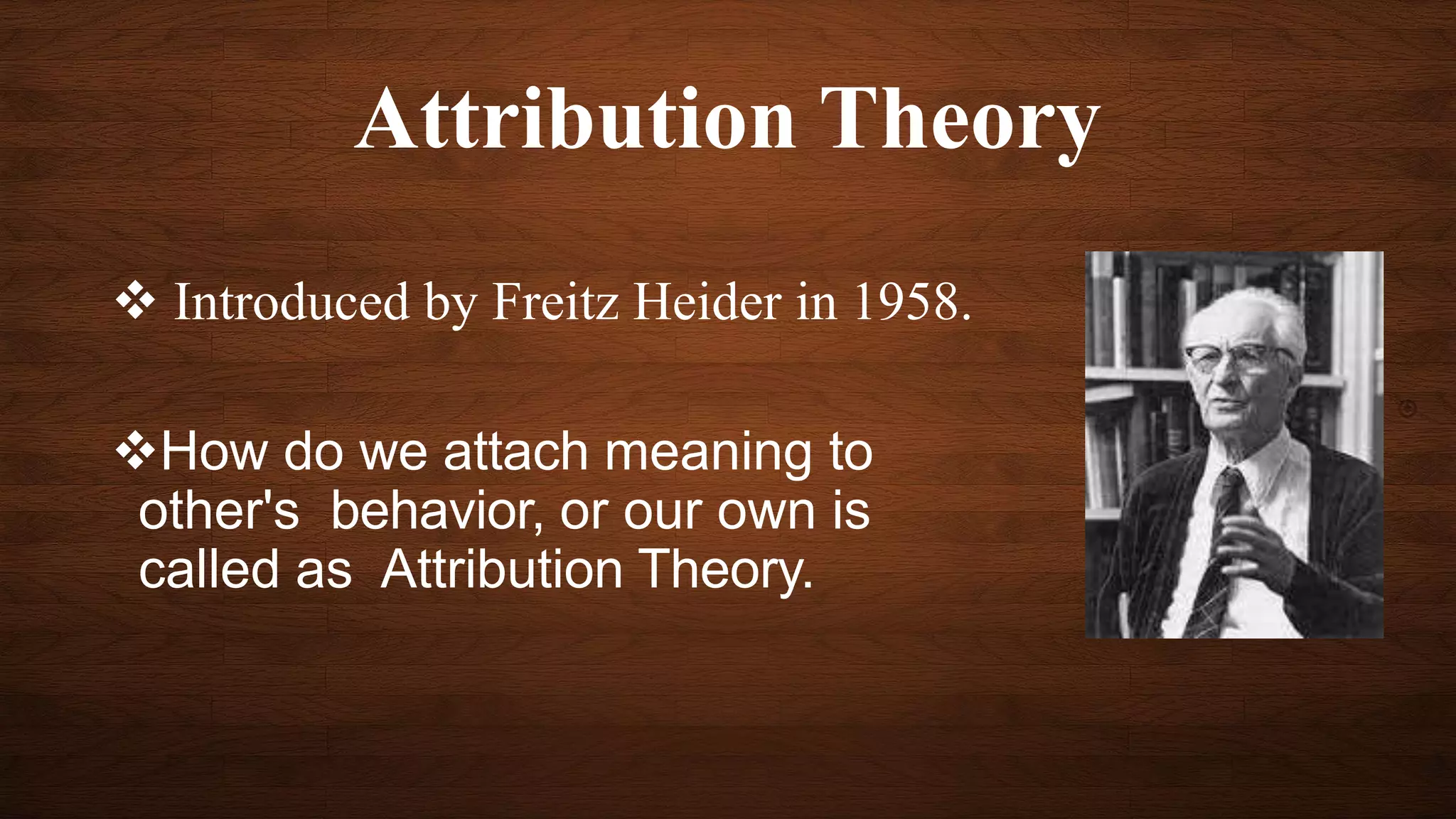
 Introduced by Freitz Heider in 1958.
How do we attach meaning to
other's behavior, or our own is
called as Attribution Theory.
Types of Attribution
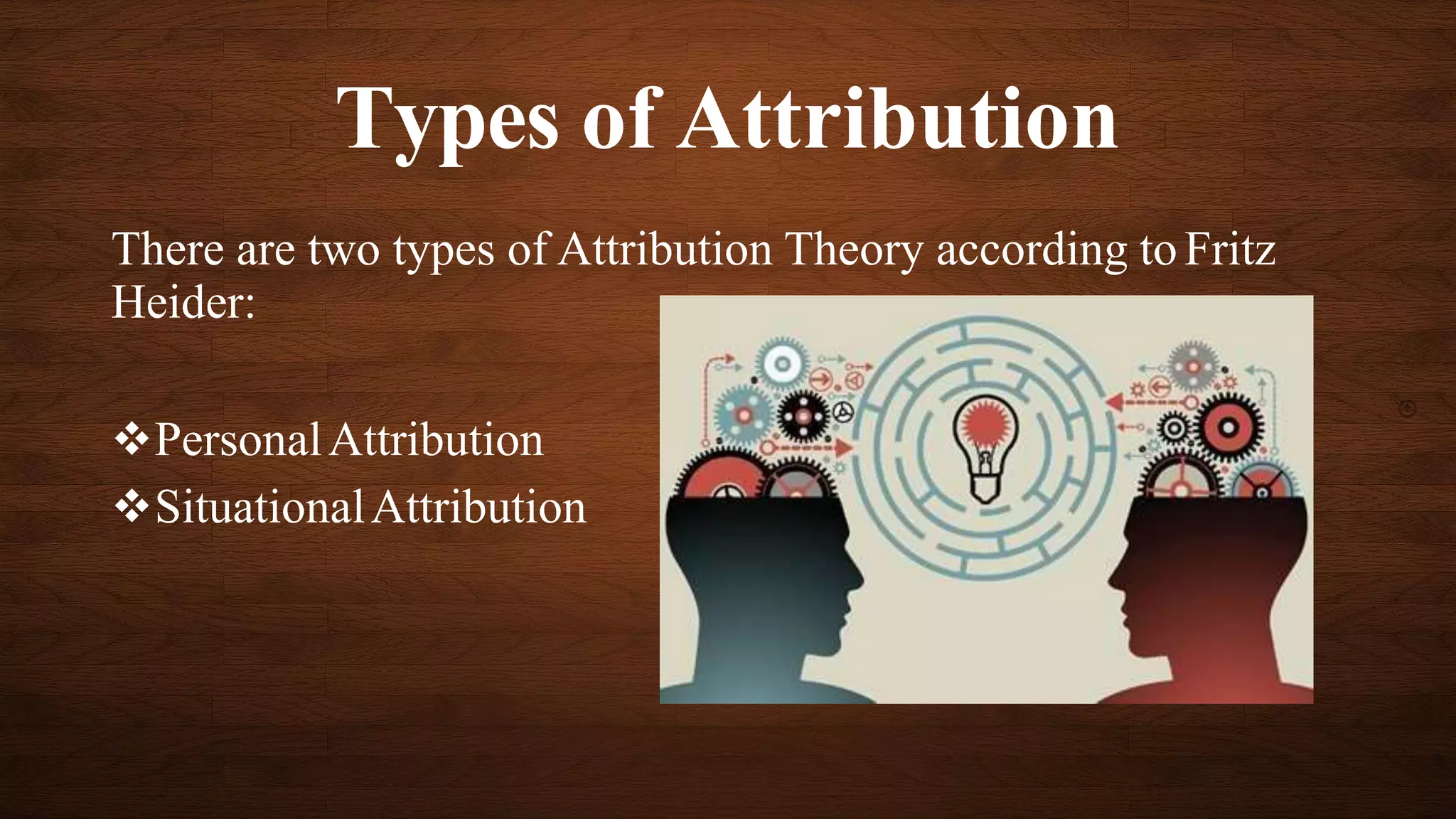
There are two types of Attribution Theory according toFritz
Heider:
PersonalAttribution
SituationalAttribution
Personal or Internal Attribution:
Explain an outcome by looking within an
individual.
Situational or External Attribution:
Explain an outcome by looking outside of an
individual.
Some AttributionErrors
Self-serving bias
Fundamental Attribution
Error
Halo effect
Self-Serving bias
• People do not make objective situational / personal
attributions for their own behavior, though.
• They tend to attribute their successes to dispositional
factors, and their failures to situational factors.
• For example: “I did well on the test because I am smart,”
or “I did poor on the test because I didn’t get enough sleep.
Fundamental attributionError
• The tendency to attribute the behavior of other people
more to internal than to external.
• Refers to Our tendency to see the person rather than situation
as the Main cause of person’s behavior.
• Example: if a person is late for work Observers are more
likely to conclude that he is lazy than to consider the
external factors.
Halo Effect
• To draw the general Impression of an individual on the basis
of his single characteristic.
• A big attritional Error.
• Example:-If a person having good formal dressing sense is
late. Observer make a conclusion that the external causes are
responsible then internal causes.
Conclusion
Keeping in mind the Attribution Theory a person should
always think before he reacts. He should not always
believe what he sees but should also focus on the both
situational and personal attributions and after that only
he/she should judge the person. A person should not
blame others for any situation or if any bad thing is taking
place.

attribution theory.pptx

  • 1.
  • 2.
    Attribution The ways inwhich people come to understand the causes of their own and others’behaviors.
  • 3.
    Attribution Theory  Introducedby Freitz Heider in 1958. How do we attach meaning to other's behavior, or our own is called as Attribution Theory.
  • 5.
    Types of Attribution Thereare two types of Attribution Theory according toFritz Heider: PersonalAttribution SituationalAttribution
  • 6.
    Personal or InternalAttribution: Explain an outcome by looking within an individual. Situational or External Attribution: Explain an outcome by looking outside of an individual.
  • 7.
  • 8.
    Self-Serving bias • Peopledo not make objective situational / personal attributions for their own behavior, though. • They tend to attribute their successes to dispositional factors, and their failures to situational factors. • For example: “I did well on the test because I am smart,” or “I did poor on the test because I didn’t get enough sleep.
  • 9.
    Fundamental attributionError • Thetendency to attribute the behavior of other people more to internal than to external. • Refers to Our tendency to see the person rather than situation as the Main cause of person’s behavior. • Example: if a person is late for work Observers are more likely to conclude that he is lazy than to consider the external factors.
  • 10.
    Halo Effect • Todraw the general Impression of an individual on the basis of his single characteristic. • A big attritional Error. • Example:-If a person having good formal dressing sense is late. Observer make a conclusion that the external causes are responsible then internal causes.
  • 11.
    Conclusion Keeping in mindthe Attribution Theory a person should always think before he reacts. He should not always believe what he sees but should also focus on the both situational and personal attributions and after that only he/she should judge the person. A person should not blame others for any situation or if any bad thing is taking place.