A LAW FIRM'S
GUIDE TO
TRANSITION
PLANNING
An Overview
Table of Contents
9.
10.
11.
12.
Orderly Transfer of Ownership Interests
Partnership/Operating Agreement Revisions
Financial Plan
Implementation Support
13. Building a Platform (Going Concern Value)
Process Management and Setting Expectation1.
2. Work-life Timelines and Capacity Planning
3. Marketing Plan
Attorney Development4.
5. Recruiting Process
Compensation and Incentives6.
7. Transition (Buyout) Compensation
8. Policy Development
Valuing a Law Practice14.
With an estimated 65% of equity partners approaching retirement age
over the next decade, most attorneys working in a firm will be affected
by the challenge of transition planning. While this statistic is notable, most
law firms pay little attention to partners’ plans for retirement. In fact, less
than 35% of firms have written agreements covering transition planning
and retirement.
A successful transition plan will benefit retiring partners, the firm, and the
firm's clients. Wise law firms will take the time to create and implement
a solid transition plan and will have a competitive advantage. What steps
are needed to develop an effective transition plan?
This eBook can guide your firm in answering such questions:
• 1.
• 2.
• 3.
3
AN OVERVIEW:
Law Firm Transition Planning
What transition compensation should I receive?
Does my firm have the resources to complete a
successful transition?
How do I fairly value my practice?
PerformLaw for Your Law Firm
PerformLaw is focused on planning, development,
analysis & improvement of your firm. We won’t waste
your time. We operate efficiently to keep costs down
and provide professional, dedicated staff to service
each client. Committed to earning your trust, we want
to serve as your “business coach for life.”
In regards to transition planning, PerformLaw can help
your firm to navigate the strategic, management,
economic and cultural issues involved in transitioning
a law firm. We can also share our experience and
knowledge of the best practices in the industry and
help to benchmark where you stand against your peer
firms.
LEARN MORE
4
Law firms taking a progressive approach to considering the elements of a transition
plan must have a sustained focus. This is often difficult for administrators and
lawyers who must manage daily business demands and press client service issues. To
best ensure the planning process remains focused and deliberate, a law firm needs
outside support to work in conjunction with in-house resources.
We have found that management personnel shares many of the concerns of younger
partners, associates, and staff. Their awareness of the business continuity issues
typically comes from their experience and direct input from the individual lawyers and
other employees.
We see management and staff as participants in the process who also have a stake in the
outcome of the process. Additionally, objective third party advice can enable a less
risky communication process from not partner participants.
A typical transition planning process takes six months to a year to complete and involves an in-
depth analysis of the following areas:
· Work-life timelines and capacity planning;
· Marketing;
· Attorney development;
· Recruiting;
· Compensation and incentives;
· Transition and buyout compensation;
· Policy formulation;
· Partnership or operating agreement;
· Orderly transfer of ownership interests;
· Technology;
· Platform building;
· Implementation timing and process; and
· Staff Development
1. Process
Management
and Setting
Expectations
5
Taken together, these areas of concentration inform a firm’s highest
priorities. The broad purpose of each analysis as follows:
• Work-life timelines provide a planning horizon;
• Marketing effectiveness indicates the firm’s ability to meet revenue goals;
Attorney development is essential to skill set continuity;
• Recruiting effectiveness enables a firm to address capability and capacity
weaknesses;
• Compensation and incentives can attract high-profit laterals, ensure partners
practice profitably, and incent senior partner transitions;
• Policy development is essential for promoting consistency and building trust
among partners, associates and staff;
• A partnership or operating agreement ensures that necessary actions have the
weight of a legal agreement;
• Perpetuating a law firm requires a process for transferring equity without
controversy;
• Technology can promote efficiency, provide a competitive advantage and bind
clients to the firm;
• Creating a platform that elevates the success of the lawyers and staff builds
value;
• A trained and motivated staff can support the knowledge transfer process; and
• Ensuring that process moves from planning to implementation is vital to the
long-term interests of the firm.
The goal of the transition planning process is to develop a set of
thoroughly analyzed and ready-to implement priorities.
6
Work-life timelines for all attorneys within ten years of retirement age are necessary for
indicating the future capacity needs of the firm. It is our experience that many attorneys
seriously consider retirement between age 68 and 70.
Practice areas are more likely to survive over a longer continuum than
many client relationships. For this reason, transition planning ten years before
an actual retirement is conceptual and primarily focused on the sustainability of
the skill sets in any affected practice areas.
Preparing work-life timelines in advance forces aging partners to consider
their successors. In our experience, introducing replacement lawyers into a client
account at least three years before a partner retirement can improve client retention
probability.
Choosing a successor from an existing account team seems logical, but is not always an
optimal choice. In many instances, loyalty and emotional attachment can impair the
judgment of the retiring partner. Law firm management can struggle to find a voice in
these situations. The retiring partner may feel that a loyal and hardworking member of the
account team deserves an opportunity to assume the lead role, which is fine if this person
is the best choice.
Most small and mid-sized firms have a non-interventionist policy regarding partner and
client relationships, and it’s hard to insert a successor lawyer into a client account without
the full support of the retiring partner and key members the account team. As we have had
better success with incentives rather than penalties, we recommend approaches that
encourage retiring partner cooperation.
2. Work-life Timelines
and Capacity Planning
7
• Age;
• Experience;
• Unique skill sets;
• Billable hours targets;
• Skill development needs;
• Marketing goals;
• Bar and professional goals;
• Pro Bono commitments;
• Recruiting responsibilities; and
• Administrative contributions.
These analyses are prepared, as relevant, at the firm, section, practice or by strategic
grouping. For example, by client team or even by skill set such as trial experience.
Capacity planning is inexpensive but curing the indicated weaknesses typically comes at
a cost. For example, hiring in advance of the need to allow for training can run into six
figures during the ramp up period.
Several benefits and risks come with this approach to capability and capacity
management including:
Benefits:
Ø Enables transition planning;
Ø Guards against turnover;
Ø Can contribute to the competitiveness of the firm;
Ø Can create competitive peer pressure;
Ø Helps ensure high client service levels; and
Ø Can maximize profitability when work surges.
Capacity planning that includes a consideration of skill and experience levels is an
essential element of any transition plan. The items considered in a capacity plan include
the following:
8
Risks:
Ø Financial risk;
Ø People don’t always work out;
Ø Excess capacity can impact productivity of others;
Ø Training objectives not achieved;
Ø Clients may not cooperate;
Ø Potential compensation implications; and;
Ø Partners who do not directly benefit may lose patience with the process.
Assuming a firm can get comfortable with the risks, staffing in advance of demand is a
useful tool in transition readiness.
Another element of capability and capacity management is the concept of strategic
staffing. This staffing approach seeks to align case assignments with skill development or
client transition objectives. For example, assigning a senior associate who needs trial
experience to cases that are going to trial, or working a successor lawyer into a client’s
most important matters.
The largest impediment to this staffing approach is a workload imbalance (big case, new
work, turnover, etc.) that causes immediate capacity needs to meet client demands. When
this happens, the firm’s short-term needs come into conflict with long-term strategic goals.
Typically, short-term priorities win. The pressure of the work and the immediate financial
gains can create an overwhelming force. Unfortunately, these situations can result in
unprepared associate lawyers, a weak transition posture, a bloated cost structure
and challenging HR situation.
9
Ensuring the long-term viability of the firm requires a more
thoughtful approach to staffing and a genuine interest in the
careers of colleagues and co-workers. The risks to a
disciplined approach to staffing are real, but the benefits can
define a firm for decades.
Successfully transitioning a law firm to the
next generation is imperative to the continuation
of a law firm. Law firms must be able to
retain longstanding clients and also consistently
attract new business. To do this, a law firm
must often develop a strategic staffing process
and expand its marketing approach.
Strategic Staffing:
Smart competitors will seize any possible opening in
a client relationship. Ensuring that the
firm is ready for these challenges is an
advantage. We recommend strategic client
staffing to ensure that younger lawyers
build the essential relationships among the
firm’s current clients, which will make
competitive challenges more difficult.
Senior partners should evaluate their
client staffing assignments at least three
years before any planned transition. If no
existing resources are available, we
recommend a targeted recruiting process.
3. Marketing
Plan
Expanded Marketing Approach:
Modernizing the firm’s marketing efforts can also improve the chances of a successful
transition. With the help of workflows driven by software applications, law firms can also
use support staff in the marketing process.
New marketing techniques focus on reaching clients digitally with written content,
webinars, video education, and blogging. The intent is to attract visitors to the firm’s website,
where the firm has the most marketing latitude.
10
Many successful lawyers also create content rich blogs to support their value to
existing clients and to build new relationships. Often these blogs are hosted apart from
the firm’s main website. We like an approach that has some content hosted on a
blogging platform and some on the law firm’s website.
Regardless of the content hosting method, we recommend that law firms commit
resources to the following items, which are affordable for any size firm:
Web Development;
Search Engine Optimization;
Social Media Support;
Video Production Support;
Graphics Support;
Editorial Support;
Marketing Automation Software;
Research; and
Content development.
Building a marketing platform to assist lawyers and future recruits with their
marketing efforts will better enable and incent them to commit to any transition plan the
partners adopt.
Relying only on current clients remaining with the firm is typically insufficient. A
marketing system that draws new clients to the firm, while hard to perfect, helps
ensure that talented lawyers stay with the firm rather than leaving for better-equipped
competitors.
Overcoming Resistance:
It is typical, however, to meet resistance to new styles of marketing. More experienced
lawyers often prefer traditional marketing activities such as travel, entertainment,
speaking, professional and trade associations, and some structured publishing.
Traditional marketing activities are all still necessary, but possibly to a lesser degree. A
good marketing plan can combine traditional and digital marketing approaches to
increase the overall effectiveness of the firm’s marketing efforts.
11 BACK TO THE TABLE OF CONTENTS
4. Attorney Development
Attorney development can happen at any age, but starting the process early in a
lawyer’s career provides greater opportunity to identify future leaders. The goals of
an attorney development system include:
• Nurturing those best suited to serve client needs;
• Enabling lawyers to reach their full potential; and
• Early identification of those who would perform better in another role.
To achieve these goals, we recommend a systematic approach to
attorney development built on setting expectations, capacity planning,
compensation, and progress measurement. More specifically, developing the best
lawyers requires several policies, systems, and guidelines that include:
• Hiring criteria;
• Model associate guidelines and expectations;
• Evaluation and or feedback process;
• Practice planning process;
• Client and senior lawyer staffing alignment;
• Compensation and Incentives for billable contributions;
• Compensation and incentives for supervision and training;
• Compensation and incentives for targeted recruiting;
• Origination and origination sharing policies; and
• A transition compensation structure.
12
At the attorney level, effective capacity planning requires a balanced
approach to time investments. In addition to billable expectations, developing a
quality lawyer requires time commitments in the following areas:
• Client service fundamentals;
• Personal development;
• Marketing competence;
• Training and mentoring contributions;
• Professional profile and peer recognition;
• Skill development;
• Leverage and supervision;
• Recruiting; and
• Basic law firm economics.
A strategic approach to staffing (aligning client work with training needs) although
challenging, can materially speed up attorney development. Client collaboration
is necessary, and creating incentives for using junior staffing to can make
strategic staffing possible.
A quality attorney development system that includes the essential elements,
systems and processes enhances a firm’s ability to operate more profitably and
can ready lawyers for future leadership and management positions.
13 BACK TO THE TABLE OF CONTENTS
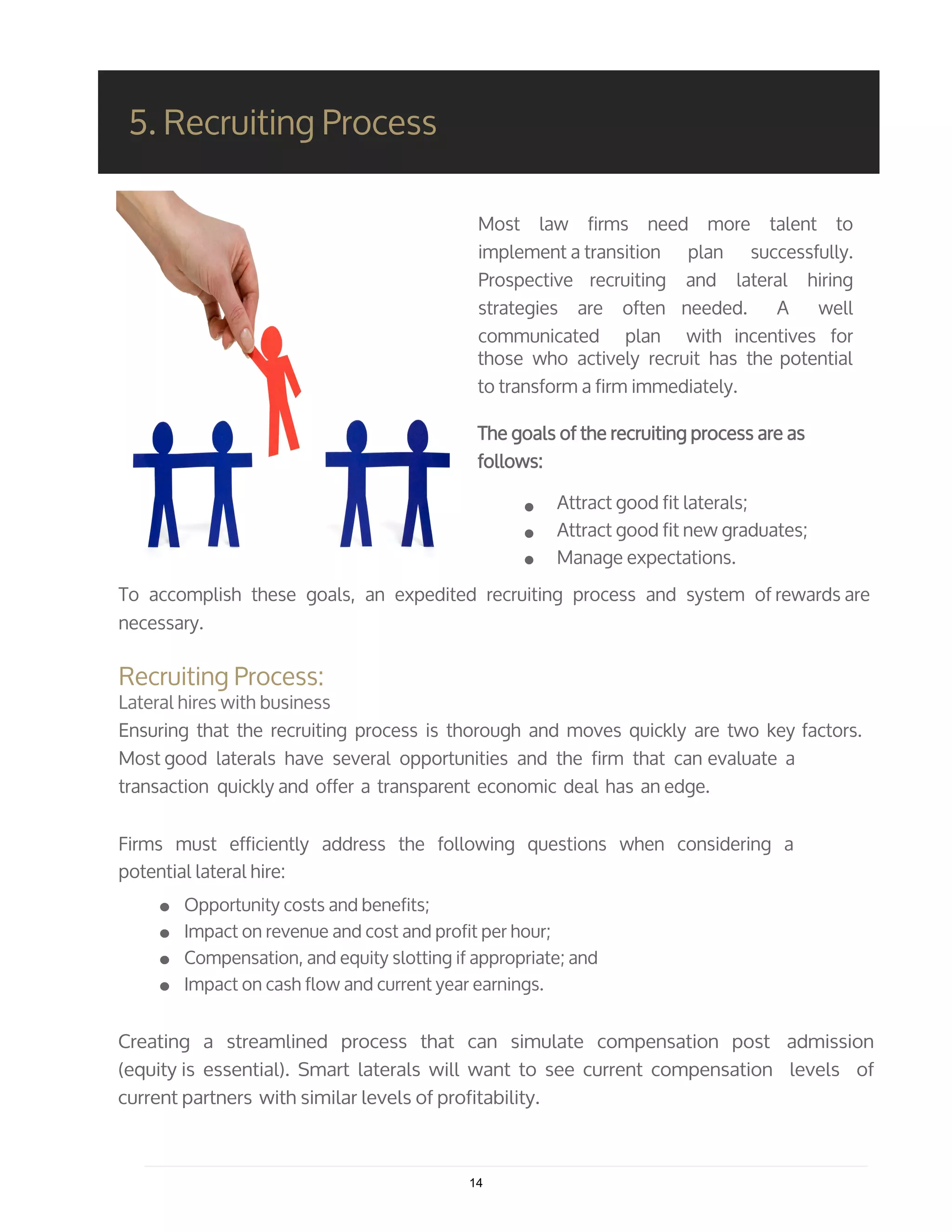
Most law firms need more talent to
implement a transition plan successfully.
Prospective recruiting and lateral hiring
strategies are often needed. A well
communicated plan with incentives for
those who actively recruit has the potential
to transform a firm immediately.
The goals of the recruiting process are as
follows:
Attract good fit laterals;
Attract good fit new graduates;
Manage expectations.
5. Recruiting Process
To accomplish these goals, an expedited recruiting process and system of rewards are
necessary.
Recruiting Process:
Lateral hires with business
Ensuring that the recruiting process is thorough and moves quickly are two key factors.
Most good laterals have several opportunities and the firm that can evaluate a
transaction quickly and offer a transparent economic deal has an edge.
Firms must efficiently address the following questions when considering a
potential lateral hire:
Opportunity costs and benefits;
Impact on revenue and cost and profit per hour;
Compensation, and equity slotting if appropriate; and
Impact on cash flow and current year earnings.
Creating a streamlined process that can simulate compensation post admission
(equity is essential). Smart laterals will want to see current compensation levels of
current partners with similar levels of profitability.
14
New Lawyers and Laterals Without Business
In some instances, attracting the right lawyers to service the firm’s current
clients can match the impact of a lateral hire with business. Often these
contributions are overlooked because they happen over time and with less
fanfare. Many firms also only hire when someone leaves, and there is an
immediate need. When this occurs, and no suitable replacement is available, law
firms are often forced to rely on lesser-talented or lesser trained lawyers to
service client work. Eventually, a permanent decline in the capability of the firm can
result. To guard against these risks we recommend the following:
Hiring in advance of need;
Accept that not everyone is in the right role and upgrade; and
Appropriately delegate at the partner level to create opportunities.
Recruiting in advance of need requires an honest evaluation of the firm’s current
staffing capacity and capability. It also requires a budgeting process that allows
for a level of prospective hiring.
Compensation and Incentives:
At the equity partner level, most firms consider recruiting a responsibility of
partnership and do not compensate for recruiting successes. The benefits of the right
lateral hires and new lawyers are often significant. Additionally, those who recruit another
attorney to join the firm are more inclined to also stay with the firm.
For these reasons, we recommend that firms consider compensating for all
recruiting contributions at every level. The value of attracting quality lawyers to the firm
include:
Profitability contributions;
Creating competition to drive lawyer
performance; Longevity;
Capability increases; and
Reputational benefits.
Recognizing that recruiting successes can provide substantial economic and
cultural benefits will improve the chances of creating a high-
performance firm. Favorable market perceptions regarding the trajectory of
the firm are invaluable.
15
In addition to promoting profitable behaviors, a market sensitive compensation plan
can produce a very competitive firm, ready to support a transition process for their
most successful attorneys.
Maintaining Competitiveness
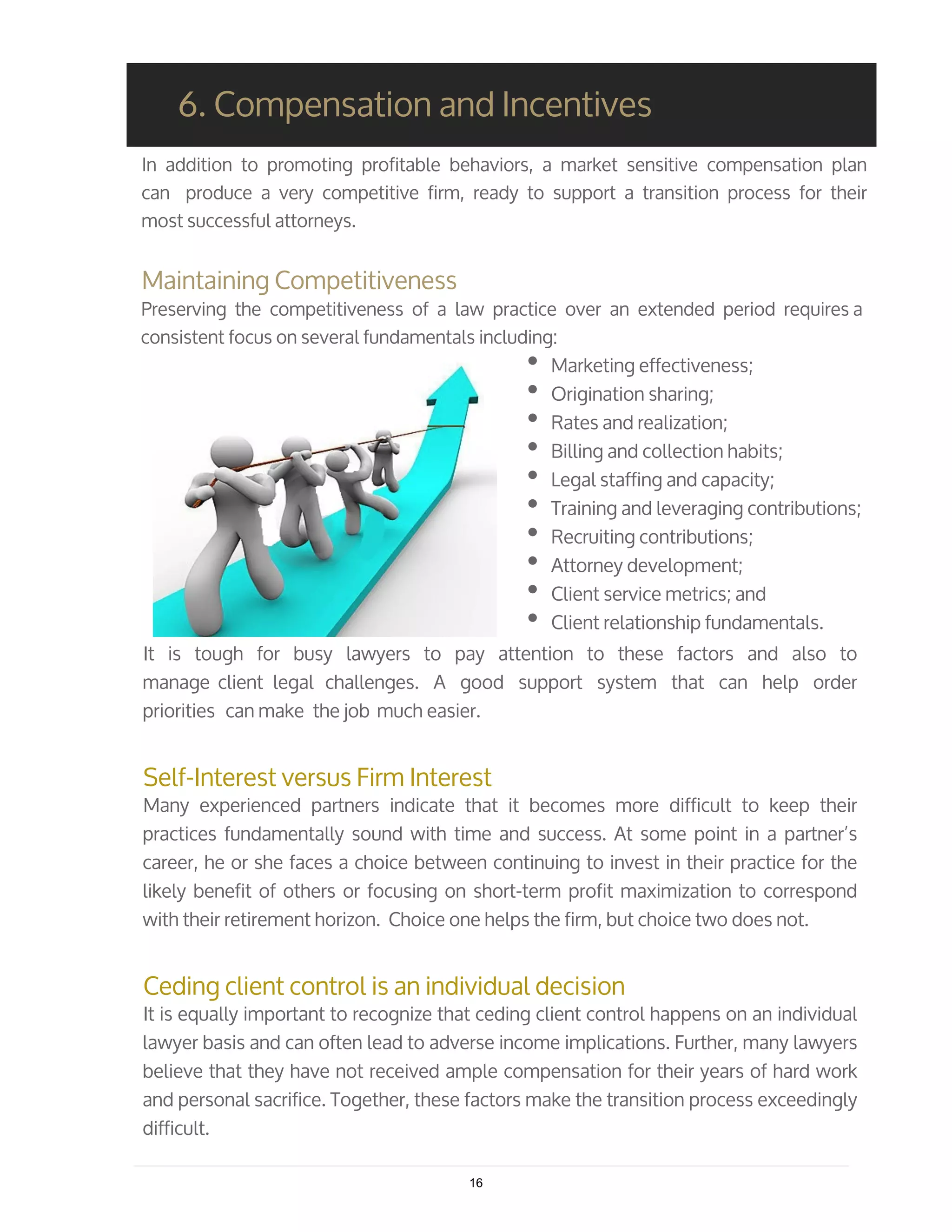
Preserving the competitiveness of a law practice over an extended period requires a
consistent focus on several fundamentals including:
Marketing effectiveness;
Origination sharing;
Rates and realization;
Billing and collection habits;
Legal staffing and capacity;
Training and leveraging contributions;
Recruiting contributions;
Attorney development;
Client service metrics; and
Client relationship fundamentals.
6. Compensation and Incentives
It is tough for busy lawyers to pay attention to these factors and also to
manage client legal challenges. A good support system that can help order
priorities can make the job much easier.
Self-Interest versus Firm Interest
Many experienced partners indicate that it becomes more difficult to keep their
practices fundamentally sound with time and success. At some point in a partner’s
career, he or she faces a choice between continuing to invest in their practice for the
likely benefit of others or focusing on short-term profit maximization to correspond
with their retirement horizon. Choice one helps the firm, but choice two does not.
Ceding client control is an individual decision
It is equally important to recognize that ceding client control happens on an individual
lawyer basis and can often lead to adverse income implications. Further, many lawyers
believe that they have not received ample compensation for their years of hard work
and personal sacrifice. Together, these factors make the transition process exceedingly
difficult.
16
Beyond transition issues
A well-managed firm is better able to manage the transition process. Often factors not
directly related to transitioning partners or their staffs can affect a firm’s ability to
focus on the necessary longer-term strategic factors.
For example, savvy younger partners may come to the realize that their firm has no
transition plan and decide to find a better opportunity. Often, the primary
motivation for leaving is the reality that their earnings will erode as a result of an
inevitable loss of business from aging senior partners.
Consider another example. Other partners may believe that their current good
fortune may not last forever and want to maximize their income during success
periods. A compensation plan that is not responsive to the market makes the
firm vulnerable to either losing these partners or worse create an atmosphere of
declension.
Data-Driven Compensation
A data-driven compensation plan that pays at competitive market levels can reconcile the
perceived and actual value of a lawyer's economic contributions – there is no better gauge
of value than what a competent competitor will pay. Accomplishing this level of
acceptance will remove a large obstacle inherent in the practice transition process.
The primary tool for compensating at the market is a contributed profit analysis by
originator with client and file level detail. The main elements of this system include:
Origination sharing policies;
Profitability by originator with client, file, and timekeeper detail;
Maximum empowerment over directly allocated costs;
Maximum empowerment over case staffing;
Maximum empowerment over directly assigned marketing costs; and
Minimum of 80% of total income based on contributed profit; and
Two year rolling average contributed profit for income allocation.
Admittedly, these systems take time and effort to build, but experienced
professional help is available. The resulting impact on profitability, firm
competitiveness and attractiveness in the market can transform a struggling
firm and elevate the success of high performing firms. With a market-based
compensation system, a transition compensation feature, and a process for the
orderly transition of ownership interests, firms can will significantly increase their
ability to pass from one generation to the next.
17
Many personal reasons motivate people to
continue working rather than retiring. One
significant factor is the lack of of
remuneration for their income generating
asset. Of course, the income generating asset
is their client base, which may not be
transferable.
Compare this situation to the owner of a
successful operating company. In most
instances, the owner of the company can
sell the business or pass it along to family
and reap a reward for his or her lifetime
of work.
Since this is not the case with small and
mid-sized law firms, especially defense
firms, these firms struggle with senior
partner buyouts.
7. Transition
(Buyout)
Compensation
19
Some of the more common reasons for these struggles include:
Most small to mid-sized firms compensate for originations and profits, which will be
affected in the transition years for those partners involved in a buyout;
Buyouts are more feasible when they are a transaction between the retiring senior
partner (seller) and the individual partner or partners assuming control of the work
(buyers);
Other partners are often reluctant to fund a buyout from which they do not directly
benefit;
The firm or partners cannot afford a buyout
There is a risk associated with not being able to keep the business;
Other partners may feel that all clients are “firm” clients. If a senior partner was paid
fairly along the way, he or she is not entitled to any more money;
Junior partners who have worked on the senior partner’s clients may feel they have
earned the right to the origination credit;
The timelines of the remaining partners may be shorter than the potential rewards
reaped from buying a senior partner out;
and
The reality that relatively few transitions work as planned.
Any of these reasons can have a degree of validity, and firms must overcome
them for any transition to occur. Removing the economic disincentives for
senior partner retirements increases the chances of a successful transition.
It is equally important not to overlook the interests of the younger partners.
Creating sensible buyouts helps ensure that the firm’s best attorneys are not
incented to start a new firm to avoid paying senior partners a disproportionate share of
current profits
I recommend that clients evaluate each retirement as if it were an individual transaction.
20
Using an objective process-oriented approach to arriving at a buyout price and
structure removes much of the emotion from the negotiation. Firm’s that have the data to
complete the recommended analyses can set expectations early in the process and create
a model for future buyouts. To help manage expectations, we recommend
transition modeling two years before the start of any transition.
Buyout period
We prefer a three-year buyout period with a declining payment schedule based on
a measure of profitability before buyout costs. For example, the senior partner
would continue to receive full origination credit in year 1, a lesser amount in year 2
and a lower amount in year 3. The assuming partner’s originations
would increase correspondingly. The slope of the origination changes would depend
upon the senior partner’s level of involvement.
The keys to setting transition compensation include an objective process
oriented approach; setting expectations early in the process, and a model to
ensure consistency.
Client matter profitability of the transitioning partner’s book of
business;
Capacity Analysis post transition;
Worklife timeline for the retiring partner;
Worklife timeline for the assuming partner(s);
Origination ceding schedule;
Pro-forma profitability of the transitioning book for three years;
and
Compensation pro forma for the retiring partner and the
assuming partner(s).
The tools needed to perform this evaluation include:
21
Developing policies that support the strategic goals of
the firm are an essential component of a transition plan.
Typically, the results achieved by the implementation of
strategic policies take years to actualize, which creates
resistance in many law firms.
Strategic policies are often changed or ignored in
response to current events. When this occurs,
management actions become inconsistent and short-
term focused.
If law firms wish to ensure client business continuity, a disciplined approach to policy
development and implementation is necessary.
The policies described below can significantly improve the chances of a smooth law
practice transition.
AssociateandIncomePartnerProgression
Consider what is at stake when developing progression criteria for the associate lawyer
group. Partnership admission criteria are important long-term considerations for
talented young professionals deciding to invest in the firm’s success or look elsewhere.
A clear advancement structure can make the difference between a good lawyer making
her current law firm better or improving the offering of a well-managed competitor.
These policies are equally important to top professionals evaluating a possible association
with the firm. Producing written advancement criteria can make a positive difference in the
recruiting process.
• Associate progression criteria
• Partnership admission criteria
8. Policy Development
* Following policies that support longer-term strategic interests helps ensure that the right
people advance, makes it easier to recruit suitable laterals, and helps prepare the firm for
future partner retirements.
Policies Needed
22
RetirementTiming
Mandatory retirements do allow for a leadership change and force senior partners to make
room for junior partners, but an unprepared firm my face painful consequences by forcing a
premature retirement. On the other hand, not making room for younger partner advancement
can have equally devastating effects on a law practice.
Mandatory retirement ages are controversial. Many clients value the experience of a
senior lawyer who may have an invaluable amount of institutional knowledge or trial
experience. Arbitrarily setting a retirement age without a transition plan is often
unproductive and not feasible. No setting a retirement age, however, comes with its set of
potentially serious issues.
Consider the example of the senior partner who is unwilling execute a transition
plan and choosing instead to exert maximum client control. Typically, these partners
have not properly introduced any of their partners or senior associates into their client
accounts. They also have probably not discussed any continuity plan with their clients.
When this occurs, a practice can erode when clients realize that their lawyer has no
succession plan, which leaves them exposed.
These instances can result in a conflicted position for the law firm. The question becomes
whether a partner is free to destroy their legal practice. As a practical matter, a partner can
allow a practice to erode, and once the decline starts, there is little a firm can do to stop it
without the retiring partner’s cooperation.
Eventually, the retirement question requires an answer. Firms that adopt a transition period
approach can ease partners into retirement, which can benefit clients and ensure the future
success of the law firm.
TransitionPeriod
We deal with this situation frequently and have better success with creating incentives for
transitioning a practice rather than consequences for failing to act. Specifically, we recommend
a process that includes creating a policy that encourages partners to declare that they wish to
enter a transition period formally.
As mentioned earlier, partners should create a succession plan at least three years before
retirement. This policy should contain incentives for a retiring partner to comply and should
encourage suitable successors to make the necessary commitment to the process. Finally, the
firm should define the criteria for qualifying as a transitioning practice (not all practices
transition.
23
Transition Period Marketing Costs
Enhanced marketing activities during the transition period can promote the relationship
transfer from the retiring partner to the successor partner or team. For example, more
frequent visits to client offices to support relationship building with the replacement partner
(s) can enable a smoother transition.
Additional activities aimed increasing awareness of the value provided by other lawyers on
client files can also help build value in staying with the firm after the current partner retires.
Partners who do not benefit directly from a client’s origination profits may resist
additional marketing spending connected to a transition plan. They instead may prefer
allocating these costs within the transition agreement. Adopting a policy for handling
transitional marketing costs can remove another obstacle to a smooth client transfer.
Origination Sharing Policies
Most firms compensate partners based on business originations. Law firms sometimes try
to disguise the weight that originations have in their compensation formula, but more
orientations typically lead to more money. An essential part of any transition plan is a
policy for sharing originations during the transition period.
Some firms may choose to underwrite all or part of the compensation cost during a
transition period by guaranteeing a certain level of compensation during the transition
period. Other law firms require the partner inheriting the client account to absorb
transitioning partner compensation costs.
For example, assume retiring partner A agrees to a three-year transition period with
origination credit declining by 1/3 each year. As such, Partner B would receive no
origination credit for the applicable clients in year 1, 1/3 credit in year 2, 2/3 credit in year 3,
and full credit in year 4. An actual origination sharing agreement would depend on
profitability, the role of the retiring partner, and the commitment of the successor partner.
Regardless of whether the firm (the remaining partners) underwrites the transition costs or
the successor partner absorbs these costs, a smooth transition requires an origination
sharing agreement.
* Addressing retirement issues in advance of any immediate pressure enables a process
oriented approach and an orderly transition of practices from one generation to the next.
Policies Needed
• Mandatory retirement with and without a transition
• Transition period incentives and requirements
• Transition period marketing activities and costs
• Origination sharing policy
24
Orderly Transfer of Equity
Equity transfers are typically more complicated in smaller law firms. Firms that include
founding members also can have difficulty when founding members want compensation for
the risks they took to start the business, deferred income in the start-up years, and the value
of the organization they help build. Without a process for reallocating equity, senior
partners are often unwilling to surrender ownership, which can cause a crisis.
We recommend that every law firm develop a process for transferring equity on a
systematic basis. We also recommend developing a standard approach to valuing equity as
it is reallocated among the partners.
Policies Needed:
• Basis for transferring equity between partners
• New partner equity policy
• Lateral partner equity policy
• Capital requirements tied to ownership
• A valuation approach to firm assets
* Transferring equity is more complex when it is a primary basis for compensation.
Regardless of compensation implications, a process for transferring ownership among
partners is essential to an orderly transition.
Removing Retiring Partners from Leases and Debt Guarantees
Debt guarantees and office leases can pose problems. For example, banks typically require
equity partners secure all or a part the firm’s notes. A challenge may arise of the bank
guarantees do not adjust with changes in ownership in the firm. Additionally, the
creditworthiness of the partners may differ and require senior partners to support junior
partner guarantees.
Office leases are often a firm’s largest debt obligation, but may not require personal
guarantees. Regardless of security requirements, law firms do not disregard their
obligations. In some instances, law firms have separate agreements among the partners
regarding lease obligations.
Whether liabilities are spread to all partners evenly or in proportion to their ownership
interests or a combination of both, accounting for changes in ownership is a requirement of
any transition plan.
25
Post Retirement Compensation
Partners who retire from equity ownership may still want to practice on a reduced
basis. Affording retiring partners a post-retirement option can ease a partner into a
transition. In some instances, however, issues can arise when the retiring partner remains
involved in transitioned clients.
Clients may revert to their old habits of calling the retired partner with their assignments,
which can cause resentment among the partners who have assumed the lead role. If these
issues are not present, retired partners can maintain a small client base or provide expertise
to firm clients.
Another situation may arise when retired partners decide to keep a practice for their
account. If the partner has received or is receiving compensation from their former firm, an
agreement that governs competitive behavior is required.
Policies Needed:
• Post retirement compensation
• Post retirement separate law practice
* Considering post-retirement scenarios in advance enables the firm and the retiring
partner to continue a smooth working relationship and supports maximum cooperation
with the transition plan.
Return of Capital and Interests in BillingAssets
Retiring partners who have a material amount of fixed capital and undistributed prior
earnings invested in the firm are typically due to these monies upon surrendering their
ownership. Several capital scenarios can occur, but firms that adjust ownership percentages
and capital accounts using orderly process have an advantage.
It is not uncommon to encounter a delayed payment schedule for the return of fixed capital,
but payment for undistributed earnings typically occurs over a shorter period.
Billing Assets (WIP and AR), and Interests in Continent Cases
If a firm is structured to pay retiring partners for their interests in the firm’s net assets
(primarily billing assets), a process for valuing these assets is necessary. For example, not all
AR and or WIP is collectible, and the valuing billing assets must consider uncollectible
amounts.
26
A good transition plan coupled with the orderly transfer of equity interests can
significantly reduce the amount of fixed capital a retiring partner may have remaining in the
firm immediately before retirement
Regardless of the approach to managing fixed and floating capital, we recommend creating
policies that govern the return of capital to retiring partners.
Contingent Cases and Liabilities
A consideration of any retiring partner interests in contingent case recoveries or hard cost
losses is necessary. As contingent recoveries and losses are often difficult to value before
case conclusion, an agreement for splitting the actual net proceeds when realized is
needed.
Contingent liabilities may occur in some cases. For example, a malpractice action that
exceeds insurance policy limits. When contingent liabilities are present, the remaining
partners must consider if an indemnification of the retiring partner is possible and
warranted.
To ensure that no impediments to retirement exist and to minimize the possibility of a
disagreement with a retired partner, we recommend the following policies.
Policies Needed:
• Return of fixed capital
• Payout of AR and WIP interests, if applicable
• Contingent case policy Contingent liability agreement, if necessary
* Planning and managing the firm’s cash flow and capital resources to enable the payouts to
retired partners can ensure that the firm does not overextend itself and create a perilous
situation.
Operating Agreement
Many of the policies needed to ensure a smooth retirement of partners become provisions in
the law firm partnership or operating agreement. While many firms can handle the
development of an operating agreement internally, many are better contracting with outside
counsel.
Our approach is to identify areas that may impact a smooth retirement process
and engage with our client’s legal counsel to ensure the provisions accomplish the
firm’s objectives.
27 BACK TO THE TABLE OF CONTENTS
9. Partnership/
Updating or creating an operating agreement
(operating agreement and partnership
agreement are used synonymously) that
supports long-term strategic objectives is
necessary. New partner entries, leadership
transitions, future equity adjustments,
addressing non-performing partners, changes in
compensation, retirement and buyout provisions,
and most other significant actions require changes to
partnership agreements.
It is also important to support strategic
initiatives with the weight of a legally binding
agreement. For example, if a transition plan
requires the admission of new partners, a
provision governing the orderly transfer of equity
is necessary. Binding the most important
elements of the transition plan with a written
and legally binding agreement bolsters confidence
in the firm’s ability to implement the necessary
changes.
Operating and partnership agreements are
mature documents, and much of their content is
standard. Most of the accords we have read contain
some references to retirement but mostly in the
context of withdrawal.
Frequently, we see agreements that include
outdated buyout methodology. Often these
provisions contemplate a valuation of the firm
that does not comport with reality, which can create
unfunded liabilities that can result in a crisis for the
remaining partners.
In some instances, partners leave to avoid paying
an unrealistic retirement cost.
Operating
Agreement
Revisions
28
Additionally, firms that do not have provisions allowing for an orderly transfer of equity
can become stagnant if too much power in concentrated in the hands of partners with
a short-term viewpoint.
To ensure that your operating agreement contains the right provisions that support
the eventual transitioning of the firm, we recommend the following requirements:
Timing and Approach
• Mandatory retirement age
• Transition plans and timing
• Qualifying for a transition plan
Depending upon the size of the firm, we recommend a mandatory age for surrendering
equity ownership percentages. Retirement age equity partners may choose to
continue practicing in an Of Counsel status, but an agreement as to role and client
connection is necessary.
Inserting these types of policies into an operating agreement before actual retirements
begin removes the difficulty of opening a dialogue with a senior partner at what may
feel like an arbitrary time. For example, a firm may approach a senior partner about
retiring when he is 65, which may offend him if he is planning to work several
more years.
Mandatory retirement age, transition plan qualification, plan substance, and timing are
necessary components of an operating agreement.
We recommend declaring an age that triggers a retirement planning process. For
example, an operating agreement provision that requires all partners to indicate
their retirement intentions (approach and timingupon the attainment of age 60.
Creating a retirement window, for example, that enables a partner to entirely
or partially retire between the ages of 65-70 can create a transition period that spans
up to 5 years, depending upon any mandatory retirement provision.
Provisions to deal with underperforming partners who are close to retirement are also
necessary. Transition plans may not apply to all partners. An expedited process
for partners who have no clients or key client relationships or unique expertise is
needed.
29
For example, a firm may have an initial mandatory retirement age that is
binding unless extended by a supermajority of voting interests.
Return ofcapitaland net asset interests
• Return of capital timing and amount
• Payout of AR and WIP interests, if applicable
The capital a retiring partner may have invested in the law firm typically consists of
fixed capital and undistributed earnings. As undistributed allocated income has been
previously taxed or subject to tax in the current period, most firms pay undistributed
earnings on an expedited basis. Depending upon the amount of fixed capital, the
payout period can extend for several months or even years.
When the return of capital also includes an amount for a retiring partner’s interest
in Accounts Receivable and Work in Progress, a valuation process and payment schedule
are necessary.
A delayed payment that corresponds to the collection of accounts receivable and unbilled
fees is typical. In some instances, however, firm members may agree to longer payment
period to allow time to defray any retiring partner replacement costs.
Advance agreement regarding payments of amounts due to retiring partners enables a
firm to plan and manage cash resources.
Post retirement liability obligations
• Lease and debt guarantee policy upon retirement
• Contingent liability agreement (if necessary)
Some obligations, especially those to third parties, may need special handling by the
remaining partners. For example, a large bank loan that is personally guaranteed by all
equity partners will require a release of guarantee for the retiring partner. Loan agreements
that require a retiring partner’s net worth as collateral are particularly challenging.
30
Managing a bank guarantee can include several options, but may force a capital call or a
pledge of additional collateral from the remaining partners. If the remaining partners are
unable to capitalize the firm adequately, concern about the firm’s future viability can arise.
Additional complexities may arise when a contingent liability exists for an action that
happened during the retiring partner’s membership. For example, an impending
malpractice suit that may exceed the policy limits of the firm’s error and omissions policy.
Depending upon the magnitude of a contingent liability, a range of options may exist, but it
is virtually impossible to plan for unknown liabilities in advance. The best approach is to
recognize that the potential for contingent liabilities exists and if they arise, take steps to
consider the impact on a retiring partner.
Post retirement compensation
• Post retirement compensation options
• Retiring partner buy-out provisions
• Contingent case policy
• Post retirement practice a law
Most law firm compensation systems are designed to pay partners contemporaneously,
which results in little residual value accruing to retiring partners except for transitioned
client relationships. While retired partner buyouts are difficult in any circumstance, it is
particularly difficult to justify post-retirement payments to partners who were not able to
transition clients to other partners in the firm.
Although less common in contemporary times, some firms may pay retired partners a
stipend for a stated period post-retirement. Typically, these payments fractionally correlate
to historical compensation or are based on a previously agreed arbitrary amount.
Transition agreements with retired partners that contain an economic foundation, which
is most often related to client transfers, are preferable and easier for the remaining partners
to underwrite.
If a firm does have a universal post-retirement compensation option, it is important
to create an annual collar based on a percentage of cash net income. For example, limiting
the total annual cost of retired partner buyouts to 5% of net income.
31
Depending upon the size of a partner retirement stipend, it is limiting
the payment period to one or two years is recommend. Without a finite time and a
material transfer of value(clients), it is hard for the remaining partners to justify
reduced earnings for retired partner buyouts. Eventually, the remaining partners
will grow weary and may join a competitor or start a new firm.
Depending upon the terms of an operating agreement, retiring partners can
sometimes force a liquidation, which is almost never preferable.
Firms that chose to pay all retiring partners a stipend would do well to ensure them
the economic burden to the remaining partners is less than the cost to start a new firm.
Agreeing on the type of post-retirement practice of law is necessary. Retiring from one
firm and joining another is difficult if a partner is still receiving compensation from a
former firm. Addressing post-retirement competition is recommended.
A compensation plan for paying partners who retire from the equity
partnership but want to remain active on a part-time basis is necessary. Post
retirement pay is typically based on a sharing of worked and generated fees,
assuming there is not conflict with a transition plan.
We prefer a transition plan approach with partners who can transfer business. Some
firms, however, prefer to pay all partners a retirement benefit and including these
provisions in an operating agreement is necessary.
Finally, to the extent that a firm may have contingent cases in progress when a partner
retires, a provision governing the distribution of any eventual recoveries
is also required.
Orderly transferofequity interestsand capitalrequirements
• New partner equity policy
• Lateral partner equity policy
• Capital requirements tied to ownership
32
An orderly process for transferring equity interests among members is beneficial and
supportive of firm longevity and growth. When ownership impacts compensation,
transferring equity among members is more difficult. Concentrated ownership
interests can make admitting new partners harder.
Untying all or a substantial part of compensation from equity percentage can also
make it easier to reallocate a retiring or transitioning partner’s ownership units.
Performance-based compensation also allows a firm to employ a conservative
approach to assigning beginning ownership levels to lateral partners.
We recommend tying capital retained by the firm to the equity interest of each partner.
For example, if a firm maintains $300,000 in capital reserves a 10 percent partner will
have $30,000 invested in the firm. Tying capital to equity ensures that influence and
dollars at risk are aligned.
The orderly transfer of equity and sensible capital management provisions help to
ensure that membership interests held by retiring partners are indicative of their
current contributions to the law firm.
Firmvaluationprovisions
• A valuation approach to firm assets
• Interest in firm assets and liabilities
Valuing a law firm beyond book value is tough. Most law firms have no value beyond the
lawyers and the clients. The value of a going concern is one possible approach, but a
more relevant approach may consider startup value.
For example, how much would it cost if the remaining partners were to liquidate the
existing firm and start a new law firm?
Some of the nuanced law firms are creating platforms that may ultimately have value to
successor owners. For example, an efficient overhead structure, cutting edge
technology, top quality fee earners and staff, a marketing process, client binding
mechanisms and proven leadership and management teams may have market value.
For most law firms, many these factors are not present, and book value concepts
are most accurate. Provisions are necessary for valuing the firm if retiring partners are
going to receive payments based on their equity interest in net assets.
33
Supporting Policies
• Compensation policies
• Partnership admission policies
Many firms include their compensation system as an exhibit to their operating
agreements. We recommend including definitions and examples of formula based
systems. Thoroughly documenting subjective pay systems where possible is also
recommended.
Documenting compensation policies and including them in the firm’s operating
agreement can promote stability and maximum predictability.
New partner admission standards and guidelines are typically not incorporated into an
operating agreement, but referencing their existence is helpful. Most operating
agreements do contain provisions that govern the admission of new partners as it relates
to voting.
We recommend investing the time to create an operating agreement that includes all
the necessary policies related to retiring partners. Retirement policies that are well
thought out, financially sound, and practical can make a firm sustainable from one
generation to the next.
34 BACK TO THE TABLE OF CONTENTS
Transferring equity interests is typically
more challenging in smaller or first
generation firms than those that are larger or
more mature. Firms that include their
founding members may have even more
difficulty with transitioning a law firm.
Founding partners often want
compensation for the start-up risks they
took, along with their reduced income in
early years and the going concern
value of the organization they helped to
build.
As law firms fully allocate profits to
current partners each year, younger partners
frequently resist the notion that founding or
senior partners should receive compensation
for prior risks.
10. Orderly Transfer of
Ownership Interests
We believe that senior partner goodwill payments that are tied to real residual
contributions (book of business) are best compensated as part of a transition plan.
Our experience is that each situation is different and much of the tension relates to the
degree of compensation. In practical terms, if the founding members want a payment level
that is greater than the cost of starting a new firm, younger partners are then inclined to
start a new firm.
Additionally, equity interests based primarily on tenure can leave highly productive partners
without a comparable level of influence on firm priorities, which is a risk. Law firms that can
balance these realities with their long-term needs can ensure their most productive
partners stay and can create advancement opportunities for talented younger partners.
35
How can a firm transfer ownership to the right people in an orderly way?
Consider the following recommended objectives for any systems that allocate membership
units to members:
• Ensuring that those partners who are consistently contributing profits to the firm
have a commensurate influence on firm strategy, policy, and management;
• Ensuring that units are available for new partners without a disproportionate impact
on the productive partners;
• To facilitate the transition of firm ownership from one generation to the next; and
• To ensure that the most consistently productive partners have the votes to
protect the culture of the firm.
Many firms decouple ownership from compensation to help ensure fair pay. Typically, paying
partners is accomplished using a bonus plan or some other formulaic approach. Some firms
consider management contributions when adjusting equity, but recommend
compensating managerial with income rather instead of ownership.
New model firms view partnership equity from an investment perspective. In
many instances, a single owner capitalizes the firm initially and owns all the equity.
These firms concentrate on building value in their platforms that new partners, when
invited, can purchase at am agreed upon valuation upon entry.
Inevitably, however, a traditional law firm structure requires a process for the orderly transfer
of equity. While not the only approach, we believe that the best way to meet
our recommended objectives is to transfer ownership based on a 3-year rolling
average of contributed profits. Our clients employ other viable methods for managing
equity interests, but the most successful firms, regardless of their approach, recognize
the relationship between consistent performance and ownership.
Smart senior partners realize that if they do not make room for others in a timely way, they
risk partner defections and the eventual extinction of the firm. Ultimately, most
partners want a positive legacy and do not want to be known as the person who presided
over the demise of the firm.
36 BACK TO THE TABLE OF CONTENTS
A law firm transition plan can span over several years, requiring substantial investments
from the remaining partners. Quantifying the potential impact on the firm’s profits and,
ultimately, the income of the partners, informs plan development.
Healthy firms that have the right information can expedite the process. Firms that
lack profitability and/or have weak financial reporting may need remedial action
before committing to a transition plan.
The elements of a transition-oriented financial plan are as follows:
1. Cash flow, debt and equity over the transition period
2. Effect of transition comp on earnings for the firm and for assuming partners
3. Profitability of transitioned work
4. Effect of multiple transitions occurring simultaneously
5. Scenario planning at various levels of transitioned work
6. Exit costs in the event of a failed implementation
11. Financial
Plan
37
1. Cash flow, debt and equity
The capital structure of many firms is reliant upon a combination of trade credit, bank and
other interest bearing debt obligations, and members’ equity. Members’ equity consists of
fixed or paid in capital plus any undistributed profits.
Depending upon the amount and duration of retiring partner payments, a firm may need to
secure additional capital. Preparing partners for the eventuality of the firm incurring more
debt, withholding current earnings, or requiring more paid in capital from partners ensures
that sufficient cash is available to make retiring partner payments.
Firms that skip this step are asking for trouble and potentially inviting instability.
2. Effect of transition compensation
The effect of a retiring partner’s compensation is either borne by all partners or only those
partners participating in the transition plan. In most situations, a hybrid is also possible that
includes a share that all partners absorb and a share that the benefiting partners pay.
All remaining members typically underwrite retirement payments not tied to a transition plan.
Firms that link retiring partner compensation to the transfer of client relationships can either
allocate transition costs to all partners or only to the benefiting partners.
As an example, a firm that uses a profitability driven compensation approach or considers
originations in compensation may allocate a retiring partner’s transition costs to the partners
receiving post-transition origination credit.
A firm may also withhold assigning client credit to any partner until the transition period is
complete. In these instances, the partners benefiting from the client transfer defer any
compensation increase until after the transition period.
Regardless of the approach, calculating a pro forma effect on the remaining partners’
compensation adds to the transparency of the process.
3. Profitability of the transitioned work
Understanding the profitability of a client relationship before a transition is useful, but it
is more important to project profit post-transition. Future profit models allow a firm
to determine the amount of net income available for transition compensation.
38
Additionally, a firm must consider the impact of changes in the staffing mix. Assume that the
retiring partner worked a high number of billable hours on a client account, but the
replacement partner plans to use a more leveraged model. Client considerations aside, what
is the impact of that decision?
What if the opposite were true and the replacement partner plans to work many of the hours
that were performed by others in a leveraged model?What if the replacement partner is
planning to staff the account differently altogether? If the transition plan calls for a retiring
partner to receive compensation based on client profits over a period, these considerations
are important.
4. Effect of multiple transitions happening simultaneously
Depending upon the size to the firm, simultaneous transitions can overtax the resources of
the firm. Additional factors include the term of any payout or return of capital. Some firms
cap combined transition costs or retiring partners’ costs at a percent of net income.
When transitions are essentially agreements between individual partners, they are easier to
accommodate. In these instances, the firm has an interest in ensuring that transition
arrangements are well understood by the parties and are feasible. A weak agreement will
inevitably become a problem for the entire firm. We recommend partnership approval of all
transition agreements.
5. Scenario planning at various levels of transitioned work
We recommend modeling a best and worst case scenario. Worst case planning prompts a
firm to consider a process for managing a failing transition. Several considerations become
relevant including:
• Who assumes the risk of a successful transition?
• Is there a role for the firm if the transition is not working?
• What monitoring tools are necessary to detect issues in a transitioning account?
39
Modeling or a best-case scenario is also important. Client relationships are fragile, and a
firm may want to allocate additional short run resources to ensure that service levels
remain high. A firm may also incur higher marketing and training costs. Recruiting fees
may also apply.
In these instances, it is necessary to consider the costs of these additional resources in
the transition plan.
6. Exit costs in the event of a failed implementation
Firms should also consider the possibility of failure. This is difficult to do with such a
forward-looking action as transitioning a retiring partner’s successful practice.
While the retiring partner will likely want compensation in a failing transition, the firm will
not have the underlying economic base to make these payments. Correspondingly, a firm
or the assuming partner will not want to pay the retiring partner if the clients chose to hire
another law firm. Basing compensation to the retiring partner on future receipts
diminishes the cost of a failing transition.
Regardless of the approach, quantifying exit costs in the transition agreement is
recommended.
A credible process
Transition plans can include several components and a substantial investment.
Understanding these costs and adequately preparing for contingencies will add credibility
to a firm’s practice transition process. A credible process that is repeatable is a
competitive advantage.
40 BACK TO THE TABLE OF CONTENTS
12. Implementation Support
Implementing a transition plan does not need to be a complicated process. Helping law
firms to use a detailed process, a specific timeline and open communication have yielded
excellent results.
41
Law firm transition planning is trying enough to firms. The process is often
further complicated when determining the value of a firm as a going-concern.
Senior partners are often dismayed at the unwillingness of junior partners to attribute
any value to the firm beyond asset value, including AR and WIP, less any debt.
Most transitions are dependent upon keeping a retiring partner’s clients and on
having junior partners willing to share a portion of future profits of any transitioned
clients. Beyond future income sharing, going-concern value, if any, is typically
limited to the amount it would cost the remaining partners to start a new firm and
possibly a convenience factor.
It is helpful to organize the valuation process into components as follows:
*Adapted from http://www.businessdictionary.com/definition/going-
concern-value.html
Valuation techniques are discussed separately in the valuation section and our
purpose now is to answer the following question:
13. Building a Platform
(Going Concern Value)
• Net realizable value of the firm’s assets less liabilities;
• A convenience factor related to a functioning firm;
• The value of ongoing client relationships;
• Going concern value which is the value of a firm’s intellectual
property, systems, processes, procedures, and trained staff,
reputation, surviving panel counsel appointments, and any unique
distinctions*.
42
What can a law firm do to create more going-concern value?
To start, a law firm can build repeatable processes that encourages consistent
client service and practice efficiency. As an example, a client of ours is adapting a
popular cloud-based application and related plugins to manage client case
communications and internal case management. Using this automated
communication workflow, the firm’s lawyers and staff communicate
significant case developments in real time and simultaneously enable
a consistent case handling and client communication process.
Marketing automation software is another example of how a firm can lessen its
reliance on the relatively few lawyers who develop business. Good marketing
automation software contains built-in best practices and marketing tools that
can raise the level of the firm’s marketing competence.
These systems enable all lawyers to contribute to the firm’s marketing effort. A
junior lawyer can increase her visibility by developing content that is relevant to a
target audience. This audience can eventually become followers and contacts.
Dedicating a portion of the firm’s resources to building a competent marketing
and business development system is another important step in creating going
concern value.
Creating going concern value requires modernizing the firm’s business processes
to the point that they become a platform. Many firms suffer from business processes,
procedures, and systems that are ad hoc and intermittently efficient. Most firms
struggle to invest the time and money to create any real institutional value.
Firms who fail to invest in building repeatable processes can only claim minimal
going concern value. In instances where technology, process and personnel skills are
outdated, negative going concern value is indicated.
If the company can create a platform with a value that extends beyond any one client
relationship, institutionalizing many of the current administrative processes is
necessary. Adopting cloud-based technologies and software applications that can
provide needed structure are recommended.
43
We recommend the following applications for consideration:
• Client case management and engagement software;
• Cloud-based email and Office;Automated Forms and Electronic Signature
Application;
• Integrated Document Management with Secure Email Transfer;
• Web Development;
• Automated Planning Software;
• CRM Software; and
• Marketing Automation Software.
Each of these applications can transform the company's ad hoc process and create
going concern value. Building a perpetuating firm will require institutionalizing many of
the manual processes and procedures. It will also require a substantial knowledge transfer
from the senior partners. The idea is to institutionalize as much of this knowledge as
possible. Combined with talented lawyers and staff, a firm can significantly increase the
chances of a successful leadership transition.
The right software applications can capture best practices and turn them into repeatable
processes. Building going concern value that transcends the reputation and referral
network of the senior partners is an essential element in the creation of going
concern value (something worth buying).
Client engagementapplications, when adapted, are designed to create a consistent
interface for clients, lawyers, and staff. Creating service levels and tracking performance
can lead to insightful performance metrics. Automated workflows can provide clear and
timely communication. Escalation workflows ensure that service levels remain high.
Combined with competent lawyering, a firm can become an easier choice for clients, which
is a deterrent to switching to another law firm.
Cloud-based emailand Office(Work, Excel, PowerPoint, Skype, etc.) applications ensure
that the firm’s licensing and software versions are all up to date. Additionally, as all email is
in the cloud, a much simpler disaster recovery process is available.
44
Many firms have already converted to cloud-based email and Office applications. Firms
that are using non-Microsoft applications can enjoy the same benefits. Lawyers and staff
benefit from the most current versions of the most popular office applications. Once fully
converted, a firm can redirect resources into higher impact areas.
Automated forms, templates, and electronic signature applications create consistent
processes where they to do not presently exist. Uniform document templates, forms, and
electronic signatures will significantly reduce paper filing and enable fast and efficient
workflows
Once created, this collection of forms, templates, and document signature workflows
will create a compelling reason to maintain the current firm. Recreating these processes
during a new law firm start-up or lateralling to another firm could require a prohibitive
amount of time and cost.
Integrated document management and secure email applications provide
encrypted email, robust document storage, advanced file sharing and basic to complex
document management. Cloud-based systems eliminate the need for most in-house
servers, which can improve functionality and reduce IT expense and downtime.
Integrating a fully functional document management system with the firm’s other client
service applications also creates a strong argument for enhanced going concern value. It
also increases the risk and complexity of starting a new firm.
Bootstrapping or recreating these processes, assuming they are competitively superior, is
expensive and challenging. Clients would likely notice a negative difference, which can
create an opportunity for competitors.
Web development is necessary to improve the company’s website and online presence.
Creating a website that is a resource for clients and prospective clients can lead to more
business and can keep the firm competitive in an increasingly more digital market.
Successful web development requires an ongoing commitment.
45
Building value in a website is a primary consideration in going concern value. Building out a
great website takes hundreds of hours of time and significant monetary resources. An
effective website can solidify a firm’s competitive position in search relevance, elevate the
visibility of the lawyers and draw prospective client traffic. It also serves as a strong
reassurance to current clients that their buying decision is a correct one.
Automated planning software, especially in sales and marketing can enable a
consistent planning process. It can also improve the effectiveness of the sales and
marketing personnel. Firm-wide planning software is most useful.
An automated planning process the promotes collaboration among the firm’s lawyers, and
management can ensure the efficient application of marketing resources. A well-formed
plan that includes clear goals and actions is more likely to receive funding and other
resources. Management can then gauge the plan’s effectiveness recommend
improvements.
Firms that can add to a lawyer’s personal marketing success can demonstrate a higher
going concern value. Alternatively, creating or plugging into a new planning process is
disruptive and can stall momentum.
CRM (Client Relationship Management) software ensures the consistent maintenance of
client and prospective client relationships. Automated workflows are available to provide
regular communication. A detailed mailing list, buyer personas, indications of client
interests, important dates, and contact histories are all components of an efficient
marketing process and add to going concern value.
Many law firms are uncomfortable with the active pursuit of new clients. For good reasons,
law firms are careful with any direct solicitation. Creating a way of engaging prospective
clients on a level dictated by them is most effective.
For example, if a firm creates informative content and experiences high-interest levels
(tracked by the marketing automation software), it may decide to create a seminar or
webinar and invite the interested prospective clients to participate.
Again, much trial and error are necessary to perfect a procurement strategy, but
once completed, the addition to going concern value is significant.
46
Marketingautomationsoftware(MAS) is a powerful tool for lifting a company’s image and
raising awareness among a larger group of prospective clients. MAS applications are the
heart of a digital marketing strategy and management of a company’s web presence,
social media, client communications, and marketing cost effectiveness.
The right application can provide the best practices, training, support,
functionality, workflows and analytics that can transform a firm’s marketing. A properly
implemented and well-maintained marketing automation system can lift the performance
of the average lawyer.
Firms that can offer their lawyers an automated and perfected marketing process
coupled with an equally good procurement system will have the highest going concern
value.
47
Cloud-based technologies that enable
advanced workflow and document
management, marketing automation, and
practice specific applications are improving
at a rapid pace. Technology can allow a firm
to expand to virtually any place in the world
with an internet connection. A distributed
workforce enabled by technology can expand
a firm’s reach and reduce overhead at the
same time. New technologies can improve
client service and enhance competitiveness.
Generating more going-concern value requires focusing on repeatable
processes and institutionalizing as much knowledge as possible. Creatively
adapting presently available cloud-based applications can transform a firm and
increase going concern value. Firm’s that rely solely on the relationships and
talents of their lawyers and staff have no real going concern value beyond a relatively
minimal convenience factor.
BACK TO THE TABLE OF CONTENTS
As any other business, a law firm can have market value to the remaining partners.
Determining its actual value can help a firm to make informed decisions involving
transition planning.
Valuing a law firm can seem complicated, but mainly, it comes down to three
elements:
1. Book Value of Equity
2. Platform Value (going concern value)
3. Value of any transitioned business
14. Valuing
a Law
Practice
1. Book Value ofEquity
Book Value of Equity is the easiest of these to calculate and most firms can get to this
number without too much difficulty. To calculate, a law firm needs:
• An updated A law firm needs an updated balance sheet as of the
valuation date
• Current accounts receivable
• Unbilled Sub-ledgers
Most small and mid-sized law firms maintain their books on a cash or modified cash
basis. Revenues are recognized when received, and expenses are recognized when paid.
Income and expense accruals beyond the current year pension liability are rare.
48
Book Value of Equity is a simple calculation the includes subtracting total
liabilities from total assets.
Most firms reflect this difference in each member’s capital account. Given the tax
structure of the typical small and mid-sized law firm, all income is allocated each
year and flows through to the individual members.
The equity section of a typical law firm balance sheet includes any fixed capital
contributions and the undistributed earnings (income less draws and payments on
behalf of partners) of the members. Accounts receivable and unbilled fees are
typically not included unless a firm prepares an accrual basis financial statement.
Many firms have provisions governing dissolution, withdrawal, disability,
retirement, and death in their operating agreements. In our experience, the most
common approaches to handling unallocated book value at retirement
include:
• None (no buy in /no buyout);
• Stated amount (agreed value among the partners);
• Based on retirement year equity; or
• Based on a measure of originations or profit.
• Regardless of the method, allocating book value is the easiest to understand.
2.. Platform Value (going concern value)
Assigning a value to a law firm as a going concern can include tangible and
intangible assets. Admittedly, valuing a law firm is not likely to follow
traditional business valuation approaches, and will probably lack any fair
market value comparable. Paying retiring partners for anything beyond
book value and shares of future client receipts is rare, but in some
instances, we believe there is a legitimate case for paying for the value of a going
concern.
49
Comparing the costs to start a new firm, which includes cash outlays and
lost time, to the cost of buying retiring partners interests is an initial
starting point. One challenge can include the reality that the existing
platform is inefficient and lacking in competitive advantage. In these
instances, it is necessary to include modernization costs and difficulties into
the analysis.
The items that can add going concern value include:
• Any client master service or panel agreements that can
potentially survive a transition;
• Marketing automation system contacts, workflows, blogs,
resources, infographics and any other unique client or contact
engagement data;
• Website and SEO rankings;
• Billing and financial histories;
• Document management infrastructure, document histories,
and document creation templates and utilities;
• Efficient accounting and billing systems;
• Trained staff;
• Branding and name recognition;
• Reputational advantages with clients and judiciary;
• Office leases;
• Difference between the book value of equipment and the
cost of buying new equipment;
• Established trade credit and banking relationships;
• Repeatable processes and procedures; and
• Ability to buy increase errors and omissions insurance.
50
While this list is not all-inclusive, it does indicate several potential
advantages for evaluation. Firms who have built an efficient platform can offer
junior partners compelling reasons for paying retiring partners for going concern
value. Firms who do not score well in these areas have a difficult time convincing
junior partners to assign a value premium to the going concern.
Assigning a value to a going concern requires a careful analysis and
comparison with the benefits and costs of starting a new firm. Developing a 3-year
profitability model that compares the results of maintaining the current platform
to those associated with starting a new law firm.
As mentioned previously, paying a retiring partner for going concern value is not
an exact science. Each situation will differ and depend on the clarity of advantages.
3. Value of Transitioned Client Accounts
Paying retiring partners for clients that a firm retains is handled in several ways, but in
small and mid-sized firms, we prefer individual agreements between retiring partners
and those benefiting from the transitioned client relationships.
For example, if a retiring partner facilitates a client transfer to a junior partner, the junior
partner would absorb the cost any compensation paid to the retiring partner for any
transferred clients. If more than one partner benefits from a retiring partner’s clients,
each partner will participate in defraying the cost of the retiring partner’s
compensation in proportion to the benefit they receive.
Firms that have client and matter profitability readily available have an advantage
and can negotiate sustainable agreements retiring partners.
51
A firm can set guidelines on how much a partner receives on a percentage basis
and the duration of the payouts, but each retiring partner agreement can differ.
Other approaches to paying retiring partners include:
• historical compensation based formulas,
• arbitrary stipends, no benefit,
• founder’s bonuses,
• and other guaranteed payments.
Additionally, most small and mid-sized firm partners receive performance-based
compensation throughout their careers, and many firms do believe that additional
post-retirement compensation is justified. In these instances, partners are likely only
to receive their capital account balances.
Transitioning clients requires planning and active participation on the part of a retiring
partner. Creating the right incentives can increase the likelihood of perpetuating the
firm.
A progressive approach to developing and executing a transition plan requires a
sustained focus, which is often difficult for administrators and lawyers who must
manage daily business demands and be pressing client service issues. Outside
support, working in conjunction with in-house resources, ensures that the planning
process remains focused and deliberate.
52 BACK TO THE TABLE OF CONTENTS
PerformLaw for Your Firm
You have probably worked long, hard hours and made
many sacrifices to build a great career and organization.
You do not want to let your investment and all of your
hard work to end up benefiting your competitors.
If you are concerned about your next generation of
leadership or want to ensure a solid future for your firm,
we can help. With your firm, PerformLaw can assess
the relevant risk factors and create a buyout structure. In
removing the economic disincentives for senior partner
retirements, your firm can increase the chances of a
successful transition.
To learn more about the services we provide and how we
can help you, please contact us by clicking the link
below to schedule a free consultation.
LEARN MORE

Law Firm's Transition Planning Guide

  • 1.
    A LAW FIRM'S GUIDETO TRANSITION PLANNING
  • 2.
    An Overview Table ofContents 9. 10. 11. 12. Orderly Transfer of Ownership Interests Partnership/Operating Agreement Revisions Financial Plan Implementation Support 13. Building a Platform (Going Concern Value) Process Management and Setting Expectation1. 2. Work-life Timelines and Capacity Planning 3. Marketing Plan Attorney Development4. 5. Recruiting Process Compensation and Incentives6. 7. Transition (Buyout) Compensation 8. Policy Development Valuing a Law Practice14.
  • 3.
    With an estimated65% of equity partners approaching retirement age over the next decade, most attorneys working in a firm will be affected by the challenge of transition planning. While this statistic is notable, most law firms pay little attention to partners’ plans for retirement. In fact, less than 35% of firms have written agreements covering transition planning and retirement. A successful transition plan will benefit retiring partners, the firm, and the firm's clients. Wise law firms will take the time to create and implement a solid transition plan and will have a competitive advantage. What steps are needed to develop an effective transition plan? This eBook can guide your firm in answering such questions: • 1. • 2. • 3. 3 AN OVERVIEW: Law Firm Transition Planning What transition compensation should I receive? Does my firm have the resources to complete a successful transition? How do I fairly value my practice?
  • 4.
    PerformLaw for YourLaw Firm PerformLaw is focused on planning, development, analysis & improvement of your firm. We won’t waste your time. We operate efficiently to keep costs down and provide professional, dedicated staff to service each client. Committed to earning your trust, we want to serve as your “business coach for life.” In regards to transition planning, PerformLaw can help your firm to navigate the strategic, management, economic and cultural issues involved in transitioning a law firm. We can also share our experience and knowledge of the best practices in the industry and help to benchmark where you stand against your peer firms. LEARN MORE 4
  • 5.
    Law firms takinga progressive approach to considering the elements of a transition plan must have a sustained focus. This is often difficult for administrators and lawyers who must manage daily business demands and press client service issues. To best ensure the planning process remains focused and deliberate, a law firm needs outside support to work in conjunction with in-house resources. We have found that management personnel shares many of the concerns of younger partners, associates, and staff. Their awareness of the business continuity issues typically comes from their experience and direct input from the individual lawyers and other employees. We see management and staff as participants in the process who also have a stake in the outcome of the process. Additionally, objective third party advice can enable a less risky communication process from not partner participants. A typical transition planning process takes six months to a year to complete and involves an in- depth analysis of the following areas: · Work-life timelines and capacity planning; · Marketing; · Attorney development; · Recruiting; · Compensation and incentives; · Transition and buyout compensation; · Policy formulation; · Partnership or operating agreement; · Orderly transfer of ownership interests; · Technology; · Platform building; · Implementation timing and process; and · Staff Development 1. Process Management and Setting Expectations 5
  • 6.
    Taken together, theseareas of concentration inform a firm’s highest priorities. The broad purpose of each analysis as follows: • Work-life timelines provide a planning horizon; • Marketing effectiveness indicates the firm’s ability to meet revenue goals; Attorney development is essential to skill set continuity; • Recruiting effectiveness enables a firm to address capability and capacity weaknesses; • Compensation and incentives can attract high-profit laterals, ensure partners practice profitably, and incent senior partner transitions; • Policy development is essential for promoting consistency and building trust among partners, associates and staff; • A partnership or operating agreement ensures that necessary actions have the weight of a legal agreement; • Perpetuating a law firm requires a process for transferring equity without controversy; • Technology can promote efficiency, provide a competitive advantage and bind clients to the firm; • Creating a platform that elevates the success of the lawyers and staff builds value; • A trained and motivated staff can support the knowledge transfer process; and • Ensuring that process moves from planning to implementation is vital to the long-term interests of the firm. The goal of the transition planning process is to develop a set of thoroughly analyzed and ready-to implement priorities. 6
  • 7.
    Work-life timelines forall attorneys within ten years of retirement age are necessary for indicating the future capacity needs of the firm. It is our experience that many attorneys seriously consider retirement between age 68 and 70. Practice areas are more likely to survive over a longer continuum than many client relationships. For this reason, transition planning ten years before an actual retirement is conceptual and primarily focused on the sustainability of the skill sets in any affected practice areas. Preparing work-life timelines in advance forces aging partners to consider their successors. In our experience, introducing replacement lawyers into a client account at least three years before a partner retirement can improve client retention probability. Choosing a successor from an existing account team seems logical, but is not always an optimal choice. In many instances, loyalty and emotional attachment can impair the judgment of the retiring partner. Law firm management can struggle to find a voice in these situations. The retiring partner may feel that a loyal and hardworking member of the account team deserves an opportunity to assume the lead role, which is fine if this person is the best choice. Most small and mid-sized firms have a non-interventionist policy regarding partner and client relationships, and it’s hard to insert a successor lawyer into a client account without the full support of the retiring partner and key members the account team. As we have had better success with incentives rather than penalties, we recommend approaches that encourage retiring partner cooperation. 2. Work-life Timelines and Capacity Planning 7
  • 8.
    • Age; • Experience; •Unique skill sets; • Billable hours targets; • Skill development needs; • Marketing goals; • Bar and professional goals; • Pro Bono commitments; • Recruiting responsibilities; and • Administrative contributions. These analyses are prepared, as relevant, at the firm, section, practice or by strategic grouping. For example, by client team or even by skill set such as trial experience. Capacity planning is inexpensive but curing the indicated weaknesses typically comes at a cost. For example, hiring in advance of the need to allow for training can run into six figures during the ramp up period. Several benefits and risks come with this approach to capability and capacity management including: Benefits: Ø Enables transition planning; Ø Guards against turnover; Ø Can contribute to the competitiveness of the firm; Ø Can create competitive peer pressure; Ø Helps ensure high client service levels; and Ø Can maximize profitability when work surges. Capacity planning that includes a consideration of skill and experience levels is an essential element of any transition plan. The items considered in a capacity plan include the following: 8
  • 9.
    Risks: Ø Financial risk; ØPeople don’t always work out; Ø Excess capacity can impact productivity of others; Ø Training objectives not achieved; Ø Clients may not cooperate; Ø Potential compensation implications; and; Ø Partners who do not directly benefit may lose patience with the process. Assuming a firm can get comfortable with the risks, staffing in advance of demand is a useful tool in transition readiness. Another element of capability and capacity management is the concept of strategic staffing. This staffing approach seeks to align case assignments with skill development or client transition objectives. For example, assigning a senior associate who needs trial experience to cases that are going to trial, or working a successor lawyer into a client’s most important matters. The largest impediment to this staffing approach is a workload imbalance (big case, new work, turnover, etc.) that causes immediate capacity needs to meet client demands. When this happens, the firm’s short-term needs come into conflict with long-term strategic goals. Typically, short-term priorities win. The pressure of the work and the immediate financial gains can create an overwhelming force. Unfortunately, these situations can result in unprepared associate lawyers, a weak transition posture, a bloated cost structure and challenging HR situation. 9 Ensuring the long-term viability of the firm requires a more thoughtful approach to staffing and a genuine interest in the careers of colleagues and co-workers. The risks to a disciplined approach to staffing are real, but the benefits can define a firm for decades.
  • 10.
    Successfully transitioning alaw firm to the next generation is imperative to the continuation of a law firm. Law firms must be able to retain longstanding clients and also consistently attract new business. To do this, a law firm must often develop a strategic staffing process and expand its marketing approach. Strategic Staffing: Smart competitors will seize any possible opening in a client relationship. Ensuring that the firm is ready for these challenges is an advantage. We recommend strategic client staffing to ensure that younger lawyers build the essential relationships among the firm’s current clients, which will make competitive challenges more difficult. Senior partners should evaluate their client staffing assignments at least three years before any planned transition. If no existing resources are available, we recommend a targeted recruiting process. 3. Marketing Plan Expanded Marketing Approach: Modernizing the firm’s marketing efforts can also improve the chances of a successful transition. With the help of workflows driven by software applications, law firms can also use support staff in the marketing process. New marketing techniques focus on reaching clients digitally with written content, webinars, video education, and blogging. The intent is to attract visitors to the firm’s website, where the firm has the most marketing latitude. 10
  • 11.
    Many successful lawyersalso create content rich blogs to support their value to existing clients and to build new relationships. Often these blogs are hosted apart from the firm’s main website. We like an approach that has some content hosted on a blogging platform and some on the law firm’s website. Regardless of the content hosting method, we recommend that law firms commit resources to the following items, which are affordable for any size firm: Web Development; Search Engine Optimization; Social Media Support; Video Production Support; Graphics Support; Editorial Support; Marketing Automation Software; Research; and Content development. Building a marketing platform to assist lawyers and future recruits with their marketing efforts will better enable and incent them to commit to any transition plan the partners adopt. Relying only on current clients remaining with the firm is typically insufficient. A marketing system that draws new clients to the firm, while hard to perfect, helps ensure that talented lawyers stay with the firm rather than leaving for better-equipped competitors. Overcoming Resistance: It is typical, however, to meet resistance to new styles of marketing. More experienced lawyers often prefer traditional marketing activities such as travel, entertainment, speaking, professional and trade associations, and some structured publishing. Traditional marketing activities are all still necessary, but possibly to a lesser degree. A good marketing plan can combine traditional and digital marketing approaches to increase the overall effectiveness of the firm’s marketing efforts. 11 BACK TO THE TABLE OF CONTENTS
  • 12.
    4. Attorney Development Attorneydevelopment can happen at any age, but starting the process early in a lawyer’s career provides greater opportunity to identify future leaders. The goals of an attorney development system include: • Nurturing those best suited to serve client needs; • Enabling lawyers to reach their full potential; and • Early identification of those who would perform better in another role. To achieve these goals, we recommend a systematic approach to attorney development built on setting expectations, capacity planning, compensation, and progress measurement. More specifically, developing the best lawyers requires several policies, systems, and guidelines that include: • Hiring criteria; • Model associate guidelines and expectations; • Evaluation and or feedback process; • Practice planning process; • Client and senior lawyer staffing alignment; • Compensation and Incentives for billable contributions; • Compensation and incentives for supervision and training; • Compensation and incentives for targeted recruiting; • Origination and origination sharing policies; and • A transition compensation structure. 12
  • 13.
    At the attorneylevel, effective capacity planning requires a balanced approach to time investments. In addition to billable expectations, developing a quality lawyer requires time commitments in the following areas: • Client service fundamentals; • Personal development; • Marketing competence; • Training and mentoring contributions; • Professional profile and peer recognition; • Skill development; • Leverage and supervision; • Recruiting; and • Basic law firm economics. A strategic approach to staffing (aligning client work with training needs) although challenging, can materially speed up attorney development. Client collaboration is necessary, and creating incentives for using junior staffing to can make strategic staffing possible. A quality attorney development system that includes the essential elements, systems and processes enhances a firm’s ability to operate more profitably and can ready lawyers for future leadership and management positions. 13 BACK TO THE TABLE OF CONTENTS
  • 14.
    Most law firmsneed more talent to implement a transition plan successfully. Prospective recruiting and lateral hiring strategies are often needed. A well communicated plan with incentives for those who actively recruit has the potential to transform a firm immediately. The goals of the recruiting process are as follows: Attract good fit laterals; Attract good fit new graduates; Manage expectations. 5. Recruiting Process To accomplish these goals, an expedited recruiting process and system of rewards are necessary. Recruiting Process: Lateral hires with business Ensuring that the recruiting process is thorough and moves quickly are two key factors. Most good laterals have several opportunities and the firm that can evaluate a transaction quickly and offer a transparent economic deal has an edge. Firms must efficiently address the following questions when considering a potential lateral hire: Opportunity costs and benefits; Impact on revenue and cost and profit per hour; Compensation, and equity slotting if appropriate; and Impact on cash flow and current year earnings. Creating a streamlined process that can simulate compensation post admission (equity is essential). Smart laterals will want to see current compensation levels of current partners with similar levels of profitability. 14
  • 15.
    New Lawyers andLaterals Without Business In some instances, attracting the right lawyers to service the firm’s current clients can match the impact of a lateral hire with business. Often these contributions are overlooked because they happen over time and with less fanfare. Many firms also only hire when someone leaves, and there is an immediate need. When this occurs, and no suitable replacement is available, law firms are often forced to rely on lesser-talented or lesser trained lawyers to service client work. Eventually, a permanent decline in the capability of the firm can result. To guard against these risks we recommend the following: Hiring in advance of need; Accept that not everyone is in the right role and upgrade; and Appropriately delegate at the partner level to create opportunities. Recruiting in advance of need requires an honest evaluation of the firm’s current staffing capacity and capability. It also requires a budgeting process that allows for a level of prospective hiring. Compensation and Incentives: At the equity partner level, most firms consider recruiting a responsibility of partnership and do not compensate for recruiting successes. The benefits of the right lateral hires and new lawyers are often significant. Additionally, those who recruit another attorney to join the firm are more inclined to also stay with the firm. For these reasons, we recommend that firms consider compensating for all recruiting contributions at every level. The value of attracting quality lawyers to the firm include: Profitability contributions; Creating competition to drive lawyer performance; Longevity; Capability increases; and Reputational benefits. Recognizing that recruiting successes can provide substantial economic and cultural benefits will improve the chances of creating a high- performance firm. Favorable market perceptions regarding the trajectory of the firm are invaluable. 15
  • 16.
    In addition topromoting profitable behaviors, a market sensitive compensation plan can produce a very competitive firm, ready to support a transition process for their most successful attorneys. Maintaining Competitiveness Preserving the competitiveness of a law practice over an extended period requires a consistent focus on several fundamentals including: Marketing effectiveness; Origination sharing; Rates and realization; Billing and collection habits; Legal staffing and capacity; Training and leveraging contributions; Recruiting contributions; Attorney development; Client service metrics; and Client relationship fundamentals. 6. Compensation and Incentives It is tough for busy lawyers to pay attention to these factors and also to manage client legal challenges. A good support system that can help order priorities can make the job much easier. Self-Interest versus Firm Interest Many experienced partners indicate that it becomes more difficult to keep their practices fundamentally sound with time and success. At some point in a partner’s career, he or she faces a choice between continuing to invest in their practice for the likely benefit of others or focusing on short-term profit maximization to correspond with their retirement horizon. Choice one helps the firm, but choice two does not. Ceding client control is an individual decision It is equally important to recognize that ceding client control happens on an individual lawyer basis and can often lead to adverse income implications. Further, many lawyers believe that they have not received ample compensation for their years of hard work and personal sacrifice. Together, these factors make the transition process exceedingly difficult. 16
  • 17.
    Beyond transition issues Awell-managed firm is better able to manage the transition process. Often factors not directly related to transitioning partners or their staffs can affect a firm’s ability to focus on the necessary longer-term strategic factors. For example, savvy younger partners may come to the realize that their firm has no transition plan and decide to find a better opportunity. Often, the primary motivation for leaving is the reality that their earnings will erode as a result of an inevitable loss of business from aging senior partners. Consider another example. Other partners may believe that their current good fortune may not last forever and want to maximize their income during success periods. A compensation plan that is not responsive to the market makes the firm vulnerable to either losing these partners or worse create an atmosphere of declension. Data-Driven Compensation A data-driven compensation plan that pays at competitive market levels can reconcile the perceived and actual value of a lawyer's economic contributions – there is no better gauge of value than what a competent competitor will pay. Accomplishing this level of acceptance will remove a large obstacle inherent in the practice transition process. The primary tool for compensating at the market is a contributed profit analysis by originator with client and file level detail. The main elements of this system include: Origination sharing policies; Profitability by originator with client, file, and timekeeper detail; Maximum empowerment over directly allocated costs; Maximum empowerment over case staffing; Maximum empowerment over directly assigned marketing costs; and Minimum of 80% of total income based on contributed profit; and Two year rolling average contributed profit for income allocation. Admittedly, these systems take time and effort to build, but experienced professional help is available. The resulting impact on profitability, firm competitiveness and attractiveness in the market can transform a struggling firm and elevate the success of high performing firms. With a market-based compensation system, a transition compensation feature, and a process for the orderly transition of ownership interests, firms can will significantly increase their ability to pass from one generation to the next. 17
  • 18.
    Many personal reasonsmotivate people to continue working rather than retiring. One significant factor is the lack of of remuneration for their income generating asset. Of course, the income generating asset is their client base, which may not be transferable. Compare this situation to the owner of a successful operating company. In most instances, the owner of the company can sell the business or pass it along to family and reap a reward for his or her lifetime of work. Since this is not the case with small and mid-sized law firms, especially defense firms, these firms struggle with senior partner buyouts. 7. Transition (Buyout) Compensation 19
  • 19.
    Some of themore common reasons for these struggles include: Most small to mid-sized firms compensate for originations and profits, which will be affected in the transition years for those partners involved in a buyout; Buyouts are more feasible when they are a transaction between the retiring senior partner (seller) and the individual partner or partners assuming control of the work (buyers); Other partners are often reluctant to fund a buyout from which they do not directly benefit; The firm or partners cannot afford a buyout There is a risk associated with not being able to keep the business; Other partners may feel that all clients are “firm” clients. If a senior partner was paid fairly along the way, he or she is not entitled to any more money; Junior partners who have worked on the senior partner’s clients may feel they have earned the right to the origination credit; The timelines of the remaining partners may be shorter than the potential rewards reaped from buying a senior partner out; and The reality that relatively few transitions work as planned. Any of these reasons can have a degree of validity, and firms must overcome them for any transition to occur. Removing the economic disincentives for senior partner retirements increases the chances of a successful transition. It is equally important not to overlook the interests of the younger partners. Creating sensible buyouts helps ensure that the firm’s best attorneys are not incented to start a new firm to avoid paying senior partners a disproportionate share of current profits I recommend that clients evaluate each retirement as if it were an individual transaction. 20
  • 20.
    Using an objectiveprocess-oriented approach to arriving at a buyout price and structure removes much of the emotion from the negotiation. Firm’s that have the data to complete the recommended analyses can set expectations early in the process and create a model for future buyouts. To help manage expectations, we recommend transition modeling two years before the start of any transition. Buyout period We prefer a three-year buyout period with a declining payment schedule based on a measure of profitability before buyout costs. For example, the senior partner would continue to receive full origination credit in year 1, a lesser amount in year 2 and a lower amount in year 3. The assuming partner’s originations would increase correspondingly. The slope of the origination changes would depend upon the senior partner’s level of involvement. The keys to setting transition compensation include an objective process oriented approach; setting expectations early in the process, and a model to ensure consistency. Client matter profitability of the transitioning partner’s book of business; Capacity Analysis post transition; Worklife timeline for the retiring partner; Worklife timeline for the assuming partner(s); Origination ceding schedule; Pro-forma profitability of the transitioning book for three years; and Compensation pro forma for the retiring partner and the assuming partner(s). The tools needed to perform this evaluation include: 21
  • 21.
    Developing policies thatsupport the strategic goals of the firm are an essential component of a transition plan. Typically, the results achieved by the implementation of strategic policies take years to actualize, which creates resistance in many law firms. Strategic policies are often changed or ignored in response to current events. When this occurs, management actions become inconsistent and short- term focused. If law firms wish to ensure client business continuity, a disciplined approach to policy development and implementation is necessary. The policies described below can significantly improve the chances of a smooth law practice transition. AssociateandIncomePartnerProgression Consider what is at stake when developing progression criteria for the associate lawyer group. Partnership admission criteria are important long-term considerations for talented young professionals deciding to invest in the firm’s success or look elsewhere. A clear advancement structure can make the difference between a good lawyer making her current law firm better or improving the offering of a well-managed competitor. These policies are equally important to top professionals evaluating a possible association with the firm. Producing written advancement criteria can make a positive difference in the recruiting process. • Associate progression criteria • Partnership admission criteria 8. Policy Development * Following policies that support longer-term strategic interests helps ensure that the right people advance, makes it easier to recruit suitable laterals, and helps prepare the firm for future partner retirements. Policies Needed 22
  • 22.
    RetirementTiming Mandatory retirements doallow for a leadership change and force senior partners to make room for junior partners, but an unprepared firm my face painful consequences by forcing a premature retirement. On the other hand, not making room for younger partner advancement can have equally devastating effects on a law practice. Mandatory retirement ages are controversial. Many clients value the experience of a senior lawyer who may have an invaluable amount of institutional knowledge or trial experience. Arbitrarily setting a retirement age without a transition plan is often unproductive and not feasible. No setting a retirement age, however, comes with its set of potentially serious issues. Consider the example of the senior partner who is unwilling execute a transition plan and choosing instead to exert maximum client control. Typically, these partners have not properly introduced any of their partners or senior associates into their client accounts. They also have probably not discussed any continuity plan with their clients. When this occurs, a practice can erode when clients realize that their lawyer has no succession plan, which leaves them exposed. These instances can result in a conflicted position for the law firm. The question becomes whether a partner is free to destroy their legal practice. As a practical matter, a partner can allow a practice to erode, and once the decline starts, there is little a firm can do to stop it without the retiring partner’s cooperation. Eventually, the retirement question requires an answer. Firms that adopt a transition period approach can ease partners into retirement, which can benefit clients and ensure the future success of the law firm. TransitionPeriod We deal with this situation frequently and have better success with creating incentives for transitioning a practice rather than consequences for failing to act. Specifically, we recommend a process that includes creating a policy that encourages partners to declare that they wish to enter a transition period formally. As mentioned earlier, partners should create a succession plan at least three years before retirement. This policy should contain incentives for a retiring partner to comply and should encourage suitable successors to make the necessary commitment to the process. Finally, the firm should define the criteria for qualifying as a transitioning practice (not all practices transition. 23
  • 23.
    Transition Period MarketingCosts Enhanced marketing activities during the transition period can promote the relationship transfer from the retiring partner to the successor partner or team. For example, more frequent visits to client offices to support relationship building with the replacement partner (s) can enable a smoother transition. Additional activities aimed increasing awareness of the value provided by other lawyers on client files can also help build value in staying with the firm after the current partner retires. Partners who do not benefit directly from a client’s origination profits may resist additional marketing spending connected to a transition plan. They instead may prefer allocating these costs within the transition agreement. Adopting a policy for handling transitional marketing costs can remove another obstacle to a smooth client transfer. Origination Sharing Policies Most firms compensate partners based on business originations. Law firms sometimes try to disguise the weight that originations have in their compensation formula, but more orientations typically lead to more money. An essential part of any transition plan is a policy for sharing originations during the transition period. Some firms may choose to underwrite all or part of the compensation cost during a transition period by guaranteeing a certain level of compensation during the transition period. Other law firms require the partner inheriting the client account to absorb transitioning partner compensation costs. For example, assume retiring partner A agrees to a three-year transition period with origination credit declining by 1/3 each year. As such, Partner B would receive no origination credit for the applicable clients in year 1, 1/3 credit in year 2, 2/3 credit in year 3, and full credit in year 4. An actual origination sharing agreement would depend on profitability, the role of the retiring partner, and the commitment of the successor partner. Regardless of whether the firm (the remaining partners) underwrites the transition costs or the successor partner absorbs these costs, a smooth transition requires an origination sharing agreement. * Addressing retirement issues in advance of any immediate pressure enables a process oriented approach and an orderly transition of practices from one generation to the next. Policies Needed • Mandatory retirement with and without a transition • Transition period incentives and requirements • Transition period marketing activities and costs • Origination sharing policy 24
  • 24.
    Orderly Transfer ofEquity Equity transfers are typically more complicated in smaller law firms. Firms that include founding members also can have difficulty when founding members want compensation for the risks they took to start the business, deferred income in the start-up years, and the value of the organization they help build. Without a process for reallocating equity, senior partners are often unwilling to surrender ownership, which can cause a crisis. We recommend that every law firm develop a process for transferring equity on a systematic basis. We also recommend developing a standard approach to valuing equity as it is reallocated among the partners. Policies Needed: • Basis for transferring equity between partners • New partner equity policy • Lateral partner equity policy • Capital requirements tied to ownership • A valuation approach to firm assets * Transferring equity is more complex when it is a primary basis for compensation. Regardless of compensation implications, a process for transferring ownership among partners is essential to an orderly transition. Removing Retiring Partners from Leases and Debt Guarantees Debt guarantees and office leases can pose problems. For example, banks typically require equity partners secure all or a part the firm’s notes. A challenge may arise of the bank guarantees do not adjust with changes in ownership in the firm. Additionally, the creditworthiness of the partners may differ and require senior partners to support junior partner guarantees. Office leases are often a firm’s largest debt obligation, but may not require personal guarantees. Regardless of security requirements, law firms do not disregard their obligations. In some instances, law firms have separate agreements among the partners regarding lease obligations. Whether liabilities are spread to all partners evenly or in proportion to their ownership interests or a combination of both, accounting for changes in ownership is a requirement of any transition plan. 25
  • 25.
    Post Retirement Compensation Partnerswho retire from equity ownership may still want to practice on a reduced basis. Affording retiring partners a post-retirement option can ease a partner into a transition. In some instances, however, issues can arise when the retiring partner remains involved in transitioned clients. Clients may revert to their old habits of calling the retired partner with their assignments, which can cause resentment among the partners who have assumed the lead role. If these issues are not present, retired partners can maintain a small client base or provide expertise to firm clients. Another situation may arise when retired partners decide to keep a practice for their account. If the partner has received or is receiving compensation from their former firm, an agreement that governs competitive behavior is required. Policies Needed: • Post retirement compensation • Post retirement separate law practice * Considering post-retirement scenarios in advance enables the firm and the retiring partner to continue a smooth working relationship and supports maximum cooperation with the transition plan. Return of Capital and Interests in BillingAssets Retiring partners who have a material amount of fixed capital and undistributed prior earnings invested in the firm are typically due to these monies upon surrendering their ownership. Several capital scenarios can occur, but firms that adjust ownership percentages and capital accounts using orderly process have an advantage. It is not uncommon to encounter a delayed payment schedule for the return of fixed capital, but payment for undistributed earnings typically occurs over a shorter period. Billing Assets (WIP and AR), and Interests in Continent Cases If a firm is structured to pay retiring partners for their interests in the firm’s net assets (primarily billing assets), a process for valuing these assets is necessary. For example, not all AR and or WIP is collectible, and the valuing billing assets must consider uncollectible amounts. 26
  • 26.
    A good transitionplan coupled with the orderly transfer of equity interests can significantly reduce the amount of fixed capital a retiring partner may have remaining in the firm immediately before retirement Regardless of the approach to managing fixed and floating capital, we recommend creating policies that govern the return of capital to retiring partners. Contingent Cases and Liabilities A consideration of any retiring partner interests in contingent case recoveries or hard cost losses is necessary. As contingent recoveries and losses are often difficult to value before case conclusion, an agreement for splitting the actual net proceeds when realized is needed. Contingent liabilities may occur in some cases. For example, a malpractice action that exceeds insurance policy limits. When contingent liabilities are present, the remaining partners must consider if an indemnification of the retiring partner is possible and warranted. To ensure that no impediments to retirement exist and to minimize the possibility of a disagreement with a retired partner, we recommend the following policies. Policies Needed: • Return of fixed capital • Payout of AR and WIP interests, if applicable • Contingent case policy Contingent liability agreement, if necessary * Planning and managing the firm’s cash flow and capital resources to enable the payouts to retired partners can ensure that the firm does not overextend itself and create a perilous situation. Operating Agreement Many of the policies needed to ensure a smooth retirement of partners become provisions in the law firm partnership or operating agreement. While many firms can handle the development of an operating agreement internally, many are better contracting with outside counsel. Our approach is to identify areas that may impact a smooth retirement process and engage with our client’s legal counsel to ensure the provisions accomplish the firm’s objectives. 27 BACK TO THE TABLE OF CONTENTS
  • 27.
    9. Partnership/ Updating orcreating an operating agreement (operating agreement and partnership agreement are used synonymously) that supports long-term strategic objectives is necessary. New partner entries, leadership transitions, future equity adjustments, addressing non-performing partners, changes in compensation, retirement and buyout provisions, and most other significant actions require changes to partnership agreements. It is also important to support strategic initiatives with the weight of a legally binding agreement. For example, if a transition plan requires the admission of new partners, a provision governing the orderly transfer of equity is necessary. Binding the most important elements of the transition plan with a written and legally binding agreement bolsters confidence in the firm’s ability to implement the necessary changes. Operating and partnership agreements are mature documents, and much of their content is standard. Most of the accords we have read contain some references to retirement but mostly in the context of withdrawal. Frequently, we see agreements that include outdated buyout methodology. Often these provisions contemplate a valuation of the firm that does not comport with reality, which can create unfunded liabilities that can result in a crisis for the remaining partners. In some instances, partners leave to avoid paying an unrealistic retirement cost. Operating Agreement Revisions 28
  • 28.
    Additionally, firms thatdo not have provisions allowing for an orderly transfer of equity can become stagnant if too much power in concentrated in the hands of partners with a short-term viewpoint. To ensure that your operating agreement contains the right provisions that support the eventual transitioning of the firm, we recommend the following requirements: Timing and Approach • Mandatory retirement age • Transition plans and timing • Qualifying for a transition plan Depending upon the size of the firm, we recommend a mandatory age for surrendering equity ownership percentages. Retirement age equity partners may choose to continue practicing in an Of Counsel status, but an agreement as to role and client connection is necessary. Inserting these types of policies into an operating agreement before actual retirements begin removes the difficulty of opening a dialogue with a senior partner at what may feel like an arbitrary time. For example, a firm may approach a senior partner about retiring when he is 65, which may offend him if he is planning to work several more years. Mandatory retirement age, transition plan qualification, plan substance, and timing are necessary components of an operating agreement. We recommend declaring an age that triggers a retirement planning process. For example, an operating agreement provision that requires all partners to indicate their retirement intentions (approach and timingupon the attainment of age 60. Creating a retirement window, for example, that enables a partner to entirely or partially retire between the ages of 65-70 can create a transition period that spans up to 5 years, depending upon any mandatory retirement provision. Provisions to deal with underperforming partners who are close to retirement are also necessary. Transition plans may not apply to all partners. An expedited process for partners who have no clients or key client relationships or unique expertise is needed. 29
  • 29.
    For example, afirm may have an initial mandatory retirement age that is binding unless extended by a supermajority of voting interests. Return ofcapitaland net asset interests • Return of capital timing and amount • Payout of AR and WIP interests, if applicable The capital a retiring partner may have invested in the law firm typically consists of fixed capital and undistributed earnings. As undistributed allocated income has been previously taxed or subject to tax in the current period, most firms pay undistributed earnings on an expedited basis. Depending upon the amount of fixed capital, the payout period can extend for several months or even years. When the return of capital also includes an amount for a retiring partner’s interest in Accounts Receivable and Work in Progress, a valuation process and payment schedule are necessary. A delayed payment that corresponds to the collection of accounts receivable and unbilled fees is typical. In some instances, however, firm members may agree to longer payment period to allow time to defray any retiring partner replacement costs. Advance agreement regarding payments of amounts due to retiring partners enables a firm to plan and manage cash resources. Post retirement liability obligations • Lease and debt guarantee policy upon retirement • Contingent liability agreement (if necessary) Some obligations, especially those to third parties, may need special handling by the remaining partners. For example, a large bank loan that is personally guaranteed by all equity partners will require a release of guarantee for the retiring partner. Loan agreements that require a retiring partner’s net worth as collateral are particularly challenging. 30
  • 30.
    Managing a bankguarantee can include several options, but may force a capital call or a pledge of additional collateral from the remaining partners. If the remaining partners are unable to capitalize the firm adequately, concern about the firm’s future viability can arise. Additional complexities may arise when a contingent liability exists for an action that happened during the retiring partner’s membership. For example, an impending malpractice suit that may exceed the policy limits of the firm’s error and omissions policy. Depending upon the magnitude of a contingent liability, a range of options may exist, but it is virtually impossible to plan for unknown liabilities in advance. The best approach is to recognize that the potential for contingent liabilities exists and if they arise, take steps to consider the impact on a retiring partner. Post retirement compensation • Post retirement compensation options • Retiring partner buy-out provisions • Contingent case policy • Post retirement practice a law Most law firm compensation systems are designed to pay partners contemporaneously, which results in little residual value accruing to retiring partners except for transitioned client relationships. While retired partner buyouts are difficult in any circumstance, it is particularly difficult to justify post-retirement payments to partners who were not able to transition clients to other partners in the firm. Although less common in contemporary times, some firms may pay retired partners a stipend for a stated period post-retirement. Typically, these payments fractionally correlate to historical compensation or are based on a previously agreed arbitrary amount. Transition agreements with retired partners that contain an economic foundation, which is most often related to client transfers, are preferable and easier for the remaining partners to underwrite. If a firm does have a universal post-retirement compensation option, it is important to create an annual collar based on a percentage of cash net income. For example, limiting the total annual cost of retired partner buyouts to 5% of net income. 31
  • 31.
    Depending upon thesize of a partner retirement stipend, it is limiting the payment period to one or two years is recommend. Without a finite time and a material transfer of value(clients), it is hard for the remaining partners to justify reduced earnings for retired partner buyouts. Eventually, the remaining partners will grow weary and may join a competitor or start a new firm. Depending upon the terms of an operating agreement, retiring partners can sometimes force a liquidation, which is almost never preferable. Firms that chose to pay all retiring partners a stipend would do well to ensure them the economic burden to the remaining partners is less than the cost to start a new firm. Agreeing on the type of post-retirement practice of law is necessary. Retiring from one firm and joining another is difficult if a partner is still receiving compensation from a former firm. Addressing post-retirement competition is recommended. A compensation plan for paying partners who retire from the equity partnership but want to remain active on a part-time basis is necessary. Post retirement pay is typically based on a sharing of worked and generated fees, assuming there is not conflict with a transition plan. We prefer a transition plan approach with partners who can transfer business. Some firms, however, prefer to pay all partners a retirement benefit and including these provisions in an operating agreement is necessary. Finally, to the extent that a firm may have contingent cases in progress when a partner retires, a provision governing the distribution of any eventual recoveries is also required. Orderly transferofequity interestsand capitalrequirements • New partner equity policy • Lateral partner equity policy • Capital requirements tied to ownership 32
  • 32.
    An orderly processfor transferring equity interests among members is beneficial and supportive of firm longevity and growth. When ownership impacts compensation, transferring equity among members is more difficult. Concentrated ownership interests can make admitting new partners harder. Untying all or a substantial part of compensation from equity percentage can also make it easier to reallocate a retiring or transitioning partner’s ownership units. Performance-based compensation also allows a firm to employ a conservative approach to assigning beginning ownership levels to lateral partners. We recommend tying capital retained by the firm to the equity interest of each partner. For example, if a firm maintains $300,000 in capital reserves a 10 percent partner will have $30,000 invested in the firm. Tying capital to equity ensures that influence and dollars at risk are aligned. The orderly transfer of equity and sensible capital management provisions help to ensure that membership interests held by retiring partners are indicative of their current contributions to the law firm. Firmvaluationprovisions • A valuation approach to firm assets • Interest in firm assets and liabilities Valuing a law firm beyond book value is tough. Most law firms have no value beyond the lawyers and the clients. The value of a going concern is one possible approach, but a more relevant approach may consider startup value. For example, how much would it cost if the remaining partners were to liquidate the existing firm and start a new law firm? Some of the nuanced law firms are creating platforms that may ultimately have value to successor owners. For example, an efficient overhead structure, cutting edge technology, top quality fee earners and staff, a marketing process, client binding mechanisms and proven leadership and management teams may have market value. For most law firms, many these factors are not present, and book value concepts are most accurate. Provisions are necessary for valuing the firm if retiring partners are going to receive payments based on their equity interest in net assets. 33
  • 33.
    Supporting Policies • Compensationpolicies • Partnership admission policies Many firms include their compensation system as an exhibit to their operating agreements. We recommend including definitions and examples of formula based systems. Thoroughly documenting subjective pay systems where possible is also recommended. Documenting compensation policies and including them in the firm’s operating agreement can promote stability and maximum predictability. New partner admission standards and guidelines are typically not incorporated into an operating agreement, but referencing their existence is helpful. Most operating agreements do contain provisions that govern the admission of new partners as it relates to voting. We recommend investing the time to create an operating agreement that includes all the necessary policies related to retiring partners. Retirement policies that are well thought out, financially sound, and practical can make a firm sustainable from one generation to the next. 34 BACK TO THE TABLE OF CONTENTS
  • 34.
    Transferring equity interestsis typically more challenging in smaller or first generation firms than those that are larger or more mature. Firms that include their founding members may have even more difficulty with transitioning a law firm. Founding partners often want compensation for the start-up risks they took, along with their reduced income in early years and the going concern value of the organization they helped to build. As law firms fully allocate profits to current partners each year, younger partners frequently resist the notion that founding or senior partners should receive compensation for prior risks. 10. Orderly Transfer of Ownership Interests We believe that senior partner goodwill payments that are tied to real residual contributions (book of business) are best compensated as part of a transition plan. Our experience is that each situation is different and much of the tension relates to the degree of compensation. In practical terms, if the founding members want a payment level that is greater than the cost of starting a new firm, younger partners are then inclined to start a new firm. Additionally, equity interests based primarily on tenure can leave highly productive partners without a comparable level of influence on firm priorities, which is a risk. Law firms that can balance these realities with their long-term needs can ensure their most productive partners stay and can create advancement opportunities for talented younger partners. 35
  • 35.
    How can afirm transfer ownership to the right people in an orderly way? Consider the following recommended objectives for any systems that allocate membership units to members: • Ensuring that those partners who are consistently contributing profits to the firm have a commensurate influence on firm strategy, policy, and management; • Ensuring that units are available for new partners without a disproportionate impact on the productive partners; • To facilitate the transition of firm ownership from one generation to the next; and • To ensure that the most consistently productive partners have the votes to protect the culture of the firm. Many firms decouple ownership from compensation to help ensure fair pay. Typically, paying partners is accomplished using a bonus plan or some other formulaic approach. Some firms consider management contributions when adjusting equity, but recommend compensating managerial with income rather instead of ownership. New model firms view partnership equity from an investment perspective. In many instances, a single owner capitalizes the firm initially and owns all the equity. These firms concentrate on building value in their platforms that new partners, when invited, can purchase at am agreed upon valuation upon entry. Inevitably, however, a traditional law firm structure requires a process for the orderly transfer of equity. While not the only approach, we believe that the best way to meet our recommended objectives is to transfer ownership based on a 3-year rolling average of contributed profits. Our clients employ other viable methods for managing equity interests, but the most successful firms, regardless of their approach, recognize the relationship between consistent performance and ownership. Smart senior partners realize that if they do not make room for others in a timely way, they risk partner defections and the eventual extinction of the firm. Ultimately, most partners want a positive legacy and do not want to be known as the person who presided over the demise of the firm. 36 BACK TO THE TABLE OF CONTENTS
  • 36.
    A law firmtransition plan can span over several years, requiring substantial investments from the remaining partners. Quantifying the potential impact on the firm’s profits and, ultimately, the income of the partners, informs plan development. Healthy firms that have the right information can expedite the process. Firms that lack profitability and/or have weak financial reporting may need remedial action before committing to a transition plan. The elements of a transition-oriented financial plan are as follows: 1. Cash flow, debt and equity over the transition period 2. Effect of transition comp on earnings for the firm and for assuming partners 3. Profitability of transitioned work 4. Effect of multiple transitions occurring simultaneously 5. Scenario planning at various levels of transitioned work 6. Exit costs in the event of a failed implementation 11. Financial Plan 37
  • 37.
    1. Cash flow,debt and equity The capital structure of many firms is reliant upon a combination of trade credit, bank and other interest bearing debt obligations, and members’ equity. Members’ equity consists of fixed or paid in capital plus any undistributed profits. Depending upon the amount and duration of retiring partner payments, a firm may need to secure additional capital. Preparing partners for the eventuality of the firm incurring more debt, withholding current earnings, or requiring more paid in capital from partners ensures that sufficient cash is available to make retiring partner payments. Firms that skip this step are asking for trouble and potentially inviting instability. 2. Effect of transition compensation The effect of a retiring partner’s compensation is either borne by all partners or only those partners participating in the transition plan. In most situations, a hybrid is also possible that includes a share that all partners absorb and a share that the benefiting partners pay. All remaining members typically underwrite retirement payments not tied to a transition plan. Firms that link retiring partner compensation to the transfer of client relationships can either allocate transition costs to all partners or only to the benefiting partners. As an example, a firm that uses a profitability driven compensation approach or considers originations in compensation may allocate a retiring partner’s transition costs to the partners receiving post-transition origination credit. A firm may also withhold assigning client credit to any partner until the transition period is complete. In these instances, the partners benefiting from the client transfer defer any compensation increase until after the transition period. Regardless of the approach, calculating a pro forma effect on the remaining partners’ compensation adds to the transparency of the process. 3. Profitability of the transitioned work Understanding the profitability of a client relationship before a transition is useful, but it is more important to project profit post-transition. Future profit models allow a firm to determine the amount of net income available for transition compensation. 38
  • 38.
    Additionally, a firmmust consider the impact of changes in the staffing mix. Assume that the retiring partner worked a high number of billable hours on a client account, but the replacement partner plans to use a more leveraged model. Client considerations aside, what is the impact of that decision? What if the opposite were true and the replacement partner plans to work many of the hours that were performed by others in a leveraged model?What if the replacement partner is planning to staff the account differently altogether? If the transition plan calls for a retiring partner to receive compensation based on client profits over a period, these considerations are important. 4. Effect of multiple transitions happening simultaneously Depending upon the size to the firm, simultaneous transitions can overtax the resources of the firm. Additional factors include the term of any payout or return of capital. Some firms cap combined transition costs or retiring partners’ costs at a percent of net income. When transitions are essentially agreements between individual partners, they are easier to accommodate. In these instances, the firm has an interest in ensuring that transition arrangements are well understood by the parties and are feasible. A weak agreement will inevitably become a problem for the entire firm. We recommend partnership approval of all transition agreements. 5. Scenario planning at various levels of transitioned work We recommend modeling a best and worst case scenario. Worst case planning prompts a firm to consider a process for managing a failing transition. Several considerations become relevant including: • Who assumes the risk of a successful transition? • Is there a role for the firm if the transition is not working? • What monitoring tools are necessary to detect issues in a transitioning account? 39
  • 39.
    Modeling or abest-case scenario is also important. Client relationships are fragile, and a firm may want to allocate additional short run resources to ensure that service levels remain high. A firm may also incur higher marketing and training costs. Recruiting fees may also apply. In these instances, it is necessary to consider the costs of these additional resources in the transition plan. 6. Exit costs in the event of a failed implementation Firms should also consider the possibility of failure. This is difficult to do with such a forward-looking action as transitioning a retiring partner’s successful practice. While the retiring partner will likely want compensation in a failing transition, the firm will not have the underlying economic base to make these payments. Correspondingly, a firm or the assuming partner will not want to pay the retiring partner if the clients chose to hire another law firm. Basing compensation to the retiring partner on future receipts diminishes the cost of a failing transition. Regardless of the approach, quantifying exit costs in the transition agreement is recommended. A credible process Transition plans can include several components and a substantial investment. Understanding these costs and adequately preparing for contingencies will add credibility to a firm’s practice transition process. A credible process that is repeatable is a competitive advantage. 40 BACK TO THE TABLE OF CONTENTS
  • 40.
    12. Implementation Support Implementinga transition plan does not need to be a complicated process. Helping law firms to use a detailed process, a specific timeline and open communication have yielded excellent results. 41
  • 41.
    Law firm transitionplanning is trying enough to firms. The process is often further complicated when determining the value of a firm as a going-concern. Senior partners are often dismayed at the unwillingness of junior partners to attribute any value to the firm beyond asset value, including AR and WIP, less any debt. Most transitions are dependent upon keeping a retiring partner’s clients and on having junior partners willing to share a portion of future profits of any transitioned clients. Beyond future income sharing, going-concern value, if any, is typically limited to the amount it would cost the remaining partners to start a new firm and possibly a convenience factor. It is helpful to organize the valuation process into components as follows: *Adapted from http://www.businessdictionary.com/definition/going- concern-value.html Valuation techniques are discussed separately in the valuation section and our purpose now is to answer the following question: 13. Building a Platform (Going Concern Value) • Net realizable value of the firm’s assets less liabilities; • A convenience factor related to a functioning firm; • The value of ongoing client relationships; • Going concern value which is the value of a firm’s intellectual property, systems, processes, procedures, and trained staff, reputation, surviving panel counsel appointments, and any unique distinctions*. 42
  • 42.
    What can alaw firm do to create more going-concern value? To start, a law firm can build repeatable processes that encourages consistent client service and practice efficiency. As an example, a client of ours is adapting a popular cloud-based application and related plugins to manage client case communications and internal case management. Using this automated communication workflow, the firm’s lawyers and staff communicate significant case developments in real time and simultaneously enable a consistent case handling and client communication process. Marketing automation software is another example of how a firm can lessen its reliance on the relatively few lawyers who develop business. Good marketing automation software contains built-in best practices and marketing tools that can raise the level of the firm’s marketing competence. These systems enable all lawyers to contribute to the firm’s marketing effort. A junior lawyer can increase her visibility by developing content that is relevant to a target audience. This audience can eventually become followers and contacts. Dedicating a portion of the firm’s resources to building a competent marketing and business development system is another important step in creating going concern value. Creating going concern value requires modernizing the firm’s business processes to the point that they become a platform. Many firms suffer from business processes, procedures, and systems that are ad hoc and intermittently efficient. Most firms struggle to invest the time and money to create any real institutional value. Firms who fail to invest in building repeatable processes can only claim minimal going concern value. In instances where technology, process and personnel skills are outdated, negative going concern value is indicated. If the company can create a platform with a value that extends beyond any one client relationship, institutionalizing many of the current administrative processes is necessary. Adopting cloud-based technologies and software applications that can provide needed structure are recommended. 43
  • 43.
    We recommend thefollowing applications for consideration: • Client case management and engagement software; • Cloud-based email and Office;Automated Forms and Electronic Signature Application; • Integrated Document Management with Secure Email Transfer; • Web Development; • Automated Planning Software; • CRM Software; and • Marketing Automation Software. Each of these applications can transform the company's ad hoc process and create going concern value. Building a perpetuating firm will require institutionalizing many of the manual processes and procedures. It will also require a substantial knowledge transfer from the senior partners. The idea is to institutionalize as much of this knowledge as possible. Combined with talented lawyers and staff, a firm can significantly increase the chances of a successful leadership transition. The right software applications can capture best practices and turn them into repeatable processes. Building going concern value that transcends the reputation and referral network of the senior partners is an essential element in the creation of going concern value (something worth buying). Client engagementapplications, when adapted, are designed to create a consistent interface for clients, lawyers, and staff. Creating service levels and tracking performance can lead to insightful performance metrics. Automated workflows can provide clear and timely communication. Escalation workflows ensure that service levels remain high. Combined with competent lawyering, a firm can become an easier choice for clients, which is a deterrent to switching to another law firm. Cloud-based emailand Office(Work, Excel, PowerPoint, Skype, etc.) applications ensure that the firm’s licensing and software versions are all up to date. Additionally, as all email is in the cloud, a much simpler disaster recovery process is available. 44
  • 44.
    Many firms havealready converted to cloud-based email and Office applications. Firms that are using non-Microsoft applications can enjoy the same benefits. Lawyers and staff benefit from the most current versions of the most popular office applications. Once fully converted, a firm can redirect resources into higher impact areas. Automated forms, templates, and electronic signature applications create consistent processes where they to do not presently exist. Uniform document templates, forms, and electronic signatures will significantly reduce paper filing and enable fast and efficient workflows Once created, this collection of forms, templates, and document signature workflows will create a compelling reason to maintain the current firm. Recreating these processes during a new law firm start-up or lateralling to another firm could require a prohibitive amount of time and cost. Integrated document management and secure email applications provide encrypted email, robust document storage, advanced file sharing and basic to complex document management. Cloud-based systems eliminate the need for most in-house servers, which can improve functionality and reduce IT expense and downtime. Integrating a fully functional document management system with the firm’s other client service applications also creates a strong argument for enhanced going concern value. It also increases the risk and complexity of starting a new firm. Bootstrapping or recreating these processes, assuming they are competitively superior, is expensive and challenging. Clients would likely notice a negative difference, which can create an opportunity for competitors. Web development is necessary to improve the company’s website and online presence. Creating a website that is a resource for clients and prospective clients can lead to more business and can keep the firm competitive in an increasingly more digital market. Successful web development requires an ongoing commitment. 45
  • 45.
    Building value ina website is a primary consideration in going concern value. Building out a great website takes hundreds of hours of time and significant monetary resources. An effective website can solidify a firm’s competitive position in search relevance, elevate the visibility of the lawyers and draw prospective client traffic. It also serves as a strong reassurance to current clients that their buying decision is a correct one. Automated planning software, especially in sales and marketing can enable a consistent planning process. It can also improve the effectiveness of the sales and marketing personnel. Firm-wide planning software is most useful. An automated planning process the promotes collaboration among the firm’s lawyers, and management can ensure the efficient application of marketing resources. A well-formed plan that includes clear goals and actions is more likely to receive funding and other resources. Management can then gauge the plan’s effectiveness recommend improvements. Firms that can add to a lawyer’s personal marketing success can demonstrate a higher going concern value. Alternatively, creating or plugging into a new planning process is disruptive and can stall momentum. CRM (Client Relationship Management) software ensures the consistent maintenance of client and prospective client relationships. Automated workflows are available to provide regular communication. A detailed mailing list, buyer personas, indications of client interests, important dates, and contact histories are all components of an efficient marketing process and add to going concern value. Many law firms are uncomfortable with the active pursuit of new clients. For good reasons, law firms are careful with any direct solicitation. Creating a way of engaging prospective clients on a level dictated by them is most effective. For example, if a firm creates informative content and experiences high-interest levels (tracked by the marketing automation software), it may decide to create a seminar or webinar and invite the interested prospective clients to participate. Again, much trial and error are necessary to perfect a procurement strategy, but once completed, the addition to going concern value is significant. 46
  • 46.
    Marketingautomationsoftware(MAS) is apowerful tool for lifting a company’s image and raising awareness among a larger group of prospective clients. MAS applications are the heart of a digital marketing strategy and management of a company’s web presence, social media, client communications, and marketing cost effectiveness. The right application can provide the best practices, training, support, functionality, workflows and analytics that can transform a firm’s marketing. A properly implemented and well-maintained marketing automation system can lift the performance of the average lawyer. Firms that can offer their lawyers an automated and perfected marketing process coupled with an equally good procurement system will have the highest going concern value. 47 Cloud-based technologies that enable advanced workflow and document management, marketing automation, and practice specific applications are improving at a rapid pace. Technology can allow a firm to expand to virtually any place in the world with an internet connection. A distributed workforce enabled by technology can expand a firm’s reach and reduce overhead at the same time. New technologies can improve client service and enhance competitiveness. Generating more going-concern value requires focusing on repeatable processes and institutionalizing as much knowledge as possible. Creatively adapting presently available cloud-based applications can transform a firm and increase going concern value. Firm’s that rely solely on the relationships and talents of their lawyers and staff have no real going concern value beyond a relatively minimal convenience factor. BACK TO THE TABLE OF CONTENTS
  • 47.
    As any otherbusiness, a law firm can have market value to the remaining partners. Determining its actual value can help a firm to make informed decisions involving transition planning. Valuing a law firm can seem complicated, but mainly, it comes down to three elements: 1. Book Value of Equity 2. Platform Value (going concern value) 3. Value of any transitioned business 14. Valuing a Law Practice 1. Book Value ofEquity Book Value of Equity is the easiest of these to calculate and most firms can get to this number without too much difficulty. To calculate, a law firm needs: • An updated A law firm needs an updated balance sheet as of the valuation date • Current accounts receivable • Unbilled Sub-ledgers Most small and mid-sized law firms maintain their books on a cash or modified cash basis. Revenues are recognized when received, and expenses are recognized when paid. Income and expense accruals beyond the current year pension liability are rare. 48
  • 48.
    Book Value ofEquity is a simple calculation the includes subtracting total liabilities from total assets. Most firms reflect this difference in each member’s capital account. Given the tax structure of the typical small and mid-sized law firm, all income is allocated each year and flows through to the individual members. The equity section of a typical law firm balance sheet includes any fixed capital contributions and the undistributed earnings (income less draws and payments on behalf of partners) of the members. Accounts receivable and unbilled fees are typically not included unless a firm prepares an accrual basis financial statement. Many firms have provisions governing dissolution, withdrawal, disability, retirement, and death in their operating agreements. In our experience, the most common approaches to handling unallocated book value at retirement include: • None (no buy in /no buyout); • Stated amount (agreed value among the partners); • Based on retirement year equity; or • Based on a measure of originations or profit. • Regardless of the method, allocating book value is the easiest to understand. 2.. Platform Value (going concern value) Assigning a value to a law firm as a going concern can include tangible and intangible assets. Admittedly, valuing a law firm is not likely to follow traditional business valuation approaches, and will probably lack any fair market value comparable. Paying retiring partners for anything beyond book value and shares of future client receipts is rare, but in some instances, we believe there is a legitimate case for paying for the value of a going concern. 49
  • 49.
    Comparing the coststo start a new firm, which includes cash outlays and lost time, to the cost of buying retiring partners interests is an initial starting point. One challenge can include the reality that the existing platform is inefficient and lacking in competitive advantage. In these instances, it is necessary to include modernization costs and difficulties into the analysis. The items that can add going concern value include: • Any client master service or panel agreements that can potentially survive a transition; • Marketing automation system contacts, workflows, blogs, resources, infographics and any other unique client or contact engagement data; • Website and SEO rankings; • Billing and financial histories; • Document management infrastructure, document histories, and document creation templates and utilities; • Efficient accounting and billing systems; • Trained staff; • Branding and name recognition; • Reputational advantages with clients and judiciary; • Office leases; • Difference between the book value of equipment and the cost of buying new equipment; • Established trade credit and banking relationships; • Repeatable processes and procedures; and • Ability to buy increase errors and omissions insurance. 50
  • 50.
    While this listis not all-inclusive, it does indicate several potential advantages for evaluation. Firms who have built an efficient platform can offer junior partners compelling reasons for paying retiring partners for going concern value. Firms who do not score well in these areas have a difficult time convincing junior partners to assign a value premium to the going concern. Assigning a value to a going concern requires a careful analysis and comparison with the benefits and costs of starting a new firm. Developing a 3-year profitability model that compares the results of maintaining the current platform to those associated with starting a new law firm. As mentioned previously, paying a retiring partner for going concern value is not an exact science. Each situation will differ and depend on the clarity of advantages. 3. Value of Transitioned Client Accounts Paying retiring partners for clients that a firm retains is handled in several ways, but in small and mid-sized firms, we prefer individual agreements between retiring partners and those benefiting from the transitioned client relationships. For example, if a retiring partner facilitates a client transfer to a junior partner, the junior partner would absorb the cost any compensation paid to the retiring partner for any transferred clients. If more than one partner benefits from a retiring partner’s clients, each partner will participate in defraying the cost of the retiring partner’s compensation in proportion to the benefit they receive. Firms that have client and matter profitability readily available have an advantage and can negotiate sustainable agreements retiring partners. 51
  • 51.
    A firm canset guidelines on how much a partner receives on a percentage basis and the duration of the payouts, but each retiring partner agreement can differ. Other approaches to paying retiring partners include: • historical compensation based formulas, • arbitrary stipends, no benefit, • founder’s bonuses, • and other guaranteed payments. Additionally, most small and mid-sized firm partners receive performance-based compensation throughout their careers, and many firms do believe that additional post-retirement compensation is justified. In these instances, partners are likely only to receive their capital account balances. Transitioning clients requires planning and active participation on the part of a retiring partner. Creating the right incentives can increase the likelihood of perpetuating the firm. A progressive approach to developing and executing a transition plan requires a sustained focus, which is often difficult for administrators and lawyers who must manage daily business demands and be pressing client service issues. Outside support, working in conjunction with in-house resources, ensures that the planning process remains focused and deliberate. 52 BACK TO THE TABLE OF CONTENTS
  • 52.
    PerformLaw for YourFirm You have probably worked long, hard hours and made many sacrifices to build a great career and organization. You do not want to let your investment and all of your hard work to end up benefiting your competitors. If you are concerned about your next generation of leadership or want to ensure a solid future for your firm, we can help. With your firm, PerformLaw can assess the relevant risk factors and create a buyout structure. In removing the economic disincentives for senior partner retirements, your firm can increase the chances of a successful transition. To learn more about the services we provide and how we can help you, please contact us by clicking the link below to schedule a free consultation. LEARN MORE