F O R L A W F I R M S
S T R I V I N G F O R
E X C E L L E N C E
ESSENTIAL GUIDE TO
ASSOCIATE
DEVELOPMENT
www.performlaw.com
2Law Firm Associate Development
INTRODUCTION
Regardless of how the practice of law changes in the future, law firms will always
need energy, experience, skill and wisdom. Forward thinking law firms realize that
hiring and supporting bright young lawyers is a critical component of ensuring that
the firm does not run out of energy and fall into decline. A strong attorney
development program can further secure long-term successes. 
These programs can be beneficial to both the associate and the firm.  Firms that
develop their leaders now will be better positioned to handle challenges in the
future.   
 Developing an effective program needs planning and partner support. PerformLaw's
eBook will review the the essential components of an effective program including:
- Evaluation and feedback
- Practice planning
- Compensation
- Advanced criteria
Associate Development Concerns
The costs of training and mentoring is a valid concern, especially because clients will
not pay for such expenses.  Clients are not saying don’t hire young people, but they
are saying that they won’t pay for them until real value is added. Smart firms will
adjust their strategic plan and cost structure to allow for the inclusion of bright new
minds.
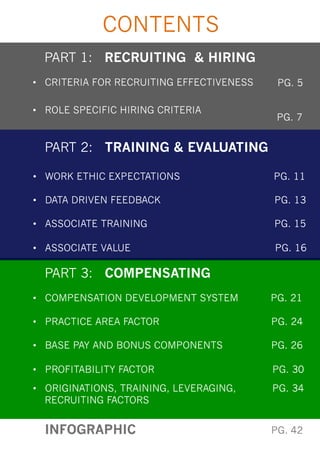
CONTENTS
PART 1: RECRUITING & HIRING
PART 2: TRAINING & EVALUATING
PART 3: COMPENSATING
PG. 5• CRITERIA FOR RECRUITING EFFECTIVENESS
• ROLE SPECIFIC HIRING CRITERIA
PG. 7
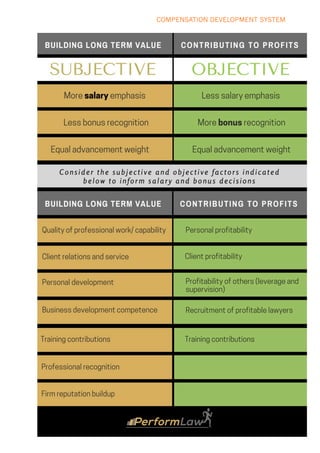
• COMPENSATION DEVELOPMENT SYSTEM PG. 21
• PRACTICE AREA FACTOR PG. 24
• BASE PAY AND BONUS COMPONENTS PG. 26
• PROFITABILITY FACTOR PG. 30
• ORIGINATIONS, TRAINING, LEVERAGING, PG. 34
RECRUITING FACTORS
• WORK ETHIC EXPECTATIONS PG. 11
• DATA DRIVEN FEEDBACK PG. 13
• ASSOCIATE TRAINING PG. 15
• ASSOCIATE VALUE PG. 16
PINFOGRAPHIC PG. 42
Want to develop your associate into stellar lawyers?
Start by hiring the right ones.
PART 1
RECRUITING
& HIRING
5Law Firm Associate Development
CRITERIA FOR RECRUITING
EFFECTIVENESS
Law school and class rank are the
most common objective criteria
used when initially selecting
associate. Other factors follow,
but subjective factors rarely
overcome school and class rank.
While the quality of law school and class rank are indicative of certain things about a
potential hire, we see higher levels of success among firms that employ “role
specific” hiring criteria aligned with client needs. For example, when hiring an
associate for clients with a volume of similar and tightly managed cases, hiring
criteria would include an ability to manage multiple priorities and a desire to work in
a structured environment that values adherence to procedure.    
Alternatively, when hiring for clients with complex issues requiring deep research and
creative approaches to each case, firms would consider candidates possessing
strong problem solving and writing skills. Associates with an ability to handle
changing priorities and a less structured routine would have a higher value in this
type environment.
Larger firms can employ higher numbers of candidates with the understanding that
attrition is inevitable. In these instances, the best available talent is selected based
on general criteria such as law school rank, grades and academic achievements.
Continuing this approach requires a certain amount of attrition (few firms can grow
at a pace to absorb 100% of new hires).
6Law Firm Associate Development
Small and mid-sized firms hire fewer associates and must achieve better hiring
results and lower attrition rates. For example, a twenty-five lawyer firm that hires two
associates per year at a 50% attrition rate will have the ability to grow by 20% every
five years. Lateral hires are a separate consideration.    
We recommend that firms expand their hiring criteria and interviewing process to
include suitability for the contemplated role and ability to address client needs. We
also recommend that firms analyze the attributes of their existing successful
associates and those who have left for perceived better opportunities to assist in the
development of a model associate platform.
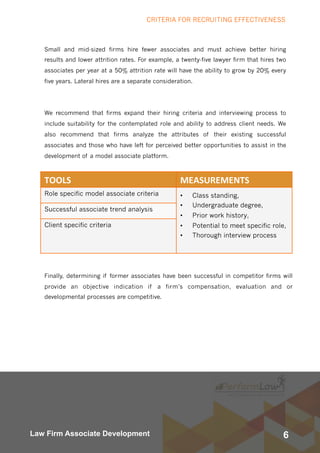
TOOLS	 MEASUREMENTS	
Role specific model associate criteria • Class standing,
• Undergraduate degree,
• Prior work history,
• Potential to meet specific role,
• Thorough interview process
Successful associate trend analysis
Client specific criteria
Finally, determining if former associates have been successful in competitor firms will
provide an objective indication if a firm’s compensation, evaluation and or
developmental processes are competitive.
CRITERIA FOR RECRUITING EFFECTIVENESS
7Law Firm Associate Development
Firms willing to invest time and effort into the hiring process are better able to choose the
right candidates. Specifically, firms developing a role specific recruiting process are more
likely to consider only high quality candidates who are a potential match for an open
position. On the contrary, firms that typically hire based on likability and broad academic
measurements are prone to a weakened hiring process. Hiring law firm associates based
on suitability for a defined role requires the following process elements:
Define the Role. Then Hire the Associate.
 
• Understanding of available roles;
• Model associate criteria;
• Client preferences; and
• Informed interviewing process
Role Definition
The first step in developing a hiring strategy is to seriously contemplate the attributes
required to succeed in an available role. Roles are best developed with both partner and
associate input.
Partners should consider internal factors (chemistry, partner work habits, and style) along
with how a particular role impacts client service.  Since associate know the daily realities of
the job, associate input is also vital to the role definition process. Additionally, the inclusion
of existing associates in the hiring process supports good morale and an increased
willingness to train new lawyers.
It is important to remember that many associate candidates are just glad to have a chance
at a paying job. Even if they are better suited for another role, their income need will force
them to try to be what the position requires. This is why it is important for firms to define
roles as specifically and realistically as possible.
ROLE SPECIFIC HIRING CRITERIA
8Law Firm Associate Development
Model associate criteria
Creating a model that indicates the attributes of successful associates is valuable tool for
selecting new hires. Personality, law school, grades and prior work experience are often
the criteria applied to hiring new associates. Firms that carefully consider the attributes of
existing successful associates are better prepared to choose candidates.
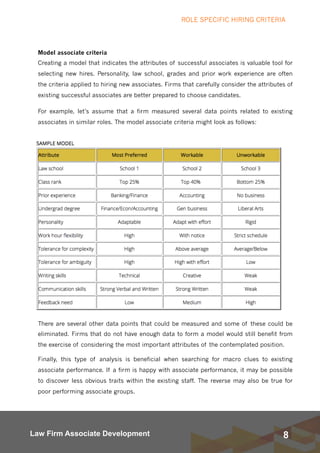
For example, let’s assume that a firm measured several data points related to existing
associates in similar roles. The model associate criteria might look as follows:
There are several other data points that could be measured and some of these could be
eliminated. Firms that do not have enough data to form a model would still benefit from
the exercise of considering the most important attributes of the contemplated position.
Finally, this type of analysis is beneficial when searching for macro clues to existing
associate performance. If a firm is happy with associate performance, it may be possible
to discover less obvious traits within the existing staff. The reverse may also be true for
poor performing associate groups.
ROLE SPECIFIC HIRING CRITERIA
9Law Firm Associate Development
When firms have a clear
understanding of the
available roles and
corresponding model
associate criteria, they
are capable of developing
a m o r e i n f o r m e d
interviewing process.
Client specific criteria
Private law firm clients generally do not tell law firms who to hire. Clients do, at times,
recommend broad hiring preferences to law firms. For example, some clients have
diversity requirements in their retention agreements with law firms. Bilingual speaking
team members are often an advantage. Finally, some clients simply will not pay for first
year lawyers. To the extent that a firm is able to identify client preferences, assuming they
are not discriminatory, they should be taken into account when considering new hires.
Informed interviewing process
Having a clear understanding of the available roles
and corresponding model associate criteria, firms are
capable of developing a more informed interviewing
process. Whether partners are responsible for
identifying and vetting their hires, or it is a hiring
partner or committee performing theses duties, the
process is much the same.
Hiring committees/partners having the benefit of role
specific model associate criteria will have more
recruiting effectiveness. Each phase of the hiring
process from the initial job posting, to resume
evaluation, to interviewing and selection will be
enhanced by an informed approach.
Define the role. Then make the hire.
ROLE SPECIFIC HIRING CRITERIA
10Law Firm Associate Development
For firms still committed to law school hiring….
rather than who still believe.
PART 2
TRAINING
& EVALUATING
11Law Firm Associate Development
Setting expectations for associates is extremely useful in the developmental process and
helps avoid burnout. If associates have an idea of the time commitment required to
progress,  they are more likely to fully engage. 
Similar to runners training for a marathon,  associates starting out too fast will burn out.
Training must begin with shorter distances that become longer with increases in
endurance. What initially seems daunting soon becomes tolerable. When law firms give
their associates robust but doable work ethic expectations that increase over time,
productivity and loyalty are enhanced. Law firms also benefit from building economic
models based on long-term associate development.
 
WORK ETHIC
EXPECTATIONS
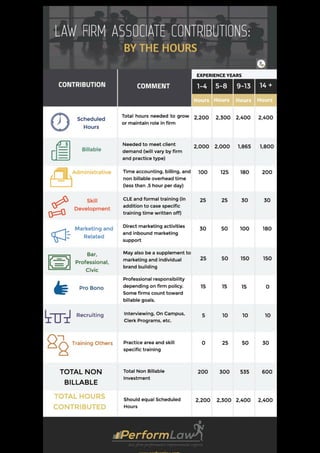
Associate Contributions: By
the Hours
Infographic (Following page)
The infographic on the following page provides a sample of a recommended process for setting
work ethic expectations. All firms are different, and the indicated expectations would be modified to
fit the role. For example, a lawyer with a heavy publishing commitment may have a reduced
billable goal or use time from other areas.
13Law Firm Associate Development
Law firms secure successful attorneys because their hiring decisions are based on
suitability for a defined role.  These firms  hire the right people since they invest the time
and effort to develop a clear understanding of the available roles and corresponding
model associate criteria.
To continue on this successful track, firms must also monitor their associate's
performance to ensure that each associate is progressing and thriving in their assigned
role. If an associate is underperforming in his or her role, changes must be made. 
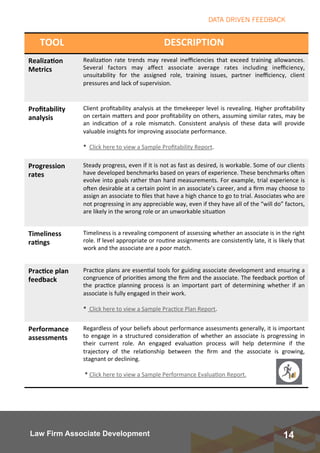
There are several data-driven feedback opportunities that firms can use to monitor and
evaluate associate performance. These tools are described on the following pages.
Successful Firms Put The Right People In The Right Jobs
DATA DRIVEN FEEDBACK
14Law Firm Associate Development
TOOL DESCRIPTION
Realiza5on	
Metrics	
Realiza'on	 rate	 trends	 may	 reveal	 inefficiencies	 that	 exceed	 training	 allowances.	
Several	 factors	 may	 affect	 associate	 average	 rates	 including	 inefficiency,	
unsuitability	 for	 the	 assigned	 role,	 training	 issues,	 partner	 inefficiency,	 client	
pressures	and	lack	of	supervision.			
Profitability	
analysis
Client	profitability	analysis	at	the	'mekeeper	level	is	revealing.	Higher	profitability	
on	certain	maDers	and	poor	profitability	on	others,	assuming	similar	rates,	may	be	
an	 indica'on	 of	 a	 role	 mismatch.	 Consistent	 analysis	 of	 these	 data	 will	 provide	
valuable	insights	for	improving	associate	performance.	
* Click	here	to	view	a	Sample	Profitability	Report.
Progression	
rates
Steady	progress,	even	if	it	is	not	as	fast	as	desired,	is	workable.	Some	of	our	clients	
have	developed	benchmarks	based	on	years	of	experience.	These	benchmarks	oHen	
evolve	into	goals	rather	than	hard	measurements.	For	example,	trial	experience	is	
oHen	desirable	at	a	certain	point	in	an	associate’s	career,	and	a	firm	may	choose	to	
assign	an	associate	to	files	that	have	a	high	chance	to	go	to	trial.	Associates	who	are	
not	progressing	in	any	appreciable	way,	even	if	they	have	all	of	the	“will	do”	factors,	
are	likely	in	the	wrong	role	or	an	unworkable	situa'on
Timeliness	
ra5ngs
Timeliness	is	a	revealing	component	of	assessing	whether	an	associate	is	in	the	right	
role.	If	level	appropriate	or	rou'ne	assignments	are	consistently	late,	it	is	likely	that	
work	and	the	associate	are	a	poor	match.		
Prac5ce	plan	
feedback
Prac'ce	plans	are	essen'al	tools	for	guiding	associate	development	and	ensuring	a	
congruence	of	priori'es	among	the	firm	and	the	associate.	The	feedback	por'on	of	
the	 prac'ce	 planning	 process	 is	 an	 important	 part	 of	 determining	 whether	 if	 an	
associate	is	fully	engaged	in	their	work.	
	
*		Click	here	to	view	a	Sample	Prac'ce	Plan	Report.	
Performance	
assessments		
Regardless	of	your	beliefs	about	performance	assessments	generally,	it	is	important	
to	engage	in	a	structured	considera'on	of	whether	an	associate	is	progressing	in	
their	 current	 role.	 An	 engaged	 evalua'on	 process	 will	 help	 determine	 if	 the	
trajectory	 of	 the	 rela'onship	 between	 the	 firm	 and	 the	 associate	 is	 growing,	
stagnant	or	declining.	
	
	*	Click	here	to	view	a	Sample	Performance	Evalua'on	Report.	
DATA DRIVEN FEEDBACK
15Law Firm Associate Development
When it comes to associate turnover or ineffectiveness, small to mid-sized firms operate
on a razor-thin margin. Many firms have simply given up law school hiring as means to
fill open positions or to meet future staffing needs.  
More often, firms prefer to hire associate lawyers with experience. These law firms are
betting that lateral associate hires come properly trained by their former employers.
However, this is not always the case.
 
 
Prezi Navigation Tips
• Click the image on the left to go to Prezi.
• Enable full screen (icon at bottom right of
the Prezi window)
• Navigate through the Prezi using arrow
keys or the spacebar.
• Click on any image to zoom in on its
contents.
ASSOCIATE TRAINING
Contributing to the training reticence are associates who leave firms prematurely.
Additionally, many clients are not willing to underwrite training costs, or in some
instances, even let lawyers work on their cases. In our experience, all of these factors
add up to a series of missed opportunities, accelerated law firm aging and diminished
competitiveness.
For those firms who still believe it is worthwhile to invest in hiring directly from law
school, we recommend a process that includes the following elements:
• Formal training plan and budget;
• Training incentives;
• Structured access to trained lawyers;
• Mentoring program;
• Work assignments that are congruent with the training plan; and
• Structured evaluation and feedback system.
Realistically, this is a lot of structure for small to mid-sized firms to employ.
Measurable benefits, however, may be produced from at least considering the
necessary elements of training lawyers and applying them on a conceptual level.
For those firms that are data driven and believe that there is value in training
associates, we created the following Prezi just for you!
16Law Firm Associate Development
Expectations and consistency are reliant on one another. To effectively set attorney
expectations, law firms should include a planning process, benchmarks, periodic
reviews and a clear progression path. The focus of this post is the planning process.
A structured process (Practice Planning Process) that creates a balance between the
firm’s needs and the career goals of the attorney is ideal.
These plans are
specific and are based
on three essential
concepts:
1.  Shared vision of success;
2.  Train associates to view their
career strategically; and
3.  Focus efforts according to
commitment and potential.
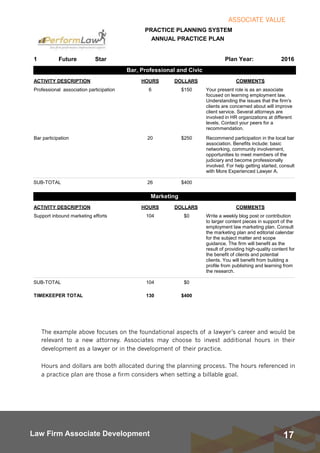
Consider the excerpt from a
sample practice plan on the
following page.
ASSOCIATE VALUE
Expedite Associate Value by Setting Expectations
17Law Firm Associate Development
The example above focuses on the foundational aspects of a lawyer’s career and would be
relevant to a new attorney. Associates may choose to invest additional hours in their
development as a lawyer or in the development of their practice.
Hours and dollars are both allocated during the planning process. The hours referenced in
a practice plan are those a firm considers when setting a billable goal.
ASSOCIATE VALUE
PRACTICE PLANNING SYSTEM
ANNUAL PRACTICE PLAN
1 Future Star Plan Year: 2016
ACTIVITY DESCRIPTION HOURS DOLLARS COMMENTS
Bar, Professional and Civic
Professional association participation 6 $150 Your present role is as an associate
focused on learning employment law.
Understanding the issues that the firm's
clients are concerned about will improve
client service. Several attorneys are
involved in HR organizations at different
levels. Contact your peers for a
recommendation.
Bar participation 20 $250 Recommend participation in the local bar
association. Benefits include: basic
networking, community involvement,
opportunities to meet members of the
judiciary and become professionally
involved. For help getting started, consult
with More Experienced Lawyer A.
26 $400SUB-TOTAL
ACTIVITY DESCRIPTION HOURS DOLLARS COMMENTS
Marketing
Support inbound marketing efforts 104 $0 Write a weekly blog post or contribution
to larger content pieces in support of the
employment law marketing plan. Consult
the marketing plan and editorial calendar
for the subject matter and scope
guidance. The firm will benefit as the
result of providing high-quality content for
the benefit of clients and potential
clients. You will benefit from building a
profile from publishing and learning from
the research.
104 $0SUB-TOTAL
130 $400TIMEKEEPER TOTAL
Page 1 of 2
18Law Firm Associate Development
ASSOCIATE VALUE
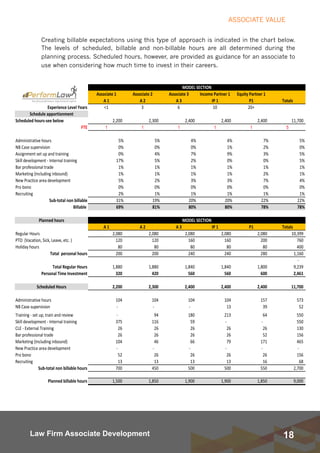
Creating billable expectations using this type of approach is indicated in the chart below.
The levels of scheduled, billable and non-billable hours are all determined during the
planning process. Scheduled hours, however, are provided as guidance for an associate to
use when considering how much time to invest in their careers.
19Law Firm Associate Development
ASSOCIATE VALUE
Each person and each situation is different, but the firm will need certain levels
of billable performance and non-billable contributions to ensure a growing and
profitable relationship with the associate.
In this model, the contributions of hours differ depending upon individual plans
and experience levels. As a general rule, the development of practice plans for
associates in years 1-5 is heavily influenced by the partners. After year 5,
individual attorney goals and the firm’s needs should be aligned. Reaching this
point affords more latitude in plan development. Once full partnership is
reached, the process usually becomes optional and is replaced with a marketing or
strategic plan.
You may recall that we recently circulated a traditional hour’s model that included
more billable hours and less non-billable time investments. When comparing that
model to the sample performance above, it is important to understand that every
firm is different and the approach introduced in this post is more difficult for some
firms to embrace. When employing a practice planning process that includes
strategic investments of non-billable time,  a long-term approach is necessary.
As more clients refuse to pay for associate training, this process seeks to
generate associate value on an expedited basis.
20Law Firm Associate Development
Does your firm want to stay around for a while?
A competent compensation system is a must.
PART 3
COMPENSATING
21Law Firm Associate Development
The topic of associate compensation typically generates many questions.
• What should you do when market pay and associate contributions are not
aligned?
• Is compensation an incentive after a certain point?
• Should associate base salary contain more base pay or more bonus?
• How do we manage profitability when clients tightly manage the use of
associate time?
The answers we give to these questions depend on client service needs and a firm’s goals. And
while every firm is different, there are best practices and a process for rewarding tangible
contributions that any firm can use.
This article and ones that follow in Part 3: Compensating will review the components and
processes to consider in developing an effective associate compensation system.
To start, consider the distinction between subjective and objective contributions shown on the
following page. Distinguishing contributions that build long term value from those that contribute
to profits (profit contributions) is the first step in creating the right incentives. Eventually, these
distinguished categories should intersect, but they may also remain distinct.
COMPENSATION DEVELOPMENT
SYSTEM
COMPENSATION DEVELOPMENT SYSTEM
As the chart indicates, building long-term value contributions are rewarded through
salary and profit contributions through bonuses. When considering advancement,
each is weighted equally.
It is our experience that many law firms weigh the objective profit contributions more
than the qualitative/ long term value contributions listed in the lower half of the table. A
firm’s long-term performance, however, is more affected by qualitative factors, and we
recommend balancing short and long-term priorities.
For example, building long term value may lead to higher bill rates, realization, and
availability for a wider range of assignments. Alternatively, a lawyer who is assigned to a
case requiring a large volume of repetitive functions may be contributing higher
profit dollars now, but may not advance their marketable skill sets.
.
.
In a competitive legal market, properly incentivizing
and compensating associates is essential to not
only the retention of top attorneys but also to a
firm's profitability and long-term viability.
24Law Firm Associate Development
PRACTICE AREA PAY
Should Pay Follow Practice Area?
Certain practice areas at law firms are clearly more profitable than others. Because of
this, firms with a diverse practice mix will face more challenges in developing an associate
compensation system.  For instance: 
How should a firm compensate same-year associates working in different practice areas with
materially differing billing rates?
Most firms rarely consider billing rates when deciding how much to pay their associates. 
They focus solely on attorney’s billable hours, making billing rates irrelevant to the
compensation equation. We believe these firms need to refocus.
Law firms will benefit when they focus more on the profit an associate generates rather
than their number of billable hours. Firms should consider an associate's billing rates and
profits contributed for the following reasons:
• Associates who successfully work on higher paying client work will develop skill sets
valued by these clients. As their career progresses, they are incented and will be
positioned to develop work in these higher rate bands.
25Law Firm Associate Development
• Billable hours may differ among practice groups. For example, certain business
practices may have less leverage and less individual billable hours. Usually, the rate
differential will overcome the result of less production. Regardless, paying on profit
contributed will account for any favorable or unfavorable differences.
• Firms that hire associates based on available roles must consider the economic
realities attached to these positions. For example, insurance defense and estate
planning will have separate economic models with billable hour and rate differences.
Partners need the flexibility to align compensation with the competitive needs of their
practice.
• Outlier practices (practices significantly different than the common practice in the firm)
must pay their people at the market value for the services they offer. A firm with mostly
lower rate practices is vulnerable to losing people doing higher rate work if they do not
account for the market realities. This is particularly true when competitors are paying
their attorneys based on the economics of that higher rate’s practice.
• Paying based on billable hours may not be feasible in non-hourly billing practices.
Having worked in law firms for virtually my entire career, I can think of individual
situations that don’t fit into any of these scenarios. Recognizing that creating policy is
an imperfect science, all compensation decisions must be accompanied by sound
management judgment.
26Law Firm Associate Development
To remain competitive, law firms must attract, motivate and retain top performing
associates.  A well-designed associate compensation system is essential to championing
this effort.  While no system is perfect,  a firm is most effective when its compensation
structure is aligned with the firm’s values and goals. The system should also be
predictable, so that there is a clear connection between an associate’s behavior and his or
her compensation.
This article will discuss the components of a successful compensation system, including
base pay and bonus pay.  It will  review ways in which your firm can approach these
components in developing an associate compensation system.
Base
Base compensation varies by law firm and market. Many firms have a salary scale based
mostly on experience. Economic factors are considered, and firm performance often
influences base pay. Typically, firms set a base compensation and give associates annual
pay increases. While associates on partnership track may have a higher earning ceiling,
eventually salaries are capped, and additional income is earned through bonus.
BASE PAY &
BONUS
COMPONENTS
Winning the Game of Associate
Compensation
27Law Firm Associate Development
We recommend setting initial base salaries at
market and increasing base salaries as additions to
long-term value occur.
Rate increases are difficult to achieve, and many clients have standard rates based on
experience level. As a result, associate profit margins are difficult to maintain. Well-
managed firms mitigate this effect through expedited training, which results in improved
production and realization.  
The two most common base compensation schemes we see include lower base/higher
bonus and higher base/lower bonus. Both of these systems are workable, but each comes
with its pros and cons. For example, lower base salaries require an aggressive bonus plan
requiring firms to reserve cash to meet bonus payouts. Higher base salaries tend to
marginalize bonuses and the performance that accompanies an extra pay incentive.
The tools that provide the data to make these assessments include:
• Practice plans;
• Performance assessments; and
• Profitability analysis.
Increasing base salary based on the thoughtful consideration of an associate's value to
clients and the firm will incent the right factors.
BASE SALARY & BONUS COMPONENTS
28Law Firm Associate Development
Bonus
Subjective
A completely subjective bonus system is based on the opinions of the firm decision
makers.  This can lead to a process susceptible to a weighting based on political
strength, likability, and perception. While billable hours and billing data may inform
bonus awards,  the actual meeting dynamics and current events (good/bad year, good/
bad month, cash position, etc.) can play a disproportionate role.
Absent a reliance on objective factors, administering a subjective system should, at a
minimum, employ a process of comparing final numbers for essentially equivalent
results. A comparison to prior year awards for the same stated performance may also
indicate inconsistencies.
Absent a reliance on objective factors, administering a subjective system should, at a
minimum, employ a process of comparing final numbers for essentially equivalent
results. A comparison to prior year awards for the same stated performance may also
indicate inconsistencies.
 .
Communicating the bonus criteria and ensuring that the recipients (or non-recipients) can
connect their performance to their award is essential to incenting the right levels of
performance.  It is fine to award non-productivity related subjective bonuses (community
activity; client satisfaction/feedback; pro bono service award, etc.) so long as there is a
clear connection between the action and the compensation. Differing bonus amounts that
are not explainable by apparent factors can create morale issues.
We believe a fair compensation system needs to be predictable
and transparent. Therefore, data is inevitably needing, which
incents a move toward an objective approach.
BASE SALARY & BONUS COMPONENTS
29Law Firm Associate Development
Objective
Among the objective bonus structures, compensating based on billable hours is the most
prevalent. Standard bonus programs range from payment for each hour worked past a
threshold to bonuses based on a percentage of salary at stated levels of production.
Several other systems exist, but the awards still primarily tie to billable hours.
The key concerns raised with hours-based bonuses include realization and workload
differences. Unless there are realization thresholds, associates may aggressively record
time. Clients also realize this so may have issues with these types of bonus plans. Some
clients have even evolved to using bill auditing services and tight rate controls.  Workload
differences may also present issues with an hours-based bonus system. Associate hours
may be related to less obvious factors such as overstaffing or even training and
supervision deficiencies.
 
BASE SALARY & BONUS COMPONENTS
The obvious benefit of rewarding based on billable hours
is that it compensates for actual work and is predictable
and transparent. Associates know the bonus parameters
and can calculate their bonus as the year progresses.
Popularity does not factor into the award. As with any
formula based systems, final results should be reviewed
for any potential gaming of the system.
We favor objectively incenting productivity. Further, we
prefer to go beyond the billable hour to also consider the
following factors in determining compensation:
• profitability
• originations/ business development,
• training,
• leveraging and
• recruiting.
30Law Firm Associate Development
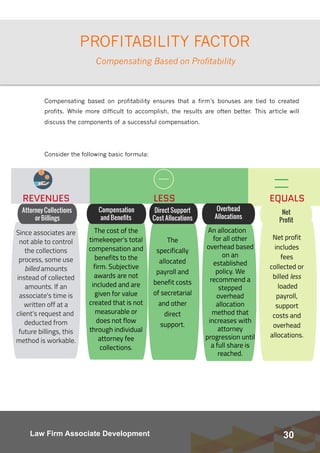
PROFITABILITY FACTOR
Compensating based on profitability ensures that a firm’s bonuses are tied to created
profits. While more difficult to accomplish, the results are often better.  This article will
discuss the components of a successful compensation.
Consider the following basic formula:
Compensating Based on Profitability
31Law Firm Associate Development
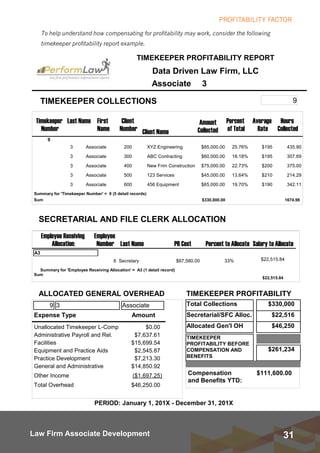
To help understand how compensating for profitability may work, consider the following
timekeeper profitability report example.
PROFITABILITY FACTOR
Data Driven Law Firm, LLC
TIMEKEEPER PROFITABILITY REPORT
Associate 3
TIMEKEEPER COLLECTIONS
SECRETARIAL AND FILE CLERK ALLOCATION
ALLOCATED GENERAL OVERHEAD
9
$330,000
TIMEKEEPER PROFITABILITY
Total Collections
$22,516Secretarial/SFC Alloc.
$46,250Allocated Gen'l OH
$261,234
TIMEKEEPER
PROFITABILITY BEFORE
COMPENSATION AND
BENEFITS
Timekeeper
Number
Last Name First
Name
Client
Number Client Name
Amount
Collected
Average
Rate
Hours
Collected
Percent
of Total
9
2003 Associate XYZ Engineering $85,000.00 $195 435.9025.76%
3003 Associate ABC Contracting $60,000.00 $195 307.6918.18%
4003 Associate New Frim Construction $75,000.00 $200 375.0022.73%
5003 Associate 123 Services $45,000.00 $210 214.2913.64%
6003 Associate 456 Equipment $65,000.00 $190 342.1119.70%
Summary for 'Timekeeper Number' = 9 (5 detail records)
Sum $330,000.00 1674.98
Employee Receiving
Allocation:
Employee
Number Last Name PR Cost Percent to Allocate Salary to Allocate
A3
6 Secretary $67,580.00 33% $22,515.84
Summary for 'Employee Receiving Allocation' = A3 (1 detail record)
Sum
$22,515.84
Unallocated Timekeeper L-Comp $0.00
Facilities $15,699.54
Equipment and Practice Aids $2,545.87
Practice Development $7,213.30
General and Administrative $14,850.92
Administrative Payroll and Rel. $7,637.61
Other Income ($1,697.25)
Total Overhead $46,250.00
Expense Type Amount
9 3 Associate
Compensation
and Benefits YTD:
$111,600.00
PERIOD: January 1, 201X - December 31, 201X
32Law Firm Associate Development
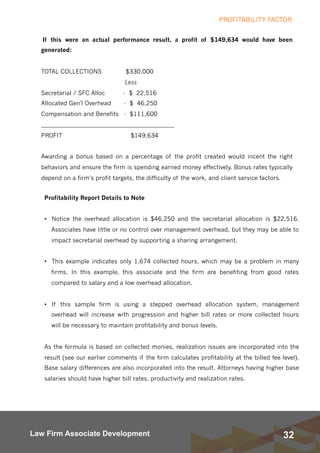
If this were an actual performance result, a profit of $149,634 would have been
generated:
TOTAL COLLECTIONS  $330,000
Less
Secretarial / SFC Alloc         -  $  22,516
Allocated Gen'l Overhead       -  $  46,250
Compensation and Benefits   -  $111,600
_____________________________________________
PROFIT                                     $149,634
Awarding a bonus based on a percentage of the profit created would incent the right
behaviors and ensure the firm is spending earned money effectively. Bonus rates typically
depend on a firm’s profit targets, the difficulty of the work, and client service factors.
PROFITABILITY FACTOR
Profitability Report Details to Note
• Notice the overhead allocation is $46,250 and the secretarial allocation is $22,516.
Associates have little or no control over management overhead, but they may be able to
impact secretarial overhead by supporting a sharing arrangement.
• This example indicates only 1,674 collected hours, which may be a problem in many
firms. In this example, this associate and the firm are benefiting from good rates
compared to salary and a low overhead allocation.
• If this sample firm is using a stepped overhead allocation system, management
overhead will increase with progression and higher bill rates or more collected hours
will be necessary to maintain profitability and bonus levels.
As the formula is based on collected monies, realization issues are incorporated into the
result (see our earlier comments if the firm calculates profitability at the billed fee level).
Base salary differences are also incorporated into the result. Attorneys having higher base
salaries should have higher bill rates, productivity and realization rates.  
33Law Firm Associate Development
PROFITABILITY BASED SYSTEM
CONCERNS
One issue that arises in profitability
based systems is that that some
associates may enjoy higher
profitability because they are assigned
to clients with higher bill rates. In
these instances, an evaluation must be
made if there is a corresponding skill or
workload premium.
It is possible that an attorney assigned
to a client with a lower bill rate is
actually adding more long term
marketable skill sets. This is a difficult
situation to address and the solutions
range from base salary differentials,
differing bonus percentages to no
intervention at all.
In firms where partners
compensation is based on profit
contributed, the cost differentials in
a profitability bonus system are borne
by the originating partners.
Additionally, firms only have so many
available roles, and associates must
strategically weigh the benefits their
existing role against their long term
career aspirations.
Finally, bonuses based on contributed
profits account for the intersection
between increases in long term value
and short term profit contributions.
Associates enjoying higher base salaries
must ultimately command some
combination of higher bill rates,
increased realization and or higher
production.
PROFITABILITY FACTOR
34Law Firm Associate Development
ORIGINATIONS, TRAINING, LEVERAGING,
RECRUITING FACTORS
The Uncharted Waters of Associate Compensation
Beyond the billable hour, there are
additional ways in which associates
can bring value to a firm. However,
firms rarely consider these areas of
value in developing their associate
compensation plans. 
Four of the more quantifiable, non-
production ways that associates,
depending upon their level, can add
value include:
Originations
Training
Leveraging
Recruiting profitable lawyers
.
The following article will review these areas and how they can increase an associate's
value to the firm.  We will discuss how firms can measure and quantify an associate's
performance in these areas for determining compensation.
35Law Firm Associate Development
We recommend associates
consider business
development as a
strategic component of
their career development.
Balanced with other
essential elements such
as competence, training,
leveraging and reputation,
an associate will increase
their value as a lawyer.
Originations
Business origination value is evident. Associates who bring in clients create income. While
associate business development is commendable, many questions arise when the subject
of compensation is brought into the conversation.
• Should the firm compensate associates for the clients they bring in?
• Should associates simply appreciate that client development will help them attain
partnership admission?
These are fair questions, especially since associates
work on other lawyers’ originations until they are self-
supporting.  Additionally,  the marketing costs
associated with obtaining a new client must be
considered, especially since these costs are
underwritten by the partners.
Among the firms that offer bonuses, we typically
encounter rewards based on collected fees (5% or
10%). These firms believe that short-term business
development bonuses will act as an incentive. A
potential contradiction is that many these same firms
are unwilling to reduce billable expectations for
business development efforts or even successes.
Regardless of incentive programs, we recommend
associates consider business development as a
strategic component of their career development to be
balanced with the other elements essential to
increasing value as a lawyer (competence, training,
leveraging, reputation, etc.)
ORIGINATIONS, TRAINING, ETC.
36Law Firm Associate Development
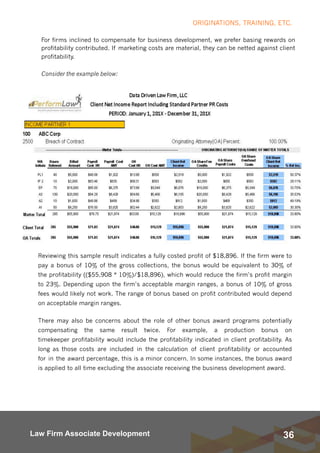
For firms inclined to compensate for business development, we prefer basing rewards on
profitability contributed. If marketing costs are material, they can be netted against client
profitability.
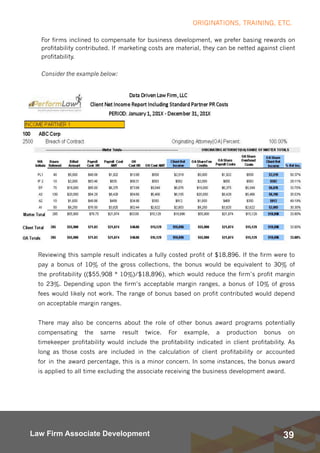
Consider the example below:
ORIGINATIONS, TRAINING, ETC.
Reviewing this sample result indicates a fully costed profit of $18,896. If the firm were to
pay a bonus of 10% of the gross collections, the bonus would be equivalent to 30% of
the profitability (($55,908 * 10%)/$18,896), which would reduce the firm’s profit margin
to 23%. Depending upon the firm’s acceptable margin ranges, a bonus of 10% of gross
fees would likely not work. The range of bonus based on profit contributed would depend
on acceptable margin ranges.
There may also be concerns about the role of other bonus award programs potentially
compensating the same result twice. For example, a production bonus on
timekeeper profitability would include the profitability indicated in client profitability. As
long as those costs are included in the calculation of client profitability or accounted
for in the award percentage, this is a minor concern. In some instances, the bonus award
is applied to all time excluding the associate receiving the business development award.
37Law Firm Associate Development
Training Contributions
Younger associates spend most of their time being trained and do not provide any real
training to other associates. More experienced associates, however, may make tangible
training contributions.
• Should associates be given training bonuses or should they view these efforts as payback for
the training they received?
• Training creates real value and adds profit on an expedited basis.
• Would compensating senior associates incent them to train junior associates better?
We believe it would.  
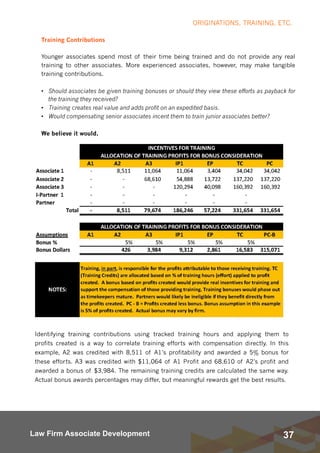
Consider the following training bonus example:
ORIGINATIONS, TRAINING, ETC.
Identifying training contributions using tracked training hours and applying them to
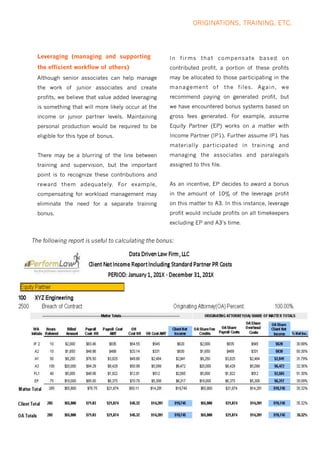
profits created is a way to correlate training efforts with compensation directly. In this
example, A2 was credited with 8,511 of A1’s profitability and awarded a 5% bonus for
these efforts. A3 was credited with $11,064 of A1 Profit and 68,610 of A2’s profit and
awarded a bonus of $3,984. The remaining training credits are calculated the same way.
Actual bonus awards percentages may differ, but meaningful rewards get the best results.
ORIGINATIONS, TRAINING, ETC.
The following report is useful to calculating the bonus:
Although senior associates can help manage
the work of junior associates and create
profits, we believe that value added leveraging
is something that will more likely occur at the
income or junior partner levels. Maintaining
personal production would be required to be
eligible for this type of bonus.
There may be a blurring of the line between
training and supervision, but the important
point is to recognize these contributions and
reward them adequately. For example,
compensating for workload management may
eliminate the need for a separate training
bonus.
In firms that compensate based on
contributed profit, a portion of these profits
may be allocated to those participating in the
management of the files. Again, we
recommend paying on generated profit, but
we have encountered bonus systems based on
gross fees generated. For example, assume
Equity Partner (EP) works on a matter with
Income Partner (IP1). Further assume IP1 has
materially participated in training and
managing the associates and paralegals
assigned to this file.
As an incentive, EP decides to award a bonus
in the amount of 10% of the leverage profit
on this matter to A3. In this instance, leverage
profit would include profits on all timekeepers
excluding EP and A3’s time.
Leveraging (managing and supporting
the efficient workflow of others)
39Law Firm Associate Development
For firms inclined to compensate for business development, we prefer basing rewards on
profitability contributed. If marketing costs are material, they can be netted against client
profitability.
Consider the example below:
ORIGINATIONS, TRAINING, ETC.
Reviewing this sample result indicates a fully costed profit of $18,896. If the firm were to
pay a bonus of 10% of the gross collections, the bonus would be equivalent to 30% of
the profitability (($55,908 * 10%)/$18,896), which would reduce the firm’s profit margin
to 23%. Depending upon the firm’s acceptable margin ranges, a bonus of 10% of gross
fees would likely not work. The range of bonus based on profit contributed would depend
on acceptable margin ranges.
There may also be concerns about the role of other bonus award programs potentially
compensating the same result twice. For example, a production bonus on
timekeeper profitability would include the profitability indicated in client profitability. As
long as those costs are included in the calculation of client profitability or accounted
for in the award percentage, this is a minor concern. In some instances, the bonus award
is applied to all time excluding the associate receiving the business development award.
40Law Firm Associate Development
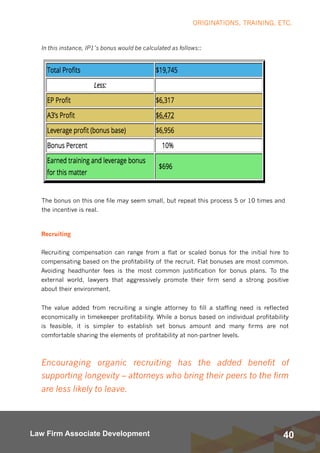
In this instance, IP1’s bonus would be calculated as follows::
ORIGINATIONS, TRAINING, ETC.
The bonus on this one file may seem small, but repeat this process 5 or 10 times and
the incentive is real.
Recruiting
Recruiting compensation can range from a flat or scaled bonus for the initial hire to
compensating based on the profitability of the recruit. Flat bonuses are most common.
Avoiding headhunter fees is the most common justification for bonus plans.  To the
external world, lawyers that aggressively promote their firm send a strong positive
about their environment.  
The value added from recruiting a single attorney to fill a staffing need is reflected
economically in timekeeper profitability. While a bonus based on individual profitability
is feasible, it is simpler to establish set bonus amount and many firms are not
comfortable sharing the elements of profitability at non-partner levels.
Encouraging organic recruiting has the added benefit of
supporting longevity – attorneys who bring their peers to the firm
are less likely to leave.
41Law Firm Associate Development
Recruiting laterals with business comes with
a different set of economics and
challenges. Firms that are not reaching
their lateral recruiting goals, assuming
their value proposition is adequate,
may need to energize par tners to
recruit more aggressively.  Additionally,
non-partners and junior partners received
no real benefit from attracting profitable
laterals. 
Senior partners, as a result of
their ownership percentages,  are more
poised to enjoy the benefits of
spreading fixed overhead among more
attorneys.  Most firms believe that it is
incumbent upon general partners to recruit
for the good of the firm. 
ORIGINATIONS, TRAINING, ETC.
While this is understandable, most partners do not actively recruit
quality laterals. Instead, firms rely heavily on recruiters, who perform a
necessary service, but organic recruits come with all of the intangible
longevity benefits previously mentioned.
Firms that have quality profitability tools are in a position to create a
profit based bonus pool to reward lateral recruiting. 
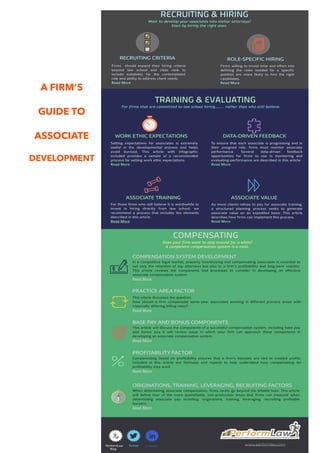
A FIRM’S
GUIDE TO
ASSOCIATE
DEVELOPMENT
PerformLaw assists law firms in all aspects of
developing Associate Development Programs
including:
• Practice plan development and follow up
• Performance evaluation and coaching
• Marketing plan development and coaching
• Compensation analysis and market comparison
• Compensation and bonus formula design and
administration
• Profitability analysis
• Individual performance improvement
• Progression criteria, policies and systems
• Remote staffing evaluation
• Issue/conflict resolution
If you are interested in learning more about how
PerformLaw can help your firm, click below.
Helping law firms become market aware and
fiercely competitive.

eBook-Associate-Development

  • 1.
    F O RL A W F I R M S S T R I V I N G F O R E X C E L L E N C E ESSENTIAL GUIDE TO ASSOCIATE DEVELOPMENT www.performlaw.com
  • 2.
    2Law Firm AssociateDevelopment INTRODUCTION Regardless of how the practice of law changes in the future, law firms will always need energy, experience, skill and wisdom. Forward thinking law firms realize that hiring and supporting bright young lawyers is a critical component of ensuring that the firm does not run out of energy and fall into decline. A strong attorney development program can further secure long-term successes.  These programs can be beneficial to both the associate and the firm.  Firms that develop their leaders now will be better positioned to handle challenges in the future.     Developing an effective program needs planning and partner support. PerformLaw's eBook will review the the essential components of an effective program including: - Evaluation and feedback - Practice planning - Compensation - Advanced criteria Associate Development Concerns The costs of training and mentoring is a valid concern, especially because clients will not pay for such expenses.  Clients are not saying don’t hire young people, but they are saying that they won’t pay for them until real value is added. Smart firms will adjust their strategic plan and cost structure to allow for the inclusion of bright new minds.
  • 3.
    CONTENTS PART 1: RECRUITING& HIRING PART 2: TRAINING & EVALUATING PART 3: COMPENSATING PG. 5• CRITERIA FOR RECRUITING EFFECTIVENESS • ROLE SPECIFIC HIRING CRITERIA PG. 7 • COMPENSATION DEVELOPMENT SYSTEM PG. 21 • PRACTICE AREA FACTOR PG. 24 • BASE PAY AND BONUS COMPONENTS PG. 26 • PROFITABILITY FACTOR PG. 30 • ORIGINATIONS, TRAINING, LEVERAGING, PG. 34 RECRUITING FACTORS • WORK ETHIC EXPECTATIONS PG. 11 • DATA DRIVEN FEEDBACK PG. 13 • ASSOCIATE TRAINING PG. 15 • ASSOCIATE VALUE PG. 16 PINFOGRAPHIC PG. 42
  • 4.
    Want to developyour associate into stellar lawyers? Start by hiring the right ones. PART 1 RECRUITING & HIRING
  • 5.
    5Law Firm AssociateDevelopment CRITERIA FOR RECRUITING EFFECTIVENESS Law school and class rank are the most common objective criteria used when initially selecting associate. Other factors follow, but subjective factors rarely overcome school and class rank. While the quality of law school and class rank are indicative of certain things about a potential hire, we see higher levels of success among firms that employ “role specific” hiring criteria aligned with client needs. For example, when hiring an associate for clients with a volume of similar and tightly managed cases, hiring criteria would include an ability to manage multiple priorities and a desire to work in a structured environment that values adherence to procedure.     Alternatively, when hiring for clients with complex issues requiring deep research and creative approaches to each case, firms would consider candidates possessing strong problem solving and writing skills. Associates with an ability to handle changing priorities and a less structured routine would have a higher value in this type environment. Larger firms can employ higher numbers of candidates with the understanding that attrition is inevitable. In these instances, the best available talent is selected based on general criteria such as law school rank, grades and academic achievements. Continuing this approach requires a certain amount of attrition (few firms can grow at a pace to absorb 100% of new hires).
  • 6.
    6Law Firm AssociateDevelopment Small and mid-sized firms hire fewer associates and must achieve better hiring results and lower attrition rates. For example, a twenty-five lawyer firm that hires two associates per year at a 50% attrition rate will have the ability to grow by 20% every five years. Lateral hires are a separate consideration.     We recommend that firms expand their hiring criteria and interviewing process to include suitability for the contemplated role and ability to address client needs. We also recommend that firms analyze the attributes of their existing successful associates and those who have left for perceived better opportunities to assist in the development of a model associate platform. TOOLS MEASUREMENTS Role specific model associate criteria • Class standing, • Undergraduate degree, • Prior work history, • Potential to meet specific role, • Thorough interview process Successful associate trend analysis Client specific criteria Finally, determining if former associates have been successful in competitor firms will provide an objective indication if a firm’s compensation, evaluation and or developmental processes are competitive. CRITERIA FOR RECRUITING EFFECTIVENESS
  • 7.
    7Law Firm AssociateDevelopment Firms willing to invest time and effort into the hiring process are better able to choose the right candidates. Specifically, firms developing a role specific recruiting process are more likely to consider only high quality candidates who are a potential match for an open position. On the contrary, firms that typically hire based on likability and broad academic measurements are prone to a weakened hiring process. Hiring law firm associates based on suitability for a defined role requires the following process elements: Define the Role. Then Hire the Associate.   • Understanding of available roles; • Model associate criteria; • Client preferences; and • Informed interviewing process Role Definition The first step in developing a hiring strategy is to seriously contemplate the attributes required to succeed in an available role. Roles are best developed with both partner and associate input. Partners should consider internal factors (chemistry, partner work habits, and style) along with how a particular role impacts client service.  Since associate know the daily realities of the job, associate input is also vital to the role definition process. Additionally, the inclusion of existing associates in the hiring process supports good morale and an increased willingness to train new lawyers. It is important to remember that many associate candidates are just glad to have a chance at a paying job. Even if they are better suited for another role, their income need will force them to try to be what the position requires. This is why it is important for firms to define roles as specifically and realistically as possible. ROLE SPECIFIC HIRING CRITERIA
  • 8.
    8Law Firm AssociateDevelopment Model associate criteria Creating a model that indicates the attributes of successful associates is valuable tool for selecting new hires. Personality, law school, grades and prior work experience are often the criteria applied to hiring new associates. Firms that carefully consider the attributes of existing successful associates are better prepared to choose candidates. For example, let’s assume that a firm measured several data points related to existing associates in similar roles. The model associate criteria might look as follows: There are several other data points that could be measured and some of these could be eliminated. Firms that do not have enough data to form a model would still benefit from the exercise of considering the most important attributes of the contemplated position. Finally, this type of analysis is beneficial when searching for macro clues to existing associate performance. If a firm is happy with associate performance, it may be possible to discover less obvious traits within the existing staff. The reverse may also be true for poor performing associate groups. ROLE SPECIFIC HIRING CRITERIA
  • 9.
    9Law Firm AssociateDevelopment When firms have a clear understanding of the available roles and corresponding model associate criteria, they are capable of developing a m o r e i n f o r m e d interviewing process. Client specific criteria Private law firm clients generally do not tell law firms who to hire. Clients do, at times, recommend broad hiring preferences to law firms. For example, some clients have diversity requirements in their retention agreements with law firms. Bilingual speaking team members are often an advantage. Finally, some clients simply will not pay for first year lawyers. To the extent that a firm is able to identify client preferences, assuming they are not discriminatory, they should be taken into account when considering new hires. Informed interviewing process Having a clear understanding of the available roles and corresponding model associate criteria, firms are capable of developing a more informed interviewing process. Whether partners are responsible for identifying and vetting their hires, or it is a hiring partner or committee performing theses duties, the process is much the same. Hiring committees/partners having the benefit of role specific model associate criteria will have more recruiting effectiveness. Each phase of the hiring process from the initial job posting, to resume evaluation, to interviewing and selection will be enhanced by an informed approach. Define the role. Then make the hire. ROLE SPECIFIC HIRING CRITERIA
  • 10.
    10Law Firm AssociateDevelopment For firms still committed to law school hiring…. rather than who still believe. PART 2 TRAINING & EVALUATING
  • 11.
    11Law Firm AssociateDevelopment Setting expectations for associates is extremely useful in the developmental process and helps avoid burnout. If associates have an idea of the time commitment required to progress,  they are more likely to fully engage.  Similar to runners training for a marathon,  associates starting out too fast will burn out. Training must begin with shorter distances that become longer with increases in endurance. What initially seems daunting soon becomes tolerable. When law firms give their associates robust but doable work ethic expectations that increase over time, productivity and loyalty are enhanced. Law firms also benefit from building economic models based on long-term associate development.   WORK ETHIC EXPECTATIONS Associate Contributions: By the Hours Infographic (Following page) The infographic on the following page provides a sample of a recommended process for setting work ethic expectations. All firms are different, and the indicated expectations would be modified to fit the role. For example, a lawyer with a heavy publishing commitment may have a reduced billable goal or use time from other areas.
  • 13.
    13Law Firm AssociateDevelopment Law firms secure successful attorneys because their hiring decisions are based on suitability for a defined role.  These firms  hire the right people since they invest the time and effort to develop a clear understanding of the available roles and corresponding model associate criteria. To continue on this successful track, firms must also monitor their associate's performance to ensure that each associate is progressing and thriving in their assigned role. If an associate is underperforming in his or her role, changes must be made.  There are several data-driven feedback opportunities that firms can use to monitor and evaluate associate performance. These tools are described on the following pages. Successful Firms Put The Right People In The Right Jobs DATA DRIVEN FEEDBACK
  • 14.
    14Law Firm AssociateDevelopment TOOL DESCRIPTION Realiza5on Metrics Realiza'on rate trends may reveal inefficiencies that exceed training allowances. Several factors may affect associate average rates including inefficiency, unsuitability for the assigned role, training issues, partner inefficiency, client pressures and lack of supervision. Profitability analysis Client profitability analysis at the 'mekeeper level is revealing. Higher profitability on certain maDers and poor profitability on others, assuming similar rates, may be an indica'on of a role mismatch. Consistent analysis of these data will provide valuable insights for improving associate performance. * Click here to view a Sample Profitability Report. Progression rates Steady progress, even if it is not as fast as desired, is workable. Some of our clients have developed benchmarks based on years of experience. These benchmarks oHen evolve into goals rather than hard measurements. For example, trial experience is oHen desirable at a certain point in an associate’s career, and a firm may choose to assign an associate to files that have a high chance to go to trial. Associates who are not progressing in any appreciable way, even if they have all of the “will do” factors, are likely in the wrong role or an unworkable situa'on Timeliness ra5ngs Timeliness is a revealing component of assessing whether an associate is in the right role. If level appropriate or rou'ne assignments are consistently late, it is likely that work and the associate are a poor match. Prac5ce plan feedback Prac'ce plans are essen'al tools for guiding associate development and ensuring a congruence of priori'es among the firm and the associate. The feedback por'on of the prac'ce planning process is an important part of determining whether if an associate is fully engaged in their work. * Click here to view a Sample Prac'ce Plan Report. Performance assessments Regardless of your beliefs about performance assessments generally, it is important to engage in a structured considera'on of whether an associate is progressing in their current role. An engaged evalua'on process will help determine if the trajectory of the rela'onship between the firm and the associate is growing, stagnant or declining. * Click here to view a Sample Performance Evalua'on Report. DATA DRIVEN FEEDBACK
  • 15.
    15Law Firm AssociateDevelopment When it comes to associate turnover or ineffectiveness, small to mid-sized firms operate on a razor-thin margin. Many firms have simply given up law school hiring as means to fill open positions or to meet future staffing needs.   More often, firms prefer to hire associate lawyers with experience. These law firms are betting that lateral associate hires come properly trained by their former employers. However, this is not always the case.     Prezi Navigation Tips • Click the image on the left to go to Prezi. • Enable full screen (icon at bottom right of the Prezi window) • Navigate through the Prezi using arrow keys or the spacebar. • Click on any image to zoom in on its contents. ASSOCIATE TRAINING Contributing to the training reticence are associates who leave firms prematurely. Additionally, many clients are not willing to underwrite training costs, or in some instances, even let lawyers work on their cases. In our experience, all of these factors add up to a series of missed opportunities, accelerated law firm aging and diminished competitiveness. For those firms who still believe it is worthwhile to invest in hiring directly from law school, we recommend a process that includes the following elements: • Formal training plan and budget; • Training incentives; • Structured access to trained lawyers; • Mentoring program; • Work assignments that are congruent with the training plan; and • Structured evaluation and feedback system. Realistically, this is a lot of structure for small to mid-sized firms to employ. Measurable benefits, however, may be produced from at least considering the necessary elements of training lawyers and applying them on a conceptual level. For those firms that are data driven and believe that there is value in training associates, we created the following Prezi just for you!
  • 16.
    16Law Firm AssociateDevelopment Expectations and consistency are reliant on one another. To effectively set attorney expectations, law firms should include a planning process, benchmarks, periodic reviews and a clear progression path. The focus of this post is the planning process. A structured process (Practice Planning Process) that creates a balance between the firm’s needs and the career goals of the attorney is ideal. These plans are specific and are based on three essential concepts: 1.  Shared vision of success; 2.  Train associates to view their career strategically; and 3.  Focus efforts according to commitment and potential. Consider the excerpt from a sample practice plan on the following page. ASSOCIATE VALUE Expedite Associate Value by Setting Expectations
  • 17.
    17Law Firm AssociateDevelopment The example above focuses on the foundational aspects of a lawyer’s career and would be relevant to a new attorney. Associates may choose to invest additional hours in their development as a lawyer or in the development of their practice. Hours and dollars are both allocated during the planning process. The hours referenced in a practice plan are those a firm considers when setting a billable goal. ASSOCIATE VALUE PRACTICE PLANNING SYSTEM ANNUAL PRACTICE PLAN 1 Future Star Plan Year: 2016 ACTIVITY DESCRIPTION HOURS DOLLARS COMMENTS Bar, Professional and Civic Professional association participation 6 $150 Your present role is as an associate focused on learning employment law. Understanding the issues that the firm's clients are concerned about will improve client service. Several attorneys are involved in HR organizations at different levels. Contact your peers for a recommendation. Bar participation 20 $250 Recommend participation in the local bar association. Benefits include: basic networking, community involvement, opportunities to meet members of the judiciary and become professionally involved. For help getting started, consult with More Experienced Lawyer A. 26 $400SUB-TOTAL ACTIVITY DESCRIPTION HOURS DOLLARS COMMENTS Marketing Support inbound marketing efforts 104 $0 Write a weekly blog post or contribution to larger content pieces in support of the employment law marketing plan. Consult the marketing plan and editorial calendar for the subject matter and scope guidance. The firm will benefit as the result of providing high-quality content for the benefit of clients and potential clients. You will benefit from building a profile from publishing and learning from the research. 104 $0SUB-TOTAL 130 $400TIMEKEEPER TOTAL Page 1 of 2
  • 18.
    18Law Firm AssociateDevelopment ASSOCIATE VALUE Creating billable expectations using this type of approach is indicated in the chart below. The levels of scheduled, billable and non-billable hours are all determined during the planning process. Scheduled hours, however, are provided as guidance for an associate to use when considering how much time to invest in their careers.
  • 19.
    19Law Firm AssociateDevelopment ASSOCIATE VALUE Each person and each situation is different, but the firm will need certain levels of billable performance and non-billable contributions to ensure a growing and profitable relationship with the associate. In this model, the contributions of hours differ depending upon individual plans and experience levels. As a general rule, the development of practice plans for associates in years 1-5 is heavily influenced by the partners. After year 5, individual attorney goals and the firm’s needs should be aligned. Reaching this point affords more latitude in plan development. Once full partnership is reached, the process usually becomes optional and is replaced with a marketing or strategic plan. You may recall that we recently circulated a traditional hour’s model that included more billable hours and less non-billable time investments. When comparing that model to the sample performance above, it is important to understand that every firm is different and the approach introduced in this post is more difficult for some firms to embrace. When employing a practice planning process that includes strategic investments of non-billable time,  a long-term approach is necessary. As more clients refuse to pay for associate training, this process seeks to generate associate value on an expedited basis.
  • 20.
    20Law Firm AssociateDevelopment Does your firm want to stay around for a while? A competent compensation system is a must. PART 3 COMPENSATING
  • 21.
    21Law Firm AssociateDevelopment The topic of associate compensation typically generates many questions. • What should you do when market pay and associate contributions are not aligned? • Is compensation an incentive after a certain point? • Should associate base salary contain more base pay or more bonus? • How do we manage profitability when clients tightly manage the use of associate time? The answers we give to these questions depend on client service needs and a firm’s goals. And while every firm is different, there are best practices and a process for rewarding tangible contributions that any firm can use. This article and ones that follow in Part 3: Compensating will review the components and processes to consider in developing an effective associate compensation system. To start, consider the distinction between subjective and objective contributions shown on the following page. Distinguishing contributions that build long term value from those that contribute to profits (profit contributions) is the first step in creating the right incentives. Eventually, these distinguished categories should intersect, but they may also remain distinct. COMPENSATION DEVELOPMENT SYSTEM
  • 22.
  • 23.
    COMPENSATION DEVELOPMENT SYSTEM Asthe chart indicates, building long-term value contributions are rewarded through salary and profit contributions through bonuses. When considering advancement, each is weighted equally. It is our experience that many law firms weigh the objective profit contributions more than the qualitative/ long term value contributions listed in the lower half of the table. A firm’s long-term performance, however, is more affected by qualitative factors, and we recommend balancing short and long-term priorities. For example, building long term value may lead to higher bill rates, realization, and availability for a wider range of assignments. Alternatively, a lawyer who is assigned to a case requiring a large volume of repetitive functions may be contributing higher profit dollars now, but may not advance their marketable skill sets. . . In a competitive legal market, properly incentivizing and compensating associates is essential to not only the retention of top attorneys but also to a firm's profitability and long-term viability.
  • 24.
    24Law Firm AssociateDevelopment PRACTICE AREA PAY Should Pay Follow Practice Area? Certain practice areas at law firms are clearly more profitable than others. Because of this, firms with a diverse practice mix will face more challenges in developing an associate compensation system.  For instance:  How should a firm compensate same-year associates working in different practice areas with materially differing billing rates? Most firms rarely consider billing rates when deciding how much to pay their associates.  They focus solely on attorney’s billable hours, making billing rates irrelevant to the compensation equation. We believe these firms need to refocus. Law firms will benefit when they focus more on the profit an associate generates rather than their number of billable hours. Firms should consider an associate's billing rates and profits contributed for the following reasons: • Associates who successfully work on higher paying client work will develop skill sets valued by these clients. As their career progresses, they are incented and will be positioned to develop work in these higher rate bands.
  • 25.
    25Law Firm AssociateDevelopment • Billable hours may differ among practice groups. For example, certain business practices may have less leverage and less individual billable hours. Usually, the rate differential will overcome the result of less production. Regardless, paying on profit contributed will account for any favorable or unfavorable differences. • Firms that hire associates based on available roles must consider the economic realities attached to these positions. For example, insurance defense and estate planning will have separate economic models with billable hour and rate differences. Partners need the flexibility to align compensation with the competitive needs of their practice. • Outlier practices (practices significantly different than the common practice in the firm) must pay their people at the market value for the services they offer. A firm with mostly lower rate practices is vulnerable to losing people doing higher rate work if they do not account for the market realities. This is particularly true when competitors are paying their attorneys based on the economics of that higher rate’s practice. • Paying based on billable hours may not be feasible in non-hourly billing practices. Having worked in law firms for virtually my entire career, I can think of individual situations that don’t fit into any of these scenarios. Recognizing that creating policy is an imperfect science, all compensation decisions must be accompanied by sound management judgment.
  • 26.
    26Law Firm AssociateDevelopment To remain competitive, law firms must attract, motivate and retain top performing associates.  A well-designed associate compensation system is essential to championing this effort.  While no system is perfect,  a firm is most effective when its compensation structure is aligned with the firm’s values and goals. The system should also be predictable, so that there is a clear connection between an associate’s behavior and his or her compensation. This article will discuss the components of a successful compensation system, including base pay and bonus pay.  It will  review ways in which your firm can approach these components in developing an associate compensation system. Base Base compensation varies by law firm and market. Many firms have a salary scale based mostly on experience. Economic factors are considered, and firm performance often influences base pay. Typically, firms set a base compensation and give associates annual pay increases. While associates on partnership track may have a higher earning ceiling, eventually salaries are capped, and additional income is earned through bonus. BASE PAY & BONUS COMPONENTS Winning the Game of Associate Compensation
  • 27.
    27Law Firm AssociateDevelopment We recommend setting initial base salaries at market and increasing base salaries as additions to long-term value occur. Rate increases are difficult to achieve, and many clients have standard rates based on experience level. As a result, associate profit margins are difficult to maintain. Well- managed firms mitigate this effect through expedited training, which results in improved production and realization.   The two most common base compensation schemes we see include lower base/higher bonus and higher base/lower bonus. Both of these systems are workable, but each comes with its pros and cons. For example, lower base salaries require an aggressive bonus plan requiring firms to reserve cash to meet bonus payouts. Higher base salaries tend to marginalize bonuses and the performance that accompanies an extra pay incentive. The tools that provide the data to make these assessments include: • Practice plans; • Performance assessments; and • Profitability analysis. Increasing base salary based on the thoughtful consideration of an associate's value to clients and the firm will incent the right factors. BASE SALARY & BONUS COMPONENTS
  • 28.
    28Law Firm AssociateDevelopment Bonus Subjective A completely subjective bonus system is based on the opinions of the firm decision makers.  This can lead to a process susceptible to a weighting based on political strength, likability, and perception. While billable hours and billing data may inform bonus awards,  the actual meeting dynamics and current events (good/bad year, good/ bad month, cash position, etc.) can play a disproportionate role. Absent a reliance on objective factors, administering a subjective system should, at a minimum, employ a process of comparing final numbers for essentially equivalent results. A comparison to prior year awards for the same stated performance may also indicate inconsistencies. Absent a reliance on objective factors, administering a subjective system should, at a minimum, employ a process of comparing final numbers for essentially equivalent results. A comparison to prior year awards for the same stated performance may also indicate inconsistencies.  . Communicating the bonus criteria and ensuring that the recipients (or non-recipients) can connect their performance to their award is essential to incenting the right levels of performance.  It is fine to award non-productivity related subjective bonuses (community activity; client satisfaction/feedback; pro bono service award, etc.) so long as there is a clear connection between the action and the compensation. Differing bonus amounts that are not explainable by apparent factors can create morale issues. We believe a fair compensation system needs to be predictable and transparent. Therefore, data is inevitably needing, which incents a move toward an objective approach. BASE SALARY & BONUS COMPONENTS
  • 29.
    29Law Firm AssociateDevelopment Objective Among the objective bonus structures, compensating based on billable hours is the most prevalent. Standard bonus programs range from payment for each hour worked past a threshold to bonuses based on a percentage of salary at stated levels of production. Several other systems exist, but the awards still primarily tie to billable hours. The key concerns raised with hours-based bonuses include realization and workload differences. Unless there are realization thresholds, associates may aggressively record time. Clients also realize this so may have issues with these types of bonus plans. Some clients have even evolved to using bill auditing services and tight rate controls.  Workload differences may also present issues with an hours-based bonus system. Associate hours may be related to less obvious factors such as overstaffing or even training and supervision deficiencies.   BASE SALARY & BONUS COMPONENTS The obvious benefit of rewarding based on billable hours is that it compensates for actual work and is predictable and transparent. Associates know the bonus parameters and can calculate their bonus as the year progresses. Popularity does not factor into the award. As with any formula based systems, final results should be reviewed for any potential gaming of the system. We favor objectively incenting productivity. Further, we prefer to go beyond the billable hour to also consider the following factors in determining compensation: • profitability • originations/ business development, • training, • leveraging and • recruiting.
  • 30.
    30Law Firm AssociateDevelopment PROFITABILITY FACTOR Compensating based on profitability ensures that a firm’s bonuses are tied to created profits. While more difficult to accomplish, the results are often better.  This article will discuss the components of a successful compensation. Consider the following basic formula: Compensating Based on Profitability
  • 31.
    31Law Firm AssociateDevelopment To help understand how compensating for profitability may work, consider the following timekeeper profitability report example. PROFITABILITY FACTOR Data Driven Law Firm, LLC TIMEKEEPER PROFITABILITY REPORT Associate 3 TIMEKEEPER COLLECTIONS SECRETARIAL AND FILE CLERK ALLOCATION ALLOCATED GENERAL OVERHEAD 9 $330,000 TIMEKEEPER PROFITABILITY Total Collections $22,516Secretarial/SFC Alloc. $46,250Allocated Gen'l OH $261,234 TIMEKEEPER PROFITABILITY BEFORE COMPENSATION AND BENEFITS Timekeeper Number Last Name First Name Client Number Client Name Amount Collected Average Rate Hours Collected Percent of Total 9 2003 Associate XYZ Engineering $85,000.00 $195 435.9025.76% 3003 Associate ABC Contracting $60,000.00 $195 307.6918.18% 4003 Associate New Frim Construction $75,000.00 $200 375.0022.73% 5003 Associate 123 Services $45,000.00 $210 214.2913.64% 6003 Associate 456 Equipment $65,000.00 $190 342.1119.70% Summary for 'Timekeeper Number' = 9 (5 detail records) Sum $330,000.00 1674.98 Employee Receiving Allocation: Employee Number Last Name PR Cost Percent to Allocate Salary to Allocate A3 6 Secretary $67,580.00 33% $22,515.84 Summary for 'Employee Receiving Allocation' = A3 (1 detail record) Sum $22,515.84 Unallocated Timekeeper L-Comp $0.00 Facilities $15,699.54 Equipment and Practice Aids $2,545.87 Practice Development $7,213.30 General and Administrative $14,850.92 Administrative Payroll and Rel. $7,637.61 Other Income ($1,697.25) Total Overhead $46,250.00 Expense Type Amount 9 3 Associate Compensation and Benefits YTD: $111,600.00 PERIOD: January 1, 201X - December 31, 201X
  • 32.
    32Law Firm AssociateDevelopment If this were an actual performance result, a profit of $149,634 would have been generated: TOTAL COLLECTIONS  $330,000 Less Secretarial / SFC Alloc         -  $  22,516 Allocated Gen'l Overhead       -  $  46,250 Compensation and Benefits   -  $111,600 _____________________________________________ PROFIT                                     $149,634 Awarding a bonus based on a percentage of the profit created would incent the right behaviors and ensure the firm is spending earned money effectively. Bonus rates typically depend on a firm’s profit targets, the difficulty of the work, and client service factors. PROFITABILITY FACTOR Profitability Report Details to Note • Notice the overhead allocation is $46,250 and the secretarial allocation is $22,516. Associates have little or no control over management overhead, but they may be able to impact secretarial overhead by supporting a sharing arrangement. • This example indicates only 1,674 collected hours, which may be a problem in many firms. In this example, this associate and the firm are benefiting from good rates compared to salary and a low overhead allocation. • If this sample firm is using a stepped overhead allocation system, management overhead will increase with progression and higher bill rates or more collected hours will be necessary to maintain profitability and bonus levels. As the formula is based on collected monies, realization issues are incorporated into the result (see our earlier comments if the firm calculates profitability at the billed fee level). Base salary differences are also incorporated into the result. Attorneys having higher base salaries should have higher bill rates, productivity and realization rates.  
  • 33.
    33Law Firm AssociateDevelopment PROFITABILITY BASED SYSTEM CONCERNS One issue that arises in profitability based systems is that that some associates may enjoy higher profitability because they are assigned to clients with higher bill rates. In these instances, an evaluation must be made if there is a corresponding skill or workload premium. It is possible that an attorney assigned to a client with a lower bill rate is actually adding more long term marketable skill sets. This is a difficult situation to address and the solutions range from base salary differentials, differing bonus percentages to no intervention at all. In firms where partners compensation is based on profit contributed, the cost differentials in a profitability bonus system are borne by the originating partners. Additionally, firms only have so many available roles, and associates must strategically weigh the benefits their existing role against their long term career aspirations. Finally, bonuses based on contributed profits account for the intersection between increases in long term value and short term profit contributions. Associates enjoying higher base salaries must ultimately command some combination of higher bill rates, increased realization and or higher production. PROFITABILITY FACTOR
  • 34.
    34Law Firm AssociateDevelopment ORIGINATIONS, TRAINING, LEVERAGING, RECRUITING FACTORS The Uncharted Waters of Associate Compensation Beyond the billable hour, there are additional ways in which associates can bring value to a firm. However, firms rarely consider these areas of value in developing their associate compensation plans.  Four of the more quantifiable, non- production ways that associates, depending upon their level, can add value include: Originations Training Leveraging Recruiting profitable lawyers . The following article will review these areas and how they can increase an associate's value to the firm.  We will discuss how firms can measure and quantify an associate's performance in these areas for determining compensation.
  • 35.
    35Law Firm AssociateDevelopment We recommend associates consider business development as a strategic component of their career development. Balanced with other essential elements such as competence, training, leveraging and reputation, an associate will increase their value as a lawyer. Originations Business origination value is evident. Associates who bring in clients create income. While associate business development is commendable, many questions arise when the subject of compensation is brought into the conversation. • Should the firm compensate associates for the clients they bring in? • Should associates simply appreciate that client development will help them attain partnership admission? These are fair questions, especially since associates work on other lawyers’ originations until they are self- supporting.  Additionally,  the marketing costs associated with obtaining a new client must be considered, especially since these costs are underwritten by the partners. Among the firms that offer bonuses, we typically encounter rewards based on collected fees (5% or 10%). These firms believe that short-term business development bonuses will act as an incentive. A potential contradiction is that many these same firms are unwilling to reduce billable expectations for business development efforts or even successes. Regardless of incentive programs, we recommend associates consider business development as a strategic component of their career development to be balanced with the other elements essential to increasing value as a lawyer (competence, training, leveraging, reputation, etc.) ORIGINATIONS, TRAINING, ETC.
  • 36.
    36Law Firm AssociateDevelopment For firms inclined to compensate for business development, we prefer basing rewards on profitability contributed. If marketing costs are material, they can be netted against client profitability. Consider the example below: ORIGINATIONS, TRAINING, ETC. Reviewing this sample result indicates a fully costed profit of $18,896. If the firm were to pay a bonus of 10% of the gross collections, the bonus would be equivalent to 30% of the profitability (($55,908 * 10%)/$18,896), which would reduce the firm’s profit margin to 23%. Depending upon the firm’s acceptable margin ranges, a bonus of 10% of gross fees would likely not work. The range of bonus based on profit contributed would depend on acceptable margin ranges. There may also be concerns about the role of other bonus award programs potentially compensating the same result twice. For example, a production bonus on timekeeper profitability would include the profitability indicated in client profitability. As long as those costs are included in the calculation of client profitability or accounted for in the award percentage, this is a minor concern. In some instances, the bonus award is applied to all time excluding the associate receiving the business development award.
  • 37.
    37Law Firm AssociateDevelopment Training Contributions Younger associates spend most of their time being trained and do not provide any real training to other associates. More experienced associates, however, may make tangible training contributions. • Should associates be given training bonuses or should they view these efforts as payback for the training they received? • Training creates real value and adds profit on an expedited basis. • Would compensating senior associates incent them to train junior associates better? We believe it would.   Consider the following training bonus example: ORIGINATIONS, TRAINING, ETC. Identifying training contributions using tracked training hours and applying them to profits created is a way to correlate training efforts with compensation directly. In this example, A2 was credited with 8,511 of A1’s profitability and awarded a 5% bonus for these efforts. A3 was credited with $11,064 of A1 Profit and 68,610 of A2’s profit and awarded a bonus of $3,984. The remaining training credits are calculated the same way. Actual bonus awards percentages may differ, but meaningful rewards get the best results.
  • 38.
    ORIGINATIONS, TRAINING, ETC. Thefollowing report is useful to calculating the bonus: Although senior associates can help manage the work of junior associates and create profits, we believe that value added leveraging is something that will more likely occur at the income or junior partner levels. Maintaining personal production would be required to be eligible for this type of bonus. There may be a blurring of the line between training and supervision, but the important point is to recognize these contributions and reward them adequately. For example, compensating for workload management may eliminate the need for a separate training bonus. In firms that compensate based on contributed profit, a portion of these profits may be allocated to those participating in the management of the files. Again, we recommend paying on generated profit, but we have encountered bonus systems based on gross fees generated. For example, assume Equity Partner (EP) works on a matter with Income Partner (IP1). Further assume IP1 has materially participated in training and managing the associates and paralegals assigned to this file. As an incentive, EP decides to award a bonus in the amount of 10% of the leverage profit on this matter to A3. In this instance, leverage profit would include profits on all timekeepers excluding EP and A3’s time. Leveraging (managing and supporting the efficient workflow of others)
  • 39.
    39Law Firm AssociateDevelopment For firms inclined to compensate for business development, we prefer basing rewards on profitability contributed. If marketing costs are material, they can be netted against client profitability. Consider the example below: ORIGINATIONS, TRAINING, ETC. Reviewing this sample result indicates a fully costed profit of $18,896. If the firm were to pay a bonus of 10% of the gross collections, the bonus would be equivalent to 30% of the profitability (($55,908 * 10%)/$18,896), which would reduce the firm’s profit margin to 23%. Depending upon the firm’s acceptable margin ranges, a bonus of 10% of gross fees would likely not work. The range of bonus based on profit contributed would depend on acceptable margin ranges. There may also be concerns about the role of other bonus award programs potentially compensating the same result twice. For example, a production bonus on timekeeper profitability would include the profitability indicated in client profitability. As long as those costs are included in the calculation of client profitability or accounted for in the award percentage, this is a minor concern. In some instances, the bonus award is applied to all time excluding the associate receiving the business development award.
  • 40.
    40Law Firm AssociateDevelopment In this instance, IP1’s bonus would be calculated as follows:: ORIGINATIONS, TRAINING, ETC. The bonus on this one file may seem small, but repeat this process 5 or 10 times and the incentive is real. Recruiting Recruiting compensation can range from a flat or scaled bonus for the initial hire to compensating based on the profitability of the recruit. Flat bonuses are most common. Avoiding headhunter fees is the most common justification for bonus plans.  To the external world, lawyers that aggressively promote their firm send a strong positive about their environment.   The value added from recruiting a single attorney to fill a staffing need is reflected economically in timekeeper profitability. While a bonus based on individual profitability is feasible, it is simpler to establish set bonus amount and many firms are not comfortable sharing the elements of profitability at non-partner levels. Encouraging organic recruiting has the added benefit of supporting longevity – attorneys who bring their peers to the firm are less likely to leave.
  • 41.
    41Law Firm AssociateDevelopment Recruiting laterals with business comes with a different set of economics and challenges. Firms that are not reaching their lateral recruiting goals, assuming their value proposition is adequate, may need to energize par tners to recruit more aggressively.  Additionally, non-partners and junior partners received no real benefit from attracting profitable laterals.  Senior partners, as a result of their ownership percentages,  are more poised to enjoy the benefits of spreading fixed overhead among more attorneys.  Most firms believe that it is incumbent upon general partners to recruit for the good of the firm.  ORIGINATIONS, TRAINING, ETC. While this is understandable, most partners do not actively recruit quality laterals. Instead, firms rely heavily on recruiters, who perform a necessary service, but organic recruits come with all of the intangible longevity benefits previously mentioned. Firms that have quality profitability tools are in a position to create a profit based bonus pool to reward lateral recruiting. 
  • 42.
  • 43.
    PerformLaw assists lawfirms in all aspects of developing Associate Development Programs including: • Practice plan development and follow up • Performance evaluation and coaching • Marketing plan development and coaching • Compensation analysis and market comparison • Compensation and bonus formula design and administration • Profitability analysis • Individual performance improvement • Progression criteria, policies and systems • Remote staffing evaluation • Issue/conflict resolution If you are interested in learning more about how PerformLaw can help your firm, click below. Helping law firms become market aware and fiercely competitive.