IA Demand Side
Management
Paris, April 2011

Rob Kool - Vice Chair
This presentation
•   IEA DSM
•   Current tasks
•   New work
•   Overlap, collaboration


2
Participants in the IEA DSM
Australia                     Canada
Greece                        Republic of Korea
Norway                        Switzerland
Austria                       Finland
India                         Netherlands
Spain                         United Kingdom
Belgium                       France
Italy                         New Zealand
Sweden                        United States


3
Some other details
Work divided in
  Load Shape Cluster
  Load Level Cluster

    Communication:
    - Annual Report: available on..
    - The DSM website
    - Three spotlight newsletters a year
    - Facebook

Next EXCO? Next week.

4
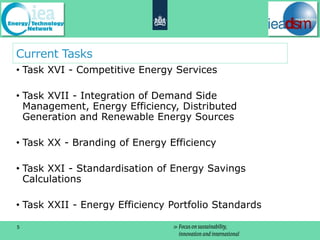
Current Tasks
• Task XVI - Competitive Energy Services

• Task XVII - Integration of Demand Side
  Management, Energy Efficiency, Distributed
  Generation and Renewable Energy Sources

• Task XX - Branding of Energy Efficiency

• Task XXI - Standardisation of Energy Savings
  Calculations

• Task XXII - Energy Efficiency Portfolio Standards

5
Task XVI - Competitive Energy Services
1. establishing an Energy Services
   Expert Platform,
2. designing, elaborating and
   testing innovative energy
   services and financing models
   and to publish them in a series of
   manuals,
3. developing and following up on
   country specific activities for
   implementing energy services in
   the market with a focus on
   selected market segments and
4. offering expertise and initiating
   joint projects and services with
   other international organizations
   (e.g., presentations, coaching
   and training).


                                            Runs until mid 2012

   6
7
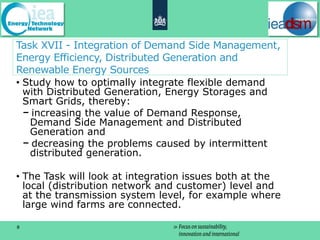
Task XVII - Integration of Demand Side Management,
Energy Efficiency, Distributed Generation and
Renewable Energy Sources
• Study how to optimally integrate flexible demand
  with Distributed Generation, Energy Storages and
  Smart Grids, thereby:
    increasing the value of Demand Response,
   Demand Side Management and Distributed
   Generation and
    decreasing the problems caused by intermittent
   distributed generation.

• The Task will look at integration issues both at the
  local (distribution network and customer) level and
  at the transmission system level, for example where
  large wind farms are connected.

8
Results
Task XVII - Integration of Demand Side
Management, Distributed Generation, Renewable
Energy Sources and Energy Storages - Final
Synthesis Report vol 1 & 2 (2008)
   Vol l. includes the main report and Vol 2. is
  the annex report with country descriptions,
  analysis tools etc.
   the secure web-site includes the answers to
  questionnaires of the experts and descriptions
  of about 50 case studies.


9
Extension until 2012
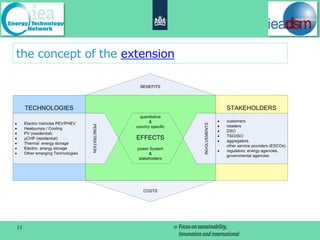
Add emerging DER technologies to the study. They include:
  plug-in electric and hybrid electric vehicles (PEV/PHEV)
  different types of heatpumps for heating and cooling
  photovoltaic at customer premises
  micro-CHP at customer premises
  energy storages (thermal/electricity) in the connection
  of previous technologies.
  smart metering, emerging
  ICT and possibly small wind at customer premises
  Other technologies seen feasible in 10 – 20 years
  period, especially by 2020.


10
the concept of the extension


11
Task XX - Branding of Energy Efficiency
1. Capability of Energy Efficiency suppliers in the
   market
2. Knowledge and attitude of private households in
   developing electricity markets
3. Best practices in definition of suppliers of energy
   efficiency products and services
4. Potential for energy efficiency products and
   services in other energy consuming sectors such
   as agriculture, industrial and commercial, etc.
5. Potential for programmatic approach towards
   energy efficiency
6. Barriers to branding of energy efficiency.

12
IEA DSM TASK XXI Standardisation of Energy
Savings Calculations
The Task is focusing on standardization, but will
not set new standards. The experts instead will
conduct preparation work to ease the work of
standardization bodies like ISO, CEN or ANSI.


13
IEA DSM TASK XXII Energy Efficiency Portfolio
Standards
Subtask l — Analysis of Various Approaches to Promote EE and
Their Relative Efficacy
Participants will analyse various approaches, Including Energy
Efficiency Portfolio Standards(EEPS) approaches adopted to
promote EE and will assess their efficacy. (report).

Subtask ll — Development of Best Practices in Design of EEPS
Participants will analyse design parameters (e.g., participants,
coverage, timing and duration, enforcement mechanism, funding,
and measurement and verification) and develop best practices for
implementing EEPS. (report).

Subtask lll — Communication and Outreach
Participants will identify and engage various stakeholder groups in
the dissemination of information on developing EEPS.
14
(newsletters and at the minimum one regional workshop).
Role of the Demand Side in Delivering Effective Smart
Grids 1/2
Specific objectives of the new Task:
• Understand the impact of the structure of energy
  markets on the interactions of consumers with
  Smart Grids;

• Explore the impact of technologies on the ability of
  customers so that they are able (and willing) to
  contribute towards the successful implementation of
  Smart Grids;

• Identify the risks and rewards associated with Smart
  Grids from the perspective of customers;

15
Role of the Demand Side in Delivering Effective Smart
Grids 2/2
• Understand the opportunity for stakeholders to
  influence these risks and rewards;

• Identify tools to minimise the risks and maximise
  the rewards associated with the Smart Grid from the
  point of view of the consumer, whilst still satisfying
  the needs of other stakeholders;

• Understand customer reactions and preferences to
  offers and opportunities that a smart grid might
  provide (including local supply); and

• Understand regulatory options, practice and
  consequences.
16
Q&A


17

Ia demand side management

  • 1.
    IA Demand Side Management Paris,April 2011 Rob Kool - Vice Chair
  • 2.
    This presentation • IEA DSM • Current tasks • New work • Overlap, collaboration 2
  • 3.
    Participants in theIEA DSM Australia Canada Greece Republic of Korea Norway Switzerland Austria Finland India Netherlands Spain United Kingdom Belgium France Italy New Zealand Sweden United States 3
  • 4.
    Some other details Workdivided in Load Shape Cluster Load Level Cluster Communication: - Annual Report: available on.. - The DSM website - Three spotlight newsletters a year - Facebook Next EXCO? Next week. 4
  • 5.
    Current Tasks • TaskXVI - Competitive Energy Services • Task XVII - Integration of Demand Side Management, Energy Efficiency, Distributed Generation and Renewable Energy Sources • Task XX - Branding of Energy Efficiency • Task XXI - Standardisation of Energy Savings Calculations • Task XXII - Energy Efficiency Portfolio Standards 5
  • 6.
    Task XVI -Competitive Energy Services 1. establishing an Energy Services Expert Platform, 2. designing, elaborating and testing innovative energy services and financing models and to publish them in a series of manuals, 3. developing and following up on country specific activities for implementing energy services in the market with a focus on selected market segments and 4. offering expertise and initiating joint projects and services with other international organizations (e.g., presentations, coaching and training). Runs until mid 2012 6
  • 7.
  • 8.
    Task XVII -Integration of Demand Side Management, Energy Efficiency, Distributed Generation and Renewable Energy Sources • Study how to optimally integrate flexible demand with Distributed Generation, Energy Storages and Smart Grids, thereby: increasing the value of Demand Response, Demand Side Management and Distributed Generation and decreasing the problems caused by intermittent distributed generation. • The Task will look at integration issues both at the local (distribution network and customer) level and at the transmission system level, for example where large wind farms are connected. 8
  • 9.
    Results Task XVII -Integration of Demand Side Management, Distributed Generation, Renewable Energy Sources and Energy Storages - Final Synthesis Report vol 1 & 2 (2008) Vol l. includes the main report and Vol 2. is the annex report with country descriptions, analysis tools etc. the secure web-site includes the answers to questionnaires of the experts and descriptions of about 50 case studies. 9
  • 10.
    Extension until 2012 Addemerging DER technologies to the study. They include: plug-in electric and hybrid electric vehicles (PEV/PHEV) different types of heatpumps for heating and cooling photovoltaic at customer premises micro-CHP at customer premises energy storages (thermal/electricity) in the connection of previous technologies. smart metering, emerging ICT and possibly small wind at customer premises Other technologies seen feasible in 10 – 20 years period, especially by 2020. 10
  • 11.
    the concept ofthe extension 11
  • 12.
    Task XX -Branding of Energy Efficiency 1. Capability of Energy Efficiency suppliers in the market 2. Knowledge and attitude of private households in developing electricity markets 3. Best practices in definition of suppliers of energy efficiency products and services 4. Potential for energy efficiency products and services in other energy consuming sectors such as agriculture, industrial and commercial, etc. 5. Potential for programmatic approach towards energy efficiency 6. Barriers to branding of energy efficiency. 12
  • 13.
    IEA DSM TASKXXI Standardisation of Energy Savings Calculations The Task is focusing on standardization, but will not set new standards. The experts instead will conduct preparation work to ease the work of standardization bodies like ISO, CEN or ANSI. 13
  • 14.
    IEA DSM TASKXXII Energy Efficiency Portfolio Standards Subtask l — Analysis of Various Approaches to Promote EE and Their Relative Efficacy Participants will analyse various approaches, Including Energy Efficiency Portfolio Standards(EEPS) approaches adopted to promote EE and will assess their efficacy. (report). Subtask ll — Development of Best Practices in Design of EEPS Participants will analyse design parameters (e.g., participants, coverage, timing and duration, enforcement mechanism, funding, and measurement and verification) and develop best practices for implementing EEPS. (report). Subtask lll — Communication and Outreach Participants will identify and engage various stakeholder groups in the dissemination of information on developing EEPS. 14 (newsletters and at the minimum one regional workshop).
  • 15.
    Role of theDemand Side in Delivering Effective Smart Grids 1/2 Specific objectives of the new Task: • Understand the impact of the structure of energy markets on the interactions of consumers with Smart Grids; • Explore the impact of technologies on the ability of customers so that they are able (and willing) to contribute towards the successful implementation of Smart Grids; • Identify the risks and rewards associated with Smart Grids from the perspective of customers; 15
  • 16.
    Role of theDemand Side in Delivering Effective Smart Grids 2/2 • Understand the opportunity for stakeholders to influence these risks and rewards; • Identify tools to minimise the risks and maximise the rewards associated with the Smart Grid from the point of view of the consumer, whilst still satisfying the needs of other stakeholders; • Understand customer reactions and preferences to offers and opportunities that a smart grid might provide (including local supply); and • Understand regulatory options, practice and consequences. 16
  • 17.