ATOMIC 
STRUCTURE
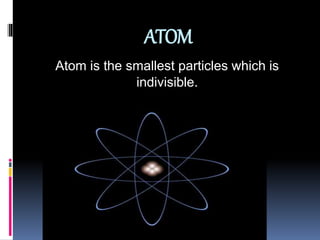
ATOM 
Atom is the smallest particles which is 
indivisible.
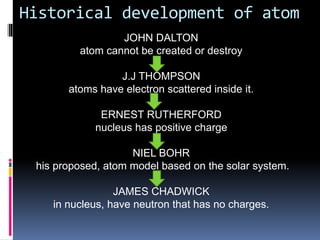
Historical development of atom 
JOHN DALTON 
atom cannot be created or destroy 
J.J THOMPSON 
atoms have electron scattered inside it. 
ERNEST RUTHERFORD 
nucleus has positive charge 
NIEL BOHR 
his proposed, atom model based on the solar system. 
JAMES CHADWICK 
in nucleus, have neutron that has no charges.
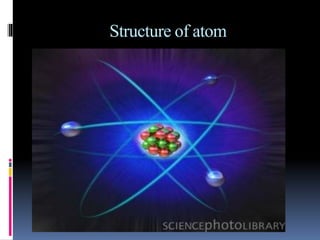
Structure of atom
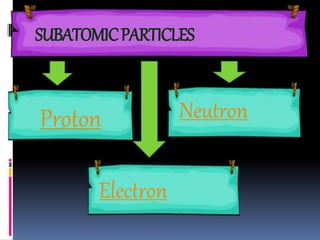
SUBATOMIC PARTICLES 
Proton Neutron 
Electron
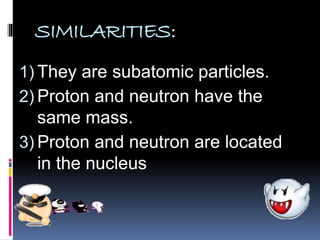
SIMILARITIES: 
1) They are subatomic particles. 
2) Proton and neutron have the 
same mass. 
3) Proton and neutron are located 
in the nucleus
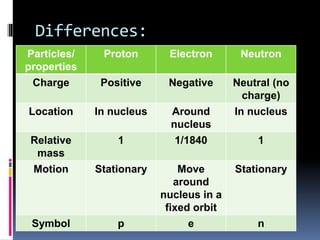
Differences: 
Particles/ 
properties 
Proton Electron Neutron 
Charge Positive Negative Neutral (no 
charge) 
Location In nucleus Around 
nucleus 
In nucleus 
Relative 
mass 
1 1/1840 1 
Motion Stationary Move 
around 
nucleus in a 
fixed orbit 
Stationary 
Symbol p e n
Proton number 
 Proton number is the number of 
protons in an atom of an element. 
 Elements can be differentiated by 
referring to their proton number.
Nucleon number 
 Nucleon number is a total number of 
protons and neutrons in an atom of an 
elements. 
Nucleon number = number of protons + 
number of neutron
 In a neutral atom, the proton number also 
refers to the number of electrons in that 
atom. 
In neutral atom, 
Proton number = number of 
protons 
= number of 
electrons in a 
neutral atom.
CALCULATION OF NUCLEON NUMBER 
Example 1: 
The following information is regarding the 
subatomic particles of atom P: 
proton number = 13 
neutron number = 14 
What is the nucleon number of atom P?
Example 2 
Oxygen atom has 8 number of 
protons and 8 number of 
neutron. The nucleon number 
of oxygen atom is _______.
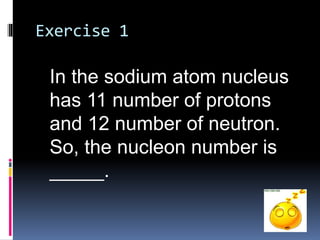
Exercise 1 
In the sodium atom nucleus 
has 11 number of protons 
and 12 number of neutron. 
So, the nucleon number is 
_____.
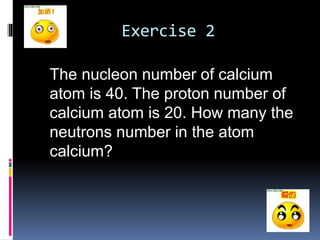
Exercise 2 
The nucleon number of calcium 
atom is 40. The proton number of 
calcium atom is 20. How many the 
neutrons number in the atom 
calcium?
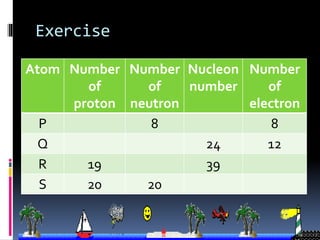
Exercise 
Atom Number 
of 
proton 
Number 
of 
neutron 
Nucleon 
number 
Number 
of 
electron 
P 8 8 
Q 24 12 
R 19 39 
S 20 20
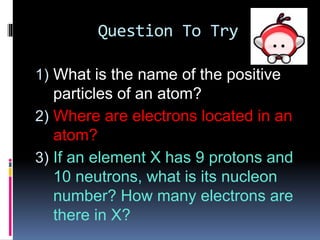
Question To Try 
1) What is the name of the positive 
particles of an atom? 
2) Where are electrons located in an 
atom? 
3) If an element X has 9 protons and 
10 neutrons, what is its nucleon 
number? How many electrons are 
there in X?
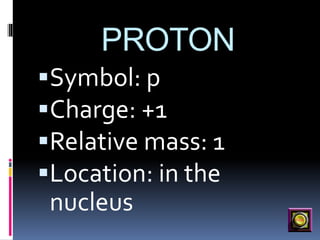
PROTON 
Symbol: p 
Charge: +1 
Relative mass: 1 
Location: in the 
nucleus
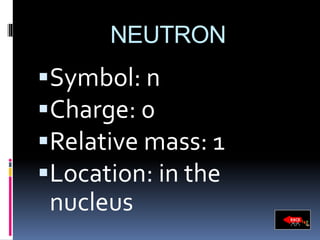
NEUTRON 
Symbol: n 
Charge: 0 
Relative mass: 1 
Location: in the 
nucleus
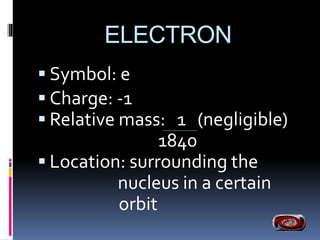
ELECTRON 
 Symbol: e 
 Charge: -1 
 Relative mass: 1 (negligible) 
1840 
 Location: surrounding the 
nucleus in a certain 
orbit

Chapter 2 - Atomic structure

  • 1.
  • 2.
    ATOM Atom isthe smallest particles which is indivisible.
  • 3.
    Historical development ofatom JOHN DALTON atom cannot be created or destroy J.J THOMPSON atoms have electron scattered inside it. ERNEST RUTHERFORD nucleus has positive charge NIEL BOHR his proposed, atom model based on the solar system. JAMES CHADWICK in nucleus, have neutron that has no charges.
  • 4.
  • 5.
  • 6.
    SIMILARITIES: 1) Theyare subatomic particles. 2) Proton and neutron have the same mass. 3) Proton and neutron are located in the nucleus
  • 7.
    Differences: Particles/ properties Proton Electron Neutron Charge Positive Negative Neutral (no charge) Location In nucleus Around nucleus In nucleus Relative mass 1 1/1840 1 Motion Stationary Move around nucleus in a fixed orbit Stationary Symbol p e n
  • 8.
    Proton number Proton number is the number of protons in an atom of an element.  Elements can be differentiated by referring to their proton number.
  • 9.
    Nucleon number Nucleon number is a total number of protons and neutrons in an atom of an elements. Nucleon number = number of protons + number of neutron
  • 10.
     In aneutral atom, the proton number also refers to the number of electrons in that atom. In neutral atom, Proton number = number of protons = number of electrons in a neutral atom.
  • 11.
    CALCULATION OF NUCLEONNUMBER Example 1: The following information is regarding the subatomic particles of atom P: proton number = 13 neutron number = 14 What is the nucleon number of atom P?
  • 12.
    Example 2 Oxygenatom has 8 number of protons and 8 number of neutron. The nucleon number of oxygen atom is _______.
  • 13.
    Exercise 1 Inthe sodium atom nucleus has 11 number of protons and 12 number of neutron. So, the nucleon number is _____.
  • 14.
    Exercise 2 Thenucleon number of calcium atom is 40. The proton number of calcium atom is 20. How many the neutrons number in the atom calcium?
  • 15.
    Exercise Atom Number of proton Number of neutron Nucleon number Number of electron P 8 8 Q 24 12 R 19 39 S 20 20
  • 16.
    Question To Try 1) What is the name of the positive particles of an atom? 2) Where are electrons located in an atom? 3) If an element X has 9 protons and 10 neutrons, what is its nucleon number? How many electrons are there in X?
  • 17.
    PROTON Symbol: p Charge: +1 Relative mass: 1 Location: in the nucleus
  • 18.
    NEUTRON Symbol: n Charge: 0 Relative mass: 1 Location: in the nucleus
  • 19.
    ELECTRON  Symbol:e  Charge: -1  Relative mass: 1 (negligible) 1840  Location: surrounding the nucleus in a certain orbit