
A relatively thin envelope of gases, the atmosphere, plays a
vital role in regulating our planet's climate and sustains life.
It even helps to protect us from some of the Solar System's
hazards - asteroid impacts and solar radiation.
The climate has changed repeatedly throughout Earth's
history through natural processes. There is strong evidence
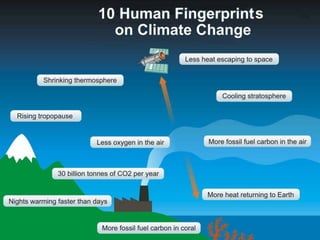
that human activities are also affecting the climate.
The earth's atmosphere is the environment for most of its
biological activity and exerts a considerable influence on the
ocean and lake environment (see biosphere). Weather consists of
the day-to-day fluctuations of environmental variables and
includes the motion of wind and formation of weather systems
such as hurricanes. Climate is the normal or long-term average
state of the atmospheric environment (as determined in spans of
about 50 years). The atmosphere protects earth's life forms from
harmful radiation and cosmic debris. The ozone layer also
protects the earth from the sun's harmful ultraviolet rays;
seasonal "holes" in the ozone layer, the first detected above
Antarctica and the Arctic in the 1980s, have caused considerable
alarm about the consequences of air pollution. Meteors strike the
thermosphere and mesosphere and burn from the heat generated
by air friction.
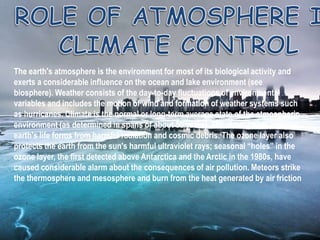
The earth's atmosphere is the environment for most of its biological activity and
exerts a considerable influence on the ocean and lake environment (see
biosphere). Weather consists of the day-to-day fluctuations of environmental
variables and includes the motion of wind and formation of weather systems such
as hurricanes. Climate is the normal or long-term average state of the atmospheric
environment (as determined in spans of about 50 years). The atmosphere protects
earth's life forms from harmful radiation and cosmic debris. The ozone layer also
protects the earth from the sun's harmful ultraviolet rays; seasonal “holes” in the
ozone layer, the first detected above Antarctica and the Arctic in the 1980s, have
caused considerable alarm about the consequences of air pollution. Meteors strike
the thermosphere and mesosphere and burn from the heat generated by air friction
Atmosphere
Atmosphere
Atmosphere
Atmosphere

Atmosphere

  • 2.
    A relatively thinenvelope of gases, the atmosphere, plays a vital role in regulating our planet's climate and sustains life. It even helps to protect us from some of the Solar System's hazards - asteroid impacts and solar radiation. The climate has changed repeatedly throughout Earth's history through natural processes. There is strong evidence that human activities are also affecting the climate.
  • 4.
    The earth's atmosphereis the environment for most of its biological activity and exerts a considerable influence on the ocean and lake environment (see biosphere). Weather consists of the day-to-day fluctuations of environmental variables and includes the motion of wind and formation of weather systems such as hurricanes. Climate is the normal or long-term average state of the atmospheric environment (as determined in spans of about 50 years). The atmosphere protects earth's life forms from harmful radiation and cosmic debris. The ozone layer also protects the earth from the sun's harmful ultraviolet rays; seasonal "holes" in the ozone layer, the first detected above Antarctica and the Arctic in the 1980s, have caused considerable alarm about the consequences of air pollution. Meteors strike the thermosphere and mesosphere and burn from the heat generated by air friction.
  • 5.
    The earth's atmosphereis the environment for most of its biological activity and exerts a considerable influence on the ocean and lake environment (see biosphere). Weather consists of the day-to-day fluctuations of environmental variables and includes the motion of wind and formation of weather systems such as hurricanes. Climate is the normal or long-term average state of the atmospheric environment (as determined in spans of about 50 years). The atmosphere protects earth's life forms from harmful radiation and cosmic debris. The ozone layer also protects the earth from the sun's harmful ultraviolet rays; seasonal “holes” in the ozone layer, the first detected above Antarctica and the Arctic in the 1980s, have caused considerable alarm about the consequences of air pollution. Meteors strike the thermosphere and mesosphere and burn from the heat generated by air friction