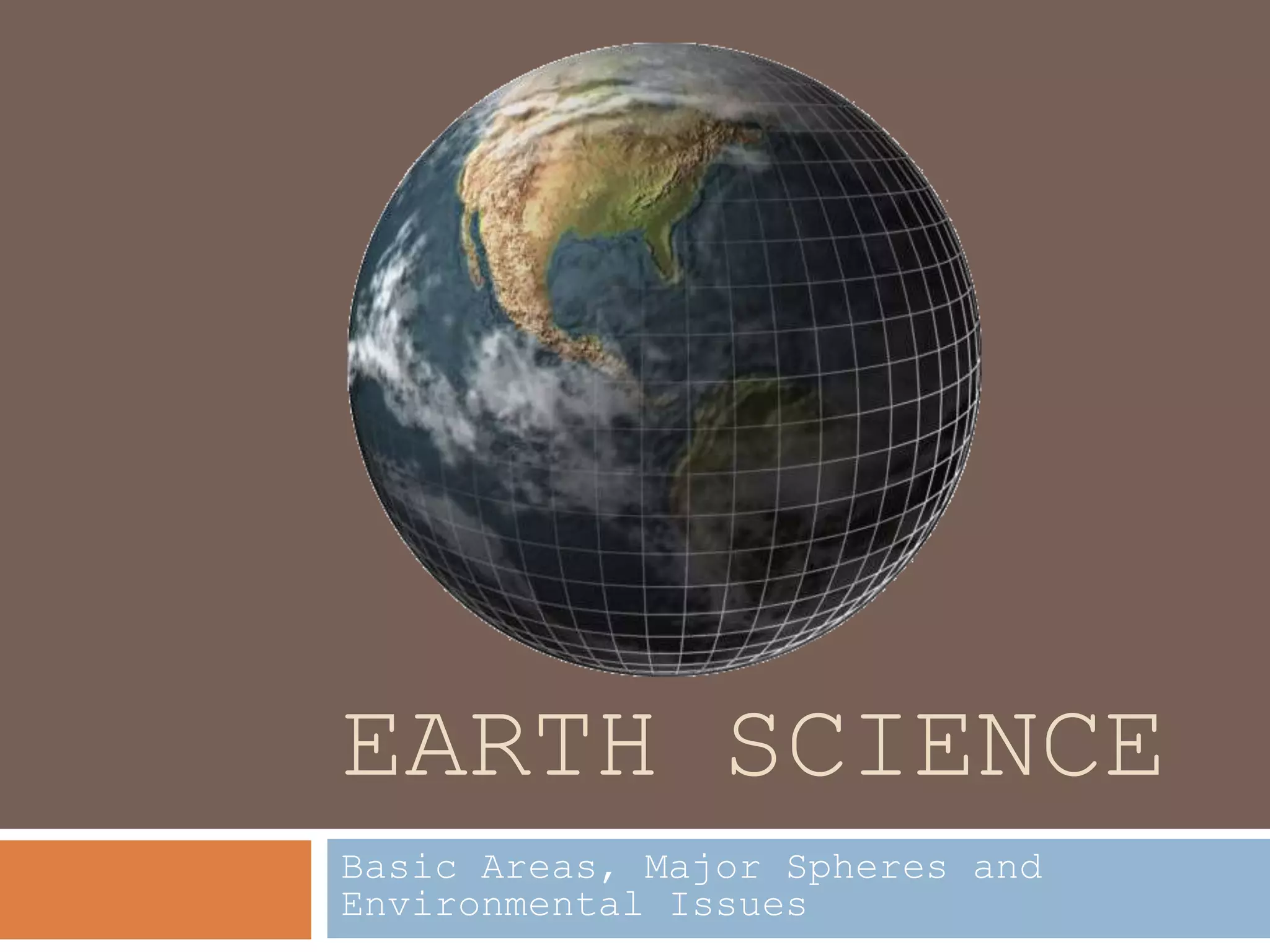
EARTH SCIENCE
Basic Areas, Major Spheres and
Environmental Issues
What is Earth Science?
Earth Science is the study of the
Earth and its neighbors in space. It is an
exciting science with many interesting and
practical applications. Some Earth
scientists use their knowledge of the Earth
to locate and develop energy and mineral
resources. Others study the impact of human
activity on Earth's environment and design
methods to protect the planet. Some use
their knowledge about Earth processes such
as volcanoes, earthquakes and hurricanes to
plan communities that will not expose
people to these dangerous events.
Many different sciences are used to learn
about the earth, however, the four basic
areas of Earth science study are:
 Geology
 Meteorology
 Oceanography
 Astronomy.
Geology: Study of the earth
Geology is the primary Earth
science. The word means "study of the
Earth". Geology deals with the
composition of Earth materials, Earth
structures, and Earth processes. It is
also concerned with the organisms of
the planet and how the planet has
changed over time. Geologists search
for fuels and minerals, study natural
hazards, and work to protect Earth's
environment
Meteorology: Study of Atmosphere
Meteorology is the study of the
atmosphere and how processes in the
atmosphere determine Earth's weather
and climate. Meteorology is a very
practical science because everyone is
concerned about the weather. How
climate changes over time in response
to the actions of people is a topic of
urgent worldwide concern. The study of
meteorology is of critical concern for
protecting Earth's environment.
Oceanography: Study of Earth’s oceans
Oceanography is the study of Earth's
oceans - their composition, movement,
organisms and processes. The oceans cover most
of our planet and are important resources for
food and other commodities. They are
increasingly being used as an energy source.
The oceans also have a major influence on the
weather and changes in the oceans can drive or
moderate climate change. Oceanographers work
to develop the ocean as a resource and protect
it from human impact. The goal is to utilize
the oceans while minimizing the effects of our
actions.
Astronomy: Study of the Universe
Astronomy is the study of the
universe. Here are some examples of why
studying space beyond Earth is important:
the moon drives the ocean's tidal system,
asteroid impacts have repeatedly
devastated Earth's inhabitants and energy
from the sun drives our weather and
climates. A knowledge of astronomy is
essential to understanding the Earth.
Astronomers can also use a knowledge of
Earth materials, processes and history to
understand other planets - even those
outside of our own solar system.
Four Spheres of the Earth
 Atmosphere
 Lithosphere
 Hydrosphere
 Biosphere
 The names of the four spheres are derived
from the Greek words for stone (litho), air
(atmo), water (hydro), and life (bio).
Atmosphere
The atmosphere is the body of air which
surrounds our planet. Most of our atmosphere is
located close to the earth's surface where it is
most dense. The air of our planet is 79% nitrogen
and just under 21% oxygen; the small amount
remaining is composed of carbon dioxide and other
gasses. All four spheres can be and often are
present in a single location. For example, a piece
of soil will of course have mineral material from
the lithosphere. Additionally, there will be
elements of the hydrosphere present as moisture
within the soil, the biosphere as insects and
plants, and even the atmosphere as pockets of air
between soil pieces.
Lithospheres
The lithosphere is the solid,
rocky crust covering entire planet.
This crust is inorganic and is composed
of minerals. It covers the entire
surface of the earth from the top of
Mount Everest to the bottom of the
Mariana Trench.
Hydrosphere
The hydrosphere is composed of all
of the water on or near the earth. This
includes the oceans, rivers, lakes, and
even the moisture in the air. Ninety-
seven percent of the earth's water is
in the oceans. The remaining three
percent is fresh water; three-quarters
of the fresh water is solid and exists
in ice sheets
Biosphere
The biosphere is composed of all
living organisms. Plants, animals, and
one-celled organisms are all part of
the biosphere. Most of the planet's
life is found from three meters below
the ground to thirty meters above it
and in the top 200 meters of the oceans
and seas.
Environmental Issues
Environmental issues are defined
as problems with the planet's systems
(air, water, soil, etc.) that have
developed as a result of human
interference or mistreatment of the
planet.
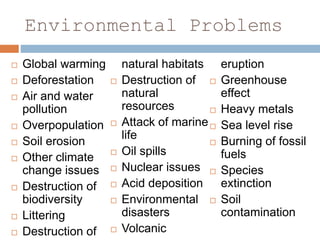
Environmental Problems
 Global warming
 Deforestation
 Air and water
pollution
 Overpopulation
 Soil erosion
 Other climate
change issues
 Destruction of
biodiversity
 Littering
 Destruction of
natural habitats
 Destruction of
natural
resources
 Attack of marine
life
 Oil spills
 Nuclear issues
 Acid deposition
 Environmental
disasters
 Volcanic
eruption
 Greenhouse
effect
 Heavy metals
 Sea level rise
 Burning of fossil
fuels
 Species
extinction
 Soil
contamination
Solutions
Sustainability is the key to
prevent or reduce the effect of
environmental issues. There is now
clear scientific evidence that humanity
is living unsustainably, and that an
unprecedented collective effort is
needed to return human use of natural
resources to within sustainable limits.
For humans to live sustainably, the
Earth's resources must be used at a
rate at which they can be replenished.
Name of Students:
 Bernadette Diana
Dividina
 Maricon Labao
 Rachel Ann Villena
 Hazel Anne Vizconde
 Jenica Valderueda
 Erika Mae Laure
 Trisha Ellaine
Pacheco
Project in Physical Science
Instructor:
Mam Jovy Agulto
Date:
March 30, 2015
Section:
BSIT 1 Group A

Earth_Science

  • 1.
    EARTH SCIENCE Basic Areas,Major Spheres and Environmental Issues
  • 2.
    What is EarthScience? Earth Science is the study of the Earth and its neighbors in space. It is an exciting science with many interesting and practical applications. Some Earth scientists use their knowledge of the Earth to locate and develop energy and mineral resources. Others study the impact of human activity on Earth's environment and design methods to protect the planet. Some use their knowledge about Earth processes such as volcanoes, earthquakes and hurricanes to plan communities that will not expose people to these dangerous events.
  • 3.
    Many different sciencesare used to learn about the earth, however, the four basic areas of Earth science study are:  Geology  Meteorology  Oceanography  Astronomy.
  • 4.
    Geology: Study ofthe earth Geology is the primary Earth science. The word means "study of the Earth". Geology deals with the composition of Earth materials, Earth structures, and Earth processes. It is also concerned with the organisms of the planet and how the planet has changed over time. Geologists search for fuels and minerals, study natural hazards, and work to protect Earth's environment
  • 5.
    Meteorology: Study ofAtmosphere Meteorology is the study of the atmosphere and how processes in the atmosphere determine Earth's weather and climate. Meteorology is a very practical science because everyone is concerned about the weather. How climate changes over time in response to the actions of people is a topic of urgent worldwide concern. The study of meteorology is of critical concern for protecting Earth's environment.
  • 6.
    Oceanography: Study ofEarth’s oceans Oceanography is the study of Earth's oceans - their composition, movement, organisms and processes. The oceans cover most of our planet and are important resources for food and other commodities. They are increasingly being used as an energy source. The oceans also have a major influence on the weather and changes in the oceans can drive or moderate climate change. Oceanographers work to develop the ocean as a resource and protect it from human impact. The goal is to utilize the oceans while minimizing the effects of our actions.
  • 7.
    Astronomy: Study ofthe Universe Astronomy is the study of the universe. Here are some examples of why studying space beyond Earth is important: the moon drives the ocean's tidal system, asteroid impacts have repeatedly devastated Earth's inhabitants and energy from the sun drives our weather and climates. A knowledge of astronomy is essential to understanding the Earth. Astronomers can also use a knowledge of Earth materials, processes and history to understand other planets - even those outside of our own solar system.
  • 8.
    Four Spheres ofthe Earth  Atmosphere  Lithosphere  Hydrosphere  Biosphere  The names of the four spheres are derived from the Greek words for stone (litho), air (atmo), water (hydro), and life (bio).
  • 9.
    Atmosphere The atmosphere isthe body of air which surrounds our planet. Most of our atmosphere is located close to the earth's surface where it is most dense. The air of our planet is 79% nitrogen and just under 21% oxygen; the small amount remaining is composed of carbon dioxide and other gasses. All four spheres can be and often are present in a single location. For example, a piece of soil will of course have mineral material from the lithosphere. Additionally, there will be elements of the hydrosphere present as moisture within the soil, the biosphere as insects and plants, and even the atmosphere as pockets of air between soil pieces.
  • 10.
    Lithospheres The lithosphere isthe solid, rocky crust covering entire planet. This crust is inorganic and is composed of minerals. It covers the entire surface of the earth from the top of Mount Everest to the bottom of the Mariana Trench.
  • 11.
    Hydrosphere The hydrosphere iscomposed of all of the water on or near the earth. This includes the oceans, rivers, lakes, and even the moisture in the air. Ninety- seven percent of the earth's water is in the oceans. The remaining three percent is fresh water; three-quarters of the fresh water is solid and exists in ice sheets
  • 12.
    Biosphere The biosphere iscomposed of all living organisms. Plants, animals, and one-celled organisms are all part of the biosphere. Most of the planet's life is found from three meters below the ground to thirty meters above it and in the top 200 meters of the oceans and seas.
  • 13.
    Environmental Issues Environmental issuesare defined as problems with the planet's systems (air, water, soil, etc.) that have developed as a result of human interference or mistreatment of the planet.
  • 14.
    Environmental Problems  Globalwarming  Deforestation  Air and water pollution  Overpopulation  Soil erosion  Other climate change issues  Destruction of biodiversity  Littering  Destruction of natural habitats  Destruction of natural resources  Attack of marine life  Oil spills  Nuclear issues  Acid deposition  Environmental disasters  Volcanic eruption  Greenhouse effect  Heavy metals  Sea level rise  Burning of fossil fuels  Species extinction  Soil contamination
  • 15.
    Solutions Sustainability is thekey to prevent or reduce the effect of environmental issues. There is now clear scientific evidence that humanity is living unsustainably, and that an unprecedented collective effort is needed to return human use of natural resources to within sustainable limits. For humans to live sustainably, the Earth's resources must be used at a rate at which they can be replenished.
  • 16.
    Name of Students: Bernadette Diana Dividina  Maricon Labao  Rachel Ann Villena  Hazel Anne Vizconde  Jenica Valderueda  Erika Mae Laure  Trisha Ellaine Pacheco Project in Physical Science Instructor: Mam Jovy Agulto Date: March 30, 2015 Section: BSIT 1 Group A