Incomplete Inhibition of Thromboxane Biosynthesis by Acetylsalicylic Acid Determinants and Effect on Cardiovascular Risk  CHARISMA  OCTOBER 2008 CIRCULATION John W. Eikelboom, FRACP, FRCPA; Graeme J. Hankey, MD, FRACP, FRCP; Jim Thom, MSc; Deepak L. Bhatt, MD; P. Gabriel Steg, MD; Gilles Montalescot, MD, PhD; S. Claiborne Johnston, MD, PhD; Steven R. Steinhubl, MD; Koon-Hou Mak, MD, FRCP; J. Donald Easton, MD; Christian Hamm, MD; Tingfei Hu, MS; Keith A.A. Fox, MB, ChB, FRCP, FESC; Eric J. Topol, MD, on behalf of the Clopidogrel for High Atherothrombotic Risk and Ischemic Stabilization, Management and Avoidance (CHARISMA) Investigators
Background Incomplete inhibition of platelet thromboxane   generation, as measured by elevated urinary 11-dehydro thromboxane   B 2  concentrations, has been associated with an increased risk   of cardiovascular events.  We aimed to determine the external   validity of this association in aspirin-treated patients enrolled   in the Clopidogrel for High Atherothrombotic Risk and Ischemic   Stabilization, Management and Avoidance (CHARISMA)
Background trial and   to determine whether there are any modifiable factors or interventions   that lower urinary 11-dehydro thromboxane B 2  concentrations   that could thereby reduce cardiovascular risk.
Acetylsalicylic acid (ASA) reduces the risk of serious cardiovascular   events by 20% in a broad range of high-risk patients.The primary   effect of ASA on hemostasis is to acetylate platelet cyclooxygenase   (COX)-1 and thereby inhibit the synthesis of thromboxane A 2 ,   a powerful platelet agonist. Acetylation of platelet COX-1   by ASA is rapid, irreversible, and permanent (for the life of   the platelet), because platelets lack the biosynthetic machinery   necessary to synthesize new protein, and it is believed to be   saturable at low doses.
doses. Acetylation of platelet COX-1   does not attain functional relevance until the maximal capacity   to generate thromboxane A 2  is reduced by at least 95%. However,   very small amounts of residual COX-1 activity can generate sufficient   amounts of thromboxane to support thromboxane-dependent platelet   function. Thus, as much as 99% inhibition of serum thromboxane   may be necessary to optimally inhibit platelets.
Some patients treated with ASA continue to generate thromboxane   A 2  and thereby activate platelets. Possible mechanisms   of continued thromboxane generation despite ASA treatment include   poor compliance with ASA treatment, inadequate ASA dose, concomitant   use of other COX inhibitors that interfere with the antiplatelet   effects of ASA,  increased rate of platelet turnover, transcellular   metabolism of prostaglandin precursors, and true "resistance"   of COX-1 to the inhibitory effects of ASA (eg, due to a genetic   polymorphism of the COX-1 gene).
Continued thromboxane production despite ASA therapy, as manifested   by elevated concentrations of 11-dehydro thromboxane B 2  (a stable   metabolite of thromboxane A 2 ) in the urine, has been associated   with an increased risk of serious cardiovascular events in 1   study of high-vascular-risk patients. 16  However, this finding   has not been validated externally in an independent data set.   If it were externally validated, knowledge of the determinants   of elevated concentrations of 11-dehydro thromboxane B 2  could   generate new interventions to lower concentrations of 11-dehydro   thromboxane B 2  and thereby reduce cardiovascular risk.
n this prespecified substudy of the Clopidogrel for High Atherothrombotic   Risk and Ischemic Stabilization, Management and Avoidance (CHARISMA)   trial, we aimed to prospectively verify the hypothesis that   incomplete suppression of thromboxane generation with usual   doses of ASA, as measured by elevated concentrations of 11-dehydro   thromboxane B 2  in the urine, is associated with an increased   risk of subsequent serious vascular events.
We also aimed to   identify the independent and significant determinants of urinary   11-dehydro thromboxane B 2  concentrations, as well as whether   the addition of an ADP receptor antagonist, clopidogrel, to   ASA would reduce ASA-insensitive thromboxane biosynthesis and   thereby improve survival free of cardiovascular events.
    Methods CHARISMA was a multinational, multicenter,   randomized, parallel-group, double-blind trial of clopidogrel   versus placebo in high-risk patients at risk of atherothrombotic   events.  The institutional review committee at each participating   center approved the study, and all subjects gave informed consent.   A total of 15 603 patients with either clinically established   cardiovascular disease or multiple risk factors were randomly   assigned to receive clopidogrel (75 mg/d) or placebo.
All patients   received ASA (75 to 162 mg/d). Patients were followed up for   a median of 28 months.  The primary efficacy outcome for the   CHARISMA trial was a composite of stroke, myocardial infarction   (MI), and cardiovascular death.
Patients A total of 3261 patients from 224 sites in 12 countries complied   with a request to provide a first-morning-urine specimen at   least 1 month after randomization.  A minimum 1-month interval   between randomization and urine collection ensured steady state   suppression of thromboxane generation and reduced the likelihood   of recruiting a patient soon after an acute atherothrombotic   event, which might be a cause of platelet activation.
Follow-Up and Ascertainment of Clinical Outcomes Patients were followed up prospectively at 1, 3, and 6 months   after randomization and every 6 months thereafter until the   trial was completed. At each follow-up, we recorded use of medications,   including ASA dose, and clinical outcomes.
The primary outcome   was the composite of stroke, MI, and cardiovascular death.
The urine samples were thawed and assayed for 11-dehydro thromboxane   B 2  with a commercially available enzyme immunoassay (Cayman   Chemical, Ann Arbor, Mich).  This assay has interassay and intra-assay   coefficients of variation of 12.1% and 10%, respectively. Control   urine samples with assigned values for 11-dehydro thromboxane   B 2  were run with each batch (kindly supplied by AspirinWorks,   Broomfield, Colo).
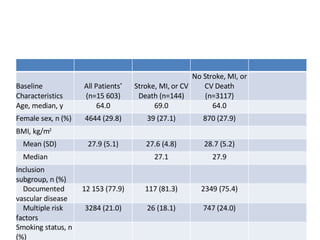
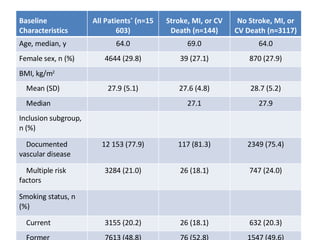
Baseline Characteristics All Patients *  (n=15 603) Stroke, MI, or CV Death (n=144) No Stroke, MI, or CV Death (n=3117) Age, median, y 64.0 69.0 64.0 Female sex, n (%) 4644 (29.8) 39 (27.1) 870 (27.9) BMI, kg/m 2      Mean (SD) 27.9 (5.1) 27.6 (4.8) 28.7 (5.2)      Median 27.1 27.9 Inclusion subgroup, n (%)      Documented vascular disease 12 153 (77.9) 117 (81.3) 2349 (75.4)      Multiple risk factors 3284 (21.0) 26 (18.1) 747 (24.0) Smoking status, n (%)      Current 3155 (20.2) 26 (18.1) 632 (20.3)      Former 7613 (48.8) 76 (52.8) 1547 (49.6) Hypertension, n (%) 11 483 (73.6) 108 (75.0) 2285 (73.3) Hypercholesterolemia, n (%) 11 535 (73.9) 107 (74.3) 2415 (77.5) Diabetes mellitus, n (%) 6556 (42.0) 73 (50.7) 1381 (44.3) Past medical history, n (%)      MI 5397 (34.6) 52 (36.1) 1082 (34.7)      TIA 1864 (11.9) 17 (11.8) 303 (9.7)      Stroke 3837 (24.6) 57 (39.6) 749 (24.0)      PAD 3531 (22.6) 38 (26.4) 670 (21.5)      PCI 3554 (22.8) 30 (20.8) 748 (24.0)      CABG surgery 3079 (19.7) 34 (23.6) 568 (18.2)      Carotid endarterectomy 825 (5.3) 12 (8.3) 140 (4.5)      Angioplasty / bypass 1737 (11.1) 20 (13.9) 322 (10.3) CV indicates cardiovascular; BMI, body mass index; TIA, transient ischemic attack; PAD, peripheral arterial disease; and PCI, percutaneous coronary intervention. *Includes all patients randomized in the CHARISMA trial.
Baseline Characteristics All Patients *  (n=15 603) Stroke, MI, or CV Death (n=144) No Stroke, MI, or CV Death (n=3117) Age, median, y 64.0 69.0 64.0 Female sex, n (%) 4644 (29.8) 39 (27.1) 870 (27.9) BMI, kg/m 2      Mean (SD) 27.9 (5.1) 27.6 (4.8) 28.7 (5.2)      Median 27.1 27.9 Inclusion subgroup, n (%)      Documented vascular disease 12 153 (77.9) 117 (81.3) 2349 (75.4)      Multiple risk factors 3284 (21.0) 26 (18.1) 747 (24.0) Smoking status, n (%)      Current 3155 (20.2) 26 (18.1) 632 (20.3)      Former 7613 (48.8) 76 (52.8) 1547 (49.6) Hypertension, n (%) 11 483 (73.6) 108 (75.0) 2285 (73.3) Hypercholesterolemia, n (%) 11 535 (73.9) 107 (74.3) 2415 (77.5) Diabetes mellitus, n (%) 6556 (42.0) 73 (50.7) 1381 (44.3) Past medical history, n (%)
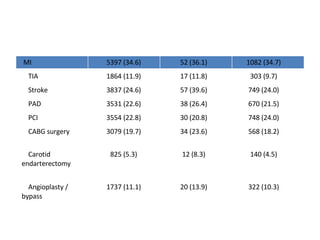
  MI 5397 (34.6) 52 (36.1) 1082 (34.7)      TIA 1864 (11.9) 17 (11.8) 303 (9.7)      Stroke 3837 (24.6) 57 (39.6) 749 (24.0)      PAD 3531 (22.6) 38 (26.4) 670 (21.5)      PCI 3554 (22.8) 30 (20.8) 748 (24.0)      CABG surgery 3079 (19.7) 34 (23.6) 568 (18.2)      Carotid endarterectomy 825 (5.3) 12 (8.3) 140 (4.5)      Angioplasty / bypass 1737 (11.1) 20 (13.9) 322 (10.3)
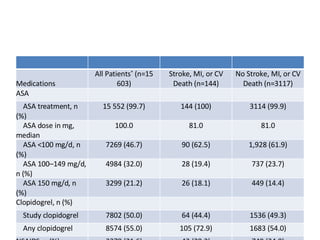
Medications All Patients *  (n=15 603) Stroke, MI, or CV Death (n=144) No Stroke, MI, or CV Death (n=3117) ASA      ASA treatment, n (%) 15 552 (99.7) 144 (100) 3114 (99.9)      ASA dose in mg, median 100.0 81.0 81.0      ASA <100 mg/d, n (%) 7269 (46.7) 90 (62.5) 1,928 (61.9)      ASA 100–149 mg/d, n (%) 4984 (32.0) 28 (19.4) 737 (23.7)      ASA 150 mg/d, n (%) 3299 (21.2) 26 (18.1) 449 (14.4) Clopidogrel, n (%)      Study clopidogrel 7802 (50.0) 64 (44.4) 1536 (49.3)      Any clopidogrel 8574 (55.0) 105 (72.9) 1683 (54.0) NSAIDS, n (%) 3378 (21.6) 42 (29.2) 749 (24.0) Statin, n (%) 11 992 (76.9) 119 (82.6) 2483 (79.7) β- Blocker, n (%) 8636 (55.3) 112 (77.8) 1733 (55.6) Diuretics, n (%) 7428 (47.6) 95 (66.0) 1419 (45.5) Calcium channel blockers, n (%) 5745 (36.8) 61 (42.4) 1205 (38.7) Ramipril, n (%) 2811 (18.0) 31 (21.5) 589 (18.9) Other ACE inhibitor, n (%) 7219 (46.3) 69 (47.9) 1441 (46.2) Other antihypertensive agent, n (%) 1934 (12.4) 24 (16.7) 347 (11.1) Oral hypoglycemic agent, n (%) 5355 (34.3) 58 (40.3) 1120 (35.9) Insulin, n (%) 2694 (17.3) 45 (31.3) 583 (18.7) ACE indicates angiotensin-converting enzyme. *Includes all patients randomized in the CHARISMA trial.
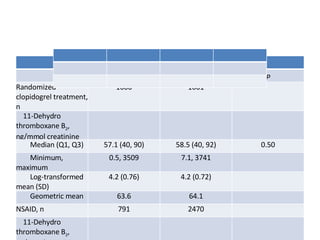
Treated Not Treated P Randomized clopidogrel treatment, n 1600 1661      11-Dehydro thromboxane B 2 , ng/mmol creatinine          Median (Q1, Q3) 57.1 (40, 90) 58.5 (40, 92) 0.50          Minimum, maximum 0.5, 3509 7.1, 3741          Log-transformed mean (SD) 4.2 (0.76) 4.2 (0.72)          Geometric mean 63.6 64.1 NSAID, n 791 2470      11-Dehydro thromboxane B 2 , ng/mmol creatinine          Median (Q1, Q3) 54.1 (37, 86) 58.9 (40, 92) 0.001          Minimum, maximum 7.5, 1235 0.5, 3741          Log-transformed mean (SD) 4.1 (0.70) 4.2 (0.75)          Geometric mean 58.7 65.6 Statins, n 2602 659      11-Dehydro thromboxane B 2 , ng/mmol creatinine          Median (Q1, Q3) 55.5 (39, 86) 69.7 (46, 122) <0.001          Minimum, maximum 0.5, 3741 8.1, 1455          Log-transformed mean (SD) 4.1 (0.71) 4.4 (0.83)          Geometric mean 60.3 80.1 Q indicates quartile.
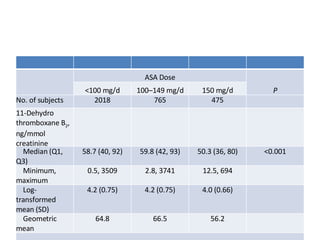
ASA Dose P <100 mg/d 100–149 mg/d 150 mg/d No. of subjects 2018 765 475 11-Dehydro thromboxane B 2 , ng/mmol creatinine      Median (Q1, Q3) 58.7 (40, 92) 59.8 (42, 93) 50.3 (36, 80) <0.001      Minimum, maximum 0.5, 3509 2.8, 3741 12.5, 694      Log-transformed mean (SD) 4.2 (0.75) 4.2 (0.75) 4.0 (0.66)      Geometric mean 64.8 66.5 56.2 Q indicates quartile.
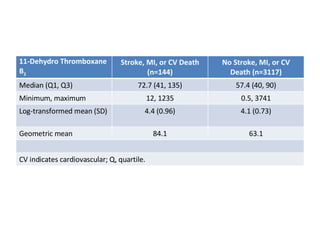
11-Dehydro Thromboxane B 2 Stroke, MI, or CV Death (n=144) No Stroke, MI, or CV Death (n=3117) Median (Q1, Q3) 72.7 (41, 135) 57.4 (40, 90) Minimum, maximum 12, 1235 0.5, 3741 Log-transformed mean (SD) 4.4 (0.96) 4.1 (0.73) Geometric mean 84.1 63.1 CV indicates cardiovascular; Q, quartile.
 
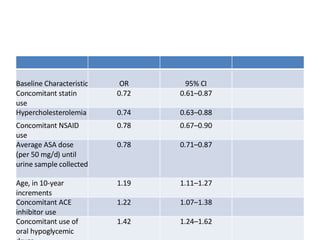
Baseline Characteristic OR 95% CI Concomitant statin use 0.72 0.61–0.87 Hypercholesterolemia 0.74 0.63–0.88 Concomitant NSAID use 0.78 0.67–0.90 Average ASA dose (per 50 mg/d) until urine sample collected 0.78 0.71–0.87 Age, in 10-year increments 1.19 1.11–1.27 Concomitant ACE inhibitor use 1.22 1.07–1.38 Concomitant use of oral hypoglycemic drugs 1.42 1.24–1.62 Female sex 1.48 1.29–1.71 Peripheral artery angioplasty or bypass surgery 1.67 1.36–2.06 Current smoker 2.02 1.72–2.38 *Model includes age, sex, body mass index, current smoking, hypertension, hypercholesterolemia, diabetes, past history of MI, stroke, transient ischemic attack, peripheral artery disease, percutaneous coronary intervention, CABG surgery, endarterectomy, peripheral angioplasty/bypass, ASA dose groups, study clopidogrel, NSAIDs, statins,  β- blockers, diuretics, calcium channel blockers, ACE inhibitors (ramipril or other), other blood pressure-lowering agents, oral hypoglycemic agents, and insulin. C statistic for overall model=0.62.
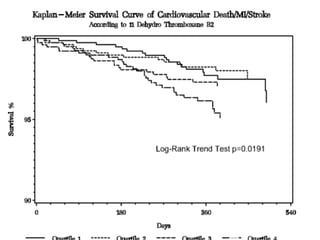
   Discussion The principal findings were as follows: (1) values of urinary   11-dehydro thromboxane B 2  concentration in the upper quartile   in a broad population of high-risk patients treated with usual   doses of ASA (75 to 162 mg/d) were independently associated   with an increased risk of serious cardiovascular events; (2)   increasing age, female sex, history of peripheral artery disease,   current smoking, and oral hypoglycemic or angiotensin-converting   enzyme inhibitor therapy were independently associated with   higher concentrations of 11-dehydro thromboxane B 2  in the urine,   whereas ASA dose 150 mg/d, history of treatment with NSAIDs,   history of hypercholesterolemia, and statin treatment were associated   with lower concentrations; and (3) randomization to clopidogrel   (versus placebo) did not reduce urinary 11-dehydro thromboxane   B 2  levels or reduce the hazard of cardiovascular events in patients   in the highest quartile of urinary 11-dehydro thromboxane B 2   levels.

aspirin effect on urinary thromboxane

  • 1.
    Incomplete Inhibition ofThromboxane Biosynthesis by Acetylsalicylic Acid Determinants and Effect on Cardiovascular Risk CHARISMA OCTOBER 2008 CIRCULATION John W. Eikelboom, FRACP, FRCPA; Graeme J. Hankey, MD, FRACP, FRCP; Jim Thom, MSc; Deepak L. Bhatt, MD; P. Gabriel Steg, MD; Gilles Montalescot, MD, PhD; S. Claiborne Johnston, MD, PhD; Steven R. Steinhubl, MD; Koon-Hou Mak, MD, FRCP; J. Donald Easton, MD; Christian Hamm, MD; Tingfei Hu, MS; Keith A.A. Fox, MB, ChB, FRCP, FESC; Eric J. Topol, MD, on behalf of the Clopidogrel for High Atherothrombotic Risk and Ischemic Stabilization, Management and Avoidance (CHARISMA) Investigators
  • 2.
    Background Incomplete inhibitionof platelet thromboxane generation, as measured by elevated urinary 11-dehydro thromboxane B 2 concentrations, has been associated with an increased risk of cardiovascular events. We aimed to determine the external validity of this association in aspirin-treated patients enrolled in the Clopidogrel for High Atherothrombotic Risk and Ischemic Stabilization, Management and Avoidance (CHARISMA)
  • 3.
    Background trial and to determine whether there are any modifiable factors or interventions that lower urinary 11-dehydro thromboxane B 2 concentrations that could thereby reduce cardiovascular risk.
  • 4.
    Acetylsalicylic acid (ASA)reduces the risk of serious cardiovascular events by 20% in a broad range of high-risk patients.The primary effect of ASA on hemostasis is to acetylate platelet cyclooxygenase (COX)-1 and thereby inhibit the synthesis of thromboxane A 2 , a powerful platelet agonist. Acetylation of platelet COX-1 by ASA is rapid, irreversible, and permanent (for the life of the platelet), because platelets lack the biosynthetic machinery necessary to synthesize new protein, and it is believed to be saturable at low doses.
  • 5.
    doses. Acetylation ofplatelet COX-1 does not attain functional relevance until the maximal capacity to generate thromboxane A 2 is reduced by at least 95%. However, very small amounts of residual COX-1 activity can generate sufficient amounts of thromboxane to support thromboxane-dependent platelet function. Thus, as much as 99% inhibition of serum thromboxane may be necessary to optimally inhibit platelets.
  • 6.
    Some patients treatedwith ASA continue to generate thromboxane A 2 and thereby activate platelets. Possible mechanisms of continued thromboxane generation despite ASA treatment include poor compliance with ASA treatment, inadequate ASA dose, concomitant use of other COX inhibitors that interfere with the antiplatelet effects of ASA, increased rate of platelet turnover, transcellular metabolism of prostaglandin precursors, and true &quot;resistance&quot; of COX-1 to the inhibitory effects of ASA (eg, due to a genetic polymorphism of the COX-1 gene).
  • 7.
    Continued thromboxane productiondespite ASA therapy, as manifested by elevated concentrations of 11-dehydro thromboxane B 2 (a stable metabolite of thromboxane A 2 ) in the urine, has been associated with an increased risk of serious cardiovascular events in 1 study of high-vascular-risk patients. 16 However, this finding has not been validated externally in an independent data set. If it were externally validated, knowledge of the determinants of elevated concentrations of 11-dehydro thromboxane B 2 could generate new interventions to lower concentrations of 11-dehydro thromboxane B 2 and thereby reduce cardiovascular risk.
  • 8.
    n this prespecifiedsubstudy of the Clopidogrel for High Atherothrombotic Risk and Ischemic Stabilization, Management and Avoidance (CHARISMA) trial, we aimed to prospectively verify the hypothesis that incomplete suppression of thromboxane generation with usual doses of ASA, as measured by elevated concentrations of 11-dehydro thromboxane B 2 in the urine, is associated with an increased risk of subsequent serious vascular events.
  • 9.
    We also aimedto identify the independent and significant determinants of urinary 11-dehydro thromboxane B 2 concentrations, as well as whether the addition of an ADP receptor antagonist, clopidogrel, to ASA would reduce ASA-insensitive thromboxane biosynthesis and thereby improve survival free of cardiovascular events.
  • 10.
       MethodsCHARISMA was a multinational, multicenter, randomized, parallel-group, double-blind trial of clopidogrel versus placebo in high-risk patients at risk of atherothrombotic events. The institutional review committee at each participating center approved the study, and all subjects gave informed consent. A total of 15 603 patients with either clinically established cardiovascular disease or multiple risk factors were randomly assigned to receive clopidogrel (75 mg/d) or placebo.
  • 11.
    All patients received ASA (75 to 162 mg/d). Patients were followed up for a median of 28 months. The primary efficacy outcome for the CHARISMA trial was a composite of stroke, myocardial infarction (MI), and cardiovascular death.
  • 12.
    Patients A totalof 3261 patients from 224 sites in 12 countries complied with a request to provide a first-morning-urine specimen at least 1 month after randomization. A minimum 1-month interval between randomization and urine collection ensured steady state suppression of thromboxane generation and reduced the likelihood of recruiting a patient soon after an acute atherothrombotic event, which might be a cause of platelet activation.
  • 13.
    Follow-Up and Ascertainmentof Clinical Outcomes Patients were followed up prospectively at 1, 3, and 6 months after randomization and every 6 months thereafter until the trial was completed. At each follow-up, we recorded use of medications, including ASA dose, and clinical outcomes.
  • 14.
    The primary outcome was the composite of stroke, MI, and cardiovascular death.
  • 15.
    The urine sampleswere thawed and assayed for 11-dehydro thromboxane B 2 with a commercially available enzyme immunoassay (Cayman Chemical, Ann Arbor, Mich). This assay has interassay and intra-assay coefficients of variation of 12.1% and 10%, respectively. Control urine samples with assigned values for 11-dehydro thromboxane B 2 were run with each batch (kindly supplied by AspirinWorks, Broomfield, Colo).
  • 16.
    Baseline Characteristics AllPatients * (n=15 603) Stroke, MI, or CV Death (n=144) No Stroke, MI, or CV Death (n=3117) Age, median, y 64.0 69.0 64.0 Female sex, n (%) 4644 (29.8) 39 (27.1) 870 (27.9) BMI, kg/m 2      Mean (SD) 27.9 (5.1) 27.6 (4.8) 28.7 (5.2)      Median 27.1 27.9 Inclusion subgroup, n (%)      Documented vascular disease 12 153 (77.9) 117 (81.3) 2349 (75.4)      Multiple risk factors 3284 (21.0) 26 (18.1) 747 (24.0) Smoking status, n (%)      Current 3155 (20.2) 26 (18.1) 632 (20.3)      Former 7613 (48.8) 76 (52.8) 1547 (49.6) Hypertension, n (%) 11 483 (73.6) 108 (75.0) 2285 (73.3) Hypercholesterolemia, n (%) 11 535 (73.9) 107 (74.3) 2415 (77.5) Diabetes mellitus, n (%) 6556 (42.0) 73 (50.7) 1381 (44.3) Past medical history, n (%)      MI 5397 (34.6) 52 (36.1) 1082 (34.7)      TIA 1864 (11.9) 17 (11.8) 303 (9.7)      Stroke 3837 (24.6) 57 (39.6) 749 (24.0)      PAD 3531 (22.6) 38 (26.4) 670 (21.5)      PCI 3554 (22.8) 30 (20.8) 748 (24.0)      CABG surgery 3079 (19.7) 34 (23.6) 568 (18.2)      Carotid endarterectomy 825 (5.3) 12 (8.3) 140 (4.5)      Angioplasty / bypass 1737 (11.1) 20 (13.9) 322 (10.3) CV indicates cardiovascular; BMI, body mass index; TIA, transient ischemic attack; PAD, peripheral arterial disease; and PCI, percutaneous coronary intervention. *Includes all patients randomized in the CHARISMA trial.
  • 17.
    Baseline Characteristics AllPatients * (n=15 603) Stroke, MI, or CV Death (n=144) No Stroke, MI, or CV Death (n=3117) Age, median, y 64.0 69.0 64.0 Female sex, n (%) 4644 (29.8) 39 (27.1) 870 (27.9) BMI, kg/m 2      Mean (SD) 27.9 (5.1) 27.6 (4.8) 28.7 (5.2)      Median 27.1 27.9 Inclusion subgroup, n (%)      Documented vascular disease 12 153 (77.9) 117 (81.3) 2349 (75.4)      Multiple risk factors 3284 (21.0) 26 (18.1) 747 (24.0) Smoking status, n (%)      Current 3155 (20.2) 26 (18.1) 632 (20.3)      Former 7613 (48.8) 76 (52.8) 1547 (49.6) Hypertension, n (%) 11 483 (73.6) 108 (75.0) 2285 (73.3) Hypercholesterolemia, n (%) 11 535 (73.9) 107 (74.3) 2415 (77.5) Diabetes mellitus, n (%) 6556 (42.0) 73 (50.7) 1381 (44.3) Past medical history, n (%)
  • 18.
      MI 5397(34.6) 52 (36.1) 1082 (34.7)      TIA 1864 (11.9) 17 (11.8) 303 (9.7)      Stroke 3837 (24.6) 57 (39.6) 749 (24.0)      PAD 3531 (22.6) 38 (26.4) 670 (21.5)      PCI 3554 (22.8) 30 (20.8) 748 (24.0)      CABG surgery 3079 (19.7) 34 (23.6) 568 (18.2)      Carotid endarterectomy 825 (5.3) 12 (8.3) 140 (4.5)      Angioplasty / bypass 1737 (11.1) 20 (13.9) 322 (10.3)
  • 19.
    Medications All Patients* (n=15 603) Stroke, MI, or CV Death (n=144) No Stroke, MI, or CV Death (n=3117) ASA      ASA treatment, n (%) 15 552 (99.7) 144 (100) 3114 (99.9)      ASA dose in mg, median 100.0 81.0 81.0      ASA <100 mg/d, n (%) 7269 (46.7) 90 (62.5) 1,928 (61.9)      ASA 100–149 mg/d, n (%) 4984 (32.0) 28 (19.4) 737 (23.7)      ASA 150 mg/d, n (%) 3299 (21.2) 26 (18.1) 449 (14.4) Clopidogrel, n (%)      Study clopidogrel 7802 (50.0) 64 (44.4) 1536 (49.3)      Any clopidogrel 8574 (55.0) 105 (72.9) 1683 (54.0) NSAIDS, n (%) 3378 (21.6) 42 (29.2) 749 (24.0) Statin, n (%) 11 992 (76.9) 119 (82.6) 2483 (79.7) β- Blocker, n (%) 8636 (55.3) 112 (77.8) 1733 (55.6) Diuretics, n (%) 7428 (47.6) 95 (66.0) 1419 (45.5) Calcium channel blockers, n (%) 5745 (36.8) 61 (42.4) 1205 (38.7) Ramipril, n (%) 2811 (18.0) 31 (21.5) 589 (18.9) Other ACE inhibitor, n (%) 7219 (46.3) 69 (47.9) 1441 (46.2) Other antihypertensive agent, n (%) 1934 (12.4) 24 (16.7) 347 (11.1) Oral hypoglycemic agent, n (%) 5355 (34.3) 58 (40.3) 1120 (35.9) Insulin, n (%) 2694 (17.3) 45 (31.3) 583 (18.7) ACE indicates angiotensin-converting enzyme. *Includes all patients randomized in the CHARISMA trial.
  • 20.
    Treated Not TreatedP Randomized clopidogrel treatment, n 1600 1661      11-Dehydro thromboxane B 2 , ng/mmol creatinine          Median (Q1, Q3) 57.1 (40, 90) 58.5 (40, 92) 0.50          Minimum, maximum 0.5, 3509 7.1, 3741          Log-transformed mean (SD) 4.2 (0.76) 4.2 (0.72)          Geometric mean 63.6 64.1 NSAID, n 791 2470      11-Dehydro thromboxane B 2 , ng/mmol creatinine          Median (Q1, Q3) 54.1 (37, 86) 58.9 (40, 92) 0.001          Minimum, maximum 7.5, 1235 0.5, 3741          Log-transformed mean (SD) 4.1 (0.70) 4.2 (0.75)          Geometric mean 58.7 65.6 Statins, n 2602 659      11-Dehydro thromboxane B 2 , ng/mmol creatinine          Median (Q1, Q3) 55.5 (39, 86) 69.7 (46, 122) <0.001          Minimum, maximum 0.5, 3741 8.1, 1455          Log-transformed mean (SD) 4.1 (0.71) 4.4 (0.83)          Geometric mean 60.3 80.1 Q indicates quartile.
  • 21.
    ASA Dose P<100 mg/d 100–149 mg/d 150 mg/d No. of subjects 2018 765 475 11-Dehydro thromboxane B 2 , ng/mmol creatinine      Median (Q1, Q3) 58.7 (40, 92) 59.8 (42, 93) 50.3 (36, 80) <0.001      Minimum, maximum 0.5, 3509 2.8, 3741 12.5, 694      Log-transformed mean (SD) 4.2 (0.75) 4.2 (0.75) 4.0 (0.66)      Geometric mean 64.8 66.5 56.2 Q indicates quartile.
  • 22.
    11-Dehydro Thromboxane B2 Stroke, MI, or CV Death (n=144) No Stroke, MI, or CV Death (n=3117) Median (Q1, Q3) 72.7 (41, 135) 57.4 (40, 90) Minimum, maximum 12, 1235 0.5, 3741 Log-transformed mean (SD) 4.4 (0.96) 4.1 (0.73) Geometric mean 84.1 63.1 CV indicates cardiovascular; Q, quartile.
  • 23.
  • 24.
    Baseline Characteristic OR95% CI Concomitant statin use 0.72 0.61–0.87 Hypercholesterolemia 0.74 0.63–0.88 Concomitant NSAID use 0.78 0.67–0.90 Average ASA dose (per 50 mg/d) until urine sample collected 0.78 0.71–0.87 Age, in 10-year increments 1.19 1.11–1.27 Concomitant ACE inhibitor use 1.22 1.07–1.38 Concomitant use of oral hypoglycemic drugs 1.42 1.24–1.62 Female sex 1.48 1.29–1.71 Peripheral artery angioplasty or bypass surgery 1.67 1.36–2.06 Current smoker 2.02 1.72–2.38 *Model includes age, sex, body mass index, current smoking, hypertension, hypercholesterolemia, diabetes, past history of MI, stroke, transient ischemic attack, peripheral artery disease, percutaneous coronary intervention, CABG surgery, endarterectomy, peripheral angioplasty/bypass, ASA dose groups, study clopidogrel, NSAIDs, statins, β- blockers, diuretics, calcium channel blockers, ACE inhibitors (ramipril or other), other blood pressure-lowering agents, oral hypoglycemic agents, and insulin. C statistic for overall model=0.62.
  • 25.
      DiscussionThe principal findings were as follows: (1) values of urinary 11-dehydro thromboxane B 2 concentration in the upper quartile in a broad population of high-risk patients treated with usual doses of ASA (75 to 162 mg/d) were independently associated with an increased risk of serious cardiovascular events; (2) increasing age, female sex, history of peripheral artery disease, current smoking, and oral hypoglycemic or angiotensin-converting enzyme inhibitor therapy were independently associated with higher concentrations of 11-dehydro thromboxane B 2 in the urine, whereas ASA dose 150 mg/d, history of treatment with NSAIDs, history of hypercholesterolemia, and statin treatment were associated with lower concentrations; and (3) randomization to clopidogrel (versus placebo) did not reduce urinary 11-dehydro thromboxane B 2 levels or reduce the hazard of cardiovascular events in patients in the highest quartile of urinary 11-dehydro thromboxane B 2 levels.