Technical Forum
Streamlining and AutomatingVirtual Network Control
Autumn 2015
Technical Forum
CloudVision,	VXLAN	
What’s Next ?
Next ?
Optimisation of
the
resource pool
40%
VM
Decrease &
automate
Deployment time
VM VM
Remove islands of
service connectivity
VM
Operational
Efficiency
P P P P
• Undefined SDN strategy ?
• Team interactions,Skills,Planning,
Strategy, Processes not ready ?
What Orchestration
platform choices ?
‘BYOC’
What corporate
Challenges ?
…But you are ready
C
6C
L
FG O ]
?
6
Technical Forum
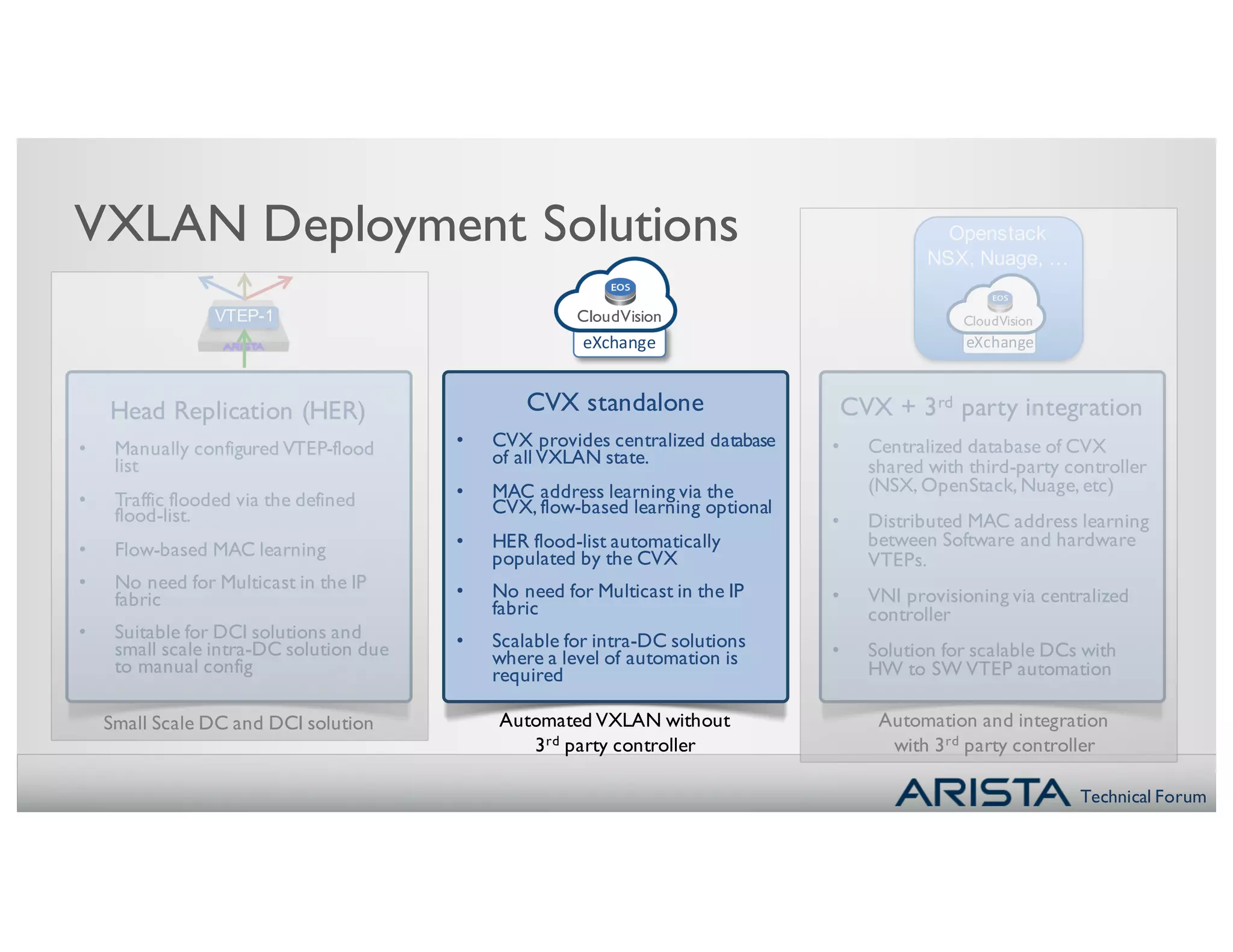
VXLAN Deployment Solutions
VTEP-1
Openstack
NSX, Nuage, …
Automated VXLAN without
3rd party controller
Automation and integration
with 3rd party controller
Small Scale DC and DCI solution
Head Replication (HER)
• Manually configured VTEP-flood
list
• Traffic flooded via the defined
flood-list.
• Flow-based MAC learning
• No need for Multicast in the IP
fabric
• Suitable for DCI solutions and
small scale intra-DC solution due
to manual config
CVX standalone
• CVX provides centralized database
of all VXLAN state.
• MAC address learning via the
CVX, flow-based learning optional
• HER flood-list automatically
populated by the CVX
• No need for Multicast in the IP
fabric
• Scalable for intra-DC solutions
where a level of automation is
required
CVX + 3rd party integration
• Centralized database of CVX
shared with third-party controller
(NSX, OpenStack, Nuage, etc)
• Distributed MAC address learning
between Software and hardware
VTEPs.
• VNI provisioning via centralized
controller
• Solution for scalable DCs with
HW to SW VTEP automation
CloudVision
eXchange
CloudVision
eXchange
Technical Forum
DEMONSTRATION
Physical Network Topology with CVX
Technical Forum
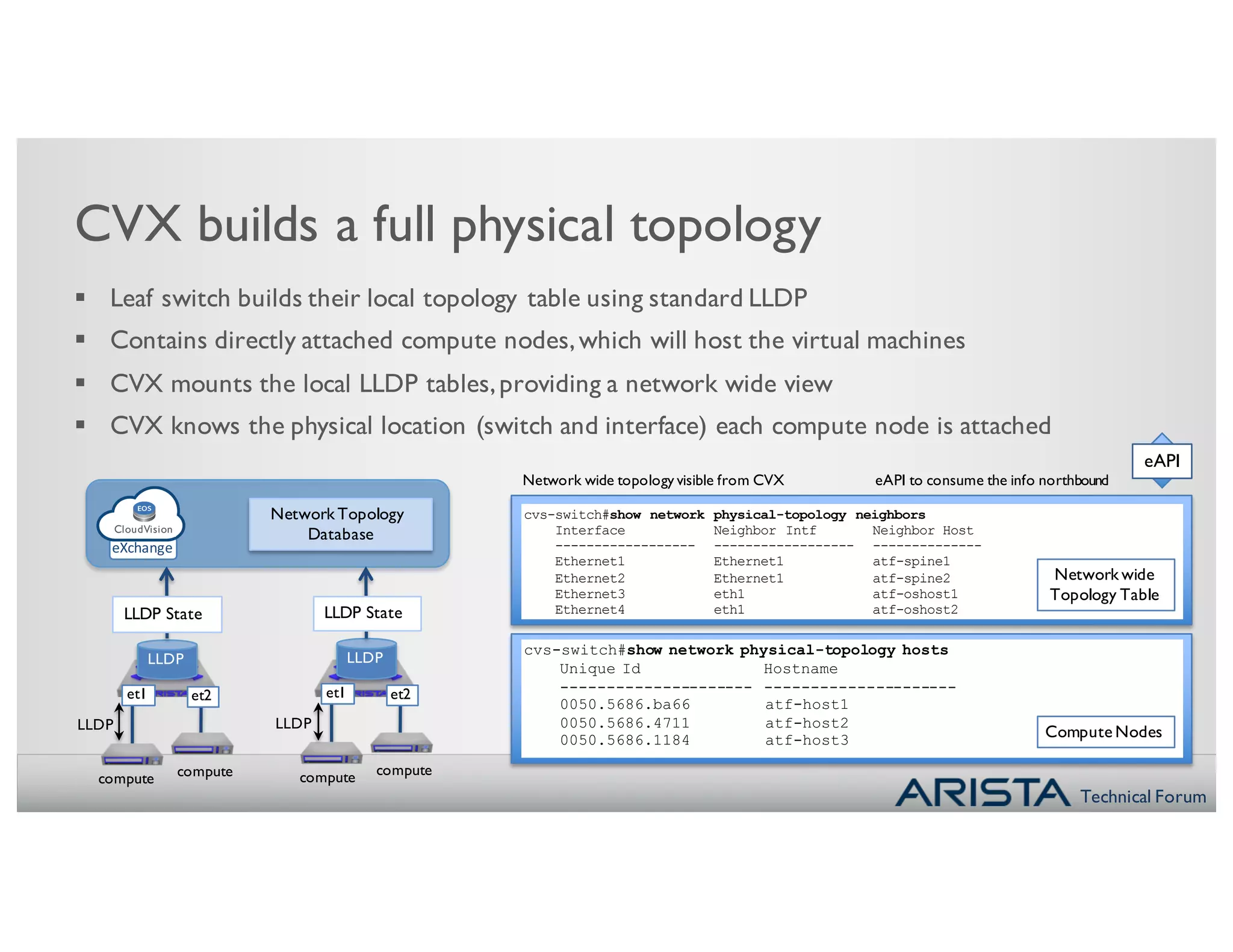
CVX builds a full physical topology
§ Leaf switch builds their local topology table using standard LLDP
§ Contains directly attached compute nodes,which will host the virtual machines
§ CVX mounts the local LLDP tables,providing a network wide view
§ CVX knows the physical location (switch and interface) each compute node is attached
eAPI
cvs-switch#show network physical-topology neighbors
Interface Neighbor Intf Neighbor Host
------------------ ------------------ --------------
Ethernet1 Ethernet1 atf-spine1
Ethernet2 Ethernet1 atf-spine2
Ethernet3 eth1 atf-oshost1
Ethernet4 eth1 atf-oshost2
Network wide
Topology Table
cvs-switch#show network physical-topology hosts
Unique Id Hostname
--------------------- ---------------------
0050.5686.ba66 atf-host1
0050.5686.4711 atf-host2
0050.5686.1184 atf-host3 Compute Nodes
Network wide topology visible from CVX eAPI to consume the info northbound
LLDP
LLDP
compute compute
et2
Network Topology
Database
LLDP State
et1
LLDP
LLDP
compute compute
et2
LLDP State
et1
CloudVision
eXchange
Technical Forum
DEMONSTRATION
VXLAN Control-Plane with CVX
Technical Forum
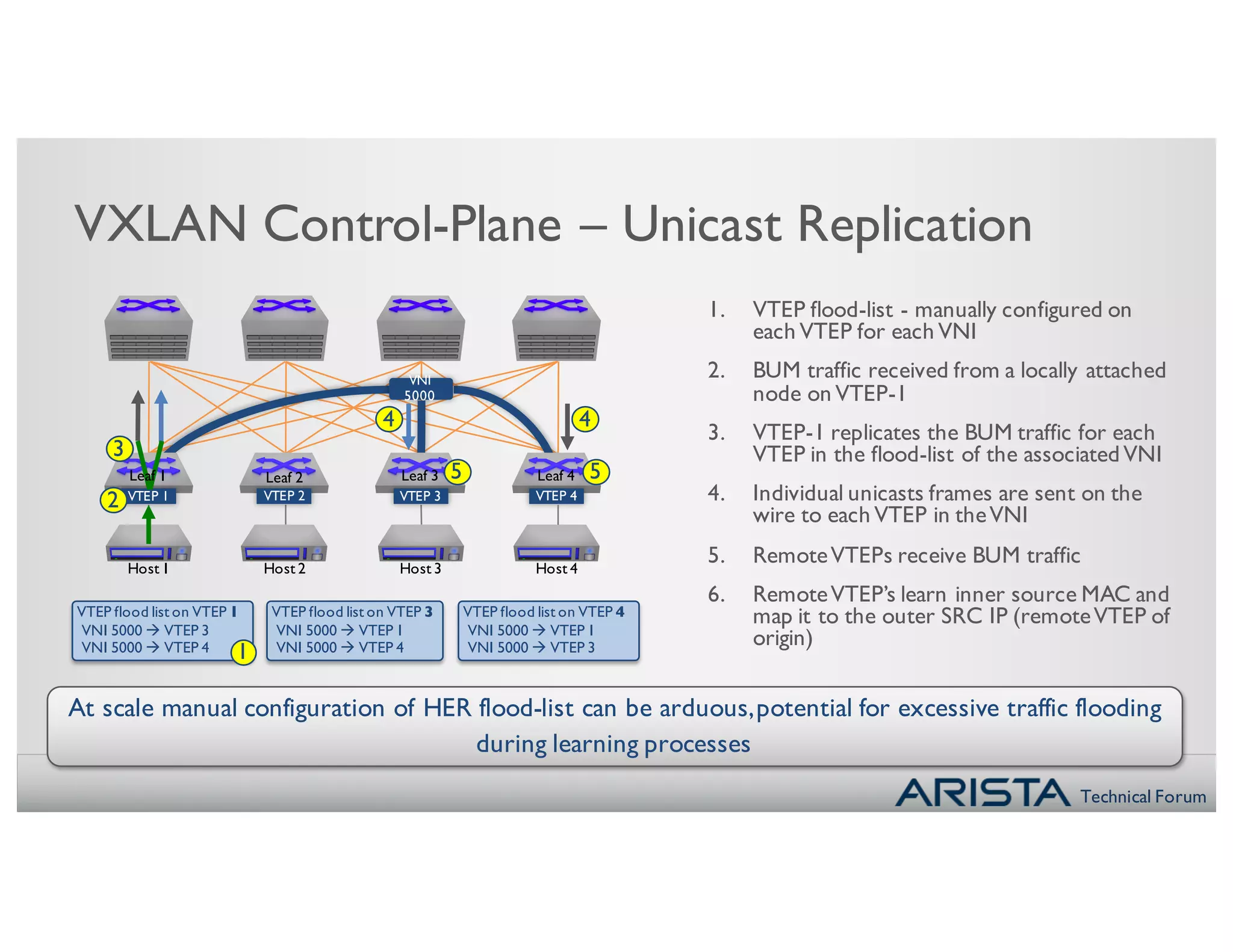
At scale manual configuration of HER flood-list can be arduous,potential for excessive traffic flooding
during learning processes
VXLAN Control-Plane – Unicast Replication
Host 4
VTEP 4
VNI
5000
VTEP 1
Host 1 Host 2
VTEP 2 VTEP 3
Host 3
VTEP flood list on VTEP 1
VNI 5000 à VTEP 3
VNI 5000 à VTEP 4
VTEP flood list on VTEP 3
VNI 5000 à VTEP 1
VNI 5000 à VTEP 4
VTEP flood list on VTEP 4
VNI 5000 à VTEP 1
VNI 5000 à VTEP 31
2
3
5 5
4 4
1. VTEP flood-list - manually configured on
each VTEP for each VNI
2. BUM traffic received from a locally attached
node on VTEP-1
3. VTEP-1 replicates the BUM traffic for each
VTEP in the flood-list of the associated VNI
4. Individual unicasts frames are sent on the
wire to each VTEP in theVNI
5. RemoteVTEPs receive BUM traffic
6. RemoteVTEP’s learn inner source MAC and
map it to the outer SRC IP (remoteVTEP of
origin)
Leaf 2 Leaf 3 Leaf 4Leaf 1
Technical Forum
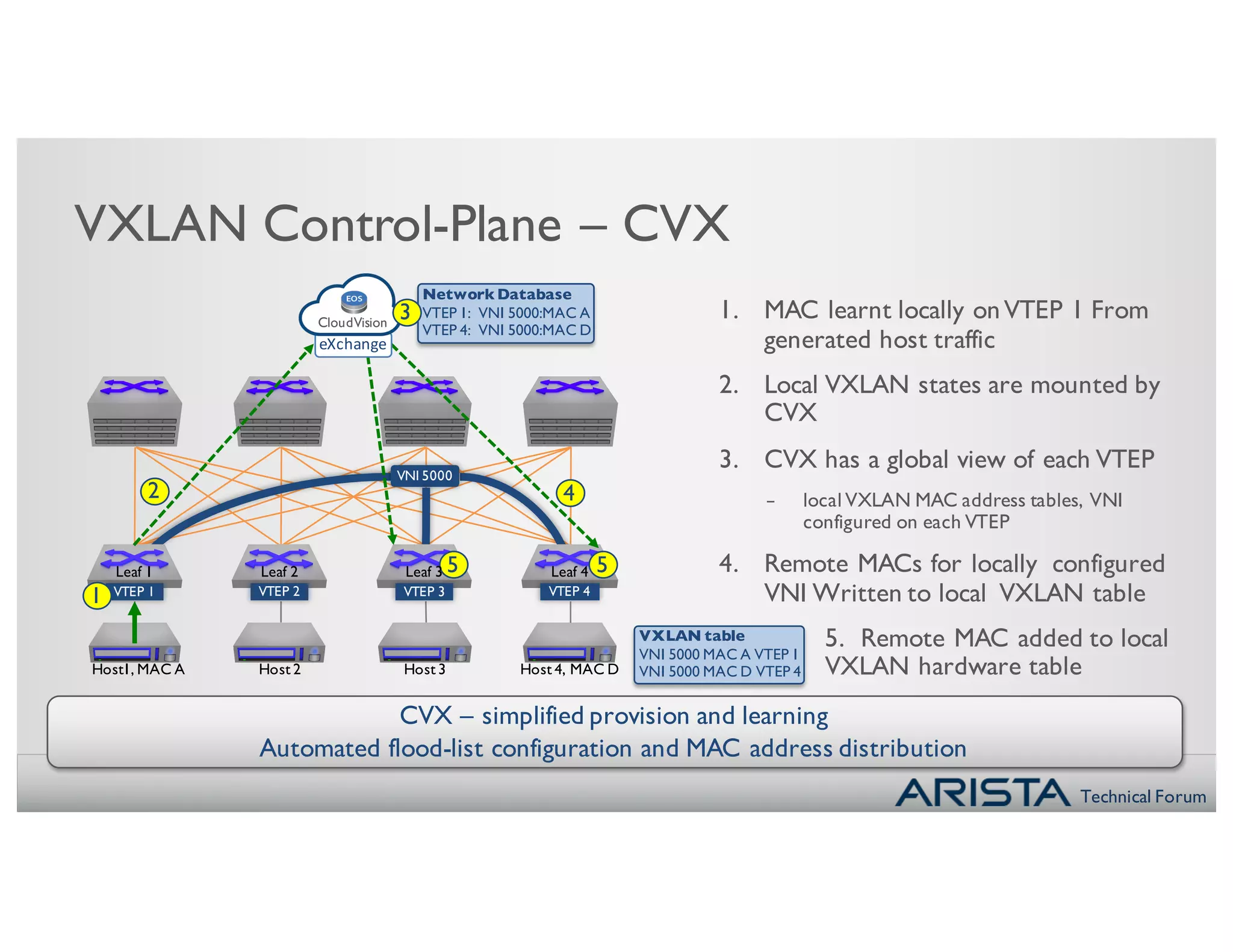
CVX – simplified provision and learning
Automated flood-list configuration and MAC address distribution
VXLAN Control-Plane – CVX
1. MAC learnt locally onVTEP 1 From
generated host traffic
2. Local VXLAN states are mounted by
CVX
3. CVX has a global view of each VTEP
- local VXLAN MAC address tables, VNI
configured on each VTEP
4. Remote MACs for locally configured
VNI Written to local VXLAN table
5. Remote MAC added to local
VXLAN hardware tableHost 4, MAC D
VTEP 4
VNI 5000
VTEP 1
Host1, MAC A Host 2
VTEP 2 VTEP 3
Host 3
1
2
5 5
4
Network Database
VTEP 1: VNI 5000:MAC A
VTEP 4: VNI 5000:MAC D
VXLAN table
VNI 5000 MAC A VTEP 1
VNI 5000 MAC D VTEP 4
CloudVision
eXchange
3
Leaf 2Leaf 1 Leaf 3 Leaf 4
Technical Forum
ThankYou

Atf 3 q15-5 - streamlining and automating virtual network control

  • 1.
    Technical Forum Streamlining andAutomatingVirtual Network Control Autumn 2015
  • 2.
    Technical Forum CloudVision, VXLAN What’s Next? Next ? Optimisation of the resource pool 40% VM Decrease & automate Deployment time VM VM Remove islands of service connectivity VM Operational Efficiency P P P P • Undefined SDN strategy ? • Team interactions,Skills,Planning, Strategy, Processes not ready ? What Orchestration platform choices ? ‘BYOC’ What corporate Challenges ? …But you are ready C 6C L FG O ] ? 6
  • 3.
    Technical Forum VXLAN DeploymentSolutions VTEP-1 Openstack NSX, Nuage, … Automated VXLAN without 3rd party controller Automation and integration with 3rd party controller Small Scale DC and DCI solution Head Replication (HER) • Manually configured VTEP-flood list • Traffic flooded via the defined flood-list. • Flow-based MAC learning • No need for Multicast in the IP fabric • Suitable for DCI solutions and small scale intra-DC solution due to manual config CVX standalone • CVX provides centralized database of all VXLAN state. • MAC address learning via the CVX, flow-based learning optional • HER flood-list automatically populated by the CVX • No need for Multicast in the IP fabric • Scalable for intra-DC solutions where a level of automation is required CVX + 3rd party integration • Centralized database of CVX shared with third-party controller (NSX, OpenStack, Nuage, etc) • Distributed MAC address learning between Software and hardware VTEPs. • VNI provisioning via centralized controller • Solution for scalable DCs with HW to SW VTEP automation CloudVision eXchange CloudVision eXchange
  • 4.
  • 5.
    Technical Forum CVX buildsa full physical topology § Leaf switch builds their local topology table using standard LLDP § Contains directly attached compute nodes,which will host the virtual machines § CVX mounts the local LLDP tables,providing a network wide view § CVX knows the physical location (switch and interface) each compute node is attached eAPI cvs-switch#show network physical-topology neighbors Interface Neighbor Intf Neighbor Host ------------------ ------------------ -------------- Ethernet1 Ethernet1 atf-spine1 Ethernet2 Ethernet1 atf-spine2 Ethernet3 eth1 atf-oshost1 Ethernet4 eth1 atf-oshost2 Network wide Topology Table cvs-switch#show network physical-topology hosts Unique Id Hostname --------------------- --------------------- 0050.5686.ba66 atf-host1 0050.5686.4711 atf-host2 0050.5686.1184 atf-host3 Compute Nodes Network wide topology visible from CVX eAPI to consume the info northbound LLDP LLDP compute compute et2 Network Topology Database LLDP State et1 LLDP LLDP compute compute et2 LLDP State et1 CloudVision eXchange
  • 6.
  • 7.
    Technical Forum At scalemanual configuration of HER flood-list can be arduous,potential for excessive traffic flooding during learning processes VXLAN Control-Plane – Unicast Replication Host 4 VTEP 4 VNI 5000 VTEP 1 Host 1 Host 2 VTEP 2 VTEP 3 Host 3 VTEP flood list on VTEP 1 VNI 5000 à VTEP 3 VNI 5000 à VTEP 4 VTEP flood list on VTEP 3 VNI 5000 à VTEP 1 VNI 5000 à VTEP 4 VTEP flood list on VTEP 4 VNI 5000 à VTEP 1 VNI 5000 à VTEP 31 2 3 5 5 4 4 1. VTEP flood-list - manually configured on each VTEP for each VNI 2. BUM traffic received from a locally attached node on VTEP-1 3. VTEP-1 replicates the BUM traffic for each VTEP in the flood-list of the associated VNI 4. Individual unicasts frames are sent on the wire to each VTEP in theVNI 5. RemoteVTEPs receive BUM traffic 6. RemoteVTEP’s learn inner source MAC and map it to the outer SRC IP (remoteVTEP of origin) Leaf 2 Leaf 3 Leaf 4Leaf 1
  • 8.
    Technical Forum CVX –simplified provision and learning Automated flood-list configuration and MAC address distribution VXLAN Control-Plane – CVX 1. MAC learnt locally onVTEP 1 From generated host traffic 2. Local VXLAN states are mounted by CVX 3. CVX has a global view of each VTEP - local VXLAN MAC address tables, VNI configured on each VTEP 4. Remote MACs for locally configured VNI Written to local VXLAN table 5. Remote MAC added to local VXLAN hardware tableHost 4, MAC D VTEP 4 VNI 5000 VTEP 1 Host1, MAC A Host 2 VTEP 2 VTEP 3 Host 3 1 2 5 5 4 Network Database VTEP 1: VNI 5000:MAC A VTEP 4: VNI 5000:MAC D VXLAN table VNI 5000 MAC A VTEP 1 VNI 5000 MAC D VTEP 4 CloudVision eXchange 3 Leaf 2Leaf 1 Leaf 3 Leaf 4
  • 9.