1
www.isocore.com/mpls2013
Data Center Virtualization Meets the WAN
Bruce Davie
VMware
bdavie@vmware.com
2
Compute Virtualization Abstraction Layer
Why we need network virtualization
Physical
Infrastructure
• Provisioning is slow
• Placement is limited
• Mobility is limited
• Hardware dependent
• Operationally intensive
Networking undoes much of the goodness of server virtualization
3
The Solution – Virtualize the Network
Physical
Infrastructure
Compute Virtualization Abstraction Layer
• Programmatic provisioning
• Place any workload anywhere
• Move any workload anywhere
• Decoupled from hardware
• Operationally efficient
Network Virtualization Abstraction Layer
Software Defined Data Center
• Provisioning is slow
• Placement is limited
• Mobility is limited
• Hardware dependent
• Operationally intensiveSOFTWARE-DEFINED
DATACENTER SERVICES
VDC
4
What is Network Virtualization?
Physical Compute & Memory
Server Hypervisor
Requirement: x86
Virtual
Machine
Virtual
Machine
Virtual
Machine
Application Application Application
x86 Environment
Physical Network
Network Virtualization Platform
Requirement: IP Transport
Virtual
Network
Virtual
Network
Virtual
Network
Workload Workload Workload
L2, L3, L4-7 Network Services
Decoupled
5
The Starting Point for Network Virtualization: Virtual Switch
Hypervisor
vSwitch
Hypervisor
vSwitch
Physical Network
6
VLAN
L2
L3
Virtual Network
L2
NSX Gateway
NSX – A Network Virtualization Platform
Physical Network
vSphere Host vSphere Host KVM Xen Server
NSX vSwitch NSX vSwitch Open vSwitch Open vSwitch
Hardware
Software
Controller Cluster
VLAN
VTEP API
HW Partner
VM VM
“NSX API”
CMP
7
IP/MPLS
CORE
Hypervisor Hypervisor Hypervisor
NSX
Gateway
Open vSwitch Open vSwitch Open vSwitch
PE
To Customer Sites
Connecting Virtualized Data Centers to the WAN
8
Option A: Map Logical Networks to VLANs
NSX
GatewayVRF
VRF
VRF
Logical Networks map to
VLANs; Each VLAN maps
to a VRF (customer-
specific routing table)
PETo Customer Sites
MPLS Core
Virtualized DC
9
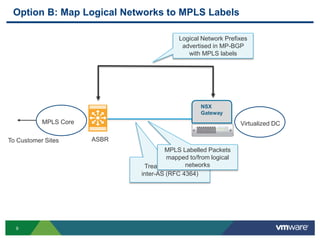
Option B: Map Logical Networks to MPLS Labels
NSX
Gateway
Logical Network Prefixes
advertised in MP-BGP
with MPLS labels
ASBRTo Customer Sites
MPLS Core
Treat interface like
inter-AS (RFC 4364)
MPLS Labelled Packets
mapped to/from logical
networks
Virtualized DC
10
What’s the gateway doing?
 Mapping tunnel formats
• Use VXLAN/NVGRE/STT in the datacenter, MPLS in the WAN
 Demarcation point between WAN services and DC services
• In the WAN, L2 & L3 services are the norm
• In the DC, rich L2-L7 services prevail
• Self-service provisioning in the DC
• Gateway is one end of the L2-L7 pipeline
 Reducing state requirements at the PE/ASBR
• No need to terminate 1000s of tunnels to hypervisors
• No per-hypervisor routes
• No VRFs
11
Summary
 Network virtualization is about agility
• Brings the operational model of server virtualization to networking
• Provision complex topologies and services in software – enabling automation
• Services decoupled from hardware
 Integration with MPLS WANs:
• Treat data center edge as AS boundary
• Retain richness of data center services
• Self-service provisioning
 A fundamental shift in the networking landscape

Network Virtualization Meets the WAN

  • 1.
    1 www.isocore.com/mpls2013 Data Center VirtualizationMeets the WAN Bruce Davie VMware bdavie@vmware.com
  • 2.
    2 Compute Virtualization AbstractionLayer Why we need network virtualization Physical Infrastructure • Provisioning is slow • Placement is limited • Mobility is limited • Hardware dependent • Operationally intensive Networking undoes much of the goodness of server virtualization
  • 3.
    3 The Solution –Virtualize the Network Physical Infrastructure Compute Virtualization Abstraction Layer • Programmatic provisioning • Place any workload anywhere • Move any workload anywhere • Decoupled from hardware • Operationally efficient Network Virtualization Abstraction Layer Software Defined Data Center • Provisioning is slow • Placement is limited • Mobility is limited • Hardware dependent • Operationally intensiveSOFTWARE-DEFINED DATACENTER SERVICES VDC
  • 4.
    4 What is NetworkVirtualization? Physical Compute & Memory Server Hypervisor Requirement: x86 Virtual Machine Virtual Machine Virtual Machine Application Application Application x86 Environment Physical Network Network Virtualization Platform Requirement: IP Transport Virtual Network Virtual Network Virtual Network Workload Workload Workload L2, L3, L4-7 Network Services Decoupled
  • 5.
    5 The Starting Pointfor Network Virtualization: Virtual Switch Hypervisor vSwitch Hypervisor vSwitch Physical Network
  • 6.
    6 VLAN L2 L3 Virtual Network L2 NSX Gateway NSX– A Network Virtualization Platform Physical Network vSphere Host vSphere Host KVM Xen Server NSX vSwitch NSX vSwitch Open vSwitch Open vSwitch Hardware Software Controller Cluster VLAN VTEP API HW Partner VM VM “NSX API” CMP
  • 7.
    7 IP/MPLS CORE Hypervisor Hypervisor Hypervisor NSX Gateway OpenvSwitch Open vSwitch Open vSwitch PE To Customer Sites Connecting Virtualized Data Centers to the WAN
  • 8.
    8 Option A: MapLogical Networks to VLANs NSX GatewayVRF VRF VRF Logical Networks map to VLANs; Each VLAN maps to a VRF (customer- specific routing table) PETo Customer Sites MPLS Core Virtualized DC
  • 9.
    9 Option B: MapLogical Networks to MPLS Labels NSX Gateway Logical Network Prefixes advertised in MP-BGP with MPLS labels ASBRTo Customer Sites MPLS Core Treat interface like inter-AS (RFC 4364) MPLS Labelled Packets mapped to/from logical networks Virtualized DC
  • 10.
    10 What’s the gatewaydoing?  Mapping tunnel formats • Use VXLAN/NVGRE/STT in the datacenter, MPLS in the WAN  Demarcation point between WAN services and DC services • In the WAN, L2 & L3 services are the norm • In the DC, rich L2-L7 services prevail • Self-service provisioning in the DC • Gateway is one end of the L2-L7 pipeline  Reducing state requirements at the PE/ASBR • No need to terminate 1000s of tunnels to hypervisors • No per-hypervisor routes • No VRFs
  • 11.
    11 Summary  Network virtualizationis about agility • Brings the operational model of server virtualization to networking • Provision complex topologies and services in software – enabling automation • Services decoupled from hardware  Integration with MPLS WANs: • Treat data center edge as AS boundary • Retain richness of data center services • Self-service provisioning  A fundamental shift in the networking landscape